

Colossians 3:13
Greek (Tischendorf 8th ed.) Colossians 3:13 appears in the Greek New Testament. The text above is from the Tischendorf 8th edition. Each word links to its Strong’s number and a concise gloss. Click any word for its full Thayer’s Greek Lexicon entry.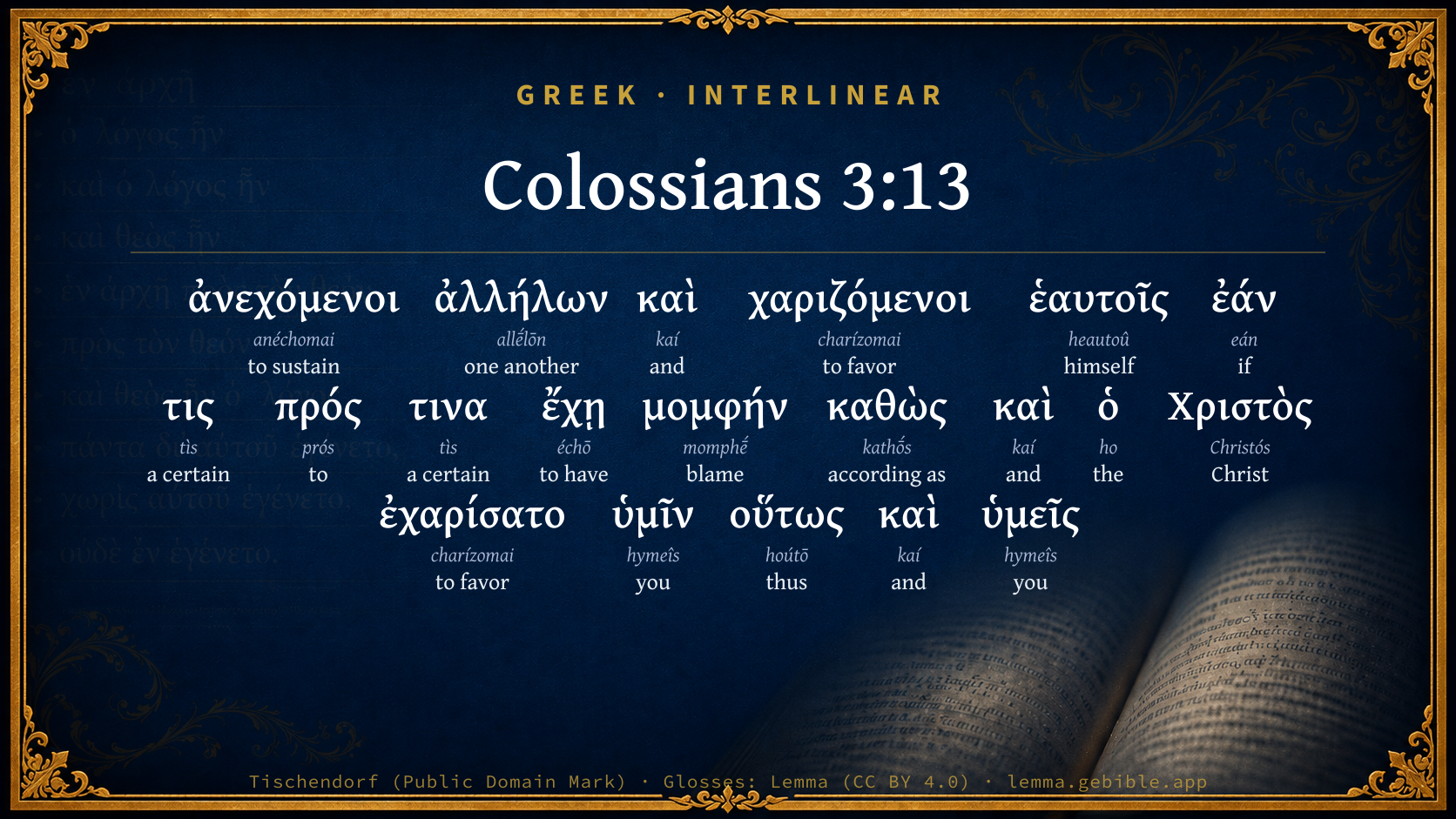
bearing with one another, and forgiving each other, if any man has a complaint against any; even as Christ forgave you, so you also do.
- 1 hapax legomenon — only here in the Greek New Testament
- 1 first appearance in the Greek New Testament
Download a study sheet
One document with this verse’s original text, its word-by-word gloss line, the meaning frame, cross-references with their text, attributed commentary, and full source and license credits — printable, and it pastes into notes with its structure intact.
This verse Autodidact and up
A passage Seminary Student
Up to 50 verses in one chapter. A passage sheet keeps up to 6 commentary sources and 12 cross-references per verse, in the order this page ranks them, and says so on the sheet whenever that leaves anything out. Ask for a single verse and you get the Autodidact verse sheet above.
Everything on this page stays free to read, with no account — the sheet is a download of what is already on screen, not access to it.
Compare translations 3
The same verse in 3 English versions, stacked beneath the original-language interlinear above. Click any original word for its lexicon entry.
Each is an independent rendering of the whole verse — the interlinear is not word-aligned to these translations.
Highlighted words mark where these versions differ — a whole-verse word diff, not a word-by-word alignment.
-
World English Bible Public Domain
bearing with one another, and forgiving each other, if any man has a complaint against any; even as Christ forgave you, so you also do.
-
King James Version Public Domain
Forbearing one another, and forgiving one another, if any man have a quarrel against any: even as Christ forgave you, so also do ye.
-
unfoldingWord Literal Text CC BY-SA 4.0
bearing with one another and being gracious to each other if someone may have a complaint against someone else; just as also the Lord forgave you, so also should you.
unfoldingWord Literal Text — © unfoldingWord, licensed CC BY-SA 4.0. Word-aligned USFM3 via Door43 (git.door43.org/unfoldingWord/en_ult).
Show all 19 translations
Every available English version of this verse, each an independent rendering of the whole verse.
-
World English Bible Public Domain
bearing with one another, and forgiving each other, if any man has a complaint against any; even as Christ forgave you, so you also do.
-
Berean Standard Bible Public Domain
Bear with one another and forgive any complaint you may have against someone else. Forgive as the Lord forgave you.
-
Majority Standard Bible Public Domain
Bear with one another and forgive any complaint you may have against someone else. Forgive as Christ forgave you.
-
King James Version Public Domain
Forbearing one another, and forgiving one another, if any man have a quarrel against any: even as Christ forgave you, so also do ye.
-
American Standard Version (1901) Public Domain
forbearing one another, and forgiving each other, if any man have a complaint against any; even as the Lord forgave you, so also do ye:
-
Revised Version (1885) Public Domain
forbearing one another, and forgiving each other, if any man have a complaint against any; even as the Lord forgave you, so also do ye:
-
Geneva Bible (1599) Public Domain
Forbearing one another, and forgiuing one another, if any man haue a quarel to another: euen as Christ forgaue, euen so doe ye.
-
Douay-Rheims (1899) Public Domain
Bearing with one another, and forgiving one another, if any have a complaint against another: even as the Lord hath forgiven you, so do you also.
-
Young's Literal Translation Public Domain
forbearing one another, and forgiving each other, if any one with any one may have a quarrel, as also the Christ did forgive you -- so also ye;
-
Literal Standard Version CC BY-SA 4.0
bearing with one another, and forgiving each other, if anyone may have a quarrel with anyone, as the Christ also forgave you—so also you;
-
Unlocked Literal Bible CC BY-SA 4.0
Bear with one another. Be gracious to each other. If someone has a complaint against someone else, forgive in the same way that the Lord has forgiven you.
-
unfoldingWord Literal Text CC BY-SA 4.0
bearing with one another and being gracious to each other if someone may have a complaint against someone else; just as also the Lord forgave you, so also should you.
-
Darby Bible Public Domain
forbearing one another, and forgiving one another, if any should have a complaint against any; even as the Christ has forgiven you, so also [do] *ye*.
-
World Messianic Bible Public Domain
bearing with one another, and forgiving each other, if any man has a complaint against any; even as Messiah forgave you, so you also do.
-
Webster's Bible Public Domain
Forbearing one another, and forgiving one another, if any man hath a quarrel against any: even as Christ forgave you, so also do ye.
-
Free Bible Version CC BY-SA 4.0
Be patient with one another, forgive others among you if you have grievances against one another. Just as the Lord forgave you, you should do the same.
-
Bible in Basic English Public Domain
Being gentle to one another and having forgiveness for one another, if anyone has done wrong to his brother, even as the Lord had forgiveness for you:
-
Text-Critical English NT CC BY 4.0
bearing with one another and forgiving one other if any one of you has a complaint against another; just as Christ forgave you, so you also must forgive.
-
Tyndale New Testament (1534) Public Domain
forbearynge one another and forgevynge one another if eny man have a quarrell to a nother even as Christ forgave you even so do ye.
Literal Standard Version (2020), Covenant Press — licensed CC BY-SA 4.0. Text via the HelloAO Bible API (eBible.org). Unlocked Literal Bible (unfoldingWord) — licensed CC BY-SA 4.0. Text via the HelloAO Bible API (eBible.org). unfoldingWord Literal Text — © unfoldingWord, licensed CC BY-SA 4.0. Word-aligned USFM3 via Door43 (git.door43.org/unfoldingWord/en_ult). Free Bible Version, Dr. Jonathan Gallagher — licensed CC BY-SA 4.0. Text via the HelloAO Bible API (eBible.org).
Word by word
More ways to search: Search by grammar → Find every occurrence → Compare this word →
Practice this passage: Drill this verse → Learn its vocabulary →
- Appears 1× in the Greek New Testament
- First appears here
- Part of Speech
- Noun
- Case
- Accusative
- Number
- Singular
- Gender
- Feminine
Full Thayer's Definition
- ἀνεχόμενοι anéchomai G430 “to sustain” Verb, Present, Middle or Passive deponent, Participle, Nominative, Plural, Masculine
- ἀλλήλων allḗlōn G240 “one another” Reciprocal pronoun, Genitive, Plural, Masculine
- καὶ kaí G2532 “and” Conjunction
- χαριζόμενοι charízomai G5483 “to favor” Verb, Present, Middle or Passive deponent, Participle, Nominative, Plural, Masculine
- ἑαυτοῖς heautoû G1438 “himself” Reflexive pronoun, 2nd person, Dative, Plural, Masculine
- ἐάν eán G1437 “if” Conditional
- τις tìs G5100 “a certain” Indefinite pronoun, Nominative, Singular, Masculine
- πρός prós G4314 “to” Preposition
- τινα tìs G5100 “a certain” Indefinite pronoun, Accusative, Singular, Masculine
- ἔχῃ échō G2192 “to have” Verb, Present, Active, Subjunctive, 3rd person, Singular
- μομφήν momphḗ G3437 “blame” Noun, Accusative, Singular, Feminine
- καθὼς kathṓs G2531 “according as” Adverb
- καὶ kaí G2532 “and” Conjunction
- ὁ ho G3588 “the” Article, Nominative, Singular, Masculine
- Χριστὸς Christós G5547 “Christ” Noun, Nominative, Singular, Masculine
- ἐχαρίσατο charízomai G5483 “to favor” Verb, Aorist, Middle deponent, Indicative, 3rd person, Singular
- ὑμῖν hymeîs G5210 “you” Personal pronoun, 2nd person, Dative, Plural
- οὕτως hoútō G3779 “thus” Adverb
- καὶ kaí G2532 “and” Conjunction
- ὑμεῖς hymeîs G5210 “you” Personal pronoun, 2nd person, Nominative, Plural
About this verse
These counts appear in no published source. They are computed here, from the morphology-tagged text and Lemma’s own curated glosses. What Lemma adds →
- 20
- words
- 15
- distinct lemmas
- Pauline Epistles
- section
Notable vocabulary
1 hapax legomenon — a word that appears only here in the entire Greek New Testament:
- μομφήν blame G3437
First appearance in Scripture
This word makes its first canonical appearance in the Greek New Testament here:
- μομφήν blame G3437
Shared distinctive vocabulary
ἀνεχόμενοι to sustain G430 occurs in 14 verses of the Greek New Testament. Also found in:
Cross-references
24Topical passages linked to Colossians 3:13 in the Treasury of Scripture Knowledge — connected by theme and wording, ordered by reader-vote popularity; previews shown in the World English Bible.
- Ephesians 4:32 And be kind to one another, tenderhearted, forgiving each other, just as God also in Christ forgave you.
- Mark 11:25 Whenever you stand praying, forgive, if you have anything against anyone; so that your Father, who is in heaven, may also forgive you your transgressions.
- James 2:13 For judgment is without mercy to him who has shown no mercy. Mercy triumphs over judgment.
- Ephesians 4:2 with all lowliness and humility, with patience, bearing with one another in love;
- Matthew 6:14–15 "For if you forgive men their trespasses, your heavenly Father will also forgive you.
- Romans 15:1–2 Now we who are strong ought to bear the weaknesses of the weak, and not to please ourselves.
- Luke 6:35–37 But love your enemies, and do good, and lend, expecting nothing back; and your reward will be great, and you will be children of the Most High; for he is kind toward the unthankful and evil.
- Matthew 6:12 Forgive us our debts, as we also forgive our debtors.
- Luke 17:3–4 Be careful. If your brother sins against you, rebuke him. If he repents, forgive him.
- Galatians 6:2 Bear one another's burdens, and so fulfill the law of Christ.
- Luke 23:34 Jesus said, "Father, forgive them, for they don't know what they are doing." Dividing his garments among them, they cast lots.
- 2 Corinthians 2:10 Now I also forgive whomever you forgive anything. For if indeed I have forgiven anything, I have forgiven that one for your sakes in the presence of Christ,
- 2 Corinthians 6:6 in pureness, in knowledge, in patience, in kindness, in the Holy Spirit, in sincere love,
- Matthew 18:15–17 "If your brother sins against you, go, show him his fault between you and him alone. If he listens to you, you have gained back your brother.
- Luke 11:4 Forgive us our sins, For we ourselves also forgive everyone who is indebted to us. Bring us not into temptation, But deliver us from the evil one.'"
- Matthew 5:44 But I tell you, love your enemies, bless those who curse you, do good to those who hate you, and pray for those who mistreat you and persecute you,
- Romans 15:7 Therefore receive one another, even as Christ also received you, to the glory of God.
- 1 Corinthians 6:7–8 Therefore it is already altogether a defect in you, that you have lawsuits one with another. Why not rather be wronged? Why not rather be defrauded?
- Luke 5:20–24 Seeing their faith, he said to him, "Man, your sins are forgiven you."
- Ephesians 5:2 Walk in love, even as Christ also loved you, and gave himself up for us, an offering and a sacrifice to God for a sweet-smelling fragrance.
- Colossians 3:12 Put on therefore, as God's chosen ones, holy and beloved, a heart of compassion, kindness, lowliness, humility, and perseverance;
- 1 Peter 2:21 For to this you were called, because Christ also suffered for us, leaving you an example, that you should follow his steps,
- Matthew 18:21–35 Then Peter came and said to him, "Lord, how often shall my brother sin against me, and I forgive him? Until seven times?"
- Luke 7:48–50 He said to her, "Your sins are forgiven."
Cross-references courtesy of OpenBible.info (CC BY 4.0).
Where the printed editions differ
1 variantPlaces in this verse where the major printed Greek editions disagree on the wording in a way that affects the translation — a comparison of editions, not a manuscript-by-manuscript collation. The editions are the modern critical texts (Nestlé-Aland 28/27, SBL, Westcott-Hort, Tregelles, Tyndale House) and the traditional texts behind the KJV (the Textus Receptus and the Byzantine/Majority text). It is not a claim about which reading is original.
-
Different wording
κύριος
“Lord”
In NA28NA27TynSBLWHTreg Not in TRByzΧριστὸς (Christos) 'Christ' occurs in traditional manuscripts (TR+Byz) instead of κύριος (kurios) 'Lord' in older manuscripts (NA28+NA27+Tyn+SBL+WH+Treg)
Textual data: Translators Amalgamated Greek New Testament (STEPBible TAGNT) · CC BY 4.0.
Lesson kit
Teaching starters — assembled from the data on this page, not authored interpretation. Every prompt links to the verse data it draws on. Edit before teaching.
Colossians, in the Pauline Epistles, opens this verse with 20 words (15 distinct Greek lemmas). Its most distinctive word is momphḗ (“blame”). A historical commentator’s framing appears above. Read the whole chapter for the surrounding context.
Discussion questions
- The word momphḗ carries the sense “blame.” How does it shape the verse?
- 1 word here appears nowhere else in the Greek New Testament. Why might the author reach for such rare wording?
- This is the first place “blame” appears in Scripture (first appears here). What does its debut here establish?
- How does Matthew 17:17, which shares the word «to sustain», read alongside this verse?
- What does the repetition of “to favor” (2× in this one verse) do in this verse?
- The translations on this page render this verse differently — a whole-verse word diff, not a word-by-word alignment. What might account for the different wordings?
- Compare how The Biblical Illustrator and Bengel's Gnomon read this verse. Where do they agree or differ?
Things to notice
- 1 word in this verse appears nowhere else in the Greek New Testament.
- 1 word makes its first canonical appearance in Scripture here.
- These translations choose different wording for 22 words in this verse.
- “to favor” occurs 2× in this single verse.
- 15 distinct Greek lemmas span 20 words in this verse.
Commentary
Notes on Colossians 3:13 from classic Christian and Jewish commentators (each source and its license shown beneath its notes). The classic Christian expositions comment on the surrounding passage and are grouped to its opening verse, so a note may address several verses; the Jewish commentaries on the Tanakh (Rashi and others) are per-verse, so they appear only where the commentator wrote on this verse.
Lemma curates 59 commentaries, every one of them public domain or Creative Commons licensed, each selected and text-cleaned for this edition rather than reprinted as found. About our sources →
The Biblical Illustrator
Joseph S. Exell
The Biblical Illustrator, edited by Joseph S. Exell (c. 1880s–1900s) — public domain. Text from a community e-Sword module.
Bengel's Gnomon
Johann Albrecht Bengel
Bengel's Gnomon of the New Testament — English translation (T&T Clark, Edinburgh, 1860) — public domain. Text from a community e-Sword module.
Meyer's Critical & Exegetical Commentary
Heinrich August Wilhelm Meyer
Meyer — Critical and Exegetical Commentary on the New Testament — English translation by Peter Christie, edited by Frederick Crombie (T&T Clark, 1880) — public domain. Text from a community e-Sword module.
Expositor's Greek Testament
ed. W. Robertson Nicoll
The Expositor's Greek Testament, edited by W. Robertson Nicoll (1897–1910) — public domain. Text from a community e-Sword module.
Cambridge Greek Testament for Schools and Colleges
Cambridge Greek Testament for Schools and Colleges (Cambridge University Press, 1896; 21 vols, various authors incl. Carr, Maclear, Plummer, Farrar, Lumby, Moule, M. R. James, Simcox) — public domain. Text from a community e-Sword module.
Jamieson, Fausset & Brown
Robert Jamieson, A. R. Fausset & David Brown
Jamieson, Fausset & Brown — Commentary Critical and Explanatory on the Whole Bible (1871) — public domain (CC PDM 1.0). Text via the HelloAO Bible API.
Adam Clarke's Commentary
Adam Clarke's Commentary on the Bible (1810–1826) — public domain. Text from a community e-Sword/MySword module.
Ellicott's Commentary for English Readers
A Bible Commentary for English Readers, edited by Charles John Ellicott (1878–1897) — public domain. Text from a community e-Sword module.
The Cambridge Bible for Schools and Colleges
gen. ed. J. J. S. Perowne
The Cambridge Bible for Schools and Colleges (gen. ed. J. J. S. Perowne; Cambridge University Press, 1878–1918) — public domain. Text from a community e-Sword module.
John Gill's Exposition
John Gill's Exposition of the Whole Bible (1746–1763) — public domain (CC PDM 1.0). Text via the HelloAO Bible API.
Trapp's Complete Commentary
John Trapp
John Trapp, A Commentary or Exposition upon All the Books of the Old and New Testament (1647–1656) — public domain. Text from a community e-Sword module.
Albert Barnes' Notes on the Bible
Albert Barnes' Notes on the Bible (1834–1885) — public domain. Text from a community e-Sword/MySword module.
Matthew Poole's English Annotations
Matthew Poole's English Annotations on the Holy Bible (1683–1685) — public domain. Text from a community e-Sword/MySword module.
Whedon's Commentary on the Bible
Daniel D. Whedon
Daniel D. Whedon (gen. ed.), Commentary on the Old and New Testaments (1874–1909) — public domain. Text from a community e-Sword module.
The Pulpit Commentary
The Pulpit Commentary (1880–1919), ed. H.D.M. Spence-Jones & Joseph S. Exell — public domain. Text from a community e-Sword module.
John Wesley's Explanatory Notes
John Wesley, Explanatory Notes Upon the Whole Bible (1754–1765) — public domain. Text via the GEBible commentary corpus.
The People's New Testament
B. W. Johnson
B. W. Johnson's The People's New Testament with Notes (1889–1891) — public domain. Electronic text from the Christian Classics Ethereal Library (CCEL) ThML edition.
International Critical Commentary
International Critical Commentary — older volumes (1896–1929), various authors — public domain. Text from a community e-Sword module.
Vincent's Word Studies in the New Testament
Marvin R. Vincent
Marvin R. Vincent, Word Studies in the New Testament (1887–1900) — public domain. Text from a community e-Sword/MySword module.
Lightfoot's Colossians and Philemon
J. B. Lightfoot
J. B. Lightfoot, St Paul's Epistles to the Colossians and Philemon: a revised text with introductions, notes and dissertations (London: Macmillan, 1875) — public domain. Electronic text from Project Gutenberg (ebook #50857). Covers Colossians and Philemon only (the verse-by-verse notes; introductions and dissertations are omitted); Lightfoot's companion Galatians and Philippians volumes are not included, as the available public-domain scans carry garbled Greek that cannot be faithfully reproduced.