

1 Thessalonians 2:4
Greek (Tischendorf 8th ed.) 1 Thessalonians 2:4 appears in the Greek New Testament. The text above is from the Tischendorf 8th edition. Each word links to its Strong’s number and a concise gloss. Click any word for its full Thayer’s Greek Lexicon entry.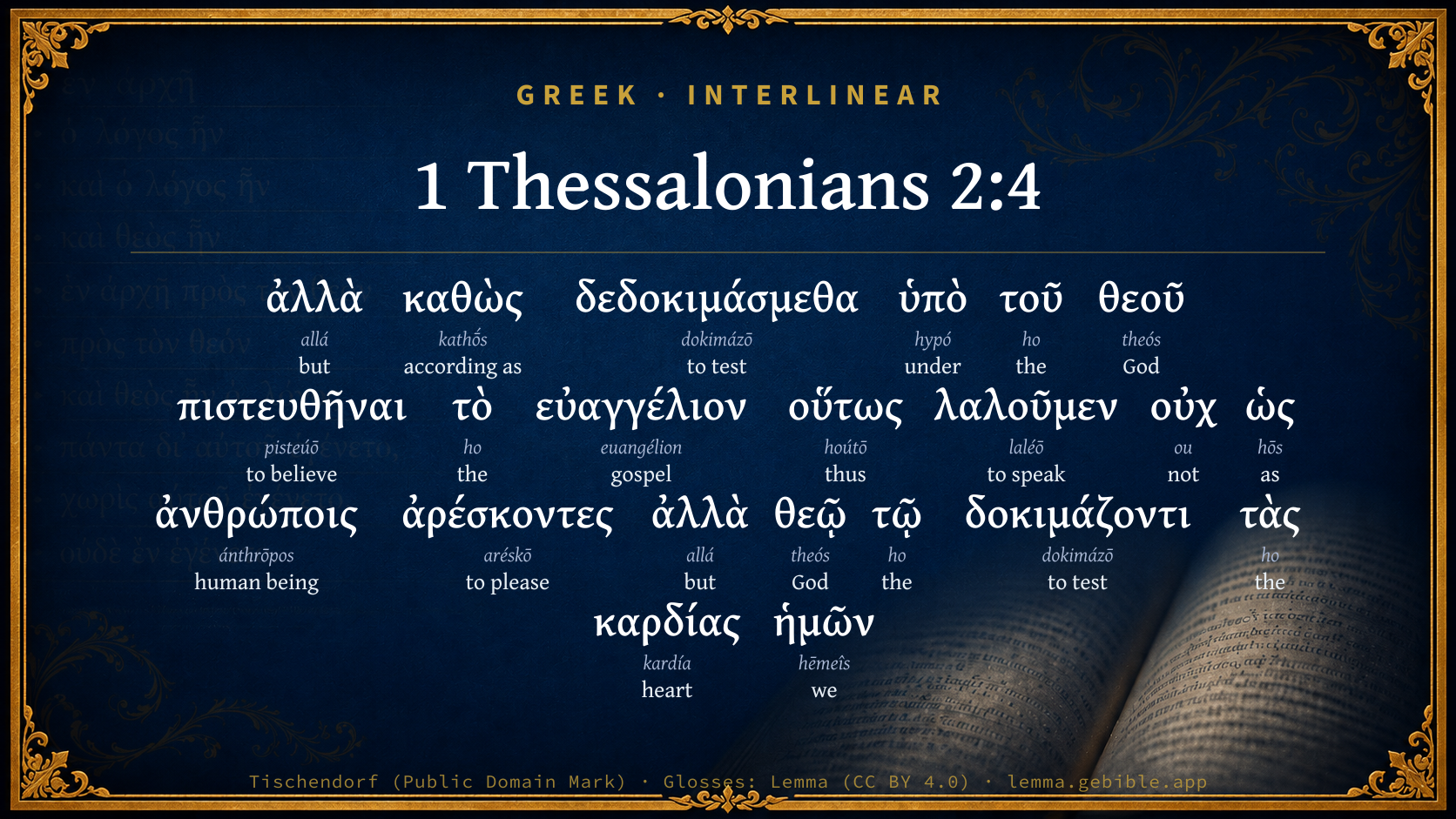
But even as we have been approved by God to be entrusted with the Gospel, so we speak; not as pleasing men, but God, who tests our hearts.
Download a study sheet
One document with this verse’s original text, its word-by-word gloss line, the meaning frame, cross-references with their text, attributed commentary, and full source and license credits — printable, and it pastes into notes with its structure intact.
This verse Autodidact and up
A passage Seminary Student
Up to 50 verses in one chapter. A passage sheet keeps up to 6 commentary sources and 12 cross-references per verse, in the order this page ranks them, and says so on the sheet whenever that leaves anything out. Ask for a single verse and you get the Autodidact verse sheet above.
Everything on this page stays free to read, with no account — the sheet is a download of what is already on screen, not access to it.
Compare translations 3
The same verse in 3 English versions, stacked beneath the original-language interlinear above. Click any original word for its lexicon entry.
Each is an independent rendering of the whole verse — the interlinear is not word-aligned to these translations.
Highlighted words mark where these versions differ — a whole-verse word diff, not a word-by-word alignment.
-
World English Bible Public Domain
But even as we have been approved by God to be entrusted with the Gospel, so we speak; not as pleasing men, but God, who tests our hearts.
-
King James Version Public Domain
But as we were allowed of God to be put in trust with the gospel, even so we speak; not as pleasing men, but God, which trieth our hearts.
-
unfoldingWord Literal Text CC BY-SA 4.0
but just as we have been examined by God to be entrusted with the gospel, so we speak, not as pleasing to men, but to God, the one examining our hearts.
unfoldingWord Literal Text — © unfoldingWord, licensed CC BY-SA 4.0. Word-aligned USFM3 via Door43 (git.door43.org/unfoldingWord/en_ult).
Show all 19 translations
Every available English version of this verse, each an independent rendering of the whole verse.
-
World English Bible Public Domain
But even as we have been approved by God to be entrusted with the Gospel, so we speak; not as pleasing men, but God, who tests our hearts.
-
Berean Standard Bible Public Domain
Instead, we speak as those approved by God to be entrusted with the gospel, not in order to please men but God, who examines our hearts.
-
Majority Standard Bible Public Domain
Instead, we speak as those approved by God to be entrusted with the gospel, not in order to please men but God, who examines our hearts.
-
King James Version Public Domain
But as we were allowed of God to be put in trust with the gospel, even so we speak; not as pleasing men, but God, which trieth our hearts.
-
American Standard Version (1901) Public Domain
but even as we have been approved of God to be intrusted with the gospel, so we speak; not as pleasing men, but God who proveth our hearts.
-
Revised Version (1885) Public Domain
but even as we have been approved of God to be intrusted with the gospel, so we speak; not as pleasing men, but God which proveth our hearts.
-
Geneva Bible (1599) Public Domain
But as we were allowed of God, that the Gospel should be committed vnto vs, so we speake, not as they that please men, but God, which approoueth our hearts.
-
Douay-Rheims (1899) Public Domain
But as we were approved by God that the gospel should be committed to us: even so we speak, not as pleasing men, but God, who proveth our hearts.
-
Young's Literal Translation Public Domain
but as we have been approved by God to be entrusted with the good news, so we speak, not as pleasing men, but God, who is proving our hearts,
-
Literal Standard Version CC BY-SA 4.0
but as we have been approved by God to be entrusted with the good news, so we speak, not as pleasing men, but God, who is proving our hearts,
-
Unlocked Literal Bible CC BY-SA 4.0
Instead, just as we have been approved by God to be trusted with the gospel, so we speak. We speak, not to please men, but to please God. He is the one who examines our hearts.
-
unfoldingWord Literal Text CC BY-SA 4.0
but just as we have been examined by God to be entrusted with the gospel, so we speak, not as pleasing to men, but to God, the one examining our hearts.
-
Darby Bible Public Domain
but even as we have been approved of God to have the glad tidings entrusted to us, so we speak; not as pleasing men, but God, who proves our hearts.
-
World Messianic Bible Public Domain
But even as we have been approved by God to be entrusted with the Good News, so we speak—not as pleasing men, but God, who tests our hearts.
-
Webster's Bible Public Domain
But as we were allowed by God to be put in trust with the gospel, even so we speak; not as pleasing men, but God, who trieth our hearts.
-
Free Bible Version CC BY-SA 4.0
On the contrary, we have God's approval for what we say—he's entrusted us with sharing the good news. We don't set out to please people, but God. He's the one who judges our motives.
-
Bible in Basic English Public Domain
But even as the good news was given to us by the approval of God, so we give it out; not as pleasing men, but God by whom our hearts are tested.
-
Text-Critical English NT CC BY 4.0
but just as we have been approved by God to be entrusted with the gospel, so we speak, not as pleasing men, but God, who examines our hearts.
-
Tyndale New Testament (1534) Public Domain
but as we were alowed of God that the gospell shuld be committed vnto vs: even so we speake not as though we entended to please men but God which trieth oure hertes.
Literal Standard Version (2020), Covenant Press — licensed CC BY-SA 4.0. Text via the HelloAO Bible API (eBible.org). Unlocked Literal Bible (unfoldingWord) — licensed CC BY-SA 4.0. Text via the HelloAO Bible API (eBible.org). unfoldingWord Literal Text — © unfoldingWord, licensed CC BY-SA 4.0. Word-aligned USFM3 via Door43 (git.door43.org/unfoldingWord/en_ult). Free Bible Version, Dr. Jonathan Gallagher — licensed CC BY-SA 4.0. Text via the HelloAO Bible API (eBible.org).
Word by word
More ways to search: Search by grammar → Find every occurrence → Compare this word →
Practice this passage: Drill this verse → Learn its vocabulary →
- Appears 17× in the Greek New Testament
- First appears at Matthew 14:6
- Part of Speech
- Verb
- Tense
- Present
- Voice
- Active
- Mood
- Participle
- Case
- Nominative
- Number
- Plural
- Gender
- Masculine
Full Thayer's Definition
- ἀλλὰ allá G235 “but” Conjunction
- καθὼς kathṓs G2531 “according as” Adverb
- δεδοκιμάσμεθα dokimázō G1381 “to test” Verb, Perfect, Passive, Indicative, 1st person, Plural
- ὑπὸ hypó G5259 “under” Preposition
- τοῦ ho G3588 “the” Article, Genitive, Singular, Masculine
- θεοῦ theós G2316 “God” Noun, Genitive, Singular, Masculine
- πιστευθῆναι pisteúō G4100 “to believe” Verb, Aorist, Passive, Infinitive
- τὸ ho G3588 “the” Article, Accusative, Singular, Neuter
- εὐαγγέλιον euangélion G2098 “gospel” Noun, Accusative, Singular, Neuter
- οὕτως hoútō G3779 “thus” Adverb
- λαλοῦμεν laléō G2980 “to speak” Verb, Present, Active, Indicative, 1st person, Plural
- οὐχ ou G3756 “not” Particle, Negative
- ὡς hōs G5613 “as” Adverb
- ἀνθρώποις ánthrōpos G444 “human being” Noun, Dative, Plural, Masculine
- ἀρέσκοντες aréskō G700 “to please” Verb, Present, Active, Participle, Nominative, Plural, Masculine
- ἀλλὰ allá G235 “but” Conjunction
- θεῷ theós G2316 “God” Noun, Dative, Singular, Masculine
- τῷ ho G3588 “the” Article, Dative, Singular, Masculine
- δοκιμάζοντι dokimázō G1381 “to test” Verb, Present, Active, Participle, Dative, Singular, Masculine
- τὰς ho G3588 “the” Article, Accusative, Plural, Feminine
- καρδίας kardía G2588 “heart” Noun, Accusative, Plural, Feminine
- ἡμῶν hēmeîs G2249 “we” Personal pronoun, 1st person, Genitive, Plural
About this verse
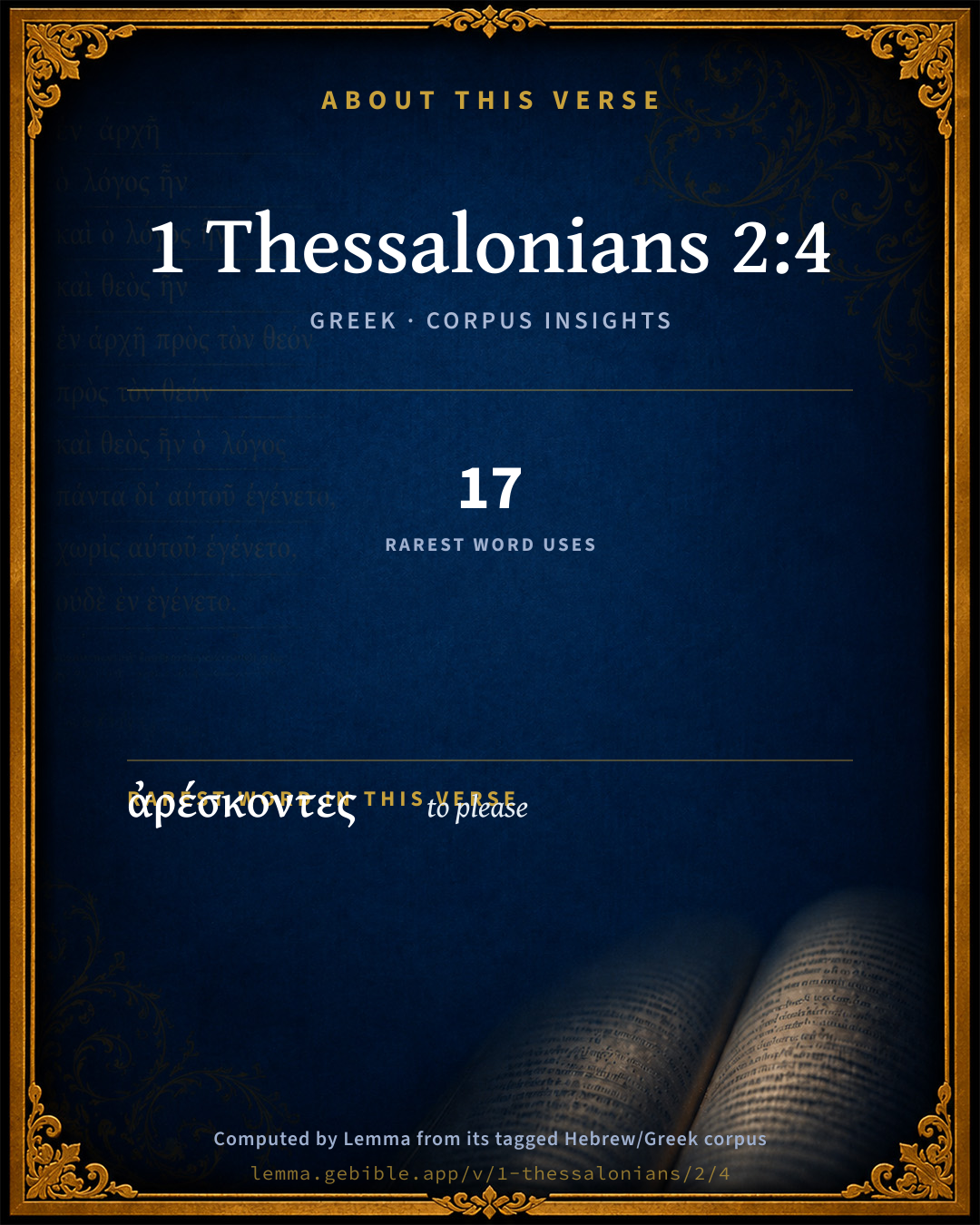
These counts appear in no published source. They are computed here, from the morphology-tagged text and Lemma’s own curated glosses. What Lemma adds →
- 22
- words
- 16
- distinct lemmas
- Pauline Epistles
- section
Cross-references
34Topical passages linked to 1 Thessalonians 2:4 in the Treasury of Scripture Knowledge — connected by theme and wording, ordered by reader-vote popularity; previews shown in the World English Bible.
- Galatians 1:10 For am I now seeking the favor of men, or of God? Or am I striving to please men? For if I were still pleasing men, I wouldn't be a servant of Christ.
- Romans 8:27 He who searches the hearts knows what is on the Spirit's mind, because he makes intercession for the saints according to God.
- Galatians 2:7 but to the contrary, when they saw that I had been entrusted with the Gospel for the uncircumcision, even as Peter with the Gospel for the circumcision
- Psalms 17:3 You have proved my heart; you have visited me in the night; You have tried me, and found nothing; I have resolved that my mouth shall not disobey.
- 2 Timothy 1:14 That good thing which was committed to you, guard through the Holy Spirit who dwells in us.
- 2 Corinthians 4:2 But we have renounced the hidden things of shame, not walking in craftiness, nor handling the word of God deceitfully; but by the manifestation of the truth commending ourselves to every man's conscience in the sight of God.
- Ephesians 6:6 not in the way of service only when eyes are on you, as men-pleasers; but as servants of Christ, doing the will of God from the heart;
- 1 Chronicles 29:17 I know also, my God, that you try the heart, and have pleasure in uprightness. As for me, in the uprightness of my heart I have willingly offered all these things: and now have I seen with joy your people, that are present here, offer willingly to you.
- Psalms 139:1–2 Yahweh, you have searched me, And you know me.
- Jeremiah 32:19 great in counsel, and mighty in work; whose eyes are open on all the ways of the sons of men, to give everyone according to his ways, and according to the fruit of his doings:
- 1 Corinthians 4:1–2 So let a man think of us as Christ's servants, and stewards of God's mysteries.
- Ephesians 3:8 To me, the very least of all saints, was this grace given, to preach to the Gentiles the unsearchable riches of Christ,
- Titus 1:3 but in his own time revealed his word in the message with which I was entrusted according to the commandment of God our Savior;
- Numbers 27:16 Let Yahweh, the God of the spirits of all flesh, appoint a man over the congregation,
- 1 Kings 8:39 then hear in heaven, your dwelling-place, and forgive, and do, and render to every man according to all his ways, whose heart you know; (for you, even you only, know the hearts of all the children of men;)
- Proverbs 17:3 The refining pot is for silver, and the furnace for gold, But Yahweh tests the hearts.
- Luke 16:11 If therefore you have not been faithful in the unrighteous mammon, who will commit to your trust the true riches?
- 1 Corinthians 9:17 For if I do this of my own will, I have a reward. But if not of my own will, I have a stewardship entrusted to me.
- 1 Timothy 1:11–13 according to the Gospel of the glory of the blessed God, which was committed to my trust.
- Hebrews 4:13 There is no creature that is hidden from his sight, but all things are naked and laid open before the eyes of him with whom we have to do.
- Psalms 44:21 Won't God search this out? For he knows the secrets of the heart.
- Jeremiah 17:10 I, Yahweh, search the mind, I try the heart, even to give every man according to his ways, according to the fruit of his doings.
- Luke 12:42 The Lord said, "Who then is the faithful and wise steward, whom his lord will set over his household, to give them their portion of food at the right times?
- 1 Corinthians 2:4–5 My speech and my preaching were not in persuasive words of human wisdom, but in demonstration of the Spirit and of power,
- 2 Corinthians 5:11 Knowing therefore the fear of the Lord, we persuade men, but we are revealed to God; and I hope that we are revealed also in your consciences.
- Colossians 3:22 Servants, obey in all things those who are your masters according to the flesh, not just when they are looking, as men-pleasers, but in singleness of heart, fearing God.
- 1 Timothy 6:20 Timothy, guard that which is committed to you, turning away from the empty chatter and oppositions of the knowledge which is falsely so called;
- Revelation 2:23 I will kill her children with Death, and all the assemblies will know that I am he who searches the minds and hearts. I will give to each one of you according to your deeds.
- Psalms 7:9 Oh let the wickedness of the wicked come to an end, But establish the righteous; Their minds and hearts are searched by the righteous God.
- John 2:24–25 But Jesus didn't trust himself to them, because he knew everyone,
- John 21:17 He said to him the third time, "Simon, son of Jonah, do you have affection for me?" Peter was grieved because he asked him the third time, "Do you have affection for me?" He said to him, "Lord, you know everything. You know that I have affection for you." Jesus said to him, "Feed my sheep.
- 1 Corinthians 7:25 Now concerning virgins, I have no commandment from the Lord, but I give my judgment as one who has obtained mercy from the Lord to be trustworthy.
- 2 Corinthians 5:16 Therefore we know no one after the flesh from now on. Even though we have known Christ after the flesh, yet now we know him so no more.
- 2 Timothy 2:2 The things which you have heard from me among many witnesses, commit the same to faithful men, who will be able to teach others also.
Cross-references courtesy of OpenBible.info (CC BY 4.0).
Lesson kit
Teaching starters — assembled from the data on this page, not authored interpretation. Every prompt links to the verse data it draws on. Edit before teaching.
1 Thessalonians, in the Pauline Epistles, opens this verse with 22 words (16 distinct Greek lemmas). Its most distinctive word is aréskō (“to please”). A historical commentator’s framing appears above. Read the whole chapter for the surrounding context.
Discussion questions
- How does “to please” (aréskō) shape what this verse is saying?
- How does Matthew 14:6, which shares the word «to please», read alongside this verse?
- What does the repetition of “to test” (2× in this one verse) do in this verse?
- The translations on this page render this verse differently — a whole-verse word diff, not a word-by-word alignment. What might account for the different wordings?
- Compare how Tyndale Open Study Notes and Bengel's Gnomon read this verse. Where do they agree or differ?
Things to notice
- These translations choose different wording for 16 words in this verse.
- “to test” occurs 2× in this single verse.
- 16 distinct Greek lemmas span 22 words in this verse.
Commentary
Notes on 1 Thessalonians 2:4 from classic Christian and Jewish commentators (each source and its license shown beneath its notes). The classic Christian expositions comment on the surrounding passage and are grouped to its opening verse, so a note may address several verses; the Jewish commentaries on the Tanakh (Rashi and others) are per-verse, so they appear only where the commentator wrote on this verse.
Lemma curates 59 commentaries, every one of them public domain or Creative Commons licensed, each selected and text-cleaned for this edition rather than reprinted as found. About our sources →
Tyndale Open Study Notes
Tyndale Open Resources
Tyndale Open Study Notes — © Tyndale Open Resources, licensed CC BY-SA 4.0. Text via the HelloAO Bible API.
Bengel's Gnomon
Johann Albrecht Bengel
Bengel's Gnomon of the New Testament — English translation (T&T Clark, Edinburgh, 1860) — public domain. Text from a community e-Sword module.
Meyer's Critical & Exegetical Commentary
Heinrich August Wilhelm Meyer
Meyer — Critical and Exegetical Commentary on the New Testament — English translation by Peter Christie, edited by Frederick Crombie (T&T Clark, 1880) — public domain. Text from a community e-Sword module.
Expositor's Greek Testament
ed. W. Robertson Nicoll
The Expositor's Greek Testament, edited by W. Robertson Nicoll (1897–1910) — public domain. Text from a community e-Sword module.
Cambridge Greek Testament for Schools and Colleges
Cambridge Greek Testament for Schools and Colleges (Cambridge University Press, 1896; 21 vols, various authors incl. Carr, Maclear, Plummer, Farrar, Lumby, Moule, M. R. James, Simcox) — public domain. Text from a community e-Sword module.
Geneva Bible (1599)
Geneva Bible translators
Geneva Bible (1599) marginal notes — public domain. Text via Bolls.life.
Jamieson, Fausset & Brown
Robert Jamieson, A. R. Fausset & David Brown
Jamieson, Fausset & Brown — Commentary Critical and Explanatory on the Whole Bible (1871) — public domain (CC PDM 1.0). Text via the HelloAO Bible API.
Adam Clarke's Commentary
Adam Clarke's Commentary on the Bible (1810–1826) — public domain. Text from a community e-Sword/MySword module.
John Calvin's Commentaries
John Calvin's Commentaries (1540-1563) — public domain. Text from the Calvin Translation Society English edition (1840s-50s) via the Christian Classics Ethereal Library (ccel.org). Calvin's coverage is partial (roughly two-thirds of the Bible); uncommented books and verses are honest gaps, never fabricated. The 19th-century editor's footnotes and remarks are omitted so the notes are faithfully Calvin's own voice.
Ellicott's Commentary for English Readers
A Bible Commentary for English Readers, edited by Charles John Ellicott (1878–1897) — public domain. Text from a community e-Sword module.
The Cambridge Bible for Schools and Colleges
gen. ed. J. J. S. Perowne
The Cambridge Bible for Schools and Colleges (gen. ed. J. J. S. Perowne; Cambridge University Press, 1878–1918) — public domain. Text from a community e-Sword module.
John Gill's Exposition
John Gill's Exposition of the Whole Bible (1746–1763) — public domain (CC PDM 1.0). Text via the HelloAO Bible API.
Trapp's Complete Commentary
John Trapp
John Trapp, A Commentary or Exposition upon All the Books of the Old and New Testament (1647–1656) — public domain. Text from a community e-Sword module.
Albert Barnes' Notes on the Bible
Albert Barnes' Notes on the Bible (1834–1885) — public domain. Text from a community e-Sword/MySword module.
Haydock's Catholic Bible Commentary
George Leo Haydock (1774–1849), Haydock's Catholic Family Bible and Commentary, 1859 edition — public domain. Excludes Psalms (Douay-Rheims chapter numbering differs from Protestant) and Deuterocanonical books (Catholic canon only).
Matthew Poole's English Annotations
Matthew Poole's English Annotations on the Holy Bible (1683–1685) — public domain. Text from a community e-Sword/MySword module.
Whedon's Commentary on the Bible
Daniel D. Whedon
Daniel D. Whedon (gen. ed.), Commentary on the Old and New Testaments (1874–1909) — public domain. Text from a community e-Sword module.
The Pulpit Commentary
The Pulpit Commentary (1880–1919), ed. H.D.M. Spence-Jones & Joseph S. Exell — public domain. Text from a community e-Sword module.
McGarvey & Pendleton's Commentaries
J. W. McGarvey
J. W. McGarvey (with Philip Y. Pendleton), Commentaries on the New Testament (The Fourfold Gospel, 1914; Acts; and the epistles) — public domain. Text from a community e-Sword/MySword module.
The People's New Testament
B. W. Johnson
B. W. Johnson's The People's New Testament with Notes (1889–1891) — public domain. Electronic text from the Christian Classics Ethereal Library (CCEL) ThML edition.
Alford’s Greek Testament
Henry Alford
Henry Alford, The Greek Testament (1849–1861) — public domain. Text from a community e-Sword module.
International Critical Commentary
International Critical Commentary — older volumes (1896–1929), various authors — public domain. Text from a community e-Sword module.
Vincent's Word Studies in the New Testament
Marvin R. Vincent
Marvin R. Vincent, Word Studies in the New Testament (1887–1900) — public domain. Text from a community e-Sword/MySword module.