2 Peter 3:4

Greek (Tischendorf 8th ed.) 2 Peter 3:4 appears in the Greek New Testament. The text above is from the Tischendorf 8th edition. Each word links to its Strong’s number and a concise gloss. Click any word for its full Thayer’s Greek Lexicon entry.
Download image
Cite this verse

2 Peter 3:4 (World English Bible). Public Domain. Lemma interlinear Bible study tool, https://lemma.gebible.app/v/2-peter/3/4.

Show BibTeX & RIS
BibTeX
RIS
English Translation
and saying, "Where is the promise of his coming? For, from the day that the fathers fell asleep, all things continue as they were from the beginning of the creation."
World English Bible · Public Domain
Download a study sheet

One document with this verse’s original text, its word-by-word gloss line, the meaning frame, cross-references with their text, attributed commentary, and full source and license credits — printable, and it pastes into notes with its structure intact.

This verse Autodidact and up

Study sheet (.html) Plain text (.txt)

A passage Seminary Student

Up to 50 verses in one chapter. A passage sheet keeps up to 6 commentary sources and 12 cross-references per verse, in the order this page ranks them, and says so on the sheet whenever that leaves anything out. Ask for a single verse and you get the Autodidact verse sheet above.

Everything on this page stays free to read, with no account — the sheet is a download of what is already on screen, not access to it.

Want to remove ads? Support Godless Engineer
Compare translations 3

The same verse in 3 English versions, stacked beneath the original-language interlinear above. Click any original word for its lexicon entry.

Each is an independent rendering of the whole verse — the interlinear is not word-aligned to these translations.

Highlighted words mark where these versions differ — a whole-verse word diff, not a word-by-word alignment.

  • World English Bible Public Domain
    and saying, "Where is the promise of his coming? For, from the day that the fathers fell asleep, all things continue as they were from the beginning of the creation."
  • King James Version Public Domain
    And saying, Where is the promise of his coming? for since the fathers fell asleep, all things continue as they were from the beginning of the creation.
  • unfoldingWord Literal Text CC BY-SA 4.0
    and saying, “Where is the promise of his coming? For since the fathers fell asleep, all things continue in the same way from the beginning of creation.”

unfoldingWord Literal Text — © unfoldingWord, licensed CC BY-SA 4.0. Word-aligned USFM3 via Door43 (git.door43.org/unfoldingWord/en_ult).

Versions to compare (up to 4)

3 of 4 selected

Show all 19 translations

Every available English version of this verse, each an independent rendering of the whole verse.

  • World English Bible Public Domain
    and saying, "Where is the promise of his coming? For, from the day that the fathers fell asleep, all things continue as they were from the beginning of the creation."
  • Berean Standard Bible Public Domain
    “Where is the promise of His coming?” they will ask. “Ever since our fathers fell asleep, everything continues as it has from the beginning of creation.”
  • Majority Standard Bible Public Domain
    “Where is the promise of His coming?” they will ask. “Ever since our fathers fell asleep, everything continues as it has from the beginning of creation.”
  • King James Version Public Domain
    And saying, Where is the promise of his coming? for since the fathers fell asleep, all things continue as they were from the beginning of the creation.
  • American Standard Version (1901) Public Domain
    and saying, Where is the promise of his coming? for, from the day that the fathers fell asleep, all things continue as they were from the beginning of the creation.
  • Revised Version (1885) Public Domain
    and saying, Where is the promise of his coming? for, from the day that the fathers fell asleep, all things continue as they were from the beginning of the creation.
  • Geneva Bible (1599) Public Domain
    And say, Where is the promise of his comming? for since the fathers died, all things continue alike from the beginning of the creation.
  • Douay-Rheims (1899) Public Domain
    Saying: Where is his promise or his coming? for since the time that the fathers slept, all things continue as they were from the beginning of the creation.
  • Young's Literal Translation Public Domain
    and saying, `Where is the promise of his presence? for since the fathers did fall asleep, all things so remain from the beginning of the creation;'
  • Literal Standard Version CC BY-SA 4.0
    and saying, “Where is the promise of His coming? For since the fathers fell asleep, all things so remain from the beginning of the creation”;
  • Unlocked Literal Bible CC BY-SA 4.0
    They will say, “Where is the promise of his return? From when our fathers fell asleep, all things have stayed the same, since the beginning of creation.”
  • unfoldingWord Literal Text CC BY-SA 4.0
    and saying, “Where is the promise of his coming? For since the fathers fell asleep, all things continue in the same way from the beginning of creation.”
  • Darby Bible Public Domain
    and saying, Where is the promise of his coming? for from the time the fathers fell asleep all things remain thus from [the] beginning of [the] creation.
  • World Messianic Bible Public Domain
    and saying, “Where is the promise of his coming? For, from the day that the fathers fell asleep, all things continue as they were from the beginning of the creation.”
  • Webster's Bible Public Domain
    And saying, Where is the promise of his coming? for since the fathers fell asleep, all things continue as they were from the beginning of the creation.
  • Free Bible Version CC BY-SA 4.0
    “So what happened to this coming he promised?” they ask. “Right from the time our ancestors died, everything's continued as it always has, ever since creation began.”
  • Bible in Basic English Public Domain
    Saying, Where is the hope of his coming? From the death of the fathers till now everything has gone on as it was from the making of the world.
  • Text-Critical English NT CC BY 4.0
    They will say, “Where is the promise of his coming? For ever since the fathers fell asleep, everything continues as it has since the beginning of creation.”
  • Tyndale New Testament (1534) Public Domain
    and saye. Where is the promes of his comynge? For sence the fathers dyed all thinges cotinue in the same estate wher in they were at the begynninge.

Literal Standard Version (2020), Covenant Press — licensed CC BY-SA 4.0. Text via the HelloAO Bible API (eBible.org). Unlocked Literal Bible (unfoldingWord) — licensed CC BY-SA 4.0. Text via the HelloAO Bible API (eBible.org). unfoldingWord Literal Text — © unfoldingWord, licensed CC BY-SA 4.0. Word-aligned USFM3 via Door43 (git.door43.org/unfoldingWord/en_ult). Free Bible Version, Dr. Jonathan Gallagher — licensed CC BY-SA 4.0. Text via the HelloAO Bible API (eBible.org).

Word by word

More ways to search: Search by grammar → Find every occurrence → Compare this word →

Practice this passage: Drill this verse → Learn its vocabulary →

διαμένει
diaménō
G1265
“to remain”
Verb, Present, Active, Indicative, 3rd person, Singular
Part of Speech
Verb
Tense
Present
Voice
Active
Mood
Indicative
Person
3rd person
Number
Singular
Full Thayer's Definition

Origin: from G1223 and G3306

TDNT: None

1. to stay permanently, remain permanently, continue
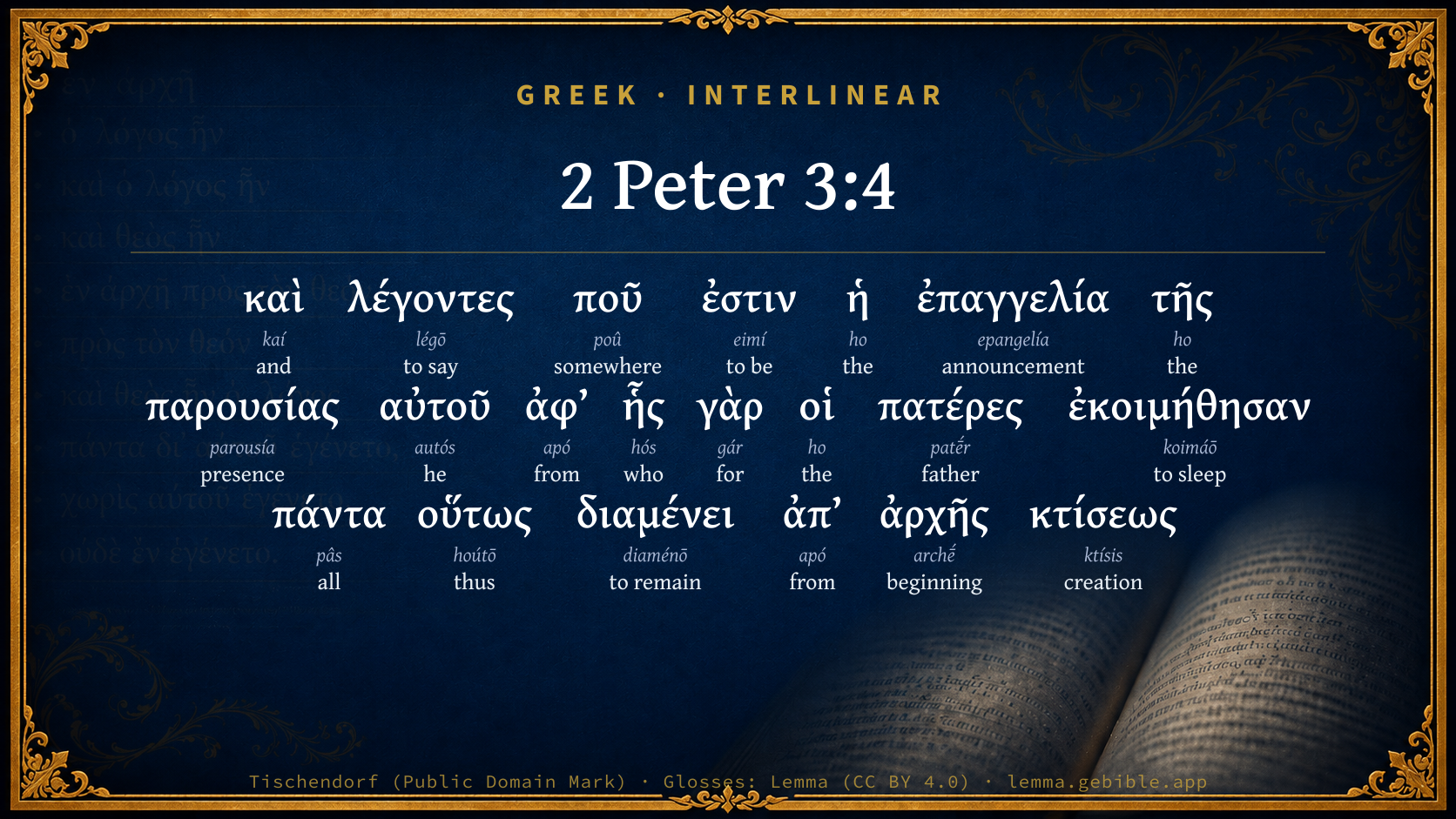
  1. καὶ kaí G2532 “and” Conjunction
  2. λέγοντες légō G3004 “to say” Verb, Present, Active, Participle, Nominative, Plural, Masculine
  3. ποῦ poû G4226 “somewhere” Particle, Interrogative
  4. ἐστιν eimí G1510 “to be” Verb, Present, Active, Indicative, 3rd person, Singular
  5. ἡ ho G3588 “the” Article, Nominative, Singular, Feminine
  6. ἐπαγγελία epangelía G1860 “announcement” Noun, Nominative, Singular, Feminine
  7. τῆς ho G3588 “the” Article, Genitive, Singular, Feminine
  8. παρουσίας parousía G3952 “presence” Noun, Genitive, Singular, Feminine
  9. αὐτοῦ autós G846 “he” Personal pronoun, Genitive, Singular, Masculine
  10. ἀφ’ apó G575 “from” Preposition
  11. ἧς hós G3739 “who” Relative pronoun, Genitive, Singular, Feminine
  12. γὰρ gár G1063 “for” Conjunction
  13. οἱ ho G3588 “the” Article, Nominative, Plural, Masculine
  14. πατέρες patḗr G3962 “father” Noun, Nominative, Plural, Masculine
  15. ἐκοιμήθησαν koimáō G2837 “to sleep” Verb, Aorist, Passive, Indicative, 3rd person, Plural
  16. πάντα pâs G3956 “all” Adjective, Nominative, Plural, Neuter
  17. οὕτως hoútō G3779 “thus” Adverb
  18. ἀπ’ apó G575 “from” Preposition
  19. ἀρχῆς archḗ G746 “beginning” Noun, Genitive, Singular, Feminine
  20. κτίσεως ktísis G2937 “creation” Noun, Genitive, Singular, Feminine

About this verse

These counts appear in no published source. They are computed here, from the morphology-tagged text and Lemma’s own curated glosses. What Lemma adds →

21
words
18
distinct lemmas
General Epistles
section

Notable vocabulary

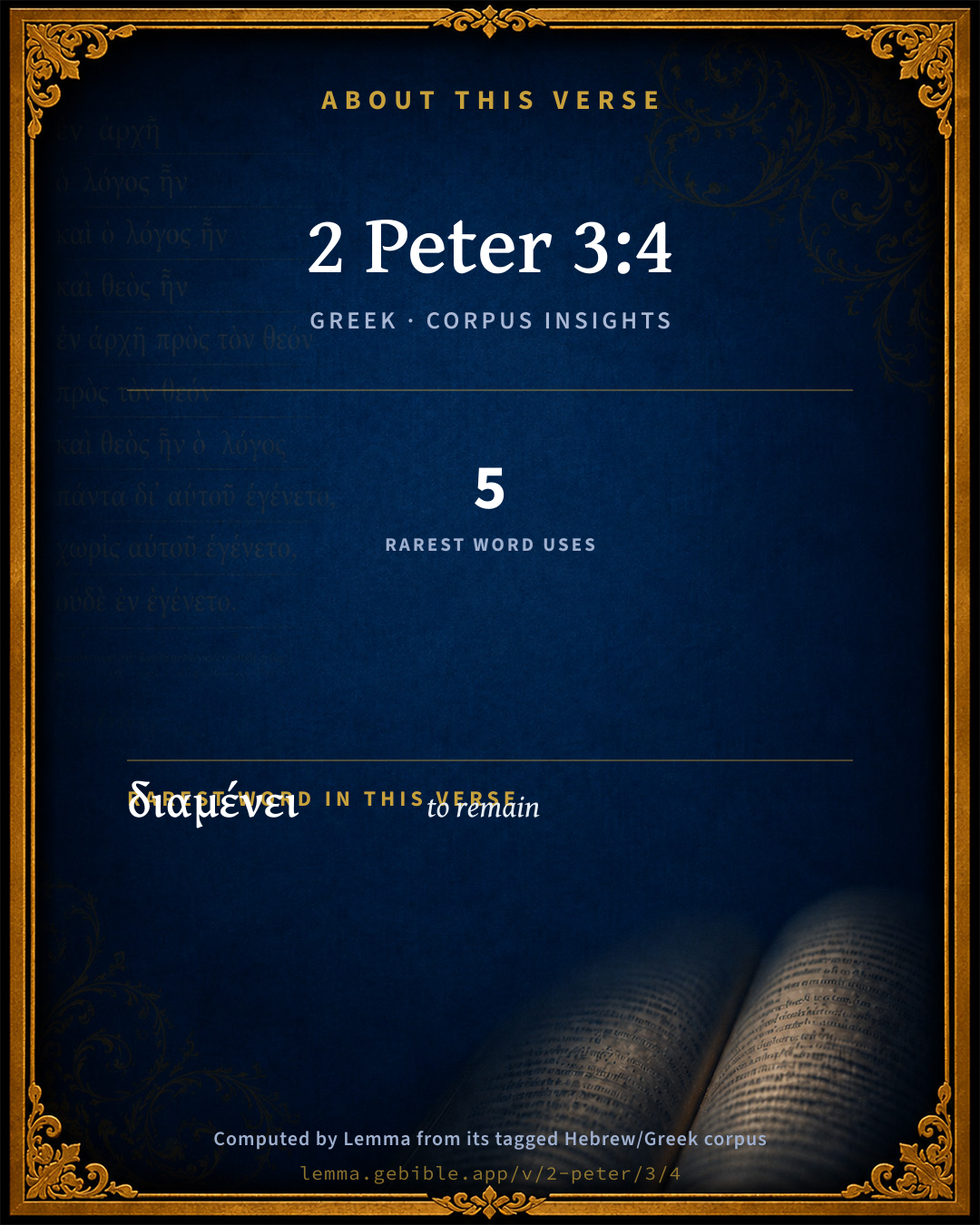
The rarest word here is διαμένει to remain G1265 — appearing just 5 times in the whole Greek New Testament.

Shared distinctive vocabulary

διαμένει to remain G1265 occurs in 5 verses of the Greek New Testament. Also found in:

Repetition

Words recur within this verse:

Cross-references

15

Topical passages linked to 2 Peter 3:4 in the Treasury of Scripture Knowledge — connected by theme and wording, ordered by reader-vote popularity; previews shown in the World English Bible.

  • Jeremiah 17:15 Behold, they tell me, Where is the word of Yahweh? let it come now.
  • Malachi 2:17 You have wearied Yahweh with your words. Yet you say, 'How have we wearied him?' In that you say, 'Everyone who does evil is good in the sight of Yahweh, and he delights in them;' or 'Where is the God of justice?'
  • Jeremiah 5:12–13 They have denied Yahweh, and said, It is not he; neither shall evil come on us; neither shall we see sword nor famine:
  • Luke 12:45 But if that servant says in his heart, 'My lord delays his coming,' and begins to beat the menservants and the maidservants, and to eat and drink, and to be drunken,
  • Isaiah 5:18–19 Woe to those who draw iniquity with cords of falsehood, And wickedness as with cart rope;
  • Ecclesiastes 8:11 Because sentence against an evil work is not executed speedily, therefore the heart of the sons of men is fully set in them to do evil.
  • Matthew 24:48 But if that evil servant should say in his heart, 'My lord is delaying his coming,'
  • Genesis 19:14 Lot went out, and spoke to his sons-in-law, who were pledged to marry his daughters, and said, "Get up! Get out of this place, for Yahweh will destroy the city." But he seemed to his sons-in-law to be joking.
  • Ezekiel 12:22–27 Son of man, what is this proverb that you have in the land of Israel, saying, The days are prolonged, and every vision fails?
  • 1 Thessalonians 2:19 For what is our hope, or joy, or crown of rejoicing? Isn't it even you, before our Lord Jesus at his coming?
  • Ecclesiastes 1:9 That which has been is that which shall be; and that which has been done is that which shall be done: and there is no new thing under the sun.
  • Mark 13:19 For in those days there will be oppression, such as there has not been the like from the beginning of the creation which God created until now, and never will be.
  • Ezekiel 11:3 who say, [The time] is not near to build houses: this [city] is the caldron, and we are the flesh.
  • Revelation 3:14 "To the angel of the assembly in Laodicea write: "The Amen, the Faithful and True Witness, the Head of God's creation, says these things:
  • Mark 10:6 But from the beginning of the creation, 'God made them male and female.

Cross-references courtesy of OpenBible.info (CC BY 4.0).

Commentary

Notes on 2 Peter 3:4 from classic Christian and Jewish commentators (each source and its license shown beneath its notes). The classic Christian expositions comment on the surrounding passage and are grouped to its opening verse, so a note may address several verses; the Jewish commentaries on the Tanakh (Rashi and others) are per-verse, so they appear only where the commentator wrote on this verse.

Lemma curates 59 commentaries, every one of them public domain or Creative Commons licensed, each selected and text-cleaned for this edition rather than reprinted as found. About our sources →

Joseph Benson's Commentary

2Pe 3:4-6. Where is the promise of his coming — To raise the dead, judge mankind, and destroy the earth? We see no sign of any such thing. The promise of Christ’s coming we have Mat 15:27, The Son of man shall come in his glory, &c.; Joh 14:3, I will come and receive you to myself, &c., and in many other passages of the gospel; a promise which was renewed by the angels at our Lord’s ascension, and is spoken of in many passages of the epistles, especially in those of St. Paul. By representing Christ’s promised coming as a delusion, the scoffers set themselves and others free from all fear of a future judgment, and bereft the righteous of their hope of reward. For since the fathers fell asleep — Since our ancestors died; all things — Heaven, earth, air, water; continue as they were from the beginning of the creation — Without any such material change as might make us believe they will ever have an end. So say these scoffers. For this they willingly are ignorant of — As if he had said, It is from their ignorance, their gross, affected ignorance, that they argue after this manner. He says willingly ignorant, to signify that they had sufficient means of knowing better, but that they did not care to know or consider any thing respecting it. That by the word of God — His almighty word, which bounds the duration of all things, so that it cannot be either longer or shorter; the heavens — As by the heavens here the apostle means the atmosphere which surrounds this earth, the plural is put for the singular by a change of the number very common in the Scriptures; were of old — Anciently before the flood; and the earth standing — Or subsisting, (as συνεστωσα more properly signifies,) out of the water — Which had before covered it, namely, emerging from it by the divine command, (the earth being formed out of the chaos, which had been previously brought into existence for that purpose,) and the liquid element retiring to the channels prepared for it; and in the water — By which God appointed that it should be surrounded, nourished, and supported, water being the life of the vegetable creation; whereby — Δι’ ων, by which things, thus constituted; the world that then was — The whole antediluvian race, with all the brute animals, except such as were with Noah in the ark; being overflowed with water, perished — Perhaps δι’ ων, by which things, refers to the heavens mentioned above, and may relate to the windows of heaven being opened, as the expression is Gen 7:11, and pouring forth upon the earth a destructive deluge of water. The apostle means that these scoffers did not consider God’s power manifested in making the world, which must enable him also to destroy it if he pleased, and that they had little reason for saying that all things continued as they were from the creation.

Joseph Benson's Commentary on the Old and New Testaments (1811–1818) — public domain. Text from a community e-Sword module.

Whedon's Commentary on the Bible

Daniel D. Whedon

4. Where is—What has become of? These scoffers truly come from out the millennial Church. They long believed that old promise embraced in the Apostles’ Creed, that Christ would “come to judge the quick and the dead.” But ages have passed, and this coming is proved to be a ridiculous superstition.

His coming—The word here is parousia, and when predicated of Christ, always denotes his literal bodily presence. The verb come, and noun coming, are often used of spiritual interpositions, but this parousia never. Note on 1Co_15:23. The word parousia occurs in the following passages: Mat_24:3; Mat_24:37; Mat_24:39; 1Co_15:23; 1Th_2:19; 1Th_3:13; 1Th_4:15; 2Th_2:1; 2Th_2:8-9; Jas_5:7-8; 2Pe_1:16; 2Pe_3:4; 2Pe_3:12; 1Jn_2:28.

The fathers—The old fathers of the Church, who predicted and believed in the second advent. Through all the ages, from their time to the day of these scoffers, no Christ has come. But Satan has come in his spiritual power; and he has deceived these sceptics into the belief that there is no judgment-day, no divine Christ, no true God. Let loose from all religious restraints, they “walk after their own lusts.”

Continue as they were—Literal Greek, remain just so. Dr. Chalmers was the first, we believe, to note that Peter here gives the argument of Hume against all miracle. It is the argument of the visible permanence of the order of nature. This continuous fact of the actual visible and reliable uniformity of nature’s order, is formulated by some presumptuous scientists into such a law as to exclude the Creator from interposing in the very succession of events which his divine will carries on. But every sensible theist can understand that things would stop of themselves if not energized by the constant influx of divine energy, and it is nonsense to doubt whether He who continues the series cannot interpose his power and act between the events that compose the series. God interposed when he originated terrene life; he interposed when he first created man; he interposed by Christ’s first advent; he will again interpose at his second advent. God’s clock is a clock of ages; after a long period it strikes; and sceptics fix their eyes on the length of that period, and forget that the stroke will ever again come.

When God’s hour is complete it is his own hand that strikes.

From the beginning of the creation—Extending their affirmation a great way beyond their knowledge. That no interposition has ever taken place is more than any philosopher ever knew.

Daniel D. Whedon (gen. ed.), Commentary on the Old and New Testaments (1874–1909) — public domain. Text from a community e-Sword module.

Tyndale Open Study Notes

Tyndale Open Resources

3:4 From before the times of our ancestors: The false teachers were probably claiming that, for all of God’s promises to intervene in history, things had not really changed and never would.

Tyndale Open Study Notes — © Tyndale Open Resources, licensed CC BY-SA 4.0. Text via the HelloAO Bible API.

Bengel's Gnomon

Johann Albrecht Bengel

2Pe 3:4. Ποῦ ἔστιν, where is?) They think, either that it ought already to have taken place, or that it never will take place. This is also their meaning when they say, all things continue as they were.—ἡ ἐπαγγελία, the promise) Mockers thus term it, not in respect of themselves, but in mimicry,[17] because the righteous earnestly desire the fulfilment of the promise.—αὐτοῦ, of Him) Of the coming Lord, whom they disdain to mention by name.—ἀφʼ ἧς) (ἡμέρας), from the day in which.—οἱ πατέρες, the fathers) who rested their hopes on the promise.—πάντα, all things) the heaven, the water, the earth.—οὕτω, thus) An adverb of pregnant meaning; that is, thus continue, as they do continue.—ἀπʼ ἀρχῆς κτίσεως, from the beginning of the creation) These mockers at any rate confess, that the world did not exist from eternity.

[17] See Append. on MIMESIS.—E.

Bengel's Gnomon of the New Testament — English translation (T&T Clark, Edinburgh, 1860) — public domain. Text from a community e-Sword module.

Meyer's Critical & Exegetical Commentary

Heinrich August Wilhelm Meyer

2Pe_3:4. The scoffing words of the ἐμπαῖκται.

καὶ λέγοντες ποῦ ἐστιν ἡ ἐπαγγελία τῆς παρουσίας αὐτοῦ] The question ποῦ ἐστιν expresses the negation; quasi dicunt: nusquam est, evanuit; denique vana est et mendax; cf. 1Pe_4:18. The same form of speech with ποῦ ἐστιν: Psa_42:4; Psa_79:10; Mal_2:17; Luk_8:25.

αὐτοῦ, i.e. Christi, cujus nomen ex re ipsa satis poterat intelligi (Grotius). Gerhard assumes that the scoffers did not mention the name of Christ per ἐξουθενισμόν; thus also Wiesinger, Hofmann. According to the connection (2Pe_3:2), the ἐπαγγελία meant is that of the O. T. (cf. chap. 2Pe_1:19 ff.[87]). In what follows we have the thesis of the scoffers in opposition to the ἐπαγγελία, and the basis of it. The thesis is: πάντα οὕτως διαμένει ἀπʼ ἀρχῆς κτίσεως; its basis is indicated by the words: ἀφʼ ἧς (sc. ἡμέρας) οἱ πατέρες ἐκοιμήθησαν. On the assumption that the ἀφʼ ἧς οἱ πατ. ἐκοιμ., as used by the scoffers, means the period marking off the commencement of the διαμένει, and that ἀπʼ ἀρχ. κτ. serves only as a more precise definition of it (Brückner, Schott), then by οἱ πατέρες must be understood the ancestors, the first generations of the human race. But on this view ἀφʼ ἧς κ.τ.λ. is an entirely superfluous determination (Wiesinger), nor would there thus be any indication of the ground on which the scoffers based their thesis; if, however, this be contained in ὀφʼ ἧς κ.τ.λ., the reference in οἱ πατέρες can be only either to the fathers of the Jewish people, to whom the ἐπαγγελία was given, cf. Heb_1:1 (Wiesinger), or those of the generation to which the scoffers belong (de Wette, Thiersch, Fronmüller, Hofmann). Now, since the falling asleep of the fathers of Israel, before its fulfilment, could not well be brought as a proof that the promise was of none effect, inasmuch as it referred to a time beyond that in which they lived (cf. 1Pe_1:10 ff.), preference must be given to the second view. Wiesinger, indeed, says that the time of the composition of the epistle does not agree with this; but as the tarrying of the παρουσία had already been the occasion of wonder in the church, and Christianity, when this letter was composed, had now been in existence for at least thirty-five years, it is quite possible that even at that time those who held Libertine views could have supported their denial of the Parousia by the fact that the expectation cherished by the early Christians had remained unrealized, thus calling forth the prophecy here made. At any rate, it is a point not to be overlooked, that the words here used are represented as to be spoken at a time then still in the future. 2Pe_3:8, which otherwise would stand totally unconnected with 2Pe_3:4, also favours this view.[88] The connection of the two members of the verse is certainly a loose one, since on none of the different interpretations does ἀφʼ ἧς κ.τ.λ. stand in close connection with διαμένει. The thought which has been somewhat inadequately expressed is: Since the fathers fell asleep, nothing has changed,the promise has not been fulfilled,a proof that everything remains as it has been since the creation. With ἐκοιμήθησαν, cf. 1Co_7:39; 1Co_15:6, and other passages.

οὕτως does not require any supplement properly so called: the scoffers point as it were with the finger to the (sacred) status quo of the world (Steinfass).

διαμένει does not mean has remained, nor is it will remain, but the present expresses the continuous, uniform duration; δια strengthens the idea μένειν.

ἀπʼ ἀρχῆς κτίσεως: since creation took its beginning.

[87] This Hofmann disputes, saying: by the promise is not to be understood the Old Testament promise, nor by the future the future of Christ, since those who speak thus are members of the Christian church; but with respect to the Old Testament prophecy, they speak of Jehovahs coming, and, with respect to Christs prophecy, of His own coming, ἡ ἐπαγγελία τῆς παρουσίας τοῦ κυρίου might comprehend the one as well as the other; the context, however, is in favour of the interpretation which Hofmann disputes.

[88] Dietleins interpretation is altogether wrong. According to it, οἱ πατέρες means: One generation after another always standing in the relation of fathers to the race succeeding it. Peculiar, but certainly quite unjustifiable, is the opinion of Steinfass, that the scoffers, with reference to the promise contained in the Book of Enoch, understood οἱ πατέρες to mean the prophetical, or more definitely, the eschatological patriarchs, beginning with Enoch and extending down to Daniel.

Meyer — Critical and Exegetical Commentary on the New Testament — English translation by Peter Christie, edited by Frederick Crombie (T&T Clark, 1880) — public domain. Text from a community e-Sword module.

Expositor's Greek Testament

ed. W. Robertson Nicoll

2Pe 3:4 . ποῦ ἐστὶν , κ . τ . λ . The coming or our Lord in the near future was evidently an integral part of the apostolic teaching, cf. 2Pe 1:16 . “There is no sure evidence that Jesus sought to undermine the assumption of His followers, that the and glory would be manifested in their day; and even this we may fairly qualify with the remembrance that a main motive of the principal eschatological discourse, reported by the Synoptists, is to warn the disciples against premature expectations” (J.H. Muirhead, Eschatology of Jesus , pp. 126, 127). τῆς παρουσίας : See note on 2Pe 1:16 . ἀφʼ ἧς γὰρ , κ . τ . λ . “The fathers,” must mean those of the preceding generation, in whose life-time the παρουσία was expected. οὕτως = in statu quo. ἀπʼ ἀρχῆς κτίσεως , i.e. , “contrary to all previous human experience”. The Teaching of our Lord Himself in one aspect would imply that the actual παρουσία , would be attended with no outward previous disturbance of life to act as a warning. Men would be engaged in their ordinary occupations and pleasures (Mat 24:36-42 ). The development and ripening of the moral and spiritual issues of men’s lives are often not outwardly apparent ( cf. Paget’s “ Studies in the Christian Character ,” “ The Hidden Issues ,” pp. 89 ff).

The Expositor's Greek Testament, edited by W. Robertson Nicoll (1897–1910) — public domain. Text from a community e-Sword module.

Geneva Bible (1599)

Geneva Bible translators

The reason which these mockers pretend because the course of nature is all one as it was from the beginning: therefore the world is from everlasting, and shall be forever.

Geneva Bible (1599) marginal notes — public domain. Text via Bolls.life.

Jamieson, Fausset & Brown

Robert Jamieson, A. R. Fausset & David Brown

(Compare Psa 10:11; Psa 73:11.) Presumptuous skepticism and lawless lust, setting nature and its so-called laws above the God of nature and revelation, and arguing from the past continuity of nature's phenomena that there can be no future interruption to them, was the sin of the antediluvians, and shall be that of the scoffers in the last days.

Where--implying that it ought to have taken place before this, if ever it was to take place, but that it never will.

the promise--which you, believers, are so continually looking for the fulfilment of (Pe2 3:13). What becomes of the promise which you talk so much of?

his--Christ's; the subject of prophecy from the earliest days.

the fathers--to whom the promise was made, and who rested all their hopes on it.

all things--in the natural world; skeptics look not beyond this.

as they were--continue as they do; as we see them to continue. From the time of the promise of Christ's coming as Saviour and King being given to the fathers, down to the present time, all things continue, and have continued, as they now are, from "the beginning of creation." The "scoffers" here are not necessarily atheists, nor do they maintain that the world existed from eternity. They are willing to recognize a God, but not the God of revelation. They reason from seeming delay against the fulfilment of God's word at all.

Jamieson, Fausset & Brown — Commentary Critical and Explanatory on the Whole Bible (1871) — public domain (CC PDM 1.0). Text via the HelloAO Bible API.

Adam Clarke's Commentary

Verse 4. Where is the promise of his coming?] Perhaps the false teachers here referred to were such as believed in the eternity of the world: the prophets and the apostles had foretold its destruction, and they took it for granted, if this were true, that the terrestrial machine would have begun long ago to have shown some symptoms of decay; but they found that since the patriarchs died all things remained as they were from the foundation of the world; that is, men were propagated by natural generation, one was born and another died, and the course of nature continued regular in the seasons, succession of day and night, generation and corruption of animals and vegetables, c. for they did not consider the power of the Almighty, by which the whole can be annihilated in a moment, as well as created. As, therefore, they saw none of these changes, they presumed that there would be none, and they intimated that there never had been any. The apostle combats this notion in the following verse.

Adam Clarke's Commentary on the Bible (1810–1826) — public domain. Text from a community e-Sword/MySword module.

John Calvin's Commentaries

4. Where is the promise. It was a dangerous scoff when they insinuated a doubt as to the last resurrection; for when that is taken away, there is no gospel any longer, the power of Christ is brought to nothing, the whole of religion is gone. Then Satan aims directly at the throat of the Church, when he destroys faith in the coming of Christ. For why did Christ die and rise again, except that he may some time gather to himself the redeemed from death, and give them eternal life? All religion is wholly subverted, except faith in the resurrection remains firm and immovable. Hence, on this point Satan assails us most fiercely.

But let us notice what the scoff was. They set the regular course of nature, such as it seems to have been from the beginning, in opposition to the promise of God, as though these things were contrary, or did not harmonize together. Though the faith of the fathers, they said, was the same, yet no change has taken place since their death, and it is known that many ages have passed away. Hence they concluded that what was said of the destruction of the world was a fable; because they conjectured, that as it had lasted so long, it would be perpetual.

John Calvin's Commentaries (1540-1563) — public domain. Text from the Calvin Translation Society English edition (1840s-50s) via the Christian Classics Ethereal Library (ccel.org). Calvin's coverage is partial (roughly two-thirds of the Bible); uncommented books and verses are honest gaps, never fabricated. The 19th-century editor's footnotes and remarks are omitted so the notes are faithfully Calvin's own voice.

Ellicott's Commentary for English Readers

(4) Where is the promise?—Not meaning, of course, “In what passages of Scripture is any such promise to be found?”—but, “What has come of it? where is there any accomplishment of it?” (Comp. Psa_42:3; Psa_79:10; Jer_17:15; Mal_2:17.)

Of his coming.—“His” instead of “the Lord’s” indicates not merely that only one Person could be meant, but also the irreverent way in which these scoffers spoke of Him.

Since the fathers fell asleep.—What fathers are meant? Four answers have been given to this question: (1) The ancestors of the human race; (2) the patriarchs and prophets; (3) the first generation of Christians; (4) each generation of men in relation to those following. Probably nothing more definite than our remote ancestors is intended. The expression “fell asleep” is used of St. Stephen’s death in Act_7:60 (comp. Mat_27:52; 1Co_7:39, where the word is not literally translated; 1Co_15:6; 1Co_15:18, &c). The thoroughly Christian term “cemetery” (=sleeping-place), in the sense of a place of repose for the dead, comes from the same Greek root.

There is a passage quoted by Clement of Rome (circ. A.D. 100) which seems at first sight to contain a reference to this verse: “Far be from us this Scripture where He saith, Wretched are the double-minded, who doubt in heart and say, These things we heard in the times of our fathers also, but behold, we have grown old, and none of them has happened to us” (Epistle to the Corinthians, xxiii.). But the remainder of this “Scripture,” as quoted by Clement, is so utterly unlike the verse before us, that one suspects some other source. And this suspicion is confirmed when we find the same passage quoted in the so-called Second Epistle of Clement (xi.) as “the prophetic word.” (See on 2Pe_1:19 and on 2Pe_2:9). The differences between the two quotations are such that the pseudo-Clement appears to be quoting independently, and not merely borrowing from the true Clement. In neither case does close inspection encourage us to believe that our present verse is the source of the quotation. But the quotation by the true Clement is important as a complete refutation of the objection that “the fathers” means the first Christians, and consequently no such scoffing argument as this would be possible in the lifetime of St. Peter This very argument was not only in existence, but was condemned in a document which Clement before the close of the first century could quote as “Scripture.” Comp. Epistle of Poly carp, chap. vii.: “Whosoever perverts the oracles of the Lord to his own lusts, and says there is neither resurrection nor judgment, he is the firstborn of Satan.”

All things continue as they were.—Rather, as they are. The error has probably arisen from a desire to get rid of the slight difficulty of two dates being given: (1) from the death of “the fathers,” and (2) from the beginning of the creation. The suggestion that “the fathers” are the first progenitors of the human race is another attempt to get rid of the difficulty by making the two dates virtually one and the same. But the second date is an after-thought, frequent in Thucydides, intensifying and strengthening the first. Since the fathers fell asleep all things continue as they are—nay, more, since the beginning of the creation.

This sceptical argument is used with increased force as each generation passes away. It will be at its strongest just before the fallacy of it is irrefragably exposed—on the eve of the day of judgment.

A Bible Commentary for English Readers, edited by Charles John Ellicott (1878–1897) — public domain. Text from a community e-Sword module.

The Cambridge Bible for Schools and Colleges

gen. ed. J. J. S. Perowne

4. Where is the promise of his coming?] The question indicates the comparatively late date of the Epistle. St James had spoken (probably a. d. 50) of the Judge as standing at the door; St Paul had written twice as if he expected to be living on the earth when the Judge should come (1Th_4:15; 1Co_15:51; 2Co_5:4), and yet He came not. Men began to think that the Coming was a delusion.

for since the fathers fell asleep] Ordinarily, the “fathers,” as in Rom_9:5, would carry our thoughts back to the great progenitors of Israel as a people. Here, however, the stress laid by the mockers on the death of the fathers as the starting-point of the frustrated expectation, seems to give the word another application, and we may see in the “fathers” the first generation of the disciples of Christ, those who had “fallen asleep” without seeing the Advent they had looked for (1Th_4:15); those who had reached the “end of their conversation” (Heb_13:7). The scoffers appealed to the continuity of the natural order of things. Seed-time and harvest, summer and winter, followed as they had done from the beginning of the creation. In the last phrase we may trace an echo of Mar_10:6; Mar_13:19. “You have told us,” they seem to have said, “of an affliction such as there has not been from the beginning of the creation, and lo! we find the world still goes on as of old, with no great catastrophe.” The answer to the sneer St Peter gives himself, but it may be noted that the question of the scoffers at least implies the early date of the writings in which the expectation of the Coming is prominent.

In the use of the verb to “fall asleep” for dying, we are reminded of our Lord’s words “Our friend Lazarus sleepeth” (Joh_11:11); of St Paul’s “many sleep” (1Co_11:30). So in Greek sculpture Death and Sleep appear as twin genii, and in Greek and Roman epitaphs nothing is more common than the record that the deceased “sleeps” below. Too often there is the addition, as of those who were without hope, “sleeps an eternal sleep.” In Christian language the idea of sleep is perpetuated in the term “cemetery” (κοιμητήριον = sleeping-place) as applied to the burial-place of the dead, but it is blended with that of an “awaking out of sleep” at the last day, and even with the thought, at first seemingly incompatible with it, that the soul is quickened into higher energies of life on its entrance into the unseen world.

The Cambridge Bible for Schools and Colleges (gen. ed. J. J. S. Perowne; Cambridge University Press, 1878–1918) — public domain. Text from a community e-Sword module.

John Gill's Exposition

And saying, Where is the promise of his coming?.... That is, of the coming of the Lord and Saviour, Pe2 3:2; the object of their scorn and derision, and whom they name not, through contempt; and the meaning is, what is become of the promise of his coming? where the accomplishment of it? The prophets foretold he would come; he himself said he would come again, Joh 14:3; the angels, at his ascension, declared he would come from heaven in like manner as he went up, Act 1:11; and all his apostles gave out that he would appear a second time to judge both quick and dead, Act 10:42 Pe1 4:5, and that his coming was at hand, Phi 4:5; but where is the fulfilment of all this? he is not come, nor is there any sign or likelihood of it:

for since the fathers fell asleep; or "died": which is the language of the Scriptures, and here sneered at by these men, who believe them so fast asleep as never to be awaked or raised more; and by "the fathers" they mean the first inhabitants of the world, as Adam, Abel, Seth, &c. and all the patriarchs and prophets in all ages; the Ethiopic version renders it, "our first fathers":

all things continue as they were from the beginning of the creation; reasoning from the settled order of things, the constant revolution of the sun, moon, and stars, the permanency of the earth, and the succession of the inhabitants of it, to the future continuance of things, without any alteration; and consequently, that Christ would not come, as was promised, to raise the dead, judge mankind destroy the world, and set up a new state of things: the fallacy of which reasoning is exposed by the apostle in the following words.

John Gill's Exposition of the Whole Bible (1746–1763) — public domain (CC PDM 1.0). Text via the HelloAO Bible API.

Trapp's Complete Commentary

John Trapp

4 And saying, Where is the promise of his coming? for since the fathers fell asleep, all things continue as they were from the beginning of the creation.

Ver. 4. Where is the promise, &c.] The sleeping of vengeance causeth the overflow of sin (the sinner thinks himself hail-fellow {a} with God, Psa 50:21), and the overflow of sin causeth the awakening of vengeance.

{a} On such terms, or using such freedom with another, as to accost him with ‘hail, fellow!’; on a most intimate footing; over familiar or unduly intimate. ŒD

John Trapp, A Commentary or Exposition upon All the Books of the Old and New Testament (1647–1656) — public domain. Text from a community e-Sword module.

Albert Barnes' Notes on the Bible

And saying, Where is the promise of his coming? - That is, either, Where is the “fulfillment” of that promise; or, Where are the “indications” or “signs” that he will come? They evidently meant to imply that the promise had utterly failed; that there was not the slightest evidence that it would be accomplished; that they who had believed this were entirely deluded. It is possible that some of the early Christians, even in the time of the apostles, had undertaken to fix the time when these events would occur, as many have done since; and that as that time had passed by, they inferred that the prediction had utterly failed. But whether this were so or not, it was easy to allege that the predictions respecting the second coming of the “Saviour” seemed to imply that the end of the world was near, and that there were no indications that they would be fulfilled. The laws of nature were uniform, as they had always been, and the alleged promises had failed.

For since the fathers fell asleep - Since they “died” - death being often, in the Scriptures, as elsewhere, represented as sleep. Joh 11:11 note; 1Co 11:30 note. This reference to the “fathers,” by such scoffers, was probably designed to be ironical and contemptuous. Perhaps the meaning may be thus expressed: “Those old men, the prophets, indeed foretold this event. They were much concerned and troubled about it; and their predictions alarmed others, and filled their bosoms with dread. They looked out for the signs of the end of the world, and expected that that day was drawing near. But those good men have died. They lived to old age, and then died as others; and since they have departed, the affairs of the world have gone on very much as they did before. The earth is suffered to have rest, and the laws of nature operate in the same way that they always did.” It seems not improbable that the immediate reference in the word “fathers” is not to the prophets of former times, but to aged and pious men of the times of the apostles, who had dwelt much on this subject, and who had made it a subject of conversation and of preaching. Those old men, said the seeing objector, have died like others; and, notwithstanding their confident predictions, things now move on as they did from the beginning.

All things continue as they were, from the beginning of the creation - That is, the laws of nature are fixed and settled. The argument here - for it was doubtless designed to be an argument - is based on the stability of the laws of nature, and the uniformity of the course of events. Thus far, all these predictions had failed. Things continued to go on as they had always done. The sun rose and set; the tides ebbed and flowed; the seasons followed each other in the usual order; one generation succeeded another, as had always been the case; and there was every indication that those laws would continue to operate as they had always done. This argument for the stability of the earth, and against the prospect of the fulfillment of the predictions of the Bible, would have more force with many minds now than it had then, for 1,800 years (circa 1880’s) more have rolled away, and the laws of nature remain the same. Meantime, the expectations of those who have believed that the world was coming to an end have been disappointed; the time set for this by many interpreters of Scripture has passed by; men have looked out in vain for the coming of the Saviour, and sublunary affairs move on as they always have done. Still there are no indications of the coming of the Saviour; and perhaps it would be said that the farther men search, by the aid of science, into the laws of nature, the more they become impressed with their stability, and the more firmly they are convinced of the improbability that the world will be destroyed in the manner in which it is predicted in the Scriptures that it will be. The specious and plausible objection arising from this source, the apostle proposes to meet in the following verses.

Albert Barnes' Notes on the Bible (1834–1885) — public domain. Text from a community e-Sword/MySword module.

Matthew Poole's English Annotations

And saying, Where is the promise? Questioning or denying the great truths of the gospel, thereby to encourage themselves in walking after their own lusts.

Of his coming; viz. Christ’s, mentioned 2Pe 3:2. Possibly these scoffers might drop the name of Christ by way of contempt, not vouchsafing to mention it, as the Jews did, Joh 9:29; q.d. Where is the promise of his coming whom you expect?

His coming, to judge the world; q.d. His promised coming doth not appear, the promise of it is not fulfilled.

For since the fathers, who died in the faith of Christ’s coming, and had the promise of it,

fell asleep; i.e. died; the usual phrase of Scripture, which these scoffers seem to speak in derision; q.d. It is so long since the fathers fell asleep, (as you call it), that it were more than time for them to be awakened, whereas we see the contrary.

All things continue as they were from the beginning of the

creation; i.e. the world continues to be the same it was, and hath the same parts it had; we see nothing changed, nothing abolished, but still nature keeps its old course. Thus they argue, that because there had been no such great change, therefore there should be none; because Christ was not yet come to judgment, therefore he should not come at all; not considering the power of God, who is as able to destroy the world as to make it, nor the will of God revealed in his word concerning the end of it.

Matthew Poole's English Annotations on the Holy Bible (1683–1685) — public domain. Text from a community e-Sword/MySword module.

The Pulpit Commentary

And saying, Where is the promise of his coming?. (comp. Mal_2:17, "Where is the God of judgment? The Lord had prophesied of his coming; St. Paul had spoken more than once as if that coming were very near at hand 1Co_15:51; 2 Corinthians. (1Th_4:15) Yet he came not. Already men were beginning to mock, and to question whether the long-delayed promise would ever be fulfilled. For since the fathers fell asleep; better, from the day that. By "the fathers" must be meant here the fathers of the Christian Church. St. Peter was writing more than thirty years after the Ascension. The first generation of Christians was rapidly passing away. Stephen "fell asleep" first, then James the son of Zebedee, the other James the Lord"s brother, and many others who had looked, it may be, to see the coming of the Lord among those "which are alive and remain". (1Th_4:17) But they had died, and he came not; and from the day of their death things went on as they were. Should men look for him still, the mockers asked, when the fathers looked in vain? The mockers adopted, in mockery, doubtless, the Christian phrase for death. The Lord first had said, "Our friend Lazarus sleepeth;" then the holy Stephen "fell asleep;" and so "they which are asleep" became the recognized name for the dead in Christ. Death is like sleep; the holy dead rest from their labours. They "sleep not idly," for they are at home with the Lord, and they are blessed; but yet the quiet rest of Paradise, though "far better" than this earthly life, is sleep compared with the perfect consummation and bliss, both in body and soul, which the redeemed of the Lord shall enjoy at last in his eternal glory. All things continue as they were from the beginning of the creation; literally, all things continue thus, as they are, and as they have been from the beginning. There has been no sudden catastrophe; the world has gone on as it was; the laws of nature are still working with their changeless uniformity" (see a remarkable parallel in Clement, I, 23, which is important also as an independent proof that this argument of the scoffers is as old as the end of the first century).

HOMILIES BY J.R. THOMSON Ver. 4.

The promise of his coming.

The principle which actuated these scoffers, leading them to irreligion and self-indulgence upon the ground that the promises and threats professing to emanate from Divine authority were unfulfilled, is the same principle which was embodied in the ancient proverb, "Because sentence against an evil work is not executed speedily, therefore the heart of the sons of men is fully set in them to do evil." It must be remembered that what is a promise to the loyal subject is a threat to the rebel. The second coming of Christ will be for the salvation of the righteous, but for the confusion of the impenitent offender.

I THE MEANING OF THE PROMISE.

1. This is definite enough in itself, and has been and is firmly held by thewhole Church. A sincere belief in the first advent of the Son of God leads to a belief in his second advent, as plainly foretold both by our Lord and by his apostles.

2. But, though definite in itself, the promise of Christ"s second coming isby no means definite in circumstances or in time. This is apparent from the diversity of view prevailing upon these points in many periods of the Church"s history. How and when Christ shall come are matters of secondary interest as compared with the fact that he shall come.

II THE GIVER OF Tile PROMISE. The value of any promise depends upon the character of him by whom it is given, and not upon his character only, but also upon his ability and resources. Now, the promise in question has been given by a Promiser who is in the highest degree faithful and powerful, even by him who is eternal and unfailing Truth. The voice has been that of the Son, of the inspired prophets and apostles; but the counsel declared has been the counsel of the all-wise God.

III THE DELAY IN THE FULFILMENT OF THE PROMISE. No doubt there has been a constant coming of the Lord Christ by his Spirit, both in judgment and rebuke, and also in mercy and deliverance. Yet the coming is still in the future. If the primitive Christians were in some instances impatient because their glowing hopes were not fulfilled, what wonder if, now and again as for example in times of depression and in times of persecution the hearts of the faithful have called for the appearance of the Redeemer, in fervent prayer, in ardent song! Can we be surprised if it has sometimes been lost sight of, that "with God one day is as a thousand years, and a thousand years as one day"?

IV THE ABUSE OF THIS DELAY BY MOCKERS AND SCOFFERS. From the first such persons have asked," Where is the promise?" Unbelief has taken the form of ridicule. And, even worse, the fear of judgment has been to some extent cast off. Like the servants who, finding that their lord delayed his coming, began to eat, drink, and be drunken, and to abuse their fellow-servants, so the scoffers have flung aside every restraint, have spurned every check, and have abandoned themselves to the indulgence of their carnal lusts.

V THE POWER AND INSPIRATION OF THE PROMISE. That which to one is the occasion of scoffing is to another the inducement to every Christian virtue. Faith rests upon the first advent; Hope stretches forth her hands towards the second advent. There may be mentioned among the fruits of this blessed promise:

1. Patient endurance of privations and sufferings which are known to betemporary.

2. Faithful fulfillment of the appointed stewardship, in preparation for theapproaching account.

3. Quiet disregard of all the scoffs and mockeries of unbelievers. J.R.T. And saying, Where is the promise of his coming?. (comp. Mal_2:17, "Where is the God of judgment? The Lord had prophesied of his coming; St. Paul had spoken more than once as if that coming were very near at hand 1Co_15:51; 2 Corinthians. (1Th_4:15) Yet he came not. Already men were beginning to mock, and to question whether the long-delayed promise would ever be fulfilled. For since the fathers fell asleep; better, from the day that. By "the fathers" must be meant here the fathers of the Christian Church. St. Peter was writing more than thirty years after the Ascension. The first generation of Christians was rapidly passing away. Stephen "fell asleep" first, then James the son of Zebedee, the other James the Lord"s brother, and many others who had looked, it may be, to see the coming of the Lord among those "which are alive and remain". (1Th_4:17) But they had died, and he came not; and from the day of their death things went on as they were. Should men look for him still, the mockers asked, when the fathers looked in vain? The mockers adopted, in mockery, doubtless, the Christian phrase for death. The Lord first had said, "Our friend Lazarus sleepeth;" then the holy Stephen "fell asleep;" and so "they which are asleep" became the recognized name for the dead in Christ. Death is like sleep; the holy dead rest from their labours. They "sleep not idly," for they are at home with the Lord, and they are blessed; but yet the quiet rest of Paradise, though "far better" than this earthly life, is sleep compared with the perfect consummation and bliss, both in body and soul, which the redeemed of the Lord shall enjoy at last in his eternal glory. All things continue as they were from the beginning of the creation; literally, all things continue thus, as they are, and as they have been from the beginning. There has been no sudden catastrophe; the world has gone on as it was; the laws of nature are still working with their changeless uniformity" (see a remarkable parallel in Clement, I, 23, which is important also as an independent proof that this argument of the scoffers is as old as the end of the first century).

HOMILIES BY J.R. THOMSON Ver. 4.

The promise of his coming.

The principle which actuated these scoffers, leading them to irreligion and self-indulgence upon the ground that the promises and threats professing to emanate from Divine authority were unfulfilled, is the same principle which was embodied in the ancient proverb, "Because sentence against an evil work is not executed speedily, therefore the heart of the sons of men is fully set in them to do evil." It must be remembered that what is a promise to the loyal subject is a threat to the rebel. The second coming of Christ will be for the salvation of the righteous, but for the confusion of the impenitent offender.

I THE MEANING OF THE PROMISE.

1. This is definite enough in itself, and has been and is firmly held by thewhole Church. A sincere belief in the first advent of the Son of God leads to a belief in his second advent, as plainly foretold both by our Lord and by his apostles.

2. But, though definite in itself, the promise of Christ"s second coming isby no means definite in circumstances or in time. This is apparent from the diversity of view prevailing upon these points in many periods of the Church"s history. How and when Christ shall come are matters of secondary interest as compared with the fact that he shall come.

II THE GIVER OF Tile PROMISE. The value of any promise depends upon the character of him by whom it is given, and not upon his character only, but also upon his ability and resources. Now, the promise in question has been given by a Promiser who is in the highest degree faithful and powerful, even by him who is eternal and unfailing Truth. The voice has been that of the Son, of the inspired prophets and apostles; but the counsel declared has been the counsel of the all-wise God.

III THE DELAY IN THE FULFILMENT OF THE PROMISE. No doubt there has been a constant coming of the Lord Christ by his Spirit, both in judgment and rebuke, and also in mercy and deliverance. Yet the coming is still in the future. If the primitive Christians were in some instances impatient because their glowing hopes were not fulfilled, what wonder if, now and again as for example in times of depression and in times of persecution the hearts of the faithful have called for the appearance of the Redeemer, in fervent prayer, in ardent song! Can we be surprised if it has sometimes been lost sight of, that "with God one day is as a thousand years, and a thousand years as one day"?

IV THE ABUSE OF THIS DELAY BY MOCKERS AND SCOFFERS. From the first such persons have asked," Where is the promise?" Unbelief has taken the form of ridicule. And, even worse, the fear of judgment has been to some extent cast off. Like the servants who, finding that their lord delayed his coming, began to eat, drink, and be drunken, and to abuse their fellow-servants, so the scoffers have flung aside every restraint, have spurned every check, and have abandoned themselves to the indulgence of their carnal lusts.

V THE POWER AND INSPIRATION OF THE PROMISE. That which to one is the occasion of scoffing is to another the inducement to every Christian virtue. Faith rests upon the first advent; Hope stretches forth her hands towards the second advent. There may be mentioned among the fruits of this blessed promise:

1. Patient endurance of privations and sufferings which are known to betemporary.

2. Faithful fulfillment of the appointed stewardship, in preparation for theapproaching account.

3. Quiet disregard of all the scoffs and mockeries of unbelievers. J.R.T.

The Pulpit Commentary (1880–1919), ed. H.D.M. Spence-Jones & Joseph S. Exell — public domain. Text from a community e-Sword module.

John Wesley's Explanatory Notes

Saying, Where is the promise of his coming - To judgment (They do not even deign to name him.) We see no sign of any such thing. For ever since the fathers - Our first ancestors. Fell asleep, all things - Heaven. water, earth. Continue as they were from the beginning of the creation - Without any such material change as might make us believe they will ever end.

John Wesley, Explanatory Notes Upon the Whole Bible (1754–1765) — public domain. Text via the GEBible commentary corpus.

The People's New Testament

B. W. Johnson

4. Where is the promise of his coming? This question is asked by the scoffers, as though the coming of Christ was so long delayed that all hope had ended. They take advantage of the disappointment to try to destroy faith. All things continue. The scoffers assert that the regular order of nature continues right on as it was from the beginning. They forget the deluge.

B. W. Johnson's The People's New Testament with Notes (1889–1891) — public domain. Electronic text from the Christian Classics Ethereal Library (CCEL) ThML edition.

Cambridge Greek Testament for Schools and Colleges

4. Ποῦ ἐστὶν κ.τ.λ. They ask the question, not as those who long for the fulfilment of the promise, but as disbelieving that it will ever be fulfilled: and therefore they are at liberty to indulge their passions (πορευόμενοι, etc.).

παρουσίας, above 2Pe 1:16.

οἱ πατέρες. Cf. ἐπὶ τῶν πατέρων in the prophecy quoted above from Clement. The phrase inevitably suggests that the first generation of Christians had passed away.

οὕτως, in statu quo. Compare the reading of some Latin authorities in Joh 21:22, Sic or Si sic eum uolo manere.

The unbelievers say: Where is the promise of His coming? the first disciples to whom it was promised are dead, and there is no sign: the world goes on in its course as it has since the creation. That is where you are wrong, replies our writer. It has not gone on without one great convulsion. There was the Deluge; and there will be the final fire.

Cambridge Greek Testament for Schools and Colleges (Cambridge University Press, 1896; 21 vols, various authors incl. Carr, Maclear, Plummer, Farrar, Lumby, Moule, M. R. James, Simcox) — public domain. Text from a community e-Sword module.

Alford’s Greek Testament

Henry Alford

4.] and saying, Where is the promise of His coming (ποῦ ἐστιν, implying that it is no where, has passed away and disappeared: cf. reff. αὐτοῦ, of Christ: whose name would be understood as of course)? for from the day when (ἀφʼ ἧς, sc. ἠμέρας: reff.) the fathers fell asleep, all things continue thus from the beginning of creation (the assertion is not easy to apportion grammatically. One thing is certain and may be first cleared away, that we cannot after οὕτως supply ὡς ἦν, “as they were,” E. V.: οὕτως simply referring to the present; as they are, as we now see them, and ἀπʼ ἀρχῆς κτίσεως belonging only to the verb, διαμένει. This being so, we still have two predicatory clauses following the verb: ἀφʼ ἧς οἱ πατ. ἐκοιμ., and ἀπʼ ἀρχῆς κτίσεως. The way of explaining this must be, that the time of waiting for the promise necessarily dates from the death of the πατέρες, and the duration of things continuing as they are now extends back beyond the death of the fathers: so that the meaning will be, ever since the death of those to whom the promise was made, things have continued as we now see them (and as they have ever continued even before those fathers) from the beginning of creation. So that πάντα οὕτως διαμένει ἀπʼ ἀρχῆς κτίσεως is a general proposition applicable to all time: ἀφʼ ἧς οἱ πατέρες ἐκοιμήθησαν, the ‘terminus a quo’ this general proposition is taken up and applied to the case in hand. And now we have cleared the way to enquiring, who are meant by οἱ πατέρες. And the answer is plain: largely and generally, those to whom the promise was made: the same as are indicated Rom 9:5, ὧν οἱ πατέρες: yet not exclusively these, but simultaneously with them any others who may be in the same category,—e. g. those who bear to the N. T. church the same relation as they to that of the O. T. The assertion, as coming from the ἐμπαῖκται, must not be pressed to any particular date, but given that wide reference which would naturally be in the mind of one making such a general charge).

Henry Alford, The Greek Testament (1849–1861) — public domain. Text from a community e-Sword module.

Vincent's Word Studies in the New Testament

Marvin R. Vincent

From the beginning of the creation [απ αρχης κτισεως] . Not a common phrase. It occurs only Mr 10:6; Mr 13:19; Rev 3:14. Fell asleep [εκοιμηθησαν] . A literal and correct translation of the word, which occurs frequently in the New Testament, but only here in Peter. Some have supposed that the peculiarly Christian sense of the word is emphasized ironically by these mockers. It is used, however, in classical Greek to denote death. The difference between the pagan and the Christian usage lies in the fact that, in the latter, it was defined by the hope of the resurrection, and therefore was used literally of a sleep, which, though long, was to have an awaking. See on Act 7:60.

Marvin R. Vincent, Word Studies in the New Testament (1887–1900) — public domain. Text from a community e-Sword/MySword module.

Lesson kit

Teaching starters — assembled from the data on this page, not authored interpretation. Every prompt links to the verse data it draws on. Edit before teaching.

2 Peter, in the General Epistles, opens this verse with 21 words (18 distinct Greek lemmas). Its most distinctive word is diaménō (“to remain”). A historical commentator’s framing appears above. Read the whole chapter for the surrounding context.

Discussion questions

  1. How does “to remain” (diaménō) shape what this verse is saying?
  2. How does Luke 1:22, which shares the word «to remain», read alongside this verse?
  3. What does the repetition of “the” (3× in this one verse) do in this verse?
  4. These translations render this verse differently. What is at stake in choosing one wording over another?
  5. Compare how Joseph Benson's Commentary and Whedon's Commentary on the Bible read this verse. Where do they agree or differ?

Things to notice

Reading settings

Reading text

Shown beneath each verse's original-language words.

Old Testament
Old Testament edition

Read the OT as the Masoretic Hebrew (MT) or the Greek Septuagint (LXX).

English shown for the Greek Septuagint (in the Hebrew ↔ Greek comparison).

Comparing translations? Open the Compare panel on any verse page to stack up to four side by side.