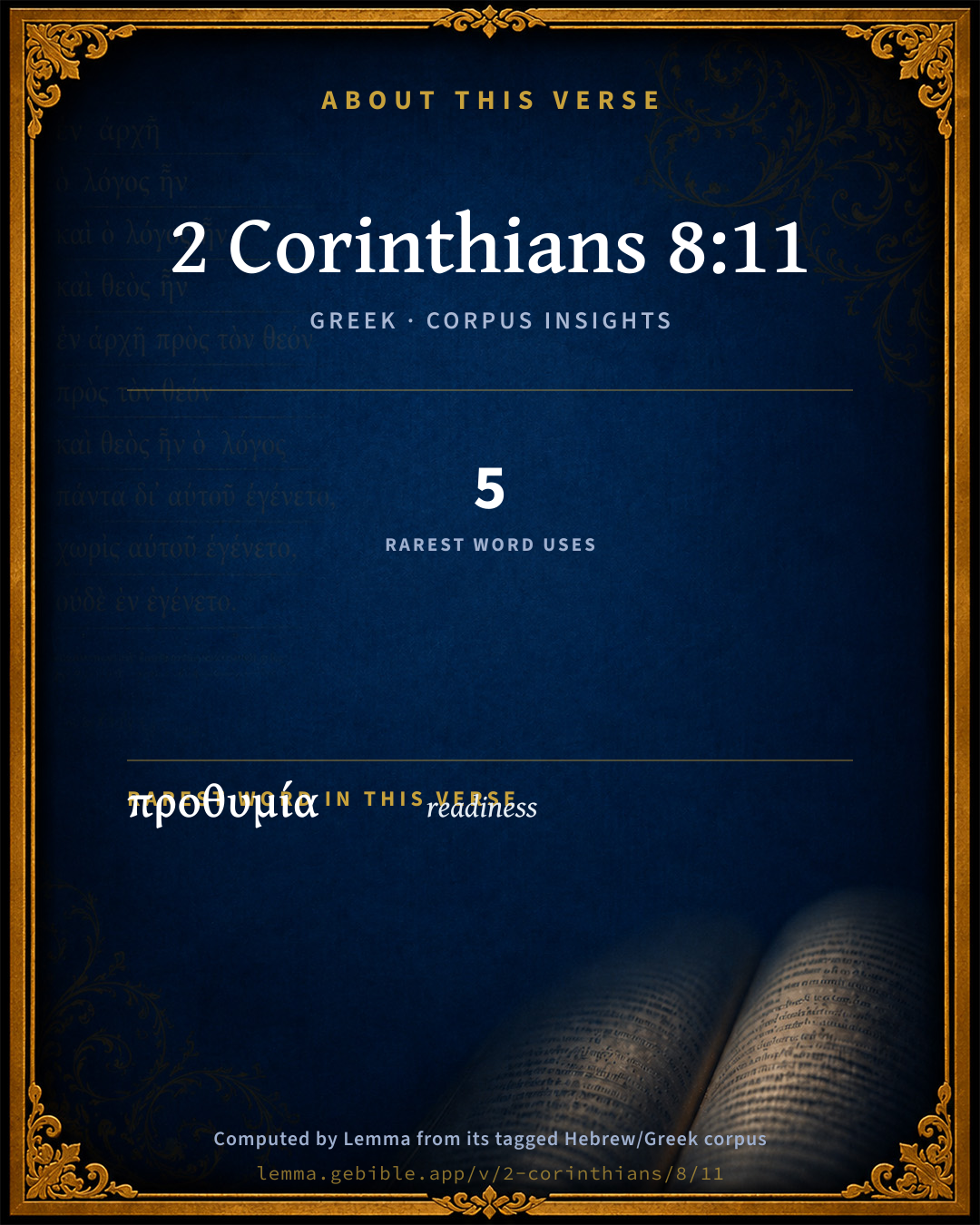
2 Corinthians 8:11

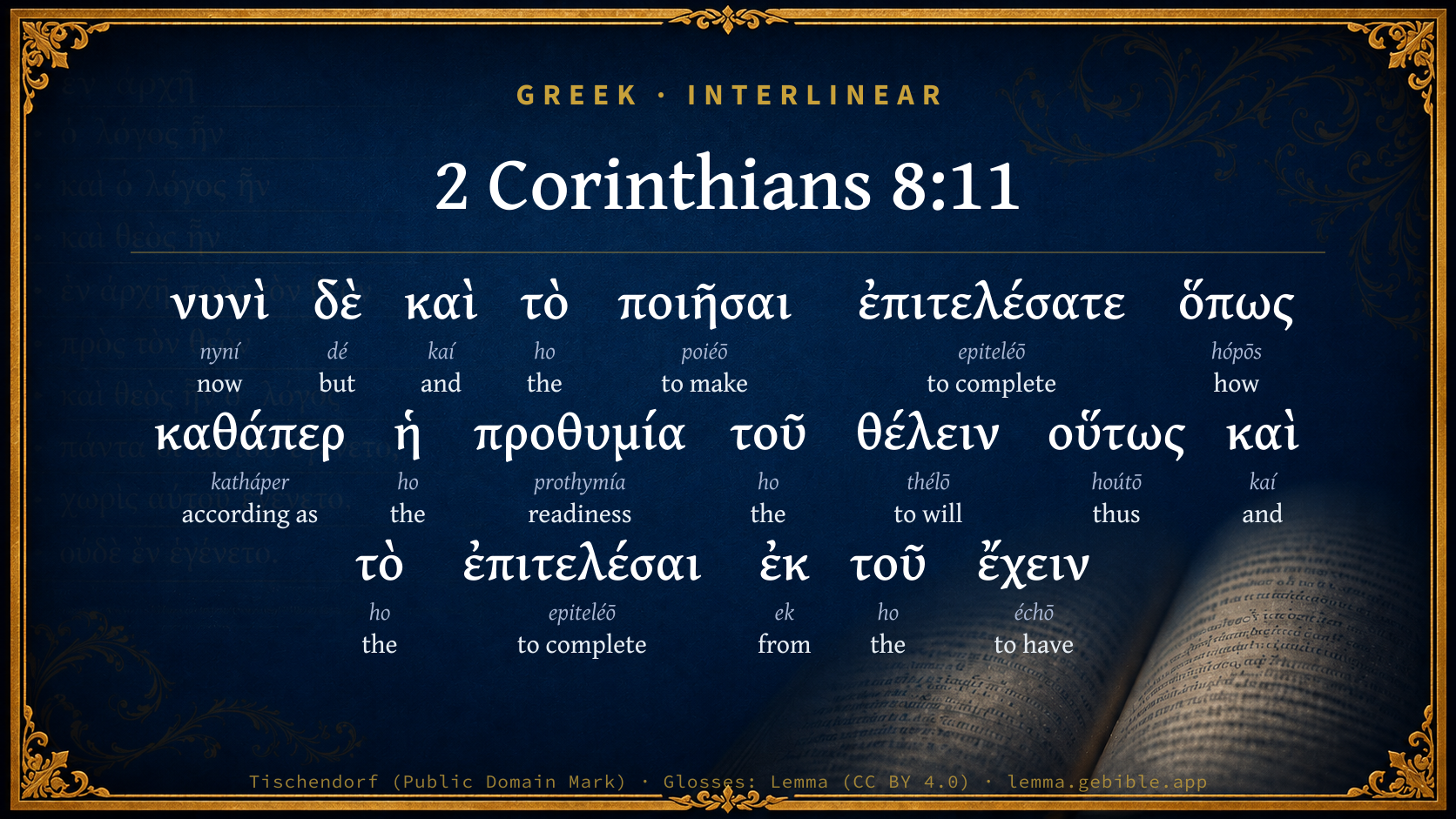
Greek (Tischendorf 8th ed.) 2 Corinthians 8:11 appears in the Greek New Testament. The text above is from the Tischendorf 8th edition. Each word links to its Strong’s number and a concise gloss. Click any word for its full Thayer’s Greek Lexicon entry.
Download image
Cite this verse

2 Corinthians 8:11 (World English Bible). Public Domain. Lemma interlinear Bible study tool, https://lemma.gebible.app/v/2-corinthians/8/11.

Show BibTeX & RIS
BibTeX
RIS
English Translation
But now complete the doing also, that as there was the readiness to be willing, so there may be the completion also out of your ability.
World English Bible · Public Domain
Download a study sheet

One document with this verse’s original text, its word-by-word gloss line, the meaning frame, cross-references with their text, attributed commentary, and full source and license credits — printable, and it pastes into notes with its structure intact.

This verse Autodidact and up

Study sheet (.html) Plain text (.txt)

A passage Seminary Student

Up to 50 verses in one chapter. A passage sheet keeps up to 6 commentary sources and 12 cross-references per verse, in the order this page ranks them, and says so on the sheet whenever that leaves anything out. Ask for a single verse and you get the Autodidact verse sheet above.

Everything on this page stays free to read, with no account — the sheet is a download of what is already on screen, not access to it.

Want to remove ads? Support Godless Engineer
Compare translations 3

The same verse in 3 English versions, stacked beneath the original-language interlinear above. Click any original word for its lexicon entry.

Each is an independent rendering of the whole verse — the interlinear is not word-aligned to these translations.

Highlighted words mark where these versions differ — a whole-verse word diff, not a word-by-word alignment.

  • World English Bible Public Domain
    But now complete the doing also, that as there was the readiness to be willing, so there may be the completion also out of your ability.
  • King James Version Public Domain
    Now therefore perform the doing of it; that as there was a readiness to will, so there may be a performance also out of that which ye have.
  • unfoldingWord Literal Text CC BY-SA 4.0
    But now also complete to do, so that just as the readiness of the desire, so also the completion from what you have.

unfoldingWord Literal Text — © unfoldingWord, licensed CC BY-SA 4.0. Word-aligned USFM3 via Door43 (git.door43.org/unfoldingWord/en_ult).

Versions to compare (up to 4)

3 of 4 selected

Show all 19 translations

Every available English version of this verse, each an independent rendering of the whole verse.

  • World English Bible Public Domain
    But now complete the doing also, that as there was the readiness to be willing, so there may be the completion also out of your ability.
  • Berean Standard Bible Public Domain
    Now finish the work, so that you may complete it just as eagerly as you began, according to your means.
  • Majority Standard Bible Public Domain
    Now finish the work, so that you may complete it with the same eager desire, according to your means.
  • King James Version Public Domain
    Now therefore perform the doing of it; that as there was a readiness to will, so there may be a performance also out of that which ye have.
  • American Standard Version (1901) Public Domain
    But now complete the doing also; that as `there was' the readiness to will, so `there may be' the completion also out of your ability.
  • Revised Version (1885) Public Domain
    But now complete the doing also; that as there was the readiness to will, so there may be the completion also out of your ability.
  • Geneva Bible (1599) Public Domain
    Nowe therefore performe to doe it also, that as there was a readinesse to will, euen so yee may performe it of that which yee haue.
  • Douay-Rheims (1899) Public Domain
    Now therefore perform ye it also in deed; that as your mind is forward to be willing, so it may be also to perform, out of that which you have.
  • Young's Literal Translation Public Domain
    and now also finish doing `it', that even as `there is' the readiness of the will, so also the finishing, out of that which ye have,
  • Literal Standard Version CC BY-SA 4.0
    and now also finish doing [it], that even as [there is] the readiness of the will, so also the finishing, out of that which you have,
  • Unlocked Literal Bible CC BY-SA 4.0
    Now finish it. Just as there was an eagerness and desire to do it then, may you also bring it to completion, as much as you can.
  • unfoldingWord Literal Text CC BY-SA 4.0
    But now also complete to do, so that just as the readiness of the desire, so also the completion from what you have.
  • Darby Bible Public Domain
    But now also complete the doing of it; so that as [there was] the readiness to be willing, so also to complete out of what ye have.
  • World Messianic Bible Public Domain
    But now complete the doing also, that as there was the readiness to be willing, so there may be the completion also out of your ability.
  • Webster's Bible Public Domain
    Now therefore finish the doing of it; that as there was a readiness to will, so there may be a performance also out of that which ye have.
  • Free Bible Version CC BY-SA 4.0
    Now finish what you planned to do. Be as keen to finish as you were to plan, and give as you are able.
  • Bible in Basic English Public Domain
    Then make the doing of it complete; so that as you had a ready mind, you may give effect to it as you are able.
  • Text-Critical English NT CC BY 4.0
    Now finish doing it, so that your eager willingness to give may be matched by your completion of the gift, according to what you have.
  • Tyndale New Testament (1534) Public Domain
    Now therfore performe the dede: that as ther was in you a redines to will even so ye maye performe the dede of that which ye have.

Literal Standard Version (2020), Covenant Press — licensed CC BY-SA 4.0. Text via the HelloAO Bible API (eBible.org). Unlocked Literal Bible (unfoldingWord) — licensed CC BY-SA 4.0. Text via the HelloAO Bible API (eBible.org). unfoldingWord Literal Text — © unfoldingWord, licensed CC BY-SA 4.0. Word-aligned USFM3 via Door43 (git.door43.org/unfoldingWord/en_ult). Free Bible Version, Dr. Jonathan Gallagher — licensed CC BY-SA 4.0. Text via the HelloAO Bible API (eBible.org).

Word by word

More ways to search: Search by grammar → Find every occurrence → Compare this word →

Practice this passage: Drill this verse → Learn its vocabulary →

προθυμία
prothymía
G4288
“readiness”
Noun, Nominative, Singular, Feminine
Part of Speech
Noun
Case
Nominative
Number
Singular
Gender
Feminine
Full Thayer's Definition

Origin: from G4289

TDNT: 17:37,9

1. zeal, spirit, eagerness 2. inclination, readiness of mind
  1. νυνὶ nyní G3570 “now” Adverb
  2. δὲ dé G1161 “but” Conjunction
  3. καὶ kaí G2532 “and” Conjunction
  4. τὸ ho G3588 “the” Article, Accusative, Singular, Neuter
  5. ποιῆσαι poiéō G4160 “to make” Verb, Aorist, Active, Infinitive
  6. ἐπιτελέσατε epiteléō G2005 “to complete” Verb, Aorist, Active, Imperative, 2nd person, Plural
  7. ὅπως hópōs G3704 “how” Adverb
  8. καθάπερ katháper G2509 “according as” Adverb
  9. ἡ ho G3588 “the” Article, Nominative, Singular, Feminine
  10. τοῦ ho G3588 “the” Article, Genitive, Singular, Neuter
  11. θέλειν thélō G2309 “to will” Verb, Present, Active, Infinitive
  12. οὕτως hoútō G3779 “thus” Adverb
  13. καὶ kaí G2532 “and” Conjunction
  14. τὸ ho G3588 “the” Article, Nominative, Singular, Neuter
  15. ἐπιτελέσαι epiteléō G2005 “to complete” Verb, Aorist, Active, Infinitive
  16. ἐκ ek G1537 “from” Preposition
  17. τοῦ ho G3588 “the” Article, Genitive, Singular, Neuter
  18. ἔχειν échō G2192 “to have” Verb, Present, Active, Infinitive

About this verse

These counts appear in no published source. They are computed here, from the morphology-tagged text and Lemma’s own curated glosses. What Lemma adds →

19
words
13
distinct lemmas
Pauline Epistles
section

Notable vocabulary

The rarest word here is προθυμία readiness G4288 — appearing just 5 times in the whole Greek New Testament.

Shared distinctive vocabulary

προθυμία readiness G4288 occurs in 5 verses of the Greek New Testament. Also found in:

Repetition

Words recur within this verse:

  • ἐπιτελέσατε to complete G2005 ×2
  • τὸ the G3588 ×5
  • καὶ and G2532 ×2

Cross-references

1

Topical passages linked to 2 Corinthians 8:11 in the Treasury of Scripture Knowledge — connected by theme and wording, ordered by reader-vote popularity; previews shown in the World English Bible.

  • 2 Corinthians 9:2 for I know your readiness, of which I boast on your behalf to them of Macedonia, that Achaia has been prepared for a year past. Your zeal has stirred up very many of them.

Cross-references courtesy of OpenBible.info (CC BY 4.0).

Commentary

Notes on 2 Corinthians 8:11 from classic Christian and Jewish commentators (each source and its license shown beneath its notes). The classic Christian expositions comment on the surrounding passage and are grouped to its opening verse, so a note may address several verses; the Jewish commentaries on the Tanakh (Rashi and others) are per-verse, so they appear only where the commentator wrote on this verse.

Lemma curates 59 commentaries, every one of them public domain or Creative Commons licensed, each selected and text-cleaned for this edition rather than reprinted as found. About our sources →

MacLaren's Expositions of Holy Scripture

Alexander MacLaren

2 Corinthians

WILLING AND NOT DOING

2Co 8:11

The Revised Version reads: ‘But now complete the doing also; that as there was the readiness to will, so there may be the completion also out of your ability.’ A collection of money for the almost pauper church at Jerusalem bulked very largely in the Apostle’s mind at the date of the writing of the two letters to the Corinthian church. We learn that that church had been the first to agree to the project, and then had very distinctly hung back from implementing its promises and fulfilling its good intentions. So the Apostle, in the chapter from which my text is taken, with wonderful delicacy, dignity, and profundity, sets forth the true principle, not only of Christian giving, but of Christian asking. The text advises that the gushing sentiments of brotherly sympathy and liberality which had inspired the Corinthians a year ago should now bear some fruit in action. So Paul is going to send Titus, his right-hand man at the time, to hurry up and finish off the collection and have done with it. The text is in effect the message which Titus was to carry; but it has a far wider application than that. It is a needful advice for us all about a great many other things: ‘As there was a readiness to will, so let there be a performance also.’

Resolutions, noble and good and Christlike, have a strange knack of cheating the people who make them. So we all need the exhortation not to be befooled by fancying that we have done, when we have only willed. Of course we shall not do unless we will. But there is a wide gap, as our experience witnesses, between the two things. We all know what place it is to which, according to the old proverb, the road is paved with good intentions; and the only way to pull up that paving is to take Paul’s advice here and always, and immediately to put into action the resolves of our hearts. Now I desire to say two or three very plain and simple things about this matter.

I. I would have you consider the necessity of this commandment.

Consider that the fault here warned against is a universal one. What different men we should be if our resolutions had fruited in conduct! In all regions of life that is true, but most emphatically is it true in regard to religion. The damning tragedy of many lives, and I dare say of those of some of my hearers, is that men have over and over again determined that they would be Christians, and they are not Christians yet; just because they have let ‘the native hue of resolution be sicklied over’ by some paleness or other, and so have resolved and resolved and resolved till every nerve of action is rotted away, and they will die unchristian. I dare say that there are men or women listening to me now, perhaps with grey hairs upon them, who can remember times, in the springtide of their youth, when they said, ‘I will give my heart to Jesus Christ, and set my faith upon Him’; and they have not done it yet. Now, therefore, ‘as there was a readiness to will, let there be also the performance.’

But it is not only in regard to that most important of all resolves that I wish to say a word. All Christians, I am sure, know what it is, over and over again, to have had stirrings in their hearts which they have been able to consolidate into determination, but have not been able to carry into act. ‘The children have come to the birth, and there is not strength to bring them forth.’ That is true about all of us, more or less, and it is very solemnly true of a great many of us professing Christians. We have tried to cure--we have determined that we will cure--manifest and flagrant defects or faults in our Christian life. We have resolved, and some nipping frost has come, and the blossoms have dropped on the grass before they have ever set into fruit. I know that is so about you, because I know that it is so about myself. And therefore, dear brethren, I appeal to you, and ask you whether the exhortation of my text has not a sharp point for every one of us--whether the universality of this defect does not demand that we all should gravely consider the exhortation here before us?

Then, again, let me remind you how this injunction is borne in upon us by the consideration of the strength of the opposition with which we have always to contend, in every honest attempt to bring to act our best resolutions. Did you ever try to cure some little habit, some mere trifle, a trick of manner or twist of the finger, or some attitude or tone that might be ugly and awkward, and that people told you that it would be better to get rid of? You know how hard it is. There is always a tremendous gulf between the ideal and its realisation in life. As long as we are moving _in vacuo_ we move without any friction or difficulty; but as soon as we come out into a world where there are an atmosphere and opposing forces, then friction comes in, and speed diminishes; and we never become what we aim to be. We begin with grand purposes, and we end with very poor results. We all start, in our early days, with the notion that our lives are going to be radiant and beautiful, and all unlike what the limitations of power and the antagonisms that we have to meet make of them at last. The tree of our life’s doings has to grow, like those contorted pines on the slopes of the Alps, in many storms, with heavy weights of snow on its branches, and beaten about by tempests from every quarter of the heavens; and so it gets gnarled and knotted and very unlike the symmetrical beauty that we dreamed would adorn it. We begin with saying: ‘Come! Let us build a tower whose top shall reach to heaven’; and we are contented at last, if we have put up some little tumble-down shed where we can get shelter for our heads from the blast.

And the difficulty in bringing into action our best selves besets us in the matter of translating our resolutions into practice. What are arrayed against it? A feeble will, enslaved too often by passions and flesh and habits, and all about us lie obstacles to our carrying into action our conscientious convictions, our deepest resolutions; obstacles to our being true to our true selves; to which obstacles, alas, far too many of us habitually, and all of us occasionally, succumb. That being the case, do not we all need to ponder in our deepest hearts, and to pray for grace to make the motto of our lives, ‘As there was a readiness to will, let there be a performance’?

II. Consider the importance of this counsel.

That is borne in upon mind and conscience by looking at the disastrous effects of letting resolutions remain sterile. Consider how apt we are to deceive ourselves with unfulfilled purposes. The quick response which an easily-moved nature may make to some appeal of noble thought or lofty principle is mistaken for action, and we are tempted to think that willing is almost as good as if we had done what we half resolved on. And there is a kind of glow of satisfaction that comes when such a man thinks, ‘I have done well in that I have determined.’ The Devil will let you resolve as much as you like--the more the better; only the more easily you resolve, the more certainly he will block the realisation. Let us take care of that seducing temptation which is apt to lead us all to plume ourselves on good resolutions, and to fancy that they are almost equivalent to their own fulfilment. Cheques are all very well if there be bullion in the bank cellars to pay them with when they fall due, but if that be not so, then the issuing of them is crime and fraud. Our resolutions, made and forgotten as so many of our good resolutions are, are very little better.

Note, too, how rapidly the habit of substituting lightly-made resolutions for seriously-endeavoured acts grows.

And mark, further, how miserable and debilitating it is to carry the dead weight of such unaccomplished intentions.

Nothing so certainly weakens a man as a multitude of resolves that he knows he has never fulfilled. They weaken his will, burden his conscience, stand in the way of his hopes, make him feel as if the entail of evil was too firm and strong to be ever broken. ‘O wretched man that I am!’ said one who had made experience of what it was to will what was good, and not to find how to perform, ‘who shall deliver me from the body of this death?’ It is an awful thing to have to carry a corpse about on your back. And that was what Paul thought the man did who loaded his own shoulders with abortive resolutions, that perished in the birth, and never grew up to maturity. Weak and miserable is always the man who is swift to resolve and slow to carry out his resolutions.

III. And now let me say a word before I close about how this universal and grave disease is to be coped with.

Well, I should say to begin with, let us take very soberly and continually into our consciousness the recognition of the fact that the disease is there. And then may I say, let us be rather slower to resolve than we often are. ‘Better is it that thou shouldest not vow than that thou shouldest vow and not pay.’ The man who has never had the determination to give up some criminal indulgence--say, drink--is possibly less criminal, and certainly less weak, than the man who, when his head aches, and the consequences of his self-indulgence are vividly realised by him, makes up his mind to be a teetotaller, and soon stumbles into the first dram-shop that is open, and then reels out a drunkard. Do not vow until you have made up your minds to pay. Remember that it is a solemn act to determine anything, especially anything bearing on moral and religious life; and that you had far better keep your will in suspense than spring to the resolution with thoughtless levity and leave it with the same.

Further, the habit of promptly carrying out our resolves is one that, like all other habits, can be cultivated. And we can cultivate it in little things, in the smallest trifles of daily life, which by their myriads make up life itself, in order that it may be a fixed custom of our minds when great resolves have to be made. The man who has trained himself day in and day out, in regard to the insignificances of daily life, to let act follow resolve as the thunder peal succeeds the lightning flash, is the man who, if he is moved to make a great resolve about his religion, or about his conduct, will be most likely to carry it out. Get the magical influence of habit on your side, and you will have done much to conquer the evil of abortive resolutions.

But then there is something a great deal more than that to be said. The Apostle did not content himself, in the passage already referred to, with bewailing the wretchedness of the condition in which to will was present, but how to perform he found not. He asked, and he triumphantly answered, the question, ‘Who shall deliver me?’ with the great words, ‘I thank God through Jesus Christ our Lord.’ There is the secret; keep near Him, trust Him, open your hearts to the influences of that Divine Spirit who makes us free from the law of sin and death. And if thus, knowing our weakness, recognising our danger, humbly trying to cultivate the habit of prompt discharge of all discerned duty, we leave ourselves in Jesus Christ’s hands, and wait, and ask, and believe that we possess, His cleansing Spirit, then we shall not ask and wait in vain. ‘Work out your own salvation, . . . for it is God that worketh in you, both the willing and the doing.’

Alexander MacLaren, Expositions of Holy Scripture (1904–1910) — public domain. Text from a community e-Sword module.

Bengel's Gnomon

Johann Albrecht Bengel

2Co 8:11. Τὸ ποιῆσαι, the doing) that you may do again.—ἐπιτελέσατε, perform) The beginning and especially the end of actions lays the foundation of praise or else blame, Gen 11:6; Jos 6:26; Jer 44:25.—ὅπως, that) namely, it may be.—ἐκ τοῦ ἔχειν, out of that which you have) not more. The proposition [theme for discussion] in relation to what follows.

Bengel's Gnomon of the New Testament — English translation (T&T Clark, Edinburgh, 1860) — public domain. Text from a community e-Sword module.

Meyer's Critical & Exegetical Commentary

Heinrich August Wilhelm Meyer

2Co_8:11. The καί before τὸ ποιῆσαι can only belong to it, and not to ἐπιτελ. also (de Wette, Hofmann). It is the simple accessory also; as in 2Co_8:10 the thought proceeded backwards from doing to willing, now it proceeds forwards from willing to doing, so that at the bottom of καὶ τὸ ποιῆσαι there lies the conception: Now, however, bring not merely the willing, but also the doing to completion. This is an analysis of the elements, which in reality coincide (for the ἐπιτελέσαι of the willing is the actual execution), occasioned, however, very naturally by the juxtaposition in 2Co_8:10, and giving rise to no misconception her.

ὅπως καθάπερ κ.τ.λ.] in order that as the inclination of the willing, so also the completion (of that, which ye will) may be according to means, i.e. in order that the actual execution of that, which you will, may not remain out of proportion to the inclination of your will, but, like the latter, may be accordant with your means. As it is the inclination of your will to contribute according to the standard of your possessing, the execution of this willingness should take place according to the same standar.

οὕτω καὶ τὸ ἐπιτελέσαι] sc. ᾖ. The supplying the subjunctive of εἰμι is not linguistically inadmissible (Rückert), and is found already in Homer (Il. i. 547, and Nägelsb. in loc.), but it is certainly rare in Greek writers. Comp. 2Co_8:13. See Bernhardy, p. 330 f.; Buttmann, neut. Gramm. p. 120 [E. T. 137].

ἐκ τοῦ ἔχειν] belongs to both subjects of the clause of purpose: in pursuance of the having, according to your means. See Fritzsche, Quaest. Luc. p. 179 f. Comp. expressions like ἐκ τῶν παρόντων, ἐκ τῶν ὑπαρχόντων, and the like. Ἐκ is not to be taken in the sense of the origin, as Hofmann wishes; for it would, in fact, be an indelicate and bad compliment to the inclination of the readers, that it had originated from their possession. Paul himself indicates afterwards by καθό in what meaning he uses ἐκ.

Meyer — Critical and Exegetical Commentary on the New Testament — English translation by Peter Christie, edited by Frederick Crombie (T&T Clark, 1880) — public domain. Text from a community e-Sword module.

Expositor's Greek Testament

ed. W. Robertson Nicoll

2Co 8:11 . νυνὶ δὲ κ . τ . λ .: but now complete the doing also, that as there was the readiness to will, so there may be also the completion in accordance with your ability : ἐκ τοῦ ἐχεῖν = καθὸ ἄν ἔχῃ of 2Co 8:12 = pro facultatibus ( cf. Joh 3:34 , ἐκ μέτρου ), and not, as A.V., “out of that which ye have”.

The Expositor's Greek Testament, edited by W. Robertson Nicoll (1897–1910) — public domain. Text from a community e-Sword module.

Jamieson, Fausset & Brown

Robert Jamieson, A. R. Fausset & David Brown

perform--"complete the doing also" (see on Co2 8:10).

a readiness to will--Greek, "the readiness of will"; referring to Co2 8:10, where the Greek for "to be forward," ought to be translated as here, "to will."

performance--"completion" [ALFORD], The godly should show the same zeal to finish, as well as to begin well, which the worldly exhibit in their undertakings (Jer 44:25).

Jamieson, Fausset & Brown — Commentary Critical and Explanatory on the Whole Bible (1871) — public domain (CC PDM 1.0). Text via the HelloAO Bible API.

Adam Clarke's Commentary

Verse 11. A readiness to will, so there may be a performance] Ye have willed and purposed this; now perform it.

Out of that which ye have.] Give as God has enabled you; and give as God has disposed you. He requires each man to do as he can; and accepts the will where the means are wanting to perform the deed.

Adam Clarke's Commentary on the Bible (1810–1826) — public domain. Text from a community e-Sword/MySword module.

John Calvin's Commentaries

11. Now what ye have begun to do. It is probable, that the ardor of the Corinthians had quickly cooled down: otherwise they would, without any delay, have prosecuted their purpose. The Apostle, however, as though no fault had as yet been committed, gently admonishes them to complete, what had been well begun.

When he adds — from what you have, he anticipates an objection; for the flesh is always ingenious in finding out subterfuges. Some plead that they have families, which it were inhuman to neglect; others, on the ground that they cannot give much, make use of this as a pretext for entire exemption. Could I give so small a sum? All excuses of this nature Paul removes, when he commands every one to contribute according to the measure of his ability. He adds, also, the reason: that God looks to the heart — not to what is given, for when he says, that readiness of mind is acceptable to God, according to the individual’s ability, his meaning is this — “If from slender resources you present some small sum, your disposition is not less esteemed in the sight of God, than in the case of a rich man’s giving a large sum from his abundance. (Mark 12:44.) For the disposition is not estimated according to what you have not, that is, God does by no means require of thee, that thou coldest contribute more than thy resources allow.” In this way none are excused; for the rich, on the one hand, owe to God a larger offering, and the poor, on the other hand, ought not to be ashamed of their slender resources.

John Calvin's Commentaries (1540-1563) — public domain. Text from the Calvin Translation Society English edition (1840s-50s) via the Christian Classics Ethereal Library (ccel.org). Calvin's coverage is partial (roughly two-thirds of the Bible); uncommented books and verses are honest gaps, never fabricated. The 19th-century editor's footnotes and remarks are omitted so the notes are faithfully Calvin's own voice.

Ellicott's Commentary for English Readers

(11) Now therefore perform the doing.—Better, complete the doing: to “perform the doing” being open, in the modern use of the word, to the charge of tautology. All the English versions, however, have “perform.” The three stages are distinctly marked out in St. Paul’s mind:—(1) Willing the purpose to give; in this they had shown readiness. (2) Setting about the work of giving; this Titus had reported, (3) Completing the work; this he now urged upon them, so that it might answer to the beginning.

A Bible Commentary for English Readers, edited by Charles John Ellicott (1878–1897) — public domain. Text from a community e-Sword module.

The Cambridge Bible for Schools and Colleges

gen. ed. J. J. S. Perowne

11. Now therefore perform the doing of it] The words perform, performance, in this verse should rather be rendered complete, completion. See ch. 2Co_7:1, where the participle of the same verb is rendered perfecting, also 2Co_8:6 of this chapter. The sense is, ‘you made a resolution last year to do a certain work. Carry out that resolution now, and let the completion of the task bear witness, as far as your ability goes, to the genuineness of the resolution you then made.’

out of that which you have] i.e. according to your means. See note on 2Co_8:2.

The Cambridge Bible for Schools and Colleges (gen. ed. J. J. S. Perowne; Cambridge University Press, 1878–1918) — public domain. Text from a community e-Sword module.

John Gill's Exposition

Now therefore perform the doing of it,.... This is a conclusion from the former advice, to finish what was readily willed; for as it is not enough to do a thing, unless it is done cheerfully and willingly, so it is not sufficient to express a good will to such service as is here called to, without doing it; both should go together:

that as there was a readiness to will, so there may be a performance also; in some cases there is neither power nor will to do good; in others there is will, when there is not a power; but in this case of beneficence to the poor saints, as there was a willingness declared, there was an ability in the Corinthians to perform; they had it in the power of their hands, more or less, to act: and the apostle in the last clause of this verse points out the rule and measure of their liberality,

out of that which you have; according to your abilities, and as God has prospered you; and with which he shuts up the mouths of all objectors, rich and poor: should the rich say, would you have us give away all we have? the answer is, no; but "out of that which you have", something of it, according as you are able; should the poorer sort say, we are in mean circumstances, we have families to provide for, and can spare little, and what we can do is so trifling, that it is not worth giving or accepting; the reply is, give "out of that which you have", be it less or more; it follows,

John Gill's Exposition of the Whole Bible (1746–1763) — public domain (CC PDM 1.0). Text via the HelloAO Bible API.

Trapp's Complete Commentary

John Trapp

11 Now therefore perform the doing of it; that as there was a readiness to will, so there may be a performance also out of that which ye have.

Ver. 11. Now therefore perform] Unless our willing of good be seconded with endeavour, it is nothing worth. Balaam wished well to heaven; so did he that came kneeling to our Saviour with Good master, &c.; but; they stuck at the hardship of holiness, without which there is no heaven to be had; they would not come off here, and therefore got nothing by their short winded wishes. Solomon compares such sluggards to the door that turns on the hinges, but yet hangs still upon them, it comes not off for all the turnings. Their purposes without performances are like a cloud without rain; and not unlike Hercules’ club in the tragedy, of a great bulk, but stuffed with moss and rubbish. Virtutem expotant contabescuntque relicta. (Peri.)

John Trapp, A Commentary or Exposition upon All the Books of the Old and New Testament (1647–1656) — public domain. Text from a community e-Sword module.

Albert Barnes' Notes on the Bible

As there was a readiness to will - Now accomplish the thing, and be not satisfied with having begun it. Do not suppose that the intention was sufficient, or that you are now released from the obligation. A year indeed has elapsed; but the necessity of the aid for the poor has not ceased. The sentiment here is, that if we have felt it our duty to aid in a cause of benevolence, and have commenced it, and have then been interrupted in executing our purpose, we should seize the first favorable opportunity to accomplish what we had designed. We should not regard ourselves as released from our obligation, but should, from a regard to consistency and our obligation to God, accomplish what we had intended.

Out of that which ye have - According to your ability; see 2Co 8:12. It should be in proportion to your means.

Albert Barnes' Notes on the Bible (1834–1885) — public domain. Text from a community e-Sword/MySword module.

Matthew Poole's English Annotations

Ye showed yourselves some time since free to will the thing which I am now pressing you unto, you have now opportunity to do it, and the example of other churches going before you in the doing of it; show yourselves now constant by

the doing of it; that seeing God hath given you something of this world’s goods, and that in proportions beyond your poor brethren, as you pretended a great readiness a great while since to relieve them, so you may by your performance justify that it was not all a mere pretence.

Matthew Poole's English Annotations on the Holy Bible (1683–1685) — public domain. Text from a community e-Sword/MySword module.

Whedon's Commentary on the Bible

Daniel D. Whedon

11. Perform—Finish, complete the actual doing. Let not the performance merge into a mere readiness to will. There are a great many who are always ready to do good, but somehow their good never gets done. Paul wants not the readiness but the money.

Daniel D. Whedon (gen. ed.), Commentary on the Old and New Testaments (1874–1909) — public domain. Text from a community e-Sword module.

The Pulpit Commentary

Now therefore perform the doing of it, etc.; "but now complete also the actual work, in order that, as was the readiness of the willing, so may be also the completion according to your means." Out of that which ye have. This, and not "out of your ability," is probably the right reading, as we see from the next verse.

The Pulpit Commentary (1880–1919), ed. H.D.M. Spence-Jones & Joseph S. Exell — public domain. Text from a community e-Sword module.

Kretzmann's Popular Commentary

Paul E. Kretzmann

The principle of equality:

v. 11. Now, therefore, perform the doing of it, that, as there was a readiness to will, so there may be a performance also out of that which ye have.

v. 12. For if there be first a willing mind, it is accepted according to that a man hath, and not according to that he hath not.

v. 13. For I mean not that other men be eased and ye burdened;

v. 14. but by an equality, that now, at this time, your abundance may be a supply for their want, that their abundance also may be a supply for your want; that there may be equality,

v. 15. as it is written, he that had gathered much had nothing over, and he that had gathered little had no lack.

Paul’s advice is no less effective because it lacks the force of a definite commandment; it rather gains in power by that very fact. For he points out to the Corinthian Christians that they had expressed their willingness to participate in the collection; they had made the necessary preliminary arrangements: what more logical than to expect, then, that they give evidence of their good intentions in a more substantial manner. Therefore Paul says: But now complete the doing also, that, as there was the readiness to will, so there may be a finishing also from that which you have. The matter of the collection was becoming more pressing and urgent every day, and since they were undoubtedly sincere in their intention of doing their share toward the alleviation of suffering in Jerusalem, they should make all speed in bringing forth concrete evidence of their purpose. They should bring the matter to an end by quick and definite action, and their performance should correspond with their willingness: they should contribute freely according to their ability; for God accepts the good will where the means are wanting to perform the deed. Or, as Paul himself explains it: For if the readiness is present, in accordance with what a man has is he acceptable, not in accordance to what he has not. God looks upon the willingness of the heart, Mar 12:43, and gauges the gift by that standard. The princely sum which a wealthy man gives from his abundance may be relatively smaller than the copper coin which may mean hardship and sacrifice to a poor widow.

This idea is now further illustrated: For it is not that there may be a relief to others and pressure to you, but to obtain equality, your plentiful supply at the present time being for their want, in order that their plentiful supply may prove to be for your want, that there may be equality. This sentence is added principally for the sake of the unwilling, grumbling contributor, whose complaint usually is that he is becoming poor in giving for others, whom he presumes to be rolling in wealth on account of his contributions. Paul’s purpose was not at all to have the congregation at Jerusalem sit back in carelessness and enjoy the gifts which poured in from the congregations in Asia, Macedonia, and Achaia, while the latter should be oppressed with care as a result of giving beyond their means. He was simply advocating the principle of equality, of reciprocity. As things were, the congregations that were engaged in this collection were able to provide help for the poor at Jerusalem, and therefore they should be willing to offer such assistance; the time might come when matters would be reversed, and then he would expect the Christians of Jerusalem and Judea to make a return in kind. The same principle is followed to this day. If a failure of crops strikes certain congregations, or if they are visited by destructive storms and find themselves unable either to sustain life or to rebuild their church property by their own efforts, it is proper that the other congregations should come to their assistance.

Paul illustrates this principle by a quotation from the Scriptural account of the collection of the manna in the wilderness: As it is written, He [that gathered] much had nothing over, and he [that gathered] little was not wanting, Exo 16:18. When the Lord gave the children of Israel manna to eat in the wilderness, the more energetic gathered a larger supply, while others were not able to bring so much back to camp. And yet the needs of the individual families differed with their size. But the difference was straightened out upon their return to camp, with the result that every family had enough manna for its needs till the next day. Just so within the congregations the Lord wants the surplus of the one to assist the lack in the other, and whenever there is need in any one section of the country, or wherever the work of the Gospel is being carried on, the congregations in the other sections should show their willingness to heed the principle here laid down for their guidance.

Paul E. Kretzmann, Popular Commentary of the Bible (1921–1924) — public domain. Text from a community e-Sword module.

McGarvey & Pendleton's Commentaries

J. W. McGarvey

But now complete the doing also; that as there was the readiness to will, so there may be the completion also out of your ability .

J. W. McGarvey (with Philip Y. Pendleton), Commentaries on the New Testament (The Fourfold Gospel, 1914; Acts; and the epistles) — public domain. Text from a community e-Sword/MySword module.

The People's New Testament

B. W. Johnson

11. Therefore, perform the doing of it. Finish it up. As there was “a readiness to will,” let there be “a performance” by giving out of what “you have.”

B. W. Johnson's The People's New Testament with Notes (1889–1891) — public domain. Electronic text from the Christian Classics Ethereal Library (CCEL) ThML edition.

Cambridge Greek Testament for Schools and Colleges

11. νυνὶ δὲ καὶ τὸ ποιῆσαι ἐπιτελέσατε. But now complete the doing also, that as there was the readiness to will, so there may be the completion also according to your means. Νυνί is more precise than νῦν, and here is in emphatic contrast to ἀπὸ πέρυσι: in the N.T. twice in Acts, twice in Hebrews, and 18 times in the Pauline Epistles. That ἐκ τοῦ ἔχειν does not mean ‘out of that which ye have,’ but in proportion to what ye have,’ is shown by 2Co 8:12. Comp. οὐ γὰρ ἐκ μέτρου δίδωσι (Joh 3:34). He does not say, Give παρὰ δύναμιν (2Co 8:3).

Cambridge Greek Testament for Schools and Colleges (Cambridge University Press, 1896; 21 vols, various authors incl. Carr, Maclear, Plummer, Farrar, Lumby, Moule, M. R. James, Simcox) — public domain. Text from a community e-Sword module.

Alford’s Greek Testament

Henry Alford

11.] But (contrast of your former zeal with your present need to be reminded of it) now complete the act itself also (καί can hardly apply to the whole τὸ ποι. ἐπιτ., as De Wette, but must be taken with ποιῆσαι; now shew not only the completion of a ready will in the act begun, but complete the act also,—as Meyer), that, as (there was) (with you) readiness of will, so (there may) also (be) completion according to your means (ἐκ τοῦ ἔχειν, not ‘out of that which ye have,’ as E. V., but ‘after the measure of your property,’ as in ref. The verbs substantive must be supplied, as in ver. 13).

Henry Alford, The Greek Testament (1849–1861) — public domain. Text from a community e-Sword module.

International Critical Commentary

11. νυνὶ δὲ καὶ τὸ ποιῆσαι ἐπιτελέσατε. ‘But now complete the doing also, that as there [was] the readiness to will, so there may be the completion also according to your means.’ It would be a sad thing that those who were foremost in willing should be hindermost in performing; they must bring their performance into line with their willingness. There is no verb expressed with καθάπερ ἡ προθυμία τοῦ θέλειν. We may supply either ‘was’ or ‘is.’ Each Corinthian would know whether he still possessed this προθυμια. The stronger form νυνί intimates that there should be no more delay; ‘precisely now and not later.’ It is rare else where in N.T., but freq. in Paul, generally as here in the usual temporal sense, but sometimes logical, as 1Co 13:13; cf. Heb. 9:29.

ἐκ τοῦ ἔχειν. Ambiguous; it might mean ‘out of that which ye have’ (AV); which has little point: if they give, it must be out of what they possess. The next verse shows that it mean’s ‘in proportion to what you possess.’ Evidently the readiness to give had for some time not been very great, certainly not since the rupture between the Apostle and the Corinthians, and now he does not wish to alarm them. He had put before them the example of the Macedonians, who had given ‘beyond their means’ (v. 3). He assures the Corinthians that he is not suggesting that they ought to give beyond their means; but they no doubt see that they ought to give, and he urges them to do so without further delay. Excepting Act 17:11, προθυμία is peculiar to 2 Cor. (vv. 12, 19, 9:2).

International Critical Commentary — older volumes (1896–1929), various authors — public domain. Text from a community e-Sword module.

Vincent's Word Studies in the New Testament

Marvin R. Vincent

Out of that which ye have [εκ του εχειν] . Wrong. Meyer justly remarks that it would be an indelicate compliment to the inclination of the readers, that it had originated from their possession. Render, according to your ability; better than Rev. out of your ability.

Marvin R. Vincent, Word Studies in the New Testament (1887–1900) — public domain. Text from a community e-Sword/MySword module.

Lesson kit

Teaching starters — assembled from the data on this page, not authored interpretation. Every prompt links to the verse data it draws on. Edit before teaching.

2 Corinthians, in the Pauline Epistles, opens this verse with 19 words (13 distinct Greek lemmas). Its most distinctive word is prothymía (“readiness”). A historical commentator’s framing appears above. Read the whole chapter for the surrounding context.

Discussion questions

  1. What does “readiness” (prothymía) contribute to the verse as a whole?
  2. Acts 17:11 shares the word «readiness» with this verse. How do the two illuminate each other?
  3. “to complete” occurs 2× in this one verse. What is the effect of the repetition?
  4. The translations on this page render this verse differently — a whole-verse word diff, not a word-by-word alignment. What might account for the different wordings?
  5. Reading how MacLaren's Expositions of Holy Scripture and Bengel's Gnomon read this verse, where do the two commentators agree and where do they part?

Things to notice

  • These translations choose different wording for 19 words in this verse.
  • “to complete” occurs 2× in this single verse.
  • 13 distinct Greek lemmas span 19 words in this verse.

Reading settings

Reading text

Shown beneath each verse's original-language words.

Old Testament
Old Testament edition

Read the OT as the Masoretic Hebrew (MT) or the Greek Septuagint (LXX).

English shown for the Greek Septuagint (in the Hebrew ↔ Greek comparison).

Comparing translations? Open the Compare panel on any verse page to stack up to four side by side.