1 Peter 2:15

Greek (Tischendorf 8th ed.) 1 Peter 2:15 appears in the Greek New Testament. The text above is from the Tischendorf 8th edition. Each word links to its Strong’s number and a concise gloss. Click any word for its full Thayer’s Greek Lexicon entry.
Download image
Cite this verse

1 Peter 2:15 (World English Bible). Public Domain. Lemma interlinear Bible study tool, https://lemma.gebible.app/v/1-peter/2/15.

Show BibTeX & RIS
BibTeX
RIS
English Translation
For this is the will of God, that by well-doing you should put to silence the ignorance of foolish men:
World English Bible · Public Domain
Download a study sheet

One document with this verse’s original text, its word-by-word gloss line, the meaning frame, cross-references with their text, attributed commentary, and full source and license credits — printable, and it pastes into notes with its structure intact.

This verse Autodidact and up

Study sheet (.html) Plain text (.txt)

A passage Seminary Student

Up to 50 verses in one chapter. A passage sheet keeps up to 6 commentary sources and 12 cross-references per verse, in the order this page ranks them, and says so on the sheet whenever that leaves anything out. Ask for a single verse and you get the Autodidact verse sheet above.

Everything on this page stays free to read, with no account — the sheet is a download of what is already on screen, not access to it.

Want to remove ads? Support Godless Engineer
Compare translations 3

The same verse in 3 English versions, stacked beneath the original-language interlinear above. Click any original word for its lexicon entry.

Each is an independent rendering of the whole verse — the interlinear is not word-aligned to these translations.

Highlighted words mark where these versions differ — a whole-verse word diff, not a word-by-word alignment.

  • World English Bible Public Domain
    For this is the will of God, that by well-doing you should put to silence the ignorance of foolish men:
  • King James Version Public Domain
    For so is the will of God, that with well doing ye may put to silence the ignorance of foolish men:
  • unfoldingWord Literal Text CC BY-SA 4.0
    For this is the will of God: doing good to silence the ignorance of the foolish people;

unfoldingWord Literal Text — © unfoldingWord, licensed CC BY-SA 4.0. Word-aligned USFM3 via Door43 (git.door43.org/unfoldingWord/en_ult).

Versions to compare (up to 4)

3 of 4 selected

Show all 19 translations

Every available English version of this verse, each an independent rendering of the whole verse.

  • World English Bible Public Domain
    For this is the will of God, that by well-doing you should put to silence the ignorance of foolish men:
  • Berean Standard Bible Public Domain
    For it is God’s will that by doing good you should silence the ignorance of foolish men.
  • Majority Standard Bible Public Domain
    For it is God’s will that by doing good you should silence the ignorance of foolish men.
  • King James Version Public Domain
    For so is the will of God, that with well doing ye may put to silence the ignorance of foolish men:
  • American Standard Version (1901) Public Domain
    For so is the will of God, that by well-doing ye should put to silence the ignorance of foolish men:
  • Revised Version (1885) Public Domain
    For so is the will of God, that by well-doing ye should put to silence the ignorance of foolish men:
  • Geneva Bible (1599) Public Domain
    For so is the will of God, that by well doing ye may put to silence the ignorance of the foolish men,
  • Douay-Rheims (1899) Public Domain
    For so is the will of God, that by doing well you may put to silence the ignorance of foolish men:
  • Young's Literal Translation Public Domain
    because, so is the will of God, doing good, to put to silence the ignorance of the foolish men;
  • Literal Standard Version CC BY-SA 4.0
    because, so is the will of God, doing good, to put to silence the ignorance of the foolish men—
  • Unlocked Literal Bible CC BY-SA 4.0
    For this is God's will, that in doing good you silence the ignorant talk of foolish people.
  • unfoldingWord Literal Text CC BY-SA 4.0
    For this is the will of God: doing good to silence the ignorance of the foolish people;
  • Darby Bible Public Domain
    Because so is the will of God, that by well-doing ye put to silence the ignorance of senseless men;
  • World Messianic Bible Public Domain
    For this is the will of God, that by well-doing you should put to silence the ignorance of foolish men.
  • Webster's Bible Public Domain
    For so is the will of God, that with well-doing ye may put to silence the ignorance of foolish men:
  • Free Bible Version CC BY-SA 4.0
    By doing what is good and right God wants you to silence the ignorant accusations of foolish people.
  • Bible in Basic English Public Domain
    Because it is God's pleasure that foolish and narrow-minded men may be put to shame by your good behaviour:
  • Text-Critical English NT CC BY 4.0
    For it is God's will that you silence the ignorance of foolish people by doing good.
  • Tyndale New Testament (1534) Public Domain
    For so is the will of god that ye put to sylence the ygnorancie of the folyshe men:

Literal Standard Version (2020), Covenant Press — licensed CC BY-SA 4.0. Text via the HelloAO Bible API (eBible.org). Unlocked Literal Bible (unfoldingWord) — licensed CC BY-SA 4.0. Text via the HelloAO Bible API (eBible.org). unfoldingWord Literal Text — © unfoldingWord, licensed CC BY-SA 4.0. Word-aligned USFM3 via Door43 (git.door43.org/unfoldingWord/en_ult). Free Bible Version, Dr. Jonathan Gallagher — licensed CC BY-SA 4.0. Text via the HelloAO Bible API (eBible.org).

Word by word

More ways to search: Search by grammar → Find every occurrence → Compare this word →

Practice this passage: Drill this verse → Learn its vocabulary →

ἀγνωσίαν
agnōsía
G56
“ignorance”
Noun, Accusative, Singular, Feminine
Part of Speech
Noun
Case
Accusative
Number
Singular
Gender
Feminine
Full Thayer's Definition

Origin: from G1 (as negative particle) and G1108

TDNT: 02:56,2

1. not knowing, ignorance
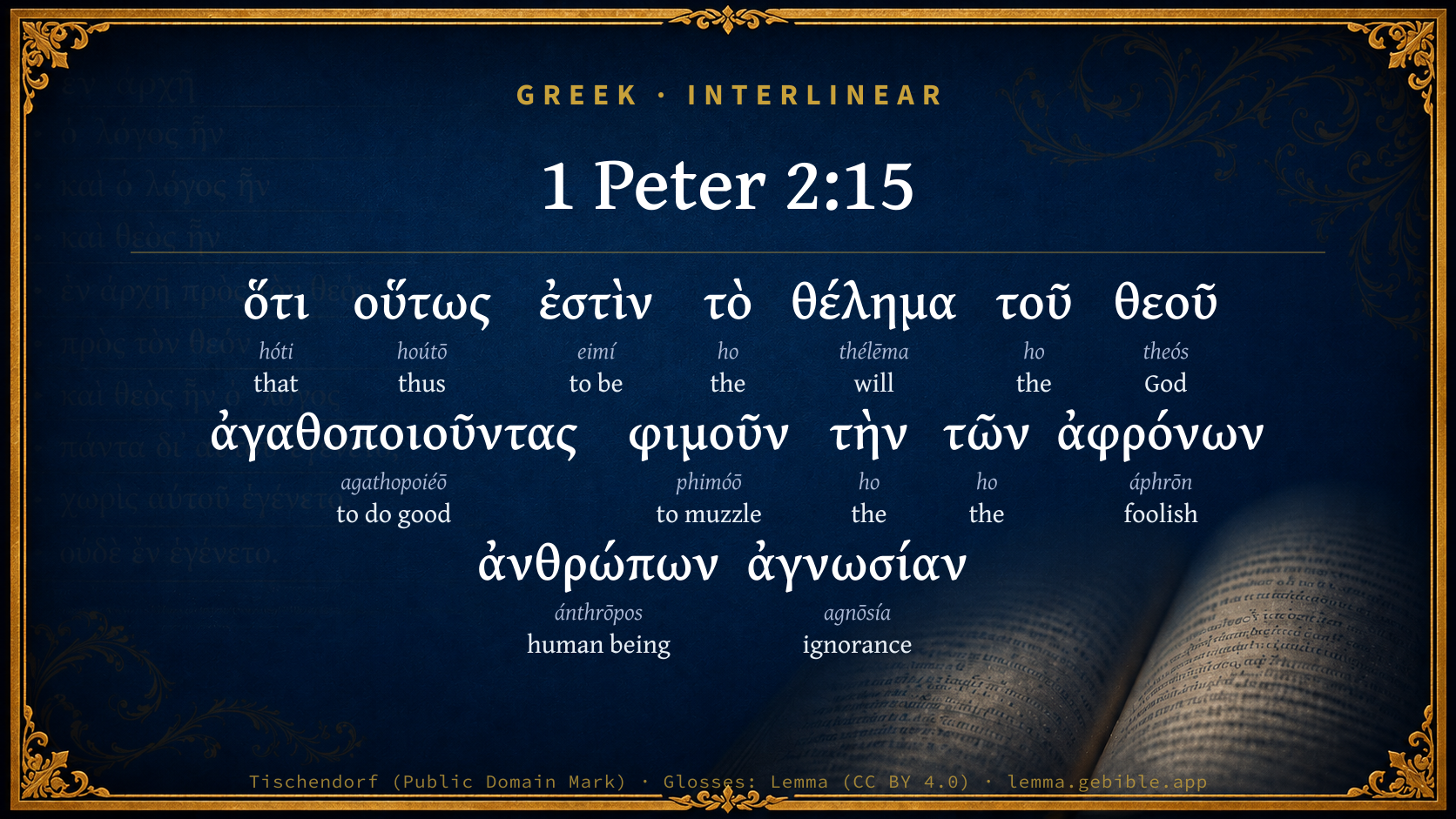
  1. ὅτι hóti G3754 “that” Conjunction
  2. οὕτως hoútō G3779 “thus” Adverb
  3. ἐστὶν eimí G1510 “to be” Verb, Present, Active, Indicative, 3rd person, Singular
  4. τὸ ho G3588 “the” Article, Nominative, Singular, Neuter
  5. θέλημα thélēma G2307 “will” Noun, Nominative, Singular, Neuter
  6. τοῦ ho G3588 “the” Article, Genitive, Singular, Masculine
  7. θεοῦ theós G2316 “God” Noun, Genitive, Singular, Masculine
  8. ἀγαθοποιοῦντας agathopoiéō G15 “to do good” Verb, Present, Active, Participle, Accusative, Plural, Masculine
  9. φιμοῦν phimóō G5392 “to muzzle” Verb, Present, Active, Infinitive
  10. τὴν ho G3588 “the” Article, Accusative, Singular, Feminine
  11. τῶν ho G3588 “the” Article, Genitive, Plural, Masculine
  12. ἀφρόνων áphrōn G878 “foolish” Adjective, Genitive, Plural, Masculine
  13. ἀνθρώπων ánthrōpos G444 “human being” Noun, Genitive, Plural, Masculine

About this verse

These counts appear in no published source. They are computed here, from the morphology-tagged text and Lemma’s own curated glosses. What Lemma adds →

14
words
11
distinct lemmas
General Epistles
section

Notable vocabulary

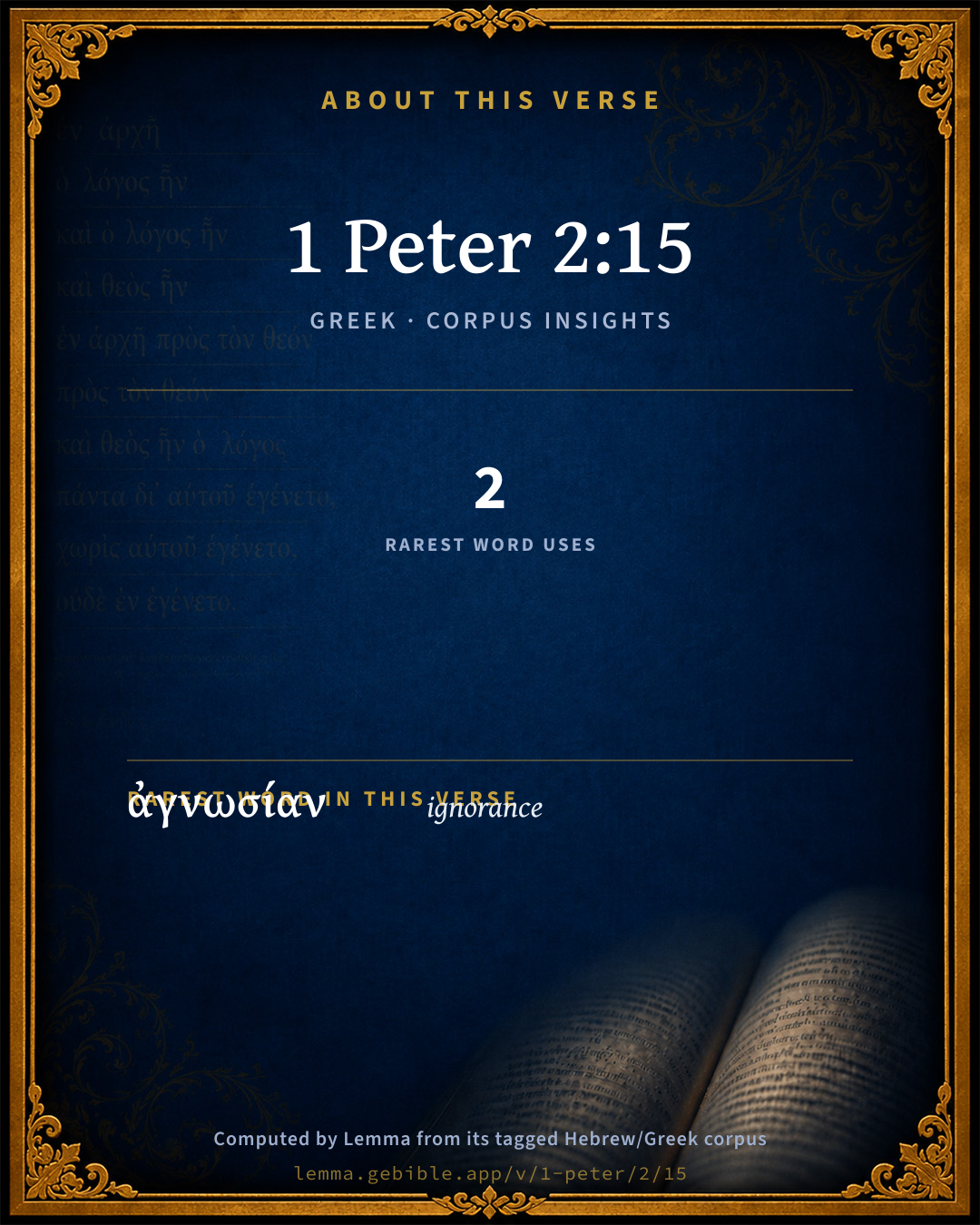
The rarest word here is ἀγνωσίαν ignorance G56 — appearing just 2 times in the whole Greek New Testament.

Shared distinctive vocabulary

ἀγνωσίαν ignorance G56 occurs in 2 verses of the Greek New Testament. Also found in:

Repetition

A word recurs within this verse:

Cross-references

22

Topical passages linked to 1 Peter 2:15 in the Treasury of Scripture Knowledge — connected by theme and wording, ordered by reader-vote popularity; previews shown in the World English Bible.

  • 1 Peter 3:17 For it is better, if the will of God should so will, that you suffer for doing well than for doing evil.
  • Titus 2:8 and soundness of speech that can't be condemned; that he who opposes you may be ashamed, having no evil thing to say about us.
  • 1 Peter 2:12 having good behavior among the nations, so in that which they speak against you as evil-doers, they may by your good works, which they see, glorify God in the day of visitation.
  • Matthew 7:26 Everyone who hears these words of mine, and doesn't do them will be like a foolish man, who built his house on the sand.
  • 1 Thessalonians 5:18 In everything give thanks, for this is the will of God in Christ Jesus toward you.
  • 1 Thessalonians 4:3 For this is the will of God: your sanctification, that you abstain from sexual immorality,
  • Jeremiah 4:22 For my people are foolish, they don't know me; they are foolish children, and they have no understanding; they are wise to do evil, but to do good they have no knowledge.
  • Job 2:10 But he said to her, "You speak as one of the foolish women would speak. What? Shall we receive good at the hand of God, and shall we not receive evil?" In all this Job didn't sin with his lips.
  • Proverbs 9:6 Leave your simple ways, and live. Walk in the way of understanding."
  • Romans 1:21 Because, knowing God, they didn't glorify him as God, neither gave thanks, but became vain in their reasoning, and their senseless heart was darkened.
  • Ephesians 6:6–7 not in the way of service only when eyes are on you, as men-pleasers; but as servants of Christ, doing the will of God from the heart;
  • 2 Peter 2:12 But these, as unreasoning creatures, born natural animals to be taken and destroyed, speaking evil in matters about which they are ignorant, will in their destroying surely be destroyed,
  • Psalms 107:42 The upright will see it, and be glad. All the wicked will shut their mouths.
  • 1 Timothy 1:13 although I was before a blasphemer, a persecutor, and insolent. However, I obtained mercy, because I did it ignorantly in unbelief.
  • 1 Peter 4:2 that you no longer should live the rest of your time in the flesh for the lusts of men, but for the will of God.
  • Jude 1:10 But these speak evil of whatever things they don't know. What they understand naturally, like the creatures without reason, in these things are they destroyed.
  • Titus 3:3 For we were also once foolish, disobedient, deceived, serving various lusts and pleasures, living in malice and envy, hateful, and hating one another.
  • Psalms 5:5 The arrogant shall not stand in your sight. You hate all workers of iniquity.
  • Matthew 25:2 Five of them were foolish, and five were wise.
  • Galatians 3:1 Foolish Galatians, who has bewitched you not to obey the truth, before whose eyes Jesus Christ was openly set forth among you as crucified?
  • Job 5:16 So the poor has hope, And injustice shuts her mouth.
  • Deuteronomy 32:6 Do you thus requite Yahweh, Foolish people and unwise? Isn't he your father who has bought you? He has made you, and established you.

Cross-references courtesy of OpenBible.info (CC BY 4.0).

Commentary

Notes on 1 Peter 2:15 from classic Christian and Jewish commentators (each source and its license shown beneath its notes). The classic Christian expositions comment on the surrounding passage and are grouped to its opening verse, so a note may address several verses; the Jewish commentaries on the Tanakh (Rashi and others) are per-verse, so they appear only where the commentator wrote on this verse.

Lemma curates 59 commentaries, every one of them public domain or Creative Commons licensed, each selected and text-cleaned for this edition rather than reprinted as found. About our sources →

Bengel's Gnomon

Johann Albrecht Bengel

1Pe 2:15. Φιμοῦν, to stop) to put to silence.—ἀγνωσίαν, the ignorance) for instance, respecting the integrity of Christians. This word contains the reason why Christians ought to pity the heathen.

Bengel's Gnomon of the New Testament — English translation (T&T Clark, Edinburgh, 1860) — public domain. Text from a community e-Sword module.

Meyer's Critical & Exegetical Commentary

Heinrich August Wilhelm Meyer

1Pe_2:15. ὅτι] gives the ground of the exhortation: ὑποτάγητε κ.τ.λ.

οὕτως ἐστὶν τὸ θέλημα τοῦ Θεοῦ] with οὕτως; cf. Winer, p. 434 [E. T. 584]; Buttm. p. 115: of such a nature is the will of God. Schott gives the sense correctly: In this wise is it with the will of God. The position of the words is opposed to a connection of οὕτως with ἀγαθοποιοῦντας (Wiesinger, Hofmann).

ἀγαθοποιοῦντας] sc. ὑμᾶς; ἀγαθοποιεῖν, in Mar_3:4; Act_14:17 the word has reference to deeds of benevolence. Here, on the other hand, it is used in a general sense: to do good, with special reference to the fulfilment of the duties towards those in authority.

φιμοῦν τὴν τῶν ἀφρόνων ἀνθρώπων ἀγνωσίαν] φιμοῦν (cf. 1Ti_5:18) here in the cognate sense of: to put to silence, Wiesinger; the ἀγνωσία is here conceived of as speaking; cf. v. 12: καταλαλοῦσι ὑμ. ὡς κακοποιῶν.

ἀγνωσία (except here, only in 1Co_15:34) is the self-caused lack of any comprehension of the Christian life. Because they are without this, they in their foolishness (hence ἀφρόνων ἀνθρώπων) imagine that its characteristic is not ἀγαθοποιεῖν, but κακοποιεῖν. Beda incorrectly limits οἱ ἄφρονες ἄνθρωποι to those persons in authority; but the reference is rather quite general to the καταλαλοῦντες, 1Pe_2:12.

Meyer — Critical and Exegetical Commentary on the New Testament — English translation by Peter Christie, edited by Frederick Crombie (T&T Clark, 1880) — public domain. Text from a community e-Sword module.

Geneva Bible (1599)

Geneva Bible translators

He declareth the first argument more amply, showing that Christian liberty doth amongst all things least, or not at all consist herein, to wit, to cast off the bridle of Laws, (as at that time some altogether unskillful in the kingdom of God reported) but rather in this, that living holily according to the will of God, we should make manifest to all men, that the Gospel is not a cloak for sin and wickedness, seeing we are in such sort free, that yet we are still the servants of God, and not of sin.

Geneva Bible (1599) marginal notes — public domain. Text via Bolls.life.

Jamieson, Fausset & Brown

Robert Jamieson, A. R. Fausset & David Brown

Ground of his directing them to submit themselves (Pe1 2:13).

put to silence--literally, "to muzzle," "to stop the mouth."

ignorance--spiritual not having "the knowledge of God," and therefore ignorant of the children of God, and misconstruing their acts; influenced by mere appearances, and ever ready to open their mouths, rather than their eyes and ears. Their ignorance should move the believer's pity, not his anger. They judge of things which they are incapable of judging through unbelief (compare Pe1 2:12). Maintain such a walk that they shall have no charge against you, except touching your faith; and so their minds shall be favorably disposed towards Christianity.

Jamieson, Fausset & Brown — Commentary Critical and Explanatory on the Whole Bible (1871) — public domain (CC PDM 1.0). Text via the HelloAO Bible API.

Adam Clarke's Commentary

Verse 15. For so is the will of God] God, as their supreme governor, shows them that it is his will that they should act uprightly and obediently at all times, and thus confound the ignorance of foolish men, who were ready enough to assert that their religion made them bad subjects. The word φιμουν, which we translate put to silence, signifies to muzzle, i.e., stop their mouths, leave them nothing to say; let them assert, but ever be unable to bring proof to support it.

Adam Clarke's Commentary on the Bible (1810–1826) — public domain. Text from a community e-Sword/MySword module.

John Calvin's Commentaries

15 For so is the will of God He returns to his former doctrine, lest an occasion should be given to the unbelieving to speak evil, though he expresses less than what he had said before; for he says only that the mouths of the foolish ought to be stopped. The phrase which he adopts, “to stop up ignorance,” though it may seem harsh on account of its novelty, does not yet obscure the sense. For he not only calls the unbelieving foolish, but also points out the reason why they slandered, even because they were ignorant of God. But inasmuch as he makes the unbelieving to be without understanding and reason, we hence conclude, that a right understanding cannot exist without the knowledge of God. How much soever, then, the unbelieving may boast of their own acuteness, and may seem to themselves to be wise and prudent, yet the Spirit of God charges them with folly, in order that we may know that, apart from God, we cannot be really wise, as without him there is nothing perfect.

But he prescribes the way in which the evil-speaking of the unbelieving is to be restrained, even by well-doing, or, by doing good. In this expression he includes all the duties of humanity and kindness which we ought to perform towards our neighbors. And in these is included obedience to magistrates, without which concord among men cannot be cultivated. Were any one to object and say, that the faithful can never be so careful to do good, but that they will be evil-spoken of by the unbelieving: to this the obvious answer is, that the Apostle here does not in any degree exempt them from calumnies and reproaches; but he means that no occasion of slandering ought to be given to the unbelieving, however much they may desire it. And lest any one should further object and say, that the unbelieving are by no means worthy of so much regard that God’s children should form their life to please them, Peter expressly reminds us that we are bound by God’s command to shut up their mouths.

John Calvin's Commentaries (1540-1563) — public domain. Text from the Calvin Translation Society English edition (1840s-50s) via the Christian Classics Ethereal Library (ccel.org). Calvin's coverage is partial (roughly two-thirds of the Bible); uncommented books and verses are honest gaps, never fabricated. The 19th-century editor's footnotes and remarks are omitted so the notes are faithfully Calvin's own voice.

Ellicott's Commentary for English Readers

(15) For so is the will of God.—This refers to the command contained in the last two verses, which then is further explained by the clause which follows, “that with well-doing.” See a very similar construction in 1Th_4:3. The “well-doing” of this and the last verse bears the most general sense of good conduct, not the special sense noticed on the “fair works” and “fair life” of 1Pe_2:12.

Put to silence the ignorance of foolish men.—A very contemptuous expression, the word for “put to silence” being the same as in 1Co_9:9; 1Ti_5:18, to “muzzle” or “gag,” implying that there is something of the animal about these “foolish men.” The same contempt appears in each word of the clause, even down to “men,” which might be rendered “people” or “creatures.” The word for “ignorance” implies a stolid and wilful ignorance, and is so used by heathen authors, as well as very markedly in the only other place in the New Testament, 1Co_15:34. “Foolish,” too, contains moral reprobation, Luk_11:40; Luk_12:20; 1Co_15:36. suggesting thoughtlessness rather than senselessness. The definite article is also used in the Greek (as in 2Th_3:2), and again seems to indicate that St. Peter had some particular enemies in view who had brought the charges. This accusation was evidently one of a political nature; and, indeed, history shows us that the hostility of the empire to the faith was entirely based on the corporate nature of the Christian religion. They would not have minded the cultus, but they could not tolerate the Church. Pliny distinctly says in his letter to Trajan, that it was in consequence of Trajan’s issuing an order against hetœriœ or societies, that he was led to contend with the Christians in Bithynia.

A Bible Commentary for English Readers, edited by Charles John Ellicott (1878–1897) — public domain. Text from a community e-Sword module.

The Cambridge Bible for Schools and Colleges

gen. ed. J. J. S. Perowne

15. For so is the will of God] Better, for thus it is the will of God. This was to be the chief, if not the only, apologia of Christians to the charges brought against them. They were accused of being evil-doers. They were to be conspicuous for well-doing. In the Greek for “put to silence” we have the word used in Mat_22:12; Mat_22:34, Mar_1:25; Mar_4:39, the primary meaning of which was “to enforce silence by a gag or muzzle.” The word “ignorance,” used elsewhere in the New Testament only in 1Co_15:34, implies something more than a mere ignorance of facts. One might almost describe it as a settled incapacity for knowing and judging rightly. The “foolish men” are the accusers and slanderers of 1Pe_2:12 rather than the official authorities of 1Pe_2:13-14.

The Cambridge Bible for Schools and Colleges (gen. ed. J. J. S. Perowne; Cambridge University Press, 1878–1918) — public domain. Text from a community e-Sword module.

John Gill's Exposition

As free,.... These converted Jews might value themselves on their freedom, partly as the descendants of Abraham, and so freeborn, and not to be brought into bondage to other people; and chiefly because of their liberty which they had in and by Christ Jews. The apostle allows that they were freemen, that they were Christ's freemen, were free from sin, its damning and domineering power, and from the curses and condemnation of the law, and had freedom of access to God, and a right to all the privileges and immunities of the house of God; but then they were not free to sin, and to live in the contempt of the laws of God and men, to despise government, speak evil of dignities, and break in upon the rules of civil society:

and not using your liberty as a cloak of maliciousness; under a pretence of Christian liberty, to hurt the persons, properties, and estates of men, without looking upon themselves accountable for their conduct to their superiors: some think the apostle alludes to the ancient custom of servants, who, when they were made free, walked with a cap, or covering on their heads, in token of it: it follows,

but as the servants of God; for they that are free are the servants of God and Christ, and show themselves to be so by submitting to and obeying those that are under them, and ordained by them; and which is no ways inconsistent with, and contrary to their Christian liberty, which never was designed to thwart and subvert the principles of natural religion, laws of a moral nature, or the rules of civil government; some instances of which are next mentioned.

John Gill's Exposition of the Whole Bible (1746–1763) — public domain (CC PDM 1.0). Text via the HelloAO Bible API.

Trapp's Complete Commentary

John Trapp

15 For so is the will of God, that with well doing ye may put to silence the ignorance of foolish men:

Ver. 15. Ye may put to silence] Gr. φιμουν, muzzle, or halter up, button up their mouths, as we say. {See Trapp on "Mat 22:34"} It is an old fetch of the devil to persuade the world that faithful people are anti-magistratical; these must be powerfully confuted by our contrary practice.

John Trapp, A Commentary or Exposition upon All the Books of the Old and New Testament (1647–1656) — public domain. Text from a community e-Sword module.

Albert Barnes' Notes on the Bible

For so is the will of God - That is, it is in accordance with the divine will that in this way you should put them to silence.

That with well doing - By a life of uprightness and benevolence.

Ye may put to silence the ignorance of foolish men - See the notes at Tit 2:8. The reference here is to men who brought charges against Christians, by accusing them of being inimical to the government, or insubordinate, or guilty of crimes. Such charges, it is well known, were often brought against them by their enemies in the early ages of Christianity. Peter says they were brought by foolish men, perhaps using the word foolish in the sense of evil-disposed, or wicked, as it is often used in the Bible. Yet, though there might be malice at the bottom, the charges were really based on ignorance. They were not thoroughly acquainted with the principles of the Christian religion; and the way to meet those charges was to act in every way as became good citizens, and so as “to live them down.” One of the best ways of meeting the accusations of our enemies is to lead a life of strict integrity. It is not easy for the wicked to reply to this argument.

Albert Barnes' Notes on the Bible (1834–1885) — public domain. Text from a community e-Sword/MySword module.

Matthew Poole's English Annotations

For so is the will of God; his command.

That with well-doing; all manner of offices of humanity, whereof obedience to magistrates is a principal one.

Ye may put to silence; Greek, muzzle, stop the mouths, Tit 1:11; viz. by taking away all occasion of evil-speaking.

The ignorance; either their ignorance of the state and conversation of believers, which may be the occasion of their speaking evil of them; or their ignorance of God and his ways, to which Christ imputes the fury of persecutors, Joh 16:3. They that know not God themselves, are most ready to reproach and slander those that do.

Of foolish men; true wisdom consisting in the knowledge of God, they that are destitute of that knowledge, as unbelievers are, are called foolish.

Matthew Poole's English Annotations on the Holy Bible (1683–1685) — public domain. Text from a community e-Sword/MySword module.

Whedon's Commentary on the Bible

Daniel D. Whedon

15. The will of God—Namely, this subjection to rulers.

Put to silence— Literally, muzzle, so as to stop their mouths.

Ignorance—Habitual and general, as Wiesinger says, “having ever its mouth open rather than its eyes.”

Foolish men—With the article, the foolish men who slanderously babble about them as evil doers.

Daniel D. Whedon (gen. ed.), Commentary on the Old and New Testaments (1874–1909) — public domain. Text from a community e-Sword module.

The Pulpit Commentary

For so is the will of God, that with well-doing ye may put to silence the ignorance of foolish men. The Gentiles speak against the Christians as evil-doers; they are to put their accusers to silence by well-doing; this is to be their answer rather than indignant self-vindication. The Greek word rendered "put to silence" (fimoun) means literally "to muzzle". (comp. Mat_22:12; Mar_4:39; 1Co_9:10) The word for "ignorance" (ajgnwsia) occurs, besides this passage, only infrwn) 1Co_15:34, where it evidently means "culpable, self-caused ignorance." The word for "foolish" (a) is a strong one it means "senseless" (comp. 1Co_15:36) Here it has the article, "the foolish men," i.e. those "who speak against you as evil-doers."

The Pulpit Commentary (1880–1919), ed. H.D.M. Spence-Jones & Joseph S. Exell — public domain. Text from a community e-Sword module.

John Wesley's Explanatory Notes

The ignorance - Of them who blame you, because they do not know you: a strong motive to pity them.

John Wesley, Explanatory Notes Upon the Whole Bible (1754–1765) — public domain. Text via the GEBible commentary corpus.

The People's New Testament

B. W. Johnson

15. That with well doing. It is God's will that thus you may silence the charge that you are seditious persons.

B. W. Johnson's The People's New Testament with Notes (1889–1891) — public domain. Electronic text from the Christian Classics Ethereal Library (CCEL) ThML edition.

Cambridge Greek Testament for Schools and Colleges

15. οὕτως may refer to the words which follow, viz. silencing ignorance by well-doing. But οὕτως is regularly used retrospectively to sum up some preceding statement. So here St Peter means that by employing civil magistrates for the praise of well-doers God indicates His own method of working. His plan is that His servants should silence (literally “gag”) senseless ignorant calumnies by well-doing, including loyal submission to civil authority.

τῶν ἀφρόνων. The article might mean “those senseless men who have been described as speaking evil of you,” or “men such as are senseless and reckless in their charges.”

ἀγνωσία, purblindness, is a much stronger word than ἀγνοία. It describes the ignorance which cannot and will not recognize the truth. Cf. 1Co 15:34 only.

Cambridge Greek Testament for Schools and Colleges (Cambridge University Press, 1896; 21 vols, various authors incl. Carr, Maclear, Plummer, Farrar, Lumby, Moule, M. R. James, Simcox) — public domain. Text from a community e-Sword module.

Alford’s Greek Testament

Henry Alford

15.] For (ground of ὑποτάγητε; correlative with, but not going so for as, the purpose announced in ver. 12) so (after this manner, in this direction and wise: viz. as follows, ἀγαθοποιοῦντας φιμοῦν κ.τ.λ.) is (‘se trouve,’ κεῖται) the will (thing willed, concrete result of the will) of God, that doing good (the anarthrous participle carries the reason with it: by doing good: “with well-doing,” E. V.) ye (necessarily understood) put to silence the ignorance (“Locutio quam usurpat, ‘obstruere ignorantiam,’ quamvis per novitatem dura sit, sensum tamen non obscurat.” Calv. On the word φιμόω, see reff.; and Palm and Rost’s Lex.

ἀγνωσία, see the instructive parallel, ref. 1 Cor., is not simply ignorance of this or that fact, but a state of lack of knowledge or understanding, habitual ignorance. This state is here introduced as speaking, “having (as Wiesinger) ever its mouth open rather than its eyes,” ready to cry out upon any mere appearance of things as misunderstood by it) of the foolish men (above designated: those viz. who καταλαλοῦσιν ὑμῶν ὡς κακοποιῶν; not, “of foolish men” in general, as E. V.).

Henry Alford, The Greek Testament (1849–1861) — public domain. Text from a community e-Sword module.

Vincent's Word Studies in the New Testament

Marvin R. Vincent

Put to silence [φιμουν] . A very graphic word, meaning to muzzle or gag. Compare 1Co 9:9; 1Ti 5:18. See on Mt 22:12. Ignorance [αγνωσιαν] . In classical Greek it is an ignorance arising from not coming into contact with the person or thing to be known. It occurs only once again in the New Testament, 1Co 14:34. Here is signifies not want of acquaintance, but of understanding; a state of ignorance.

Of foolish men [των αφρονων ανθρωπων] . Of the foolish men; the article referring to those just mentioned, who speak against them as evil - doers.

Marvin R. Vincent, Word Studies in the New Testament (1887–1900) — public domain. Text from a community e-Sword/MySword module.

Lesson kit

Teaching starters — assembled from the data on this page, not authored interpretation. Every prompt links to the verse data it draws on. Edit before teaching.

1 Peter, in the General Epistles, opens this verse with 14 words (11 distinct Greek lemmas). Its most distinctive word is agnōsía (“ignorance”). A historical commentator’s framing appears above. Read the whole chapter for the surrounding context.

Discussion questions

  1. How does “ignorance” (agnōsía) shape what this verse is saying?
  2. How does 1 Corinthians 15:34, which shares the word «ignorance», read alongside this verse?
  3. What does the repetition of “the” (4× in this one verse) do in this verse?
  4. The translations on this page render this verse differently — a whole-verse word diff, not a word-by-word alignment. What might account for the different wordings?
  5. Compare how Bengel's Gnomon and Meyer's Critical & Exegetical Commentary read this verse. Where do they agree or differ?

Things to notice

Reading settings

Reading text

Shown beneath each verse's original-language words.

Old Testament
Old Testament edition

Read the OT as the Masoretic Hebrew (MT) or the Greek Septuagint (LXX).

English shown for the Greek Septuagint (in the Hebrew ↔ Greek comparison).

Comparing translations? Open the Compare panel on any verse page to stack up to four side by side.