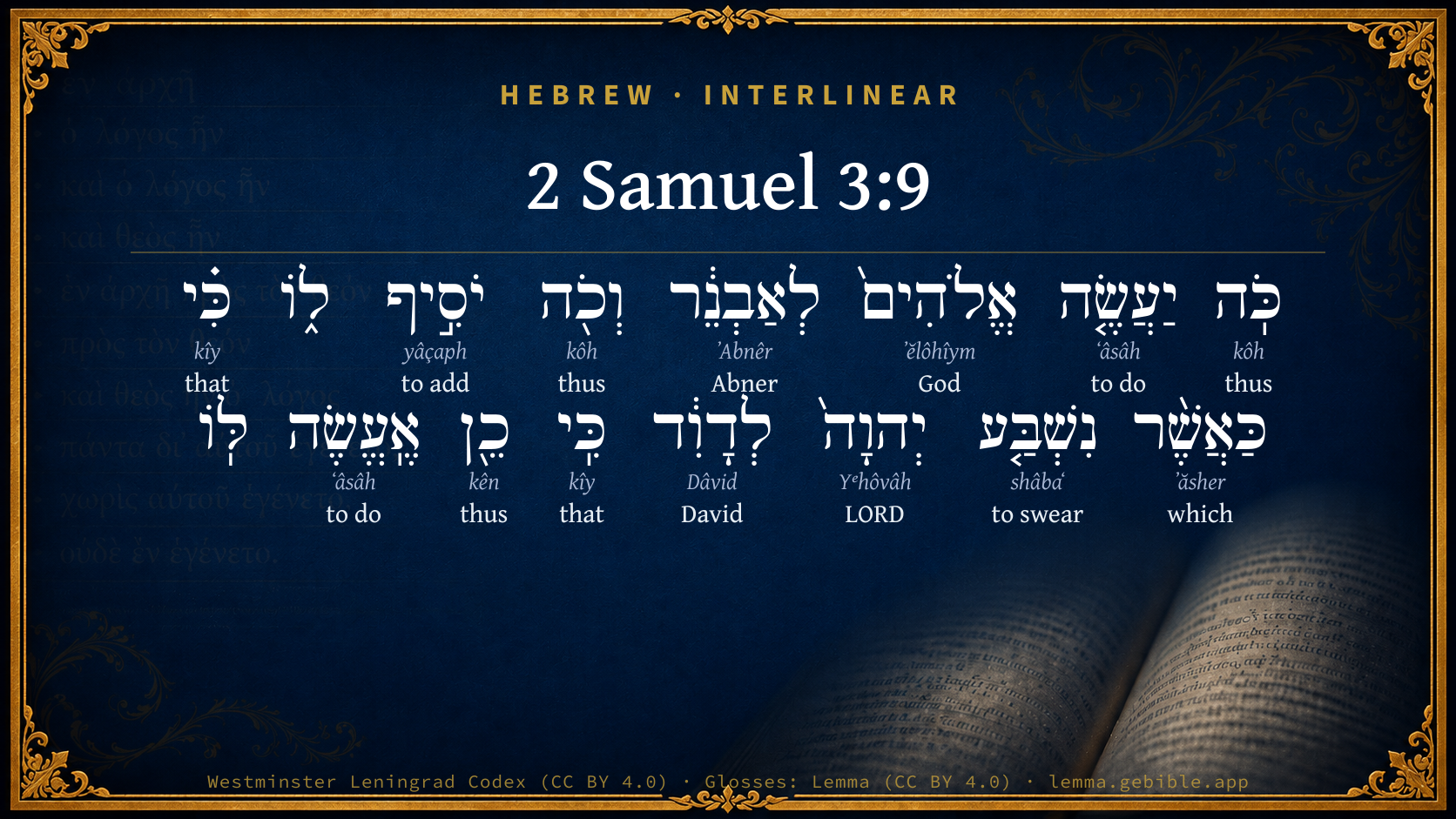
2 Samuel 3:9

Hebrew (Westminster Leningrad Codex) 2 Samuel 3:9 appears in the Hebrew Old Testament. The text above is from the Westminster Leningrad Codex. Each word links to its Strong’s number, a concise gloss, and parsing drawn from the Open Scriptures Hebrew Bible morphology. Click any word for its full Brown-Driver-Briggs (BDB) entry.
Download image
Cite this verse

2 Samuel 3:9 (World English Bible). Public Domain. Lemma interlinear Bible study tool, https://lemma.gebible.app/v/2-samuel/3/9.

Show BibTeX & RIS
BibTeX
RIS
English Translation
God do so to Abner, and more also, if, as Yahweh has sworn to David, I don't do even so to him;
World English Bible · Public Domain
Download a study sheet

One document with this verse’s original text, its word-by-word gloss line, the meaning frame, cross-references with their text, attributed commentary, and full source and license credits — printable, and it pastes into notes with its structure intact.

This verse Autodidact and up

Study sheet (.html) Plain text (.txt)

A passage Seminary Student

Up to 50 verses in one chapter. A passage sheet keeps up to 6 commentary sources and 12 cross-references per verse, in the order this page ranks them, and says so on the sheet whenever that leaves anything out. Ask for a single verse and you get the Autodidact verse sheet above.

Everything on this page stays free to read, with no account — the sheet is a download of what is already on screen, not access to it.

Want to remove ads? Support Godless Engineer
Compare translations 3

The same verse in 3 English versions, stacked beneath the original-language interlinear above. Click any original word for its lexicon entry.

Each is an independent rendering of the whole verse — the interlinear is not word-aligned to these translations.

Highlighted words mark where these versions differ — a whole-verse word diff, not a word-by-word alignment.

  • World English Bible Public Domain
    God do so to Abner, and more also, if, as Yahweh has sworn to David, I don't do even so to him;
  • King James Version Public Domain
    So do God to Abner, and more also, except, as the LORD hath sworn to David, even so I do to him;
  • unfoldingWord Literal Text CC BY-SA 4.0
    Thus may God do to Abner, and thus may he add to him, if, according to what Yahweh has sworn to David, that thus I will do for him,

unfoldingWord Literal Text — © unfoldingWord, licensed CC BY-SA 4.0. Word-aligned USFM3 via Door43 (git.door43.org/unfoldingWord/en_ult).

Versions to compare (up to 4)

3 of 4 selected

Show all 18 translations

Every available English version of this verse, each an independent rendering of the whole verse.

  • World English Bible Public Domain
    God do so to Abner, and more also, if, as Yahweh has sworn to David, I don't do even so to him;
  • Berean Standard Bible Public Domain
    May God punish Abner, and ever so severely, if I do not do for David what the LORD has sworn to him:
  • Majority Standard Bible Public Domain
    May God punish Abner, and ever so severely, if I do not do for David what the LORD has sworn to him:
  • King James Version Public Domain
    So do God to Abner, and more also, except, as the LORD hath sworn to David, even so I do to him;
  • American Standard Version (1901) Public Domain
    God do so to Abner, and more also, if, as Jehovah hath sworn to David, I do not even so to him;
  • Revised Version (1885) Public Domain
    God do so to Abner, and more also, if, as the LORD hath sworn to David, I do not even so to him;
  • Geneva Bible (1599) Public Domain
    So doe God to Abner, and more also, except, as the Lord hath sworne to Dauid, euen so I doe to him,
  • Douay-Rheims (1899) Public Domain
    So do God to Abner, and more also, unless as the Lord hath sworn to David, so I do to him,
  • Young's Literal Translation Public Domain
    thus doth God to Abner, and thus He doth add to him, surely as Jehovah hath sworn to David -- surely so I do to him:
  • Literal Standard Version CC BY-SA 4.0
    Thus God does to Abner, and thus He adds to him, surely as YHWH has sworn to David—surely so I do to him:
  • Unlocked Literal Bible CC BY-SA 4.0
    May God do so to me, Abner, and more also, if I do not do for David as Yahweh has sworn to him,
  • unfoldingWord Literal Text CC BY-SA 4.0
    Thus may God do to Abner, and thus may he add to him, if, according to what Yahweh has sworn to David, that thus I will do for him,
  • Darby Bible Public Domain
    So do God to Abner, and more also, if, as Jehovah has sworn to David, I do not so to him;
  • World Messianic Bible Public Domain
    God do so to Abner, and more also, if, as the LORD has sworn to David, I don’t do even so to him:
  • Webster's Bible Public Domain
    So do God to Abner, and more also, except, as the LORD hath sworn to David, even so I do to him;
  • Free Bible Version CC BY-SA 4.0
    So now may God punish me severely if I don't help David achieve what the Lord has promised him.
  • Bible in Basic English Public Domain
    May God's punishment be on Abner, if I do not for David as the Lord in his oath has said,
  • JPS Tanakh (1917) Public Domain
    God do so to Abner, and more also, if, as the LORD hath sworn to David, I do not even so to him;

Literal Standard Version (2020), Covenant Press — licensed CC BY-SA 4.0. Text via the HelloAO Bible API (eBible.org). Unlocked Literal Bible (unfoldingWord) — licensed CC BY-SA 4.0. Text via the HelloAO Bible API (eBible.org). unfoldingWord Literal Text — © unfoldingWord, licensed CC BY-SA 4.0. Word-aligned USFM3 via Door43 (git.door43.org/unfoldingWord/en_ult). Free Bible Version, Dr. Jonathan Gallagher — licensed CC BY-SA 4.0. Text via the HelloAO Bible API (eBible.org).

Word by word

More ways to search: Search by grammar → Find every occurrence → Compare this word →

Practice this passage: Drill this verse → Learn its vocabulary →

לְאַבְנֵ֔ר
ʼAbnêr
H74
“to/for · Abner”
Preposition + Noun, Proper
Part of Speech
Preposition + Noun
Type
Proper
Full BDB Definition

Origin: from H1 and H5216

TWOT: None

Abner = "my father is a lamp" - Saul's cousin and army captain, treacherously slain by Joab
  1. כֹּֽה kôh H3541 “thus” Adverb
  2. יַעֲשֶׂ֤ה ʻâsâh H6213 “to do” Verb, Qal, Jussive, 3rd Person, Masculine, Singular
  3. אֱלֹהִים֙ ʼĕlôhîym H430 “God(s)” Noun, Common, Masculine, Plural, Absolute
  4. וְכֹ֖ה kôh H3541 “and · thus” Conjunction + Adverb
  5. יֹסִ֣יף yâçaph H3254 “to add” Verb, Hiphil, Jussive, 3rd Person, Masculine, Singular
  6. כִּ֗י kîy H3588 “that” Conjunction
  7. כַּאֲשֶׁ֨ר ʼăsher H834 “like/as · which” Preposition + Particle, Relative
  8. נִשְׁבַּ֤ע shâbaʻ H7650 “to swear” Verb, Niphal, Perfect, 3rd Person, Masculine, Singular
  9. יְהוָה֙ Yᵉhôvâh H3068 “LORD” Noun, Proper
  10. לְדָוִ֔ד Dâvid H1732 “to/for · David” Preposition + Noun, Proper
  11. כִּֽי kîy H3588 “that” Conjunction
  12. כֵ֖ן kên H3651 “thus” Adverb
  13. אֶֽעֱשֶׂה ʻâsâh H6213 “to do” Verb, Qal, Imperfect, 1st Person, Common, Singular

About this verse

These counts appear in no published source. They are computed here, from the morphology-tagged text and Lemma’s own curated glosses. What Lemma adds →

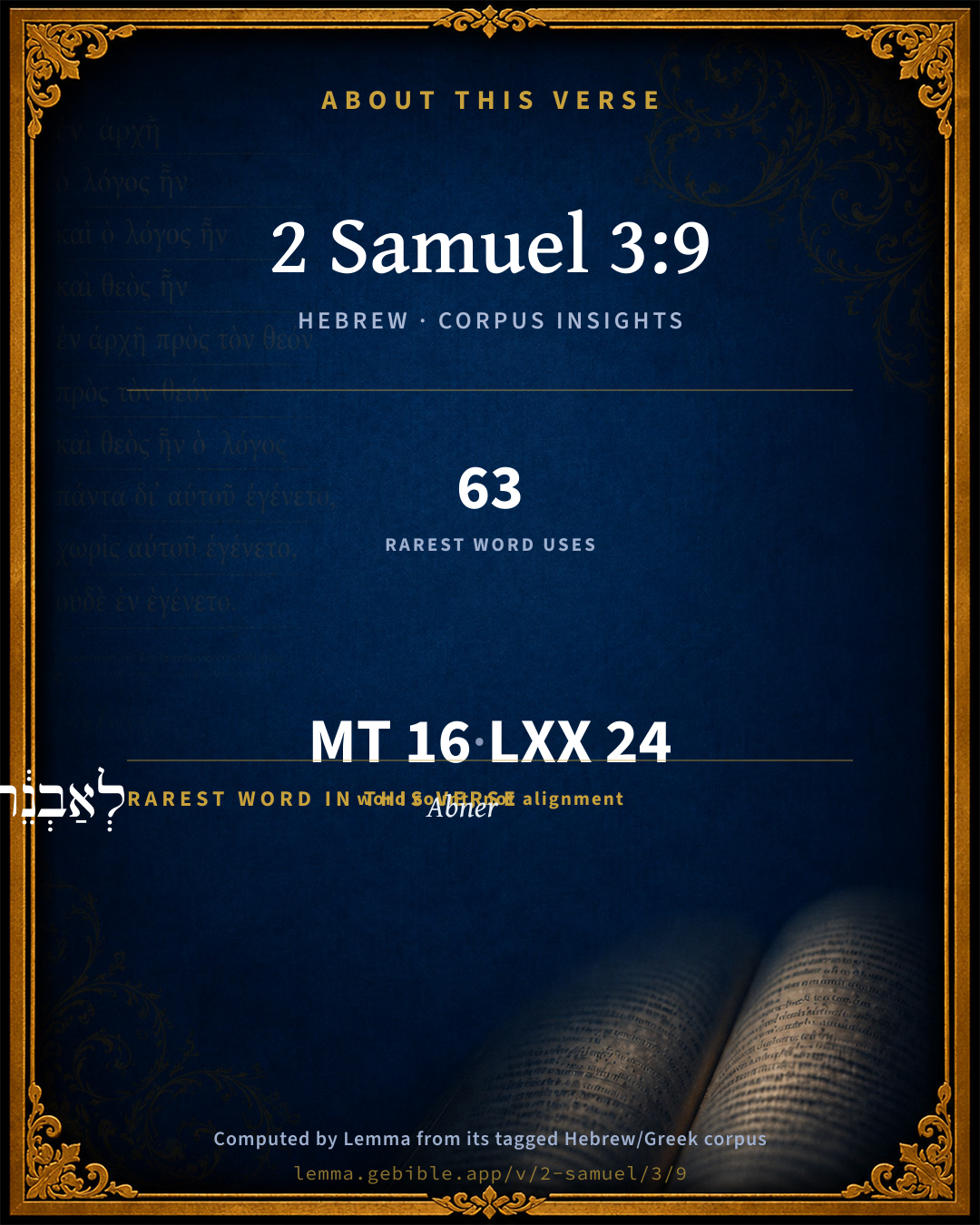
16
words
11
distinct lemmas
Historical
section

Grammatical profile

  • 4 verbs
  • 4 nouns
  • 2 prepositions
  • 2 conjunctions
  • 3 adverbs
  • 1 particle

Verb forms

  • יַעֲשֶׂ֤ה Qal · Jussive
  • יֹסִ֣יף Hiphil · Jussive
  • נִשְׁבַּ֤ע Niphal · Perfect
  • אֶֽעֱשֶׂה Qal · Imperfect

Repetition

Words recur within this verse — often emphatic in Hebrew:

  • כֹּֽה thus H3541 ×2
  • יַעֲשֶׂ֤ה to do H6213 ×2
  • כִּ֗י that H3588 ×2

Hebrew & Septuagint length

In English translation the verse runs 22 words from the Hebrew and 23 from the Septuagint (LXX English) — closely comparable.

A rough comparison of the two English renderings, which tokenize alike — not a word-level alignment.

Word counts can differ between the Hebrew and the Greek without any difference in meaning — e.g. the Hebrew direct-object marker אֵת has no separate Greek word, and Greek often adds the article ὁ.

In the original languages it is 16 Hebrew tokens and 24 Greek tokens — but the two are counted differently (Hebrew bundles its prefixes and suffixes into one token; the Greek is in lemma form), so that isn’t a like-for-like length.

Cross-references

14

Topical passages linked to 2 Samuel 3:9 in the Treasury of Scripture Knowledge — connected by theme and wording, ordered by reader-vote popularity; previews shown in the World English Bible.

  • 1 Samuel 15:28 Samuel said to him, Yahweh has torn the kingdom of Israel from you this day, and has given it to a neighbor of yours who is better than you.
  • 1 Kings 19:2 Then Jezebel send a messenger to Elijah, saying, So let the gods do to me, and more also, if I don't make your life as the life of one of them by tomorrow about this time.
  • Ruth 1:17 where you die, will I die, and there will I be buried: Yahweh do so to me, and more also, if anything but death part you and me."
  • 1 Samuel 28:17 Yahweh has done to you, as he spoke by me: and Yahweh has torn the kingdom out of your hand, and given it to your neighbor, even to David.
  • 1 Chronicles 12:23 These are the numbers of the heads of those who were armed for war, who came to David to Hebron, to turn the kingdom of Saul to him, according to the word of Yahweh.
  • 1 Samuel 3:17 He said, "What is the thing that [Yahweh] has spoken to you? Please don't hide it from me. God do so to you, and more also, if you hide anything from me of all the things that he spoke to you."
  • 1 Samuel 14:44 Saul said, God do so and more also; for you shall surely die, Jonathan.
  • 1 Samuel 16:1–13 Yahweh said to Samuel, How long will you mourn for Saul, seeing I have rejected him from being king over Israel? fill your horn with oil, and go: I will send you to Jesse the Bethlehemite; for I have provided me a king among his sons.
  • 1 Samuel 25:22 God do so to the enemies of David, and more also, if I leave of all that belongs to him by the morning light so much as one man-child.
  • 2 Samuel 3:35 All the people came to cause David to eat bread while it was yet day; but David swore, saying, God do so to me, and more also, if I taste bread, or anything else, until the sun be down.
  • 2 Samuel 19:13 Say you to Amasa, Aren't you my bone and my flesh? God do so to me, and more also, if you aren't captain of the host before me continually in the room of Joab.
  • Psalms 89:3–4 "I have made a covenant with my chosen one, I have sworn to David, my servant,
  • Psalms 89:19–20 Then you spoke in vision to your saints, And said, "I have bestowed strength on the warrior. I have exalted a young man from the people.
  • Psalms 89:35–37 Once have I sworn by my holiness, I will not lie to David.

Cross-references courtesy of OpenBible.info (CC BY 4.0).

Hebrew and Greek witnesses Masoretic Hebrew ↔ Greek Septuagint

The same verse in the two great witnesses to the Old Testament, shown verse-for-verse.

These are two independent witnesses, not word-aligned to each other, and the Septuagint is shown in lemma (dictionary) form.

Hebrew 2 Samuel 3:9 Masoretic · Westminster Leningrad Codex

כֹּֽה יַעֲשֶׂ֤ה אֱלֹהִים֙ לְאַבְנֵ֔ר וְכֹ֖ה יֹסִ֣יף ל֑וֹ כִּ֗י כַּאֲשֶׁ֨ר נִשְׁבַּ֤ע יְהוָה֙ לְדָוִ֔ד כִּֽי כֵ֖ן אֶֽעֱשֶׂה לּֽוֹ

God do so to Abner, and more also, if, as Yahweh has sworn to David, I don't do even so to him;

World English Bible · Public Domain

Greek LXX 2 Samuel 3:9 Septuagint · lemma form

ὅδε ποιέω ὁ θεός ὁ αβεννηρ καί ὅδε προςτίθημι αὐτός ὅτι καθώς ὄμνυμι κύριος ὁ δαυίδ ὅτι οὕτως ποιέω αὐτός ἐν ὁ ἡμέρα οὗτος

God do thus and more also to Abenner, if as the Lord swore to David, so do I not to him this day;

LXX2012 (modern English Septuagint) · Public Domain

Hebrew: Westminster Leningrad Codex (CC BY 4.0). Greek: Septuagint (public domain); English from LXX2012 (modern English Septuagint) (Public Domain). How the Septuagint differs from the Hebrew →

Targum (Aramaic paraphrase)

1

The Targum is the ancient Jewish Aramaic paraphrase of the Hebrew Scriptures — an interpretive translation, not the Hebrew text itself. Onkelos (literal) and Pseudo-Jonathan (expansive) render the Torah, and Jonathan the Prophets. Coverage is partial: where no permissively-licensed English translation exists for a verse, only the Aramaic is shown. This is verse-level text, not a word-by-word alignment to the Hebrew.

  1. Targum Jonathan Prophets (Joshua–Malachi)
    כְּדֵין יַעְבֵּד יְיָ לְאַבְנֵר וּכְדֵין יוֹסֵיף לֵיהּ אֲרֵי כְּמָא דְקַיֵם יְיָ לְדָוִד אֲרֵי כְדֵין אַעְבֵּיד לֵיהּ:

    (no public-domain English translation for this verse)

    Targum Jonathan — Aramaic: “Mikraot Gedolot” (public domain). English: “Sefaria Community Translation” (CC0 1.0 (public-domain dedication)); “London "Chaldee Paraphrase," 1871” (public domain). Text via Sefaria.

Commentary

Notes on 2 Samuel 3:9 from classic Christian and Jewish commentators (each source and its license shown beneath its notes). The classic Christian expositions comment on the surrounding passage and are grouped to its opening verse, so a note may address several verses; the Jewish commentaries on the Tanakh (Rashi and others) are per-verse, so they appear only where the commentator wrote on this verse.

Lemma curates 59 commentaries, every one of them public domain or Creative Commons licensed, each selected and text-cleaned for this edition rather than reprinted as found. About our sources →

Trapp's Complete Commentary

John Trapp

2Sa 3:9 So do God to Abner, and more also, except, as the LORD hath sworn to David, even so I do to him;

Ver. 9. Except, as the Lord hath sworn to David.] What Abner did, then, hitherto for Ishbosheth, he did against his conscience: and now they fall out. Sinful leagues last not long; thieves falling out, true men come by their goods. But who ever heard Abner godly till now? Neither had he been so at this time, if he had not intended a revengeful departure from Ishbosheth. Nothing is more odious than to make religion a stalking horse to policy. If Abner be a means of doing David right, yet because he doth it with an ill mind, and out of self-respects, he loseth his reward with God.

John Trapp, A Commentary or Exposition upon All the Books of the Old and New Testament (1647–1656) — public domain. Text from a community e-Sword module.

Joseph Benson's Commentary

2Sa 3:9. As the Lord hath sworn to David — These words show clearly that Abner knew very well God had resolved to bestow the kingdom of Israel upon David; and yet he had hitherto opposed it with all his might, from a principle of ambition. That is, he had all this while fought against his own knowledge and conscience, and against God himself. Now, however, (but, alas! it is out of resentment to Ish-bosheth, and from a principle of revenge,) he complies with the divine will, and vows with an oath to do that to David which the Lord had sworn to him. Undoubtedly Abner talked most foolishly in this, as if God needed his help to bring to pass what he had sworn to David, or as if his opposition could prevent it!

Joseph Benson's Commentary on the Old and New Testaments (1811–1818) — public domain. Text from a community e-Sword module.

Tyndale Open Study Notes

Tyndale Open Resources

3:9 help David get what the Lord has promised him! Abner was aware that God had chosen David to be king over all Israel (see also 3:18).

Tyndale Open Study Notes — © Tyndale Open Resources, licensed CC BY-SA 4.0. Text via the HelloAO Bible API.

Geneva Bible (1599)

Geneva Bible translators

We see how the wicked cannot abide to be admonished of their faults, but seek their displeasure, which go about to bring them from their wickedness.

Geneva Bible (1599) marginal notes — public domain. Text via Bolls.life.

Adam Clarke's Commentary

Verse 9. Except, as the Lord hath sworn to David] And why did he not do this before, when he knew that God had given the kingdom to David? Was he not now, according to his own concession, fighting against God?

Adam Clarke's Commentary on the Bible (1810–1826) — public domain. Text from a community e-Sword/MySword module.

Ellicott's Commentary for English Readers

(9) So do God to Abner.—The anger of Abner culminates in a solemn oath to transfer the kingdom to David, “as the Lord hath sworn to him.” There is no record of a Divine oath to give the kingdom to David, but the prophetic declaration that God’s choice of him was unalterable (1Sa_15:29) may well have been considered to have the force of an oath. Abner does not propose to do this in order to fulfil the Divine will, for his words show that he had been acting hitherto in conscious opposition to that will, but to revenge himself for the insult now offered him. He had doubtless also become satisfied of his master’s entire unfitness for the throne, and his power over Israel opened before him the prospect of high preferment from David.

A Bible Commentary for English Readers, edited by Charles John Ellicott (1878–1897) — public domain. Text from a community e-Sword module.

The Cambridge Bible for Schools and Colleges

gen. ed. J. J. S. Perowne

9. So do God, &c.] An oath characteristic of the books of Samuel and Kings. See note on 1Sa_3:17.

as the Lord hath sworn to David] No express divine oath promising the kingdom to David is recorded: but Samuel’s solemn declaration to Saul (1Sa_15:28-29), and his choice and anointing of David by divine command (1Sa_16:1-12), were equivalent to it. It seems to have been generally known that David was designated by God to be Saul’s successor (1Sa_25:28-31; 2Sa_5:2). “Abner is self-convicted by these words. He knew that the Lord had sworn to give the throne to David, and yet he had resisted—consciously resisted—to the best of his power the fulfilment of that high decree. He now reaps his reward in this, that his return to what was really his duty, bears the aspect of treachery, meanness, and dishonour. It now devolved upon him to undo his own work, whereas at the first it was in his power to subside into graceful and honourable acquiescence in a decree which, although distasteful to him, he could not and ought not to resist. Had he done this, his acknowledged abilities might have secured for him no second place among the worthies of David, and his end might have been very different.” Kitto, Bible Illustr. p. 324.

The Cambridge Bible for Schools and Colleges (gen. ed. J. J. S. Perowne; Cambridge University Press, 1878–1918) — public domain. Text from a community e-Sword module.

John Gill's Exposition

So do God to Abner, and more also,.... He wishes the worst of evils to himself, such as he cared not to name; but left them to be supposed what he meant as utter ruin and destruction of himself, soul and body:

except as the Lord hath sworn to David, even so I do to him; meaning if he did not do that David, which God had sworn should be done, namely, what follows, the translation of the kingdom to him; by which it appears that Abner knew of the promise and oath of God respecting this matter; and therefore acted against his conscience, in setting up Ishbosheth on the throne; which he knew would not prosper, and that he was fighting against God; which shows what a hardened wicked creature he was, and how far ambition, and being thought to be of consequence, will carry a man.

John Gill's Exposition of the Whole Bible (1746–1763) — public domain (CC PDM 1.0). Text via the HelloAO Bible API.

Haydock's Catholic Bible Commentary

Sworn. It seems therefore that he knew of God’s appointment, and had hitherto resisted it for his own temporal convenience. (Haydock) --- If both he and Isboseth were ignorant of this decree, Abner had no right to deprive the latter of the crown. (Abulensis, q. 7.) (Menochius)

George Leo Haydock (1774–1849), Haydock's Catholic Family Bible and Commentary, 1859 edition — public domain. Excludes Psalms (Douay-Rheims chapter numbering differs from Protestant) and Deuterocanonical books (Catholic canon only).

Matthew Poole's English Annotations

Whence it appears that this wicked wretch did all this while fight against his own knowledge and conscience, and against God himself.

Matthew Poole's English Annotations on the Holy Bible (1683–1685) — public domain. Text from a community e-Sword/MySword module.

Whedon's Commentary on the Bible

Daniel D. Whedon

9. As the Lord hath sworn to David — It seems to have been generally understood in Israel, even before the death of Saul, that David was divinely destined to be king, (1Sa_23:17; 1Sa_24:20,) and this confession of Abner convicts him of knowingly opposing the will of God. By strengthening himself in the house of Saul he knew that he was acting against the will of the God of Israel. See on 2Sa_3:18.

Daniel D. Whedon (gen. ed.), Commentary on the Old and New Testaments (1874–1909) — public domain. Text from a community e-Sword module.

The Pulpit Commentary

As the Lord hath sworn to David. This not only shows that the prophetic promise of the kingdom to David was generally known, (see note on 2Sa_1:2) hut that Abner regarded it as solemnly ratified. There is no express mention of any such oath, but Abner was a man of strong words, and possibly only meant that Jehovah"s purpose was becoming evident by the course of events.

HOMILIES BY G. WOOD

Vers. 9-12. Doing right wrongly. Abner knew well that David was appointed by God to be king over all Israel. Yet he set up Ishbosheth as king over the eleven tribes in opposition to David, and thus caused much unnecessary and useless delay and bloodshed. When, however, Ishbosheth (whether rightly or wrongly) remonstrated with him for his conduct towards Rizpah, he calls to mind the purpose and promise of God, and resolves to cooperate with him(!) in placing David over all the nation (ver. 9); and he opens communications with David with this view. The known will of God thus becomes a convenient pretext for the gratification at once of his revenge and his ambition. His own lips convicted him of insincerity and hypocrisy. His tardy obedience to the truth he knew was unreal and unacceptable to God, however useful to David. It was self, and not God, that ruled him throughout. Abner has many imitators men who, instead of simply and sincerely obeying the truth they know, make it wait on their ambition or covetousness, now neglecting it, now acting according to it, and professing great regard for it, as their selfish aims may prompt. They choose their side in religion or polities, not according to conviction, but according to their supposed interests; and if they change sides it is not because of changed convictions, but because their ambition or avarice has been disappointed they have not been made enough of, or they have quarrelled with some one, or their pride has been mortified, or they see that they have been on the side of a decaying cause which cannot be of much more service to them. Such men may be welcomed to the side they join, and may be of some service; but they wilt not be trusted, and their service will be of doubtful value. In religion especially the adherence of such persons is to be deprecated as wanting in the right spirit, and likely to be injurious rather than beneficial. They tend to corrupt the society in which they are active and influential, and deprive it of its true strength that of sincere, spiritual, consistent character. Observe:

1. The importance of simple and uniform obedience to the known will of God. To obey as it suits our worldly aims is not to obey at all, and the pretence of obedience is hypocritical and hateful to God. Such obedience may have its uses to others; God may overrule it for good; but it will bring no blessing to the doer.

2. The language of Abner may be adopted by us in relation to the kingdom of our Lord Jesus Christ. "As Jehovah has sworn to his beloved Son, even so I do to him." Our knowledge of the purpose and promise of God to establish Christ"s rule over all men should stimulate us to devoted service in his cause. It assures us that to be on his side is to be on God"s side, on the side that must succeed. In being thus workers with God we cannot labour in vain; and labouring not in pretence, but in truth, we shall ultimately share in the glory and power of the great King whose cause we espouse. G.W. (Rev_3:21)

The Pulpit Commentary (1880–1919), ed. H.D.M. Spence-Jones & Joseph S. Exell — public domain. Text from a community e-Sword module.

unfoldingWord translationNotes

Door43 World Missions Community

May God do so to me ... and more also, if I do not

This is the form of a solemn vow in that time. Abner is asking God to judge him severely if he does not keep his vow. Your language may have a way of expressing vows. AT: "I am asking God to punish me if I do not"

the house of Saul

Here "house" refers to Saul's family and supporters who survived Saul's death. AT: "the family and supporters of Saul"

throne of David

This phrase refers to the authority of David as king. (See: Metonymy)

translationWords

God

Yahweh

oath

kingdom

throne

Israel

Dan

Beersheba

fear

unfoldingWord translationNotes — © Distant Shores Media and the Door43 World Missions Community, licensed CC BY-SA 4.0. Source: git.door43.org/Door43/en_tn.

Lesson kit

Teaching starters — assembled from the data on this page, not authored interpretation. Every prompt links to the verse data it draws on. Edit before teaching.

2 Samuel, in the Historical, opens this verse with 16 words (11 distinct Hebrew lemmas). Its most distinctive word is ʼAbnêr (“Abner”). A historical commentator’s framing appears above. Read the whole chapter for the surrounding context.

Discussion questions

  1. The word ʼAbnêr carries the sense “Abner.” How does it shape the verse?
  2. How does 1 Samuel 15:28, which shares this passage’s theme, read alongside this verse?
  3. What does the repetition of “thus” (2× in this one verse) do in this verse?
  4. These translations render this verse differently. What is at stake in choosing one wording over another?
  5. «יַעֲשֶׂ֤ה» is a Qal Jussive verb. How does that grammatical form shape the action described?
  6. Compare how Trapp's Complete Commentary and Joseph Benson's Commentary read this verse. Where do they agree or differ?

Things to notice

Reading settings

Reading text

Shown beneath each verse's original-language words.

Old Testament
Old Testament edition

Read the OT as the Masoretic Hebrew (MT) or the Greek Septuagint (LXX).

English shown for the Greek Septuagint (in the Hebrew ↔ Greek comparison).

Comparing translations? Open the Compare panel on any verse page to stack up to four side by side.