1 Corinthians 8:12

Greek (Tischendorf 8th ed.) 1 Corinthians 8:12 appears in the Greek New Testament. The text above is from the Tischendorf 8th edition. Each word links to its Strong’s number and a concise gloss. Click any word for its full Thayer’s Greek Lexicon entry.
Download image
Cite this verse

1 Corinthians 8:12 (World English Bible). Public Domain. Lemma interlinear Bible study tool, https://lemma.gebible.app/v/1-corinthians/8/12.

Show BibTeX & RIS
BibTeX
RIS
English Translation
Thus, sinning against the brothers, and wounding their conscience when it is weak, you sin against Christ.
World English Bible · Public Domain
Download a study sheet

One document with this verse’s original text, its word-by-word gloss line, the meaning frame, cross-references with their text, attributed commentary, and full source and license credits — printable, and it pastes into notes with its structure intact.

This verse Autodidact and up

Study sheet (.html) Plain text (.txt)

A passage Seminary Student

Up to 50 verses in one chapter. A passage sheet keeps up to 6 commentary sources and 12 cross-references per verse, in the order this page ranks them, and says so on the sheet whenever that leaves anything out. Ask for a single verse and you get the Autodidact verse sheet above.

Everything on this page stays free to read, with no account — the sheet is a download of what is already on screen, not access to it.

Want to remove ads? Support Godless Engineer
Compare translations 3

The same verse in 3 English versions, stacked beneath the original-language interlinear above. Click any original word for its lexicon entry.

Each is an independent rendering of the whole verse — the interlinear is not word-aligned to these translations.

Highlighted words mark where these versions differ — a whole-verse word diff, not a word-by-word alignment.

  • World English Bible Public Domain
    Thus, sinning against the brothers, and wounding their conscience when it is weak, you sin against Christ.
  • King James Version Public Domain
    But when ye sin so against the brethren, and wound their weak conscience, ye sin against Christ.
  • unfoldingWord Literal Text CC BY-SA 4.0
    And thus sinning against your brothers and wounding their weak consciences, you sin against Christ.

unfoldingWord Literal Text — © unfoldingWord, licensed CC BY-SA 4.0. Word-aligned USFM3 via Door43 (git.door43.org/unfoldingWord/en_ult).

Versions to compare (up to 4)

3 of 4 selected

Show all 19 translations

Every available English version of this verse, each an independent rendering of the whole verse.

  • World English Bible Public Domain
    Thus, sinning against the brothers, and wounding their conscience when it is weak, you sin against Christ.
  • Berean Standard Bible Public Domain
    By sinning against your brothers in this way and wounding their weak conscience, you sin against Christ.
  • Majority Standard Bible Public Domain
    By sinning against your brothers in this way and wounding their weak conscience, you sin against Christ.
  • King James Version Public Domain
    But when ye sin so against the brethren, and wound their weak conscience, ye sin against Christ.
  • American Standard Version (1901) Public Domain
    And thus, sinning against the brethren, and wounding their conscience when it is weak, ye sin against Christ.
  • Revised Version (1885) Public Domain
    And thus, sinning against the brethren, and wounding their conscience when it is weak, ye sin against Christ.
  • Geneva Bible (1599) Public Domain
    Nowe when ye sinne so against the brethren, and wound their weake conscience, ye sinne against Christ.
  • Douay-Rheims (1899) Public Domain
    Now when you sin thus against the brethren, and wound their weak conscience, you sin against Christ.
  • Young's Literal Translation Public Domain
    and thus sinning in regard to the brethren, and smiting their weak conscience -- in regard to Christ ye sin;
  • Literal Standard Version CC BY-SA 4.0
    And thus sinning in regard to the brothers, and striking their weak conscience—you sin in regard to Christ;
  • Unlocked Literal Bible CC BY-SA 4.0
    Thus, when you sin against your brothers and wound their weak consciences, you sin against Christ.
  • unfoldingWord Literal Text CC BY-SA 4.0
    And thus sinning against your brothers and wounding their weak consciences, you sin against Christ.
  • Darby Bible Public Domain
    Now, thus sinning against the brethren, and wounding their weak conscience, ye sin against Christ.
  • World Messianic Bible Public Domain
    Thus, sinning against the brothers, and wounding their conscience when it is weak, you sin against Messiah.
  • Webster's Bible Public Domain
    But when ye thus sin against the brethren, and wound their weak conscience, ye sin against Christ.
  • Free Bible Version CC BY-SA 4.0
    In this way you sin against other believers, wounding their weaker consciences, and you sin against Christ.
  • Bible in Basic English Public Domain
    And in this way, doing evil to the brothers, and causing trouble to those whose faith is feeble, you are sinning against Christ.
  • Text-Critical English NT CC BY 4.0
    When you sin in this way against your brothers and wound their weak conscience, you sin against Christ.
  • Tyndale New Testament (1534) Public Domain
    When ye synne so agaynst the brethren and wounde their weake consciences ye synne agaynst Christ.

Literal Standard Version (2020), Covenant Press — licensed CC BY-SA 4.0. Text via the HelloAO Bible API (eBible.org). Unlocked Literal Bible (unfoldingWord) — licensed CC BY-SA 4.0. Text via the HelloAO Bible API (eBible.org). unfoldingWord Literal Text — © unfoldingWord, licensed CC BY-SA 4.0. Word-aligned USFM3 via Door43 (git.door43.org/unfoldingWord/en_ult). Free Bible Version, Dr. Jonathan Gallagher — licensed CC BY-SA 4.0. Text via the HelloAO Bible API (eBible.org).

Word by word

More ways to search: Search by grammar → Find every occurrence → Compare this word →

Practice this passage: Drill this verse → Learn its vocabulary →

τύπτοντες
týptō
G5180
“to strike”
Verb, Present, Active, Participle, Nominative, Plural, Masculine
Part of Speech
Verb
Tense
Present
Voice
Active
Mood
Participle
Case
Nominative
Number
Plural
Gender
Masculine
Full Thayer's Definition

Origin: a primary verb (in a strengthened form)

TDNT: 12:20,1

1. to strike, beat, smite a. with a staff, a whip, the fist, the hand b. of mourners, to smite their breast 2. to smite one on whom he inflicts punitive evil 3. to smite a. metaph. i.e. to wound, disquiet one's conscience
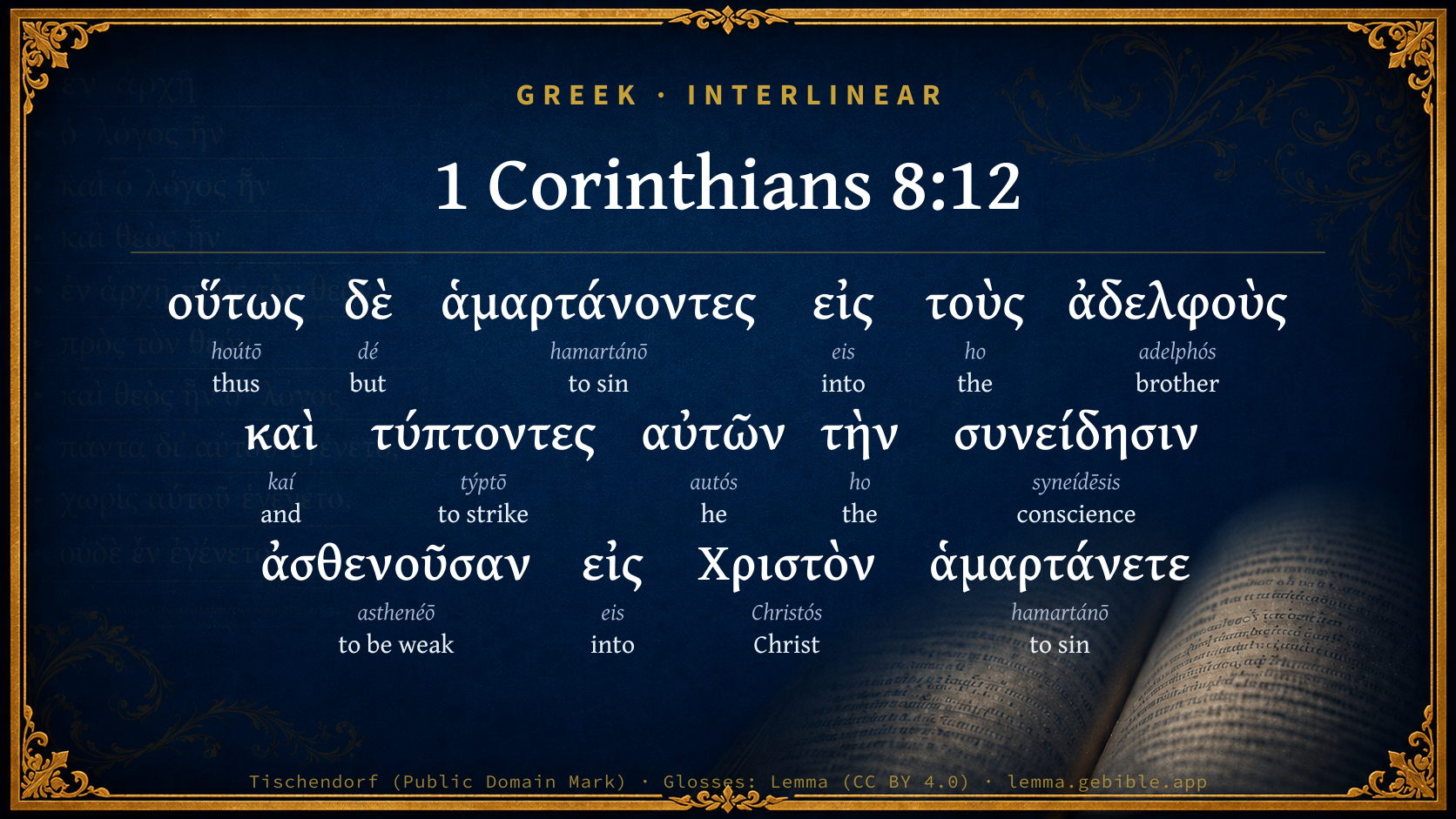
  1. οὕτως hoútō G3779 “thus” Adverb
  2. δὲ dé G1161 “but” Conjunction
  3. ἁμαρτάνοντες hamartánō G264 “to sin” Verb, Present, Active, Participle, Nominative, Plural, Masculine
  4. εἰς eis G1519 “into” Preposition
  5. τοὺς ho G3588 “the” Article, Accusative, Plural, Masculine
  6. ἀδελφοὺς adelphós G80 “brother” Noun, Accusative, Plural, Masculine
  7. καὶ kaí G2532 “and” Conjunction
  8. αὐτῶν autós G846 “he” Personal pronoun, Genitive, Plural, Masculine
  9. τὴν ho G3588 “the” Article, Accusative, Singular, Feminine
  10. συνείδησιν syneídēsis G4893 “conscience” Noun, Accusative, Singular, Feminine
  11. ἀσθενοῦσαν asthenéō G770 “to be weak” Verb, Present, Active, Participle, Accusative, Singular, Feminine
  12. εἰς eis G1519 “into” Preposition
  13. Χριστὸν Christós G5547 “Christ” Noun, Accusative, Singular, Masculine
  14. ἁμαρτάνετε hamartánō G264 “to sin” Verb, Present, Active, Indicative, 2nd person, Plural

About this verse

These counts appear in no published source. They are computed here, from the morphology-tagged text and Lemma’s own curated glosses. What Lemma adds →

15
words
12
distinct lemmas
Pauline Epistles
section

Notable vocabulary

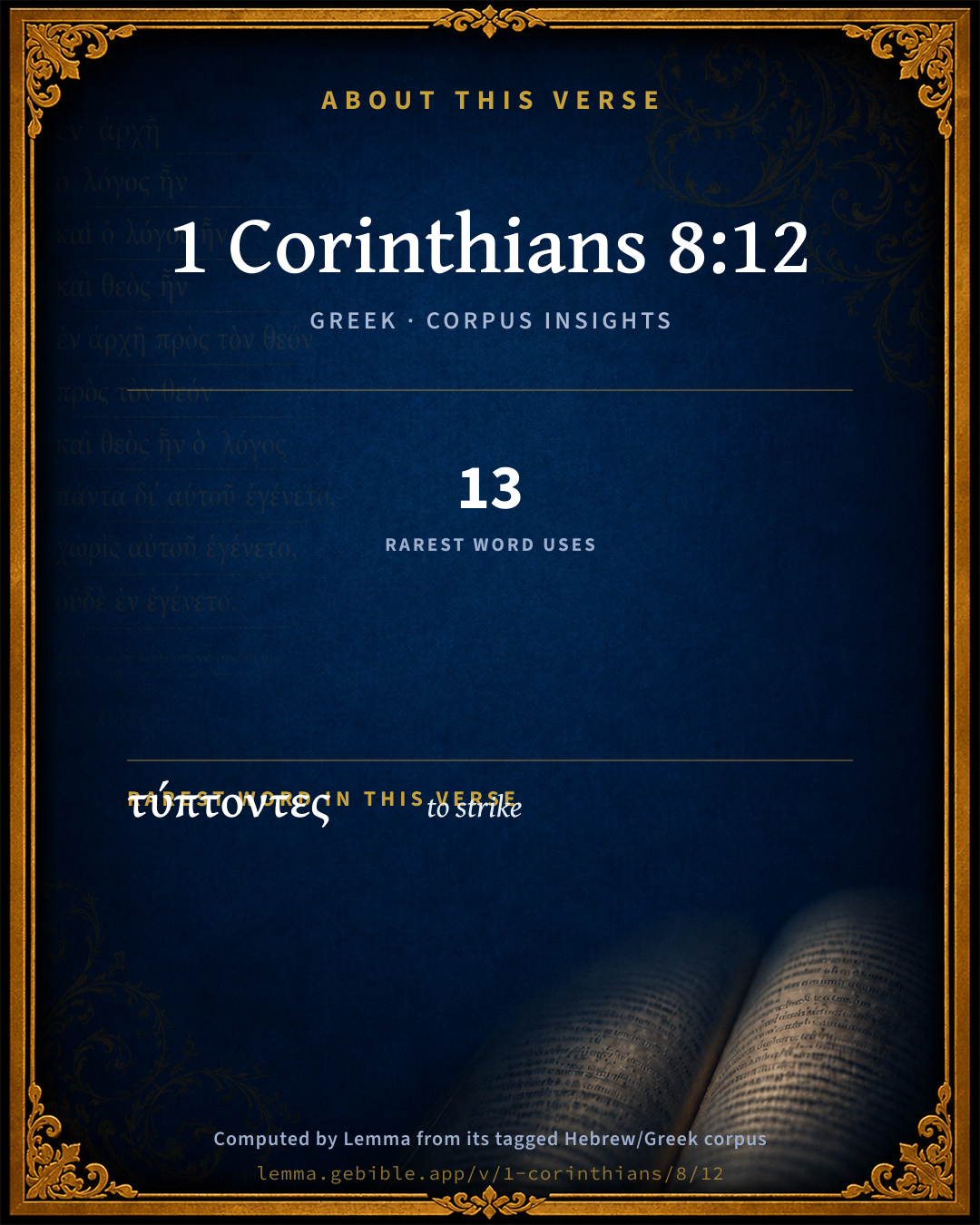
The rarest word here is τύπτοντες to strike G5180 — appearing just 13 times in the whole Greek New Testament.

Shared distinctive vocabulary

τύπτοντες to strike G5180 occurs in 12 verses of the Greek New Testament. Also found in:

Repetition

Words recur within this verse:

  • ἁμαρτάνοντες to sin G264 ×2
  • εἰς into G1519 ×2
  • τοὺς the G3588 ×2

Cross-references

15

Topical passages linked to 1 Corinthians 8:12 in the Treasury of Scripture Knowledge — connected by theme and wording, ordered by reader-vote popularity; previews shown in the World English Bible.

  • Matthew 18:6 but whoever causes one of these little ones who believe in me to stumble, it would be better for him that a huge millstone should be hung around his neck, and that he should be sunk in the depths of the sea.
  • Matthew 25:45 "Then he will answer them, saying, 'Most assuredly I tell you, inasmuch as you didn't do it to one of the least of these, you didn't do it to me.'
  • 1 Corinthians 12:12 For as the body is one, and has many members, and all the members of the body, being many, are one body; so also is Christ.
  • Genesis 20:9 Then Abimelech called Abraham, and said to him, "What have you done to us? How have I sinned against you, that you have brought on me and on my kingdom a great sin? You have done deeds to me that ought not to be done!"
  • Genesis 42:22 Reuben answered them, saying, "Didn't I tell you, saying, 'Don't sin against the child,' and you wouldn't listen? Therefore also, behold, his blood is required."
  • Exodus 16:8 Moses said, "Now Yahweh shall give you meat to eat in the evening, and in the morning bread to satisfy you; because Yahweh hears your murmurings which you murmur against him. And who are we? Your murmurings are not against us, but against Yahweh."
  • Exodus 32:21 Moses said to Aaron, "What did these people do to you, that you have brought a great sin on them?"
  • 1 Samuel 2:25 If one man sin against another, God shall judge him; but if a man sin against Yahweh, who shall entreat for him? Notwithstanding, they didn't listen to the voice of their father, because Yahweh was minded to kill them.
  • 1 Samuel 19:4–5 Jonathan spoke good of David to Saul his father, and said to him, Don't let the king sin against his servant, against David; because he has not sinned against you, and because his works have been very good toward you:
  • 1 Samuel 24:11 Moreover, my father, behold, yes, see the skirt of your robe in my hand; for in that I cut off the skirt of your robe, and didn't kill you, know you and see that there is neither evil nor disobedience in my hand, and I have not sinned against you, though you hunt after my life to take it.
  • Matthew 12:49–50 He stretched out his hand towards his disciples, and said, "Behold, my mother and my brothers!
  • Matthew 18:10 See that you don't despise one of these little ones, for I tell you that in heaven their angels always see the face of my Father who is in heaven.
  • Matthew 18:21 Then Peter came and said to him, "Lord, how often shall my brother sin against me, and I forgive him? Until seven times?"
  • Matthew 25:40 "The King will answer them, 'Most assuredly I tell you, inasmuch as you did it to one of the least of these my brothers, you did it to me.'
  • Acts 9:4–5 He fell on the earth, and heard a voice saying to him, "Saul, Saul, why do you persecute me?"

Cross-references courtesy of OpenBible.info (CC BY 4.0).

Commentary

Notes on 1 Corinthians 8:12 from classic Christian and Jewish commentators (each source and its license shown beneath its notes). The classic Christian expositions comment on the surrounding passage and are grouped to its opening verse, so a note may address several verses; the Jewish commentaries on the Tanakh (Rashi and others) are per-verse, so they appear only where the commentator wrote on this verse.

Lemma curates 59 commentaries, every one of them public domain or Creative Commons licensed, each selected and text-cleaned for this edition rather than reprinted as found. About our sources →

Tyndale Open Study Notes

Tyndale Open Resources

8:12 To make immature believers sin by violating their conscience is the same as sinning against Christ, who has claimed them for himself (cp. Matt 25:40, 45).

Tyndale Open Study Notes — © Tyndale Open Resources, licensed CC BY-SA 4.0. Text via the HelloAO Bible API.

Bengel's Gnomon

Johann Albrecht Bengel

1Co 8:12. Τύπτοντες, striking) [Engl. V. not so well, wounding], as the weary cattle are urged on by the lash. Striking is elegantly used, not wounding, for a wound is seen, a stroke is not so discernible. You strike brethren, or make them strike themselves.—εἰς Χριστὸν, against Christ) to whom the brethren are united. The expression, against Christ, in the latter clause bears the chief emphasis; when ye sin, in the former.

Bengel's Gnomon of the New Testament — English translation (T&T Clark, Edinburgh, 1860) — public domain. Text from a community e-Sword module.

Meyer's Critical & Exegetical Commentary

Heinrich August Wilhelm Meyer

1Co_8:12. Οὕτω] When ye sin against the brethren in this way, as described in 1Co_8:10-11.

καί] and especially.

τύπτοντες] in substance the same thing as μολύνοντες in 1Co_8:7, only expressed by a different metaphor, which makes the cruelty of the procedure more apparent. What befits a weak conscience is forbearance, not that it should morally receive blows, should be smitten through offence done to it as with a wounding weapon (Hom. Il. xix. 125; Herod, iii. 64; Xen. Cyr. v. 4. 5; Pro_26:22), so that now, instead of being but a weak, it becomes a bad conscience.

αὐτῶν] put first because correlative to the εἰς Χριστόν which follows; in the latter is finally concentrated the whole heinousness of the offence.

Meyer — Critical and Exegetical Commentary on the New Testament — English translation by Peter Christie, edited by Frederick Crombie (T&T Clark, 1880) — public domain. Text from a community e-Sword module.

Expositor's Greek Testament

ed. W. Robertson Nicoll

1Co 8:12 . In such case, not only the weak brother sins by yielding, but the strong who tempted him; and the latter sins directly “against Christ” (for the construction, cf. 1Co 6:18 ): “But sinning in this way against the brethren, and inflicting a blow on their conscience while it is weak, you sin against Christ”. τὴν συνείδησιν ἀσθενοῦσαν , not “their weak conscience” ( τὴν ἀσθεν .), but “their conscience weak as it is”: how base to strike the weak! τύπτω describes as the violent wrong of the injurer, what is a μόλυσμα . and πρόσκομμα (1Co 8:7 ; 1Co 8:9 ) in its effect upon the injured. A blow on the conscience shocks and deranges it. For the bearing of such an act on Christ , see Mat 18:6 ff; Mat 25:40 ; Mat 25:45 ; also Zec 2:8 , etc. The principle of union with Christ, which forbids sin against oneself (1Co 6:15 ), forbids sin against one’s brother.

The Expositor's Greek Testament, edited by W. Robertson Nicoll (1897–1910) — public domain. Text from a community e-Sword module.

Godet's Commentaries

Frédéric Louis Godet

Vv. 12, 13. “But when ye sin so against the brethren, and wound their weak conscience, ye sin against Christ. 13. Wherefore, if meat make my brother to offend, I will eat no flesh while the world standeth, lest I make my brother to offend.”

Every violence done to a brother’s conscience, even though he should not thereby be drawn into a deed of unfaithfulness, is a sin committed against Christ, whose work so painfully accomplished we compromise. Here again there is a marked force in every term: τύπτειν, strictly speaking, to strike; συνείδησις, conscience, the most sacred of things; ἀσθενοῦσα, weak, tottering with weakness, and consequently claiming the greatest regard; εἰς Χριστόν, against Christ, the highest of crimes.

Vv. 13. This thought of 1Co 8:12 tells so vividly on the apostle’s heart, that it inspires him with a sort of vow whereby he is ready to devote his whole life. The διόπερ, wherefore, sums up all the grounds previously indicated, in particular that of 1Co 8:12: against Christ.

Instead of, a [kind of] meat, we ought logically to read, this [kind of] meat, or a [kind of] flesh. But the apostle generalizes the idea; though in the second part of the verse, by the use of the expression: flesh, he returns to the particular case. He employs the first person, because the sacrifice in question is one which a man may impose on himself, but which he has no right to impose on others. He would rather abstain from flesh all his life than by using it cause one of his brethren to fall even once.

Holsten well sums up the idea of the chapter thus: The strong sought the solution of the question from the standpoint of knowledge and its rights; the apostle finds it from the standpoint of love and its obligations.

The last words of this chapter evidently form the transition to the following passage, in which Paul continues to present to the Corinthians his own example, by reminding them of the great and constant voluntary sacrifice with which he accompanies the exercise of his apostleship. As Calvin observes to perfection (and such is the real transition from chap. 8 to chap. 9): “Quia in futurum pollicendo non omnibus fecisset fidem, quid jam fecerit, allegat.” To the contingent sacrifice of 1Co 8:13 he adds, as a still more convincing example, the sacrifice which he has already made, and which he renews daily, his renunciation of all recompense from the Churches founded by him.

Frédéric Louis Godet — Commentaries on Luke, John, Romans, and 1 Corinthians — English translation (T&T Clark, Edinburgh, 1870s–1890s) — public domain. Text from a community e-Sword module.

Hodge's Commentary on Romans, Ephesians & First Corinthians

Charles Hodge

1Co_8:12

But when ye sin so against the brethren, and wound their weak conscience, ye sin against Christ.

We sin against our brethren when we wound their weak conscience. The one phrase explains the other. To wound a mans conscience is to give it the pain of remorse. When we bring on him a sense of guilt we inflict on him the greatest evil in our power; not only because a wounded spirit is worse than a wounded body; but also because a sense of guilt alienates us from God and brings us under the power of Satan. He who thus sins against his brother, sins against Christ. This is true in two senses. An injury done to a child is an injury to the parent, both because proper regard for the parent would prevent one from injuring his child; and also because the parent suffers in the child. They are so united that the injury of the one is the injury of the other. So also it is a manifestation of want of love to Christ, an insult and injury to him, to injure his people; and moreover, he and they are so united that whatever of good or evil is done to them is done also to him. Inasmuch as ye have done it unto one of the least of these my brethren, ye have done it unto me, Mat_25:40. If we believed this aright it would render us very careful not to wound our fellow Christians, and make us also feel it to be an honor to relieve their wants.

Charles Hodge — Commentary on Romans (1835), First Corinthians (1857), and Ephesians (1856) — public domain. Text from a community e-Sword module.

Geneva Bible (1599)

Geneva Bible translators

Another amplification: Such offending of our weak brethren redoundeth unto Christ, and therefore let not these men think that they have to do only with their brethren.

Geneva Bible (1599) marginal notes — public domain. Text via Bolls.life.

Jamieson, Fausset & Brown

Robert Jamieson, A. R. Fausset & David Brown

wound their weak conscience--literally, "smite their conscience, being (as yet) in a weak state." It aggravates the cruelty of the act that it is committed on the weak, just as if one were to strike an invalid.

against Christ--on account of the sympathy between Christ and His members (Mat 25:40; Act 9:4-5).

Jamieson, Fausset & Brown — Commentary Critical and Explanatory on the Whole Bible (1871) — public domain (CC PDM 1.0). Text via the HelloAO Bible API.

Adam Clarke's Commentary

Verse 12. But when ye sin so against the brethren] Against Christians, who are called by the Gospel to abhor and detest all such abominations.

Ye sin against Christ.] By sending to perdition, through your bad example, a soul for whom he shed his blood; and so far defeating the gracious intentions of his sacrificial death. This is a farther intimation, that a person for whom Christ died may perish; and this is the drift of the apostle's argument.

Adam Clarke's Commentary on the Bible (1810–1826) — public domain. Text from a community e-Sword/MySword module.

John Calvin's Commentaries

12. When ye sin so against the brethren, etc. For if the soul of every one that is weak is the price of Christ’s blood, that man who, for the sake of a very small portion of meat, hurries back again to death the brother who has been redeemed by Christ, shows how contemptible the blood of Christ is in his view. Hence contempt of this kind is an open insult to Christ. In what way a weak conscience may be wounded has been already explained — when it is built up in what is evil (1 Corinthians 8:10) so as daringly and rashly to rush on farther than the individual thinks to be lawful for him.

John Calvin's Commentaries (1540-1563) — public domain. Text from the Calvin Translation Society English edition (1840s-50s) via the Christian Classics Ethereal Library (ccel.org). Calvin's coverage is partial (roughly two-thirds of the Bible); uncommented books and verses are honest gaps, never fabricated. The 19th-century editor's footnotes and remarks are omitted so the notes are faithfully Calvin's own voice.

Ellicott's Commentary for English Readers

(12) When ye sin so.—When you sin in this way—and he explains further what the sin is: “Striking a blow upon their weak consciences”—you sin against Christ. You wound a member of that body which is His. (See Mat_25:40.)

A Bible Commentary for English Readers, edited by Charles John Ellicott (1878–1897) — public domain. Text from a community e-Sword module.

The Cambridge Bible for Schools and Colleges

gen. ed. J. J. S. Perowne

12. ye sin against Christ] Cf. St Mat_25:40; Mat_25:45. For the reason of this compare St John 17 throughout, as also such passages as Rom_12:5; Eph_1:23; Eph_3:17; Eph_4:15-16; Col_2:19; and ch. 1Co_10:17, 1Co_12:17 of this Epistle, where the indwelling of Christ in the individual believer is taught.

The Cambridge Bible for Schools and Colleges (gen. ed. J. J. S. Perowne; Cambridge University Press, 1878–1918) — public domain. Text from a community e-Sword module.

John Gill's Exposition

But when ye sin so against the brethren,.... Through sitting at meat in an idol's temple, and thereby violating the new commandment of love; by which saints are obliged to love one another as brethren, and take care to do nothing that may hurt and prejudice one another's peace and comfort, it being an incumbent duty upon them by love to serve one another: and

wound their weak conscience: as before observed: it is contrary to the law of love to wound a brother; it is an aggravation of the sin to wound a weak one; what greater cruelty than to strike or beat, as the word here used signifies, a sick and infirm man? and greater still to strike and wound his conscience than any part of his body; for a wounded spirit is insupportable without divine aid and influence; and what serves most to enhance the crime and guilt is,

ye sin against Christ, who has so loved this weak brother as to die for him; and between whom there is so close an union, as between head and members; and from whence such a sympathy arises, that what is done to or against such a person, Christ takes as done to himself. The Syriac version emphatically adds, "himself".

John Gill's Exposition of the Whole Bible (1746–1763) — public domain (CC PDM 1.0). Text via the HelloAO Bible API.

Trapp's Complete Commentary

John Trapp

12 But when ye sin so against the brethren, and wound their weak conscience, ye sin against Christ.

Ver. 12. And wound their weak consciences] Gr. τυπτοντες, beat upon it to make it sound heavily, as a shaulm (shawm). {a} Sin is as a stroke upon the heart, 2Sa 24:10.

Ye sin against Christ] Who holds himself highly concerned in the misusages of his servants. It is an idle misprision to sever the sense of an injury done to any of the members, from the head. Joab had slain Abner and Amasa. David appropriates it; "Thou knowest" (saith he to Solomon) "what Joab did to me." The arraignment of mean malefactors runs in the style of wrong to the king’s crown and dignity. So here.

{a} A mediaeval musical instrument of the oboe class, having a double reed enclosed in a globular mouthpiece. ŒD

John Trapp, A Commentary or Exposition upon All the Books of the Old and New Testament (1647–1656) — public domain. Text from a community e-Sword module.

Albert Barnes' Notes on the Bible

But when ye sin so against the brethren - This is designed further to show the evil of causing others to sin; and hence, the evil which might arise from partaking of the meat offered to idols. The word sin here is to be taken in the sense of “injuring, offending, leading into sin.” You violate the law which requires you to love your brethren, and to seek their welfare, and thus you sin against them. Sin is properly against God; but there may be a course of injury pursued against people, or doing them injustice or wrong, and this is sin against them. Christians are bound to do right toward all.

And wound their weak conscience - The word “wound” here (τύπτοντες tuptontes, “smiting, beating”) is taken in the sense of injure. Their consciences are ill-informed. They have not the knowledge which you have. And by your conduct they are led further into error, and believe that the idol is something, and is to be honored. They are thus led into sin, and their conscience is more and more perverted, and oppressed more and more with a sense of guilt.

Ye sin against Christ - Because:

(1) Christ has commanded you to love them, and seek their good, and not to lead them into sin, and,

(2) Because they are so intimately united to Christ (see the notes at Joh 15:1 ff) that to offend them is to offend him; to injure the members is to injure the head; to destroy their souls is to pain his heart and to injure his cause; see the note at Mat 10:40; compare Luk 10:16.

Albert Barnes' Notes on the Bible (1834–1885) — public domain. Text from a community e-Sword/MySword module.

Matthew Poole's English Annotations

But when ye sin so against the brethren: sin is properly against God, for it is a breach of the Divine law; but the violations of that part of the Divine law which concerneth our duty to our neighbour, are called sins against our brethren, that is, sins against God in matters which concern our duty towards our brethren.

And wound their weak conscience; the giving the weak judgments of others, by your examples, an occasion of sin, by venturing upon actions which they think sinful, is that which is here called a beating, or a wounding, their weak consciences, because it is indeed a hurting and defiling of them.

Ye sin against Christ; this the apostle determineth to be a sinning against Christ; both against the law of Christ, concerning loving one another, and against the love of Christ, who, in dying for the weakest believers, hath showed the highest degree of love imaginable to them; whom they are far from following, who will not abate themselves a small matter of liberty, where the use of it this or that way may very probably be an occasion of sin and ruin to their brethren’s souls.

Matthew Poole's English Annotations on the Holy Bible (1683–1685) — public domain. Text from a community e-Sword/MySword module.

Whedon's Commentary on the Bible

Daniel D. Whedon

12. Sin against Christ—By destroying the fruit of his death. This was a new argument in the world, drawn from a new source, and in behalf of a new virtue, namely, tenderness for the souls of men.

Daniel D. Whedon (gen. ed.), Commentary on the Old and New Testaments (1874–1909) — public domain. Text from a community e-Sword module.

The Pulpit Commentary

And wound their weak conscience; rather, and in smiting their conseience which is weak. "What," asks St. Chrysostom, "can be more ruthless than a man who strikes one who is sick?" Was it not a cowardly exercise of liberty to strike the conscience of the defenceless? It is another form of "defiling" (ver. 7) the conscience, but brings out the cruelty of such conduct. Ye sin against Christ. Because Christ lives and suffers in the persons of the least of his little ones (Mat_25:40, Mat_25:45; Rom_12:5, etc.)

Sin against Christ.

It is a proof of the personal and intimate character of the relation between Christ and his people, as that relation was conceived in the primitive Churches, that it should be the very climax of reproach against any professed Christians because of any course of action they followed, to charge them with sin against Christ, It is surely obvious that language like this could not be used of any merely human teacher or leader. One who was on the one hand so closely united to the Divine Father and on the other hand so truly a Son of man, as Jesus, Immanuel, could alone be spoken of thus. It was not possible to go further in expostulation than by the use of such language as this, addressed to those who considered too little the conscience of a weak brother, "Ye sin against Christ." To act without due sympathy, consideration, and charity towards a brother Christian is to sin against Christ, because it is

I TO OFFEND AGAINST CHRIST"S COMMANDMENT. Our Lord"s great commandment, his new commandment, his oft repeated commandment, was a commandment to his disciples to love one another. He even went so far as to make obedience to this law of charity a test and note of discipleship: "By this shall all men know that ye are my disciples, if ye have love one to another." A disregard for the feelings, the conscience, the spiritual health, of a Christian brother was an evident cud flagrant violation of the Lord"s great precept, and was therefore "sin against Christ.

II TO CONTRADICT CHRIST"S EXAMPLE. Our Lord did not enjoin a spirit or conduct which he did not exemplify in his own life. Whoever reads the record of that life must observe that his spirit in dealing with his disciples was one of forbearance, consideration, pity, and benevolence. He washed his disciples" feet; he bore with their infirmities and their slowness to understand him; he pitied and instructed their ignorance; he overlooked and forgave their cowardice and desertion; in a word, he laid himself out in every way for their spiritual good. How then could any Corinthian, how can any other professing Christian, be a follower of the blessed Lord, if he display an inconsiderate, contemptuous, unforgiving spirit towards a brother in Christ? In so doing he sins against the Master.

III TO INJURE CHRIST IN THE PERSON OF ONE OF HIS LITTLE ONES. Jesus laid down this principle with great clearness when he identified himself with his own, assuring us that what was done good or ill to his little ones he should, in the judgment, regard as done unto himself. The Head is insulted when the member is injured; the King is aggrieved when his subject is attacked; the Shepherd is smitten when his sheep are scattered. Whosoever is indifferent to the welfare of the Lord"s servant sins against that Lord himself, and shall not be held guiltless. Christ expects all his people to act as if he were present in the person of every one whom he loves and for whom he died. T.

The Pulpit Commentary (1880–1919), ed. H.D.M. Spence-Jones & Joseph S. Exell — public domain. Text from a community e-Sword module.

John Wesley's Explanatory Notes

Ye sin against Christ - Whose members they are.

John Wesley, Explanatory Notes Upon the Whole Bible (1754–1765) — public domain. Text via the GEBible commentary corpus.

Scofield Reference Notes

C. I. Scofield

sin

Sin. (See Scofield "Rom 3:23").

The Scofield Reference Bible (1917 edition), notes by C. I. Scofield — public domain. Text from a community e-Sword module.

Burkitt's Expository Notes on the New Testament

William Burkitt

The apostle goes on to show, that such an use of our Christian liberty as doth embolden and encourage others to do that which is evil, is both an act of uncharitableness towards our brother, and also an act of sin against our Lord Jesus Christ, in betraying a soul to ruin as much as in us lieth, and hindering his salvation, for the saving of whom Christ died; wounding the members of his body, defeating the great end of his death, and destroying them whom he designed to save.

Learn, 1. That Christ, in dying for the weakest believers, hath shown the highest degree of love imaginable unto them.

Learn, 2. That such as will not abate or abridge themselves of their Christian liberty, when the use of it may probably be an occasion of sin, and the ruin of their brethren’s souls, do at once wound their weak brethren, and sin against Christ.

William Burkitt's Expository Notes on the New Testament (1700–1703) — public domain. Text from a community e-Sword module.

Godbey's Commentary on the New Testament

William B. Godbey

12. “You thus sinning against the brethren, and wounding their weak conscience, sin against Christ.

William B. Godbey, Commentary on the New Testament (1896–1900) — public domain. Text from a community e-Sword module.

McGarvey & Pendleton's Commentaries

J. W. McGarvey

And thus, sinning against the brethren, and wounding their conscience when it is weak, ye sin against Christ . [who suffers with the very least of his servants ( Mat_18:6 ; Mat_25:40 ; Mat_25:45 ). Corinth was full of temples, and sacrifices were daily and abundant. Part of the meat of these sacrifices went to the priests, part was burnt on the altar, and part was returned to the worshiper. The priests' and the worshiper's parts were frequently sold to the butchers, who in turn vended the same in the public markets. Such sacrificial meat was so plentiful, and was so indistinguishably mingled with other meats, that a Christian could hardly avoid using it unless he refrained from meat altogether. He could not attend any of the public banquets, nor dine with his pagan friends or relatives, without being almost sure to eat such meat. The Jews illustrated the difficulty, for wherever they lived they required a butcher of their own who certified the meat which he sold by affixing to it a leaden seal, on which was engraved the word kashar--"lawful." Under such circumstances the strong-minded made bold to eat such sacrificial meat, contending that the idol, being a nonentity, could in no way contaminate it. But there were others having less knowledge, and weaker consciences, who could not shake off the power of old habits, thoughts and associations, and who therefore could not free themselves from their former reverence for the idol, but looked upon it as really representing something--a false something, but still a reality. To such the sacrificial meat was part of a real sacrifice, and was contaminating. In answering, therefore, Paul states the correctness of the position that the idol, being nothing, does not contaminate meat sacrificed to it, and urges that the Christian's knowledge of God and relationship to him preclude all thought of reality in idols. But, nevertheless, because it is a cruel sin against Christ to wound those already weak in conscience, he pleads that the strong use forbearance, not privilege; love, not knowledge, lest they make the death of Christ of none effect as to such weaklings. The principle may be applied to many modern amusements and indulgences which the strong regard as harmless, but which they should rejoice to sacrifice rather than endanger weaker lives.]

J. W. McGarvey (with Philip Y. Pendleton), Commentaries on the New Testament (The Fourfold Gospel, 1914; Acts; and the epistles) — public domain. Text from a community e-Sword/MySword module.

The People's New Testament

B. W. Johnson

12. But when ye so sin. To wound, injure, imperil the weak brethren, is a sin against Christ. It injures Christ's cause; besides, he denounces those who cause the weaker ones to stumble (Matt. 18:6; 25:40).

B. W. Johnson's The People's New Testament with Notes (1889–1891) — public domain. Electronic text from the Christian Classics Ethereal Library (CCEL) ThML edition.

Cambridge Greek Testament for Schools and Colleges

12. ἀσθενοῦσαν refers rather to the present condition than the permanent character of the conscience, and intimates the hope that the weakness will pass away as the believer grows in grace.

εἰς Χριστόν. Cf. Mat 25:40; Mat 25:45. For the reason of this compare John 17 throughout, as also such passages as Rom 12:5; Eph 1:23; Eph 3:17; Eph 4:15-16; Col 2:19; and ch. 1Co 10:17, 1Co 12:27 of this Epistle, where the indwelling of Christ in the individual believer is taught.

Cambridge Greek Testament for Schools and Colleges (Cambridge University Press, 1896; 21 vols, various authors incl. Carr, Maclear, Plummer, Farrar, Lumby, Moule, M. R. James, Simcox) — public domain. Text from a community e-Sword module.

Alford’s Greek Testament

Henry Alford

12.] οὕτως, viz. as in vv. 10, 11. καί fixes and explains what is meant by ἁμαρτ. εἰς τ. ἀδ.

τύπτοντες] smiting: τί γὰρ ἀπηνέστερον ἀνθρώπου γένοιτʼ ἂν τὸν νοσοῦντα τύπτοντος; Chrys. p. 176

Henry Alford, The Greek Testament (1849–1861) — public domain. Text from a community e-Sword module.

International Critical Commentary

12. οὕτως δὲ ἁμαρτάνοντες εἰς τοὺς ἀδ. ‘But by sinning against your brothers in such a way as this’: οὕτως is emphatic. This verse confirms the view that εἰς τ. ἴδ. σῶμα ἁμαρτ. (6:18) must mean ‘sins against his own body.’

καὶ τύπτοντες. ‘And by inflicting blows upon their conscience in its weakness.’ The καί makes the ἁμαρτάνοντες more definite, by showing the kind of injury. The force of the present participles should be noted: the wounding is a continued process, and so also is the weakliness; not ἀσθενῆ, but ἀσθενοῦσαν. Nowhere else in N.T. is τύπτω used in a metaphorical sense: elsewhere only in the Synoptists and Acts. But this sense occurs, in LXX (1Sa 1:8; Pro 26:22; Dan 11:20). ‘Wounding’ and ‘weakening’ are in emphatic contrast: what requires the tenderest handling is brutally treated, so that its sensibility is numbed. The wounding is not the shock which the weak Christian receives at seeing a fellow-Christian eating idol-meats in an idol-court, but the inducement to do the like, although he believes it to be wrong. His conscience is lamed by being crushed. This is the third metaphor used respecting the weak conscience; it is soiled (v. 7), made to stumble (v. 9), wounded (v. 12). The order of the words is a climax; ‘inflicting blows, not on the back, but on the conscience, and on the conscience when it is in a weakly state.’

εἰς Χριστὸν ἁμ. Like οὕτως and τύπτοντες, εἰς Χρ. is emphatic by position: ‘it is against Christ that ye are sinning.’ St Paul may have known the parable of the Sheep and the Goats (Mat 25:40, Mat 25:45), but Christ Himself had taught him that an injury to the brethren was an injury to Himself (Act 9:4, Act 9:5).

International Critical Commentary — older volumes (1896–1929), various authors — public domain. Text from a community e-Sword module.

Lesson kit

Teaching starters — assembled from the data on this page, not authored interpretation. Every prompt links to the verse data it draws on. Edit before teaching.

1 Corinthians, in the Pauline Epistles, opens this verse with 15 words (12 distinct Greek lemmas). Its most distinctive word is týptō (“to strike”). A historical commentator’s framing appears above. Read the whole chapter for the surrounding context.

Discussion questions

  1. The word týptō carries the sense “to strike.” How does it shape the verse?
  2. Matthew 24:49 shares the word «to strike» with this verse. How do the two illuminate each other?
  3. “to sin” occurs 2× in this one verse. What is the effect of the repetition?
  4. These translations render this verse differently. What is at stake in choosing one wording over another?
  5. Reading how Tyndale Open Study Notes and Bengel's Gnomon read this verse, where do the two commentators agree and where do they part?

Things to notice

Reading settings

Reading text

Shown beneath each verse's original-language words.

Old Testament
Old Testament edition

Read the OT as the Masoretic Hebrew (MT) or the Greek Septuagint (LXX).

English shown for the Greek Septuagint (in the Hebrew ↔ Greek comparison).

Comparing translations? Open the Compare panel on any verse page to stack up to four side by side.