1 Corinthians 15:42

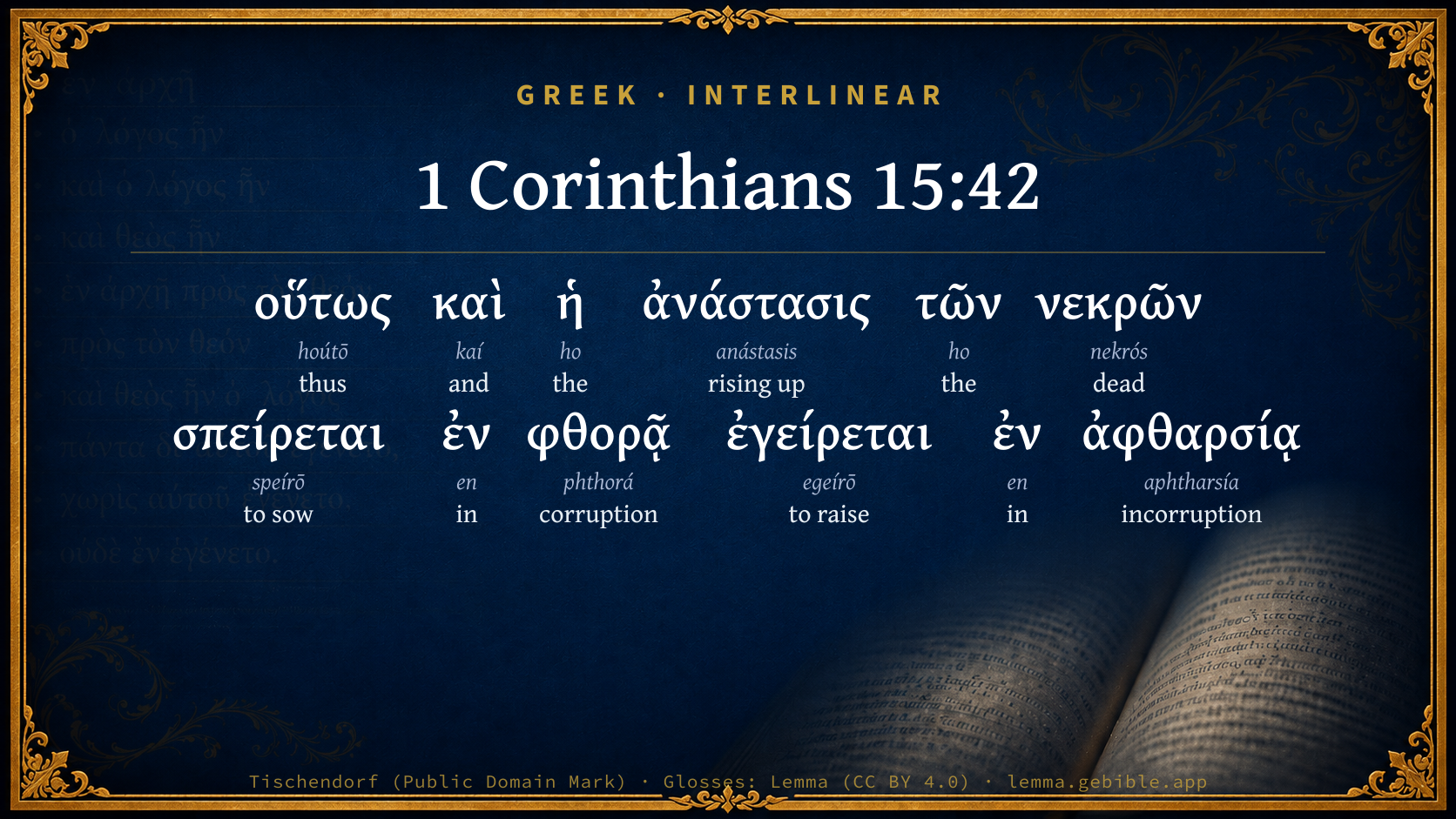
Greek (Tischendorf 8th ed.) 1 Corinthians 15:42 appears in the Greek New Testament. The text above is from the Tischendorf 8th edition. Each word links to its Strong’s number and a concise gloss. Click any word for its full Thayer’s Greek Lexicon entry.
Download image
Cite this verse

1 Corinthians 15:42 (World English Bible). Public Domain. Lemma interlinear Bible study tool, https://lemma.gebible.app/v/1-corinthians/15/42.

Show BibTeX & RIS
BibTeX
RIS
English Translation
So also is the resurrection of the dead. It is sown in corruption; it is raised in incorruption.
World English Bible · Public Domain
Download a study sheet

One document with this verse’s original text, its word-by-word gloss line, the meaning frame, cross-references with their text, attributed commentary, and full source and license credits — printable, and it pastes into notes with its structure intact.

This verse Autodidact and up

Study sheet (.html) Plain text (.txt)

A passage Seminary Student

Up to 50 verses in one chapter. A passage sheet keeps up to 6 commentary sources and 12 cross-references per verse, in the order this page ranks them, and says so on the sheet whenever that leaves anything out. Ask for a single verse and you get the Autodidact verse sheet above.

Everything on this page stays free to read, with no account — the sheet is a download of what is already on screen, not access to it.

Want to remove ads? Support Godless Engineer
Compare translations 3

The same verse in 3 English versions, stacked beneath the original-language interlinear above. Click any original word for its lexicon entry.

Each is an independent rendering of the whole verse — the interlinear is not word-aligned to these translations.

Highlighted words mark where these versions differ — a whole-verse word diff, not a word-by-word alignment.

  • World English Bible Public Domain
    So also is the resurrection of the dead. It is sown in corruption; it is raised in incorruption.
  • King James Version Public Domain
    So also is the resurrection of the dead. It is sown in corruption; it is raised in incorruption:
  • unfoldingWord Literal Text CC BY-SA 4.0
    So also the resurrection of the dead. is sown in decay is raised in immortality.

unfoldingWord Literal Text — © unfoldingWord, licensed CC BY-SA 4.0. Word-aligned USFM3 via Door43 (git.door43.org/unfoldingWord/en_ult).

Versions to compare (up to 4)

3 of 4 selected

Show all 19 translations

Every available English version of this verse, each an independent rendering of the whole verse.

  • World English Bible Public Domain
    So also is the resurrection of the dead. It is sown in corruption; it is raised in incorruption.
  • Berean Standard Bible Public Domain
    So will it be with the resurrection of the dead: What is sown is perishable; it is raised imperishable.
  • Majority Standard Bible Public Domain
    So will it be with the resurrection of the dead: What is sown is perishable; it is raised imperishable.
  • King James Version Public Domain
    So also is the resurrection of the dead. It is sown in corruption; it is raised in incorruption:
  • American Standard Version (1901) Public Domain
    So also is the resurrection of the dead. It is sown in corruption; it is raised in incorruption:
  • Revised Version (1885) Public Domain
    So also is the resurrection of the dead. It is sown in corruption; it is raised in incorruption:
  • Geneva Bible (1599) Public Domain
    So also is the resurrection of the dead. The bodie is sowen in corruption, and is raysed in incorruption.
  • Douay-Rheims (1899) Public Domain
    So also is the resurrection of the dead. It is sown in corruption, it shall rise in incorruption.
  • Young's Literal Translation Public Domain
    So also `is' the rising again of the dead: it is sown in corruption, it is raised in incorruption;
  • Literal Standard Version CC BY-SA 4.0
    So also [is] the resurrection of the dead: it is sown in corruption, it is raised in incorruption;
  • Unlocked Literal Bible CC BY-SA 4.0
    So also is the resurrection of the dead. What is sown is perishable, and what is raised is imperishable.
  • unfoldingWord Literal Text CC BY-SA 4.0
    So also the resurrection of the dead. is sown in decay is raised in immortality.
  • Darby Bible Public Domain
    Thus also [is] the resurrection of the dead. It is sown in corruption, it is raised in incorruptibility.
  • World Messianic Bible Public Domain
    So also is the resurrection of the dead. The body is sown perishable; it is raised imperishable.
  • Webster's Bible Public Domain
    So also is the resurrection of the dead. It is sown in corruption, it is raised in incorruption:
  • Free Bible Version CC BY-SA 4.0
    It's the same with the resurrection of the dead. The body is sown in decay; it is raised to last forever.
  • Bible in Basic English Public Domain
    So is it with the coming back from the dead. It is planted in death; it comes again in life:
  • Text-Critical English NT CC BY 4.0
    So it is with the resurrection of the dead. The body that is sown is perishable, but it is raised imperishable.
  • Tyndale New Testament (1534) Public Domain
    So is the resurreccion of the deed. It is sowe in corrupcion and ryseth in incorrupcion.

Literal Standard Version (2020), Covenant Press — licensed CC BY-SA 4.0. Text via the HelloAO Bible API (eBible.org). Unlocked Literal Bible (unfoldingWord) — licensed CC BY-SA 4.0. Text via the HelloAO Bible API (eBible.org). unfoldingWord Literal Text — © unfoldingWord, licensed CC BY-SA 4.0. Word-aligned USFM3 via Door43 (git.door43.org/unfoldingWord/en_ult). Free Bible Version, Dr. Jonathan Gallagher — licensed CC BY-SA 4.0. Text via the HelloAO Bible API (eBible.org).

Word by word

More ways to search: Search by grammar → Find every occurrence → Compare this word →

Practice this passage: Drill this verse → Learn its vocabulary →

About this verse

These counts appear in no published source. They are computed here, from the morphology-tagged text and Lemma’s own curated glosses. What Lemma adds →

12
words
10
distinct lemmas
Pauline Epistles
section

Notable vocabulary

The rarest word here is ἀφθαρσίᾳ incorruption G861 — appearing just 8 times in the whole Greek New Testament.

Shared distinctive vocabulary

ἀφθαρσίᾳ incorruption G861 occurs in 8 verses of the Greek New Testament. Also found in:

Repetition

Words recur within this verse:

Cross-references

17

Topical passages linked to 1 Corinthians 15:42 in the Treasury of Scripture Knowledge — connected by theme and wording, ordered by reader-vote popularity; previews shown in the World English Bible.

  • Daniel 12:3 Those who are wise shall shine as the brightness of the expanse; and those who turn many to righteousness as the stars forever and ever.
  • Matthew 13:43 Then the righteous will shine forth like the sun in the Kingdom of their Father. He who has ears to hear, let him hear.
  • Philippians 3:20–21 For our citizenship is in heaven, from where we also wait for a Savior, the Lord Jesus Christ;
  • Romans 8:21 that the creation itself also will be delivered from the bondage of decay into the liberty of the glory of the children of God.
  • 1 Peter 1:4 to an incorruptible and undefiled inheritance that doesn't fade away, reserved in heaven for you,
  • 1 Corinthians 15:50–54 Now I say this, brothers, that flesh and blood can't inherit the Kingdom of God; neither does corruption inherit incorruption.
  • Acts 2:27 Because you will not leave my soul in Hades, Neither will you allow your Holy One to see decay.
  • Acts 2:31 he foreseeing this spoke about the resurrection of the Christ, that neither was his soul left in Hades, nor did his flesh see decay.
  • Genesis 3:19 By the sweat of your face will you eat bread until you return to the ground, for out of it you were taken. For you are dust, and to dust you shall return."
  • Job 17:14 If I have said to corruption, 'You are my father;' To the worm, 'My mother,' and 'my sister;'
  • Psalms 16:10 For you will not leave my soul in Sheol, Neither will you allow your holy one to see corruption.
  • Psalms 49:14 They are appointed as a flock for Sheol. Death shall be their shepherd. The upright shall have dominion over them in the morning. Their beauty shall decay in Sheol, Far from their mansion.
  • Isaiah 38:17 Behold, [it was] for [my] peace [that] I had great bitterness: But you have in love to my soul delivered it from the pit of corruption; For you have cast all my sins behind your back.
  • Luke 20:35–36 But those who are considered worthy to attain to that age and the resurrection from the dead, neither marry, nor are given in marriage.
  • Acts 13:34–37 "Concerning that he raised him up from the dead, now no more to return to corruption, he has spoken thus: 'I will give you the holy and sure blessings of David.'
  • Romans 1:23 and traded the glory of the incorruptible God for the likeness of an image of corruptible man, and of birds, and four-footed animals, and creeping things.
  • Psalms 49:9 That he should live on forever, That he should not see corruption.

Cross-references courtesy of OpenBible.info (CC BY 4.0).

Commentary

Notes on 1 Corinthians 15:42 from classic Christian and Jewish commentators (each source and its license shown beneath its notes). The classic Christian expositions comment on the surrounding passage and are grouped to its opening verse, so a note may address several verses; the Jewish commentaries on the Tanakh (Rashi and others) are per-verse, so they appear only where the commentator wrote on this verse.

Lemma curates 59 commentaries, every one of them public domain or Creative Commons licensed, each selected and text-cleaned for this edition rather than reprinted as found. About our sources →

The Biblical Illustrator

Joseph S. Exell

1Co_15:42-45

So also is the resurrection of the dead.

It is sown in corruption; it is raised in incorruption.

The resurrection

I. Its essential character.

1. It is not the work of an age, but of a moment--not a gradual process, but an instantaneous act.

2. It is to be distinguished in its nature from--

(1) An awakening out of a soul sleep.

(2) A clothing of the unclothed spirit.

(3) A restoration of our flesh and bone in like form as before.

3. It is a work of perfect beauty.

II. Its certainty. A threefold voice testifies to it.

1. The voice of nature, which shadows it forth.

2. The testimony of the Scripture, which confirms it.

3. The testimony of the spirit within, which awakens the expectation of it.

III. Its glory.

1. The enemy which at this hour shall be annihilated.

2. The condition of happiness which begins now.

3. The kingdom of God which will now be completed. (Prof. Van Oosterzee.)

The resurrection body

I. Its substance.

1. Material and identical: that which is sown is raised, and not by any process but by the Word of God.

II. Its properties.

1. No longer corruptible, but undecaying, vigorous, and immortal.

2. No longer dishonoured by sin and defect, but; holy, beautiful, glorious.

3. No longer weak and frail, but endued with extraordinary capabilities and strength.

4. No longer a natural body subject to sense, passion, and the necessities of the earthly nature, but governed by the Spirit.

III. Its life. Not natural, but mysteriously sustained by the life-giving Spirit: for there is a natural and there is a spiritual body. (J. Lyth, D.D.)

The resurrection harvest

Look at those grassy mounds in the light of this truth; the eye of faith sees them change into a field sown with the seeds of immortality. Blessed field! what flowers shall spring there! What a harvest shall be gathered there! In the neighbouring fields, Whatsoever a man soweth, that he shall also reap. But here how great the difference between what is sown amid mourners tears, and what shall be reaped amid angels joys; between the poor body that we restore to the earth, and the noble form that shall spring from its ashes. Those who saw Lazarus putrid corpse, with health glowing on its cheek, saw nothing to match the change the grave shall work on these mouldering bones. (T. Guthrie.)

The resurrection of the dead

I. The doctrine teaches that the same body shall be raised in glory to a nobler life.

II. Its evidence.

1. The Word of God.

2. The resurrection of Christ.

3. The quickening Spirit within us.

III. Its use. It teaches us to take care of the soul first--then the body, not to enfeeble it by folly, pollute it with sin, neglect it in suffering, or mourn it when dead. (J. Lyth, D.D.)

The resurrection of the saint

I. The body is sown, not buried. No exact analogy with the seed; life is extinct. Yet it is sown in hope of a new life.

II. Will be gloriously transformed--from corruption to incorruption, etc.

III. Will be fashioned after the example of christ. (J. Lyth, D.D.)

The old house and the new

When we pluck down a house, with the intent to rebuild it, or repair the ruins of it, we warn the inhabitants out of it, lest they should be soiled with the dust and rubbish, or offended with the noise, and so for a time provide some other place for them; but, when we have newly trimmed and dressed up the house, then we bring them back to a better habitation. Thus God, when He overturneth this rotten room of our flesh, calleth out the soul for a little time, and lodgeth it with Himself in some corner of His kingdom, repaireth the imperfections of our bodies against the resurrection, and then, having made them beautiful--yea, glorious and incorruptible--He doth put our souls back again into their acquainted mansions. (Chrysostom.)

Life in heaven a spiritual life in a glorified body

I. The body will be a fit organ for the spirit.

1. A new body, incorruptible, glorious, vigorous, spiritual.

2. Yet substantially the same that was sown in the grave, therefore glorified by the power of God as the organ of the redeemed spirit.

II. The spirit will be developed in its full perfection.

1. Freed from ignorance and sin, from the control of the body, from the capability of suffering.

2. Yet retaining its peculiar properties.

(1) Knowledge, which must then be perfected in sight.

(2) Will, that shall then be clothed with power.

(3) Sensibility, that will be filled with enjoyment. (J. Lyth, D.D.)

It is sown in dishonour; it is raised in glory.

Dishonour belongs to the corpse of even the richest and the noblest in the land. You may conceal that humiliation by a splendid coffin, a rich funeral pall, the pomp of lying in state, and a costly monument; but the corpse is a poor, poor thing, with all your elaborate attempt to conceal its shame. The loveliest, sweetest maiden that you know soon becomes ghastly in the coffin, and you long to put the body out of sight. It was the shock of such a sight that made Don Francis Borgia, one of the founders of the Jesuits, renounce the world and devote himself to a religious life. It was the custom in Spain not to bury any of the royal family until some grandee of the highest rank should look within the coffin and identify the body. Queen Isabella, to whom Francis had been much attached, was smitten down by death. Don Francis was chosen to look within the coffin and say whether or not it was the corpse of the queen, whose eyes, now closed in death, had always turned in kindness unto him; whose every facial lineament was perfectly familiar unto him. Amidst the half-uttered prayers which commended her soul to the Divine mercy and the low dirge of the organ, Francis advanced with streaming eyes and reverently raised the covering which concealed the secrets of the grave;… but the horrible change which death had wrought upon the queens countenance was so loathsome and appalling that Francis turned aside to shudder and to pray, and from that day the courtier became a monk. Verily Queen isabellas body was sown in corruption and dishonour, in spite of all the funeral pomp and show! But the resurrection body of every Christian shall be incorruptible, spiritual powerful, and glorious. (F. W. Aveling, M.A.)

It is sown in weakness; it is raised in power.

At Stratford-on-Bow, in the days of Queen Mary, there was once a stake erected for the burning of two martyrs, one of them a lame man, the other a blind man. Just when the fire was lit, the lame man hurled away his staff, and turning round said to the blind man, Courage, brother, this fire will cure us both. So can the righteous say of the grave, Courage, the grave will cure us all; we shall leave our infirmities behind us. (C. H. Spurgeon.)

It is sown a natural body; it is raised a spiritual body.--

The natural body and the spiritual body

At first the phrase a spiritual body seems a contradiction in terms. Body and spirit are not only distinct in our thoughts, but opposite.

I. St. Paul has in part prepared us to understand the phrase by his argument from the analogies of nature.

1. He has taught us that one life, one flesh, one glory, may take many forms; the same flesh: it clothes itself in many forms in man, in beasts, in fishes, in birds, modified by the external conditions in which it is placed. So, also, there is one glory of light; but it takes many and diverse forms in the suns, the moons, the stars. And that bodies answer to the quality of the inward life, and are adapted to it, and to the conditions in which it is to act. This is the law of the universe.

2. Let us illustrate this.

(1) Take the parable of the Grain of Wheat. The seed is cast into the ground. In the husk are whatever the vital germ needs for its sustenance; and these, by the process of fermentation, are reduced to the very state in which the germ can most easily assimilate them. Its roots strike downwards, the stem springs upward, and soon we get the blade, the ear, and the full corn in the ear. And this new body, no less than the old, has all that it needs for the nourishment of its life, and is no less exactly adapted to its conditions. But how vast the change! From an earthly, it has become an aerial body, which draws vigour and comeliness from the bountiful heavens.

(2) Take the Greek parable of the butterfly. Psyche, the butterfly, has two bodies. First, it is a worm, creeping slowly on the earth, ugly, liable to be crushed, destroying the leaves on which it feeds, and the fruit which they should shelter. Finding itself grow sick with age, it spins its own shroud, coffin, grave, all in one--to prepare for its resurrection. At length, when the appointed time has come, out of the body of the crawling worm there breaks a new body, all the old imperfections taken away. Instead of creeping on the earth, it flies; for ugliness, it is clothed in beauty; instead of destroying that on which it feeds, it now feeds on the delicate fragrant flowers, and fertilises them by carrying pollen from plant to plant: the lovely flowers paying a willing tribute to the yet higher loveliness of the flower angel.

(3) Once more; as I stood looking at my marine aquarium one hot summer day, I saw on the surface of the water a tiny creature--half fish, half snake--not an inch long, writhing as in a mortal agony. I was stretching out my hand to remove it, lest it should sink and die and pollute the clear waters; when lo, in the twinkling of an eye, its skin split from end to end, and there sprang out a delicate fly. Balancing itself for an instant on its discarded skin, it preened its gossamer wings, and then flew out of an open window. Afterward I saw the marvel repeated again and again, and thus I learned that on sea as on land God bears perpetual varied witness to the mystery of the resurrection.

3. Therefore we may fairly assume that this universal law holds good of man, that he too will pass into a new form, a form more heavenly and spiritual, as his capacities are spiritualised and he rises into more heavenly conditions.

II. If we look a little more closely into the word translated a natural body, Pauls meaning will grow upon us, and the argument become more cogent.

1. The Greeks called the soul psyche, as well as the butterfly. And as psyche stood for soul, of course psychical stood for soulish, or of the soul. So St. Paul speaks here of a soulish and of a spiritual body, just as elsewhere he speaks of a soulish and a spiritual man. He held, as Aristotle held before him, and as the ablest metaphysicians still hold, that man is composed of body, soul, and spirit. He meant--

(1) By the soul all of intelligence and emotion which we possess in common with other animals, though in higher degree.

(2) By the spirit, our moral nature; the higher reason and conscience. With him the psychical man is the man in whom the psyche rules; the man who is intelligent, but uses his intelligence for ends bounded by time and space; but the spiritual man is the man in whom the spirit rules; in whom conscience, faith, love, are supreme.

2. St. Paul holds that so long as we remain soulish men, we have the very body adapted to our present stage of life and to the conditions of our life. But he also holds that if we live in the spirit, and walk in the spirit, we thus develop capacities and graces to which the present body gives neither full scope nor adequate expression. Therefore it is that, like the seed which has the life of wheat in it, our bodies must be sown in the earth that they may spring up heavenly bodies. Therefore it is that, as the caterpillar, which has in it the germ of a nobler life, lies down in death that its life may pass into a new aerial body, so we must lie down in the grave that, shedding these earthly husks, we may be clothed upon with a spiritual body, incorrupt, immortal, strong, glorious.

3. Our present body only imperfectly expresses our spiritual life; it veils from us many of the things of the Spirit, it impedes us in the pursuit of spiritual excellence. When the spirit is willing, how often is the flesh weak! The more spiritual we are, so much the more do we feel that we are in bondage to the flesh, and crave that spiritual body which, instead of veiling and clogging, will further and express all that is highest in us and best. How bright and animating the hope, then, that one day we too shall have a body as quick and responsive to the spirit in us as the mortal body to the soul, a body whose organs will minister as delicately and perfectly to our spiritual capacities, energies, virtues, graces, as the senses now minister to the energies and passions of the soul! (S. Cox, D.D.)

A spiritual body

is a bodily organism adapted to the life of the spirit, and controlled thereby. In it the soul has taken its proper position of subordination: mans spirit now holds the administrative power, and, ruled by Gods Spirit, rules the body through the executive medium of the willing soul. Man is at last what God originally intended him to be, a creature in whom the spirit is the personifying principle and the seat of government: his proper self down from his own spirit, as from a throne, reigns supreme over the soul, and through that over the body, in a threefold harmony: the harmony of the parts is the harmony of the whole: for the body is now reconstituted meet for the new government: it is pneumatic, no longer psychical. In the hour of Adams probation, as his spirit was to him the vehicle of fellowship with the Holy Spirit and his body the channel of communication with the sensible world, so his soul or self-living nature had to decide between two attractions, a higher and a lower, whether it would consent in accordance with the Divine intention to be determined by the spirit and thereby continue in fellowship with God, or would conclude against God and choose a life of selfish independence. By the fall of Adam his fellowship with God was dissolved, and the Divine life of his spirit was quenched, although its Divine substance remained, but not unimpaired. (Canon Evans.)

The relation between resurrection and immortality

The doctrines of immortality and resurrection stand somewhat in the same relation as a block of marble to a finished statue. The Christian doctrine of resurrection is the natural fact of immortality wrought into shape. We may know there is a statue in the marble, but how beautiful it may be, in what grace of posture it may stand, what emblems may hang upon its neck or crown its head, what spirit may breathe from its features, we do not know till the inspired sculptor has uncovered his ideal and brought it to light. The analogy may go farther. As an artist works a mass of marble into a statue, putting mental conceptions and meanings into it that are no part of the marble, so Christ has given a Divine shape to immortality and filled it with beautiful suggestions and gracious meaning. We see in the statue the mind of the sculptor as well as the marble; so in the doctrine of the resurrection we see the mind and purpose of Christ as well as the bare fact of future existence.

Our spiritual bodies

Our spiritual bodies will doubtless have new powers, and new glories, as much beyond those we now have as the flower in the sunshine, beautiful and fragrant, is beyond the seed under ground. May it not be that the wonderful development of our national powers by the inventions of Christian civilisation are but hints and glimpses and foretastes of the enlarged powers of our spiritual bodies? In the microscope, in the telescope, in the telegraph and telephone, in our facilities of travel, in the connection of mind with mind hinted at in some of the facts of mesmerism, all which a few years ago were but wildest dreams, but have more than realised the fables of the Arabian Nights, may we not have gleams of the dawning rays of our spiritual bodies when the resurrection morn shall have come? A curious illustration of the possibilities of our spiritual bodies was given not long ago in the American Popular Science Monthly. Sound is the vibration produced on us when the vibrations of the air strike on the drum of our ear. When they are few, the sound is deep; as they increase in number, it becomes shriller and shriller; but when they reach forty thousand in a second they cease to be audible. Light is the effect produced on us when waves of light strike on the eye. When four hundred millions of millions of vibrations of ether strike the retina in a second, they produce red, and as the number increases the colour passes into orange, then yellow, then green, blue, and violet. But between forty thousand vibrations in a second and four hundred millions of millions we have no organ of sense capable of receiving the impression. Yet between these limits any number of sensations may exist. We have five senses, and sometimes fancy that no other is possible. But it is obvious that we cannot measure the infinite by our own narrow limitations. (Christian Age.)

The Biblical Illustrator, edited by Joseph S. Exell (c. 1880s–1900s) — public domain. Text from a community e-Sword module.

Joseph Benson's Commentary

1Co 15:42-44. So also is the resurrection of the dead — So great is the difference between the body which fell and that which rises. It is to be observed, that in this and the following verses, the apostle is giving an account of the righteous only. It is sown — A beautiful word; committed as seed to the ground: and the apostle thus expresses the burial of the body, because he had illustrated the possibility of its resurrection, notwithstanding it rots in the grave, or is otherwise destroyed, by the example of grain sown in the earth, which after it rots produces grain of the same kind with itself; a comparison intended to illustrate only the possibility of the resurrection, but not the manner of its being effected. For certainly the body to be raised will not be produced by any virtue in the body buried, as plants are produced by a virtue latent in the seeds that are sown. For we are carefully taught in the Scriptures, that the resurrection of our bodies will be effected merely by the extraordinary and miraculous power of God, and not at all as either plants or animals are produced, in a natural way, from their seeds. In corruption — Just ready to putrefy, and by various degrees of corruption and decay, to return to the dust from whence it came. It is raised in incorruption — Utterly incapable of either dissolution or decay. It is sown in dishonour — Shocking to those who loved it best: human nature in disgrace! It is raised in glory — Clothed with robes of light, fit for those whom the King of heaven delights to honour. See on Mat 13:23; Php 3:21. It is sown in weakness — Deprived even of that feeble strength which it once enjoyed: it is raised in power — Endued with vigour, strength, and activity, such as we cannot now conceive. It is sown in this world a natural body — Or rather, an animal body, as σωμα ψυχικον more properly signifies, supported by food, sleep, and air, as the bodies of all animals are: it is raised a spiritual body — Of a more refined contexture, needing none of those animal refreshments, and endued with qualities of a spiritual nature like the angels of God. These alterations to be produced in the contexture of the bodies of the righteous are indeed great and wonderful, but far from being impossible. For, as Dr. Macknight justly observes, “to illustrate great things by small, we have an example of a similar, though very inferior transformation, in the bodies of caterpillars, which in their first state are ugly, weak, and easily crushed, but in their second state become beautifully winged animals, full of life and activity. This shows what God can do in greater instances.”

It may not be improper to add here, what is justly observed by the same author, that, notwithstanding this great difference between the bodies raised, and the bodies committed to the ground, those raised will, in a sound sense, be the same with the bodies that were buried; inasmuch as they will consist of members and organs of sensation in form and use similar to the members and organs of the present body: that is, as far as their new state will admit; a limitation this, absolutely necessary to be made, because the Scripture itself mentions two particulars, and reason suggests others, in which the bodies raised will essentially differ from those which died. 1st, We are told (1Co 6:13) that God will destroy both the belly, (including both the stomach and bowels,) or the use of that member, and meats. 2d, Our Lord assures us, that they who shall be accounted worthy to obtain that world, and the resurrection from the dead, neither marry nor are given in marriage, for they are equal to the angels. From these texts it follows, that none of the members necessary to eating, and drinking, and marriage, will make part of the glorified bodies of the saints; and that none of the appetites and passions which are gratified by these members, will have any existence in their minds: consequently, the joys of the heavenly country, though in part they are to arise from bodily senses, will have no affinity with the pleasures of a Mohammedan paradise. 3d, Reason directs us to believe, that to the similarity or sameness of the body which is raised, with the body that was buried, it is by no means necessary that the imperfections in the members of the buried body, should take place in the raised body. On the contrary, the restoration of all the members to their proper form, place, and office in the body, instead of making it a different body, will render it more perfectly the same. 4th, Besides the differences mentioned, there may be other differences likewise in the glorified bodies of the saints, suited to the difference of their state, of which at present we can form no conception. For if the raised body is to be endowed with new powers of action, and new senses, these may require additional members; and notwithstanding the addition, the raised body may, on account of its general similarity to the body that was buried, be still considered as the same. To conclude, the Scripture speaks consistently when, in describing the state of the righteous after the resurrection, it represents them as having their mortal bodies refashioned like to the glorious body of Christ, and informs us, that after their whole persons are thus completed, they shall be carried to a heavenly country, where every object being suited to the nature of their glorified bodies, they shall live unspeakably happy to all eternity.

Joseph Benson's Commentary on the Old and New Testaments (1811–1818) — public domain. Text from a community e-Sword module.

Whedon's Commentary on the Bible

Daniel D. Whedon

6. With these differences in various bodies, the differences between the buried and risen bodies correspond, 1Co_15:42-50.

42. So also—Similar to the difference in these contrasted classes of objects in nature is the difference between the buried and the resurrection body.

The words thrice produced—sown, sown, sown—can mean nothing but buried, buried, buried in the grave. And raised, raised, raised, can mean nothing but raised from the grave. And what is or can be raised but the material corpse there buried? And what can be “resurrected,” or immortalized, but that same material which is raised from the grave? And if the corpse is raised from the grave by the resurrection, what need of any other material? Obviously, indeed, both Jesus and Paul select the case of the buried only as the ordinary fact. But that ordinary fact is selected to declare the resurrection of the actually dead body. For what has any substituted body to do with the grave at all?

It… it—The it is not expressed in the Greek, but necessarily implied. For as the subject of both verbs, sown and raised, is the same, so the same subject is buried and “resurrected.” But what is the grammatical antecedent of it? What is it that is sown? None is here expressed, but 1Co_15:44 shows that body is implied.

If Jesus, instead of reanimating the putrid corpse of Lazarus by restoring to it its soul, had enshrined his soul in a new body, it would have been, so far as the soul was concerned, a transmigration, and not a resurrection. And so far as the body is concerned, a substitution and not a resurrection. The resurrection, to be a resurrection, must be of the same body; and it must be the same body by being the same substance, particle for particle. But it destroys not the resurrection to endow the body with new properties, and arrange its molecules to a new model.

There are three qualities assigned to the present body—corruption, dishonour, and weakness; and three to the resurrection body— incorruption, honour, and power. Corruption is the quality that arises from the instability of the material particles, by which displacement, decay, and disintegration take place. Incorruption implies that the body, however flexible to every volition, suffers no displacement, disarrangement, or dissolution. Every part and particle retains its place with perfect indissolubleness, health, and durability. Flexible as gossamer, it is unyielding as adamant.

Daniel D. Whedon (gen. ed.), Commentary on the Old and New Testaments (1874–1909) — public domain. Text from a community e-Sword module.

Tyndale Open Study Notes

Tyndale Open Resources

15:42-44 Just as growing plants differ from the seeds out of which they sprout, so resurrection bodies will be vastly unlike our mortal bodies.

Tyndale Open Study Notes — © Tyndale Open Resources, licensed CC BY-SA 4.0. Text via the HelloAO Bible API.

Bengel's Gnomon

Johann Albrecht Bengel

1Co 15:42. Οὕτω, thus) This word relates to the protasis already begun at 1Co 15:36.—σπείρεται, is sown) a very delightful word instead of burial.—ἐν φθορᾷ, in corruption) The condition not only of the dead body but of the mortal body is denoted.

Bengel's Gnomon of the New Testament — English translation (T&T Clark, Edinburgh, 1860) — public domain. Text from a community e-Sword module.

Meyer's Critical & Exegetical Commentary

Heinrich August Wilhelm Meyer

1Co_15:42-44. Application of the passage from 1Co_15:36 (σπείρεται) on to 1Co_15:41.

οὕτω καὶ ἡ ἀνάστασις τ. νεκρ.] sc. ἐστι. So does it hold also with the resurrection of the dead, in so far, namely, as the resurrection-body will be quite otherwise constituted than the present body.[76]

It is sown in corruption, etc. What is sown and raised up, is self-evident, and is also distinctly said in 1Co_15:44, on occasion being given by the adjectival form of expression, into which the discourse there passes.

On σπείρεται, the remark of Grotius is sufficient: cum posset dicere sepelitur, maluit dicere seritur, ut magis insisteret similitudini supra sumtae de grano. The apostle falls back on the image of the matter already familiar to the readers, because it must have by this time become clear to them in general from this image, that a reproduction of the present body at the resurrection was not to be thought of. The fact, again, that the image of sowing had already gone before in this sense,in the sense of interment,excludes as contrary to the text, not only van Hengels interpretation, according to which σπείρεται is held to apply to generation and man is to be conceived as the subject, but also Hofmanns view, that the sowing is the giving up of the body to death, without reference to the point whether it be laid in the earth or not. The sowing is mans act, but the ἐγείρεται Gods act, quite corresponding to the antithesis cf σύ, 1Co_15:36, and ὁ δὲ θεός, 1Co_15:38.

ἐν φθορᾷ] in corruption, i.e. in the condition of decay, is the body when it is buried.[77] Of a wholly different nature, however, will be the new body which raises itself at the resurrection-summons (1Co_15:52 f.) out of the buried one (as the plant out of the seed-corn); it is raised in the condition of incorruptibility. Comp. 1Co_15:50; 1Co_15:52.

ἐν ἀτιμίᾳ] in the condition of dishonour. Chrysostom (τί γὰρ εἰδεχθέστερον νεκροῦ διαῤῥυέντος;), Theodoret, Theophylact, Oecumenius, Beza, Grotius, al., including Billroth, have rightly understood this of the foeditas cadaveris; for σπείρεται represents the act of burial. Erasmus, Calvin, Vorstius, Estius, Rosenmüller, al., including Flatt (comp. Rückert), hold that it refers to the ante mortem miseriis et foeditatibus obnoxium esse, Estius. So also de Wette (comp. Osiander and Hofmann) in reference to all the three points, which, according to these expositors, are meant to designate the nature of the living body as regards its organization, or at least to include it (comp. Maier) in their scope. But this mode of conception, according to which the definition of state characterizes the earthly body generally according to its nature, not specially according to the condition in which it is at its interment, comes in only at the fourth point with σῶμα ψυχικόν in virtue of the change in the form of expression which is adopted on that very account. From the way in which Paul has expressed the first three points, he desires to state in what condition that which is being sown is at its sowing; in what condition, therefore, the body to be buried is, when it is being buried. This, too, in opposition to Ewalds view: even the best Christians move now in corruption, in outward dishonour before the world, et.

ἐν δόξῃ] refers to the state of outward glory, which will be peculiar to the resurrection-bodies; 1Co_15:40. It is the σύμμορφον εἶναι τῷ σώματι τῆς δόξης Χριστοῦ, Php_3:21.

ἘΝ ἈΣΘΕΝΕΊᾼ] not: variis morbis et periculis obnoxium, Rosenmüller and others, comp. Rückert (weakliness); for it refers to the already dead body (σπείρεται), but: in the condition of powerlessness, inasmuch as all ability, all ἰσχύς (Soph. Oed. Col. 616), all σθένος of the limbs (Pindar, Nem. v. 72, x. 90) has vanished from the dead body. Chrysostom, Oecumenius, Theodoret, Theophylact, al., narrow the reference too much in an arbitrary way, applying it simply to the inability to withstand corruption. Ἐν ἀσθ. is not a superfluous (de Wette), but a characteristic mark which specifically distinguishes the dead from the living bod.

ἐν δυνάμει] in the condition, of strength: the resurrection body will be endowed with fulness of strength for life and activity. What Grotius adds: cum sensibus multis, quos nunc non intelligimus, is perhaps true in itself, but is not conveyed in ἐν δυνάμει.

Instead of adducing one by one further qualities of the body as buried, with their opposites in the resurrection-body, Paul sums up by naming in addition that which conditions those other qualities, the specific fundamental nature of the present body which is buried, and of the future one which is raised: σπείρεται σῶμα ψυχικὸν, ἐγείρ. σ. πνευματικόν, i.e. there is sown a psychical body, etc. This is not opposed to the identity of the body, but the one which rises is quite differently qualified; there is buried a ψυχικόν, there rises a ΠΝΕΥΜΑΤΙΚΌΝ. That is the new ποιότης τοῦ σώματος in which the risen man comes (1Co_15:35); but the expression, which sets forth the difference as two subjects, is stronger and more significant than if we should take it with Hofmann: it is sown as a psychical body, etc.

The body which is buried is ψυχικόν, inasmuch as the ΨΥΧΉ, this power of the sensuous and perishable life (comp. on 1Co_2:14), was its life-principle and the determining element of its whole nature (consisting of flesh and blood, 1Co_15:50). The ΨΥΧΉ had in it, as Oecumenius and Theophylact say, ΤῸ ΚῦΡΟς Κ. ΤῊΝ ἩΓΕΜΟΝΊΑΝ. The resurrection-body, however, will be ΠΝΕΥΜΑΤΙΚΌΝ, i.e. not an ethereal body (Origen, comp. Chrysostom),[78] which the antithesis of ψυχικόν forbids; but a spiritual body, inasmuch as the πνεῦμα, the power of the supersensuous, eternal life (the true, imperishable ζωή), in which the Holy Spirit carries on the work of regeneration and sanctification (Rom_8:16-17), will be its life-principle and the determining element of its whole nature. In the earthly body the ψυχή, not the πνεῦμα, is that which conditions its constitution and its qualities, so that it is framed as the organ of the ψυχή;[79] in the resurrection-body the reverse is the case; the πνεῦμα, for whose life-activity it is the adequate organ, conditions its nature, and the ψυχή has ceased to be, as formerly, the ruling and determining element. We are not, however, on this account to assume, with Rückert, that Paul conceived the soul as not continuing to subsist for ever,a conception which would do away with the essential completeness and thereby with the identity of the human being. On the contrary, he has conceived of the πνεῦμα in the risen bodies as the absolutely dominant element, to which the psychical powers and activities shall be completely subordinated. The whole predicates of the resurrection-body, contrasted with the properties of the present body, are united in the likeness to the angels, which Jesus affirms of the risen, Mat_22:30, Luk_20:36, and in their being fashioned like unto the glorified body of Christ, as is promised by Paul, 1Co_15:48-49; Php_3:21. How far the doctrine of Paul is exalted above the assertion by the Rabbins of the (quite crass) identity of the resurrection-body with the present one, may be seen from the citations in Wetstein on 1Co_15:36, and in Eisenmenger, entdeckt. Judenth. II. p. 938 f.

εἰ ἔστι σῶμα ψυχ., ἔστι καὶ κ.τ.λ.] logical confirmation of the σῶμα πνευματ. just mentioned. It is to be shown, namely, that it is not an air-drawn fancy to speak of the future existence of a σῶμα πνευματικόν: If it is true that there is a psychical body, then there is also a spiritual body, then such a body cannot be a non-ensaccording to the mutually conditioning relations of the antitheses. The emphasis lies on the twice-prefixed ἔστι, existit (comp. the Rabbinical אית in Schoettgen, Hor. p. 670). The logical correctness of the sentence, again, depends upon the presupposition (1Co_15:42 f.) that the present and the future body stand in the relation of counterparts to each other. If, therefore, there exists a psychical body (and that is the present one), then a pneumatic body also must be no mere idea, but really existent (and that is the resurrection-body).

[76] It is to be observed that Paul, in his whole discussion regarding the nature of the future bodies, has in view only those of the first resurrection (see on ver. 23), leaving quite out of account the bodies of those who shall belong to the second resurrection, and consequently to the τέλος, ver. 24. He has in fact to do with believers, with future sharers in the resurrection of the righteous (comp. on Php_3:11), whose resurrection-hope was being assailed.

[77] Not as Hofmann would have it, in connection with his inappropriate interpretation of σπείρεται: up to the point, when it is given over to death.

[78] Or as Zeller in the theol. Jahrb. 1852, p. 297, would have it: a body composed of spirit, the πνεῦμα being conceived as material. Comp. Holsten, zum Ev. d. Paul. u. Petr. p. 72: out of heavenly light-material.

[79] Luthers gloss is: which eats, drinks, sleeps, digests, grows larger and smaller, begets children, etc. Spiritual, which may do none of these things, and nevertheless is a true body alive from the spirit.

Meyer — Critical and Exegetical Commentary on the New Testament — English translation by Peter Christie, edited by Frederick Crombie (T&T Clark, 1880) — public domain. Text from a community e-Sword module.

Expositor's Greek Testament

ed. W. Robertson Nicoll

1Co 15:42 a sums up what has been advanced in 1Co 15:36-41 , and presents it in six words: οὕτως καὶ ἡ ἀνάστασις τῶν νεκρῶν , “So indeed is the resurrection of the dead”. It is as possible as that plants of wholly diff [2522] form should shoot from the seed sown by your own hand; and the form of each risen body will be determined by God, who finds a suitable organism for every type of earthly life, and can do so equally for every type and grade of heavenly life, in a region where, as sun, moon, and stars nightly show, the universal splendour is graduated and varied infinitely.

[2522] difference, different, differently.

1Co 15:42-43 . Σπείρεται ἐν φθορᾷ … ἐν ἀτιμίᾳ … ἐν ἀσθενείᾳ : “The sowing is in corruption (perishableness) … in dishonour … in weakness”. It is better, with Cv [2523] , Wr [2524] (p. 656), and Hn [2525] , to regard σπείρεται and ἐγείρεται as impersonal , since no subject is supplied; the vbs., thrice repeated with emphasis, are contrasted in idea; the antithesis lies between two opp [2526] stages of being ( cf. , for the mode of expression, Luk 12:48 ). σπείρεται recalls, and applies in the most general way, the ὃ σπείρεις and σπέρματα of 1Co 15:36 ff. To interpret this vb [2527] as figuring the act of burial (“verbum amœnissimum pro sepultura,” Bg [2528] ; so Cm [2529] , Gr [2530] , Mr [2531] , Bt [2532] , El [2533] , and many others) confuses the analogy (the “sowing” is expressly distinguished from the “dying” of the seed, 1Co 15:36 ), and jars with ἐν ἀσθενείᾳ (a sick man, not a corpse, is called weak ), and with ψυχικὸν in 1Co 15:44 ; cf. also 1Co 15:50-54 , where ἡ φθορά , τὸ φθαρτόν , τὸ θνητὸν τοῦτο are identified with the living ἡμεῖς . Our present life is the seed-time (Gal 6:7 ff.), and our “mortal bodies” (Rom 8:10 f.) are in the germinal state, concluding with death (1Co 15:36 ), out of which a wholly diff [2534] organism will spring. The attributes φθορά ( cf. δουλεία τ . φθορᾶς , Rom 8:21 ), ἀτιμία ( cf. Phi 3:21 ), ἀσθενεία ( cf. 2Co 13:4 ) summed up in the θνητὰ σώματα of Rom 8:11 and μορφὴ δούλου of Phi 2:7 are those that P. is wont to ascribe to man’s actual physique, in contrast with the ἀφθαρσία , δόξα , δύναμις of the post-resurrection state: see 2Co 4:7 ; 2Co 4:10 ; 2Co 4:16 ; 2Co 5:1 ; 2Co 5:4 , Rom 1:4 ; Rom 8:18-23 . Thus, with variety in detail, Est. (“moritur corpus multis ante mortem miseriis et fœditatibus obnoxium, suscitabitur idem corpus omni ex parte gloriosum”), Cv [2535] , Hf [2536] , Hn [2537] , Ed [2538] Gd [2539] refers the threefold σπείρεται to the three moments of burial, mortal life , and birth respectively; van Hengel identifies it with procreation , quite unsuitably.

[2523] Calvin’s In Nov. Testamentum Commentarii .

[2524] Winer-Moulton’s Grammar of N.T. Greek (8th ed., 1877).

[2525] C. F. G. Heinrici’s Erklärung der Korintherbriefe (1880), or 1 Korinther in Meyer’s krit.-exegetisches Kommentar (1896).

[2526] opposite, opposition.

[2527] verb

[2528] Bengel’s Gnomon Novi Testamenti.

[2529] John Chrysostom’s Homiliœ († 407).

[2530] Greek, or Grotius’ Annotationes in N.T.

[2531] Meyer’s Critical and Exegetical Commentary (Eng. Trans.).

[2532] J. A. Beet’s St. Paul’s Epp. to the Corinthians (1882).

[2533] C. J. Ellicott’s St. Paul’s First Epistle to the Corinthians .

[2534] difference, different, differently.

[2535] Calvin’s In Nov. Testamentum Commentarii .

[2536] J. C. K. von Hofmann’s Die heilige Schrift N.T. untersucht , ii. 2 (2te Auflage, 1874).

[2537] C. F. G. Heinrici’s Erklärung der Korintherbriefe (1880), or 1 Korinther in Meyer’s krit.-exegetisches Kommentar (1896).

[2538] T. C. Edwards’ Commentary on the First Ep. to the Corinthians . 2

[2539] F. Godet’s Commentaire sur la prem. Ép. aux Corinthiens (Eng. Trans.).

The Expositor's Greek Testament, edited by W. Robertson Nicoll (1897–1910) — public domain. Text from a community e-Sword module.

Hodge's Commentary on Romans, Ephesians & First Corinthians

Charles Hodge

1Co_15:42

So also (is) the resurrection of the dead It is sown in corruption, it is raised in incorruption:

So also is the resurrection of the dead. That is, as the heavenly bodies differ from the earthly bodies, and as one star differs from another star, so the resurrection body will differ from our present body. The apostle does not mean that as one star differs from another star in glory, so one risen believer will differ from another. This, no doubt, is true; but it is not what Paul here says or intimates. His object is simply to show the absurdity of the objection founded on the assumption that the body hereafter must be what it is here. He shows that it may be a body and yet differ as much from what it is now as the light of the sun differs from a piece of clay. He therefore proceeds to show wherein this difference consists. The body is sown in corruption; it is raised in incorruption. The figure of the seed is again introduced. The bodies of the saints are as seed sown in the ground, not there to be lost or to remain; but at the appointed time, to rise in a state the very reverse of that in which they were committed to the dust. It is sown in corruption, i.e. it is now a corruptible body, constantly tending to decay, subject to disease and death, and destined to entire dissolution. It is raised in incorruption. Hereafter it will be imperishable; free from all impurity, and incapable of decay.

Charles Hodge — Commentary on Romans (1835), First Corinthians (1857), and Ephesians (1856) — public domain. Text from a community e-Sword module.

Geneva Bible (1599)

Geneva Bible translators

He maketh three manner of qualities of the bodies being raised: Incorruption, to wit, because they shall be sound, and altogether of a nature that cannot be corrupt: Glory, because they shall be adorned with beauty and honor: Power, because they shall continue everlasting without meat, drink, and all other helps, without which this frail life cannot keep itself from corruption.

Is buried, and man is hid as seed in the ground.

Geneva Bible (1599) marginal notes — public domain. Text via Bolls.life.

Jamieson, Fausset & Brown

Robert Jamieson, A. R. Fausset & David Brown

sown--Following up the image of seed. A delightful word instead of burial.

in corruption--liable to corruption: corruptible: not merely a prey when dead to corruption; as the contrast shows, "raised in incorruption," that is, not liable to corruption: incorruptible.

Jamieson, Fausset & Brown — Commentary Critical and Explanatory on the Whole Bible (1871) — public domain (CC PDM 1.0). Text via the HelloAO Bible API.

Adam Clarke's Commentary

Verse 42. So also is the resurrection of the dead.] That is, the bodies of the dead, though all immortal, shall possess different degrees of splendour and glory, according to the state of holiness in which their respective souls were found. The rabbins have some crude notions concerning different degrees of glory, which the righteous shall possess in the kingdom of heaven. They make out seven degrees:-

"The first of which is possessed by צדיקים tsaddi kim, the just, who observe the covenant of the holy, blessed God, and subjugate all evil affections."

"The second is possessed by those who are ישרים yesharim, the upright; whose delight it is to walk in the ways of God and please him."

"The third is for תמימים temimim, the perfect: those who, with integrity, walk in the ways of God, and do not curiously pry into his dispensations."

"The fourth is for קדושים kedoshim, the holy ones; those who are the excellent of the earth, in whom is all God's delight." Ps 16:3.

"The fifth is for בעלי תשובה baaley teshubah, the chief of the penitents; who have broken through the brazen doors, and returned to the Lord."

"The sixth is for תינוקות של בית רבן tinukoth shel beith raban, the scholars and tender ones; who have not transgressed."

"The seventh is for חסידים chasidim, the godly: and this is the innermost of all the departments." These seven degrees require a comment by themselves.

There is a saying among the rabbins very like that of the apostle in this and the preceding verse Siphri, in Yalcut Simeoni, page 2, fol. 10: "The faces of the righteous shall be, in the world to come, like suns, moons, the heaven, stars, lightnings: and like the lilies and candlesticks of the temple."

It is sown in corruption] The body is buried in a state of degradation, decay, and corruption. The apostle uses the word sown to intimate that the body shall rise again, as a seed springs up that has been sown in the earth.

It is raised in incorruption] Being no more subject to corruption, dissolution, and death.

Adam Clarke's Commentary on the Bible (1810–1826) — public domain. Text from a community e-Sword/MySword module.

Ellicott's Commentary for English Readers

(42) So also is the resurrection of the dead.—Here follows the application of these analogies to the subject in hand. As there is in the vegetable growth, in the varieties of animal life, and in the diversities of form assumed by inorganic matter, an identity preserved amid ever-varying form or variety of “body,” so a change in the form or glory of our organism which we call our “body” is compatible with the preservation of personal identity. The “it,” the personality, remains the same—now in corruption, then in incorruption; now in dishonour, then in glory; now in weakness, then in power.

A Bible Commentary for English Readers, edited by Charles John Ellicott (1878–1897) — public domain. Text from a community e-Sword module.

The Cambridge Bible for Schools and Colleges

gen. ed. J. J. S. Perowne

42. So also is the resurrection of the dead] The fact is now plainly stated that all shall not possess the same degree of glory in heaven. ‘So,’ i.e. as has been before stated. But St Paul goes on to deal less with the fact than with the manner in which the fact is accomplished.

It is sown in corruption; it is raised in incorruption] Cf. Rom_8:21; Col_2:22; 2Pe_1:4 for corruption (in the Greek). And for incorruption see Rom_2:7, Eph_6:24 (margin), 2Ti_1:10, and Tit_2:7. The English version in the first and third of these passages renders by immortality, in the second and fourth by sincerity. The rendering in the text is the more accurate.

The Cambridge Bible for Schools and Colleges (gen. ed. J. J. S. Perowne; Cambridge University Press, 1878–1918) — public domain. Text from a community e-Sword module.

John Gill's Exposition

And so it is written,.... In Gen 2:7

the first man Adam was made a living soul: in the Hebrew text it is, man, or Adam, became, or was made a living soul; that is, as the apostle says, "the first man Adam": he calls him, as the Jews (a) frequently do, , "the first man"; he was the first man that was made, and the first parent of mankind, and the head and representative of all his posterity, and so the first in time, causality and dignity; whose name was Adam, so called by God in the day he was created, because he was formed , "from the ground, or earth"; when God breathed life into the earthly mass, or lump; and being animated with a rational soul, it became an animal body, or a living creature; and so the apostle proves, from the first man that was upon earth, that there is a natural, or animal body; a body animated by a soul, and which was supported by eating and drinking, by sleep and rest; and was capable of dying, and should die, in case of sin; and which was the state of it in its first creation, whilst in innocence, and before the fall; and this is all he meant to prove by this Scripture; for what follows is not mentioned as therein written, or elsewhere, but as the apostle's own assertion:

the last Adam was made a quickening spirit: by "the last Adam" is meant Jesus Christ, called Adam, because he is really and truly a man, a partaker of the same flesh and blood as the rest of mankind; and because he is the antitype of the first man Adam, who was a figure of him that was to come; and therefore called Adam, for the same reason as he is called David and Solomon: he is said to be "the last", in distinction from the first Adam, with respect to him he stood, last upon the earth, as in Job 19:25 to which passage some think the apostle here alludes; and because he appeared in the last days in the end of the world, and is the last that shall rise up as a common head and representative of the whole, or any part of mankind: now he is made "a quickening spirit"; which some understand of the Holy Spirit, which filled the human nature of Christ, raised him from the dead, and will quicken our mortal bodies at the last day; others of the divine nature of Christ, to which his flesh, or human nature, was united; and which gave life, rigour, and virtue, to all his actions and sufferings, as man; and by which he was quickened, when put to death in the flesh, and by which he will quicken others another day: though rather I think it is to be understood of his spiritual body, of his body, not as it was made of the virgin, for that was a natural, or an animal one; it was conceived and bred, and born as animal bodies are; it grew and increased, and was nourished with meat and drink, and sleep and rest; and was subject to infirmities, and to death itself, as our bodies be; but it is to be understood of it as raised from the dead, when it was made a spiritual body, for which reason it is called a "spirit": not that it was changed into a spirit, for it still remained flesh and blood; but because it was no more supported in an animal way; nor subject to those weaknesses that animal bodies are, but lives as spirits, or angels do; and a quickening one, not only because it has life itself, but because by virtue of the saints' union to it, as it subsists in the divine person of the Son of God, their bodies will be quickened at the last day, and made like unto it, spiritual bodies; also because he lives in his body as a spiritual one, they shall live in theirs as spiritual ones: and so the apostle shows, that there is a spiritual, as well as an animal body; that as the first man's body, even before the fall, was an animal or natural one; the last Adam's body upon his resurrection is a spiritual and life giving one, as the Syriac version renders it; so the Cabalistic writers (b) speak of

"Adam; who is the holy and supreme, who rules over all, and gives spirit and life to all.''

(a) T. Bab. Sanhedrin, fol 38. 2. & 100. 1. & alibi passim. & , Cabala denud. par. 4. p. 195, &c. Vid. 2 Esdras iii. 21. (b) Zohar in Exod. fol. 59. 4.

John Gill's Exposition of the Whole Bible (1746–1763) — public domain (CC PDM 1.0). Text via the HelloAO Bible API.

Trapp's Complete Commentary

John Trapp

42 So also is the resurrection of the dead. It is sown in corruption; it is raised in incorruption:

Ver. 42. So also is the resurrection] Whether there are degrees of glory, as it seems probable, so we shall certainly know, when we come to heaven. Three glimpses of the body’s glory were seen, in Moses’ face, in Christ’s transfiguration, and in Stephen’s countenance.

John Trapp, A Commentary or Exposition upon All the Books of the Old and New Testament (1647–1656) — public domain. Text from a community e-Sword module.

Albert Barnes' Notes on the Bible

So also is the resurrection - In a manner similar to the grain that is sown, and to the different degrees of splendor and magnificence in the bodies in the sky and on the earth. The dead shall be raised in a manner analogous to the springing up of grain; and there shall be a difference between the body here and the body in the resurrection.

It is sown - In death. As we sow or plant the kernel in the earth.

In corruption - In the grave; in a place where it shall be corrupt; in a form tending to putrefaction, disorganization, and dust.

It is raised in incorruption - It will be so raised. In the previous verses 1Co 15:36-41 he had reasoned from analogy, and had demonstrated that it was possible that the dead should rise, or that there was no greater difficulty attending it than actually occurred in the events which were in fact constantly taking place. He here states positively what would be, and affirms that it was not only possible, but that such a resurrection would actually occur. They body would be raised “in incorruption,” “uncorruptible” 1Co 15:52; that is, no more liable to decay, sickness, disorganization, and putrefaction. This is one characteristic of the body that shall be raised, that it shall be no more liable, as here, to wasting sickness, to disease, and to the loathsome corruption of the grave. That God can form a body of that kind, no one can doubt; that he actually will, the apostle positively affirms. That such will be the bodies of the saints is one of the most cheering prospects that can be presented to those who are here wasted away by sickness, and who look with dread and horror on the loathsome putrefaction of the tomb.

Albert Barnes' Notes on the Bible (1834–1885) — public domain. Text from a community e-Sword/MySword module.

Matthew Poole's English Annotations

So also is the resurrection of the dead; that is, so shall it be, as to the bodies of the saints, in the resurrection. The same bodies of the saints shall rise, though with qualities, and in a condition, much different from what they were when they fell; as the same grain of wheat shooteth up, though with another body: and as there is a difference between celestial and terrestrial bodies, and between celestial bodies themselves; so there will be a difference between the bodies of the saints, now that they are only of the earth, earthy, from what they shall be in the resurrection; which difference he openeth in several particulars.

It is sown in corruption, it is raised in incorruption: it is sown that is, it dieth and is buried in such a state, that it is subject to putrefaction; but when it shall be again raised from the dead, it shall be subject to no putrefaction or corruption: so 1Co 15:52; The dead shall be raised incorruptible.

Matthew Poole's English Annotations on the Holy Bible (1683–1685) — public domain. Text from a community e-Sword/MySword module.

The Pulpit Commentary

So also is the resurrection of the dead. In like manner the dead, when raised, shall have bodies which differ from their body of humiliation. (Php_3:21) It is sown in corruption. "Dust thou art, and unto dust shalt thou return". (Gen_3:19) It is raised in incorruption. The word means strictly, "incorruptibility." The resurrection body will not be subjected to earthly conditions. (Luk_20:35, Luk_20:36)

Vers. 42-53.

The resurrection body.

Limited to resurrection body of redeemed, for we know not what will be that of the lost. Of the former in our present state we can know comparatively little. Still some valuable and cheering truths respecting it are revealed.

I IT WILL BE:

1. Incorruptible. Our body now is corruptible, tending towards decay and dissolution, bearing the marks of injury, disease, age. It becomes more corruptible at death. But the resurrection body will have no such tendencies, be subject to no such influences.

2. Glorious. Our present body is a body of dishonour. The marks of the curse of sin are upon it. In the grave it becomes very inglorious. Paul calls it "our vile body". (Php_3:21) The resurrection body will be in striking contrast a body of glory and beauty, like unto the glorious body of the Son of man.

3. Strong. Now our body is weak, subject to enervating sickness, and when "sown" as a corpse is the very perfection of weakness. But the resurrection body will possess fulness of strength, abundant energy, never diminishing vitality.

4. Spiritual. Our present body is dominated by the animal soul; it is fitted for life in the lower world; it is an organism of flesh and blood (ver. 50); it is "of the earth, earthy." It is a "natural" body. But the resurrection body will be "spiritual," moulded by the Spirit, an organism adapted to the higher and spiritual life.

II THOUGH SO DIFFERENT FROM, IT IS IDENTIFIED WITH, OUR PRESENT BODY. It is a new body and yet identified with the old. Not the same particles or form, yet our body. Note the apostolic expression: "It is sown; it is raised. Much mystery is here. But perhaps the seed developing into a living plant conveys as much of the truth as we are capable of comprehending.

III WE RECEIVE IT THROUGH THE SECOND ADAM, CHRIST. Through the first Adam we have our present body, and, through his sin and our own, not a few of its imperfections. The first Adam was a "living soul," endowed with an animal soul, the living principle of the body. His body was adapted for the lower life for a life on earth. He was "of the earth, earthy." But the second Adam is a life-giving Spirit. If we are in him, he quickens our mortal body into glorious immortality. Through him we receive the spiritual body suited for the higher life. Contrasted with Christ, the characteristic of the first Adam is animal life, the characteristic of Christ is spiritual life. We inherit from Adam what he had and was. So also we inherit from Christ what he had and was. The difference between the first Adam and the second causes the difference between our body now and our body at the resurrection.

IV CIRCUMSTANCES ATTENDANT UPON ITS BESTOWAL. It will be assumed suddenly at the second coming of Christ. "The trumpet shall sound, and the dead shall be raised incorruptible" (ver. 52). The living will be "changed" "in the twinkling of an eye". (see 1Th_4:16) No slow process, as in the development of the present body, but suddenly we shall be "clothed upon.

V WE SHOULD BE INTENSELY GRATEFUL FOR THIS GLORIOUS GIFT. This poor body we may be glad to lose. Certainly its imperfections. But what a life may we anticipate when we are "clothed upon with our house which is from heaven"! To be free from weakness, weariness, pain, decay, most of all from carnal cravings and fleshly lusts; to have abounding energy, perfect health, pure desires, and great and completed powers: what service and pleasure we shall be capable of! This is "of the Lord." Is he our Lord? When we die shall we die in "Christ"? Can we humbly lay claim to this great gift as true, though imperfect, servants of the Master? H.

The Pulpit Commentary (1880–1919), ed. H.D.M. Spence-Jones & Joseph S. Exell — public domain. Text from a community e-Sword module.

John Wesley's Explanatory Notes

So also is the resurrection of the dead - So great is the difference between the body which fell, and that which rises. It is sown - A beautiful word; committed, as seed, to the ground. In corruption - Just ready to putrefy, and, by various degrees of corruption and decay, to return to the dust from whence it came. It is raised in incorruption - Utterly incapable of either dissolution or decay.

John Wesley, Explanatory Notes Upon the Whole Bible (1754–1765) — public domain. Text via the GEBible commentary corpus.

Kretzmann's Popular Commentary

Paul E. Kretzmann

A contrast between the present and the future states:

v. 42. It is sown in corruption, it is raised in incorruption;

v. 43. it is sown in dishonor, it is raised in glory; it is sown in weakness, it is raised in power;

v. 44. it is sown a natural body, it is raised a spiritual body. There is a natural body, and there is a spiritual body.

v. 45. And so it is written, The first man, Adam, was made a living, soul; the last Adam was made a quickening spirit.

v. 46. Howbeit that was not first which is spiritual, but that which is natural; and afterward that which is spiritual.

v. 47. The first man is of the earth, earthy; the second man is the Lord from heaven.

v. 48. As is the earthy, such are they also that are earthy; and as is the heavenly, such are they also that are heavenly.

v. 49. And as we have borne the image of the earthy, we shall also bear the image of the heavenly.

As the apostle develops this beautiful contrast, he retains the imagery of the pictures used in the previous section and thus makes his presentation concrete, easily understood, in a fine, symmetrical pattern. As with the seed, so it is with the human body, specifically that of the believers: It is sown in corruption, it is raised in incorruption. The dead body is laid into its last resting-place, the grave. We sow it as a seed in God’s acre, knowing that it will spring up into imperishable life. Decay may take hold of the lifeless hull, putrefaction may result in the total decomposition of the body, yet the omnipotent power of the Lord will raise it up to a glorious, heavenly condition. It is sown in dishonor, it is raised in glory. The earthly body, due to the action of sin and its effects, is unseemly, vile, Php 3:21, and at the time of its burial the little attractiveness and loveliness which it may have possessed is gone; it must be covered from the sight of men. But when God calls it forth from the grave, it will rise in glory, renewed once more to the brightness of His image that created it, fashioned like unto the glorious body of Christ Himself. "Transparent as crystal, the body of the resurrection will radiate the glory which the Spirit of Christ imparts to it; the flesh, no longer a dull covering, will be a lamp of spiritual light, according to the manner in which Christ was transfigured on the holy mount. " It is sown in weakness, it is raised in power. The body which we commit to the grave is about to return to the dust from which it was made; what little physical and intellectual strength lived in that unlovely frame has fled; it is an inert, helpless mass of decaying flesh. But when the trumpet-call of the Lord assembles the bones, then that same body will be clothed with power from on high, its nature will partake of that of Christ’s body. And all these facts are summarized by Paul: There is sown a natural, a fleshly body, the body being controlled in all its actions by the soul, but yet subject to corruption, dishonor, and weakness. And there is raised a spiritual body, one that partakes of the qualities of a spirit, with incorruption, glory, and power. For if there is a natural body, one in which the soul is the agency of natural life, then there is no reason for assuming that there is not also a spiritual body, one which is possessed, spiritualized, by the spirit, through the power of God. So the comparison holds true: The body of the resurrection is indeed not the same weak, corrupt body that was laid in the grave, and yet there are not two different bodies, the natural body being annihilated, and the spiritual body being filled with the soul of the former human being. The spiritual body, rather, the Christian body of resurrection, is the outgrowth of the new man that was planted in the Christian as the germ of the future glorified body, through the Word and Sacraments.

The apostle substantiates this doctrine by a Scripture quotation: The first man, Adam, became a living soul, Gen 2:7. That was the natural state of Adam, as the representative and the forefather of the entire human race; he was created to be a bodily being animated with a living soul, and as such he existed during his earthly life. In contrast to this Paul says that the last Adam, the progenitor of the new spiritual humanity, became a life-giving spirit, for Christ is the antitype of Adam. From Adam, as a forefather, the human race received only soul, earthly, natural life; but from Christ, the Forefather of the spiritual race of mankind, the believers receive the true spiritual life, which extends beyond the grave and makes us possessors of the divine glory: He is the Source of the heavenly and eternal life.

In case someone should now object by asking why God did not immediately create every human being so as to make the body spiritual at once, to give to soul, body, and spirit the eternal, heavenly life, Paul answers: However, not is first the spiritual, but the psychic, the natural, then the spiritual. Even the body of Adam, the first man, was not spiritual, but natural, God’s intention being that the spiritualized condition was to be realized by man’s remaining in permanent communion with the Lord, for which Adam had received strength. Through the. Fall, of course, the intention of God was thwarted, and now, more than ever, the body of sin is a natural body, truly born of the flesh. Only by the power of the Spirit in the means of grace is the spiritual life planted in us, and only by the application of the same power will He raise us up as spiritual bodies. It follows, then, that the first man is of the earth, earthy, his body partaking of the nature of the dust out of which he was formed. The second man, Christ, had no such origin, even though He assumed human nature in the body of the Virgin Mary. From the very moment of His conception He was the Lord from heaven, the Son of Man which is in heaven, Joh 3:13. And so He succeeded and displaced the first father of mankind; He is of heaven, the God-man. As the earthy, such they also that are earthy; all those that have descended from Adam are, like him, of an earthy nature. Adam, instead of rising to a spiritual state, fell into sin; and we, who are his bodily descendants, fell in his fall, and bear his mere natural, earthy life. And as the heavenly, such they also that are heavenly; as the exalted Christ, the First-born of many brethren, partakes of the fullness of the heavenly glory in His spiritual body, so Christ’s risen followers, their bodies made like unto His own glorious body, shall share in this glory. And just as we have borne the image of the earthy, the outward, bodily form of our progenitor, Adam, so let us bear also the image of the Heavenly One. We drag around this body of sin with us, homesick throughout our earthly life for the true life above; but we look forward to the happy day of our final deliverance, when we shall be restored to His image and once more, according to soul and body, enter the ranks of the children of God, 1Jn 3:2; Col 3:4. "The wearing of Christ’s moral likeness here carries with it the wearing of His bodily likeness hereafter."

Paul E. Kretzmann, Popular Commentary of the Bible (1921–1924) — public domain. Text from a community e-Sword module.

Burkitt's Expository Notes on the New Testament

William Burkitt

Here the apostle gives a fourfold instance of the body’s different qualities in the resurrection: It is sown in corruption; that is, it is here a frail mortal body, subject to putrefaction; but when raised shall be incorruptible, that is, never more subject to death or dissolution. It is here a vile body, subject to deformity and dishonour, and when sown or laid in the grave, is loathsome and unlovely; but shall be raised in glory, a bright and beautiful body, shining like the sun in the firmament of the heavens. It is thought we shall rise in a full and perfect age, in full strength, activity, and vigour: and whereas our bodies now move heavily, they shall then ascend and descend like angels.

Again, It is sown in weakness; that is, it is subject to weakness by labour, to decays by age, to impotency and wastings by diseases; and when it dies, it appears in impotent piece of clay. But it shall be raised in power by God’s power; it shall be raised a powerful body; no more impotent, weak, or feeble, but strong and active, vigorous and nimble; never subject more either to weariness or weakness.

Lastly, It is sown a natural body, an animal body, a body suited to this lower sensible state, in which we live at present; and when it dies, it is sown in the grave, like the body of a beast. But it shall be raised a spiritual body.

Mark, he doth not say it shall be changed into a spirit, but into a spiritual body; a body it shall remain still, but spiritualized. It is probable that our bodies will then be aerial, and thin, and light, more suited to the nature of the soul, as active as fire, as fine and thin as the air.

More particularly note here, that the raised body will be a spiritual body in a threefold respect.

1. As it shall always be subject and serviceable to the spirit. Here the soul is subject to the body; the soul must go the body’s pace; but at the resurrection the body shall be everlastingly subject to the soul or spirit, and for that reason is called a spiritual body.

2. It may be called a spiritual body, in regard of the great strength and activity with which the body shall be then endowed; spirits are strong, and so is every thing that is spiritual. The devil is called a spiritual enemy, because he is a powerful enemy. Thus our spiritual bodies will be strong bodies; and strong had they need to be, that they may be able to bear that exceeding weight of glory, as the apostle calls it, 2Co 4:17, which would crush our bodies under it, were they not made strong to bear it.

3. It is called spiritual, because it will then need no natural helps to support it, as meat, drink, sleep, and clothing. We shall want these no more than the angels want them, being immediately supported by the power of God, as they are.

Thus it is sown a natural body, but raised a spiritual body; not attenuated into a spirit, but still a body; a real, but spiritual body. The body, after the resurrection, shall be true flesh, but spiritualized, rarefied, and refined; it shall not lose any perfections which it had, but gain many perfections which it had not.

Hail, happy day, when soul and body shall be re-united, and the happiness of both completed! How will the soul then bless God for that body which was here its instrument and assistant in the service of God; and how will the body then bless God for such a soul, which was so careful to secure an interest in that happiness which it was created for, and made capable of! Then will full glory be poured into the soul: and when it is a second time married to the body, it shall have a greater degree of glory than ever it had.

William Burkitt's Expository Notes on the New Testament (1700–1703) — public domain. Text from a community e-Sword module.

McGarvey & Pendleton's Commentaries

J. W. McGarvey

So also is the resurrection of the dead . [Here the apostle answers the second question of 1Co_15:35 . If a man rises from the dead changed as the grain of wheat is changed, will he not have a different body, and so lose his identity? Will he not cease to be man? Paul gives a threefold answer to this question. He shows that there may be diversity, and yet a common ground of identity. There are diverse forms of flesh, yet all these forms are flesh; there may be different forms of bodies having different glories, yet are they all bodies; yea, even the glories may differ in luster and yet may have common identity as glory. Thus also is the resurrection of the dead. The flesh is changed, and yet it is in a sense flesh--humanity; there may be modifications in the form, and yet it will be the same body. There may be great changes in the glory, yet the glory will still be glory, and not essentially different. Thus man may still be man, and yet be vastly improved. In this part of the argument Paul is correcting a cardinal error in Greek thought. They stumbled at the doctrine of a resurrection, because they regarded the body as a clog to the soul; and so the body might indeed be, if God could form but one kind of body. But he can form celestial as well as terrestrial bodies, and spiritual bodies adapted to the needs of the spirit, which will not hinder it as does this earthly tabernacle which it now inhabits--bodies which will not only prove no disadvantage, but of infinite assistance, because answering every requirement. This truth is now further exemplified.] It is sown in corruption [ Ecc_12:7 ]; it is raised in incorruption [ Luk_20:35-36 ]:

J. W. McGarvey (with Philip Y. Pendleton), Commentaries on the New Testament (The Fourfold Gospel, 1914; Acts; and the epistles) — public domain. Text from a community e-Sword/MySword module.

The People's New Testament

B. W. Johnson

42–50. So also is the resurrection of the dead. It is sown. Planted in burial in corruption. It goes to decay. It is raised in incorruption. With a new body suited to the new condition of existence, which is incorruptible; cannot decay.

B. W. Johnson's The People's New Testament with Notes (1889–1891) — public domain. Electronic text from the Christian Classics Ethereal Library (CCEL) ThML edition.

unfoldingWord translationNotes

Door43 World Missions Community

What is sown ... what is raised ... It is sown ... it is raised

The writer speaks of a person's body being buried as if it were a seed that is planted in the ground. And he speaks of a person's body being raised from the dead as if it were a plant growing from the seed. The passive verbs can be stated in active form. AT: "What goes into the ground ... what comes out of the ground ... It goes into the ground ... it comes out of the ground" or "What people bury ... what God raises ... People bury it ... God raises it" (See: Idiom and Metaphor and Active or Passive)

is raised

"is caused to live again"

is perishable ... is imperishable

"can rot ... cannot rot"

translationWords

resurrection

die

plant

perish

dishonor

glory

power

body

spirit

unfoldingWord translationNotes — © Distant Shores Media and the Door43 World Missions Community, licensed CC BY-SA 4.0. Source: git.door43.org/Door43/en_tn.

Cambridge Greek Testament for Schools and Colleges

42. οὕτως καὶ ἡ ἀνάτασις. The fact is now plainly stated that all shall not possess the same degree of glory in heaven. οὕτως, i.e. as has been before stated. But St Paul goes on to deal less with the fact than with the manner in which the fact is accomplished.

σπείρεται ἐν φθορᾷ. Cf. Rom 8:21; Gal 6:8; Col 2:22; 2Pe 1:4 for φθορά. And for ἀφθαρσία see Rom 2:7; Eph 6:24; 2Ti 1:10, and Tit 2:7. The English version in the first and third of these passages renders by immortality, in the second and fourth by sincerity.

Cambridge Greek Testament for Schools and Colleges (Cambridge University Press, 1896; 21 vols, various authors incl. Carr, Maclear, Plummer, Farrar, Lumby, Moule, M. R. James, Simcox) — public domain. Text from a community e-Sword module.

Alford’s Greek Testament

Henry Alford

42.] οὕτως, thus, viz. in the entire diversity of that which is raised again from the former body.

σπείρεται] “Cum posset dicere sepelitur, maluit dicere seritur, ut magis insisteret similitudini supra sumtæ de grano.” Grot.

ἐν φθορᾷ, ἐν ἀφθαρσίᾳ] in a state of corruption,—in a state of incorruptibility.

Henry Alford, The Greek Testament (1849–1861) — public domain. Text from a community e-Sword module.

International Critical Commentary

42. Hitherto the answer to the second question (ποίῳ δὲ σώματι ἒρχονταὶ) has been indirect: it now becomes direct. The risen body is incorruptible, glorious, powerful, spiritual. It is quite obvious that the corpse which is `sown’ is none of these things. It is in corruption before it reaches the grave; it has lost all rights of citizenship (ἀτιμία), and, excepting decent burial, all rights of humanity; it is absolutely powerless, unable to move a limb. The last epithet, ψυχικόν, is less appropriate to a corpse, but it comes in naturally enough to distinguish the body which is being dissolved from the body which will be raised. The former was by nature subject to the laws and conditions of physical life (ψυχή), the latter will be controlled only by the spirit (πνεῦμα), and this spirit will be in harmony with the spirit of God. In the material body the spirit has been limited and hampered in its action; in the future body it will have perfect freedom of action and consequently complete control, and man will at last be, what God created him to be, a being in which the higher self is supreme. The connexion between ‘spirit’ and ‘power’ is frequent in Paul (2:4, 5:4; Rom 1:4, Rom 1:15:13, Rom 1:19): cf. Luk 1:35; Act 1:8. Evidently, ψυχικόν does not mean that the body is made of ψυχή, consists entirely of ψυχή: and πνευματικόν does not mean is made and consists entirely of πνεῦμα. The adjectives mean ‘congenital with,’ ‘formed to be the organ of.’ The ψυχή, in combination with the physical germ, enables the latter to develop according to the law of the γένος. The πνεῦμα, in combination with an immaterial germ, enables the latter to develop according to a higher law which is quite beyond our comprehension. The πνεῦμα is the power by which the ψυχή in our present body has communion with God; it is also the future body’s principle of life. Only in this Epistle does St Paul use ψυχικός (vv. 44, 46, 2:14; elsewhere Jas 3:15 and Jud 1:19; see Mayor on both passages, and Hort on Jas 3:15): ψυχή is found in all groups, except the Pastoral Epp. In the liturgies we frequently have the order, ψυχή, σῶμα, πνεῦμα, perhaps suggesting that σῶμα is the link between the other two (JTS. Jan. 1901, p. 273). See Additional Note, pp. 380 f.

International Critical Commentary — older volumes (1896–1929), various authors — public domain. Text from a community e-Sword module.

Vincent's Word Studies in the New Testament

Marvin R. Vincent

So also. Having argued that newness of organization is no argument against its possibility, Paul now shows that the substantial diversity of organism between the earthly and the new man is founded in a diversity of the whole nature in the state before and in the state after the resurrection. Earthly beings are distinguished from the risen as to duration, value, power, and a natural as distinguished from a spiritual body. 130 It is sown. Referring to the interment of the body, as is clear from vers. 36, 37. 131

Marvin R. Vincent, Word Studies in the New Testament (1887–1900) — public domain. Text from a community e-Sword/MySword module.

Godet's Commentaries

Frédéric Louis Godet

Vv. 42, 43. “So also is the resurrection of the dead. The body is sown in corruption; it is raised in incorruption: 43. it is sown in dishonour; it is raised in glory: it is sown in weakness; it is raised in power.”

Here, strictly speaking, is the answer to the second question of 1Co 15:35 : With what body? Answer: with a body which, far from being the reappearance of the former, will have characteristics of an absolutely opposite kind. The verb σπείρεται, it is sown, is generally applied, in accordance with the term sow in 1Co 15:36-37, to the interment of the body. This meaning may no doubt suit the first member of the first antithesis: sown in corruption. But it is impossible to carry out this application in the first members of the three following antitheses. The term weakness is not suitable to the state of the dead body, whatever Meyer may say; and in any case, it would form a singular stage beyond the preceding term, dissolution. Finally, it is still more impossible to apply the term psychical, “moved by a soul,” in 1Co 15:44, to the body which is laid in the tomb. No doubt it may be said that the point in question here is not the state of the body at that time, but its nature during life. But it is still very forced to apply the term animated to the body when deprived of the breath of life. For this reason, several commentators, such as Erasmus, Calvin, Heinrici, have been led to apply the term sow to the fact of birth. This meaning may suit the second and fourth epithets (weak, psychical); but hardly the other two (in dishonour, dissolution). How could Paul thus characterize the life of the child, full of freshness, at the moment when it begins to unfold its powers? Hofmann has been driven by these two impossibilities to understand by the word sow the giving up of the body, not specially to interment, but to the power of death, which works in it all through the duration of its earthly existence. This explanation comes near to what seems to me to be the true meaning of the four antitheses; but it is insufficient, inasmuch as it does not clearly account for their gradation. Their order is in a manner retrograde; and the meaning of the word sow is modified and widened as we pass from one antithesis to another. In the first, it relates to interment, as is required by the word φθορά, dissolution. In the second (the state of dishonour), the thought, taking a first retrograde step, embraces in the term sow all the miseries of this earthly life, which precede and go to produce the dissolution of the body, all the humiliating conditions to which our body is now subjected; comp. the expression: “the body of our humiliation” (Php 3:21). In the third antithesis, the term weakness brings us to the moment of birth, to that state of entire powerlessness which belongs to the infant at its entrance into life. Finally, the term psychical body, in 1Co 15:44, carries us further back still, to that moment when the breath of life, ψυχή, is communicated to the physical germ which is about to begin its development in order to serve the ψυχή as its organ. The word sow thus embraces all the phases of the body’s existence, which, beginning with the first dawn of being, terminates in committal to the earth. It is in this sense that the earthly life is so frequently compared to the time of sowing, and eternity to the time of harvest. The three first corresponding terms: incorruptibility, glory, and power, are easily understood. The first represents the body to come as exempt from the touch of sickness, decline, and death; the second, as free from the daily infirmities of the present body, and all radiant with the brightness of perfect life; the third, as endowed with unlimited power of action.

But these three opposite characteristics distinguishing between the present and the resurrection body are all three effects; they rest on a fourth contrast which touches the very essence of the two bodies, and which the apostle indicates in the first proposition of 1Co 15:44 by the antithesis between a psychical and a spiritual body. It is this last contrast which is developed in the following passage, 1Co 15:44-49.

Frédéric Louis Godet — Commentaries on Luke, John, Romans, and 1 Corinthians — English translation (T&T Clark, Edinburgh, 1870s–1890s) — public domain. Text from a community e-Sword module.

Lesson kit

Teaching starters — assembled from the data on this page, not authored interpretation. Every prompt links to the verse data it draws on. Edit before teaching.

1 Corinthians, in the Pauline Epistles, opens this verse with 12 words (10 distinct Greek lemmas). Its most distinctive word is aphtharsía (“incorruption”). A historical commentator’s framing appears above. Read the whole chapter for the surrounding context.

Discussion questions

  1. What does “incorruption” (aphtharsía) contribute to the verse as a whole?
  2. How does Romans 2:7, which shares the word «incorruption», read alongside this verse?
  3. What does the repetition of “the” (2× in this one verse) do in this verse?
  4. The translations on this page render this verse differently — a whole-verse word diff, not a word-by-word alignment. What might account for the different wordings?
  5. Compare how The Biblical Illustrator and Joseph Benson's Commentary read this verse. Where do they agree or differ?

Things to notice

Reading settings

Reading text

Shown beneath each verse's original-language words.

Old Testament
Old Testament edition

Read the OT as the Masoretic Hebrew (MT) or the Greek Septuagint (LXX).

English shown for the Greek Septuagint (in the Hebrew ↔ Greek comparison).

Comparing translations? Open the Compare panel on any verse page to stack up to four side by side.