
Romans 4:18

Greek (Tischendorf 8th ed.) Romans 4:18 appears in the Greek New Testament. The text above is from the Tischendorf 8th edition. Each word links to its Strong’s number and a concise gloss. Click any word for its full Thayer’s Greek Lexicon entry.
Download image
Cite this verse

Romans 4:18 (World English Bible). Public Domain. Lemma interlinear Bible study tool, https://lemma.gebible.app/v/romans/4/18.

Show BibTeX & RIS
BibTeX
RIS
English Translation
Who in hope believed against hope, to the end that he might become a father of many nations, according to that which had been spoken, "So will your seed be."
World English Bible · Public Domain
Download a study sheet

One document with this verse’s original text, its word-by-word gloss line, the meaning frame, cross-references with their text, attributed commentary, and full source and license credits — printable, and it pastes into notes with its structure intact.

This verse Autodidact and up

Study sheet (.html) Plain text (.txt)

A passage Seminary Student

Up to 50 verses in one chapter. A passage sheet keeps up to 6 commentary sources and 12 cross-references per verse, in the order this page ranks them, and says so on the sheet whenever that leaves anything out. Ask for a single verse and you get the Autodidact verse sheet above.

Everything on this page stays free to read, with no account — the sheet is a download of what is already on screen, not access to it.

Want to remove ads? Support Godless Engineer
Compare translations 3

The same verse in 3 English versions, stacked beneath the original-language interlinear above. Click any original word for its lexicon entry.

Each is an independent rendering of the whole verse — the interlinear is not word-aligned to these translations.

Highlighted words mark where these versions differ — a whole-verse word diff, not a word-by-word alignment.

  • World English Bible Public Domain
    Who in hope believed against hope, to the end that he might become a father of many nations, according to that which had been spoken, "So will your seed be."
  • King James Version Public Domain
    Who against hope believed in hope, that he might become the father of many nations, according to that which was spoken, So shall thy seed be.
  • unfoldingWord Literal Text CC BY-SA 4.0
    who against hope believed on the basis of hope so that he might become the father of many nations according to what said, “So will your seed be.”

unfoldingWord Literal Text — © unfoldingWord, licensed CC BY-SA 4.0. Word-aligned USFM3 via Door43 (git.door43.org/unfoldingWord/en_ult).

Versions to compare (up to 4)

3 of 4 selected

Show all 19 translations

Every available English version of this verse, each an independent rendering of the whole verse.

  • World English Bible Public Domain
    Who in hope believed against hope, to the end that he might become a father of many nations, according to that which had been spoken, "So will your seed be."
  • Berean Standard Bible Public Domain
    Against all hope, Abraham in hope believed and so became the father of many nations, just as he had been told, “So shall your offspring be.”
  • Majority Standard Bible Public Domain
    Against all hope, Abraham in hope believed and so became the father of many nations, just as he had been told, “So shall your offspring be.”
  • King James Version Public Domain
    Who against hope believed in hope, that he might become the father of many nations, according to that which was spoken, So shall thy seed be.
  • American Standard Version (1901) Public Domain
    Who in hope believed against hope, to the end that he might become a father of many nations, according to that which had been spoken, So shall thy seed be.
  • Revised Version (1885) Public Domain
    Who in hope believed against hope, to the end that he might become a father of many nations, according to that which had been spoken, So shall thy seed be.
  • Geneva Bible (1599) Public Domain
    Which Abraham aboue hope, beleeued vnder hope, that he should be the father of many nations: according to that which was spoken to him, So shall thy seede be.
  • Douay-Rheims (1899) Public Domain
    Who against hope believed in hope; that he might be made the father of many nations, according to that which was said to him: So shall thy seed be.
  • Young's Literal Translation Public Domain
    Who, against hope in hope did believe, for his becoming father of many nations according to that spoken: `So shall thy seed be;'
  • Literal Standard Version CC BY-SA 4.0
    Who, against hope, believed in hope, for his becoming father of many nations according to that spoken: “So will your seed be”;
  • Unlocked Literal Bible CC BY-SA 4.0
    In hope he believed against hope, that he would become the father of many nations, according to what he had been told, “So will your descendants be.”
  • unfoldingWord Literal Text CC BY-SA 4.0
    who against hope believed on the basis of hope so that he might become the father of many nations according to what said, “So will your seed be.”
  • Darby Bible Public Domain
    who against hope believed in hope to his becoming father of many nations, according to that which was spoken, So shall thy seed be:
  • World Messianic Bible Public Domain
    Against hope, Abraham in hope believed, to the end that he might become a father of many nations, according to that which had been spoken, “So will your offspring be.”
  • Webster's Bible Public Domain
    Who against hope believed with hope, that he should become the father of many nations; according to that which was spoken, So shall thy seed be.
  • Free Bible Version CC BY-SA 4.0
    Against all hope Abraham in hope trusted God, so he could become the father of many peoples, just as God had promised him: “This is how many descendants you'll have!”
  • Bible in Basic English Public Domain
    Who without reason for hope, in faith went on hoping, so that he became the father of a number of nations, as it had been said, So will your seed be.
  • Text-Critical English NT CC BY 4.0
    Against all hope Abraham believed in hope that he would become the father of many nations according to what had been spoken: “So shall yoʋr offspring be.”
  • Tyndale New Testament (1534) Public Domain
    Which Abraham contrary to hope beleved in hope that he shuld be the father of many nacions accordynge to that which was spoken: So shall thy seed be.

Literal Standard Version (2020), Covenant Press — licensed CC BY-SA 4.0. Text via the HelloAO Bible API (eBible.org). Unlocked Literal Bible (unfoldingWord) — licensed CC BY-SA 4.0. Text via the HelloAO Bible API (eBible.org). unfoldingWord Literal Text — © unfoldingWord, licensed CC BY-SA 4.0. Word-aligned USFM3 via Door43 (git.door43.org/unfoldingWord/en_ult). Free Bible Version, Dr. Jonathan Gallagher — licensed CC BY-SA 4.0. Text via the HelloAO Bible API (eBible.org).

Word by word

More ways to search: Search by grammar → Find every occurrence → Compare this word →

Practice this passage: Drill this verse → Learn its vocabulary →

σπέρμα
spérma
G4690
“seed”
Noun, Nominative, Singular, Neuter
Part of Speech
Noun
Case
Nominative
Number
Singular
Gender
Neuter
Full Thayer's Definition

Origin: from G4687

TDNT: 15:56,1

1. from which a plant germinates a. the seed i.e. the grain or kernel which contains within itself the germ of the future plants 1. of the grains or kernels sown b. metaph. a seed i.e. a residue, or a few survivors reserved as the germ of the next generation (just as seed is kept from the harvest for the sowing) 2. the semen virile a. the product of this semen, seed, children, offspring, progeny b. family, tribe, posterity c. whatever possesses vital force or life giving power 1. of divine energy of the Holy Spirit operating within the soul by which we are regenerated
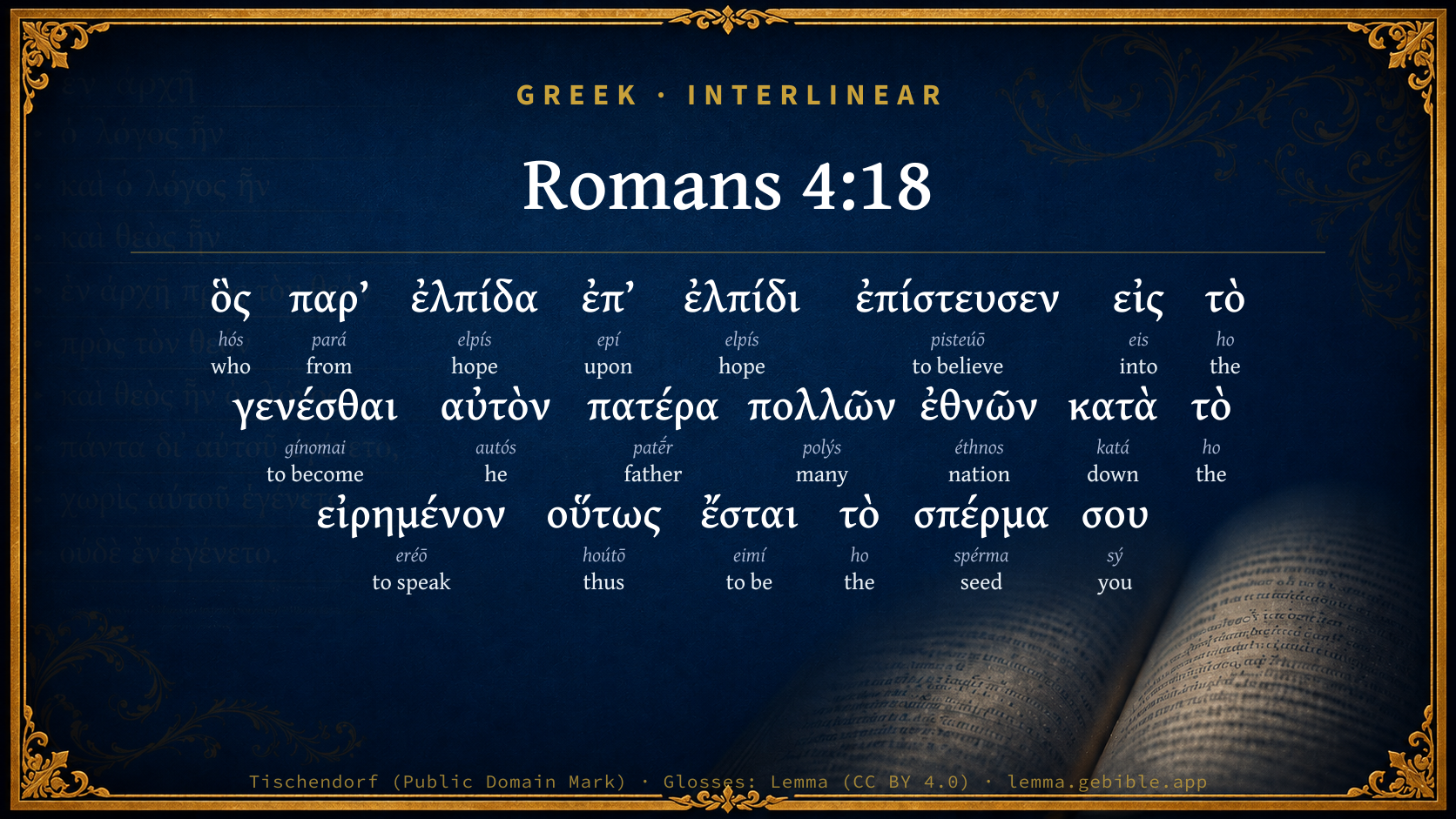
  1. ὃς hós G3739 “who” Relative pronoun, Nominative, Singular, Masculine
  2. παρ’ pará G3844 “from” Preposition
  3. ἐλπίδα elpís G1680 “hope” Noun, Accusative, Singular, Feminine
  4. ἐπ’ epí G1909 “upon” Preposition
  5. ἐλπίδι elpís G1680 “hope” Noun, Dative, Singular, Feminine
  6. ἐπίστευσεν pisteúō G4100 “to believe” Verb, Aorist, Active, Indicative, 3rd person, Singular
  7. εἰς eis G1519 “into” Preposition
  8. τὸ ho G3588 “the” Article, Accusative, Singular, Neuter
  9. γενέσθαι gínomai G1096 “to become” Verb, Aorist, Middle deponent, Infinitive
  10. αὐτὸν autós G846 “he” Personal pronoun, Accusative, Singular, Masculine
  11. πατέρα patḗr G3962 “father” Noun, Accusative, Singular, Masculine
  12. πολλῶν polýs G4183 “many” Adjective, Genitive, Plural, Neuter
  13. ἐθνῶν éthnos G1484 “nation” Noun, Genitive, Plural, Neuter
  14. κατὰ katá G2596 “down” Preposition
  15. τὸ ho G3588 “the” Article, Accusative, Singular, Neuter
  16. εἰρημένον eréō G2046 “to speak” Verb, Perfect, Passive, Participle, Accusative, Singular, Neuter, Attic form
  17. οὕτως hoútō G3779 “thus” Adverb
  18. ἔσται eimí G1510 “to be” Verb, Future, Middle deponent, Indicative, 3rd person, Singular
  19. τὸ ho G3588 “the” Article, Nominative, Singular, Neuter
  20. σου sý G4771 “you” Personal pronoun, 2nd person, Genitive, Singular

About this verse

These counts appear in no published source. They are computed here, from the morphology-tagged text and Lemma’s own curated glosses. What Lemma adds →

21
words
18
distinct lemmas
Pauline Epistles
section

Shared distinctive vocabulary

σπέρμα seed G4690 occurs in 41 verses of the Greek New Testament. Also found in:
Repetition

Words recur within this verse:

  • ἐλπίδα hope G1680 ×2
  • τὸ the G3588 ×3

Cross-references

11

Topical passages linked to Romans 4:18 in the Treasury of Scripture Knowledge — connected by theme and wording, ordered by reader-vote popularity; previews shown in the World English Bible.

  • Romans 8:24 For we were saved in hope, but hope that is seen is not hope. For who hopes for that which he sees?
  • Genesis 15:5–6 Yahweh brought him outside, and said, "Look now toward the sky, and count the stars, if you are able to count them." He said to Abram, "So shall your seed be."
  • Romans 5:5 and hope doesn't disappoint us, because God's love has been poured out into our hearts through the Holy Spirit who was given to us.
  • Acts 27:25 Therefore, sirs, cheer up! For I believe God, that it will be just as it has been spoken to me.
  • Proverbs 13:12 Hope deferred makes the heart sick, But when longing is fulfilled, it is a tree of life.
  • Mark 5:35–36 While he was still speaking, they came from the synagogue ruler's house saying, "Your daughter is dead. Why bother the Teacher any more?"
  • Ezekiel 37:11 Then he said to me, Son of man, these bones are the whole house of Israel: behold, they say, Our bones are dried up, and our hope is lost; we are clean cut off.
  • Romans 4:17 As it is written, "I have made you a father of many nations." This is in the presence of him whom he believed: God, who gives life to the dead, and calls the things that are not, as though they were.
  • Ruth 1:11–13 Naomi said, Turn again, my daughters: why will you go with me? have I yet sons in my womb, that they may be your husbands?
  • Luke 1:18 Zacharias said to the angel, "How can I be sure of this? For I am an old man, and my wife is well advanced in years."
  • Romans 4:19 Without being weakened in faith, he didn't consider his own body, already having been worn out, (he being about a hundred years old), and the deadness of Sarah's womb.

Cross-references courtesy of OpenBible.info (CC BY 4.0).

Commentary

Notes on Romans 4:18 from classic Christian and Jewish commentators (each source and its license shown beneath its notes). The classic Christian expositions comment on the surrounding passage and are grouped to its opening verse, so a note may address several verses; the Jewish commentaries on the Tanakh (Rashi and others) are per-verse, so they appear only where the commentator wrote on this verse.

Lemma curates 59 commentaries, every one of them public domain or Creative Commons licensed, each selected and text-cleaned for this edition rather than reprinted as found. About our sources →

Joseph Benson's Commentary

Rom 4:18-22. Who, &c. — In this paragraph the apostle first takes notice of the difficulties which stood in the way of Abraham’s faith, and then of the power and excellence of it, manifested in its triumphing over them. Against hope — Against all probability; believed in hope — With an assured confidence, grounded on the divine promise; according to all that which was spoken — When God called him forth abroad to view the stars of heaven. So shall thy seed be — So numerous and glorious. And being not weak in faith — That is, being strong in faith; for the Hebrews, when they meant to assert a thing strongly, did it by the denial of its contrary. He considered not his own body now dead — With regard to the probability of begetting children. He did not regard it so as to be discouraged thereby, or induced to disbelieve the promise. The children which Abraham had by Keturah, after Sarah’s death, do not invalidate the apostle’s assertion here; for Abraham’s body, having been renewed by a miracle in order to the begetting of Isaac, might preserve its vigour for a considerable time afterward. Nor did he consider or regard the old age of Sarah. He staggered not — Greek, εις την επαγγελιαν του θεου ου διεκριθη τη απιστια, against the promise of God he did not reason; through unbelief — Did not call in question the truth of God’s promise, or the certainty of its fulfilment; but was strong in faith, giving glory to God — Entertaining high and honourable thoughts of God’s power and faithfulness, and manifesting the same by his actions. “We are told, indeed, that when God declared that Sarah was to be the mother of nations, Gen 17:17, Abraham fell upon his face and laughed, and said in his heart, Shall a child be born to him that is a hundred years old? &c. But these questions did not proceed from unbelief, but from admiration and gratitude, as may be gathered from the posture into which he put himself. And with respect to his laughing, it did not imply any doubt of God’s promise, otherwise he would have been rebuked, as Sarah was for her laughing: but it means simply, that he rejoiced at God’s promise; for in the Hebrew language, to laugh signifies to rejoice, Gen 21:6, God hath made me to laugh, so that all that hear will laugh with me; consequently the passage may be translated, Abraham rejoiced and said, &c.” And being fully persuaded — Through the knowledge which he had of the divine perfections; that what he had promised — Greek, ο επηγγελται, that what was promised; he was able, and willing also, to perform — He believed God to be most faithful, and sure never to fail in the performance of his promises; collecting nothing else from the difficulty and improbability of the matter, but that it was the fitter for an Almighty power to effect; and therefore it — His faith; was imputed to him for righteousness — He was justified by it.

Joseph Benson's Commentary on the Old and New Testaments (1811–1818) — public domain. Text from a community e-Sword module.

The Preacher's Complete Homiletical Commentary

Joseph S. Exell (gen. ed.)

CRITICAL NOTES

Rom_4:18.—Against hope as man; but upon hope in God (Severian).

Rom_4:19.—In this passage Abraham is represented as placed between two opposite forces—that of sight and that of faith. The look of faith fixed on the promises prevented every look cast on the external circumstances.

Rom_4:24. If we believe on Him, etc—Implies purpose, certainty, and continuance.

Rom_4:25.—Christians assured by Christ’s resurrection of the removal of their guilt. In the same way that the death and resurrection of Christ form an intimate unity, so also in man the death of the old and the rising up of the new cannot be conceived as existing without each other (Olshausen).

MAIN HOMILETICS OF THE PARAGRAPH.—Rom_4:18-25

Not for his sake alone.—It is a glorious sight, a good man struggling with adversity and endeavouring to bear patiently the ills of life—more glorious still a good man rejoicing in adversity and making difficulties minister to highest delights. Travel back many centuries to the olden time. See a good man believing, hoping, rejoicing, though the sphere of sense did not furnish ground for such mighty faith. Abraham was not a materialist. Matter, with sceptical materialism for our guide, crushes faith. Matter is mighty, but mind is mightier. We know not the omnipotent energy of the infinite Mind. Abraham did not believe that man is a mere creature of circumstances except in so far as they are directed by God. Man divinely strengthened is superior to circumstances. Abraham defied time. What are a hundred years to Him whose existence is not measured on human dial-plates! Abraham believed in a knowable God—one whose promise was equalled by His performance. Promise and performance are coequal with God. If they were not, God would be untrue to His nature, and that He can never be. Abraham had a noble ambition. He believed in hope to the intent that he might become the father of many nations. Spiritual fatherhood is the highest and the noblest. The patriarch looked forward to a glorious and ever-increasing family. His sons and daughters are numerous. Abraham lived, believed, hoped, and prayed not for himself alone: he lived in his God and in the thought of our ennobled race. “Not for his sake alone” is inscribed on his monumental pillar. How beautifully Abraham seeks to settle the dispute between his herdmen and Lot’s! Abraham’s kindly considerateness shows that he spoke not for his sake alone. Abraham the intercessor for the Cities of the Plain showed himself one living for the welfare of others. Not for his sake alone is the short biography written. We are the heirs of the ages. A down the stream of time come argosies laden with mental and spiritual wealth. We stand on the moral delta which is enriched by the alluvial deposits from the noblest men and times. We are rich, or ought to be, in the moral spoils of time. And yet how weak in faith, how puny in works! We shake in the presence of modern pretenders like reeds before the wind. If a woman writes a book against our religion, we pile up against her magazine articles and send forth Christian evidence lecturers, as if she could hurl the Omnipotent from His throne. Why is our faith weak? Because:

1. We look only at the things which are seen. Our vision is bounded by the things of sense. We must look at the things which are unseen. We believe in the unseen and unseeable things of this world—if we may use the word—on the testimony of observant men. Why not believe in the unseen things of the spiritual realm on the testimony of God and of His servants? The things unseen are the realities—the certain and abiding realities. Let faith thus exercise itself, and it will grow.

2. We dwell on the seeming. Our morbid fancy leads us astray. We first fancy, and then we believe that the creation of our fancy is a child of fact. Let us seek to be, like Abraham, strong in faith. In spite of all appearances, in spite of all seeming impossibilities, let us believe in God. Can it be that Abraham in the dawn of time by his might shames our weakness? By this weakness of faith we shut ourselves up in the gloomy castle of doubt, we lead miserable lives. Our harps are hung on the willows. Our swords rust in the sheaths. We impede true progress, and we dishonour God. We might be strong if we could look above and beyond our surroundings to the God who promises, and remember that with Him nothing is impossible. Delay there may be to human seeming, and yet that may be accomplishment in the divine purpose. Faith grows like all other powers and graces. Abraham by believing was strengthened in his faith. How wide the promise “To him that hath shall be given”! Faith is an increasing grace. In order to increase there must be growth; in order to growth there must be food and exercise. Faith is fed by the promise. Faith is exercised by the period of waiting. The very obstacles which would stagger the faith of a doubting soul will be made by the believing man into the means whereby his faith is strengthened. Let us not shame our noble father. A strong faith-soul he walks the upper plains. Does he look down on us as sickly members of his great family? Oh to be strengthened in faith! and then we should give glory to God by the fuller recognition of His power and faithfulness, we should be the better able to perform our duties, our lives would be filled with joy, and God’s blessing would rest upon us. Let us live for the sake of others. The inheritance which Abraham has handed down to us let us impart to our fellows and transmit unimpaired to our descendants.

Rom_4:20. The unwavering man gathers strength.—Physical and intellectual strength may be developed up to a certain limit, and then it declines. Physical strength, sooner or later, will be shorn of the locks wherein it lies. Intellectual strength will fade into the imbecility of age. But moral strength has no limit. It will grow through the longest life. It will develop in eternal cycles. How shall we grow in strength? By wavering not at the promises of God.

I. The unwavering man has a single eye.—He looks to the promise, and not to the improbability. He treads the plank of the divine promise, looking forward to the goal of fulfilment, and thus he is not disturbed by the surging waters of scepticism.

II. The unwavering man has a clear vision.—The divine promise reveals to his soul the divine Promisor. He is able to perform. He must be faithful. For God to break His promise, would be for God to be untrue to His covenant, to be untrue to His own nature, and that He can never be. How strong a man must grow who clearly sees the divine attributes behind the promise!

III. The unwavering man provides soul growth.—He feeds on the promise. It provides a banqueting table at which the unwavering man feeds. God provides by furnishing the food. Man provides by making use of the food. We put on moral strength as we feed on the promises. We increase in strength.

IV. The unwavering man reaches sublime heights.—He develops in faith, giving glory to God. The Infinite condescends to the finite, and seeks to raise man out of his human finiteness into the larger spaces of divine possibilities. We give glory to God, not by our weakness, but by striving to get out of our weakness and by putting on strength. Dispute not the faithfulness of the divine Promiser. Be firm in faith, and thou shalt stand even amid the shifting sands of scepticism. Have the spiritual knowableness of faith, and thou shalt not feel the touch of agnosticism. Feed on the promise, and thou wilt become stronger and stronger.

Rom_4:20-21. Religious faith rational.—It is not at all true that faith itself, i.e. trust, is a strange principle of action; and to say that it is irrational is even an absurdity. I mean such a faith as that of Abraham mentioned in the text, which led him to believe God’s word when opposed to his own experience. It is obvious that we trust to our memory. We trust the general soundness of our reasoning powers. From knowing one thing we think we can be sure about another, even though we do not see it. We continually trust our memory and our reasoning powers, though they often deceive us. This is worth observing, because it is sometimes said that we cannot be certain that our faith in religion is not a mistake. When we come to examine the subject, it will be found that, strictly speaking, we know little more than that we exist, and that there is an unseen Power whom we are bound to obey. Beyond this we must trust; and first our senses, memory, reasoning powers—then other authorities; so that, in fact, almost all we do, every day of our lives, is on trust, i.e. faith. Scripture, then, only bids us act in respect to a future life as we are every day acting at present. We are from our birth dependent creatures, utterly dependent—dependent immediately on man; and that visible dependence reminds us forcibly of our truer and fuller dependence upon God. It is a mistake to suppose that our obedience to God’s will is merely founded on our belief in the word of such persons as tell us Scripture came from God. We obey God primarily because we actually feel His presence in our consciences bidding us obey Him. And this, I say, confutes these objectors on their own ground, because the very reason they give for their belief is that they trust their own sight and reason, because their own, more than the words of God’s ministers. Now let me ask, If they trust their senses and their reason, why do they not trust their conscience also? Is not conscience their own? Their conscience is as much a part of themselves as their reason is; and it is placed within them by almighty God in order to balance the influence of sight and reason, and yet they will not attend to it. For a plain reason: they love sin; they love to be their own masters, and therefore they will not attend to that secret whisper of their hearts which tells them they are not their own masters and that sin is hateful and ruinous. For ourselves, let us but obey God’s voice in our hearts, and I will venture to say we shall have no doubts practically formidable about the truth of Scripture. Find out the man who strictly obeys the law within him, and yet is an unbeliever as regards the Bible, and then it will be time enough to consider all that variety of proof by which the truth of the Bible is confirmed to us. This is no practical inquiry for us. Our doubts, if we have any, will be found to arise after disobedience. It is bad company or corrupt books which lead to unbelief. It is sin which quenches the Holy Spirit. If we but obey God strictly, in time, through His blessing, faith will become like sight; we shall have no more difficulty in finding what will please God than in moving our limbs or in understanding the conversation of our familiar friends. This is the blessedness of confirmed obedience. Let us aim at attaining it; and in whatever proportion we now enjoy it, praise and bless God for His unspeakable gift.—Newman.

Rom_4:25. The possibility of a resurrection.—The presumptions against the possibility of a resurrection operate so strongly in the minds of some that they think it needless to inquire what evidence there is for it, being persuaded that the thing itself is not capable of being supported by any evidence. This prejudice was a very early one, for the apostle expostulates this case with King Agrippa: “Why should it be thought a thing incredible with you that God should raise the dead?” Let us consider the force of this expostulation, and see whether it is strong enough to encounter the prejudice. Now nothing can be said to be incredible if there is a power in any person able to effect it; for if there is such a power, that power may bring into existence that very thing which you doubt of; and it cannot be incredible that a thing should exist which may possibly really exist. If we consider only the strength of children, it is incredible that they should build castles; but if we consider the strength and ability of men, it would be ridiculous to doubt whether they could or no. So that the credibility or incredibility of anything depends on knowing whether there is or is not a power adequate to the undertaking. The resurrection of the dead is in truth a very stupendous work; but neither you nor I am to undertake it: if it depended on us, it would be incredible indeed. It is the work of God, and of Him only; and surely I have named one of credit and power sufficient to be trusted in this great affair. And this is St. Paul’s argument, “Why should it be thought incredible that God should raise the dead?” Whoever, therefore, affirms that a resurrection is in itself a thing incredible must affirm that it is incredible that God has power to raise the dead. And now consider who it is that can, consistently with the common and allowed principles of reason and nature, deny this power to God. No one certainly who admits that God made the world can entertain this doubt; for if God has given us the life we now enjoy, what should hinder Him from restoring life again after this is lost? Can there be more difficulty in giving life the second time than there was at first? If there be any contradiction therefore in the notion of a resurrection, there must be the very same in the notion of creation. And therefore natural religion is just as much concerned in this point as revelation; for though the belief of the fact that the dead shall be raised depends on revelation, yet our belief that God has power to raise the dead depends, not on revelation, but on the clear dictates of reason—of that reason by which we discover Him to be our creator. And if you doubt even of this, His power of creation, you must bid adieu to all religion at once; for if God created not the world, how are you at all related to Him? If He did not make us, what right has He to govern us? or what pretence to our obedience? Neither you from nature nor we from revelation can ever be satisfied. The power of God being admitted to be equal to this work, the question of the resurrection of Christ comes to be a question of fact. And though I propose not to enter into the evidence of the fact, yet it may be proper to observe that a resurrection considered as a fact is a fact as capable of evidence as any whatever; it is an object of sense, of every sense by which we judge of the reality of things without us. We are told that “Christ died and rose again.” Of His death, I suppose, there is no great doubt—die He certainly did. And surely there could be no more difficulty to see and know that He was dead than in knowing when others were dead, from Adam to this day. One would think, therefore, that those about Him, who saw Him crucified and buried, might be trusted when they report that He died. But He came to life again. Very true; and it was very easy for those who conversed with Him to know whether He was alive or no. There was no more difficulty in judging of His being alive than of judging in any other case whether those we converse with are alive or no. His having been dead and buried could not possibly alter the case, or create any difficulty in judging whether He was really alive or no. So that the Resurrection, considered as a fact, was in every part of it an object of sense, and as capable of being well attested as any other object of sense whatever. Lay these things together—the romise of God to give us eternal life, His power to make good His word, the confirmation He has given us of our hope by the resurrection of Christ—and what is wanting to make the belief of this article a rational act of faith? The promises of God have never borrowed help from moral probabilities. The promises to Abraham were not of this kind; so far otherwise, that it is said of him that “against hope he believed in hope”—that is, he hoped where, humanly speaking, there was no ground for hope. There was no probability that his seed who was a stranger and pilgrim on earth should inherit the land of Canaan, possessed by great and powerful nations. Compare now this case with the case of Christians. We have great promises made to us by God in Christ Jesus, the promises of a resurrection to life. Inquire of the world; they know of no such thing—the ages past have afforded no instance of this kind; and, as far as they can see and judge, daily experience is a witness against this hope. Under these difficulties, whither shall we go for refuge and support? Whither but to the promises of God, and to this full persuasion, that what He has promised He is able to perform? If we hold fast this persuasion and stagger not through unbelief, then shall we indeed be the children of the faith of Abraham, whose “faith was imputed to him for righteousness.”—Sherlock.

SUGGESTIVE COMMENTS ON Rom_4:18-25

These things are written not for Abraham’s sake alone.—These things were not written for Abraham’s sake alone; they were written for ours. Abraham trusted in God to quicken his unborn son—by-and-by to raise him (if need were) from the dead. We trust Him who did quicken in the flesh and raise from the dead His own supernatural Son Jesus. The gospel facts, the gospel promises, and the blessings of the new covenant in Christ are to us what the birth of Isaac was to Abraham: things all of them beyond the reach of experience or against it—things past or future or absent or spiritual—things in one way or another undiscerned by sense and to reason improbable; resting for their evidence solely on the word of the living God. To that man they are very real things—more real than anything else—who believes in God before all others. To other men they are quite unreal, shadowy, phantom-like, unbelievable. Such a faith in God is reckoned for righteousness to every man who has it, just as it was to Abraham, the father of all believers.—Dykes.

Christ died not as a mere teacher.—St. Paul first declares that Christ was “delivered for our offences.” Now, if the single service which Christ has rendered to mankind be, as the Socinian tells us, in the character of a teacher of religion; and if, by the discovery which our Lord has made of the different conditions of the righteous and the wicked in a future life, every man, once brought to a belief of the doctrine, might be reclaimed in such a degree as to merit, by his future conduct, not only a free pardon of his past offences, but also a share of those good things which “God hath prepared for them that love Him”; if our Lord’s doctrine might of itself, in this way, be a remedy for the sins of men, and if His sufferings and death were necessary only for the confirmation of His doctrine,—then might we admit it to be only in an indirect and a figurative sense that the sins of men are spoken of in this clause as having been the occasion of His death. For His doctrine would in that case be the means of their reformation, and His death would only be the means of establishing His doctrine. But if nothing future can undo the past; if we have incurred guilt without so much as the ability of meriting reward; if it is only through the power of divine grace that we can think or do anything which is right; and if, after all that divine grace has done for him, the life of the believer still consists in a perpetual conflict with appetites which are never totally subdued, and in an endeavour after perfection which never is attained; if the case really be that “if we say we have no sin we deceive ourselves, and the truth is not in us”; if, nevertheless, we are expressly assured that, on “confessing our sins, God is faithful and just to forgive us our sins, and to cleanse us from all unrighteousness”; and if, as the beloved disciple assures us, it is the “blood of Jesus Christ” which “cleanseth us from all sin,”—then must it plainly follow that the Redeemer’s death was available to the expiation of the sins of men, far otherwise than merely as a solemn confirmation of the truth of the Christian religion; then must it plainly follow that Christ died to make an atonement for the sins of men, and that His blood has a direct and proper efficacy to expiate our guilt.—Bishop Horsley.

Faith against improbability.—For “against hope”—contrary to all natural reason for hope—“he believed in hope.” He trusted with the most immovable expectation that he should become the father of many nations, according to that which was spoken, “So shall thy seed be.” This was the promise on the fulfilment of which he so confidently relied. It was given many years before the birth of Isaac to which it relates. But though every year of delay increased the natural improbability of the event, it in no degree weakened the patriarch’s faith. He did not suspect that the circumstances on which its improbability depended rendered the promise unlikely to be fulfilled. He looked to nothing but the faithfulness of God, who quickeneth the dead and calleth things which be not as though they were. He knew that whatever the Almighty promised He was able to fulfil, and would fulfil. “He staggered not therefore at the promise through unbelief.” He did not deliberate on the improbability of the event, the possibility of his being deceived as to the divine authority of the communication, or the unlikelihood of the supernatural event taking place in order to raise up a family to him. The expression “He was delivered” means He was given up to death, as is plain from the immediately subsequent reference to His resurrection. He was given up to death in order to atone for our offences, and as a sacrifice in virtue of which it might be just in God to forgive our sins, and raised again for our justification. These words are not intended to imply that to particular parts of our Lord’s ministry particular parts of our salvation must be referred—the pardon of sin being the consequence of His death, and justification the effect of His resurrection. His whole ministry forms one connected series; and from the whole series of our Lord’s obedience, and death, and resurrection, and ascension into heaven, and intercession at the Father’s right hand, our salvation, and every particular part of it, are derived. By being “raised again for our justification” may be understood that His resurrection from the dead is a sure proof that His death is a full and an accepted atonement for sin, and that in virtue of it we may obtain justification by faith in His name.—Ritchie.

Faith rests on the nature of God and work of Christ.—Our judgment declares that God will keep His word—i.e., that He will not punish for their sins those who believe the gospel. By an act of the will our entire being accepts this verdict of our judgment, and there follows at once within us, by the laws of mind fixed by God, a confident expectation that we ourselves will escape from punishment. Such is justifying faith. The faith which sanctifies is a belief of the promises. It is a sure expectation that in consequence of God’s eternal purpose, by union with Christ, and through the agency of the Holy Spirit, we shall actually be, from this moment, dead to sin and living only for God. In each case according to our faith it is done to us. Again, it is because God raised Christ from the dead that we accept the teaching of Jesus as the word and promise of God. Consequently our assurance of escape from punishment, and our expectation that all the promises will be fulfilled, rest upon the historical fact of the resurrection of Christ. Our faith is therefore a leaning “on Him who raised Jesus from the dead.” In the death of Christ God’s infinite love is revealed to us as the firm ground of our confidence. We are sure that He who spared not His own Son will give us all things. Hence the love of God manifested on the cross of Christ is the immovable foundation on which rests our expectation of the fulfilment of each gospel promise. We may therefore describe faith in God as an assurance that God’s words will come true, an assurance resting upon the nature of God as made known in the death and resurrection of Christ. From the foregoing it will be evident that faith in God, so far from being contrary to reason, is itself the noblest kind of reasoning. For our hope we have the best reason, one which our intelligence fully approves—viz., the word and character of God. Owing to the comparative uncertainty of all human testimony, the word “believe” frequently denotes in common life an assurance mingled more or less with doubt. But the faith which God requires is the very opposite of doubt. It is therefore a full assurance that God’s word will come true.—Beet.

ILLUSTRATIONS TO CHAPTER 4

Rom_4:18. Comfort in a cloud.—“A friend of mine,” says Paxton Hood, “told me of a visit he had paid to a poor woman overwhelmed with trouble in her little room, but she was always cheerful; she knew the Rock. ‘Why,’ said he, ‘Mary, you must have very dark days; they must overwhelm you with clouds sometimes.’ ‘Yes,’ she answered; ‘but then I often find that there is comfort in a cloud.’ ‘Comfort in a cloud, Mary?’ ‘Yes,’ she said; ‘when I am very low and dark I go to the window, and if I see a heavy cloud I think of those precious words, “A cloud received Him out of their sight,” and I look up and see the cloud sure enough, and then I think, “Well, that may be the cloud that hides Him”; and so you see there is comfort in a cloud.’ There was strong faith. She gave glory to God by believing in hope against human appearances, and God rewarded her faith by putting cheerfulness into her soul. A simple faith can do more than sublime philosophy. Against hope Abraham believed in hope.”

Rom_4:20. Lord to the fore.—“The Lord’s aye to the fore,” said a good Scotchwoman in her day of trial, and by this faith she was supported. God is ever in the forefront of His trusting people. He is still at the helm of human affairs. “The best of all is, God is with us,” said John Wesley as he was dying, and by this trust he was supported as he passed within the veil. Yea, by this trust he was supported as he passed from scene to scene in his laborious life of surpassing energy and glorious endeavours for the benefit of his fellow-creatures and for the extension of the Saviour’s kingdom.

Rom_4:21. God’s promise to Abraham.—Among the curiosities of the Bank of England may be seen some cinders, the remains of some bank-notes that were burned in the great fire of Chicago. After the fire they were found, and carefully put between boards and brought to the bank. After applying chemical tests, the numbers and values were ascertained, and the Bank of England paid the money value to the owners. If a human promise can be worth so much, how much more so is the promise of God? Nothing can ever destroy the promise divine. “I will be their God.”—Home Words.

Rom_4:22.—Imputed righteousness.—Bishop Asbury being asked his thoughts on imputed righteousness, observed, “Were I disposed to boast, my boasting would be found true. I obtained religion near the age of thirteen. At the age of sixteen I began to preach, and travelled some time in Europe. At twenty-six I left my native land and bid adieu to my weeping parents, and crossed the boisterous ocean to spend the balance of my days in a strange land, partly settled by savages. I have travelled through heat and cold for forty-five years. In thirty years I have crossed the Alleghany Mountains fifty-eight times. I have often slept in the woods without necessary food or raiment. In the Southern States I have waded swamps and led my horse for miles, where I took cold that brought on the diseases which are now preying on my system and must soon terminate in death. But my mind is still the same—that it is through the merits of Christ I am to be saved.”

Rom_4:24-25. The roll-call.—In a hospital at Scutari during the Crimean war a soldier lay dying; he had lain there, watched by his nurses for many a long hour, apparently unconscious. On a sudden he rose up in his bed, and with a voice which startled them all—so strong it was—he shouted, “Yes, I am here!” They laid him back upon his bed exhausted and breathless with the effort, gently soothed him, and asked him what he was doing. “Oh! “he said,” I heard the roll-call of my regiment after the battle, and I was answering to my name.” Jesus Christ was delivered for our offences and raised again for our justification. His resurrection is the pledge of that of all believers. The great roll-call will be given at the final day. The redeemed will pass to the home of endless rest and peace.

The Preacher's Complete Homiletical Commentary (gen. ed. Joseph S. Exell; Funk & Wagnalls, c. 1892) — public domain (pre-1929). A full-Bible homiletical/sermon-outline anthology covering 65 of 66 books (2 John is absent from the source module). Text from a community e-Sword module.

Bengel's Gnomon

Johann Albrecht Bengel

Rom 4:18. Παρʼ ἐλπίδα ἐπʼ ἐλπίδι ἐπίστευσεν, past [against] hope believed in hope) We lay hold of one and the same object both by faith and by hope; by faith, as a thing, which is truthfully enunciated [proclaimed]; by hope, as an object of joy, which for certain both can and will realized. He believed in the hope of the promise, past [beyond, ‘præter’] the hope of reason, [which reason would have suggested]. παρὰ and ἐπὶ, past [against] and in, the particles opposed to each other, produce a striking oxymoron.[48]—οὓτως, so) as the stars, Gen 15:5. LXX. also, οὓτως.—σου. Comp. Gal 3:8, notes.

[48] See Appendix.

Rom 4:18-21. Ὃς, who) Paul shows, that the faith, to which justification is ascribed, is no frail thing, but an extraordinary power.

Bengel's Gnomon of the New Testament — English translation (T&T Clark, Edinburgh, 1860) — public domain. Text from a community e-Sword module.

Meyer's Critical & Exegetical Commentary

Heinrich August Wilhelm Meyer

Rom_4:18. Ὃς] Parallel to the ὅς ἐστι κ.τ.λ[1073] Rom_4:16; therefore only a comma or a colon need be put after Ὡς ὌΝΤΑ.

ἘΠʼ ἘΛΠΊΔΙ] on hope, is the basis of the ἐπίστ. Comp 1Co_9:10; frequent in Greek authors. See also Tit_1:2. Abrahams faith was opposed to hope (παρʼ ἐλπίδα, frequent in classical writers) in its objective reference, and yet not ἀνέλπιστος, but rather based on hope in its subjective reference,a significant oxymoron.

εἰς τὸ γενέσθαι Κ.Τ.Λ[1075]] Rightly Luther: in order that he might be. Comp Rückert, Tholuck, Philippi. It contains the end, ordained by God, of the ἐπίστ., thus exhibiting Abrahams faith in its teleological connection with the divine decree, and that in reference to the word of God, Rom_4:17; hence, it is less in harmony with the context to take εἰς τὸ γενέσθαι κ.τ.λ[1077] as the purpose of Abraham. Rom_4:11, εἰς τὸ εἶναι αὐτὸν Κ.Τ.Λ[1078] is quite analogous. Following Beza, many writers (including even Reiche, Köllner, Baumgarten-Crusius, Krehl, Mehring, Hofmann) take εἰς τὸ γεν. as the object of ἐπίστ.; quite contrary to the usage of the N. T.; see on Rom_4:11. Here, as in every case previously, the object of faith (the divine promise) is quite self-evident. The view which explains it of the consequence (Böhme, Flatt, Fritzsche, following older writers) for καὶ οὕτως ἐγένετο, is linguistically erroneous (see on Rom_1:20), and quite at variance with the tenor of the discourse; for in Rom_4:19-21 the delineation of the faith itself is still continued, so that at this stage the result (it is introduced in Rom_4:22) would be quite out of place.

κατὰ τὸ εἰρημ.] belonging to γενέσθαι κ.τ.λ[1079], not to ἘΠΊΣΤΕΥΣΕ (Hofmann, in accordance with his incorrect view of ΕἸς ΤῸ Κ.Τ.Λ[1080]).

οὕτως] What is meant by this, Paul assumes to be familiar to his readers; and therefore the corresponding part is by no means wanting. F G and several Fathers (also Vulg. ms.) have after σου the addition: ὡς οἱ ἀστέρες τοῦ οὐρανοῦ καὶ ἡ ἄμμος τῆς θαλάσσης. The first half only is a proper gloss; the καὶ ἡ ἄμ. τ. θαλ. does not lie in the οὕτως, Gen_15:5, but is imported from Gen_12:16.

[1073] .τ.λ. καὶ τὰ λοιπά.

[1075] .τ.λ. καὶ τὰ λοιπά.

[1077] .τ.λ. καὶ τὰ λοιπά.

[1078] .τ.λ. καὶ τὰ λοιπά.

[1079] .τ.λ. καὶ τὰ λοιπά.

[1080] .τ.λ. καὶ τὰ λοιπά.

Rom_4:18-21. More particular setting forth of this faith of Abraham, according to its lofty power and strength. Εἶδες πῶς τίθησι καὶ τὰ κωλύματα καὶ τὴν ὑψηλὴν τοῦ δικαίου γνώμην πάντα ὑπερβαίνουσαν, Chrysostom.

Meyer — Critical and Exegetical Commentary on the New Testament — English translation by Peter Christie, edited by Frederick Crombie (T&T Clark, 1880) — public domain. Text from a community e-Sword module.

Expositor's Greek Testament

ed. W. Robertson Nicoll

Rom 4:18 ff. Abraham’s faith described. It was both contrary to hope (as far as nature could give hope), and rested on hope (that God could do what nature could not). εἰς τὸ γενέσθαι αὐτὸν πατέρα κ . τ . λ . ( cf. Rom 4:11 ) is most properly taken to express the Divine purpose that he might become father, etc. (see Moulton’s note in Winer, p. 414); not result so that he became. κατὰ τὸ εἰρημένον , Οὕτως κ . τ . λ ., Gen 15:5 : the passage is familiar, and the οὕτως is supposed to suggest its own interpretation the stars of the heaven.

μὴ ἀσθενήσας … κατενόησεν , without becoming weak in faith, he considered his own body. “The participle ἀσθενήσας , though preceding the verb, is most naturally interpreted as referring to a (conceived) result of the action denoted by κατενόησεν .” Burton, Moods and Tenses , § 145. This remark holds good only with the reading κατενόησεν : if we read οὐ κατ . the meaning is, He considered not his body quippe qui non esset imbecillis (Winer, p. 610). ἑκατονταετής που (circiter) ὑπάρχων : his great age was the primary and fundamental fact in the situation: this seems to be the suggestion of ὑπάρχων as distinct from ὤν . In Rom 4:20 ( εἰς δὲ τὴν ἐπαγγελίαν ) the δὲ contrasts with becoming weak, as he considered his body, the actual conduct of Abraham. “He did not waver in relation to the promise, in unbelief; on the contrary, he was strengthened in faith.” On διεκρίθη , cf. Mat 21:21 , Jas 1:6 , Rom 14:23 . τῇ ἀπιστίᾳ : instrum, dative; because of unbelief. It is simplest to take τῇ πίστει as dative of respect, though Heb 11:11 can be adduced by those who would render: “he became strong, recovered his bodily vigour, by faith”. The participles in Rom 4:21 are loosely attached to the principal verbs, and are really equivalent to co-ordinate clauses with καί . In his whole conduct on this occasion Abraham glorified God, and demonstrated his own assurance of His power. See Burton, § 145. δοὺς δόξαν τῷ θεῷ : for this Hebraism see Jos 7:19 , Jer 13:16 , Joh 9:24 , Act 12:23 . For πληροφορηθείς Rom 14:5 , Col 4:12 .

The Expositor's Greek Testament, edited by W. Robertson Nicoll (1897–1910) — public domain. Text from a community e-Sword module.

Hodge's Commentary on Romans, Ephesians & First Corinthians

Charles Hodge

Rom_4:18-25

Analysis

The object of this section is the illustration of the faith of Abraham, and the application of his case to our instruction. With regard to Abrahams faith, the apostle states, first, its object, viz. the divine promise, Rom_4:18. He then illustrates its strength, by a reference to the apparent impossibility of the thing promised, Rom_4:19, Rom_4:20. The ground of Abrahams confidence was the power and veracity of God, Rom_4:21. The consequence was, that he was justified by his faith, Rom_4:22. Hence it is to be inferred that this is the true method of justification; for the record was made to teach us this truth. We are situated as Abraham was; we are called upon to believe in the Almighty God, who, by raising up Christ from the dead, has accepted him as the propitiation for our sins, Rom_4:23-25.

Commentary

Rom_4:18

Who against hope believed in hope. Here ἐπ ̓ ἐλπίδι may be taken adverbially, confidently: Against all human hope or reasonable expectation, he confidently believed. Or it may indicate the subjective ground of his faith: he believed, because he had a hope founded on the promise of God. He believed, that he might become the father of many nations. The Greek is, εἰς τὸ γενέσθαι αὐτὸν πατέρα, κ. τ. λ., that is, according to one explanation, the object of his faith was, that he should be the father of many nations. The idea thus expressed is correct. Abraham did believe that God would make him the father of many nations. But to this it is objected that πιστεύειν εἰς, with an infinitive used as a substantive, although grammatically correct, is a construction which never occurs. Had the apostle, therefore, intended to express the object of Abrahams faith, he would probably have used ὃτι, he believed that he should be, etc. Others make εἰς τὸ γενέσθαι express the result of his faith: He believed … and hence he became, etc. The consequence of his faith was, that the promise was fulfilled. Most recent commentators assume that εἰς with the infinitive here, as it commonly does, expresses design, or intention; not however the design of Abraham, but of God: He believed in order that, agreeably to the purpose of God, he might become the father of many nations. This best agrees with what is said in Rom_4:11, and with the context. According to that which was spoken, So shall thy seed be. This is a reference to the promise which was the object of Abrahams faith. It is a quotation from Gen_15:5. The word so refers to the stars of heaven, mentioned in the passage as it stands in the Old Testament. The promise, therefore, particularly intended by the apostle is, that Abraham should be the father of many nations, or that his seed should be as numerous as the stars. It has already been seen, however, that the apostle understood this promise as including far more than that the natural descendants of Abraham should be very numerous; see Rom_4:13, Rom_4:17. The expression in the test is a concise allusion to the various promises made to the ancient patriarch, which had reference to all nations being blessed through him. The promise of a numerous posterity, therefore, included the promise of Christ and his redemption. This is evident,

1. Because Paul had been speaking of a promise (Rom_4:16), in which believing Jews and Gentiles were alike interested; see Gal_3:14.

2. Because Paul asserts and argues that the seed promised to Abraham, and to which the promise related, was Jesus Christ, Gal_3:16.

3. So Abraham himself understood it, according to the declaration of our Savior; Joh_8:56, Abraham rejoiced to see my day; and he saw it, and was glad.

He looked forward under the greatest discouragements to the Redeemer as yet to come. We have the easier task to look back to the same Deliverer, who has died for our sins, and risen again for our justification, Rom_4:25.

Charles Hodge — Commentary on Romans (1835), First Corinthians (1857), and Ephesians (1856) — public domain. Text from a community e-Sword module.

Geneva Bible (1599)

Geneva Bible translators

A description of true faith, wholly resting in the power of God, and his good will, set forth in the example of Abraham.

Geneva Bible (1599) marginal notes — public domain. Text via Bolls.life.

Jamieson, Fausset & Brown

Robert Jamieson, A. R. Fausset & David Brown

Who against hope--when no ground for hope appeared.

believed in hope--that is, cherished the believing expectation.

that he might become the father of many nations, according to that which was spoken, So shall thy seed be--that is, Such "as the stars of heaven," Gen 15:5.

Jamieson, Fausset & Brown — Commentary Critical and Explanatory on the Whole Bible (1871) — public domain (CC PDM 1.0). Text via the HelloAO Bible API.

Adam Clarke's Commentary

Verse 18. Who against hope believed in hope] The faith of Abraham bore an exact correspondence to the power and never-failing faithfulness of God; for though, in the ordinary course of things, he had not the best foundation of hope, yet he believed that he should be the father of many nations, according to that which was spoken; namely, that his posterity should be like the stars of heaven for multitude, and like the dust of the earth.

Adam Clarke's Commentary on the Bible (1810–1826) — public domain. Text from a community e-Sword/MySword module.

John Calvin's Commentaries

18. Who against hope, etc. If we thus read, the sense is, that when there was no probable reason, yea, when all things were against him, he yet continued to believe. And, doubtless, there is nothing more injurious to faith than to fasten our minds to our eyes, that we may from what we see, seek a reason for our hope. We may also read, “above hope,” and perhaps more suitably; as though he had said that by his faith he far surpassed all that he could conceive; for except faith flies upward on celestial wings so as to look down on all the perceptions of the flesh as on things far below, it will stick fast in the mud of the world. But Paul uses the word hope twice in this verse: in the first instance, he means a probable evidence for hoping, such as can be derived from nature and carnal reason; in the second he refers to faith given by God; for when he had no ground for hoping he yet in hope relied on the promise of God; and he thought it a sufficient reason for hoping, that the Lord had promised, however incredible the thing was in itself.

According to what had been said, etc. So have I preferred to render it, that it may be applied to the time of Abraham; for Paul meant to say, that Abraham, when many temptations were drawing him to despair, that he might not fail, turned his thoughts to what had been promised to him, “Thy seed shall equal the stars of heaven and the sands of the sea;” but he resignedly adduced this quotation incomplete, in order to stimulate us to read the Scriptures. The Apostles, indeed, at all times, in quoting the Scriptures, took a scrupulous care to rouse us to a more diligent reading of them.

John Calvin's Commentaries (1540-1563) — public domain. Text from the Calvin Translation Society English edition (1840s-50s) via the Christian Classics Ethereal Library (ccel.org). Calvin's coverage is partial (roughly two-thirds of the Bible); uncommented books and verses are honest gaps, never fabricated. The 19th-century editor's footnotes and remarks are omitted so the notes are faithfully Calvin's own voice.

Ellicott's Commentary for English Readers

(18) Who.—It must be noticed that the relative here refers to Abraham, whereas in the previous verse it referred to God.

Believed in hope.—The force of the preposition gives rather to the sentence the meaning of “grounded his faith upon hope”—that internal subjective hope that was strong within him, though there were no objective grounds for hoping.

That he might become.—So as by exercise of faith to carry out God’s purpose.

(18-22) Extended description of the faith of Abraham.

A Bible Commentary for English Readers, edited by Charles John Ellicott (1878–1897) — public domain. Text from a community e-Sword module.

The Cambridge Bible for Schools and Colleges

gen. ed. J. J. S. Perowne

18. against hope … in hope] Lit. beyond hope … upon hope. Here perhaps the first is subjective hope, the second objective. Abraham was asked to believe in a way which went beyond all mere impressions of probability; but he rested upon the “hope set before him” by the Divine promise, and believed.

that he might become] with a view to becoming. Not that this was the radical motive of his trust; knowledge of God was that motive. But this great “joy set before him” was strongly present in his believing soul.

So shall thy seed be] Gen_15:5. This is interesting, as an example of allusive quotation. St Paul takes it for granted that the reader knows the context, and thus understands the force of the “so.” Cp. Heb_6:13-14, where the very point of the quotation lies in the unquoted context. But that passage, addressed to Jewish disciples, is less remarkable than this, addressed to a mixed, and chiefly Gentile, Church. We have here a significant note of the Apostle’s encouragement of minute study of the O. T. among his Gentile converts.—No doubt allusive quotation was much used by the Rabbis; but St Paul would not have used it with Gentiles had he not felt it to be in place.—Notice that the words here quoted immediately precede (in Genesis 15) the words “Abraham believed God, &c.”

The Cambridge Bible for Schools and Colleges (gen. ed. J. J. S. Perowne; Cambridge University Press, 1878–1918) — public domain. Text from a community e-Sword module.

John Gill's Exposition

And being not weak in faith,.... Abraham was not weak in the exercise of his faith, on the promise of God; nor was his faith weakened about the accomplishment of it, neither by the length of time after the promise was made, nor by the seeming insuperable difficulties of nature which attended it; for

he considered not his own body now dead. The Alexandrian copy reads without the negative, "he considered his own body now dead", and so the Syriac version: which makes his faith the greater, that though he did consider his case, yet his faith was not weakened: the phrase, "his body now dead", is an "euphemism" of the "merebrum virile", which by the Jews, when unfit for generation, is called , "merebrum emortuum" (t):

when he was about an hundred years old; not being quite an hundred years of age, wanting a year or thereabout:

neither yet the deadness of Sarah's womb; how unfit she was to conceive and bear children: now though he might consider these things in his mind, yet they did not dwell upon his mind, nor he upon them; at least he did not consider them, so as to distrust the divine promise.

(t) T. Bab. Yebamot, fol. 55. 2. & Gloss. in ib. Sanhedrin, fol. 55. 1. & Gloss in ib. Shebuot, fol. 18. 1.

John Gill's Exposition of the Whole Bible (1746–1763) — public domain (CC PDM 1.0). Text via the HelloAO Bible API.

Trapp's Complete Commentary

John Trapp

18 Who against hope believed in hope, that he might become the father of many nations, according to that which was spoken, So shall thy seed be.

Ver. 18. Who against hope, &c.] Elegans Antanaclasis propter speciem contradietionis, saith Piscator. Spes in terrenis, incerti nomen boni; spes in divinis, nomen est certissimi, saith another.

Believed in hope] It is the nature of faith to believe God upon his bare word; and that against sense in things invisible, against reason in things incredible: sense corrects imagination, reason corrects sense, but faith corrects both. It will not be, saith sense; it cannot be, saith reason; it both can and will be, saith faith, for I have a promise for it.

John Trapp, A Commentary or Exposition upon All the Books of the Old and New Testament (1647–1656) — public domain. Text from a community e-Sword module.

Albert Barnes' Notes on the Bible

Who against hope - Who against all apparent or usual ground of hope. He refers here to the prospect of a posterity; see Rom 4:19-21.

Believed in hope - Believed in what was promised to excite his hope. Hope here is put for the object of his hope - what was promised.

According to what was spoken - Gen 15:5.

So shall thy seed be - That is, as the stars in heaven for multitude. Thy posterity shall be very numerous.

Albert Barnes' Notes on the Bible (1834–1885) — public domain. Text from a community e-Sword/MySword module.

Haydock's Catholic Bible Commentary

Who, against hope, believed in hope, or with hope. That is, Abraham, against all probability of human hopes, still hoped in God, says St. John Chrysostom, that he should have a son by Sara: and in this, he was not weak in faith. Therefore it, that is, is great faith, was imputed to him unto justice: and also our faith shall be imputed to us unto justice, or make us truly just, by believing in Christ, &c. (Witham)

George Leo Haydock (1774–1849), Haydock's Catholic Family Bible and Commentary, 1859 edition — public domain. Excludes Psalms (Douay-Rheims chapter numbering differs from Protestant) and Deuterocanonical books (Catholic canon only).

Matthew Poole's English Annotations

Here the apostle digresseth a little from his principal argument, and falls into a commendation of Abraham’s faith.

Who against hope believed in hope: Abraham, when he had no natural or rational grounds of hope, either in respect of himself or Sarah his wife, did yet believe and hope he should have a son; and so be a root or stock, from whence many nations should spring: and this faith and hope of his was grounded upon the power and faithfulness of God.

So shall thy seed be; so as the stars of heaven for multitude, which must be supplied out of the promise, in Gen 15:5.

Matthew Poole's English Annotations on the Holy Bible (1683–1685) — public domain. Text from a community e-Sword/MySword module.

Whedon's Commentary on the Bible

Daniel D. Whedon

18. Against hope—Contrary to all ordinary human hopeful expectation. In a divine hope.

Daniel D. Whedon (gen. ed.), Commentary on the Old and New Testaments (1874–1909) — public domain. Text from a community e-Sword module.

The Pulpit Commentary

Vers. 18-21. Who against hope in hope believed (par elpida ep elpidi an oxymoron. For a similar use of ep elpidi , see Corinthians 9:10; also below, Rom_5:2. Its position in the Authorized Version might suggest its dependence on "believed," which is grammatically possible, (cf. Rom_9:33 Rom_10:11) but unallowable here, since hope cannot well be regarded as the object of belief) to the end he might become the father of many nations, according to that which was spoken, So shall thy seed be. (Gen_15:5, viz. "as the stars And being not weak in faith, he considered not (i.e. paid no regard to as a hindrance to faith. The codices relied on by our recent Revisers omit ou before katenohsen , and they accordingly translate, "he considered his own body," thus making the idea to be that he was fully aware of the apparent impossibility of his having a son, but believed notwithstanding. But the reading of the Textus Receptus has good support, and especially that of the Greek Fathers, and gives the best sense) his own body now dead (already deadened nenekrwmenon i.e. with respect to virility. So, with the same reference, Heb_11:12), when he was about a hundred years old, neither yet the deadness of Sarah"s womb; but he staggered not at the promise of God through unbelief, but was strong (rather, was strengthened) in faith, giving glory to God; and being fully persuaded that what he had promised he was able also to perform. With regard to the construction of ver. 20, we may observe that, though in the Authorized Version, which is followed above, the prepositions put before "unbelief" and "faith" are varied, both words are datives without a preposition in the Greek, and apparently with the same force of the dative in both cases, the sense being, "With regard to the promise, etc., unbelief did not cause him to waver (ou diekriyh th apistia), but faith made him strong enedunamwyh th pistei)." The purport of the whole passage is to show, with reference to Gen_17:15-22 Gen_18:9-16, how Abraham"s faith in the promise of a seed through Sarah, which seemed impossible in the natural course of things, corresponded in essence to our faith in "him that raised Jesus our Lord from the dead" (ver. 24). It was faith in a Divine power above nature, able to quicken into supernatural life that which humanly is dead. And as Abraham"s faith in this promised birth of Isaac involved a further faith in the fulfilment through him of all the promises, so our faith in the resurrection of Christ involves faith in all that is signified and assured to us thereby in "the power of a Divine life" in him, to bring life out of death, to regenerate and quicken the spiritually dead, and finally in "eternal redemption" and the "restitution of all things". (cf. Joh_3:6 Joh_5:25 Rom_6:3-12 1Co_3:21-23 Eph_1:18-23 Eph_2:4-8 Rev_1:18; to which many other similarly significant passages might be added) It may be observed that, not only in the instance here adduced, but in his whole life as recorded in Genesis, Abraham stands forth as an exemplification of habitual faith in a Divine order beyond sight, and trust in Divine promises. In this consists the religious meaning of that record for us all. Notably so (as is especially set forth in Heb_11:17, etc.) in his willingness to sacrifice the son through whom the promise was to be fulfilled, retaining still his faith in the fulfilment.

Hope against hope.

Faith and hope are allied, though separate, exercises and habits of created, finite mind. Neither of the two is possible to God, who is independent and eternal, and can neither confide in a superior nor anticipate a future. Man"s highest welfare depends upon faith, which is the principle of a high and noble life. Hope is less necessary, yet it belongs to a complete development of human nature, which looks forward to the future as well as upward to the unseen. Faith must have an object, and hope must have a ground. Faith is in a person; hope has respect to experience anticipated. If there be faith in a Being who has given definite promises, there will be hope in whatever is the matter of those promises. He who believes in God will hopefully expect the fulfilment of Divine assurances.

I THERE IS HOPE WHICH IS BASED UPON NATURAL HUMAN EXPERIENCES. TO some extent, hope is a matter of temperament; circumstances which to a despondent man seem to afford no gleam of comfort in looking forward to the future, will arouse the brightest expectations on the part of the man of sanguine disposition. Still, hope is often precluded by the stern teaching of constant experience; and a man would prove himself mad if, in certain circumstances, he should look forward hopefully to the enjoyment of health, honour, or riches. Abraham, in the circumstances referred to in the context, might hope for many blessings; but, if illumined only by the experience of his own life and by the experience of preceding generations, he could not hope for a posterity which should take possession of the land of Canaan as their inheritance. And we, if enlightened only by earthly wisdom, could not venture to anticipate blessings which the gospel, upon Divine authority, assures to the believing and obedient. Human hope could not so far delude us.

II THERE IS HOPE WHICH IS BASED UPON THE FAITHFUL PROMISES OF THE ETERNAL. With God nothing is impossible; from God nothing is concealed. Therefore, when he deigns to reveal his purposes to men, and when those purposes are purposes of mercy, those to whom they are made are justified in embracing them and in acting upon them. In the case of Abraham, that which human hope would have had no ground for anticipating was assured by the firm and unchanging promises of the Supreme; and Divine hope justly prevailed. He hoped in God against any hope or failure of hope which might be natural to him as man. And Abraham did not hope in vain. He embraced and believed the promises. He and his family, "not having received the promises, but having seen them and greeted them from afar, confessed that they were strangers and pilgrims on the earth." Hope triumphed, even over the bitter trial connected with the sacrifice of Isaac. Looking forward to the future with the bright and piercing eye of hope, our father Abraham saw the day of the Messiah, and he rejoiced and was glad.

APPLICATION. Often the Christian, if reduced to the limits of earthly anticipations, might give way to discouragement and fear. But he has hope, as "an anchor to his soul," by means of which he may ride out the storms of time. Let him hope against hope, and his confidence shall be justified, and his anticipations shall be realized. His is a hope which, in the beautiful language of the Apocrypha, is "full of immortality.

"Strong in faith.

There is nothing upon which men are more given to pride themselves than upon their strength. The athlete boasts of his strength of muscle and of bodily constitution, the thinker of his strength of intellect, the monarch of his strength in war, the self-confident man of his strength of character. Such boasting is vain. Man"s estimate of his own powers may seem absurd to other beings; in the presence of the Eternal and Almighty it is profane.

Well did the prophet speak the familiar words of warning, "Let not the strong man glory in his strength." There is one respect, however, in which man may be strong. Weak in body in the presence of natural laws, weak in mind before the difficulties of life, man may nevertheless be "strong in faith." Here no limits can be set; it is faith that "Laughs at impossibilities, And cries, "It shall be done!

I STRONG FAITH IS REQUIRED BY THE EXIGENCIES OF HUMAN NATURE AND HUMAN CIRCUMSTANCES. The apostles drew their examples of virtue, of practical religion, from the history of the fathers of their nation; the author of the Epistle to the Hebrews recounts the triumphs of faith as apparent in the life of their illustrious progenitors; and St. Paul in this passage, with a view to encourage his readers to the exercise of a living and mighty faith, quotes the example of Abraham, whom be terms "the father of us all." Certainly, there seemed, to human judgment, little likelihood of the fulfilment of Jehovah"s promise to the patriarch that the land of Canaan should be the possession of his seed. There was an antecedent improbability, so far as man"s foresight could penetrate. And there were special difficulties in the family circumstances of Abraham, which seemed insuperable. Yet, St. Paul reminds his readers, Abraham "staggered not at the promise of God through unbelief; but was strong in faith, giving glory to God." There is very much in our character and in our life which can only be successfully dealt with by the exercise of strong faith. Our sins, our sorrows, our privations, our ignorance and uncertainty with regard to the future, all call for faith. Intellectual doubts stand in the way of some men"s progress and welfare; temptations to worldliness and selfishness are formidable obstacles in the way of others. All have occasion to complain that the light of nature, of reason, is sometimes dim. All are tempted sometimes to discouragement and to despondency. When our hearts are weak and our knowledge is limited, and all our resources fail us, as must often happen in our human existence, where shall we look? Experience is at fault, reason hesitates, man"s help is vain. What we need at such times is "strong faith.

II STRONG FAITH IS JUSTIFIED BY THE ATTRIBUTES AND THE PROMISES OF GOD. Reflection and reason may teach us something of the Supreme; but the clearest light is shed upon his character and purposes by revelation; and it is in Christ Jesus that he has made himself most fully known to us; for "he that hath seen the Son hath seen the Father." If we have the assurance that God is wise and all-powerful, much of our doubt and difficulty will disappear, for we shall enjoy the conviction that our lot is not ordered by chance or fate, but by an overruling Providence. If we are encouraged upon satisfactory authority to believe that God is good and merciful, faithful and compassionate, such belief will relieve us from many apprehensions aroused by a feeling of our own innumerable errors and follies. Such a revelation has been vouchsafed to us. It should ever be borne in mind that the value of faith depends upon the object of faith. Placed upon feeble and fallible men, faith may often fail us; but settled and fixed upon infinite wisdom, righteousness, and love, it can sustain, direct, and cheer us throughout life"s pilgrimage. To Abraham certain direct and personal promises were given by God; and Abraham"s faith is recorded by the apostle in the statement that he was "fully persuaded that what he had promised he was able to perform." The promises given to mankind through Jesus Christ are no less explicit, and are far more interesting, precious, and far-reaching. We may have, and justly, a very moderate measure of faith in assurances given to us by our fellow-men, a very qualified confidence in themselves. But this ought not to be the case when the eternal and faithful God and his gracious promises are in question. Upon him and his words we may "build an absolute trust." "Believe in God," says Christ; "believe also in me.

III STRONG FAITH IS RECOMPENSED IN THE EXPERIENCE OF GOD"S PEOPLE. It was so in the case of Abraham, who became the father of many nations, whose posterity inherited the land of Canaan, and to whom his personal faith was "imputed for righteousness." It has ever been so with Christians who have walked, not by sight, but by faith. Confidence in an unseen, but ever-present, Divine, almighty Helper, has been the principle of every truly Christian life. It has brought pardon and peace to the heart of the penitent; it has caused many "out of weakness to wax strong;" it has brought light to those in darkness, and leading to those in perplexity, safety to those in danger, comfort to those in sorrow, and hope to those who were ready to perish. "This is the victory which overcometh the world, even your faith." Nor is this inexplicable; for by faith we lay hold of the strength that is irresistible and invincible, and the might of the believer is not his own, but God"s.

Promise and performance.

How condescendingly and graciously does our heavenly Father deign to communicate with his children! What proofs does he give of his interest in us, his sympathy with us! No better illustration of this can be found than in the promises of the holy Word. Stooping, as it were, to our level, God addresses to us not merely precepts to direct our conduct, but promises to sustain our courage and to animate our hope. Exceeding great and precious are the Divine promises uttered and fulfilled for the benefit of the spiritual family dependent upon the bounty, forbearance, and tender mercy of the Most High.

I DIVINE PROMISES. The promise given to Abraham was of a special character, but both in itself, and in the way in which it was received and acted upon, it is peculiarly instructive to us as Christians.

1. The Giver of the promises upon which we, as believers in God"s Word, are called upon to rely, is the Being whose infinite resources, omniscient acquaintance with his people"s needs, and unfailing fidelity, place all his assurances apart from and altogether above those of others.

2. The matter of the Divine promises deserves our special attention; they have regard rather to spiritual than to temporal good, and whilst varied in their character, they are singularly adapted to the condition and necessities of men.

3. The receivers of these promises are creatures dependent altogether upon the Divine favour, with no resources of their own, and no hope save that which is based upon the faithfulness of God.

4. The purpose of the Divine promises is to remove natural fear and depression concerning the future, and in place thereof to instill a calm confidence, a bright and peaceful hope. If men were left to their own forecastings of the future, gloomy forebodings would often take possession of their souls; the promises of God are fitted to reassure and reanimate the downcast and cheerless.

II DIVINE PERFORMANCE.

1. This is assured and certain. We read of God that "he cannot lie." Abraham"s confidence was justified, when he was "fully assured that, what God had promised, he was able also to perform.

2. It is complete, satisfactory, and effectual. Abraham was removed from earth before the appointed time arrived for the fulfilment of the promises made to him and to his seed. Yet he foresaw with the clear vision of faith what in due season came to pass. His descendants received and possessed "the land of promise." It is so with all the performances of Eternal Wisdom and Compassion. Not one word that God has spoken shall fail; his promises are "all Yea and Amen in Christ Jesus.

3. God"s performance of his plighted word of assurance is such as to justify his people"s unhesitating confidence. How can we question either his ability or his willingness? "The voice that rolls the stars along Spake all the promises

The Pulpit Commentary (1880–1919), ed. H.D.M. Spence-Jones & Joseph S. Exell — public domain. Text from a community e-Sword module.

Burkitt's Expository Notes on the New Testament

William Burkitt

Here St. Paul farther expatiates in the commendation of Abraham’s faith, telling us, That against hope he believed in hope; that is he had a strong hope, a firm faith and trust in the promise and power of God, against all natural grounds of hope; namely, that he should certainly have a son, and a seed like the stars of heaven for multitude.

He farther adds, That he considered not the deadness of his own body nor the barrenness of Sarah’s womb: neither staggered at the promise through unbelief: That is, he regarded not any difficulties which lay in the way of his faith, he admitted no doubts or questions touching the promise or power of God; but without all disputing depended fully upon God for the performance of his own promise, and so gave God the glory of his omnipotency and faithfulness.

Observe here, 1. What was the ground of Abraham’s faith; namely, the special promise, yea, the absolute promise of God, that he should have a son.

Observe, 2. The height and measure of his faith: He was strong in faith, and staggered not through unbelief; he was fully persuaded of God’s all-sufficiency: it is a metaphor taken from ships that come into the harbour with full sail. Thus was it with Abraham, there was not any sail of his soul but what was filled with the wind of assurance. As a ship with full gale and strong sail is carried to the haven against winds and waves, so Abraham, by the strength of his faith, overcame all waves of doubts and difficulties beating upon his mind.

Observe, 3. What was the fruit and issue, the end and event of Abraham’s faith, it brought glory to God: He was strong in faith, giving glory to God. All faith glorifies God truly, but strong faith glorifies him abundantly: It gives him the glory of his power and faithfulness, goodness and truth.

Quest. 1. But how could Abraham’s body be said to be dead, when he had several children afterwards by Keturah? even six months, forty years after Sarah’s death.

Ans. Abraham’s and Sarah’s bodies received now a blessing, or new generative faculty from God, which rendered them capable of begetting and bearing children, when by nature they were not so.

Quest. 2. Was Abraham’s faith so strong as to exclude all doubting? Did not he distrust when he said, Shall a child be born to Abraham that is an hundred years old; and Sarah, that is ninety years old, bear? Genesis 21.

Ans. These words are not words of doubting, but inquiring; they proceeded from a desire to be further informed how these things could be. But Abraham laughed, and Sarah also at the mention of a son. True, they did both laugh, but not both alike; Abraham’s laughter proceeded from admiration and joy, but Sarah’s from diffidence and distrust: And accordingly we find Sarah reprimanded, but not Abraham reprimanded, for laughing: Abraham staggered not at the promise through unbelief, but was strong in faith, giving glory to God.

William Burkitt's Expository Notes on the New Testament (1700–1703) — public domain. Text from a community e-Sword module.

Godbey's Commentary on the New Testament

William B. Godbey

18. “Who against hope believed, pursuant to hope that he should be the father of many nations according to that which had been spoken, So shall thy seed be.

William B. Godbey, Commentary on the New Testament (1896–1900) — public domain. Text from a community e-Sword module.

McGarvey & Pendleton's Commentaries

J. W. McGarvey

Who in hope believe against hope, to the end that he might become a father of many nations, according to that which had been spoken, So shall thy seed be . [Now, since a righteousness of law is unattainable by men, the inheritance was bestowed because of a righteousness of faith, that it might be a free gift, and that all the promises concerning it might be sure, to the entire household. Not only to that division of Abraham's spiritual children who are under the law (believing Jews), but also to that part who are only his children by reason of a like faith with him (believing Gentiles), for Abraham is the father of all believers, whether Jews or Gentiles; as it is written, "A father of many nations have I made thee." And Abraham was such a spiritual father in the estimate of God, who, in his omnipotence and omniscience, gives life to the dead (and, from a child-bearing standpoint, Abraham and Sarah were as good as dead), and speaks of unborn and as yet non-existent children as though they already had being. And God spoke thus to the man who, when nature withheld all reason to hope, still hoped for the purpose of obtaining from God the fulfillment of the promise that he should be the father of many nations, according to God's gracious assurance, when he bade Abraham look upon the stars, and said, "So shall thy seed be." The word "made," in Rom_4:17 ; means to constitute or appoint. "This word," says Shedd, "denotes that the paternity spoken of was the result of a special arrangement or economy. It would not be used to denote the merely physical connection between father and son." Such a word is to be expected, for the promise was that Abraham was to be a spiritual, not a fleshly, father of many nations. Again, it is fittingly said that Abraham was such in God's sight, for it was God, and not man, who thus anticipated the future. Though Abraham and Sarah were long past the age of child-bearing, and though it was to be many centuries before Abraham would have spiritual children, begotten of the gospel among the Gentiles, yet God spoke of him as the father of many nations; foreknowing his own power and foreseeing his own workings, God meant both to make him a father in the near future, and to give him a spiritual seed among the Gentiles in the remote future.]

J. W. McGarvey (with Philip Y. Pendleton), Commentaries on the New Testament (The Fourfold Gospel, 1914; Acts; and the epistles) — public domain. Text from a community e-Sword/MySword module.

The People's New Testament

B. W. Johnson

18. Who against hope. Though an old man, and his wife an aged woman, far beyond the time of child-bearing, he yet believed the promise that he would have numerous offspring.

B. W. Johnson's The People's New Testament with Notes (1889–1891) — public domain. Electronic text from the Christian Classics Ethereal Library (CCEL) ThML edition.

unfoldingWord translationNotes

Door43 World Missions Community

In hope he believed against hope

This idiom means that Abraham trusted God even though it did not seem that he could have a son. AT: "Even though it seemed impossible for him to have descendants, he believe God" (See: Assumed Knowledge and Implicit Information)

according to what he had been told

You can translate this in an active form. AT: "just as God said to Abraham" (See: Active or Passive)

So will your descendants be

The full promise God gave to Abraham can be made explicit. AT: "You will have more descendants than you can count" (See: Assumed Knowledge and Implicit Information)

Without becoming weak in faith,

You can translate this in a positive form. AT: "He remained strong in his faith, although" (See: Litotes)

translationWords

Abraham

trust

nation

descend

faith

Sarah

unfoldingWord translationNotes — © Distant Shores Media and the Door43 World Missions Community, licensed CC BY-SA 4.0. Source: git.door43.org/Door43/en_tn.

Cambridge Greek Testament for Schools and Colleges

18. παρ’ ἐλπίδα ἐπ’ ἐλπίδι, when hope was passed, he took his stand on hope and trusted, so that he became, etc.

Cambridge Greek Testament for Schools and Colleges (Cambridge University Press, 1896; 21 vols, various authors incl. Carr, Maclear, Plummer, Farrar, Lumby, Moule, M. R. James, Simcox) — public domain. Text from a community e-Sword module.

Alford’s Greek Testament

Henry Alford

18-22.] A more detailed description of this (Abraham’s) faith, as reposed on God’s Omnipotence.

18.] Who against hope (where there was nothing to hope) believed in (ἐπί, with dat., in its literal import signifying close adherence, is accordingly used to connect an act with that to which it is immediately attached as its ground or accompaniment. Thus here, the hope existed as the necessary concomitant and in some sense the condition of the faith) hope, in order to his becoming the father of many nations (i.e. as a step in the process of his becoming, and one necessary to that process going forward. He would never have become, &c., had be not believed. To render εἰς τὸ γεν. ‘that he should become,’ and connect it with ἐπίστευσεν (Theophyl., Beza, all., De Wette) is against Paul’s usage, who never connects πιστεύω with a neut. inf.,—and not justified by Php 1:23; 1Th 3:10.

The mere consecutive sense, ‘so that he became,’ here, as every where, is a weakening of the sense (see however note on ch. 1:20),—and besides, would introduce an objective clause in a passage which all refers subjectively to Abraham).

οὕτως] viz. as the stars of heaven: see l. c.,—and compare Psa 147:4.

Henry Alford, The Greek Testament (1849–1861) — public domain. Text from a community e-Sword module.

International Critical Commentary

18. εἰς τὸ γενέσθαι = ὥστε γενέσθαι: ‘his faith enabled him to become the father,’ but with the underlying idea that his faith in this was but carrying out the great Divine purpose which ordered all these events.

οὕτως ἔσται: = Gen 15:5 (LXX).

International Critical Commentary — older volumes (1896–1929), various authors — public domain. Text from a community e-Sword module.

Godet's Commentaries

Frédéric Louis Godet

Vv. 18. “Who against hope believed in hope, in order to become the father of many nations, according to that which was spoken, So shall thy seed be.”

The word hope is used here in two different senses, the one subjective: hope as a feeling (in the phrase: in hope), the other objective: hope to denote the motive for hoping (in the phrase: against hope). It is nearly the same in Rom 8:24, with this difference, that hope in the latter passage, taken objectively, does not denote the ground of hoping, but the object of hope (as in Col 1:5). The apostle therefore means: without finding in the domain of sense or reason the least ground for hoping, he nevertheless believed, and that by an effort of hope proceeding from a fact which the eye did not see nor the reason comprehend, God and His promise. This is the realization of the notion of faith expressed Heb 11:1, a notion which is so often wrongly contrasted with the conception of Paul. Instead of: he believed in hope, it seems as if it should have been: he hoped on (the foundation of) his faith. But the ἐπί is taken here nearly in the same sense as in the frequent phrases: ἐπ᾿ εὐνοίᾳ, ἐπ᾿ ἔχθρᾳ, in goodwill, in hatred; ἐπὶ ξενίᾳ, in hospitality. His faith burst forth in the form of hope, and that in a situation which presented no ground for hope.

Translators generally weaken the expression εἰς τὸ γενέσθαι, in order to become, by suppressing the idea of intention: “and thus it is that he became” (Oltram.), or: “and he believed that he would become” (Osterv.). This substitution of the result for the intention is grammatically inadmissible. He really believed with the intention of becoming. If he grasped the promise with such energy, it certainly was in order that it might be realized. It is therefore unnecessary to ascribe this notion of aim to God, as Meyer does.

The following verses develop the two notions: against hope (Rom 4:19), and in hope (Rom 4:20-21).

Frédéric Louis Godet — Commentaries on Luke, John, Romans, and 1 Corinthians — English translation (T&T Clark, Edinburgh, 1870s–1890s) — public domain. Text from a community e-Sword module.

Lesson kit

Teaching starters — assembled from the data on this page, not authored interpretation. Every prompt links to the verse data it draws on. Edit before teaching.

Romans, in the Pauline Epistles, opens this verse with 21 words (18 distinct Greek lemmas). Its most distinctive word is spérma (“seed”). A historical commentator’s framing appears above. Read the whole chapter for the surrounding context.

Discussion questions

  1. What does “seed” (spérma) contribute to the verse as a whole?
  2. How does Matthew 13:24, which shares the word «seed», read alongside this verse?
  3. What does the repetition of “hope” (2× in this one verse) do in this verse?
  4. These translations render this verse differently; the difference is in the English rendering, not the original. What questions does that raise?
  5. Compare how Joseph Benson's Commentary and The Preacher's Complete Homiletical Commentary read this verse. Where do they agree or differ?

Things to notice

Reading settings

Reading text

Shown beneath each verse's original-language words.

Old Testament
Old Testament edition

Read the OT as the Masoretic Hebrew (MT) or the Greek Septuagint (LXX).

English shown for the Greek Septuagint (in the Hebrew ↔ Greek comparison).

Comparing translations? Open the Compare panel on any verse page to stack up to four side by side.