Hebrews 10:33

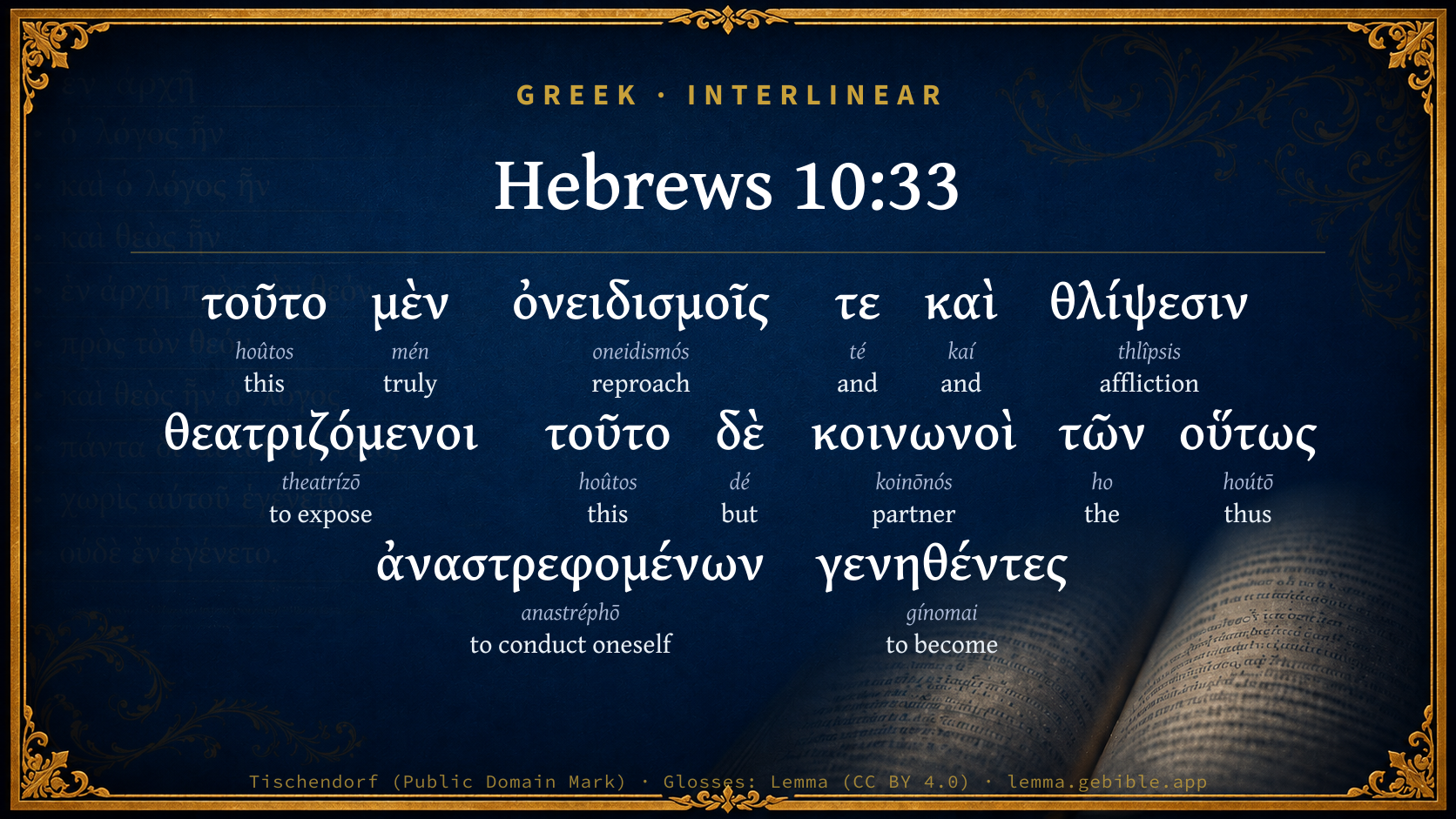
Greek (Tischendorf 8th ed.) Hebrews 10:33 appears in the Greek New Testament. The text above is from the Tischendorf 8th edition. Each word links to its Strong’s number and a concise gloss. Click any word for its full Thayer’s Greek Lexicon entry.
Download image
Cite this verse

Hebrews 10:33 (World English Bible). Public Domain. Lemma interlinear Bible study tool, https://lemma.gebible.app/v/hebrews/10/33.

Show BibTeX & RIS
BibTeX
RIS
English Translation
partly, being exposed to both reproaches and oppressions; and partly, becoming partakers with those who were treated so.
World English Bible · Public Domain
Highlights
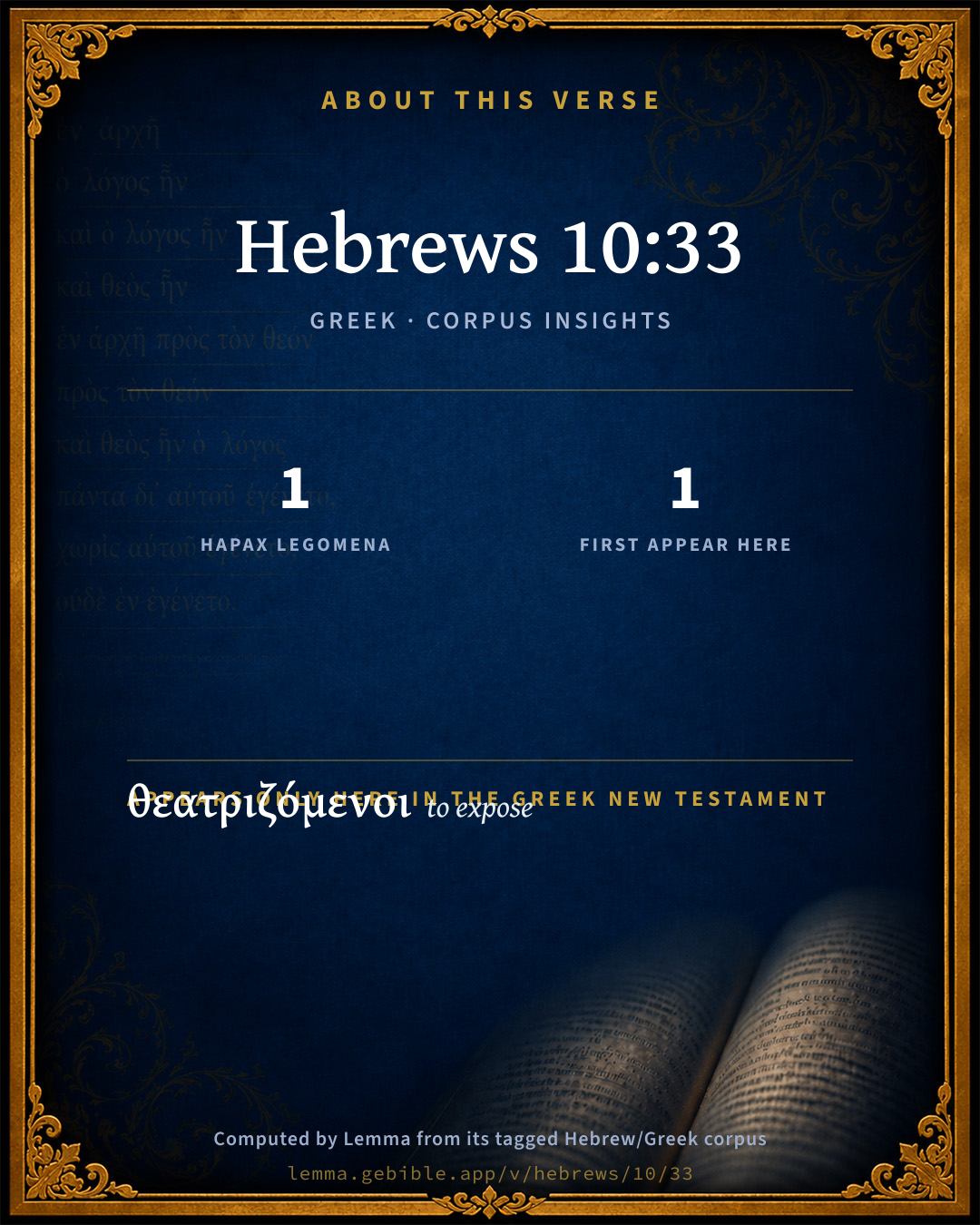
  • 1 hapax legomenon — only here in the Greek New Testament
  • 1 first appearance in the Greek New Testament
Full analysis ↓
Download a study sheet

One document with this verse’s original text, its word-by-word gloss line, the meaning frame, cross-references with their text, attributed commentary, and full source and license credits — printable, and it pastes into notes with its structure intact.

This verse Autodidact and up

Study sheet (.html) Plain text (.txt)

A passage Seminary Student

Up to 50 verses in one chapter. A passage sheet keeps up to 6 commentary sources and 12 cross-references per verse, in the order this page ranks them, and says so on the sheet whenever that leaves anything out. Ask for a single verse and you get the Autodidact verse sheet above.

Everything on this page stays free to read, with no account — the sheet is a download of what is already on screen, not access to it.

Want to remove ads? Support Godless Engineer
Compare translations 3

The same verse in 3 English versions, stacked beneath the original-language interlinear above. Click any original word for its lexicon entry.

Each is an independent rendering of the whole verse — the interlinear is not word-aligned to these translations.

Highlighted words mark where these versions differ — a whole-verse word diff, not a word-by-word alignment.

  • World English Bible Public Domain
    partly, being exposed to both reproaches and oppressions; and partly, becoming partakers with those who were treated so.
  • King James Version Public Domain
    Partly, whilst ye were made a gazingstock both by reproaches and afflictions; and partly, whilst ye became companions of them that were so used.
  • unfoldingWord Literal Text CC BY-SA 4.0
    at indeed being publicly exposed both to reproach and persecution, but at other having become partners of the ones being treated in this way.

unfoldingWord Literal Text — © unfoldingWord, licensed CC BY-SA 4.0. Word-aligned USFM3 via Door43 (git.door43.org/unfoldingWord/en_ult).

Versions to compare (up to 4)

3 of 4 selected

Show all 19 translations

Every available English version of this verse, each an independent rendering of the whole verse.

  • World English Bible Public Domain
    partly, being exposed to both reproaches and oppressions; and partly, becoming partakers with those who were treated so.
  • Berean Standard Bible Public Domain
    Sometimes you were publicly exposed to ridicule and persecution; at other times you were partners with those who were so treated.
  • Majority Standard Bible Public Domain
    Sometimes you were publicly exposed to ridicule and persecution; at other times you were partners with those who were so treated.
  • King James Version Public Domain
    Partly, whilst ye were made a gazingstock both by reproaches and afflictions; and partly, whilst ye became companions of them that were so used.
  • American Standard Version (1901) Public Domain
    partly, being made a gazingstock both by reproaches and afflictions; and partly, becoming partakers with them that were so used.
  • Revised Version (1885) Public Domain
    partly, being made a gazingstock both by reproaches and afflictions; and partly, becoming partakers with them that were so used.
  • Geneva Bible (1599) Public Domain
    Partly while yee were made a gazing stocke both by reproches and afflictions, and partly while ye became companions of them which were so tossed to and from.
  • Douay-Rheims (1899) Public Domain
    And on the one hand indeed, by reproaches and tribulations, were made a gazingstock; and on the other, became companions of them that were used in such sort.
  • Young's Literal Translation Public Domain
    partly both with reproaches and tribulations being made spectacles, and partly having become partners of those so living,
  • Literal Standard Version CC BY-SA 4.0
    this indeed, being made spectacles with both insults and afflictions, now this, having become partners of those so living,
  • Unlocked Literal Bible CC BY-SA 4.0
    You were exposed to public ridicule by insults and persecution, and you were sharing with those who went through such suffering.
  • unfoldingWord Literal Text CC BY-SA 4.0
    at indeed being publicly exposed both to reproach and persecution, but at other having become partners of the ones being treated in this way.
  • Darby Bible Public Domain
    on the one hand, when ye were made a spectacle both in reproaches and afflictions; and on the other, when ye became partakers with those who were passing through them.
  • World Messianic Bible Public Domain
    partly, being exposed to both reproaches and oppressions, and partly, becoming partakers with those who were treated so.
  • Webster's Bible Public Domain
    Partly, while ye were made a gazing-stock both by reproaches and afflictions; and partly, while ye became companions of them that were so used.
  • Free Bible Version CC BY-SA 4.0
    Sometimes you were made a spectacle of, being insulted and attacked; at other times you stood in solidarity with those who were suffering.
  • Bible in Basic English Public Domain
    In part, in being attacked by angry words and cruel acts, before the eyes of everyone, and in part, in being united with those who were attacked in this way.
  • Text-Critical English NT CC BY 4.0
    At times you were publicly exposed to reproach and affliction, and at other times you were partners with those who were treated that way.
  • Tyndale New Testament (1534) Public Domain
    partly whill all men wondred and gased at you for the shame and trioulacion that was done vnto you and partly whill ye became companyons of the which so passed their tyme.

Literal Standard Version (2020), Covenant Press — licensed CC BY-SA 4.0. Text via the HelloAO Bible API (eBible.org). Unlocked Literal Bible (unfoldingWord) — licensed CC BY-SA 4.0. Text via the HelloAO Bible API (eBible.org). unfoldingWord Literal Text — © unfoldingWord, licensed CC BY-SA 4.0. Word-aligned USFM3 via Door43 (git.door43.org/unfoldingWord/en_ult). Free Bible Version, Dr. Jonathan Gallagher — licensed CC BY-SA 4.0. Text via the HelloAO Bible API (eBible.org).

Word by word

More ways to search: Search by grammar → Find every occurrence → Compare this word →

Practice this passage: Drill this verse → Learn its vocabulary →

θεατριζόμενοι
theatrízō
G2301
“to expose”
Verb, Present, Passive, Participle, Nominative, Plural, Masculine
Part of Speech
Verb
Tense
Present
Voice
Passive
Mood
Participle
Case
Nominative
Number
Plural
Gender
Masculine
Full Thayer's Definition

Origin: from G2302

TDNT: 3:42,*

1. to bring upon the stage 2. to set forth as a spectacle, expose to contempt
  1. τοῦτο hoûtos G3778 “this” Demonstrative pronoun, Nominative, Singular, Neuter
  2. μὲν mén G3303 “truly” Particle
  3. ὀνειδισμοῖς oneidismós G3680 “reproach” Noun, Dative, Plural, Masculine
  4. τε té G5037 “and” Particle
  5. καὶ kaí G2532 “and” Conjunction
  6. θλίψεσιν thlîpsis G2347 “affliction” Noun, Dative, Plural, Feminine
  7. τοῦτο hoûtos G3778 “this” Demonstrative pronoun, Nominative, Singular, Neuter
  8. δὲ dé G1161 “but” Conjunction
  9. κοινωνοὶ koinōnós G2844 “partner” Noun, Nominative, Plural, Masculine
  10. τῶν ho G3588 “the” Article, Genitive, Plural, Masculine
  11. οὕτως hoútō G3779 “thus” Adverb
  12. ἀναστρεφομένων anastréphō G390 “to conduct oneself” Verb, Present, Passive, Participle, Genitive, Plural, Masculine
  13. γενηθέντες gínomai G1096 “to become” Verb, Aorist, Passive deponent, Participle, Nominative, Plural, Masculine

About this verse

These counts appear in no published source. They are computed here, from the morphology-tagged text and Lemma’s own curated glosses. What Lemma adds →

14
words
13
distinct lemmas
General Epistles
section

Notable vocabulary

1 hapax legomenon — a word that appears only here in the entire Greek New Testament:

  • θεατριζόμενοι to expose G2301

First appearance in Scripture

This word makes its first canonical appearance in the Greek New Testament here:

  • θεατριζόμενοι to expose G2301

Shared distinctive vocabulary

ὀνειδισμοῖς reproach G3680 occurs in 5 verses of the Greek New Testament. Also found in:

Repetition

A word recurs within this verse:

  • τοῦτο this G3778 ×2

Cross-references

18

Topical passages linked to Hebrews 10:33 in the Treasury of Scripture Knowledge — connected by theme and wording, ordered by reader-vote popularity; previews shown in the World English Bible.

  • 1 Corinthians 4:9 For, I think that God has displayed us, the apostles, last of all, like men sentenced to death. For we are made a spectacle to the world, both to angels and men.
  • Philippians 4:14 However you did well that you shared in my affliction.
  • Psalms 74:22 Arise, God! Plead your own cause. Remember how the foolish man mocks you all day.
  • Isaiah 51:7 Listen to me, you who know righteousness, the people in whose heart is my law; don't you fear the reproach of men, neither be you dismayed at their insults.
  • 2 Corinthians 12:10 Therefore I take pleasure in weaknesses, in injuries, in necessities, in persecutions, in distresses, for Christ's sake. For when I am weak, then am I strong.
  • Philippians 1:7 It is even right for me to think this way on behalf of all of you, because I have you in my heart, because, both in my bonds and in the defense and confirmation of the Gospel, you all are partakers with me of grace.
  • Hebrews 11:36 Others were tried by mocking and scourging, yes, moreover by bonds and imprisonment.
  • Psalms 69:9 For the zeal of your house consumes me. The reproaches of those who reproach you have fallen on me.
  • Psalms 71:7 I am a marvel to many, But you are my strong refuge.
  • Psalms 79:12 Pay back to our neighbors seven times into their bosom Their reproach with which they have reproached you, Lord.
  • Psalms 89:51 With which your enemies have mocked, Yahweh, With which they have mocked the footsteps of your anointed one.
  • Nahum 3:6 I will throw abominable filth on you, and make you vile, and will set you a spectacle.
  • Zechariah 3:8 Hear now, Joshua the high priest, you and your fellows who sit before you; for they are men who are a sign: for, behold, I will bring forth my servant, the Branch.
  • 1 Thessalonians 2:14 For you, brothers, became imitators of the assemblies of God which are in Judea in Christ Jesus; for you also suffered the same things from your own countrymen, even as they did from the Jews;
  • 2 Timothy 1:8 Therefore don't be ashamed of the testimony of our Lord, nor of me his prisoner; but endure hardship for the Gospel according to the power of God,
  • 2 Timothy 1:16–18 May the Lord grant mercy to the house of Onesiphorus, for he often refreshed me, and was not ashamed of my chain,
  • Hebrews 11:26 accounting the reproach of Christ greater riches than the treasures of Egypt; for he looked to the reward.
  • Hebrews 13:13 Let us therefore go forth to him outside of the camp, bearing his reproach.

Cross-references courtesy of OpenBible.info (CC BY 4.0).

Commentary

Notes on Hebrews 10:33 from classic Christian and Jewish commentators (each source and its license shown beneath its notes). The classic Christian expositions comment on the surrounding passage and are grouped to its opening verse, so a note may address several verses; the Jewish commentaries on the Tanakh (Rashi and others) are per-verse, so they appear only where the commentator wrote on this verse.

Lemma curates 59 commentaries, every one of them public domain or Creative Commons licensed, each selected and text-cleaned for this edition rather than reprinted as found. About our sources →

Tyndale Open Study Notes

Tyndale Open Resources

10:33 public ridicule: They were insulted and disgraced. • beaten: They were abused physically. • At times they were direct recipients of abuse, and at times they stood with others who were suffering.

Tyndale Open Study Notes — © Tyndale Open Resources, licensed CC BY-SA 4.0. Text via the HelloAO Bible API.

Bengel's Gnomon

Johann Albrecht Bengel

Heb 10:33. Τοῦτο· τοῦτο) A pronoun with an adverbial meaning. Two heads are set before us, which are explained in inverse order by Chiasmus, Heb 10:34.

Bengel's Gnomon of the New Testament — English translation (T&T Clark, Edinburgh, 1860) — public domain. Text from a community e-Sword module.

Meyer's Critical & Exegetical Commentary

Heinrich August Wilhelm Meyer

Heb_10:33. Τοῦτο μὲν … τοῦτο δέ] on the one hand … on the other; partly … partly. A genuinely Greek formula (comp. Wetstein ad loc.). In the N. T. only here.

τοῦτο μὲν ὀνειδισμοῖς τε καὶ θλίψεσιν θεατριζόμενοι] in that, on the one hand, by conditions of infamy (Heb_11:26, Heb_13:13) and by tribulations, ye were made a spectacle (were exposed publicly to reviling). ὀνειδισμοί (belonging to the later period of the Greek language; see Lobeck, ad Phryn. p. 512) has reference to the assaults upon honour and good name, θλίψεις to assaults upon the person (the life) and outward possessions.

θεατριζόμενοι] comp. 1Co_4:9 : θέατρον ἐγενήθημεν τῷ κόσμῳ καὶ ἀγγὲλοις καὶ ἀνθρώποις. The verb only here and with the Church Fathers.

τοῦτο δὲ κοινωνοὶ … γενηθέντες] and, on the other hand, ye became associates (fellow-sufferers) … sc. by the administering of consolation, and by efforts for the alleviation of their sufferings. κοινωνοὶ γενηθέντες is elucidated by συνεπαθήσατε, Heb_10:34, thus alludes equally as the first half of the sentence to historic facts. Arbitrarily therefore Ebrard: the expression indicates that the readers, by the act of their conversion, had become once for all associates in that community, of which they knew that it thus fared, or was thus wont to fare with it.

τῶν οὕτως ἀναστρεφομένων] of those who were in such condition (sc. ἐν θλίψεσιν καὶ ὀνειδισμοῖς). Kypke, Storr, Böhme, Kuinoel, and others supplement the οὕτως from the πολλὴν ἄθλησιν ὑπεμείνατε παθημάτων, Heb_10:32 : of those who thus walked, i.e. sustained with great stedfastness the contest of sufferings. In favour of this interpretation the authority of the ordinary Biblical use of ἀναστρέφεσθαι may no doubt be urged. Since, however, πολλὴν ἄθλησιν ὑπεμείνατε παθημάτων, Heb_10:32, is the general statement, which afterwards, Heb_10:33, separates into two special subdivisions by means of τοῦτο μὲν … τοῦτο δέ, so οὕτως in the second member can only refer back to the immediately foregoing characterization in the first member.

Meyer — Critical and Exegetical Commentary on the New Testament — English translation by Peter Christie, edited by Frederick Crombie (T&T Clark, 1880) — public domain. Text from a community e-Sword module.

Geneva Bible (1599)

Geneva Bible translators

You were brought forth to be ashamed.

In taking their miseries, to be your miseries.

Geneva Bible (1599) marginal notes — public domain. Text via Bolls.life.

Jamieson, Fausset & Brown

Robert Jamieson, A. R. Fausset & David Brown

The persecutions here referred to seem to have been endured by the Hebrew Christians at their first conversion, not only in Palestine, but also in Rome and elsewhere, the Jews in every city inciting the populace and the Roman authorities against Christians.

gazing-stock--as in a theater (so the Greek): often used as the place of punishment in the presence of the assembled multitudes. Act 19:29; Co1 4:9, "Made a theatrical spectacle to the world."

ye became--of your own accord: attesting your Christian sympathy with your suffering brethren.

companions of--sharers in affliction with.

Jamieson, Fausset & Brown — Commentary Critical and Explanatory on the Whole Bible (1871) — public domain (CC PDM 1.0). Text via the HelloAO Bible API.

Adam Clarke's Commentary

Verse 33. Ye were made a gazing-stock] Θεατριζομενοι. Ye were exhibited as wild beasts and other shows at the theatres. See the note on 1Cor 4:9, where all this is illustrated.

Companions of them that were so used.] It appears, from 1Th 2:14-15, that the Churches of God in Judea were greatly persecuted, and that they believed with courage and constancy in their persecutions. When any victim of persecuting rage was marked out, the rest were prompt to take his part, and acknowledge themselves believers in the same doctrine for which he suffered. This was a noble spirit; many would have slunk into a corner, and put off the marks of Christ, that they might not be exposed to affliction on this account.

Adam Clarke's Commentary on the Bible (1810–1826) — public domain. Text from a community e-Sword/MySword module.

John Calvin's Commentaries

33. Partly, whilst ye were made, etc. We see who they were whom he addresses, even those whose faith had been proved by no common trials, and yet he refrains not from exhorting them to greater things. Let no man therefore deceive himself by self-flattery as though he had reached the goal, or had no need of incentives from others.

Now he says, that they had been made gazingstocks both by reproaches and afflictions, or exposed to public shame by reproaches and distresses, as though they were exposed on a public theater. We hence learn that the persecutions which they had sustained were remarkably severe. But we ought especially to notice the latter clause, when he says that they became companions, or associates of the godly in their persecutions; for as it is Christ’s cause for which all the godly contend, and as it is what their contend for in common, whatever one of them suffers, all the rest ought to transfer, as it were, to themselves; and this is what ought by all means to be done by us, unless we would separate ourselves from Christ himself.

John Calvin's Commentaries (1540-1563) — public domain. Text from the Calvin Translation Society English edition (1840s-50s) via the Christian Classics Ethereal Library (ccel.org). Calvin's coverage is partial (roughly two-thirds of the Bible); uncommented books and verses are honest gaps, never fabricated. The 19th-century editor's footnotes and remarks are omitted so the notes are faithfully Calvin's own voice.

Ellicott's Commentary for English Readers

(33) Whilst ye were made a gazingstock.—Literally, being exposed in the theatre (see the Notes on Act_19:29; 1Co_4:9; 1Co_15:32). Here also it is probable that the word has only a figurative sense.

Whilst ye became companions.—Better, having become sharers with them that thus lived—that lived amidst “reproaches and afflictions.” Not “companions” only had they been, but sharers of the lot of their persecuted brethren, both by sympathy and by voluntary association with their sufferings.

A Bible Commentary for English Readers, edited by Charles John Ellicott (1878–1897) — public domain. Text from a community e-Sword module.

The Cambridge Bible for Schools and Colleges

gen. ed. J. J. S. Perowne

33. ye were made a gazingstock] Lit. “being set upon a stage” (theatrizomenoi). The same metaphor is used in 1Co_4:9 (“We became a theatre,” comp. 1Co_15:32).

companions] Rather, “partakers.”

that were so used] “Who lived in this condition of things.”

The Cambridge Bible for Schools and Colleges (gen. ed. J. J. S. Perowne; Cambridge University Press, 1878–1918) — public domain. Text from a community e-Sword module.

John Gill's Exposition

For ye have need of patience,.... Not that they were destitute of the grace of patience; for where God is the God of all grace, he is the God of patience; and such, who are called by grace, are conformed to the image of Christ, and, among other things, are like him in this; and those who are born of the Spirit, have the fruits of the Spirit, and this, among the rest; to whom the word of God is effectual, this fruit is produced in them, that being the word of patience; and such who are brought into the kingdom of Christ, are also in the patience of Jesus; where there is one grace, there is every grace; saints are immediately called to sufferings and trials, which require patience; and, without this, there can be no enjoyment of a man's self: but the meaning is, that they needed the continuance, exercise, and increase of it; in general, to run the race set before them; to bear afflictions from the hand of God, and reproaches and persecutions from men; to wait for God, when he hides his face, and for answers of prayer, when they are deferred; and to bear up, and not to sink under temptations; and to live in the constant expectation of heaven and happiness: and, in particular, it is necessary for the following,

that after ye have done the will of God: there is the purposing will of God, which is done by himself; and there is his revealed will, touching the salvation of men, which is done by his Son; and there is his will of precept to be done by men; and which, when done aright, is done according to the rule of his word, in faith, from love, through the strength of Christ, and by the assistance of his Spirit and grace, with a view to his glory, and without any dependence on what is done: and the will of God regards suffering, as well as doing; for to that the saints are also called, to which patience is necessary:

ye might receive the promise; that is, of eternal life; not the promise itself, which they had received already, but the thing promised; which is the sense, in which this word is often used in this book, Heb 6:12 which is so called, to show that it is not of works, for promise and merit do not agree together; but that it is of grace, and will certainly be enjoyed, but must be patiently waited for.

John Gill's Exposition of the Whole Bible (1746–1763) — public domain (CC PDM 1.0). Text via the HelloAO Bible API.

Trapp's Complete Commentary

John Trapp

33 Partly, whilst ye were made a gazingstock both by reproaches and afflictions; and partly, whilst ye became companions of them that were so used.

Ver. 33. Made a gazing-stock] Gr. θεατριζομενοι, set upon a theatre; take it either properly, or metaphorically, both befell Christians. See 1Co 4:9.

Ye became companions of them] Sympathy hath a strange force; as we see in the strings of an instrument; which being played upon (as they say), the strings of another instrument are also moved with it. (Dr Sibbs.) After love hath once kindled love, then the heart being melted is fit to receive any impression. Two spirits warmed with the same heat, will easily solder together.

John Trapp, A Commentary or Exposition upon All the Books of the Old and New Testament (1647–1656) — public domain. Text from a community e-Sword module.

Albert Barnes' Notes on the Bible

Partly - That is, your affliction consisted partly in this. The Greek is, “this” - specifying one kind of affliction that they were called to endure.

Whilst ye were made a gazing-stock - Greek θεατριζόμενοι theatrizomenoi - you were made a public spectacle, as if in a theater; you were held up to public view, or exposed to public scorn. When this was done, or in precisely what manner, we are not told. It was not an uncommon thing, however, for the early Christians to be held up to reproach and scorn, and probably this refers to some time when it was done by rulers or magistrates. It was a common custom among the Greeks and Romans to lead criminals, before they were put to death, through the theater, and thus to expose them to the insults and reproaches of the multitude. See the proofs of this adduced by Kuinoel on this passage. The “language” here seems to have been taken from this custom, though there is no evidence that the Christians to whom Paul refers had been treated in this manner.

By reproaches - Repreached as being the followers of Jesus of Nazareth; probably as weak and fanatical.

And afflictions - Various “sufferings” inflicted on them. They were not merely reviled in words, but they were made to endure positive sufferings of various kinds.

And partly, while ye became companions of them that were so used - That is, even when they had not themselves been subjected to these trials, they had sympathized with those who were. They doubtless imparted to them of their property; sent to them relief, and identified themselves with them. It is not known to what particular occasion the apostle here refers. In the next verse he mentions one instance in which they had done this, in aiding him when he was a prisoner.

Albert Barnes' Notes on the Bible (1834–1885) — public domain. Text from a community e-Sword/MySword module.

Matthew Poole's English Annotations

Partly, whilst ye were made a gazingstock both by reproaches and afflictions; their sufferings personal in this famous instance, θεατριζομενοι. They were so publicly exposed as on a stage or theatre, so as multitudes might sport themselves with them, 1Co 4:9; as many were exposed to be devoured by beasts in their public shows, 1Co 15:32. Or, to destroy them, exposed in their public courts of justice, and there taunted and reviled, as Christ foretold them, Mat 10:17,18. They were suffering reproaches and afflictions publicly both in word and deed. What nick-names imposed on them, what crimes imputed to them which they abhorred, what buffeting, scourging, tormenting, shackling, imprisoning, banishing, were they not exercised with, as their fellow Christians are to this day?

And partly, whilst ye became companions of them that were so used; their sufferings by participation, in presence and sympathy with their fellow Christians. This is another kind of it; they were consorts and sharers of all those members of Christ, who were so abused by the devil and his instruments, and they bore their burdens with them, were inwardly grieved for them, publicly owned and comforted them, supplied and supported them as they could, as Heb 10:34; 2Co 11:25,26.

Matthew Poole's English Annotations on the Holy Bible (1683–1685) — public domain. Text from a community e-Sword/MySword module.

Whedon's Commentary on the Bible

Daniel D. Whedon

33. Made a gazing stock—Literally, theatrized; that is, exposed to shame, as if a spectacle in a public theatre.

Reproaches—Affecting their reputations.

Afflictions—Affecting their persons and goods.

Companions—Sympathizers and associates of despised and persecuted Christians.

Daniel D. Whedon (gen. ed.), Commentary on the Old and New Testaments (1874–1909) — public domain. Text from a community e-Sword module.

The Pulpit Commentary

Partly, being made a gazing-stock both by reproaches and afflictions; and partly, having become partakers with them that were so used. On yeatrizomenoi (translated "made a gazing-stock"), cf. 1Co_4:9, Yeatron egenhyhmen tw kosmw kai oggeloiv kai anyrwpoiv . The figure is drawn from the Roman amphitheatres, where persons doomed to death were exposed to the gaze and the contumely of crowds; and the expression may not be wholly figurative, but denote the actual treatment of Christians, as expressed by the common cry, "Christianos ad leones!" The phrase, twn outw anastrefomenwn , (translated "them that were so used"), might be more correctly rendered (as anastrefesyai is elsewhere), "them that so had their conversation," i.e. manner of life. For the word is not used in a passive sense, but as equivalent to versari; cf. Mat_17:22 2Co_1:12 Eph_2:3 Heb_13:18; also Gal_1:13 Eph_4:22, etc. ( anastrofh). The Vulgate has taliter conversantium; Wickliffe, "men living so;" Tyndale and Cranmer, "them who so passed their time." But the A.V may give the meaning with sufficient correctness, the main thought being probably the experience of the persons referred to rather than their demeanor under it.

The Pulpit Commentary (1880–1919), ed. H.D.M. Spence-Jones & Joseph S. Exell — public domain. Text from a community e-Sword module.

Burkitt's Expository Notes on the New Testament

William Burkitt

Here our apostle particularly mentions the sufferings which the primitive saints underwent for the sake of Christianity, and reduces them to three heads, shame, pain, loss: They suffered in their names, by being disgraced; in their persons, by being scourged; in their estates, by the spoiling of their goods. Let all that make profession of the name of Christ expect and provide for such sufferings, especially for reproaches.

We may put a due value upon our names and reputations, but must not be over solicitous about the preservation of them. Let us keep in the way of our duty, and leave our good name to God’s care and keeping. The world first thunders out our reproaches, then falls into a storm persecution.

Learn hence, that all temporary sufferings, in all their aggravating circumstances, in all their formidable dress and appearance, may be, and oft-times are, the lot and portion of those who have undertaken the profession of Christianity. Ye endured a great fight of afflictions, whilst ye were made a gazing-stock to the world.

The Christians here wre exposed to the world as it were upon a stage, or in a theatre where multitudes might gaze upon them, revile, and make a sport of them.

William Burkitt's Expository Notes on the New Testament (1700–1703) — public domain. Text from a community e-Sword module.

The People's New Testament

B. W. Johnson

33. Made a gazing stock. Looked upon with reproach, abused and afflicted personally. Companions. Sharing the suffering of those who were persecuted.

B. W. Johnson's The People's New Testament with Notes (1889–1891) — public domain. Electronic text from the Christian Classics Ethereal Library (CCEL) ThML edition.

Cambridge Greek Testament for Schools and Colleges

33. τοῦτο μὲν … τοῦτο δέ. Distributive formula, used adverbially, Winer.

θεατρίζομενοι. Lit., “being set upon a stage.” The same metaphor is used in 1Co 4:9 (“We became a theatre,” comp. 1Co 15:32). It was however fearfully literal to many Christians in the Neronian and later persecutions in which Christian youths had to undertake on the stage the characters of Hercules and Mucius and Laureolus, displaying to the blood-corrupted spectators a horrible realism of agony; and even Christian maidens had to appear in the characters of Dirce or the Danaids. See Sueton. Nero, 12, Caius, 57; Juv. Sat. VIII. 186; Mart. X. 25, VIII. 30, Spectac. VII.; Clem. Rom. ad Cor. i. 6 γυναῖκες Δαναΐδες καὶ Δίρκαι. And see Renan L’Antéchrist, pp. 168–175.

κοινωνοί. “Partakers.”

οὕτως ἀναστρεφομένων. “Who lived in this condition of things.”

Cambridge Greek Testament for Schools and Colleges (Cambridge University Press, 1896; 21 vols, various authors incl. Carr, Maclear, Plummer, Farrar, Lumby, Moule, M. R. James, Simcox) — public domain. Text from a community e-Sword module.

Alford’s Greek Testament

Henry Alford

33.] (the nature of these sufferings is now specified) partly (see reff.) being made a spectacle (the theatre being the place where conspicuous punishments were inflicted, on account of the multitudes there assembling. See Act 19:29. The word θεατρίζω may therefore be literally taken, if (see Prolegg. § ii. and § iii. 3) the Epistle was written to Rome, after the Neronian persecution. See reff., and cf. 1Co 4:9, θέατρον ἐγενήθημεν τῷ κόσμῳ. Thl. says, θεατριζόμενοι, τουτέστιν ὥσπερ ἐπὶ θέατρον παραδειγματιζόμενοι, καὶ ταῦτα τυχὸν παρὰ εὐτελῶν καὶ εὐδαιμόνων. And Chrys., οὐχ ἁπλῶς εἶπεν, ὀνειδισμοῖς, ἀλλὰ … μετʼ ἐπιτάσεως πολλῆς θεατριζόμενοί φησιν· ὅταν μὲν γάρ τις ὀνειδίζηται καθʼ ἑαυτόν, λυπηρὸν μέν, πολλῷ δὲ πλέον, ὅταν ἐπὶ πάντων) in reproaches (ὀνειδισμός is a word of later Greek. The dat. is one of manner in which) and tribulations; partly also (see above), having become (there is something of purpose in γενηθέντες, almost a middle sense, ‘having made yourselves.’ It is a fine encomium on their Christian sympathy and love) partakers with them who were thus living (viz. ἐν ὀνειδισμοῖς τε κ. θλίψεσιν: so Œc. and Thl. Some would give ἀναστρεφομένων an ethical sense: “who walk,” have their Christian walk and conduct, “in this way,” viz. as he exhorts them to endure, manfully and firmly. So Kypke, Kuinoel, al. But I prefer the other as more in accord with N. T. usage: cf. reff.).

Henry Alford, The Greek Testament (1849–1861) — public domain. Text from a community e-Sword module.

Vincent's Word Studies in the New Testament

Marvin R. Vincent

Whilst ye were made a gazing - stock [θεατριζομενοι] . N. T. o. o LXX, o Class. Lit. exhibited in the theater. Comp. 1Co 4:9. Whilst ye became companions [κοινωνοι γενηθεντες] . Rend. by becoming partakers. More than companionship is implied. For koinwnoi see on Luk 5:10. The noun and its kindred verb in N. T. almost exclusively of ethical and spiritual relations, as 1Ti 5:22; 1Pe 4:13; 2 John 11; 1Co 10:18; 2Co 1:7; Phl 1:17. Even when applied to pecuniary contributions they imply Christian fellowship as the basis of the liberality. See on Rom 12:13; Rom 14:27; Phi 4:15.

Of them that were so used [των ουτως αναστρφομενων] . Rend. "of them that fared thus." Others render " who conducted themselves thus "; endured their persecutions, so bravely. But the outwv can refer only to made a gazing - stock.

Marvin R. Vincent, Word Studies in the New Testament (1887–1900) — public domain. Text from a community e-Sword/MySword module.

Westcott on Hebrews & the Epistles of John

Brooke Foss Westcott

33. τοῦτο μέν.. τοῦτο δέ...) Vulg. δὲ in altero quidem...in altero autem. The courage of the Hebrews was shewn both in what they bore personally, and (which is often more difficult) in their readiness to shew sympathy to those who were in affliction. The contrast in the tenses of the participles, θεατριζόμενοι, γενη-

vi. 9 &c.), the writer implies that tho knowledge was realised through the trial: through that the confessors came to know tho value of their faith. Comp. James i. 3.

Tho order in the words κρείσσονα ὕπαρξιν καὶ μένουσαν gives distinctness to the two thoughts: ‘a better possession and that too an abiding one.’ Comp. 1 Pet. ij. 23. The word ὕπαρξις (Latt. substantia) occurs again Acts ii. 45, and several times in the later books of the Lxx.

35—39. The sacrifices which the Hebrews once made proved their confidence — confidence in an unseen future—which they boldly proclaimed ; and at the same time they confirmed it. The lesson of the past thorefore

durance. And such endurance God claims from His people.

Brooke Foss Westcott (1825–1901), The Epistle to the Hebrews (1889) and The Epistles of St John (1883) — public domain (pre-1929). Text recovered from Internet Archive / Google Books OCR scans. Westcott’s Gospel of John commentary is not included (its OCR lost the chapter running-heads required for reliable verse-keying). Some Greek quoted in the Hebrews volume is imperfectly rendered by the OCR.

Lesson kit

Teaching starters — assembled from the data on this page, not authored interpretation. Every prompt links to the verse data it draws on. Edit before teaching.

Hebrews, in the General Epistles, opens this verse with 14 words (13 distinct Greek lemmas). Its most distinctive word is theatrízō (“to expose”). A historical commentator’s framing appears above. Read the whole chapter for the surrounding context.

Discussion questions

  1. What does “to expose” (theatrízō) contribute to the verse as a whole?
  2. 1 word here appears nowhere else in the Greek New Testament. Why might the author reach for such rare wording?
  3. This is the first place “to expose” appears in Scripture (first appears here). What does its debut here establish?
  4. How does Romans 15:3, which shares the word «reproach», read alongside this verse?
  5. What does the repetition of “this” (2× in this one verse) do in this verse?
  6. These translations render this verse differently. What is at stake in choosing one wording over another?
  7. Compare how Tyndale Open Study Notes and Bengel's Gnomon read this verse. Where do they agree or differ?

Things to notice

  • 1 word in this verse appears nowhere else in the Greek New Testament.
  • 1 word makes its first canonical appearance in Scripture here.
  • These translations choose different wording for 26 words in this verse.
  • “this” occurs 2× in this single verse.
  • 13 distinct Greek lemmas span 14 words in this verse.

Reading settings

Reading text

Shown beneath each verse's original-language words.

Old Testament
Old Testament edition

Read the OT as the Masoretic Hebrew (MT) or the Greek Septuagint (LXX).

English shown for the Greek Septuagint (in the Hebrew ↔ Greek comparison).

Comparing translations? Open the Compare panel on any verse page to stack up to four side by side.