Acts 28:14

Greek (Tischendorf 8th ed.) Acts 28:14 appears in the Greek New Testament. The text above is from the Tischendorf 8th edition. Each word links to its Strong’s number and a concise gloss. Click any word for its full Thayer’s Greek Lexicon entry.
Download image
Cite this verse

Acts 28:14 (World English Bible). Public Domain. Lemma interlinear Bible study tool, https://lemma.gebible.app/v/acts/28/14.

Show BibTeX & RIS
BibTeX
RIS
English Translation
where we found brothers, and were entreated to stay with them for seven days. So we came to Rome.
World English Bible · Public Domain
Download a study sheet

One document with this verse’s original text, its word-by-word gloss line, the meaning frame, cross-references with their text, attributed commentary, and full source and license credits — printable, and it pastes into notes with its structure intact.

This verse Autodidact and up

Study sheet (.html) Plain text (.txt)

A passage Seminary Student

Up to 50 verses in one chapter. A passage sheet keeps up to 6 commentary sources and 12 cross-references per verse, in the order this page ranks them, and says so on the sheet whenever that leaves anything out. Ask for a single verse and you get the Autodidact verse sheet above.

Everything on this page stays free to read, with no account — the sheet is a download of what is already on screen, not access to it.

Want to remove ads? Support Godless Engineer
Compare translations 3

The same verse in 3 English versions, stacked beneath the original-language interlinear above. Click any original word for its lexicon entry.

Each is an independent rendering of the whole verse — the interlinear is not word-aligned to these translations.

Highlighted words mark where these versions differ — a whole-verse word diff, not a word-by-word alignment.

  • World English Bible Public Domain
    where we found brothers, and were entreated to stay with them for seven days. So we came to Rome.
  • King James Version Public Domain
    Where we found brethren, and were desired to tarry with them seven days: and so we went toward Rome.
  • unfoldingWord Literal Text CC BY-SA 4.0
    where, having found brothers, we were begged to stay with them for seven days, and thus we went towards Rome.

unfoldingWord Literal Text — © unfoldingWord, licensed CC BY-SA 4.0. Word-aligned USFM3 via Door43 (git.door43.org/unfoldingWord/en_ult).

Versions to compare (up to 4)

3 of 4 selected

Show all 19 translations

Every available English version of this verse, each an independent rendering of the whole verse.

  • World English Bible Public Domain
    where we found brothers, and were entreated to stay with them for seven days. So we came to Rome.
  • Berean Standard Bible Public Domain
    There we found some brothers who invited us to spend the week with them. And so we came to Rome.
  • Majority Standard Bible Public Domain
    There we found some brothers who invited us to spend the week with them. And so we came to Rome.
  • King James Version Public Domain
    Where we found brethren, and were desired to tarry with them seven days: and so we went toward Rome.
  • American Standard Version (1901) Public Domain
    where we found brethren, and were entreated to tarry with them seven days: and so we came to Rome.
  • Revised Version (1885) Public Domain
    where we found brethren, and were entreated to tarry with them seven days: and so we came to Rome.
  • Geneva Bible (1599) Public Domain
    Where we found brethren, and were desired to tary with them seuen dayes, and so we went toward Rome.
  • Douay-Rheims (1899) Public Domain
    Where, finding brethren, we were desired to tarry with them seven days: and so we went to Rome.
  • Young's Literal Translation Public Domain
    where, having found brethren, we were called upon to remain with them seven days, and thus to Rome we came;
  • Literal Standard Version CC BY-SA 4.0
    where, having found brothers, we were called on to remain with them seven days, and thus we came to Rome;
  • Unlocked Literal Bible CC BY-SA 4.0
    There we found some brothers and were invited to stay with them for seven days. In this way we came to Rome.
  • unfoldingWord Literal Text CC BY-SA 4.0
    where, having found brothers, we were begged to stay with them for seven days, and thus we went towards Rome.
  • Darby Bible Public Domain
    where, having found brethren, we were begged to stay with them seven days. And thus we went to Rome.
  • World Messianic Bible Public Domain
    where we found brothers, and were entreated to stay with them for seven days. So we came to Rome.
  • Webster's Bible Public Domain
    Where we found brethren, and were desired to tarry with them seven days: and so we went towards Rome.
  • Free Bible Version CC BY-SA 4.0
    where we discovered some believers. They asked us to stay with them for a week. So we came to Rome.
  • Bible in Basic English Public Domain
    Where we came across some of the brothers, who kept us with them for seven days; and so we came to Rome.
  • Text-Critical English NT CC BY 4.0
    There we found some brothers and were invited to stay with them for seven days. And so we came to Rome.
  • Tyndale New Testament (1534) Public Domain
    where we founde brethren and were desyred to tary with them seven dayes and so came to Rome.

Literal Standard Version (2020), Covenant Press — licensed CC BY-SA 4.0. Text via the HelloAO Bible API (eBible.org). Unlocked Literal Bible (unfoldingWord) — licensed CC BY-SA 4.0. Text via the HelloAO Bible API (eBible.org). unfoldingWord Literal Text — © unfoldingWord, licensed CC BY-SA 4.0. Word-aligned USFM3 via Door43 (git.door43.org/unfoldingWord/en_ult). Free Bible Version, Dr. Jonathan Gallagher — licensed CC BY-SA 4.0. Text via the HelloAO Bible API (eBible.org).

Word by word

More ways to search: Search by grammar → Find every occurrence → Compare this word →

Practice this passage: Drill this verse → Learn its vocabulary →

Ῥώμην
Rhṓmē
G4516
“Rome”
Noun, Accusative, Singular, Feminine
Part of Speech
Noun
Case
Accusative
Number
Singular
Gender
Feminine
Full Thayer's Definition

Origin: from the base of G4517

TDNT: None

Rome = "strength" 1. the famous capital of the ancient world
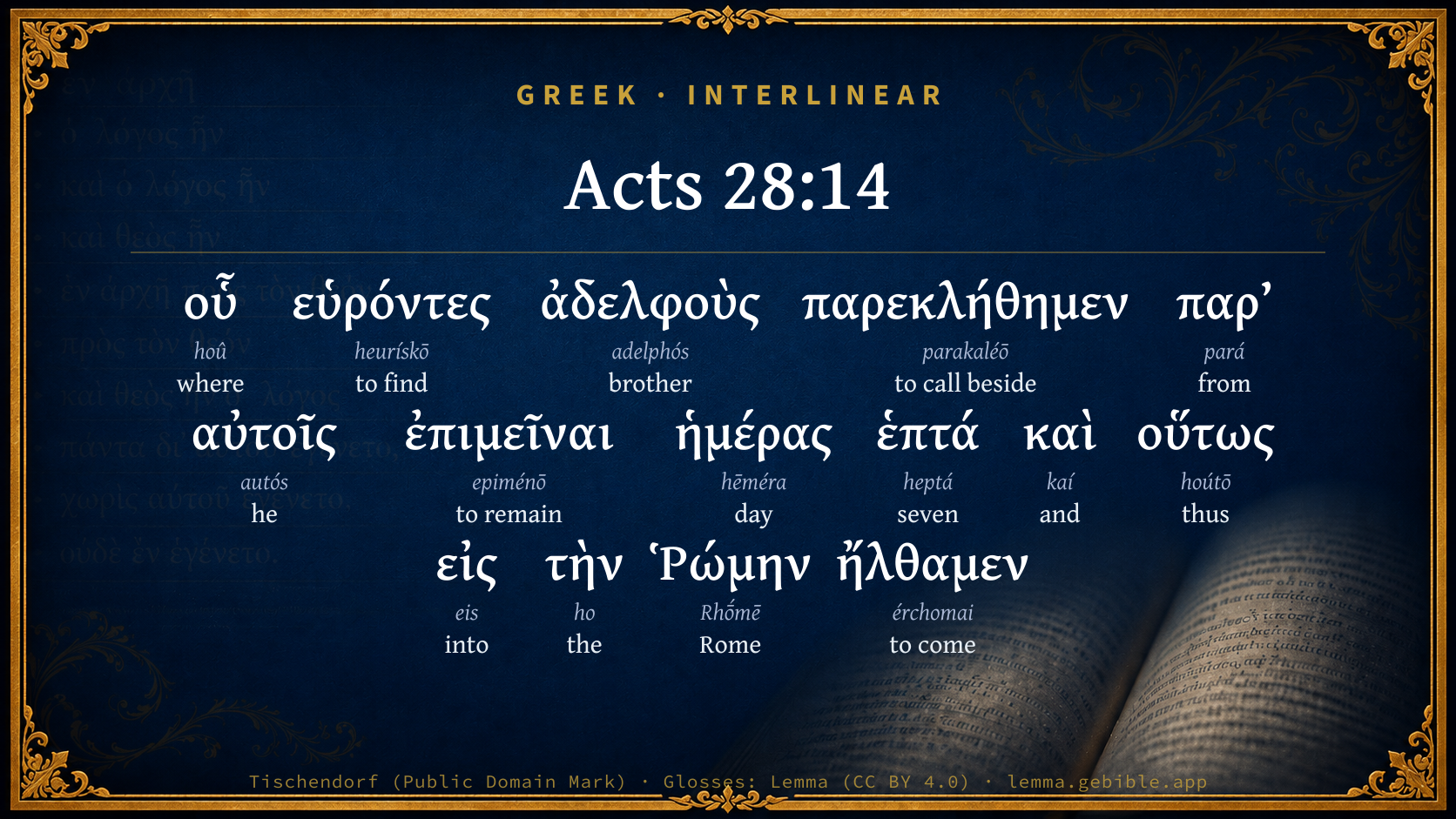
  1. οὗ hoû G3757 “where” Adverb
  2. εὑρόντες heurískō G2147 “to find” Verb, Aorist, Active, Participle, Nominative, Plural, Masculine
  3. ἀδελφοὺς adelphós G80 “brother” Noun, Accusative, Plural, Masculine
  4. παρεκλήθημεν parakaléō G3870 “to call beside” Verb, Aorist, Passive, Indicative, 1st person, Plural
  5. παρ’ pará G3844 “from” Preposition
  6. αὐτοῖς autós G846 “he” Personal pronoun, Dative, Plural, Masculine
  7. ἐπιμεῖναι epiménō G1961 “to remain” Verb, Aorist, Active, Infinitive
  8. ἡμέρας hēméra G2250 “day” Noun, Accusative, Plural, Feminine
  9. ἑπτά heptá G2033 “seven” Adjective, Numeral (indeclinable)
  10. καὶ kaí G2532 “and” Conjunction
  11. οὕτως hoútō G3779 “thus” Adverb
  12. εἰς eis G1519 “into” Preposition
  13. τὴν ho G3588 “the” Article, Accusative, Singular, Feminine
  14. ἤλθαμεν érchomai G2064 “to come” Verb, Aorist, Active, Indicative, 1st person, Plural

About this verse

These counts appear in no published source. They are computed here, from the morphology-tagged text and Lemma’s own curated glosses. What Lemma adds →

15
words
15
distinct lemmas
Acts
section

Notable vocabulary

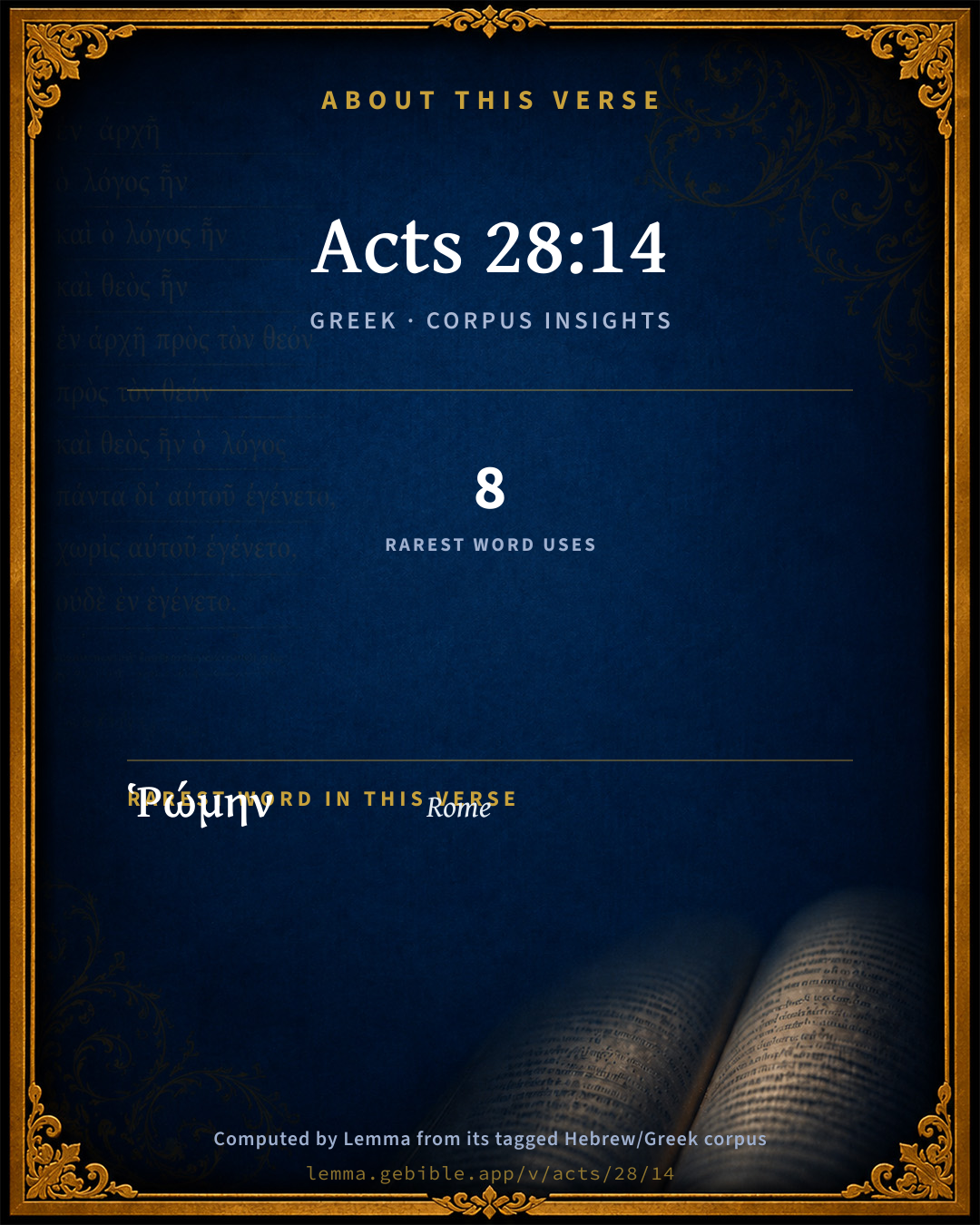
The rarest word here is Ῥώμην Rome G4516 — appearing just 8 times in the whole Greek New Testament.

Shared distinctive vocabulary

Ῥώμην Rome G4516 occurs in 8 verses of the Greek New Testament. Also found in:

Cross-references

10

Topical passages linked to Acts 28:14 in the Treasury of Scripture Knowledge — connected by theme and wording, ordered by reader-vote popularity; previews shown in the World English Bible.

  • Genesis 7:4 In seven days, I will cause it to rain on the earth for forty days and forty nights. Every living thing that I have made, I will destroy from the surface of the ground."
  • Genesis 8:10–12 He stayed yet another seven days; and again he sent forth the dove out of the ark.
  • Acts 19:1 It happened that, while Apollos was at Corinth, Paul, having passed through the upper country, came to Ephesus, and found certain disciples.
  • Acts 20:6 We sailed away from Philippi after the days of Unleavened Bread, and came to them at Troas in five days, where we stayed seven days.
  • Acts 21:4 Having found disciples, we stayed there seven days. These said to Paul through the Spirit, that he should not go up to Jerusalem.
  • Acts 21:7–8 When we had finished the voyage from Tyre, we arrived at Ptolemais. We greeted the brothers, and stayed with them one day.
  • Psalms 119:63 I am a friend of all those who fear you, Of those who observe your precepts.
  • Matthew 10:11 Into whatever city or village you enter, find out who in it is worthy; and stay there until you go on.
  • John 21:23 This saying therefore went out among the brothers, that this disciple wouldn't die. Yet Jesus didn't say to him that he wouldn't die, but, "If I desire that he stay until I come, what is that to you?"
  • Acts 9:42–43 And it became known throughout all Joppa, and many believed in the Lord.

Cross-references courtesy of OpenBible.info (CC BY 4.0).

Commentary

Notes on Acts 28:14 from classic Christian and Jewish commentators (each source and its license shown beneath its notes). The classic Christian expositions comment on the surrounding passage and are grouped to its opening verse, so a note may address several verses; the Jewish commentaries on the Tanakh (Rashi and others) are per-verse, so they appear only where the commentator wrote on this verse.

Lemma curates 59 commentaries, every one of them public domain or Creative Commons licensed, each selected and text-cleaned for this edition rather than reprinted as found. About our sources →

Bengel's Gnomon

Johann Albrecht Bengel

Act 28:14. Παρεκλήθημεν ἐπʼ αὐτοῖς) The sight of brethren was a consolation to us [Engl. Vers. takes παρεκλήθημεν differently]; and it led us to stay seven days. Here also the kindness of the centurion gave indulgence to Paul.—εἰς τὴν Ῥώμην ἤλθομεν, we came to Rome) a remarkable place, earnestly wished for. Here there is an Emphasis on τὴν Ῥώμην, (the) Rome, that it may be marked as the city long desired: but in Act 28:16, ἤλθομεν εἰς Ῥώμην, we came to Rome, the emphasis is on ἤλθομεν, we came, that the entry itself may be marked.

Bengel's Gnomon of the New Testament — English translation (T&T Clark, Edinburgh, 1860) — public domain. Text from a community e-Sword module.

Expositor's Greek Testament

ed. W. Robertson Nicoll

Act 28:14 . ἀδελφούς , see on Act 1:15 , they may have been from Alexandria, as the commerce between it and Puteoli was so considerable; the absence of the article indicates that the writer knew nothing of their presence previously, but at all events Blass is right when he says, “non magis mirum est Puteolis Christianos ante Paulum fuisse quam Romæ”. Probably after Rome itself Puteoli was the most ancient Jewish community in Italy. Jews were there as early as B.C. 4, after the death of Herod the Great, Jos., Ant. , xvii., 12, 1; B. J. , ii., 7, 1, and Schürer accepts the notice of the existence of a Christian Church as in the text, Jewish People , div. ii., vol. ii., p. 241, E.T., so too O. Holtzmann, Neutest. Zeitgeschichte , p. 108; see also Lightfoot, Philippians , p. 26. Rhegium and Puteoli are the only two Italian towns mentioned in the N.T. (except, of course, Rome itself), and when we consider that Puteoli was the most important port, not only for ships from Alexandria, but also from Syria, there is nothing surprising in the fact that Christianity found an early and an easy entrance; at Pompeii, not far from Puteoli, Christianity had made its way, and before 79 A.D. it was discussed by the gossiping loungers in the street (Ramsay). παρεκ .: “we were entreated to tarry,” R.V. Ramsay (so Blass), rendering “we were consoled among them, remaining seven days” (see critical note), thinks that R.V., although strongly supported, is irreconcilable with St. Paul’s situation as a prisoner. Julius was a Roman officer, and discipline was natural to him, however friendly he was towards Paul. Blass compares Act 20:12 , and Zöckler also prefers the inferior reading on account of this more usual meaning of παρακαλεῖν . Probably the seven days’ delay was needful for Julius to report his arrival at Rome, and to receive further orders from the capital, perhaps with regard to the disposal of the prisoners, but St. Paul must have been rejoiced at the opportunity of celebrating a Sunday with the little Christian Church at Puteoli, cf. Act 20:6 , Act 21:4 . καὶ οὕτως : “and so we came to Rome,” about 140 miles, cf. Act 27:25 , “destinatum itineris terminum,” Blass, cf. the article before Ῥ ., Blass, Gram. , p. 149, so Bengel (but see Page’s note). Others take οὕτως as simply = after the stay of seven days, a notice which leads on to Act 28:15 , and makes us to understand how the brethren came to meet us, since news would easily have reached Rome, and a deputation of the brethren have arrived at Appii Forum. On the former view the writer marks the conclusion and the aim of the long journey ( cf. εἰς τὴν Ῥ . before the verb; in Act 28:12-13 , names of places follow the verb without any article, Weiss), and there is a kind of triumph in the words: like an emperor who has fought a naval battle and overcome, Paul entered into that most imperial city; he was nearer now to his crown; Rome received him bound, and saw him crowned and proclaimed conqueror: cf. Chrys. Others take ἤλθ . as = ἐπορευόμεθα , the actual end of the journey following in Act 28:16 (see on the other hand Wendt, in loco , 1888). But Act 28:15 may possibly be taken as adding an episode which commences, as it were, a new section of the Apostle’s work in the meeting with the brethren from Rome, the journey itself being regarded as completed in Act 28:14 (Nösgen). If we read εἰσήλθομεν in Act 28:16 , see critical note, the word emphasises apparently the actual entry into the city, “and when we entered into,” R.V., or it may simply take up the conclusion of Act 28:14 (so Wendt, who sees no difficulty in the words). Ramsay, however, draws another distinction between Act 28:14 ; Act 28:16 (to which Wendt (1899) refers, without endorsing it), and thinks that the double expression of arrival is due to the double meaning which the name of a city-state bears in Greek ( St. Paul , pp. III, 347, and Expositor , Jan., 1899); thus Rome might be restricted to the walls and buildings, or it might include the whole ager Romanus , and so in Act 28:14 , “we reached the State Rome,” we passed through two points in the ager Romanus , Act 28:15 , and in Act 28:16 , “we entered the (walls of) Rome”.

The Expositor's Greek Testament, edited by W. Robertson Nicoll (1897–1910) — public domain. Text from a community e-Sword module.

Geneva Bible (1599)

Geneva Bible translators

God boweth and bendeth the hearts even of profane men, as it pleaseth him to favor his.

Geneva Bible (1599) marginal notes — public domain. Text via Bolls.life.

Jamieson, Fausset & Brown

Robert Jamieson, A. R. Fausset & David Brown

Where we found brethren--not "the brethren" (see on Act 21:4), from which one would conclude they did not expect to find such [WEBSTER and WILKINSON].

and were desired--"requested."

to tarry with them seven days--If this request came from Julius, it may have proceeded partly from a wish to receive instructions from Rome and make arrangements for his journey thither, partly from a wish to gratify Paul, as he seems studiously and increasingly to have done to the last. One can hardly doubt that he was influenced by both considerations. However this may be, the apostle had thus an opportunity of spending a Sabbath with the Christians of the place, all the more refreshing from his long privation in this respect, and as a seasoning for the unknown future that lay before him at the metropolis.

so we went toward Rome.

Jamieson, Fausset & Brown — Commentary Critical and Explanatory on the Whole Bible (1871) — public domain (CC PDM 1.0). Text via the HelloAO Bible API.

Adam Clarke's Commentary

Verse 14. Where we found brethren] That is, Christians; for there had been many in Italy converted to the faith of Christ, some considerable time before this, as appears from St. Paul's epistle to the Romans, written some years before this voyage.

We went toward Rome.] One of the most celebrated cities in the universe, the capital of Italy, and once of the whole world; situated on the river Tiber, 410 miles SSE. of Vienna; 600 SE. of Paris; 730 E. by N. of Madrid; 760 W. of Constantinople; and 780 SE. of London. Long. 12°. 55'. E., lat. 41°. 54'. N. This famous city was founded by Romulus, at the end of the seventh Olympiad, A.M. 3251; of the flood, 1595; and 753 years before the Christian aera. The history of this city must be sought for in works written expressly on the subject, of which there are many. Modern Rome is greatly inferior to ancient Rome in every respect. Its population, taken in 1709, amounted to 138,569 souls only; among whom were 40 bishops, 2686 priests, 3359 monks, 1814 nuns, 893 courtezans, between 8 and 9000 Jews, and 14 Moors. This city, which once tyrannized over the world by its arms, and over the whole Christian world by its popes, is now reduced to a very low state among the governments of Europe, by whom it is supported, for it has no power sufficient for its own defence.

Adam Clarke's Commentary on the Bible (1810–1826) — public domain. Text from a community e-Sword/MySword module.

Ellicott's Commentary for English Readers

(14) Where we found brethren.—The fact is significant as showing, in the absence of any distinct record, the extent to which the new society had been silently spreading. Who had been the agents in preaching the gospel there we can only conjecture, but a city which was en rapport, like Puteoli, with both Alexandria and Rome, may have received it from either. One or two coincidences, however, tend to the former rather than the latter conclusion. We find in Heb_10:24 a salutation sent from “those of (or, better, from) Italy.” This would not be a natural way of speaking of Christians of Rome, and we are led, therefore, to think of some other Italian Church. The only such Church, however, of which we read in the New Testament is this of Puteoli, and we naturally infer that the writer of that Epistle refers to it. But the writer was, in the judgment of many critics (see Introduction to the Epistle to the Hebrews), none other than Apollos, the eloquent Alexandrian Jew of Act_18:24, and some have been led to think that it was addressed to the Hebrew disciples of the Therapeutæ, or ascetic, class, in the Delta of the Nile. All these facts tend to the conclusion that there was a connection of some kind between Alexandria and some Italian Church, and the theory that that Church was at Puteoli, though not proven, at least combines and explains all the phenomena. We find from Josephus (Ant. xvii. 12, § 1) that there was a considerable Jewish element in the population of Puteoli. They had, indeed, spread themselves through the greater part of Italy, and the remains of a Jewish cemetery have been found even near Perugia.

Were desired to tarry with them seven days.—As before at Troas (Act_20:6) and Tyre (Act_21:4), so here, we can scarcely fail to connect the duration of St. Paul’s stay at Puteoli with the wish of the Church there, that he should be with them on one, or, it may be, two Sundays, that so he might break bread with them, and that they might profit by his teaching. The kindness of the centurion is seen once more in the permission which made compliance with the request possible.

And so we went toward Rome.—The journey would lead them through Cumæ and Liternum to Sinuessa, a distance of thirty-three miles from Puteoli. Here they would come upon the great Appian Road, which ran from Rome to Brundusium, the modern Brindisi. The stages from Sinuessa would probably be Minturnæ, Formiæ, Fundi, and Terracina, making altogether a distance of fifty-seven miles. At this point they would have to choose between two modes of travel, taking the circuitous road round the Pontine Marshes, or going by the more direct line of the canal. Both routes met at Appii Forum, eighteen miles from Terracina. For us well-nigh every stage of the journey is connected with some historical or legendary fact in classical antiquity. We think of the great Appius Claudius, the censor from whom the Via and the Forum took their names; of the passage in the over-crowded canal track-boat, with its brawling sailors, and of the scoundrel inn-keepers, whom Horace has immortalised in the narrative of his journey to Brundusium (Sat. i. 5). All this was, we may believe, for the Apostle as though it had not been. Past associations and the incidents of travel, all were for him swallowed up in the thought that he was now on the point of reaching, after long delays, the goal after which he had been striving for so many years (Act_19:21; Rom_15:23).

A Bible Commentary for English Readers, edited by Charles John Ellicott (1878–1897) — public domain. Text from a community e-Sword module.

The Cambridge Bible for Schools and Colleges

gen. ed. J. J. S. Perowne

14. where we found brethren] i.e. there was a Christian Church established in Puteoli, and it was to such a degree well known, that the Apostle on his arrival at once learnt of its existence. From this we may gather that the Christians in Italy had already spread to a considerable extent, and hence it seems very probable that Christianity had been carried into that country from Jerusalem soon after the first Pentecostal preaching, at which time Roman visitors were present in the Holy City. Of course in such a place as Puteoli the Jews were likely to congregate, for the sake of trade, more than in many other places of Italy, and from their body the earliest converts to Christianity must have been made. But that, without any previous recorded visit of an Apostle, there should already be in Puteoli a numerous band of Christians is evidence of the zeal with which the new faith was being propagated. For it was now only about 28 years since the death of Jesus.

and were desired] [R. V. intreated]. The stronger word represents the original better. It has generally been thought that the duration of this stay was arranged so that the Apostle might be present with the Church in Puteoli at least over one Lord’s day. Thus the Christian congregation would be able to gather in its entirety, and to hear from the lips of the great Apostle of the Gentiles, the Gospel for which he was now “an ambassador in bonds.” We do not know whether any circumstances occurred to detain Julius in Puteoli, but if it were not so, it is a token of the great influence which St Paul had obtained over the centurion, that he was permitted to stay such a long time with his Christian friends, when the capital was so near at hand.

and so we went toward Rome] The Greek is more nearly represented by the R. V. “and so we came to Rome.” The narrative at first speaks of the completed voyage, and then in Act_28:15 mention is made of some details which relate to the short land journey from Puteoli to the capital.

The Cambridge Bible for Schools and Colleges (gen. ed. J. J. S. Perowne; Cambridge University Press, 1878–1918) — public domain. Text from a community e-Sword module.

John Gill's Exposition

Where we found brethren,.... Christians; which is not to be wondered at, since it was a port much frequented, and where many came and went, of different countries and nations; particularly there were many Jews here, to whom the Gospel was first preached, and to some of them it was the power of God unto salvation in many places, and doubtless was so here: Josephus (c) speaks of Jews in this place, who were deceived by a false Alexander, who pretended to be the son of Herod, a prince of their nation. Patrobulus, the same with Patrobas in Rom 16:14; who is reckoned one of the seventy disciples, is said to be bishop of this place; See Gill on Luk 10:1; though we have no account of its church state until the "fifth" century, when a bishop of the church at Puteoli is said to be in the council held at Ephesus against Eutyches, and sustained the place of Leo, pope of Rome: in the "sixth" century, a bishop of this church was in a council held at Rome, under Symmachus: in the seventh century, the bishop of Puteoli was in the sixth council at Constantinople (d):

and were desired to tarry with them seven days; that is, the Christians at Puteoli desired the apostle, and those that were with him, to stay a week with them, that they might have the advantage of a day of public worship together, and might enjoy much of their Christian conversation; and accordingly they did stay that time, no doubt by the leave, and with the consent of Julius the centurion; and which shows, that he used the apostle with great civility and courteousness, and was very ready to grant him favours; if he was not in this voyage converted by him, which is not unlikely, considering the whole of his conduct:

and so we went toward Rome; after they had stayed seven days at Puteoli, they set forward on their journey to Rome; for from hence they went thither on foot, though they might have gone from hence to Rome by sea, as Apollonius Tyaneus did; See Gill on Act 28:13; and so likewise Titus the son of Vespasian, who went from Rhegium to Puteoli in a merchant ship, and from thence to Rome (e); but it may be the ship unloaded here, and there was no other going for Rome at that time: Rome was the metropolis of Italy, the seat of the empire, and mistress of the whole world; it is so well known, as not to need describing: it was built on seven hills, and had its name either from Romulus the founder of it; or from the Greek word which signifies "strength" (f), from whence Romulus is supposed to have his name; with the Hebrews it has its name from its sublimity, height, and glory, from the word which signifies to be high and exalted: some say it had its name from Roma, a daughter of Italus, who first laid the foundation of it, though Romulus and Remus brought it into the form of a city; it was built seven hundred and fifty years, and upwards, before the birth of Christ. The Jews make it to be of an earlier date; they say (g), that at the time Solomon married Pharaoh's daughter, Gabriel descended and fixed a reed in the sea, and brought up clay, and with it was built the great city, which is Rome; and in another place (h) it is said, in the day in which Jeroboam set up the two calves, one at Dan, and the other at Bethel, was built a certain cottage, which is Italy of Greece, that is, Rome; for it is elsewhere observed (i), Italy of Greece, this is the great city of Rome; and again (k), on the day in which Jeroboam set up the two calves, Remus and Romulus came and built two cottages in Rome.

(c) Antiqu. l. 17. c. 14. sect. 1. (d) Magdeburg. Eccl. Hist. cent. 5. c. 2. p. 7. cent. 6. c. 2. p. 8. cent. 7. c. 2. p. 5. (e) Sueton. Vita Titi, c. 5. (f) Aur. Victor. Origo Gent. Rom. p. 233. (g) T. Bab. Sanhedrin, fol. 21. 2. (h) T. Bab. Sabbat, fol. 56. 2. (i) T. Bab. Megilia, fol. 6. 1. (k) T. Hicros. Avoda Zara, fol. 39. 3. Vid. Shirhashirim Rabba, fol. 6. 2.

John Gill's Exposition of the Whole Bible (1746–1763) — public domain (CC PDM 1.0). Text via the HelloAO Bible API.

Trapp's Complete Commentary

John Trapp

14 Where we found brethren, and were desired to tarry with them seven days: and so we went toward Rome.

Ver. 14. Seven days] For mutual enjoyment of one another; there being no such comfort upon earth, next to communion with God, as the communion of saints, 2Jn 1:12, that our joy may be full. This, heathens knew, and therefore relegated Christians and confined them to isles and mines, where they could not have access one to another. (Cyprian, Epist.)

John Trapp, A Commentary or Exposition upon All the Books of the Old and New Testament (1647–1656) — public domain. Text from a community e-Sword module.

Albert Barnes' Notes on the Bible

Brethren - Christian brethren. But by whom the gospel had been preached there is unknown.

Albert Barnes' Notes on the Bible (1834–1885) — public domain. Text from a community e-Sword/MySword module.

Matthew Poole's English Annotations

Where we found brethren; Christians, as some think, for so they mutually called one another. But it is not so probable that any should profess Christianity so near unto Rome, and that it should be no more known or believed in Rome. Others therefore think that the apostle means Jews, whom he calls brethren (being, as himself, descended from Abraham); for so he calls the Jews he found at Rome, Act 28:17; who yet called the Christians a sect, adding, that it was every where spoken against, Act 28:22.

Rome is known to be the chief city in Italy, and to have been the empress of the world, and famous for the church to whom St. Paul wrote his Epistle, known by its inscription unto them.

Matthew Poole's English Annotations on the Holy Bible (1683–1685) — public domain. Text from a community e-Sword/MySword module.

Whedon's Commentary on the Bible

Daniel D. Whedon

14. Found brethren—Jews were plenty at Puteoli, as a commercial town, and Christians were not wanting. It is a proof of Julius’ high regard for Paul that he delayed an entire week in deference to the wishes of his Christian friends. The week suggests that it was the wish of the Christian Church at Puteoli that Paul should pass a Sabbath with them that his preaching might be heard by a general gathering of a widespread brotherhood. By the delay, as intimated in the verse following, intelligence of the apostle’s arrival surprised the Church at Rome, and drew a joyous delegation thence to meet and escort the “ambassador in bonds” to the capital.

Toward Rome—From Puteoli they would go twelve miles eastward to intersect the great Appian Way at Capua, (see map,) the luxurious city which melted away the hardihood of Hannibal’s veteran army. The Appian Way was titled in ancient times the “Queen of Great Thoroughfares.” It was built by Appius Claudius four hundred and eleven years after the founding of the city. It stretched from Rome, the length of southern Italy, until, as seen on the map, it reached Brundusium at the extremity of the heel of the boot-like shape of Italy. From Brundusium a water route across the Adriatic connected it at Dyrrachium on the west coast of Greece with the great Egnatian Way, (see notes on Act_16:14-40,) and thence formed an unbroken line to the northeastern extremity of Macedonia. From the intersection at Capua to Rome was one hundred and twenty-five miles.

Daniel D. Whedon (gen. ed.), Commentary on the Old and New Testaments (1874–1909) — public domain. Text from a community e-Sword module.

The Pulpit Commentary

Intreated for desired, A.V.; came to for went toward, A.V.. Brethren. It is very interesting to find the gospel already planted in Italy. The circumstances of Purcell as the great emporium of African wheat made it a likely place for Christianity to reach, whether from Rome or from Alexandria. (see Act_18:24) Luke calls them ajdelfoi, not Cristianoi. (Act_11:26) Perhaps the name of Christian was still rather the name given by those without, and that of "brethren," or "disciples," the name used by the Christians among themselves. What a joy it must have been to Paul and his companions to find themselves among brethren! Seven days. Surely that they might take part in the service and worship of the next Sunday. (see Act_20:6, Act_20:7) It is implied that the philanthropy of Julius (Act_27:3) did not now fail. So we came to Rome. The R.V. is undoubtedly right. "We can trace in the anticipatory form of speech here used by St. Luke, simple as the words are, his deep sense of the transcendent interest of the arrival of the apostle of the Gentiles at the colossal capital of the heathen world. Yes; after all the conspiracies of the Jews who sought to take away his life, after the two years" delay at Caesarea, after the perils of that terrible shipwreck, in spite of the counsel of the soldiers to kill the prisoners, and in spite of the "venomous beast, Paul came to Rome. The word of God," Thou must bear witness also at Rome", (Act_23:11) had triumphed over all "the power of the enemy". (Luk_10:19) And doubtless the hearts both of Paul and Luke beat quicker when they first caught sight of the city on the seven hills.

A week with brethren.

It cannot be that this one verse was written for nothing. Like a waif and stray on the wide waters of Scripture, to the careless eye, it is anything but really such. We may notice touching the events the verse records

I THEIR PARTICULAR SIGNIFICANCE ON THIS OCCASION.

1. They included the heightening pleasure of a very agreeable surprise.

2. They speak the affection of a hearty invitation. Invitations are often as superficial and insincere and abased to ill purpose as many other good things. But the genius of them is good. They mean care and regard, respect and love, willinghood and an anticipation of what may be in brethren"s hearts.

3. They are tinted with a certain sacred hue. Did not a "seven days pressing invitation mean to make sure of one "day of the Lord" together? Those who gave that invitation longed for the opportunity it would bring for themselves and others. They wanted what the memory of it would give them to lay up as though "precious store." Those who received that invitation would read respect to themselves in it, and what was better, the sign of religious life and love.

4. They were a most welcome contrast to the scenes and the dangers, the strife and the talk and the company of all the time since Paul and his companions set sail from Caesarea. (Act_27:1)

II THEIR STANDING AND LASTING SIGNIFICANCE. They tell of the loving, longing, purposing communion of brethren. They stamp the genuineness and even superior sort of C hristian brotherhood. The communion of Christian brethren is:

1. Distinctly honoring to the Master, even him who himself once said, "One is your Master, even Christ, and all ye are brethren". (Mat_23:8)

2. It is distinctly adapted to be useful at the time to those brethren themselves, for reminding them of the relation of all of them to One; and of their mutual relations; for comparing experiences, for imparting instruction, for joining in the quickening exercises of united worship, so stirring to deepest feelings of the heart, and so stimulating to faith and love.

3. It is, further, in one particular direction specially inspiring. While by nature it takes out the painfulness of many a strong present impression, it also supersedes these by the materials and the very scenery, which are sure to abide, full of the resources of comfort and encouragement for "the future distress." How much we live on memory! What a force holy memories have proved themselves! Those that have come out of the silence and the solitude of the closet have had their peculiar mission. Certainly not less powerful for good have those holy memories been which have seemed to come borne by "a cloud of witnesses," the former companions of our thoughts, our prayers, and our praises.

4. It is entitled to expect special influences from above, and the special presence of the Holy Spirit. (Act_1:4 Act_2:1) Those who meeting together seek by all means within their reach and by prayer, light, and knowledge, love and grace, will be those most abundantly rewarded. Light will be reflected from face to face, and love will glow from heart to heart. It is not vainly added, "So we went toward Rome." The weeks, the days, the hours, were numbered of Christian converse for Paul of Christian help and enjoyment, whether given or received. And the surprise the Master had graciously prepared is gratefully received. It assists Paul, body, mind, and soul, in his journey "toward Rome. B.

The Pulpit Commentary (1880–1919), ed. H.D.M. Spence-Jones & Joseph S. Exell — public domain. Text from a community e-Sword module.

Godbey's Commentary on the New Testament

William B. Godbey

14, 15. It is two hundred and twenty miles to Rome. Paul and his comrades had a nice walk. I ran over it by steam. The brethren came out forty miles and met him at the Appii Forum and the Three Forums, a good recreation walk.

William B. Godbey, Commentary on the New Testament (1896–1900) — public domain. Text from a community e-Sword module.

McGarvey & Pendleton's Commentaries

J. W. McGarvey

See notes on verse 11

J. W. McGarvey (with Philip Y. Pendleton), Commentaries on the New Testament (The Fourfold Gospel, 1914; Acts; and the epistles) — public domain. Text from a community e-Sword/MySword module.

Cambridge Greek Testament for Schools and Colleges

14. οὗ εὑρόντες ἀδελφούς, where having found brethren. There was, we see from this, a Christian Church already established in Puteoli, and it was to such a degree well known, that the Apostle on his arrival at once learnt of its existence. From this we may gather that the Christians in Italy had already spread to a considerable extent, and hence it seems very probable that Christianity had been carried into that country from Jerusalem soon after the first Pentecostal preaching, at which time Roman visitors were present in the Holy City. Of course in such a place as Puteoli the Jews were likely to congregate, for the sake of trade, more than in many other places of Italy, and from their body the earliest converts to Christianity must have been made. But that, without any previous recorded visit of an Apostle, there should already be in Puteoli a numerous band of Christians is evidence of the zeal with which the new faith was being propagated. For it was now only about 28 years since the death of Jesus.

παρεκλήθημεν, we were intreated. It has generally been thought that the duration of this stay (seven days) was arranged so that the Apostle might be present with the Church in Puteoli at least over one Lord’s day. Thus the Christian congregation would be able to gather in its entirety, and to hear from the lips of the great Apostle of the Gentiles, the Gospel for which he was now ‘an ambassador in bonds.’ We do not know whether any circumstances occurred to detain Julius in Puteoli, but if it were not so, it is a token of the great influence which St Paul had obtained over the centurion, that he was permitted to stay such a long time with his Christian friends, when the capital was so near at hand.

καὶ οὕτως εἰς τὴν Ῥώμην ἤλθαμεν, and so we came to Rome. The narrative at first speaks of the completed voyage, and then in Act 28:16 mention is made of some details which relate to the short land journey from Puteoli to the capital.

Cambridge Greek Testament for Schools and Colleges (Cambridge University Press, 1896; 21 vols, various authors incl. Carr, Maclear, Plummer, Farrar, Lumby, Moule, M. R. James, Simcox) — public domain. Text from a community e-Sword module.

Alford’s Greek Testament

Henry Alford

14.] These Christians were perhaps Alexandrines, as the commerce was so considerable between the two places.

ουτως] after this stay with them: implying that the request was complied with.

Henry Alford, The Greek Testament (1849–1861) — public domain. Text from a community e-Sword module.

Lesson kit

Teaching starters — assembled from the data on this page, not authored interpretation. Every prompt links to the verse data it draws on. Edit before teaching.

Acts, in the Acts, opens this verse with 15 words (15 distinct Greek lemmas). Its most distinctive word is Rhṓmē (“Rome”). A historical commentator’s framing appears above. Read the whole chapter for the surrounding context.

Discussion questions

  1. What does “Rome” (Rhṓmē) contribute to the verse as a whole?
  2. Acts 18:2 shares the word «Rome» with this verse. How do the two illuminate each other?
  3. These translations render this verse differently. What is at stake in choosing one wording over another?
  4. Reading how Bengel's Gnomon and Expositor's Greek Testament read this verse, where do the two commentators agree and where do they part?

Things to notice

Reading settings

Reading text

Shown beneath each verse's original-language words.

Old Testament
Old Testament edition

Read the OT as the Masoretic Hebrew (MT) or the Greek Septuagint (LXX).

English shown for the Greek Septuagint (in the Hebrew ↔ Greek comparison).

Comparing translations? Open the Compare panel on any verse page to stack up to four side by side.