Exodus 12:28

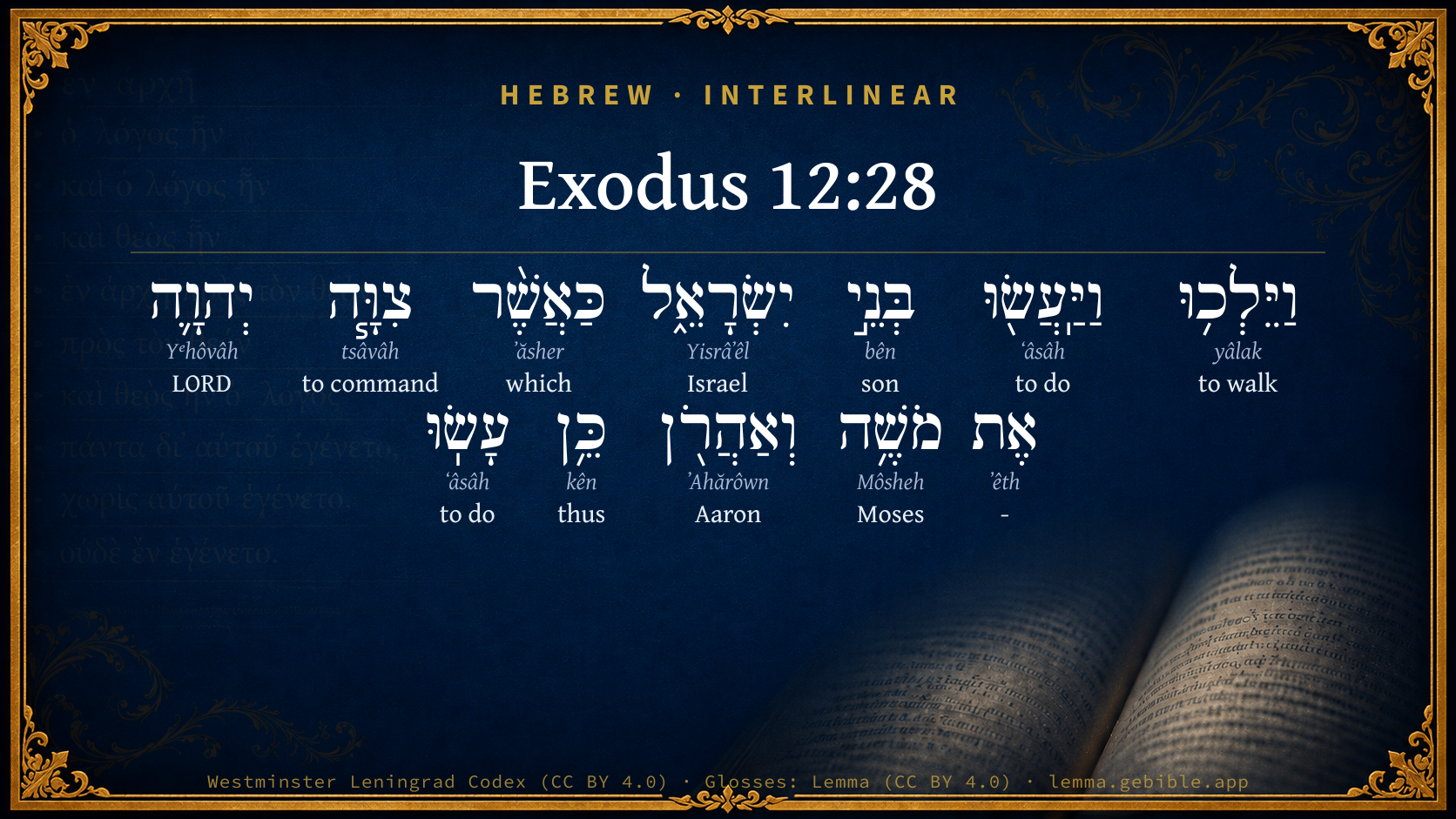
Hebrew (Westminster Leningrad Codex) Exodus 12:28 appears in the Hebrew Old Testament. The text above is from the Westminster Leningrad Codex. Each word links to its Strong’s number, a concise gloss, and parsing drawn from the Open Scriptures Hebrew Bible morphology. Click any word for its full Brown-Driver-Briggs (BDB) entry.
Download image
Cite this verse

Exodus 12:28 (World English Bible). Public Domain. Lemma interlinear Bible study tool, https://lemma.gebible.app/v/exodus/12/28.

Show BibTeX & RIS
BibTeX
RIS
English Translation
The children of Israel went and did so; as Yahweh had commanded Moses and Aaron, so they did.
World English Bible · Public Domain
Download a study sheet

One document with this verse’s original text, its word-by-word gloss line, the meaning frame, cross-references with their text, attributed commentary, and full source and license credits — printable, and it pastes into notes with its structure intact.

This verse Autodidact and up

Study sheet (.html) Plain text (.txt)

A passage Seminary Student

Up to 50 verses in one chapter. A passage sheet keeps up to 6 commentary sources and 12 cross-references per verse, in the order this page ranks them, and says so on the sheet whenever that leaves anything out. Ask for a single verse and you get the Autodidact verse sheet above.

Everything on this page stays free to read, with no account — the sheet is a download of what is already on screen, not access to it.

Want to remove ads? Support Godless Engineer
Compare translations 3

The same verse in 3 English versions, stacked beneath the original-language interlinear above. Click any original word for its lexicon entry.

Each is an independent rendering of the whole verse — the interlinear is not word-aligned to these translations.

Highlighted words mark where these versions differ — a whole-verse word diff, not a word-by-word alignment.

  • World English Bible Public Domain
    The children of Israel went and did so; as Yahweh had commanded Moses and Aaron, so they did.
  • King James Version Public Domain
    And the children of Israel went away, and did as the LORD had commanded Moses and Aaron, so did they.
  • unfoldingWord Literal Text CC BY-SA 4.0
    And the sons of Israel went and did; as Yahweh had commanded Moses and Aaron, so they did.

unfoldingWord Literal Text — © unfoldingWord, licensed CC BY-SA 4.0. Word-aligned USFM3 via Door43 (git.door43.org/unfoldingWord/en_ult).

Versions to compare (up to 4)

3 of 4 selected

Show all 18 translations

Every available English version of this verse, each an independent rendering of the whole verse.

  • World English Bible Public Domain
    The children of Israel went and did so; as Yahweh had commanded Moses and Aaron, so they did.
  • Berean Standard Bible Public Domain
    And the Israelites went and did just what the LORD had commanded Moses and Aaron.
  • Majority Standard Bible Public Domain
    And the Israelites went and did just what the LORD had commanded Moses and Aaron.
  • King James Version Public Domain
    And the children of Israel went away, and did as the LORD had commanded Moses and Aaron, so did they.
  • American Standard Version (1901) Public Domain
    And the children of Israel went and did so; as Jehovah had commanded Moses and Aaron, so did they.
  • Revised Version (1885) Public Domain
    And the children of Israel went and did so; as the LORD had commanded Moses and Aaron, so did they.
  • Geneva Bible (1599) Public Domain
    So the children of Israel went, and did as the Lord had commanded Moses and Aaron: so did they.
  • Douay-Rheims (1899) Public Domain
    And the children of Israel going forth did as the Lord had commanded Moses and Aaron.
  • Young's Literal Translation Public Domain
    And the people bow and do obeisance, and the sons of Israel go and do as Jehovah commanded Moses and Aaron; so have they done.
  • Literal Standard Version CC BY-SA 4.0
    And the people bow and pay respect, and the sons of Israel go and do as YHWH commanded Moses and Aaron; so they have done.
  • Unlocked Literal Bible CC BY-SA 4.0
    The Israelites went and did exactly as Yahweh had commanded Moses and Aaron.
  • unfoldingWord Literal Text CC BY-SA 4.0
    And the sons of Israel went and did; as Yahweh had commanded Moses and Aaron, so they did.
  • Darby Bible Public Domain
    And the children of Israel went away, and did as Jehovah had commanded Moses and Aaron; so did they.
  • World Messianic Bible Public Domain
    The children of Israel went and did so; as the LORD had commanded Moses and Aaron, so they did.
  • Webster's Bible Public Domain
    And the children of Israel went away, and did as the LORD had commanded Moses and Aaron, so did they.
  • Free Bible Version CC BY-SA 4.0
    Then the Israelites went and did just as the Lord had told Moses and Aaron.
  • Bible in Basic English Public Domain
    And the children of Israel went and did so; as the Lord had given orders to Moses and Aaron, so they did.
  • JPS Tanakh (1917) Public Domain
    And the children of Israel went and did so; as the LORD had commanded Moses and Aaron, so did they.

Literal Standard Version (2020), Covenant Press — licensed CC BY-SA 4.0. Text via the HelloAO Bible API (eBible.org). Unlocked Literal Bible (unfoldingWord) — licensed CC BY-SA 4.0. Text via the HelloAO Bible API (eBible.org). unfoldingWord Literal Text — © unfoldingWord, licensed CC BY-SA 4.0. Word-aligned USFM3 via Door43 (git.door43.org/unfoldingWord/en_ult). Free Bible Version, Dr. Jonathan Gallagher — licensed CC BY-SA 4.0. Text via the HelloAO Bible API (eBible.org).

Word by word

More ways to search: Search by grammar → Find every occurrence → Compare this word →

Practice this passage: Drill this verse → Learn its vocabulary →

וְאַהֲרֹ֖ן
ʼAhărôwn
H175
“and · Aaron”
Conjunction + Noun, Proper
Part of Speech
Conjunction + Noun
Type
Proper
Full BDB Definition

Origin: of uncertain derivation

TWOT: 35

Aaron = "light bringer" - brother of Moses, a Levite and the first high priest
  1. וַיֵּלְכ֥וּ yâlak H3212 “and · to walk” Conjunction + Verb, Qal, Sequential Imperfect, 3rd Person, Masculine, Plural
  2. וַיַּֽעֲשׂ֖וּ ʻâsâh H6213 “and · to do” Conjunction + Verb, Qal, Sequential Imperfect, 3rd Person, Masculine, Plural
  3. בְּנֵ֣י bên H1121 “sons of” Noun, Common, Masculine, Plural, Construct
  4. יִשְׂרָאֵ֑ל Yisrâʼêl H3478 “Israel” Noun, Proper
  5. כַּאֲשֶׁ֨ר ʼăsher H834 “like/as · which” Preposition + Particle, Relative
  6. צִוָּ֧ה tsâvâh H6680 “to command” Verb, Piel, Perfect, 3rd Person, Masculine, Singular
  7. יְהוָ֛ה Yᵉhôvâh H3068 “LORD” Noun, Proper
  8. אֶת ʼêth H853 “-” Particle, Direct Object
  9. מֹשֶׁ֥ה Môsheh H4872 “Moses” Noun, Proper
  10. כֵּ֥ן kên H3651 “thus” Particle, Demonstrative
  11. עָשֽׂוּ ʻâsâh H6213 “to do” Verb, Qal, Perfect, 3rd Person, Common, Plural

About this verse

These counts appear in no published source. They are computed here, from the morphology-tagged text and Lemma’s own curated glosses. What Lemma adds →

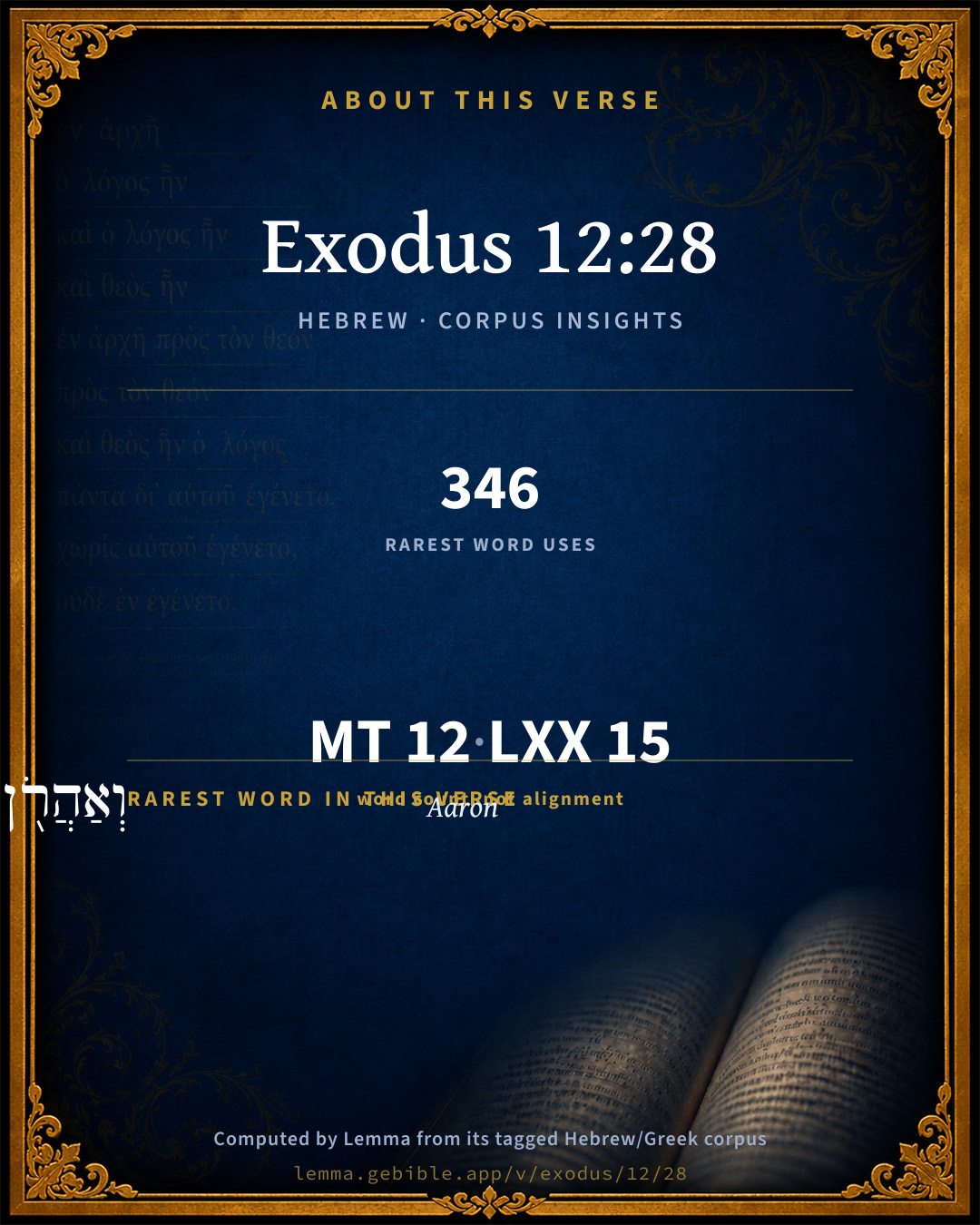
12
words
11
distinct lemmas
Pentateuch
section

Grammatical profile

  • 4 verbs
  • 5 nouns
  • 3 particles

Verb forms

  • וַיֵּלְכ֥וּ Qal · Sequential Imperfect
  • וַיַּֽעֲשׂ֖וּ Qal · Sequential Imperfect
  • צִוָּ֧ה Piel · Perfect
  • עָשֽׂוּ Qal · Perfect

Repetition

A word recurs within this verse — often emphatic in Hebrew:

  • וַיַּֽעֲשׂ֖וּ to do H6213 ×2

Hebrew & Septuagint length

In English translation the verse runs 18 words from the Hebrew and 24 from the Septuagint (LXX English) — closely comparable.

A rough comparison of the two English renderings, which tokenize alike — not a word-level alignment.

Word counts can differ between the Hebrew and the Greek without any difference in meaning — e.g. the Hebrew direct-object marker אֵת has no separate Greek word, and Greek often adds the article ὁ.

In the original languages it is 12 Hebrew tokens and 15 Greek tokens — but the two are counted differently (Hebrew bundles its prefixes and suffixes into one token; the Greek is in lemma form), so that isn’t a like-for-like length.

Cross-references

1

Topical passages linked to Exodus 12:28 in the Treasury of Scripture Knowledge — connected by theme and wording, ordered by reader-vote popularity; previews shown in the World English Bible.

  • Hebrews 11:28 By faith, he kept the Passover, and the sprinkling of the blood, that the destroyer of the firstborn should not touch them.

Cross-references courtesy of OpenBible.info (CC BY 4.0).

Hebrew and Greek witnesses Masoretic Hebrew ↔ Greek Septuagint

The same verse in the two great witnesses to the Old Testament, shown verse-for-verse.

These are two independent witnesses, not word-aligned to each other, and the Septuagint is shown in lemma (dictionary) form.

Hebrew Exodus 12:28 Masoretic · Westminster Leningrad Codex

וַיֵּלְכ֥וּ וַיַּֽעֲשׂ֖וּ בְּנֵ֣י יִשְׂרָאֵ֑ל כַּאֲשֶׁ֨ר צִוָּ֧ה יְהוָ֛ה אֶת מֹשֶׁ֥ה וְאַהֲרֹ֖ן כֵּ֥ן עָשֽׂוּ

The children of Israel went and did so; as Yahweh had commanded Moses and Aaron, so they did.

World English Bible · Public Domain

Greek LXX Exodus 12:28 Septuagint · lemma form

καί ἀποἔρχομαι ποιέω ὁ υἱός ἰσραήλ καθά ἐντέλλομαι κύριος ὁ μωυσῆς καί ααρων οὕτως ποιέω

And the people bowed and worshipped. And the children of Israel departed and did as the Lord commanded Moses and Aaron, so did they.

LXX2012 (modern English Septuagint) · Public Domain

Hebrew: Westminster Leningrad Codex (CC BY 4.0). Greek: Septuagint (public domain); English from LXX2012 (modern English Septuagint) (Public Domain). How the Septuagint differs from the Hebrew →

Targum (Aramaic paraphrase)

2

The Targum is the ancient Jewish Aramaic paraphrase of the Hebrew Scriptures — an interpretive translation, not the Hebrew text itself. Onkelos (literal) and Pseudo-Jonathan (expansive) render the Torah, and Jonathan the Prophets. Coverage is partial: where no permissively-licensed English translation exists for a verse, only the Aramaic is shown. This is verse-level text, not a word-by-word alignment to the Hebrew.

  1. Targum Onkelos Torah (Genesis–Deuteronomy)
    וַאֲזָלוּ וַעֲבָדוּ בְּנֵי יִשְׂרָאֵל כְּמָא דְפַקִיד יְיָ יָת משֶׁה וְאַהֲרֹן כֵּן עֲבָדוּ:

    (no public-domain English translation for this verse)

    Targum Onkelos — Aramaic: “Onkelos Genesis” (public domain); “Onkelos Exodus” (public domain); “Onkelos Leviticus” (public domain); “Onkelos Numbers” (public domain); “Onkelos Deuteronomy” (public domain). English: “Sefaria Community Translation” (CC0 1.0 (public-domain dedication)); “J.W. Etheridge. The Targums of Onkelos and Jonathan Ben Uzziel on the Pentateuch. London: Longmans, Green, 1862” (public domain). Text via Sefaria.

  2. Targum Pseudo-Jonathan Torah (Genesis–Deuteronomy)
    וַאֲזָלוּ וַעֲבָדוּ בְּנֵי יִשְרָאֵל הֵיכְמָא דְפַקֵּיד יְיָ יַת משֶׁה וְיַת אַהֲרן הֵיכְדֵין אִיזְדַרְזוּ וַעֲבָדוּ

    And the sons of Israel went and did as the Lord com-manded Mosheh and Aharon, so did they hasten and do.

    Targum Pseudo-Jonathan — Aramaic: “Targum Jonathan on Genesis” (public domain); “Targum Jonathan on Exodus” (public domain); “Targum Jonathan on Leviticus” (public domain); “Targum Jonathan on Numbers” (public domain); “Targum Jonathan on Deuteronomy” (public domain). English: “The Targum of Jonathan ben Uzziel, trans. J. W. Etheridge, London, 1862” (public domain). Text via Sefaria.

Commentary

Notes on Exodus 12:28 from classic Christian and Jewish commentators (each source and its license shown beneath its notes). The classic Christian expositions comment on the surrounding passage and are grouped to its opening verse, so a note may address several verses; the Jewish commentaries on the Tanakh (Rashi and others) are per-verse, so they appear only where the commentator wrote on this verse.

Lemma curates 59 commentaries, every one of them public domain or Creative Commons licensed, each selected and text-cleaned for this edition rather than reprinted as found. About our sources →

Trapp's Complete Commentary

John Trapp

Exo 12:28 And the children of Israel went away, and did as the LORD had commanded Moses and Aaron, so did they.

Ver. 28. Went away, and did, &c.] They that will not timeously obey God’s sweet precepts, shall one day have no other command to obey but that bitter, Ite maledicti, "Go, ye cursed," &c.

John Trapp, A Commentary or Exposition upon All the Books of the Old and New Testament (1647–1656) — public domain. Text from a community e-Sword module.

The Biblical Illustrator

Joseph S. Exell

Exo_12:28

Did as the Lord had commanded.

Worship and obedience

1. Worship of God in faith, humility, and integrity is the fittest way of expressing thanks to him.

2. Gods revelation of grace in providences and ordinances deserve praise from His people.

3. Worship of God and obedience to Him are well coupled (Exo_12:27).

4. Dispatch in obedience is very requisite in Gods Israel.

5. Sons of Israel are fit to give worship and obedience, and Jehovah only to receive it.

6. Obedience and worship must be regulated by Gods Word only.

7. As God gives to ministers, so the Church must receive, and do exactly. (G. Hughes, B. D.)

The Biblical Illustrator, edited by Joseph S. Exell (c. 1880s–1900s) — public domain. Text from a community e-Sword module.

Tyndale Open Study Notes

Tyndale Open Resources

12:28-30 The predicted plague was fulfilled. Just as death exempts no one, so no one in Egypt, from Pharaoh to the lowest prisoner, escaped the effects of Pharaoh’s pride.

Tyndale Open Study Notes — © Tyndale Open Resources, licensed CC BY-SA 4.0. Text via the HelloAO Bible API.

The Cambridge Bible for Schools and Colleges

gen. ed. J. J. S. Perowne

28. How the people carried out the instructions given to them (vv. 1–13). The verse, as its style and form shew (see on Exo_7:6), belongs to P; and perhaps formed originally the conclusion to vv. 1–13.

The Cambridge Bible for Schools and Colleges (gen. ed. J. J. S. Perowne; Cambridge University Press, 1878–1918) — public domain. Text from a community e-Sword module.

John Gill's Exposition

And Pharaoh rose up in the night,.... Being awakened by the uncommon noise he heard:

he and all his servants, and all the Egyptians; he and his nobles, and ministers of state, courtiers, and counsellors, and his subjects in common, perhaps everywhere in his kingdom, but particularly in the metropolis:

and there was a great cry in Egypt; throughout the whole land, the firstborn being everywhere slain, which caused a most dreadful lamentation of parents for their eldest son, of brethren and sisters for their elder brother, and of servants and maidens for the principal and heir of the family; a cry so loud and general as perhaps was never heard before or since, and under which distress they could have no relief, or any to be their comforter, since all were in the same circumstances: for there was not a house wherein there was not one dead; for if there was no firstborn in it, as it can hardly be thought there should be in every house, though some have been of opinion that it was so ordered in Providence that there should; yet the principal or most considerable person in the family, that is next to the master, might be called the firstborn, as Jarchi notes from Psa 89:27. Though this may be taken as an hyperbolical expression, or, as Aben Ezra observes, it being usual with the Scripture to say that of all, which is true of the greatest part.

John Gill's Exposition of the Whole Bible (1746–1763) — public domain (CC PDM 1.0). Text via the HelloAO Bible API.

Matthew Poole's English Annotations

They killed and did eat the paschal lamb in such manner as God prescribed.

Matthew Poole's English Annotations on the Holy Bible (1683–1685) — public domain. Text from a community e-Sword/MySword module.

The Pulpit Commentary

So did they. The long series of miracles wrought by Moses and Aaron had so impressed the people, that they yielded an undoubting and ready obedience.

The Pulpit Commentary (1880–1919), ed. H.D.M. Spence-Jones & Joseph S. Exell — public domain. Text from a community e-Sword module.

Rashi

Rabbi Shlomo Yitzchaki (Rashi)

וילכו ויעשו בני ישראל AND THE CHILDREN OF ISRAEL WENT AND DID — But did they really do this at once — was not all this spoken to them at the beginning of the month (cf. Rashi on v. 3) and they carried out the command only on the tenth and the fourteenth? But the explanation is: so soon as they had taken these duties upon themselves Scripture accounts it unto them as though they had already performed them (Mekhilta).

וילכו ויעשו THEY WENT AND DID — Scripture enumerates their going also, to give them a reward for going and a reward for doing (Mekhilta).

כאשר צוה ה' את משה ואהרן [THEY DID] AS THE LORD HAD COMMANDED MOSES AND AARON — This is stated for the purpose of declaring Israel’s praise — that they did not omit a single matter of all the commandments of Moses and Aaron. And what is the meaning of כן עשו SO DID THEY? Moses and Aaron also did thus!(Mekhilta).

Rashi on the Tanakh — English translations: “The Judaica Press complete Tanach with Rashi, translated by A. J. Rosenberg” (CC BY 4.0); “Pentateuch with Rashi's commentary by M. Rosenbaum and A.M. Silbermann, 1929-1934” (public domain); “The Metsudah Tanach series, Lakewood, N.J” (CC BY 4.0); and “The Book of Joshua, Metsudah Publications, 1997” (CC BY 4.0). Text via Sefaria.

Ramban (Nachmanides)

Rabbi Moshe ben Nachman (Ramban / Nachmanides)

AND THE CHILDREN OF ISRAEL WENT AND DID SO; AS THE ETERNAL HATH COMMANDED MOSES AND AARON, SO DID THEY. That is, they departed from before Moses and went to the sheep and slaughtered the Passover-offering at eventide [of the fourteenth day of Nisan]. Now such is Scriptural custom to repeat and say, so did they, in order to explain that they did not omit anything from whatever they were commanded, as I have explained in the case of Noah. A similar case is the verse, And Moses saw all the work, and behold, they had done it; as the Eternal had commanded, even so had they done it. Now our Rabbis have a Midrash on this verse, since it was not necessary for Scripture to mention that the children of Israel “went” [and did so]. Therefore they explained: “And the children of Israel went. This indicates that reward is given for going [to perform a religious duty] as well as for actually performing it. And they did so. And had they already done so? No, but once they undertook to perform these duties, Scripture accounts it to them as if they had done them. As the Eternal hath commanded Moses and Aaron, so did they. This is to make known the praiseworthiness of Israel, i.e., that they did exactly as Moses and Aaron told them. Another interpretation: What is the meaning of the words, so did they? It is to teach us that Moses and Aaron also did so.” The Rabbis thus expounded first that the repetition [of the phrase, so did they], was in praise of Israel, i.e., that they did not forget [all they were commanded], and that they did not omit anything of whatever was told to them. This is the customary way of the [Sacred] Language in many places.

Ramban (Nachmanides) on the Tanakh — English translation: “Commentary on the Torah by Ramban (Nachmanides). Translated and annotated by Charles B. Chavel. New York, Shilo Pub. House, 1971-1976” (CC BY 4.0). Text via Sefaria.

Lesson kit

Teaching starters — assembled from the data on this page, not authored interpretation. Every prompt links to the verse data it draws on. Edit before teaching.

Exodus, in the Pentateuch, opens this verse with 12 words (11 distinct Hebrew lemmas). Its most distinctive word is ʼAhărôwn (“Aaron”). A historical commentator’s framing appears above. Read the whole chapter for the surrounding context.

Discussion questions

  1. What does “Aaron” (ʼAhărôwn) contribute to the verse as a whole?
  2. How does Hebrews 11:28, which shares this passage’s theme, read alongside this verse?
  3. What does the repetition of “to do” (2× in this one verse) do in this verse?
  4. These translations render this verse differently; the difference is in the English rendering, not the original. What questions does that raise?
  5. «וַיֵּלְכ֥וּ» is a Qal Sequential Imperfect verb. How does that grammatical form shape the action described?
  6. Compare how Trapp's Complete Commentary and The Biblical Illustrator read this verse. Where do they agree or differ?

Things to notice

Reading settings

Reading text

Shown beneath each verse's original-language words.

Old Testament
Old Testament edition

Read the OT as the Masoretic Hebrew (MT) or the Greek Septuagint (LXX).

English shown for the Greek Septuagint (in the Hebrew ↔ Greek comparison).

Comparing translations? Open the Compare panel on any verse page to stack up to four side by side.