
Exodus 12:11

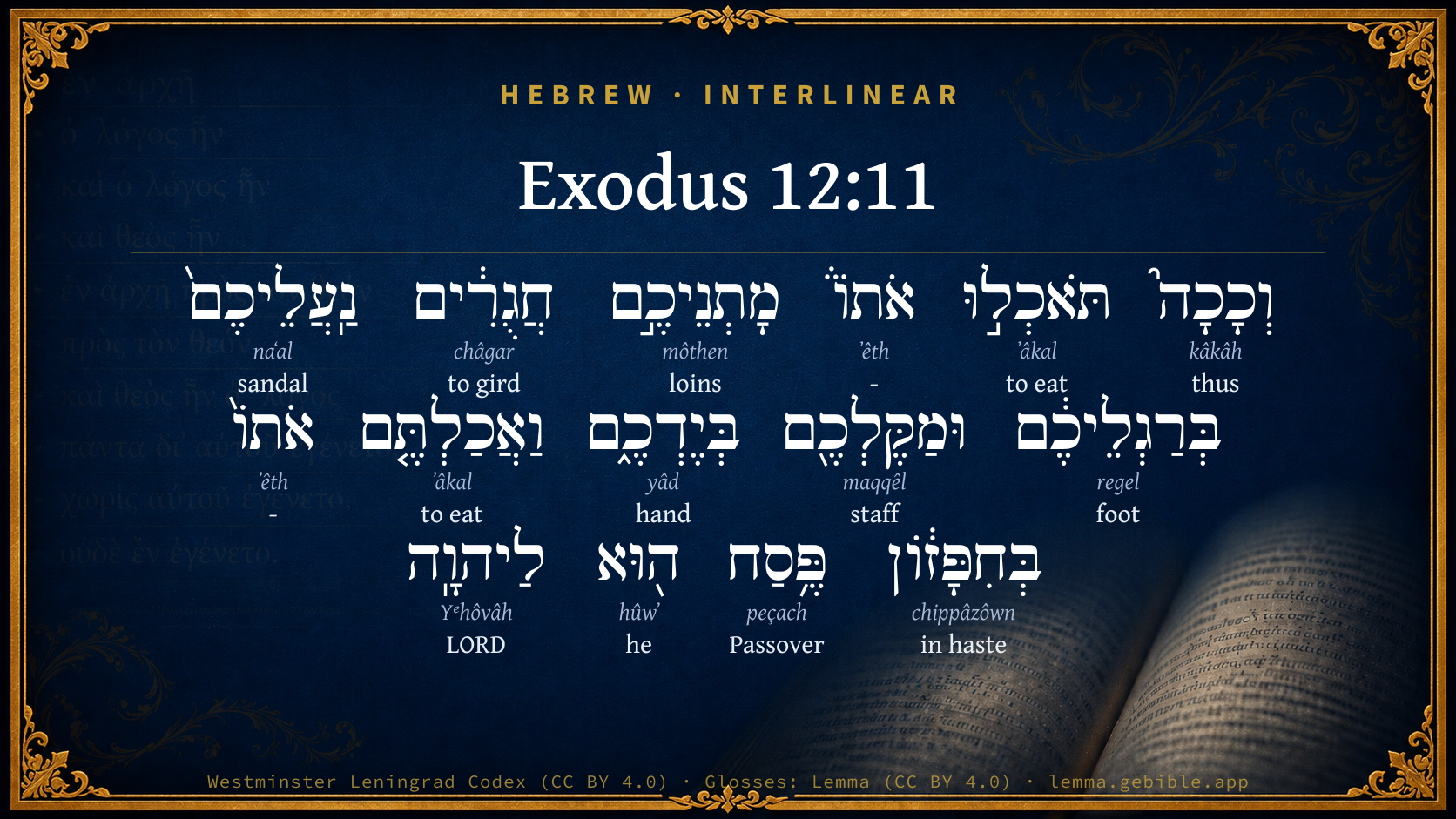
Hebrew (Westminster Leningrad Codex) Exodus 12:11 appears in the Hebrew Old Testament. The text above is from the Westminster Leningrad Codex. Each word links to its Strong’s number, a concise gloss, and parsing drawn from the Open Scriptures Hebrew Bible morphology. Click any word for its full Brown-Driver-Briggs (BDB) entry.
Download image
Cite this verse

Exodus 12:11 (World English Bible). Public Domain. Lemma interlinear Bible study tool, https://lemma.gebible.app/v/exodus/12/11.

Show BibTeX & RIS
BibTeX
RIS
English Translation
This is how you shall eat it: with your loins girded, your shoes on your feet, and your staff in your hand; and you shall eat it in haste: it is Yahweh's Passover.
World English Bible · Public Domain
Highlights
  • 4 first appearances in the Hebrew Bible
Full analysis ↓
Download a study sheet

One document with this verse’s original text, its word-by-word gloss line, the meaning frame, cross-references with their text, attributed commentary, and full source and license credits — printable, and it pastes into notes with its structure intact.

This verse Autodidact and up

Study sheet (.html) Plain text (.txt)

A passage Seminary Student

Up to 50 verses in one chapter. A passage sheet keeps up to 6 commentary sources and 12 cross-references per verse, in the order this page ranks them, and says so on the sheet whenever that leaves anything out. Ask for a single verse and you get the Autodidact verse sheet above.

Everything on this page stays free to read, with no account — the sheet is a download of what is already on screen, not access to it.

Want to remove ads? Support Godless Engineer
Compare translations 3

The same verse in 3 English versions, stacked beneath the original-language interlinear above. Click any original word for its lexicon entry.

Each is an independent rendering of the whole verse — the interlinear is not word-aligned to these translations.

Highlighted words mark where these versions differ — a whole-verse word diff, not a word-by-word alignment.

  • World English Bible Public Domain
    This is how you shall eat it: with your loins girded, your shoes on your feet, and your staff in your hand; and you shall eat it in haste: it is Yahweh's Passover.
  • King James Version Public Domain
    And thus shall ye eat it; with your loins girded, your shoes on your feet, and your staff in your hand; and ye shall eat it in haste: it is the LORD's passover.
  • unfoldingWord Literal Text CC BY-SA 4.0
    And this is how you shall eat it: belts fastened on your waist, your sandals on your feet, and your staff in your hand. And you shall eat it with haste. It is the Passover to Yahweh.

unfoldingWord Literal Text — © unfoldingWord, licensed CC BY-SA 4.0. Word-aligned USFM3 via Door43 (git.door43.org/unfoldingWord/en_ult).

Versions to compare (up to 4)

3 of 4 selected

Show all 18 translations

Every available English version of this verse, each an independent rendering of the whole verse.

  • World English Bible Public Domain
    This is how you shall eat it: with your loins girded, your shoes on your feet, and your staff in your hand; and you shall eat it in haste: it is Yahweh's Passover.
  • Berean Standard Bible Public Domain
    This is how you are to eat it: You must be fully dressed for travel, with your sandals on your feet and your staff in your hand. You are to eat in haste; it is the LORD’s Passover.
  • Majority Standard Bible Public Domain
    This is how you are to eat it: You must be fully dressed for travel, with your sandals on your feet and your staff in your hand. You are to eat in haste; it is the LORD’s Passover.
  • King James Version Public Domain
    And thus shall ye eat it; with your loins girded, your shoes on your feet, and your staff in your hand; and ye shall eat it in haste: it is the LORD's passover.
  • American Standard Version (1901) Public Domain
    And thus shall ye eat it: with your loins girded, your shoes on your feet, and your staff in your hand; and ye shall eat it in haste: it is Jehovah's passover.
  • Revised Version (1885) Public Domain
    And thus shall ye eat it; with your loins girded, your shoes on your feet, and your staff in your hand: and ye shall eat it in haste: it is the LORD’S passover,
  • Geneva Bible (1599) Public Domain
    And thus shall yee eate it, Your loynes girded, your shoes on your feete, and your staues in your handes, and yee shall eate it in haste: for it is the Lords Passeouer.
  • Douay-Rheims (1899) Public Domain
    And thus you shall eat it: you shall gird your reins, and you shall have shoes on your feet, holding staves in your hands, and you shall eat in haste: for it is the Phase (that is the Passage) of the Lord.
  • Young's Literal Translation Public Domain
    `And thus ye do eat it: your loins girded, your sandals on your feet, and your staff in your hand, and ye have eaten it in haste; it is Jehovah's passover,
  • Literal Standard Version CC BY-SA 4.0
    And thus you eat it: your loins girded, your sandals on your feet, and your staff in your hand, and you have eaten it in haste; it is YHWH’s Passover,
  • Unlocked Literal Bible CC BY-SA 4.0
    This is how you must eat it: with your belt fastened, your shoes on your feet, and your staff in your hand. You must eat it hurriedly. It is Yahweh's Passover.
  • unfoldingWord Literal Text CC BY-SA 4.0
    And this is how you shall eat it: belts fastened on your waist, your sandals on your feet, and your staff in your hand. And you shall eat it with haste. It is the Passover to Yahweh.
  • Darby Bible Public Domain
    And thus shall ye eat it: your loins shall be girded, your sandals on your feet, and your staff in your hand; and ye shall eat it in haste; it is Jehovah's passover.
  • World Messianic Bible Public Domain
    This is how you shall eat it: with your belt on your waist, your sandals on your feet, and your staff in your hand; and you shall eat it in haste: it is the LORD’s Passover.
  • Webster's Bible Public Domain
    And thus shall ye eat it; with your loins girded, your shoes on your feet, and your staff in your hand: and ye shall eat it in haste; it is the LORD'S passover.
  • Free Bible Version CC BY-SA 4.0
    This is how you are to eat the meal. You should be dressed ready to travel, with your sandals on your feet and your walking stick in your hand. You are to eat quickly—it is the Lord's Passover.
  • Bible in Basic English Public Domain
    And take your meal dressed as if for a journey, with your shoes on your feet and your sticks in your hands: take it quickly: it is the Lord's Passover.
  • JPS Tanakh (1917) Public Domain
    And thus shall ye eat it: with your loins girded, your shoes on your feet, and your staff in your hand; and ye shall eat it in haste — it is the LORD'S passover.

Literal Standard Version (2020), Covenant Press — licensed CC BY-SA 4.0. Text via the HelloAO Bible API (eBible.org). Unlocked Literal Bible (unfoldingWord) — licensed CC BY-SA 4.0. Text via the HelloAO Bible API (eBible.org). unfoldingWord Literal Text — © unfoldingWord, licensed CC BY-SA 4.0. Word-aligned USFM3 via Door43 (git.door43.org/unfoldingWord/en_ult). Free Bible Version, Dr. Jonathan Gallagher — licensed CC BY-SA 4.0. Text via the HelloAO Bible API (eBible.org).

Word by word

More ways to search: Search by grammar → Find every occurrence → Compare this word →

Practice this passage: Drill this verse → Learn its vocabulary →

בְּחִפָּז֔וֹן
chippâzôwn
H2649
“in/at · in haste”
Preposition + Noun, Common, Masculine, Singular, Absolute
Part of Speech
Preposition + Noun
Type
Common
Gender
Masculine
Number
Singular
State
Absolute
Full BDB Definition

Origin: from H2468

TWOT: 708a

hurriedly, in haste, trepidation, hurried flight
  1. וְכָכָה֮ kâkâh H3602 “and · thus” Conjunction + Adverb
  2. תֹּאכְל֣וּ ʼâkal H398 “to eat” Verb, Qal, Imperfect, 2nd Person, Masculine, Plural
  3. אֹתוֹ֒ ʼêth H853 “- · him” Particle, Direct Object + Suffix, Personal, 3rd Person, Masculine, Singular
  4. מָתְנֵיכֶ֣ם môthen H4975 “loins · your” Noun, Common, Masculine, Dual, Construct + Suffix, Personal, 2nd Person, Masculine, Plural
  5. חֲגֻרִ֔ים châgar H2296 “girding” Verb, Qal, Participle Active, Masculine, Plural, Absolute
  6. נַֽעֲלֵיכֶם֙ naʻal H5275 “sandals · your” Noun, Common, Feminine, Plural, Construct + Suffix, Personal, 2nd Person, Masculine, Plural
  7. בְּרַגְלֵיכֶ֔ם regel H7272 “in/at · feet · your” Preposition + Noun, Common, Feminine, Dual, Construct + Suffix, Personal, 2nd Person, Masculine, Plural
  8. וּמַקֶּלְכֶ֖ם maqqêl H4731 “and · staff · your” Conjunction + Noun, Common, Masculine, Singular, Construct + Suffix, Personal, 2nd Person, Masculine, Plural
  9. בְּיֶדְכֶ֑ם yâd H3027 “in/at · hand · your” Preposition + Noun, Common, Both, Singular, Construct + Suffix, Personal, 2nd Person, Masculine, Plural
  10. וַאֲכַלְתֶּ֤ם ʼâkal H398 “and · to eat” Conjunction + Verb, Qal, Sequential Perfect, 2nd Person, Masculine, Plural
  11. אֹתוֹ֙ ʼêth H853 “- · him” Particle, Direct Object + Suffix, Personal, 3rd Person, Masculine, Singular
  12. פֶּ֥סַח peçach H6453 “Passover” Noun, Common, Masculine, Singular, Absolute
  13. ה֖וּא hûwʼ H1931 “he” Pronoun, Personal, 3rd Person, Masculine, Singular
  14. לַיהוָֽה Yᵉhôvâh H3068 “to/for · LORD” Preposition + Noun, Proper

About this verse

These counts appear in no published source. They are computed here, from the morphology-tagged text and Lemma’s own curated glosses. What Lemma adds →

15
words
13
distinct lemmas
Pentateuch
section

Notable vocabulary

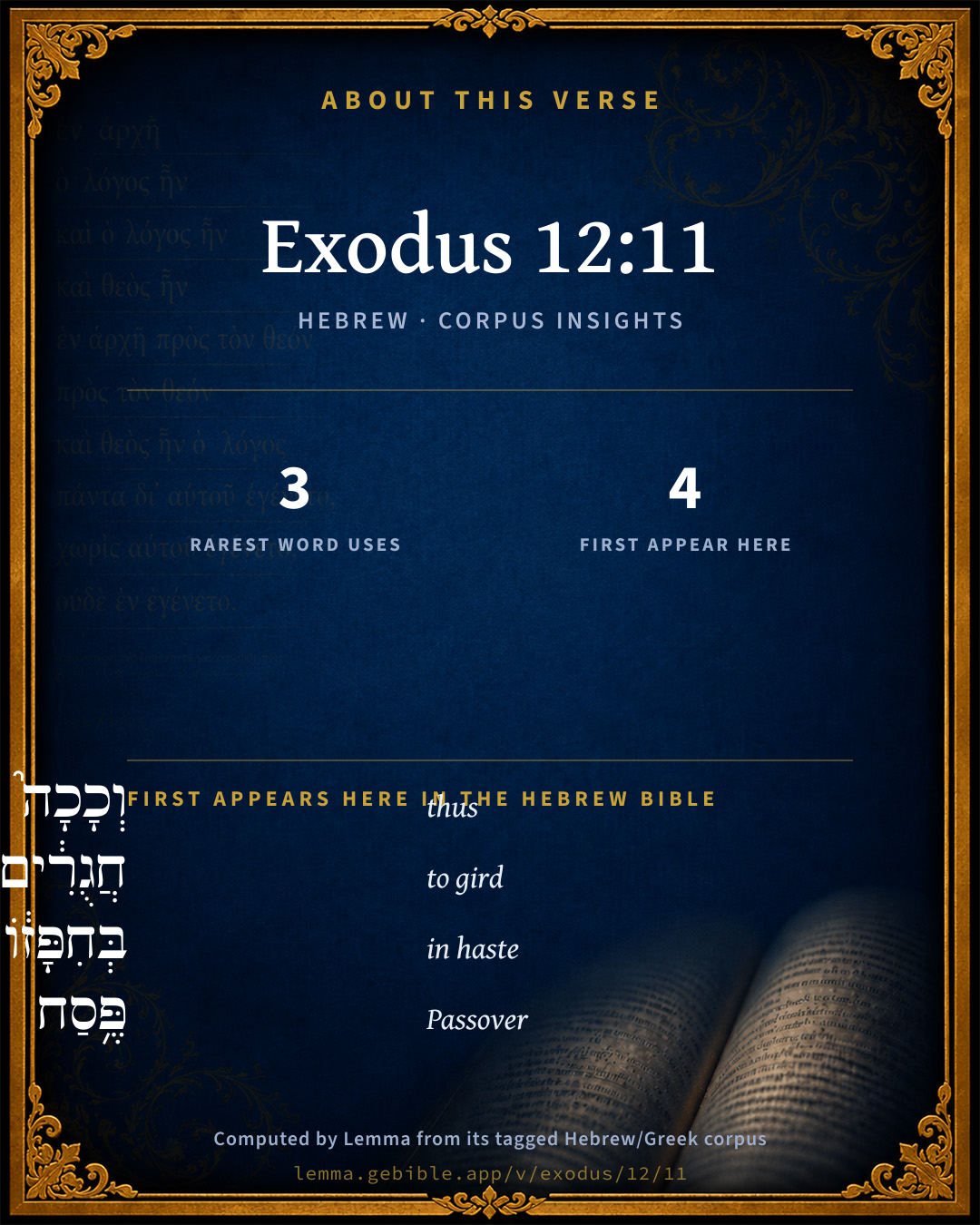
The rarest word here is בְּחִפָּז֔וֹן in haste H2649 — appearing just 3 times in the whole Hebrew Bible.

First appearance in Scripture

These words make their first canonical appearance in the Hebrew Bible here:

  • וְכָכָה֮ thus H3602
  • חֲגֻרִ֔ים to gird H2296
  • בְּחִפָּז֔וֹן in haste H2649
  • פֶּ֥סַח Passover H6453

Shared distinctive vocabulary

בְּחִפָּז֔וֹן in haste H2649 occurs in 3 verses of the Hebrew Bible. Also found in:

Grammatical profile

  • 3 verbs
  • 8 nouns
  • 1 pronoun
  • 1 adverb
  • 2 particles

Verb forms

  • תֹּאכְל֣וּ Qal · Imperfect
  • חֲגֻרִ֔ים Qal · Participle Active
  • וַאֲכַלְתֶּ֤ם Qal · Sequential Perfect

Repetition

A word recurs within this verse — often emphatic in Hebrew:

  • תֹּאכְל֣וּ to eat H398 ×2

Hebrew & Septuagint length

In English translation the verse runs 33 words from the Hebrew and 35 from the Septuagint (LXX English) — closely comparable.

A rough comparison of the two English renderings, which tokenize alike — not a word-level alignment.

Word counts can differ between the Hebrew and the Greek without any difference in meaning — e.g. the Hebrew direct-object marker אֵת has no separate Greek word, and Greek often adds the article ὁ.

Cross-references

14

Topical passages linked to Exodus 12:11 in the Treasury of Scripture Knowledge — connected by theme and wording, ordered by reader-vote popularity; previews shown in the World English Bible.

  • Exodus 12:27 that you shall say, 'It is the sacrifice of Yahweh's Passover, who passed over the houses of the children of Israel in Egypt, when he struck the Egyptians, and spared our houses.'" The people bowed their heads and worshiped.
  • Ephesians 6:15 and having fitted your feet with the preparation of the Gospel of peace;
  • 1 Corinthians 5:7 Purge out the old yeast, that you may be a new lump, even as you are unleavened. For indeed Christ, our Passover, has been sacrificed in our place.
  • 1 Peter 1:13 Therefore, prepare your minds for action, be sober and set your hope fully on the grace that will be brought to you at the revelation of Jesus Christ--
  • Luke 12:35 "Let your loins be girded and your lamps burning.
  • Exodus 12:21 Then Moses called for all the elders of Israel, and said to them, "Draw out, and take lambs according to your families, and kill the Passover.
  • Exodus 12:43 Yahweh said to Moses and Aaron, "This is the ordinance of the Passover. There shall no foreigner eat of it,
  • Leviticus 23:5 In the first month, on the fourteenth day of the month in the evening, is Yahweh's Passover.
  • Numbers 28:16 In the first month, on the fourteenth day of the month, is Yahweh's Passover.
  • Deuteronomy 16:2–6 You shall sacrifice the Passover to Yahweh your God, of the flock and the herd, in the place which Yahweh shall choose, to cause his name to dwell there.
  • Matthew 26:19–20 The disciples did as Jesus commanded them, and they prepared the Passover.
  • Exodus 12:13 The blood shall be to you for a token on the houses where you are: and when I see the blood, I will pass over you, and there shall no plague be on you to destroy you, when I strike the land of Egypt.
  • Luke 7:38 Standing behind at his feet weeping, she began to wet his feet with her tears, and she wiped them with the hair of her head, kissed his feet, and anointed them with the ointment.
  • Luke 15:22 "But the father said to his servants, 'Bring out the best robe, and put it on him. Put a ring on his hand, and shoes on his feet.

Cross-references courtesy of OpenBible.info (CC BY 4.0).

Hebrew and Greek witnesses Masoretic Hebrew ↔ Greek Septuagint

The same verse in the two great witnesses to the Old Testament, shown verse-for-verse.

These are two independent witnesses, not word-aligned to each other, and the Septuagint is shown in lemma (dictionary) form.

Hebrew Exodus 12:11 Masoretic · Westminster Leningrad Codex

וְכָכָה֮ תֹּאכְל֣וּ אֹתוֹ֒ מָתְנֵיכֶ֣ם חֲגֻרִ֔ים נַֽעֲלֵיכֶם֙ בְּרַגְלֵיכֶ֔ם וּמַקֶּלְכֶ֖ם בְּיֶדְכֶ֑ם וַאֲכַלְתֶּ֤ם אֹתוֹ֙ בְּחִפָּז֔וֹן פֶּ֥סַח ה֖וּא לַיהוָֽה

This is how you shall eat it: with your loins girded, your shoes on your feet, and your staff in your hand; and you shall eat it in haste: it is Yahweh's Passover.

World English Bible · Public Domain

Greek LXX Exodus 12:11 Septuagint · lemma form

οὕτως δέ ἐσθίω αὐτός ὁ ὀσφύς σύ περιζώννυμι καί ὁ ὑπόδημα ἐν ὁ πούς σύ καί ὁ βακτηρία ἐν ὁ χείρ σύ καί ἐσθίω αὐτός μετά σπουδή πασχα εἰμί κύριος

And thus shall you⌃ eat it: your loins girded, and your sandals on your feet, and your staves in your hands, and you⌃ shall eat it in haste. It is a passover to the Lord.

LXX2012 (modern English Septuagint) · Public Domain

On this verse, The Cambridge Bible for Schools and Colleges discusses the Septuagint’s reading. Read the note in Commentary ↓

Hebrew: Westminster Leningrad Codex (CC BY 4.0). Greek: Septuagint (public domain); English from LXX2012 (modern English Septuagint) (Public Domain). How the Septuagint differs from the Hebrew →

Targum (Aramaic paraphrase)

2

The Targum is the ancient Jewish Aramaic paraphrase of the Hebrew Scriptures — an interpretive translation, not the Hebrew text itself. Onkelos (literal) and Pseudo-Jonathan (expansive) render the Torah, and Jonathan the Prophets. Coverage is partial: where no permissively-licensed English translation exists for a verse, only the Aramaic is shown. This is verse-level text, not a word-by-word alignment to the Hebrew.

  1. Targum Onkelos Torah (Genesis–Deuteronomy)
    וּכְדֵין תֵּיכְלוּן יָתֵהּ חַרְצֵיכוֹן יְהוֹן אֲסִירִין מְסָנֵיכוֹן בְּרִגְלֵיכוֹן וְחוּטְרֵיכוֹן בִּידֵיכוֹן וְתֵיכְלוּן יָתֵהּ בִּבְהִילוּ פִּסְחָא הוּא קֳדָם יְיָ:

    (no public-domain English translation for this verse)

    Targum Onkelos — Aramaic: “Onkelos Genesis” (public domain); “Onkelos Exodus” (public domain); “Onkelos Leviticus” (public domain); “Onkelos Numbers” (public domain); “Onkelos Deuteronomy” (public domain). English: “Sefaria Community Translation” (CC0 1.0 (public-domain dedication)); “J.W. Etheridge. The Targums of Onkelos and Jonathan Ben Uzziel on the Pentateuch. London: Longmans, Green, 1862” (public domain). Text via Sefaria.

  2. Targum Pseudo-Jonathan Torah (Genesis–Deuteronomy)
    וּכְדָא הִילְכָתָא תֵיכְלוּן יָתֵיהּ בְּזִמְנָא דָא וְלָא לְדָרַיָא חַרְצֵיכוֹן יְהוֹן מְזַרְזִין מְסַנֵיכוֹן בְּרִיגְלֵיכוֹן וְחוּטְרֵיכוֹן בִּידֵיכוֹן וְתֵיכְלוּן יָתֵיהּ בִּבְהִילוּ דִשְׁכִינַת מָארֵי עַלְמָא מְטוּל דְּחַיְיסָא מִן קֳדָם יְיָ לְכוֹן הוּא

    And according to this manner you shall eat it, this time, but not in (other) generations: your loins shall be girded, your shoes on your feet, and your staves in your hands; and you shall eat in the fear of the majesty of the Lord of the world; because mercy hath been shown to you from before the Lord.

    Targum Pseudo-Jonathan — Aramaic: “Targum Jonathan on Genesis” (public domain); “Targum Jonathan on Exodus” (public domain); “Targum Jonathan on Leviticus” (public domain); “Targum Jonathan on Numbers” (public domain); “Targum Jonathan on Deuteronomy” (public domain). English: “The Targum of Jonathan ben Uzziel, trans. J. W. Etheridge, London, 1862” (public domain). Text via Sefaria.

Commentary

Notes on Exodus 12:11 from classic Christian and Jewish commentators (each source and its license shown beneath its notes). The classic Christian expositions comment on the surrounding passage and are grouped to its opening verse, so a note may address several verses; the Jewish commentaries on the Tanakh (Rashi and others) are per-verse, so they appear only where the commentator wrote on this verse.

Lemma curates 59 commentaries, every one of them public domain or Creative Commons licensed, each selected and text-cleaned for this edition rather than reprinted as found. About our sources →

Jamieson, Fausset & Brown

Robert Jamieson, A. R. Fausset & David Brown

THE RITE OF THE PASSOVER. (Exo 12:11-14)

thus shall ye eat it; with your loins girded, your shoes on your feet--as prepared for a journey. The first was done by the skirts of the loose outer cloth being drawn up and fastened in the girdle, so as to leave the leg and knee free for motion. As to the other, the Orientals never wear shoes indoors, and the ancient Egyptians, as appears from the monuments, did not usually wear either shoes or sandals. These injunctions seem to have applied chiefly to the first celebration of the rite.

it is the Lord's passover--called by this name from the blood-marked dwellings of the Israelites being passed over figuratively by the destroying angel.

Jamieson, Fausset & Brown — Commentary Critical and Explanatory on the Whole Bible (1871) — public domain (CC PDM 1.0). Text via the HelloAO Bible API.

Trapp's Complete Commentary

John Trapp

Exo 12:11 And thus shall ye eat it; [with] your loins girded, your shoes on your feet, and your staff in your hand; and ye shall eat it in haste: it [is] the LORD’S passover.

Ver. 11. With your loins girded.] As pressed and intent to the service. So we should be at all times, but especially when to depart out of the Egypt of this life, and to take heaven by force. Then, if ever, we should hoc agere, "gird up the loins of our minds," &c. {1Pe 1:13}

And ye shall eat it in haste.] As not doubting of deliverance, and waiting a call out of life.

It is the Lord’s Passover.] A sacramental expression, like that of our Saviour, "This is my body". {Mat 26:26} {See Trapp on "Mat 26:26"} The sacraments of the Old Testament were both sacraments and types: but those of the New, are sacraments only.

John Trapp, A Commentary or Exposition upon All the Books of the Old and New Testament (1647–1656) — public domain. Text from a community e-Sword module.

Tyndale Open Study Notes

Tyndale Open Resources

12:11 Be fully dressed: The Israelites were to be ready to depart at a moment’s notice.

Tyndale Open Study Notes — © Tyndale Open Resources, licensed CC BY-SA 4.0. Text via the HelloAO Bible API.

Geneva Bible (1599)

Geneva Bible translators

The lamb was not the Passover, but signified it, as sacraments are not the thing itself, which they do represent, but signify it.

Geneva Bible (1599) marginal notes — public domain. Text via Bolls.life.

Adam Clarke's Commentary

Verse 11. And thus shall ye eat it; with your loins girded] As in the eastern countries they wear long loose garments, whenever they travel they tuck up the fore parts of their garments in the girdle which they wear round their loins.

Your shoes on your feet] This seems particularly mentioned because not customary. "The easterns throw off their shoes when they eat, because it would be troublesome," says Sir J. Chardin, "to keep their shoes upon their feet, they sitting cross-legged on the floor, and having no hinder quarters to their shoes, which are made like slippers; and as they do not use tables and chairs as we do in Europe, but have their floors covered with carpets, they throw off their shoes when they enter their apartments, lest they should soil those beautiful pieces of furniture." On the contrary the Israelites were to have their shoes on, because now about to commence their journey. It was customary among the Romans to lay aside their shoes when they went to a banquet. The servants took them off them when they entered the house, and returned them when they departed to their own habitations.

Your staff in your hand] The same writer observes that the eastern people universally make use of a staff when they travel on foot.

Ye shall eat it in haste] Because they were suddenly to take their departure: the destroying angel was at hand, their enemies were coming against them, and they had not a moment to lose.

It is the Lord's passover.] That is, Jehovah is now about to pass over the land, and the houses only where the blood is sprinkled shall be safe from the stroke of death. The Hebrew word פסח pesach, which we very properly translate PASSOVER, and which should always be pronounced as two words, has its name from the angel of God passing by or over the houses of the Israelites, on the posts and lintels of which the blood of the lamb was sprinkled, while he stopped at the houses of the Egyptians to slay their first-born.

Adam Clarke's Commentary on the Bible (1810–1826) — public domain. Text from a community e-Sword/MySword module.

Ellicott's Commentary for English Readers

(11) Thus shall ye eat it.—The injunctions which follow are not repeated in any later part of the Law, and were not generally regarded as binding at any Passover after the first. They all had reference to the impending departure of the Israelites, who were to eat the Passover prepared as for a journey. The long robe (beged), usually allowed to flow loosely around the person, was to be gathered together, and fastened about the loins with a girdle; sandals, not commonly worn inside the house, were to be put on the feet, and a walking-stick was to be held in one hand. The meal was to be eaten “in haste,” as liable to be interrupted at any moment by a summons to quit Egypt and set out for Canaan. Some such attitude befits Christians at all times, since they know not when the summons may come to them requiring them to quit the Egypt of this world and start for the heavenly country.

It is the Lord’s passover.—The word “passover” (pesakh) is here used for the first time. It is supposed by some to be of Egyptian origin, and to signify primarily “a spreading out of wings, so as to protect. But the meaning “pass over” is still regarded by many of the best Hebraists as the primary and most proper sense, and the word itself as Semitic. It occurs in the geographic name Tiphsach (Thapsacus), borne by the place where it was usual to cross, or “pass over,” the Euphrates.

A Bible Commentary for English Readers, edited by Charles John Ellicott (1878–1897) — public domain. Text from a community e-Sword module.

The Cambridge Bible for Schools and Colleges

gen. ed. J. J. S. Perowne

11. The Israelites are to partake of the Passover completely prepared for their departure.

your loins girded] The long and loose robes of Orientals, when they wish to move rapidly, are fastened up round the waist with a strong girdle: cf. 1Ki_18:46, 2Ki_4:29; 2Ki_9:1.

your sandals on your feet] ready for a journey. Sandals were not worn in the house.

your staff in your hand] a staff was regularly used in walking.

and ye shall eat it in trepidation] in mingled hurry and alarm. ‘Haste’ alone is not adequate: notice the cognate verb in Deu_20:3 (‘tremble’), 1Sa_23:26, Psa_48:5 (RVm.). Cf. the same word in Deu_16:3, and Isa_52:12 (where the coming exodus from Babylon is not to be ‘in trepidation’).

it is a passover (Heb. pésaḥ) to Jehovah. The form of sentence, as vv. 27, 42, Exo_29:18 a, 18b, Exo_30:10, &c. In vv. 13 (see note), 23, 27, the term pésaḥ is explained by means of the cognate verb in the sense of a passing over (cf. Aq. here ὑπέρβασις); but it is uncertain whether this is the original meaning of the term. The LXX. render by πάσχα, ‘pascha,’ from the Aramaic form of the word: so in NT. (e.g. Mat_26:17). The Vulg. has in the OT. Phase, in the NT. Pascha; hence our adj. ‘Paschal.’ On the Heb. word, see further p. 408.

The Cambridge Bible for Schools and Colleges (gen. ed. J. J. S. Perowne; Cambridge University Press, 1878–1918) — public domain. Text from a community e-Sword module.

John Gill's Exposition

And thus shall ye eat it,.... After the following manner, in the habit and posture described: the Targum of Jonathan adds,"at this time, and not in ages following;''for these rites were peculiar to the passover in Egypt, and not to be observed in later times:

with your loins girded; that is, with their garments girt about their loins, for the better convenience in travelling; for in those countries they wore long loose garments, which reached to their feet, and unless girt up, were a great hinderance in walking; and may denote the saints being girt with the girdle of truth, and their readiness and fitness to perform every good work:

your shoes on your feet; which used to be put off at feasts, in order to have their feet washed, which was frequently done at such times, as we learn from many instances in Scripture, which could not be done unless the shoes were off, Gen 18:4, besides, it is highly probable that the Israelites in Egypt did not wear shoes in common, it being a hot country, and they in a state of poverty and bondage; but now being about to depart the land, and to take a journey, they are ordered to have their shoes on, to be ready for it: and was a token of their deliverance and freedom, and joy on that occasion; and may, in an evangelic sense, denote the feet of the saints being shod with the preparation of the Gospel of peace, Eph 6:15,

and your staff in your hand; such as travellers make use of to support and assist, protect and defend them, in their journey, and may be expressive of faith in the word and promises of God, which are the support of his people in their passage through this world, Psa 23:4.

and ye shall eat it in haste; because upon slaying the firstborn the Egyptians would be urgent upon them to depart immediately. Aquila renders it, "with fear", and so the Targum of Jonathan; but the other sense suits best with the circumstances of the Israelites:

it is the Lord's passover; which he has commanded, and is a sign and token of his passing over the houses of the Israelites, when he destroyed the firstborn in all the houses of the Egyptians, and which is explained in the following verse, and the reason of its name given; the act of passing was his, the ordinance was appointed by him, and it was typical of the Lord Jesus Christ, the true passover, Co1 5:7.

John Gill's Exposition of the Whole Bible (1746–1763) — public domain (CC PDM 1.0). Text via the HelloAO Bible API.

Albert Barnes' Notes on the Bible

These instructions are understood by the Jews to apply only to the first Passover, when they belonged to the occasion. There is no trace of their observance at any later time. Each of the directions marks preparation for a journey; the long flowing robes are girded round the loins; shoes or sandals, not worn in the house or at meals, were fastened on the feet; and the traveler’s staff was taken in hand.

The Lord’s passover - The great and most significant name for the whole ordinance. The word Passover renders as nearly as possible the true meaning of the original, of which the primary sense is generally held to be “pass rapidly,” like a bird with outstretched wings, but it undoubtedly includes the idea of sparing Exo 12:13. See Isa 31:5, which combines the two great ideas involved in the word.

Albert Barnes' Notes on the Bible (1834–1885) — public domain. Text from a community e-Sword/MySword module.

Haydock's Catholic Bible Commentary

Haste, as all the aforesaid prescriptions intimate. (Menochius) --- Many of them regarded only this occasion, and were not required afterwards. --- Phase, which the Chaldean writes Pascha, signifies the passing over (Calmet) of the destroying angel, when he spared those houses only which were marked with blood, to insinuate the necessity of faith in Christ’s death. Some have derived the word from the Greek Pascho, "to suffer," on account of the similarity of sound. (Haydock)

George Leo Haydock (1774–1849), Haydock's Catholic Family Bible and Commentary, 1859 edition — public domain. Excludes Psalms (Douay-Rheims chapter numbering differs from Protestant) and Deuterocanonical books (Catholic canon only).

Matthew Poole's English Annotations

Thus shall ye eat it, to wit, for this time, because their circumstances required it, that they being suddenly to take a great journey, might be in a traveller’s habit. But that these, and some other circumstances now enjoined and used, were only temporary, and not perpetual nor obligatory, sufficiently appears from the practice not only of the Jews in following ages, but also of Christ and of his apostles. And in like manner there are some institutions in the New Testament which did only oblige that age, and not all that follow them, as Act 15:28,29.

With your loins girded, like travellers and persons undertaking some difficult service; for such used to gird up their garments, which in those parts were long and troublesome. See 2Ki 4:29; 9:1; Luk 12:35.

Shoes on your feet; a badge,

1. Of their readiness for their journey, Isa 5:27; Act 12:8.

2. Of their freedom; for slaves, such as the Israelites now were in Egypt, used to go barefooted.

3. Of joy, as on the contrary going barefoot was a badge of mourning, 2Sa 15:30. Your staff in your hand, like persons upon the point of departing, which was a very comfortable circumstance.

In haste; for so the word signifies, Deu 16:3; Isa 52:12. It is the Lord’s passover: this lamb, or your eating of it, is the Lord’s passover, i.e. it is a sign of God’s passing over you and your houses, when he comes to destroy the Egyptians on every side of you, Exo 12:13,23. It is a metonomy usual in sacramental speeches, as Gen 17:10; Mat 26:26-28.

Matthew Poole's English Annotations on the Holy Bible (1683–1685) — public domain. Text from a community e-Sword/MySword module.

The Pulpit Commentary

With your loins girded, etc. Completely prepared, i.e. , to start on your journey with the loose wrapper (beged), ordinarily worn, collected together and fastened by a girdle about the waist; with sandals on the feet, which were not commonly worn in houses; and with walkingsticks in the hand. There were some Jews who regarded these directions as of perpetual obligation; but the general view was that they applied to the first occasion only, when alone they would have answered any useful purpose. You shall eat it in haste. As not knowing at what moment you may be summoned to start on your journey, and as having to see to the burning of the bones after the flesh was eaten, which would take some time. It is the Lord"s Passover. Very emphatic words! "This is no common meal," they seem to say, "it is not even an ordinary sacrificial repast. The lamb is Jehovah"s. It is his pass-sign the mark of his protection, the precious means of your preservation from death. As such view it; and though ye eat it in haste, eat it with reverence."

The Pulpit Commentary (1880–1919), ed. H.D.M. Spence-Jones & Joseph S. Exell — public domain. Text from a community e-Sword module.

John Wesley's Explanatory Notes

The Lord's passover - A sign of his passing over you, when he destroyed the Egyptians.

John Wesley, Explanatory Notes Upon the Whole Bible (1754–1765) — public domain. Text via the GEBible commentary corpus.

Scofield Reference Notes

C. I. Scofield

passover

The Passover, type of Christ our Redeemer Exo 12:1-28; Joh 1:29; 1Co 5:6; 1Co 5:7; 1Pe 1:18; 1Pe 1:19.

(1) The lamb must be without blemish, and to test this it was kept up for four days Exo 12:5; Exo 12:6. So our Lord’s public life, under hostile scrutiny, was the testing which proved his holiness; Luk 11:53; Luk 11:54; Joh 8:46; Joh 18:38.

(2) The Lamb thus tested must be slain Exo 12:6; Joh 12:24; Heb 9:22.

(3) The blood must be applied Exo 12:7 This answers to appropriation by personal faith, and refutes universalism Joh 3:36.

(4) The blood thus applied of itself, without anything, constituted a perfect protection from judgment Exo 12:13; 1Jn 1:7; Heb 10:10; Heb 10:14.

(5) The feast typified Christ as the bread of life, answering to the memorial supper. Mat 26:26-28; 1Co 11:23-26. To observe the feast was a duty and privilege, but not a condition of safety. As a matter of fact, the bread was not eaten by the Israelites on the night in which, nevertheless, they were preserved from the judgment upon the firstborn. Exo 12:34-39.

The Scofield Reference Bible (1917 edition), notes by C. I. Scofield — public domain. Text from a community e-Sword module.

Kretzmann's Popular Commentary

Paul E. Kretzmann

The Precept Pertaining to Unleavened Bread

v. 11. And thus shall ye eat it: with your loins girded, your shoes on your feet, literally, "shod on your feet," and your staff in your hand; and ye shall eat it in haste, in hasty flight, as such that were about to flee, in readiness for speedy flight. It is the Lord’s Passover. These instructions concerned the celebration in Egypt and were afterward dropped as unessential. Only the name for the festival, the Passover of the Lord, was not changed, a perpetual reminder of the miracle which the Lord performed in delivering His people.

v. 12. For I will pass through the land of Egypt this night, and will smite all the first-born in the land of Egypt, both man and beast; and against all the gods of Egypt I will execute judgment. I am the Lord. As the avenging, almighty Judge the Lord intended to traverse the entire land of Egypt, to strike down all the first-born, to punish the princes with the common people, and thus to expose all the Egyptian idols as helpless delusions.

v. 13. And the blood shall be to you for a token upon the houses where ye are; and when I see the blood, I will pass over you, and the plague shall not be upon you to destroy you, when I smite the land of Egypt. Thus the Lord Himself explained the meaning of the Passover. Wherever there was a sign of blood, as He had commanded, there He would pass by, or over, and the blow would not strike the inmates of a house thus designated to work destruction in their midst. The slaughter would come upon the land of the Egyptians only.

v. 14. And this day shall be unto you for a memorial, the evening of the fourteenth day of Abib; and ye shall keep it a feast to the Lord throughout your generations, a festival of commemoration from one generation to the next; ye shall keep it a feast by an ordinance forever. It was to be celebrated as the festival of Israel’s redemption and of its being set aside as the people of God’s covenant.

v. 15. Seven days shall ye eat unleavened bread; even the first day ye shall put away leaven out of your houses; for whosoever eateth leavened bread from the first day until the seventh day, that soul shall be cut off from Israel. This is the solemn ordinance relating to the Feast of Unleavened Bread, which was thus from the beginning connected with the Festival of Passover. The exact period of the seven days is later fixed by many further ordinances.

v. 16. And in the first day there shall be an holy convocation, a solemn festival assembly, and in the seventh day there shall be an holy convocation to you, another service of worship; no manner of work shall be done in them, save that which every man must eat, that only may be done of you. That was the only labor which was permitted, that connected with the preparation of foods, according to the necessities of the day, the ordinance thus being less strict than that concerning the Sabbath. Cf Lev 23:7.

v. 17. And ye shall observe the Feast of Unleavened Bread; for in this selfsame day have I brought your armies out of the land of Egypt; therefore shall ye observe this day in your generations by an ordinance forever. While the Passover commemorated the dreadful night of judgment and deliverance, the Feast of Unleavened Bread, so closely connected with it, reminded the children of Israel of the Exodus itself, of the chief circumstances connected with the departure of their armies out of Egypt.

v. 18. In the first month, on the fourteenth day of the month at even, ye shall eat unleavened bread, until the one and twentieth day of the month at even.

v. 19. Seven days shall there be no leaven found in your houses; that was the order which was to apply for the future, when they would have reached the Land of Promise; for whosoever eateth that which is leavened, in any solid food, even that soul shall be cut off from the congregation of Israel, whether he be a stranger or born in the land. The naturalized, that is, the circumcised foreigner was obliged to submit to the ordinance in just the same manner as the native Israelite.

v. 20. Ye shall eat nothing leavened; in all your habitations shall ye eat unleavened bread. The ordinance was certainly not lacking in clearness and emphasis, for it was the intention of the Lord to symbolize the entire consecration of His people, as based upon their redemption.

Paul E. Kretzmann, Popular Commentary of the Bible (1921–1924) — public domain. Text from a community e-Sword module.

Rashi

Rabbi Shlomo Yitzchaki (Rashi)

מתניכם חגרים YOUR LOINS GIRDED — i. e. prepared for the journey (Mekhilta).

בחפזון — This is an expression denoting hurry and haste, similar to, (I Samuel 23:26) “And David made haste (נחפז) to get away”; (2 Kings 7:15) ”which the Arameans had cast away in their haste"

פסח הוא לה IT IS THE PASSOVER OF THE LORD — The offering is called פסח in allusion to the springing and passing over — because the Holy One, blessed be He, passed over the houses of the Israelites in between the houses of the Egyptians and sprang from Egyptian to Egyptian, whilst the Israelite who was between them escaped. The words “And ye shall eat it in haste for it is a 'springing’-offering to the Lord” imply: Ye, therefore, do every act of sacrificial service connected with it (with the Paschal lamb) in honour of Heaven (God) by way of springing and leaping over (i. e. hastily), as a reminder of its name, which is called, the “springing”-offering. In old French, (Provencal) too, Pascua (the term for the Passover festival) signifies stepping over.

Rashi on the Tanakh — English translations: “The Judaica Press complete Tanach with Rashi, translated by A. J. Rosenberg” (CC BY 4.0); “Pentateuch with Rashi's commentary by M. Rosenbaum and A.M. Silbermann, 1929-1934” (public domain); “The Metsudah Tanach series, Lakewood, N.J” (CC BY 4.0); and “The Book of Joshua, Metsudah Publications, 1997” (CC BY 4.0). Text via Sefaria.

Lesson kit

Teaching starters — assembled from the data on this page, not authored interpretation. Every prompt links to the verse data it draws on. Edit before teaching.

Exodus, in the Pentateuch, opens this verse with 15 words (13 distinct Hebrew lemmas). Its most distinctive word is chippâzôwn (“in haste”). A historical commentator’s framing appears above. Read the whole chapter for the surrounding context.

Discussion questions

  1. The word chippâzôwn carries the sense “in haste.” How does it shape the verse?
  2. 4 words make their first appearance in Scripture here. What does this debut establish?
  3. How does Deuteronomy 16:3, which shares the word «in haste», read alongside this verse?
  4. What does the repetition of “to eat” (2× in this one verse) do in this verse?
  5. These translations render this verse differently. What is at stake in choosing one wording over another?
  6. «תֹּאכְל֣וּ» is a Qal Imperfect verb. How does that grammatical form shape the action described?
  7. Compare how Jamieson, Fausset & Brown and Trapp's Complete Commentary read this verse. Where do they agree or differ?

Things to notice

  • 4 words make their first canonical appearance in Scripture here.
  • These translations choose different wording for 13 words in this verse.
  • “to eat” occurs 2× in this single verse.
  • 13 distinct Hebrew lemmas span 15 words in this verse.

Reading settings

Reading text

Shown beneath each verse's original-language words.

Old Testament
Old Testament edition

Read the OT as the Masoretic Hebrew (MT) or the Greek Septuagint (LXX).

English shown for the Greek Septuagint (in the Hebrew ↔ Greek comparison).

Comparing translations? Open the Compare panel on any verse page to stack up to four side by side.