Revelation 2:15

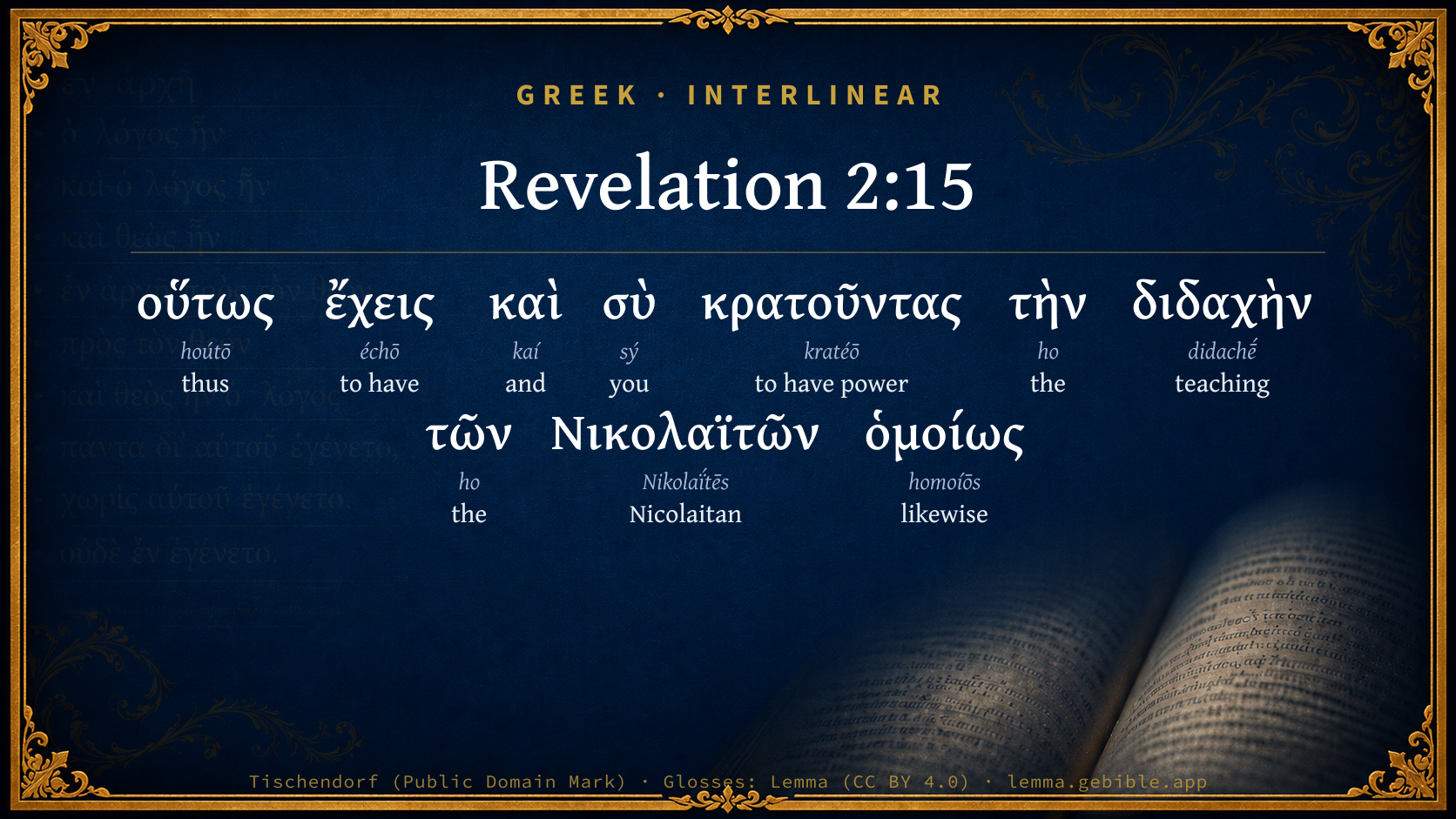
Greek (Tischendorf 8th ed.) Revelation 2:15 appears in the Greek New Testament. The text above is from the Tischendorf 8th edition. Each word links to its Strong’s number and a concise gloss. Click any word for its full Thayer’s Greek Lexicon entry.
Download image
Cite this verse

Revelation 2:15 (World English Bible). Public Domain. Lemma interlinear Bible study tool, https://lemma.gebible.app/v/revelation/2/15.

Show BibTeX & RIS
BibTeX
RIS
English Translation
So you also have some who hold to the teaching of the Nicolaitans likewise.
World English Bible · Public Domain
Download a study sheet

One document with this verse’s original text, its word-by-word gloss line, the meaning frame, cross-references with their text, attributed commentary, and full source and license credits — printable, and it pastes into notes with its structure intact.

This verse Autodidact and up

Study sheet (.html) Plain text (.txt)

A passage Seminary Student

Up to 50 verses in one chapter. A passage sheet keeps up to 6 commentary sources and 12 cross-references per verse, in the order this page ranks them, and says so on the sheet whenever that leaves anything out. Ask for a single verse and you get the Autodidact verse sheet above.

Everything on this page stays free to read, with no account — the sheet is a download of what is already on screen, not access to it.

Want to remove ads? Support Godless Engineer
Compare translations 3

The same verse in 3 English versions, stacked beneath the original-language interlinear above. Click any original word for its lexicon entry.

Each is an independent rendering of the whole verse — the interlinear is not word-aligned to these translations.

Highlighted words mark where these versions differ — a whole-verse word diff, not a word-by-word alignment.

  • World English Bible Public Domain
    So you also have some who hold to the teaching of the Nicolaitans likewise.
  • King James Version Public Domain
    So hast thou also them that hold the doctrine of the Nicolaitanes, which thing I hate.
  • unfoldingWord Literal Text CC BY-SA 4.0
    Thus you also have ones holding the teaching of the Nicolaitans similarly.

unfoldingWord Literal Text — © unfoldingWord, licensed CC BY-SA 4.0. Word-aligned USFM3 via Door43 (git.door43.org/unfoldingWord/en_ult).

Versions to compare (up to 4)

3 of 4 selected

Show all 19 translations

Every available English version of this verse, each an independent rendering of the whole verse.

  • World English Bible Public Domain
    So you also have some who hold to the teaching of the Nicolaitans likewise.
  • Berean Standard Bible Public Domain
    In the same way, some of you also hold to the teaching of the Nicolaitans.
  • Majority Standard Bible Public Domain
    In the same way, some of you also hold to the teaching of the Nicolaitans.
  • King James Version Public Domain
    So hast thou also them that hold the doctrine of the Nicolaitanes, which thing I hate.
  • American Standard Version (1901) Public Domain
    So hast thou also some that hold the teaching of the Nicolaitans in like manner.
  • Revised Version (1885) Public Domain
    So hast thou also some that hold the teaching of the Nicolaitans in like manner.
  • Geneva Bible (1599) Public Domain
    Euen so hast thou them, that maintaine the doctrine of the Nicolaitanes, which thing I hate.
  • Douay-Rheims (1899) Public Domain
    So hast thou also them that hold the doctrine of the Nicolaites.
  • Young's Literal Translation Public Domain
    so hast thou, even thou, those holding the teaching of the Nicolaitans -- which thing I hate.
  • Literal Standard Version CC BY-SA 4.0
    so have you, even you, those holding the teaching of the Nicolaitans—which thing I hate.
  • Unlocked Literal Bible CC BY-SA 4.0
    In the same way, you even have some who hold tightly to the teaching of the Nicolaitans.
  • unfoldingWord Literal Text CC BY-SA 4.0
    Thus you also have ones holding the teaching of the Nicolaitans similarly.
  • Darby Bible Public Domain
    So thou also hast those who hold the doctrine of Nicolaitanes in like manner.
  • World Messianic Bible Public Domain
    So also you likewise have some who hold to the teaching of the Nicolaitans.
  • Webster's Bible Public Domain
    So hast thou also them that hold the doctrine of the Nicolaitans, which thing I hate.
  • Free Bible Version CC BY-SA 4.0
    Similarly you also have some who hold to the teaching of the Nicolaitans.
  • Bible in Basic English Public Domain
    And you have those who keep the teaching of the Nicolaitans.
  • Text-Critical English NT CC BY 4.0
    In the same way, yoʋ also have some who hold to the teaching of the Nicolaitans.
  • Tyndale New Testament (1534) Public Domain
    Even so hast thou them that mayntayne the doctryne of the Nicolaytans which thynge I hate.

Literal Standard Version (2020), Covenant Press — licensed CC BY-SA 4.0. Text via the HelloAO Bible API (eBible.org). Unlocked Literal Bible (unfoldingWord) — licensed CC BY-SA 4.0. Text via the HelloAO Bible API (eBible.org). unfoldingWord Literal Text — © unfoldingWord, licensed CC BY-SA 4.0. Word-aligned USFM3 via Door43 (git.door43.org/unfoldingWord/en_ult). Free Bible Version, Dr. Jonathan Gallagher — licensed CC BY-SA 4.0. Text via the HelloAO Bible API (eBible.org).

Word by word

More ways to search: Search by grammar → Find every occurrence → Compare this word →

Practice this passage: Drill this verse → Learn its vocabulary →

About this verse

These counts appear in no published source. They are computed here, from the morphology-tagged text and Lemma’s own curated glosses. What Lemma adds →

10
words
9
distinct lemmas
Revelation
section

Notable vocabulary

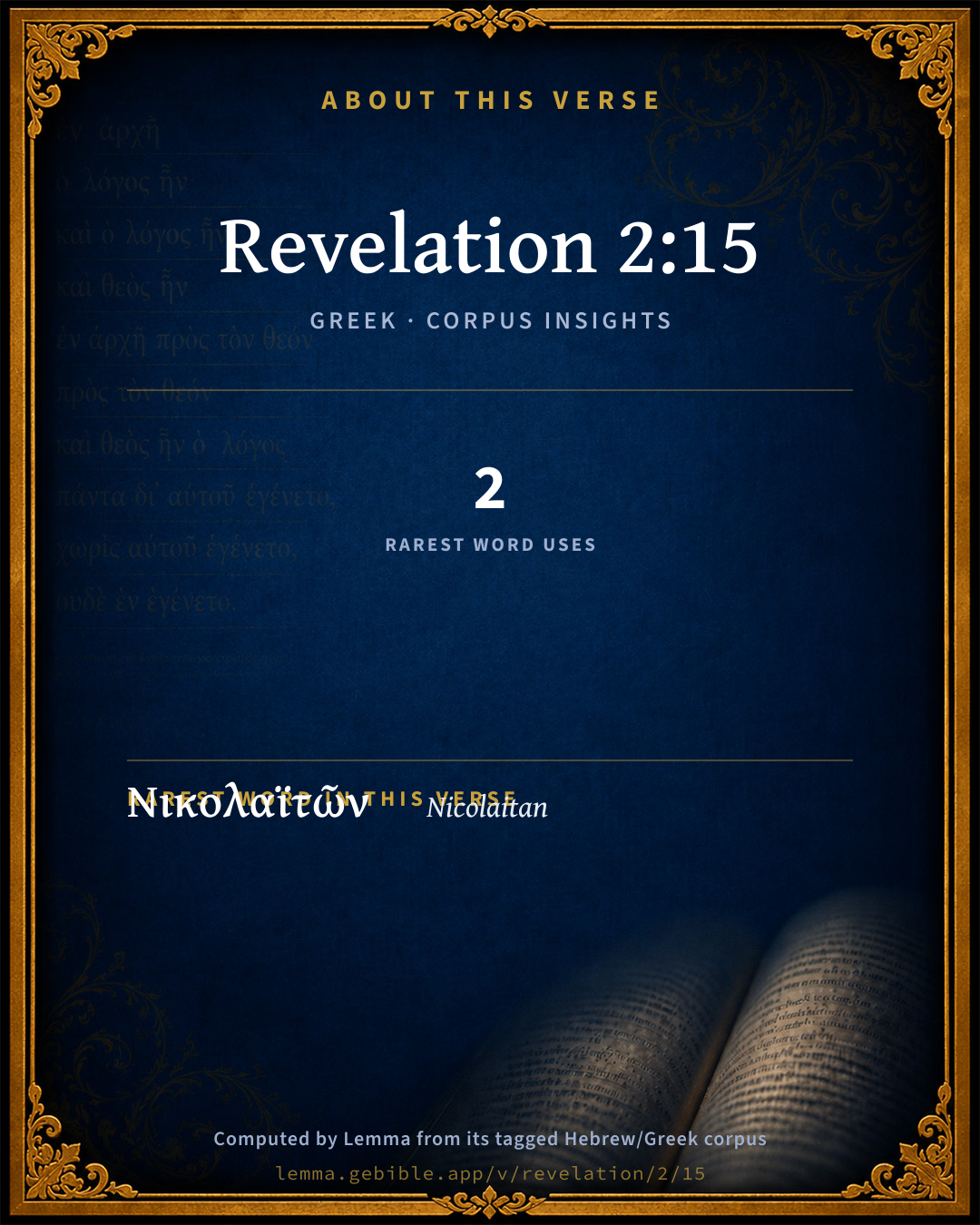
The rarest word here is Νικολαϊτῶν Nicolaitan G3531 — appearing just 2 times in the whole Greek New Testament.

Shared distinctive vocabulary

Νικολαϊτῶν Nicolaitan G3531 occurs in 2 verses of the Greek New Testament. Also found in:

Repetition

A word recurs within this verse:

Cross-references

1

Topical passages linked to Revelation 2:15 in the Treasury of Scripture Knowledge — connected by theme and wording, ordered by reader-vote popularity; previews shown in the World English Bible.

  • Revelation 2:6 But this you have, that you hate the works of the Nicolaitans, which I also hate.

Cross-references courtesy of OpenBible.info (CC BY 4.0).

Where the printed editions differ

1 variant

Places in this verse where the major printed Greek editions disagree on the wording in a way that affects the translation — a comparison of editions, not a manuscript-by-manuscript collation. The editions are the modern critical texts (Nestlé-Aland 28/27, SBL, Westcott-Hort, Tregelles, Tyndale House) and the traditional texts behind the KJV (the Textus Receptus and the Byzantine/Majority text). It is not a claim about which reading is original.

  1. Different wording
    ὁμοίως.

    “likewise.”

    In NA28NA27TynSBLWHTregByz Not in TR

    ὅ μισῶ (ho misō) 'who I hate' occurs in traditional manuscripts (TR) instead of ὁμοίως. (homoiōs) 'likewise.' in older manuscripts (NA28+NA27+Tyn+SBL+WH+Treg+Byz)

Textual data: Translators Amalgamated Greek New Testament (STEPBible TAGNT) · CC BY 4.0.

Commentary

Notes on Revelation 2:15 from classic Christian and Jewish commentators (each source and its license shown beneath its notes). The classic Christian expositions comment on the surrounding passage and are grouped to its opening verse, so a note may address several verses; the Jewish commentaries on the Tanakh (Rashi and others) are per-verse, so they appear only where the commentator wrote on this verse.

Lemma curates 59 commentaries, every one of them public domain or Creative Commons licensed, each selected and text-cleaned for this edition rather than reprinted as found. About our sources →

Bengel's Gnomon

Johann Albrecht Bengel

Rev 2:15-16. Ὁμοίως μετανόησον οὖν) The angel at Pergamos is ordered to repent in like manner with the angel at Ephesus: καὶ, also, corresponds, Rev 2:15. The reading ὁμοίως, for which others have written ὅ μισῶ from Rev 2:6, is defended by almost all[34] the authorities. Yet οὖν, therefore, remains with great emphasis. Comp. Rev 2:5, ch. Rev 3:3; Rev 3:19.

[34] This reading therefore (ὁμοίως) is preferred in the margin of Ed. 2 and Vers. Germ., otherwise than is the case in the greater Edition.—E. B.

ABC Vulg. Memph. Syr. read ὁμοίως: Rec. Text, ὃ μισῶ, without good authority.—E.

Bengel's Gnomon of the New Testament — English translation (T&T Clark, Edinburgh, 1860) — public domain. Text from a community e-Sword module.

Expositor's Greek Testament

ed. W. Robertson Nicoll

Rev 2:15 . οὕτως κ . τ . λ . Are the N. put parallel to, or identified with, the Balaamites? The latter becomes more probable when the symbolical sense of N. and B [902] (see above, on Rev 2:6 , and Kalisch’s Bible Studies , i. 23) is adopted. In this event a single class of errorists is in view; they are instigating and seducing the local Christians much as Balaam managed (by means of Balak, in rabbinic tradition, cf. the slight play on βαλεῖν ) to get the Israelites enticed to ruin ( Sanh. 105 a). Josephus explains that Balaam showed Balak how to win a victory over the Israelites ( νίκην τινὰ … κατʼ αὐτῶν κερδᾶναι ) by enticing them to lust, and such a symbolic allusion is quite in the manner of the Apocalypse. The Niko-laitans, who probably resembled Cerinthus or Carpokrates in their tenets, are no better than a Balaam. And the Jewish dictum was ( Sanh. 106 b) that whenever one discovered anything bad in Balaam’s life, one should preach about it.

[902]. Codex Vaticanus (sæc. iv.), published in photographic facsimile in 1889 under the care of the Abbate Cozza-Luzi.

The Expositor's Greek Testament, edited by W. Robertson Nicoll (1897–1910) — public domain. Text from a community e-Sword module.

Geneva Bible (1599)

Geneva Bible translators

Which follow the footsteps of Balaam, and such as are abandoned unto all filthiness, as he showed in the verse foregoing, and is here signified by a note of similitude. And thus also must the next verse be understood. For this matter especially Ireneus must be consulted withal.

Geneva Bible (1599) marginal notes — public domain. Text via Bolls.life.

Jamieson, Fausset & Brown

Robert Jamieson, A. R. Fausset & David Brown

thou--emphatic: "So THOU also hast," As Balak and the Moabites of old had Balaam and his followers literally, so hast thou also them that hold the same Balaamite or Nicolaitane doctrine spiritually or symbolically. Literal eating of idol-meats and fornication in Pergamos were accompanied by spiritual idolatry and fornication. So TRENCH explains. But I prefer taking it, "THOU also," as well as Ephesus ("in like manner" as Ephesus; see below the oldest reading), hast . . . Nicolaitanes, with this important difference, Ephesus, as a Church, hates them and casts them out, but thou "hast them," namely, in the Church.

doctrine--teaching (see on Rev 2:6): namely, to tempt God's people to idolatry.

which thing I hate--It is sin not to hate what God hates. The Ephesian Church (Rev 2:6) had this point of superiority to Pergamos. But the three oldest manuscripts, and Vulgate and Syriac, read instead of "which I hate," "IN LIKE MANNER."

Jamieson, Fausset & Brown — Commentary Critical and Explanatory on the Whole Bible (1871) — public domain (CC PDM 1.0). Text via the HelloAO Bible API.

Adam Clarke's Commentary

Verse 15. The doctrine of the Nicolaitanes] See Clarke on Re 2:6.

Adam Clarke's Commentary on the Bible (1810–1826) — public domain. Text from a community e-Sword/MySword module.

Ellicott's Commentary for English Readers

(15) So hast thou also them that hold the doctrine of the Nicolaitanes—i.e., thou, as well as those of old, hast such teachers. There is little doubt that this is the connection between the verses, but opinions are divided whether we are on this account to identify the Balaamites with the Nicolaitanes, and to suppose that both names point to the same sect. The simplest meaning of the passage seems to be that the temptation to which the Israelites were exposed, is used to illustrate the temptations of the Pergamene Church, through the teaching of the Nicolaitanes. Both temptations lead in the same Antinomian direction. Such a tendency was early seen (comp. Rom_6:4; Gal_5:13; Jud_1:4), and is not extinct now. “Is there not,” writes Dr. Vaughan, “a vague, unavowed, unrealised idea that the Atonement has made sin less fatal, that even sin indulged and persisted in, may yet not work death?” To such and all who countenance them the warning is, “Repent; but if not, I am coming for thee, and will war with thee (note the change of person and number) with (literally, in—i.e., armed with) the sword of My mouth.”

A Bible Commentary for English Readers, edited by Charles John Ellicott (1878–1897) — public domain. Text from a community e-Sword module.

The Cambridge Bible for Schools and Colleges

gen. ed. J. J. S. Perowne

15. thou also] As well as Israel of old.

which thing I hate] Instead of these words read in like manner. This correction makes it certain that we are not to suppose two immoral sects prevailing at Pergamum, those who held the doctrine of Balaam and those who held that of the Nicolaitans: but one sect holding the doctrine taught by Balaam of old and the Nicolaitans now. The sense is, “thou hast with thee followers of Balaam: he taught God’s people to fornicate and to communicate in idol-worship, and the Nicolaitans with thee teach the same.” The passage gives no support to the theory that the Nicolaitans were so called from Balaam;—the etymology of whose name is doubtful, but according to a possible one Nicolaus (“conqueror of the people”) might be an approximate Greek equivalent to it. If not called after Nicolas the deacon, they no doubt were called after another Nicolas—as we hear from a tradition or conjecture, later than the one which traces them to him.

The Cambridge Bible for Schools and Colleges (gen. ed. J. J. S. Perowne; Cambridge University Press, 1878–1918) — public domain. Text from a community e-Sword module.

John Gill's Exposition

So hast thou also them that hold the doctrine of the Nicolaitans,.... These impure heretics sprung up in the time of the apostolic church, but their doctrines were not received, and their deeds were hated, see Rev 2:6. This seems to design the doctrines of the church of Rome, which in this period took place; which forbid marriage to the priests, and recommended celibacy and virginity to others also; which were the source of all uncleanness and abominable lusts; for which pardons and indulgences were given, and, in process of time, brothel houses were set up, and licensed and encouraged by authority,

Which thing I hate; the doctrine of these men, as well as their deeds.

John Gill's Exposition of the Whole Bible (1746–1763) — public domain (CC PDM 1.0). Text via the HelloAO Bible API.

Trapp's Complete Commentary

John Trapp

15 So hast thou also them that hold the doctrine of the Nicolaitans, which thing I hate.

Ver. 15. The doctrine of the Nicolaitans] {See Trapp on "Rev 2:6"} In the year 1067, the popish synod of Milan made laws against simony {a} and the heresy of the Nicolaitans; by which latter they meant priest’s marriage. Brutum fulmen, novum crimen. Heavy blow, new sins.

{a} The act or practice of buying or selling ecclesiastical preferments, benefices, or emoluments; traffic in sacred things. ŒD

John Trapp, A Commentary or Exposition upon All the Books of the Old and New Testament (1647–1656) — public domain. Text from a community e-Sword module.

Albert Barnes' Notes on the Bible

So hast thou also them ... - That is, there are those among you who hold those doctrines. The meaning here may be, either that, in addition to those who held the doctrine of Balaam, they had also another class who held the doctrine of the Nicolaitanes; or that the Nicolaitanes held the same doctrine, and taught the same thing as Balaam. If but one class is referred to, and it is meant that the Nicolaitanes held the doctrines of Balaam, then we know what constituted their teaching; if two classes of false teachers are referred to, then we have no means of knowing what was the uniqueness of the teaching of the Nicolaitanes. The more natural and obvious construction, it seems to me, is to suppose that the speaker means to say that the Nicolaitanes taught the same things which Balaam did - to wit, that they led the people into corrupt and licentious practices. This interpretation seems to be demanded by the proper use of the word “so” - οὕτως houtōs - meaning, “in this manner on this wise, thus”; and usually referring to what precedes. If this be the correct interpretation, then we have, in fact, a description of what the Nicolaitanes held, agreeing with all the accounts given of them by the ancient fathers. See the notes on Rev 2:6. If this is so, also, then it is clear that the same kind of doctrines was held at Smyrna, at Pergamos, and at Thyatira Rev 2:20, though mentioned in somewhat different forms. It is not quite certain, however, that this is the correct interpretation, or that the writer does not mean to say that, in addition to those who held the doctrine of Balaam, they had also another class of errorists who held the doctrine of the Nicolaitanes.

Which thing I hate - So the common Greek text - ὅ μισῶ ho misō. But the best-supported reading, and the one adopted by Griesbach, Tittmann, and Hahn, is ὁμοίως homoiōs - “in like manner”; that is, “as Balak retained a false prophet who misled the Hebrews, so thou retainest those who teach things like to those which Balaam taught.”

Albert Barnes' Notes on the Bible (1834–1885) — public domain. Text from a community e-Sword/MySword module.

Matthew Poole's English Annotations

So hast thou also them that hold the doctrine of the Nicolaitanes; so, saith he, thou sufferest in thy communion filthy persons, who maintain fornication lawful, and the lawfulness of eating meat offered to idols, which exactly corresponds with Balaam’s doctrine or counsel given to Balak, in order to his weakening the Israelites by separating them from God. His counsel took place, to the destruction of twenty-four thousand Israelites.

Which thing I hate; I am the same God still, and hate such doctrines, as much as ever I did in the time of Balak.

Matthew Poole's English Annotations on the Holy Bible (1683–1685) — public domain. Text from a community e-Sword/MySword module.

Whedon's Commentary on the Bible

Daniel D. Whedon

15. So hast thou also—Observe that the Nicolaitans are different from, and additional to, the holders of the teachings of Balaam, and not identical. They very much agreed in the ultimate of licentiousness they reached, but from different historical and doctrinal starting points. The doctrines of Balaam were a remnant of the old Canaanite or Phoenician Baalism, and were Shemitic; that of the Nicolaitans was Aryan, derived from India, and based on the dogma of the residence of all evil in matter. See notes on Act_6:5, Jud_1:11, and Introduction to John’s Epistles. The active existence of these heretics at the time of the writing of this book proves it later than the reign of Nero.

Daniel D. Whedon (gen. ed.), Commentary on the Old and New Testaments (1874–1909) — public domain. Text from a community e-Sword module.

The Pulpit Commentary

So hast thou also some that hold. As in vers. 13 and 14 "hold" is kratein with the accusative (see notes on ver. 13). What does "also" mean? Probably, "As Israel had Balak to seduce them, and Balak had Balaam, so hast thou," etc.). Others take it, "As the Church at Ephesus has Nicolaitans, so hast thou." The reading of the Authorized Version, "which thing I hate," must certainly yield to that of the Revised Version, "in like manner," which is supported by all the best manuscripts and versions. In the Greek there is much similarity between the two readings, OMISW and OMOIWS . "In like manner" refers to the similarity between those who hold the doctrine of the Nicolaitans, and those who hold the doctrine of Balaam. It confirms the view that two sects are meant.

The Pulpit Commentary (1880–1919), ed. H.D.M. Spence-Jones & Joseph S. Exell — public domain. Text from a community e-Sword module.

John Wesley's Explanatory Notes

In like manner thou also - As well as the angel at Ephesus. Hast them that hold the doctrine of the Nicolaitans - And thou sufferest them to remain in the flock.

John Wesley, Explanatory Notes Upon the Whole Bible (1754–1765) — public domain. Text via the GEBible commentary corpus.

The People's New Testament

B. W. Johnson

15. So hast thou also them, etc. For Nicolaitanes. See note on verse 6 above.

B. W. Johnson's The People's New Testament with Notes (1889–1891) — public domain. Electronic text from the Christian Classics Ethereal Library (CCEL) ThML edition.

Cambridge Greek Testament for Schools and Colleges

15. ὁμοίως. P adds, 1 and Text. Rec[98] substitute, ὃ μισῶ.

[98] Rec. Textus Receptus as printed by Scrivener.

15. καὶ σύ. As well as Israel of old.

ὁμοίως. “In like manner” (see critical note). This makes it certain that we are not to suppose two immoral sects prevailing at Pergamum. those who held the doctrine of Balaam and those who held that of the Nicolaitans: but one sect holding the doctrine taught by Balaam of old and the Nicolaitans now. The sense is: “thou hast with thee followers of Balaam: he taught God’s people to fornicate and to communicate in idol-worship, and the Nicolaitans with thee teach the same.” The passage gives no support to the theory that the Nicolaitans were so called from Balaam; the etymology of the latter name is doubtful, but according to a possible one Nicolaus (“conqueror of the people”) might be an approximate Greek equivalent to it. If not called after Nicolas the deacon, they no doubt were called after another Nicolas—as we hear from a tradition or conjecture, later than the one which traces them to the deacon.

Cambridge Greek Testament for Schools and Colleges (Cambridge University Press, 1896; 21 vols, various authors incl. Carr, Maclear, Plummer, Farrar, Lumby, Moule, M. R. James, Simcox) — public domain. Text from a community e-Sword module.

Alford’s Greek Testament

Henry Alford

15.] Nevertheless I have against thee a few things (not “a little matter,” as Luth., Hengstb.; nor does ὀλίγα imply that more than one matter is blamed, as Beng.: nor is it used by litotes, to mean “graviter de te conqueror,” as Heinr. and Ebrard; nor is any reference to be thought of to the sins of Christ’s people having been removed by His atonement, and thus spoken of lightly by Him, as Aretius: but is used as a word of comparison with the far greater number of approved things which remained, and is plural, inasmuch as ὀλίγον would refer, not to the objective fewness, but to the subjective unimportance, of the grounds of complaint; which latter was not so. This use of the plural comes under the case treated by Winer (§ 27. 2), where only one thing is really meant, but the writer speaks of that one generically; e. g. τεθνήκασιν οἱ ζητοῦντες τὴν ψυχ. τοῦ παιδίου, Mat 2:20, where Herod only is meant. And so De Wette and Düsterd.): thou hast there (in Pergamum: the locality is specified probably on account of the description which has been just given of it as the place where a faithful martyr had suffered unto death) men holding (cf. κρατεῖς τὸ ὄν. μου above) the teaching of Balaam (διδαχήν: not simply as De W., “doctrine corresponding to the character of the advice of Balaam,” but used in strict correspondence with ὃς ἐδίδασκεν following: that which a man teaches being his doctrine. And κρατεῖν this διδαχήν, is to follow the teaching), who taught Balak (the dat. seems to be a Hebraism, לִמֵּד לִ, Job 21:22: so Ewald, De W., Ebrard, Düsterd.: not a dat. commodi, “for Balak” to serve his purpose, understanding “men” as an object after ἐδίδασκεν, as Hengstb. Certainly it is not expressly asserted in Num 31:16 that it was Balak whom Balaam advised to use this agency against Israel: but the narrative almost implies it: Balak was in power, and was the most likely person to authorize and put in force the scheme. And so Josephus, Antt. iv. 6. 6, makes Balaam on departing call to him τόν τε Βάλακον καὶ τοὺς ἄρχοντας τῶν Μαδιανιτῶν, and give them the advice) to put a stumbling-block (properly σκανδάληθρον: see reff., and a minute investigation of the word by Trench in loc.: an occasion of sin) before (in the way, or before the face of) the sons of Israel, to eat (i. e. inducing them to eat. See var. readd.) things offered to idols (from Num 25:1, Num 25:2, it was not only participation in things offered to idols, but the actual offering sacrifices to them, of which the children of Israel were guilty. But seeing that the participation was that which was common to both, our Lord takes that as the point to be brought forward: “satis hic habuit Christus id dicere, quod illi Israelitæ cum Nicolaitis habebant commune.” Grot.) and to commit fornication.

15.] Thus thou also hast (as well as those of old: not, as the Church at Ephesus, ver. 6 (De W.). “Sicut Balac tenuit doctrinam pestiferam Balaam, sic apud te sunt aliqui tenentes doctrinam Nicolai erroneam.” Lyra) men holding (see above) the teaching of the Nicolaitans (the art. though not expressed, is in fact, in this later usage, contained in the proper name) in like manner (viz. in eating things offered to idols, and fornication. We may remark, 1) that it is most according to the sense of the passage to understand these sins in the case of the Nicolaitans, as in that of those whom Balaam tempted, literally, and not mystically. So , Andr., Areth., Ribera, Calov., Beng., Heinr. (doubtfully), Ewald, De W., Hengst., Ebrard, Düsterd., Trench, al.: 2) that the whole sense of the passage is against the idea of the identity of the Balaamites and the Nicolaitans; and would be in fact destroyed by it. The mere existence of the etymological relation is extremely doubtful (see above on ver. 6): and even granting it,—to suppose the two identical, would be to destroy the historical illustration by which the present existing sect is described).

Henry Alford, The Greek Testament (1849–1861) — public domain. Text from a community e-Sword module.

Vincent's Word Studies in the New Testament

Marvin R. Vincent

So. Even as Balak had Balaam for a false teacher, so hast thou the Nicolaitan teachers.

Nicolaitans. See on verse 6.

Which thing I hate. Omit.

Marvin R. Vincent, Word Studies in the New Testament (1887–1900) — public domain. Text from a community e-Sword/MySword module.

Lesson kit

Teaching starters — assembled from the data on this page, not authored interpretation. Every prompt links to the verse data it draws on. Edit before teaching.

Revelation, in the Revelation, opens this verse with 10 words (9 distinct Greek lemmas). Its most distinctive word is Nikolaḯtēs (“Nicolaitan”). A historical commentator’s framing appears above. Read the whole chapter for the surrounding context.

Discussion questions

  1. How does “Nicolaitan” (Nikolaḯtēs) shape what this verse is saying?
  2. How does Revelation 2:6, which shares the word «Nicolaitan», read alongside this verse?
  3. What does the repetition of “the” (2× in this one verse) do in this verse?
  4. These translations render this verse differently; the difference is in the English rendering, not the original. What questions does that raise?
  5. Compare how Bengel's Gnomon and Expositor's Greek Testament read this verse. Where do they agree or differ?

Things to notice

Reading settings

Reading text

Shown beneath each verse's original-language words.

Old Testament
Old Testament edition

Read the OT as the Masoretic Hebrew (MT) or the Greek Septuagint (LXX).

English shown for the Greek Septuagint (in the Hebrew ↔ Greek comparison).

Comparing translations? Open the Compare panel on any verse page to stack up to four side by side.