
Galatians 4:3

Greek (Tischendorf 8th ed.) Galatians 4:3 appears in the Greek New Testament. The text above is from the Tischendorf 8th edition. Each word links to its Strong’s number and a concise gloss. Click any word for its full Thayer’s Greek Lexicon entry.
Download image
Cite this verse

Galatians 4:3 (World English Bible). Public Domain. Lemma interlinear Bible study tool, https://lemma.gebible.app/v/galatians/4/3.

Show BibTeX & RIS
BibTeX
RIS
English Translation
So we also, when we were children, were held in bondage under the elements of the world.
World English Bible · Public Domain
Highlights
  • 1 first appearance in the Greek New Testament
Full analysis ↓
Download a study sheet

One document with this verse’s original text, its word-by-word gloss line, the meaning frame, cross-references with their text, attributed commentary, and full source and license credits — printable, and it pastes into notes with its structure intact.

This verse Autodidact and up

Study sheet (.html) Plain text (.txt)

A passage Seminary Student

Up to 50 verses in one chapter. A passage sheet keeps up to 6 commentary sources and 12 cross-references per verse, in the order this page ranks them, and says so on the sheet whenever that leaves anything out. Ask for a single verse and you get the Autodidact verse sheet above.

Everything on this page stays free to read, with no account — the sheet is a download of what is already on screen, not access to it.

Want to remove ads? Support Godless Engineer
Compare translations 3

The same verse in 3 English versions, stacked beneath the original-language interlinear above. Click any original word for its lexicon entry.

Each is an independent rendering of the whole verse — the interlinear is not word-aligned to these translations.

Highlighted words mark where these versions differ — a whole-verse word diff, not a word-by-word alignment.

  • World English Bible Public Domain
    So we also, when we were children, were held in bondage under the elements of the world.
  • King James Version Public Domain
    Even so we, when we were children, were in bondage under the elements of the world:
  • unfoldingWord Literal Text CC BY-SA 4.0
    So also, when we were children, we were being enslaved under the elemental principles of the world.

unfoldingWord Literal Text — © unfoldingWord, licensed CC BY-SA 4.0. Word-aligned USFM3 via Door43 (git.door43.org/unfoldingWord/en_ult).

Versions to compare (up to 4)

3 of 4 selected

Show all 19 translations

Every available English version of this verse, each an independent rendering of the whole verse.

  • World English Bible Public Domain
    So we also, when we were children, were held in bondage under the elements of the world.
  • Berean Standard Bible Public Domain
    So also, when we were children, we were enslaved under the basic principles of the world.
  • Majority Standard Bible Public Domain
    So also, when we were children, we were enslaved under the basic principles of the world.
  • King James Version Public Domain
    Even so we, when we were children, were in bondage under the elements of the world:
  • American Standard Version (1901) Public Domain
    So we also, when we were children, were held in bondage under the rudiments of the world:
  • Revised Version (1885) Public Domain
    So we also, when we were children, were held in bondage under the rudiments of the world:
  • Geneva Bible (1599) Public Domain
    Euen so, we when wee were children, were in bondage vnder the rudiments of the world.
  • Douay-Rheims (1899) Public Domain
    So we also, when we were children, were serving under the elements of the world.
  • Young's Literal Translation Public Domain
    so also we, when we were babes, under the elements of the world were in servitude,
  • Literal Standard Version CC BY-SA 4.0
    so we also, when we were children, were in servitude under the elements of the world,
  • Unlocked Literal Bible CC BY-SA 4.0
    So also, when we were children, we were enslaved to the elemental principles of the world.
  • unfoldingWord Literal Text CC BY-SA 4.0
    So also, when we were children, we were being enslaved under the elemental principles of the world.
  • Darby Bible Public Domain
    So we also, when we were children, were held in bondage under the principles of the world;
  • World Messianic Bible Public Domain
    So we also, when we were children, were held in bondage under the elemental principles of the world.
  • Webster's Bible Public Domain
    Even so we, when we were children, were in bondage under the elements of the world:
  • Free Bible Version CC BY-SA 4.0
    It's just the same for us. When we were children, we were slaves subject to the basic rules of the law.
  • Bible in Basic English Public Domain
    So we, when we were young, were kept under the first rules of the world;
  • Text-Critical English NT CC BY 4.0
    In the same way also, when we were children, we were enslaved to the elements of the world.
  • Tyndale New Testament (1534) Public Domain
    Even so we as longe as we were chyldren were in bondage vnder the ordinaunces of the worlde.

Literal Standard Version (2020), Covenant Press — licensed CC BY-SA 4.0. Text via the HelloAO Bible API (eBible.org). Unlocked Literal Bible (unfoldingWord) — licensed CC BY-SA 4.0. Text via the HelloAO Bible API (eBible.org). unfoldingWord Literal Text — © unfoldingWord, licensed CC BY-SA 4.0. Word-aligned USFM3 via Door43 (git.door43.org/unfoldingWord/en_ult). Free Bible Version, Dr. Jonathan Gallagher — licensed CC BY-SA 4.0. Text via the HelloAO Bible API (eBible.org).

Word by word

More ways to search: Search by grammar → Find every occurrence → Compare this word →

Practice this passage: Drill this verse → Learn its vocabulary →

στοιχεῖα
stoicheîon
G4747
“element”
Noun, Accusative, Plural, Neuter
Part of Speech
Noun
Case
Accusative
Number
Plural
Gender
Neuter
Full Thayer's Definition

Origin: from a presumed derivative of the base of G4748

TDNT: 18:10,1

1. any first thing, from which the others belonging to some series or composite whole take their rise, an element, first principal a. the letters of the alphabet as the elements of speech, not however the written characters, but the spoken sounds b. the elements from which all things have come, the material causes of the universe c. the heavenly bodies, either as parts of the heavens or (as others think) because in them the elements of man, life and destiny were supposed to reside d. the elements, rudiments, primary and fundamental principles of any art, science, or discipline 1. i.e. of mathematics, Euclid's geometry
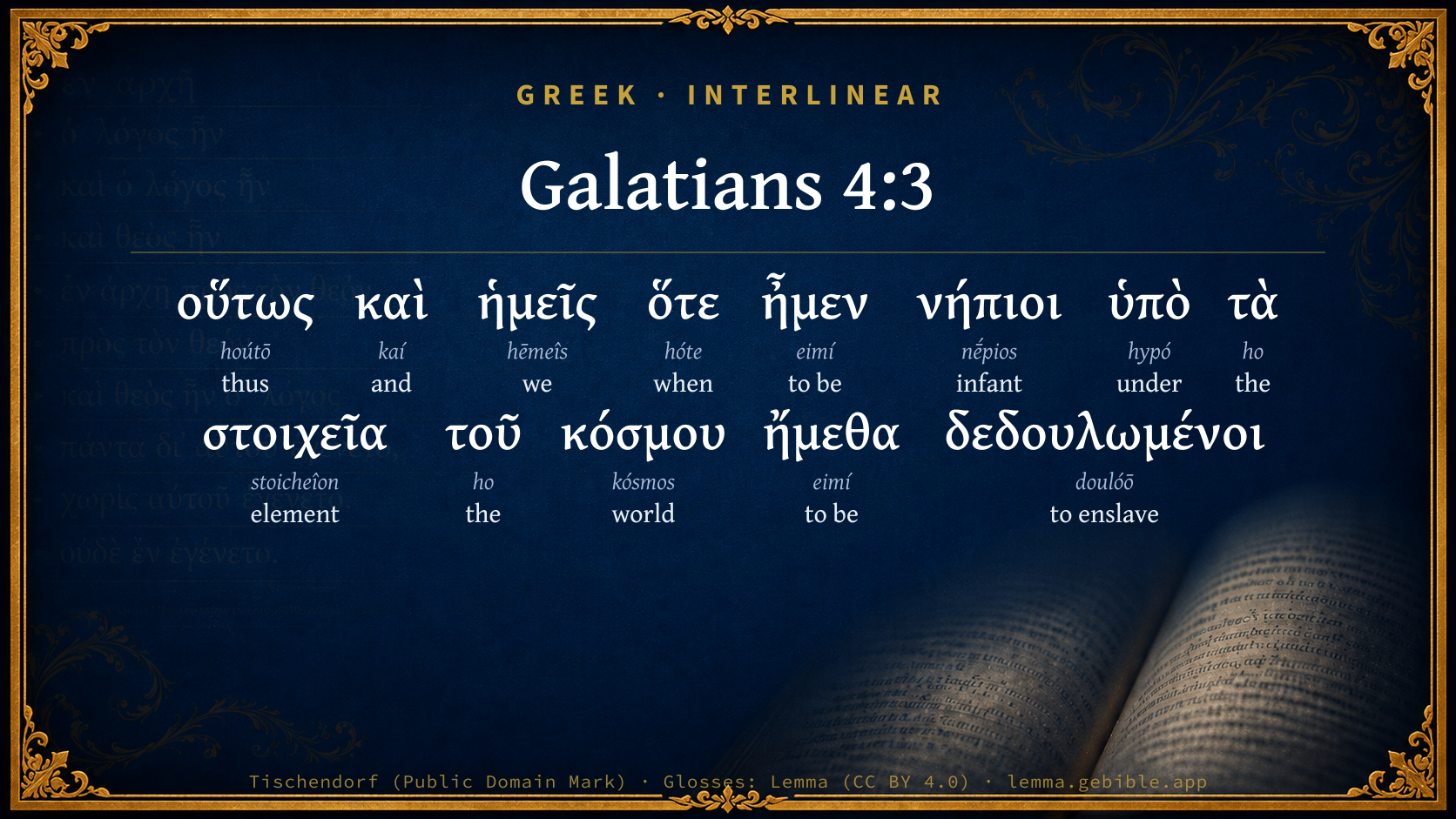
  1. οὕτως hoútō G3779 “thus” Adverb
  2. καὶ kaí G2532 “and” Conjunction
  3. ἡμεῖς hēmeîs G2249 “we” Personal pronoun, 1st person, Nominative, Plural
  4. ὅτε hóte G3753 “when” Adverb
  5. ἦμεν eimí G1510 “to be” Verb, Imperfect, Active, Indicative, 1st person, Plural
  6. νήπιοι nḗpios G3516 “infant” Adjective, Nominative, Plural, Masculine
  7. ὑπὸ hypó G5259 “under” Preposition
  8. τὰ ho G3588 “the” Article, Accusative, Plural, Neuter
  9. τοῦ ho G3588 “the” Article, Genitive, Singular, Masculine
  10. κόσμου kósmos G2889 “world” Noun, Genitive, Singular, Masculine
  11. ἤμεθα eimí G1510 “to be” Verb, Imperfect, Middle, Indicative, 1st person, Plural
  12. δεδουλωμένοι doulóō G1402 “to enslave” Verb, Perfect, Passive, Participle, Nominative, Plural, Masculine

About this verse

These counts appear in no published source. They are computed here, from the morphology-tagged text and Lemma’s own curated glosses. What Lemma adds →

13
words
11
distinct lemmas
Pauline Epistles
section

Notable vocabulary

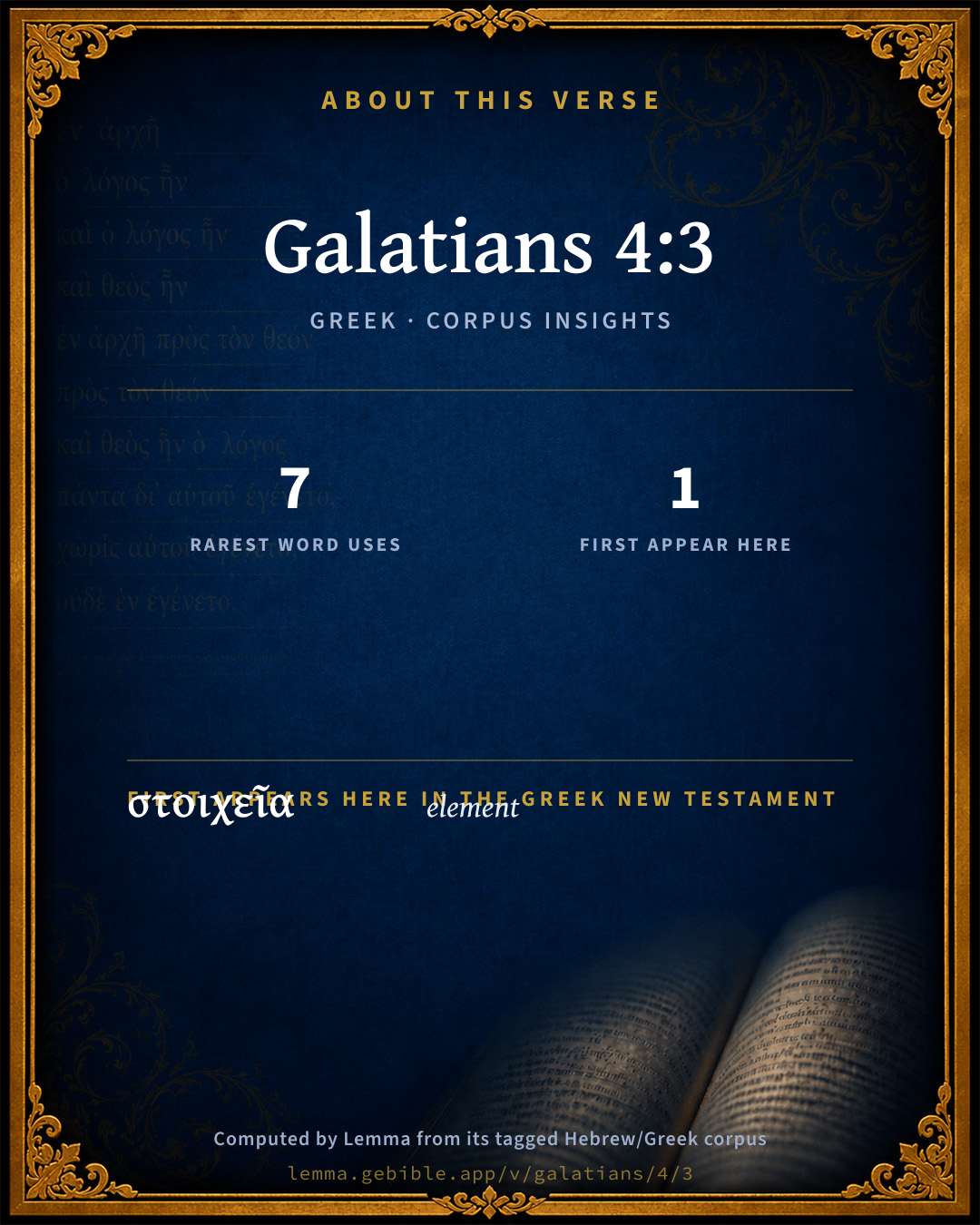
The rarest word here is στοιχεῖα element G4747 — appearing just 7 times in the whole Greek New Testament.

First appearance in Scripture

This word makes its first canonical appearance in the Greek New Testament here:

  • στοιχεῖα element G4747

Shared distinctive vocabulary

στοιχεῖα element G4747 occurs in 7 verses of the Greek New Testament. Also found in:
Repetition

Words recur within this verse:

Cross-references

13

Topical passages linked to Galatians 4:3 in the Treasury of Scripture Knowledge — connected by theme and wording, ordered by reader-vote popularity; previews shown in the World English Bible.

  • Colossians 2:8 Be careful that you don't let anyone rob you through his philosophy and vain deceit, after the tradition of men, after the elements of the world, and not after Christ.
  • Colossians 2:20 If you died with Christ from the elements of the world, why, as though living in the world, do you subject yourselves to ordinances,
  • Galatians 4:9 But now that you have come to know God, or rather to be known by God, why do you turn back again to the weak and miserable elements, to which you desire to be in bondage all over again?
  • Galatians 2:4 This was because of the false brothers secretly brought in, who stole in to spy out our liberty which we have in Christ Jesus, that they might bring us into bondage;
  • Galatians 4:31–5:1 So then, brothers, we are not children of a handmaid, but of the free woman.
  • Acts 15:10 Now therefore why do you tempt God, that you should put a yoke on the neck of the disciples which neither our fathers nor we were able to bear?
  • Romans 8:15 For you didn't receive the spirit of bondage again to fear, but you received the Spirit of adoption, by whom we cry, "Abba! Father!"
  • John 8:31 Jesus therefore said to those Jews who had believed him, "If you remain in my word, then you are truly my disciples.
  • Matthew 11:28 "Come to me, all you who labor and are heavily burdened, and I will give you rest.
  • Galatians 3:19 What then is the law? It was added because of transgressions, until the seed should come to whom the promise has been made. It was ordained through angels by the hand of a mediator.
  • Galatians 3:23–25 But before faith came, we were kept in custody under the law, shut up to the faith which should afterwards be revealed.
  • Galatians 4:25 For this Hagar is Mount Sinai in Arabia, and answers to the Jerusalem that exists now, for she is in bondage with her children.
  • Hebrews 7:16 who has been made, not after the law of a fleshly commandment, but after the power of an endless life:

Cross-references courtesy of OpenBible.info (CC BY 4.0).

Commentary

Notes on Galatians 4:3 from classic Christian and Jewish commentators (each source and its license shown beneath its notes). The classic Christian expositions comment on the surrounding passage and are grouped to its opening verse, so a note may address several verses; the Jewish commentaries on the Tanakh (Rashi and others) are per-verse, so they appear only where the commentator wrote on this verse.

Lemma curates 59 commentaries, every one of them public domain or Creative Commons licensed, each selected and text-cleaned for this edition rather than reprinted as found. About our sources →

Albert Barnes' Notes on the Bible

Even so we - We who were Jews - for so I think the word here is to be limited, and not extended to the pagan, as Bloomfield supposes. The reasons for limiting it are:

That the pagans in no sense sustained such a relation to the Law and promises of Gad as is here supposed; Such an interpretation would not be pertinent to the design of Paul. He is stating reasons why there should not be subjection to the laws of Moses, and his argument is, that that condition was like that of bondage or minorship.

When we were children - (νήπιοι nēpioi). Minors; see the note at Gal 4:1. The word is not υἱοι huioi, “sons;” but the idea is, that they were in a state of non-age; and though heirs, yet were under severe discipline and regimen. They were under a kind of government that was suited to that state, and not to the condition of those who had entered on their inheritance.

Were in bondage - In a state of servitude. Treated as servants or slaves.

Under the elements of the world - Margin, Rudiments. The word rendered “elements” (sing. στοιχεῖον stoicheion), properly means a row or series; a little step; a pin or peg, as the gnomen of a dial; and then anything “elementary,” as a sound, a letter. It then denotes the elements or rudiments of any kind of instruction, and in the New Testament is applied to the first lessons or principles of religion; Heb 5:12. It is applied to the elements or component parts of the physical world; 2Pe 3:10, 2Pe 3:12. Here the figure is kept up of the reference to the infant Gal 4:1, Gal 4:3; and the idea is, that lessons were taught under the Jewish system adapted to their nonage - to a state of childhood. They were treated as children under tutors and governors. The phrase “the elements of the world,” occurs also in Col 2:8, Col 2:20. In Gal 4:9, Paul speaks of these lessons as “beggarly elements,” referring to the same thing as here.

Different opinions have been held as to the reason why the Jewish institutions are here called “the elements of the world.” Rosenmuller supposes it was because many of those rites were common to the Jews and to the pagan - as they also had altars, sacrifices, temples, libations, etc. Doddridge supposes it was because those rites were adapted to the low conceptions of children, who were most affected with sensible objects, and have no taste for spiritual and heavenly things. Locke supposes it was because those institutions led them not beyond this world, or into the possession and taste of their heavenly inheritance. It is probable that there is allusion to the Jewish manner of speaking, so common in the Scriptures, where this world is opposed to the kingdom of God, and where it is spoken of as transient and worthless compared with the future glory. The world is fading, unsatisfactory, temporary. In allusion to this common use of the word, the Jewish institutions are called the wordly rudiments. It is not that they were in themselves evil - for that is not true; it is not that they were adapted to foster a worldly spirit - for that is not true; it is not that they had their origin from this world - for that is not true; nor is it from the fact that they resembled the institutions of the pagan world - for that is as little true; but it is, that, like the things of the world, they were transient, temporary, and of little value. They were unsatisfactory in their nature, and were soon to pass away, and to give place to a better system - as the things of this world are soon to give place to heaven.

Albert Barnes' Notes on the Bible (1834–1885) — public domain. Text from a community e-Sword/MySword module.

The Biblical Illustrator

Joseph S. Exell

Gal_4:3

Even so we, when we were children, were in bondage under the elements of the world.

The elements of this world

The law was so called.

I. In respect of the fuller and complete doctrine of the new testament.

II. Because Jewry was a little school set up in a corner of the world and the law an A.B.C. or primer in which Christ was revealed in an elementary and obscure manner. Thus we see--

1. That Gods ancient people were heirs as well as we: the only difference is the manner which God used in dispensing His blessings.

2. That they were but children in respect of us;

(1) as regards the Mosaic regimen: they were kept subject to more laws than we;

(2) as regards revelation: God has revealed more to us than to them (Luk_10:24; Heb_1:1-2).

3. That we should increase in the knowledge and grace of God so as to be answerable to our condition. How sad that a Christian who should be a teacher is often a babe (Heb_5:12).

4. That we should rejoice in and live conformably to our privilege as sons. (W. Perkins.)

Children cannot have presented to them pure intellectual conceptions

They must first learn the import of external signs. They must learn language and letters. They must put together syllables and words. They must see thought through the medium of form, or learn to think of what is moral and spiritual by facts, parables, pictures, or such like appeals to the imagination and the senses. For a time words to the young mind are things--stories are facts. By and by the inward meaning of what has been learned comes to be understood. The outward ultimately falls off or loses its primary aspect and uses; and the man, with his fully developed and perfected faculties, is in immediate contact with the abstract and the spiritual. He then feels as if he apprehended it, and could reason about it, or at least meditate upon it, without the aid of words and signs. When I was a child, etc. (1Co_12:11-13). Then I saw through a glass darkly--feeling after truth as reflected from a mirror, or presented in a parable; now I look upon it face to face. (T. Binney, D. D.)

All mankind, the whole race of Adam, were until the Incarnation of Christ as children

1. Because of their want of knowledge of God and the feebleness of their intellect in the things of God.

2. Because of their condition as under the laws of nature or of ceremonies, so that they were no better than servants under the control of a taskmaster.

But to the Jews especially does this word children apply--

1. As being ordinarily busied about small things, minute observances--the occupation of children.

2. Because of the littleness of their knowledge of Divine things.

3. Because of their fear of correction, their timidity as children, going ever in the fear of death (W. Denton, M. A.)

The minor

I. His position--one of restraint, subservience, dependence.

II. His training--suitable (v. 3), wise, appointed and limited by the Father.

III. His prospects--well grounded, magnificent, conditional. (J. Lyth.)

Childhood is a period of--

I. Subjection.

II. Instruction.

III. Anticipation. (J. Lyth.)

The Biblical Illustrator, edited by Joseph S. Exell (c. 1880s–1900s) — public domain. Text from a community e-Sword module.

Tyndale Open Study Notes

Tyndale Open Resources

4:3 Before Christ came, God’s people were like underage heirs to a large estate (4:1-2). They would inherit a great fortune (4:5), but they were still subject to their guardian (3:23-25). • the basic spiritual principles of this world: This probably refers to the principles of law that govern the world apart from Christ; these principles were fully expressed in the law of Moses (3:23-24; cp. 4:5).

Tyndale Open Study Notes — © Tyndale Open Resources, licensed CC BY-SA 4.0. Text via the HelloAO Bible API.

Bengel's Gnomon

Johann Albrecht Bengel

Gal 4:3. Ὑπὸ τὰ στοιχεῖα τοῦ κόσμου, under the elements of the world)—Στοιχεῖον, an element) A certain first principle, from which other things arise and are constituted; in the universe, 2Pe 3:10, see note: and in letters (learning), Heb 5:12 (comp. στοιχείωσις, respecting the child in the womb, 2Ma 7:22): thence by Metonymy, elements of the world in this passage, likewise weak and beggarly elements, presently, Gal 4:9, i.e. principles of living, which depend on times marked out by the motion of the elements, i.e. of the sun and moon; likewise principles which refer to meat, drink, and other sublunary matters, all these being only material and external objects, Gal 3:28.—Comp. Col 2:8; Col 2:16; Col 2:20, etc. They are called tutors in the concrete, elements in the abstract. The Son of God, sent down from heaven, and the Spirit of the Son of God, Gal 4:6, are opposed to these worldly things.—δεδουλωμένοι, reduced to slavery [in bondage]) This answers to, He differs nothing from a slave [servant], Gal 4:1.

Bengel's Gnomon of the New Testament — English translation (T&T Clark, Edinburgh, 1860) — public domain. Text from a community e-Sword module.

Meyer's Critical & Exegetical Commentary

Heinrich August Wilhelm Meyer

Gal_4:3. Ἡμεῖς] embraces Christians generally, the Jewish and Gentile Christians together. In favour of this view we may decisively urge, (1) the sense of στοιχεῖα τοῦ κόσμου (see below); (2) Gal_4:5, where the first ἵνα applies to the Jewish Christians, but the second, reverting to the first person, applies to Christians generally, because the address to the readers which follows in Gal_4:6 represents these as a whole, and not merely the Jewish Christians among them, as included in the preceding ἵνα τὴν υἱοθεσίαν ἀπολάβωμεν; lastly, (3) that the οὐκέτι and τότε, said of the Galatians in Gal_4:7-8, point back to the state of slavery of the ἡμεῖς in Gal_4:3. Therefore ἡμεῖς is not to be understood as referring either merely to the Jewish Christians (Chrysostom and most expositors, including Grotius, Estius, Morus, Flatt, Usteri, Schott, Baumgarten-Crusius, de Wette, Wieseler); oras Hofmann in consistency with his erroneous reference of Gal_3:29 to the Gentile readers holdsto the Old Testament church of God, which has now passed over into the New Testament church; or to the Jewish Christians pre-eminently (Koppe, Rückert, Matthies, Olshausen); or, lastly, even to the Gentile Christians alone (Augustine).

ὅτε ἦμεν νήπιοι] characterizes, in terms of the prevailing comparison, the pre-Christian condition, which, in relation to the Christian condition of the same persons, was their age of boyhood. Elsewhere Paul has represented the condition of the Christians before the Parousia, in comparison with their state after the Parousia, as a time of boyhood. See 1Co_13:11; Eph_4:13.

ὑπὸ τὰ στοιχεῖα τοῦ κόσμου ἦμεν δεδουλ.] corresponds, as application, to the οὐδὲν διαφέρει δούλου … ἀλλὰ ὑπὸ ἐπιτρόπους ἐστὶ καὶ οἰκον. The word στοιχεῖονwhich denotes primarily a stake or peg standing in a row, then a letter of the alphabet (Plat. Theaet. p. 202 E; Xen. Mem. ii. 1. 1; Arist. Poet. ii. 2; Lucian, Jud. voc. 12), then, like ἀρχή, element (see Rudolph on Ocell. p. 402 ff.)means here at all events element,[174] which signification has developed itself from the idea of a letter, inasmuch as a word is a series of the letters which form it (Walz, Rhetor. VI. p. 110). In itself, however, it might be used either in the physical sense of elementary substances, which Plato (Ruhnk. ad Tim. p. 283) calls also γένη (2Pe_3:10; 2Pe_3:12; Wis_7:17; Wis_19:18; 4Ma_12:13; Plat. Tim. p. 48 B, 56 B, Polit. p. 278 C; Philo, de Opif. m. p. 7, 11, Cherub. p. 162; Clem. Hom. x. 9), as it frequently occurs in Greek authors applied to the so-called four elements (comp. Suidas, s.v.), or in the intellectual sense of rudimenta, first principles (Heb_5:12; Plut. de pueror. educ. 16; Isocr. p. 18 A; Nicol. ap. Stob. xiv. 7. 31; see Wetstein). In the latter sense the verb στοιχειοῦν was used to signify the instruction given to catechumens; Constitt. ap. vi. 18. 1, vii. 25. 2. Comp. our expression the A, B, C of an art or science.[175] In the physical sensein which it is used by later Greek authors for designating the stars (Diog. L. vi. 102; Man. iv. 624; Eustath. Od. p. 1671, 53)it was understood by most of the Fathers: either as by Augustine (de civ. D. iv. 11), who thought of the Gentile adoration of the heavenly bodies and of other nature-worship; or as by Chrysostom, Theodoret, Ambrose, Pelagius, who referred it to the Jewish observance of new moons, feasts, and Sabbaths, which was regulated by the course of the moon and sun. So, combining the Gentile and Jewish cultus, Hilgenfeld, p. 66 (comp. in his Zeitschr. 1858, p. 99; 1866, p. 314), who ascribes to the apostle the heterogeneous idea of sidereal powers of heaven, that is, of the stars as powerful animated beings (comp. Baur and Holsten); and Caspari (in the Strassb. Beitr. 1854, p. 206 ff.), in whose view Paul is supposed to have placed Mosaism in the category of star and nature worship; and likewise Reithmayr, although without such extravagances. But because the expression does not apply either merely to the circumstances of the heathen, or merely to those of the Jewish, cultus (see, on the contrary, Gal_4:8-10),to the latter of which it is in the physical sense not at all suitable, for the Jewish celebrations of days and the like were by no means a star-worship or other (possibly unconscious) worship of nature, under which man would have been in bondage, but were an imperfect worship of Godand because the context suggests nothing else than the contrast between the imperfect and the perfect religion, as well as also on account of the correlation to νήπιοι, the physical sense of ΣΤΟΙΧΕῖΟΝ is altogether to be rejected.[176] Besides, it would be difficult to perceive why Paul, if he had thought of the stars, should not have written τοῦ οὐρανοῦ instead of τοῦ κόσμου. Hence Jerome (also τινές in Theophylact, and Gennadius in Oecumenius, p. 747 D), Erasmus, Castalio, Beza, Calvin, Grotius, and most of the later expositors, though with various modifications, have correctly adhered to the sense rudimenta disciplinae, which alone corresponds to the notion of the νηπιότης (for the age of childhood does not get beyond first prineiples). The στοιχεῖα τοῦ κόσμου are the elements of non-Christian humanity (κόσμος; see 1Co_6:2; 1Co_11:32, et al.), that is, the elementary things, the immature beginnings of religion, which occupy the minds of those who are still without the pale of Christianity. Not having attained to the perfect religion, the κόσμος has still to do with the religious elementary state, to which it is in bondage, as in the position of a servant. Rudiments of this sort are expressly mentioned in Gal_4:10; hence we must understand the expression, not in a onesided fashion as the elementary knowledge, the beginnings of religious perception in the non-Christian world (comp. Kienlen, in the Strassb. Beitr. II. p. 133 ff.)with which neither the idea of the relation as slavery, nor the inclusion of the Jewish and Gentile worships under one category would harmonizebut as the rudimenta ritualia, the ceremonial character of Judaism and heathenism,[177] with which, however, is also combined the corresponding imperfection of religious knowledge. Comp. Col_2:8; Col_2:20. Against the explanation, religious elementary things of the world, the objection has been made, that this idea is not suitable either to Judaism, in so far as the latter was a divine revelation, or even to heathenism, which, according to Paul, is something foreign to religion; see especially Neander. But the latter part of the objection is erroneous (Act_17:22-23); and the former part is disposed of, whenin the light of the pretensions put forth by the apostles opponents, which were chiefly based on the ceremonial side of the lawwe take into account the relative character of the idea rudimenta, according to which Judaism, when compared with Christianity as the absolute religion, may, although a divine institution, yet be included under the notion of στοιχεῖα, because destined only for the νήπιοι and serving a transitory propaedeutic purpose. Comp. Baur, Paulus, II. p. 222, ed. 2; Weiss, bibl. Theol. p. 289; also Ritschl, altkath. K. p. 73. Most of the older expositors, as also Olshausen, Baumgarten-Crusius, de Wette (with many various and mistaken interpretations of κόσμος; see Wolf and Rückert in loc.), have referred the expression merely to Judaism (the law as a means of training calculated only for the age of childhood, de Wette, who is followed by Wieseler), whilst Koppe and Schott only allow the analogous nature of ethnicism to be included incidentally; but, besides what has been above remarked on ἡμεῖς, these views are at variance with the idea of τοῦ κόσμου. This idea is, at all events, too wide to suit the law, which was given to the people of Israel only; whether it be taken as applying to mankind generally (de Wette, Wieseler), or to the unbelieving portion of mankind, in contrast to the ἅγιοι in a Christian sense.[178] Certainly it might appear unwise (see especially Wieseler) that Paul should have placed Judaism and heathenism in one category. But, in point of fact, he has to deal with Judaistic seductions occurring in churches chiefly Gentile-Christian: he might therefore, with the view of more effectually warning them and putting them to shame, so designate the condition of bondage to which by these seductions they were induced to revert, as to comprehend it in the same category with the heathen cultus, from the bondage of which they had been not long before liberated by Christianity. According to Hofmann, the στοιχεῖα τ. κόσμου are contrasted with the promise given to Abraham of the ΚΛΗΡΟΝΟΜΊΑ ΚΌΣΜΟΥ, Rom_4:13. He supposes that out of the destruction of the material elements of the present world (2Pe_3:10) the οἰκουμένη μέλλουσα (Heb_2:5) will arise, and that this will derive its nature and character from the Spirit, the communication of which is the beginning of the fulfilment of that promise. Israel, however, has been in bondage under the material elements of which the present world is composed, inasmuch as in what it did and what it left undone it was subject to stringent laws, which had reference to the world in its existing materiality; it had to conform itself to the things of this corporeal world, whilst the promise had been made to it that it should be lord of all things. Apart from the erroneous application of ἡμεῖς (see above), every essential point in this interpretation is gratuitously introduced. In particular, the contrast on which it is basednamely, that of the new world of the αἰών which is to comeis utterly foreign not only to the whole context, but even to the words themselves; for, if Paul had had this contrast in view, he must, in order not to leave his readers wholly without a hint of it, have at least added a ΤΟΎΤΟΥ (1Co_7:31; 1Co_1:20; 1Co_3:19; Eph_2:2) to ΤΟῦ ΚΌΣΜΟΥ.[179] It is, moreover, incorrect to discover in the στοιχεῖα the opposite of the future world, so far as the latter has its nature from the Spirit. The world of the αἰὼν μέλλων, as the new heaven and the new earth (2Pe_3:13), must likewise be corporeally material, and must have its στοιχεῖα, although the σχῆμα of the old world will have passed away (comp. on 1Co_7:31).

ἦμεν δεδουλωμ.] may be taken either together, or separately; the latter is to be preferred, because it corresponds more emphatically to the οὐδὲν διαφέρει δούλου (Gal_4:1) and the ὑπὸ ἐπιτρόπους ἐστι (in Gal_4:2): we were enslaved ones.

[174] A point on which almost all expositors agree. Yet Luther, 1519, following the precedent of Tertull. c. Marc. v. 4, adopted the signification of letters: pro ipsis literis legis, quibus lex constat.… Mundi autem vocat, quod sint de iis rebus, quae in mundo sunt. So also in 1524, and at least to a similar effect in 1538. More recently Michaelis has also explained it as letters; holding that the acts of the Levitical law were intended, because, taken as a whole, they had preached the gospel by anticipation. Similarly Nösselt, Opusc. II. p. 209, takes στοιχεῖα as signs (Arist. Eccl. 652, where it is used for the shadow of the plate on the sun-dial; comp. Lucian, Gall. 9, Cronos. 17), holding that the Jewish ceremonies are thus named because they prefigured the future Christian worship. These views are all erroneous, because the expression στοιχεῖα τ. κόσμου applies also to Gentile habits.

[175] Comp. generally, Schaubach, Commentat. quid στοιχεῖα τοῦ κόσμου in N.T. sibi velint, Meining. 1862.

[176] With strange arbitrariness Schulthess (Engelwelt, pp. 113, 129) has recently anticipated Hilgenfeld in re-asserting this sense; holding that the stars are meant, but that Paul is glancing at the Jewish ministry of angels (Job_38:7 (!)). More thoroughly Schneckenburger (in the theol. Jahrb. 1848, p. 445 ff.) has again defended the physical reference (elements of the visible world). Comp. Holsten, z. Ev. d. Paul. u. Petr. p. 323. In this interpretation the law must be excepted (as is done by Holsten) from the στοιχεῖα,an exception which is forbidden by the whole connection with ch. 3, and is also inconsistent with the concrete instances in vv. 8 and 10; see above. Neander alsowho, however, introduces the idea of the sensuous forms of religionwould retain the physical reference, which is decidedly assumed by Lipsius (Rechtfertigungsl. p. 83), who specially commends the interpretation of Hilgenfeld; whilst Messner (Lehre d. Ap. p. 226) agrees in substance with Neander, holding that δεδουλ. ὑπὸ τὰ στοιχεῖα τοῦ κόσμου is the dependence of the religious consciousness on the earthly, sensuous, perishable things, of which this earthly κόσμος, as to its fundamental elements, consists. But why, then, the restriction as to its fundamental elements? And the idea of perishableness is imported. Ewald understands by it the elements of the world, into the whole of which life must be brought through the spirit, and unity and meaning through God; it comprehends the Jewish observances as to meats and days, as well as the heathen star-worship. Yet how unsuited to popular apprehension (as pertaining to natural philosophy) would the whole expression thus be! an enigmatic designation for the heathen worship, and an unsuitable one for the Jewish cultus, which is based on divine precept. As to the way in which Hofmann understands the material elements of the world, see the sequel.

[177] Comp. Schaubach, l.c. p. 9 ff.

[178] Olshausen, feeling the difficulty which the idea of κόσμος puts in the way of the reference to Judaism, hits upon the arbitrary expedient of taking the expression to apply to the merely external and literal way of apprehending the O. T., which confines itself merely to the actions, without considering the idea involved in them. This was the procedure of the Judaists, and in this shape the Old Test. appeared not merely as the beginning of divine life, but also as given over to the world, etc.

[179] He does not add τούτου in Col_2:8; Col_2:20, just because the contrast suggested by Hofmann was far from his thoughts.

Meyer — Critical and Exegetical Commentary on the New Testament — English translation by Peter Christie, edited by Frederick Crombie (T&T Clark, 1880) — public domain. Text from a community e-Sword module.

Expositor's Greek Testament

ed. W. Robertson Nicoll

Gal 4:3 . νήπιοι : children, i.e. , spiritually children. The clause points to the stage of undeveloped spiritual life through which converts from heathenism had passed, the spiritual childhood which had been the lot of earlier generations before the time was ripe for the Advent. στοιχεῖα . The association of this word with νήπιοι fixes on it the conception of a rudimentary training to which the world was subjected during its spiritual infancy by way of preparation for the Gospel of Christ and the dispensation of the Spirit. Before men could enter into the spirit of His teaching, they had to learn the elementary principles of religion and morality. Compulsory obedience to definite rules of justice and order was a necessary preparation for the freedom of the Spirit. This preliminary education was given to the Hebrews in the Ten Commandments and the Law, it was imparted to a wider world in Greek civilisation and philosophy, in Roman law and government, and in other forms of national and social life. These rudiments are disparaged in Gal 4:9 as weak and beggarly in comparison with the teaching of the Spirit, for Christian men ought to have outgrown their spiritual childhood. So, again, in Col 2:8 ; Col 2:20 , they are condemned wherever their traditional hold on human society produces an antagonism to the higher teaching of Christ. But before the Advent they formed a valuable discipline for the education of the world.

The Expositor's Greek Testament, edited by W. Robertson Nicoll (1897–1910) — public domain. Text from a community e-Sword module.

International Critical Commentary

3. οὕτως καὶ ἡμεῖς, ὅτε ἦμεν νήπιοι, ὑπὸ τὰ στοιχεῖα τοῦ κόσμου ἤμεθα δεδουλωμένοι· “So also we, when we were children, were enslaved under the elements of the world.” ἡμεῖς is best understood as referring to Christians generally, the predicates of the sentence describing their pre-Christian condition. For, though the language of vv. 3-5 is specially appropriate to Jewish Christians and was probably written with them specially in mind, as that in v. 6 was probably written with the Gentile Galatians especially in mind, yet the use of the same or the equivalent expressions with reference to those who are included under the first person, ἡμεῖς, and those who are addressed (in the second person), together with the change in pronoun or the person of the verb when there is no antithesis but, on the contrary, continuity of reference is required by the argument, shows that these grammatical changes do not mark a substantial change of persons denoted. Cf. ἡμοῖς … δεδουλωμένοι of v. 3 with οὐκέτι εἶ δοῦλος of v. 6 (notice especially the implication of οὐκέτι that the persons addressed —the Galatians—had previously been in bondage), and observe that in v. 5 τοὺς ὑπὸ νόμον (third person) are evidently the same who constitute the subject of ὑπολάβωμεν, that in v. 6 ἡμῶν is used of those who are the subject of the verb ἐστέ, and that it is scarcely less clear from the nature of the argument that there is no real change of persons referred to (other than the change of emphasis above mentioned) in passing from v. 5 to v. 6. A comparison of ὑπὸ τὰ στοιχεῖα τοῦ κόσμου ἤμεθα δεδουλωμένοι of this verse with πῶς ἐπιστρέφετε πάλιν ἐπὶ τὰ … στοιχεῖα οἶς πάλιν ἄνωθεν δουλεύειν θέλετε of v. 9 points in the same direction, v. 9 clearly implying that the previous condition of the Galatians, as well as that to which they are now in danger of turning, was a bondage to the στοιχεῖα, while v. 8 as distinctly marks them as having previously been worshippers of idols, and 3:1-6 shows that they had come to faith in Christ not through judaism as proselytes, but directly from their worship of idols. On the bearing of the phrase ὑπὸ νόμον on the inclusiveness of ἡμεῖς, see on v. 4. For a change of person similar to that which takes place in passing from v. 5 to v. 6, cf. 3:26 and notes there. Jews and Gentiles are therefore classed together as being before the coming of Christ in the childhood of the race, and in bondage, and the knowledge of religion which the Jews possessed in the law is classed with that which the Gentiles possessed without it under the common title, “the elements of the world,” τὰ στοιχεῖα τοῦ κόσμου. On the meaning of this phrase, see detached note, p. 510. For a direct assertion of what is here implied as to the common standing of Jews and Gentiles as concerns possession of truth (but without reference to its inferiority to the Christian revelation), see Rom 2:14, Rom 2:15.

אD*F G 33, 442, 463 read ἤμεθα δεδουλ.; ABCDb et cKL. most cursives Clem. Chrys. Euthal. Thdrt. read ἦμεν. Despite the weightier external evidence for ἦμεν the strong improbability that for the common ἦμεν the unusual ἤμεθα would be substituted is decisive for the latter.

3. To interpret allegorically, i. e., to draw out the spiritual meaning supposed to underlie the words in their literal sense: Philo, Leg. alleg. III 238. (85): ἵνα … ἀλληγορῇς—“ποιεῖν τὰ ἔργα αὐτοῦ.” Origen, Cels. 1:17: αἰτιᾶται τοὺς τροπολογοῦντας καὶ ἀλληγοροῦντας αὐτήν. Philo, Vita contempl. 28 (3 a); Origen, Com. in Joan. 20:10. Cels. 1:18; 4:48; 4:87; 7:30; 8:68.

For ἀλληγορία in the sense “an allegory,” “a thing to be understood allegorically,” see Philo, Leg. alleg. III 236 (84).

The second of these meanings of the verb is excluded for the present passage by the fact that ἅτινα evidently refers either to the persons and events just named or to the statements concerning them, not to their spiritual significates, which have not yet been named; whereas this meaning occurs only in reference to the spiritual significates. If, then, we take into consideration the two remaining and for this passage only possible significations and the possible usages of the present participle in predicate, there result the following possible interpretations of ἐστιν ἀλλ., those that are too improbable to deserve consideration being ignored: (1) ἔστιν ἀλληγορούμενα may be, so far as usage is concerned, a periphrastic present of customary action, and mean (a) “are wont to be spoken allegorically”; but this is excluded by the fact that the subject refers to statements taken for substance from scripture, of which it might be said that they were spoken allegorically, but not that they are wont to be so spoken; or (b) “are wont to be interpreted allegorically”; but this is excluded by the context, for with this meaning the following clause introduced by γάρ must be understood as containing the interpretation thus referred to; but this interpretation was certainly not the current Jewish one, and it is very improbable that a current Christian interpretation had yet sprung up, or, even if it had, that it would be such as that which follows; this is adapted to express and sustain Paul’s own conception of things, and must be ascribed to him rather than supposed to be borrowed by him from a current view. The tempting modification of this, “are to be interpreted allegorically,” would give excellent sense, but is not sustained by Greek usage, which would have required ἀλληγορητέα; cf. Origen, Lam. Jer 1:10. Such cases as Act 15:27, Act 15:21:3, 2Pe 3:11 are only apparently vouchers for such a use of the participle, since, though they may be translated into English by “to be,” etc., they really denote not propriety, but impending futurity. To the same effect is the interpretation of Mey. Sief., “which things have an allegorical sense”; which is sustained neither by any recognised force of the participle nor by specific instances of such a meaning of the passive of this verb. (2) ἔστιν ἀλληγορούμενα may be supposed to be a periphrastic present indicative, meaning “are spoken allegorically,” equivalent to ἡ γραφὴ ἀλληγορεῖ, the utterance being thought of as present because made by the ever-present scripture. Cf. Rom 4:3: τί γὰρ ἡ γραφὴ λέγει; Rom 10:6; v. 26 below, el freq., and in the passive, Heb 7:13, ἐφʼ δν γὰρ λέγεται ταῦτα. But for this idea a periphrastic present would scarcely be used, the expression being, indeed, approximately “aoristic,” neither progression nor customariness being distinctly suggested. (3) The participle may be a present participle for the imperfect, referring to an action, strictly speaking, antecedent in time to that of the principal verb (BMT 127; Mat 2:20, etc.). But the pres. part. is apparently never used in this way when the fact referred to belongs definitely to time distinctly past in reference to the principal verb, as must be the case here it the utterance is thought of as past at all. (4) It may be a general present participle equivalent to a noun, and meaning “allegorical utterances” (BMT 123, 432 (a); MGNTG p. 127); cf. Joh 12:6. τὰ βαλλόμενα “the deposits”; Rom 10:21, 1Co 15:29, 1Th 2:12, 1Th 2:5:24, 2Th 1:6, Gal 5:3, περιτεμνόμενος, “one who receives circumcision”; 6:6, 13, Eph 4:28, Rom 11:26, 1Th 1:10, ὁ ῥυόμενος, “the deliverer”; Philo, Leg. alleg. III 239 (85), ἵνα τὸ λεγόμενον … γένται. It is true that N. T. furnishes no example of a present participle applied in just this way to utterances of scripture, such utterances, when designated by a participle used substantively, being always elsewhere expressed by a perfect participle (τὸ εἰρημένον: Luk 2:24, Act 2:16, Act 13:40, Rom 4:18; τὸ γεγραμμένον: Act 13:29, Act 13:24:14, 2Co 4:13, Gal 3:10, Rev 1:3) or by an aorist participle (τὸ ῥηθέν: Mat 1:22 and ten other passages in Mt.). Yet in view of the frequent occurrence of the present participle of other verbs with substantive force (see exx. above) and of such expressions as ἡ γραφὴ λέγει (Rom 4:3, etc.), λέγεται ταῦτα (Heb 7:13; sc. ἐν γραφῇ), and ἡ γραφὴ ἡ λέγουσα (Jas 2:23), and the apparent use of ἀλληγορούμενα with substantive force, meaning “allegorical sayings,” in Philo, Vita contempl. 29 (3 b) cited above, such a use here is not improbable, and, though grammatically more difficult than interpretation (1), must because of the contextual difficulties of the former be preferred to it. It is substantially identical with (2), but grammatically more defensible; and is in substance the interpretation of the ancient versions and of the Greek interpreters. See Zahn, ad loc. The apostle is then speaking not of what the passage meant as uttered by the original writer, but of the meaning conveyed by the passage as it stands. In common with Philo before him, and the author of the Epistle to the Hebrews and Origen after him, he conceived of the scriptures as speaking in his own day; and since Paul elsewhere in this epistle and in Romans speaks without qualification of Abraham as a historical character, it is apparent that in this passage at least he ascribes to the scripture as now speaking a meaning distinct from that which it bore as originally written, regarding the latter as representing historic truth,* the latter as conveying spiritual truth. The only question can be whether in this case he regarded the spiritual truth as really conveyed and vouched for by scripture, or only for the purposes of appeal to the Galatians adopted a current method of using scripture. The unusualness of this method of argument on his part perhaps favours the latter view; but the absence of anything in the language of this passage (e. g., κατʼ ἄνθρωπον λέγω) to indicate that he is speaking otherwise than in accordance with his own convictions, together with such other instances as 1Co 9:8, 1Co 9:10, 1Co 9:10:4, favours the former.

It is doubtful whether any stress can be laid on the fact that Paul uses the compound relative ἅτινα rather than the simple ἅ. The generic force of ἅτινα, “which as other like things” (cf. Th. s. v. 2; MGNTG. p. 91 ff.; Ell. ad loc.) is appropriate enough in this place, conveying the thought that the predicate ἀλληγορούμενα applies not simply to the passage or events just mentioned, but to others of like character in O. T. But the use of the relatives in the Pauline letters seems to indicate both a preference for the longer form in the nom. plur. and an ignoring of the distinction between these and the shorter forms. Thus οἴτινες occurs in Rom 1:25, Rom 1:32, Rom 1:2:15, Rom 1:6:2, Rom 1:9:4, Rom 1:11:4, Rom 1:16:4, Rom 1:7, 1Co 3:17, 2Co 8:10, Gal 2:4, Gal 5:4, Eph 4:19, Col 4:11, 2Ti 2:2, 2Ti 2:18, Tit 1:11, while οἵ occurs in Rom 16:7 only; αἵτινες occurs in Php 4:3, 1Ti 1:4, 1Ti 6:9, with no instance of αἵ; ἅτινα occurs, besides the present passage, in Gal 5:19, Php 3:7, Col 2:23; the only certain instance of ἅ in nom. is Col 2:22; in 1Co 4:6 and Tit 2:1 it was probably felt to be accus.; in Col 2:17 the reading is uncertain; in Eph 5:4 it is possibly an accus., but more probably a nom. If, then, the three cases of ἅ in the nom. (probably or certainly such), viz. Col 2:17, Col 2:22, Tit 2:1, be compared with the instances of ἅτινα, it will be impossible to discover any difference in the relation of the relative clause to the antecedent that will account for the use of ἅτινα in one group and ἅ in the other. This is especially clear in Col 2:22, Col 2:23, where of successive clauses in entirely similar relation to what precedes the former uses ἅ and the latter ἅτινα. There is even less reason for ascribing to ἥτις in vv. 25, 26 any force different from that of the simple relative than in the case of ἅτινα here; for not only is it difficult to discover any of the logical relations sometimes intimated by the use of the compound relative, but Paul’s uniform employment of ἥτις for the fem. sing. nom. forbids any argument based on his use of it here in preference to ἥ.

αὗται γάρ εἰσιν δύο διαθῆκαι, μία μὲν ἀπὸ ὄρους Σινά, “For these women are two covenants, one proceeding from Mount Sinai.” With these words the apostle proceeds to give the allegorical interpretation of the persons and events referred to in vv. 22, 23, i. e., to point out what they mean when they are taken as allegorical utterances. From this point of view εἰσίν is to be interpreted as meaning in effect “represent,” “stand for.” Cf. Mat 13:38, Mar 14:24; Philo, Cherub. 23 (7): γίνεται οὖν τὸ μὲν ἕτερον τῶν χερουβὶμ ἡ ἐξωτάτω (σφαίρα). On διαθῆκαι, here meaning “covenants,” not “testaments,” see detached note on Διαθήκη, p. 496. Of the two covenants here referred to, the first only is named, the phrase μία … Σινά identifying it as the covenant involved in the giving of the law, a familiar idea, as is shown by Heb 8:9 (quoting Jer 31:32) 9:4, 2Co 3:6, 2Co 3:14, Sir. 24:23, Ps. Sol. 10:5. The ἑτέρα διαθήκη implied in δύο διαθῆκαι and μία is left unnamed, but is evidently that of which faith is the basal principle and which is referred to in 3:15-17 as a covenant in contrast with the law, which is not there designated as a covenant.

εἰς δουλείαν γεννῶσα, “bringing forth children unto bondage,” i. e., bearing children destined to be slaves. The participle is adjective in force and timeless (BMT 123, 420). Applied to Hagar the phrase designates her as one who, being a slave woman, bears children who share her status of slavery. As applied to the Sinai covenant it refers to the fact that they who came under this covenant were in the position of slaves as being in bondage to the law. Cf. 4:1. The form of the expression, γεννῶσα, etc., is, of course, determined by the fact literally taken; there is nothing in the spiritual experience exactly corresponding to the child-bearing.

It is assumed in O. T. that in general the offspring of a man’s slaves were also his slaves. See Gen 14:14, Gen 17:12, Gen 17:13. The status of the children which a slave concubine bore to her master is not definitely defined. The Genesis story of Hagar and Ishmael indicates that the slave mother remained a slave at least in cases in which she had been a slave before becoming her master’s concubine, and that her son was not ipso facto the heir of his father (Gen 21:10), but suggests that the status of the son was at the option of the father.

ἥτις ἐστὶν Ἅγαρ, “which is Hagar.” The clause is best taken as identifying. On the force of ἥτις, see above on ἅτινα and on that of ἐστίν, see εἰσίν, above. This clause simply states that of the two women named above, Hagar represents in the allegory the covenant that proceeded from Sinai.

International Critical Commentary — older volumes (1896–1929), various authors — public domain. Text from a community e-Sword module.

Geneva Bible (1599)

Geneva Bible translators

The Law is called rudiments, because that by the Law God instructed his Church as it were by rudiments, and afterward poured out his holy Spirit most plentifully in the time of the Gospel.

Geneva Bible (1599) marginal notes — public domain. Text via Bolls.life.

Jamieson, Fausset & Brown

Robert Jamieson, A. R. Fausset & David Brown

we--the Jews primarily, and inclusively the Gentiles also. For the "we" in Gal 4:5 plainly refers to both Jew and Gentile believers. The Jews in their bondage to the law of Moses, as the representative people of the world, include all mankind virtually amenable to God's law (Rom 2:14-15; compare Note, see on Gal 3:13; Gal 3:23). Even the Gentiles were under "bondage," and in a state of discipline suitable to nonage, till Christ came as the Emancipator.

were in bondage--as "servants" (Gal 4:1).

under the elements--or "rudiments"; rudimentary religion teaching of a non-Christian character: the elementary lessons of outward things (literally, "of the [outward] world"); such as the legal ordinances mentioned, Gal 4:10 (Col 2:8, Col 2:20). Our childhood's lessons [CONYBEARE and HOWSON]. Literally, The letters of the alphabet (Heb 5:12).

Jamieson, Fausset & Brown — Commentary Critical and Explanatory on the Whole Bible (1871) — public domain (CC PDM 1.0). Text via the HelloAO Bible API.

Adam Clarke's Commentary

Verse 3. Even so we] The whole Jewish people were in a state of nonage while under the law.

The elements of the world] A mere Jewish phrase, יסודי עולם הזה yesodey olam hazzeh, "the principles of this world;" that is, the rudiments or principles of the Jewish religion. The apostle intimates that the law was not the science of salvation, it was only the elements or alphabet of it; and in the Gospel this alphabet is composed into a most glorious system of Divine knowledge: but as the alphabet is nothing of itself, unless compounded into syllables, words, sentences, and discourses; so the law, taken by itself, gives no salvation; it contains indeed the outlines of the Gospel, but it is the Gospel alone that fills up these outlines.

Adam Clarke's Commentary on the Bible (1810–1826) — public domain. Text from a community e-Sword/MySword module.

John Calvin's Commentaries

3. Under the elements of the world. Elements may either mean, literally, outward and bodily things, or, metaphorically, rudiments. I prefer the latter interpretation. But why does he say that those things which had a spiritual signification were of the world? We did not, he says, enjoy the truth in a simple form, but involved in earthly figures; and consequently, what was outward must have been “of the world,” though there was concealed under it a heavenly mystery.

John Calvin's Commentaries (1540-1563) — public domain. Text from the Calvin Translation Society English edition (1840s-50s) via the Christian Classics Ethereal Library (ccel.org). Calvin's coverage is partial (roughly two-thirds of the Bible); uncommented books and verses are honest gaps, never fabricated. The 19th-century editor's footnotes and remarks are omitted so the notes are faithfully Calvin's own voice.

Ellicott's Commentary for English Readers

(3) We.—That is, in the first instance, and specially, the Jews; but the Gentiles are also included. The Apostle is speaking from the point of view of the Christians: “all who are now Christians, whatever their antecedents.” Before the coming of Christ both Jews and Gentiles had been subject to law; and what the Apostle says of the law of Moses applies more faintly to the law of conscience and of nature.

Elements of the world.—The word translated “elements” is peculiar. The simpler word from whence it is derived means “a row.” Hence the derivative is applied to the letters of the alphabet, because they were arranged in rows. Thus it came to mean the “elements” or “rudiments” of learning, and then” elements” of any kind. The older commentators on this passage, for the most part, took it in the special sense of “the elements of nature,” “the heavenly bodies,” either as the objects of Gentile worship or as marking the times of the Jewish festivals. There is, however, little doubt that the other sense is best: “the elements (or rudiments, as in the margin) of religious teaching.” These are called “the elements of the world” because they were mundane and material; they included no clear recognition of spiritual things. The earlier forms of Gentile and even of Jewish religion were much bound up with the senses; the most important element in them was that of ritual. The same phrase, in the same sense, occurs twice in the Epistle to the Colossians (Col_2:8; Col_2:20).

A Bible Commentary for English Readers, edited by Charles John Ellicott (1878–1897) — public domain. Text from a community e-Sword module.

The Cambridge Bible for Schools and Colleges

gen. ed. J. J. S. Perowne

3. Even so we] Both Jews and Gentiles, as such, i.e. before conversion to Christ.

children] minors, as in Gal_4:1.

the elements of the world] The exact meaning of this expression is doubtful. The word rendered ‘elements’ is translated ‘rudiments’ in Col_2:8; Col_2:20, and there, as in this passage, it has the qualifying addition, ‘of the world’. The senses assigned to the word are: (1) the material elements, which are supposed to constitute the physical universe, such as earth, fire, water, air and the heavenly bodies; and (2) rudimentary instruction, the alphabet of the human race, which it was taught in times antecedent to the Gospel revelation—a system of rites and ceremonies, the picture-lessons of its childhood.

It is used in the former sense in two passages of St Peter (2Pe_3:10; 2Pe_3:12) and is so understood in this place by most of the older commentators. Theod. Mops. explains it of the sun and moon, by which months and years are measured, and refers it to that observance of days and seasons and months, which the Apostle condemns Gal_4:10. Others see a reference to the worship of the great powers of nature among the heathen, and the honours virtually paid to them by the Jews in their observance of weeks and years.

Most modern expositors adopt the second explanation, and suppose St Paul to represent “the religion of the world before Christ, especially the Jewish, as an elementary religion, or a religion of childhood, full of external rites and ceremonies, all of which had a certain educational significance, but pointed beyond themselves to an age of manhood in Christ”. These systems are characterised (Gal_4:9) as ‘weak and beggarly’ (see note there). In Col_2:8 these ‘rudiments of the world’ are placed in parallelism with ‘the traditions of men’, and are closely associated with ‘philosophy and vain deceit’ which Clement of Alexandria explains as referring to Greek philosophy. The expression here seems to include all those systems of religion and philosophy which prevailed in the world, prior and preparatory to the dispensation of the Spirit, the Gospel of Jesus Christ. Subservience to these was slavery. Of the Jewish ceremonial we read that it consisted “only in meats and drinks and divers washings and ordinances of the flesh imposed, pressing heavily on them, until the time of reformation.” Heb_9:10. Yet more burdensome were the requirements of Rabbinic Judaism, and of most heathen systems of religion.

of the world] Not only sensuous, material, as opposed to spiritual; but as embracing under various systems the whole human race.

The Cambridge Bible for Schools and Colleges (gen. ed. J. J. S. Perowne; Cambridge University Press, 1878–1918) — public domain. Text from a community e-Sword module.

John Gill's Exposition

Even so we,.... Jews, for of such the apostle is only speaking, and to whom he applies the above case of heirs in minority; it was to the Jews he had spoken of the law, as being a military guard, a prison, and a schoolmaster to them; and then having addressed the Gentiles, as being the children of God, baptized into Christ, one in him, interested in him, the spiritual seed of Abraham, and heirs of all the blessings of grace and glory; he returns to the Jews, and represents their estate and condition under the law by the above simile, which he here makes an application of:

when we were children; not in age, but in knowledge of divine, spiritual, and evangelical things; which must be understood not of every individual person among them, for there were some grown men, men of great faith, light, knowledge, and experience; but of the bulk and generality of the people of the Jews, and that also in comparison of the clear understanding of the saints under the Gospel dispensation. The Jews were like children, peevish, froward, and perverse, and often stood in need of correction and chastisement; and as children are pleased with pictures, shows, sights, and gaudy amusements, so they were taken with an external pompous form of worship, and which they had, and was suited to their infant state; and which infant state of the Jewish church commenced from the time of their coming up out of Egypt, and lasted until the times of the Messiah; see Hos 11:1.

Were in bondage under the elements of the world; by which are meant, not the four elements of fire, water, earth, and air; nor the angels, who by some are thought to preside over them; nor the sun and moon, according to whose revolutions the festivals of the Jews were regulated; but the several institutions of the Mosaic economy, which were to the Jews what an A B C, or an alphabet of letters, is to one that is beginning to learn; or what an accidence and grammar be to such who are learning any language, and which contain the rudiments of it; as the physical elements are the first principles of nature, and the general rules of speech and language are the rudiments thereof, so the Mosaic institutions were the elements, rudiments, or first principles of the Jewish religion, taught them by the law, as their schoolmaster, and by which they were used as children: these are called "elements", in allusion to the first principles of nature and learning; and the elements "of the world", because they lay in outward worldly and earthly things, as meats, drinks, divers washings, &c. and because that hereby God instructed the world, at least a part of it, the world of the Jews: or as the word may be rendered "beauty", or "elegancy", these were elegant elements, which in a most beautiful manner taught the people of the Jews the first principles of the doctrine of Christ: but nevertheless, whilst they were under the instructions and discipline of the law as a schoolmaster, "they were in bondage"; referring not to their bondage in Egypt, nor in the several captivities into which they were carried by their neighbours; nor to the bondage of sin and Satan, common to all men in a state of nature; but to the bondage which the law naturally gendered, led them to, induced upon them, and kept them in, through its sanctions and penalties; for, through fear of death, they were under a servile disposition, and were all their lifetime subject to bondage; they carried a yoke of bondage upon their necks, and were under a spirit of bondage unto fear; they were like children closely kept to school to learn their letters, say their lessons, and perform their tasks; and, if not, receive due correction, which kept them in continual fear and bondage.

John Gill's Exposition of the Whole Bible (1746–1763) — public domain (CC PDM 1.0). Text via the HelloAO Bible API.

Trapp's Complete Commentary

John Trapp

3 Even so we, when we were children, were in bondage under the elements of the world:

Ver. 3. When we were children] Gr. νηπιοι, infants, babies, that must be pleased with rattles; so the old Church with carnal ceremonies.

John Trapp, A Commentary or Exposition upon All the Books of the Old and New Testament (1647–1656) — public domain. Text from a community e-Sword module.

Haydock's Catholic Bible Commentary

Under the elements of the world. St. John Chrysostom understands the exterior ceremonies and precepts of the law of Moses, with an allusion to the first elements or rudiments which children are taught. (Witham)

George Leo Haydock (1774–1849), Haydock's Catholic Family Bible and Commentary, 1859 edition — public domain. Excludes Psalms (Douay-Rheims chapter numbering differs from Protestant) and Deuterocanonical books (Catholic canon only).

Matthew Poole's English Annotations

Such children were all believers, the seed of Abraham; from the first designed to a gospel liberty, but that was not to be fully enjoyed, until the fulness of time should come when God intended to send his Son into the world; and during the time of their nonage they were kept under the law, as a tutor and governor, leading them unto Christ. He chiefly intendeth the ceremonial law, which, Act 15:10, Peter calleth a yoke, which neither they nor their fathers were able to bear. He calls these ordinances the elements of the world; so also Col 2:20; he means that discipline by which God instructed, and under which God by Moses at first tutored, the world, that is, the Jews, who were that part of the world to whom God pleased to make his oracles known. He calls those ritual observances, elements, or rudiments, because they were the first instructions God gave believers, leading them to Christ; like the first elements or rudiments in grammar learning.

Matthew Poole's English Annotations on the Holy Bible (1683–1685) — public domain. Text from a community e-Sword/MySword module.

Whedon's Commentary on the Bible

Daniel D. Whedon

3. Even so—Introducing the parallel growth of the child and of race in religion. The nice adjustment of parallel terms and phrases must be specially marked. Children answers to child, Gal_4:1; bondage to servant; elements to tutors and governors. We—That Gentiles as well as Jews are included as children and heirs is clear from Gal_4:8. Gentilism is thus viewed in its aspect of a preparatory dispensation, a previous stage to Christianity. See notes on Act_17:22-23.

Elements—The Greek word is derived from a root signifying a row, or any objects standing in rows, ranks, or orders. Hence it became a term for the letters of the alphabet.

And as nature is viewed in rows and orders, so it came to signify the elements of nature, which were then held to be earth, air, fire, and water. Thence, from their visible order, or from their orderly measurement of time, the term was applied to the heavenly bodies, the sun, moon, and stars. By the phrase elements of the world, here, most of the ancient interpreters understood the heavenly bodies, as objects of worship among Gentiles. But that does not fit the parallelism between the child and the early human race. The parallelism requires that alphabetic elements should be understood, adjusted to under tutors. These elements are of the world in that sense of the world in which it is in antithesis to the Christian Church, and so includes Judaism in its adverse aspect, as well as Gentilism.

The latter is viewed in its most favourable aspect in order to its being associated with Judaism. Both, then, are viewed as unknowing Christ, yet preparatory to Christ.

Daniel D. Whedon (gen. ed.), Commentary on the Old and New Testaments (1874–1909) — public domain. Text from a community e-Sword module.

The Pulpit Commentary

Even so we (outw kai hJmeiv); so we also. This "we" represents the same persons as before in Gal_3:13, Gal_3:24, 25 (see notes) namely, the people of God; a society preserving a continuous identity through successive stages of development, till now appearing as the Church of Christ. The plural pronoun recites, not individuals, but the community viewed as a whole, having the now subsisting "us" as its present representatives. Individually, Christians in general now, and many of those who then when the apostle wrote belonged to the Church, never were in the state of nonage or bondage here referred to. It is, however, notwithstanding this, quite supposable that St. Paul"s account of the history of the whole society is in some degree tinted by the recollection of his own personal experiences. When we were children (ote hmen nhpioi); that is, when we were in our nonage. The phrase is not meant to point to a state of immaturity in personal development, but simply to the period of our being withheld from the full possession of our inheritance. This is all that the course of thought now pursued requires; and we only create for ourselves superfluous embarrassment by carrying further the parallel between the figuring persons and the figured. The spiritual illumination enjoyed by the Christian Church, compared with that of the pre-Christian society, presents as great a contrast as that of a man"s knowledge compared with a child"s; but that is not the point here. Were in bondage under the elements (or, rudiments) of the world (uJpo tasmou h+men dedoulwmenoi); were held in bond. age under the rudiments of the world; or, were under the rudiments of the world brought into bond-service. This latter way of construing, separating h+men from the participle dedoulwmenoi to connect it with the words which precede, is recommended by the parallel, which the words, "were under the rudiments of the world," then present to the words," is under guardians and stewards," in ver. 2; while the participle "brought into bond-service" reproduces the notion expressed by the words, "is no better than a bond-servant," of ver. 1. The participle "brought into bond-service," then, stands apart, in the same way as the participle "shut up "does in Gal_3:23. This, however, is only a question of style; the substantial elements ofthought remain the same in either way of construing. The Greek word stoiceia calls for a few remarks, founded upon the illustration of its use given by Schneider in his "Greek Lexicon." From the primary sense of "stakes placed in a row," for example, to fasten nets upon, the term was applied to the letters of the alphabet as placed in rows, and thence to the primary constituents of speech; then to the primary constituents of all objects in nature, as, for example, the four "elements"; (see 2Pe_3:10, 2Pe_3:12) and to the "rudiments" or first "elements" of any branch of knowledge. It is in this last sense that it occurs in Heb_5:12, "What are the (stoiceia) rudiments (of the beginning, or) of the first principles of the oracles of God" (on which compare the passage from Galen quoted by Alford at the place). This must be the meaning of the word here; it recites the rudimental instruction of children, as if the apostle had said "under the A, B, C, of the world." This is evidently intended to describe the ceremonial Law; for in ver. 5 the phrase, "those under the Law," recites the same persons as are here described as "under the rudiments of the world;" as again the "weak and beggarly rudiments," in ver. 9, are surely the same sort of" rudiments" as are illustrated in ver. 10 by the words, "Ye observe days, and months, and seasons, and years." Since the Law under which the people of God were placed was God"s own ordinance, we must infer that, when it is here designated as "the A, B, C, of the world," the genitive can neither denote the origin of these rudiments nor yet any qualification of moral pravity, but only the qualification of imperfection and inferiority; that is, it denotes the ceremonial institution s of the Law as appertaining to this earthly material sphere of existence, as contrasted with a higher spiritual sphere. Thus "the A, B, C, of the world" is an expression as nearly as possible identical with that of "carnal ordinances" (literally, ordinances of the flesh), used to describe the external ceremonialism of the Law inmata), Heb_9:10; which phrase, like the one before us, is used with a full recognition, in the word "ordinances" (dikaiw) of the Law as of Divine appointment, while the genitive "of the flesh" marks its comparative imperfection. They were, as Conybeare paraphrases, "their childhood"s elementary lessons of outward things." This designation of Levitical ceremonies as being an "A, B, C," or "rudiments, of the world," appears to have become a set phrase with the apostle, who uses it again twice in the Colossians, (Col_2:8, Col_2:20) where he appears, if we may judge from the context, to have in view a (perhaps mongrel) form of Jewish ceremonialism which, with circumcision (mentioned in ver. 11), conjoined other "ordinances" (dogmata) mentioned in vers. 14, 20, relating to meats and drinks and observance of times, illustrated in vers. 16, 21. This, he tells the Colossians, might have been all very well if they were still "living in the world" (ver. 20); but now they were risen with Christ! with Christ, who had taken that "bond" (ceirografon, ver. 14) out of the way; and therefore were called to care for higher things than such merely earthly ones as these. Some suppose that the apostle has reference to the religious ceremonialisms of the idolatrous Gentiles, as well as those of the Mosaic Law. These former ceremonialisms belonged, indeed, to "the world," beth in the sense above pointed out and as tinged with the moral pravity characterizing the "present evil world" in general. But these cannot be here intended, forasmuch as it was not to such that God"s people were by his ordinance subjected. The other rendering of stoiceia which the Authorized Version puts into the text, but the Revised Version into the margin, was probably selected in deference to the view of most of the Fathers, who, as Meyer observes, took the Greek word in its physical sense: Augustine referring it to the heathen worship of the heavenly bodies and the other cults of nature; Chrysostom, Theodoret, and Ambrose to the new moons and sabbaths of the Jews, viewed as determined by the motions of the sun and moon; Jerome, however, interpreting it rudimenta discipliner. On the other hand, Col_2:8, Col_2:20, both of our Versions have "rudiments" in the text and "elements" in the margin; in 2Pe_3:10, 2Pe_3:12," elements" only.

into bend-service" (dedoulwmenoi), namely, by the act of the supreme Father imposing upon us the yoke of his Law.

The Pulpit Commentary (1880–1919), ed. H.D.M. Spence-Jones & Joseph S. Exell — public domain. Text from a community e-Sword module.

John Wesley's Explanatory Notes

So we - The church of God. When we were children - In our minority, under the legal dispensation. Were in bondage - In a kind of servile state. Under the elements of the world - Under the typical observances of the law, which were like the first elements of grammar, the A B C of children; and were of so gross a nature, as hardly to carry our thoughts beyond this world.

John Wesley, Explanatory Notes Upon the Whole Bible (1754–1765) — public domain. Text via the GEBible commentary corpus.

Luther on Galatians

Martin Luther

VERSE 3. Even so we, when we were children, were in bondage under the elements of the world.

As children of the Law we were treated like servants and prisoners. We were oppressed and condemned by the Law. But the tyranny of the Law is not to last forever. It is to last only until "the time appointed of the father," until Christ came and redeemed us.

VERSE 3. Under the elements of the world.

By the elements of the world the Apostle does not understand the physical elements, as some have thought. In calling the Law "the elements of the world" Paul means to say that the Law is something material, mundane, earthly. It may restrain evil, but it does not deliver from sin. The Law does not justify; it does not bring a person to heaven. I do not obtain eternal life because I do not kill, commit adultery, steal, etc. Such mere outward decency does not constitute Christianity. The heathen observe the same restraints to avoid punishment or to secure the advantages of a good reputation. In the last analysis such restraint is simple hypocrisy. When the Law exercises its higher function it accuses and condemns the conscience. All these effects of the Law cannot be called divine or heavenly. These effects are elements of the world.

In calling the Law the elements of the world Paul refers to the whole Law, principally to the ceremonial law which dealt with external matters, as meat, drink, dress, places, times, feasts, cleansings, sacrifices, etc. These are mundane matters which cannot save the sinner. Ceremonial laws are like the statutes of governments dealing with purely civil matters, as commerce, inheritance, etc. As for the pope’s church laws forbidding marriage and meats, Paul calls them elsewhere the doctrines of devils. You would not call such laws elements of heaven.

The Law of Moses deals with mundane matters. It holds the mirror to the evil which is in the world. By revealing the evil that is in us it creates a longing in the heart for the better things of God. The Law forces us into the arms of Christ, "who is the end of the law for righteousness to every one that believeth." (Rom 1:4.) Christ relieves the conscience of the Law. In so far as the Law impels us to Christ it renders excellent service.

I do not mean to give the impression that the Law should be despised. Neither does Paul intend to leave that impression. The Law ought to be honored. But when it is a matter of justification before God, Paul had to speak disparagingly of the Law, because the Law has nothing to do with justification. If it thrusts its nose into the business of justification we must talk harshly to the Law to keep it in its place. The conscience ought not to be on speaking terms with the Law. The conscience ought to know only Christ. To say this is easy, but in times of trial, when the conscience writhes in the presence of God, it is not so easy to do. As such times we are to believe in Christ as if there were no Law or sin anywhere, but only Christ. We ought to say to the Law: "Mister Law, I do not get you. You stutter so much. I don’t think that you have anything to say to me."

When it is not a question of salvation or justification with us, we are to think highly of the Law and call it "holy, just, and good." (Rom 7:12) The Law is of no comfort to a stricken conscience. Therefore it should not be allowed to rule in our conscience, particularly in view of the fact that Christ paid so great a price to deliver the conscience from the tyranny of the Law. Let us understand that the Law and Christ are impossible bedfellows. The Law must leave the bed of the conscience, which is so narrow that it cannot hold two, as Isaiah says, chapter 28, verse 20.

Only Paul among the apostles calls the Law "the elements of the world, weak and beggarly elements, the strength of sin, the letter that killeth," etc. The other apostles do not speak so slightingly of the Law. Those who want to be first-class scholars in the school of Christ want to pick up the language of Paul. Christ called him a chosen vessel and equipped with a facility of expression far above that of the other apostles, that he as the chosen vessel should establish the doctrine of justification in clear-cut words.

Martin Luther — Commentary on the Epistle to the Galatians (1535), English translation by Theodore Graebner (Zondervan, 1939) — public domain (U.S. copyright not renewed). Text from a community e-Sword module.

Scofield Reference Notes

C. I. Scofield

world

kosmos = mankind. (See Scofield "Mat 4:8")

The Scofield Reference Bible (1917 edition), notes by C. I. Scofield — public domain. Text from a community e-Sword module.

McGarvey & Pendleton's Commentaries

J. W. McGarvey

So we also, when we were children, were held in bondage under the rudiments of the world

J. W. McGarvey (with Philip Y. Pendleton), Commentaries on the New Testament (The Fourfold Gospel, 1914; Acts; and the epistles) — public domain. Text from a community e-Sword/MySword module.

The People's New Testament

B. W. Johnson

3. Even so we. Both Jews and Gentiles. We were minors, children, not yet delivered from bondage, since the time had not come appointed by the Father. Under the elements of the world. The law of Moses and whatever law might be diffused among the heathen. The law of Moses was a temporal law, having temporal promises.

B. W. Johnson's The People's New Testament with Notes (1889–1891) — public domain. Electronic text from the Christian Classics Ethereal Library (CCEL) ThML edition.

unfoldingWord translationNotes

Door43 World Missions Community

General Information:

The word "we" here refers to all Christians, including Paul's readers. (See: Inclusive "We")

when we were children

Here "children" is a metaphor for being spiritually immature. AT: "when we were like children" (See: Metaphor)

we were enslaved to the elemental principles of the world

Here "enslaved" is a metaphor being unable to stop one's self from doing something. This can be stated in active form. AT: "the elemental principles of the world controlled us" or "we had to obey the elemental principles of the world as if we were slaves" (See: Metaphor and Active or Passive)

the elemental principles of the world

Possible meanings are 1) this refers to the laws or moral principles of the world, or 2) this refers to spiritual powers, which some people thought control what happens on earth.

redeem

Paul uses the metaphor of a person buying back lost property or buying the freedom of a slave as a picture of Jesus paying for his people's sins by dying on the cross. (See: Metaphor)

Son

This is an important title for Jesus, the Son of God. (See: Translating Son and Father)

translationWords

enslave

God

Son of God

law

redeem

adoption

son

unfoldingWord translationNotes — © Distant Shores Media and the Door43 World Missions Community, licensed CC BY-SA 4.0. Source: git.door43.org/Door43/en_tn.

Cambridge Greek Testament for Schools and Colleges

3. ἤμεθα אD*G. ἦμεν ABC etc.

3. οὕτως καὶ ἡμεῖς. We Jews primarily, though not exclusively, for the restraints were felt by all until Christ came.

ὅτε ἦμεν νήπιοι, Gal 4:1. What a claim for the greatness of the change brought by the Gospel!

ὑπὸ τὰ στοιχεῖα τοῦ κόσμον. The full phrase is found in Col 2:8; Col 2:20 (where see notes), στοιχεῖα alone in Gal 4:9; Heb 5:12; 2Pe 3:10; 2Pe 3:12[117]. The phrase means not (a) the physical elements as such, nor (b) the spiritual beings, angels, directing the physical elements, but (c) the rudiments, the A, B, C of outward things, elementary beggarly rules connected with the external and the visible, e.g. the observance of sabbaths, new moons etc. (Gal 4:10), as ordered in the Law, written or oral, or the many ceremonies of the heathen. These external checks on personal freedom answer to the ἐπίτροποι and οἰκόνομοι of Gal 4:2.

[117] Is affixed to a word it means that all the passages are mentioned where that word occurs in the New Testament.

ἤμεθα δεδουλωμἐνοι. The form is that of the periphrastic pluperfect, but the meaning is not pluperfect, but imperfect, with stress on the permanency of the result of the action.

Cambridge Greek Testament for Schools and Colleges (Cambridge University Press, 1896; 21 vols, various authors incl. Carr, Maclear, Plummer, Farrar, Lumby, Moule, M. R. James, Simcox) — public domain. Text from a community e-Sword module.

Alford’s Greek Testament

Henry Alford

3.] ἡμεῖς—are Jews only here included, or Jews and Gentiles? Clearly, both: for ἵνα τ. υἱοθεσ. ἀπολάβωμεν is spoken of all believers in Christ. He regards the Jews as, for this purpose, including all mankind (see note on ch. 3:23), God’s only positive dealings by revelation being with them—and the Gentiles as partakers both in their infant-discipline, and in their emancipation in Christ.

ὅτε ἦμεν νήπιοι refers, not to any immaturity of capacity in us, but to the lifetime of the church, as regarded in the προθεσμία τοῦ πατρός: see below on ver. 4.

τὰ στοιχεῖα τοῦ κόσμου] Aug. interprets this physically, of the worship of the elements of nature by the Gentiles: Chrys., Thdrt., al., of the Jewish new moons and sabbaths: Neander (Pfl. u. Leit. p. 370), of a religion of sense as opposed to that of the spirit. But it is more natural to take στοιχεῖα in its simpler meaning, that of letters or symbols of the alphabet, and τοῦ κόσμου not in its worst sense, but as in Heb 9:1, ἅγιον κοσμικόν,—‘belonging to the unspiritual outer world.’ Thus (as in reff. Col.) the words will mean, the elementary lessons of outward things (as Conybeare has rendered it in his note: ‘outward ordinances,’ in his text, is not so good). Of this kind were all the enactments peculiar to the Law; some of which are expressly named, ver. 10. See στοιχεῖα well discussed in Ellicott’s note; and some useful remarks in Jowett, in loc.

Meyer prefers taking ἦμεν and δεδουλωμένοι separate: ‘we were under the elements of the world, enslaved:’ as answering better to ὑπὸ ἐπιτρόπους ἐστίν above.

Henry Alford, The Greek Testament (1849–1861) — public domain. Text from a community e-Sword module.

Vincent's Word Studies in the New Testament

Marvin R. Vincent

We. Not Jewish Christians only, but all Christians. For in verse 5, Jewish Christians are distinctly characterized as those under the law, while the following we, subjects of Christian adoption, points back to the we in this verse. Again, elements of the world is too wide a conception to suit the law, which was given to Israel only.

Elements of the world [τα στοιχεια του κοσμου] . For the word stoiceia in N. T. see Col 2:8, 20; Heb 5:12; 2Pe 3:10, 12. See on 2Pe 3:10. Interpretations differ.

1. Elements of knowledge, rudimentary religiou s ideas. See Heb 5:12. The meaning of world will then be, the material as distinguished from the spiritual realm. Elements of the world will be the crude beginnings of religion, suited to the condition of children, and pertaining to those who are not Christians : elementary religious truths belonging to mankind in general. Thus the Jewish economy was of the world as appealing to the senses, and affording only the first elements of a spiritual system. The child - heir was taught only faint outlines of spiritual truth, and was taught them by worldly symbols.

2. Elements of nature - of the physical world, especially the heavenly bodies. See 2Pe 3:10, 12; Wisd. 7 17. According to this explanation, the point would be that the ordering of the religious life was regulated by the order of nature; "the days, months, times," etc. (verse 10), as well as the heathen festivals, being dependent on the movements of the heavenly bodies. This was the patristic view (Ambrose, Augustine, Chrysostom, Theodoret).

3. The elements of the world are the personal, elemental spirits. This seems to be the preferable explanation, both here and in Col 2:8. According to Jewish ideas, all things had their special angels. In the Book of Jubilees, chapter 2, appear, the angel of the presence (comp. Isa 63:9); the angel of adoration; the spirits of the wind, the clouds, darkness, hail, frost, thunder and lightning, winter and spring, cold and heat. In the Book of Enoch, 82 10 - 14, appear the angels of the stars, who keep watch that the stars may appear at the appointed time, and who are punished if the stars do not appear (xviii. 15).

In the Revelation of John we find four angels of the winds (xiv. 18); the angel of the waters (xvi. 5); the age in the sun (xix. 17). In Heb 1:7 we read, "who maketh his angels winds." Paul also recognizes elemental forces of the spiritual world. The thorn is "a messenger of Satan" (2Co 12:7); Satan prevents his journey to Thessalonica (1Th 2:18); the Corinthian offender is to be "delivered to Satan" (1Co 5:5); the Kingdom of God is opposed by "principalities and powers" (1Co 14:24); Christians wrestle against "the rulers of the darkness of this world; against the spiritual hosts of wickedness in the upper regions" (Eph 6:12). In this passage the elements of the world are compared with overseers and stewards. This would seem to require a personal interpretation. In verse 8, "did service to them which by nature are no gods," appears to be = "in bondage under the elements," suggesting a personal interpretation of the latter. The Galatians had turned again to the observance of times and seasons (verse 10), which were controlled by the heavenly bodies and their spirits. 68

Marvin R. Vincent, Word Studies in the New Testament (1887–1900) — public domain. Text from a community e-Sword/MySword module.

Lesson kit

Teaching starters — assembled from the data on this page, not authored interpretation. Every prompt links to the verse data it draws on. Edit before teaching.

Galatians, in the Pauline Epistles, opens this verse with 13 words (11 distinct Greek lemmas). Its most distinctive word is stoicheîon (“element”). A historical commentator’s framing appears above. Read the whole chapter for the surrounding context.

Discussion questions

  1. The word stoicheîon carries the sense “element.” How does it shape the verse?
  2. This is the first place “element” appears in Scripture (first appears here). What does its debut here establish?
  3. How does Galatians 4:9, which shares the word «element», read alongside this verse?
  4. What does the repetition of “to be” (2× in this one verse) do in this verse?
  5. The translations on this page render this verse differently — a whole-verse word diff, not a word-by-word alignment. What might account for the different wordings?
  6. Compare how Albert Barnes' Notes on the Bible and The Biblical Illustrator read this verse. Where do they agree or differ?

Things to notice

  • 1 word makes its first canonical appearance in Scripture here.
  • These translations choose different wording for 9 words in this verse.
  • “to be” occurs 2× in this single verse.
  • 11 distinct Greek lemmas span 13 words in this verse.

Reading settings

Reading text

Shown beneath each verse's original-language words.

Old Testament
Old Testament edition

Read the OT as the Masoretic Hebrew (MT) or the Greek Septuagint (LXX).

English shown for the Greek Septuagint (in the Hebrew ↔ Greek comparison).

Comparing translations? Open the Compare panel on any verse page to stack up to four side by side.