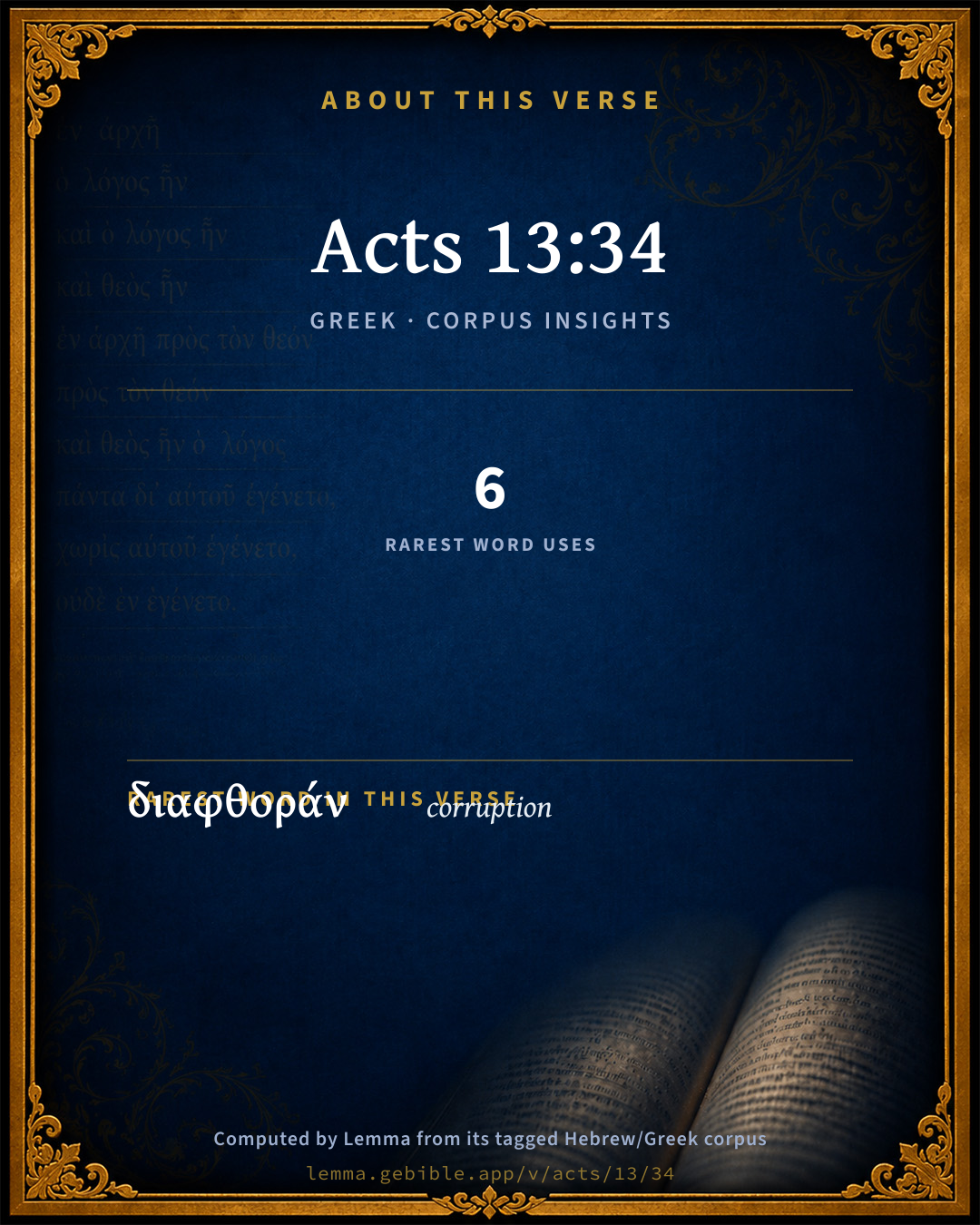
Acts 13:34

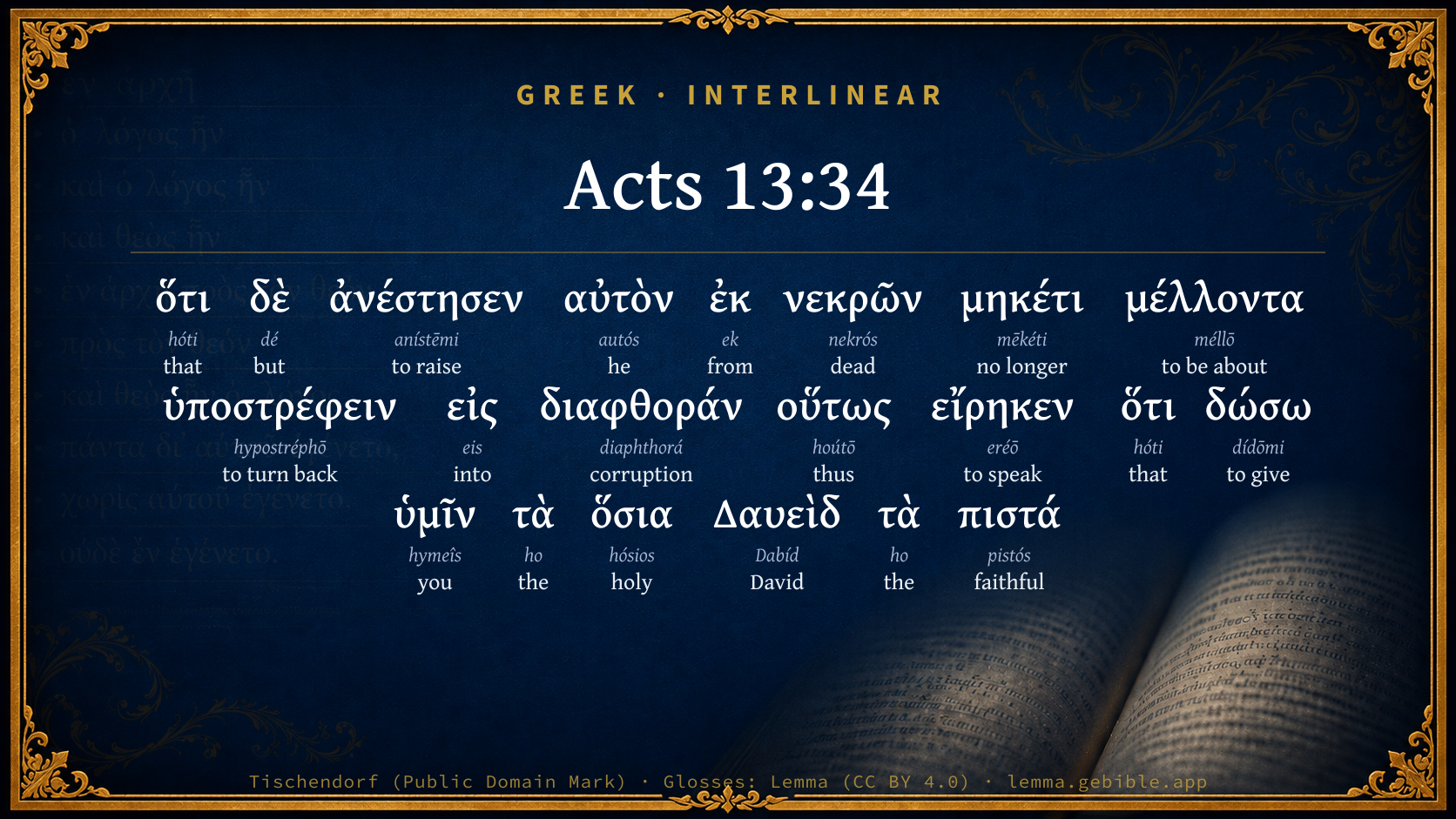
Greek (Tischendorf 8th ed.) Acts 13:34 appears in the Greek New Testament. The text above is from the Tischendorf 8th edition. Each word links to its Strong’s number and a concise gloss. Click any word for its full Thayer’s Greek Lexicon entry.
Download image
Cite this verse

Acts 13:34 (World English Bible). Public Domain. Lemma interlinear Bible study tool, https://lemma.gebible.app/v/acts/13/34.

Show BibTeX & RIS
BibTeX
RIS
English Translation
"Concerning that he raised him up from the dead, now no more to return to corruption, he has spoken thus: 'I will give you the holy and sure blessings of David.'
World English Bible · Public Domain
Download a study sheet

One document with this verse’s original text, its word-by-word gloss line, the meaning frame, cross-references with their text, attributed commentary, and full source and license credits — printable, and it pastes into notes with its structure intact.

This verse Autodidact and up

Study sheet (.html) Plain text (.txt)

A passage Seminary Student

Up to 50 verses in one chapter. A passage sheet keeps up to 6 commentary sources and 12 cross-references per verse, in the order this page ranks them, and says so on the sheet whenever that leaves anything out. Ask for a single verse and you get the Autodidact verse sheet above.

Everything on this page stays free to read, with no account — the sheet is a download of what is already on screen, not access to it.

Want to remove ads? Support Godless Engineer
Compare translations 3

The same verse in 3 English versions, stacked beneath the original-language interlinear above. Click any original word for its lexicon entry.

Each is an independent rendering of the whole verse — the interlinear is not word-aligned to these translations.

Highlighted words mark where these versions differ — a whole-verse word diff, not a word-by-word alignment.

  • World English Bible Public Domain
    "Concerning that he raised him up from the dead, now no more to return to corruption, he has spoken thus: 'I will give you the holy and sure blessings of David.'
  • King James Version Public Domain
    And as concerning that he raised him up from the dead, now no more to return to corruption, he said on this wise, I will give you the sure mercies of David.
  • unfoldingWord Literal Text CC BY-SA 4.0
    And that he raised him up from the dead, never going to return to decay, he has spoken thus: ‘I will give you the holy, trustworthy things of David.’

unfoldingWord Literal Text — © unfoldingWord, licensed CC BY-SA 4.0. Word-aligned USFM3 via Door43 (git.door43.org/unfoldingWord/en_ult).

Versions to compare (up to 4)

3 of 4 selected

Show all 19 translations

Every available English version of this verse, each an independent rendering of the whole verse.

  • World English Bible Public Domain
    "Concerning that he raised him up from the dead, now no more to return to corruption, he has spoken thus: 'I will give you the holy and sure blessings of David.'
  • Berean Standard Bible Public Domain
    In fact, God raised Him from the dead, never to see decay. As He has said: ‘I will give you the holy and sure blessings promised to David.’
  • Majority Standard Bible Public Domain
    In fact, God raised Him from the dead, never to see decay. As He has said: ‘I will give you the holy and sure blessings promised to David.’
  • King James Version Public Domain
    And as concerning that he raised him up from the dead, now no more to return to corruption, he said on this wise, I will give you the sure mercies of David.
  • American Standard Version (1901) Public Domain
    And as concerning that he raised him up from the dead, now no more to return to corruption, he hath spoken on this wise, I will give you the holy and sure `blessings' of David.
  • Revised Version (1885) Public Domain
    And as concerning that he raised him up from the dead, now no more to return to corruption, he hath spoken on this wise, I will give you the holy and sure blessings of David.
  • Geneva Bible (1599) Public Domain
    Nowe as concerning that he raised him vp from the dead, no more to returne to corruption, he hath said thus, I wil giue you the holy things of Dauid, which are faithfull.
  • Douay-Rheims (1899) Public Domain
    And to shew that he raised him up from the dead, not to return now any more to corruption, he said thus: I will give you the holy things of David faithful.
  • Young's Literal Translation Public Domain
    `And that He did raise him up out of the dead, no more to return to corruption, he hath said thus -- I will give to you the faithful kindnesses of David;
  • Literal Standard Version CC BY-SA 4.0
    And that He raised Him up out of the dead, to no longer return to corruption, He has said this: I will give to You the holy [blessings] of David [that are] faithful;
  • Unlocked Literal Bible CC BY-SA 4.0
    The fact that he raised him up from the dead so that his body would never decay, God has spoken in this way: 'I will give you the holy and sure blessings promised to David.'
  • unfoldingWord Literal Text CC BY-SA 4.0
    And that he raised him up from the dead, never going to return to decay, he has spoken thus: ‘I will give you the holy, trustworthy things of David.’
  • Darby Bible Public Domain
    But that he raised him from among [the] dead, no more to return to corruption, he spoke thus: I will give to you the faithful mercies of David.
  • World Messianic Bible Public Domain
    “Concerning that he raised him up from the dead, now no more to return to corruption, he has spoken thus: ‘I will give you the holy and sure blessings of David.’
  • Webster's Bible Public Domain
    And as concerning that he raised him from the dead, now no more to return to corruption, he said on this wise, I will give you the sure mercies of David.
  • Free Bible Version CC BY-SA 4.0
    God raised him from the dead, never to die again, as he indicated by saying, ‘I will give you what is holy and trustworthy, as I promised to David.’
  • Bible in Basic English Public Domain
    And about his coming back from the dead, never again to go to destruction, he has said these words, I will give you the holy and certain mercies of David.
  • Text-Critical English NT CC BY 4.0
    As for the fact that he raised him from the dead, no longer to return to corruption, God has spoken in this way: ‘I will give you the holy and sure blessings of David.’
  • Tyndale New Testament (1534) Public Domain
    As concernynge that he reysed him vp from deeth now no more to returne to corrupcion he sayde on this wyse: The holy promyses made to David I will geve them faithfully to you.

Literal Standard Version (2020), Covenant Press — licensed CC BY-SA 4.0. Text via the HelloAO Bible API (eBible.org). Unlocked Literal Bible (unfoldingWord) — licensed CC BY-SA 4.0. Text via the HelloAO Bible API (eBible.org). unfoldingWord Literal Text — © unfoldingWord, licensed CC BY-SA 4.0. Word-aligned USFM3 via Door43 (git.door43.org/unfoldingWord/en_ult). Free Bible Version, Dr. Jonathan Gallagher — licensed CC BY-SA 4.0. Text via the HelloAO Bible API (eBible.org).

Word by word

More ways to search: Search by grammar → Find every occurrence → Compare this word →

Practice this passage: Drill this verse → Learn its vocabulary →

διαφθοράν
diaphthorá
G1312
“corruption”
Noun, Accusative, Singular, Feminine
Part of Speech
Noun
Case
Accusative
Number
Singular
Gender
Feminine
Full Thayer's Definition

Origin: from G1311

TDNT: 10:33,1

1. corruption, destruction 2. in the NT that destruction which is effected by the decay of the body after death
  1. ὅτι hóti G3754 “that” Conjunction
  2. δὲ dé G1161 “but” Conjunction
  3. ἀνέστησεν anístēmi G450 “to raise” Verb, Aorist, Active, Indicative, 3rd person, Singular
  4. αὐτὸν autós G846 “he” Personal pronoun, Accusative, Singular, Masculine
  5. ἐκ ek G1537 “from” Preposition
  6. νεκρῶν nekrós G3498 “dead” Adjective, Genitive, Plural, Masculine
  7. μηκέτι mēkéti G3371 “no longer” Adverb, Negative
  8. μέλλοντα méllō G3195 “to be about” Verb, Present, Active, Participle, Accusative, Singular, Masculine
  9. ὑποστρέφειν hypostréphō G5290 “to turn back” Verb, Present, Active, Infinitive
  10. εἰς eis G1519 “into” Preposition
  11. οὕτως hoútō G3779 “thus” Adverb
  12. εἴρηκεν eréō G2046 “to speak” Verb, Perfect, Active, Indicative, 3rd person, Singular, Attic form
  13. ὅτι hóti G3754 “that” Conjunction
  14. δώσω dídōmi G1325 “to give” Verb, Future, Active, Indicative, 1st person, Singular
  15. ὑμῖν hymeîs G5210 “you” Personal pronoun, 2nd person, Dative, Plural
  16. τὰ ho G3588 “the” Article, Accusative, Plural, Neuter
  17. ὅσια hósios G3741 “holy” Adjective, Accusative, Plural, Neuter
  18. Δαυεὶδ Dabíd G1138 “David” Noun, Proper, indeclinable
  19. τὰ ho G3588 “the” Article, Accusative, Plural, Neuter
  20. πιστά pistós G4103 “faithful” Adjective, Accusative, Plural, Neuter

About this verse

These counts appear in no published source. They are computed here, from the morphology-tagged text and Lemma’s own curated glosses. What Lemma adds →

21
words
19
distinct lemmas
Acts
section

Notable vocabulary

The rarest word here is διαφθοράν corruption G1312 — appearing just 6 times in the whole Greek New Testament.

Shared distinctive vocabulary

διαφθοράν corruption G1312 occurs in 6 verses of the Greek New Testament. Also found in:

Repetition

Words recur within this verse:

Cross-references

14

Topical passages linked to Acts 13:34 in the Treasury of Scripture Knowledge — connected by theme and wording, ordered by reader-vote popularity; previews shown in the World English Bible.

  • Isaiah 55:3 Turn your ear, and come to me; hear, and your soul shall live: and I will make an everlasting covenant with you, even the sure mercies of David.
  • Psalms 89:2–4 I indeed declare, "Love stands firm forever. You established the heavens. Your faithfulness is in them."
  • Romans 6:9 knowing that Christ, being raised from the dead, dies no more. Death no more has dominion over him!
  • Psalms 89:19–37 Then you spoke in vision to your saints, And said, "I have bestowed strength on the warrior. I have exalted a young man from the people.
  • 2 Samuel 7:14–16 I will be his father, and he shall be my son: if he commit iniquity, I will chasten him with the rod of men, and with the stripes of the children of men;
  • Jeremiah 33:15–17 In those days, and at that time, will I cause a Branch of righteousness to grow up to David; and he shall execute justice and righteousness in the land.
  • Jeremiah 33:26 then will I also cast away the seed of Jacob, and of David my servant, so that I will not take of his seed to be rulers over the seed of Abraham, Isaac, and Jacob: for I will cause their captivity to return, and will have mercy on them.
  • Ezekiel 34:23–24 I will set up one shepherd over them, and he shall feed them, even my servant David; he shall feed them, and he shall be their shepherd.
  • 2 Samuel 23:5 Most assuredly my house is not so with God; Yet he has made with me an everlasting covenant, Ordered in all things, and sure: For it is all my salvation, and all [my] desire, Although he doesn't make it grow.
  • Ezekiel 37:24–25 My servant David shall be king over them; and they all shall have one shepherd: they shall also walk in my ordinances, and observe my statutes, and do them.
  • Amos 9:11 In that day I will raise up the tent of David who is fallen, and close up its breaches, and I will raise up its ruins, and I will build it as in the days of old;
  • Zechariah 12:8 In that day Yahweh will defend the inhabitants of Jerusalem. He who is feeble among them at that day will be like David, and the house of David will be like God, like the angel of Yahweh before them.
  • Acts 13:37 But he whom God raised up saw no decay.
  • Hosea 3:5 Afterward the children of Israel shall return, and seek Yahweh their God, and David their king, and shall come with trembling to Yahweh and to his blessings in the last days.

Cross-references courtesy of OpenBible.info (CC BY 4.0).

Commentary

Notes on Acts 13:34 from classic Christian and Jewish commentators (each source and its license shown beneath its notes). The classic Christian expositions comment on the surrounding passage and are grouped to its opening verse, so a note may address several verses; the Jewish commentaries on the Tanakh (Rashi and others) are per-verse, so they appear only where the commentator wrote on this verse.

Lemma curates 59 commentaries, every one of them public domain or Creative Commons licensed, each selected and text-cleaned for this edition rather than reprinted as found. About our sources →

Bengel's Gnomon

Johann Albrecht Bengel

Act 13:34. Ὄτι that) Paul does not prove the everlasting life of Christ by, as it were, presupposing the resurrection; otherwise, in Act 13:37, he would say in the future, He shall not see corruption; but proves the resurrection itself (comp. following ver.), and mentions additionally, that His everlasting life is conjoined with it. The question was concerning the resurrection itself of Christ, not, presupposing it, concerning His everlasting life.—μηκέτι, no more hereafter) Not even once did Christ see corruption. Therefore resolve μηκέτι, thus: μηκέτι, He shall no more go to death, which in ordinary cases is wont to be followed by διαφθορὰ, corruption. Comp. Rom 6:9, οὐκέτι, “Christ being raised from the dead, dieth no more.”—ὄτι δώσω ὑμῖν τὰ ὄσια Δαυὶδ τὰ πιστά) Isa 55:3, in the LXX., διαθήσομαι ὑμῖν διαθήκην αἰώνιον, τὰ ὅσια Δαυὶδ τὰ πιστά.—τὰ ὅσια Δαυὶδ, the holy things of David) חסדי דויד, the graces of (the acts of grace promised to) David. Christ is called ὁ ὄσιος, the Holy One, חסיד, in Act 13:35; τὸ τοῦ Χριστοῦ, that which is the peculiar attribute of Christ, is expressed by חסדים, an abstract term. And it is in the plural in Isa 63:7, loving-kindnesses; in Joh 1:16, grace for grace (i.e. grace accumulated upon grace); and in Act 13:17, ibid., “grace and truth came by Jesus Christ.” They are those Divine graces promised in Christ to David, and eagerly looked for by David: comp. Act 13:23.—τὰ πιστὰ) הנאמנים, sure, firm, solid, which altogether uphold and answer to their name (Rom 11:6, “If by grace, then is it no more of works: otherwise grace is no more grace”), and which mutually sustain one another; of which some precede others, some follow others by necessary consequence, and on which we ought altogether to lean, and which will stand fast for ever. Comp. אמן, amen, 2Co 1:18; 2Co 1:20; מבות נאמנות, νόσους πιστὰς, sure plagues, Deu 28:59. Comp. ibid. Deu 32:20, where, by comparing with it the following ver., such sons in whom there is no faith (אֵמֻן, LXX., πίστις), are no sons (comp. Act 13:19, His sons). Isaiah has from the parallel put before this phrase, “an everlasting covenant.” Hence necessarily follows the resurrection of Christ, Heb 13:20; for without it the promised benefits of the Messiah could not have been enjoyed by the people of God. אמונה, πίστις, faith, is a conjugate and correlative to these (ὅσια) πιστά

Bengel's Gnomon of the New Testament — English translation (T&T Clark, Edinburgh, 1860) — public domain. Text from a community e-Sword module.

Meyer's Critical & Exegetical Commentary

Heinrich August Wilhelm Meyer

Act_13:34. But that God raised Him from the dead as one who is no more to return to corruption, He has thus said. The μηκέτι μέλλοντα … διαφθορ. is the main element whereby the speech advances. Comp. Rom_6:9.

εἰς διαφθοράν] into corruption, is not, with Kuinoel (after Beza and Piscator), to be explained: in locum corruptionis, i.e. in sepulcrum, for which there is no reason at all, as μηκέτι by no means requires the inference that Christ must already have been once in the condition of corruption; for μηκέτι refers logically to the general idea of dying present in the mind of Paul, which he, already thinking on Psa_16:10, expresses by ὑποστρ. εἰς διαφθ. Comp. Winer, p. 574 [E. T. 772]. Bengel aptly says: non amplius ibit in mortem, quam alias solet subsequi διαφθορά. The appeal to the LXX., which renders שַׁחַת by διαφθορά, is equally inadmissible, for the translators actually so understood שַׁחַת, and thus connected with their διαφθορά no other idea than corruptio (comp. on Act_2:27).

δώσω ὑμῖν τ. ὅσ. Δ. τ. πιστά] a free quotation of the LXX. Isa_55:3, in which Paul, instead of διαθήσομσι ὑμῖν διαθήκην αἰώνιον, gives δώσω ὑμῖν, certainly not designedly, because the text of the LXX. represents the appearance of the Messiah as something future, as Olshausen thinks; for the words of the LXX., particularly the αἰώνιον, would have been very suitable as probative of our passage; nor yet by a mistake of memory, as the passage about the eternal covenant certainly was very accurately known to the apostle; but because he saw the probative force in τὰ ὅσια Δ. τὰ πιστά, and therefore, in introducing those words on which his argument hinged, with his freedom otherwise in quotation he regarded it as sufficient only to prefix to them that verb, the idea of which is really contained in διαθήσομαι ὑμῖν διαθήκην αἰών. I shall give unto you the holy things of David, the sure; i.e. the holy blessings conferred by me on David, the possession of which will be (federally) sure and certain. By this is meant the whole Messianic salvation as eternally enduring, which (in an ideal sense, for future realization by the Son of David, the Messiah) belonged as a holy property to David, the Messianic ancestor, and was to come to believers through Christ as a sacred inheritance. The LXX. translates חַסְדֵי דָוִיד inexactly by τὰ ὅσια Δαυΐδ; but on this very account the literal meaning beneficia is not (against Kuinoel and others) to be assumed for ὅσια. It denotes veneranda, pie observanda. Comp. Bremi, ad Lys. p. 269, Goth.

The historical meaning of the passage in Isaiah contains a promise of the Messianic times alluring the exiles to the appropriation of the theocratic salvation; but in this very Messianic nature of the promise Paul had reason and right to recognise the condition of its fulfilment in the eternal remaining-alive of the risen Christ, and accordingly to understand the passage as a prophetic promise of this eternal remaining-alive; because through a Messiah liable again to death, and accordingly to corruption, those holy possessions of David, seeing they are to be πιστά, could not be conferred; for that purpose His life and His government, as the fulfiller of the promises (2Co_1:10), must be eternal. Comp. Calvin and Hofmann, Weissag. u. Erf. II. p. 173 f. As surely as God, according to this prophetic assurance, must bestow the ὅσια Δαυῒδ τὰ πιστά, so surely Christ, through whom they are bestowed, cannot again die. Less accurately Hengstenberg, Christol. II. p. 384.

Meyer — Critical and Exegetical Commentary on the New Testament — English translation by Peter Christie, edited by Frederick Crombie (T&T Clark, 1880) — public domain. Text from a community e-Sword module.

Expositor's Greek Testament

ed. W. Robertson Nicoll

Act 13:34 . μηκέτι μ . ὑποσ . εἰς διαφθ ., cf. Rom 6:9 , “no more to return to corruption,” does not of course mean that Christ had already seen corruption, so that there is no need to understand διαφθ . of the place of corruption, sepulchrum , with Beza, Kuinoel. Hilgenfeld refuses to follow Jüngst, Sorof, Clemen in referring Act 13:34-37 to a reviser, for he justly remarks that the speech which was intended to move the Israelites to a recognition of Jesus as the promised Saviour of the seed of David, would have been imperfect, unless it had set forth His sufferings and after-resurrection. Δώσω κ . τ . λ .: “I will give you the holy and sure blessings of David”. This rendering makes the connection with the next verse more evident, cf. Isa 55:3 , καὶ διαθήσομαι ὑμῖν διαθήκην αἰώνιον τὰ ὅσια Δαυὶδ τὰ πιστά . “By David was understood the Messiah, which yet the Rabbis themselves have well observed:” J. Lightfoot, Hor. Heb. (so Schöttgen), in loco. “The everlasting covenant,” what was it but the holy and sure blessings promised to David? But these blessings, ὅσια , sancta promissa Davidi data , are connected with the resurrection of Christ because (“ διότι not διό , T.R., see critical notes, stating the cause, not the consequence”) only in the triumph of God’s Holy One ( τὸν ὅσιον ) are these blessings ratified and assured. Just as Peter (Act 2:47 ), so here Paul applies the passage in Psa 16 . directly to Christ, Briggs, Messianic Prophecy , p. 151.

The Expositor's Greek Testament, edited by W. Robertson Nicoll (1897–1910) — public domain. Text from a community e-Sword module.

Geneva Bible (1599)

Geneva Bible translators

The Greeks call those holy things, which the Hebrews call gracious bounties: and they are called David’s bounties in the passive signification, because God bestowed them upon David: Moreover, they are termed faithful, after the manner of speech which the Hebrews use, who terms those things faithful, which are steady and sure such as never alter nor change.

Geneva Bible (1599) marginal notes — public domain. Text via Bolls.life.

Jamieson, Fausset & Brown

Robert Jamieson, A. R. Fausset & David Brown

now no more to return to corruption--that is, to the grave where death reigns; and compare Rom 6:9, "Christ being raised from the dead dieth no more, death hath no more dominion over him."

I will give you the sure mercies of David-- (Isa 55:3). The word rendered "mercies" is peculiar, denoting the sanctity of them, as comprehending the whole riches of the new covenant; while the other word, "sure," points to the certainty with which they would, through David's Seed, be at length all substantiated. See on Joh 1:14. But how do these words prove the resurrection of Christ? "They presuppose it; for since an eternal kingdom was promised to David, the Ruler of this kingdom could not remain under the power of death. But to strengthen the indefinite prediction by one more definite, the apostle adduces Psa 16:10, of which Peter had given the same explanation (see on Act 2:27; Act 2:30-31), both apostles denying the possibility of its proper reference to David" [OLSHAUSEN].

Jamieson, Fausset & Brown — Commentary Critical and Explanatory on the Whole Bible (1871) — public domain (CC PDM 1.0). Text via the HelloAO Bible API.

Adam Clarke's Commentary

Verse 34. No more to return to corruption] To the grave, to death, the place and state of corruption; for so we should understand the word διαφθοραν in the text.

The sure mercies of David.] τα οσια δαβιδ τα πιστα. These words are quoted literatim from the Septuagint version of Isa 55:3; where the Hebrew is חסדי דוד הנאמנים chasdey David ha-neemanim, of which the Greek is a faithful translation; and which sure mercies of David St. Paul considers as being fulfilled in the resurrection of Christ. From this application of the words, it is evident that the apostle considered the word David as signifying the Messiah; and then the sure or faithful mercies, being such as relate to the new covenant, and the various blessings promised in it, are evidently those which are sealed and confirmed to mankind by the resurrection of Christ; and it is in this way that the apostle applies them. Had there not been the fullest proof of the resurrection of Christ, not one of the promises of the new covenant could have been considered as sure or faithful. If he did not rise from the dead, then, as said the apostle, your faith and our preaching are vain, 1Co 15:14.

The following observations of Bp. Pearce are judicious: "For the sense of these words, we must have recourse to what God said to David in 2Sa 7:11-12, c., explained by what is said in Ps 89:3-4, Ps 89:28-29, Ps 89:36, where frequent mention is made of a covenant established by God with David, and sworn to by God, that David's seed should endure for ever, and his throne as the days of heaven, and as the sun, to all generations. This covenant and this oath are the sure and sacred things of which Isaiah, Isa 55:3, speaks and Luke in this place. And Paul understood them as relating to the kingdom of Jesus, (the Son of David,) which was to be an everlasting kingdom; and if an everlasting one, then it was necessary that Jesus should have been (as he was) raised from the dead; and, to support this argument, Paul, in the next verse, strengthens it with another, drawn from Ps 16:10." See also the note among the marginal readings.

Adam Clarke's Commentary on the Bible (1810–1826) — public domain. Text from a community e-Sword/MySword module.

John Calvin's Commentaries

34. That he should not return. He addeth now the other member, that Christ was once raised from death that he may live for ever, as Paul teacheth, Romans 6:10,

“He dieth no more, neither shall death have dominion over him any more; because he liveth to God.”

For the hope conceived of Christ’s resurrection should be slender and cold, if he were yet subject to destruction, or to any change. Therefore he is said to be entered into the kingdom of God, that he may also give to his [people] eternal felicity, living for ever. For because Christ rose rather for our sake than for himself, the perpetuity of life which the Father hath given him reacheth unto us all, and is ours. Notwithstanding the place of Isaiah which is here cited, seemeth to make but a little for proof of Christ’s immortality, I will give you the holy things of David, (Isaiah 55:3.) But it is not so. For seeing Isaiah speaketh of the redemption promised to David, and affirmeth that the same shall be firm and stable, we do well gather by this the immortal kingdom of Christ, wherein the eternity of salvation is grounded. And Paul followed the Greek interpreters when he put holy things for mercies. Chessed, which signifieth meek, merciful, and gentle, is wont by the Grecians to be translated holy. Therefore they translated הסדי of David, the holy things of David, whereas the prophet meaneth rather the grace promised to David. But Paul granted this to the ignorant and weak, who were better acquainted with the Greek reading, especially forasmuch as the force of the testimony consisteth in another point. For this is Paul’s meaning in sum, If the grace be eternal which God saith he will give in his Son, the life of his Son must be eternal, and not subject to corruption. For we must hold this rule, that all the promises of God are in Christ yea and amen, (2 Corinthians 1:20;) and that therefore they cannot be of any force unless he do quicken them.

John Calvin's Commentaries (1540-1563) — public domain. Text from the Calvin Translation Society English edition (1840s-50s) via the Christian Classics Ethereal Library (ccel.org). Calvin's coverage is partial (roughly two-thirds of the Bible); uncommented books and verses are honest gaps, never fabricated. The 19th-century editor's footnotes and remarks are omitted so the notes are faithfully Calvin's own voice.

Ellicott's Commentary for English Readers

(34) Now no more to return to corruption.—We note from the turn of the phrase that St. Paul already has the words of Psa_16:10 in his mind, though he has not as yet referred to it.

I will give you the sure mercies of David.—The words do not seem in themselves to have the nature of a Messianic prediction. To those, however, whose minds were full to overflowing with the writings of the prophets they would be pregnant with meaning. What were the “sure mercies of David” (Isa_55:3) but the “everlasting covenant” of mercy which was to find its fulfilment in One who should be “a leader and commander to the people?” We may well believe that the few words quoted recalled to St. Paul and to his hearers the whole of that wonderful chapter which opens with “Ho, every one that thirsteth, come ye to the waters.” The Greek word for “mercies” is the same adjective as that translated “holy” in the next verse, “holiness” being identified with “mercy,” and so forms a connecting link with the prophecy cited in the next verse.

A Bible Commentary for English Readers, edited by Charles John Ellicott (1878–1897) — public domain. Text from a community e-Sword module.

The Cambridge Bible for Schools and Colleges

gen. ed. J. J. S. Perowne

34. he said on this wise] Better, “He [i.e. God] hath spoken on this wise.” The words are from Isa_55:3.

I will give you the sure mercies of David] Rather, “I will give you the holy and faithful (mercies) of David.” There is no word for “mercies” in the original; but the word rendered “holy” is one which the LXX. have frequently used to represent the Hebrew word for “mercies.” St Paul to the audience at Antioch used the Greek version, though no doubt he carried along with him the thought of the Hebrew. But having this Greek rendering as an interpretation of the “everlasting covenant” of which Isaiah speaks in the verse here quoted, he connects the “holy and faithful things of David” with that verse of David’s Psalm (Act_16:10) which tells how God will not give his Holy One to see corruption.

The Cambridge Bible for Schools and Colleges (gen. ed. J. J. S. Perowne; Cambridge University Press, 1878–1918) — public domain. Text from a community e-Sword module.

John Gill's Exposition

But he whom God raised again,.... The Vulgate Latin version adds, "from the dead"; meaning the Lord Jesus Christ, who was raised from the dead by God the Father: and

saw no corruption; he did not lie so long in the grave as to corrupt and putrefy, but was raised from the dead the third day; wherefore the passage, before cited, is very applicable to him, and is a clear proof that the Messiah was to rise from the dead, as Jesus did.

John Gill's Exposition of the Whole Bible (1746–1763) — public domain (CC PDM 1.0). Text via the HelloAO Bible API.

Trapp's Complete Commentary

John Trapp

34 And as concerning that he raised him up from the dead, now no more to return to corruption, he said on this wise, I will give you the sure mercies of David.

Ver. 34. To return to corruption] That is, to the grave, that house of corruption; which yet the Hebrews call Beth chajim, the house of the living, because of the promise "thy dead men shall live," &c. The Germans call the place of burial God’s Acre, because the dead body, though sown there in corruption, yet riseth again in incorruption.

John Trapp, A Commentary or Exposition upon All the Books of the Old and New Testament (1647–1656) — public domain. Text from a community e-Sword module.

Albert Barnes' Notes on the Bible

And as concerning - In further proof of this. To show that he actually did it, he proceeds to quote another passage of Scripture.

No more to return to corruption - The word “corruption” is usually employed to denote “putrefaction, or the mouldering away of a body in the grave; its returning to its native dust.” But it is certain (Act 13:35. See the notes on Act 2:27) that the body of Christ never in this sense saw corruption. The word is therefore used to denote “death, or the grave, the cause and place of corruption.” The word is thus used in the Septuagint. It means here simply that he should not die again.

He said on this wise - He said thus ὅυτως houtōs.

I will give you - This quotation is made from Isa 55:3. It is quoted from the Septuagint, with a change of but one word, not affecting the sense. In Isaiah the passage does not refer particularly to the resurrection of the Messiah, nor is it the design of Paul to affirm that it does. His object in this verse is not to prove that he would rise from the dead, but that, being risen, he would not again die. That the passage in Isaiah refers to the Messiah there can be no doubt, Act 13:1, Act 13:4. The passage here quoted is an address to the people, an assurance to them that the promise made to David would be performed, a solemn declaration that he would make an everlasting covenant with them through the Messiah, the promised descendant of David.

The sure mercies of David - The word “mercies” here refers to the promise made to David; the mercy or favor shown to him by promising to him a successor that should not fail to sit on his throne, 2Sa 7:16; Psa 89:4-5; Psa 132:11-12. These mercies and promises are called “sure,” as being true or unfailing; they would certainly be accomplished. Compare 2Co 1:20. The word “David” here does not refer, as many have supposed, to the Messiah, but to the King of Israel. God made to David a promise, a certain pledge; he bestowed on him this special mercy, in promising that he should have a successor who should sit forever on his throne. This promise was understood by the Jews, and is often referred to in the New Testament, as relating to the Messiah. Paul here says that that promise is fulfilled. The only question is how it refers to the subject on which he was discoursing. The point was not mainly to prove his resurrection, but to show particularly that he would never die again, or that he would forever live and reign. And the argument is, that as God had promised that David should have a successor who should sit forever on his throne, and as this prediction now terminated in the Messiah, the Lord Jesus, it followed that, as that promise was sure and certain, he would never die again. He must live if the promise was fulfilled. And though he had been put to death, yet under that general promise there was a certainty that he would live again. It was impossible, the meaning is, that the Messiah, the promised successor of David, the perpetual occupier of his throne, should remain under the power of death. Under this assurance the church now reposes its hopes. Zion’s King now lives, ever able to vindicate and save his people.

Albert Barnes' Notes on the Bible (1834–1885) — public domain. Text from a community e-Sword/MySword module.

Haydock's Catholic Bible Commentary

I will give you the holy things of David sure. These are the words of the prophet Isaias, lv. ver. 3. According to the Septuagint the sense is, I will faithfully fulfil the promises I made to David. (Challoner)

George Leo Haydock (1774–1849), Haydock's Catholic Family Bible and Commentary, 1859 edition — public domain. Excludes Psalms (Douay-Rheims chapter numbering differs from Protestant) and Deuterocanonical books (Catholic canon only).

Matthew Poole's English Annotations

The former verse was not intended so much by St. Paul for a proof of the resurrection, as it was to show how faithful God was in fulfilling that promise there spoken of; here the apostle’s design is, to evince Christ’s resurrection, and that it was agreeable to the prophesies which were concerning him.

I will give you the sure mercies of David; these words are found, Isa 60:3, and

the sure mercies of David there and here spaken of, are such mercies as were promised to David (David being to be taken positively). Now the mercies which were promised to David are all included or surmounted in this, that by this Son of David (our Lord and Saviour, frequently and truly so called) God would erect and establish an everlasting kingdom; which could not be done, unless Christ rose again, and obtained the victory over death and the grave. All the promises God hath made unto his church in any age concerning Christ, are sure and faithful, holy and just; the words have been variously rendered and changed; but no words can sufficiently express their stability and excellency.

Matthew Poole's English Annotations on the Holy Bible (1683–1685) — public domain. Text from a community e-Sword/MySword module.

Whedon's Commentary on the Bible

Daniel D. Whedon

34. Sure mercies of David—We can give no better commentary upon these words than is furnished by Bishop Pearce: “For the sense of these words we must have recourse to what God said to David in 2Sa_7:11-12, etc., explained by what is said in Psa_89:3-4; Psa_89:28-29; Psa_89:36, where frequent mention is made of a covenant established by God with David, and sworn to by God, that David’s seed should endure forever, and his throne as the days of heaven, and as the sun, to all generations. This covenant and this oath are the sure and sacred things of which Isaiah (Isa_55:3) speaks, and Luke in this place. And Paul understood them as relating to the kingdom of Jesus, (the son of David,) which was to be an everlasting kingdom; and if an everlasting one, then it was necessary that Jesus should have been (as he was) raised from the dead; and to support this argument, Paul, in the next verse, strengthens it with another, drawn from Psa_16:10.”

Daniel D. Whedon (gen. ed.), Commentary on the Old and New Testaments (1874–1909) — public domain. Text from a community e-Sword module.

The Pulpit Commentary

Hath spoken for said, A.V.; holy and sure blessings for sure mercies, A.V. No more to return to corruption. This is added to show that Christ"s resurrection was a final victory over death; not like that of Lazarus, or the Shunammite"s son, or Jairus"s daughter, but, as St. Paul himself says, (Rom_6:9) "Christ being raised from the dead dieth no more, death hath no more dominion over him." Here he tells us that this eternal exemption of Christ from death was promised or signified insomai Isa_55:3, which he quotes from the LXX, only abbreviating thediaqh k.t.l., into dwsw, I will give. What, then, is meant by the osia Dabid ta? The Hebrew has dwd ydesju, which can mean nothing else but "the sure mercies of David," the favor and mercy promised to David in God"s everlasting covenant, well ordered in all things and sure. And in like manner, in 2Ch_6:42, osia Dabid means "the mercies of God to David." And if we turn to the account of this covenanted mercy in 2Sa 7., we shall see that it comprises the setting of David"s seed upon his throne for ever (see specially vers. 12-16). In ver. 15 it is said, WgMmi rWsy ail ydisj, "My mercy shall not depart from him." And in the next verse his house and his kingdom are described as being man, sure," or "established for ever," which, when applied to the personal Christ, the Son of David, manifestly implies his eternal exemption from death and corruption. (see also Psa_132:4) The sense of the Hebrew, therefore, is clever and certain, and it is equally certain that the LXX meant to represent this sense in the version here quoted by St. Paul.

Osiov, though properly meaning "holy, pious," and thence "mild" and "merciful" (eijrhnikov, Hesych.) as applied to man, came to be applied in the same senses to God. (Rev_15:4 Rev_16:5; and here and in the LXX) Beyond doubt, therefore, the passage before us is rightly rendered in the A.V, "the sure mercies of David;" the plural, osia, represents the of the Hebrew. Clemens Alex. (quoted by Schleusner) uses it in the same way for "mercies or "benefits:" Posa aujtw ojfeilomen osia: For how many mercies are we indebted to Christ!" In a similar way, the Latin pietas is used for God"s "justice" or "kindness" ("AEneid," 2:536; 5:688). "Trini pulses pietatem" (on a sepulchral monument, A.D. 1427): "Beat at the door of God"s mercy." Gronovius, in his note on "AEian. V H.," 8:1, where he ascribes to osiov the primitive sense of what is "just" and "due," from man either to God or to his fellowman, adds, "Tribuunt quidem LXX? interpetiam Deo to osion: sod etiam tum significat quoddam quasi offcium benignitatia in heroines pios, Deo decorum."

The Pulpit Commentary (1880–1919), ed. H.D.M. Spence-Jones & Joseph S. Exell — public domain. Text from a community e-Sword module.

John Wesley's Explanatory Notes

No more to return to corruption - That is, to die no more. I will give you the sure mercies of David - The blessings promised to David in Christ. These are sure, certain, firm, solid, to every true believer in him. And hence the resurrection of Christ necessarily follows; for without this, those blessings could not be given. Isaiah lv, 3.

John Wesley, Explanatory Notes Upon the Whole Bible (1754–1765) — public domain. Text via the GEBible commentary corpus.

McGarvey & Pendleton's Commentaries

J. W. McGarvey

34-37. That we have given the true explanation of the clause last quoted is confirmed by the course of the argument in that which follows, in which the speaker continues to quote from David, to prove that, according to his prophesies, the Messiah should rise from the dead. (34) " Now that he did raise him from the dead, no more to return to corruption, he spoke thus: I will give to you the sure mercies of David. (35) Wherefore he also says in another psalm, Thou wilt not suffer thy Holy One to see corruption. (36) For David, after he had served his own generation by the will of God, fell asleep, and was added to his fathers, and saw corruption; (37) but he whom God raised up did not see corruption. "

The words quoted from the fifty-fifth chapter of Isaiah , "I will give you the sure mercies of David," have given no little trouble to both translators and interpreters. No translator can feel well satisfied with rendering ta osia David ta pista, the sure mercies of David; yet the literal translators have generally adopted this as the best that can be done. I think the words mean the holy things made sure to David. The purpose of the quotation is to prove that God would raise the Messiah from the dead no more to return to corruption. He assumes, therefore, that the words quoted refer to the Messiah, and that his hearers would not dispute the reference. Whatever, therefore, might otherwise be our own understanding of the words, we must take this as their true reference. The promise is addressed not to the Messiah, but to the Jews; for the pronoun you ( umin ) is in the plural number. It is a promise, then, to give to the Jews the holy things faithfully promised to David, among which was the promise already referred to, "Thou wilt not suffer thy Holy One to see corruption." It furnished, therefore, the required proof that the Messiah would rise, and not see corruption.

The only objection which his hearers would be likely to raise against the argument is, that in the words, "Thou wilt not suffer thy Holy One to see corruption," David spoke of himself. But this objection is anticipated by the remark that David had fallen asleep and seen corruption, whereas he, Jesus, whom God raised up, as was proved by the witnesses who saw him alive, did not see corruption; hence to him the words must refer. According, therefore, to the only possible application of David's words, and to the admitted reference of the words quoted from Isaiah, they were bound to admit that Jesus was the Messiah.

J. W. McGarvey (with Philip Y. Pendleton), Commentaries on the New Testament (The Fourfold Gospel, 1914; Acts; and the epistles) — public domain. Text from a community e-Sword/MySword module.

Cambridge Greek Testament for Schools and Colleges

34. οὕτως εἴρηκεν, He [i.e. God] hath spoken on this wise. The quotation is from Isa 55:3.

δώσω ὑμῖν τὰ ὅσια Δαευὶδ τὰ πιστά, I will give you the sure (faithful) mercies of David. τὰ ὅσια is often used by the LXX. to represent the Hebrew word for ‘mercies’ as here. St Paul speaking to the people of Antioch no doubt used the Greek version, though he would carry the Hebrew thought along with him. But having τὰ ὅσια as the explanation of the ‘everlasting covenant’ of which Isaiah is speaking, St Paul at once connects τὰ ὅσια with the τὸν ὅσιον of Psa 16:10, where it is said God will not give His Holy One to see corruption.

Cambridge Greek Testament for Schools and Colleges (Cambridge University Press, 1896; 21 vols, various authors incl. Carr, Maclear, Plummer, Farrar, Lumby, Moule, M. R. James, Simcox) — public domain. Text from a community e-Sword module.

Alford’s Greek Testament

Henry Alford

34. μηκέτι μέλλ.] Compare Rom 6:9, χριστὸς ἐγερθεὶς ἐκ νεκρῶν οὐκέτι ἀποθνήσκει· θἁνατος αὐτοῦ οὐκέτι κυριεύει. It is interesting to trace the same shades of thought in the speeches and epistles of Paul; and abundant opportunity of doing so will occur as we proceed.

But here the ὑποστρ. εἰς διαφθ. does not merely imply death, so that Jesus should have once undergone it, and no more hereafter, as the E. V. seems to imply: but we must supply ‘to die, and in consequence to’ before the words, understanding them as the result of death, if it had dominion over him: thus the clause answers even more remarkably to Rom 6:9.

τὰ ὅσια is the LXX rendering of חַסְדֵי, ref. Isa., which in 2Ch 6:42, they have translated τὰ ἐλέη. The word ‘holy’ should have been preserved in the E. V., as answering to τὸν ὅσιόν σου below; the mercies of David, holy and sure: or my holy promises which I made sore unto David.

Henry Alford, The Greek Testament (1849–1861) — public domain. Text from a community e-Sword module.

Vincent's Word Studies in the New Testament

Marvin R. Vincent

The sure mercies [τα οσια τα πιστα] . Lit., the holy things, the sure. Rev., the holy and sure blessings.

Marvin R. Vincent, Word Studies in the New Testament (1887–1900) — public domain. Text from a community e-Sword/MySword module.

Lesson kit

Teaching starters — assembled from the data on this page, not authored interpretation. Every prompt links to the verse data it draws on. Edit before teaching.

Acts, in the Acts, opens this verse with 21 words (19 distinct Greek lemmas). Its most distinctive word is diaphthorá (“corruption”). A historical commentator’s framing appears above. Read the whole chapter for the surrounding context.

Discussion questions

  1. What does “corruption” (diaphthorá) contribute to the verse as a whole?
  2. Acts 2:27 shares the word «corruption» with this verse. How do the two illuminate each other?
  3. “that” occurs 2× in this one verse. What is the effect of the repetition?
  4. These translations render this verse differently. What is at stake in choosing one wording over another?
  5. Reading how Bengel's Gnomon and Meyer's Critical & Exegetical Commentary read this verse, where do the two commentators agree and where do they part?

Things to notice

Reading settings

Reading text

Shown beneath each verse's original-language words.

Old Testament
Old Testament edition

Read the OT as the Masoretic Hebrew (MT) or the Greek Septuagint (LXX).

English shown for the Greek Septuagint (in the Hebrew ↔ Greek comparison).

Comparing translations? Open the Compare panel on any verse page to stack up to four side by side.