1 Thessalonians 4:17

Greek (Tischendorf 8th ed.) 1 Thessalonians 4:17 appears in the Greek New Testament. The text above is from the Tischendorf 8th edition. Each word links to its Strong’s number and a concise gloss. Click any word for its full Thayer’s Greek Lexicon entry.
Download image
Cite this verse

1 Thessalonians 4:17 (World English Bible). Public Domain. Lemma interlinear Bible study tool, https://lemma.gebible.app/v/1-thessalonians/4/17.

Show BibTeX & RIS
BibTeX
RIS
English Translation
then we who are alive, who are left, will be caught up together with them in the clouds, to meet the Lord in the air. So we will be with the Lord forever.
World English Bible · Public Domain
Download a study sheet

One document with this verse’s original text, its word-by-word gloss line, the meaning frame, cross-references with their text, attributed commentary, and full source and license credits — printable, and it pastes into notes with its structure intact.

This verse Autodidact and up

Study sheet (.html) Plain text (.txt)

A passage Seminary Student

Up to 50 verses in one chapter. A passage sheet keeps up to 6 commentary sources and 12 cross-references per verse, in the order this page ranks them, and says so on the sheet whenever that leaves anything out. Ask for a single verse and you get the Autodidact verse sheet above.

Everything on this page stays free to read, with no account — the sheet is a download of what is already on screen, not access to it.

Want to remove ads? Support Godless Engineer
Compare translations 3

The same verse in 3 English versions, stacked beneath the original-language interlinear above. Click any original word for its lexicon entry.

Each is an independent rendering of the whole verse — the interlinear is not word-aligned to these translations.

Highlighted words mark where these versions differ — a whole-verse word diff, not a word-by-word alignment.

  • World English Bible Public Domain
    then we who are alive, who are left, will be caught up together with them in the clouds, to meet the Lord in the air. So we will be with the Lord forever.
  • King James Version Public Domain
    Then we which are alive and remain shall be caught up together with them in the clouds, to meet the Lord in the air: and so shall we ever be with the Lord.
  • unfoldingWord Literal Text CC BY-SA 4.0
    Then we, the ones living, the ones surviving, will be caught up together with them in the clouds to meet the Lord in the air, and in this way we will always be with the Lord.

unfoldingWord Literal Text — © unfoldingWord, licensed CC BY-SA 4.0. Word-aligned USFM3 via Door43 (git.door43.org/unfoldingWord/en_ult).

Versions to compare (up to 4)

3 of 4 selected

Show all 19 translations

Every available English version of this verse, each an independent rendering of the whole verse.

  • World English Bible Public Domain
    then we who are alive, who are left, will be caught up together with them in the clouds, to meet the Lord in the air. So we will be with the Lord forever.
  • Berean Standard Bible Public Domain
    After that, we who are alive and remain will be caught up together with them in the clouds to meet the Lord in the air. And so we will always be with the Lord.
  • Majority Standard Bible Public Domain
    After that, we who are alive and remain will be caught up together with them in the clouds to meet the Lord in the air. And so we will always be with the Lord.
  • King James Version Public Domain
    Then we which are alive and remain shall be caught up together with them in the clouds, to meet the Lord in the air: and so shall we ever be with the Lord.
  • American Standard Version (1901) Public Domain
    then we that are alive, that are left, shall together with them be caught up in the clouds, to meet the Lord in the air: and so shall we ever be with the Lord.
  • Revised Version (1885) Public Domain
    then we that are alive, that are left, shall together with them be caught up in the clouds, to meet the Lord in the air: and so shall we ever be with the Lord.
  • Geneva Bible (1599) Public Domain
    Then shall we which liue and remaine, be caught vp with them also in the clouds, to meete the Lord in the ayre: and so shall we euer be with the Lord.
  • Douay-Rheims (1899) Public Domain
    Wherefore, comfort ye one another with these words.
  • Young's Literal Translation Public Domain
    then we who are living, who are remaining over, together with them shall be caught away in clouds to meet the Lord in air, and so always with the Lord we shall be;
  • Literal Standard Version CC BY-SA 4.0
    then we who are living, who are remaining over, will be snatched up together with them in [the] clouds to meet the LORD in [the] air, and so we will always be with the LORD;
  • Unlocked Literal Bible CC BY-SA 4.0
    Then we who are alive, who are left, will together with them be caught up in the clouds to meet the Lord in the air. In this way we will always be with the Lord.
  • unfoldingWord Literal Text CC BY-SA 4.0
    Then we, the ones living, the ones surviving, will be caught up together with them in the clouds to meet the Lord in the air, and in this way we will always be with the Lord.
  • Darby Bible Public Domain
    then *we*, the living who remain, shall be caught up together with them in [the] clouds, to meet the Lord in [the] air; and thus we shall be always with [the] Lord.
  • World Messianic Bible Public Domain
    then we who are alive, who are left, will be caught up together with them in the clouds to meet the Lord in the air. So we will be with the Lord forever.
  • Webster's Bible Public Domain
    Then we who are alive and remain shall be caught up together with them in the clouds, to meet the Lord in the air: and so shall we ever be with the Lord.
  • Free Bible Version CC BY-SA 4.0
    Then those of us who are alive and still here will be carried up together with them into the clouds, and we shall meet the Lord in the air. Then we will be with the Lord forever!
  • Bible in Basic English Public Domain
    Then we who are still living will be taken up together with them into the clouds to see the Lord in the air: and so will we be for ever with the Lord.
  • Text-Critical English NT CC BY 4.0
    Then we who are alive, who are left behind, will be caught up together with them in the clouds to meet the Lord in the air. And so we will always be with the Lord.
  • Tyndale New Testament (1534) Public Domain
    then shall we which live and remayne be caught vp with them also in the cloudes to mete the Lorde in the ayer. And so shall we ever be with the Lorde.

Literal Standard Version (2020), Covenant Press — licensed CC BY-SA 4.0. Text via the HelloAO Bible API (eBible.org). Unlocked Literal Bible (unfoldingWord) — licensed CC BY-SA 4.0. Text via the HelloAO Bible API (eBible.org). unfoldingWord Literal Text — © unfoldingWord, licensed CC BY-SA 4.0. Word-aligned USFM3 via Door43 (git.door43.org/unfoldingWord/en_ult). Free Bible Version, Dr. Jonathan Gallagher — licensed CC BY-SA 4.0. Text via the HelloAO Bible API (eBible.org).

Word by word

More ways to search: Search by grammar → Find every occurrence → Compare this word →

Practice this passage: Drill this verse → Learn its vocabulary →

περιλειπόμενοι
perileípō
G4035
“to remain over”
Verb, Present, Passive deponent, Participle, Nominative, Plural, Masculine
Part of Speech
Verb
Tense
Present
Voice
Passive deponent
Mood
Participle
Case
Nominative
Number
Plural
Gender
Masculine
Full Thayer's Definition

Origin: from G4012 and G3007

TDNT: 4:194,*

1. to leave over 2. to remain over, to survive
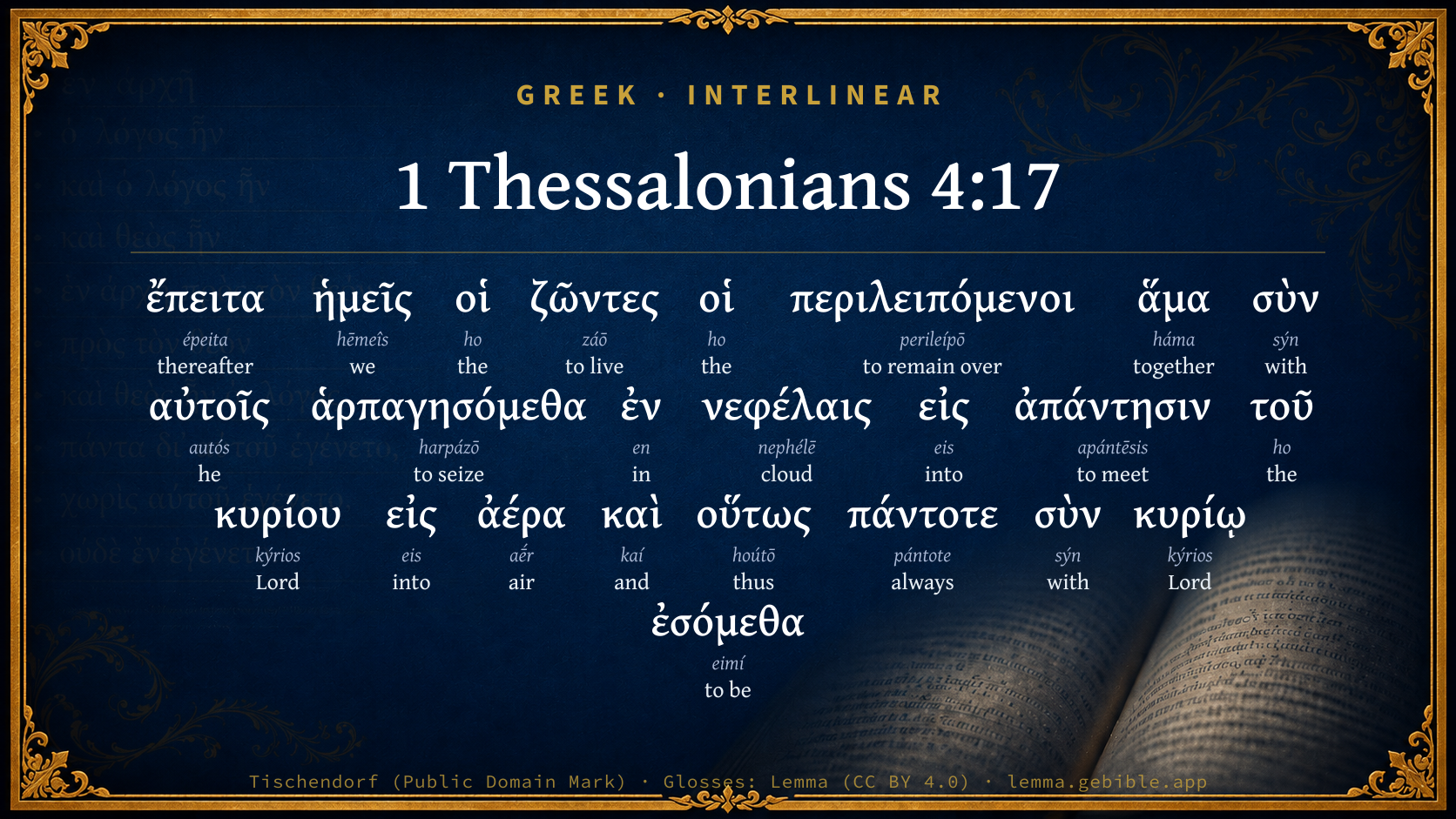
  1. ἔπειτα épeita G1899 “thereafter” Adverb
  2. ἡμεῖς hēmeîs G2249 “we” Personal pronoun, 1st person, Nominative, Plural
  3. οἱ ho G3588 “the” Article, Nominative, Plural, Masculine
  4. ζῶντες záō G2198 “to live” Verb, Present, Active, Participle, Nominative, Plural, Masculine
  5. οἱ ho G3588 “the” Article, Nominative, Plural, Masculine
  6. ἅμα háma G260 “together” Adverb
  7. σὺν sýn G4862 “with” Preposition
  8. αὐτοῖς autós G846 “he” Personal pronoun, Dative, Plural, Masculine
  9. ἁρπαγησόμεθα harpázō G726 “to seize” Verb, Future, Passive, Indicative, 1st person, Plural
  10. ἐν en G1722 “in” Preposition
  11. νεφέλαις nephélē G3507 “cloud” Noun, Dative, Plural, Feminine
  12. εἰς eis G1519 “into” Preposition
  13. ἀπάντησιν apántēsis G529 “to meet” Noun, Accusative, Singular, Feminine
  14. τοῦ ho G3588 “the” Article, Genitive, Singular, Masculine
  15. κυρίου kýrios G2962 “Lord” Noun, Genitive, Singular, Masculine
  16. εἰς eis G1519 “into” Preposition
  17. ἀέρα aḗr G109 “air” Noun, Accusative, Singular, Masculine
  18. καὶ kaí G2532 “and” Conjunction
  19. οὕτως hoútō G3779 “thus” Adverb
  20. πάντοτε pántote G3842 “always” Adverb
  21. σὺν sýn G4862 “with” Preposition
  22. κυρίῳ kýrios G2962 “Lord” Noun, Dative, Singular, Masculine
  23. ἐσόμεθα eimí G1510 “to be” Verb, Future, Middle deponent, Indicative, 1st person, Plural

About this verse

These counts appear in no published source. They are computed here, from the morphology-tagged text and Lemma’s own curated glosses. What Lemma adds →

24
words
19
distinct lemmas
Pauline Epistles
section

Notable vocabulary

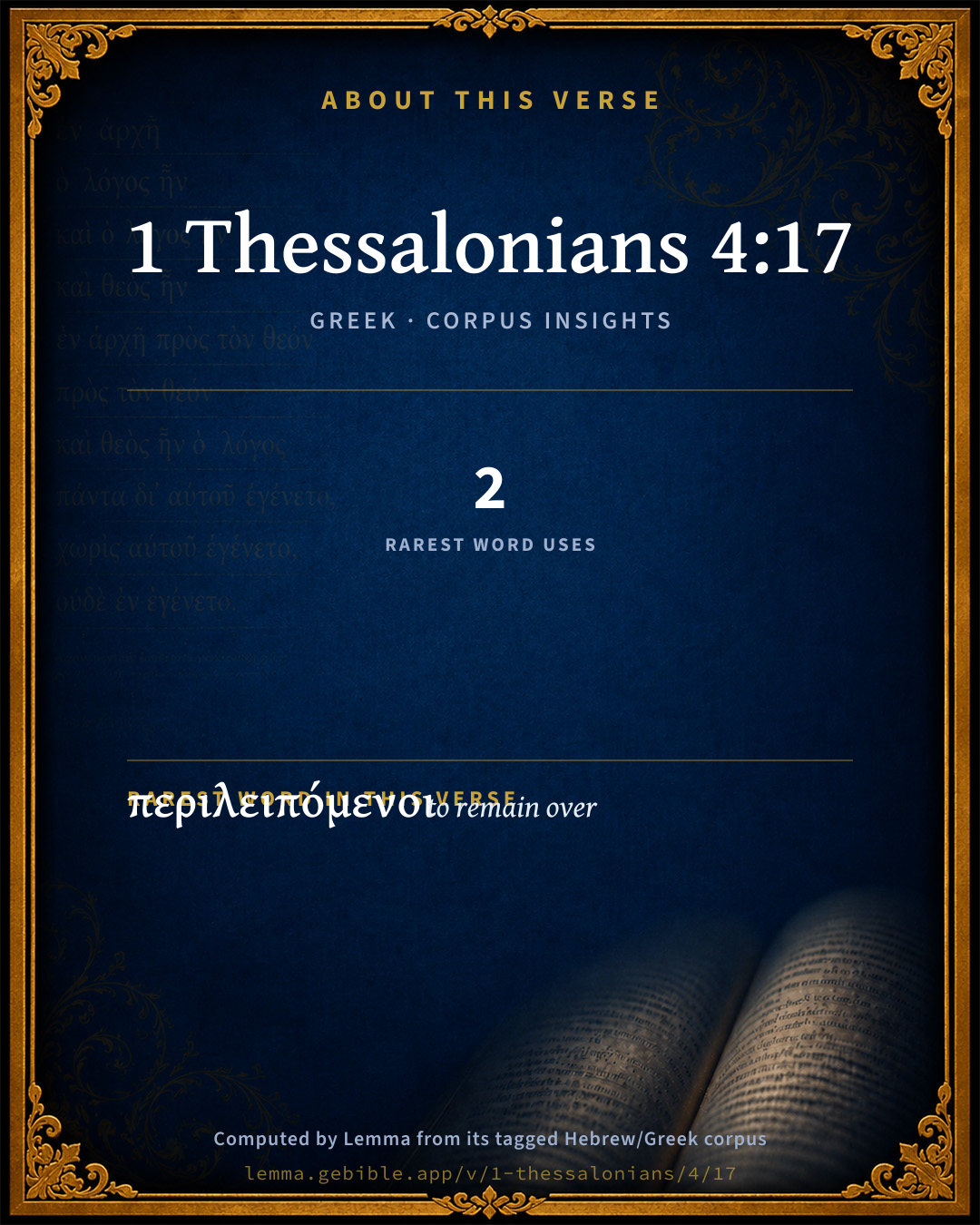
The rarest word here is περιλειπόμενοι to remain over G4035 — appearing just 2 times in the whole Greek New Testament.

Shared distinctive vocabulary

περιλειπόμενοι to remain over G4035 occurs in 2 verses of the Greek New Testament. Also found in:

Repetition

Words recur within this verse:

Cross-references

30

Topical passages linked to 1 Thessalonians 4:17 in the Treasury of Scripture Knowledge — connected by theme and wording, ordered by reader-vote popularity; previews shown in the World English Bible.

  • 1 Corinthians 15:52 in a moment, in the twinkling of an eye, at the last trumpet. For the trumpet will sound, and the dead will be raised incorruptible, and we will be changed.
  • Revelation 11:12 I heard a loud voice from heaven saying to them, "Come up here!" They went up into heaven in the cloud, and their enemies saw them.
  • John 14:3 If I go and prepare a place for you, I will come again, and will receive you to myself; that where I am, you may be there also.
  • 1 Thessalonians 4:15 For this we tell you by the word of the Lord, that we who are alive, who are left to the coming of the Lord, will in no way precede those who have fallen asleep.
  • Revelation 1:7 Behold, he is coming with the clouds, and every eye will see him, including those who pierced him. All the tribes of the earth will mourn over him. Even so, Amen.
  • Revelation 7:14–17 I told him, "My lord, you know." He said to me, "These are those who came out of the great tribulation. They washed their robes, and made them white in the Lamb's blood.
  • Daniel 7:13 I saw in the night-visions, and, behold, there came with the clouds of the sky one like a son of man, and he came even to the ancient of days, and they brought him near before him.
  • John 17:24 Father, I desire that they also whom you have given me be with me where I am, that they may see my glory, which you have given me, for you loved me before the foundation of the world.
  • Matthew 26:64 Jesus said to him, "You have said it. Nevertheless, I tell you, henceforth you will see the Son of Man sitting at the right hand of Power, and coming on the clouds of the sky."
  • John 12:26 If anyone serves me, let him follow me. Where I am, there will my servant also be. If anyone serves me, the Father will honor him.
  • Acts 1:9 When he had said these things, as they were looking, he was taken up, and a cloud received him out of their sight.
  • Acts 8:39 When they came up out of the water, the Spirit of the Lord caught Philip away, and the eunuch didn't see him any more, for he went on his way rejoicing.
  • 2 Corinthians 12:2–4 I know a man in Christ, fourteen years ago (whether in the body, I don't know, or whether out of the body, I don't know; God knows), such a one caught up into the third heaven.
  • Revelation 12:5 She gave birth to a son, a male child, who is to rule all the nations with a rod of iron. Her child was caught up to God, and to his throne.
  • Mark 14:62 Jesus said, "I AM. You will see the Son of Man sitting at the right hand of Power, and coming with the clouds of the sky."
  • Psalms 16:11 You will show me the path of life. In your presence is fullness of joy. In your right hand there are pleasures forevermore.
  • Isaiah 60:19–20 The sun shall be no more your light by day; neither for brightness shall the moon give light to you: but Yahweh will be to you an everlasting light, and your God your glory.
  • Revelation 22:3–5 There will be no curse any more. The throne of God and of the Lamb will be in it, and his servants serve him.
  • 1 Kings 18:12 It will happen, as soon as I am gone from you, that the Spirit of Yahweh will carry you I don't know where; and so when I come and tell Ahab, and he can't find you, he will kill me: but I your servant fear Yahweh from my youth.
  • 2 Kings 2:11 It happened, as they still went on, and talked, that behold, [there appeared] a chariot of fire, and horses of fire, which parted them both apart; and Elijah went up by a whirlwind into heaven.
  • 2 Kings 2:16 They said to him, See now, there are with your servants fifty strong men; let them go, we pray you, and seek your master, lest the Spirit of Yahweh has taken him up, and cast him on some mountain, or into some valley. He said, You shall not send.
  • Revelation 21:3–7 I heard a loud voice out of heaven saying, "Behold, God's dwelling is with people, and he will dwell with them, and they will be his people, and God himself will be with them as their God.
  • Psalms 17:15 As for me, I shall see your face in righteousness; I shall be satisfied, when I awake, with seeing your form.
  • 2 Corinthians 5:8 We are of good courage, I say, and are willing rather to be absent from the body, and to be at home with the Lord.
  • Philippians 1:23 But I am in a dilemma between the two, having the desire to depart and be with Christ, which is far better.
  • Psalms 49:15 But God will redeem my soul from the power of Sheol, For he will receive me. Selah.
  • 2 Peter 3:13 But, according to his promise, we look for new heavens and a new earth, in which dwells righteousness.
  • Isaiah 35:10 and the ransomed of Yahweh shall return, and come with singing to Zion; and everlasting joy shall be on their heads: they shall obtain gladness and joy, and sorrow and sighing shall flee away.
  • Revelation 21:22–23 I saw no temple in it, for the Lord God, the Almighty, and the Lamb, are its temple.
  • Psalms 73:24 You will guide me with your counsel, And afterward receive me to glory.

Cross-references courtesy of OpenBible.info (CC BY 4.0).

Commentary

Notes on 1 Thessalonians 4:17 from classic Christian and Jewish commentators (each source and its license shown beneath its notes). The classic Christian expositions comment on the surrounding passage and are grouped to its opening verse, so a note may address several verses; the Jewish commentaries on the Tanakh (Rashi and others) are per-verse, so they appear only where the commentator wrote on this verse.

Lemma curates 59 commentaries, every one of them public domain or Creative Commons licensed, each selected and text-cleaned for this edition rather than reprinted as found. About our sources →

Tyndale Open Study Notes

Tyndale Open Resources

4:17 to meet: This alludes to the custom of sending an official delegation to greet a visiting dignitary and accompany him as he enters the city (Matt 25:6, 10; Acts 28:15-16).

Tyndale Open Study Notes — © Tyndale Open Resources, licensed CC BY-SA 4.0. Text via the HelloAO Bible API.

Bengel's Gnomon

Johann Albrecht Bengel

1Th 4:17. Ἅμα) Ammonious, ἅμα μὲν ἐστι χρονικὸν ἐπίῤῥημα· ὁμοῦ δὲ, τοπικόν, “ἅμα is an adverb of time, ὁμοῦ of place.” You see here the propriety of the apostle’s language.—εἰς ἀέρα, in, or rather, [caught up] into the air) The ungodly will remain on the earth. The godly, having been acquitted, will be made assessors in the judgment.—καὶ οὕτω, and so) When Paul has written what needed to be written for consolation, he treats of [lit. he wraps up] the most important matters in this brief style.—πάντοτε, [ever] always) without any separation.—σὺν Κυρίῳ, with the Lord) not only in the air, but in heaven, whence He came.—ἐσόμεθα, we shall be) both [the living and those raised from the dead].

Bengel's Gnomon of the New Testament — English translation (T&T Clark, Edinburgh, 1860) — public domain. Text from a community e-Sword module.

Meyer's Critical & Exegetical Commentary

Heinrich August Wilhelm Meyer

1Th_4:17. Σὺν αὐτοῖς] i.e. with the raised νεκροὶ ἐν Χριστῷ.

ἁρπαγησόμεθα] we will be snatched away. The expression (comp. 2Co_12:4; Act_8:39) depicts the swiftness and irresistible force with which believers will be caught up. But, according to 1Co_15:50-53, the apostle must have conceived this ἁρπάζεσθαι as only occurring after a change has taken place in their former earthly bodies into heavenly, to qualify them for a participation in the eternal kingdom of the Messiah.

ἐν νεφέλαις] not instead of εἰς νεφέλας (Moldenhauer), but either in clouds, i.e. enveloped in clouds, or better, on clouds, i.e. enthroned in their midst. According to the Old Testament representation (Psa_104:3), God rides on clouds as on a triumphal chariot. Also the Messiah appears on clouds (Dan_7:13). According to Act_1:9, Christ ascended to heaven on a cloud; and according to Act_1:11, Mat_24:30, He will return on a cloud. Theodoret: Ἔδειξε τὸ μέγεθος τῆς τιμῆς· ὥσπερ γὰρ αὐτὸς ὁ δεσπότης ἐπὶ νεφελῆς φωτεινῆς ἀνελήφθη, οὕτω καὶ οἱ εἰς αὐτὸν πεπιστευκότες κ.τ.λ.

εἰς ἀπάντησιν τοῦ κυρίου] to the meeting of the Lord, i.e. in order to be led towards the Lord. εἰς ἀπάντησιν, corresponding to the Hebrew לִקְרַאת, is united both with the genitive (Mat_25:1; Mat_25:6), as here, and with the dative (Act_28:15). From the words it follows that the apostle did not think of Christ descending completely down to the earth.

εἰς ἀέρα] into the air, belongs to ἁρπαγησόμεθα, and can as little be considered as equivalent to εἰς τοὺς οὐρανούς (Flatt) as it can denote through the air, i.e. through the air to the higher regions (Flatt). Nor, on the other hand, can it be the apostles meaningalthough Pelt, Usteri, Paulin. Lehrbegr. pp. 356, 359 (hesitatingly), and Weizel in the Theol. Stud. u. Krit. 1836, p. 935 f. assume itthat the Christian host would be caught up into the air, in order to have their permanent abode with Christ in the air. For, according to 2Co_5:1, the future eternal abode of Christians is ἐν τοῖς οὐρανοῖς.[60] Nevertheless the apostle was constrained to express himself as he has done. For when Christ descends down from heaven, and Christians are caught up to meet Him, the place of meeting can only be a space between heaven and earth, i.e. the air. Comp. Augustine, de civit. Dei, xx. 20, 1 Thessalonians 2 : Quod enim ait … non sic accipiendum est, tanquam in aëre nos dixerit semper cum domino esse mansuros; quia nec ipse utique ibi manebit, quia veniens transiturus est. Venienti quippe ibitur obviam, non manenti. But that Paul adds nothing concerning the removal of the glorified Christian host to heaven, following their being caught up with Christ, and of the resurrection of all men connected with the advent, along with the judgment of the world, is naturally explained, because the description of the advent as such is not here his object, but his design is wholly and entirely to satisfy the doubts raised by the Thessalonians in respect of the advent.[61] But to effect this purpose it was perfectly sufficient that he now, specifying the result of the points described, proceeds: ΚΑῚ ΟὝΤΩς ΠΆΝΤΟΤΕ ΣῪΝ ΚΥΡΊῼ ἘΣΌΜΕΘΑ] and so shall we ever be united with the Lord.

οὕτως] so, that is, after that we have actually met with Him. It refers back to εἰς ἀπάντησιν.

σύν] imports more than ΜΕΤΆ. It expresses intimate union, not mere companionship.

ἘΣΌΜΕΘΑ] comprehends as its subject both ΝΕΚΡΟῚ ἘΝ ΧΡΙΣΤῷ and the ΖῶΝΤΕς.

[60] Also on this account Paul cannot have thought on a permanent residence on the glorified earth (Georgii in Zellers theol. Jahrb. 1845, I. p. 6, and Hilgenfeld in the Zeitsch. f. wiss. Theol., Halle 1862, p. 240).

[61] For the same reason also the silence concerning the change of believers who happened to be alive at the advent is justified. Against Schrader, who thinks on account of this silence that the author must have conceived the circumstances of the advent in an entirely sensible manner; the incongruities of this representation, if it is understood sensibly, cannot be Pauline, because with Paul the doctrine of the last things has a purely (?) spiritual character.

Meyer — Critical and Exegetical Commentary on the New Testament — English translation by Peter Christie, edited by Frederick Crombie (T&T Clark, 1880) — public domain. Text from a community e-Sword module.

Expositor's Greek Testament

ed. W. Robertson Nicoll

1Th 4:17 . ἐν νεφέλαις , the ordinary method of sudden rapture or ascension to heaven (Act 1:9 ; Act 1:11 ; Rev 11:12 ; Slav. En. iii. 1, 2). ἁρπαγησόμεθα . So in Sap. 1Th 4:11 , the righteous man, εὐάρεστος τῷ θεῷ (1Th 4:1 ) γενόμενος ἠγαπήθη (1Th 1:4 ), is caught up ( ἡρπάγη ). ἅμα σὺν αὐτοῖς … σὺν Κυρίῳ , the future bliss is a re-union of Christians not only with Christ but with one another. εἰς ἀπάντησιν , a pre-Christian phrase of the koinê ( cf. e.g., Tebtunis Papyri , 1902, pt. i., n. 43, 7, παρεγενήθημεν εἰς ἀπάντησιν , κ . τ . λ ., and Moulton, i. 14), implying welcome of a great person on his arrival. What further functions are assigned to the saints, thus incorporated in the retinue of the Lord (1Th 3:13 ; cf. 2Th 1:10 ), whether, e.g. , they are to sit as assessors at the judgment (Sap. 1Th 3:8 ; 1Co 6:2-3 ; Luk 22:30 ) Paul does not stop to state here. His aim is to reassure the Thessalonians about the prospects of their dead in relation to the Lord, not to give any complete programme of the future (so Mat 24:31 ; Did. x., xvi.). Plainly, however, the saints do not rise at once to heaven, but return with the Lord to the scene of his final manifestation on earth (so Chrysost., Aug., etc.). They simply meet the Lord in the air, on his way to judgment a trait for which no Jewish parallel can be found. καὶ οὕτως πάντοτε σὺν κυρίῳ ἐσόμεθα (no more sleeping in him or waiting for him).

The Expositor's Greek Testament, edited by W. Robertson Nicoll (1897–1910) — public domain. Text from a community e-Sword module.

Geneva Bible (1599)

Geneva Bible translators

Suddenly and in the twinkling of an eye.

Geneva Bible (1599) marginal notes — public domain. Text via Bolls.life.

Jamieson, Fausset & Brown

Robert Jamieson, A. R. Fausset & David Brown

we which are alive . . . shall be caught up--after having been "changed in a moment" (Co1 15:51-52). Again he says, "we," recommending thus the expression to Christians of all ages, each generation bequeathing to the succeeding one a continually increasing obligation to look for the coming of the Lord. [EDMUNDS].

together with them--all together: the raised dead, and changed living, forming one joint body.

in the clouds--Greek, "in clouds." The same honor is conferred on them as on their Lord. As He was taken in a cloud at His ascension (Act 1:9), so at His return with clouds (Rev 1:7), they shall be caught up in clouds. The clouds are His and their triumphal chariot (Psa 104:3; Dan 7:13). ELLICOTT explains the Greek, "robed round by upbearing clouds" [Aids to Faith].

in the air--rather, "into the air"; caught up into the region just above the earth, where the meeting (compare Mat 25:1, Mat 25:6) shall take place between them ascending, and their Lord descending towards the earth. Not that the air is to be the place of their lasting abode with Him.

and so shall we ever be with the Lord--no more parting, and no more going out (Rev 3:12). His point being established, that the dead in Christ shall be on terms of equal advantage with those found alive at Christ's coming, he leaves undefined here the other events foretold elsewhere (as not being necessary to his discussion), Christ's reign on earth with His saints (Co1 6:2-3), the final judgment and glorification of His saints in the new heaven and earth.

Jamieson, Fausset & Brown — Commentary Critical and Explanatory on the Whole Bible (1871) — public domain (CC PDM 1.0). Text via the HelloAO Bible API.

John Calvin's Commentaries

17 And so we shall be ever. To those who have been once gathered to Christ he promises eternal life with him, by which statements the reveries of Origen and of the Chiliasts are abundantly refuted. For the life of believers, when they have once been gathered into one kingdom, will have no end any more than Christ’s. Now, to assign to Christ a thousand years, so that he would afterwards cease to reign, were too horrible to be made mention of. Those, however, fall into this absurdity who limit the life of believers to a thousand years, for they must live with Christ as long as Christ himself will exist. We must observe also what he says — we shall be, for he means that we profitably entertain a hope of eternal life, only when we hope that it has been expressly appointed for us.

John Calvin's Commentaries (1540-1563) — public domain. Text from the Calvin Translation Society English edition (1840s-50s) via the Christian Classics Ethereal Library (ccel.org). Calvin's coverage is partial (roughly two-thirds of the Bible); uncommented books and verses are honest gaps, never fabricated. The 19th-century editor's footnotes and remarks are omitted so the notes are faithfully Calvin's own voice.

Ellicott's Commentary for English Readers

(17) Shall be caught up.—“Our Assumption,” as Bishop Ellicott well calls it. The spiritualising of our natural bodies without death, as described in 1Co_15:50, et seq., will enable us to be “caught up” equally well with, and in company with (both of which thoughts are included in “together with”), the resurgent dead. “Clouds” and “air” will be support enough for material so immaterial. Theodoret says, “He showeth the greatness of the honour: as the Master Himself was taken up upon a shining cloud, so also they that have believed in Him.” The absolute equality, then, of quick and dead is proved.

To meet the Lord in the air.—St. Chrysostom says:” When the King cometh into a city, they that are honourable proceed forth to meet him, but the guilty await their judge within.” The phrase “in the air” certainly does not mean “heaven.” The word “air”) in itself properly signifies the lower, denser, grosser atmosphere, in which the powers of darkness reign (Eph_2:2); but here it is only used in contrast with the ground, and means “on the way from Heaven whence He comes,” of course not to dwell there, but to accompany Him to His Judgment-seat on the earth.

And so.—Now that St. Paul has settled the question of disparity between the dead and the living, he does not think it necessary to describe what is immediately to follow; that, the Thessalonians were sure to know (see Heb_6:2): it only remains to say that having once rejoined the Lord, they would never be parted from Him.

A Bible Commentary for English Readers, edited by Charles John Ellicott (1878–1897) — public domain. Text from a community e-Sword module.

The Cambridge Bible for Schools and Colleges

gen. ed. J. J. S. Perowne

17. then we which are alive and remain] Better, we that are alive, that remain (or survive). The phrase of 1Th_4:15 repeated; see note. The Apostle distinguishes, as in 1Co_15:51-52, between those “living” and those “dead in Christ” at the time of His advent, marking the different position in which these two divisions of the saints will then be found.

shall be caught up together with them in the clouds] In the Greek order: together with them will be caught up in the clouds, emphasis being thrown on the precedence of the dead: “we the living shall join their company, who are already with the Lord.” Together with implies full association.

“Caught” in the original implies a sudden, irresistible force,—seized, snatched up! In Mat_11:12 it is rendered, “The violent take it by force;” in 2Co_12:2; 2Co_12:4 St Paul applies it to his rapture into the third heaven.

“In” signifies not into, but “amid clouds,”—surrounding and upbearing us “like a triumphal chariot” (Grotius). So Christ Himself, and the angels at His Ascension, promised He should come (Mat_26:68; Act_1:9-11); comp. the “bright overshadowing cloud” at the Transfiguration, and the “voice out of the cloud” (Mat_17:5). There is something wonderful and mystical about the clouds, half of heaven and half of earth, that fits them to be the medium of such events. They lend their ethereal drapery to form the curtain and canopy of this glorious meeting. “What belongs to cloudland is no less real than if set down on the solid ground.”

Such a raising of the living bodies of the saints, along with the risen dead, implies the physical transformation of the former to which the Apostle afterwards alludes in 1Co_15:51 : “we shall not all sleep, but we shall all be changed” (comp. 2Co_5:1-4; Php_3:21). Some change had taken place in the sacred body of Jesus after His resurrection, for it was emancipated from the ordinary laws of matter. And this transformation the Apostle conceived to be possible without dissolution.

to meet the Lord in the air] Lit., into (raised into) the air. “The air,” like the “clouds,” belongs to the interspace between the heaven from which Christ comes and the earth to which He returns. Here He will meet His Church. She will not need to wait until He sets foot on earth; but those who are ready, “looking for their Lord when He shall return” (Luk_12:35-40), will hear His trumpet call and “go forth to meet the Bridegroom” (Mat_25:1; Mat_25:6). St Paul employs the same, somewhat rare Hebraistic idiom which is found in this passage of St Matthew, as though the words of Christ lingered in his ear.

and so shall we ever be with the Lord] Where the Apostle does not say; whether still on earth for some longer space, or in heaven. The one and all-sufficing comfort is in the thought of being always with the Lord. This, too, was the promise of Christ, “Where I am, there shall also My servant be” (Joh_12:26; Joh_14:3). Those living in the flesh cannot be so in any complete sense; “at home in the body,” we are “absent from the Lord” (2Co_5:6).

The Cambridge Bible for Schools and Colleges (gen. ed. J. J. S. Perowne; Cambridge University Press, 1878–1918) — public domain. Text from a community e-Sword module.

John Gill's Exposition

Then we which are alive and remain,.... See Gill on Th1 4:15.

shall be caught up; suddenly, in a moment, in the twinkling of an eye, and with force and power; by the power of Christ, and by the ministry and means of the holy angels; and to which rapture will contribute, the agility which the bodies both of the raised and changed saints will have: and this rapture of the living saints will be

together with them; with the dead in Christ, that will then be raised; so that the one will not come before the other, or the one be sooner with Christ than the other; but the one being raised and the other changed, they will be joined in one company and general assembly, and be caught up together:

in the clouds; the same clouds perhaps in which Christ will come, will be let down to take them up; these will be the chariots, in which they will be carried up to him; and thus, as at our Lord's ascension a cloud received him, and in it he was carried up out of the sight of men, so at this time will all the saints ride up in the clouds of heaven:

to meet the Lord in the air; whither he will descend, and will then clear the regions of the air of Satan, and his posse of devils, which now rove about there, watching all opportunities, and taking all advantages to do mischief on earth; these shall then fall like lightning from heaven, and be bound and shut up in the bottomless pit, till the thousand years are ended: here Christ will stop, and will be visible to all, and as easily discerned by all, good and bad, as the body of the sun at noonday; as yet he will not descend on earth, because it is not fit to receive him; but when that and its works are burnt up, and it is purged and purified by fire, and become a new earth, he will descend upon it, and dwell with his saints in it: and this suggests another reason why he will stay in the air, and his saints shall meet him there, and whom he will take up with him into the third heaven, till the general conflagration and burning of the world is over, and to preserve them from it; and then shall all the elect of God descend from heaven as a bride adorned for her husband, and he with them, and the tabernacle of God shall be with men; see Rev 21:1. The resurrection by the Mahometans is called (q), "a meeting of God", or a going to meet God:

and so shall we ever be with the Lord; now the saints are with him at times, and have communion with him, but not always; but then they shall be ever with him; wherever he is; first in the air, where they shall meet him; then in the third heaven, where they shall go up with him; then on earth, where they shall descend and reign with him a thousand years; and then in the ultimate glory to all eternity: and this will be the issue and accomplishment of the counsel and covenant of grace, of the sufferings and death of Christ, and of his preparations and prayers.

(q) Alkoran, Surat. 6. v. 31. p. 113. Ed. Hinckelman.

John Gill's Exposition of the Whole Bible (1746–1763) — public domain (CC PDM 1.0). Text via the HelloAO Bible API.

Trapp's Complete Commentary

John Trapp

17 Then we which are alive and remain shall be caught up together with them in the clouds, to meet the Lord in the air: and so shall we ever be with the Lord.

Ver. 17. Then we which are alive] He speaketh thus of himself as alive at Christ’s coming, because we should daily expect it, and even hasten to it.

Shall be caught up together] This is that mystery mentioned 1Co 15:51, and not till now made known to the world. {See Trapp On "1Co 15:51"}

In the clouds] As Christ also ascended, Act 1:9. These be the wagons and chariots that Christ will send for us, as Joseph sent his father’s family down to Egypt.

And so shall we ever be, &c.] Oh, blessed hour! oh, thrice happy union! Nothing ever came so near it as the meeting of Jacob and Joseph, or of those two cousins, Mary and Elizabeth, Luk 1:39-45.

John Trapp, A Commentary or Exposition upon All the Books of the Old and New Testament (1647–1656) — public domain. Text from a community e-Sword module.

Albert Barnes' Notes on the Bible

Then we which are alive - Those who shall then be alive; see 1Th 4:15. The word here rendered “then” (ἔπειτα epeita), does not necessarily mean that this would occur immediately. It properly marks succession in time, and means “afterward, next, next in the order of events;” Luk 16:7; Gal 1:21; Jam 4:14. There may be a considerable interval between the resurrection of the pious and the time when the living shall be caught up to meet the Lord, for the change is to take place in them which will fit them to ascend with those who have been raised. The meaning is, that after the dead are raised, or the next thing in order, they and the living will ascend to meet the Lord. The proper meaning of the word, however, denotes a succession so close as to exclude the idea of a long interval in which other important transactions would occur, such an interval, for example, as would be involved in a long personal reign of the Redeemer on earth. The word demands this interpretation - that the next thing in order after the resurrection of the righteous, will be their being caught up with the living, with an appropriate change, into the air - though, as has been remarked, it will admit of the supposition of such a brief, momentary interval ἐν ἄτομος ἐν ῥιπη ὀφθαλμου en atomos en rhipē ophthalmou, 1Co 15:51-52) as shall be necessary to prepare for it.

Shall be caught up - The word here used implies that there will be the application of external force or power by which this will be done. It will not be by any power of ascending which they will themselves have; or by any tendency of their raised or changed bodies to ascend of their own accord, or even by any effort of their own will, but by a power applied to them which will cause them to rise. Compare the use of the word ἁρπάζω harpazō in Mat 11:12, “the violent take it by force;” Mat 13:19, “then cometh the wicked one and snatcheth away;” Joh 6:15, “that they would come and take him by force; Joh 10:12, “the wolf catcheth them;” Act 8:39, “the Spirit of the Lord caught away Philip; 2Co 12:2, “such an one caught up to the third heaven;” also, Joh 12:28-29; Act 23:10; Jud 1:23; Rev 12:5. The verb does not elsewhere occur in the New Testament In all these instances there is the idea of either foreign force or violence effecting that which is done. What force or power is to be applied in causing the living and the dead to ascend, is not expressed. Whether it is to be by the ministry of angels, or by the direct power of the Son of God, is not intimated, though the latter seems to be most probable. The word should not be construed, however. as implying that there will be any reluctance on the part of the saints to appear before the Saviour, but merely with reference to the physical fact that power will be necessary to elevate them to meet him in the air. Will their, bodies then be such that they will have the power of locomotion at will from place to place?

In the clouds - Greek, “in clouds” - ἐν νεφέλαις en nephelais - without the article. This may mean “in clouds;” that is, in such numbers, and in such grouping as to resemble clouds. So it is rendered by Macknight, Koppe, Rosenmuller, Bush (Anasta. 266), and others. The absence of the article here would rather seem to demand this interpretation Still, however, the other interpretation may be true, that it means that they will be caught up into the region of the clouds, or to the clouds which shall accompany the Lord Jesus on his return to our world. Mat 24:30; Mat 26:64; Mar 16:19; Mar 14:62; Rev 1:7; compare Dan 7:13. In whichever sense it is understood, the expression is one of great sublimity, and the scene will be immensely grand. Some doctrine of this kind was held by the ancient Jews. Thus rabbi Nathan (Midras Tillin, 48:13) says, “What has been done before will be done again. As he led the Israelites from Egypt in the clouds of heaven, so will he do to them in the future time.”

To meet the Lord in the air - In the regions of the atmosphere - above the earth. It would seem from this, that the Lord Jesus, in his coming, would not descend to the earth, but would remain at a distance from it in the air, where the great transactions of the judgment will occur. It is, indeed, nowhere said that the transactions of the judgment will occur upon the earth. The world would not be spacious enough to contain all the assembled living and dead, and hence the throne of judgment will be fixed in the ample space above it.

And so shall we ever be with the Lord - This does not mean that they will always remain with him in the air - for their final home will be heaven - and after the trial they will accompany him to the realms of glory; Mat 25:34, “Come, ye blessed of my Father, inherit the kingdom,” etc. The time during which they will remain with him “in the air” is nowhere mentioned in the Bible. It will be as long as will be necessary for the purposes of judging a world and deciding the eternal doom of every individual “according to the deeds done in the body.” There is no reason to suppose that this will be accomplished in a single day of twenty-four hours; but it is impossible to form and conjecture of the period which will be occupied.

Albert Barnes' Notes on the Bible (1834–1885) — public domain. Text from a community e-Sword/MySword module.

Matthew Poole's English Annotations

Christ will have a church to the end of the world, and some will be found alive at his coming, and will be

caught up, or snatched up, to denote its suddenness, it may be in the arms of angels, or by some immediate attractive power of Christ; and it will be

together with them that are now raised from the dead; they shall all ascend in one great body, and it will be

in the clouds; as Christ himself ascended in a cloud, Act 1:9, and so will return again, Mat 24:30, he making the clouds his chariots, Psa 104:3.

To meet the Lord in the air:

1. To congratulate his coming, when others shall flee and tremble.

2. To put honour upon him; as the angels will also attend him for that end.

3. To receive their final discharge.

4. To be visibly joined to their Head.

5. To be assistants with him in judging of the world, and to reign with him upon earth.

And whether the last judgment will be upon the earth, or in the air, I shall not determine; but after this Christ and his saints shall never part. Their first meeting shall be in the air, and their continuance will be with him while he is in this lower world, and after that they shall ascend with him into heaven, and so be for ever with him. Augustine imagined that the saints that are found alive shall in their rapture die, and then immediately revive, because it is appointed to all men once to die; but the apostle saith expressly: We shall not all die, but we shall all be changed, 1Co 15:51.

Matthew Poole's English Annotations on the Holy Bible (1683–1685) — public domain. Text from a community e-Sword/MySword module.

Whedon's Commentary on the Bible

Daniel D. Whedon

17. Then we—After the dead have first risen.

Caught up—This upward movement is preceded by the change by which this mortal puts on immorality. By that change the glorified body is able to neutralize gravitation by volition. But in this case they are caught up by divine power, the phrase implying great suddenness.

With them—The dead in Christ.

In the clouds—The passage quoted by Alford from Theodoret, comparing this to our Lord’s ascent upon a cloud, misses the mark. The true parallels are Dan_7:13, and Rev_1:7 : “Behold, he cometh with clouds;” an image of altitude and misty grandeur.

In the air— Simply a designation of locality or region; aerial space. Eph_1:3; Eph_2:2. The grand congregation of the judgment may be in pure space; for these resurrection bodies, absolved from the power of gravitation, and of power by pure volition, can tread upon a plane of pure space as easily as Jesus trod upon the sea, or as we tread upon a pavement. Of a burning world, a resurrection and condemnation of the wicked, and a new earth, no account is here given; for, as Lunemann well notes, St. Paul does not here profess to give a full picture of the last things, but simply such a glimpse as shall meet the doubt and grief in regard to the late deceased Christians.

Ever be with the Lord—Not as limited to this one mid-space region, though it and the new earth may be within their future range; but in the highest heaven, the capital of the great system centred by the throne. And now science demands, Where is the final heaven of the glorious resurrection, as distinguished from the intermediate paradise of the blessed disembodied spirit? And where is the final hell, gehenna, as distinguished from the hades or Tartarus of the intermediate state of the impenitent? See note on 2Co_12:1-4; Eph_1:2; Eph_4:8-10.

Astronomers of the present day assure us that all planets are destined, in time, to narrow their orbits, lose their heat, and fall into the sun. The sun, as satellite to a greater sun, is to fall into and be swallowed by its central sun; and finally, the utmost central sun will swallow the whole system of stars and suns, from which all heat will have departed and form a final lifeless, frozen char. It may be, then, that our whole material system of worlds, as well as our earth, is under the doom of sin, sin older than the fall of Adam, and so may be destined to become the eternal abode and monument of sin and wrath. The “everlasting fire” of Mat_25:41, was prepared for sinners older than man, namely, the devil and his angels. This may be the final Gehenna. But whither goes the energy, which scientists tell us is departing with the heat from the present entire material system, and pouring into immensity? The ingenious authors of the “Unseen Universe” suggest that it goes to crystallize into a future universe, including that Future State, that Heaven of the resurrection, to which our faith is looking. So he who is Lord of all said to his disciples, “I go to prepare a place for you.” That place may be in the present highest heavens; the circumambient zone that girds our starry universe, separating it, perhaps, from other universes, with which our history does not connect. That future state, formed of the pure forces that gave life and power to this dark system, may be the new heavens and earth “wherein dwelleth righteousness.” It may gradually supplant our present stellar system.

The terms distinguishing the regions of the invisible world are so irregularly translated that the English reader may be aided by the following summary:— Hades (which should never be rendered hell, but be used in English without change as the generic name of the intermediate abode) occurs in the following passages: Mat_11:29; Mat_16:18; Luk_12:15; Luk_16:23; Act_2:27; Act_2:31; 1Co_15:55; Rev_1:18; Rev_6:8; Rev_20:13.

Paradise, (the blessed phase of hades,) Luk_23:43; 2Co_12:4; Rev_2:7. A comparison of Rev_2:7, with Rev_22:2 suggests, that as in the eternal state beyond the judgment hades is merged in gehenna, (Rev_20:14,) so paradise is merged in the eternal heaven. Tartarus, in verb form, (the adverse phase of hades,) 2Pe_2:4. Gehenna, (hell,) the final opposite of heaven. Mat_5:22; Mat_5:29; Mat_10:28; Mat_18:9; Mat_23:15; Mat_23:33; Mar_9:43; Mar_9:47; Luk_12:5; James 3, 6.

Daniel D. Whedon (gen. ed.), Commentary on the Old and New Testaments (1874–1909) — public domain. Text from a community e-Sword module.

The Pulpit Commentary

Then we which are alive and remain; or, are left; that is, the saints who shall then be found alive on the earth. The apostle classes himself among the living, because he was then alive. Shall be caught up. The expression describes the irresistible power with which the saints shall be caught up, perhaps by the ministry of angels. Together with them; with the dead in Christ who are raised. In the clouds. Our Lord is described as coming to judgment in the clouds of heaven. (Mat_24:30; Rev_1:7) According to the Old Testament representation, God is described as making the clouds his chariot. (Psa_104:3) To meet the Lord; in his descent from heaven to earth. In the air. Not that he shall fix his throne in the air, but that he passes through the air in his descent to the earth. And so shall we ever be with the Lord; shall share a blessed eternity in the vision and participation of his glory. The apostle does not here describe the solemnities of the judgment; but stops at the meeting of Christ and his risen saints, because his object was to comfort the Thessalonians under bereavement.

The Pulpit Commentary (1880–1919), ed. H.D.M. Spence-Jones & Joseph S. Exell — public domain. Text from a community e-Sword module.

John Wesley's Explanatory Notes

Together - In the same moment. In the air - The wicked will remain beneath, while the righteous, being absolved, shall be assessors with their Lord in the judgment. With the Lord - In heaven.

John Wesley, Explanatory Notes Upon the Whole Bible (1754–1765) — public domain. Text via the GEBible commentary corpus.

Scofield Reference Notes

C. I. Scofield

caught up

Not church saints only, but all bodies of the saved, of whatever dispensation, are included in the first resurrection. (See Scofield "1Co 15:52") as here described, but it is peculiarly the "blessed hope" of the Church (cf) Mat 24:42; Mat 25:13; Luk 12:36-48; Act 1:11; Php 3:20; Php 3:21; Tit 2:11-13.

The Scofield Reference Bible (1917 edition), notes by C. I. Scofield — public domain. Text from a community e-Sword module.

Burkitt's Expository Notes on the New Testament

William Burkitt

Observe here, 1. The triumphant ascension both of the living and sleeping saints, together into the clouds; We which are alive shall be caught up together with them in the clouds. This ascension shall be effected by the power of Christ, by the ministry of angels, and by the spirituality of the saints’ own bodies.

Learn hence, that the descent of the saints of God into the grave, is not with so much weakness, ignominy, and abasement, as their ascent after the resurrection, to meet their Lord in the air, shall be with power, triumph, and glory: Christ shall draw them, clouds shall carry them, angels shall conduct them.

Observe, 2. The blessed meeting of all the saints together in one body, to take their flight together to meet the Lord Jesus, who comes from the third heaven to meet them in the lower region of the air, when Christ will own them in their persons, own them in their services, own them in their sufferings, and they shall receive their full and final benediction from the mouth of Christ, and take an everlasting possession of the heavenly kingdom, together with Christ.

Observe, 3. The saints’ cohabitation and fellowship with Christ, together with its extent and duration, they shall ever be with the Lord. This implies the saints’ presence with Christ, their vision and sight of him, their fruition and enjoyment of him, their delectation of him, their conformity to him.

Learn hence, that the top and height of the saints’ blessedness in heaven consists in this, that they shall for ever be there with Christ.

William Burkitt's Expository Notes on the New Testament (1700–1703) — public domain. Text from a community e-Sword module.

McGarvey & Pendleton's Commentaries

J. W. McGarvey

then we that are alive, that are left, shall together with them be caught up in the clouds, to meet the Lord in the air: and so shall we ever be with the Lord . [Some, mistaking the spiritual resurrection mentioned at Rev_20:4-5 ; for a literal one, have thought that there are two resurrections, one for the righteous (the first resurrection) and one for the wicked (the second resurrection). Of course such a doctrine is abhorrent to the idea of a single hour of judgment, with the saved upon the right hand and the lost upon the left, but it shall be fully discussed in its own place. Those who hold this theory appeal to this passage in proof of it, reading it thus: "The dead in Christ shall rise first, and the dead out of Christ shall rise second." But in order to make it read thus they have supplied a correlative clause which is totally foreign to the context, and which crowds out the correlative which Paul himself has given; for "shall rise first" is correlative with "then shall be caught up." The apostle has been drawing a comparison, not between the righteous dead and the unrighteous dead, but between the dead and the living at the hour of the advent. He began this comparison at verse 15, and he here completes it by showing that the supposition that the living would precede the dead is so contrary to the facts that, on the contrary, the dead will be raised before any ascension is allowed the living, and then after the resurrection of the dead, the living and the dead shall be caught up together to meet the Lord. That glorious change, wherein the mortal puts on the immortal, as indicated at 1Co_15:51 ; 1Co_15:55 ; will no doubt be simultaneous with the resurrection of the dead. The phrase "caught up" implies the sudden and irresistible power of God. We are not to understand that we are to be caught up with clouds, but that we will meet him who comes with clouds ( Dan_7:13 ; Rev_1:7 ; Mat_24:30 ). He makes the clouds his chariot ( Psa_104:3 ). The term "air" is used generally for the region above the earth. No doubt we will be caught up far beyond our atmosphere into the realm of pure space-- Eph_1:3 ; Eph_2:2 ]

J. W. McGarvey (with Philip Y. Pendleton), Commentaries on the New Testament (The Fourfold Gospel, 1914; Acts; and the epistles) — public domain. Text from a community e-Sword/MySword module.

The People's New Testament

B. W. Johnson

17. Then we, etc. All the church, the saints of past ages, and the saints of the last age, shall ascend together to meet the Lord. So shall we ever be with the Lord. That glorious meeting shall never end.

B. W. Johnson's The People's New Testament with Notes (1889–1891) — public domain. Electronic text from the Christian Classics Ethereal Library (CCEL) ThML edition.

Cambridge Greek Testament for Schools and Colleges

17. For απαντησιν, υπ- D*G. For του κυριου Db, latt vg, most Lat Fathers, read τῳ κυριῳ (obviam domino); D*G, with some Latins, τῳ χριστῳ. The dative may be a Latinism; but cf. Act 28:15.

Instead of συν B reads εν κυριῳ: “ganz gedankenlos” (Weiss).

Cambridge Greek Testament for Schools and Colleges (Cambridge University Press, 1896; 21 vols, various authors incl. Carr, Maclear, Plummer, Farrar, Lumby, Moule, M. R. James, Simcox) — public domain. Text from a community e-Sword module.

International Critical Commentary

17. ἔπειτ … ἁρπαγησόμεθα κτλ. “Then, presumably at no great interval after the resurrection, ἡμεῖς οἱ ζῶντες οἱ περιλειπόμενο (as in v. 13; it is unnecessary here to add εἰς τὴν παρουσίαν τοῦ κυρίο) shall be caught up simultaneously (ἅμ) with the risen saints (σὺν αὐτοῖ) and carried by clouds to meet the Lord in the air.” The rapture is a supernatural act as in Act 8:39, Rev 12:5; cf. 2Co 12:2 ff. The means (ἐ), not the agent (ὑπο; cf. Baruch 4:26), by which the rapture is executed is the clouds which, as in Elijah’s case (4 Reg. 2:11), are conceived as a triumphal chariot. Slavonic Enoch 3:1 ff. (ed. Morfill and Charles; noted also by Mill.) is in point: “These men (that is, angels) summoned me and took me on their wings and placed me on the clouds. And lo, the clouds moved. And again, going still higher, I saw the ether and they placed me in the first heaven.”

ἅμα σύ occurs in Gk. Bib. only here and 5:10; Vulg has here simul rapiemur cum; in 5:10, am. fuld. omit simul. In Gk. Bib. ἅμ is regularly an adverb (Pro 22:18, etc.); in Mat 13:29, Mat 20:1, it is a preposition. Ell. remarks: “We shall be caught up with them at the same time that they shall be caught up, ἅμ marking as usual connection in point of time.” The phrase gives the most precise statement of the equality of advantage that we have; it does not appear in the summary of the agraphon in v. 15. GF m Ambst omit οἱ περιλειπόμενο; B has οι περιλειμενο In the syn. gospels, the cloud appears, apart from the transfiguration and Luk 12:54, only in connection with the Parousia of the Son of Man. The influence of Dan 7:13 is felt where Lxx has ἐπὶ τῶν νεφελῶ (Mat 24:30, Mat 26:64) and Th. μετα (Mar 14:62; cf. Rev 1:7). The ἐ, however, is given by Mar 13:26 = Luk 21:27; see further Rev 11:12 (ἐ), 4 Ezra 13:3 (cum), and Exo 34:5 (κατέβη κύριος ἐν νεφέλῃ); and cf. Act 1:11 with 1:9.

εἰς ἀπάντησιν κτλ. With εἰ, the purpose of ἁρπαγησόμεθ is expressed, “to meet the Lord.” The εἰς ἀέρ designates the place of meeting, probably the space between the earth and the firmament of the first heaven, as in Slav. Eph 3:1 ff. quoted above. As it is probably to the air, not to the earth that the Lord descends from heaven, so it is into the air that all the saints are caught up into the company of the Lord and from the air that God will lead them on with Jesus (ἄξει σὺν αὐτῷ v. 14) to heaven where the fellowship with Christ begun in the air will continue forever; for, in summing up the point intended in the description of vv. 16-17, he says not καὶ ἐκει (“and there,” as if the air were the permanent dwelling-place; so apparently Kabisch (op. cit. 233) alluding to Ass. Mos. 10:9) but καὶ οὕτω, drawing the conclusion from vv. 16-17, implicit in v. 14 (σὺν αὐτῷ), with the added emphasis upon the permanence of the fellowship, πάντοτε σὺν κυρίῳ ἐσόμεθ

In the Lxx συνάντησις, ἀπάντησις, ἀπαντή, ὑπάντησι and συναντη occur chiefly in phrases with εἰ and gen. or dat. The readings vary, but εἰ with ὑπάντησι or συνάντησι is rare. In the N. T. the readings also vary; cf. Mat 25:6, Mat 27:32, Act 28:15; also Mat 8:34, Mat 25:1, Joh 12:13. Here DGF read εἰς ὑπάντησιν τῷ Χριστῷ Moulton (I 14:3), who notes BGU, 362 (πρὸς ἀπάντησιν τοῦ ἡγέμονο; for πρό, cf. 3 Mac. 5:2), thinks the special idea of the word is the “official welcome of a newly arrived dignitary. The case after it is entirely consistent with Greek idiom, the gen. as in our “to his inauguration,” the dat. as the case governed by the verb”; see also Exo 19:17 εἰς συνάντησιν τοῦ θεοῦ—The εἰ before ἀέρ is naturally taken with ἀπάντησι, the usage being either classical, or εἰ for ἐ of place (Bl 39:3). Above the firmament is the αἰθή, a word not found in Gk. Bib. שהק is rendered a few times in Sym. by αἰθή; in Lxx (2 Reg. 22:12 = Psa 17:12) by ἀή On the meaning of ἀή, cf. Slav. Eph 3:1-2, Ascen. Isa 7:9, Isa 7:13, Isa 7:10:2; and see Moses Stuart in Bibliotheca Sacra, 1843, 139 ff. and Ezra Abbot in Smith’s DB, I, 56 f.

καὶ οὕτως κτλ. “And so (cf. 1Co 7:17, Rom 11:25 f.), as the result of the resurrection, the rapture, and the meeting of the Lord in the air, we shall be with the Lord, not for the moment only but forever” (πάντοτ), the point of v. 14 and the fruition of the Christian hope.

For σὺν κυρίῳ, B reads ἐν χυρίῳ which is “ganz gedankenlos” (Weiss, 56); cf. Php 1:23. The belief in the nearness of the coming of Christ is constant in Paul, but there is less emphasis on the traditional scenery in the letters subsequent to our epistles. Even in 1Co 15:24-26 where there is an allusion to the last conflict (cf. II 2:8), the concrete imagery is less conspicuous (cf. Rom 8:18 ff. 2Co 5:1-10). In the epistles of the imprisonment, the eschatology is summed up in hope (Col 1:5, Col 1:23; cf. Eph 1:18, Eph 4:4), the hope of being with Christ (Col 3:3 f. Php 1:23; cf. 2Co 13:4). On καὶ οὕτω … ἐσόμεθ, Moff. remarks: “This is all that remains to us, in our truer view of the universe, from the naïve λόγος χυρίο of the Apostle, but it is everything.”

International Critical Commentary — older volumes (1896–1929), various authors — public domain. Text from a community e-Sword module.

Vincent's Word Studies in the New Testament

Marvin R. Vincent

Together with them [αμα συν αυτοις] . %Ama, at the same time, referring to the living. We that are alive shall simultaneously or one and all (comp. Rom 3:12) be caught up. Sun aujtoiv along with them, i e., the dead. Thus ama is to be const. with shall be caught up. The A. V. and Rev. are inaccurate. 29 These are the important words as related to the disquietude of the Thessalonians.

Shall be caught up [αρπαγησομεθα] . By a swift, resistless, divine energy. Comp. 2Co 12:2, 4; Act 8:39.

In the air [εις αερα] . Rend. into the air, and const. with shall be caught up. Ahr the atmosphere with the clouds, as distinguished from aijqhr the pure ether, which does not occur in N. T.

And so. After having met the Lord

Marvin R. Vincent, Word Studies in the New Testament (1887–1900) — public domain. Text from a community e-Sword/MySword module.

Lesson kit

Teaching starters — assembled from the data on this page, not authored interpretation. Every prompt links to the verse data it draws on. Edit before teaching.

1 Thessalonians, in the Pauline Epistles, opens this verse with 24 words (19 distinct Greek lemmas). Its most distinctive word is perileípō (“to remain over”). A historical commentator’s framing appears above. Read the whole chapter for the surrounding context.

Discussion questions

  1. What does “to remain over” (perileípō) contribute to the verse as a whole?
  2. How does 1 Thessalonians 4:15, which shares the word «to remain over», read alongside this verse?
  3. What does the repetition of “into” (2× in this one verse) do in this verse?
  4. These translations render this verse differently. What is at stake in choosing one wording over another?
  5. Compare how Tyndale Open Study Notes and Bengel's Gnomon read this verse. Where do they agree or differ?

Things to notice

Reading settings

Reading text

Shown beneath each verse's original-language words.

Old Testament
Old Testament edition

Read the OT as the Masoretic Hebrew (MT) or the Greek Septuagint (LXX).

English shown for the Greek Septuagint (in the Hebrew ↔ Greek comparison).

Comparing translations? Open the Compare panel on any verse page to stack up to four side by side.