
Galatians 4:29

Greek (Tischendorf 8th ed.) Galatians 4:29 appears in the Greek New Testament. The text above is from the Tischendorf 8th edition. Each word links to its Strong’s number and a concise gloss. Click any word for its full Thayer’s Greek Lexicon entry.
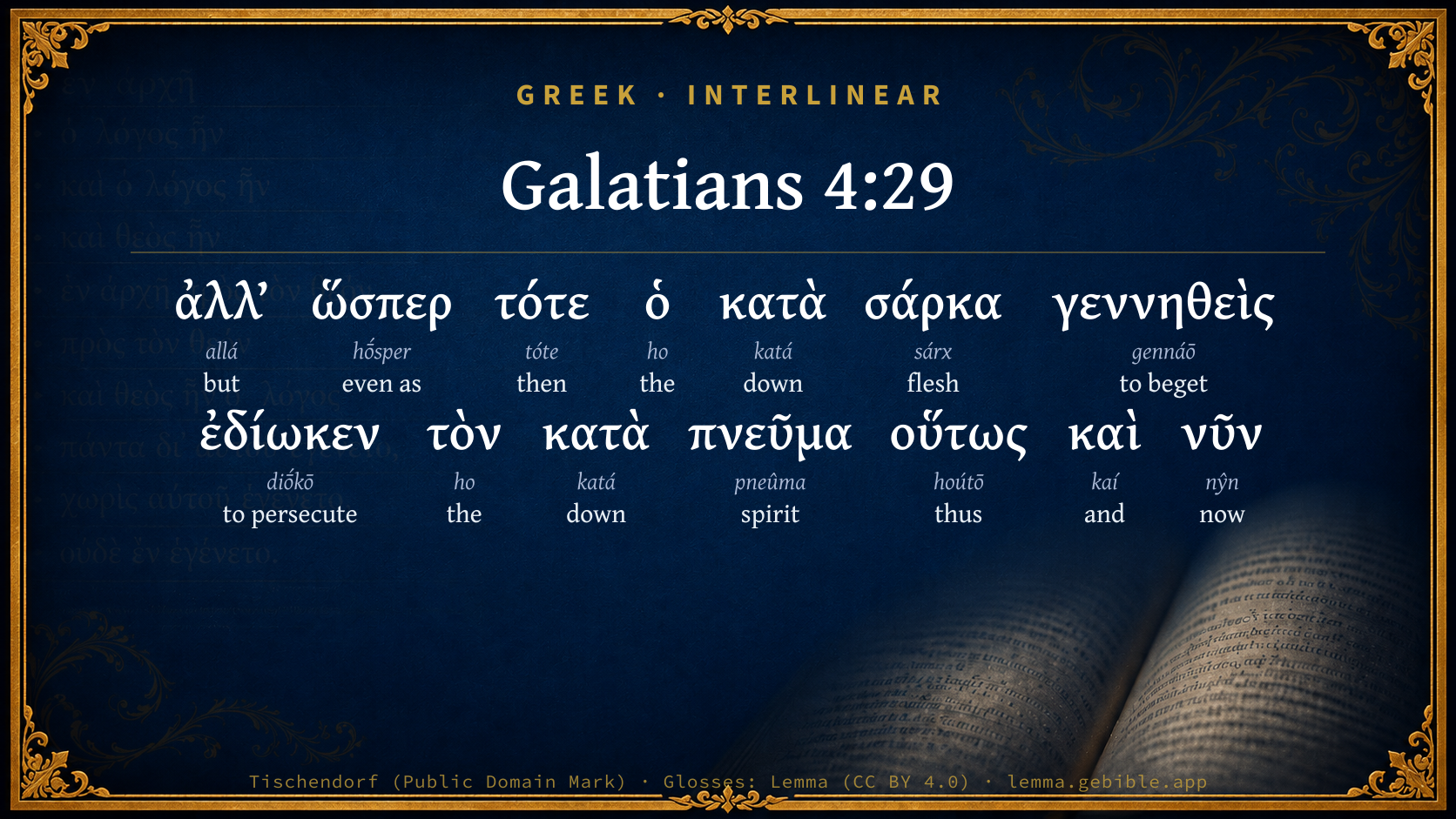
Download image
Cite this verse

Galatians 4:29 (World English Bible). Public Domain. Lemma interlinear Bible study tool, https://lemma.gebible.app/v/galatians/4/29.

Show BibTeX & RIS
BibTeX
RIS
English Translation
But as then, he who was born according to the flesh persecuted him who was born according to the Spirit, so also it is now.
World English Bible · Public Domain
Download a study sheet

One document with this verse’s original text, its word-by-word gloss line, the meaning frame, cross-references with their text, attributed commentary, and full source and license credits — printable, and it pastes into notes with its structure intact.

This verse Autodidact and up

Study sheet (.html) Plain text (.txt)

A passage Seminary Student

Up to 50 verses in one chapter. A passage sheet keeps up to 6 commentary sources and 12 cross-references per verse, in the order this page ranks them, and says so on the sheet whenever that leaves anything out. Ask for a single verse and you get the Autodidact verse sheet above.

Everything on this page stays free to read, with no account — the sheet is a download of what is already on screen, not access to it.

Want to remove ads? Support Godless Engineer
Compare translations 3

The same verse in 3 English versions, stacked beneath the original-language interlinear above. Click any original word for its lexicon entry.

Each is an independent rendering of the whole verse — the interlinear is not word-aligned to these translations.

Highlighted words mark where these versions differ — a whole-verse word diff, not a word-by-word alignment.

  • World English Bible Public Domain
    But as then, he who was born according to the flesh persecuted him who was born according to the Spirit, so also it is now.
  • King James Version Public Domain
    But as then he that was born after the flesh persecuted him that was born after the Spirit, even so it is now.
  • unfoldingWord Literal Text CC BY-SA 4.0
    But just as then, the one having been born according to flesh was persecuting the one according to Spirit, so also now.

unfoldingWord Literal Text — © unfoldingWord, licensed CC BY-SA 4.0. Word-aligned USFM3 via Door43 (git.door43.org/unfoldingWord/en_ult).

Versions to compare (up to 4)

3 of 4 selected

Show all 19 translations

Every available English version of this verse, each an independent rendering of the whole verse.

  • World English Bible Public Domain
    But as then, he who was born according to the flesh persecuted him who was born according to the Spirit, so also it is now.
  • Berean Standard Bible Public Domain
    At that time, however, the son born by the flesh persecuted the son born by the Spirit. It is the same now.
  • Majority Standard Bible Public Domain
    At that time, however, the son born by the flesh persecuted the son born by the Spirit. It is the same now.
  • King James Version Public Domain
    But as then he that was born after the flesh persecuted him that was born after the Spirit, even so it is now.
  • American Standard Version (1901) Public Domain
    But as then he that was born after the flesh persecuted him `that was born' after the Spirit, so also it is now.
  • Revised Version (1885) Public Domain
    But as then he that was born after the flesh persecuted him that was born after the Spirit, even so it is now.
  • Geneva Bible (1599) Public Domain
    But as then hee that was borne after the flesh, persecuted him that was borne after the Spirit, euen so it is nowe.
  • Douay-Rheims (1899) Public Domain
    But as then he, that was born according to the flesh, persecuted him that was after the spirit; so also it is now.
  • Young's Literal Translation Public Domain
    but as then he who was born according to the flesh did persecute him according to the spirit, so also now;
  • Literal Standard Version CC BY-SA 4.0
    but as he then who was born according to the flesh persecuted him [born] according to the Spirit, so also now;
  • Unlocked Literal Bible CC BY-SA 4.0
    At that time the one who was born according to the flesh persecuted the one born according to the Spirit. It is the same now.
  • unfoldingWord Literal Text CC BY-SA 4.0
    But just as then, the one having been born according to flesh was persecuting the one according to Spirit, so also now.
  • Darby Bible Public Domain
    But as then he that was born according to flesh persecuted him [that was born] according to Spirit, so also [it is] now.
  • World Messianic Bible Public Domain
    But as then, he who was born according to the flesh persecuted him who was born according to the Spirit, so also it is now.
  • Webster's Bible Public Domain
    But as then he that was born according to the flesh persecuted him that was born according to the Spirit, even so it is now.
  • Free Bible Version CC BY-SA 4.0
    However, just as the one born according to a human plan persecuted the one born through the Spirit, so it is today.
  • Bible in Basic English Public Domain
    But as in those days he who had birth after the flesh was cruel to him who had birth after the Spirit, even so it is now.
  • Text-Critical English NT CC BY 4.0
    But just as at that time the child who was born according to the flesh persecuted the child who was born according to the Spirit, so it is now also.
  • Tyndale New Testament (1534) Public Domain
    But as then he that was borne carnally persecuted him that was borne spiritually. Even so is it now.

Literal Standard Version (2020), Covenant Press — licensed CC BY-SA 4.0. Text via the HelloAO Bible API (eBible.org). Unlocked Literal Bible (unfoldingWord) — licensed CC BY-SA 4.0. Text via the HelloAO Bible API (eBible.org). unfoldingWord Literal Text — © unfoldingWord, licensed CC BY-SA 4.0. Word-aligned USFM3 via Door43 (git.door43.org/unfoldingWord/en_ult). Free Bible Version, Dr. Jonathan Gallagher — licensed CC BY-SA 4.0. Text via the HelloAO Bible API (eBible.org).

Word by word

More ways to search: Search by grammar → Find every occurrence → Compare this word →

Practice this passage: Drill this verse → Learn its vocabulary →

About this verse

These counts appear in no published source. They are computed here, from the morphology-tagged text and Lemma’s own curated glosses. What Lemma adds →

14
words
12
distinct lemmas
Pauline Epistles
section

Shared distinctive vocabulary

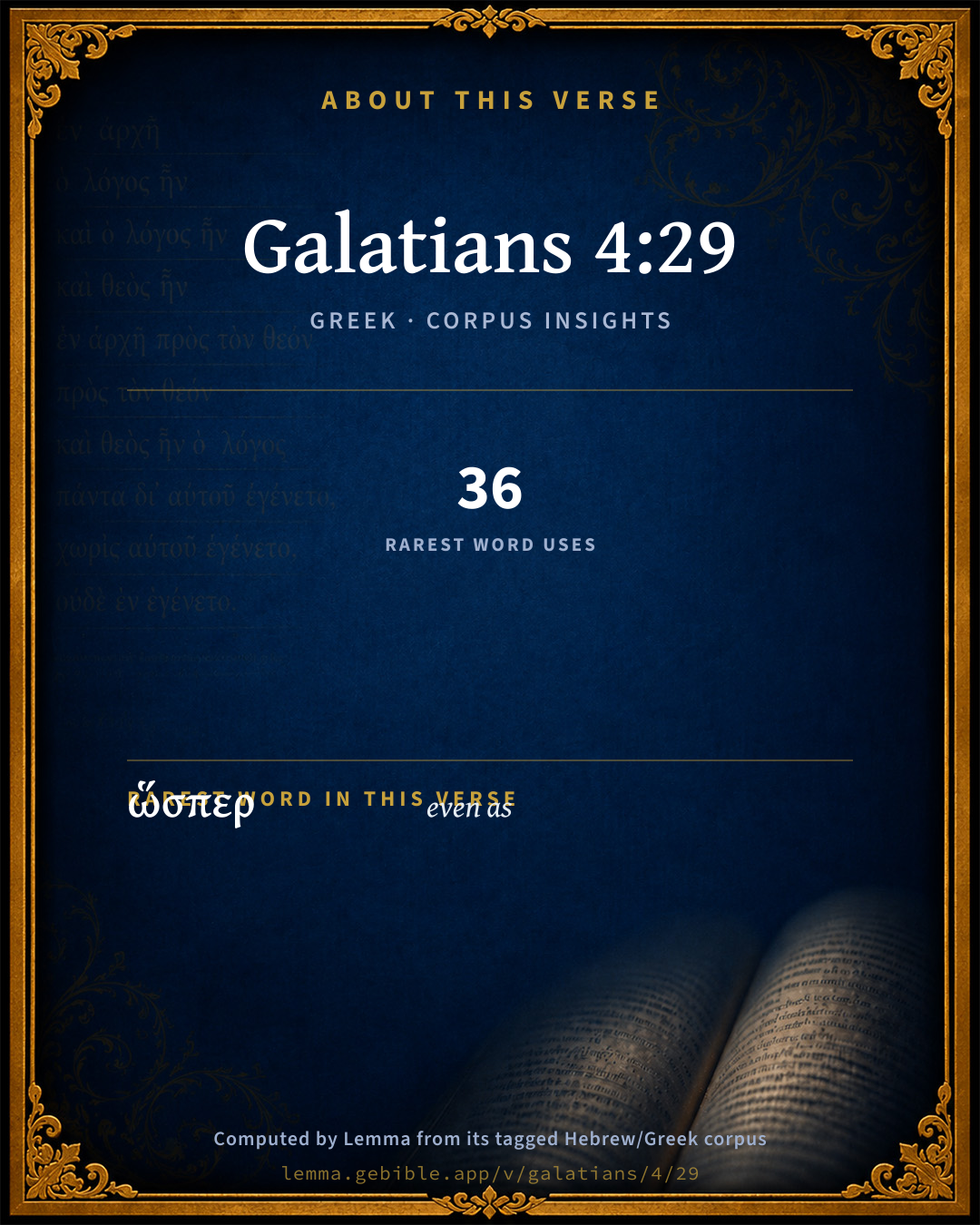
ὥσπερ even as G5618 occurs in 36 verses of the Greek New Testament. Also found in:
Repetition

Words recur within this verse:

Cross-references

11

Topical passages linked to Galatians 4:29 in the Treasury of Scripture Knowledge — connected by theme and wording, ordered by reader-vote popularity; previews shown in the World English Bible.

  • Genesis 21:9 Sarah saw the son of Hagar the Egyptian, whom she had borne to Abraham, mocking.
  • Romans 8:13 For if you live after the flesh, you must die; but if by the Spirit you put to death the deeds of the body, you will live.
  • Galatians 5:11 But I, brothers, if I still preach circumcision, why am I still persecuted? Then the stumbling-block of the cross has been removed.
  • Matthew 23:34–37 Therefore, behold, I send to you prophets, wise men, and scribes. Some of them you will kill and crucify; and some of them you will scourge in your synagogues, and persecute from city to city;
  • John 3:5 Jesus answered, "Most assuredly I tell you, unless one is born of water and spirit, he can't enter into the Kingdom of God!
  • John 15:9 Even as the Father has loved me, I also have loved you. Remain in my love.
  • Galatians 4:23 However, the son by the handmaid was born according to the flesh, but the son by the free woman was born through promise.
  • 1 Thessalonians 2:14–15 For you, brothers, became imitators of the assemblies of God which are in Judea in Christ Jesus; for you also suffered the same things from your own countrymen, even as they did from the Jews;
  • Hebrews 10:33–34 partly, being exposed to both reproaches and oppressions; and partly, becoming partakers with those who were treated so.
  • Galatians 6:12–14 As many as desire to look good in the flesh, they compel you to be circumcised; only that they may not be persecuted for the cross of Christ.
  • Romans 8:1 There is therefore now no condemnation to those who are in Christ Jesus, who don't walk according to the flesh, but according to the Spirit.

Cross-references courtesy of OpenBible.info (CC BY 4.0).

Commentary

Notes on Galatians 4:29 from classic Christian and Jewish commentators (each source and its license shown beneath its notes). The classic Christian expositions comment on the surrounding passage and are grouped to its opening verse, so a note may address several verses; the Jewish commentaries on the Tanakh (Rashi and others) are per-verse, so they appear only where the commentator wrote on this verse.

Lemma curates 59 commentaries, every one of them public domain or Creative Commons licensed, each selected and text-cleaned for this edition rather than reprinted as found. About our sources →

The Biblical Illustrator

Joseph S. Exell

Gal_4:29

He that was born after the flesh persecuted him that was born after the Spirit.

Enmity between the natural and the spiritual man

I must profess that since I observed the course of the world, and the concord of the Word and providences of God, I took it for a notable proof of mans fall, and of the verity of the Scripture, and the supernatural origin of true sanctification, to find such a universal enmity between the holy and the serpentine seed, and to find Cain and Abels case so ordinarily exemplified, and him that is born after the flesh to persecute him that is born after the Spirit. And methinks to this day it is a great and visible help for the confirmation of our Christian faith. But that which is much remarkable in it is, that nothing else in the world, except the crossing of mens carnal interest, doth meet with any such universal enmity. A man may be as learned as he can, and no man hate him for it. If he excel all others, all men will praise him, and proclaim his excellency; he may be an excellent linguist, an excellent philosopher, an excellent physician, an excellent logician, an excellent orator, and all commend him. Among musicians, architects, soldiers, seamen, and all arts and sciences, men value, prefer, and praise the best; yea, even speculative theology, such wits as the schoolmen and those who are called great divines are honoured by all, and meet, as such, with but little enmity, persecution, or obloquy in the world. Though I know that even a Galilaeus, a Campanella, and man such have suffered by the Roman Inquisitors, that was not so much in enmity to their speculations or opinions, as through a fear lest new philosophical notions should unsettle mens minds and open the way to new opinions in theology, and so prove injurious to the kingdom and interest of Rome. I know also that Demosthenes, Cicero, Seneca, Lucan, and many other learned men have died by the hands or power of tyrants. But this was not for their learning, but for their opposition to those tyrants wills and interests. And I know that some religious men have suffered for their sins and follies, and some for their meddling too much with secular affairs, as the counsellors of princes, as Funetius, Justus Jonas, and many others. But yet no parts, no excellency, no skill or learning, is hated commonly, but honoured in the world; no, not theological learning, save only this practical godliness and religion, and the principles of it, which only renders men amiable to God, through Christ, and saves mens souls. (R. Baxter.)

Honour of persecution

One who was persecuted in Queen Marys time wrote thus: A prisoner for Christ! What is this for a poor worm? Such honour have not all His saints. Both the degrees which I took in the university have not set me so high as the honour of becoming a prisoner of the Lord.

Glorifying in persecution

Paul and Silas had their prison songs in their prison sufferings. Those caged birds sing with as much melody as any that have sky liberty. Thus Ignatius, in his epistle, glorified, saying: The wild beasts may grind me as corn between their teeth: but I shall by that become as choice bread in the hand of my God. (Archbishop Secker.)

Faithfulness under persecution

A young Christian soldier in the army was often assaulted by his tent-mates while at prayer at night. He sought advice of the chaplain, and, by his counsels, omitted his usual habit. But his ardent soul could not endure this. He chose rather to have prayer with persecution than peace without it, and resumed his old way. The result was, that after a time all his tent-companions knelt in prayer with him. In reporting to the chaplain he said, Isnt it better to keep the colours flying?

Riches of persecution

A certain person, on seeing a Christian woman go cheerfully to prison, said to her, O, you have not yet tasted of the bitterness of death. She as cheerfully replied, No, nor never shall; for Christ has promised, that those who keep His sayings shall never see death.

On persecution

In these words the apostle doth present to our eye the true face of the Church in an allegory of Sarah and Hagar, of Ishmael and Isaac, of Mount Sinai and Mount Sion. Take the full scheme and delineation in brief.

1. Here is Sarah and Hagar; that is, servitude and freedom.

2. Here are two cities: Jerusalem that now is, the synagogue of the Jews; and that Jerusalem which is above, the vision of peace, and mother of all the faithful. For by the new covenant we are made children unto God.

3. Here is the law promulgated and thundered out on Mount Sinai; and the gospel, the covenant of grace, which God published, not from the mount, but from heaven itself, by the voice of His Son. In all, you see a fair correspondence and agreement between the type and the thing, but so that Jerusalem our mother is still the highest; the gospel glorious with the liberty it brought, and the law putting OH a yoke, breathing nothing but servitude and fear; Isaac an heir, and Ishmael thrust out; the Christian more honourable than the Jew.

The veil is drawn, and you may behold presented to your view and consideration a double parallel.

1. Of the times; But as then, so now.

2. Of the occurrences, the acts and monuments, of these times, divided between two, the agent and the patient, those that are born after the flesh persecuting, and those that are born after the Spirit suffering persecution.

I. Though the privileges and prerogatives of the Church be many, yet was she never exempted from persecution, but rather had it entailed on her as an inheritance.

1. In the persons themselves.

2. This will yet more plainly appear from the very nature and constitution of the Church, which is best seen in her blood, when she is militant; which is more full and expressive than any other representation of the title that she hath.

3. As it was then, so it is now. St. Paul doth not say, It may be so, or It is by chance, but So it is, by the providence of God, which is seen in the well-ordering and bringing of every motion and action of man to a right end, which commonly runneth in a contrary course to that which flesh and blood, human infirmity, would find out. Eternity and mortality, majesty and dust and ashes, wisdom and ignorance, steer not the same course, nor are they bound to the same point, My ways are not your ways, nor My thoughts yours, saith God, by His prophet, to a foolish nation who in extremity of folly would be wiser than God. We must first be made more spiritual by the contradiction of those who are born after the flesh; more Isaacs than before, for the many Ishmaels. So perfection is not only agreeable to the wisdom of God, but convenient to the weakness of man. And it is a beatitude: Blessed poverty, blessed mourning, blessed persecution (Mat_5:3-4; Mat_5:10-12). Blessedness is set upon these as a crown, or as rich embroidery upon sackcloth, or some coarser stuff. Thus you see the Church is not, cannot be, exempt from persecution, if either we consider the quality of the persons themselves, or the nature and constitution of the Church, or the providence and wisdom and mercy of God.

II. Let us now look back upon this dreadful but blessed sight, and see what advantage we can work, what light we can strike, out of this cloud of blood to direct and strengthen us in this our warfare, that we may be faithful unto death, and so receive the crown of life (Rev_2:10).

1. Let us not be dismayed when we see that befall the Church which befalleth all the kingdoms and commonwealths in the world, when we see the face of the Church gather blackness, and not shine in that beauty in which formerly we beheld her. For what strange thing is it that Ishmael should mock Isaac? that a serpent should bite, or a lion roar? that the world should be the world, or the Church the Church? The Church, so far as she is visible, in respect of her visibility and outward form, is as subject to change as any other thing that is seen, as those things which we use to say are but the balls of fortune to play with.

2. And that we may not marvel, let us, in the next place, have a right judgment in all things, and not set up the Church in our fancy, and shape her out by the state and pomp of this world, but be transformed by the renewing of our minds (Rom_12:2). We must not make the world the idea and platform of a Church.

3. Therefore let us cast down these imaginations, these bubbles of air blown up by the flesh the worse part which doth soonest bring on a persecution, and doth soonest fear it; and let us, in the place of these, build up a royal fort, build ourselves up in our holy faith, and so fit and prepare ourselves against the fiery trial.

4. Be ye therefore ready; for, in an hour when you think not, the Son of man, the Captain of your salvation, may come (Mat_24:44), and put you into the lists. Though the trumpet sound not to battle, yet is it not peace. And now, to conclude, What saith the Scripture? Cast out the bondwoman and her son: for the son of the bondwoman shall not inherit with the son of the freewoman.

To cast out is an act of violence; and the true Church evermore hath the suffering part; but yet she may cast them out, and that with violence; but then it is with the same violence we take the kingdom of heaven, a violence upon ourselves (Mat_11:12).

1. By laying ourselves prostrate, by the vehemency of our devotion, by our frequent prayers that God would either melt their hearts, or shorten their hands; either bring them into the right way, or strike off their chariot wheels. 2 By our patience and long-suffering. Patience worketh more miracles than power.

3. We cast them out by our innocency of life, and sincerity of conversation.

4. Lastly: We may cast them out by casting our burden on the Lord (Psa_55:22); by putting our cause into His hands who best can plead it, by citing our persecutors before His tribunal who is the righteous Judge. If we thus cast it upon Him, we need no other umpire, no other revenger. If it be a loss, He can restore it; if an injury, He can return it; if grief, He can heal it; if disgrace, He can wipe it off: and He will certainly do it, if we so cast it upon Him as to trust in Him alone; the full persuasion of Gods power being that which awaketh Him as one out of sleep, putteth Him to clothe Himself with His majesty, setteth His power a working, to bring mighty things to pass, and make Himself glorious by the delivery of His people. (A. Farindon, D. D.)

He that was born after the flesh persecuted him that was born after the Spirit

When the powers of the world give any rest, yet the carnal seed will be mocking and scoffing, and bringing Gods holy ways into contempt, branding them with censures and calumnies. The reasons of this are partly because men are drunk with the delusions of the flesh, and so cannot judge of spiritual things; and partly to excuse themselves. Men will be quarrelling at religion when they have no mind to practise it, and dispute away duties when they are unwilling to perform them; partly they take occasion from the failings of Gods people, though there is no reason why they should do so. An art should not be condemned for the workmans want of skill; but they do so. If Christians be serious then religion is counted an uncomfortable thing. If there be any differences among Gods people, because of their several degrees of light, oh, then there are so many sects and factions and controversies about religion, they suspect all. If any creep into the holy profession, and pollute it with their scandals, then all strictness in religion is but a pretence and imposture. If men be strict and would avoid every ordinary failing incident to mankind, then they are more nice than wise, and this is preciseness and indiscretion. (T. Manton, D. D.)

We must expect persecution

A soldier in the East Indies--a stout, lion-hearted man--had been a noted prizefighter, and a terror to those who knew him. That man sauntered into the mission chapel, heard the gospel, and was converted. The change in his character was most marked and decided. The lion was changed into a lamb. Two months afterwards, in the mess-room, some of those who had been afraid of him before began to ridicule him. One of them said, Ill put it to the test whether he is a Christian or not; and, taking a basin of hot soup, he threw it into his bosom. The whole company gazed in breathless silence, expecting that the lion would start up, and murder him on the spot. But after he had torn open his waistcoat, and wiped his scalded breast, he calmly turned round, and said, This is what I must expect if I become a Christian. I must suffer persecution. His comrades were filled with astonishment. (Biblical Treasury.)

Persecution is harmless

Do they cast us out of the city? They cannot cast us out of that which is in the heavens. If they who hate us could do this, they would be doing something real against us. So long, however, as they cannot do this, they are but pelting us with drops of water or striking us with the wind. (Gregory Nazianzen.)

The Biblical Illustrator, edited by Joseph S. Exell (c. 1880s–1900s) — public domain. Text from a community e-Sword module.

Tyndale Open Study Notes

Tyndale Open Resources

4:29 Ishmael persecuted Isaac, the child of the promise, at Isaac’s weaning ceremony (see Gen 21:9). Similarly, in Galatia, those who want you to keep the law were persecuting those who trusted in God’s promise, the message of God’s grace through faith in Christ alone (cp. Acts 13:50-51; 14:1-7).

Tyndale Open Study Notes — © Tyndale Open Resources, licensed CC BY-SA 4.0. Text via the HelloAO Bible API.

Bengel's Gnomon

Johann Albrecht Bengel

Gal 4:29. Ἐδίωκε, persecuted) wantonly, Gen 21:9. Persecution is the work of carnal, not of spiritual men. [Take care lest you esteem it of little importance, whatever is done against the children of the free woman.—V. g.]—τὸν κατὰ πνεῦμα) viz. γεννηθέντα, him who was born after the Spirit. Paul, having the Apodosis in his mind, so frames his discourse respecting Ishmael and Isaac as to apply it to carnal men and believers. Where the Spirit is, there is liberty.

Bengel's Gnomon of the New Testament — English translation (T&T Clark, Edinburgh, 1860) — public domain. Text from a community e-Sword module.

Meyer's Critical & Exegetical Commentary

Heinrich August Wilhelm Meyer

Gal_4:29-30. Nevertheless, notwithstanding this their higher state of sonship, these spiritual children of Abraham are persecuted by the bodily children of Abraham, as was formerly the case with Isaac and Ishmael; but (Gal_4:30) how wholly without ultimate success is, and, according to the Scripture, must be, this persecution! This is not a collateral trait (Holsten), but the consolatory practical result in which the allegory terminatesits triumphantly joyful conclusion. Comp. on Gal_4:31.

τότε] then, namely, at that time when the allegorically-significant history came to pass.

ὁ κατὰ σάρκα γεννηθείς] see Gal_4:23.

ἐδίωκε] persecuted. It is true that in Gen_21:9 Ishmael is designated only as a mocker (of Isaac).[223] But Paul follows the tradition, which, starting from the basis of that statement, went further. See Beresch. R. liii. 15: Dixit Ismael Isaaco: eamus et videamus portionem nostram in agro; et tulit Ismael arcum et sagittas, et jaculatus est Isaacum et prae se tulit ac si luderet. According to Hofmann, Paul in the word διώκειν probably intends a running after Isaac wantonly to annoy him (just as the partisans of the law followed after the believing Gentiles in order to annoy them, Gal_5:10; Gal_5:12). Quite unsupported by any historical evidence, and very inappropriate to the ταράσσειν of the Judaists (of which there is no mention here at all); comp. Gal_1:7.

ΤῸΝ ΚΑΤᾺ ΠΝΕῦΜΑ] him that is born according to the Spirit, that is, him who was born in consequence of the intervening agency of the Holy Spirit (for the divine πνεῦμα, as the principle of the divine promise, is instrumental in the efficacy of the latter). By means of the vis carnis Isaac could not have been born, but only by means of the vis Spiritus divini, which, operative in the divine promise, furnished at his procreation (Rom_4:17 ff.) the capacity of generation and conception. In fact, therefore, τὸν κατὰ πνεῦμα conveys the same idea as ΤῸΝ ΔΙᾺ Τῆς ἘΠΑΓΓΕΛΊΑς ΓΕΝΝΗΘΈΝΤΑ, Gal_4:23. The explanation: per singularem efficacitatem Dei (Schott), compares things which are in their nature different (Luk_1:35), and is not verbally accurate. And Hilgenfeld unnecessarily assumes (comp. Bengel) that the expression is to be explained by a blending together of the ideal reference of the allegory to the Christians, and of its historical basis.

οὕτω καὶ νῦν] So also now the children of Abraham according to the flesh (the Jews) persecute those who are Abrahams children ΚΑΤᾺ ΠΝΕῦΜΑ (Christians, ἘΠΑΓΓΕΛΊΑς ΤΈΚΝΑ, Gal_4:28). Comp. 1Th_2:15. This ΟὝΤΩ ΚΑῚ ΝῦΝ does not exclude any kind of persecution which the Christians suffered at the hands of the Jews; but that which is intended must have been actual persecutions, such as those to which the Christians as a body were so generally at that time subjected by the Jews, and not the ταράσσειν on the part of the Judaists (Hofmann; see on ἘΔΊΩΚΕ).

ἈΛΛᾺ ΤΊ ΛΈΓΕΙ Ἡ ΓΡΑΦΉ;] triumphantly introduces the divine certainty of the want of success, which will attend this ΔΙΏΚΕΙΝ, to the destruction of the persecutors themselves. Observe how the importance of the utterance is brought out more vividly by the interrogative announcement. Comp. Rom_4:3; Rom_10:8; Rom_11:2; Rom_11:4; Dissen, ad Dem. de cor. p. 186, 347; Blomfield, Gloss. ad Aesch. Pers. 1013. The quotation is from Gen_21:10, almost exactly following the LXX. Instead of μετὰ τοῦ υἱοῦ μου Ἰσαάκ in the LXX. (which therefore D* E? F G, codd. of the Itala, and some Fathers read also here), Paul has written ΜΕΤᾺ ΤΟῦ ΥἹΟῦ Τῆς ἘΛΕΥΘΈΡΑς, not accidentally, but in order to give prominence to the contrast, which significantly refers back to the chief point of the allegory (comp. Gal_4:22).

ἜΚΒΑΛΕ Κ.Τ.Λ.] The words of Sarah to Abraham (which, however, in Gen_21:12 are expressly approved by God and confirmed with a view to fulfilment), requiring the expulsion of Hagar and her son from the house. From this, looking to the scope of the allegory, the Galatians are to infer the exclusion of the non-free Jews, who were now persecuting the free Christians, from the people of God. This exclusion already actually exists even in the present αἰών, in so far as the true Israel which is free from the law (the ἸΣΡΑῊΛ ΤΟῦ ΘΕΟῦ, Gal_6:16) has taken the place of the ancient people of God, and will attain its perfect realization at the ΠΑΡΟΥΣΊΑ, when none but the free Christian family of God will share in the ΚΛΗΡΟΝΟΜΊΑ of eternal Messianic salvation. Comp. Gal_3:18; Gal_3:29. According to Hofmann (comp. also his Schriftbew. II. 2, p. 71), the meaning is, that as Abraham separated Ishmael from Isaac, so also the readers are to dismiss from among them, as unentitled to share in their inheritance, those who desired to force upon them their own legalism; the Christian body ought to remain undisturbed by such persons. This weakening of the idea is impossible with a correct conception of διώκειν in Gal_4:29; the sure divine Nemesis against the persecutors must be meantthe divine ἐκδίκησις (Luk_18:7 f.; comp. 2Th_1:6; 2Th_1:8).

Οὐ ΓᾺΡ ΜῊ ΚΛΗΡΟΝ.] prefixed with great emphasis; the son of the bond-woman shall assuredly not inherit. Comp. Gen_25:5 f. As to the exclusion, according to the Israelite law, of the children of a concubine from the right of inheritance, see Selden, de success, ad leg. Hebr. p. 28; Saalschütz, M. R. p. 831; Ewald, Alterth. p. 266.

[223] The idea that Paul, in using ἐδίωκε, really intended nothing more than this mocking (nulla enim persecutio tam molesta esse nobis debet, quam dum impiorum ludibriis videmus labefactari nostram vocationem, Calvin), is not in harmony with the comprehensive sense of the word.

Meyer — Critical and Exegetical Commentary on the New Testament — English translation by Peter Christie, edited by Frederick Crombie (T&T Clark, 1880) — public domain. Text from a community e-Sword module.

Expositor's Greek Testament

ed. W. Robertson Nicoll

Gal 4:29 . ἐδίωκεν . This imperfect denotes a tendency and disposition rather than actual persecution on the part of Ishmael. The nearest approach to it recorded is in fact his mockery of Isaac on the occasion of his weaning (Gen 21:9 ). The LXX gives a different version of his conduct on that occasion, which is accepted in the margin of the Revised Version, and seems more in harmony with the circumstances, viz. , that he was playing with the child, bearing himself in short as an elder brother in the family, and that the jealousy of Sarah was aroused lest he should claim an elder brother’s share of the inheritance. But the Apostle adopts the traditional view of his conduct which was accepted by the Jews, in consequence perhaps of the subsequent feud between the two races; and discovers in Ishmael the same jealous temper that was exhibited by Jewish persecutors towards the infant Church.

The Expositor's Greek Testament, edited by W. Robertson Nicoll (1897–1910) — public domain. Text from a community e-Sword module.

Geneva Bible (1599)

Geneva Bible translators

By the virtue of God’s promise and after a spiritual manner.

By the common course of nature.

Geneva Bible (1599) marginal notes — public domain. Text via Bolls.life.

Jamieson, Fausset & Brown

Robert Jamieson, A. R. Fausset & David Brown

persecuted--Ishmael "mocked" Isaac, which contained in it the germ and spirit of persecution (Gen 21:9). His mocking was probably directed against Isaac's piety and faith in God's promises. Being the older by natural birth, he haughtily prided himself above him that was born by promise: as Cain hated Abel's piety.

him . . . born after the Spirit--The language, though referring primarily to Isaac, born in a spiritual way (namely, by the promise or word of God, rendered by His Spirit efficient out of the course of nature, in making Sarah fruitful in old age), is so framed as especially to refer to believers justified by Gospel grace through faith, as opposed to carnal men, Judaizers, and legalists.

even so it is now-- (Gal 5:11; Gal 6:12, Gal 6:17; Act 9:29; Act 13:45, Act 13:49-50; Act 14:1-2, Act 14:19; Act 17:5, Act 17:13; Act 18:5-6). The Jews persecuted Paul, not for preaching Christianity in opposition to heathenism, but for preaching it as distinct from Judaism. Except in the two cases of Philippi and Ephesus (where the persons beginning the assault were pecuniarily interested in his expulsion), he was nowhere set upon by the Gentiles, unless they were first stirred up by the Jews. The coincidence between Paul's Epistles and Luke's history (the Acts) in this respect, is plainly undesigned, and so a proof of genuineness (see PALEY, Horæ Paulinæ).

Jamieson, Fausset & Brown — Commentary Critical and Explanatory on the Whole Bible (1871) — public domain (CC PDM 1.0). Text via the HelloAO Bible API.

Adam Clarke's Commentary

Verse 29. But as then he] Ishmael, who was born after the flesh-whose birth had nothing supernatural in it, but was according to the ordinary course of nature,

Persecuted him] Isaac, who was born after the Spirit-who had a supernatural birth, according to the promise, and through the efficacy, of the Holy Spirit, giving effect to that promise-Sarah shall have a son, Ge 17:16-21; Ge 21:1, c.

Persecuted him the persecution here referred to is that mentioned Ge 21:9. It consisted in mocking his brother Isaac.

Even so it is now.] So the Jews, in every place, persecute the Christians; and show thereby that they are rather of the posterity of Hagar than of Sarah.

Adam Clarke's Commentary on the Bible (1810–1826) — public domain. Text from a community e-Sword/MySword module.

John Calvin's Commentaries

29. As then, he that was born after the flesh. He denounces the cruelty of the false apostles, who wantonly insulted pious persons that placed all their confidence in Christ. There was abundant need that the uneasiness of the oppressed should be soothed by consolation, and that the cruelty of their oppressors should be severely checked. It is not wonderful, he says, that the children of the law, at the present day, do what Ishmael their father at first did, who, trusting to his being the first-born, persecuted Isaac the true heir. With the same proud disdain do his posterity now, on account of outward ceremonies, circumcision, and the various services of the law, molest and vaunt over the lawful sons of God. The Spirit is again contrasted with the flesh, that is, the calling of God with human appearance. (1 Samuel 16:7.) So the disguise is admitted to be possessed by the followers of the Law and of works, but the reality is claimed for those who rely on the calling of God alone, and depend upon his grace.

Persecuted. But persecution is nowhere mentioned, only Moses says that Ishmael was מצהק, (metzahek,) mocking, (Genesis 21:9;) and by this participle he intimates that Ishmael ridiculed his brother Isaac. The explanation offered by some Jews, that this was a simple smile, is entirely inadmissible; for what cruelty would it have argued, that a harmless smile should have been so fearfully revenged? There cannot then be a doubt that he maliciously endeavored to provoke the child Isaac by reproachful language.

But how widely distant is this from persecution? And yet it is not idly or unguardedly that Paul enlarges on this point. No persecution ought to distress us so much as to see our calling attempted to be undermined by the reproaches of wicked men. Neither blows, nor scourging, nor nails, nor thorns, occasioned to our Lord such intense suffering as that blasphemy:

“He trusted in God; what availeth it to him? for he is deprived of all assistance.” (Matthew 27:43.)

There is more venom in this than in all persecutions; for how much more alarming is it that the grace of Divine adoption shall be made void, than that this frail life shall be taken from us? Ishmael did not persecute his brother with the sword; but, what is worse, he treated him with haughty disdain by trampling under foot the promise of God. All persecutions arise from this source, that wicked men despise and hate in the elect the grace of God; a memorable instance of which we have in the history of Cain and Abel. (Genesis 4:8.)

This reminds us, that not only ought we to be filled with horror at outward persecutions, when the enemies of religion slay us with fire and sword; when they banish, imprison, torture, or scourge; but when they attempt, by their blasphemies, to make void our confidence, which rests on the promises of God; when they ridicule our salvation, when they wantonly laugh to scorn the whole gospel. Nothing ought to wound our minds so deeply as contempt of God, and reproaches cast upon His grace: nor is there any kind of persecution more deadly than when the salvation of the soul is assailed. We who have escaped from the tyranny of the Pope, are not called to encounter the swords of wicked men. But how blind must we be, if we are not affected by that spiritual persecution, in which they strive, by every method, to extinguish that doctrine, from which we draw the breath of life! — when they attack our faith by their blasphemies, and shake not a few of the less informed! For my own part, I am far more grieved by the fury of the Epicureans than of the Papists. They do not attack us by open violence; but, in proportion as the name of God is more dear to me than my own life, the diabolical conspiracy which I see in operation to extinguish all fear and worship of God, to root out the remembrance of Christ, or to abandon it to the jeers of the ungodly, cannot but rack my mind with greater anxiety, than if a whole country were burning in one conflagration:

John Calvin's Commentaries (1540-1563) — public domain. Text from the Calvin Translation Society English edition (1840s-50s) via the Christian Classics Ethereal Library (ccel.org). Calvin's coverage is partial (roughly two-thirds of the Bible); uncommented books and verses are honest gaps, never fabricated. The 19th-century editor's footnotes and remarks are omitted so the notes are faithfully Calvin's own voice.

Ellicott's Commentary for English Readers

(29) Persecuted.—The expression used in Gen_21:9 is translated in our version “mocking.” It seems doubtful whether the Hebrew can really mean more than “playing.” The Jewish traditions added that Ishmael took out the child Isaac and “shot at him with arrows under pretence of sport.” The Arab tribes, Ishmael’s descendants, had always been a thorn in the side of their Israelite neighbours.

Him that was born after the Spirit.—A miraculous agency intervened in the birth of Isaac, and the Christian Church was inaugurated and inspired by the same agency—that of the Spirit. The Messianic reign was realised through the Spirit; and their participation in this reign made all Christians true and spiritual descendants of Abraham.

Even so it is now.—This seems to have especial reference to the behaviour of the Judaising party in Galatia, but would also apply to the relations between Jews and Christians generally.

A Bible Commentary for English Readers, edited by Charles John Ellicott (1878–1897) — public domain. Text from a community e-Sword module.

The Cambridge Bible for Schools and Colleges

gen. ed. J. J. S. Perowne

29. In Gen_21:9-10, we read, ‘And Sarah saw the son of Hagar the Egyptian, which she had borne unto Abraham, mocking. Wherefore she said, Cast out the bondwoman and her son: for the son of this bondwoman shall not be heir with my son, even with Isaac’. There is no specific mention here of persecution. But apart from the fact that insult is one form of persecution—a form in which the spirit of hatred finds expression when prevented by law or lack of opportunity from open violence—according to the Jewish tradition, Ishmael actually assaulted Isaac. And this hostility was perpetuated by their descendants. The Hagarenes or Hagarites are thrice mentioned among the enemies of Israel, 1Ch_5:10; 1Ch_5:19; Psa_68:7.

even so it is now] Compare our Lord’s words (Joh_15:20), ‘If they have persecuted me, they will also persecute you’. St Paul could say this from his own experience. See 2Ti_3:11, where after speaking of the persecutions which he had endured, he adds, ‘Yea, and all that will live godly in Christ Jesus shall suffer persecution’. From the Acts of the Apostles we learn that the chief originators of these persecutions were the Jews whose bigoted attachment to the Rabbinic system inspired them with a bitter hatred of the Gospel and those who proclaimed it. In the subsequent history of the Church the illustrations of St Paul’s words are written in letters of blood. But to those who suffer for the truth these persecutions are an evident token of salvation, and that of God, Php_1:28. They are ‘the marks of the Lord Jesus’, proofs of sonship, badges of freedom, pledges of inheritance.

The Cambridge Bible for Schools and Colleges (gen. ed. J. J. S. Perowne; Cambridge University Press, 1878–1918) — public domain. Text from a community e-Sword module.

John Gill's Exposition

Nevertheless, what saith the Scripture?.... This is a Talmudic form of citing Scriptures, and answers to , "what says the Scriptures (e)?" the passage referred to is Gen 21:10 and which are the words of Sarah to Abraham; but inasmuch as she spake them under divine inspiration, and they were approved of and confirmed by God, as appears from Gen 21:12 they are ascribed to God speaking in the Scripture:

cast out the bondwoman and her son, for the son of the bondwoman shall not be heir with the son of the free woman. There is very little difference in the citation from the original. The apostle omits the word "this" in both clauses, which though very proper to be expressed by Sarah, to point out the person she meant, and as being in a vehement passion, was not absolutely necessary to be retained by the apostle, since by the context there is no difficulty of knowing who is meant by her; though the Alexandrian copy has the word in it: and instead of "with my son, with Isaac", the apostle says, "with the son of the free woman, Sarah"; there speaking of herself, whose character the apostle gives, in opposition to the bondwoman: in like manner a Jewish writer (f) reads and interprets it,

"for the son of this woman shall not be heir , "with the son of the mistress".''

The casting of Hagar and Ishmael out of Abraham's family was a type and emblem of the rejection of the carnal and self-righteous Jews from the Gospel church state; nor ought any carnal persons, any that are after the flesh, unregenerate ones, or that trust to their own righteousness, to be in a Gospel church; as they will also be excluded and thrust out of the kingdom of heaven, into which no unregenerate and unrighteous, or self-righteous persons shall enter. The Jews make this ejection of Hagar and her son to be both out of this world and that which is to come (g). The reason given why the one should not be heir with the other perfectly agrees with the Jewish canons; which was not because he was the son of a concubine, for the sons of concubines might inherit, if they were Israelites, and free, but because he was the son of a bondwoman, for thus they run (h);

"all that are near of kin, though by iniquity, are heirs, as they that are legitimate; how? thus for instance, if a man has a son that is spurious, or a brother that is spurious, lo, these are as the other sons, and the other brethren for inheritance; but if, , "his son is by an handmaid", or by a strange woman, he is no son in any of these matters, , "and no heir at all":''

and again (i),

"an Israelite that hath a son by an handmaid, or by a Gentile, seeing he is not called his son, he that he has after him by an Israelitish woman, , "is the firstborn for inheritance", and takes the double portion.''

The reason assigned for non-inheritance in the text implies that the children of the free woman, the spiritual seed of Abraham, shall inherit the privileges of God's house, the blessings of grace, and eternal glory; they are children of the promise, and heirs according to it; when the children of the bondwoman, self-righteous ones, shall not; for the inheritance is not of the law, neither are they heirs who are of the works of it; nor is it to be enjoyed by mixing the law and Gospel, grace and works, in the business of salvation.

(e) T. Bab. Beracot, fol. 9. 2. (f) R. Abraham Seba, Tzeror, fol. 21. 3. (g) Pirke Eliezer, c. 30. (h) Maimon. Hilch. Nechalot, c. 1. sect. 7. (i) Ib c. 2. sect. 12.

John Gill's Exposition of the Whole Bible (1746–1763) — public domain (CC PDM 1.0). Text via the HelloAO Bible API.

Trapp's Complete Commentary

John Trapp

29 But as then he that was born after the flesh persecuted him that was born after the Spirit, even so it is now.

Ver. 29. Persecuted him] By cruel mockings and real injuries, challenging the birthright and deriding the covenant, &c. Moses’s word, מצזחק Gen 21:9, holds forth, that Ishmael did not only himself mock Isaac, but made others also to mock him, exposing him to their jeers. The Papists made way for their great project of perdition in 1588, (Spanish Armada) by dividing the people here under the terms of Protestant and Puritan, and provoking them thereby to real and mutual both hate and contempt. (George Abbot’s Answer.)

Even so it is now] And so also it is now, may we say at this day. For what do Papists persecute us for else, but because we reject their justification by works? They poisoned their own Cardinal Contarenus, for that he declared himself sound in this point, by a book that he set forth some four years before the Council of Trent.

John Trapp, A Commentary or Exposition upon All the Books of the Old and New Testament (1647–1656) — public domain. Text from a community e-Sword module.

Albert Barnes' Notes on the Bible

But as then he that was born after the flesh - Ishmael; see Gal 4:23.

Persecuted him that was born after the Spirit - That is, Isaac. The phrase, “after the Spirit,” here, is synonymous with “according to the promise” in the previous verse. It stands opposed to the phrase “after the flesh,” and means that his birth was by the special or miraculous agency of God; see Rom. 4. It was not in the ordinary course of events. The persecution here referred to, was the injurious treatment which Isaac received from Ishmael, or the opposition which subsisted between them. The particular reference of Paul is doubtless to Gen 21:9, where it is said that “Sarah saw the son of Hagar the Egyptian, which she had born unto Abraham, mocking.” It was on account of this, and at the special request of Sarah, that Hagar and her son were expelled from the house of Abraham; Gen 21:10.

Even so it is now - That is, Christians, the children of the promise, are persecuted by the Jews, the inhabitants of Jerusalem, “as it now is,” and who are uninterested in the promises, as Ishmael was. For an illustration of this, see Paley’s Hora Paulina, on this Epistle, no. v. Dr. Paley has remarked that it does not appear that the apostle Paul was ever set upon by the Gentiles, unless they were first stirred up by the Jews, except in two instances. One of these was at Philippi, after the cure of the Pythoness Act 16:19; and the other at Ephesus, at the instance of Demetrius; Act 19:24. The persecutions of the Christians arose, therefore, mainly from the Jews, from those who were in bondage to the Law, and to rites and customs; and Paul’s allusion here to the case of the persecution which Isaac the free-born son endured, is exceedingly pertinent and happy.

Albert Barnes' Notes on the Bible (1834–1885) — public domain. Text from a community e-Sword/MySword module.

Haydock's Catholic Bible Commentary

St. Paul makes another observation upon this example of Ismael and Isaac: that as Ismael was troublesome to Isaac, for which he and his mother were turned out of the family, so also now the Jews insulted and persecuted the Christians, who had been Gentiles; but God will protect them as heirs of the blessings promised: they shall be accounted the spiritual children of Abraham, while the Jews, with their carnal ceremonies, shall be cast off. (Witham) --- This, says St. Augustine, is a figure of heretics, (who are the children of the bond-woman) unjustly persecuting the Catholic Church. (Ep. 48.)

George Leo Haydock (1774–1849), Haydock's Catholic Family Bible and Commentary, 1859 edition — public domain. Excludes Psalms (Douay-Rheims chapter numbering differs from Protestant) and Deuterocanonical books (Catholic canon only).

Matthew Poole's English Annotations

As it was in Abraham’s time, Ishmael, who was born in a mere carnal and ordinary way of generation, persecuted Isaac, by mocking at him, Gen 21:9, who was born by virtue of the promise, and the mighty power of God, enabling Sarah at those years to conceive, and Abraham to beget a child;

even so it is now, the carnal seed of Abraham, the Jews, persecute the Christians, which are his spiritual seed. From whence we may observe, that the Holy Ghost accounteth mockings of good people for religion, persecution. So Heb 11:36; Others had trial of cruel mockings; and we know these were one kind of the sufferings of Christ. By this also the apostle doth both confirm what he had before said, in making Hagar a type of the Jews, and Sarah a type of the Gentiles, the Jews persecuting the seed of Christ, as Hagar’s seed persecuted Isaac.

Matthew Poole's English Annotations on the Holy Bible (1683–1685) — public domain. Text from a community e-Sword/MySword module.

Whedon's Commentary on the Bible

Daniel D. Whedon

29. Then… now—The persecution of Isaac by Ishmael is identical with the persecution of faithful Christians by circumcised Jews and Judaists. Isaac and the faithful Christians are alike the born after the flesh, as Ishmael and the Judaists are alike the born after the flesh. And this verities the statement of our note on Rom_9:8. Persecuted, seems, at first, to be a severe word for mocking, (in Gen_21:9,) describing Ishmael’s demeanour to Isaac; and still more for the Hebrew, which is “laughing,” and the Septuagint, which is “playing.” But, somehow, it was Ishmaelite playing; arousing the indignation of Sarah, confirmed by Jehovah; was the type of future wars between the two races, and, as here, the type, of the persecution of the good by the bad.

Daniel D. Whedon (gen. ed.), Commentary on the Old and New Testaments (1874–1909) — public domain. Text from a community e-Sword module.

The Pulpit Commentary

But as then he that was born after the flesh persecuted him that was born after the Spirit (ajll wsper tote oJ katarka gennhqeiwke ton kata Pneuma). (For the phrase, "after," or "according to, the Spirit," see note on ver. 23.) It must be conceded that the apostle somewhat strains the expression in applying it to the case of Isaac; but he does it for the purpose of exhibiting the manner of his birth as homogeneous with that of his antitypes; for these are they of whom it is the more characteristically true; for they are begotten through the Spirit"s agency, into the Spirit"s kingdom, to be to the uttermost perfected by the Spirit. The imperfect ejdiwke, was persecuting, points to the scene presented to our view in Gen_21:9, in the midst of which intervenes the injunction," Cast out," etc.; or possibly the apostle regards what then took place as one among other incidents exhibiting the same animus on the part of Ishmael. We cannot doubt that St. Paul points to the word "mocking," which occurs in the passage referred to. At the feast held in honour of Isaac"s being weaned, "Sarah saw the son of Hagar the Egyptian, which she had born unto Abraham, mocking." The same Hebrew verb is used of insult and disrespect in Gen_39:14, He hath brought in a Hebrew unto us to mock us;" so again ver. 17. The Septuagint, as we now have it, instead of "mocking," has paizonta meta jIsaak tou uiJou aujthv, "at play with Isaac her son;" which would indicate no unkindness on Ishmael"s part, but suggest the idea that Sarah"s resentment was simply a movement of jealous feeling, roused by her seeing Ishmael assuming a position of equality with a child of hers. But the apostle disregards this interpretation, if indeed the words, "with Isaac her sons" had already then been interpolated into the passage. As those words are not in the Hebrew, the participles lacking any such explanatory adjunct, would fail of itself to express this idea. It is further rendered improbable by the disparity in age between the two lads; for Isaac, having been just weaned, would be only two or three years old, whilst Ishmael would be sixteen or seventeen. It is much more likely that Ishmael, having arrived at these years, participated in Hagar"s feelings of jealousy and disappointment that this child should have come to supersede him in the position which, but for this, he might have held in the family; and that, on the occasion of this "great feast," by which the aged pair were celebrating their pious joy ever this "child of promise" as well as very markedly signalizing his peculiar position as Abraham"s heir, the elder-born indulged himself in ill-natured and very possibly profane ridicule of the circumstances under which Isaac was born. Hagar"s feelings towards her mistress had of old been those of upstart insubordination. (Gen_16:4) That both mother and son were very greatly in the wrong is evidenced by the sanction which Heaven accorded to the punishment with which they were visited. The critics (see Wetstein) quote the following passage from the rabbinical treatise, "Bereshith rabb.," 53, 15. "Rabbi Asaria said: Ishmael said to Isaac, "Let us go and see our portion in the field;" and Ishmael took bow and arrows, and shot at Isaac, and pretended that he was in sport." St. Paul"s view, therefore, of the import of the Hebrew participle rendered "mocking" is corroborated by the rabbinical interpretation of the word a consideration which in such a case is of no small weight. The particular word, "persecuted," with which the apostle describes Ishmael"s behaviour to his half-brother, was, no doubt, like the expression, "born after the Spirit," suggested by the antitypal case to which he is comparing it. But the features justifying its application to Ishmael viewed as typical were these spiteful jealousy; disregard of the will of God; antipathy to one chosen of God to be Abraham"s seed; abuse of superior power. Even so it is now (outw kai nun); even so he does now. The full sentence represented by this elliptic one is: "even so now does he that is born after the flesh persecute him that is born after the Spirit." This was a fact with which the apostle"s experience was but too familiar. In Asia Minor itself, as the Acts abundantly testifies, from city to city had he been dogged by the animosity of the "children of Hagar." No doubt something of this had been witnessed even in the Galatian towns, of the evangelization of which we have no equally full particulars; there, too, we may believe, St. Paul"s converts had had to note the abhorrence with which their master was regarded by the adherents of the old religion; and it was natural that this should have a tendency to lessen his hold upon their minds; for were not the Jews the ancient Israel of God, the depositaries of his revelations? Moreover, the hostility which harassed him would also alight more or less upon them as being disciples of his (see Jerusalem that is above; etc.6:12, and note). All this might make some of them the more ready to listen to Judaizing suggestions. In this verse, therefore, St. Paul is not merely breathing out a sorrow of his own but is fortifying the Galatian believers against a temptation assaulting themselves.

The Pulpit Commentary (1880–1919), ed. H.D.M. Spence-Jones & Joseph S. Exell — public domain. Text from a community e-Sword module.

John Wesley's Explanatory Notes

But as then, he that was born after the flesh persecuted him that was born after the Spirit, so it is now also - And so it will be in all ages and nations to the end of the world.

John Wesley, Explanatory Notes Upon the Whole Bible (1754–1765) — public domain. Text via the GEBible commentary corpus.

Luther on Galatians

Martin Luther

VERSE 29. But as that he that was born after the flesh persecuted him that was born after the Spirit, even so it is now.

This is a cheering thought. We who are born of the Gospel, and live in Christ, and rejoice in our inheritance, have Ishmael for our enemy. The children of the Law will always persecute the children of the Gospel. This is our daily experience. Our opponents tell us that everything was at peace before the Gospel was revived by us. Since then the whole world has been upset. People blame us and the Gospel for everything, for the disobedience of subjects to their rulers, for wars, plagues, and famines, for revolutions, and every other evil that can be imagined. No wonder our opponents think they are doing God a favor by hating and persecuting us. Ishmael will persecute Isaac.

We invite our opponents to tell us what good things attended the preaching of the Gospel by the apostles. Did not the destruction of Jerusalem follow on the heels of the Gospel? And how about the overthrow of the Roman Empire? Did not the whole world seethe with unrest as the Gospel was preached in the whole world? We do not say that the Gospel instigated these upheavals. The iniquity of man did it.

Our opponents blame our doctrine for the present turmoil. But ours is a doctrine of grace and peace. It does not stir up trouble. Trouble starts when the people, the nations and their rulers of the earth rage and take counsel together against the Lord, and against His anointed. (Psalm 2.) But all their counsels shall be brought to naught. "He that sitteth in the heavens shall laugh: the Lord shall have them in derision." (Psa 2:4.) Let them cry out against us as much as they like. We know that they are the cause of all their own troubles.

As long as we preach Christ and confess Him to be our Savior, we must be content to be called vicious trouble makers. "These that have turned the world upside down are come hither also; and these all do contrary to the decrees of Caesar," so said the Jews of Paul and Silas. (Act 17:6-7.) Of Paul they said: "We have found this man a pestilent fellow, and a mover of sedition among all the Jews throughout the world, and a ringleader of the sect of the Nazarenes." The Gentiles uttered similar complaints: "These men do exceedingly trouble our city."

This man Luther is also accused of being a pestilent fellow who troubles the papacy and the Roman empire. If I would keep silent, all would be well, and the Pope would no more persecute me. The moment I open my mouth the Pope begins to fume and to rage. It seems we must choose between Christ and the Pope. Let the Pope perish.

Christ foresaw the reaction of the world to the Gospel. He said: "I am come to send fire on the earth, and what will I, if it be already kindled?" (Luk 12:49.)

Do not take the statement of our opponents seriously, that no good can come of the preaching of the Gospel. What do they know? They would not recognize the fruits of the Gospel if they saw them.

At any rate, our opponents cannot accuse us of adultery, murder, theft, and such crimes. The worst they can say about us is that we have the Gospel. What is wrong with the Gospel? We teach that Christ, the Son of God, has redeemed us from sin and everlasting death. This is not our doctrine. It belongs to Christ. If there is anything wrong with it, it is not our fault. If they want to condemn Christ for being our Savior and Redeemer, that is their lookout. We are mere onlookers, watching to see who will win the victory, Christ or His opponents.

On one occasion Jesus remarked: "If ye were of the world, the world would love his own, but because ye are not of the world, but I have chosen you out of the world, therefore the world hateth you." (Joh 15:19.) In other words: "I am the cause of all your troubles. I am the one for whose sake you are killed. If you did not confess my name, the world would not hate you. The servant is not greater than his lord. If they have persecuted me, they will also persecute you."

Christ takes all the blame. He says: "You have not incurred the hatred and persecutions of the world. I have. But be of good cheer; I have overcome the world."

Martin Luther — Commentary on the Epistle to the Galatians (1535), English translation by Theodore Graebner (Zondervan, 1939) — public domain (U.S. copyright not renewed). Text from a community e-Sword module.

McGarvey & Pendleton's Commentaries

J. W. McGarvey

But as then he that was born after the flesh persecuted him that was born after the Spirit, so also is it now.

J. W. McGarvey (with Philip Y. Pendleton), Commentaries on the New Testament (The Fourfold Gospel, 1914; Acts; and the epistles) — public domain. Text from a community e-Sword/MySword module.

The People's New Testament

B. W. Johnson

29. As he then that was born after the flesh persecuted. See Gen. 21:9. Ishmael persecuted Isaac. So the Jews still persecuted God's spiritual children, the heirs of the promise. Paul “of the Jews had five times received forty stripes save one.”

B. W. Johnson's The People's New Testament with Notes (1889–1891) — public domain. Electronic text from the Christian Classics Ethereal Library (CCEL) ThML edition.

Cambridge Greek Testament for Schools and Colleges

29. ἀλλʼ. In contrast to what we might have expected as God’s chosen, Why wonder at persecution? Isaac had to bear it at Ishmael’s hands. It should be observed that by this further evidence of the applicability of the narrative to present circumstances St Paul justifies afresh his interpretation of the identification of Isaac with believers, and Ishmael with unbelieving Jews.

ὁ κατὰ σάρκα γεννηθεὶς. Cf. Gal 4:23.

ἐδίωκε. In those far-off days. The word but slightly exaggerates the meaning of the Hebrew tzaḥaq “mocking.” An old Rabbinic exposition (A.D. 90–120, in Gen. R. Parasha 53 on Gen 21:9) says that Ishmael pretended to play, but shot at Isaac with a bow and arrow, really intending to kill him; illustrating this meaning of tzaḥaq from the similar word saḥaq in 2Sa 2:14 (see Zahn).

τὸν κατὰ πνεῦμα. For the special help of God is implied in the circumstances of Isaac’s birth, cf. Rom 4:17-21.

Cambridge Greek Testament for Schools and Colleges (Cambridge University Press, 1896; 21 vols, various authors incl. Carr, Maclear, Plummer, Farrar, Lumby, Moule, M. R. James, Simcox) — public domain. Text from a community e-Sword module.

Alford’s Greek Testament

Henry Alford

29.] ὁ κατ. σάρ. γεν., see ver. 23. It has been thought that there is nothing in the Hebrew text to justify so strong a word as ἐδίωκεν. It runs, ‘and Sarah saw the son of Hagar … מְצַחֵק’ (παίζοντα μετὰ Ἰσαὰκ τοῦ υἱοῦ αὐτῆς, LXX); and some deny that צָחַק ever means ‘he mocked.’ But certainly it does: see Gen 19:14. And this would be quite ground enough for the ἐδίωκεν, for the spirit of persecution was begun. So that we need not refer to tradition, as many have done (even Ellic., whom see; Jowett, as unfortunately usual with him when impugning the accuracy of St. Paul, asserts rashly and confidently, that the sense in which the Apostle takes the Hebrew is inadmissible), to account for St. Paul’s expression.

τὸν κατὰ πνεῦμα, sc. γεννηθέντα, him that was born after the Spirit, i.e. in virtue of the promise, which was given by the Spirit. Or, ‘by virtue of the Spirit’s agency:’ but the other is better.

οὕτως καὶ νῦν] “nec quicquam est quod tam graviter animos nostras vulnerare debeat, quam Dei contemptus, et adversus ejus gratiam ludibria: nec ullum magis exitiale est persequutionis genus, quam quum impeditur animæ salus.” Calv.

Henry Alford, The Greek Testament (1849–1861) — public domain. Text from a community e-Sword module.

International Critical Commentary

29. ἀλλʼ ὥσπερ τότε ὁ κατὰ σάρκα γεννηθεὶς ἐδίωκε τὸν κατὰ πνεῦμα, οὕτως καὶ νῦν. “But as then he that was born according to the flesh persecuted him that was born according to the Spirit, so also now.” The persecution which the Gentile Christians had suffered at the hands of the descendants of Abraham according to the flesh, the apostle adroitly converts to the purposes of his allegorical argument by pointing out that this fact had its analogue in the relations of Ishmael and Isaac. In speaking of the persecution of those who are according to the Spirit the apostle probably has in mind chiefly the persistent efforts of the judaisers to induce the Galatians to take on the burden of the law. Cf. v. 17, 1:7, 5:10. Cf. also 3:4, though as shown there that passage does not necessarily refer to persecutions. That persecutions of a more violent nature and at the hands of Jews (cf. 1Th 2:15, 1Th 2:16) are also in mind is possible but not probable. The persecution of Isaac probably refers to Gen 21:9, and the traditions that had gathered about it, but the apostle may also have had in mind the mutual hostility of the nations supposed to have descended from the two brothers.

The adversative ἀλλά introduces a fact which is on the face of it in contrast with the preceding statement. ὁ κατὰ σάρκα is, of course, in the literal sense Ishmael. Cf. on v. 23. In the allegorical interpretation it stands for those who are descendants of Abraham, but do not walk in the footsteps of his faith. The Lxx of Gen 21:9 reads παίζοντα μετὰ Ἰσαὰκ τοῦ υἱοῦ ἑαυτῆς. On the possibility that this represents an original Hebrew different from our present Hebrew, and on the rabbinic expansion of the incident, see Ltft. ad loc. The Talmud (Beresch. Rabb. 53:15) says: “Dixit Ismael Isaaco: Eamus et videamus portionem noscram in agro; et tulit Ismael arcum et sagittas, et jaculatus est Isaacum et prae se tulit, ac si luderet.” (Quoted by Wies. ad loc.) For κατὰ πνεῦμα we should naturally expect κατʼ ἐπαγγελίαν (3:29) or διʼ ἐπαγγελίας (v. 23). The introduction of πνεῦμα might naturally be explained as a substitution of the giver of the promise for the promise. But while Paul speaks of the Spirit as the content of the promise (3:14), he is not wont to speak of the promises or prophecies as given by the Spirit (cf. Mar 12:36), and in the absence of such usage it seems necessary to suppose that the phrase stands in the clause by a species of trajection from the clause which expresses the second element of the comparison, οὕτως καὶ νῦν. The full sentence would have read ὥσπερ γὰρ … ἐδίωκε τὸν κατὰ ἐπαγγελίαν, οὕτως καὶ νῦν ὁ κατὰ σάρκα τὸν κατὰ πνεῦμα. Cf. Rom 8:5. That πνεῦμα is in the apostle’s vocabulary the usual antithesis to σάρξ (cf. 3:8, 5:16, 17, 6:8, Rom 8:4ff.) may also have had some influence. If the phrase be thought of strictly with reference to Isaac it must be explained by the fact that the promise pertaining to Isaac involved also the ultimate bestowal of the Spirit. Cf. 3:14. But see also Philo, Leg. alleg. III 219 (77): Ἰσαὰκ ἐγέννησεν ὁ κύριος.

International Critical Commentary — older volumes (1896–1929), various authors — public domain. Text from a community e-Sword module.

Lesson kit

Teaching starters — assembled from the data on this page, not authored interpretation. Every prompt links to the verse data it draws on. Edit before teaching.

Galatians, in the Pauline Epistles, opens this verse with 14 words (12 distinct Greek lemmas). Its most distinctive word is hṓsper (“even as”). A historical commentator’s framing appears above. Read the whole chapter for the surrounding context.

Discussion questions

  1. What does “even as” (hṓsper) contribute to the verse as a whole?
  2. How does Matthew 6:2, which shares the word «even as», read alongside this verse?
  3. What does the repetition of “down” (2× in this one verse) do in this verse?
  4. The translations on this page render this verse differently — a whole-verse word diff, not a word-by-word alignment. What might account for the different wordings?
  5. Compare how The Biblical Illustrator and Tyndale Open Study Notes read this verse. Where do they agree or differ?

Things to notice

Reading settings

Reading text

Shown beneath each verse's original-language words.

Old Testament
Old Testament edition

Read the OT as the Masoretic Hebrew (MT) or the Greek Septuagint (LXX).

English shown for the Greek Septuagint (in the Hebrew ↔ Greek comparison).

Comparing translations? Open the Compare panel on any verse page to stack up to four side by side.