2 Peter 1:11

Greek (Tischendorf 8th ed.) 2 Peter 1:11 appears in the Greek New Testament. The text above is from the Tischendorf 8th edition. Each word links to its Strong’s number and a concise gloss. Click any word for its full Thayer’s Greek Lexicon entry.
Download image
Cite this verse

2 Peter 1:11 (World English Bible). Public Domain. Lemma interlinear Bible study tool, https://lemma.gebible.app/v/2-peter/1/11.

Show BibTeX & RIS
BibTeX
RIS
English Translation
For thus will be richly supplied to you the entrance into the eternal Kingdom of our Lord and Savior, Jesus Christ.
World English Bible · Public Domain
Download a study sheet

One document with this verse’s original text, its word-by-word gloss line, the meaning frame, cross-references with their text, attributed commentary, and full source and license credits — printable, and it pastes into notes with its structure intact.

This verse Autodidact and up

Study sheet (.html) Plain text (.txt)

A passage Seminary Student

Up to 50 verses in one chapter. A passage sheet keeps up to 6 commentary sources and 12 cross-references per verse, in the order this page ranks them, and says so on the sheet whenever that leaves anything out. Ask for a single verse and you get the Autodidact verse sheet above.

Everything on this page stays free to read, with no account — the sheet is a download of what is already on screen, not access to it.

Want to remove ads? Support Godless Engineer
Compare translations 3

The same verse in 3 English versions, stacked beneath the original-language interlinear above. Click any original word for its lexicon entry.

Each is an independent rendering of the whole verse — the interlinear is not word-aligned to these translations.

Highlighted words mark where these versions differ — a whole-verse word diff, not a word-by-word alignment.

  • World English Bible Public Domain
    For thus will be richly supplied to you the entrance into the eternal Kingdom of our Lord and Savior, Jesus Christ.
  • King James Version Public Domain
    For so an entrance shall be ministered unto you abundantly into the everlasting kingdom of our Lord and Saviour Jesus Christ.
  • unfoldingWord Literal Text CC BY-SA 4.0
    For in this way will be richly provided to you the entrance into the eternal kingdom of our Lord and Savior Jesus Christ.

unfoldingWord Literal Text — © unfoldingWord, licensed CC BY-SA 4.0. Word-aligned USFM3 via Door43 (git.door43.org/unfoldingWord/en_ult).

Versions to compare (up to 4)

3 of 4 selected

Show all 19 translations

Every available English version of this verse, each an independent rendering of the whole verse.

  • World English Bible Public Domain
    For thus will be richly supplied to you the entrance into the eternal Kingdom of our Lord and Savior, Jesus Christ.
  • Berean Standard Bible Public Domain
    and you will receive a lavish reception into the eternal kingdom of our Lord and Savior Jesus Christ.
  • Majority Standard Bible Public Domain
    and you will receive a lavish reception into the eternal kingdom of our Lord and Savior Jesus Christ.
  • King James Version Public Domain
    For so an entrance shall be ministered unto you abundantly into the everlasting kingdom of our Lord and Saviour Jesus Christ.
  • American Standard Version (1901) Public Domain
    for thus shall be richly supplied unto you the entrance into the eternal kingdom of our Lord and Saviour Jesus Christ.
  • Revised Version (1885) Public Domain
    for thus shall be richly supplied unto you the entrance into the eternal kingdom of our Lord and Saviour Jesus Christ.
  • Geneva Bible (1599) Public Domain
    For by this meanes an entring shalbe ministred vnto you aboundantly into the euerlasting kingdome of our Lord and Sauiour Iesus Christ.
  • Douay-Rheims (1899) Public Domain
    For so an entrance shall be ministered to you abundantly into the everlasting kingdom of our Lord and Saviour Jesus Christ.
  • Young's Literal Translation Public Domain
    for so, richly shall be superadded to you the entrance into the age-during reign of our Lord and Saviour Jesus Christ.
  • Literal Standard Version CC BY-SA 4.0
    in this way the entrance into the continuous kingdom of our Lord and Savior Jesus Christ will be richly supplemented to you.
  • Unlocked Literal Bible CC BY-SA 4.0
    In this way there will be richly provided for you an entrance into the eternal kingdom of our Lord and Savior Jesus Christ.
  • unfoldingWord Literal Text CC BY-SA 4.0
    For in this way will be richly provided to you the entrance into the eternal kingdom of our Lord and Savior Jesus Christ.
  • Darby Bible Public Domain
    for thus shall the entrance into the everlasting kingdom of our Lord and Saviour Jesus Christ be richly furnished unto you.
  • World Messianic Bible Public Domain
    For thus you will be richly supplied with the entrance into the eternal Kingdom of our Lord and Savior, Yeshua the Messiah.
  • Webster's Bible Public Domain
    For so an entrance shall be ministered to you abundantly into the everlasting kingdom of our Lord and Savior Jesus Christ.
  • Free Bible Version CC BY-SA 4.0
    You will receive a tremendous welcome into the eternal kingdom of our Lord and Savior Jesus Christ.
  • Bible in Basic English Public Domain
    For so the way will be open to you into the eternal kingdom of our Lord and Saviour Jesus Christ.
  • Text-Critical English NT CC BY 4.0
    For in this way, entry into the eternal kingdom of our Lord and Savior Jesus Christ will be richly provided for you.
  • Tyndale New Testament (1534) Public Domain
    Ye and by this meanes an entrynge in shall be ministred vnto you aboundantly in to the everlastynge kyngdome of oure lorde and saveoure Iesus Christ.

Literal Standard Version (2020), Covenant Press — licensed CC BY-SA 4.0. Text via the HelloAO Bible API (eBible.org). Unlocked Literal Bible (unfoldingWord) — licensed CC BY-SA 4.0. Text via the HelloAO Bible API (eBible.org). unfoldingWord Literal Text — © unfoldingWord, licensed CC BY-SA 4.0. Word-aligned USFM3 via Door43 (git.door43.org/unfoldingWord/en_ult). Free Bible Version, Dr. Jonathan Gallagher — licensed CC BY-SA 4.0. Text via the HelloAO Bible API (eBible.org).

Word by word

More ways to search: Search by grammar → Find every occurrence → Compare this word →

Practice this passage: Drill this verse → Learn its vocabulary →

πλουσίως
plousíōs
G4146
“richly”
Adverb
Part of Speech
Adverb
Full Thayer's Definition

Origin: from G4145

TDNT: None

1. abundantly, richly
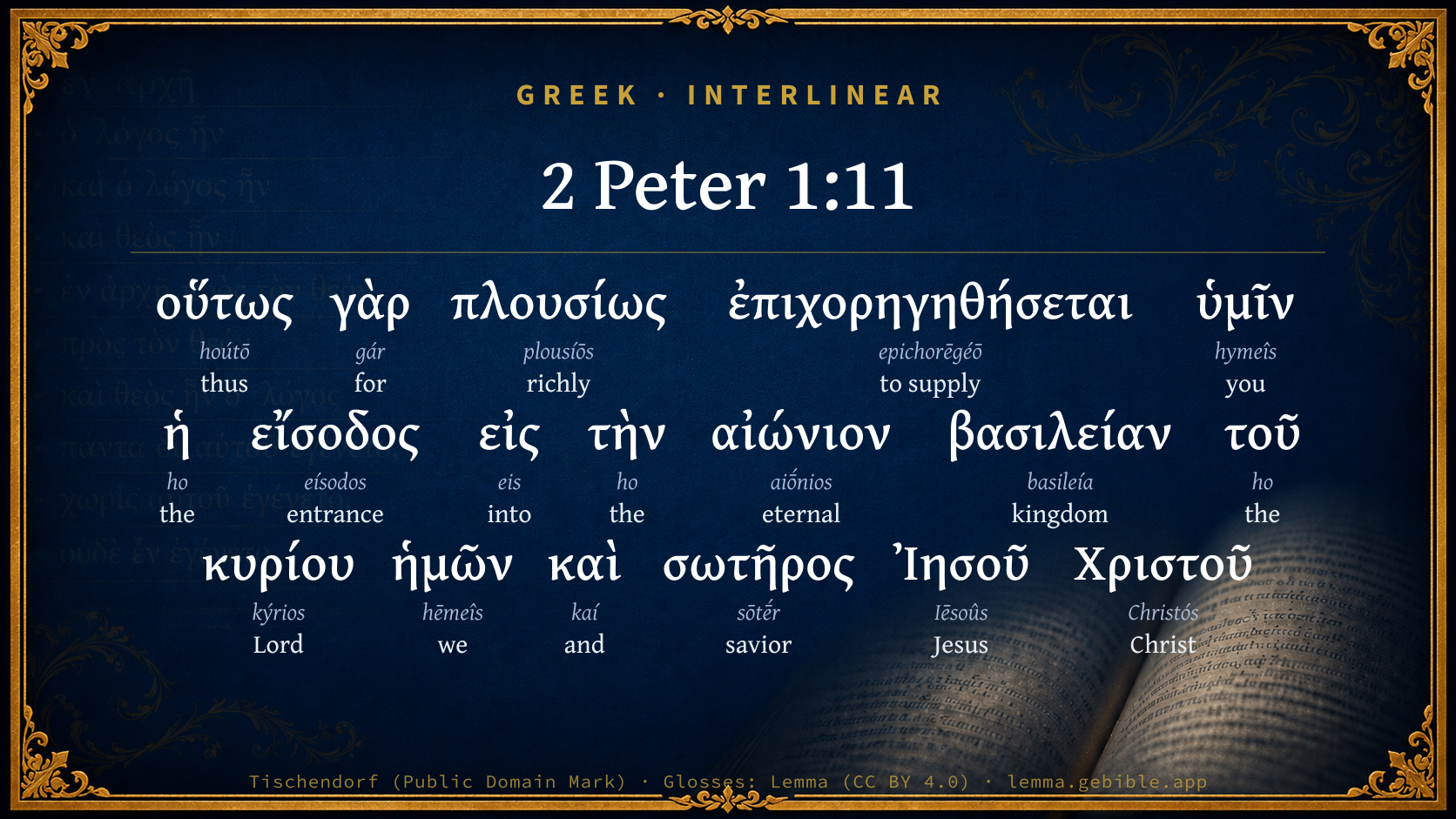
  1. οὕτως hoútō G3779 “thus” Adverb
  2. γὰρ gár G1063 “for” Conjunction
  3. ἐπιχορηγηθήσεται epichorēgéō G2023 “to supply” Verb, Future, Passive, Indicative, 3rd person, Singular
  4. ὑμῖν hymeîs G5210 “you” Personal pronoun, 2nd person, Dative, Plural
  5. ἡ ho G3588 “the” Article, Nominative, Singular, Feminine
  6. εἴσοδος eísodos G1529 “entrance” Noun, Nominative, Singular, Feminine
  7. εἰς eis G1519 “into” Preposition
  8. τὴν ho G3588 “the” Article, Accusative, Singular, Feminine
  9. αἰώνιον aiṓnios G166 “eternal” Adjective, Accusative, Singular, Feminine
  10. βασιλείαν basileía G932 “kingdom” Noun, Accusative, Singular, Feminine
  11. τοῦ ho G3588 “the” Article, Genitive, Singular, Masculine
  12. κυρίου kýrios G2962 “Lord” Noun, Genitive, Singular, Masculine
  13. ἡμῶν hēmeîs G2249 “we” Personal pronoun, 1st person, Genitive, Plural
  14. καὶ kaí G2532 “and” Conjunction
  15. σωτῆρος sōtḗr G4990 “savior” Noun, Genitive, Singular, Masculine
  16. Ἰησοῦ Iēsoûs G2424 “Jesus” Noun, Genitive, Singular, Masculine
  17. Χριστοῦ Christós G5547 “Christ” Noun, Genitive, Singular, Masculine

About this verse

These counts appear in no published source. They are computed here, from the morphology-tagged text and Lemma’s own curated glosses. What Lemma adds →

18
words
16
distinct lemmas
General Epistles
section

Notable vocabulary

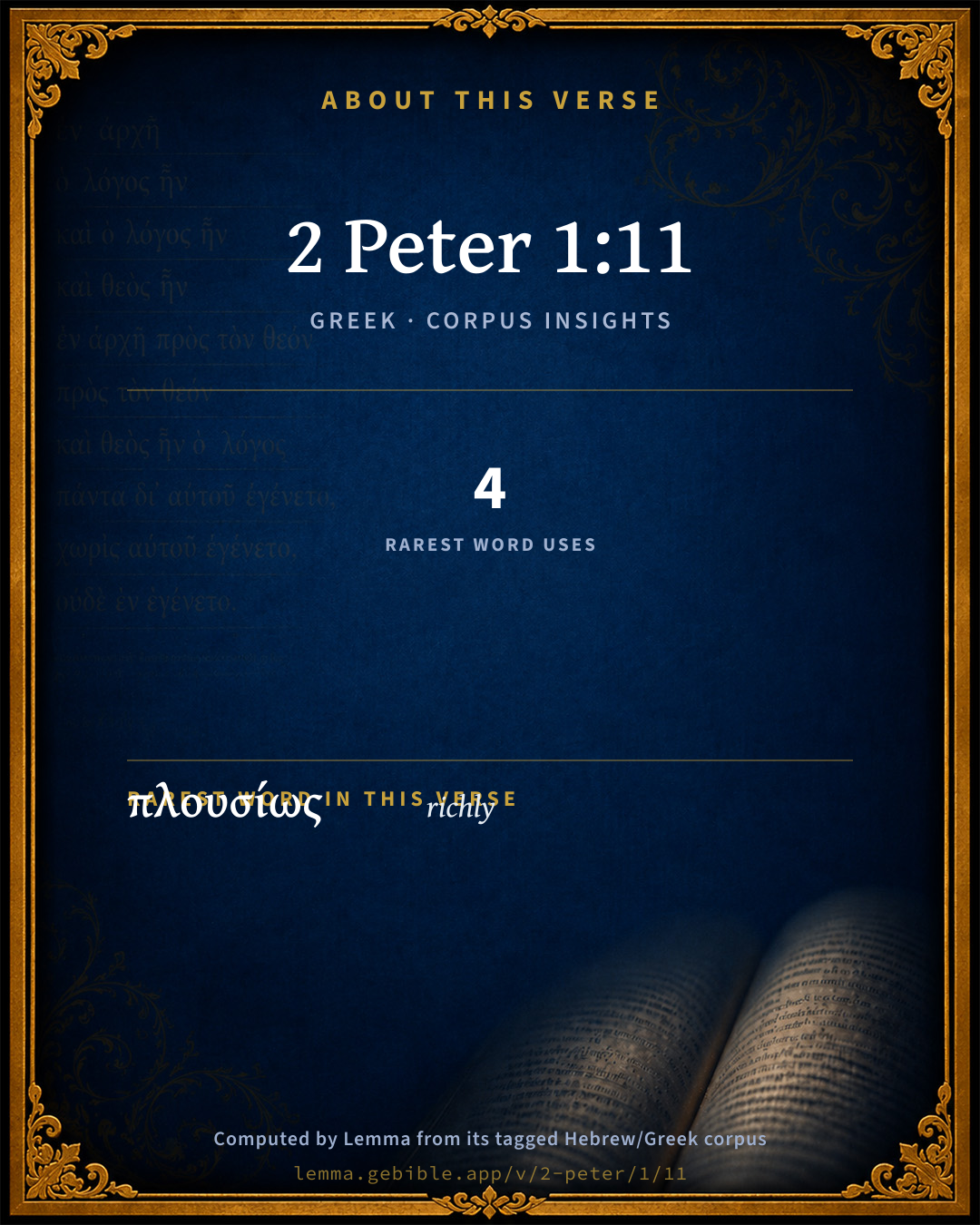
The rarest word here is πλουσίως richly G4146 — appearing just 4 times in the whole Greek New Testament.

Shared distinctive vocabulary

πλουσίως richly G4146 occurs in 4 verses of the Greek New Testament. Also found in:

Repetition

A word recurs within this verse:

Cross-references

15

Topical passages linked to 2 Peter 1:11 in the Treasury of Scripture Knowledge — connected by theme and wording, ordered by reader-vote popularity; previews shown in the World English Bible.

  • Revelation 5:10 And made them kings and priests to our God, And they reign on earth."
  • Matthew 25:34 Then the King will tell those on his right hand, 'Come, blessed of my Father, inherit the Kingdom prepared for you from the foundation of the world;
  • Revelation 3:21 He who overcomes, I will give to him to sit down with me on my throne, as I also overcame, and sat down with my Father on his throne.
  • Daniel 7:27 The kingdom and the dominion, and the greatness of the kingdoms under the whole the sky, shall be given to the people of the saints of the Most High: his kingdom is an everlasting kingdom, and all dominions shall serve and obey him.
  • John 10:10 The thief only comes to steal, kill, and destroy. I came that they may have life, and may have it abundantly.
  • 2 Timothy 4:8 From now on, there is stored up for me the crown of righteousness, which the Lord, the righteous judge, will give to me on that day; and not to me only, but also to all those who have loved his appearing.
  • Hebrews 6:17 In this way God, being determined to show more abundantly to the heirs of the promise the immutability of his counsel, interposed with an oath;
  • Daniel 7:14 There was given him dominion, and glory, and a kingdom, that all the peoples, nations, and languages should serve him: his dominion is an everlasting dominion, which shall not pass away, and his kingdom that which shall not be destroyed.
  • Ephesians 3:20 Now to him who is able to do exceedingly abundantly above all that we ask or think, according to the power that works in us,
  • 2 Corinthians 5:1 For we know that if the earthly house of our tent is dissolved, we have a building from God, a house not made with hands, eternal, in the heavens.
  • Psalms 36:8 They shall be abundantly satisfied with the abundance of your house. You will make them drink of the river of your pleasures.
  • Song of Solomon 5:1 I have come into my garden, my sister, my bride. I have gathered my myrrh with my spice; I have eaten my honeycomb with my honey; I have drunk my wine with my milk. Friends Eat, friends! Drink, yes, drink abundantly, beloved. Beloved
  • Isaiah 9:7 Of the increase of his government and of peace there shall be no end, on the throne of David, and on his kingdom, to establish it, and to uphold it with justice and with righteousness from henceforth even forever. The zeal of Yahweh of Hosts will perform this.
  • Isaiah 35:2 It shall blossom abundantly, and rejoice even with joy and singing; the glory of Lebanon shall be given to it, the excellency of Carmel and Sharon: they shall see the glory of Yahweh, the excellency of our God.
  • 2 Peter 1:1 Simon Peter, a servant and apostle of Jesus Christ, to those who have obtained a like precious faith with us in the righteousness of our God and Savior, Jesus Christ:

Cross-references courtesy of OpenBible.info (CC BY 4.0).

Commentary

Notes on 2 Peter 1:11 from classic Christian and Jewish commentators (each source and its license shown beneath its notes). The classic Christian expositions comment on the surrounding passage and are grouped to its opening verse, so a note may address several verses; the Jewish commentaries on the Tanakh (Rashi and others) are per-verse, so they appear only where the commentator wrote on this verse.

Lemma curates 59 commentaries, every one of them public domain or Creative Commons licensed, each selected and text-cleaned for this edition rather than reprinted as found. About our sources →

MacLaren's Expositions of Holy Scripture

Alexander MacLaren

2 Peter

GOING OUT AND GOING IN

2Pe 1:11-15

I do not like, and do not often indulge in, the practice of taking fragments of Scripture for a text, but I venture to isolate these two words, because they correspond to one another, and when thus isolated and connected, bring out very prominently two aspects of one thing. In the original the correspondence is even closer, for the words, literally rendered, are ‘a going in’ and ‘a going out.’ The same event is looked at from two sides. On the one it is a departure; on the other it is an arrival. That event, I need not say, is Death.

I note, further, that the expression rendered, ‘my decease,’ employs the word which is always used in the Greek translation of the Old Testament to express the departure of the Children of Israel from bondage, and which gives its name, in our language, to the Second Book of the Pentateuch. ‘My exodus’--associations suggested by the word can scarcely fail to have been in the writer’s mind.

Further, I note that this expression for Death is only employed once again in the New Testament--viz., in St. Luke’s account of the Transfiguration, where Moses and Elias spake with Jesus ‘concerning His decease--the exodus--which He should accomplish at Jerusalem.’ If you look on to the verses which follow the second of my texts, you will see that the Apostle immediately passes on to speak about that Transfiguration, and about the voice which He heard then in the holy mount. So that I think we must suppose that in the words of our second text he was already beginning to think about the Transfiguration, and was feeling that, somehow or other, his ‘exodus’ was to be conformed to his Master’s.

Now bearing all these points in mind, let us just turn to these words and try to gather the lessons which they suggest.

I. The first of them is this, the double Christian aspect of death.

It is well worth noting that the New Testament very seldom condescends to use that name for the mere physical fact of dissolution. It reserves it for the most part for something a great deal more dreadful than the separation of body and soul, and uses all manner of periphrases, or what rhetoricians call euphemising, that is, gentle expressions which put the best face upon a thing instead of the ugly word itself. It speaks, for instance, as you may remember, in the context here about the ‘putting off’ of a tent or ‘a tabernacle,’ blending the notions of stripping off a garment and pulling down a transitory abode. It speaks about death as a sleep, and in that and other ways sets it forth in gracious and gentle aspects, and veils the deformity, and loves and hopes away the dreadfulness of it.

Now other languages and other religions besides Christianity have done the same things, and Roman and Greek poets and monuments have in like manner avoided the grim, plain word--death, but they have done it for exactly the opposite reason from that for which the Christian does it. They did it because the thing was so dark and dismal, and because they knew so little and feared so much about it. And Christianity does it for exactly the opposite reason, because it fears it not at all, and knows it quite enough. So it toys with leviathan, and ‘lays its hand on the cockatrice den,’ and my text is an instance of this.

‘My decease ... an entrance.’ So the terribleness and mystery dwindled down into this--a change of position; or if locality is scarcely the right class of ideas to apply to spirits detached from the body--a change of condition. That is all.

We do not need to insist upon the notion of change of place. For, as I say, we get into a fog when we try to associate place with pure spiritual existence. But the root of the conviction which is expressed in both these phrases, and most vividly by their juxtaposition, is this, that what happens at death is not the extinction, but the withdrawal, of a person, and that the man is, as fully, as truly as he was, though all the relations in which he stands may be altered.

Now no materialistic teaching has any right to come in and bar that clear faith and firm conclusion. For by its very saying that it knows nothing about life except in connection with organisation, it acknowledges that there is a difference between them. And until science can tell me how it is that the throb of a brain or the quiver of a nerve, becomes transformed into morality, into emotion, I maintain that it knows far too little of personality and of life to be a valid authority when it asserts that the destruction of the organisation is the end of the man. I feel myself perfectly free--in the darkness in which, after all investigation, that mysterious transformation of the physical into the moral and the spiritual lies--I feel perfectly free to listen to another voice, the voice which tells me that life can subsist, and that personal being can be as full--ay, fuller--apart altogether from the material frame which here, and by our present experience, is its necessary instrument. And though accepting all that physical investigation can teach us, we can still maintain that its light does not illumine the central obscurity; and that, after all, it still remains true that round about the being of each man, as round about the being of God, clouds and darkness roll,

‘Life and thought have gone away,

Side by side,

Leaving door and window wide.’

That, and nothing more, is death--’My decease ... an entrance.’

Then, again, the combination of these two words suggests to us that the one act, in the same moment, is both departure and arrival. There is not a pin-point of space, not the millionth part of a second of time, intervening between the two. There is no long journey to be taken. A man in straits, and all but desperation, is recorded in the old Book to have said: ‘There is but a step between me and death.’ Ah, there is but a step between death and the Kingdom; and he that passes out at the same moment passes in.

I need not say a word about theories which seem to me to have no basis at all in our only source of information, which is Revelation; theories which would interpose a long period of unconsciousness--though to the man unconscious it be no period at all--between the act of departure and that of entrance. Not so do I read the teaching of Scripture: ‘This day thou shalt be with Me in Paradise.’ We pass out, and as those in the vestibule of a presence-chamber have but to lift the curtain and find themselves face to face with the king, so we, at one and the same moment, depart and arrive.

Friends stand round the bed, and before they can tell by the undimmed mirror that the last breath has been drawn, the saint is ‘with Christ, which is far better.’ To depart is to be with Him. There is a moment in the life of every believing soul in which there strangely mingle the lights of earth and the lights of heaven. As you see in dissolving views, the one fades and the other consolidates. Like the mighty angel in the Apocalypse, the dying man stands for a moment with one foot on the earth and the other already laved and cleansed by the waters of that ‘sea of glass mingled with fire which is before the Throne,’ ‘Absent from the body; present with the Lord.’

Further, these two words suggest that the same act is emancipation from bondage and entrance into royalty.

‘My exodus.’ Israel came out of Egyptian servitude and dropped chains from wrists and left taskmasters cracking their useless whips behind them, and the brick kilns and the weary work were all done when they went forth. Ah, brethren, whatever beauty and good and power and blessedness there may be in this mortal life, there are deep and sad senses in which, for all of us, it is a prison-house and a state of captivity. There is a bondage of flesh; there is a dominion of the animal nature; there are limitations, like high walls, cribbing, cabining, confining us--the limitations of circumstance. There is the slavery of dependence upon this poor, external, and material world. There are the tyranny of sin and the subjugation of the nobler nature to base and low and transient needs. All these fetters, and the scars of them, drop away. Joseph comes out of prison to a throne. The kingdom is not merely one in which the redeemed man is a subject, but one in which he himself is a prince. ‘Have thou authority over ten cities.’ These are the Christian aspects of death.

II. Now note, secondly, the great fact on which this view of death builds itself.

I have already remarked that in one of my texts the Apostle seems to be thinking about Jesus Christ and His decease. The context also refers to another incident in his own life, when our Lord foretold to him that the putting off his tabernacle was to be ‘sudden,’ and added: ‘Follow thou Me.’

Taking these allusions into account, they suggest that it is the death of Jesus Christ--and that which is inseparable from it, His Resurrection--that changes for a soul believing on Him the whole aspect of that last experience that awaits us all. It is His exodus that makes ‘my exodus’ a deliverance from captivity and an entrance upon royalty.

I need not remind you, how, after all is said and done, we are sure of life eternal, because Jesus Christ died and rose again. I do not need to depreciate other imperfect arguments which seem to point in that direction, such as the instincts of men’s natures, the craving for some retribution beyond, the impossibility of believing that life is extinguished by the fact of physical death. But whilst I admit that a good deal may be said, and strong probabilities may be alleged, it seems to me that however much you may argue, no words, no considerations, moral or intellectual, can suffice to establish more than that it would be a very good thing if there were a future life and that it is probable that there is. But Jesus Christ comes to us and says, ‘Touch Me, handle Me; a spirit hath not flesh and bones as I have. Here I am. I was dead; I am alive for evermore.’ So then one life, that we know about, has persisted undiminished, apart from the physical frame, and that one Man has gone down into the dark abyss, and has come up the same as when He descended. So it is His exodus--and, as I believe, His death and Resurrection alone--on which the faith in immortality impregnably rests.

But that is not the main point which the text suggests. Let me remind you how utterly the whole aspect of any difficulty, trial, or sorrow, and especially of that culmination of all men’s fears--death itself--is altered when we think that in the darkest bend of the dark road we may trace footsteps, not without marks of blood in them, of Him that has trodden it all before us. ‘Follow thou Me,’ He said to Peter; and it should be no hard thing for us, if we love Him, to tread where He trod. It should be no lonely road for us to walk, however the closest clinging hands may be untwined from our grasp, and the most utter solitude of which a human soul is capable may be realised, when we remember that Jesus Christ has walked it before us.

The entrance, too, is made possible because He has preceded us. ‘I go to prepare a place for you.’ So we may be sure that when we go through those dark gates and across the wild, the other side of which no man knows, it is not to step out of ‘the warm precincts of the cheerful day’ into some dim, cold, sad land, but it is to enter into His presence.

Israel’s exodus was headed by a mummy case, in which the dead bones of their whilom leader were contained. Our exodus is headed by the Prince of Life, who was dead and is alive for evermore.

So, brethren, I beseech you, treasure these thoughts more than you do. Turn to Jesus Christ and His resurrection from the dead more than you do. I may be mistaken, but it seems to me that the Christianity of this day is largely losing the habitual contemplation of immortality which gave so much of its strength to the religion of past generations. We are all so busy in setting forth and enforcing the blessings of Christianity in its effects in the present life that, I fear me, we are largely forgetting what it does for us at the end, and beyond the end. And I would that we all thought more of our exodus and of our entrance in the light of Christ’s death and resurrection. Such contemplation will not unfit us for any duty or any enjoyment. It will lift us above the absorbed occupation with present trivialities, which is the bane of all that is good and noble. It will teach us ‘a solemn scorn of ills.’ It will set on the furthest horizon a great light instead of a doleful darkness, and it will deliver us from the dread of that ‘shadow feared of man,’ but not by those who, listening to Jesus Christ, have been taught that to depart is to be with Him.

III. Now I meant to have said a word, in the close of my sermon, about a third point--viz., the way of securing that this aspect of death shall be our experience, but your time will not allow of my dwelling upon that as I should have wished. I would only point out that, as I have already suggested, this context teaches us that it is His death that must make our deaths what they may become; and would ask you to notice, further, that the context carries us back to the preceding verses. ‘An entrance shall be ministered unto you abundantly.’ We have just before read, ‘If these things be in you and abound, they make you that ye shall neither be barren nor unfruitful in the knowledge of our Lord Jesus Christ’; and just before is the exhortation, ‘giving all diligence, minister to your faith virtue.’

So the Apostle, by reiterating the two words which he had previously been using, teaches us that if death is to be to us that departure from bondage and entrance into the Kingdom, we must here and now bring forth the fruits of faith. There is no entrance hereafter, unless there has been a habitual entering into the Holy Place by the blood of Jesus Christ even whilst we are on earth. There is no entrance by reason of the fact of death, unless all through life there has been an entrance into rest by reason of the fact of faith.

And so, dear brethren, I beseech you to remember that it depends on yourself whether departing shall be arrival, and exodus shall be entrance. One thing or other that last moment must be to us all--either a dragging us reluctant away from what we would fain cleave to, or a glad departure from a foreign land and entrance to our home. It may be as when Peter was let out of prison, the angel touched him, and the chains fell from his hands, and the iron gate opened of its own accord, and he found himself in the city. It is for you to settle which of the two it shall be. And if you will take Him for your King, Companion, Saviour, Enlightener, Life here, ‘the Lord shall bless your going out and coming in from this time forth and even for evermore.’

Alexander MacLaren, Expositions of Holy Scripture (1904–1910) — public domain. Text from a community e-Sword module.

Bengel's Gnomon

Johann Albrecht Bengel

2Pe 1:11. Πλουσίως) abundantly; so that at any time, without stumbling, you may be able to enter, not as having escaped from a shipwreck, or from fire, but as it were in triumph; and that things past, things present, and things to come may profit you. Here Peter does not now say, scarcely, as in his first Epistle, 1Pe 4:8. This expression answers to abound, in 2Pe 1:8.

Bengel's Gnomon of the New Testament — English translation (T&T Clark, Edinburgh, 1860) — public domain. Text from a community e-Sword module.

Meyer's Critical & Exegetical Commentary

Heinrich August Wilhelm Meyer

2Pe_1:11. οὕτω γάρ] Resumption of the ταῦτα ποιοῦντες; Dietleins interpretation is erroneous: precisely when ye in all humility renounce every arrogant striving after distinction; for there is no reference here to any such striving.

πλουσίως ἐπιχορηγηθήσεται ὑμῖν ἡ εἴσοδος εἰς κ.τ.λ.] The conjunction of εἴσοδος and πλουσίως ἐπιχορηγηθήσεται is surprising. It is incorrect to attribute to πλουσίως a meaning different from that which it always has (thus Grotius: promptissimo Dei affectu; Augusti: in more than one way). It is, however, also erroneous to make πλουσ. ἐπιχορ. apply not to εἴσοδος itself, but to the condition which is entered upon after the εἴσοδος, the higher degree of blessedness (de Wette).[42] ἐπιχορ. represents the entrance into the eternal kingdom of Christ as a gift; πλουσίως as a gift abundantly; in so far as that entrance is not in any way rendered difficult, or even hindered; the opposite is the μόλις, 1Pe_4:18. Schott is not quite accurate in applying πλουσίως to the secure certainty of the entrance. Wiesinger adopts both the interpretation of Gerhard: divites eritis in praemiis coelestibus, and that of Bengel: ut quasi cum triumpho intrare possitis. Dietlein here inaptly brings in with ἐπιχορηγ. the conception of a chorus in solemn procession. It is to be noted that as ἐπιχορηγήσατε, 2Pe_1:5, points back to δεδώρηται in 2Pe_1:4, so does this ἐπιχορηγηθήσεται here to ἐπιχορηγήσατε. The Christians gift in return must correspond with the gift of God, and the return-gift of God again with that of the Christian.

[42] Steinfass: This passage treats of the way, of the admission to it, and not of the blessedness which awaits the believer at the end of it. He is right, only that it is not even the way that is treated of, but merely the admission (or more correctly, the entrance) to it.

Meyer — Critical and Exegetical Commentary on the New Testament — English translation by Peter Christie, edited by Frederick Crombie (T&T Clark, 1880) — public domain. Text from a community e-Sword module.

Expositor's Greek Testament

ed. W. Robertson Nicoll

2Pe 1:11 . Note the accumulation in this verse of words suggesting splendour and fulness. ἐπιχορηγηθήσεται . Cf. note on 2Pe 1:5 . Mayor says that here the word “suggests the ordering of a triumphal procession,” and compares Plut. Vit. 994, ὁ δῆμος ἐθεᾶτο τὰς θέας ἀφειδῶς πάνυ χορηγουμένας . εἴσοδος . Cf. Heb 10:19 . In a theatre, εἰς . is the place of entrance for the chorus (Ar. Nub. 326; Av. 296), and in P. Par. ii. 41, we find εἴσοδος κοινή = of the door of a house. The great description of the entrance of the pilgrims into the celestial city in Bunyan’s Pilgrim’s Progress , Pt. 1., may be quoted in illustration. αἰώνιον βασιλείαν . does not occur elsewhere in N.T. or Apostolic Fathers ( cf. Aristotle’s Apol. xvi., and Clem. Hom. x. 25), but αἰωνίου ἀρχῆς occurs in the Stratonicean inscriptions already quoted (Deissmann, op. cit. p. 361).

The Expositor's Greek Testament, edited by W. Robertson Nicoll (1897–1910) — public domain. Text from a community e-Sword module.

Jamieson, Fausset & Brown

Robert Jamieson, A. R. Fausset & David Brown

an entrance--rather as Greek, "the entrance" which ye look for.

ministered--the same verb as in Pe2 1:5. Minister in your faith virtue and the other graces, so shall there be ministered to you the entrance into that heaven where these graces shine most brightly. The reward of grace hereafter shall correspond to the work of grace here.

abundantly--Greek, "richly." It answers to "abound," Pe2 1:8. If these graces abound in you, you shall have your entrance into heaven not merely "scarcely" (as he had said, Pe1 4:18), nor "so as by fire," like one escaping with life after having lost all his goods, but in triumph without "stumbling and falling."

Jamieson, Fausset & Brown — Commentary Critical and Explanatory on the Whole Bible (1871) — public domain (CC PDM 1.0). Text via the HelloAO Bible API.

Adam Clarke's Commentary

Verse 11. For so an entrance shall be ministered] If ye give diligence; and do not fall, an abundant, free, honourable, and triumphant entrance shall be ministered to you into the everlasting kingdom. There seems to be here an allusion to the triumphs granted by the Romans to their generals who had distinguished themselves by putting an end to a war, or doing some signal military service to the state. (See the whole account of this military pageant in Clarke's note on "2Co 2:14".) "Ye shall have a triumph, in consequence of having conquered your foes, and led captivity captive."

Instead of everlasting kingdom, αιωνιονβασιλειαν, two MSS. have επουρανιον, heavenly kingdom; and several MSS. omit the word καισωτηρος, and Saviour.

Adam Clarke's Commentary on the Bible (1810–1826) — public domain. Text from a community e-Sword/MySword module.

John Calvin's Commentaries

He explains the way or means of persevering, when he says, an entrance shall be ministered to you. The import of the words is this: “God, by ever supplying you abundantly with new graces, will lead you to his own kingdom.” And this was added, that we may know, that though we have already passed from death into life, yet it is a passage of hope; and as to the fruition of life, there remains for us yet a long journey. In the meantime we are not destitute of necessary helps. Hence Peter obviates a doubt by these words, “The Lord will abundantly supply your need, until you shall enter into his eternal kingdom.” He calls it the kingdom of Christ, because we cannot ascend to heaven except under his banner and guidance.

John Calvin's Commentaries (1540-1563) — public domain. Text from the Calvin Translation Society English edition (1840s-50s) via the Christian Classics Ethereal Library (ccel.org). Calvin's coverage is partial (roughly two-thirds of the Bible); uncommented books and verses are honest gaps, never fabricated. The 19th-century editor's footnotes and remarks are omitted so the notes are faithfully Calvin's own voice.

Ellicott's Commentary for English Readers

(11) An entrance shall be ministered unto you.—“Ministered” is the passive of the same verb that is translated “add” in 2Pe_1:5, and is probably chosen to answer to 2Pe_1:5. “Supply these graces, and an entrance into the kingdom shall be abundantly supplied to you”—“abundantly,” i.e., with a warm welcome, as to a son coming home in triumph; not a bare grudging admission, as to a stranger.

Thus ends the first main section of the Epistle, which contains the substance of the whole. Its gentle earnestness and obvious harmony with the First Epistle have made some critics ready to admit its genuineness, who throw doubt on much of the rest. But if it stands it carries with it all the rest. Change of style is amply accounted for by change to a new and exciting subject; and the links between the parts are too strong to be severed by any such considerations. (See opening observations in the Introduction.)

The first sections of the two Epistles should be carefully compared. In both we find these thoughts pervading the opening exhortation: Be earnest, be active; for (1) so much has been done for you, and (2) there is such a rich reward in store for you. (Comp. especially the conclusions of the two sections, 1Pe_1:13 with 2Pe_1:10-11.)

A Bible Commentary for English Readers, edited by Charles John Ellicott (1878–1897) — public domain. Text from a community e-Sword module.

The Cambridge Bible for Schools and Colleges

gen. ed. J. J. S. Perowne

11. for so an entrance shall be ministered unto you abundantly] Better, the entrance shall be richly bestowed or supplied. The verb is the same as that which is translated “add” in 2Pe_1:5, where see note. The Greek has the article with the noun as defining the entrance to be that which was the well-known object of the faith and hope of all Christians. In St Peter’s use of the word we may, perhaps, trace an echo of 1Th_1:9; 1Th_2:1, though it is used there in a lower sense.

everlasting] The rule of keeping, as far as possible, to uniformity of rendering would make eternal preferable. It is, perhaps, worth noting that this is the only passage in the New Testament in which the adjective is joined to “kingdom.”

The Cambridge Bible for Schools and Colleges (gen. ed. J. J. S. Perowne; Cambridge University Press, 1878–1918) — public domain. Text from a community e-Sword module.

John Gill's Exposition

For so an entrance shall be ministered unto you abundantly,.... An abundant supply of grace and strength shall be freely afforded, to carry you through all the duties and trials of life; and when that shall be ended, an admission will be granted

into the everlasting kingdom of our Lord and Saviour Jesus Christ; meaning, not the Gospel dispensation, or the spiritual kingdom of Christ, which is not of this world, but lies among his people, who are called out of it, in whom he reigns by his Spirit and, grace, according to laws of his own enacting; nor his personal kingdom on earth with his saints, which will last only a thousand years, and not be for ever; but the kingdom of heaven, or the ultimate glory, which will be everlasting; and is called a kingdom, to denote the glory and excellency of that state; and an everlasting one, because it will never end; and the kingdom of Christ, because it is in his possession, for his people; it is prepared by him, and he will introduce them into it, when they shall be for ever with him, and reign with him for ever and ever. Some copies read, "the heavenly kingdom". There is an entrance of separate souls into this kingdom at death; and which may be said to be ministered "abundantly" to them, or "richly" as the word signifies, when they depart out of this world with joy and comfort; triumphing over death, and the grave, in a full view by faith of their interest in the love of God, the grace of Christ, and the glories of another world; and there is an entrance into it at judgment, and which will be abundantly, when all the saints together, in their souls and bodies, shall be introduced by Christ into the full joy of their Lord. As the saints enter the kingdom through many tribulations, the gate is strait, and the way is narrow, and they are scarcely saved, and many of them so as only by fire; but when the abundant grace given unto them by the way to heaven, the great consolation many enjoy in their last moments, and especially the free and full admission of them, both at death and at judgment, to eternal happiness, are considered, the entrance ministered may be said to be abundantly; or, as the Arabic version renders it, "with a breadth"; the entrance is large and broad.

John Gill's Exposition of the Whole Bible (1746–1763) — public domain (CC PDM 1.0). Text via the HelloAO Bible API.

Trapp's Complete Commentary

John Trapp

11 For so an entrance shall be ministered unto you abundantly into the everlasting kingdom of our Lord and Saviour Jesus Christ.

Ver. 11. Ministered unto you abundantly] Ye shall go gallantly into heaven, not get thither as many do, with hard shift and much ado. A ship may make a shift to get into the harbour, but with anchors lost, cables rent, sails torn, mast broken; another comes in with sails and flags up, with trumpets sounding, and comes bravely into the haven: so do fruitful and active Christians into Christ’s kingdom.

Into the everlasting kingdom] Not so into this world, which is like a candlestick, where ye may see orchards and gardens curiously drawn, but ye cannot enter into them.

John Trapp, A Commentary or Exposition upon All the Books of the Old and New Testament (1647–1656) — public domain. Text from a community e-Sword module.

Albert Barnes' Notes on the Bible

For so an entrance - In this manner you shall be admitted into the kingdom of God.

Shall be ministered unto you - The same Greek word is here used which occurs in 2Pe 1:5, and which is there rendered “add.” See the notes at that verse. There was not improbably in the mind of the apostle a recollection of that word; and the sense may be, that “if they would lead on the virtues and graces referred to in their beautiful order, those graces would attend them in a radiant train to the mansions of immortal glory and blessedness.” See Doddridge in loc.

Abundantly - Greek, “richly.” That is, the most ample entrance would be furnished; there would be no doubt about their admission there. The gates of glory would be thrown wide open, and they, adorned with all the bright train of graces, would be admitted there.

Into the everlasting kingdom ... - Heaven. It is here called “everlasting,” not because the Lord Jesus shall preside over it as the Mediator (compare the notes at 1Co 15:24), but because, in the form which shall be established when “he shall have given it up to the Father,” it will endure forever, The empire of God which the Redeemer shall set up over the souls of his people shall endure to all eternity. The object of the plan of redemption was to secure their allegiance to God, and that will never terminate.

Albert Barnes' Notes on the Bible (1834–1885) — public domain. Text from a community e-Sword/MySword module.

Matthew Poole's English Annotations

Abundantly; or richly: while ye minister, or add one grace to another, one good work to another, 2Pe 1:5, &c., God likewise will minister, (the same word is here used as 2Pe 1:5), or add largely or richly, the supplies of the Spirit, in grace, and strength, and consolation, and whatsoever is needful for you in the way, whereby your faith may be increased, your joy promoted, and your perseverance secured, till ye come into the possession of the everlasting kingdom.

Matthew Poole's English Annotations on the Holy Bible (1683–1685) — public domain. Text from a community e-Sword/MySword module.

Whedon's Commentary on the Bible

Daniel D. Whedon

11. For so—You, for your part, doing these things.

Shall be ministered—The same Greek as add, 2Pe_1:5. God, on his part, will richly furnish you with your hoped-for entrance into the heavenly kingdom. Thus God’s work and man’s work unite in securing our eternal salvation.

Kingdom… Christ—The assertion of the kingship of Christ fitly closes the discussion.

Daniel D. Whedon (gen. ed.), Commentary on the Old and New Testaments (1874–1909) — public domain. Text from a community e-Sword module.

The Pulpit Commentary

For so an entrance shall be ministered unto you abundantly; rather, as in the Revised Version, for thus shall be richly supplied unto you the entrance. The verb ejpicorhghqhsetai looks back to ejpicorhghsate in verse 5, and "richly" to "abound" in verse 8. If we do our poor best in supplying the graces mentioned above, the entrance shall be richly supplied. St. Peter seems to imply that there will be degrees of glory hereafter proportioned to our faithfulness in the use of God"s gifts here. The adverb "richly" is fitly joined with the verb ejpicorhgein, which signifies properly to provide the expenses for a chorus. The article defines the entrance as the great object of the Christian"s hope. Into the everlasting kingdom of our Lord and Saviour Jesus Christ; rather, the eternal kingdom. Notice the exact correspondence of the Greek words here, tou Kuriou hJmwn kai Swthrov jIhsou Cristou, with these in verse 2, tou Qeou hJmwn kai Swthrov jIhsou Cristou, as a strong argument in favour of the translation, "Our God and Saviour Jesus Christ," in that verse.

The Pulpit Commentary (1880–1919), ed. H.D.M. Spence-Jones & Joseph S. Exell — public domain. Text from a community e-Sword module.

John Wesley's Explanatory Notes

For if ye do so, an entrance shall be ministered to you abundantly into the everlasting kingdom - Ye shall go in full triumph to glory.

John Wesley, Explanatory Notes Upon the Whole Bible (1754–1765) — public domain. Text via the GEBible commentary corpus.

Burkitt's Expository Notes on the New Testament

William Burkitt

There are four sorts of persons spoken of in scripture:

1. Some are said to be far from the kingdom of God, afar off from God, as Heathens and Infidels, who know not God.

2. Others are said not to be far from the kingdom of God, Mar 12:34, who yet will never come there.

3. Others are scarcely saved, saved with great difficulty, so as by fire, with much dross of error in judgment, and corruption in life.

4. Others are said to have an abundant entrance administered to them into the everlasting kingdom, and these are the fruitful Christians, who are daily adding to their graces, and going from strength to strength: These shoot the gulph of death in the holy triumph of their grace; they enter the harbour of heaven with a plerophory, a full sail, with full assurance of faith and hope. Thus will the fruitful Christian have both a more comfortable passage to, and also a more ample reward in heaven.

William Burkitt's Expository Notes on the New Testament (1700–1703) — public domain. Text from a community e-Sword module.

The People's New Testament

B. W. Johnson

11. An abundant entrance. We will be richly prepared for entrance. Into the eternal kingdom. The heavenly kingdom.

B. W. Johnson's The People's New Testament with Notes (1889–1891) — public domain. Electronic text from the Christian Classics Ethereal Library (CCEL) ThML edition.

Cambridge Greek Testament for Schools and Colleges

11. εἴσοδος would most naturally mean the place of entrance, but here, as in Heb 10:19 and elsewhere in N.T., it clearly means the action of entering.

Cambridge Greek Testament for Schools and Colleges (Cambridge University Press, 1896; 21 vols, various authors incl. Carr, Maclear, Plummer, Farrar, Lumby, Moule, M. R. James, Simcox) — public domain. Text from a community e-Sword module.

Alford’s Greek Testament

Henry Alford

11.] The exhortation is resumed, and further pressed, both on the preceding grounds, and on account of its blessed ultimate results, if followed.

11.] for thus (i. e. ταῦτα ποιοῦντες) shall be richly (the adverb πλουσίως is not, as Huther, surprising, but most natural and obvious with the verb ἐπιχορηγηθήσεται, which is one of furnishing and ministering; therefore of quantity. The adverb belongs to the figure latent in the verb: and must therefore be interpreted in and with the interpretation of the verb: in which case it will indicate high degrees and fulness of glory) furnished to you (the verb seems expressly chosen in order to answer to ἐπιχορηγήσατε, ver. 5: “furnish forth your own lives with these Christian graces, so shall be furnished to you” &c.) the [or, your] entrance (which all Christians look for: not the fact of this entrance taking place, but the fact of its πλουσίως ἐπιχορηγηθῆναι, is that asserted) into the eternal kingdom of our Lord and Saviour Jesus Christ.

Henry Alford, The Greek Testament (1849–1861) — public domain. Text from a community e-Sword module.

Vincent's Word Studies in the New Testament

Marvin R. Vincent

Shall be ministered abundantly [πλουσιως επιχορηγηθησεται] . On the verb see ver. 5. Rev., shall be richly supplied. We are to furnish in our faith : the reward shall be furnished unto us. Richly, indicating the fulness of future blessedness. Professor Salmond observes that it is the reverse of "saved, yet so as by fire" (1Co 3:15).

Everlasting kingdom [αιωνιον βασιλειαν] . In the first epistle, Peter designated the believer 's future as an inheritance; here he calls it a kingdom. Eternal, as Rev., is better than everlasting, since the word includes more than duration of time.

Marvin R. Vincent, Word Studies in the New Testament (1887–1900) — public domain. Text from a community e-Sword/MySword module.

Lesson kit

Teaching starters — assembled from the data on this page, not authored interpretation. Every prompt links to the verse data it draws on. Edit before teaching.

2 Peter, in the General Epistles, opens this verse with 18 words (16 distinct Greek lemmas). Its most distinctive word is plousíōs (“richly”). A historical commentator’s framing appears above. Read the whole chapter for the surrounding context.

Discussion questions

  1. How does “richly” (plousíōs) shape what this verse is saying?
  2. How does Colossians 3:16, which shares the word «richly», read alongside this verse?
  3. What does the repetition of “the” (3× in this one verse) do in this verse?
  4. These translations render this verse differently. What is at stake in choosing one wording over another?
  5. Compare how MacLaren's Expositions of Holy Scripture and Bengel's Gnomon read this verse. Where do they agree or differ?

Things to notice

Reading settings

Reading text

Shown beneath each verse's original-language words.

Old Testament
Old Testament edition

Read the OT as the Masoretic Hebrew (MT) or the Greek Septuagint (LXX).

English shown for the Greek Septuagint (in the Hebrew ↔ Greek comparison).

Comparing translations? Open the Compare panel on any verse page to stack up to four side by side.