
2 Corinthians 9:5

Greek (Tischendorf 8th ed.) 2 Corinthians 9:5 appears in the Greek New Testament. The text above is from the Tischendorf 8th edition. Each word links to its Strong’s number and a concise gloss. Click any word for its full Thayer’s Greek Lexicon entry.

Download image
Cite this verse

2 Corinthians 9:5 (World English Bible). Public Domain. Lemma interlinear Bible study tool, https://lemma.gebible.app/v/2-corinthians/9/5.

Show BibTeX & RIS
BibTeX
RIS
English Translation
I thought it necessary therefore to entreat the brothers that they would go before to you, and arrange ahead of time the generous gift that you promised before, that the same might be ready as a matter of generosity, and not of greediness.
World English Bible · Public Domain
Highlights
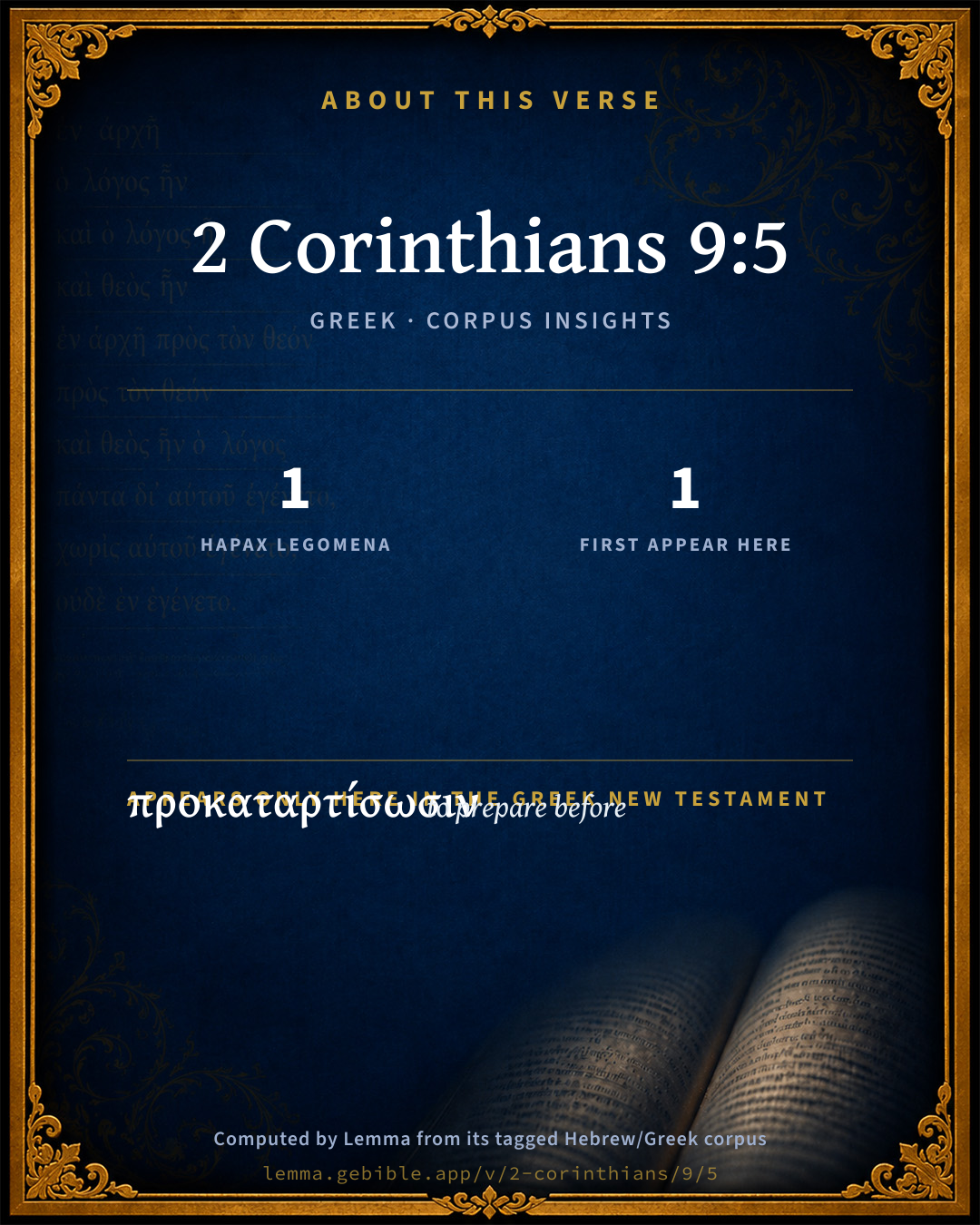
  • 1 hapax legomenon — only here in the Greek New Testament
  • 1 first appearance in the Greek New Testament
Full analysis ↓
Download a study sheet

One document with this verse’s original text, its word-by-word gloss line, the meaning frame, cross-references with their text, attributed commentary, and full source and license credits — printable, and it pastes into notes with its structure intact.

This verse Autodidact and up

Study sheet (.html) Plain text (.txt)

A passage Seminary Student

Up to 50 verses in one chapter. A passage sheet keeps up to 6 commentary sources and 12 cross-references per verse, in the order this page ranks them, and says so on the sheet whenever that leaves anything out. Ask for a single verse and you get the Autodidact verse sheet above.

Everything on this page stays free to read, with no account — the sheet is a download of what is already on screen, not access to it.

Want to remove ads? Support Godless Engineer
Compare translations 3

The same verse in 3 English versions, stacked beneath the original-language interlinear above. Click any original word for its lexicon entry.

Each is an independent rendering of the whole verse — the interlinear is not word-aligned to these translations.

Highlighted words mark where these versions differ — a whole-verse word diff, not a word-by-word alignment.

  • World English Bible Public Domain
    I thought it necessary therefore to entreat the brothers that they would go before to you, and arrange ahead of time the generous gift that you promised before, that the same might be ready as a matter of generosity, and not of greediness.
  • King James Version Public Domain
    Therefore I thought it necessary to exhort the brethren, that they would go before unto you, and make up beforehand your bounty, whereof ye had notice before, that the same might be ready, as a matter of bounty, and not as of covetousness.
  • unfoldingWord Literal Text CC BY-SA 4.0
    So I thought it necessary to urge the brothers that they should go to you beforehand and prepare in advance this promised blessing of yours, to be ready in this way as a blessing and not as something forced.

unfoldingWord Literal Text — © unfoldingWord, licensed CC BY-SA 4.0. Word-aligned USFM3 via Door43 (git.door43.org/unfoldingWord/en_ult).

Versions to compare (up to 4)

3 of 4 selected

Show all 19 translations

Every available English version of this verse, each an independent rendering of the whole verse.

  • World English Bible Public Domain
    I thought it necessary therefore to entreat the brothers that they would go before to you, and arrange ahead of time the generous gift that you promised before, that the same might be ready as a matter of generosity, and not of greediness.
  • Berean Standard Bible Public Domain
    So I thought it necessary to urge the brothers to visit you beforehand and make arrangements for the bountiful gift you had promised. This way, your gift will be prepared generously and not begrudgingly.
  • Majority Standard Bible Public Domain
    So I thought it necessary to urge the brothers to visit you beforehand and make arrangements for the generous gift that was announced. This way, your gift will be prepared generously and not begrudgingly.
  • King James Version Public Domain
    Therefore I thought it necessary to exhort the brethren, that they would go before unto you, and make up beforehand your bounty, whereof ye had notice before, that the same might be ready, as a matter of bounty, and not as of covetousness.
  • American Standard Version (1901) Public Domain
    I thought it necessary therefore to entreat the brethren, that they would go before unto you, and make up beforehand your aforepromised bounty, that the same might be ready as a matter of bounty, and not of extortion.
  • Revised Version (1885) Public Domain
    I thought it necessary therefore to entreat the brethren, that they would go before unto you, and make up beforehand your aforepromised bounty, that the same might be ready, as a matter of bounty, and not of extortion.
  • Geneva Bible (1599) Public Domain
    Wherefore, I thought it necessarie to exhort the brethren to come before vnto you, and to finish your beneuolence appointed afore, that it might be readie, and come as of beneuolence, and not as of niggardlinesse.
  • Douay-Rheims (1899) Public Domain
    Therefore I thought it necessary to desire the brethren that they would go to you before, and prepare this blessing before promised, to be ready, so as a blessing, not as covetousness.
  • Young's Literal Translation Public Domain
    Necessary, therefore, I thought `it' to exhort the brethren, that they may go before to you, and may make up before your formerly announced blessing, that this be ready, as a blessing, and not as covetousness.
  • Literal Standard Version CC BY-SA 4.0
    Therefore I thought [it] necessary to exhort the brothers, that they may go before to you, and may make up before your formerly announced blessing, that this be ready, as a blessing, and not as covetousness.
  • Unlocked Literal Bible CC BY-SA 4.0
    So I thought it was necessary to urge the brothers to come to you and to make arrangements in advance for the gift you have promised. This is so that it might be ready as a blessing, and not as something extorted.
  • unfoldingWord Literal Text CC BY-SA 4.0
    So I thought it necessary to urge the brothers that they should go to you beforehand and prepare in advance this promised blessing of yours, to be ready in this way as a blessing and not as something forced.
  • Darby Bible Public Domain
    I thought it necessary therefore to beg the brethren that they would come to you, and complete beforehand your fore-announced blessing, that this may be ready thus as blessing, and not as got out of you.
  • World Messianic Bible Public Domain
    I thought it necessary therefore to entreat the brothers that they would go before to you and arrange ahead of time the generous gift that you promised before, that the same might be ready as a matter of generosity, and not of greediness.
  • Webster's Bible Public Domain
    Therefore I thought it necessary to exhort the brethren, that they would go before to you, and make up before hand your bounty, of which ye had notice before, that the same might be ready, as a matter of bounty, and not of covetousness.
  • Free Bible Version CC BY-SA 4.0
    That's why I decided I should ask these brothers to visit you in advance, and complete the arrangements to collect this offering, so that it would be ready as a gift, and not as something demanded.
  • Bible in Basic English Public Domain
    So it seemed to me wise for the brothers to go before, and see that the amount which you had undertaken to give was ready, so that it might be a cause for praise, and not as if we were making profit out of you.
  • Text-Critical English NT CC BY 4.0
    So I thought it necessary to urge the brothers to go on ahead to you and arrange in advance your previously announced blessing, so that this gift of yours may be ready as a blessing and not as something you feel forced to do.
  • Tyndale New Testament (1534) Public Domain
    Wherfore I thought it necessary to exhorte the brethren to come before hode vnto you forto prepare youre good blessynge promysed afore that it myght be redy: so that it be a blessynge and not a defraudynge.

Literal Standard Version (2020), Covenant Press — licensed CC BY-SA 4.0. Text via the HelloAO Bible API (eBible.org). Unlocked Literal Bible (unfoldingWord) — licensed CC BY-SA 4.0. Text via the HelloAO Bible API (eBible.org). unfoldingWord Literal Text — © unfoldingWord, licensed CC BY-SA 4.0. Word-aligned USFM3 via Door43 (git.door43.org/unfoldingWord/en_ult). Free Bible Version, Dr. Jonathan Gallagher — licensed CC BY-SA 4.0. Text via the HelloAO Bible API (eBible.org).

Word by word

More ways to search: Search by grammar → Find every occurrence → Compare this word →

Practice this passage: Drill this verse → Learn its vocabulary →

προκαταρτίσωσιν
prokatartízō
G4294
“to prepare before”
Verb, Aorist, Active, Subjunctive, 3rd person, Plural
Part of Speech
Verb
Tense
Aorist
Voice
Active
Mood
Subjunctive
Person
3rd person
Number
Plural
Full Thayer's Definition

Origin: from G4253 and G2675

TDNT: None

1. to prepare beforehand
  1. ἀναγκαῖον anankaîos G316 “necessary” Adjective, Accusative, Singular, Neuter
  2. οὖν oûn G3767 “therefore” Conjunction
  3. ἡγησάμην hēgéomai G2233 “to govern” Verb, Aorist, Middle deponent, Indicative, 1st person, Singular
  4. παρακαλέσαι parakaléō G3870 “to call beside” Verb, Aorist, Active, Infinitive
  5. τοὺς ho G3588 “the” Article, Accusative, Plural, Masculine
  6. ἀδελφοὺς adelphós G80 “brother” Noun, Accusative, Plural, Masculine
  7. ἵνα hína G2443 “that” Conjunction
  8. προέλθωσιν proérchomai G4281 “to go before” Verb, Aorist, Active, Subjunctive, 3rd person, Plural
  9. εἰς eis G1519 “into” Preposition
  10. ὑμᾶς hymeîs G5210 “you” Personal pronoun, 2nd person, Accusative, Plural
  11. καὶ kaí G2532 “and” Conjunction
  12. τὴν ho G3588 “the” Article, Accusative, Singular, Feminine
  13. προεπηγγελμένην proepangéllomai G4279 “to promise before” Verb, Perfect, Middle or Passive deponent, Participle, Accusative, Singular, Feminine
  14. εὐλογίαν eulogía G2129 “praise” Noun, Accusative, Singular, Feminine
  15. ὑμῶν hymeîs G5210 “you” Personal pronoun, 2nd person, Genitive, Plural
  16. ταύτην hoûtos G3778 “this” Demonstrative pronoun, Accusative, Singular, Feminine
  17. ἑτοίμην hétoimos G2092 “ready” Adjective, Accusative, Singular, Feminine
  18. εἶναι eimí G1510 “to be” Verb, Present, Active, Infinitive
  19. οὕτως hoútō G3779 “thus” Adverb
  20. ὡς hōs G5613 “as” Adverb
  21. εὐλογίαν eulogía G2129 “praise” Noun, Accusative, Singular, Feminine
  22. μὴ mḗ G3361 “not” Particle, Negative
  23. ὡς hōs G5613 “as” Adverb
  24. πλεονεξίαν pleonexía G4124 “covetousness” Noun, Accusative, Singular, Feminine

About this verse

These counts appear in no published source. They are computed here, from the morphology-tagged text and Lemma’s own curated glosses. What Lemma adds →

25
words
21
distinct lemmas
Pauline Epistles
section

Notable vocabulary

1 hapax legomenon — a word that appears only here in the entire Greek New Testament:

  • προκαταρτίσωσιν to prepare before G4294

First appearance in Scripture

This word makes its first canonical appearance in the Greek New Testament here:

  • προκαταρτίσωσιν to prepare before G4294

Shared distinctive vocabulary

προεπηγγελμένην to promise before G4279 occurs in 2 verses of the Greek New Testament. Also found in:
Repetition

Words recur within this verse:

  • εὐλογίαν praise G2129 ×2
  • τοὺς the G3588 ×2
  • ὑμᾶς you G5210 ×2
  • ὡς as G5613 ×2

Cross-references

9

Topical passages linked to 2 Corinthians 9:5 in the Treasury of Scripture Knowledge — connected by theme and wording, ordered by reader-vote popularity; previews shown in the World English Bible.

  • Genesis 33:11 Please take the gift that I brought to you; because God has dealt graciously with me, and because I have enough." He urged him, and he took it.
  • 1 Samuel 25:27 Now this present which your servant has brought to my lord, let it be given to the young men who follow my lord.
  • Philippians 4:17 Not that I seek for the gift, but I seek for the fruit that increases to your account.
  • Judges 1:15 She said to him, Give me a blessing; for that you have set me in the land of the South, give me also springs of water. Caleb gave her the upper springs and the lower springs.
  • 1 Samuel 30:26 When David came to Ziklag, he sent of the spoil to the elders of Judah, even to his friends, saying, Behold, a present for you of the spoil of the enemies of Yahweh:
  • 2 Kings 5:15 He returned to the man of God, he and all his company, and came, and stood before him; and he said, See now, I know that there is no God in all the earth, but in Israel: now therefore, please take a present from your servant.
  • 1 Corinthians 16:2 On the first day of the week, let each one of you save, as he may prosper, that no collections be made when I come.
  • 2 Corinthians 8:6 So we urged Titus, that as he made a beginning before, so he would also complete in you this grace.

Cross-references courtesy of OpenBible.info (CC BY 4.0).

Where the printed editions differ

1 variant

Places in this verse where the major printed Greek editions disagree on the wording in a way that affects the translation — a comparison of editions, not a manuscript-by-manuscript collation. The editions are the modern critical texts (Nestlé-Aland 28/27, SBL, Westcott-Hort, Tregelles, Tyndale House) and the traditional texts behind the KJV (the Textus Receptus and the Byzantine/Majority text). It is not a claim about which reading is original.

  1. Editions differ
    προεπηγγελμένην

    “having pre-promised”

    In NA28NA27TynSBLWHTreg Not in TRByz

Textual data: Translators Amalgamated Greek New Testament (STEPBible TAGNT) · CC BY 4.0.

Commentary

Notes on 2 Corinthians 9:5 from classic Christian and Jewish commentators (each source and its license shown beneath its notes). The classic Christian expositions comment on the surrounding passage and are grouped to its opening verse, so a note may address several verses; the Jewish commentaries on the Tanakh (Rashi and others) are per-verse, so they appear only where the commentator wrote on this verse.

Lemma curates 59 commentaries, every one of them public domain or Creative Commons licensed, each selected and text-cleaned for this edition rather than reprinted as found. About our sources →

Bengel's Gnomon

Johann Albrecht Bengel

2Co 9:5. Ἀναγκαῖον, necessary) not merely [suitable] becoming.—προἐπηγγελμένην, promised before [But Engl. V., whereof ye had notice before]) by me, among the Macedonians, concerning you [the liberality on your part, which I had vouched for to the Macedonians].—εὐλογίαν) as דבר is used for word and deed, so εὐλογία, a blessing and a benefit [‘bounty’], a bountiful gift, LXX. Jos 15:19.—εἶναι) for τοῦ εἶναι, that it may be.—οὕτως, so) The Ploce is by this word [so] shown in regard to bounty.[55]—πλεονεξίαν, [covetousness] avarice) It is avarice, when men give niggardly, and receive [get] unjustly.

[55] Ploce, where a word is used, as εὐλογία here, first in the simple sense, then to express some attribute of it.—See Append.—ED.

Bengel's Gnomon of the New Testament — English translation (T&T Clark, Edinburgh, 1860) — public domain. Text from a community e-Sword module.

Meyer's Critical & Exegetical Commentary

Heinrich August Wilhelm Meyer

2Co_9:5. Οὖν] in pursuance of what was said in 2Co_9:4.

ἵνα] comp. 2Co_8:6.

προέλθ.] namely, before my arrival and that of the Macedonians possibly accompanying me. The thrice-repeated προ- is not used by accident, but adds point to the instigation to have everything ready before the apostles arriva.

προκατατίσ.] adjusted beforehand, put into complete order beforehand, Hippocr. p. 24, 10. 18.

τὴν προεπηγγελμένην εὐλογίαν ὑμῶν] your blessing promised beforehand (by me). See 2Co_9:2-4. On προεπ., comp. Rom_1:2. Erasmus, Estius, Rückert, and some others at variance with the context, take it: the blessing formerly promised by you.

εὐλογία is a characteristically conciliatory (καὶ τῇ προσηγορίᾳ αὐτοὺς ἐπεσπάσατο, Chrysostom) designation of the collection, inasmuch as it is for the receivers a practical blessing proceeding from the givers (i.e. πληθυσμὸς ἀγαθῶν ἐξ ἑκουσιότητος διδόμενος, Phavor.). Comp. on εὐλογία in the sense of good deed, LXX. Gen_33:11; Jdg_1:5; Eze_34:26; Sir_39:22; Wis_15:19; Eph_1:3.

ταύτην ἑτοίμην εἶναι οὕτως ὡς κ.τ.λ.] the intended consequence of προκαταρτ. τ. προεπ. εὐλ. ὑμῶν, so that the infinitive in the sense of ὥστε (Kühner, II. p. 565, ad Xen. Mem. ii. 5. 3) and ταύτην, which attaches itself more emphatically to what has to come than to what goes before (Hofmann), are used anaphorically (Bernhardy, p. 283): that this may be in readiness thus like blessing and not like covetousness, in such manner that it may have the quality of blessing, not of covetousness; in other words, that it may be liberal, which is the character of εὐλογία, and not sparing, as covetousness shows itself in giving. Πλεονεξία does not mean here or anywhere else parsimony (Flatt, Rückert, de Wette, and many others); but Paul conceives of the sparing giver as covetous, in so far as such a man desires himself to have that which he contributes, in order to increase his own, and therefore gives but very scantily. Following Chrysostom (comp. Erasmus, Paraphr., and Beza), Billroth refers πλεονεξία to Paul and his colleagues: Your gift is to be a free, and not an extorted, one. Against this may be urged as well the analogy of ὡς εὐλογίαν, as also 2Co_9:6, where the meaning of ὡς πλεονεξ. is represented by φειδομένως; hence also we must not, with Rückert and others, combine the ideas of willingly and unwillingly (which are not mentioned till 2Co_9:7) with those of giving liberally and sparingly.

On οὕτως after its adjective, see Stallb. ad Plat. Rep. p. 500 A.

Meyer — Critical and Exegetical Commentary on the New Testament — English translation by Peter Christie, edited by Frederick Crombie (T&T Clark, 1880) — public domain. Text from a community e-Sword module.

Expositor's Greek Testament

ed. W. Robertson Nicoll

2Co 9:5 . ἀναγκαῖον οὖν ἡγησάμην κ . τ . λ .: therefore, sc. , because of the reason in 2Co 9:4 , I thought it necessary to exhort the brethren (inasmuch as two of these “brethren” were not chosen by St. Paul, but were the delegates of the contributing Churches, the rendering “entreat” of the R.V. conveys well the meaning of παρακαλέσαι ; but see on 2Co 8:6 ) that they should go beforehand unto you, sc. , before the Apostle should himself arrive at Corinth, and make up beforehand your bounty which was promised beforehand, sc. , to the Macedonians. “Bis dat qui cito dat” is what he would impress upon the Corinthian Christians. εὐλογία , elsewhere used in the N.T. as = “blessing” ( e.g. , Rom 15:29 , 1Co 10:16 , Gal 3:14 ), is here = “gift,” a meaning which as the rendering of בְּרָכָה it frequently has in the LXX (Gen 33:11 , etc.). “Originally the blending of the two ideas arose from the fact that every blessing or praise of God or man was in the East (as still to a great extent) accompanied by a gift” (Stanley). cf. the similar ambiguity in the word χάρις . ταύτην ἑτοίμην εἶναι κ . τ . λ .: that (we must supply ὥστε as at Col 4:6 ) the same might be ready as a bounty ( οὕτως ὡς marks the exact mode in which the thank-offering is desired; cf. 1Co 3:15 ; 1Co 4:1 ; 1Co 9:26 ), and not as an extortion, sc. , a matter of covetous grasping on my part ( cf. 2Co 12:17 ). The A.V. rendering of πλεονεξίαν = “covetousness,” seems to mean “niggardliness, such as a covetous man would exhibit,” and this would fall in well with the verses which follow; but it is not agreeable to the general meaning of the word or to St. Paul’s usage elsewhere (see reff.).

The Expositor's Greek Testament, edited by W. Robertson Nicoll (1897–1910) — public domain. Text from a community e-Sword module.

Geneva Bible (1599)

Geneva Bible translators

As from covetous men.

Geneva Bible (1599) marginal notes — public domain. Text via Bolls.life.

Jamieson, Fausset & Brown

Robert Jamieson, A. R. Fausset & David Brown

that they would go before--Translate, "that they should," &c.

whereof ye had notice before--rather, "promised before"; "long announced by me to the Macedonians" (Co2 9:2) [BENGEL]. "Your promised bounty" [ELLICOTT and others].

not as of covetousness--Translate, "not as matter of covetousness," which it would be, if you gave niggardly.

Jamieson, Fausset & Brown — Commentary Critical and Explanatory on the Whole Bible (1871) — public domain (CC PDM 1.0). Text via the HelloAO Bible API.

Adam Clarke's Commentary

Verse 5. Whereof ye had notice before] Instead of προκατηγγελμενην, spoken of before, BCDEFG, several others, with the Coptic, Vulgate, Itala, and several of the fathers, have προεπηγγελμενην, what was promised before. The sense is not very different; probably the latter reading was intended to explain the former. See the margin.

Bounty, and not as of covetousness.] Had they been backward, strangers might have attributed this to a covetous principle; as it would appear that they were loth to give up their money, and that they parted with it only when they could not for shame keep it any longer. This is the property of a covetous heart; whereas readiness to give is the characteristic of a liberal mind. This makes a sufficiently plain sense; and we need not look, as some have done, for any new sense of πλεονεξια, covetousness, as if it were here to be understood as implying a small gift.

Adam Clarke's Commentary on the Bible (1810–1826) — public domain. Text from a community e-Sword/MySword module.

John Calvin's Commentaries

5. As a blessing, not in the way of niggardliness In place of blessing, some render it collection. I have preferred, however, to render it literally, as the Greeks employed the term εὐλογίας to express the Hebrew word ברכה, (beracah,) which is used in the sense of a blessing, that is, an invoking of prosperity, as well as in the sense of beneficence. The reason I reckon to be this, that it is in the first instance ascribed to God. Now we know how God blesses us efficiently by his simple nod. When it is from this transferred to men, it retains the same meaning, — improperly, indeed, inasmuch as men have not the same efficacy in blessing, but yet not unsuitably by transference.

To blessing Paul opposes πλεονεξίαν, (grudging,) which term the Greeks employ to denote excessive greediness, as well as fraud and niggardliness. I have rather preferred the term niggardliness in this contrast; for Paul would have them give, not grudgingly, but. with a liberal spirit, as will appear still more clearly from what follows.

John Calvin's Commentaries (1540-1563) — public domain. Text from the Calvin Translation Society English edition (1840s-50s) via the Christian Classics Ethereal Library (ccel.org). Calvin's coverage is partial (roughly two-thirds of the Bible); uncommented books and verses are honest gaps, never fabricated. The 19th-century editor's footnotes and remarks are omitted so the notes are faithfully Calvin's own voice.

Ellicott's Commentary for English Readers

(5) Therefore I thought it necessary . . .—The brethren were to go before St. Paul, so as to get all things ready for his arrival. There were to be no hurried and unsatisfactory collections then.

Your bounty, whereof ye had notice before.—Better, your bounty, announced before. He is not referring to any notice that he had given, whether in 1Co_16:1-2 or elsewhere, but to the announcement that he himself had made to the churches of Macedonia. The word for “bounty” (eulogia) has, like that for “confidence” in the preceding verse, the interest of an ecclesiastical history attaching to it. Literally, it means a “blessing;” then, as in the LXX. of Gen_23:11, Jdg_1:15, it was used for the “gift,” which is the outward token or accompaniment of a blessing. In liturgical language, as connected with the “cup of blessing,” it was applied—(1) to the consecrated bread and wine of the Lord’s Supper generally; (2) specially to those portions which were reserved to be sent to the sick and other absentees; (3) when that practice fell into disuse, to the unconsecrated remains; and (4) to gifts of bread or cake to friends or the poor, as a residuum of the old distributions at the Agapæ, or Feasts of Charity.

As a matter of bounty, and not as of covetousness.—The bearing of the last word is not quite obvious. Probably what is meant is this:—“Let your gift be worthy of what you call it, a ‘blessing’ expressed in act, not the grudging gift of one who, as he gives, is intent on gaining some advantage through his seeming generosity.” So understood, it expresses the same thought as Shakespeare’s well-known lines:—

“The quality of mercy is not strained,

It blesseth him that gives and him that takes.”

It is possible, however, that the word “covetousness” had been applied tauntingly to St. Paul himself, as always “asking for more,” always “having his hand” (as is sometimes said of active organising secretaries in our own time) “in people’s pockets,” and that this is his answer to that taunt. The use of the corresponding verb in 2Co_7:2; 2Co_12:17-18, is strongly in favour of this view. “Don’t look on this business,” he seems to say, “as a self-interested work of mine. Think of it as, in every sense of the word, a blessing both to givers and receivers.”

A Bible Commentary for English Readers, edited by Charles John Ellicott (1878–1897) — public domain. Text from a community e-Sword module.

The Cambridge Bible for Schools and Colleges

gen. ed. J. J. S. Perowne

5. the brethren] i.e. those mentioned in the last chapter.

go before] i.e. before the Apostle.

your bounty, whereof ye had notice before] Rather, according to the best MSS., ‘your previously announced bounty,’ i.e. either (1) announced by me to the Macedonian Churches; or (2) generally, promised beforehand. The word translated bounty is more usually translated blessing (Vulg. benedictio). See 1Co_10:16; also Gen_33:11; 1Sa_30:26 in the LXX. The gifts of the Corinthians are called a blessing, because they are so to others, and because they call down a blessing on those who impart them. See Dean Stanley’s note, who quotes the well-known passage from the Merchant of Venice, where Portia says that mercy is “twice blessed; it blesseth him that gives and him that takes.”

as a matter of bounty] Rather, so as to be a blessing.

and not as of covetousness] Rather, perhaps, greed; i.e. to be given in a generous and not in a grudging spirit. But Dr Plumptre regards it as possibly referring to St Paul, ‘as a work of your bounty, not of my claims upon your purses.’ Ch. 2Co_7:2, 2Co_12:17-18, which he cites, are decidedly in favour of this interpretation. For covetous, covetousness, see 1Co_5:10 (note).

The Cambridge Bible for Schools and Colleges (gen. ed. J. J. S. Perowne; Cambridge University Press, 1878–1918) — public domain. Text from a community e-Sword module.

John Gill's Exposition

Therefore I thought it necessary to exhort the brethren,.... Titus, and the other two, on whom he did not lay his commands, or apostolical injunctions, according to the authority and dignity of his office; only exhorted or besought them, and which was judged by him very needful and proper at this time:

that they would go before hand unto you; before him, and the Macedonian brethren that might probably come with him:

and make up before hand your bounty; or blessing; for any present sent, or delivered, by one person to another, as a token of their friendship, favour, and good will, whether in a necessitous case or not, was by the Jews called "a blessing"; see Gen 33:11 and especially what is contributed for the relief of the poor may be so called, because it is not only a part of the bounty of Providence, and blessings of life, with which men are favoured; but is also one way of blessing God for the mercies he has blessed them with, and likewise of blessing, or doing good to fellow creatures and Christians. Moreover, because for this the poor bless their benefactors; and it is a blessing itself to do good to others. Now the apostle judged it expedient to send the brethren before hand to complete and finish this good work begun.

Whereof, says he,

ye had notice before: in his former epistle, Co1 16:1 or which was promised before by them; or had been spoken of so much before by him to other churches:

that the same might be ready, as a matter of bounty, or blessing,

not as of covetousness; that is, that the collection being ready made, largely and liberally, it might appear to be a free generous action, and show what a noble bountiful disposition they were of; and not performed as covetous men usually do what they do, sparingly, tenaciously, keeping their money as long as they can, being loath to part with it.

John Gill's Exposition of the Whole Bible (1746–1763) — public domain (CC PDM 1.0). Text via the HelloAO Bible API.

Trapp's Complete Commentary

John Trapp

5 Therefore I thought it necessary to exhort the brethren, that they would go before unto you, and make up beforehand your bounty, whereof ye had notice before, that the same might be ready, as a matter of bounty, and not as of covetousness.

Ver. 5. Not of covetousness] Non ut extortum aliquid, saith Piscator, vel ut illiberale aliquid. Not as wrung out of you, squeezed out, as verjuice {a} is out of a crab. Covetous persons part with their penny as with blood out of their hearts. Citius aquam ex pumice, clavam ex manu Herculis extorqueas. God will set off all hearts from such misers, in their misery, that are so unreasonably merciless. Bounty or blessing (for so the Greek word ευλογια signifies) is here fitly opposed to covetousness; and St Paul concludes, that when church contributions are not free and liberal, covetousness is the cause.

{a} The acid juice of green or unripe grapes, crab-apples, or other sour fruit, expressed and formed into a liquor; formerly much used in cooking, as a condiment, or for medicinal purposes. ŒD

John Trapp, A Commentary or Exposition upon All the Books of the Old and New Testament (1647–1656) — public domain. Text from a community e-Sword module.

Albert Barnes' Notes on the Bible

Therefore I thought it necessary ... - In order to secure the collection, and to avoid all unpleasant feeling on all hands.

That they would go before unto you - Before I should come.

And make up beforehand your bounty - Prepare it before I come. The word “bounty” is in the margin, rendered “blessing.” The Greek (εὐλογία eulogia) means properly commendation, eulogy. Then it means blessing, praise applied to God. Then that which blesses - a gift, donation, favor, bounty - whether of God to human beings, or of one man to another. Here it refers to their contribution as that which would be adapted to confer a blessing on others, or suited to produce happiness.

That the same might be ready as a matter of bounty - That it may truly appear as a liberal and voluntary offering; as an act of generosity and not as wrung or extorted from you. That it may be truly a blessing - a thank-offering to God and adapted to do good to people.

And not as of covetousness - “And not like a sort of extortion, wrung from you by mere dint of importunity” - Doddridge. The word used here (πλεονεξία pleonexia) means usually covetousness, greediness of gain, which leads a person to defraud others. The idea here is, that Paul would have them give this as an act of bounty, or liberality on their part, and not as an act of covetousness on his part, not as extorted by him from them.

Albert Barnes' Notes on the Bible (1834–1885) — public domain. Text from a community e-Sword/MySword module.

Haydock's Catholic Bible Commentary

Not forced from covetousness. Literally, not as avarice, as it were extorted from covetous people, who give unwillingly. (Witham)

George Leo Haydock (1774–1849), Haydock's Catholic Family Bible and Commentary, 1859 edition — public domain. Excludes Psalms (Douay-Rheims chapter numbering differs from Protestant) and Deuterocanonical books (Catholic canon only).

Matthew Poole's English Annotations

This was the cause why I judged it reasonable to send the three brethren, before mentioned, unto you, that they might make up your bounty; προκαταρτισωσι, not so much to move, quicken, or exhort you to it, as to hasten the despatch and perfecting of it, that your money might be ready gathered. The word which we translate

bounty, in the Greek signifieth blessing, which agreeth with the Hebrew dialect. Abigail’s present to David in his distress is called ברכה, a blessing, 1Sa 25:27; so Jacob called his present to his brother Esau, Gen 33:11. Such kind of reliefs are called a blessing in both the Hebrew and the Greek tongue:

1. Because they are a part of God’s blessing upon him that gives, Psa 24:5.

2. Because the giving of them is a recognition or acknowledgntent how far God hath blessed persons, they giving as the Lord hath prospered them, 1Co 16:2.

3. Because they are an indication of the blessing, or well wishing, of him that giveth to him that receiveth the gift.

4. Because they are a real doing good to the person that receiveth them, an actual blessing of him.

5. Possibly they are (in him that gives) an effectual, real blessing of God; for we then bless God with what we have, when we use and improve it for the ends for which he hath given it to us. It is very observable, that a liberal, free giving to the relief of the servants of God in distress, is called χαρις and ευλογια, grace and blessing; a heart to it being created in us from the free grace of God, and the work itself being a real, actual blessing of God with our substance, and the fruit of our increase: which two things well digested, will be potent arguments to charity with every soul that knoweth any thing of God, or hath any love for God.

That the same might be ready; that the same may be ready gathered, not to gather when I come. As a blessing, we translate it,

as a matter of bounty: the sense is the same.

Not as of covetousness: the meaning is, I have also sent the brethren, that they may persuade you to a free and liberal contribution, a giving that may look like a blessing, not as proceeding from a narrow heart, in which the love of money prevaileth above the love of God. Giving to the distressed saints of God sparingly, and disproportionately to what estate we have, no ways looks like a blessing; he that so gives, doth not, according to the apostle’s phrase, give ως ευλογιαν’ for he neither gives as the Lord hath blessed and prospered him, nor yet according to what God requires of him; for he withholds a part of what he ought to part with: neither doth he bless his brother; he doth him some little good, but blessing another signifies a more liberal doing good to him.

Matthew Poole's English Annotations on the Holy Bible (1683–1685) — public domain. Text from a community e-Sword/MySword module.

Whedon's Commentary on the Bible

Daniel D. Whedon

5. Before… beforehand… before—Paul is intensely earnest that the Corinthian preparation shall be ahead of the Macedonian inspection. The first before means antecedent to St. Paul’s visit to Corinth.

Bounty— Greek, blessing; as being in the spirit of blessing by the donor, and with the effect of blessing on the receiver. Hence the word is well rendered benefaction, or bounty.

Covetousness—Or rather, overreaching; that is, as though overreached or cheated into giving. For Paul would have their heart to so correspond with the bestowment as that it may be blessed in the deed.

Daniel D. Whedon (gen. ed.), Commentary on the Old and New Testaments (1874–1909) — public domain. Text from a community e-Sword module.

The Pulpit Commentary

That they would go before unto you. The triple repetition of the word "before" shows how earnest St. Paul is in the matter. The Corinthians had promised largely; it was evident that there had been, or that there was ground for fearing that there might be, some slackness of performance. St. Paul was so unwilling to have seemed inaccurate in what, he had said about them in Macedonia that he wished to give them ample notice before the Macedonian delegates arrived. Your bounty, whereof ye had notice before; your previously promised blessing, bounty; literally, blessing. The mere word should have acted as an inducement to generosity. See the use of the word to express a generous gift in Gen_33:11; Jud_1:15, etc. (LXX); Eph_1:3. In this sense it resembles the Hebrew berachah. (Jos_15:19, etc.) As a matter of bounty, and not as of covetousness; as a blessing, and not as an extortion; i.e. as a free gift of your own, and not as something which I had wrung from you, or "got out of you". (2Co_7:2 2Co_12:17, 2Co_12:18) It is less likely that the word pleonexia refers to the "parsimony" of the Corinthians, as though the smallness of their gift would show their greed for large gains.

Covetousness.

a matter of bounty, and not as of covetousness." Dean Plumptre translates, "as a work of your bounty, and not of my claims upon your purses." The Revised Version renders, "and not of extortion," but putting the word "covetousness" in the margin. The Greek of the word "covetous," signifies "to have more," and it signifies

(1) one who has more than enough;

(2) one who desires more than enough of whatever kind; and

(3) one greedy after money.

But these do not precisely express the thought which is in the word as employed in Scripture. Covetousness is that exaggerated consideration for self which makes it possible, not only to neglect the interests of others, but even to injure others to secure a man"s own ends. It is the desire to get and to hold for self, which shuts up a man"s hand and heart so that he cannot give to others. We suggest for treatment

I THE COVETOUS SPIRIT. Distinguish between covetous acts, and the covetous spirit which may be cherished in such a way as to utterly spoil acts which men may call acts of liberality. It is "covetousness," the self-seeking spirit, concerning which St. Paul is anxious, and this is a form of spiritual evil to which we are all more exposed than we think. The most painful exemplification of it is found in Judas Iscariot. Its subtle and mischievous workings in him can be clearly traced. The examples of Achan, Demas, etc., may also be given. "It is not necessary to describe at any length the sin which the Word of God brands under the name of "covetousness," and always associates with whatever is most offensive and most vile, "the root of all evil," by bad pre-eminence, "idolatry." We assume its existence. It will not be denied. Its spell is upon all. It is the abuse and perversion of a great law of man"s nature the law which teaches him to aspire heavenward and Godward; or of a law not less primary the law of self-preservation. It is the ruling passion of nearly all men, of all tastes and times. "Take heed, and beware of covetousness," said the All-wise; and though his Word teems with such warnings against the sin, men have not been warned. At one time men call it "the great queen regent of the world;" at another, "the all-consuming cancer" of the Church; at another, her "deadly upas;" at a fourth, "a fatal opiate;" while others assure us that, at the best, man is only the heir of a vault or the lord of a grave. Yet fain are all such exposures. Though it creeps stealthily upon man like grey hairs or dropsy, the conquests of covetousness continue far wider than those of Alexander. The monarch and the menial are alike its slaves. The phlegmatic are covetous because this freezing sin specially suits their nature; the earnest, because it stimulates; the licentious, because it can pamper; the ambitious, because it can exalt; the stupid, because it compensates for dulness. Prosperity fans it, and adversity cannot quench it; men willingly bow down before it, as the tyrant summoned them of old to bow before another idol" (W.K. Tweedie, D.D.).

II ITS RELATION TO THE CHRISTIAN CHARACTER. It is always and necessarily injurious, and, wherever willingly cherished, not only imperilling the finer and more delicate features of character, but even destructive of it root and branch. For the very essence of Christian character is the love of Christ, which takes us out of ourselves, and absorbs us with concern for him; and the love of others, for Christ"s sake, which sets us upon making their interests superior to our own. Covetousness may linger in the holes and caves of Mansoul while Immanuel is its King, but where covetousness reigns Christ cannot; or, to put it in other words, it is absolutely impossible to raise a Christian character upon a foundation of covetousness, and this spirit will but exert itself to daub and spoil the whole picture of the Christian graces.

III ITS HINDRANCE TO CHRISTIAN GIVING.

1. By preventing the reception of a due impression of cases of need.Covetousness hardens, deafens, and blinds.

2. By compelling its victim to form a false estimate of his ability.

3. By deceiving a man through the presentation of unworthy excuses. R.T.

The Pulpit Commentary (1880–1919), ed. H.D.M. Spence-Jones & Joseph S. Exell — public domain. Text from a community e-Sword module.

John Wesley's Explanatory Notes

Spoken of before - By me, to the Macedonians. Not as a matter of covetousness - As wrung by importunity from covetous persons.

John Wesley, Explanatory Notes Upon the Whole Bible (1754–1765) — public domain. Text via the GEBible commentary corpus.

Kretzmann's Popular Commentary

Paul E. Kretzmann

The gifts of Christians should be measured by the greatness of their love toward God:

v. 5. Therefore I thought it necessary to exhort the brethren that they would go before unto you and make up beforehand your bounty, whereof ye had notice before, that the same might be ready, as a matter of bounty, and not as of covetousness.

v. 6. But this I say, he which soweth sparingly shall reap also sparingly; and he which soweth bountifully shall reap also bountifully.

v. 7. Every man according as he purposes in his he art, so let him give; not grudgingly or of necessity; for God loveth a cheerful giver.

The apostle here states the exact business of the deputies whom he was sending: Therefore, namely, to obviate the danger spoken of in v. 4, he had believed it necessary to entreat the brethren, the companions of Titus, that they should precede him to Corinth, should get there some time before he himself could make the journey. By this arrangement it would be possible for the three men to prepare in advance the gift previously promised by the Corinthians. It was a gift, literally, a blessing, which they had promised, because they themselves had received it as a blessing out of the hand of God, and because by the mercy of God active through them it would become a blessing to the needy brethren. By complying with the request of Paul, the Corinthians would thus have their contribution ready as a true gift, or bounty, a matter of free love on their part, and not as a matter of extortion, drawn from unwilling hearts and hands by the apostle’s covetous grasping.

That only the gifts of free love have any value in the sight of God, Paul now emphasizes in the form of a proverbial saying: But this I say, He that sows sparingly, sparingly also shall reap, and he that sows bountifully, bountifully also shall reap. See Pro 11:24-25. It is a common experience that the return, the reward, is commensurate with the amount and work invested. If a farmer saves on seed and sows too thin, his harvest will be meager in proportion, but if he sows in accordance with the fertility of the soil, he will have a rich return for his labors. The application to the spiritual field is not difficult. If a person is chary of works of love, if he can be persuaded only with difficulty to participate in charitable enterprises, his reward will be proportionately small, his will be an inferior reward of grace. On the other hand, he that sows abundantly, with a blessing, as a gift of bountiful love, will have a reward of mercy that will mean more than a full compensation. See Luk 6:38. "For the blessed will have reward, one higher than the other. " Let every Christian remember that, especially when he is called upon to give a practical proof of that fellowship of faith and love which unites all believers. In all our earthly possessions we are only stewards of God, under obligation to administer the money entrusted to us according to His will.

That such giving must be done without the slightest shade of annoyance follows from the fact that it flows from love: Every man as he has intended in his heart, not with a grudge or of necessity; for a cheerful giver God loves. Practically everything depends upon the state of mind with which a person participates in the works of mercy which have been given us by the Lord to perform. If a person is in a morose, gloomy frame of mind, if he is filled with sadness at the idea of parting with what he does give, or if he considers himself under compulsion, because he cannot very well avoid it, then his gift will not meet with the approval of the Lord. Every Christian should make up his mind to attend to his share of the Lord’s business without permitting such thoughts to enter or rule his heart. "For such specious [hypocritical] works God does not want [does not approve], but the people of the New Testament are to be a willing people, Psa 110:3, and sacrifice freely, Psa 54:6. " The proper state of mind is that which measures its willingness by its love toward God, and is cheerful, prompt, and eager in accordance with the saying which the Greek translators of the Old Testament added as an explanation of Pro 22:9. See Deu 15:10. On the one hand, there will be no undue compulsion in the matter of charitable collections, but, on the other hand, there will be sincere pleasure in doing for the Lord what each giver can possibly afford to give Note: It is most interesting to see in these two chapters how many different terms the apostle uses to denote the collection. With reference to its source, it is grace; in its relations to the Church’s life, it is fellowship, communication: in its relation to public servants, it is ministry: in its beneficial purposes, it is blessing; as a public act of piety, it is service or worship.

Paul E. Kretzmann, Popular Commentary of the Bible (1921–1924) — public domain. Text from a community e-Sword module.

McGarvey & Pendleton's Commentaries

J. W. McGarvey

I thought it necessary therefore to entreat the brethren, that they would go before unto you, and make up beforehand [i. e., before my coming] your afore-promised bounty, that the same might be ready as a matter of bounty, and not of extortion . [I sent these messengers on before me that they might stir you up to gather the collection before I came, that the offering might be seen to be your own free gift and not a veritable tax extorted from you by the fear of my displeasure and your shame at being exposed in your selfishness.]

J. W. McGarvey (with Philip Y. Pendleton), Commentaries on the New Testament (The Fourfold Gospel, 1914; Acts; and the epistles) — public domain. Text from a community e-Sword/MySword module.

The People's New Testament

B. W. Johnson

5. Therefore. Hence, he thought it needful to send the brethren that the work might surely be conducted to completion, and the collection ready. As a matter of bounty. As a free gift, cheerfully bestowed; not something extorted from them (see Revision).

B. W. Johnson's The People's New Testament with Notes (1889–1891) — public domain. Electronic text from the Christian Classics Ethereal Library (CCEL) ThML edition.

Cambridge Greek Testament for Schools and Colleges

5. The threefold προ- is doubtless intentional: he insists that all must be ready before he arrives. Comp. 2Co 13:2 and the repetition of πᾶς in 2Co 9:8.

προεπηγγελμένην. Afore-promised (R.V.); ‘announced beforehand by the Apostle to the Macedonians,’ or perhaps simply ‘promised long ago.’

εὐλογίαν. This also is a word which has gone through various phases. It is used, 1. of praise to God (Rev 7:12), and to men, whether bestowed by God (Gal 3:14; Rom 15:29) or by men (Heb 12:17): 2. of the invocation of blessings (Heb 12:17; Jas 3:10): 3. of a concrete blessing or benefit (Heb 6:7; 1Pe 3:9): 4. of a benefit or gift bestowed by men; which is the meaning here. Comp. Gen 33:11; Jos 15:19; Jdg 1:15; 1Sa 25:27; Eze 34:26. See Westcott on Heb 7:1. Gifts are a blessing both to those who give (Act 20:35) and to those who receive. It is the latter aspect which is indicated here: Corinthian bounty will be a blessing to Palestinian need.

ὡς εὐλογίαν καὶ μὴ ὡς πλεονεξίαν. ‘Give in a generous spirit, and not in a covetous one, keeping back all you can.’ The R.V. substitutes ‘matter of extortion’ for ‘matter of covetousness’ (A.V.), and thus makes εὐλογία refer to the Corinthians, and πλεονεξία to himself and his colleagues, as if they were putting pressure on the Corinthians. But both φειδομένως and ἐπʼ εὐλογίαις in 2Co 9:6 refer to the Corinthians, and φειδομένως is evidently synonymous with ὡς πλεονεξίαν. To give less than one ought to the needy is to disregard the claims of others and have too much oneself; and this is exactly πλεονεξία. Comp. 1Th 2:5; Eph 4:19; Eph 5:3; and see Lightfoot on Col 3:5 and Rom 1:9. Avaritia enim vocatur datio, quae fit tenaci et parco ac tristi animo; benedictio autem, quae fit largo et alacri animo (Herveius Burgidol).

Cambridge Greek Testament for Schools and Colleges (Cambridge University Press, 1896; 21 vols, various authors incl. Carr, Maclear, Plummer, Farrar, Lumby, Moule, M. R. James, Simcox) — public domain. Text from a community e-Sword module.

Alford’s Greek Testament

Henry Alford

5.] I therefore (because of ver. 4) thought it necessary to exhort the brethren (Titus and the two others) that they would go before (my coming) to you, and previously prepare your long announced beneficence (i.e. long announced by me to the Macedonians, ver. 2.

εὐλογία, blessing; not used only of a blessing in words, but of one expressed by a present, as Gen 33:11; Jdg 1:15. (See Stanley.) But beware of the blunder of connecting it with εὖ and λογία, ‘a good collection.’ This sense of blessing, combined with the primitive sense, affords the Apostle an opportunity for bringing out the true spirit in which Christian gifts should be given), that this same may be ready (the construction is unusual: ταύτην refers back to εὐλ. and the inf. must have ὥστε supplied. De W. compares Heb 5:5. Perhaps the nearest is Col 4:6) in such sort as beneficence, and not as covetousness (i.e. as the fruit of blessing, poured out from a beneficent mind, not of a sparing covetous spirit which gives no more than it need. There is no need to alter the primitive meaning, or to make the word signify ‘tenacity,’ as Calv., De Wette, al.: he who defrauds the poor by stinting them πλεονεκτεῖ, in the literal sense. Still less must we with Chrys., al., refer πλεονεξ. to the Apostle,—μὴ νομίσητε, φησίν, ὅτι ὡς πλεονεκτοῦντες αὐτὴν λαμβάνομεν, Hom xix. p. 573,—which is inconsistent with the interpretation φειδομένως below, and with εὐλογίαν, the corresponding word, which applies to the spirit of the givers).

6,

Henry Alford, The Greek Testament (1849–1861) — public domain. Text from a community e-Sword module.

International Critical Commentary

5. προέλθωσιν … προκαταρτίσωσι τὴν προεπηγγελμένην εὐλογίαν. ‘To go to you before me and get into order before I come the bounty which was promised before (Rom 1:2).’ In this way, or by having ‘in advance’ in all three places, the repetition, which is no doubt deliberate, may be preserved in English. See on 13:2. It is not quite clear that the participle means promised long before’ by the Corinthians. It might mean ‘announced long before’ by St Paul. With ἀναγκαῖον ἡγησάμην comp. 2 Macc. 9:21.

εὐλογίαν. From being used of good words it comes to mean good deeds; from men blessing God and one another and God blessing men it comes to mean a concrete blessing or benefit, whether bestowed by men or by God (Jdg 1:15; Eze 34:26). Here it means a benefit bestowed by men on men. What the Corinthians give will be a blessing to the Jerusalem poor (Gen 33:11; Jos 15:19). He is not hinting that liberal giving will bring a blessing to them in this life or will be rewarded in the next; he is thinking of the good done to the recipients. In Rom 16:18 εὐλογία has the rare sense of ‘flattering speech.’ It is remarkable that St Paul, who uses so many words in connexion with this benevolence to poor Christians, κοινωνία, διακονία, χάρις, ἁδρότης, λειτουργία and εὐλογία, nowhere speaks of it as φιλανθρωπία: that word he uses of God’s love to man (Tit 3:4). Luke has it of man’s love to man (Act 28:2).*

ὡς εὐλογίαν καὶ μὴ ὡς πλεονεξίαν. Here RV. makes a change for the worse. ‘As a matter of bounty, not of covetousness’ (AV), is better than ‘not of extortion’ (RV). In the next verse φειδομένως as well as ἐπʼ εὐλογίαις applies to the Corinthians, and φειδομένως is parallel to ὡς πλεονεξίαν as ἐπʼ εὐλογίαις is to ὡς εὐλογίαν. ‘Not of extortion’ makes πλεονεξία apply to the Apostle and his three envoys; ‘that this might be ready, because you are so willing to give, and not because we force you to do so.’ The meaning rather is ‘that this may be ready as a generous gift and not as a grudging contribution.’ Πλεονεξία is “The disposition which is ever ready to sacrifice one’s neighbour to oneself in all things” (Lightfoot on Rom 1:29). It has therefore a much wider sweep than φιλαργυρία (Trench, Syn. § 24), and in the case of giving it means keeping for one’s own use what one ought to bestow on others. That is the meaning here.† But Chrysostom and Beza (ut extortum aliquid) take it as RV.

εἰς ὑμᾶς (א C K L) rather than πρὸς ὑμᾶς (B D F G).προεπηγγελμένην (א B C D F G P) rather than προκατηγγελμένην (K L). The καί before μὴ ὡς is probably original; but א* F G, Latt. omit. D E gave καί although d e omit.

9:6-15. Give Liberally and Cheerfully, for Your Own Sakes and for the Sake of the Whole Church.

6 Now remember this sure law; He who sows sparingly, sparingly shall also reap, and he who sows on principles of bounty, on principles of bounty shall also reap. 7 Let each man give just what he has resolved in his mind to give, neither impulsively, because he takes no thought, nor regretfully, because he thinks that he cannot avoid giving. It is one who gives joyously that God loves and blesses. 8 Do not regard this as an impossible standard. God can and will help you to attain to it. He can shower earthly blessings in abundance upon you; and so, when you find that on all occasions you have all sufficiency in all things, you will have abundant means for accomplishing all kinds of good work. 9 This is exactly what stands written about the charitable man in Scripture;

He scattered, he gave to the needy,

His good deeds shall never be forgotten.

God not only can do this; He certainly will do it. 10 He who so bountifully supplies seed for man to sow, and thus gives bread for him to eat, will certainly supply and multiply benefits for you to sow, and will make the harvest which springs from your good deeds to be a full one; 11 you will be enriched on every side, so that all kinds of liberality will be open to you; and this liberality of yours, which I hope to administer, will be sure to make the recipients very thankful to God. 12 For the ministration of this truly religious service of yours does a great deal more than increase the supply of the wants of our fellow-Christians; it does that, but it also, through the chorus of thanksgivings which it occasions, produces something more for God. 13 This charitable ministration of yours is a proof of your Christian character, and it gives those who profit by it two grounds of thankfulness to God; viz. the genuine loyalty with which you confess your adherence to the Gospel of Christ, and the consequent liberality of your contribution to themselves, which is a benefit to the whole Church. 14 They themselves, moreover, will respond by offering prayers on your behalf, longing for closer union with you, on account of the overflowing grace of God which has been manifestly poured upon you. 15 Thanks be to God for effecting such brotherly love between Jew and Gentile in the Church, a precious boon of which it is impossible to state the worth.

The paragraph is a closely united whole and is closely connected with what precedes. Having begged the Corinthians not to spoil his praise of them by exhibiting unreadiness now, but to give without further delay, he puts before them three motives for giving liberally and joyfully. 1. Giving in a right spirit is a sowing which is sure of a harvest. Dare non est amittere sed seminare (Herveius). 2. God is able and willing to bestow the right spirit and the worldly wealth with which to exhibit it. 3. What they give will not only be a relief to the recipients, but it will fill them with gratitude to God and with affection for the donors. In a few details the exact meaning is not always clear, and in several places the grammatical construction is rugged or even broken. These blemishes are due to the deep feeling with which the Apostle advocates a cause which he has greatly at heart to those who have not been very enthusiastic about it, and who quite recently have been ill-disposed to himself. We must also remember that he is dictating, and in so doing may lose the thread of the construction.

International Critical Commentary — older volumes (1896–1929), various authors — public domain. Text from a community e-Sword module.

Vincent's Word Studies in the New Testament

Marvin R. Vincent

Go before. Notice the thrice repeated before, emphasizing the injunction to have everything ready before Paul 's arrival.

Make up beforehand [προκαταρτισωσιν] . Adjust. See on Mt 4:21; Mt 21:16; Luk 6:40; 1Pe 5:10.

Bounty [ευλογιαν] . Lit., blessing. In this sense only here in the New Testament. In the Septuagint indifferently of gift or blessing. See Gen 33:11; Jud 1:15; Eze 34:26. In Pro 11:25, liberal soul is rendered by Sept., eujlogoumenh blessed.

Whereof ye had notice before [προεπηγγελημενην] . Rev., better, your afore - promised bounty. The bounty promised by you, or by me on your behalf.

Marvin R. Vincent, Word Studies in the New Testament (1887–1900) — public domain. Text from a community e-Sword/MySword module.

Lesson kit

Teaching starters — assembled from the data on this page, not authored interpretation. Every prompt links to the verse data it draws on. Edit before teaching.

2 Corinthians, in the Pauline Epistles, opens this verse with 25 words (21 distinct Greek lemmas). Its most distinctive word is prokatartízō (“to prepare before”). A historical commentator’s framing appears above. Read the whole chapter for the surrounding context.

Discussion questions

  1. How does “to prepare before” (prokatartízō) shape what this verse is saying?
  2. This verse holds 1 word here found nowhere else in the Greek New Testament. What might the rare word draw attention to?
  3. The word “to prepare before” first appears here in Scripture. What is being introduced at this debut?
  4. Romans 1:2 shares the word «to promise before» with this verse. How do the two illuminate each other?
  5. “praise” occurs 2× in this one verse. What is the effect of the repetition?
  6. The translations on this page render this verse differently — a whole-verse word diff, not a word-by-word alignment. What might account for the different wordings?
  7. Reading how Bengel's Gnomon and Meyer's Critical & Exegetical Commentary read this verse, where do the two commentators agree and where do they part?

Things to notice

  • 1 word in this verse appears nowhere else in the Greek New Testament.
  • 1 word makes its first canonical appearance in Scripture here.
  • These translations choose different wording for 35 words in this verse.
  • “praise” occurs 2× in this single verse.
  • 21 distinct Greek lemmas span 25 words in this verse.

Reading settings

Reading text

Shown beneath each verse's original-language words.

Old Testament
Old Testament edition

Read the OT as the Masoretic Hebrew (MT) or the Greek Septuagint (LXX).

English shown for the Greek Septuagint (in the Hebrew ↔ Greek comparison).

Comparing translations? Open the Compare panel on any verse page to stack up to four side by side.