
Leviticus 4:20

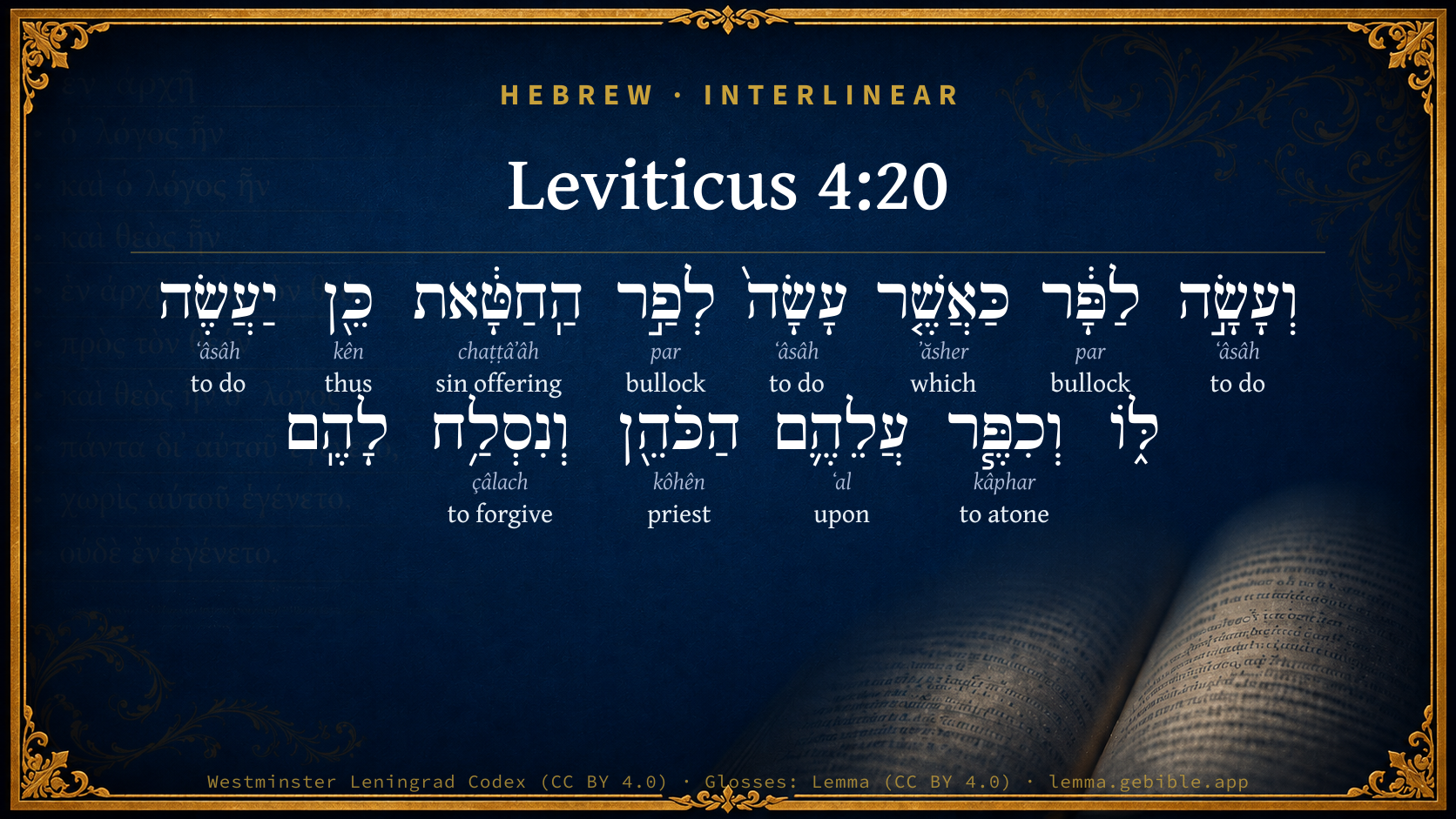
Hebrew (Westminster Leningrad Codex) Leviticus 4:20 appears in the Hebrew Old Testament. The text above is from the Westminster Leningrad Codex. Each word links to its Strong’s number, a concise gloss, and parsing drawn from the Open Scriptures Hebrew Bible morphology. Click any word for its full Brown-Driver-Briggs (BDB) entry.
Download image
Cite this verse

Leviticus 4:20 (World English Bible). Public Domain. Lemma interlinear Bible study tool, https://lemma.gebible.app/v/leviticus/4/20.

Show BibTeX & RIS
BibTeX
RIS
English Translation
Thus shall he do with the bull; as he did with the bull of the sin offering, so shall he do with this; and the priest shall make atonement for them, and they shall be forgiven.
World English Bible · Public Domain
Download a study sheet

One document with this verse’s original text, its word-by-word gloss line, the meaning frame, cross-references with their text, attributed commentary, and full source and license credits — printable, and it pastes into notes with its structure intact.

This verse Autodidact and up

Study sheet (.html) Plain text (.txt)

A passage Seminary Student

Up to 50 verses in one chapter. A passage sheet keeps up to 6 commentary sources and 12 cross-references per verse, in the order this page ranks them, and says so on the sheet whenever that leaves anything out. Ask for a single verse and you get the Autodidact verse sheet above.

Everything on this page stays free to read, with no account — the sheet is a download of what is already on screen, not access to it.

Want to remove ads? Support Godless Engineer
Compare translations 3

The same verse in 3 English versions, stacked beneath the original-language interlinear above. Click any original word for its lexicon entry.

Each is an independent rendering of the whole verse — the interlinear is not word-aligned to these translations.

Highlighted words mark where these versions differ — a whole-verse word diff, not a word-by-word alignment.

  • World English Bible Public Domain
    Thus shall he do with the bull; as he did with the bull of the sin offering, so shall he do with this; and the priest shall make atonement for them, and they shall be forgiven.
  • King James Version Public Domain
    And he shall do with the bullock as he did with the bullock for a sin offering, so shall he do with this: and the priest shall make an atonement for them, and it shall be forgiven them.
  • unfoldingWord Literal Text CC BY-SA 4.0
    And he shall do with the bull just as he did with the bull of the sin offering; thus he shall do with it. And the priest shall make atonement for them, and it will be forgiven to them.

unfoldingWord Literal Text — © unfoldingWord, licensed CC BY-SA 4.0. Word-aligned USFM3 via Door43 (git.door43.org/unfoldingWord/en_ult).

Versions to compare (up to 4)

3 of 4 selected

Show all 18 translations

Every available English version of this verse, each an independent rendering of the whole verse.

  • World English Bible Public Domain
    Thus shall he do with the bull; as he did with the bull of the sin offering, so shall he do with this; and the priest shall make atonement for them, and they shall be forgiven.
  • Berean Standard Bible Public Domain
    He shall offer this bull just as he did the bull for the sin offering; in this way the priest will make atonement on their behalf, and they will be forgiven.
  • Majority Standard Bible Public Domain
    He shall offer this bull just as he did the bull for the sin offering; in this way the priest will make atonement on their behalf, and they will be forgiven.
  • King James Version Public Domain
    And he shall do with the bullock as he did with the bullock for a sin offering, so shall he do with this: and the priest shall make an atonement for them, and it shall be forgiven them.
  • American Standard Version (1901) Public Domain
    Thus shall he do with the bullock; as he did with the bullock of the sin-offering, so shall he do with this; and the priest shall make atonement for them, and they shall be forgiven.
  • Revised Version (1885) Public Domain
    Thus shall he do with the bullock; as he did with the bullock of the sin offering, so shall he do with this: and the priest shall make atonement for them, and they shall be forgiven.
  • Geneva Bible (1599) Public Domain
    And the Priest shall doe with this bullocke, as he did with the bullocke for his sinne: so shall he do with this: so the Priest shall make an atonement for them, and it shalbe forgiuen them.
  • Douay-Rheims (1899) Public Domain
    Doing so with this calf, as he did also with that before: and the priest praying for them, the Lord will be merciful unto them.
  • Young's Literal Translation Public Domain
    `And he hath done to the bullock as he hath done to the bullock of the sin-offering, so he doth to it; and the priest hath made atonement for them, and it hath been forgiven them;
  • Literal Standard Version CC BY-SA 4.0
    And he has done to the bullock as he has done to the bullock of the sin-offering, so he does to it; and the priest has made atonement for them, and it has been forgiven them;
  • Unlocked Literal Bible CC BY-SA 4.0
    That is what he must do with the bull. Just as he did with the bull of the sin offering, so will he also do with this bull, and the priest will make atonement for the people, and they will be forgiven.
  • unfoldingWord Literal Text CC BY-SA 4.0
    And he shall do with the bull just as he did with the bull of the sin offering; thus he shall do with it. And the priest shall make atonement for them, and it will be forgiven to them.
  • Darby Bible Public Domain
    And he shall do with the bullock as he did with the bullock of sin-offering: so shall he do with it. And the priest shall make atonement for them; and it shall be forgiven them.
  • World Messianic Bible Public Domain
    He shall do this with the bull; as he did with the bull of the sin offering, so he shall do with this; and the priest shall make atonement for them, and they shall be forgiven.
  • Webster's Bible Public Domain
    And he shall do with the bullock as he did with the bullock for a sin-offering, so shall he do with this: and the priest shall make an atonement for them, and it shall be forgiven them.
  • Free Bible Version CC BY-SA 4.0
    He shall offer this bull in the same way he did for the sin offering. This is how the priest will make them right, and they will be forgiven.
  • Bible in Basic English Public Domain
    Let him do with the ox as he did with the ox of the sin-offering; and the priest will take away their sin and they will have forgiveness.
  • JPS Tanakh (1917) Public Domain
    Thus shall he do with the bullock; as he did with the bullock of the sin-offering, so shall he do with this; and the priest shall make atonement for them, and they shall be forgiven.

Literal Standard Version (2020), Covenant Press — licensed CC BY-SA 4.0. Text via the HelloAO Bible API (eBible.org). Unlocked Literal Bible (unfoldingWord) — licensed CC BY-SA 4.0. Text via the HelloAO Bible API (eBible.org). unfoldingWord Literal Text — © unfoldingWord, licensed CC BY-SA 4.0. Word-aligned USFM3 via Door43 (git.door43.org/unfoldingWord/en_ult). Free Bible Version, Dr. Jonathan Gallagher — licensed CC BY-SA 4.0. Text via the HelloAO Bible API (eBible.org).

Word by word

More ways to search: Search by grammar → Find every occurrence → Compare this word →

Practice this passage: Drill this verse → Learn its vocabulary →

וְנִסְלַ֥ח
çâlach
H5545
“and · to forgive”
Conjunction + Verb, Niphal, Sequential Perfect, 3rd Person, Masculine, Singular
Part of Speech
Conjunction + Verb
Stem
Niphal
Form
Sequential Perfect
Person
3rd Person
Gender
Masculine
Number
Singular
Full BDB Definition

Origin: a primitive root

TWOT: 1505

to forgive, pardon - (Qal) to forgive, pardon - (Niphal) to be forgiven
  1. וְעָשָׂ֣ה ʻâsâh H6213 “and · to do” Conjunction + Verb, Qal, Sequential Perfect, 3rd Person, Masculine, Singular
  2. לַפָּ֔ר par H6499 “to/for the · bullock” Preposition, Determined + Noun, Common, Masculine, Singular, Absolute
  3. כַּאֲשֶׁ֤ר ʼăsher H834 “like/as · which” Preposition + Particle, Relative
  4. עָשָׂה֙ ʻâsâh H6213 “to do” Verb, Qal, Perfect, 3rd Person, Masculine, Singular
  5. לְפַ֣ר par H6499 “to/for · bullock of” Preposition + Noun, Common, Masculine, Singular, Construct
  6. הַֽחַטָּ֔את chaṭṭâʼâh H2403 “the · sin offering” Particle, Definite Article + Noun, Common, Feminine, Singular, Absolute
  7. כֵּ֖ן kên H3651 “thus” Particle, Demonstrative
  8. יַעֲשֶׂה ʻâsâh H6213 “to do” Verb, Qal, Imperfect, 3rd Person, Masculine, Singular
  9. וְכִפֶּ֧ר kâphar H3722 “and · to atone” Conjunction + Verb, Piel, Sequential Perfect, 3rd Person, Masculine, Singular
  10. עֲלֵהֶ֛ם ʻal H5921 “upon · them” Preposition + Suffix, Personal, 3rd Person, Masculine, Plural
  11. הַכֹּהֵ֖ן kôhên H3548 “the · priest” Particle, Definite Article + Noun, Common, Masculine, Singular, Absolute

About this verse

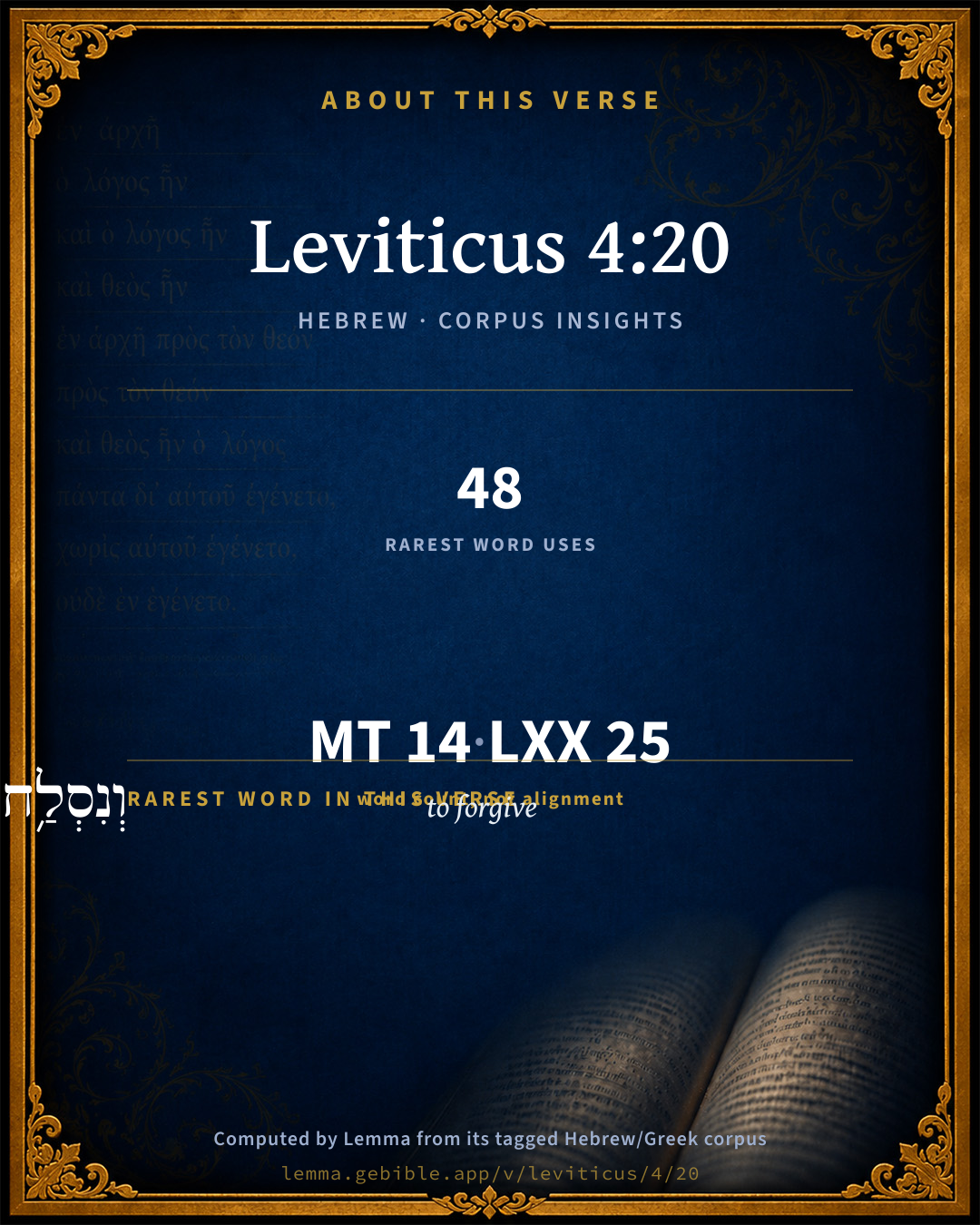
These counts appear in no published source. They are computed here, from the morphology-tagged text and Lemma’s own curated glosses. What Lemma adds →

14
words
9
distinct lemmas
Pentateuch
section

Shared distinctive vocabulary

וְנִסְלַ֥ח to forgive H5545 occurs in 45 verses of the Hebrew Bible. Also found in:

Grammatical profile

  • 5 verbs
  • 4 nouns
  • 3 prepositions
  • 2 particles

Verb forms

  • וְעָשָׂ֣ה Qal · Sequential Perfect
  • עָשָׂה֙ Qal · Perfect
  • יַעֲשֶׂה Qal · Imperfect
  • וְכִפֶּ֧ר Piel · Sequential Perfect
  • וְנִסְלַ֥ח Niphal · Sequential Perfect

Repetition

Words recur within this verse — often emphatic in Hebrew:

  • וְעָשָׂ֣ה to do H6213 ×3
  • לַפָּ֔ר bullock H6499 ×2

Hebrew & Septuagint length

In English translation the verse runs 36 words from the Hebrew and 36 from the Septuagint (LXX English) — the same length.

A rough comparison of the two English renderings, which tokenize alike — not a word-level alignment.

Word counts can differ between the Hebrew and the Greek without any difference in meaning — e.g. the Hebrew direct-object marker אֵת has no separate Greek word, and Greek often adds the article ὁ.

In the original languages it is 14 Hebrew tokens and 25 Greek tokens — but the two are counted differently (Hebrew bundles its prefixes and suffixes into one token; the Greek is in lemma form), so that isn’t a like-for-like length.

Cross-references

19

Topical passages linked to Leviticus 4:20 in the Treasury of Scripture Knowledge — connected by theme and wording, ordered by reader-vote popularity; previews shown in the World English Bible.

  • Numbers 15:25 The priest shall make atonement for all the congregation of the children of Israel, and they shall be forgiven; for it was an error, and they have brought their offering, an offering made by fire to Yahweh, and their sin-offering before Yahweh, for their error:
  • Leviticus 12:8 If she cannot afford a lamb, then she shall take two turtledoves, or two young pigeons; the one for a burnt offering, and the other for a sin offering: and the priest shall make atonement for her, and she shall be clean.'"
  • Hebrews 10:10–12 by which will we have been sanctified through the offering of the body of Jesus Christ once for all.
  • Exodus 32:30 It happened on the next day, that Moses said to the people, "You have sinned a great sin. Now I will go up to Yahweh. Perhaps I shall make atonement for your sin."
  • Leviticus 1:4 He shall lay his hand on the head of the burnt offering, and it shall be accepted for him to make atonement for him.
  • Leviticus 4:26 All its fat he shall burn on the altar, like the fat of the sacrifice of peace offerings; and the priest shall make atonement for him concerning his sin, and he will be forgiven.
  • Leviticus 5:6 and he shall bring his trespass offering to Yahweh for his sin which he has sinned, a female from the flock, a lamb or a goat, for a sin offering; and the priest shall make atonement for him concerning his sin.
  • Leviticus 6:7 The priest shall make atonement for him before Yahweh, and he will be forgiven concerning whatever he does to become guilty."
  • Leviticus 14:18 The rest of the oil that is in the priest's hand he shall put on the head of him who is to be cleansed, and the priest shall make atonement for him before Yahweh.
  • Numbers 15:28 The priest shall make atonement for the soul who errs, when he sins unwittingly, before Yahweh, to make atonement for him; and he shall be forgiven.
  • Daniel 9:24 Seventy weeks are decreed on your people and on your holy city, to finish disobedience, and to make an end of sins, and to make reconciliation for iniquity, and to bring in everlasting righteousness, and to seal up vision and prophecy, and to anoint the most holy.
  • Romans 5:11 Not only so, but we also rejoice in God through our Lord Jesus Christ, through whom we have now received the reconciliation.
  • Galatians 3:13 Christ redeemed us from the curse of the law, having become a curse for us. For it is written, "Cursed is everyone who hangs on a tree,"
  • Hebrews 1:3 His Son is the radiance of his glory, the very image of his substance, and upholding all things by the word of his power, when he had by himself made purification for our sins, sat down on the right hand of the Majesty on high;
  • Hebrews 2:17 Therefore he was obligated in all things to be made like his brothers, that he might become a merciful and faithful high priest in things pertaining to God, to make atonement for the sins of the people.
  • Hebrews 9:14 how much more will the blood of Christ, who through the eternal Spirit offered himself without blemish to God, cleanse your conscience from dead works to serve the living God?
  • 1 John 1:7 But if we walk in the light, as he is in the light, we have fellowship with one another, and the blood of Jesus Christ, his Son, cleanses us from all sin.
  • 1 John 2:2 And he is the atoning sacrifice for our sins, and not for ours only, but also for the whole world.
  • Revelation 1:5 and from Jesus Christ, the faithful witness, the firstborn of the dead, and the ruler of the kings of the earth. To him who loves us, and washed us from our sins by his blood;

Cross-references courtesy of OpenBible.info (CC BY 4.0).

Hebrew and Greek witnesses Masoretic Hebrew ↔ Greek Septuagint

The same verse in the two great witnesses to the Old Testament, shown verse-for-verse.

These are two independent witnesses, not word-aligned to each other, and the Septuagint is shown in lemma (dictionary) form.

Hebrew Leviticus 4:20 Masoretic · Westminster Leningrad Codex

וְעָשָׂ֣ה לַפָּ֔ר כַּאֲשֶׁ֤ר עָשָׂה֙ לְפַ֣ר הַֽחַטָּ֔את כֵּ֖ן יַעֲשֶׂה לּ֑וֹ וְכִפֶּ֧ר עֲלֵהֶ֛ם הַכֹּהֵ֖ן וְנִסְלַ֥ח לָהֶֽם

Thus shall he do with the bull; as he did with the bull of the sin offering, so shall he do with this; and the priest shall make atonement for them, and they shall be forgiven.

World English Bible · Public Domain

Greek LXX Leviticus 4:20 Septuagint · lemma form

καί ποιέω ὁ μόσχος ὅς τρόπος ποιέω ὁ μόσχος ὁ ὁ ἁμαρτία οὕτως ποιέω καί ἐκἱλάσκομαι περί αὐτός ὁ ἱερεύς καί ἀποἵημι αὐτός ὁ ἁμαρτία

And he shall do to the calf as he did to the calf of the sin-offering, so shall it be done; and the priest shall make atonement for them, and the trespass shall be forgiven them.

LXX2012 (modern English Septuagint) · Public Domain

Hebrew: Westminster Leningrad Codex (CC BY 4.0). Greek: Septuagint (public domain); English from LXX2012 (modern English Septuagint) (Public Domain). How the Septuagint differs from the Hebrew →

Targum (Aramaic paraphrase)

2

The Targum is the ancient Jewish Aramaic paraphrase of the Hebrew Scriptures — an interpretive translation, not the Hebrew text itself. Onkelos (literal) and Pseudo-Jonathan (expansive) render the Torah, and Jonathan the Prophets. Coverage is partial: where no permissively-licensed English translation exists for a verse, only the Aramaic is shown. This is verse-level text, not a word-by-word alignment to the Hebrew.

  1. Targum Onkelos Torah (Genesis–Deuteronomy)
    וְיַעְבֵּד לְתוֹרָא כְּמָא דִי עֲבַד לְתוֹרָא דְחַטָאתָא כֵּן יַעְבֵּד לֵהּ וִיכַפֵּר עֲלֵיהוֹן כַּהֲנָא וְיִשְׁתְּבֵק לְהוֹן

    (no public-domain English translation for this verse)

    Targum Onkelos — Aramaic: “Onkelos Genesis” (public domain); “Onkelos Exodus” (public domain); “Onkelos Leviticus” (public domain); “Onkelos Numbers” (public domain); “Onkelos Deuteronomy” (public domain). English: “Sefaria Community Translation” (CC0 1.0 (public-domain dedication)); “J.W. Etheridge. The Targums of Onkelos and Jonathan Ben Uzziel on the Pentateuch. London: Longmans, Green, 1862” (public domain). Text via Sefaria.

  2. Targum Pseudo-Jonathan Torah (Genesis–Deuteronomy)
    וְיַעֲבֵיד לְתוֹרָא הֵיכְמָא דְעָבַד לְתוֹרָא דְחַטָאתָא דְכַהֲנָא רַבָּא הֵיכְדֵין יַעֲבֵיד לֵיהּ וִיכַפֵּר עֲלֵיהוֹן כַּהֲנָא וְיִשְׁתְּבֵיק לְהוֹן

    And he shall do with the bullock as he did with the bullock for the sin of the high priest, so shall he do with him. And the priest shall atone for them, and it shall be forgiven them.

    Targum Pseudo-Jonathan — Aramaic: “Targum Jonathan on Genesis” (public domain); “Targum Jonathan on Exodus” (public domain); “Targum Jonathan on Leviticus” (public domain); “Targum Jonathan on Numbers” (public domain); “Targum Jonathan on Deuteronomy” (public domain). English: “The Targum of Jonathan ben Uzziel, trans. J. W. Etheridge, London, 1862” (public domain). Text via Sefaria.

Commentary

Notes on Leviticus 4:20 from classic Christian and Jewish commentators (each source and its license shown beneath its notes). The classic Christian expositions comment on the surrounding passage and are grouped to its opening verse, so a note may address several verses; the Jewish commentaries on the Tanakh (Rashi and others) are per-verse, so they appear only where the commentator wrote on this verse.

Lemma curates 59 commentaries, every one of them public domain or Creative Commons licensed, each selected and text-cleaned for this edition rather than reprinted as found. About our sources →

Trapp's Complete Commentary

John Trapp

Lev 4:20 And he shall do with the bullock as he did with the bullock for a sin offering, so shall he do with this: and the priest shall make an atonement for them, and it shall be forgiven them.

Ver. 20. As he did with the bullock.] For even ignorance and infirmities are deadly sins, direct fruits of the flesh, {Joh 3:6} and such as for which Christ laid down his life, even "for the errors (αγνοηματα) of the people." {Heb 9:7}

John Trapp, A Commentary or Exposition upon All the Books of the Old and New Testament (1647–1656) — public domain. Text from a community e-Sword module.

Joseph Benson's Commentary

Lev 4:20. For a sin-offering — That is, for the priest’s sin-offering, called the first bullock, Lev 4:21.

Joseph Benson's Commentary on the Old and New Testaments (1811–1818) — public domain. Text from a community e-Sword module.

Tyndale Open Study Notes

Tyndale Open Resources

4:20 A similar form of the phrase they will be forgiven appears frequently in passages dealing with atonement (4:26, 31, 35; 5:10, 13, 16, 18; 6:7; 19:22; Num 15:25, 26, 28). God is willing to forgive a repentant person’s sin and restore him or her to the community of faith.

Tyndale Open Study Notes — © Tyndale Open Resources, licensed CC BY-SA 4.0. Text via the HelloAO Bible API.

The Cambridge Bible for Schools and Colleges

gen. ed. J. J. S. Perowne

20. the bullock of the sin offering] i.e. the bullock referred to in Lev_4:3-12; called ‘the first bullock’ in Lev_4:21.

Another law in Num_15:22-26 prescribes an offering to be brought by the whole congregation which differs from that here enjoined, viz. a young bullock for a Burnt-Offering with the accompanying Meal-Offering and Drink-Offering, and a he-goat for a Sin-Offering. The most probable explanation of the divergence is that the laws are from different sources.

Jewish tradition interprets ‘the congregation’ in this section as referring to the Sanhedrin, and ‘the assembly’ as meaning the children of Israel. If the Sanhedrin were to give a wrong decision on some point of observance, thereby causing the people who followed such decision to transgress, then the sacrifice enjoined in this section would be necessary. A short treatise of the Mishna (Horaioth) discusses decisions of this kind, and the circumstances under which the sacrifice of Lev_4:13-21 should be brought. This interpretation was probably prompted by a desire to reconcile this law with that of Num_15:22-26. But in Lev_4:13-21 the words ‘assembly’ and ‘congregation’ denote the same thing, the whole community. Note that in Lev_4:14; Lev_4:21 the rendering ‘congregation’ of A.V. is corrected in R.V. to ‘assembly,’ the Heb. word ḳâhâl being the same as in Lev_4:13 where both R.V. and A.V. translate ‘assembly.’

The Cambridge Bible for Schools and Colleges (gen. ed. J. J. S. Perowne; Cambridge University Press, 1878–1918) — public domain. Text from a community e-Sword module.

Matthew Poole's English Annotations

For a sin-offering, to wit, for the priest’s sin-offering, called the first bullock. Lev 4:21.

Matthew Poole's English Annotations on the Holy Bible (1683–1685) — public domain. Text from a community e-Sword/MySword module.

Whedon's Commentary on the Bible

Daniel D. Whedon

20. Make… atonement for them — The radical significance of this term is to cover the sinner from the holiness of God lest he be consumed because of his sin. The term atonement in the Old Testament corresponds not to the Greek of which atonement is the translation in Rom_5:11, καταλλαγην, reconciliation, or a state of harmonized variance, irrespective of the means, but to propitiation, ιλαστηριον, (Rom_3:25,) and ιλασμος. 1Jn_2:2; 1Jn_4:10. See note on Lev_1:4.

It shall be forgiven — For the nature of the Old Testament forgiveness, see Introduction, (7.)

Daniel D. Whedon (gen. ed.), Commentary on the Old and New Testaments (1874–1909) — public domain. Text from a community e-Sword module.

John Wesley's Explanatory Notes

For a sin-offering - That is, for the priest's sin-offering, called the first bullock, ver. 21.

John Wesley, Explanatory Notes Upon the Whole Bible (1754–1765) — public domain. Text via the GEBible commentary corpus.

Keil & Delitzsch

C. F. Keil & F. Delitzsch

"And let the priest make an atonement for them, that it may be forgiven them," or, "so will they be forgiven." This formula recurs with all the sin-offerings (with the exception of the one for the high priest), viz., Lev 4:26, Lev 4:31, Lev 4:35, Lev 5:10, Lev 5:13; Num 15:25-26, Num 15:28; also with the trespass-offerings, Lev 5:16, Lev 5:18; Lev 19:22, - the only difference being, that in the sin-offerings presented for defilements cleansing is mentioned, instead of forgiveness, as the effect of the atoning sacrifice (Lev 12:7-8; Lev 13:20, Lev 13:53; Num 8:21).

Keil & Delitzsch — Biblical Commentary on the Old Testament (1861–1891) — public domain (CC PDM 1.0). Text via the HelloAO Bible API. (Old Testament only.)

Scofield Reference Notes

C. I. Scofield

atonement

(See Scofield "Exo 29:33").

The Scofield Reference Bible (1917 edition), notes by C. I. Scofield — public domain. Text from a community e-Sword module.

unfoldingWord translationNotes

Door43 World Missions Community

he must do

"the priest must do"

the priest will make atonement for the people

The abstract noun "atonement" can be stated as a verb. AT: "the priest will atone for the people's sins" (See: Abstract Nouns)

they will be forgiven

This can be stated in active form. AT: "Yahweh will forgive them" (See: Active or Passive)

translationWords

cow

sin offering

priest

atonement

forgive

assembly

unfoldingWord translationNotes — © Distant Shores Media and the Door43 World Missions Community, licensed CC BY-SA 4.0. Source: git.door43.org/Door43/en_tn.

Rashi

Rabbi Shlomo Yitzchaki (Rashi)

ועשה לפר AND HE SHALL DO WITH THE BULLOCK — with this bullock —כאשר עשה לפר החטאת AS HE DID WITH THE BULLOCK FOR A SIN-OFFERING – i. e. as is expressly set forth in the case of the bullock of the anointed priest. This statement thus serves to bring under the command of offering the fat portions the lobe of the liver and the two kidneys which are not expressly mentioned there but which are not expressly mentioned here; and it serves also to repeat the command referring to these rites, teaching thereby that if he (the anointed priest) omitted one of all the applications of the blood it (the sacrifice) becomes invalid (Sifra, Vayikra Dibbura d'Chovah, Chapter 6 5). Since we find in regard to blood which had to be placed on the outer altar, that if he places it there by one application alone he nevertheless effected atonement (cf. Mish. Zevachim 4:1), Scripture was compelled to intimate here that the omission of one application impedes the validity of the rite (Zevachim 39a).

Rashi on the Tanakh — English translations: “The Judaica Press complete Tanach with Rashi, translated by A. J. Rosenberg” (CC BY 4.0); “Pentateuch with Rashi's commentary by M. Rosenbaum and A.M. Silbermann, 1929-1934” (public domain); “The Metsudah Tanach series, Lakewood, N.J” (CC BY 4.0); and “The Book of Joshua, Metsudah Publications, 1997” (CC BY 4.0). Text via Sefaria.

Lesson kit

Teaching starters — assembled from the data on this page, not authored interpretation. Every prompt links to the verse data it draws on. Edit before teaching.

Leviticus, in the Pentateuch, opens this verse with 14 words (9 distinct Hebrew lemmas). Its most distinctive word is çâlach (“to forgive”). A historical commentator’s framing appears above. Read the whole chapter for the surrounding context.

Discussion questions

  1. What does “to forgive” (çâlach) contribute to the verse as a whole?
  2. Exodus 34:9 shares the word «to forgive» with this verse. How do the two illuminate each other?
  3. “to do” occurs 3× in this one verse. What is the effect of the repetition?
  4. These translations render this verse differently. What is at stake in choosing one wording over another?
  5. The verb «וְעָשָׂ֣ה» is Qal Sequential Perfect. How does its form color the action?
  6. Reading how Trapp's Complete Commentary and Joseph Benson's Commentary read this verse, where do the two commentators agree and where do they part?

Things to notice

Reading settings

Reading text

Shown beneath each verse's original-language words.

Old Testament
Old Testament edition

Read the OT as the Masoretic Hebrew (MT) or the Greek Septuagint (LXX).

English shown for the Greek Septuagint (in the Hebrew ↔ Greek comparison).

Comparing translations? Open the Compare panel on any verse page to stack up to four side by side.