
Ephesians 5:33

Greek (Tischendorf 8th ed.) Ephesians 5:33 appears in the Greek New Testament. The text above is from the Tischendorf 8th edition. Each word links to its Strong’s number and a concise gloss. Click any word for its full Thayer’s Greek Lexicon entry.
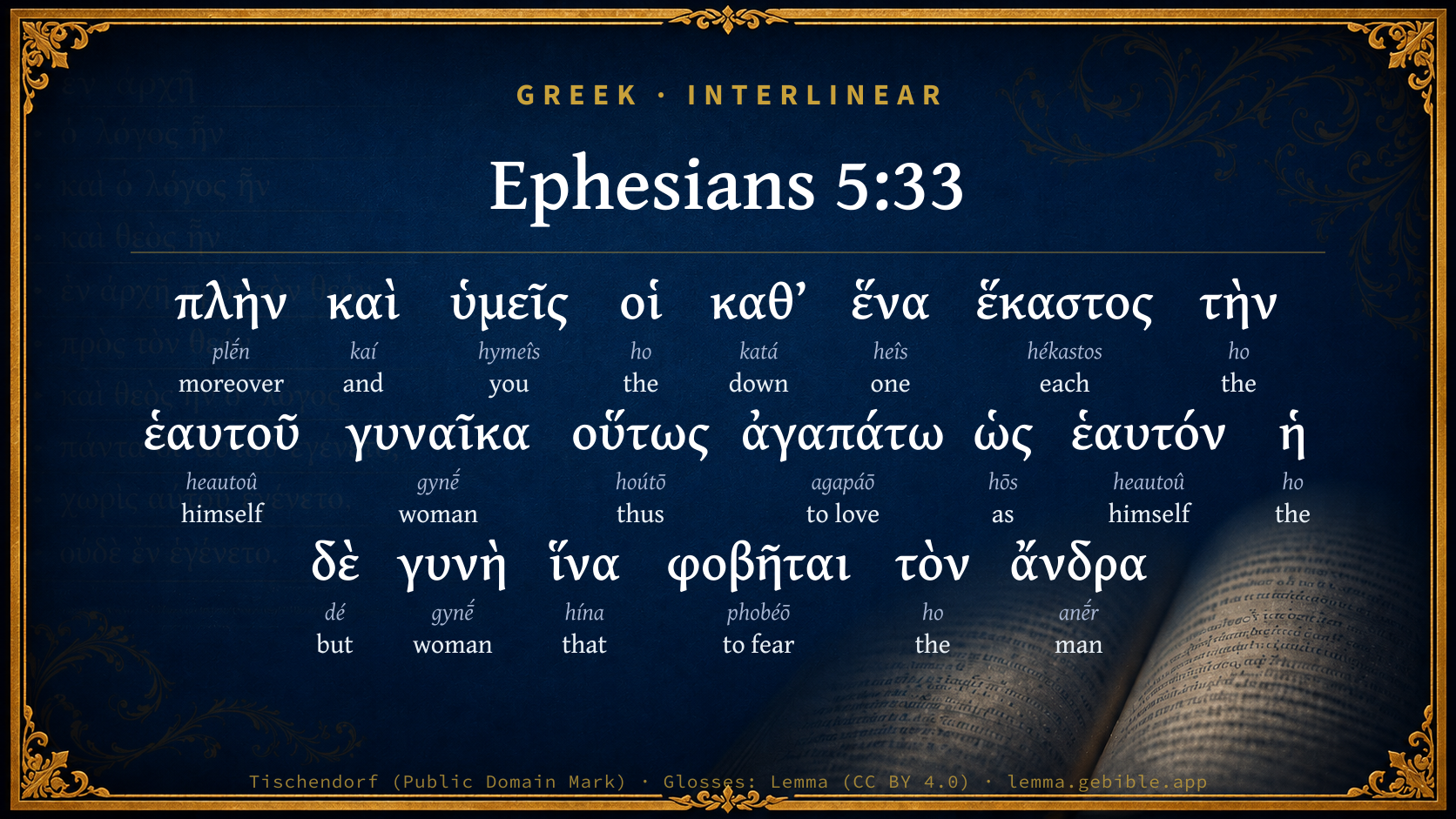
Download image
Cite this verse

Ephesians 5:33 (World English Bible). Public Domain. Lemma interlinear Bible study tool, https://lemma.gebible.app/v/ephesians/5/33.

Show BibTeX & RIS
BibTeX
RIS
English Translation
Nevertheless each of you must also love his own wife even as himself; and let the wife see that she respects her husband.
World English Bible · Public Domain
Download a study sheet

One document with this verse’s original text, its word-by-word gloss line, the meaning frame, cross-references with their text, attributed commentary, and full source and license credits — printable, and it pastes into notes with its structure intact.

This verse Autodidact and up

Study sheet (.html) Plain text (.txt)

A passage Seminary Student

Up to 50 verses in one chapter. A passage sheet keeps up to 6 commentary sources and 12 cross-references per verse, in the order this page ranks them, and says so on the sheet whenever that leaves anything out. Ask for a single verse and you get the Autodidact verse sheet above.

Everything on this page stays free to read, with no account — the sheet is a download of what is already on screen, not access to it.

Want to remove ads? Support Godless Engineer
Compare translations 3

The same verse in 3 English versions, stacked beneath the original-language interlinear above. Click any original word for its lexicon entry.

Each is an independent rendering of the whole verse — the interlinear is not word-aligned to these translations.

Highlighted words mark where these versions differ — a whole-verse word diff, not a word-by-word alignment.

  • World English Bible Public Domain
    Nevertheless each of you must also love his own wife even as himself; and let the wife see that she respects her husband.
  • King James Version Public Domain
    Nevertheless let every one of you in particular so love his wife even as himself; and the wife see that she reverence her husband.
  • unfoldingWord Literal Text CC BY-SA 4.0
    Nevertheless, you also—each one of you—must love his own wife in this way—as himself, and the wife must respect her husband.

unfoldingWord Literal Text — © unfoldingWord, licensed CC BY-SA 4.0. Word-aligned USFM3 via Door43 (git.door43.org/unfoldingWord/en_ult).

Versions to compare (up to 4)

3 of 4 selected

Show all 19 translations

Every available English version of this verse, each an independent rendering of the whole verse.

  • World English Bible Public Domain
    Nevertheless each of you must also love his own wife even as himself; and let the wife see that she respects her husband.
  • Berean Standard Bible Public Domain
    Nevertheless, each one of you also must love his wife as he loves himself, and the wife must respect her husband.
  • Majority Standard Bible Public Domain
    Nevertheless, each one of you also must love his wife as he loves himself, and the wife must respect her husband.
  • King James Version Public Domain
    Nevertheless let every one of you in particular so love his wife even as himself; and the wife see that she reverence her husband.
  • American Standard Version (1901) Public Domain
    Nevertheless do ye also severally love each one his own wife even as himself; and `let' the wife `see' that she fear her husband.
  • Revised Version (1885) Public Domain
    Nevertheless do ye also severally love each one his own wife even as himself; and let the wife see that she fear her husband.
  • Geneva Bible (1599) Public Domain
    Therefore euery one of you, doe ye so: let euery one loue his wife, euen as himselfe, and let the wife see that shee feare her husband.
  • Douay-Rheims (1899) Public Domain
    Nevertheless let every one of you in particular love his wife as himself: and let the wife fear her husband.
  • Young's Literal Translation Public Domain
    but ye also, every one in particular -- let each his own wife so love as himself, and the wife -- that she may reverence the husband.
  • Literal Standard Version CC BY-SA 4.0
    but you also, everyone in particular—let each so love his own wife as himself, and the wife—that she may revere the husband.
  • Unlocked Literal Bible CC BY-SA 4.0
    Nevertheless, each of you also must love his own wife as himself, and the wife must respect her husband.
  • unfoldingWord Literal Text CC BY-SA 4.0
    Nevertheless, you also—each one of you—must love his own wife in this way—as himself, and the wife must respect her husband.
  • Darby Bible Public Domain
    But *ye* also, every one of you, let each so love his own wife as himself; but as to the wife [I speak] that she may fear the husband.
  • World Messianic Bible Public Domain
    Nevertheless each of you must also love his own wife even as himself; and let the wife see that she respects her husband.
  • Webster's Bible Public Domain
    Nevertheless, let every one of you in particular so love his wife even as himself: and the wife see that she reverence her husband.
  • Free Bible Version CC BY-SA 4.0
    However, each husband should love his own wife as he does himself, and the wife should respect her husband.
  • Bible in Basic English Public Domain
    But do you, everyone, have love for his wife, even as for himself; and let the wife see that she has respect for her husband.
  • Text-Critical English NT CC BY 4.0
    Nevertheless, each man among you must love his own wife as he loves himself, and the wife must respect her husband.
  • Tyndale New Testament (1534) Public Domain
    Neverthelesse do ye so that every one of you love his wyfe truely even as him silfe. And let the wyfe se that she feare her husbande.

Literal Standard Version (2020), Covenant Press — licensed CC BY-SA 4.0. Text via the HelloAO Bible API (eBible.org). Unlocked Literal Bible (unfoldingWord) — licensed CC BY-SA 4.0. Text via the HelloAO Bible API (eBible.org). unfoldingWord Literal Text — © unfoldingWord, licensed CC BY-SA 4.0. Word-aligned USFM3 via Door43 (git.door43.org/unfoldingWord/en_ult). Free Bible Version, Dr. Jonathan Gallagher — licensed CC BY-SA 4.0. Text via the HelloAO Bible API (eBible.org).

Word by word

More ways to search: Search by grammar → Find every occurrence → Compare this word →

Practice this passage: Drill this verse → Learn its vocabulary →

πλὴν
plḗn
G4133
“moreover”
Adverb
Part of Speech
Adverb
Full Thayer's Definition

Origin: from G4119

TDNT: None

1. moreover, besides, but, nevertheless 2. besides, except, but
  1. καὶ kaí G2532 “and” Conjunction
  2. ὑμεῖς hymeîs G5210 “you” Personal pronoun, 2nd person, Nominative, Plural
  3. οἱ ho G3588 “the” Article, Nominative, Plural, Masculine
  4. καθ’ katá G2596 “down” Preposition
  5. ἕνα heîs G1520 “one” Adjective, Accusative, Singular, Masculine
  6. ἕκαστος hékastos G1538 “each” Adjective, Nominative, Singular, Masculine
  7. τὴν ho G3588 “the” Article, Accusative, Singular, Feminine
  8. ἑαυτοῦ heautoû G1438 “himself” Reflexive pronoun, 3rd person, Genitive, Singular, Masculine
  9. γυναῖκα gynḗ G1135 “woman” Noun, Accusative, Singular, Feminine
  10. οὕτως hoútō G3779 “thus” Adverb
  11. ἀγαπάτω agapáō G25 “to love” Verb, Present, Active, Imperative, 3rd person, Singular
  12. ὡς hōs G5613 “as” Adverb
  13. ἑαυτόν heautoû G1438 “himself” Reflexive pronoun, 3rd person, Accusative, Singular, Masculine
  14. ἡ ho G3588 “the” Article, Nominative, Singular, Feminine
  15. δὲ dé G1161 “but” Conjunction
  16. γυνὴ gynḗ G1135 “woman” Noun, Nominative, Singular, Feminine
  17. ἵνα hína G2443 “that” Conjunction
  18. φοβῆται phobéō G5399 “to fear” Verb, Present, Middle or Passive deponent, Subjunctive, 3rd person, Singular
  19. τὸν ho G3588 “the” Article, Accusative, Singular, Masculine
  20. ἄνδρα anḗr G435 “man” Noun, Accusative, Singular, Masculine

About this verse

These counts appear in no published source. They are computed here, from the morphology-tagged text and Lemma’s own curated glosses. What Lemma adds →

21
words
16
distinct lemmas
Pauline Epistles
section

Shared distinctive vocabulary

πλὴν moreover G4133 occurs in 31 verses of the Greek New Testament. Also found in:
Repetition

Words recur within this verse:

  • ἑαυτοῦ himself G1438 ×2
  • γυναῖκα woman G1135 ×2
  • οἱ the G3588 ×4

Cross-references

8

Topical passages linked to Ephesians 5:33 in the Treasury of Scripture Knowledge — connected by theme and wording, ordered by reader-vote popularity; previews shown in the World English Bible.

  • 1 Peter 3:2–7 seeing your pure behavior in fear.
  • Esther 1:20 When the king's decree which he shall make shall be published throughout all his kingdom (for it is great), all the wives will give to their husbands honor, both to great and small.
  • Ephesians 5:22 Wives, be subject to your own husbands, as to the Lord.
  • Ephesians 5:25 Husbands, love your wives, even as Christ also loved the assembly, and gave himself up for it;
  • Ephesians 5:28–29 Even so ought husbands also to love their own wives as their own bodies. He who loves his own wife loves himself.
  • Colossians 3:19 Husbands, love your wives, and don't be bitter against them.
  • Hebrews 12:9 Furthermore, we had the fathers of our flesh to chasten us, and we paid them respect. Shall we not much rather be in subjection to the Father of spirits, and live?
  • 1 Kings 1:31 Then Bathsheba bowed with her face to the earth, and did obeisance to the king, and said, Let my lord king David live forever.

Cross-references courtesy of OpenBible.info (CC BY 4.0).

Commentary

Notes on Ephesians 5:33 from classic Christian and Jewish commentators (each source and its license shown beneath its notes). The classic Christian expositions comment on the surrounding passage and are grouped to its opening verse, so a note may address several verses; the Jewish commentaries on the Tanakh (Rashi and others) are per-verse, so they appear only where the commentator wrote on this verse.

Lemma curates 59 commentaries, every one of them public domain or Creative Commons licensed, each selected and text-cleaned for this edition rather than reprinted as found. About our sources →

Joseph Benson's Commentary

Eph 5:33. Nevertheless — As if he said, But though there be such a mystical sense in the marriage of Adam and Eve, or in the union subsisting between a man and his wife; though it be a striking emblem of the union between Christ and his church, yet the plain, literal sense especially now concerns you. Let every one of you in particular so love his wife even as himself — That is, with a sincere, peculiar, cordial, and prevailing affection, like that which he bears to himself: and let the wife see that she reverence her husband — That she entertain a high esteem for him, be desirous of pleasing him in all things lawful, reasonable, and proper, and fear to give him unnecessarily any just offence in any thing, persuaded that it is the will of God, and the law of the relation in which she stands to him, that she should thus conduct herself toward him.

Joseph Benson's Commentary on the Old and New Testaments (1811–1818) — public domain. Text from a community e-Sword module.

Tyndale Open Study Notes

Tyndale Open Resources

5:33 Paul summarizes his teaching on the relationship between husbands and wives (5:22-33). Christian marriages should be marked by love and respect.

Tyndale Open Study Notes — © Tyndale Open Resources, licensed CC BY-SA 4.0. Text via the HelloAO Bible API.

Bengel's Gnomon

Johann Albrecht Bengel

Eph 5:33. Πλὴν, nevertheless) Paul, as it were forgetful of the matter in hand by reason of the noble character of the digression, returns now to his subject.—ἵνα, that) Supply I will, or I wish, or something similar; comp. 1Co 4:2, note, 1Co 7:29; 2Co 8:13. The particle gives force; the ellipsis, in a feeling of courtesy, restrains that force.

—————

Bengel's Gnomon of the New Testament — English translation (T&T Clark, Edinburgh, 1860) — public domain. Text from a community e-Sword module.

Meyer's Critical & Exegetical Commentary

Heinrich August Wilhelm Meyer

Eph_5:33. Πλήν] is usually explained to the effect, that it leads back to the proper theme after the digression of Eph_5:30-32, or merely Eph_5:32 (Olshausen). Paulus prae nobilitate digressionis quasi oblitus propositae rei nunc ad rem revertitur, Bengel. A digression, however, has certainly not taken place, but Eph_5:30-31 essentially belong to the description of the love of Christ to the church, and Eph_5:32 was a brief gloss pertaining to the right understanding of Eph_5:31, and not a digression. And πλήν is used by way doubtless of breaking off (Luk_19:27, al.), but not of resuming. So also here: Yetnot further to enter upon the subject of this μυστήριονye also ought (as Christ the church), each one individually, in such manner (οὕτως, i.e. in keeping with the ideal of Christ contained in this μυστήριον) to love his own wife as himself. With καί the persons appealed to, and with οὕτως the mode of what they are to do, are placed in a parallel with Christ.

οἱ καθʼ ἕνα] ye one by one, vos singuli, man by man. See Matthiae, p. 1357. The following verb, however, has taken its regimen from ἕκαστος, not from the proper subject ἡμεῖς, as often also in classical writers. See Matthiae, p. 765; Stallbaum, ad Gorg. p. 503 E; Bornemann, ad Cyrop. iii. 1. 8.

The twofold designation οἱ καθʼ ἕνα ἕκαστος strengthens the conception, that each one without exception, etc.

ὡς ἑαυτόν] as himself, so that the love issues from, and is determined by, the point of view: ὁ ἀγαπῶν τὴν ἑαυτοῦ γυναῖκα ἑαυτὸν ἀγαπᾷ, Eph_5:28.

ἡ δὲ γυνὴ ἵνα φοβῆται τὸν ἄνδρα] ἡ δὲ γυνή is with emphasis absolutely (Winer, p. 506 [E. T. 722]) prefixed, not yet dependent on the notion of volo (see on 2Co_8:7) to be supplied in thought before ἵνα. Hence: but the wifeshe ought to fear her husband. In this brief stern closing utterance, the apostle, while stating the obligation of the husband to love the wife ὡς ἑαυτόν, yet secures as concerns the wife the relation of subordination, namely, the duty of reverence for the husbanda duty, which is not done away with by that obligation on the part of the husband. Optime cohaerebit concordia, si utrimque constabunt officia, Erasmus, Paraphr. Rightly, we may add, in accordance with the context Oecumenius defines the notion of φοβῆται: ὡς πρέπει γυναῖκα φοβεῖσθαι, μὴ δουλοπρεπῶς. See Eph_5:22-24.

Meyer — Critical and Exegetical Commentary on the New Testament — English translation by Peter Christie, edited by Frederick Crombie (T&T Clark, 1880) — public domain. Text from a community e-Sword module.

Expositor's Greek Testament

ed. W. Robertson Nicoll

Eph 5:33 . πλὴν καὶ ὑμεῖς οἱ καθʼ ἕνα : nevertheless ye also severally . πλήν , connected probably with πλέον and meaning primarily further, besides , is used both for unfolding (= moreover); and for restricting (= howbeit, nevertheless; cf. Thayer-Grimm, ut sup. , p. 517; Donaldson, Greek Gram. , § 548). Here probably it has the latter application, = “nevertheless, not to say more of that higher union, see that ye, all of you, fulfil the obligation of love to your wives”. The distributive phrase οἱ καθʼ ἕνα , “ye one by one,” individualises the ὑμεῖς , and excludes all exceptions. The καί conjoins the ὑμεῖς with Christ, = “in you also, as in Christ, love is to be fulfilled”. ἕκαστος τὴν ἑαυτοῦ γυναῖκα οὕτως ἀγαπάτω ὡς ἑαυτόν : let each one of you love his own wife as himself . The sentence, which has begun with the plural ὑμεῖς , when it reaches its verb follows the nearest ἕκαστος , and gives ἀγαπάτω instead of ἀγαπᾶτε . The ἕκαστος expresses still more emphatically the absoluteness and universality of the Christian duty of conjugal love a duty from which no single husband is exempt. As in Eph 5:28 the ὡς means not merely that each husband is to love his wife as he loves himself, but that he is to love her as being himself, part and parcel of himself according to the Divine idea of the marriage union. ἡ δὲ γυνὴ ἵνα φοβῆται τὸν ἄνδρα : and the wife let her see that she fear her husband . ἡ γυνή is a nom. absol. of a simple kind and emphatic; the δέ is metabatic and slightly adversative; = “so much has been said of the husband, and as to the wife now, reverence is her part”. The change in the construction from the usual imperative to the form ἵνα φοβῆται is explained by some by supplying βλεπέτω , as βλέπετε stands in Eph 5:15 . But ἵνα with the conj. is used elsewhere in the NT (Mar 5:23 ; 2Co 8:7 ) as an imperative formula, originally no doubt an elliptical form for “I bid you that you do,” or “see you that you do”. It occurs also in later Greek prose ( e.g. , Arrian, Epict. , iv., 1, 41), as the corresponding formula ὅπως is used in the same way in classical Greek with the fut. indic. (Aristoph., Nubes , 823), and more occasionally with the conj. (Xen., Cyr. , i, 3, 18). So in Latin, ibi ut sint omnia parata , Cic., Fam. , xiv., 20 ( cf. Donaldson, Greek Gram. , p. 602; Win.-Moult., p. 396). φοβῆται , fear , in the sense of reverence , spontaneous, obedient regard; cf. the frequent application of the verb to the fear of God (Luk 1:50 ; Luk 18:2 ; Luk 18:4 ; Act 10:2 ; Act 10:22 ; Act 10:35 , etc.); and its use in the case of Herod (Mar 6:20 ).

The Expositor's Greek Testament, edited by W. Robertson Nicoll (1897–1910) — public domain. Text from a community e-Sword module.

Hodge's Commentary on Romans, Ephesians & First Corinthians

Charles Hodge

Eph_5:33

The relation of this verse to what precedes, as indicated by πλὴν, admits of two explanations. That particle is used at the beginning of a clause, after an interruption, to introduce the resumption of the main subject. It may be so here. The principal object of the whole paragraph from Eph_5:21, is to unfold the true nature of the conjugal relation and its duties. With this was connected an exposition of the analogous relation between Christ and the church. This latter point in Eph_5:30, Eph_5:31, is the only one brought into view. Here the apostle reverts to the main subject. But, to resume my subject, let every one of you in particular so love his wife even as himself. This explanation is the one commonly adopted. Πλὴν, however, may mean, nevertheless, as it is rendered in our version, and this verse be connected with the 32nd. The relation between Christ and the church is a great mystery; nevertheless., do you also love your wives That is, although there is something in the relation between Christ and the church which infinitely transcends the conjugal relation, nevertheless there is sufficient analogy between the cases, to render it obligatory on husbands to love their wives as Christ loves his church. This view of the connection is to be preferred, especially because of the words καὶ ὑμεῖς, you also, which evidently suppose the reference is to what immediately precedes.

Ὑμεῖς οἱ καθ ̓ ἕνα, you severally, ἕκαστος τὴν ἑαυτοῦ γυναῖκα οὕτως ἀγαπάτω ὡς ἑαυτόν, let each one so love his wife as himself. The construction varies; the verb ἀγαπάτω being made to agree with ἕκαστος instead of ὑμεῖς the real subject. The meaning is the same as in Eph_5:28. The husband is to love his wife as himself. In the next clause (ἡ δὲ γυνὴ ἵνα φοβῆται τὸν ἄνδρα), ἡ δὲ γυνὴ is the nominative absolute, and ἵνα depends on a verb understood. But as to the woman, let her see, that she reverence her husband. The word φοβέω may express the emotion of fear in all its modifications and in all its degrees from simple respect, through reverence, up to adoration, according to its object. It is, however, in all its degrees an acknowledgment of superiority. The sentiments, therefore, which lie at the foundation of the marriage relation, which arise out of the constitution of nature, which are required by the command of God, and are essential to the happiness and well-being of the parties, are, on the part of the husband that form of love which leads him to cherish and protect his wife as being himself, and on the part of the woman, that sense of his superiority out of which trust and obedience involuntarily flow.

Charles Hodge — Commentary on Romans (1835), First Corinthians (1857), and Ephesians (1856) — public domain. Text from a community e-Sword module.

Geneva Bible (1599)

Geneva Bible translators

The conclusion both of the husband’s duty toward his wife, and of the wife’s toward her husband.

Geneva Bible (1599) marginal notes — public domain. Text via Bolls.life.

Jamieson, Fausset & Brown

Robert Jamieson, A. R. Fausset & David Brown

Nevertheless--not to pursue further the mystical meaning of marriage. Translate, as Greek, "Do ye also (as Christ does) severally each one so love," &c. The words, "severally each one," refer to them in their individual capacity, contrasted with the previous collective view of the members of the Church as the bride of Christ.

Next: Ephesians Chapter 6

Jamieson, Fausset & Brown — Commentary Critical and Explanatory on the Whole Bible (1871) — public domain (CC PDM 1.0). Text via the HelloAO Bible API.

Adam Clarke's Commentary

Verse 33. Nevertheless] πλην. Moreover, or therefore, on the consideration of God's design in the institution of marriage, let every one of you love his wife as himself, because she is both naturally and by a Divine ordinance a part of himself.

That she reverence her husband.] Let the wife ever consider the husband as her head, and this he is, not only by nature, but also by the ordinance of God. These are very important matters, and on them the apostle lays great stress. See the following observations.

THERE is one subject in the preceding verse on which I could not enlarge sufficiently in the notes, and which I have reserved for this place; viz. what the apostle says concerning the mystery of marriage, which certainly has a deeper meaning than what is generally apprehended. Dr. Macknight has some good observations on this part of the subject, which I shall beg leave to lay before my readers.

1. "The apostle calls the formation of Eve from Adam's body, his marriage with her; and the intimate union established between them by that marriage, a great mystery, because it contained an important emblematical meaning concerning the regeneration of believers, and their union with Christ, which hitherto had been kept secret, but which he had discovered in the 30th verse. Eph 5:30 For there, in allusion to what Adam said concerning Eve, 'This now is bone of my bones, and flesh of my flesh,' the apostle says, concerning Christ and believers: We are bone of his bones, and flesh of his flesh: that is, we are parts of his body, the Church. And by this application of Adam's words concerning Eve to Christ and to his Church, he intimates, First, That the formation of Eve of a rib taken out of Adam's body was a figure of the regeneration of believers by the breaking of Christ's body, mentioned Eph 5:25. Secondly, That Adam's love to Eve, on account of her being formed of his body, was a figure of Christ's love to believers because they are become his body, Eph 5:30. Thirdly, That Adam's marriage with Eve was a figure of the eternal union of Christ with believers in heaven, mentioned Eph 5:27. For he left his Father to be united to his Church.

2. "In giving this emblematical representation of these ancient facts, the apostle has not exceeded the bounds of probability. In the first age, neither the art of writing, nor any permanent method of conveying instruction, being invented, it was necessary to make such striking actions and events as could not easily be forgotten emblems of the instruction meant to be perpetuated. On this supposition, Adam, in whom the human race began, was a natural image of Christ, in whom the human race was to be restored; and his deep sleep, the opening of his side, and the formation of Eve of a rib taken out of his side, were fit emblems of Christ's death, of the opening of his side on the cross, and of the regeneration of believers by his death. The love which Adam expressed towards Eve, and his union with her by marriage, were lively images of Christ's love to believers, and of his eternal union with them in one society after their resurrection; and Eve herself, who was formed of a rib taken from Adam's side, was a natural image of believers, who are regenerated, both in their body and in their mind, by the breaking of Christ's side on the cross. Thus, the circumstances which accompanied the formation of Eve being fit emblems of the formation of the Church, we may suppose they were brought to pass to prefigure that great event; and, by prefiguring it, to show that it was decreed of God from the very beginning.

3. "The aptness, however, of these images is not the only reason for supposing that the formation of Eve, and her marriage with Adam in paradise, were emblems of the regeneration of believers by the death of Christ, and of their eternal union with him in heaven. The singular manner in which Eve was formed, and the declaration at her marriage with Adam, 'Therefore shall a man leave his father and his mother, and cleave unto his wife, and they shall be one flesh,' strongly lead to that conclusion. Eve was not formed of the dust of the earth, as all other living things were made, (not excepting Adam himself,) but of a rib taken from Adam's side while he was in a deep sleep. Now, for this diversity, what reason can be assigned, if that which the apostle hath suggested is not admitted? Farther: unless some deep instruction were couched under the formation of Eve, what occasion was there for Adam, at his marriage with her, to declare, 'This is now bone of my bones, and flesh of my flesh; she shall be called woman, because she was taken out of man: therefore shall a man leave,' c.? For although the taking of Eve out of Adam might be a reason for Adam's affection towards her, it was no reason for the affection of his posterity towards their wives, who were not so formed. The reason of their love to their wives is their being creatures of the same species with themselves. This Eve might have been, though, like Adam, she had been formed of the dust of the earth. Wherefore Adam's declaration concerning Eve being taken out of his body, and concerning his love to her on that account, was intended for some purpose peculiar to himself namely, as he was a type of Him who was to restore the human race by the breaking of his body on the cross, and who on that account loves them, and will unite them to himself for ever. Upon the whole, the formation of Eve and her marriage with Adam, and his love to and union with her because she was taken out of his side, and the declaration that, on that account, all his posterity should love their wives, and continue united to them through life, (a union which does not subsist among other animals,) are events so singular, that I do not see what account can be given of them, unless, with the Apostle Paul, we suppose that, agreeably to the most ancient method of instruction, God intended these things as figurative representations of the regeneration of believers by the death of Christ, and of his eternal union with them in heaven; and that Adam and Eve were taught by God himself to consider them as such.

4. "It is no small confirmation of the apostle's emblematical interpretation of the formation and marriage of Eve, that in Scripture we find a variety of images and expressions founded on that interpretation. For example, Ro 5:14, Adam is expressly called a type of him who was to come, on which account, 1Co 15:45, Christ is called the last Adam. Next, the catholic Church, consisting of believers of all nations, is called the body of Christ, and the members thereof are said to be members of his body, of his flesh, and of his bones; in allusion to the formation of Eve, the emblem of the Church. For, as Eve was formed of a rib taken out of Adam's body during his deep sleep, so believers are regenerated both in mind and body, and formed into one great society, and united to Christ as their head and governor, by the breaking of his body on the cross. Thirdly, to this emblematical meaning of the formation of Eve, our Lord, I think, alluded when he instituted his supper. For instead of appointing one symbol only of his death, he appointed two; and, in explaining the first of them, he expressed himself in such a manner as to show that he had his eye on what happened to Adam when Eve was formed: This is my body which is broken for you-for your regeneration. Fourthly, the eternal union of the regenerated with Christ after the resurrection is called a marriage, Re 19:7; and the new Jerusalem, that is, the inhabitants of the new Jerusalem, the society of the redeemed, is termed the bride, the Lamb's wife; and the preparing of men for that happy union, by introducing them into the Church upon earth through faith, and by sanctifying them through the word, is called, 2Co 11:2, A fitting them for one husband, that at the resurrection they may be presented a chaste virgin to Christ; in allusion, I suppose, to the presenting of Eve to Adam, in order to her marriage with him; and to show that, in this expression, the apostle had the figurative meaning of Eve's marriage in his mind, he mentions, 2Co 11:3, the subtlety of the devil in deceiving Eve. Finally, the union of the Jewish Church with God, as the figure of the catholic Church, consisting of the regenerated of all nations, is by God himself termed a marriage, Jer 3:14; Eze 16:8-32; and God is called the husband of that people, Isa 54:5; and their union to him by the law of Moses is termed, The day of their espousals, Jer 2:2."

1. A truly Christian marriage has an excellence, holiness, and unity in it, that cannot be easily described; and let it be observed that, while it prefigures the union of Christ with his Church, it is one means of giving children to the Church, and members to the mystical body of Christ. It is an ordinance of God, and, cannot be too highly honoured; endless volumes might be written on its utility to man: without marriage, by which every man is assigned his own wife, and every woman her own husband, even the multitude of spurious births which would take place would fail to keep up the population of the earth; and natural, moral, and political wretchedness would be the consequence of promiscuous, fortuitous, and transitory connections. For without that ascertainment of peculiar property which marriage gives to every man in his wife, and to every woman in her husband, the human progeny would be unnoticed, unclaimed, uneducated, and totally neglected. This would continually increase the wretchedness, and in process of time bring about the total depopulation of the world.

2. The husband is to love his wife, the wife to obey and venerate her husband; love and protection on the one hand, affectionate subjection and fidelity on the other. The husband should provide for his wife without encouraging profuseness; watch over her conduct without giving her vexation; keep her in subjection without making her a slave; love her without jealousy; oblige her without flattery; honour her without making her proud; and be hers entirely, without becoming either her footman or her slave. In short, they have equal rights and equal claims; but superior strength gives the man dominion, affection and subjection entitle the woman to love and protection. Without the woman, man is but half a human being; in union with the man, the woman finds her safety and perfection.

In the above remarks there are many things solid and useful; there are others which rest more on fancy than judgment.

3. Of marriage the Church of Rome has made a sacrament, and it is one of the seven which that Church acknowledges. That it is an ordinance of God is sufficiently evident; that he has not made it a sacrament is not less so. Though the minister of religion celebrates it, yet the regulation of it, in reference to inheritance, c., is assumed by the state. This is of great moment, as by it many evils are prevented, and many political and domestic advantages secured. If a man enter hastily into this state it is at his own risk after he has once entered it, the seal of the legislature is imposed upon it, and with his engagements, he cannot trifle. A consideration of this has prevented many hasty and disproportionate alliances. Though they might hope to trifle with the Church, they dare not do it with the state.

Adam Clarke's Commentary on the Bible (1810–1826) — public domain. Text from a community e-Sword/MySword module.

John Calvin's Commentaries

33. Nevertheless, let every one. Having digressed a little from this subject, though the very digression aided his design, he adopts the method usually followed in short precepts, by giving a brief summary of duties. Husbands are required to love their wives, and wives to fear (φοβὢται) their husbands, understanding by fear that reverence which will lead them to be submissive. Where reverence does not exist, there will be no willing subjection.

John Calvin's Commentaries (1540-1563) — public domain. Text from the Calvin Translation Society English edition (1840s-50s) via the Christian Classics Ethereal Library (ccel.org). Calvin's coverage is partial (roughly two-thirds of the Bible); uncommented books and verses are honest gaps, never fabricated. The 19th-century editor's footnotes and remarks are omitted so the notes are faithfully Calvin's own voice.

Ellicott's Commentary for English Readers

(33) Nevertheless.—Although, i.e., the primary and perfect application is to Christ alone, let the teaching be so far applied to marriage as that practically “the husband love his wife as himself,” and “the wife reverence (properly, fear) the husband.” This return to homely, practical duty after high and mysterious teaching is characteristic of St. Paul. (See, for example, 1Co_15:58.)

A Bible Commentary for English Readers, edited by Charles John Ellicott (1878–1897) — public domain. Text from a community e-Sword module.

The Cambridge Bible for Schools and Colleges

gen. ed. J. J. S. Perowne

33. Nevertheless] The word recalls the reader from the Divine but incidental “mystery” of the mystical Union to the holy relationship which is at once a type of it and sanctified and glorified by it.

of you] Add, with the Gr., also: “you Christian husbands, as well as the heavenly Husband.”

his wife] His own wife, as above, Eph_5:28.

reverence] Lit., “fear,” and so R.V. The fear of respect, of reverence, is obviously meant, and we prefer the expression of this as in A.V. The word “fear” is indeed continually used in Scripture of the holy and happy reverence of man for God, and so has lost all necessary connexion with painful ideas. But just because we have here a precept for a human mutual relation, the word which best keeps painful ideas out seems to be not only the most beautiful, but the most true to the import of the Greek, in such a context.

The Cambridge Bible for Schools and Colleges (gen. ed. J. J. S. Perowne; Cambridge University Press, 1878–1918) — public domain. Text from a community e-Sword module.

Trapp's Complete Commentary

John Trapp

33 Nevertheless let every one of you in particular so love his wife even as himself; and the wife see that she reverence her husband.

Ver. 33. Nevertheless] q.d. But that I may return to my former discourse, from the which I have somewhat digressed for your satisfaction.

See that she reverence] 1. In heart, as Sarah did Abraham, and she is crowned and chronicled for it, 1Pe 3:6; 1Pe 2:1-25. In her speeches both to him, and of him, as the spouse in the Son 3:1-11. In all her gestures and deportments; for she may scold with her looks, &c. Vultu saepe laeditur pietas. By looks often is goodness offended. God hath a barren womb for mocking Michal.

John Trapp, A Commentary or Exposition upon All the Books of the Old and New Testament (1647–1656) — public domain. Text from a community e-Sword module.

Albert Barnes' Notes on the Bible

Nevertheless - The apostle here resumes the subject which he had been discussing in Eph 5:21-29, and says that it was the duty of every man to love his wife as he did himself. This was the main topic, from which he had been diverted by the discussion respecting the love which the Redeemer had shown for his church.

And the wife see that she reverence her husband - The word “see” is supplied by our translators. The meaning is, that it was the special duty of the wife to show respect for her husband as the head of the family, and as set over her in the Lord; see on Eph 5:22, note 28, note. The word rendered “reverence,” is that which usually denotes “fear” - φοβῆται phobētai. She is to fear; i. e., to honor, respect, obey the will of her husband. It is, of course, not implied that it is not also her duty to love her husband, but that there should be no usurping of authority; no disregard of the arrangement which God has made; and that order and peace should be secured in a family by regarding the husband as the source of law.

From what is here said of the duties of husband and wife we may remark:

(1) That the happiness of society depends on just views of the marriage relation. It is true the world over, that the views which prevail in regard to this relation, determine everything in reference to all other relations of life, and to all other sources of enjoyment.

(2) God designed that woman should occupy a subordinate, though an important place in the relations of social life. This arrangement is never disregarded without evils which cannot be corrected until the original intention is secured. No imaginary good that can come out of the violation of the original design; no benefits which females, individual or associated, can confer on mankind by disregarding this arrangement, can be a compensation for the evil that is done, nor can the evil be remedied unless woman occupies the place which God designed she should fill. There nothing else can supply her place; and when she is absent from that situation - no matter what good she may be doing elsewhere - there is a silent evil reigning, which can be removed only by her return. It is not hers to fight battles, or to command armies and navies, or to control kingdoms, or to make laws. Nor is it hers to go forward as a public leader even in enterprises of benevolence, or in associations designed to act on the public mind. Her empire is the domestic circle; her first influence is there; and in connection with that, in such scenes as she can engage in without trenching on the prerogative of man, or neglecting the duty which she owes to her own family.

(3) It is not best that there should be the open exercise of authority in a family. When “commands” begin in the relation of husband and wife, “happiness” flies; and the moment a husband is “disposed” to command his wife, or is “under a necessity” of doing it, that moment he may bid adieu to domestic peace and joy.

(4) A wife, therefore, should never give her husband “occasion” to command her to do anything, or forbid anything. His known wish, except in cases of conscience, should be law to her. The moment she can ascertain what his will is, that moment ought to settle her mind as to what is to be done.

(5) A husband should never “wish” or “expect” anything that it may not be perfectly proper for a wife to render. He, too, should consult “her” wishes; and when he understands what they are, he should regard what she prefers as the very thing which he would command. The known wish and preference of a wife, unless there be something wrong in it, should be allowed to influence his mind, and be that which he directs in the family.

(6) There is no danger that a husband will love a wife too much, provides his love be subordinate to the love of God. The command is, to love her as Christ loved the church. What love has ever been like that? How can a husband exceed it? What did not Christ endure to redeem the church? So should a husband be willing to deny himself to promote the happiness of his wife; to watch by her in sickness, and, if need be, to peril health and life to promote her welfare. Doing this, he will not go beyond what Christ did for the church. He should remember that she has a special claim of justice on him. For him she has left her father’s home, forsaken the friends of her youth, endowed him with whatever property she may have, sunk her name in his, confided her honor, her character, and her happiness, to his virtue; and the least that he can do for her is to love her, and strive to make her happy. This was what she asked when she consented to become his; and a husband’s love is what she still asks to sustain and cheer her in the trials of life. If she has not this, whither shall she go for comfort?

(7) We may see, then, the guilt of those husbands who withhold their affections from their wives, and forsake those to whom they had solemnly pledged themselves at the altar; those who neglect to provide for their needs, or to minister to them in sickness; and those who become the victims of intemperance, and leave their wives to tears. There is much, much guilt of this kind on earth. There are many, many broken vows. There are many, many hearts made to bleed. There is many a pure and virtuous woman who was once the object of tender affection, now, by no fault of hers, forsaken, abused, broken-hearted, by the brutal conduct of a husband,

(8) Wives should manifest such a character as to be worthy of love. They owe this to their husbands. They demand the confidence and affection of man; and they should show that they are worthy of that confidence and affection. It is not possible to love that which is unlovely, nor to force affection where it is undeserved; and, as a wife expects that a husband will love her more than he does any other earthly being, it is but right that she should evince such a spirit as shall make that proper. A wife may easily alienate the affections of her partner in life. If she is irritable and fault-finding; if none of his ways please her; if she takes no interest in his plans, and in what he does; if she forsakes her home when she should he there, and seeks happiness abroad; or if, at home, she never greets him with a smile; if she is wasteful of his earnings, and extravagant in her habits, it will be impossible to prevent the effects of such a course of life on his mind. And when a wife perceives the slightest evidence of alienated affection in her husband, she should inquire at once whether she has not given occasion for it, and exhibited such a spirit as tended inevitably to produce such a result.

(9) To secure mutual love, therefore, it is necessary that there should be mutual kindness, and mutual loveliness of character. Whatever is seen to be offensive or painful, should be at once abandoned. All the little peculiarities of temper and modes of speech that are observed to give pain, should be forsaken; and, while one party should endeavor to tolerate them, and not to be offended, the other should make it a matter of conscience to remove them.

(10) the great secret of conjugal happiness is in the cultivation of a proper temper. It is not so much in the great and trying scenes of life that the strength of virtue is tested; it is in the events that are constantly occurring; the manifestation of kindness in the things that are happening every moment; the gentleness that flows along every day, like the stream that winds through the meadow and around the farm-house, noiseless but useful, diffusing fertility by day and by night. Great deeds rarely occur. The happiness of life depends little on them, but mainly on the little acts of kindness in life. We need them everywhere; we need them always. And eminently in the marriage relation there is need of gentleness and love, returning each morning, beaming in the eye, and dwelling in the heart through the livelong day.

Albert Barnes' Notes on the Bible (1834–1885) — public domain. Text from a community e-Sword/MySword module.

Matthew Poole's English Annotations

Nevertheless; q.d. Setting aside this mystery; or, to return to my former exhortation.

Love his wife even as himself; as her that is one flesh with him.

Reverence her husband; or fear, yet not with a servile, but ingenuous fear, and such as proceeds from love.

Matthew Poole's English Annotations on the Holy Bible (1683–1685) — public domain. Text from a community e-Sword/MySword module.

Whedon's Commentary on the Bible

Daniel D. Whedon

33. Nevertheless—Although the marital is the subordinate mystery.

Let every one of you—Husband or wife faithfully perform the duties herein illustrated.

As himself—In accordance with this conceptual oneness.

Reverence… husband—Just as it is her husband’s duty to be worthy to be revered, it is one of “woman’s rights”—not, unhappily, always attained—to have “a husband to whom she can look up.” But an effeminate man and a masculine woman are equally abnormal and unattractive beings.

Daniel D. Whedon (gen. ed.), Commentary on the Old and New Testaments (1874–1909) — public domain. Text from a community e-Sword module.

The Pulpit Commentary

Nevertheless let each of you severally so love his own wife even as himself. The "nevertheless" refers to the unsolved part of the mystery: whatever may be mysterious, there is no mystery as to this, as to the duty of each husband to love his wife even as himself: that, as already shown, is clear from many considerations. And let the wife see that she fear her husband. Not, of course, with the slavish fear of one terrified and trembling because of a stronger being, but with the holy respect due to one to whom, by the will of God, she stands in a subordinate relation. The relation of Sarah to Abraham may again be referred to as indicating the true ideal of the relation of the wife to the husband.

The Pulpit Commentary (1880–1919), ed. H.D.M. Spence-Jones & Joseph S. Exell — public domain. Text from a community e-Sword module.

The People's New Testament

B. W. Johnson

33. Nevertheless. Without regard to the mystery, let every one, etc. The rest of the verse states the mutual duties already so tenderly explained.

B. W. Johnson's The People's New Testament with Notes (1889–1891) — public domain. Electronic text from the Christian Classics Ethereal Library (CCEL) ThML edition.

Cambridge Greek Testament for Schools and Colleges

33. πλὴν. Cf. ἀλλὰ, Eph 5:24 resumptive. ‘However that may be.’

ἵνα φοβῆται = imperative. Cf. Moulton, Proleg. p. 179; Mar 5:23; Rev 14:13. φοβῆται ‘reverence,’ cf. ἐν φόβῳ Χριστοῦ (Eph 5:21), and cf. Rom 13:7; 1Pe 2:18; 1Pe 3:16.

Cambridge Greek Testament for Schools and Colleges (Cambridge University Press, 1896; 21 vols, various authors incl. Carr, Maclear, Plummer, Farrar, Lumby, Moule, M. R. James, Simcox) — public domain. Text from a community e-Sword module.

Alford’s Greek Testament

Henry Alford

33.] Nevertheless (not to go further into the mystical bearings of the subject—so Meyer) you also (as well as Christ) every one (see reff. and 1Co 14:27; Act 15:21; Heb 9:25), let each (the construction is changed and the verb put into concord with ἕκαστος instead of ὑμεῖς: so Plato, Gorg. p. 503, ὥς περ κ. οἱ ἄλλοι πάντες δημιουργοὶ βλέποντες πρὸς τὸ ἑκάστου ἔργον ἕκαστος οὐκ εἰκῆ ἐκλεγόμενος προσφέρει κ.τ.λ.; Rep. p. 346, αἱ ἄλλαι πᾶσαι (τέχναι) οὕτω τὸ αὑτῆς ἑκάστη ἔργον ἐργάζεται, κ.τ.λ. Cic. de Off. i. 41, ‘poetæ suum quisque opus a vulgo considerari vult’) so love his own wife as himself, and the wife (best taken as a nominative absolute, as Mey. Otherwise we should rather expect ἵνα δὲ ἡ γυνὴ κ.τ.λ. It is no objection to this (Eadie) that in the resolution of the idiom a verb must be supplied:—but the wife, for her part,—‘I order,’ or, ‘let her see,’ cf. note on 2Co 8:7), that she fear (ὡς πρέπει γυναῖκα φοβεῖσθαι, μὴ δουλοπρεπῶς, Œc.) her husband.

Henry Alford, The Greek Testament (1849–1861) — public domain. Text from a community e-Sword module.

International Critical Commentary

33. πλὴν καὶ ὑμεῖς οἱ καθʼ ἕνα ἕκαστος τὴν ἑαυτοῦ γυναῖκα οὕτως ἀγαπάτω ὡς ἑαυτόν.

πλήν. “Howbeit—not to dwell on this matter of Christ and the Church, but to return to what I am treating of—”.

καὶ ὑμεῖς, ye also, viz. after the pattern of Christ. AV. drops the καί, which is important. The precept is individualised by the ἕκαστος, so as to bring more home its force for each man. ὡς ἑαυτόν, as being himself, ver. 28.

ἡ δὲ γυνὴ, ἵνα φοβῆται τὸν ἄνδρα. ἡ γυνή is best taken as a nom. abs. and “the wife—let her see,” etc. On φοβῆται, Oecum. rightly remarks: ὡς πρέπει γυναῖκα φοβεῖσθαι, μὴ δουλοπρεπῶς. “Nunquam enim erit voluntaria subjectio nisi praecedat reverentia,” Calvin.

It Old Latin.

Sah The Sahidic or Thebaic (“the.” WH).

Boh Bohairic. Cited by Tisch. as “Coptic,” by Tregelles as “Memphitic,” by WH. as “me.”

Eth Ethiopic.

Syr-Harcl. The Harclean Syriac.

Arm Armenian.

WH Westcott and Hort.

Syr-Pesh The Peshitto Syriac.

Tisch. Tischendorf.

Treg. Tregelles.

International Critical Commentary — older volumes (1896–1929), various authors — public domain. Text from a community e-Sword module.

Vincent's Word Studies in the New Testament

Marvin R. Vincent

Nevertheless. Not to dwell longer on the mystical aspect of the subject.

Even as himself. Not as much as he loves himself, but as being his very self.

Marvin R. Vincent, Word Studies in the New Testament (1887–1900) — public domain. Text from a community e-Sword/MySword module.

Lesson kit

Teaching starters — assembled from the data on this page, not authored interpretation. Every prompt links to the verse data it draws on. Edit before teaching.

Ephesians, in the Pauline Epistles, opens this verse with 21 words (16 distinct Greek lemmas). Its most distinctive word is plḗn (“moreover”). A historical commentator’s framing appears above. Read the whole chapter for the surrounding context.

Discussion questions

  1. How does “moreover” (plḗn) shape what this verse is saying?
  2. How does Matthew 11:22, which shares the word «moreover», read alongside this verse?
  3. What does the repetition of “himself” (2× in this one verse) do in this verse?
  4. These translations render this verse differently; the difference is in the English rendering, not the original. What questions does that raise?
  5. Compare how Joseph Benson's Commentary and Tyndale Open Study Notes read this verse. Where do they agree or differ?

Things to notice

Reading settings

Reading text

Shown beneath each verse's original-language words.

Old Testament
Old Testament edition

Read the OT as the Masoretic Hebrew (MT) or the Greek Septuagint (LXX).

English shown for the Greek Septuagint (in the Hebrew ↔ Greek comparison).

Comparing translations? Open the Compare panel on any verse page to stack up to four side by side.