
Romans 5:19

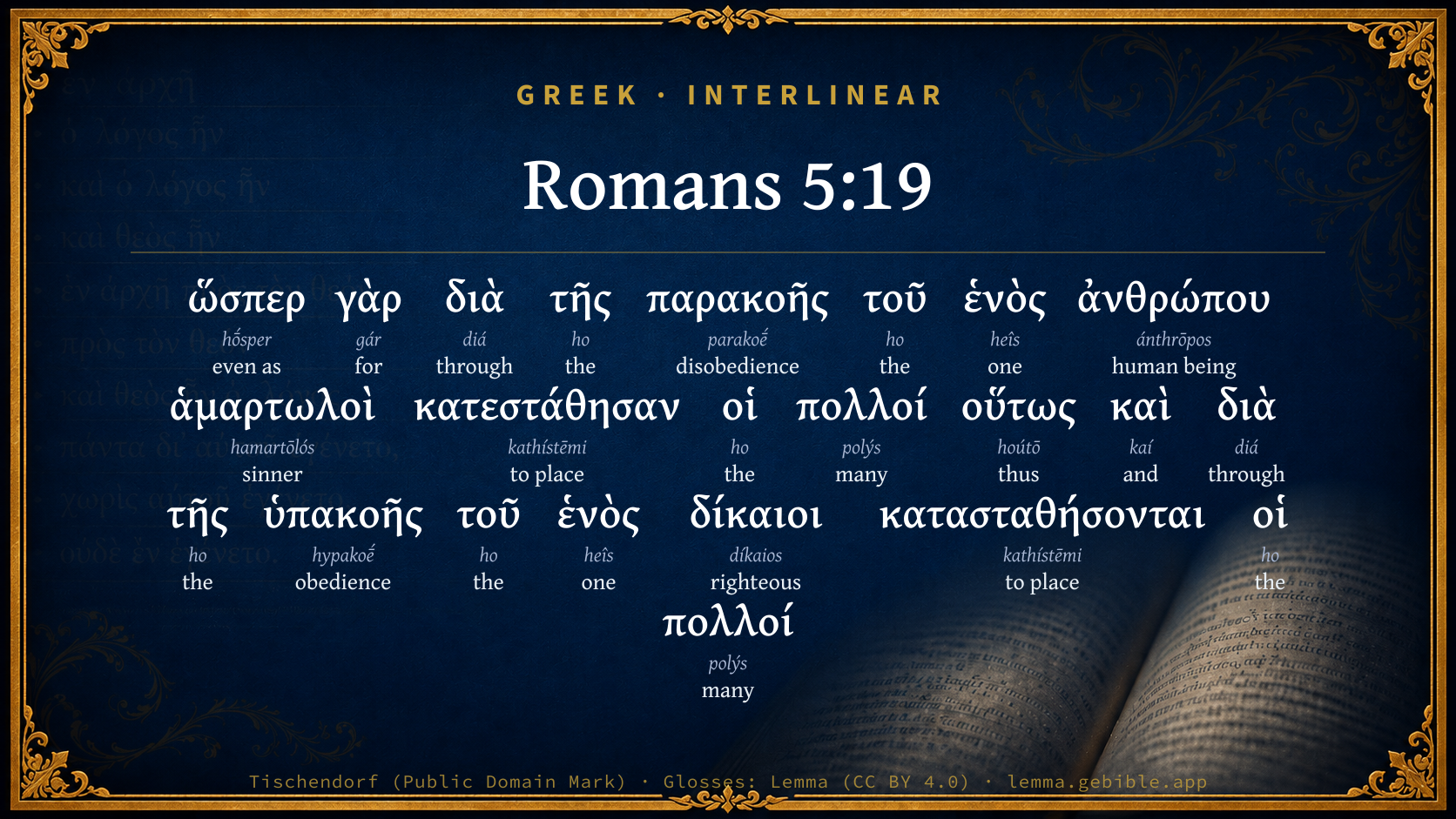
Greek (Tischendorf 8th ed.) Romans 5:19 appears in the Greek New Testament. The text above is from the Tischendorf 8th edition. Each word links to its Strong’s number and a concise gloss. Click any word for its full Thayer’s Greek Lexicon entry.
Download image
Cite this verse

Romans 5:19 (World English Bible). Public Domain. Lemma interlinear Bible study tool, https://lemma.gebible.app/v/romans/5/19.

Show BibTeX & RIS
BibTeX
RIS
English Translation
For as through the one man's disobedience many were made sinners, even so through the obedience of the one will many be made righteous.
World English Bible · Public Domain
Highlights
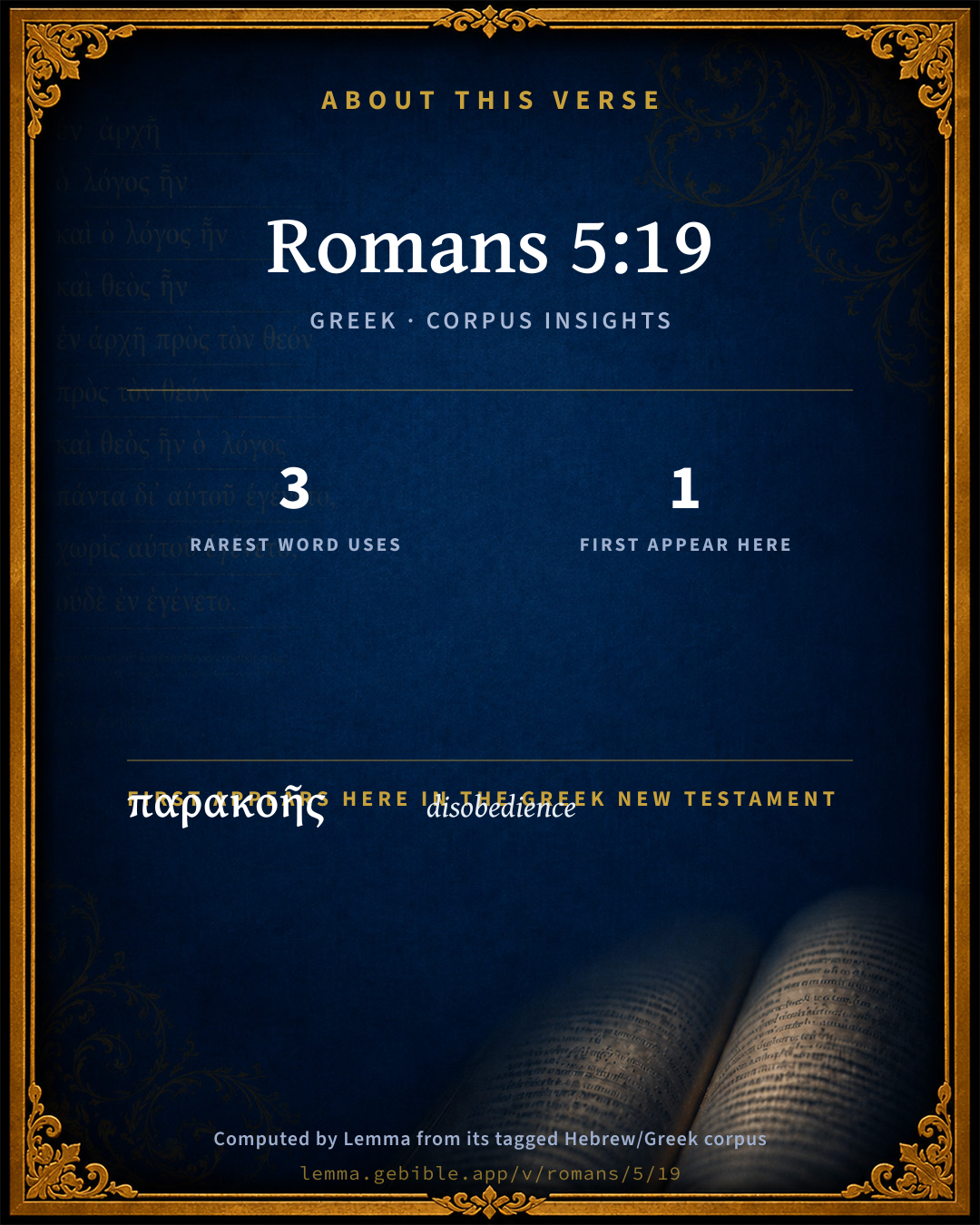
  • 1 first appearance in the Greek New Testament
Full analysis ↓
Download a study sheet

One document with this verse’s original text, its word-by-word gloss line, the meaning frame, cross-references with their text, attributed commentary, and full source and license credits — printable, and it pastes into notes with its structure intact.

This verse Autodidact and up

Study sheet (.html) Plain text (.txt)

A passage Seminary Student

Up to 50 verses in one chapter. A passage sheet keeps up to 6 commentary sources and 12 cross-references per verse, in the order this page ranks them, and says so on the sheet whenever that leaves anything out. Ask for a single verse and you get the Autodidact verse sheet above.

Everything on this page stays free to read, with no account — the sheet is a download of what is already on screen, not access to it.

Want to remove ads? Support Godless Engineer
Compare translations 3

The same verse in 3 English versions, stacked beneath the original-language interlinear above. Click any original word for its lexicon entry.

Each is an independent rendering of the whole verse — the interlinear is not word-aligned to these translations.

Highlighted words mark where these versions differ — a whole-verse word diff, not a word-by-word alignment.

  • World English Bible Public Domain
    For as through the one man's disobedience many were made sinners, even so through the obedience of the one will many be made righteous.
  • King James Version Public Domain
    For as by one man's disobedience many were made sinners, so by the obedience of one shall many be made righteous.
  • unfoldingWord Literal Text CC BY-SA 4.0
    For just as through the disobedience of the one man the many were made sinners, so also through the obedience of the one will the many be made righteous ones.

unfoldingWord Literal Text — © unfoldingWord, licensed CC BY-SA 4.0. Word-aligned USFM3 via Door43 (git.door43.org/unfoldingWord/en_ult).

Versions to compare (up to 4)

3 of 4 selected

Show all 19 translations

Every available English version of this verse, each an independent rendering of the whole verse.

  • World English Bible Public Domain
    For as through the one man's disobedience many were made sinners, even so through the obedience of the one will many be made righteous.
  • Berean Standard Bible Public Domain
    For just as through the disobedience of the one man the many were made sinners, so also through the obedience of the one man the many will be made righteous.
  • Majority Standard Bible Public Domain
    For just as through the disobedience of the one man the many were made sinners, so also through the obedience of the one man the many will be made righteous.
  • King James Version Public Domain
    For as by one man's disobedience many were made sinners, so by the obedience of one shall many be made righteous.
  • American Standard Version (1901) Public Domain
    For as through the one man's disobedience the many were made sinners, even so through the obedience of the one shall the many be made righteous.
  • Revised Version (1885) Public Domain
    For as through the one man’s disobedience the many were made sinners, even so through the obedience of the one shall the many be made righteous.
  • Geneva Bible (1599) Public Domain
    For as by one mans disobedience many were made sinners, so by that obedience of that one shall many also be made righteous.
  • Douay-Rheims (1899) Public Domain
    For as by the disobedience of one man, many were made sinners; so also by the obedience of one, many shall be made just.
  • Young's Literal Translation Public Domain
    for as through the disobedience of the one man, the many were constituted sinners: so also through the obedience of the one, shall the many be constituted righteous.
  • Literal Standard Version CC BY-SA 4.0
    for as through the disobedience of the one man, the many were constituted sinners: so also through the obedience of the One, will the many be constituted righteous.
  • Unlocked Literal Bible CC BY-SA 4.0
    For as through the one man's disobedience the many were made sinners, even so through the obedience of the one will the many be made righteous.
  • unfoldingWord Literal Text CC BY-SA 4.0
    For just as through the disobedience of the one man the many were made sinners, so also through the obedience of the one will the many be made righteous ones.
  • Darby Bible Public Domain
    For as indeed by the disobedience of the one man the many have been constituted sinners, so also by the obedience of the one the many will be constituted righteous.
  • World Messianic Bible Public Domain
    For as through the one man’s disobedience many were made sinners, even so through the obedience of the one, many will be made righteous.
  • Webster's Bible Public Domain
    For as by one man's disobedience many were made sinners, so by the obedience of one shall many be made righteous.
  • Free Bible Version CC BY-SA 4.0
    Just as through one man's disobedience many became sinners, in the same way through one man's obedience many are made right with God.
  • Bible in Basic English Public Domain
    Because, as numbers of men became sinners through the wrongdoing of one man, even so will great numbers get righteousness through the keeping of the word of God by one man.
  • Text-Critical English NT CC BY 4.0
    For just as many were made sinners through the disobedience of one man, so also many will be made righteous through the obedience of one man.
  • Tyndale New Testament (1534) Public Domain
    For as by one mannes disobediece many be cam synners: so by the obediece of one shall many be made righteous.

Literal Standard Version (2020), Covenant Press — licensed CC BY-SA 4.0. Text via the HelloAO Bible API (eBible.org). Unlocked Literal Bible (unfoldingWord) — licensed CC BY-SA 4.0. Text via the HelloAO Bible API (eBible.org). unfoldingWord Literal Text — © unfoldingWord, licensed CC BY-SA 4.0. Word-aligned USFM3 via Door43 (git.door43.org/unfoldingWord/en_ult). Free Bible Version, Dr. Jonathan Gallagher — licensed CC BY-SA 4.0. Text via the HelloAO Bible API (eBible.org).

Word by word

More ways to search: Search by grammar → Find every occurrence → Compare this word →

Practice this passage: Drill this verse → Learn its vocabulary →

παρακοῆς
parakoḗ
G3876
“disobedience”
Noun, Genitive, Singular, Feminine
Part of Speech
Noun
Case
Genitive
Number
Singular
Gender
Feminine
Full Thayer's Definition

Origin: from G3878

TDNT: 04:43,3

1. a hearing amiss 2. disobedience
  1. ὥσπερ hṓsper G5618 “even as” Adverb
  2. γὰρ gár G1063 “for” Conjunction
  3. διὰ diá G1223 “through” Preposition
  4. τῆς ho G3588 “the” Article, Genitive, Singular, Feminine
  5. τοῦ ho G3588 “the” Article, Genitive, Singular, Masculine
  6. ἑνὸς heîs G1520 “one” Adjective, Genitive, Singular, Masculine
  7. ἀνθρώπου ánthrōpos G444 “human being” Noun, Genitive, Singular, Masculine
  8. ἁμαρτωλοὶ hamartōlós G268 “sinner” Adjective, Nominative, Plural, Masculine
  9. κατεστάθησαν kathístēmi G2525 “to place” Verb, Aorist, Passive, Indicative, 3rd person, Plural
  10. οἱ ho G3588 “the” Article, Nominative, Plural, Masculine
  11. πολλοί polýs G4183 “many” Adjective, Nominative, Plural, Masculine
  12. οὕτως hoútō G3779 “thus” Adverb
  13. καὶ kaí G2532 “and” Conjunction
  14. διὰ diá G1223 “through” Preposition
  15. τῆς ho G3588 “the” Article, Genitive, Singular, Feminine
  16. ὑπακοῆς hypakoḗ G5218 “obedience” Noun, Genitive, Singular, Feminine
  17. τοῦ ho G3588 “the” Article, Genitive, Singular, Masculine
  18. ἑνὸς heîs G1520 “one” Adjective, Genitive, Singular, Masculine
  19. δίκαιοι díkaios G1342 “righteous” Adjective, Nominative, Plural, Masculine
  20. κατασταθήσονται kathístēmi G2525 “to place” Verb, Future, Passive, Indicative, 3rd person, Plural
  21. οἱ ho G3588 “the” Article, Nominative, Plural, Masculine
  22. πολλοί polýs G4183 “many” Adjective, Nominative, Plural, Masculine

About this verse

These counts appear in no published source. They are computed here, from the morphology-tagged text and Lemma’s own curated glosses. What Lemma adds →

23
words
14
distinct lemmas
Pauline Epistles
section

Notable vocabulary

The rarest word here is παρακοῆς disobedience G3876 — appearing just 3 times in the whole Greek New Testament.

First appearance in Scripture

This word makes its first canonical appearance in the Greek New Testament here:

  • παρακοῆς disobedience G3876

Shared distinctive vocabulary

παρακοῆς disobedience G3876 occurs in 3 verses of the Greek New Testament. Also found in:
Repetition

Words recur within this verse:

  • διὰ through G1223 ×2
  • ἑνὸς one G1520 ×2
  • κατεστάθησαν to place G2525 ×2
  • πολλοί many G4183 ×2
  • τῆς the G3588 ×6

Cross-references

8

Topical passages linked to Romans 5:19 in the Treasury of Scripture Knowledge — connected by theme and wording, ordered by reader-vote popularity; previews shown in the World English Bible.

  • Romans 5:18 So then as through one trespass, all men were condemned; even so through one act of righteousness, all men were justified to life.
  • 2 Corinthians 5:21 For him who knew no sin he made to be sin on our behalf; so that in him we might become the righteousness of God.
  • Philippians 2:8 And being found in human form, he humbled himself, becoming obedient to death, yes, the death of the cross.
  • Romans 5:12 Therefore, as sin entered into the world through one man, and death through sin; and so death passed to all men, because all sinned.
  • Ephesians 1:6 to the praise of the glory of his grace, by which he freely bestowed favor on us in the Beloved,
  • Romans 5:15 But the free gift isn't like the trespass. For if by the trespass of the one the many died, much more did the grace of God, and the gift by the grace of the one man, Jesus Christ, abound to the many.
  • Isaiah 53:10–12 Yet it pleased Yahweh to bruise him; he has put him to grief: when you shall make his soul an offering for sin, he shall see [his] seed, he shall prolong his days, and the pleasure of Yahweh shall prosper in his hand.
  • Daniel 9:24 Seventy weeks are decreed on your people and on your holy city, to finish disobedience, and to make an end of sins, and to make reconciliation for iniquity, and to bring in everlasting righteousness, and to seal up vision and prophecy, and to anoint the most holy.

Cross-references courtesy of OpenBible.info (CC BY 4.0).

Commentary

Notes on Romans 5:19 from classic Christian and Jewish commentators (each source and its license shown beneath its notes). The classic Christian expositions comment on the surrounding passage and are grouped to its opening verse, so a note may address several verses; the Jewish commentaries on the Tanakh (Rashi and others) are per-verse, so they appear only where the commentator wrote on this verse.

Lemma curates 59 commentaries, every one of them public domain or Creative Commons licensed, each selected and text-cleaned for this edition rather than reprinted as found. About our sources →

Jamieson, Fausset & Brown

Robert Jamieson, A. R. Fausset & David Brown

For, &c.--better, "For as by the one man's disobedience the many were made sinners, even so by the obedience of the One shall the many be made righteous." On this great verse observe: First, By the "obedience" of Christ here is plainly not meant more than what divines call His active obedience, as distinguished from His sufferings and death; it is the entire work of Christ in its obediential character. Our Lord Himself represents even His death as His great act of obedience to the Father: "This commandment (that is, to lay down and resume His life) have I received of My Father" (Joh 10:8). Second, The significant word twice rendered made, does not signify to work a change upon a person or thing, but to constitute or ordain, as will be seen from all the places where it is used. Here, accordingly, it is intended to express that judicial act which holds men, in virtue of their connection with Adam, as sinners; and, in connection with Christ, as righteous. Third, The change of tense from the past to the future--"as through Adam we were made sinners, so through Christ we shall be made righteous"--delightfully expresses the enduring character of the act, and of the economy to which such acts belong, in contrast with the for-ever-past ruin of believers in Adam. (See on Rom 6:5). Fourth, The "all men" of Rom 5:18 and the "many" of Rom 5:19 are the same party, though under a slightly different aspect. In the latter case, the contrast is between the one representative (Adam--Christ) and the many whom he represented; in the former case, it is between the one head (Adam--Christ) and the human race, affected for death and life respectively by the actings of that one. Only in this latter case it is the redeemed family of man that is alone in view; it is humanity as actually lost, but also as actually saved, as ruined and recovered. Such as refuse to fall in with the high purpose of God to constitute His Son a "second Adam," the Head of a new race, and as impenitent and unbelieving finally perish, have no place in this section of the Epistle, whose sole object is to show how God repairs in the second Adam the evil done by the first. (Thus the doctrine of universal restoration has no place here. Thus too the forced interpretation by which the "justification of all" is made to mean a justification merely in possibility and offer to all, and the "justification of the many" to mean the actual justification of as many as believe [ALFORD, &c.], is completely avoided. And thus the harshness of comparing a whole fallen family with a recovered part is got rid of. However true it be in fact that part of mankind is not saved, this is not the aspect in which the subject is here presented. It is totals that are compared and contrasted; and it is the same total in two successive conditions--namely, the human race as ruined in Adam and recovered in Christ).

Jamieson, Fausset & Brown — Commentary Critical and Explanatory on the Whole Bible (1871) — public domain (CC PDM 1.0). Text via the HelloAO Bible API.

Albert Barnes' Notes on the Bible

For ... - This verse is not a mere repetition of the former, but it is an explanation. By the former statements it might perhaps be inferred that people were condemned without any guilt or blame of theirs. The apostle in this verse guards against this, and affirms that they are in fact sinners. He affirms that those who are sinners are condemned, and that the sufferings brought in on account of the sin of Adam, are introduced because many were made sinners. Calvin says,” Lest anyone should arrogate to himself innocence, (the apostle) adds, that each one is condemned because he is a sinner.”

(The same objection which was stated against a previous quotation from Calvin applies here. The reformer does not mean that each is condemned because he is actually a sinner. He affirms that the ground of condemnation lies in something with which we are born, which belongs to us antecedent to actual transgression.)

By one man’s disobedience - By means of the sin of Adam. This affirms simply the fact thai such a result followed from the sin of Adam. The word by διά dia is used in the Scriptures as it is in all books and in all languages. It may denote the efficient cause; the instrumental cause; the principal cause; the meritorious cause; or the chief occasion by which a thing occurred. (See Schleusner.) It does not express one mode, and one only, in which a thing is done; but that one thing is the result of another. When we say that a young man is ruined in his character by another, we do not express the mode, but the fact. When we say that thousands have been made infidels by the writings of Paine and Voltaire, we make no affirmation about the mode, but about the fact. In each of these, and in all other cases, we should deem it most inconclusive reasoning to attempt to determine the mode by the preposition by; and still more absurd if it were argued from the use of that preposition that the sins of the seducer were imputed to the young man; or the opinions of Paine and Voltaire imputed to infidels.

(What is here said of the various significations of διά dia is true. Yet it will not be denied, that in a multitude of instances it points to the real cause or ground of a thing. The sense is to be determined by the connection. “We have in this single passage no less than three cases, Rom 5:12, Rom 5:18-19, in which this preposition with the genitive indicates the ground or reason on account of which something is given or performed. All this is surely sufficient to prove that it may, in the case before us, express the ground why the sentence of condemnation has passed upon all men.” To draw an illustration from the injury inflicted by Voltaire and Paine, will not serve the author’s purpose, until he can prove, that they stand in a relation, to those whom they have injured, similar to what Adam bears to the human family. When we say that thousands have been ruined by Voltaire, it is true we can have no idea of imputation: yet we may fairly entertain such an idea when it is said, “all man. kind have been ruined by Adam.”)

Many - Greek, The many, Rom 5:15. “Were made” (κατεσταθησαν katestathēsan). The verb used here, occurs in the New Testament in the following places: Mat 24:45, Mat 24:47; Mat 25:21, Mat 25:23; Luk 12:14, Luk 12:42, Luk 12:44; Act 6:3; Act 7:10, Act 7:27, Act 7:35; Act 17:15; Rom 5:19; Tit 1:5; Heb 2:7; Heb 5:1; Heb 7:28; Heb 8:3; Jam 3:6; Jam 4:4; 2Pe 1:8. It usually means to constitute, set, or appoint. In the New Testament it has two leading significations.

(1) To appoint to an office, to set over others (Mat 24:45, Mat 24:47; Luk 12:42, etc.); and,

(2) It means to become, to be in fact, etc.; Jam 3:6, “so is the tongue among our members,” etc.

That is, it becomes such; Jam 4:4, “The friendship of the world is enmity with God; it becomes such; it is in fact thus, and is thus to be regarded. The word is, in no instance, used to express the idea of imputing that to one which belongs to another. It here either means that this was by a constitution of divine appointment that they in fact became sinners, or simply declares that they were so in fact. There is not the slightest intimation that it was by imputation. The whole scope of the argument is, moreover, against this; for the object of the apostle is not to show that they were charged with the sin of another, but that they were in fact sinners themselves. If it means that they were condemned for his act, without any concurrence of their own will, then the correspondent part will be true, that all are constituted righteous in the same way; and thus the doctrine of universal salvation will be inevitable. But as none are constituted righteous who do not voluntarily avail themselves of the provisions of mercy, so it follows that those who are condemned, are not condemned for the sin of another without their own concurrence; nor unless they personally deserve it.

Sinners - Transgressors; those who deserve to be punished. It does not mean those who are condemned for the sin of another; but those who are violators of the Law of God. All who are condemned are sinners. They are not innocent persons condemned for the crime of another. People may be involved in the consequences of the sins of others without being to blame. The consequences of the crimes of a murderer, a drunkard, a pirate may pass over from them, and affect thousands, and overwhelm them in ruin. But this does not prove that they are blameworthy. In the divine administration none are regarded as guilty who are not guilty; none are condemned who do not deserve to be condemned. All who sink to hell are sinners.

By the obedience of one - Of Christ. This stands opposed to the disobedience of Adam, and evidently includes the entire work of the Redeemer which has a bearing on the salvation of people; Phi 2:8, “He ...became obedient unto death.”

Shall many - Greek, The many; corresponding to the term in the former part of the verse, and evidently commensurate with it; for there is no reason for limiting it to a part in this member, any more than there is in the former.

Be made - The same Greek word as before be appointed, or become. The apostle has explained the mode in which this is done; Rom 1:17; Rom 3:24-26; Rom 4:1-5. That explanation is to limit the meaning here. No more are considered righteous than become so in that way. And as all do not become righteous thus, the passage cannot be adduced to prove the doctrine of universal salvation.

The following remarks may express the doctrines which are established by this much-contested and difficult passage.

(1) Adam was created holy; capable of obeying law; yet free to fall.

(2) A law was given him, adapted to his condition - simple, plain, easy to be obeyed, and suited to give human nature a trial in circumstances as favorable as possible.

(3) Its violation exposed him to the threatened penalty as he had understood it, and to all the collateral woes which it might carry in its train - involving, as subsequent developments showed, the loss of God’s favor; his displeasure evinced in man’s toil, and sweat, and sickness, and death; in hereditary depravity, and the curse, and the pains of hell forever.

(4) Adam was the head of the race; he was the fountain of being; and human nature was so far tried in him, that it may be said he was on trial not for himself alone, but for his posterity, inasmuch as his fall would involve them in ruin. Many have chosen to call this a covenant, and to speak of him as a federal head; and if the above account is the idea involved in these terms, the explanation is not exceptionable. As the word “covenant,” however, is not applied in the transaction in the Bible, and as it is liable to be misunderstood, others prefer to speak of it as a law given to Adam, and as a divine constitution, under which he was placed.

(5) “his posterity are, in consequence of his sin, subjected to the same train of ills as if they had been personally the transgressors.” Not that they are regarded as personally ill-deserving, or criminal for his sin, God reckons things as they are, and not falsely, (see the note at Rom 4:3), and his imputations are all according to truth. He regarded Adam as standing at the head of the race; and regards and treats all his posterity as coming into the world subject to pain, and death, and depravity, as a consequence of his sin; see the note. This is the Scripture idea of imputation; and this is what has been commonly meant when it has been said that “the guilt of his first sin” - not the sin itself - “is imputed to his posterity.”

(6) There is something antecedent to the moral action of his posterity, and growing out of the relation which they sustain to him, which makes it certain that they will sin as soon as they begin to act as moral agents. What this is, we may not be able to say; but we may be certain that it is not physical depravity, or any created essence of the soul, or anything which prevents the first act of sin from being voluntary. This hereditary tendency to sin has been usually called “original sin;” and this the apostle evidently teaches.

(7) As an infant comes into the world with a certainty that he will sin as soon as he becomes a moral agent here, there is the same certainty that, if he were removed to eternity, he would sin there also, unless he were changed. There is, therefore, need of the blood of the atonement and of the agency of the Holy Spirit, that an infant may be saved.

(8) The facts here stated accord with all the analogy in the moral government of God. The drunkard secures as a result commonly, that his family will be reduced to beggary, want, and woe. A pirate, or a traitor, will overwhelm not himself only, but his family in ruin. Such is the great law or constitution on which society is now organized; and we are not to be surprised that the same principle occurred in the primary organization of human affairs.

(9) As this is the fact everywhere, the analogy disarms all objections which have been made against the scriptural statements of the effects of the sin of Adam. If just now, it was just then. If it exists now, it existed then.

(10) the doctrine should be left, therefore, simply as it is in the Scriptures. It is there the simple statement of a fact, without any attempt at explanation. That fact accords with all that we see and feel. It is a great principle in the constitution of things, that the conduct of one man may pass over in its effects on others, and have an influence on their happiness. The simple fact in regard to Adam is, that he sinned; and that such is the organization of the great society of which he was the head and father, that his sin has secured as a certain result that all the race will be sinners also. How this is, the Bible has not explained. It is a part of a great system of things. That it is unjust no man can prove, for none can show that any sinner suffers more than he deserves. That it is wise is apparent, for it is attended with numberless blessings. It is connected with all the advantages that grow out of the social organization.

The race might have been composed of independent individuals, where the conduct of an individual, good or evil, might have affected no one but himself. But then society would have been impossible. All the benefits of organization into families, and communities, and nations would have been unknown. Man would have lived alone; wept alone; rejoiced alone; died alone. There would have been no sympathy; no compassion; no mutual aid. God has therefore grouped the race into separate communities. He has organized society. He has constituted families, tribes, clans, nations; and though on the general principle the conduct of one may overwhelm another in misery, yet the union, the grouping, the constitution, is the source of most of the blessings which man enjoys in this life, and may be of numberless mercies in regard to what is to come. If it was the organization on which the race might be plunged into sin, it is also the organization on which it may be raised to life eternal. If, on the one hand, it may be abused to produce misery, it may, on the other, be improved to the advancement of peace, sympathy, friendship, prosperity, salvation. At all events, such is the organization in common life and in religion, and it becomes man not to complain, but to act on it, and to endeavor, by the tender mercy of God, to turn it to his welfare here and hereafter. As by this organization, through Adam, he has been plunged into sin, so by the same organization, he shall, through “the second Adam,” rise to life, and ascend to the skies.

Albert Barnes' Notes on the Bible (1834–1885) — public domain. Text from a community e-Sword/MySword module.

The Biblical Illustrator

Joseph S. Exell

Rom_5:19

For, by the obedience of one many were made sinners, and by the obedience of one shall many be made righteous.

One mans disobedience and its consequence

I. Man was made in the image of God, which consisted partly--

1. In his power over all terrestrial creatures (Gen_1:26; Psa_8:5-6). Hence he gave names (Gen_2:19-20).

2. In the perfection of his nature, endued with--

(1) Reason.

(2) Will.

(3) Knowledge (Col_3:9-10).

(4) True holiness (Eph_4:24).

II. Man fell from this high estate through disobedience (Gen_2:16-17; Gen_3:1, etc.)

1. How this was done.

(1) Through Satans temptation, which was managed with great cunning.

(a) He enters the serpent, the subtlest creature.

(b) Sets upon the woman, the weaker vessel (1Pe_3:7).

(c) Propounds a doubtful question (Gen_3:1).

(d) Denies the truth of Gods threatenings (Rom_5:4).

(e) Gives a contrary promise and uses the name of God to confirm it (Rom_5:5).

(2) Through the womans fault.

(a) In entering into a dispute with the devil.

(b) In doubting the truth of Gods command.

(c) In eating the fruit.

(3) Through the mans fault. In taking the fruit at her hands.

2. What was involved.

(1) He broke the first command, by infidelity, ingratitude, contempt of God, and ambition to be like God (Gen_3:5).

(2) Hearkened to the devils word before Gods.

(3) Pleased his wife rather than God.

(4) Murdered his whole posterity (Joh_8:44).

(5) Minded the lusts of the flesh more than the law of God.

(6) Stole Gods fruit.

(7) Coveted Gods attributes.

III. Through this disobedience all his posterity were made sinners.

1. By imputation.

(1) In that all sinned in him (Rom_5:12; Rom_5:16-18; Heb_7:9-10).

(2) In that all died in him (Rom_6:23; 1Co_15:22).

(3) All were then in his loins; so that he was the common father of all mankind; therefore called Adam, i.e., man in general (Gen_5:1).

2. By inhesion. All, through Adams sin--

(1) Are born in sin (Psa_51:5; Job_14:4; Eph_2:3; Joh_3:3). Hence only is it that children die.

(2) Do actually commit sin, which shows all mankind to be polluted with it and inclined to it (Ecc_7:20; Pro_20:9; 1Ki_8:46; Gal_3:22; 1Jn_1:8-10).

3. The whole man is defiled with sin and continually subject to it.

(1) The understanding (1Co_1:19-20; 1Co_2:14).

(2) The mind and conscience (Tit_1:15). It is stupid (1Ti_4:2), or else troubled.

(3) The memory (2Pe_1:21).

(4) The thoughts and the imagination (Gen_6:5), which appears in their vanity and disorder.

(5) The will and affections (Joh_1:13; Col_3:2).

(6) The body (1Th_5:23). It is not now serviceable to the soul, but a clog to it; yet it tempts it to sin.

4. Hence our original sin is the corrupt fountain from which all our actual sins flow (Jam_1:14). Some relics of it remain in the best saints (Gal_5:17).

Conclusion:

1. This should make us humble (Job_15:14-16).

2. Hence we should earnestly desire to be made new creatures; and go to Christ, the Second Adam, that we may be made righteous by Him, as we are sinners by the first. (Bp. Beveridge.)

One mans obedience and its consequences

I. Who is this one spoken of? Note--

1. All mankind being contained in, and so fallen with Adam, God raised up another Adam, by whom they might rise (1Co_15:45). Who being promised, as soon as the first fell (Gen_3:15) is called the Second Man (1Co_15:47).

2. This was no less a Person than the Son of God made Man (Joh_1:14; 1Ti_3:16). For He took the nature of man into His Divine Person (Heb_2:16).

3. Hence the whole nature of man was so fully and really contained in Him as in the first Adam (1Co_15:22).

4. This, the Second Man, had an advantage over the first, that whereas the other was but a man made in the likeness of God, this was God made in the likeness of man (Php_2:6-7).

II. What was the obedience of this One?

1. He did no sin, was not guilty in the least (Isa_53:9; 1Pe_2:22; 1Jn_3:5; Joh_8:46).

2. He did whatsoever the law required, and so remained perfectly righteous in all things (Mat_3:15; Heb_7:26-28; Joh_15:10; Joh_4:34).

3. He was obedient, even to death itself (Php_2:8); so He underwent that death which the first Adam had deserved for all mankind.

III. In what sense are many made righteous by one? In the same sense as they are sinners by one.

1. By having Christs righteousness as we had Adams sin imputed to us.

(1) No man can be pronounced righteous by God, unless he be really so (Pro_17:15; Isa_5:23).

(2) But no man is really righteous in himself (Ecc_7:20).

(3) Hence it is impossible we should be accepted as righteous before God, unless we have some other righteousness imputed to us (Rom_4:6; Rom_4:11).

(4) Hence Christ was pleased to be obedient even unto death for us; that so by His obedience imputed to us we might be accepted as righteous. For--

(a) Our righteousness is plainly asserted to be only in Christ (2Co_5:21). He was made sin for us. Our sins were laid on Him (Isa_53:6); so His righteousness on us (Php_3:8-9; Eph_1:6).

(b) He is expressly called Our righteousness (Jer_23:6; Jer_33:16; 1Co_1:30).

(c) He is called our Surety (Heb_7:22), who, being bound for us, paid in our stead what the law required of us.

(d) Christs whole obedience was only upon our account, and for our sakes (Gal_4:4-5); so that by His obedience the law is perfectly fulfilled in us (Rom_8:3-4).

2. We are made righteous by Christ as sinners by Adam, inherently. He--

(1) Mortifies our sins (1Jn_3:8; Act_3:26; 1Jn_1:7-9).

(2) Gives repentance (Act_5:31).

(3) Sanctifies our whole nature (1Co_1:30; 1Co_6:11; Eph_5:25-27).

(4) Enables us to do good works (Joh_15:4-5; Tit_2:14; Php_4:11-13).

Conclusion:

1. Thank God for Christ.

2. Put your whole trust in Him only, for grace as well as pardon.

3. Let it be your great care to be in the number of those who are made righteous in Christ, in believing in Him.

4. Live as becometh righteous persons. (Bp. Beveridge.)

Mans first sin

Is there a human being to be found who, after reflection, and speaking honestly, would affirm of himself, I have never sinned? We are aware of the existence of great ignorance concerning the extent of sin, and the evil of sin; and we know men are exceedingly reluctant to confess even those sins of which they are conscious; but we do not think there is a man who, after serious reflection, is entirely unconscious of guilt. Furthermore, is there a man who would say of a fellow human being, however dearly loved and highly prized, I do not believe that person has ever sinned? Verily, our consciousness and our observation confirm the Bible doctrine, There is none that doeth good; no, not one!

I. The fact and the circumstances of mans first sin.

1. The first sin was Adams failure under trial as the representative of the human race. Say that this test was simple; then how adapted to inexperience, and how fitted to show whether, in filial dependence, man would serve God or not. Do you refuse to judge of the quarter whence the wind blows by the course of the thistle down, or by the path of the smoke; and would you wait for information until you could see the vane of some lofty tower? Do you not measure the heat of a summers day by the moistened brow, and judge of the cold of winter by the smarting skin, far more frequently than by the scale of the thermometer?

2. Man was specially tempted to the first sin.

3. Temptation was necessary in mans probation. Could probation be conducted apart from this trying process? Is not the coin tested in the balance? Is not silver proved in the fining pot? Is not gold tried in the furnace? Are not the elements of a chemical compound made manifest by analysis? Is not the strength of metal or timber relied upon after proof? As in our law courts, no prisoner is recognised as guilty until his crime has been proved; so, in Gods moral government, no procedure is based on character until the character is made manifest by the light of conduct.

4. The first sin of man was (tested by any standard) a great transgression. Actions must be judged by the principle involved in them. In eating the forbidden fruit did not Adam transgress a law? In transgressing this law did not Adam reject the Divine authority and cast off his allegiance to God? In thus sinning did not Adam resist the power of the strongest motives on the side of obedience?--motives arising from his obligations to the kindness of God; motives connected with the full and flowing fountains of pleasure and of advantage by which he was encompassed; and from the fact that he was being proved, and that upon his conduct were suspended tremendous results? Moreover the image of God was within him--revelations of God surrounded him; and under the power of these multiplied motives and influences his attention was fixed on one defined, intelligible, and distinct requirement. It was not an easy thing for Adam to sin against God.

(1) Observe that human nature, at its best state, is not to be trusted; and that it universally fails where the failure is of most consequence.

(2) See the tremendous responsibility which our influence over each other involves.

(3) Learn the utility of experience in the trial of temptation.

(4) Look, by the aid of the facts we are considering, into the philosophy of sinning.

II. The results of mans first sin. Trace them in the transgressors themselves. We know not what interval existed between the evil act and a sense of its iniquity. Delusion may have continued through some time. At length, however, an inward monitor gave notice of the fault; disapprobation and self-condemnation, with their keen smart, succeeded; and Adam tasted the bitterness of sin.

1. Learn hence the enormous evil of any one sin; and profit in this department of knowledge by the experience of others.

2. Know also the certainty of punishment where pardon is not vouchsafed.

3. Mark the limit of Divine interference with human conduct. (S. Martin.)

Mans disobedience and Christs obedience

I. Mans disobedience.

1. Its consequences.

2. Perpetration.

3. Extent.

II. Christs obedience.

1. Its nature.

2. Operation.

3. Result. (J. Lyth, D. D.)

The condition of man a sinner and man made righteous cont

rasted:--

1. Unbelief and faith.

2. Enmity and love.

3. Banishment from God and acceptance with God.

4. Disobedience and righteousness.

5. Misery and bliss.

6. Curse and blessing.

7. Death and life.

8. Paradise lost and paradise regained. (D. MNicoll.)

Of our fall in Adam

Consider--

1. Who that one man was. Adam (verse 14).

2. What his disobedience was. His first sin, the eating of the forbidden fruit, which opened the door to death (verse 12).

3. Whom it concerned; many; the all (verse 14). The alteration is not without reason, for there is an exception here of Christ. It reached many men, but not all simply; he, and he only, was excepted.

4. How it touched them; they were made sinners by it. There are two ways how men might be made sinners by the disobedience of Adam, viz., either by imputation or imitation. The last is not meant.

(1) Because some of those many who are made Sinners are not capable of imitation or actual sin, viz., infants.

(2) Because we are made righteous, not by the imitation, but imputation of Christs righteousness; but as we are made righteous by the one, so we are made sinners by the other.

I. What sin of Adams it was that they who sinned and fell with him sinned and fell in. His first sin, the eating of the forbidden fruit. This was the sin that broke the covenant of works. Other sins of Adam are not imputed to them, more than those of any other private persons. So then, Adam quickly betaking himself to the covenant of grace, and placing himself under another head as a private man, ceased to be the head in the covenant of works. Adam had all his children in one ship to carry them to Immanuels land; by his negligence he dashed the ship on a rock, and broke it all in pieces; and so he and his lay foundering in a sea of guilt. Jesus Christ lets out the second covenant as a rope to draw them to the shore. Adam for himself lays hold on it, while others hold by the broken beards of the ship, till they be by the power of grace enabled to quit them too, as he was.

II. Who were they that sinned and fell in Adam. All mankind, descending from him by ordinary generation. So--

1. Christ is excepted. Adams sin was not imputed to the man Christ. He was separated from sinners (Heb_7:26), and was not infected with the plague whereof He was to be the cleanser. And so Christ comes not in under Adam as head, but, as in the text, is opposed to Adam as another head. Christ was indeed a Son of Adam (Luk_3:1-38). And it was necessary He should be so, that He might be our near kinsman, and that the same nature that sinned might suffer. But He came not of him by ordinary generation--He was born of a virgin. And upon this account He came not in under Adam in the covenant of works; for Christ was not born by virtue of that blessing of marriage given before the fall (Gen_1:28), but by virtue of a covenant-promise made after the fall (Gen_3:15). So that Adam could represent none in that covenant, but such as were to spring from him by virtue of that blessing.

2. All mankind besides sinned and fell with Adam in that first transgression. His sin of eating the forbidden fruit is imputed to them. Consider--

(1) The Scripture plainly testifies that all sinned in him (verse 12). Hence it is plain that death has not come into the world but in pursuit of sin; all die, for all have sinned.

(2) All fell with him into misery by that sin. Now, a just God will not involve the innocent with the guilty in the same punishment.

(a) All fell under condemnation (verses 16, 18).

(b) All fell under the loss of Gods image, and the corruption of nature with him (Psa_51:5).

(c) All the punishments inflicted on Adam and Eve, for that sin, as specified in Gen_3:1-24, are common to mankind, their posterity; and therefore the sin must be so too.

III. How the first sin of Adam comes to be imputed to us. The great reason of this is, because we are all included in Adams covenant. The covenant was made with him, not only for himself, but for all his posterity.

1. Consider here--

(1) It was the covenant of works, the condition whereof was perfect obedience.

(2) It was made with Adam for himself. That was the way he himself was to attain perfect happiness; his own stock was in that ship.

(3) It was made not only for himself, but for all his posterity descending from him by ordinary generation. So that he was not here as a private, but as a public person, the moral head and representative of all mankind. Hence the Scripture holds forth Adam and Christ, as if there had never been any but these two men in the world (1Co_15:47). And this he does, because they were two public persons, each of them having under them persons represented by them (verses 14, 18).

2. But some may be ready to say, we made not choice of Adam for that purpose. Answer--

(1) God made the choice, who was as meet to make it for us as we for ourselves. And who art thou that repliest against God?

(2) Adam was our natural head, the common father of us all (Act_17:26), and who was so meet to be trusted with the concerns of all mankind as he?

3. But to clear further the reasonableness of this imputation, consider--

(1) Adams sin is imputed to us, because it is ours. For God doth not reckon a thing ours, which is not so (Rom_2:2). If a person that has the plague infect others, and they die, they die, by their own plague, and not by that of another.

(2) It was free for God either to have annihilated all mankind, or to have given them no promise of eternal life. Was it not, then, an act of grace in God to make such a rich covenant as this? and would not men have consented to this representation gladly in this case?

(3) Adam being made after the image of God (Gen_1:26) was as capable to stand as any afterwards could be for themselves; and this was a trial that would soon have been over, while the other would have been continually a-doing, had men been created independent of him.

(4) He had natural affection the strongest to engage him. He was our father, and all we the children that were in his loins, to whom we had as good ground to trust as to any other creature.

(5) His own stock was in the ship; his all lay at stake as well as ours. Forgetting our interest, he behoved to disregard his own, for he had no separate interest from ours. No man quarrels, that when a master sets his land in tack to a man and his heirs upon conditions, if the first possessor break the bargain, the heirs be denuded of it.

(6) All that quarrel with this dispensation must renounce their part in Christ; for we are made righteous by Him, as sinners are made guilty by Adam. If we fall in with the one, why not with the other? We chose Christ for our head in the second covenant no more than we did Adam in the first covenant.

IV. Inferences.

1. See the dreadful nature of sin; one sin could destroy a world.

2. Let this be a lesson to parents to do nothing that may bring ruin on their children. Many times children are destroyed by their parents through their bad example and government.

3. This doctrine affords a lesson of humility to all. The rich have no cause to boast of their wealth, for they have as sad a heritage as the poor and needy.

4. View and wonder at the redemption purchased for sinners by Christ.

5. Quit your hold of the first Adam and his covenant, and come to and unite with Christ by faith, and lay hold on His covenant (1Co_15:22). (T. Boston, D. D.)

The fall and the atonement

These are the two main facts involved in the text. Round these there has gathered a vast cloud of theological formulas which render it difficult to discern them in their simplicity and integrity. I have a few suggestions to make, which are simple and hang well together.

1. We can hardly begin to reflect on the fall without asking, Why did God permit it? why make man so that he not only could, but almost must, fall away from his original righteousness? The very moment we begin to reflect on the fall we are confronted by the origin of evil. Why did God permit it to invade and stain His universe?

2. So, again, with that other fact, How could the obedience, or sacrifice, of the one just Man avail for the salvation of the whole sinful race? How is it so to tell on those who have fallen from righteousness as to recover them to the love and service of righteousness? To tell us that these problems are insoluble is to contradict the inspired apostle. To warn us against intermeddling with them is to pour contempt on the labours of eighteen centuries. And, worse still, it is to bid us suppress an inbred and unconquerable tendency, viz., that when we believe certain facts we cannot but try to frame some reasonable conception of them, in which each shall hold its due place and form part of an intelligible and harmonious whole.

I. The fall.

1. We start from a point familiar and approved.

(1) If God were to surround Himself, not with mere automata that would mechanically obey the impulses of His will, but with creatures capable of love and obedience, He must give them wills of their own and leave them free. A mechanical or compelled goodness is not a goodness at all. If the angels are incapable of sin they are also incapable of righteousness. If they are not free to choose between good and evil, but are kept by the power and will of God, then their goodness is Gods goodness, and not their own. If the stars keep their courses only by an involuntary and unconscious obedience to natural laws, there is nothing noble, because there is nothing free, in their obedience. But if, as some of our poets have dreamed, each heavenly body is but the vesture of some great spirit, then the very stars become moral, because voluntary, agents, who render a willing and constant obedience to the laws imposed upon them.

2. Now, what the choice of God would be we may infer from our own preference. Just as we prefer to have even a dog about us to all the mechanical toys ever invented: or just as we love to have children about us whose love we can win, who are capable of a true because voluntary goodness, so we may reasonably believe God would choose to surround Himself with many orders of creatures, each capable of loving Him of its own will, and of rendering Him a free and glad obedience.

3. But this very capacity involves an alternative. Those who can freely lift their wills into accord with the will of God, can also deflect their wills from His. And was it not well-nigh inevitable that, in the infinite possibilities of existence, some of them should strike out a path for themselves, and take that rather than keep the path marked out for them by God? How else were they to prove to themselves that their wills were their own, and free?

4. This free will, if a great is also a most perilous endowment; for there is a certain charm in asserting it. It is not mere depravity which prompts a child to do that which he knows he ought not to do. The temptation, although he may be unconscious of it, is the charm of assuring himself and showing others that he is free, that he is not a mere link in the chain of necessity, not a mere pipe in the fingers of others to sound what stop they please. Who has not felt this fascination, and done that which he knew would yield him neither pleasure nor profit, simply in order that he might feel and assert his freedom? And who that has felt this charm can doubt that when myriads of creatures had been called into being gifted with free will, some of them would be sure to prove their freedom by trying whether or not their wills were their own?

5. Our argument leads us straight into that great mystery--the origin of evil. Evil is in the world, in the universe, by no Divine fiat or decree. It is not of Gods making, but of our own. And from this gift of a will free to select its own path and take its own course have sprung all the miseries of evil. What God intended for our good, as our special honour and distinction, we have turned to our own harm. But before any man complains that so perilous a gift has been conferred upon him, and that he is called to rule and control it, let him remember the alternative--incapability of conscious and voluntary choice of righteousness and love. If any man would prefer to sink so low as that, it certainly is hard to see what God made him a man for. But does any such man exist?

II. Its consequences. When men, in the exercise of their free will, have fallen into sin, they begin to make excuse. They say, It is human to err. Sin is common to all; how, then, can I hope to escape it? This is one of the saddest consequences.

2. Men condemn even while they excuse themselves. All the while they feel that sin has alienated them from the life of God; that He is displeased with them; that they are debased; and that God must be propitiated. And thus men are made both reckless and hopeless. On the one hand, sin seems so human, so inevitable, that it can hardly be very wrong; and, on the other hand, it is so alien to God that He can hardly be expected to pardon it.

III. From these consequences we get some of our best and simplest conceptions of redemption.

1. What is the answer of the Divine grace to the feeling of doubt and despair? It is this. While we are yet sinners, God, in the person of His Son, comes down and dwells among us. He virtually says to us, See, much as I hate the sins which have degraded and enslaved you, fellowship with Me is not impossible. I am in your midst to bless you by turning every one of you away from your sins. So far from being separated from you, I have become one with you, that you may become one with Me, partaking your nature that you may partake Mine.

2. Men say, It is human to sin; so long as we are men we can hardly hope to avoid it. Nay, replies Christ; for, see, I, too, am a man; and which of you convicteth Me of sin? So far from sin being an essential part of manhood, or a necessary adjunct of it, you feel that I am a higher style of man, precisely because I never at any time transgressed My Fathers commandments, because I make it My will to do His will. This, then, is a chief way in which the redemption of Christ comes to tell on men, in which they are atoned to the God against whom they have sinned. Our wills are ours, then; but they are ours that we may make them His. And not till we do make them His shall we be recovered from the fall, and know the power of His redemption. (S. Cox, D. D.)

The Lord our righteousness

I. The obedience of Christ.

1. Personally and privately, in regard to His own moral character. He fulfilled all righteousness. He alone, of all the human race, has maintained from first to last a perfectly spotless character before the tribunal of God.

2. Officially, Christs obedience was equally perfect. He came into the world to fulfil a public mission, as the Lords servant, and at the close it was not necessary for Him to bewail shortcomings or to avow Himself an unprofitable servant (Joh_17:4). Nor was His an easy task. He needed more meekness than Moses, more Wisdom than Solomon, more watchfulness than Isaiah, and more courage than Daniel. Yet never in all His public course did He betray an unworthy spirit or act unwisely. No doing or saying of His requires to be covered with the cloak of charity.

3. As a sacrificial victim for sin, we find Christ equally obedient. He received this commandment from the Father, that He should lay down His life for His sheep. This He was to do by surrendering Himself into the hands of wicked men. He might have refused and have consumed His enemies. He might have come down even from the Cross, and declined to shed His hearts best blood for such a thankless race; but no, He submitted to it all without a murmur. His own language was, The cup which My Father hath given Me, shall I not drink it? (cf. Isa_53:4-6; Isa_53:10; Php_2:8; Heb_2:10)

.

II. The way is which we are made righteous by this obedience.

1. By the eternal purpose of God Himself. He gave His Son to achieve such mighty results for us, and He accepts us in the Beloved, and imputes to us a righteousness, which is purely of grace, and through faith in Christ. The Lord hath laid on Him the iniquity of us all.

2. The ground of this imputation, undoubtedly, is the perfect obedience of Christ, our Head; and the principle of it is, that, because of our union with Christ, what belongs to Him comes to be regarded as belonging to us. He takes our sins, that we may take His righteousness.

3. Yet, in looking at Christs obedience as the ground of our righteousness, we must view it as a whole. We cannot say that one part of the blessing we derive from Christ is to be ascribed to His sinless life, and another to His vicarious suffering. We take a whole Christ as a whole Saviour.

4. Yet in this gift of righteousness we find these three blessings.

(1) Pardon. This we have in Christs obedience unto death. That death owes its merits to His preceding spotless life.

(2) Holiness. This relates to the present, as pardon to the past, and we owe it to Christs holy life, setting us an example; to His mediatorial labours, teaching us the law; and to His sacrificial death, constraining our love, and procuring for us the Spirit, by whose indwelling we are quickened, renewed, changed into the Divine likeness, and enabled to wall: as becometh saints.

(3) Heaven. This relates to the future. Even if we were pardoned, and made holy, we could by no means earn for ourselves a title to glory. It is Gods free gift: bestowed upon us only for the sake of the perfect obedience of Christ, who hath purchased this inheritance, and secured it for us. It is He who both washes us from our sins and makes us kings and priests unto God and His Father forever. Conclusion:

1. Behold, then, the Scripture doctrine of substitution, which ascribes our salvation, not to our own obedience, but to the obedience of Christ. This is--

(1) A conceivable arrangement: it is in harmony with equity and justice, provided only that the substituted victim of suffering be a voluntary one, and that he be not a permanent loser by what he endures.

(2) An arrangement, analogous to much that we see in nature and providence, and especially to the hereditary law of association, which obtains among all mankind.

(3) Necessity. For without it no member of our fallen race could ever have risen to holiness and happiness at all.

(4) An accomplished reality, for Christ hath actually suffered for our sins, once for all, and put them away by the sacrifice of Himself (Heb_9:26-28).

2. A few practical inferences.

(1) Christian believer, see your dependence on Jesus, and rejoice in it. Cultivate a simple and confiding faith in Him, and believe that if your salvation be the reward of His obedience, there is no limit to what God is able and willing to do for you.

(2) Penitent inquirer, behold the way of righteousness, and walk in it. Come, as a sinner, to the throne of grace; and ceasing from your own works, enter by faith into spiritual rest.

(3) Ye unconverted, we point you to the Cross. There see what sin has done. Reflect, repent, return unto the Lord, for He will have mercy upon you, and to our God, for He will abundantly pardon. (T. G. Horton.)

The mechanism of heredity

Why should children, born with tainted constitutions and damaged prospects, suffer blamelessly for their fathers iniquity? Precisely as, on the contrary, children benefit gratuitously through the goodness of their parent. For the marvellous mechanism of heredity does not merely transmit evil. It is also, and indeed preponderantly, the machinery by which the physical, mental, and spiritual acquisitions of bygone generations--the accumulated and stored wealth of the ages--are conveyed to the future and preserved for posterity. There is an inheritance of strength and intellect, grace and goodness, as well as of disease and vice and evil. Nay, this last is but a misuse and perversion of Gods beneficent and stupendous contrivance of heredity. To escape the entail of ill, you must snap the mechanism of transmission, and so forfeit the entail of blessing. It is as if you should propose that each generations acquisition of property, tools, inventions, arts, and appliances should be destroyed, and the next generation compelled to begin afresh on the bare, barren soil. Progress were impossible, civilisation but the rolling of a Sisyphus stone, the human race no longer an organic unity, without continuity, without history, without moral solidarity. Take from my life and actions this awful prerogative of the transmission of good and evil, and you rob it of all dignity and depth of perspective; you degrade it to the narrowest dimensions of self-centred insignificance; you divest my actions of all far-reaching influence and unselfish consequence; you isolate my being from all impersonal interests and ennobling sympathies. Cut asunder the fine meshes of heredity, and you dissolve the ties of affection that bind the generations together, and reduce humanity to a chaos of trivial atoms, without roots in the past, without part in futurity, devoid of large possibilities of achievement, and therefore destitute of strong moral motive. Heredity ordained by Heaven for blessing, through sin becomes a vehicle of evil. (Prof. Elmslie, D. D.)

The Biblical Illustrator, edited by Joseph S. Exell (c. 1880s–1900s) — public domain. Text from a community e-Sword module.

Bengel's Gnomon

Johann Albrecht Bengel

Rom 5:19. Παρακοῆς) παρὰ in παρακοή very appositely points out the principle of the initial step, which ended in Adam’s fall. The question is asked, how could the understanding or the will of an upright man have been capable of receiving injury, or of committing an offence? Ans. The understanding and the will simultaneously gave way [tottered] through carelessness, ἀμέλεια, nor can we conceive of any thing else previous to carelessness, ἀμέλεια, in this case, as the initial step towards a city being taken is remissness on the part of the guards on watch. Adam was seduced through carelessness and indolence of mind, δια̇ ῥᾳθυμίαν; as Chrysostom says, Homil. xxvii. on Gen., and at full length in Homil. lx. on Matt., “whence did man wish to disobey God? from weakness and indolence of mind,” πόθεν ἠθέλησεν ὁ ἄνθρωπος παρακοῦσαι Θεοῦ; ἀπὸ ῥᾳθυμίας, κ.τ.λ.—παρακοὴ, disobedience, implies this carelessness or weakness. The opposite in this passage is ὑπακοὴ, obedience, from which is derived an excellent argument regarding active obedience, without which the atonement of Christ could not have been called obedience; it is for this reason He is so often praised as, ἄμωμος, blameless.—κατασταθήσονται, shall be constituted) It is one thing for a man to be constituted righteous, even where imputation is spoken of, it is another thing to be justified, since the former exists as the basis and foundation of justification, and necessarily precedes true justification, under which it is laid as the substratum [on which it rests]; for a man must of necessity stand forth as righteous, before he can be truly justified. But we have both the one and the other from Christ, for both the merit of Christ’s satisfaction for sin, imputed to a man in himself unrighteous, already constitutes that same person righteous, inasmuch as it procures for him the righteousness, by which he is righteous; and by virtue of this righteousness, which is obtained by that merit, he is necessarily justified wherein-soever that justification be needed; that is, he is justly acquitted by merit, who in this way stands forth righteous, Thom. Gataker. Diss. de novi instr. stylo, cap. 8. This is quite right. Nevertheless the apostle, as at the end of the period, seems to set forth such a constituting of men as righteous, as [which] may follow upon the act of justification, and which is included in the expression being found, Php 3:9; comp. with Gal 2:17.—οἱ πολλοὶ, the many) all men, Rom 5:18; Rom 5:15.

Bengel's Gnomon of the New Testament — English translation (T&T Clark, Edinburgh, 1860) — public domain. Text from a community e-Sword module.

Meyer's Critical & Exegetical Commentary

Heinrich August Wilhelm Meyer

Rom_5:19. This final sentence, assigning a reason, now formally by the recurrence of the ὥσπερ points back to Rom_5:12, with which the whole chain of discourse that here runs to an end had begun. But that which is to be established by γάρ is not the how of the parallel comparison, which is set forth repeatedly with clearness (in opposition to Rothe), but the blissful conclusion of that comparison in Rom_5:18 : εἰς δικαίωσιν ζωῆς, upon which what is now expressed in Rom_5:19 impresses the seal of certainty. Dietzsch thinks that the purport, which is kept general, of Rom_5:18 is now to be established from the personal life. But the right interpretation of δικαίωμα and of δίκαιοι κατασταθήσονται is opposed to this view.

ἁμαρτωλοὶ κατεστάθ. οἱ πολλοί] The many were set down as sinners; for according to Rom_5:12 ff. they were indeed, through the disobedience of Adam, put actually into the category of sinners, because, namely, they sinned in and with the fall of Adam. Thus through the disobedience of the one man, because all had part in it, has the position of all become that of sinners. The consequence of this, that they were subjected to punishment (Chrysostom, Oecumenius, Theophylact and others), were treated as sinners (Grotius, Flatt, Böhme, Krehl and others), and the like, is not here expressly included, but after the foregoing is obvious of itself. Fritzsche (comp Koppe and Reiche) has: through their death they appeared as sinners.[1344] On the one hand this gratuitously imports something (through their death), and on the other it does violence to the expression κατεστάθ., which denotes the real putting into the position of sinners, whereby they de facto came to stand as sinners,[1345] peccatores constituti sunt (Jam_4:4; 2Pe_1:8; Heb_5:1; Heb_8:3; 2Ma_15:2; 3Ma_1:7; Plat. Rep. p. 564 A; Conv. p. 222 B; examples from Xenophon in Sturz, II. p. 610), as is required by the ruling normal clause ἐφ ᾧ πάντες ἥμαρτον in Rom_5:12. The Apostle might have written ἘΓΕΝΉΘΗΣΑΝ (as Dietzsch explains the ΚΑΤΕΣΤ.), but he has already in view the antithesis ΔΊΚΑΙΟΙ ΚΑΤΑΣΤ., and expresses himself in conformity to it: hence also he does not put ΠΆΝΤΕς (which might have stood in the first clause), but ΟἹ ΠΟΛΛΟΊ.

ΔΙᾺ ὙΠΑΚΟῆς] through obedience. The death of Jesus was κατʼ ἐξοχήν His obedience to the will of the Father, Php_2:8; Heb_5:8. But this designation is selected as the antithesis to the παρακοή of Adam, and all the more certainly therefore it does not here mean the collective life-obedience (Lechler, comp Hofmann, Dietzsch and others), but must be understood as the deed of atonement willed by God (Rom_5:8 ff.), to which we owe justification, and the ethical premiss of which on Christs side is righteousness of life, although Hofmann improperly rejects this view as a groundless fancy.

δίκαιοι κατασταθήσονται] shall be placed in the category of righteous. The future refers[1347] to the future revelation of glory after the resurrection (Reiche, Fritzsche, Klöpper); not to the fact that the multitude of believers is conceived of as not yet completed, and consequently the justifying of them is chiefly regarded as a succession of cases to come (comp Rom_3:20; Rom_3:30). The how of the δίκαιοι κατασταθ. cannot be found in an actual becoming righteous, as result of the divine work of grace, at the close of the saving process (Dietzsch), which would offend against the whole context since Rom_5:12, and anticipate the contents of ch. 6. In truth the mode which Paul had in view is beyond doubt, after the development of the doctrine of justification in chs. Rom_3:4. God has forgiven believers on account of the death of Christ, and counted their faith as righteousness. Thus the obedience of the One has caused that at the judgment the πολλοί shall by Gods sentence enter into the category of the righteous,[1349] as the disobedience of the One had caused the πολλοί to enter the opposite. In both cases the causa meritoria is the objective act of the two heads of the race (the sin of Adamthe death of Christ), to whom belong the πολλοί on both sides; while the subjective mediating cause is the individual relation to those acts (communion in Adams fallfaith). It is a mistake therefore to quote this passage against the Protestant doctrine of justification (Reithmayr and Bisping), as if the making righteous were designated as sanctification. But we are not entitled to carry the comparison between Adam and Christ further than Paul himself has done.

[1344] So also Julius Müller, v. d. Sünde, II. p. 485, ed. 5, evading the literal sense: the many have become declared (as it were before the divine judgment-seat) as sinners through the disobedience of the one man (as the determining initial point of sinful development), by the fact, that they have been subjected to death. See on the other hand Hofmann, who properly urges that they did not become sinners only along with their dying, but immediately through Adams disobedience. But the how of their doing so is in fact just the ἐφʼ ᾧ πάντες ἥμαρτον, according to our conception of these words.

[1345] Dietzsch should not have raised the objection that it ought to have been εἰς ἁμαρτωλούς, or ἐν ἁμαρτωλοῖς. See generally Kühner, II. 1, p. 274.

[1347] Corresponding to the βασιλεύσουσι in ver. 17, and hence not to be explained in a mere general way of the certain expectation or conviction (Mehring), as Hofmann also takes it in the sense of μέλλει λογίζεσθαι, Rom_4:24. Comp. on the other hand Rom_2:13; Rom_2:16; and see on Gal_5:5.

[1349] Consequently not through any internal communication or infusion of the moral quality of righteousness; comp. Döllinger, Christenthum u. K. p. 200 f. 190, ed. 2. See on the other hand Köstlin in the Jahrb. f. D. Theol. 1856, p. 95. Döllinger erroneously explains κατασταθήσ.: established in righteousness.

Meyer — Critical and Exegetical Commentary on the New Testament — English translation by Peter Christie, edited by Frederick Crombie (T&T Clark, 1880) — public domain. Text from a community e-Sword module.

Expositor's Greek Testament

ed. W. Robertson Nicoll

Rom 5:19 . The sense of this verse has been determined by what precedes. The γὰρ connects it closely with the last words of Rom 5:18 : “justification of life; for, as through, etc.”. ἁμαρτωλοὶ κατεστάθησαν : “were constituted sinners”. For the word κατεστ . cf. Jas 4:4 , 2Pe 1:8 . It has the same ambiguity as the English word “constituted” (S. and H.); but we cannot say, from the word itself, whether the many constituted sinners, through the one person’s disobedience, are so constituted immediately and unconditionally, or mediately through their own sin (to be traced back, of course, to him); this last, as has been argued above, is the Apostle’s meaning. οὕτως καὶ διὰ τῆς ὑπακοῆς τοῦ ἑνός : the application of τῆς ὑπακοῆς has been disputed. By some (Hofmann, Lechler) it is taken to cover the whole life and work of Jesus conceived as the carrying out of the Father’s will: cf. Phi 2:8 . By others (Meyer) it is limited to Christ’s death as the one great act of obedience on which the possibility of justification depended: cf. chap. Rom 3:25 , Rom 5:9 . Both ideas are Pauline, but the last seems most congruous to the context and the contrast which pervades it. δίκαιοι κατασταθήσονται : “shall be constituted righteous”; the futureshows again that Paul is dealing with experience, or at least with possible experience; the logic which finds the key to the passage in Bengel’s formula, Omnes peccarunt Adamo peccante , would have written here also δίκαιοι κατεστάθησαν . It is because Paul conceives of this justification as conditioned in the case of each of the πολλοί by faith, and as in process of taking place in one after another that he uses the future. A reference to the Judgment Day (Meyer) is forced: it is not then, but when they believe in Christ, that men are constituted δίκαιοι .

The Expositor's Greek Testament, edited by W. Robertson Nicoll (1897–1910) — public domain. Text from a community e-Sword module.

Godet's Commentaries

Frédéric Louis Godet

Vv. 19. At the first glance this verse seems to be a mere useless repetition of the foregoing. Looking at it closely, we see that, as the γάρ, for, indicates, it is meant to state the moral cause which gives rise to the two facts put parallel to one another in Rom 5:18. In fact, Rom 5:19 a serves to explain 18a, and 19b to explain 18b. This logical relation accounts for two modifications, apparently accidental, which are introduced into the parallel expressions in Rom 5:19. For the simple ὡς, as, of Rom 5:18, there is substituted here ὥσπερ, which is more emphatic and precise, for precisely as. For the new contrast is meant to give the key to the preceding one. Then, for the antithesis of one offence, of one sentence of justification, to the notion of universality, (all), Rom 5:18, there is substituted the antithesis between εἷς and οἱ πολλοί, one and the many. Why the reappearance of this expression used in Rom 5:15, but abandoned since Rom 5:16-17? It is because the apostle would here ascend from historical effects to moral causes or hidden principles. Two historical facts sway the life of mankind (Rom 5:18): the condemnation which kills it, and the justification which quickens it. These two great facts rest on two individual moral acts: an act of disobedience, and an act of obedience. Now in both cases the extension to all of the effect produced can be explained only on one condition: the possibility, namely, of the action of one on many. This second antithesis: one and many, belongs therefore to the exposition of the cause (Rom 5:19), as the first: one act and all, belong to the exposition of the historical fact (Rom 5:18). Hence the reason why in Rom 5:15, where he had to do with the antithesis between the two causes, the apostle had dropped the pronoun πάντες, all, used in Rom 5:12, to apply the form εἷς and οἱ πολλοί, one and the many, and why he reverts to it here, where he is ascending from the effect to the cause. New proofs of the scrupulous care with which the apostle watched over the slightest details of his writings.

This word παρακοή, disobedience, denotes the moral act which provoked the sentence of condemnation (Rom 5:18 a). There had been in the case of Adam ἀκοή, hearing; a positive prohibition had sounded in his ears. But this prohibition had been for him as it were null and non-existent (παρακοή).

The verb κατεστάθησαν, which we have translated literally by were constituted, signifies, when it is applied to an office: to be established in it (Luk 12:14; Act 7:10; Act 7:27; and even Heb 5:1); but when it is applied, as here, to a moral state, the question arises whether it is to be taken in the sense of being regarded and treated as such, or being rendered such. The second meaning, if I am not mistaken, is the most common in classic Greek: τινὰ εἰς ἀπορίαν καθιστάναι, to put one into a state of embarrassment; κλαίοντα καταστῆσαί τινα, to make one weep, etc. In the two principal examples taken from the New Testament there is room for some hesitation; Jas 4:4: “Whosoever will be a friend of the world is made the enemy of God,” may signify: “is proved, or is rendered the enemy”...The last sense is the more natural. In 2Pe 1:8 : “Such virtues will make you neither barren nor unfruitful,” the second meaning is the more probable. It is also the meaning which the context appears to me to demand here. The apostle is explaining the moral cause of the fact stated 18a. The meaning: to be regarded, or treated as..., will only yield a tautology with the fact to be explained. The real gradation from the one verse to the other is as follows: “They were treated as sinners (by the sentence of death) (Rom 5:18); for they were really made sinners in Adam (Rom 5:19).” The last words of Rom 5:12 already involved the same idea. “They all participated mysteriously in the offence (ἐφ᾿ ᾧ πάντες ἥμαρτον);” the first fact whence there resulted the inclination to sin affirmed in our Rom 5:19. Moreover, the διά construed with the genitive (by) would suffice to demonstrate the effective sense of the καθιστάναι, to constitute, in Rom 5:19. With the other sense, the διά with the accusative (on account of) would have been more suitable.

With the disobedience of one there is contrasted the obedience of one. Some understand thereby the expiatory sacrifice of Jesus. But as in the Levitical cultus the victim required to be witbout blemish, so in the true expiatory sacrifice the victim required to be without sin. It is impossible, therefore, to isolate the death of Christ here from His holy life; and the term obedience embraces both; comp. Php 2:8.

If the word δίκαιοι, righteous, denoted here a moral state, like the ἁμαρτωλοί, sinners, in the first proposition, the same question would be raised here as to the meaning of καθίστασθαι. But if the word righteous is applied, as the sense of this whole part requires, to imputed righteousness, then the verb naturally takes the meaning of being constituted righteous, though there would be nothing to hinder us from translating it, as in the first member, by: being rendered righteous. For as the case in question is a state obtained in a declaratory way, being rendered amounts to the same thing as being constituted. The future: will be rendered, or constituted righteous, is referred by some to the successive justification of those sinners who during the present economy come to faith; by others, to the final declaration of the judgment day. In the passages 16b and 17b the apostle transported himself, as we have seen, to the close of the economy of probation. This connection decides in favor of the second meaning. The time in question is that described Rom 5:9-11. If, then, the idea of moral righteousness is not that of this word righteous, as Dietzsch and others will have it, the fact of sanctification is nevertheless involved in the supreme absolution to which the second part of this verse refers.

The expression: the many, or the multitude, cannot have the same extension in the second member as in the first. For it is not here as in Rom 5:15, where the question was only of the destination of righteousness. This passage refers, as is proved by the future: will be made righteous, to the effectual application. Now, nowhere does St. Paul teach universal salvation. There are even passages in his writings which seem expressly to exclude it; for example, 2Th 1:9; Php 3:19. On the other hand, the pronoun the many cannot denote a simple plurality (the majority); for, as we have seen in Rom 5:15; Rom 5:19 a, the article οἱ, the, implies a totality. The totality must therefore be restricted to those whom, Rom 5:17, Paul called the accepters, οἱ λαμβάνοντες, and of whom he said: they shall reign in life. This future: shall reign, is in close connection with the future: will be made, in our verse; for the declaration of righteousness (Rom 5:19) is the condition of reigning in life (Rom 5:17).

We cannot hold, with the school of Baur, that this parallel between Adam and Christ was inspired by a polemical intention in opposition to a legal Jewish-Christianity. But it is nevertheless evident that in so vast a survey of the principal phases of the religious development of mankind, a place, however small, could not fail to be granted to the Mosaic institution. The part of the law is therefore briefly indicated Rom 5:20; Rom 5:21 is the general conclusion.

Frédéric Louis Godet — Commentaries on Luke, John, Romans, and 1 Corinthians — English translation (T&T Clark, Edinburgh, 1870s–1890s) — public domain. Text from a community e-Sword module.

Hodge's Commentary on Romans, Ephesians & First Corinthians

Charles Hodge

Rom_5:19

For as by one mans disobedience many were made sinners, so by the obedience of one shall many be made righteous. This verse presents the doctrine of the preceding one in a somewhat different form. As in the doctrine of justification, there are the two ideas of the ascription of righteousness, and treating as righteous; and in the doctrine of the fall, the ascription of guilt (legal responsibility,) and the treating all men as guilty; so either of these ideas is frequently presented more prominently than the other. In Rom_5:18, it is the latter, in each case, which is made most conspicuous, and in Rom_5:19, the former. In Rom_5:18, it is our being treated as sinners for the sin of Adam, and our being treated as righteous for the righteousness of Christ, that is most prominently presented. In Rom_5:19, on the contrary, it is our being regarded as sinners for the disobedience of Adam, and our being regarded as righteous for the obedience of Christ, that are rendered most conspicuous. Hence, Paul begins this verse with for: We are treated as sinners for the offense of Adam, for we are regarded as sinners on his account, etc. Though the one idea seems thus to be the more prominent in Rom_5:18, and the other in Rom_5:19, yet it is only a greater degree of prominence to the one, and not the exclusion of the other, that is in either case intended.

By one mans disobedience. The disobedience here is evidently the first transgression of Adam, spoken of in Rom_5:16, as the one offense. The obedience of Christ here stands for all his work in satisfying the demands of the law; his obedience unto and in death; that by which the law was magnified and rendered honorable, as well as satisfied. From its opposition to the disobedience of Adam, his obedience, strictly speaking, rather than his sufferings, seems to be the prominent idea. Paulus unterscheidet in dem Werke Christi diese beiden Momente, das Thun und das Leiden. Neander. Paul distinguishes, in the work of Christ, these two element doing and suffering. Geschichte der Pflanzung, etc., p. 543. In the paragraph which follows this statement, Neander presents the old distinction between the active and passive obedience of Christ, very nearly in its usual form. On p. 546, he says, Dies heilige Leben Christi will God als That der ganzen Menschheit betrachten. God regards the holy life of Christ as the act of all men. The words he many in both clauses of this verse, are obviously equivalent to the all of the corresponding clauses of Rom_5:18, and are to be explained in the same manner.

The words ἁμαρτωλοὶ κατεστάθησαν οἱ πολλοί, rendered the many were made sinners, properly mean, were set down in the rank or category of sinners. Καθίστημι never, in the New Testament, means to make, in the sense of effecting, or causing a person or thing, to be in its character or nature other than it was before. Καθιστάναι τινά ἁμαρτωλόν does not mean to make one sinful, but to set him down as such, to regard or appoint him to be of that class. Thus, when Christ is said to have been constituted the Son of God, he was not made Son, but declared to be such: Who constituted thee a ruler or judge? i.e. Who appointed thee to that office? So, Whom his Lord made ruler. When, therefore, the apostle says, that the many were (κατεστάθησαν) constituted sinners by the disobedience of Adam, it cannot mean, that the many thereby were rendered sinful, but that his disobedience was the ground of their being placed in the category of sinners. It constituted a good and sufficient reason for so regarding and treating them. The same remark applies, of course, to the other clause of this verse: δίκαιοι κατασταθήσονται οἱ πολλοί. This cannot mean, that by the obedience of one the many shall be made holy. It can only mean, that the obedience of Christ was the ground on which the many are to be placed in the category of the righteous, i.e. shall be so regarded and treated. It is not our personal righteousness which makes us righteous, but the imputation of the obedience of Christ. And the sense in which we are here declared to be sinners, is not that we are such personally, (which indeed is true,) but by the imputation of Adams disobedience.

Of course the several interpretations above mentioned are applied to this verse.

1. That the sin of Adam was the mere occasion of other men becoming sinners; whether this was by the force of example, or by an unfavorable change in their external circumstances, or in some other unexplained manner, being left undecided.

2. That in virtue of community, or numerical oneness of nature between Adam and his posterity, his act was strictly their act, and made them sinners as it made him a sinner.

3. That as the apostasy of Adam involved a corruption of nature, that corruption was transmitted to his descendants, by the general physical law of propagation.

4. That the sin of Adam was the judicial ground of the condemnation of his race. They were by his sin constituted sinners in a legal or forensic sense; as by the righteousness of Christ we are constituted legally righteous.

That this last is the true interpretation is plain,

1. Because it is in accordance with usage. To make clean, to make unclean, to make righteousness, to make guilty, are the constant expressions for regarding and treating as clean, unclean, righteous, or unrighteous.

2. The expression, to make sin, and to make righteousness, occurring in a corresponding sense, illustrate and confirm this interpretation. Thus in 2Co_5:21, Christ is said to be made sin, i.e., regarded and treated as a sinner, that we might be made the righteousness of God in him, i.e., that we might be regarded and treated as righteous in the sight of God, on his account.

3. The antithesis is here so plain as to be of itself decisive. To be made righteous is, according to Professor Stuart, to be justified, pardoned, regarded and treated as righteous. With what show of consistency then can it be denied that to be made sinners, in the opposite clause, means to be regarded and treated as sinners? If one part of the verse speaks of justification, the other must speak of condemnation.

4. As so often before remarked, the analogy between the case of Adam and Christ requires this interpretation. If the first clause means either that the disobedience of Adam was the occasion of our committing sin, or that it was the cause of our becoming inherently corrupt, and on the ground of these sins, or of this corruption, being condemned; then must the other clause mean that the obedience of Christ is the cause of our becoming holy, or performing good works, on the ground of which we are justified. But this confessedly is not the meaning of the apostle. If then the same words, in the same connection, and the same grammatical construction, have the same moaning the interpretation given above must be correct.

5. The design of the apostle to illustrate the great doctrine of the gospel, that men, although in themselves ungodly, are regarded and treated as righteous for Christs sake, demands this interpretation.

6. This view of the passage, so obviously required by the usage of the words and the context, is, as remarked above on Rom_5:16, adopted by commentators of every class, as to theological opinion. See the passages there quoted. The many are here again all, who, from the opposition to the one, are in this place, as in Rom_5:15, denominated from their great number.

These have without exception become sinners (ἁμαρτωλοὶ κατεστάθησαν), not in reference to their own inward corruption, of which Paul is not here speaking, but in reference to their guilt (Strafwürdigkeit) and actual punishment on account of Adams sin.‹19› Even Flatt, whose general view of the passage would lead to a different interpretation, gives, as a correct exhibition of the meaning of the apostle, As on account of the disobedience of one the many are treated as sinners, so on account of the obedience of one shall the many be treated as righteous. Storr also renders the first clause, They were regarded and treated as sinners; this, he says, must be its meaning, from its opposition to the words were constituted righteous, which obviously express the idea of justification, and also from the use of the word condemnation in the corresponding clause of Rom_5:18. These writers are referred to rather than Calvinistic commentators, to shew how entirely destitute of foundation is the reproach, that the interpretation given above is the result of theological prejudice.

The meaning then of the whole passage is this: By one man sin entered into the world, or men were brought to stand in the relation of sinners to God; death consequently passed on all, because for the offense of that one man they were all regarded and treated as sinners. That this is really the case is plain, because the execution of the penalty of a law cannot be more extensive than its violation; and consequently, if all are subject to penal evils, all are regarded as sinners in the sight of God. This universality in the infliction of penal evil cannot be accounted for on the ground of the violation of the law of Moses, since men were subject to such evil before that law was given; nor yet on account of the violation of the more general law written on the heart, since even they are subject to this evil, who have never personally sinned at all. We must conclude, therefore, that men are regarded and treated as sinners on account of the sin of Adam.

He is, therefore, a type of Christ. The cases, however, are not entirely analogous; for if it is consistent with the Divine character, that we should suffer for what Adam did, how much more may we expect to be made happy for what Christ has done! Besides, we are condemned for one sin only, on Adams account; whereas Christ saves us not only from the evils consequent on that transgression, but also from the punishment of our own innumerable offenses. Now, if for the offense of one, death thus triumphs over all, how much more shall they who receive the grace of the gospel, not only be saved from evil, but reign in life through Christ Jesus!

Wherefore, as on account of one the condemnatory sentence has passed on all the descendants of Adam, so on account of the righteousness of one, gratuitous justification comes on all who receive the grace of Christ; for as on account of the disobedience of one we are regarded as sinners, so on account of the obedience of the other we are regarded as righteous.

It may be proper to add a few remarks on the preceding interpretation of this whole section.

1. The first is, that the evidence of its correctness is cumulative, and is therefore not to be judged exclusively by what is said in favor of the view presented of any one of its parts. If it is probable that Rom_5:12 asserts, that all men became subject to death on account of one man, this is rendered still plainer by the drift and force of Rom_5:13, Rom_5:14; it is rendered almost certain by Rom_5:15, where it is asserted, that for the offense of one the many die; by Rom_5:16, where it is said that for one offense all are condemned; by Rom_5:17, which affirms again, that the ground of deaths reigning over all is to be found in this one offense; and it would appear to be raised almost beyond the reach of doubt by Rom_5:18, where the words of Rom_5:16 are repeated, and the analogy with the method of our justification is expressly asserted; and by Rom_5:19, in which this same idea is reiterated in a form which seems to set all efforts at misunderstanding or misinterpretation at defiance.

2. The force of a remark previously made may now be more fully appreciated, viz., that the sentiment attributed to Rom_5:12, after having been proved in Rom_5:13, Rom_5:14, is ever after assumed as the ground of illustrating the nature, and confirming the certainty of our justification. Thus, in Rom_5:16, for if by the offense of one many be dead, etc.; and Rom_5:17, for if by one mans offense, etc.; in Rom_5:18, therefore as by the offense of one all are condemned, even so by the righteousness of one all are justified; and, finally, in Rom_5:19, for as by one mans disobedience, etc.

3. In connection with these remarks, it should be remembered that the interpretation given to the several clauses in this passage is the simple natural meaning of the words, as, with scarcely an exception, is admitted. The objections relied upon against it are almost exclusively of a theological rather than a philological or exegetical character. This interpretation, too, is perfectly consistent with itself, harmonious with the design of the apostle, and illustrative of the point which he proposed to explain. If all these separate sources of proof be properly considered and brought to bear, with their mutually sustaining force, on a candid mind, it can hardly fail to acknowledge that the commonly received view of this interesting portion of the word of God, is supported by an amount and force of evidence not easily overthrown or resisted.

4. This interpretation is old. It appears in the writings of the early Christian fathers; it has the sanction, in its essential features, of the great body of the Reformers; it has commanded the assent of men of all parties, and of every form of theological opinion. The modern Rationalist, certainly an impartial witness, who considers it a melancholy proof of the apostles subjection to Jewish prejudices, unites with the devout and humble Christian in its adoption. An interpretation which has stood its ground so long and so firstly, and which has commended itself to minds to variously constituted, cannot be dismissed as a relic of a former age, or disparaged as the offspring of theological speculation.

5. Neither of the opposite interpretations can be consistently carried through. They are equally at variance with the design of the apostle, and the drift of his argument. They render the design and force of Rom_5:13, Rom_5:14, either nugatory or unintelligible. They require the utmost violence to be done to the plainest rules of exposition; and the most unnatural interpretations to be given to the most perspicuous and important declarations of the apostle. Witness the assertion, that receiving the abundance of grace and gift of righteousness, means to be brought under a dispensation of mercy; and that to reign in life by one, Jesus Christ, is to be brought under a dispensation of life. Thus, too, the free gift of justification of life has come upon all men, is made to mean that all are in a salvable state; and all are constituted righteous, (i.e., justified, pardoned, regarded and treated as righteous,) is only to have the offer of pardon made to all. These are but a tithe of the exegetical difficulties attending the other interpretations of this passage, which make the reception of either the severest of all sacrifices to prejudice or authority.

Charles Hodge — Commentary on Romans (1835), First Corinthians (1857), and Ephesians (1856) — public domain. Text from a community e-Sword module.

Geneva Bible (1599)

Geneva Bible translators

The ground of this whole comparison is this, that these two men are set as two stocks or roots, so that out of the one, sin by nature, out of the other, righteousness by grace doth spring forth upon others.

This word, Many, is set against this word, A few.

So then, sin entered not into us only by following the steps of our forefather, but we take corruption of him by inheritance.

Geneva Bible (1599) marginal notes — public domain. Text via Bolls.life.

Adam Clarke's Commentary

Verse 19. For, as by one man's disobedience, &c.] The explanation of this verse has been anticipated in the foregoing.

Adam Clarke's Commentary on the Bible (1810–1826) — public domain. Text from a community e-Sword/MySword module.

John Calvin's Commentaries

19. This is no tautology, but a necessary explanation of the former verse. For he shows that we are guilty through the offense of one man, in such a manner as not to be ourselves innocent. He had said before, that we are condemned; but that no one might claim for himself innocence, he also subjoined, that every one is condemned because he is a sinner. And then, as he declares that we are made righteous through the obedience of Christ, we hence conclude that Christ, in satisfying the Father, has provided a righteousness for us. It then follows, that righteousness is in Christ, and that it is to be received by us as what peculiarly belongs to him. He at the same time shows what sort of righteousness it is, by calling it obedience. And here let us especially observe what we must bring into God’s presence, if we seek to be justified by works, even obedience to the law, not to this or to that part, but in every respect perfect; for when a just man falls, all his former righteousness will not be remembered. We may also hence learn, how false are the schemes which they take to pacify God, who of themselves devise what they obtrude on him. For then only we truly worship him when we follow what he has commanded us, and render obedience to his word. Away then with those who confidently lay claim to the righteousness of works, which cannot otherwise exist than when there is a full and complete observance of the law; and it is certain that this is nowhere to be found. We also learn, that they are madly foolish who vaunt before God of works invented by themselves, which he regards as the filthiest things; for obedience is better than sacrifices.

John Calvin's Commentaries (1540-1563) — public domain. Text from the Calvin Translation Society English edition (1840s-50s) via the Christian Classics Ethereal Library (ccel.org). Calvin's coverage is partial (roughly two-thirds of the Bible); uncommented books and verses are honest gaps, never fabricated. The 19th-century editor's footnotes and remarks are omitted so the notes are faithfully Calvin's own voice.

Ellicott's Commentary for English Readers

(19) Many were made sinners.—The many, or mankind collectively, were placed in the position of sinners.

Obedience.—This term is chosen in contradistinction to the disobedience of Adam. The obedience of Christ was an element in the atonement. (Comp. Php_2:8, where it is said that he “became obedient unto death;” and Heb_10:7, “Lo, I come to do thy will, O God,” specially in connection with the atonement.) But if we interpret St. Paul by himself, we must not see in it the sole element to the exclusion of the “propitiatory sacrifice” of Rom_3:25; Eph_1:7; Eph_5:2; 1Ti_2:6.

A Bible Commentary for English Readers, edited by Charles John Ellicott (1878–1897) — public domain. Text from a community e-Sword module.

The Cambridge Bible for Schools and Colleges

gen. ed. J. J. S. Perowne

19. For, &c.] This verse is in close connexion with Rom_5:18. St Paul recurs to the central truth in view, now from this side now from that, so as to leave the one deep and distinct impression of the vicariousness of the unique Work of the Second Adam; the truth that the justification of all the justified wholly results therefrom.

made sinners … made righteous] Better, constituted, “put into a position” of guilt and righteousness respectively. Here the whole context points to not a moral change but a legal standing. In Adam “the many” became, in the eye of the Law, guilty; in Christ “the many” shall become, in the eye of the same Law, righteous. In other words, they shall be justified.—“Shall be made:”—the future refers to the succession of believers. The justification of all was, ideally, complete already; but, actually, it would await the times of individual believing.—“Many:”—lit., in both cases, “the many.” See on Rom_5:15.—“Obedience:”—here probably the special reference is to the Redeemer’s “delight to do the will” of His Father, “even unto the death of the cross.” (Psa_40:8; Php_2:8.)

The Cambridge Bible for Schools and Colleges (gen. ed. J. J. S. Perowne; Cambridge University Press, 1878–1918) — public domain. Text from a community e-Sword module.

John Gill's Exposition

For as by one man's disobedience many were made sinners,.... Agreeably to this the Jews say (g), that

"for the sin of the first man, all that are born of him, , "become wicked".''

This is the sum of what is said in the foregoing verses, that as by Adam's sin all his posterity are made sinners, and so are brought under a sentence of condemnation; in like manner by the obedience of Christ, all his seed are made righteous, and come under a sentence of justification of life: the persons made sinners are said to be "many", in opposition to the "one man", by whose disobedience they became so, and because there is an exception of one, even Jesus Christ; and mean all the natural descendants of Adam, who are many, and are so called, to answer to the subjects of justification in the next clause: what they are made sinners by, is "the disobedience of one man, Adam"; and by the first and single disobedience of his, in eating the fruit of the forbidden tree, by which they "were made sinners": the meaning of which is not, that they became sufferers for it, or subject to death on the account of it; the word used will not bear such a sense, but signifies men guilty of sin, and sometimes the worst and chief of sinners; besides, the apostle had expressed that before; add to this, that the sons of Adam could not be sufferers for his sin, or subject to death on account of it, if they were not made sinners by it, or involved in the guilt or it: and though the posterity of Adam are habitually sinners, that is, derive corrupt nature from Adam, yet this is not meant here; but that they are become guilty, through the imputation of his sin to them; for it is by the disobedience of another they are made sinners, which must be by the imputation of that disobedience to them; he sinned, and they sinned in him, when they had as yet no actual existence; which could be no other way, than by imputation, as he was reckoned and accounted their head and representative, and they reckoned and accounted in him, and so have sinned in him. This is also evident, from the sentence of condemnation and death passing upon all men for it; and even upon those, who had not actually sinned; to which may be added, that Adam's posterity are made sinners through his disobedience, in the same way as Christ's seed are made righteous by his obedience, which is by the imputation of it to them;

so by the obedience of one shall many be made righteous; not by their own obedience; nor by their own obedience and Christ's together; but by his sole and single obedience to the law of God: and the persons made righteous by it are not all the posterity of Adam, and yet not a few of them; but "many", even all the elect of God, and seed of Christ; these are all made righteous in the sight of God, are justified from all their sins, and entitled to eternal life and happiness.

(g) Tzeror Hammor, fol. 97. 1.

John Gill's Exposition of the Whole Bible (1746–1763) — public domain (CC PDM 1.0). Text via the HelloAO Bible API.

Trapp's Complete Commentary

John Trapp

19 For as by one man’s disobedience many were made sinners, so by the obedience of one shall many be made righteous.

Ver. 19. Many] That is, all except Christ, sinners, tainted with sins, guilt, and filth.

John Trapp, A Commentary or Exposition upon All the Books of the Old and New Testament (1647–1656) — public domain. Text from a community e-Sword module.

Haydock's Catholic Bible Commentary

===============================

[BIBLIOGRAPHY]

See St. John Chrysostom, hom. x. p. 73. Ed Savil. Greek: eis uiothesian echthemen ... kai egenometha adelphoi tou monogenous, &c.

====================

George Leo Haydock (1774–1849), Haydock's Catholic Family Bible and Commentary, 1859 edition — public domain. Excludes Psalms (Douay-Rheims chapter numbering differs from Protestant) and Deuterocanonical books (Catholic canon only).

Matthew Poole's English Annotations

One man’s; i.e. Adam’s: see the notes on Rom 5:12.

Many; i.e. all, as before; many is here opposed to one, or a few; the meaning is: Though Adam was but one, yet he infected many others, his sin rested not in his own person.

Were made sinners; brought into a state of sin. This is more than when all the world were said to sin in him. The word is used to signify great and heinous sinners. The apostle here informs us of that which all philosophy was ignorant of, viz. the imputation of Adam’s sin, and our natural pollution flowing from it. Yea, this was more than the naked history of man’s fall by Moses did discover; there indeed we see the cause of death, how that came upon all mankind; but that Adam’s sin was accounted to us, that by his disobedience we are involved in sin and misery, that is not clearly revealed in the books of Moses. We are beholden to the gospel, and particularly to this text and context, for the more full discovery hereof.

By the obedience of one; i.e. of Christ. He leaves out the word man, either for brevity sake, or because Christ was not a mere man, as Adam was. Here the apostle concludes the collation he had made between Adam and Christ, whom he had all along represented as two public persons, or as two common roots or fountains, the one of sin and death, the other of righteousness and life. And indeed there are throughout the context (as one observes) several textual and grammatical obscurities, as also redundant and defective expressions, which are not unusual with this apostle, whose matter runneth from him like a torrent, and cannot be so well bounded by words. Another saith, upon the consideration of the difficulties in this context: We do not need Theseus’s twine of thread, but the Holy Ghost, and that light by which this Epistle was wrote, to guide us into the understanding of it.

Matthew Poole's English Annotations on the Holy Bible (1683–1685) — public domain. Text from a community e-Sword/MySword module.

Whedon's Commentary on the Bible

Daniel D. Whedon

19. Made… made—The Greek word signifies constituted or assigned the position of. From Adam the continued race is, by the law of natural descent, born and constituted sinners, (see note on Rom_5:12.) Yet justification by Christ overlies the condemnation at birth; and even when forfeited by sin may, by repentance and faith, be recovered, and mature into holiness and eternal life.

Daniel D. Whedon (gen. ed.), Commentary on the Old and New Testaments (1874–1909) — public domain. Text from a community e-Sword module.

The Pulpit Commentary

For as through the one man"s disobedience the many were made sinners, so also through the obedience of the One shall the many be made righteous. As to the significance of oi polloi , see under ver. 15. The phrase, if taken as equivalent to pantev , would seem here to imply even more than in ver. 15; for there it was only said that "the gift... abounded unto the many;" here an actual result is expressed by the future, dikaioi katastayhsontai . But even so the universality of final salvation need not necessarily follow. The phrase is, "shall be constituted righteous," and might only mean that all will be put into the position of justified persons, capable as such of salvation, just as all had, through the first transgression, been put into the position of sinners, liable as such to condemnation; and the future tense might be taken to denote the continuance, through all future ages, of the availing effect of the accomplished atonement. Further, it may be remarked that if universal final salvation did seem to follow from the passage before us, it would still have to be understood consistently with the purport of ch. 6, 7, and 8, which follow. In them the practical result to the believer of his justification through Christ is treated; and renunciation of sin, "living after the Spirit," is postulated as the condition for attaining the life eternal. Hence, if the doctrine of "eternal hope" be sound (and who can fail to desire that it should be so?), it must be to some unknown reconciliation beyond the limits of the present life that we must look in the ease of those who have not fulfilled the necessary conditions here. Thus, further, the doctrine cannot legitimately be allowed to affect our view of our responsibilities now. To us the only doctrine distinctly revealed on the subject of salvation is that it is in this present life that we are to make our "calling and election sure." Two ways are put before us the way of life, and the way of death; the one leading to zwh aiwniov , the other to kolasiv aiwniov . In vers. 6-10 (as elsewhere, see note on Rom_3:25) it was through the death, the blood, of Christ that we were said to have been reconciled to God; here it is through his obedience, opposed to the disobedience of Adam. Though the doctrine of the atonement, in all its depth, is beyond our comprehension now (see above on ver. 9), yet it is important for us to observe the various aspects in which it is presented to us in Scripture. Here the idea suggested is that of Christ, as the Representative of humanity, satisfying Divine righteousness by perfect obedience to the Divine will, and thus offering to God for man what man had lest the power of offering. (cf. Psa_40:10, "Lo, I come to fulfil thy will, O my God;" and Heb_9:14 Heb_10:9, et seq .; also Php_2:8, "became obedient unto death, even the death of the cross

Ruin and redemption.

By itself the first clause expresses a fact of deepest gloom. It calls attention to the prevalence of sin and death. The history of the world is traced in darkest colours. We see the race from Adam till now marching to the grave, with the taint of corruption upon all. We are confronted by that profound mystery, the existence of moral evil, with its widespread, deep-seated effects. The possibility of man made upright and free yielding to temptation does not exhaust the explanation of the actual Fall. And when the Scriptures point to the influence of an external agent, the serpent, employed to bring about the downfall of the first pair, the pall of mystery is not removed; its corner is lifted a little that we may see how our difficulties relate to questionings concerning the origin and continuance of evil in beings superior to man. This appears to be God"s mode of dealing with us. Enough is said to allow faith a foothold, not enough to place the whole territory at our disposal. Instead of unlocking the house of previous being and inviting us to its darkened halls, to explore for ourselves the tragedy with which our own world-tragedy is connected, the Scriptures point to a Sun that has risen to shine upon our moral firmament, and bid us note its blissful tendencies, kindling fresh life and beauty, arresting decay, reviving hope, attesting the interest of the Almighty in his creatures, and showing that the permission of evil is not to be ascribed to any lack of Divine love. The subject of sin cannot be beneficially studied unless combined with the antidote which the wisdom and affection of the Most High have provided. Faith may waver as it contemplates the inroads made by sin upon the intelligence and happiness of the human family, and faith must be strengthened by meditation on the remedial work of Christ. Do you wonder at the transmission of contagion from generation to generation, at the long-drawn-out penalty of the race? and does the law seem inequitable that lays many of the acts of the guilty as a burden on the shoulders of the innocent? Then notice the operation of the same law in redemption, where the Son of God sheds his blood to save sinners, and observe how from him is perpetuated the blessing of peace and godliness. Separate the two hemispheres, and the mind becomes a prey to chilling doubts and oppressive fears; unite them, and hope asserts its beneficent vivifying power. Whilst we declare in amazement, "How unsearchable are his judgments, and his ways past finding out!" we can add, "To whom be glory for ever;" "Just and true are thy ways, thou King of saints.

I THE CONTRAST BETWEEN THE SIN OF ADAM AND THE RIGHTEOUSNESS OF CHRIST. To disobey the particular prohibition was to listen to the tempter, and to substitute human will for the Divine. Therein was contained the germ of the worst vices. To Jesus was assigned the more difficult task of remaining holy amid a world of evil, and the slightest deviation from rectitude had marred his perfect offering. Our sin is disobedience, and we are righteous in proportion as we obey the dictates of God from the heart. Disobedience, as Adam found, does not enlarge, but restricts our liberty. Not knowledge, but obedience, saves the soul.

II THE CONTRAST FURTHER SHOWN IN THE EFFECTS WROUGHT BY EACH. The apostle assumes the truth of the story in Genesis. He proves the universality of sin by a reference to the fact that all have died, showing that even the ancients prior to Moses must have transgressed some law, and so incurred the penalty for disobedience. The principle of heredity confirms the truth of the doctrine that our progenitors have transmitted a vitiated nature to their descendants. Jesus, the second Adam, is the Head of a new race, to whom he imparts a new birth, with its issue sanctification. By the model of his flawless obedience, and by the grace which flows into us from that spring of obedience, the curse is removed from believers, and righteousness is imputed and imparted.

III THE COMPARISON OF THE NUMBERS INFLUENCED. This passage should enlarge our estimate of the kingdom of the saved. In each case it is "the many" who are affected. The obedience of Christ is sufficient as a meritorious cause to justify the whole world, though only those who "receive the Word" are consciously gladdened and sanctified thereby. No man is condemned on account of Adam"s transgression; it is his own disobedience to the written or innate law which determines his sentence. The millions who have died in infancy are redeemed by Christ; multitudes in the Jewish and heathen world were saved by virtue of his atonement, though not explicitly revealed to them, and the Apostle John saw in heaven a number beyond the arithmetic of earth to calculate. S.R.A.

The Pulpit Commentary (1880–1919), ed. H.D.M. Spence-Jones & Joseph S. Exell — public domain. Text from a community e-Sword module.

John Wesley's Explanatory Notes

As by the disobedience of one man many (that is, all men) were constituted sinners - Being then in the loins of their first parent, the common head and representative of them all. So by the obedience of one - By his obedience unto death; by his dying for us. Many - All that believe. Shall be constituted righteous - Justified, pardoned.

John Wesley, Explanatory Notes Upon the Whole Bible (1754–1765) — public domain. Text via the GEBible commentary corpus.

Scofield Reference Notes

C. I. Scofield

sinners

Sin. (See Scofield "Rom 3:23").

The Scofield Reference Bible (1917 edition), notes by C. I. Scofield — public domain. Text from a community e-Sword module.

Godbey's Commentary on the New Testament

William B. Godbey

19. “For as by the offense of one man the many were made sinners, so also by the obedience of one man the many shall be made righteous.” This verse clearly and unmistakably again affirms the parallelism of the two Adams, assuring us that what we lost in the one we gain in the other.

William B. Godbey, Commentary on the New Testament (1896–1900) — public domain. Text from a community e-Sword module.

McGarvey & Pendleton's Commentaries

J. W. McGarvey

For as through the one man's disobedience the many were made sinners, even so through the obedience of the one shall the many be made righteous . [ Rom_5:18 has spoken of the effects; viz. condemnation and justification. This verse proves that these effects must come, for it sets forth the causes, sin and righteousness, which produce them, and shows where and how these causes came to exist, thus showing that Adam and Christ resemble each other in that one is the fountain of evil and the other the fountain of good; for, as the disobedience of one caused many (all) to be constituted sinners who had personally committed no sin, so the obedience of the other ( Phi_2:8 ) caused the many (all) to be constituted righteous as to Adam's sin (i. e., sufficiently to be resurrected). It is evident that only in verses 16 and 17 does Paul suggest any of those larger results wherein the act of Christ exceeded those of the acts of Adam. It may seem strange to some that, having thus introduced the larger things of Christ, Paul should, in verses 18 and 19, return to those things wherein the acts of each were equal. But this is to be expected, for Paul is describing the resemblance of the two; and of course, where one exceeds the other, the resemblance ceases. It is natural, therefore, that Paul should briefly dismiss these enlargements or "abundances" of Christ which exceed similarity, and return to that precise point, the unity of the many in the one, which constitutes between the two federal heads the relation of type and antitype. It was Paul's design to establish this oneness, "in order that," as Chrysostom observes, "when the Jew says to you, 'How by the well-doing of one, Christ, was the world saved?' you may be able to say to him, 'How by the disobedience of one, Adam, was the world condemned?'"]

J. W. McGarvey (with Philip Y. Pendleton), Commentaries on the New Testament (The Fourfold Gospel, 1914; Acts; and the epistles) — public domain. Text from a community e-Sword/MySword module.

The People's New Testament

B. W. Johnson

19. For as by one man's disobedience. By Adam's disobedience, all disobeyed and were counted sinners. So by the obedience of one, all are counted obedient, and hence, righteous. That is, all inherited penalty for Adam's sin is blotted out for the whole race. All who have not personal sins are held to be justified. Hence all infants are sinless. The basis of infant baptism is removed. Baptism is for those who have personally sinned.

B. W. Johnson's The People's New Testament with Notes (1889–1891) — public domain. Electronic text from the Christian Classics Ethereal Library (CCEL) ThML edition.

Cambridge Greek Testament for Schools and Colleges

19. ὥσπερ γὰρ κ.τ.λ. The antithesis is repeated in another form, for clearness of thought.

παρακοή. This word is substituted for παράπτωμα as definitely involving the personal action.

κατεστάθησαν. Cf. Jas 4:4. = were brought into the condition of sinners—i.e. under the doom of death; the condition then realised by their own sins.

δίκαιοι καταστ., shall be brought into the condition of righteous or justified men—again the condition to be realised by their own faith; marked by the future tense.

Cambridge Greek Testament for Schools and Colleges (Cambridge University Press, 1896; 21 vols, various authors incl. Carr, Maclear, Plummer, Farrar, Lumby, Moule, M. R. James, Simcox) — public domain. Text from a community e-Sword module.

Alford’s Greek Testament

Henry Alford

19.] For (in explanation of ver. 18) as by the disobedience of (the) one man the many (= πάντες ἄνθρωποι, but not so expressed here, because in the other limb of the comparison πάντ. ἄνθρ. could not be put, and this is conformed to it: see there) were made (not, ‘were accounted as’ (Grot. al.): nor ‘became by imputation’ (Beza, Bengel): nor ‘were proved to be’ (Koppe, Reiche, Fritz.): see reff.) sinners (not ὑπεύθυνοι κολἀσει, as Chrys., Theophyl.: ‘actual sinners by practice,’ is meant, the disobedience of Adam having been the inlet to all this: compare ἐφʼ ᾡ πάντες ἥμαρτον ver. 12 and the notes, on the kind of sin spoken of in this whole passage, as being both original and actual), so also (after the same manner or analogy likewise) by means of the obedience (unto death, see on last verse) of (the) One (man) shall (future, because, as in ch. 3:30, justification, as regards the many, is not yet completed. De W.) the many (= πολλοί, compare Mat 26:28; Mar 10:45, but thus expressed because πολλοί would not have answered in the other limb of the comparison. In order to make the comparison more strict, the πάντες who have been made sinners are weakened to the indefinite οἱ πολλοί, the πολλοί who shall be made righteous are enlarged to the indefinite οἱ πολλοί. Thus a common term of quantity is found for both, the one extending to its largest numerical interpretation, the other restricted to its smallest) be made (see above) righteous (not by imputation merely, any more than in the other case: but ‘shall be made really and actually righteous, as completely so as the others were made really and actually sinners.’ When we say that man has no righteousness of his own, we speak of him as out of Christ: but in Christ and united to Him, he is made righteous, not by a fiction, or imputation only of Christ’s righteousness, but by a real and living spiritual union with a righteous Head as a righteous member, righteous by means of, as an effect of, the righteousness of that Head, but not merely righteous by transference of the Righteousness of that Head; just as in his natural state he is united to a sinful head as a sinful member, sinful by means of, as an effect of, the sinfulness of that Head, but not merely by transference of the sinfulness of that Head).

See the whole question respecting πάντες and οἱ πολλοί treated in Tholuck’s Comm. in loc.

Henry Alford, The Greek Testament (1849–1861) — public domain. Text from a community e-Sword module.

International Critical Commentary

19. διὰ τῆς παρακοῆς … διὰ τῆς ὑπακοῆς. It is natural that this aspect of the Fall as παρακοή should be made prominent in a context which lays stress on the effect of law or express command in enhancing the heinousness of sin. It is natural also that in antithesis to this there should be singled out in the Death of Christ its special aspect as ὑπακοή: cf. Heb 5:8, Heb 5:9; Mat 26:39; Php 2:8. On the word παρακοή (‘a failing to hear,’ incuria, and thence inobedientia) see Trench, Syn. p. 234.

κατεστάθησαν … κατασταθήσονται: ‘were constituted’ … ‘shall be constituted.’ But in what sense ‘constituted’? The Greek word has the same ambiguity as the English. If we define further, the definition must come from the context. Here the context is sufficiently clear: it covers on the one hand the whole result of Adam’s Fall for his descendants prior to and independently of their own deliberate act of sin; and it covers on the other hand the whole result of the redeeming act of Christ so far as that too is accomplished objectively and apart from active concurrence on the part of the Christian. The fut. κατασταθήσονται has reference not to the Last Judgement but to future generations of Christians; to all in fact who reap the benefit of the Cross.

When St. Paul wrote in Gal 2:15 ἡμεῖς φύσει Ἰουδαῖοι, καὶ οὐκ ἐξ ἐθνῶν ἁμαρτωλοί, he implied (speaking for the moment from the stand-point of his countrymen) that Gentiles would be regarded as φύσει ἁμαρτωλοί: they belonged ‘to the class’ of sinners; just as we might speak of a child as belonging to the ‘criminal class’ before it had done anything by its own act to justify its place in that class. The meaning of the text is very similar: so far as it relates to the effects of the Fall of Adam it must be interpreted by vv. 12-14; and so far as it relates to the effects of the Death of Christ it is parallel to vv. 1, 2 δικαιωθέντες οὖν [ἐκ πίστεως] εἰρήνην ἔχομεν (contained in ἔχωμεν) πρὸς τὸν Θεὸν διὰ τοῦ Κυρίου ἡμῶν Ἰ. Χ., διʼ οὗ καὶ τὴν προσαγωγὴν ἐσχήκαμεν εἰς τὴν χάριν ἐν ᾗ ἑστήκαμεν. For the use of καθίστασθαι there is a good parallel in Xen. Mem. ii. 1. 9 Ἐγὼ οὗν τοὺς μὲν βουλομένους πολλὰ πράγματα ἔχειν … εἰς τοὺς ἀρχικοὺς καταστήσαιμι, where καταστ. = εἰς τοὺς ἀρχικοὺς τάττομεν (sup.) and ἐμαυτὸν τάττω εἰς τοὺς βουλομένους (inf.).

International Critical Commentary — older volumes (1896–1929), various authors — public domain. Text from a community e-Sword module.

Vincent's Word Studies in the New Testament

Marvin R. Vincent

Disobedience [παρακοης] . Only here, 2Co 10:6; Heb 9:2. The kindred verb paralouw to neglect, Rev., refuse, occurs Mt 18:17. From para aside, amiss, and ajkouw to hear, sometimes with the accompanying sense of heeding, and so nearly = obey. Parakoh is therefore, primarily, a failing to hear or hearing amiss. Bengel remarks that the word very appositely points out the first step in Adam 's fall - carelessness, as the beginning of a city's capture is the remissness of the guards.

Were made [κατεσταθησαν] . See on Jas 3:6. Used elsewhere by Paul only at Tit 1:5, in the sense of to appoint to office or position. This is its most frequent use in the New Testament. See Mt 24:25; Act 6:3; Act 7:10; Heb 5:1, etc. The primary meaning being to set down, it is used in classical Greek of bringing to a place, as a ship to the land, or a man to a place or person; hence to bring before a magistrate (Act 17:15). From this comes the meaning to set down as, i e., to declare or show to be; or to constitute, make to be. So 2Pe 1:8; Jas 4:4; Jas 3:6. The exact meaning in this passage is disputed. The following are the principal explanations :

1. Set down in a declarative sense; declared to be.

2. Placed in the category of sinners because of a vital connection with the first tranegressor.

3. Became sinners; were made. This last harmonizes with sinned in ver. 12.

The disobedience of Adam is thus declared to have been the occasion of the death of all, because it is the occasion of their sin; but the precise nature of this relation is not explained. 36 Obedience [υπακοης] . Note the play on the words, parakoe, hypokoe, disobedience, obedience. Upakoh obedience, is also derived from ajkouw to hear (see on disobedience) and uJpo beneath, the idea being submission to what one hears.

Marvin R. Vincent, Word Studies in the New Testament (1887–1900) — public domain. Text from a community e-Sword/MySword module.

Lesson kit

Teaching starters — assembled from the data on this page, not authored interpretation. Every prompt links to the verse data it draws on. Edit before teaching.

Romans, in the Pauline Epistles, opens this verse with 23 words (14 distinct Greek lemmas). Its most distinctive word is parakoḗ (“disobedience”). A historical commentator’s framing appears above. Read the whole chapter for the surrounding context.

Discussion questions

  1. The word parakoḗ carries the sense “disobedience.” How does it shape the verse?
  2. This is the first place “disobedience” appears in Scripture (first appears here). What does its debut here establish?
  3. How does 2 Corinthians 10:6, which shares the word «disobedience», read alongside this verse?
  4. What does the repetition of “through” (2× in this one verse) do in this verse?
  5. These translations render this verse differently. What is at stake in choosing one wording over another?
  6. Compare how Jamieson, Fausset & Brown and Albert Barnes' Notes on the Bible read this verse. Where do they agree or differ?

Things to notice

  • 1 word makes its first canonical appearance in Scripture here.
  • These translations choose different wording for 9 words in this verse.
  • “through” occurs 2× in this single verse.
  • 14 distinct Greek lemmas span 23 words in this verse.

Reading settings

Reading text

Shown beneath each verse's original-language words.

Old Testament
Old Testament edition

Read the OT as the Masoretic Hebrew (MT) or the Greek Septuagint (LXX).

English shown for the Greek Septuagint (in the Hebrew ↔ Greek comparison).

Comparing translations? Open the Compare panel on any verse page to stack up to four side by side.