2 Corinthians 7:14

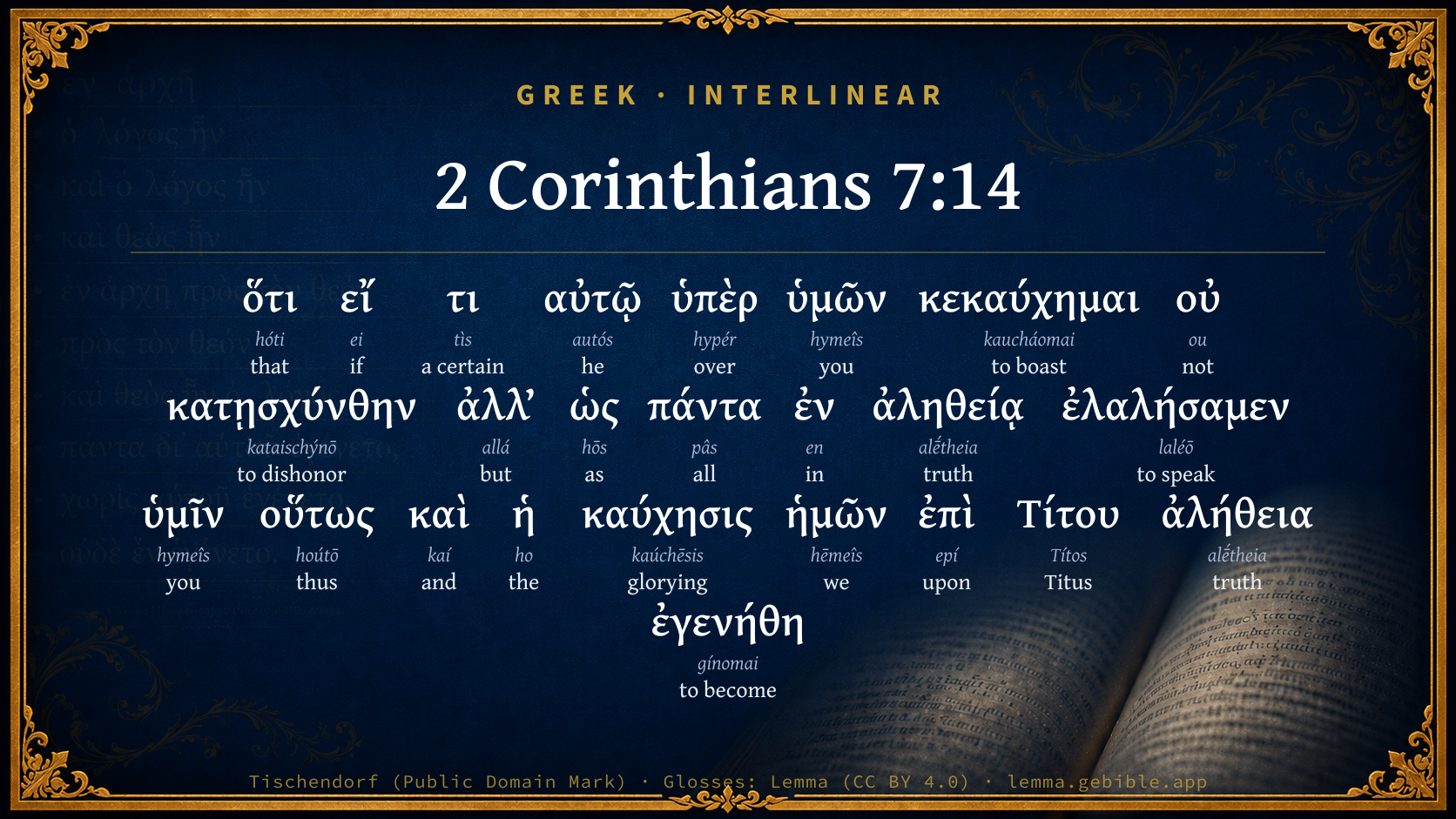
Greek (Tischendorf 8th ed.) 2 Corinthians 7:14 appears in the Greek New Testament. The text above is from the Tischendorf 8th edition. Each word links to its Strong’s number and a concise gloss. Click any word for its full Thayer’s Greek Lexicon entry.
Download image
Cite this verse

2 Corinthians 7:14 (World English Bible). Public Domain. Lemma interlinear Bible study tool, https://lemma.gebible.app/v/2-corinthians/7/14.

Show BibTeX & RIS
BibTeX
RIS
English Translation
For if in anything I have boasted to him on your behalf, I was not disappointed. But as we spoke all things to you in truth, so our glorying also which I made before Titus was found to be truth.
World English Bible · Public Domain
Download a study sheet

One document with this verse’s original text, its word-by-word gloss line, the meaning frame, cross-references with their text, attributed commentary, and full source and license credits — printable, and it pastes into notes with its structure intact.

This verse Autodidact and up

Study sheet (.html) Plain text (.txt)

A passage Seminary Student

Up to 50 verses in one chapter. A passage sheet keeps up to 6 commentary sources and 12 cross-references per verse, in the order this page ranks them, and says so on the sheet whenever that leaves anything out. Ask for a single verse and you get the Autodidact verse sheet above.

Everything on this page stays free to read, with no account — the sheet is a download of what is already on screen, not access to it.

Want to remove ads? Support Godless Engineer
Compare translations 3

The same verse in 3 English versions, stacked beneath the original-language interlinear above. Click any original word for its lexicon entry.

Each is an independent rendering of the whole verse — the interlinear is not word-aligned to these translations.

Highlighted words mark where these versions differ — a whole-verse word diff, not a word-by-word alignment.

  • World English Bible Public Domain
    For if in anything I have boasted to him on your behalf, I was not disappointed. But as we spoke all things to you in truth, so our glorying also which I made before Titus was found to be truth.
  • King James Version Public Domain
    For if I have boasted any thing to him of you, I am not ashamed; but as we spake all things to you in truth, even so our boasting, which I made before Titus, is found a truth.
  • unfoldingWord Literal Text CC BY-SA 4.0
    For if I had boasted anything to him about you, I was not ashamed, but as we spoke everything to you in truth, in the same way also our boasting became the truth to Titus.

unfoldingWord Literal Text — © unfoldingWord, licensed CC BY-SA 4.0. Word-aligned USFM3 via Door43 (git.door43.org/unfoldingWord/en_ult).

Versions to compare (up to 4)

3 of 4 selected

Show all 19 translations

Every available English version of this verse, each an independent rendering of the whole verse.

  • World English Bible Public Domain
    For if in anything I have boasted to him on your behalf, I was not disappointed. But as we spoke all things to you in truth, so our glorying also which I made before Titus was found to be truth.
  • Berean Standard Bible Public Domain
    Indeed, I was not embarrassed by anything I had boasted to him about you. But just as everything we said to you was true, so our boasting to Titus has proved to be true as well.
  • Majority Standard Bible Public Domain
    Indeed, I was not embarrassed by anything I had boasted to him about you. But just as everything we said to you was true, so our boasting to Titus has proved to be true as well.
  • King James Version Public Domain
    For if I have boasted any thing to him of you, I am not ashamed; but as we spake all things to you in truth, even so our boasting, which I made before Titus, is found a truth.
  • American Standard Version (1901) Public Domain
    For if in anything I have gloried to him on your behalf, I was not put to shame; but as we spake all things to you in truth, so our glorying also which I made before Titus was found to be truth.
  • Revised Version (1885) Public Domain
    For if in anything I have gloried to him on your behalf, I was not put to shame; but as we spake all things to you in truth, so our glorying also, which I made before Titus, was found to be truth.
  • Geneva Bible (1599) Public Domain
    For if that I haue boasted any thing to him of you, I haue not bene ashamed: but as I haue spoken vnto you all things in trueth, euen so our boasting vnto Titus was true.
  • Douay-Rheims (1899) Public Domain
    And if I have boasted any thing to him of you, I have not been put to shame; but as we have spoken all things to you in truth, so also our boasting that was made to Titus is found a truth.
  • Young's Literal Translation Public Domain
    because if anything to him in your behalf I have boasted, I was not put to shame; but as all things in truth we did speak to you, so also our boasting before Titus became truth,
  • Literal Standard Version CC BY-SA 4.0
    because if I have boasted anything to him in your behalf, I was not put to shame; but as we spoke to you all things in truth, so also our boasting before Titus became truth,
  • Unlocked Literal Bible CC BY-SA 4.0
    For if I boasted to him about you, I was not embarrassed. On the contrary, just as everything we said to you was true, our boasting about you to Titus proved to be true.
  • unfoldingWord Literal Text CC BY-SA 4.0
    For if I had boasted anything to him about you, I was not ashamed, but as we spoke everything to you in truth, in the same way also our boasting became the truth to Titus.
  • Darby Bible Public Domain
    Because if I boasted to him anything about you, I have not been put to shame; but as we have spoken to you all things in truth, so also our boasting to Titus has been [the] truth;
  • World Messianic Bible Public Domain
    For if in anything I have boasted to him on your behalf, I was not disappointed. But as we spoke all things to you in truth, so our glorying also which I made before Titus was found to be truth.
  • Webster's Bible Public Domain
    For if I have boasted any thing to him concerning you, I am not ashamed; but as we spoke all things to you in truth, even so our boasting, which I made before Titus, is found a truth.
  • Free Bible Version CC BY-SA 4.0
    I boasted to him about you, and you didn't let me down. Just as all I've told you is true, my boasting about you to Titus has proved to be true too!
  • Bible in Basic English Public Domain
    For I was not put to shame in anything in which I may have made clear to him my pride in you; but as we said nothing to you but what was true, so the good things which I said to Titus about you were seen by him to be true.
  • Text-Critical English NT CC BY 4.0
    For if I made any boast to him about you, I was not put to shame. But just as everything we said to you was true, so our boasting to Titus has also proven to be true.
  • Tyndale New Testament (1534) Public Domain
    I am therfor, not now ashamed though I bosted my sylfe to hym of you. For as all thynges which I preached vnto you are true even so is oure bostynge that I bosted my silfe to Titus with all founde true.

Literal Standard Version (2020), Covenant Press — licensed CC BY-SA 4.0. Text via the HelloAO Bible API (eBible.org). Unlocked Literal Bible (unfoldingWord) — licensed CC BY-SA 4.0. Text via the HelloAO Bible API (eBible.org). unfoldingWord Literal Text — © unfoldingWord, licensed CC BY-SA 4.0. Word-aligned USFM3 via Door43 (git.door43.org/unfoldingWord/en_ult). Free Bible Version, Dr. Jonathan Gallagher — licensed CC BY-SA 4.0. Text via the HelloAO Bible API (eBible.org).

Word by word

More ways to search: Search by grammar → Find every occurrence → Compare this word →

Practice this passage: Drill this verse → Learn its vocabulary →

καύχησις
kaúchēsis
G2746
“glorying”
Noun, Nominative, Singular, Feminine
Part of Speech
Noun
Case
Nominative
Number
Singular
Gender
Feminine
Full Thayer's Definition

Origin: from G2744

TDNT: 13:45,4

1. the act of glorying
  1. ὅτι hóti G3754 “that” Conjunction
  2. εἴ ei G1487 “if” Conditional
  3. τι tìs G5100 “a certain” Indefinite pronoun, Nominative, Singular, Neuter
  4. αὐτῷ autós G846 “he” Personal pronoun, Dative, Singular, Masculine
  5. ὑπὲρ hypér G5228 “over” Preposition
  6. ὑμῶν hymeîs G5210 “you” Personal pronoun, 2nd person, Genitive, Plural
  7. κεκαύχημαι kaucháomai G2744 “to boast” Verb, Perfect, Middle or Passive deponent, Indicative, 1st person, Singular
  8. οὐ ou G3756 “not” Particle, Negative
  9. κατῃσχύνθην kataischýnō G2617 “to dishonor” Verb, Aorist, Passive, Indicative, 1st person, Singular
  10. ἀλλ’ allá G235 “but” Conjunction
  11. ὡς hōs G5613 “as” Adverb
  12. πάντα pâs G3956 “all” Adjective, Accusative, Plural, Neuter
  13. ἐν en G1722 “in” Preposition
  14. ἀληθείᾳ alḗtheia G225 “truth” Noun, Dative, Singular, Feminine
  15. ἐλαλήσαμεν laléō G2980 “to speak” Verb, Aorist, Active, Indicative, 1st person, Plural
  16. ὑμῖν hymeîs G5210 “you” Personal pronoun, 2nd person, Dative, Plural
  17. οὕτως hoútō G3779 “thus” Adverb
  18. καὶ kaí G2532 “and” Conjunction
  19. ἡ ho G3588 “the” Article, Nominative, Singular, Feminine
  20. ἡμῶν hēmeîs G2249 “we” Personal pronoun, 1st person, Genitive, Plural
  21. ἐπὶ epí G1909 “upon” Preposition
  22. Τίτου Títos G5103 “Titus” Noun, Genitive, Singular, Masculine
  23. ἀλήθεια alḗtheia G225 “truth” Noun, Nominative, Singular, Feminine
  24. ἐγενήθη gínomai G1096 “to become” Verb, Aorist, Passive deponent, Indicative, 3rd person, Singular

About this verse

These counts appear in no published source. They are computed here, from the morphology-tagged text and Lemma’s own curated glosses. What Lemma adds →

25
words
23
distinct lemmas
Pauline Epistles
section

Notable vocabulary

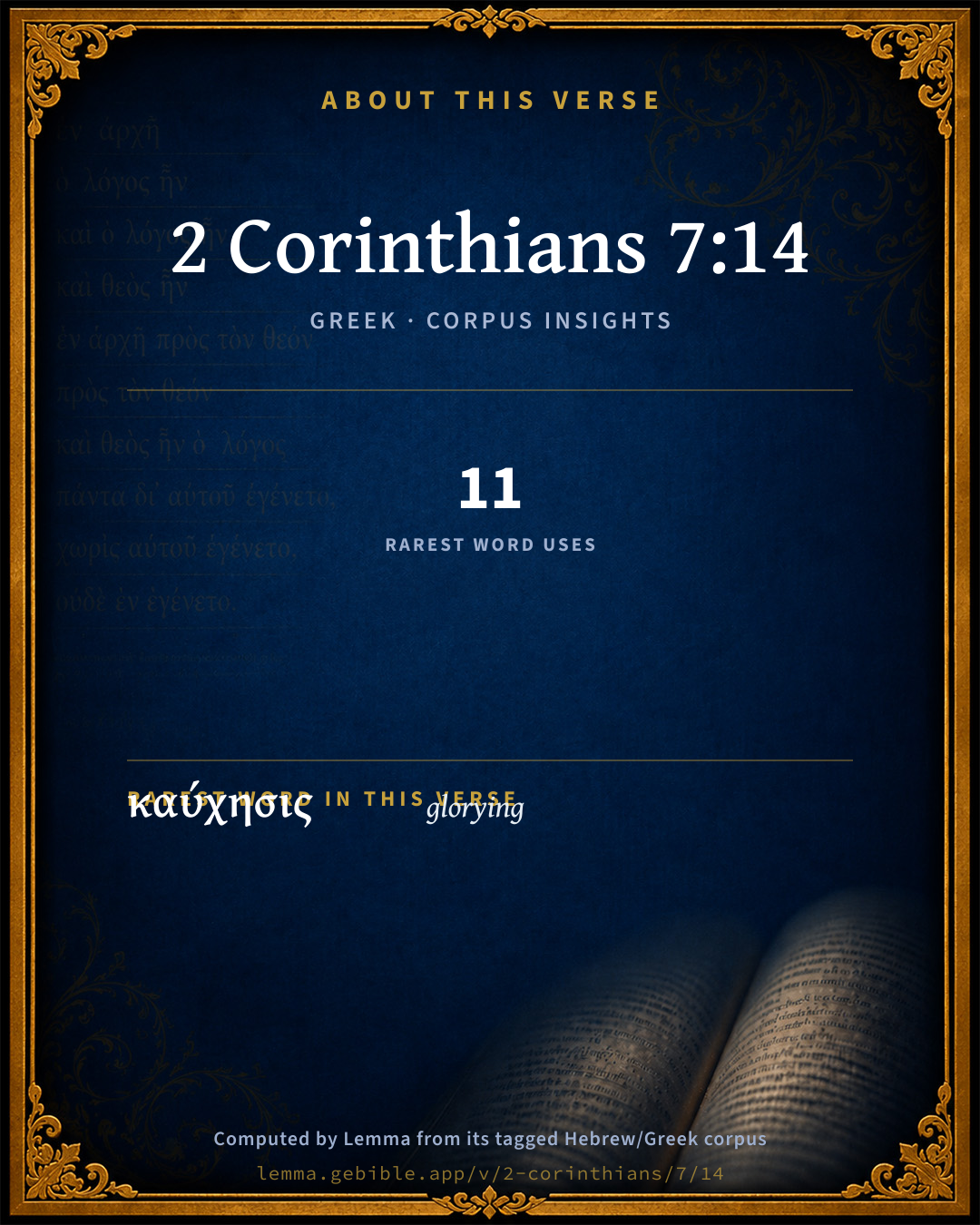
The rarest word here is καύχησις glorying G2746 — appearing just 11 times in the whole Greek New Testament.

Shared distinctive vocabulary

καύχησις glorying G2746 occurs in 11 verses of the Greek New Testament. Also found in:

Repetition

Words recur within this verse:

  • ἀληθείᾳ truth G225 ×2
  • ὑμῶν you G5210 ×2

Cross-references

7

Topical passages linked to 2 Corinthians 7:14 in the Treasury of Scripture Knowledge — connected by theme and wording, ordered by reader-vote popularity; previews shown in the World English Bible.

  • 2 Corinthians 7:4 Great is my boldness of speech toward you. Great is my boasting on your behalf. I am filled with comfort. I overflow with joy in all our affliction.
  • 2 Corinthians 1:18–20 But as God is faithful, our word toward you was not "Yes and no."
  • 2 Corinthians 8:24 Therefore show the proof of your love to them in front of the assemblies, and of our boasting on your behalf.
  • 2 Corinthians 9:2–4 for I know your readiness, of which I boast on your behalf to them of Macedonia, that Achaia has been prepared for a year past. Your zeal has stirred up very many of them.
  • 2 Thessalonians 1:4 so that we ourselves boast about you in the assemblies of God for your patience and faith in all your persecutions and in the afflictions which you endure.
  • 2 Corinthians 7:6 Nevertheless, he who comforts the lowly, God, comforted us by the coming of Titus;
  • 2 Corinthians 10:8 For though I should boast somewhat abundantly concerning our authority, (which the Lord gave for building you up, and not for casting you down) I will not be disappointed,

Cross-references courtesy of OpenBible.info (CC BY 4.0).

Commentary

Notes on 2 Corinthians 7:14 from classic Christian and Jewish commentators (each source and its license shown beneath its notes). The classic Christian expositions comment on the surrounding passage and are grouped to its opening verse, so a note may address several verses; the Jewish commentaries on the Tanakh (Rashi and others) are per-verse, so they appear only where the commentator wrote on this verse.

Lemma curates 59 commentaries, every one of them public domain or Creative Commons licensed, each selected and text-cleaned for this edition rather than reprinted as found. About our sources →

Tyndale Open Study Notes

Tyndale Open Resources

7:14 All along Paul had been optimistic, despite his fears, about the outcome of Titus’s trip to Corinth.

Tyndale Open Study Notes — © Tyndale Open Resources, licensed CC BY-SA 4.0. Text via the HelloAO Bible API.

Bengel's Gnomon

Johann Albrecht Bengel

2Co 7:14. Κεκαύχημαι, οὐ κατῃσχύνθην, I have boasted, I am not ashamed) ch. 2Co 9:4, 2Co 12:6.—πάντα, all things) He suitably refers to ch. 2Co 1:18.

Bengel's Gnomon of the New Testament — English translation (T&T Clark, Edinburgh, 1860) — public domain. Text from a community e-Sword module.

Meyer's Critical & Exegetical Commentary

Heinrich August Wilhelm Meyer

2Co_7:14 f. Polite statement of the reason why the joy of Titus had rejoiced him so greatl.

εἴ τι αὐτῷ ὑπὲρ ὑμ. κεκαυχ.] Comp. 2Co_9:2. Who could deny that Paul, both alone, of which he is thinking here, and in company with Timothy (at which ἡ καύχησις ἡμῶν then glances), had justly boasted before Titus (coram Tito) to the advantage of the Corinthians (ὑπὲρ ὑμῶν, comp. 2Co_9:2)? See 1Co_1:4 ff. He had, in fact, founded the church and laboured so long in it, and they were in his heart, 2Co_7:3.

οὐ κατῃσχύνθην] This κατῃσχ. would have taken place, if Titus had experienced among you an opposite state of things, contradicting the truth of my καύχησις. But when he came to you: διὰ τῶν ἔργων ἐδείξατέ μου τὰ ῥήματα, Chrysosto.

ἀλλʼ ὡς πάντα κ.τ.λ.] Opposite of οὐ κατῃσχ.: as we have spoken everything truly to you, our boasting before Titus has also become truth. No doubt Paul is here making a passing allusion to the attack on his veracity (comp. 2Co_1:17 ff.), and that in such a way as emphatically to confront it with, first, what was said by him (πάντα … ἡ καύχησις ἡμῶν), and then the persons to whom he spoke (ὑμῖν … ἡ ἐπὶ Τίτου). Thus the first, and next to it the last, place in the arrangement of the sentence has the emphasis (Kühner, II. p. 625).

πάντα] quite general: we have lied to you in nothing. Chrysostom and Billroth think that it applies to all the good, which Paul had said of Titus to the Corinthians,a purely arbitrary view, not to be guessed by any reade.

ἐν ἀληθείᾳ] i.e. truthfully. Comp. Col_1:6; Joh_17:19; Pind. Ol. vii. 127. The adverbial use is genuine Greek (Matthiae, p. 1342; Bernhardy, p. 211), not a Hebraism (Rückert). See on Joh_17:19.

ἐλαλήσαμεν] locuti sumus, quite general, and not to be limited, at variance with the context, to doctrine (Emmerling, Flatt, Hofmann, and others, following Theodoret).

ἐπὶ Τίτου] coram Tito. See Schaefer, Melet. p. 105; Fritzsche, Quaest. Luc. p. 139.

ἐγενήθη] se praestitit; it has shown itself as truth by experience. Comp. 2Co_1:19; Rom_3:4; Rom_7:13. Often so also in classic writers.

Meyer — Critical and Exegetical Commentary on the New Testament — English translation by Peter Christie, edited by Frederick Crombie (T&T Clark, 1880) — public domain. Text from a community e-Sword module.

Expositor's Greek Testament

ed. W. Robertson Nicoll

2Co 7:14 . ὅτι εἴ τι κ . τ . λ .: for if in anything I have gloried to him on your behalf, i.e. , have boasted of you ( cf. 2Co 9:2 , 2Co 12:5 ), I was not put to shame, sc. , by the vanity of my boasting being exposed; but as we spake all things to you in truth (this he is continually insisting on, e.g. , at 2Co 1:18 , 2Co 2:17 , 2Co 4:2 , etc.), so our glorying also, viz., that made before Titus ( cf. Mar 13:9 for ἐπί with the gen.), was found (not “is found” as A.V., but “was found” as at 1Co 1:30 ) to be truth .

The Expositor's Greek Testament, edited by W. Robertson Nicoll (1897–1910) — public domain. Text from a community e-Sword module.

Jamieson, Fausset & Brown

Robert Jamieson, A. R. Fausset & David Brown

anything--that is, at all.

I am not ashamed--"I am not put to shame," namely, by learning from Titus that you did not realize the high character I gave him of you.

as . . . all things . . . in truth, even so our boasting . . . is found a truth--As our speaking in general to you was true (Co2 1:18), so our particular boasting to Titus concerning you is now, by his report, proved to be truth (compare Co2 9:2). Some oldest manuscripts read expressly, "concerning you"; this in either reading is the sense.

Jamieson, Fausset & Brown — Commentary Critical and Explanatory on the Whole Bible (1871) — public domain (CC PDM 1.0). Text via the HelloAO Bible API.

Adam Clarke's Commentary

Verse 14. For if I have boasted] The apostle had given Titus a very high character of this Church, and of their attachment to himself; and doubtless this was the case previously to the evil teacher getting among them, who had succeeded in changing their conduct, and changing in a great measure their character also; but now they return to themselves, resume their lost ground, so that the good character which the apostle gave them before, and which they had for a time forfeited, is now as applicable to them as ever. Therefore his boasting of them is still found a truth.

Adam Clarke's Commentary on the Bible (1810–1826) — public domain. Text from a community e-Sword/MySword module.

John Calvin's Commentaries

14. But if I have boasted any thing to him. He shows indirectly, how friendly a disposition he had always exercised towards the Corinthians, and with what sincerity and kindness he had judged of them; for at the very time that they seemed to be unworthy of commendation, he still promised much that was honorable on their behalf. Here truly we have a signal evidence of a rightly constituted and candid mind, — reproving to their face those that you love, and yet hoping well, and giving others good hopes respecting them. Such sincerity ought to have induced them not to take amiss any thing that proceeded from him. In the mean time, he takes this opportunity of setting before them again, in passing, his fidelity in all other matters. “You have hitherto had opportunity of knowing my candor, so that I have shown myself to be truthful, and not by any means fickle. I rejoice, therefore, that I have now also been found truthful, when boasting of you before others.”

John Calvin's Commentaries (1540-1563) — public domain. Text from the Calvin Translation Society English edition (1840s-50s) via the Christian Classics Ethereal Library (ccel.org). Calvin's coverage is partial (roughly two-thirds of the Bible); uncommented books and verses are honest gaps, never fabricated. The 19th-century editor's footnotes and remarks are omitted so the notes are faithfully Calvin's own voice.

Ellicott's Commentary for English Readers

(14) For if I have boasted any thing to him of you.—It is obviously implied that he had boasted. He had encouraged Titus, when he sent him, with the assurance that he would find many elements of good mingled with the evil which he was sent to correct. And now St. Paul can add: “I was not shamed” (the tense requires this rendering) “when he came back with his report.”

Even so our boasting, which I made before Titus.—The words “I made” are, as the italics show, not in the Greek. Some of the better MSS. give, indeed, “your boasting,” and with this reading the sense would be: “As what I said of you to Titus turned out to be true, so I recognise that what you said to him of yourselves, of your zeal and longing (as in 2Co_7:11), was spoken truly.” The Received reading rests, however, on very good authority, and certainly gives a better sense: “We spoke truly to you of your faults; we spoke truly to Titus of your good qualities.”

A Bible Commentary for English Readers, edited by Charles John Ellicott (1878–1897) — public domain. Text from a community e-Sword module.

The Cambridge Bible for Schools and Colleges

gen. ed. J. J. S. Perowne

14. I am not ashamed] Rather, ‘I was not ashamed,’ i.e. at his return.

but as we spake] i.e. when we were with you.

The Cambridge Bible for Schools and Colleges (gen. ed. J. J. S. Perowne; Cambridge University Press, 1878–1918) — public domain. Text from a community e-Sword module.

John Gill's Exposition

For if I have boasted anything to him of you,.... As of their faith in Christ, of their liberality to the saints, their affection for him, and obedience to him as children to a father:

I am not ashamed; since these all appeared to be true; as he must have been had they been otherwise:

but as we spake all things to you in truth; that is, our preaching among you was true; all the doctrines we delivered to you were truth; our word was not yea and nay, but uniform, and all of a piece:

even so our boasting, which I made before Titus, is found a truth; some understand this of the boasting which the apostle made concerning Titus, in his epistle to them, highly commending him, and which they found to be in all things exactly true; but the words rather design his boasting of the Corinthians unto Titus, which was found to be true by him.

John Gill's Exposition of the Whole Bible (1746–1763) — public domain (CC PDM 1.0). Text via the HelloAO Bible API.

Trapp's Complete Commentary

John Trapp

14 For if I have boasted any thing to him of you, I am not ashamed; but as we spake all things to you in truth, even so our boasting, which I made before Titus, is found a truth.

Ver. 14. I am not ashamed] As I should have been, had it proved otherwise. Lying is a blushful sin, and therefore the liar denies his own lie, because he is ashamed to be taken with it; and our ruffians revenge it with a stab.

John Trapp, A Commentary or Exposition upon All the Books of the Old and New Testament (1647–1656) — public domain. Text from a community e-Sword module.

Albert Barnes' Notes on the Bible

For if I have boasted anything to him ... - This seems to imply that Paul had spoken most favorably to Titus of the Corinthians before he went among them. He had probably expressed his belief that he would be kindly received; that they would be disposed to listen to him, and to comply with the directions of the apostle; perhaps he had spoken to him of what he anticipated would be their liberality in regard to the collection which he was about to make for the poor saints at Jerusalem.

I am not ashamed - It has all turned out to be true. He has found it as I said it would be. All my expectations are realized; and you have been as kind, and hospitable, and benevolent as I assured him you would be.

As we spake all things to you in truth - Everything which I said to you was said in truth. All my promises to you, and all my commands, and all my reasonable expectations expressed to you, were sincere. I practiced no disguise, and all that I have said thus far turned out to be true.

Even so our boasting ... - My boasting of your character, and of your disposition to do right, which I made before Titus has turned out to be true. It was as I said it would be. I did not commend you too highly to him, as I did not overstate the matter to you in my Epistle.

Albert Barnes' Notes on the Bible (1834–1885) — public domain. Text from a community e-Sword/MySword module.

Matthew Poole's English Annotations

The apostle here multiplieth expressions to sweeten the Corinthians, by all manner of ways declaring his value for and affection towards them. It appeareth by this, that the apostle had at some time before spoken something to Titus in commendation of this church of Corinth, which he here calleth a

boasting of them; he now again boasted, that he had said nothing but the truth, which Titus had experienced, and reported to him.

Matthew Poole's English Annotations on the Holy Bible (1683–1685) — public domain. Text from a community e-Sword/MySword module.

Whedon's Commentary on the Bible

Daniel D. Whedon

14. Boasted… ashamed—Paul takes care to offer Titus to their high respect. Titus had justified his highest boasts.

Daniel D. Whedon (gen. ed.), Commentary on the Old and New Testaments (1874–1909) — public domain. Text from a community e-Sword module.

The Pulpit Commentary

I am not ashamed. The due rendering of the tenses brings out the sense much more accurately. "Because if I have boasted anything to him on your behalf, I was not put to the blush;" in other words, "One reason of my exceeding gladness was that you fully justified that very favorable picture of you which I had drawn for Titus when I was urging him to be the bearer of my letter." Is found a truth; literally, proved itself to be a truth. Here again there is a most delicate reference to the charge of levity and unveracity which had been brought against him. (2Co_1:17) I always spoke the truth to you; but I might well have feared that, in speaking of you to Titus, my affection for you had led me to overstep the limits of perfect accuracy. But you yourselves, by proving yourselves worthy of all I said of you, have established my perfect truthfulness, even in the only point where I might have thought it doubtful. Nothing could exceed the tact and refinement, the subtle delicacy and beauty, of this gentle remark.

The Pulpit Commentary (1880–1919), ed. H.D.M. Spence-Jones & Joseph S. Exell — public domain. Text from a community e-Sword module.

Burkitt's Expository Notes on the New Testament

William Burkitt

Observe here, How the apostle had formerly taken occasion to speak boastingly, and not without assurance, concerning the church of Corinth. "Now, says the apostle, whatever I said of you, is as infallibly and certainly true, as what I have heretofore either or spoken to you."- Happy is it when a minister’s commendations of his people unto others, are not contradicted or gainsayed by the people themselves, but confirmed greatly.

Here, what St. Paul had boasted of the Corinthians, Titus found a truth.

Observe, next, With what inward affection Titus did embrace and receive the Corinthians, remembering with what great deference and regard they had received him; he is greatly affected towards you, upon his finding you so obedient to me. Nothing doth more endear a people to the ministers of Christ, than to find them obedient to their spiritual guides in things pertaining to godliness and religion: The affection of Titus is more abundant towards you, whilst he remebereth the obedience of you all.

Observe, lastly, What confidence the apostle had, that the church of Corinth would hearken to, and comply with his future admonitions, exhortations and reproofs: I have confidence in you in all things. It is a blessed thing when the ministers of the gospel and their beloved people have a mutual confidence in each other, and when that confidence on either side is not broken, but preserved and increased between them all their days; when, they can say of each other, as doth the apostle here, I rejoice that I have confidence in you in all things.

William Burkitt's Expository Notes on the New Testament (1700–1703) — public domain. Text from a community e-Sword module.

McGarvey & Pendleton's Commentaries

J. W. McGarvey

For if in anything I have gloried to him on your behalf, I was not put to shame; but as we spake all things to you in truth, so our glorying also which I made before Titus was found to be truth . [Paul had evidently told Titus that he would find the Corinthians true and loyal, and ready to obey the apostle's letter. Had events proved otherwise, Paul would have been put to shame in the eyes of Titus. But as the apostle, despite the accusations of the Corinthians to the contrary ( 2Co_1:15-17 ), had always spoken truth to them, so he had always been truthful in speaking to Titus about them. Paul's affection for the Corinthians had not caused him to overstep the limits of perfect accuracy while boasting of them to Titus.]

J. W. McGarvey (with Philip Y. Pendleton), Commentaries on the New Testament (The Fourfold Gospel, 1914; Acts; and the epistles) — public domain. Text from a community e-Sword/MySword module.

The People's New Testament

B. W. Johnson

14. For if I have boasted anything to him of you. If he had done so, their prompt repentance showed that his boasting was well founded.

B. W. Johnson's The People's New Testament with Notes (1889–1891) — public domain. Electronic text from the Christian Classics Ethereal Library (CCEL) ThML edition.

Cambridge Greek Testament for Schools and Colleges

14. After ἡμῶν אB 115 omit ἡ, which א3CDFGKLP insert.

14. εἵ τι … κακαύχημαι, οὐ κατῃσχύνθην. For if in anything I have gloried (see on 2Co 9:2) to him on your behalf (2Co 5:4, 2Co 9:2) I was not put to shame (2Co 9:4; Rom 9:33). ‘I am not ashamed’ (A.V.) is not what S. Paul says. He ‘was not put to shame’ (R.V.) by his praise of them turning out to be undeserved. He had praised them to Titus, and Titus had found that the praise was true.

ὡς πάντα ἐν ἀληθείᾳ … οὕτως καὶ ἡ καύχησις. As we spake all things to you in truth, so our glorying also was found to be truth. Both in what he said to them, and in what he has said about them, he was proved to be sincere.

ἐπὶ Τίτου. Before Titus, in his presence: comp. ἐπὶ τῶν ἀδίκων καὶ οὐχὶ ἐπὶ τῶν ἁγίων, and ἐπὶ ἀπίστων (1Co 6:1; 1Co 6:6).

Cambridge Greek Testament for Schools and Colleges (Cambridge University Press, 1896; 21 vols, various authors incl. Carr, Maclear, Plummer, Farrar, Lumby, Moule, M. R. James, Simcox) — public domain. Text from a community e-Sword module.

Alford’s Greek Testament

Henry Alford

14.] This increased joy was produced by the verification which my former boasting of you to Titus now received.

εἴ τι …] see one particular in which he boasted of them, ch. 9:2.

οὐ κατῃσχ.] I was not put to shame, viz. by being shewn, on Titus’s coming to you, to have boasted in vain.

ἀλλʼ ὡς …] ‘But truthfulness was shewn to be my constant rule of speech, to whomsoever I spoke.’ But as we spoke (generally, not merely in our teaching, as Theodoret, al.) all things in truth (truthfully) to you, so also our boasting concerning you (gen. obj.: the rec. ἡμῶν agrees better with the comparison, of ‘our words’ in general, with ‘our boasting’ in particular: but on that very account it is probably an alteration: and this is the implied meaning at all events) before Titus was (was proved to be: was, as shewn by proof) truth. De W. suggests that the Apostle had described (by anticipation) to Titus in glowing terms the affection and probable prompt obedience of the Corinthians, as an encouragement to his somewhat unwelcome journey.

Henry Alford, The Greek Testament (1849–1861) — public domain. Text from a community e-Sword module.

International Critical Commentary

14. ὅτι εἴ τι αὐτῷ ὑπὲρ ὑμῶν κεκαύχημαι, οὐ κατῃσχύνθην. ‘For if in anything I have gloried to him on your behalf, I was not put to shame.’ This is added in explanation of the great relief which the conduct of the Corinthians had been to Titus. Titus had accepted the mission to Corinth with serious misgivings; his overtures might be rejected with contempt and violence. St Paul had praised the Corinthians to him, and had assured him that the strained situation would pass, because they were thoroughly sound at heart. St Paul is now able to tell them that his praise of them had been completely justified by their subsequent conduct. He was ‘not put to shame’ (RV) by being proved to be utterly mistaken about them. Titus had found that the Apostle’s high estimate of them was correct. The Corinthians were rightminded people who knew how to listen to reason and respect authority. He had told them to welcome and obey Titus, and they had done so; and this had quite won Titus’ heart. For κεκαύχημαι see on 9:2.

ὡς πάντα ἐν ἀληθείᾳ κ.τ.λ. ‘As we spake all things to you in truth, so our glorying also before Titus was proved to be truth.’ For ἐπί = ‘in the presence of,’ ‘before,’ cf. 1Co 6:1, 1Co 6:6; Mar 13:9; Act 25:9. The introductory ἀλλά means, ‘On the contrary; so far from my being put to shame, etc.’ He appeals to his own truthfulness and sincerity, which had been challenged at Corinth and had been proved to be real: ὑμῖν and ἐπὶ Τίτου balance one another, and there is a sort of chiasmus; ἐν ἀληθείᾳ ὑμῖν … ἐπὶ Τίτου ἀλήθεια. The first ἀλήθεια is subjective, the second is objective.

πἄντα (א B D E K L P, Latt.) rather than πάντοτε (C F G, g Copt.). C D E P, Latt. have ὑμῖν ἐν ἀληθείᾳ by assimilation of order to ἐπὶ Τ. ἀλ. No ἡ before ἐπὶ Τ. (א* B).

International Critical Commentary — older volumes (1896–1929), various authors — public domain. Text from a community e-Sword module.

Lesson kit

Teaching starters — assembled from the data on this page, not authored interpretation. Every prompt links to the verse data it draws on. Edit before teaching.

2 Corinthians, in the Pauline Epistles, opens this verse with 25 words (23 distinct Greek lemmas). Its most distinctive word is kaúchēsis (“glorying”). A historical commentator’s framing appears above. Read the whole chapter for the surrounding context.

Discussion questions

  1. What does “glorying” (kaúchēsis) contribute to the verse as a whole?
  2. Romans 3:27 shares the word «glorying» with this verse. How do the two illuminate each other?
  3. “truth” occurs 2× in this one verse. What is the effect of the repetition?
  4. The translations on this page render this verse differently — a whole-verse word diff, not a word-by-word alignment. What might account for the different wordings?
  5. Reading how Tyndale Open Study Notes and Bengel's Gnomon read this verse, where do the two commentators agree and where do they part?

Things to notice

Reading settings

Reading text

Shown beneath each verse's original-language words.

Old Testament
Old Testament edition

Read the OT as the Masoretic Hebrew (MT) or the Greek Septuagint (LXX).

English shown for the Greek Septuagint (in the Hebrew ↔ Greek comparison).

Comparing translations? Open the Compare panel on any verse page to stack up to four side by side.