1 Corinthians 7:17

Greek (Tischendorf 8th ed.) 1 Corinthians 7:17 appears in the Greek New Testament. The text above is from the Tischendorf 8th edition. Each word links to its Strong’s number and a concise gloss. Click any word for its full Thayer’s Greek Lexicon entry.
Download image
Cite this verse

1 Corinthians 7:17 (World English Bible). Public Domain. Lemma interlinear Bible study tool, https://lemma.gebible.app/v/1-corinthians/7/17.

Show BibTeX & RIS
BibTeX
RIS
English Translation
Only, as the Lord has distributed to each man, as God has called each, so let him walk. So I command in all the assemblies.
World English Bible · Public Domain
Download a study sheet

One document with this verse’s original text, its word-by-word gloss line, the meaning frame, cross-references with their text, attributed commentary, and full source and license credits — printable, and it pastes into notes with its structure intact.

This verse Autodidact and up

Study sheet (.html) Plain text (.txt)

A passage Seminary Student

Up to 50 verses in one chapter. A passage sheet keeps up to 6 commentary sources and 12 cross-references per verse, in the order this page ranks them, and says so on the sheet whenever that leaves anything out. Ask for a single verse and you get the Autodidact verse sheet above.

Everything on this page stays free to read, with no account — the sheet is a download of what is already on screen, not access to it.

Want to remove ads? Support Godless Engineer
Compare translations 3

The same verse in 3 English versions, stacked beneath the original-language interlinear above. Click any original word for its lexicon entry.

Each is an independent rendering of the whole verse — the interlinear is not word-aligned to these translations.

Highlighted words mark where these versions differ — a whole-verse word diff, not a word-by-word alignment.

  • World English Bible Public Domain
    Only, as the Lord has distributed to each man, as God has called each, so let him walk. So I command in all the assemblies.
  • King James Version Public Domain
    But as God hath distributed to every man, as the Lord hath called every one, so let him walk. And so ordain I in all churches.
  • unfoldingWord Literal Text CC BY-SA 4.0
    However, as the Lord has assigned to each one, as God has called each one, thus let him walk. And in this way I direct in all the churches.

unfoldingWord Literal Text — © unfoldingWord, licensed CC BY-SA 4.0. Word-aligned USFM3 via Door43 (git.door43.org/unfoldingWord/en_ult).

Versions to compare (up to 4)

3 of 4 selected

Show all 19 translations

Every available English version of this verse, each an independent rendering of the whole verse.

  • World English Bible Public Domain
    Only, as the Lord has distributed to each man, as God has called each, so let him walk. So I command in all the assemblies.
  • Berean Standard Bible Public Domain
    Regardless, each one should lead the life that the Lord has assigned to him and to which God has called him. This is what I prescribe in all the churches.
  • Majority Standard Bible Public Domain
    Regardless, each one should lead the life that God has assigned to him and to which the Lord has called him. This is what I prescribe in all the churches.
  • King James Version Public Domain
    But as God hath distributed to every man, as the Lord hath called every one, so let him walk. And so ordain I in all churches.
  • American Standard Version (1901) Public Domain
    Only, as the Lord hath distributed to each man, as God hath called each, so let him walk. And so ordain I in all the churches.
  • Revised Version (1885) Public Domain
    Only, as the Lord hath distributed to each man, as God hath called each, so let him walk. And so ordain I in all the churches.
  • Geneva Bible (1599) Public Domain
    But as God hath distributed to euery man, as the Lord hath called euery one, so let him walke: and so ordaine I, in all Churches.
  • Douay-Rheims (1899) Public Domain
    But as the Lord hath distributed to every one, as God hath called every one, so let him walk: and so in all churches I teach.
  • Young's Literal Translation Public Domain
    if not, as God did distribute to each, as the Lord hath called each -- so let him walk; and thus in all the assemblies do I direct:
  • Literal Standard Version CC BY-SA 4.0
    If not, as God distributed to each, as the LORD has called each—so let him walk; and thus I direct in all the assemblies:
  • Unlocked Literal Bible CC BY-SA 4.0
    Only let each one live the life the Lord has assigned him, each as God has called him. This is my rule in all the churches.
  • unfoldingWord Literal Text CC BY-SA 4.0
    However, as the Lord has assigned to each one, as God has called each one, thus let him walk. And in this way I direct in all the churches.
  • Darby Bible Public Domain
    However, as the Lord has divided to each, as God has called each, so let him walk; and thus I ordain in all the assemblies.
  • World Messianic Bible Public Domain
    Only, as the Lord has distributed to each man, as God has called each, so let him walk. So I command in all the assemblies.
  • Webster's Bible Public Domain
    But as God hath distributed to every man, as the Lord hath called every one, so let him walk. And so I ordain in all churches.
  • Free Bible Version CC BY-SA 4.0
    Apart from such cases, each of you should remain in the situation that the Lord has placed you, and continue to live the life to which God has called you. That's my instruction to all the churches.
  • Bible in Basic English Public Domain
    Only, as the Lord has given to a man, and as is the purpose of God for him, so let him go on living. And these are my orders for all the churches.
  • Text-Critical English NT CC BY 4.0
    Nevertheless, each person should live the life that God has assigned to him and to which the Lord has called him. This is the rule I lay down in all the churches.
  • Tyndale New Testament (1534) Public Domain
    but even as God hath distributed to every man. As the lorde hath called every person so let him walke: and so orden I in all congregacions.

Literal Standard Version (2020), Covenant Press — licensed CC BY-SA 4.0. Text via the HelloAO Bible API (eBible.org). Unlocked Literal Bible (unfoldingWord) — licensed CC BY-SA 4.0. Text via the HelloAO Bible API (eBible.org). unfoldingWord Literal Text — © unfoldingWord, licensed CC BY-SA 4.0. Word-aligned USFM3 via Door43 (git.door43.org/unfoldingWord/en_ult). Free Bible Version, Dr. Jonathan Gallagher — licensed CC BY-SA 4.0. Text via the HelloAO Bible API (eBible.org).

Word by word

More ways to search: Search by grammar → Find every occurrence → Compare this word →

Practice this passage: Drill this verse → Learn its vocabulary →

μεμέρικεν
merízō
G3307
“to divide”
Verb, Perfect, Active, Indicative, 3rd person, Singular
Part of Speech
Verb
Tense
Perfect
Voice
Active
Mood
Indicative
Person
3rd person
Number
Singular
Full Thayer's Definition

Origin: from G3313

TDNT: None

1. to divide a. to separate into parts, cut into pieces 1. to divide into parties, i.e. be split into factions b. to distribute 1. a thing among people 2. bestow, impart
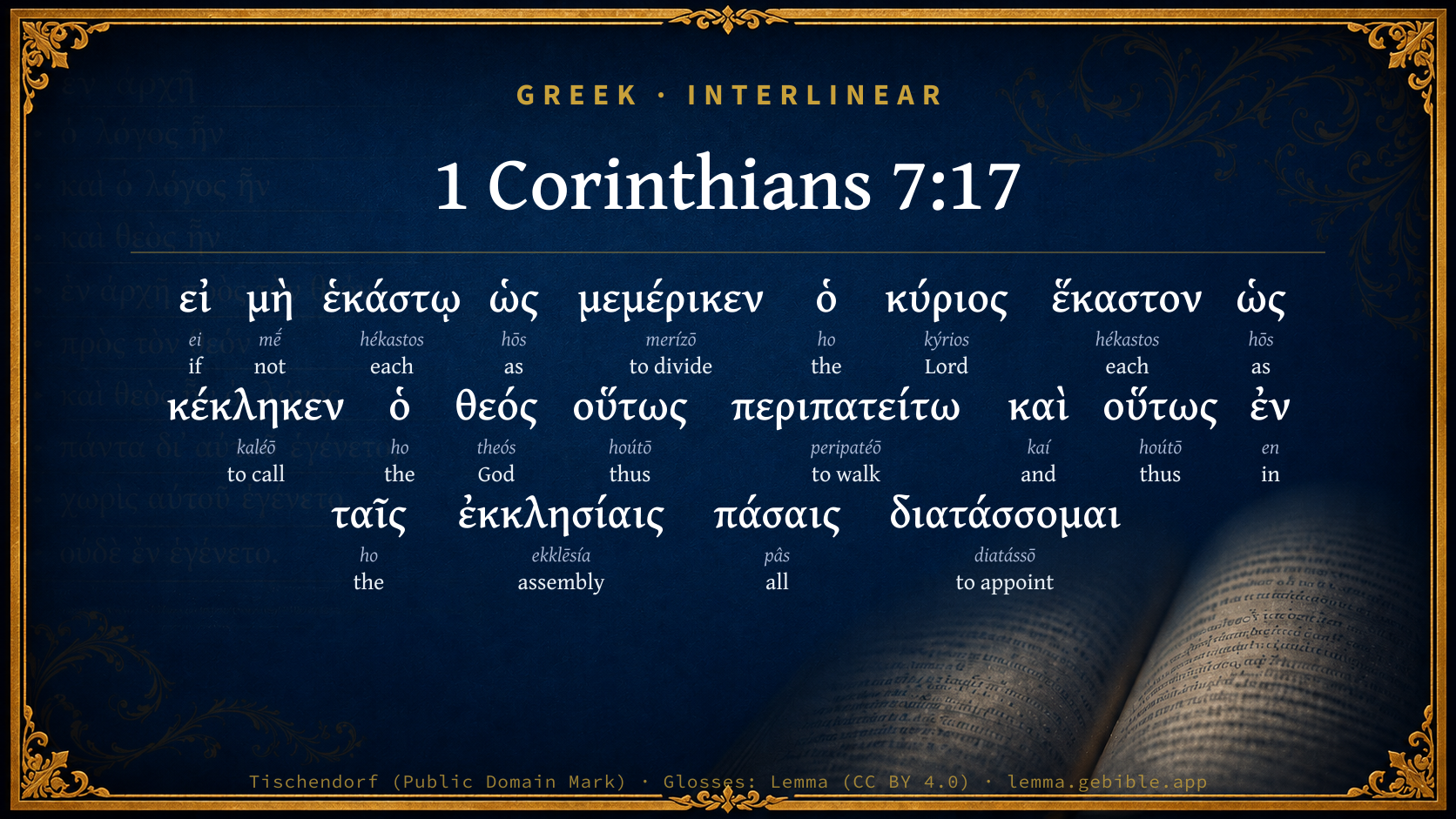
  1. εἰ ei G1487 “if” Conditional
  2. μὴ mḗ G3361 “not” Particle, Negative
  3. ἑκάστῳ hékastos G1538 “each” Adjective, Dative, Singular, Masculine
  4. ὡς hōs G5613 “as” Adverb
  5. ὁ ho G3588 “the” Article, Nominative, Singular, Masculine
  6. κύριος kýrios G2962 “Lord” Noun, Nominative, Singular, Masculine
  7. ἕκαστον hékastos G1538 “each” Adjective, Accusative, Singular, Masculine
  8. ὡς hōs G5613 “as” Adverb
  9. κέκληκεν kaléō G2564 “to call” Verb, Perfect, Active, Indicative, 3rd person, Singular
  10. ὁ ho G3588 “the” Article, Nominative, Singular, Masculine
  11. θεός theós G2316 “God” Noun, Nominative, Singular, Masculine
  12. οὕτως hoútō G3779 “thus” Adverb
  13. περιπατείτω peripatéō G4043 “to walk” Verb, Present, Active, Imperative, 3rd person, Singular
  14. καὶ kaí G2532 “and” Conjunction
  15. οὕτως hoútō G3779 “thus” Adverb
  16. ἐν en G1722 “in” Preposition
  17. ταῖς ho G3588 “the” Article, Dative, Plural, Feminine
  18. ἐκκλησίαις ekklēsía G1577 “assembly” Noun, Dative, Plural, Feminine
  19. πάσαις pâs G3956 “all” Adjective, Dative, Plural, Feminine
  20. διατάσσομαι diatássō G1299 “to appoint” Verb, Present, Middle, Indicative, 1st person, Singular

About this verse

These counts appear in no published source. They are computed here, from the morphology-tagged text and Lemma’s own curated glosses. What Lemma adds →

21
words
16
distinct lemmas
Pauline Epistles
section

Notable vocabulary

The rarest word here is μεμέρικεν to divide G3307 — appearing just 14 times in the whole Greek New Testament.

Shared distinctive vocabulary

μεμέρικεν to divide G3307 occurs in 13 verses of the Greek New Testament. Also found in:

Repetition

Words recur within this verse:

Cross-references

12

Topical passages linked to 1 Corinthians 7:17 in the Treasury of Scripture Knowledge — connected by theme and wording, ordered by reader-vote popularity; previews shown in the World English Bible.

  • 1 Corinthians 4:17 Because of this I have sent Timothy to you, who is my beloved and faithful child in the Lord, who will remind you of my ways which are in Christ, even as I teach everywhere in every assembly.
  • Romans 12:3–8 For I say, through the grace that was given me, to every man who is among you, not to think of himself more highly than he ought to think; but to think reasonably, as God has apportioned to each person a measure of faith.
  • 1 Corinthians 7:24 Brothers, let each man, in whatever condition he was called, stay in that condition with God.
  • 1 Corinthians 7:20–21 Let each man stay in that calling in which he was called.
  • 1 Corinthians 7:18 Was anyone called having been circumcised? Let him not become uncircumcised. Has anyone been called in uncircumcision? Let him not be circumcised.
  • 2 Corinthians 8:18 We have sent together with him the brother whose praise in the Gospel is known through all the assemblies.
  • 2 Corinthians 11:28 Besides those things that are outside, there is that which presses on me daily, anxiety for all the assemblies.
  • 1 Corinthians 7:7 Yet I wish that all men were like me. However each man has his own gift from God, one of this kind, and another of that kind.
  • Matthew 19:12 For there are eunuchs who were born that way from their mother's womb, and there are eunuchs who were made eunuchs by men; and there are eunuchs who made themselves eunuchs for the Kingdom of Heaven's sake. He who is able to receive it, let him receive it."
  • 1 Corinthians 14:33 for God is not a God of confusion, but of peace. As in all the assemblies of the saints,
  • 1 Peter 4:10–11 According as each has received a gift, be ministering it among yourselves, as good stewards of the grace of God in its various forms.
  • 1 Corinthians 16:1 Now concerning the collection for the saints, as I commanded the assemblies of Galatia, you do likewise.

Cross-references courtesy of OpenBible.info (CC BY 4.0).

Commentary

Notes on 1 Corinthians 7:17 from classic Christian and Jewish commentators (each source and its license shown beneath its notes). The classic Christian expositions comment on the surrounding passage and are grouped to its opening verse, so a note may address several verses; the Jewish commentaries on the Tanakh (Rashi and others) are per-verse, so they appear only where the commentator wrote on this verse.

Lemma curates 59 commentaries, every one of them public domain or Creative Commons licensed, each selected and text-cleaned for this edition rather than reprinted as found. About our sources →

The Biblical Illustrator

Joseph S. Exell

1Co_7:17-24

But as God hath distributed to every man, as the Lord hath called every one, so let him walk.

Every Christian at his post

1. God appoints every man his station and condition in life.

2. Has called him in it.

3. Requires him faithfully to fulfil its duties.

4. Allows of no exception unless when compliance is sinful. (J. Lyth, D. D.)

The dignity of the true Christian

He rises above the circumstances--

I. Of caste.

1. Externals are nothing.

2. Only conformity to the will of God gives true dignity.

II. Of station.

1. As a servant he is free; serving God in his calling, contented to leave the improvement of his position to Divine Providence, rejoicing in the liberty of Christ.

2. As free he is unaffected by external advantage, and glories in being a servant of Christ.

III. Of human servility.

1. He is redeemed by Christ.

2. Therefore not the servant of man.

3. Can in every condition abide with God. (J. Lyth, D. D.)

True contentment

I. Respects--

1. Our religious privileges.

2. Our earthly condition.

II. Arises out of the conviction--

1. That we are redeemed.

2. Can serve Christ.

3. Enjoy fellowship with God. (J. Lyth, D. D.)

The true freedom and dependence of every Christian

I. His true freedom.

1. From an over-estimate of externals.

2. From pride of condition and false shame.

3. From servility.

4. In the service of Christ.

II. His true dependence.

1. He knows that self-dependence is impossible.

2. Regards himself as Christs property.

3. Accounts it his highest honour to abide in God. (J. Lyth, D. D.)

Is any man called being circumcised? let him not become uncircumcised.--

The external and the real in religion

1. God calls us without any reference to our former condition.

2. Puts no value upon religious externals.

3. Requires holiness of heart and life.

4. Hence anxiety about mere forms is reprehensible. (J. Lyth, D. D.)

Why Christians should be contented with their circumstances

1. External circumstances are of no importance in the sight of God (1Co_7:18-19).

2. God overrules them for our advantage (1Co_7:20-22).

3. By seeking to change them we may easily forget Christ and become the servants of men (1Co_7:23-24). (J. Lyth, D. D.)

Circumcision is nothing … but keeping the commandments of God.--

Forms versus character

(text, Gal_5:6; Gal_6:15):--The great controversy which embittered Pauls life turned upon the question whether a heathen could come into the Church by the door of faith, or of circumcision. Time, which settles all controversies, has settled that. But the principles are eternal, though the forms vary with every varying age. The Ritualist and the Puritan represent permanent tendencies of human nature. These three passages are Pauls deliverance on the question of the comparative value of external rites and spiritual character. Note--

I. The emphatic proclamation of the nullity of outward rites.

1. Circumcision neither is anything nor does anything. Paul speaks about baptism, in chap. 1., in a precisely similar tone and for precisely the same reason.

(1) Forms have their value. A man prays all the better if he bow his head, &c. Forms help us to the realisation of the truths which they express. Music may waft our souls to the heavens, and pictures may stir deep thoughts.

(2) But then external rights tend to usurp more than belongs to them, and in our weakness we are apt, instead of using them as means to lift us higher, to stay in them, and to mistake the mere gratification of taste and the excitement of the sensibilities for worship, if there be as much form as will embody the spirit, that is all that we want. What is more is dangerous. All form in worship is like fire, it is a good servant but it is a bad master. Now, when men say about Christian rites that they are necessary, then it is needful to take up Pauls ground and to say, No! they are nothing! If you say that grace is miraculously conveyed through them, then it is needful to declare their nullity for the highest purpose, that of making that spiritual character which alone is essential.

2. Uncircumcision is nothing. It is very hard for a man who has been delivered from the dependence upon forms not to fancy that his formlessness is what the other people think that their forms are. The Puritan who does not believe that a man can be a good man because he is a Ritualist or a Roman Catholic, is committing the very same error as the Ritualist or the Roman Catholic. There may be as much idolatry in reliance upon the bare worship as the ornate; and many a Nonconformist who fancies that he has never bowed the knee to Baal is as true an idol-worshipper as the men who trust in Ritualism.

II. The threefold variety of the designation of essentials.

1. By keeping the commandments the apostle does not mean merely external obedience, but conformity to the will of God. That is the perfection of a mans nature, when his will fits on to Gods like one of Euclids triangles superimposed upon another, and line for line coincides. When his will allows a free passage to the will of God, without resistance or deflection, as light travels through transparent glass; when his will responds to the touch of Gods fingers upon the keys, like the telegraphic needle to the operators hand, then man has attained all that God and religion can do for him, all that his nature is capable of; and far beneath his feet may be the ladders of ceremonies and forms and outward acts by which he climbed to that serene and blessed height.

2. But I can fancy a man saying, That is all very well, but how can I attain to that? Well, take Gal_6:15. If we are ever to keep the will of God we must be made over again. Our own consciences and the history of all the efforts that ever we have made, tell us that there needs to be a stronger hand than ours to come into the fight if it is ever to be won by us. But in that word, a new creature, lies a promise from God; for a creature implies a Creator. We may have our spirits moulded into His likeness, and new tastes, desires, and capacities infused into us, so as that we shall not be left with our own poor powers to try and force ourselves into obedience to Gods will, but that submission and holiness, and love that keeps the commandments of God, will spring up in our renewed spirits as their natural product and growth.

3. And so we come to Gal_5:6. If we are to be made over again, we must have faith in Christ. We have got to the root now. External rites cannot make men partakers of a new nature. He that trusts Christ opens his heart to Christ, who comes with His new-creating Spirit, and makes us willing in the day of His power to keep His commandments; and faith shows itself living, because it leads us to love, and through love it produces its effects upon conduct. The keeping of the commandments will be easy where there is love in the heart. The will will bow where there is love in the heart. Paul and James shake hands here. (A. Maclaren, D. D.)

The one threefold essential

As with all deeply earnest men, the teaching of St. Paul grew out of the special events of his life. The crisis called out the struggle, and the struggle called out the word of command. For some years of his life St. Paul passed through a strange experience. The man who to us is a saint, the very type of all that is most exalted, the very man who now keeps the conscience of Christendom, and of whom it is a commonplace to say, Follow him, as he followed Christ, this man, while he lived, was for many years regarded by religious men, and doubtless by devout women also, as a dangerous man, as lacking true reverence in things pertaining to God, as what we might call in these days an innovator and latitudinarian. Circumcision, in the eyes of St. Pauls opponents, was the symbol of what they reverenced and what they accused him, rightly or wrongly, of disparaging. He called himself the Apostle of the Gentiles. He turned his back on his own race and training. He seemed eager not to bridge over the chasm which separated the new from the old, but to glory in the conviction, which, indeed, in one of these four Epistles he expressly enunciated, that in Christ old things had passed away; behold, all things had become new. Now, how did St. Paul bear such comments, and the consciousness that they came not only from unscrupulous partisans, but also doubtless from devout and aggrieved souls? I think we may say that among all his manifold troubles he had no heavier cross to bear than this. It led him not only to justify himself--not only in various ways and at various times to make an Apologia pro vita sua--but to dwell earnestly, solemnly, may we not also say wistfully, and with something of a holy impatience, on the real stake at issue. Why all this battling about symbols, about outward things, about the things below, instead of the things above? Circumcision and uncircumcision, symbol and no symbol, conformity with the past, or no conformity, what were they in the sight of Him who is a Spirit, and knows no difference between Gerizim and Jerusalem? The essential thing is this--the keeping of the commandments of God; faith which worketh by love; a new creature, We may regard these as three essentials, or as one essential; but here we have from a master of the spiritual life, at a time when he was attacked on every side by misrepresentation, besides that which came upon him daily, the care of all the churches, an emphatic declaration of the essence of true Christianity; obedience to Gods commands, faith working by love, a new creature.

I. Whatever else may be important or unimportant in Christian teaching or discipline, this at least is essential, the keeping of the commandments of God. The expression may mean almost anything, or almost nothing, according to our rank in the school of Christ. To the ripe scholar it means almost everything. The keeping of the commandments of God. Which be they? The same which God spake in the 20th chapter of Exodus? Yes, of course, and much more. The same which the life and death of Christ have written, not on tables of stone, but on tables of the heart and conscience. The commandments which every development of thought, every discovery or half-discovery as to the origin or the mysterious interdependence of mind and body, nay, every acceptance, general or partial, of some moral half-truth or even honest heresy, have concurred in stamping upon an enlightened conscience. Wherever the spirit of the age is in harmony with the Spirit of God, wherever the increase of thought and knowledge points to wider sympathies and enlarged fields of human service, there are fresh provinces marked out for the empire of the commandments of God. To learn these commandments, to accept them with ardour and intelligence, with the mind as well as with the heart--to do them ourselves and to teach men so--this is one of the essentials of a true Christian faith.

II. In Christ neither circumcision availeth anything, nor uncircumcision, but faith which worketh by love. We are not content, surely, that these should remain merely technical words; we would have them living forces. To St. Paul faith is that outgoing of the whole being--mind, heart, spirit--which attaches itself to a Person; believes in Him, clings to Him, trusts Him, worships Him; finds in His will, and even more in His assured sympathy, the plainest guarantee of duty, and cannot, even in imagination, separate itself from His presence and His indwelling. By this test may we know whether we are Christs disciples. In Christ Jesus faith working through love is an essential. We cannot live without regard to Him, as though He were nothing mow to us beyond an illustrious Example. We cannot look at Him, speak of Him, criticise Him as from outside. We cannot think of Him as the citizens of a neutral power might think of the ruler or the general of some belligerent nation, sympathising perhaps in part with his policy, but still regarding it as outside their own. No! we are not outsiders. We are servants of One who has used the strongest language as to His claims upon His servants; One who has said, He that is not with Me is against Me; and again, Abide in Me, and I in you; as the branch cannot bear fruit of itself except it abide in the vine, no more can ye except ye abide in Me; and again, Except ye eat the flesh of the Son of Man and drink His blood, ye have no life in you. Faith which works by love, perfect trust in Jesus Christ showing forth its devotion by sympathy with those whom He calls His brethren--this is life eternal; this can never disappoint, never betray the soul that trusts it.

III. Neither is circumcision anything, nor uncircumcision, but a new creature. It is not easy, nay, it is morally perilous, to try to analyse, as in a laboratory, the essence of an expression wrung, one might dare to say, from the very heart, and steeped in the very life-blood of this great soldier of Christ, a new creature, a new creation. One thing is clear--we may interpret at least, if we hesitate to apply--that St. Paul must have meant to express by this phrase the greatest of all changes, not a mere improvement, the lopping off of a vice here, and an ambition there; not a taming down of the old wild nature under the yoke of some humanising and civilising charm: nothing so small as this, but a change comparable to a new birth, a new order of being, a new manifestation of life, with new aims, new conceptions, new ideals, new organ, new powers. To become a Christian, then, whether the change were from heathendom or Judaism, must, of course, have been something different from what it can be to the sons of Christian parents in the nineteenth century of the Christian Church, and at a place like this where the very stones are witnesses to the reforming and re-creating power of the name of Christ. But even now I venture to say that we do not know what true Christianity is unless we are able to recognise it as a new creature. It is the new creature which through peril, toil and pain, was to overcome the world. It was the new creature which was to root out gradually all that was vile and refuse in humanity, and to present to Christ a changed society, worthy to be called His own bride, a glorious Church, not having spot or wrinkle, or any such thing. (H. M. Butler, D. D.)

Let every man abide in the same calling wherein he was calleth--

On the choice of a profession

In seasons of unusual religious excitement and earnestness men are tempted to regard all political and social distinctions, and all ordinary secular employments, as abolished or suspended. This apostolic injunction may be considered as directed in principle against a twofold form of error prevalent at such times.

1. In the first place it is directed against the error of making religion a business or profession by itself, leaving us no time or thought for anything else. Who is the best Christian? Not he who makes the loudest professions of Christianity, nor he who gives the most time to thinking about it, nor yet he who best understands its principles; but he who best succeeds in applying these principles to his daily cares and duties, and in filling his place in society, whatever it may be, in a Christ-like spirit.

2. Again, the injunction in the text is directed generally, and in principle, against the kindred error of supposing that there are many lawful callings or professions in which it is impossible to lead a Christian life. More difficult it may be, but not impossible, the difficulty only enhancing the virtue which has strength and resolution enough to overcome it. On the other hand, the clerical profession, to those who are fit for it, is generally thought, in a moral and religious point of view, to promise best of all; because the special business and object of the calling coincide so entirely with what ought to be the highest business and object of us all. But here also there is difficulty and drawback, showing that the difference in the eligibility of the various professions on moral grounds is not so great as is often supposed. Where the profession is religious, the danger is that the religion will become professional. Then, too, looking merely at the effect of his labours, I believe it is often possible for a layman to do more for religion than a clergyman, from the very fact that he cannot be suspected of a professional bias or bribe. We arrive, then, at the conclusion that all the great professions are open to choice, and that there is nothing in any one of them, in itself considered, to hinder a good man in certain cases from choosing it. But it by no means follows that all professions are equally eligible in themselves; much less, that all are equally eligible to every person and under all circumstances. All are open to choice; but this does not exclude the duty of making a wise choice, as being that on which, more perhaps than on any other one thing, a mans usefulness and happiness will depend. Let me begin by observing, that if the time for choosing a profession has come, it is not well, as a general rule, to postpone it by unnecessary delays. If you say, your mind is unsettled; I reply, in the first place, that in practical matters the will has more to do in settling the mind than arguments; and, secondly, that the probable effect of another year spent without an object will only be to unsettle your minds still more. To enter on the practice of any profession without being duly prepared for it is, I admit, a great error; but this is a reason for beginning the preparation as soon as may be; certainly it is no reason for unnecessary delays. So much impressed was Dr. Johnson with the mischief of fickleness on this subject, that he is half inclined to recommend that every ones calling should be determined by his parents or guardian; at any rate, he does not hesitate to conclude, that of two states of life equally consistent with religion and virtue, he who chooses earliest chooses best. Another preliminary suggestion is, that in choosing a profession we should take care not to allow too much weight to local and temporary considerations;--considerations which will have no bearing on our future progress, except perhaps to narrow and limit it. I suppose there are those who can give no better reason for being in one profession rather than another than this, that they found it easier to get into it. But certainly our success and happiness are to depend, not on our getting into a profession, but on our getting on in it; that is to say, on our being able to fill it honourably and well. I know the common excuse. It will be said, that we are often placed in circumstances where we must do, not as we would, but as we can. We talk about what we can do, and what we cannot; but, after all, this is, for the most part, an arbitrary distinction. What one man calls impossible, another man calls merely difficult; and, with minds which are made of the right sort of stuff, difficulties do not repel or dishearten; they only stimulate to new and greater efforts. Hence we conclude, that every young man owes it to himself, at any sacrifice consistent with virtue and religion, to find, as soon as may be, his proper place and calling, meaning thereby the place and calling in which, with his education and abilities, he is most likely to become useful and happy. But how is he to find it? that is the great question. I answer generally, By considering what he was made for, taking into view, at the same time, his intellectual aptitudes, and his moral needs and dangers. As regards intellectual or mental aptitudes, or what is sometimes called the natural bent of ones genius, two extreme opinions have found supporters, which seem to me to be almost equally removed from practical wisdom. The first is that of those who contend that a strong tendency to one profession rather than to another is to be considered; but only, that it may be crossed and overruled. Thus, if a person early manifests extraordinary talents for business and affairs, this is a reason why he should not be, by profession, a man of business and affairs, for he is enough of that already: he ought rather to go into the army or the Church, which will have the effect to call forth his latent qualities. I hardly need say that this doctrine, plausible as it may seem to some minds, is theoretically false, and practically absurd. It is theoretically false; for, though balance and harmony of character enter into the theory of what a man ought to be, these have nothing to do with an equal, or even with a proportionate development of his faculties. Moreover, to pursue this course would be practically absurd. Every man would do what he is least fitted to do; and the consequence would be, that the whole work of life would, be done in the worst possible manner and under the greatest possible disadvantages. Nor is this all; for the subject has its religious aspects. When we refer to a mans profession as being his vocation, or calling, we suppose him to be called. Every man is calmly and impartially to consider what he was made for, what by the constitution of his mind and character he is best fitted to become, and to look upon this as a call from God--the voice of God speaking in his own nature, which, when distinct and emphatic, he has no right to disregard. Often, however, and I suppose I may say generally, the call is not distinct and emphatic, at least as regards most professions; and this leads me to notice the other of the two extreme opinions referred to above. It consists in supposing that every man has his place, and that everything depends on his finding that particular place, a mistake here being final and fatal. No such thing. We are not born with adaptations, but with adaptabilities; and these are such in most men that they can fit themselves as well, or nearly as well, for one as another of several professions. Leaving out of view eminence in the fine arts, which seems to require at the start a peculiar nervous organisation, I do not believe there is one man in ten whom nature has endowed with aptitudes and predispositions so special and marked that he might not succeed perfectly well in any one out of several pursuits. In a large majority of cases the battle of life is won, not by natural, but by personal qualities; by those personal qualities which invite favour and inspire confidence and insure courage and persistency in whatever is undertaken. Neither your profession nor your circumstances, but the quick eye, and the strong arm, and the iron will must work out for you the great problem of life. These qualities, however, are little better than brute force, unless inspired and directed by a high moral purpose; and this high moral purpose little better than a breath of air, unless it rests on religious faith; and this religious faith unstable as water, unless accepted as the revealed will of God. For other foundation can no man lay than that is laid, which is Jesus Christ. (J. Walker, D. D.)

Abide in your calling,

if it is an honest one.

1. It is Gods own appointment.

2. God has blessed you in it.

3. It can be no impediment to a holy life.

4. Affords ample scope for the development of Christian character.

5. May be dignified by fidelity. (J. Lyth, D. D.)

Christianity universally applicable

It is--

I. Adapted to every rank and condition.

II. Interferes with no honest calling, but rather alleviates, dignifies, and makes it subservient to the noblest ends.

III. Teaches universal contentment.

1. In the recognition of the Divine will.

2. By the enjoyment of the Divine blessing. (J. Lyth, D. D.)

Art thou called, being a servant?

The Christian slave

I. His privilege--called.

II. His duty--contentment.

III. His emancipation--a lawful object of ambition. (J. Lyth, D. D.)

True liberty

I. Does not consist in independence.

1. A slave may be free.

2. The freeman a slave.

II. It consists in the subjection of the heart to Christ who--

1. Makes the hardest service freedom.

2. Subjects the freest will by the force of love. (J. Lyth, D. D.)

The gospel

1. Emancipates the slave.

2. Captivates the free. (J. Lyth, D. D.)

The common lot the best sphere

In the Records of Dr. Raleighs Life we meet with some striking thoughts suggested while he journeyed in Palestine. The following remarks are interesting and instructive: It seems strange that events so great should transpire in a geographical area so small. Palestine is not much larger than Wales, to which, in some parts, it is not unlike, and not only is it small, but rugged, even what men call common. Some travellers come back almost oppressed with the commonness of what they have seen. God does not need much earthly space, nor that the little should be of what men esteem the best, on which to prepare the scenes of the great drama, historical and celestial, which has been there unfolded. He does not want a continent with far-stretching plains and ship-bearing rivers. He wants only a strip of land running along the sea shore; a confused mass of mountain and high land and plain; a single river of moderate size, a lake, and a Dead Sea. Only so much--and the great drama may go on which has already culminated in a tragedy, and which is destined, on some future day, to end in a world-wide triumph. God has repeated that type and method of action often. Egypt is a river-bed. Greece is little else than rock and sea. Montenegro is an eagles nest. Grandly the Divine action shows against a background of plainness! Beautifully the Divine idea is worked out in scenes of common life! The fisherman in his boat on the sea; the shepherd leading his flock along the hillside; sisters dwelling in a brothers house in a village--these, and such as these, are the characters illuminated for ever for the instruction of all the world. What can we do better than construct our life, and seek to have it inspired after the model of Gods own action? Do our souls begin to hanker after the fat pastures, the broad acres, the rich estate, the ample, well-furnished house? And do we dislike the commonness, the ruggedness through which we must work our way? We are wrong, we need much less than we are apt to imagine, we must correct our ideal. We need only foothold--room to begin. We do not need selected and auspicious circumstances--we need just such as come. We may take the commonness and glorify it by our temper and spirit. We may vanquish the hardships of life by courage and industry, and fill all its scenes with a gentle and noble simplicity. We may put righteousness into it, strong as the bars of the mountains round about Jerusalem, and love in the heart of it, rising ever more like the waters of Shiloah, and so all our life will be a Holy Land.

For he that is called in the Lord, being a servant, is the Lords freeman.--

Deliverance from slavery

I. The bondage supposed by the gospel, and which calls for its interference. It is a bondage--

1. In which all are born.

2. Produced and perpetuated by an awfully evil agency from without. Satan exercises his dominion in a secret way, by adapting it to our own perverted inclinations. He moves us, not violently, but by means of exciting in a natural way, our depraved powers and propensities.

3. Toilsome and painful, profitless and punishable.

II. The nature of that freedom from it, which the gospel effects in the case of all its converts. Every such one is the Lords freeman Of this freedom the Lord Jesus is the author. He is the meritorious cause of its being bestowed; the agent of effecting it by His Spirit, and the leader of all who partake of it. It is a freedom of three steps and degrees,

1. It is a deliverance from the rightful power and custody of Satan.

(1) Our bondage, because voluntary, is our crime. Satan does not force, but only draws, and we obey. Hence guilt is contracted, and guilt renders us amenable to the Divine justice. Thus guilt brings us under condemnation, and gives Satan a rightful power and custody over us, as the permitted executioner of the Divine displeasure. Such a power the law gives a jailer over the prisoner under sentence.

(2) This is the state of which we are made aware when convinced of sire Nor can we think of any plea for mitigating or removing the sentence of Divine justice. Finding ourselves in this dilemma, we are prepared for the revelation of Divine mercy. Jesus steps forth as an Almighty Deliverer. We see Him in the gospel offering His life, paying it into the hands of justice as a ransom for the deliverance of sinners. But this deliverance must be sued by us, accompanied with a reference by faith to the great ransom presented. Then it becomes applied, and we are set free.

(3) Our sentence being cancelled, Satan loses his rightful power over us. He retains his vexing, tempting, accusing power; but his right is g, no. By the removal of condemnation we are taken out of his custody for ever (Rom_8:1).

2. It is a deliverance from inbred sin, by means of new and holy tastes, inclinations, and principles. The faith by which we obtain deliverance from guilt and the power of Satan is a holy principle. There is a law in the mind now, stronger than the law of sin in the members, and overcoming its dictates (Rom_8:2).

3. It is a freedom of acting and moving in a noble and elevated condition. The converted person is the Lords freeman. He serves Him in obeying His laws, reverencing His institutions, cherishing His image, cultivating His worship, and promoting His glory. This service is perfect freedom. It is the soul moving in its proper element, and feeling the pleasure which every creature enjoys so moving.

Conclusion:

1. Observe the noble character of Christianity.

2. Those who are partakers of the spiritual freedom of the gospel have three appropriate exercises allotted to them.

(1) They should promote the natural and civil freedom of men, according to the dictates of the gospel, and in its spirit. The genius of the gospel is opposed to bondage and vassalage of every kind.

(2) By teaching men in the highest ranks to be just, they can hold none of their fellow-creatures in slavish and ignominious subjection. The reign of Christianity, therefore, must be productive of liberty.

(3) Anticipate for yourselves the liberty of heaven, and exult in the prospect. Your freedom is here only begun. You shall enter into full redemption. (J. Leifchild, D. D.)

Liberty and slavery

The ideas are antithetical; they therefore explain each other. We cannot understand the liberty spoken of until we understand the bondage, and vice versa. Liberty is not freedom from restraint or authority. No creature is thus free. All rational beings are under the authority of reason and right. And as these are in infinite subjection to God, all creatures are under absolute subjection to Him. And this is the highest liberty. Consider--

I. Mans servile state,

1. In renouncing subjection to God man lost his liberty and became--

(1) The slave of sin. This subjection is bondage because--

(a) It has no right to rule. It does not belong to our normal state, and is inconsistent with the end of being.

(b) It is independent of the will. We cannot throw it off.

(2) The slave of the law. He is under the obligation of satisfying its demands or of bearing its penalty. This--

(a) Is inexorable.

(b) Reveals itself in the conscience.

(c) Produces the slavish spirit--fear and anxious looking for of judgment.

(3) The slave of Satan. We are in his power, subject to his control.

2. This subjection manifests itself in various ways.

(1) It destroys the balance and power of the soul.

(2) Not being subject to God, and being unable to guide itself, it submits to the world and public opinion, and to the priesthood and the Church.

II. Mans free state. Christ is our Redeemer, and the author of our liberty. They only are truly free whom He makes free. He frees us--

1. From condemnation. Until this is done nothing is done. A man in prison under sentence of death must be freed or he cannot be delivered from other evils.

2. From the law or the obligation of fulfilling its demands.

3. From the authority and power of Satan (Heb_2:14-15).

4. From the reigning power of sin.

5. From a slavish spirit.

6. From all undue subjection to men.

(1) By bringing the reason under subjection to His truth we are freed from their authority as to doctrine.

(2) As we are subject to Him alone, as to the conscience, we cannot be subject to any other authority in deciding what is morally right or wrong.

(3) As we have through Him deliverance from condemnation and acceptance with God, we are free from the priesthood.

(4) As all we do is done in obedience to Him, lawful subjection to men is part of our liberty. (C. Hodge, D. D.)

Slaves and free

This remarkable saying occurs in a remarkable connection, and is used for a remarkable purpose. The apostle has been laying down the principle that the effect of true Christianity is greatly to diminish the importance of outward circumstance. Paul says, You will better yourself by getting nearer God, and if you secure that--art thou a slave? care not for it; if thou mayest be free, use it rather. Art thou bound to a wife? seek not to be loosed. Art thou loosed? seek not to be bound. Art thou circumcised? seek not to be uncircumcised. Never mind about externals: the main thing is our relation to Jesus Christ, because in that there is what will be compensation for all the disadvantages of circumstances.

I. First, then, note how, according to the one-half of the antithesis, Christs freed men are slaves. Now the way in which the New Testament deals with that awful wickedness of a man held in bondage by a man is extremely remarkable. It might seem as if such a hideous piece of immorality were altogether incapable of yielding any lessons of good, But the apostles have no hesitation whatever in taking slavery as a clear picture of the relation in which all Christian people stand to Jesus Christ their Lord. He is the owner and we are the slaves. And all the ugly associations which gather round the word are transported bodily into the Christian region, and there, instead of being hideous, take on a shape of beauty, and become expressions of the most blessed truths. And what is the centre idea that lies in this metaphor, if you like to call it so? It is this: absolute authority, which has for its correlative--for the thing in us that answers to it--unconditional submission. Jesus Christ has the perfect right to command each of us, and we are bound to bow ourselves, unreluctant, unmurmuring, unhesitating, with complete submission at His feet. And His authority, and our submission, go far, far deeper than the most despotic sway of the most tyrannous master, or than the most abject submission of the most downtrodden slave. For no man can coerce another mans will, and no man can require more, or can ever get more, than the outward obedience, which may be rendered with the most sullen and fixed rebellion of a hating heart and obstinate will. Absolute submission is not all that makes a disciple, but depend upon it there is no discipleship worth calling by the name without it. Bow your obstinate wills, surrender yourselves and accept Him as absolute, dominant Lord over your whole being! Are you Christians after that pattern? Being freemen, are you Christs slaves? What does it matter what you and I are set to do? Nothing! And so why need we struggle and wear our hearts out to get into conspicuous places, or to do work that shall bring some revenue of praise and glory to ourselves? Play well thy part; there all the honour lies, the world can say. Serve Christ in anything, and it is all alike in His sight. The slave-owner had absolute power of life and death over his dependents. He could split up families; he could sell away dear ones; he could part husband and wife, parent and child. And Jesus Christ, the Lord of the household, the Lord of providence, can say to this one, Go! and he goes into the mists and shadows of death. And He could say to those that are most closely united, Loose your hands! I have need of one of you yonder. I have need of the other one here. And if we are wise, if we are His servants in any real deep sense, we shall not kick against the appointments of His supreme and yet most loving providence. The slave-owner owned all that the slave owned. He gave him a little cottage, with some humble sticks of furniture in it, and a bit of ground on which to grow his vegetables for his family. But he to whom the owner of the vegetables and the stools belonged owned them too. And if we are Christs servants, our bankers book is Christs, and our purse is Christs, and our investments are Christs; and our mills, and our warehouses, and our shops, and our businesses are His. We are not His slaves if we arrogate to ourselves the right of doing what we like with His possessions. And then, still further, there comes into our apostles picture here yet another point of resemblance between slaves and the disciples of Jesus. For what follows my text immediately is, Ye are bought with a price. Jesus Christ has won us for Himself. There is only one price that can buy a heart, and that is a heart. There is only one way of getting a man to be mine, and that is by giving myself to be his. And so we come to the very vital, palpitating centre of all Christianity when we say, He gave Himself for us, that He might acquire to Himself a people for His possession. The one bright point in the hideous institution of slavery was that it bound the master to provide for the slave, and though that was degrading to the inferior, it made his life a careless, childlike, merry life, even amidst the many cruelties and abominations of the system. If I am Christs slave it is His business to take care of His own property, and I do not need to trouble myself much about it.

II. Then there is the other side, about which I must say, secondly, a word or two; and that is, the freedom of Christs slaves. As the text puts it, he that is called, being a servant, is the Lords freedman. A freeman was one who was emancipated, and who therefore stood in a relation of gratitude to his emancipator and patron. So in the very word freedman there is contained the idea of submission to Him who has struck off the fetters. I do not forget how wisdom and truth, and noble aims, and high purposes, and culture of various kinds have, in lower degrees and partially, emancipated men from self and flesh and sin and the world and all the other fetters that bind us. But sure I am that the process is never so completely and so assuredly effected as by the simple way of absolute submission to Jesus Christ, taking Him for the supreme and unconditional Arbiter and Sovereign of a life. If we do that, if we really yield ourselves to Him, in heart and will, in life and conduct, submitting our understanding to His infallible Word, and our wills to His authority, regulating our conduct by His perfect pattern, and in all things seeking to serve Him, and to realise His presence, then be sure of this, we shall be set free from the one real bondage, and that is the bondage of our own wicked selves. There is no such tyranny as mob tyranny; and there is no such slavery as to be ruled by the mob of our own passions and lusts. And that is the only way by which a man can be delivered from the bondage of dependence upon outward things. Christian faith does so, because it brings into a life a sufficient compensation for all losses, limitations, and sorrows, and a good which is the reality of which all earthly goods are but shadows. So the slave may be free in Christ, and the poor man may be rich in Him, and the sad man may be joyful, and the joyful man may be delivered from excess of gladness, and the rich man kept from the temptations and sins of wealth, and the freeman taught to surrender his liberty to the Lord who makes him free. And if we are the servants of Christ we shall be set free, in the measure in which we are His, from the slavery which daily becomes more oppressive as the means of communication become more complete, the slavery to popular opinion, and to men round about us. (A. Maclaren, D. D.)

Freedom through Christ

Freedom! What a word! It has in it the music of the trumpet and psaltery, the harp, the loud cymbals and the high sounding cymbals of heaven and earth!

I. Ambition speaks out boldly. Feeling fettered by our present lot, our poverty, hard toil, obscure position and such like, we indulge the animus of discontent, pine to rise above penury, grinding toil and isolation. Independence affirms that freedom is her legitimate offspring. The boy at home, curbed in many ways, feels under restraint and dreams of liberty. And this spirit of reckless independence belongs to us all. One of our ruling passions is a desire to be our own master--to do as we like--set up on our own account--throw off all Divine control.

II. But some will say, to be free is to be educated. There is but one thing needed, we are told, to roll back the dark cloud of bondage from the race and cause the stars of liberty to stud every mans blue vault, viz., intelligence. Give the people a profound learning, a broad culture, and you give them freedom. All will concede the great blessing of education and the utter impossibility of lifting men up without it. But it must be borne in mind that never yet have a people been made free, m any true sense, by mere intellectual culture, however profound. I appeal to Greece of old, with her high scholarship represented by Socrates, Plato, and Aristotle, and to France in modern history with her Voltaire, Diderot, Beaumarchais, and Rousseau. After all their learning, Greece ended in corruption, and France in the horrors of revolution. Examples we have of men, bound in hand and foot and heart by chains of vice and ill-formed habits, bearing the most crushing yoke of bondage, yet highly educated in the sense in which the term is here used. Julius Caesar was a great scholar, but he borrowed money, which he never paid back, to bribe the people in election times, and he made common traffic of female virtues. Aristotle was profoundly educated, but he classed working men with brutes, and made lewdness in woman excusable so long as she thereby accumulated wealth. Cardinal de Richelieu was one of the brightest intellectual stars of his age, yet he lived an immoral life, being a helpless slave to intemperance and uncleanness. And what are we to say of the defaulters, rogues, impostors, and backsliders from integrity so numerous in our midst and all over the country? Looking at the facts of the case, is it not the wildest absurdity to speak of education as the ultimate source of freedom?

III. Once more, government aspires to be the true liberator of the race. Now it is an absolute monarchy for which the high claim is made, now limited monarchy, now an oligarchy, now a republic. In the name of freedom has every government of earth been set up. From the capitals of all the States and the seats of power of all nations has floated the silken banner of freedom. But oh, how often the breezes that have carried out these folds from the flag-staff have brought to the people themselves a pestilence of corruption, self-seeking, intrigue, and imperialism--bondage in its worst forms!

IV. Over against government, education, ambition, vaunting independence, and every other such thing, I place the declaration of the old sage of Tarsus as the only real source of true freedom: For he that is called of the Lord, being a servant, is the Lords freeman. When a man is called of Jesus Christ into His kingdom as a regenerated soul through the power of the Holy Spirit, such an one is free, has come into possession of that liberty which knows no trammels save what his duty to God and to man puts upon him. Ye shall know the truth and the truth shall make you free. Where the Spirit of the Lord is, there is liberty. But what is the freedom here taught? First of all, it is from sin. The essential element of all servitude and degradation and bone and heart crushing forces is sin. Here, then, is the first thing from which Jesus Christ gives freedom. But Christ in the soul not only emancipates from the polluting and condemning power of sin, but secures for us the joy and exercise of the highest freedom, notwithstanding the most hampering earthly circumstances. Paul had in mind this thought. He was thinking about what the gospel did even for slaves. In short, Paul says: It makes no difference what your calling is or what your circumstances are; if Christ is in you, you are a free man, and your duty is to serve Him. How this argument rebuts what many affirm, that they cannot be Christians because of their peculiar lot in life; or they cannot serve the Lord because the state of their affairs will not permit them. Some plead poverty as an excuse for not being Christians, or for taking no part in the service of Christ and the work of the Church. Not a few say they have no time for these things. Others again parade the wrong-doing of others, the hindrances placed in their way, it may be, by domestic infelicities. Over against this, the Scriptures declare that the grace of God is sufficient to save us, no matter what our lot or fortune may be, and being saved, we are, therefore, free men in Christ, and hence His servants. Art thou called being a slave--a poor person, a man crushed with cares and toil, a heart-broken husband or wife, mother or father--care nothing for it. Remember that God is greater than adverse circumstances, and He can straighten every one of them and make you free to enjoy and serve Him. Nothing is any more a thraldom when the soul has been born into the light and liberty of the gospel. With this liberty comes the duty of serving the Lord--a duty which is never irksome, but always a glorious delight, as all obligations springing out of a sense of true freedom ever are. He that is called, being free, is Christs servant. My text also involves freedom from all ecclesiastical trammels and sectarian and denominational rigidities. Not that we are to condemn Church forms and laws and observances, but these are not to hamper us in our service of Christ or, in any way, keep us from the largest possible usefulness. Then, too, political freedom is found in Christ. Of one thing I am convinced, remarked a Brahmin, do what we will, oppose it as we may, it is the Christians Bible that will work the regeneration of India. Wise indeed is this confession of the learned Oriental. Applicable to every nation is the thing he says. The Bible is the worlds emancipator. (A. H. Moment.)

In Christ, the servant the Lords freeman: the free man Christs servant

In Christ there is neither bond nor free. It is not what they are with respect to man that is thought of, but what they are with respect to Christ. Thus considered, the servant is the Lords free man, the free man is Christs servant. The apostle speaks to the bond as free. The man who is called being a servant, may remain so. And then in some sense he is still the servant of his earthly master, and in some sense he is not so. His freedom consists in his being Christs. That one thing, while it sets him free from the dominion of sin, and thus brings him into the glorious liberty of the children of God, changes the nature of that service which he pays to his earthly master, and gives the character of liberty to that also. For in reality he has but one master, i.e., the Lord; and the service which he now most dutifully renders to his master on earth, is but a part of the service which he pays to his Master in heaven. It may be still called service from the nature of the work, but it is freedom from the spirit in which it is done. As the servant of man, he once found his work drudgery, and did it unwillingly. But as the Lords freeman, he finds it liberty, and does it with delight. He then served through fear. He now serves through love, and therefore performs every part of his duty better than ever he did. His joy is to approve himself to the Master whose he is, and whom he loves, as well as serves. His service is uniform, because Jesus is always the same, whatever be the changing humour of an earthly master. But now let us pass to him who has been called, being free. Of him it is said, Chat he is Christs servant. He also is reminded that he has a master. In fact, he that is called being a servant, and he that is called being free, are both, after their calling, exactly in the same circumstances. Both are under the law to Christ, and neither of them under the law to man any further than the law of Christ permits. The servant, therefore, is bound no further than the superior will of Christ requires; and so far the free man, when he becomes the servant of Christ, is bound also. He is no longer his own. He has not himself only to please. He has talents committed to him, and he must employ them according to the will of Him who committed them. His time is not to be idled away, nor his health and strength wasted in frivolous employments, nor his substance squandered in selfish gratifications. And these, whether they be professional, or mercantile, or agricultural, are all appointed of God; and by them the servants of Christ, though they serve no one earthly master, serve the public at the command of their Master. Thus those who are not servants to men, are servants to Christ. They have to serve their generation by His will; and they have to receive the law from Him. And now let us endeavour to review the subject in as practical a manner as we may be enabled to do. We have already observed, that to be the servant of Christ, and to be the Lords free man, are one and the same thing. Thus both were the servants of Christ, and both were free, because the service of both was a service of love. A service of love must be a free service, because it is childlike and willing, delighting to do what pleases him whose person is loved, as well as his authority owned. But whence arises this love which makes the servant of Christ thus affectionately dutiful, the free man of the Lord thus willingly laborious? It is faith. The servant of Christ can then only be satisfied when he is conscious of being where he is, and doing what he does, according to the will of Christ. Hence will arise two benefits.

1. It is obvious that this habitual reference to the will of his Lord will very much tend to give him assurance, and to prevent doubts concerning his state. And it is absolutely necessary to this end. It is impossible for a man to hope assuredly who lives negligently. They who habitually acknowledge Christ as a Master will also steadily hope in Him as a Saviour.

2. And as this spirit of obedience, which leads a man habitually to consider himself as Christs servant, is the best evidence of that faith and interest in Christ with which salvation is connected, so it gives a nobleness to every station of life, and every work of man, which is thus conducted. The magistrate on his bench, or even the monarch on his throne, has the most exalted, as well as the most just views of his office, when he considers himself as the minister of God, as the servant of Jesus Christ.

3. Lastly, I may observe, that Christ is too good a Master to let His servants obey Him for nothing. (J. Fawcett.)

Personal Christianity for the bond and the free

Personal Christianity--

I. May be possessed by both bond and free (verse 22). Many slaves were in connection with the Corinthian Church. Naturally enough some would desire their emancipation, and the more so as Christianity gave them a sublime sense of their manhood. Pauls advice is not to be too anxious about their enfranchisement, but rather to be anxious to abide in their calling, their religion. Christianity is for man as man, not for him as bond or free; it comes to him as outward nature comes to him, with equal freeness and fitness for all. The physical, civil, or ecclesiastical condition of a man, therefore, in this life is no excuse for his not becoming a Christian; though bound in chains, his soul is free, and it is with the soul that Christianity has to do. Slaves were members of many of the first Churches, and religion reigned amongst a large number of American slaves.

II. Its possession, whether by the bond or the free, invests man with the highest liberty. He is the Lords freeman, however manacled his bodily limbs. There is no freedom like this from the dominion and consequences of moral wrong--the glorious liberty of the children of God.

III. This highest liberty augments mans obligation to serve Christ (verse 23). No creature owns itself. The highest angel has nothing in him that he can call his own. Man is not merely the property of God on the ground of creatureship, but on the ground of Christs interposition (1Co_6:19). This being the case, however free and independent of men, you must ever serve Christ heartily, faithfully, loyally, and for ever. His service is perfect freedom, it is heaven. (D. Thomas, D. D.)

The subordination of love

Slavery is the subordination of one will to another will under the influence of fear; loyalty is the subordination of one will to another will under the inspiration of love. Here are two soldiers: one has been dragged by conscription and put in the army, and fights for fear, because there is a bayonet behind him; and beside him another man who loves his country, his flag, and he courts danger and death for loves sake--fear there, loyalty here. Here are two pupils sitting side by side in school: one afraid of his teacher, with his mind half on his book and half on his sports, eyeing his teacher and dreading the rod--slave, he! at his side another pupil who reveres the teacher, whose ambition it is to be such a scholar as this teacher and such a man as this man is--loyal pupil, he! Subordination to a larger, nobler, diviner will for reverence sake and for loves sake is not slavery; it is the great emancipator of the world. The men who have believed in Divine sovereignty have not been the worlds slaves, they have been the worlds freemen. When a man has a conscience behind his will, and God behind his conscience, no man can put manacles upon his wrists. Submission is not the weak, invertebrate, jellyfish quality that men imagine it to be. Submission to fear is. But submission to love and loyalty is not. Men tell us that if a man yields his will to the sovereign and supreme will of Christ, he will be made gentle, amiable, peaceful, kindly, meek, but the heroic will be taken out of him. Ask history to answer the question. What sort of men were the Scotch Presbyterians? Not famous for meekness and gentleness and invertebrate qualities. What sort of men were the Swiss Calvinists? Not men famous for truckling and letting other people walk over them. What sort of people were the New England Puritans? Men who were strong because their will had behind it the Divine will, and they willed to do the will of Another, A weak will is one thing, and an obedient will is another and a very different thing. To be a Christian is to take the Divine will as your will. (Lyman Abbott.)

Christs freemen

If you are His servants you are free from all besides; if you give yourselves up to Jesus Christ, in the measure in which you give yourselves up to Him, you will be set at liberty from the worst of all slaveries, that is the slavery of your own will and your own weakness, and your own tastes and fancies. You will be set at liberty from the dependence upon men, from thinking about their opinion. You will be set at liberty from your dependence upon externals, from feeling as if you could not live unless you had this, that, or the other person or thing. You will be emancipated from fears and hopes which torture the men who strike their roots no deeper than this visible film of time which floats upon the surface of the great invisible abyss of Eternity. If you have Christ for your Master you will be the masters of the world, and of time and sense and men and all besides; and so, being triumphed over by Him, you will share in His triumph. (A. Maclaren, D. D.)

Ye are bought with a price; be not ye the servants of men (see on 1Co_6:20).

True freedom

Observe--

I. The import of the apostles counsel. Be not under bondage to men.

1. This excludes--

(1) Slavish fear.

(2) Servility.

(3) Unlawful submission.

2. A servant must maintain his Christian dignity as serving the Lord Christ.

II. The motive by which he enforces it. Christs claim upon us secured by redeeming grace--by the price of blood. (J. Lyth, D. D.)

The Biblical Illustrator, edited by Joseph S. Exell (c. 1880s–1900s) — public domain. Text from a community e-Sword module.

Tyndale Open Study Notes

Tyndale Open Resources

7:17-24 Paul states as a general principle that Christians should accept their God-given lot in life.

7:17 As a general rule, Christians should continue in the social situation in which they first became believers (see 7:20, 24).

Tyndale Open Study Notes — © Tyndale Open Resources, licensed CC BY-SA 4.0. Text via the HelloAO Bible API.

Bengel's Gnomon

Johann Albrecht Bengel

1Co 7:17. Εἰ μὴ, if not) that is, if this be not so, or, otherwise [but]. There is a digression from husbands and wives, 1Co 7:10, to any external condition of life.—ἑκάστῳ, to each) It may be thus resolved, let every man walk, as God hath distributed to him.—ἐμέρισεν, hath distributed) 1Co 7:7.—ὡς κέκληκεν, as He hath called) The state in which the heavenly calling has found every one.—ὁ Κύριος, the Lord) Christ.—περιπατείτω, let him walk) This conclusion in which permission and command are blended together, is repeated and explained at 1Co 7:20; 1Co 7:24. Calling from above does not destroy our external conditions. Paul shows that what any one has done or would have done without it, is lawful to be done in it.—καὶ οὕτως, and thus) a universal doctrine, in which the Corinthians also may acquiesce.

Bengel's Gnomon of the New Testament — English translation (T&T Clark, Edinburgh, 1860) — public domain. Text from a community e-Sword module.

Meyer's Critical & Exegetical Commentary

Heinrich August Wilhelm Meyer

1Co_7:17. Εἰ μή] is meant, according to Grotius, to introduce an exception from the τὶ οἶδας: Illud quidem, quod dixi, non scis,. sed hoc debes scire; or, more exactly, since εἰ μή is not the same as ἀλλά (see on Gal_1:7): Nothing but the duty dost thou know, etc. Comp my 3d edition. But this mode of joining on the verse is very harsh and forced in itself, and is, besides, unsuitable for this reason, that 1Co_7:16 was only a subordinate thought, to which ΕἸ ΜῊ Κ.Τ.Λ[1150] as a newly introduced leading idea stands in no logical nexus. The logical connection of εἰ μή, nisi, etc., is, on the contrary, to be sought in the leading thought of the foregoing passage, which was οὐ δεδούλωται κ.τ.λ[1151] This Οὐ ΔΕΔΟΎΛΩΤΑΙ … ΘΕΌς was enunciated without any limitation being put upon it hitherto. It was further confirmed in 1Co_7:16. Paul desires now, in order to avert all frivolous and reckless procedure, to add to it the necessary limitation in the shape of a general principle of a practical kind, which should never be forgotten in connection with it.[1152] We may paraphrase accordingly somewhat in this fashion: The believer is not in bondage in this matter, having, on the contrary, been called in peace, and not so much as knowing whether he shall save his non-believing consort; he is not in bondage, only[1153] he is not to use this freedom in a light and regardless way, but to remember that it is limited by the rule that every one ought to abide in a conservative spirit by the position in which God has placed and called him, and to conduct himself accordingly, instead of possibly seeking to break it up without any very pressing cause Comp as in substance agreeing with this, Olshausen, de Wette, Osiander, Ewald, Maier. Pott holds that ΧΩΡΊΖΕΤΑΙ should be supplied after ΕἸ ΜΉ; but the antithesis would require ΕἸ ΔῈ ΜΉ, and the rule which follows would be very superfluous in a case where no separation had taken place, more especially after 1Co_7:12 f. Vater and Rückert supply ΣΏΣΕΙς: But even if thou shouldst not, the general rule applies in every case. Were that correct, we should of necessity find ΕἸ ΔἘ ΚΑῚ ΜΉ. Lastly, there is the view of those who would join ΕἸ ΜΉ to the preceding clause (ΤΙΝΈς in Theophylact, Knatchbull, Homberg, Hammond, Olearius, Morus, and recently Hofmann): if thou shalt save thy wife, if (or) not?[1155] Now this is not, indeed, excluded by the μή (as Rückert thinks, who requires οὐ; but see Hartung, Partikell. II. p. 123); still the addition would be quite inappropriate to the sense of the two questions, for these convey the idea: thou knowest not at all if, etc., with which the alternative necne does not harmonize,on which ground, too, Hofmann makes 1Co_7:16 to be the concluding confirmation of the whole admonition beginning with τοῖς δὲ λοιποῖς in 1Co_7:12. This, again, is impossible, for this reason, that the first part of the counsel given to the λοιποί has already received its confirmation in the γάρ of 1Co_7:14, and in accordance therewith the γάρ of 1Co_7:16 must now refer in the way of confirmation only to the second part of the said counsel, as contained in 1Co_7:15. Hofmanns interpretation is in the most complicated opposition to the plan and development of the postles argument. Rinck, in his Lucubr. crit. p. 142 f. (and o previously Theodoret), connects from εἰ μή on to Κύριος with the preceding passage: nescis enim, an salvum eum facturus sis, nisi prout quemque Dominus adjuverit. But ἑκάστῳ ὡς ἐμέρ. ὁ. Κ. and ἕκαστον ὡς κέκλ. ὁ. Θ. are manifestly parallel, and, as such, contain not a frigid repetition (Rinck), but an earnest exhaustion of the thought.

ἑκάστῳ ὡς] the same as ὡς ἐκ., but with emphasis on the ἑκάστῳ. Comp 1Co_3:5, 1Co_10:16; Rom_12:3. As the Lord (God) hath apportioned to each (has bestowed his outward lot), as (i.e. ᾗ κλήσει, 1Co_7:20) God hath called each (to he Messiahs kingdom), so let him walk, i.e. according to the standard of this outward position (without seeking, therefore,) break with it or step out from it, 1Co_7:20; 1Co_7:24) let him regulate is conduct, his course of life. Ἐμέρισεν, has given his portion (Polybius, xxxi. 18. 3, xi. 28. 9; Sir_45:20; 2Ma_8:28; 4Ma_13:18), refers to the earthly relations of life, according to which, e.g., a man may be married to this person or that (and it is to this relationship that the primary application is to be made), may be circumcised or uncircumcised, a slave or free,[1157] etc. See 1Co_7:18 ff. These relationships of life are here regarded as a whole, out of which each individual has received his μέρος from God (ΤῸ ΜΕΜΕΡΙΣΜΈΝΟΝ, Lucian, D. D. xxiv. 1), in accordance with the varying modes (ὡς) of the divine apportionment. Comp the classical Ἡ ΕἹΜΑΡΜΈΝΗ, sors attributa. We have neither to supply περιπατεῖν (Hofmann), nor anything else. What the Lord has apportioned is just the μέρος, which each man has. Reiche, Comm. crit. I. p. 175 ff., understands μερίζειν in the theocratic-Messianic sense, and makes Ὁ ΚΎΡΙΟς refer to Christ: in qua vitae externae sorte ac statu (ὡς, conf. 1Co_7:18) cuique Dominus beneficiorum suorum quasi partem tribuit. According to this, what would be meant would be the μερὶς τοῦ κλήρου τῶν ἁγίων (Col_1:12), which, however, refers to the bliss of the future αἰών, and would require, therefore, to be understood here proleptically. But there are two consideration which put a decided negative upon this view; first, the reference assumed for the absolute ἐμέρ. is not suggested by the context, (see, on the contrary, 1Co_7:18 ff.); and, in the second place, logically the calling must go first, since before it there can be no mention of the Messianic μερίζειν (Rom_8:30; Rom_10:14; Col_1:12). This holds also against the essentially similar interpretation of Harless, which co-ordinates ἐμέρ. with the calling.

ΚΈΚΛΗΚΕΝ] a completed transaction continuing to the present in its results, hence the perfect; the aorist ἐμέρ., on the other hand, indicate something merely which took place as an act of the past, and this act occurred before the κέκληκεν, at birth, or some other point in life.

ΚΑῚ ΟὝΤΩς Κ.Τ.Λ[1159]] showing the importance of this rule, which Paul is not by any means laying down simply with a view to the special state of things at Corinth, but, etc., ἵνα τῷ ἔχειν καὶ ἄλλους κοινωνοὺς προθυμότεροι περὶ τὴν ὑπακοὴν διατεθῶσι, Theophylact.

διατάσσ.] I ordain, appoint, 1Co_11:34, 1Co_16:1. Observe the evidence here of apostolic power over the church.

[1150] .τ.λ. καὶ τὰ λοιπά.

[1151] .τ.λ. καὶ τὰ λοιπά.

[1152] Paul had doubtless ground enough in the rich experience of his career for giving this warning. How often in the cases of conversion to Christianity must the deep inward change have had linked to it a yearning after some change of outward relationships!an offence against the practical rule: Qua positus fueris, in statione mane (Ovid, Fasti, ii. 674), which Paul here gives expression to in a Christian form.

[1153] Respecting εἰ μή in the sense of πλήν, see Poppo, ad Thuc. III. 1, p. 216; and respecting the principal sentence annexed to it, Buttmann, neut. Gram. p. 308 [E. T. 359].

[1155] Hence the reading ἢ μή it in more recent codd. Severianus in Oecumenius, Chrysostom, ms. Syr. p. on the margin.

[1157] The call of the individuals to salvation took place in these differently apportioned positions and relationships in life. Hence the ὡς ἐμέρισεν takes precedence of the κίκληκεν. Hofmann is wrong in holding that the ὡς ἐμέρισεν might lie on this side or on that of the calling, and might consist even in a change of the situation in which they had been when called. This mistake should have been precluded even what follows, which always starts from those circumstances alone which subsisted at the time of the calling; see vv. 18, 21, 24.

[1159] .τ.λ. καὶ τὰ λοιπά.

Meyer — Critical and Exegetical Commentary on the New Testament — English translation by Peter Christie, edited by Frederick Crombie (T&T Clark, 1880) — public domain. Text from a community e-Sword module.

Expositor's Greek Testament

ed. W. Robertson Nicoll

1Co 7:17-24 . § 22. GOD’S CALLING AND ONE’S EARTHLY STATION. In treating of questions relating to marriage, the Apostle’s general advice admitting of large exceptions (1Co 7:2 ; 1Co 7:9 ; 1Co 7:15 ) had been that each, whether single or married, should be content with his present state ( 1Co 7:1 ; 1Co 7:8 ; 1Co 7:10-14 ; 1Co 7:27 ). The Christian revolution had excited in some minds a morbid restlessness and eagerness for change, which disturbed domestic relations ( cf. Mat 10:36 ), but was not confined thereto. This wider tendency the Ap. combats in the ensuing paragraph; he urges his readers to acquiesce in their position in life and to turn it to account as Christians. In Thessalonica a similar excitement had led men to abandon daily work and throw their support upon the Church (1Th 4:11 f., 2Th 3:6-15 ). Hn [1075] , in Meyer’s Comm [1076] , p. 229, points out the close resemblance, both in form and matter, between this section and certain passages in Epictetus ( Dissertt. , I., xix., 47 ff.; II., ix., 19 f.). The freedom of the inner man and loyal acceptance of the providence of God are inculcated by both the Stoic and the Christian philosopher, from their differing standpoints.

[1075] C. F. G. Heinrici’s Erklärung der Korintherbriefe (1880), or 1 Korinther in Meyer’s krit.-exegetisches Kommentar (1896).

[1076] commentary, commentator.

1Co 7:17 . “Only, in each case as the Lord has apportioned to him, in each case as God has called him, so let him (the believer) walk.” Under this general rule the exceptional and guarded permission of divorce in 1Co 7:15 was to be understood. For εἰ μὴ in this exceptive sense (= πλήν ), cf. Rom 14:14 , Gal 1:7 ; Gal 1:19 ; see Bm [1077] , p. 359. The repeated distributive ἔκαστος extends the principle pointedly to every situation in life; cf. 1Co 7:20 ; 1Co 7:24 , 1Co 3:5 ; 1Co 3:8-13 . On μεμέρικεν , see 1Co 7:33 and 1Co 1:12 : the Christian’s secular status is a μέρος which “the Lord,” the Disposer of men’s affairs, has assigned him ( cf. Mat 25:14 f.). ὡς κέκληκεν , on the other hand, refers not to the secular “vocation” but, as always (see 1Co 7:211Co 7:21 f., 1Co 1:9 ; 1Co 1:26 , etc.), to the “call” of God’s grace in the Gospel, which came to the individual readers under these circumstances or those. οὕτως περιπατείτω enjoins the pursuance of the Christian life in harmony with the conditions thus determined at its outset. P. does not mean to stereotype a Christian’s secular employment from the time of his conversion, but forbids his renouncing this under a false notion of spiritual freedom, or in contempt of secular things as though there were no will of God for him in their disposition.

[1077] A. Buttmann’s Grammar of the N.T. Greek (Eng. Trans., 1873).

The last clause of the ver. shows that the tendency here reproved was widespread; cf. 1Co 1:2 , 1Co 11:16 , 1Co 14:33 ; 1Co 14:36 .

The Expositor's Greek Testament, edited by W. Robertson Nicoll (1897–1910) — public domain. Text from a community e-Sword module.

Godet's Commentaries

Frédéric Louis Godet

Vers. 17-24.

To illustrate the spirit of the prescriptions which he has just given, and to trace at the same time the line of conduct to be followed in certain analogous cases which occurred in the life of the Church, the apostle widens the question, and shows that the general viewpoint which he has taken, to solve the questions relating to marriage, commands all the relations of the Christian life. The following passage is therefore a digression, but one intended to elucidate more completely the subject treated. In 1Co 7:17 the principle is laid down on which all such questions depend; in 1Co 7:18-19 this principle is applied to a first example; it is repeated in 1Co 7:20, then applied to a second example, 1Co 7:21-23; finally, it is repeated anew by way of conclusion, 1Co 7:24.

Vv. 17. “Save this, that as the Lord hath distributed to every man, as God hath called every one, so let him walk; and so ordain I in all the Churches.”

The particle εἰ μή, unless, or, if it is not so, has been explained in a multitude of ways. Some have connected it with the preceding verse, in this sense: “What knowest thou whether thou shalt save thy wife, or not?” But there would have been needed at least ἢ εἰ μή, or better, ἢ μή; and it is certainly from this that there has arisen the reading ἢ μή, or not, which is followed by Chrysostom and others, but which has no authorities in its favour. Besides, why not add this or not also to the first question? (de Wette). This addition, finally, would be most superfluous. Rückert would be disposed to make εἰ μή (supplying σώσεις, thou shalt save) a new proposition: “But if thou knowest not whether thou shalt save thy wife, here in any case is the rule to be followed.” This meaning would be admissible, but an adversative particle would have been indispensable. Beza takes εἰ μή in the sense of ἀλλά, but, which cannot be supported grammatically.

Already by the words ἐν τοῖς τοιούτοις, in such things, the apostle had betrayed his intention of extending the treatment of the question proposed to other analogous subjects. This transition is indicated by the particle εἰ μή, unless that, which marks his return to the general rule from which he had been forced to deviate in the exceptional case treated, 1Co 7:15-16. The principle, on which rested the two directions given to spouses, 1Co 7:10-14, was to remain as Christians in the situation where marriage had previously placed them. After the exception to this rule which he authorized, 1Co 7:15-16, the apostle returns, by the particle, unless that, or, saving the case that, to the line of conduct indicated in the outset, and which he now states in a perfectly general way in 1Co 7:17: every believer ought to remain in the earthly situation in which the call to salvation found him. This is the meaning held by most modern interpreters (de Wette, Osiander, Meyer, Hofmann, etc.).

The authority of the Mjj. hardly allows us to admit the received reading, according to which the subject of the first clause is ὁ θεός, God, and that of the second, ὁ κύριος, the Lord, evidently Jesus Christ; comp. 1Co 8:6. This reading is, however, the most natural, for in the first proposition the subject in question is external circumstances over which God presides, and in the second the calling to salvation which is undoubtedly often ascribed to God, but which may also be attributed to Christ. Hofmann, too, prefers this reading to that of the majority of the Mjj., which reverses the order of the two subjects. With this last reading it must be held that Christ is regarded here as directing from the midst of His glory the course of things on the earth. For it does not seem to me possible to apply, as Reiche and Heinrici do, the verb ἐμέρισεν, has distributed (μεμέρικεν, of א B, is probably a correction after κέκληκεν), to the share of spiritual graces bestowed on each believer. The assigned portion in which each should continue can only be, according to the context, the circumstances, analogous to the state of Christian or mixed marriage, in which the believer was providentially placed at the time of his conversion: “The position in which thou didst hear and receive the Divine call is also that in which thou shouldest continue to live” (περιπατεῖν, to walk). A situation which could not prevent salvation from being realized in us, will not be incompatible with life in salvation.

The two everys are, by a strong inversion, placed before the conjunction which begins the proposition to which they belong. Thereby the apostle would emphasize the idea that there are as many particular positions as individuals called, and that each of them is their Divinely distributed lot which they ought not to change at will.

But Paul would not have it thought at Corinth that the principle here laid down is invented by him with a view to some present and special application which he contemplates within that Church. As to the rule, he lays it down in all the Churches founded by him, whose conduct amid such delicate questions he is called to direct. The word διατάσσομαι, I ordain, contains two ideas: that of a summary decision (διά), and that of apostolical competency (the middle, τάσσομαι, I regulate in my sphere). — The word all must of course be limited to the Churches dependent on his apostleship; comp. 1Co 14:37. The rule laid down in this verse is therefore this: the calling to the gospel ought not to be a reason with the believer for changing his outward situation. This principle well shows with what a conviction of its victorious power the gospel made its entrance into the world. It did not fear to confront any earthly position, lawful in itself; but it faced them all with the certainty of being able to penetrate and sanctify them by its spirit. As Edwards says: “The gospel introduces the principle of order as limiting that of liberty in the present life. It does not make slaves of us, but it does not plunge us into anarchy. It is not despotic; but neither is it revolutionary.”

The apostle cites and deals with two examples: the state of circumcision or uncircumcision, and that of slavery or freedom.

Frédéric Louis Godet — Commentaries on Luke, John, Romans, and 1 Corinthians — English translation (T&T Clark, Edinburgh, 1870s–1890s) — public domain. Text from a community e-Sword module.

Hodge's Commentary on Romans, Ephesians & First Corinthians

Charles Hodge

1Co_7:17

But as God hath distributed to every man, as the Lord hath called every one, ‹8› so let him walk. And so ordain I in all churches.

Paul was not only averse to breaking up the conjugal relation, but it was a general ordinance of his that men should remain in the same social position after becoming Christians, which they had occupied before. We can very imperfectly appreciate the effect produced by the first promulgation of the gospel. The signs and wonders, and diverse miracles and gifts of the Holy Ghost by which it was attended; the perfect equality of men which it announced; the glorious promises which it contained; the insignificancy and ephemeral character which it ascribed to every thing earthly; and the certainty of the second coming of Christ which it predicted, produced a ferment in the minds of men such as was never experienced either before or since. It is not surprising, therefore, that men were in many instances disposed to break loose from their social ties; wives to forsake their unbelieving husbands, or husbands their wives; slaves to renounce the authority of their masters, or subjects the dominion of their sovereigns. This was an evil which called for repression. Paul endeavored to convince his readers that their relation to Christ was compatible with any social relation or position. It mattered not whether they were circumcised or uncircumcised, bond or free, married to a Christian or married to a Gentile, their fellowship with Christ remained the same. Their conversion to Christianity involved, therefore, no necessity of breaking asunder their social ties. The gospel was not a revolutionary, disorganizing element; but one which was designed to eliminate what is evil, and to exalt and purify what is in itself indifferent.

As God (or the Lord) hath distributed to every man, i.e. whatever lot in life God has assigned any man. As the Lord (or God) hath called every man, i.e. whatever condition or station a man occupied when called by the word and Spirit of God, let him remain in it. His conversion, at least, does not render any change necessary. The principal difficulty with regard to this verse does not appear in our version. The words (εἰ μὴ), rendered but at the beginning of the verse, mean except or unless, and this meaning they have so uniformly that many commentators insist that they must be so rendered here. Some of them say the meaning is, What do you know except this, that every man should remain in the condition in which he was called? But in this way the verse does not cohere with the preceding one. How knowest thou O man, whether thou shalt save thy wife? except let every man remain as he was called. This every one feels to be intolerably harsh. It would be better with others, to supply something at the beginning of the verse. What is to be done except. Do not favor the separation of husbands and wives on account of differences in religion. God has called us to peace. The wife may save her husband, and the husband his wife. What then is to be done, except to remain in the condition in which you were called. Others get over the difficulty by separating the εἰ and μὴ and connecting the latter with a verb understood. How knowest thou, O man, but that thou shalt save thy wife? If not, i.e. if thou shalt not save her, still the principle holds good that every man should remain in the state in which he was called. This gives a good sense, but it would require εἰ δὲ μή. As it is undeniable that the Greek of the New Testament especially in the use of the particles, is in a measure conformed to the usage of the Hebrew, a freer use of these particles is allowable, when the context requires it, than is common in classic writers. Most commentators therefore render the words in question as our translators have done. And so I ordain in all the churches. That is, this is the rule or order which I lay down in all churches. The apostles, in virtue of their plenary inspiration, were authorized not only to teach the doctrines of the gospel, but also to regulate all matters relating to practice.

Charles Hodge — Commentary on Romans (1835), First Corinthians (1857), and Ephesians (1856) — public domain. Text from a community e-Sword module.

Geneva Bible (1599)

Geneva Bible translators

Hath bound him to a certain kind of life.

Taking occasion by that which he said of the bondage and liberty of matrimony, he digresseth to a general doctrine concerning the outward state and condition of man’s life, as Circumcision and uncircumcision, servitude and liberty: warning every man generally to live with a contented mind in the Lord, what state or condition forever he be in, because that those outward things, as to be circumcised or uncircumcised, to be bond or free, are not of the substance (as they term it) of the kingdom of heaven.

Geneva Bible (1599) marginal notes — public domain. Text via Bolls.life.

Matthew Henry's Commentary

Here the apostle takes occasion to advise them to continue in the state and condition in which Christianity found them, and in which they became converts to it. And here,

I. He lays down this rule in general - as God hath distributed to every one. Note, Our states and circumstances in this world are distributions of divine Providence. This fixes the bounds of men's habitations, and orders their steps. God setteth up and pulleth down. And again, As the Lord hath called every one, so let him walk. Whatever his circumstances or condition was when he was converted to Christianity, let him abide therein, and suit his conversation to it. The rules of Christianity reach every condition. And in every state a man may live so as to be a credit to it. Note, It is the duty of every Christian to suit his behaviour to his condition and the rules of religion, to be content with his lot, and conduct himself in his rank and place as becomes a Christian. The apostle adds that this was a general rule, to be observed at all times and in all places; So ordain I in all churches.

II. He specifies particular cases; as, 1. That of circumcision. Is any man called being circumcised? Let him not be uncircumcised. Is any man called being uncircumcised? Let him not be circumcised. It matters not whether a man be a Jew or Gentile, within the covenant of peculiarity made with Abraham or without it. He who is converted, being a Jew, has no need to give himself uneasiness upon that head, and wish himself uncircumcised. Nor, is he who is converted from Gentilism under an obligation to be circumcised: nor should he be concerned because he wants that mark of distinction which did heretofore belong to the people of God. For, as the apostle goes on, circumcision is nothing, and uncircumcision is nothing, but keeping the commandments of God, Co1 7:19. In point of acceptance with God, it is neither here nor there whether men be circumcised or not. Note, It is practical religion, sincere obedience to the commands of God, on which the gospel lays stress. External observances without internal piety are as nothing. Therefore let every man abide in the calling (the state) wherein he was called, Co1 7:20. 2. That of servitude and freedom. It was common in that age of the world for many to be in a state of slavery, bought and sold for money, and so the property of those who purchased them. "Now," says the apostle, "art thou called being a servant? Care not for it. Be not over-solicitous about it. It is not inconsistent with thy duty, profession, or hopes, as a Christian. Yet, if thou mayest be made free, use it rather," Co1 7:21. There are many conveniences in a state of freedom above that of servitude: a man has more power over himself, and more command of his time, and is not under the control of another lord; and therefore liberty is the more eligible state. But men's outward condition does neither hinder nor promote their acceptance with God. For he that is called being a servant is the Lord's freed-man - apeleutheros, as he that is called being free is the Lord's servant. Though he be not discharged from his master's service, he is freed from the dominion and vassalage of sin. Though he be not enslaved to Christ, yet he is bound to yield himself up wholly to his pleasure and service; and yet that service is perfect freedom. Note, Our comfort and happiness depend on what we are to Christ, not what we are in the world. The goodness of our outward condition does not discharge us from the duties of Christianity, nor the badness of it debar us from Christian privileges. He who is a slave may yet be a Christian freeman; he who is a freeman may yet be Christ's servant. He is bought with a price, and should not therefore be the servant of man. Not that he must quit the service of his master, or not take all proper measures to please him (this were to contradict the whole scope of the apostle's discourse); but he must not be so the servant of men but that Christ's will must be obeyed, and regarded, more than his master's. He has paid a much dearer price for him, and has a much fuller property in him. He is to be served and obeyed without limitation or reserve. Note, The servants of Christ should be at the absolute command of no other master besides himself, should serve no man, any further than is consistent with their duty to him. No man can serve two masters. Though some understand this passage of persons being bought out of slavery by the bounty and charity of fellow-Christians; and read the passage thus, Have you been redeemed out of slavery with a price? Do not again become enslaved; just as before he had advised that, if in slavery they had any prospect of being made free, they should choose it rather. This meaning the words will bear, but the other seems the more natural. See Co1 6:20.

III. He sums up his advice: Let every man wherein he is called abide therein with God, Co1 7:24. This is to be understood of the state wherein a man is converted to Christianity. No man should make his faith or religion an argument to break through any natural or civil obligations. He should quietly and comfortably abide in the condition in which he is; and this he may well do, when he may abide therein with God. Note, The special presence and favour of God are not limited to any outward condition or performance. He may enjoy it who is circumcised; and so may he who is uncircumcised. He who is bound may have it as well as he who is free. In this respect there is neither Greek nor Jew, circumcision nor uncircumcision, barbarian nor Scythian, bond nor free, Col 3:11. The favour of God is not bound.

Matthew Henry's Commentary on the Whole Bible (1708–1710) — public domain (CC PDM 1.0). Text via the HelloAO Bible API.

Jamieson, Fausset & Brown

Robert Jamieson, A. R. Fausset & David Brown

But--Greek, "If not." "Only." Caution that believers should not make this direction (Co1 7:16; as ALFORD explains it) a ground for separating "of themselves" (Co1 7:12-14). Or, But if there be no hope of gaining over the unbeliever, still let the general principle be maintained, "As the Lord hath allotted to each, as God hath called each, so let him walk" (so the Greek in the oldest reading); let him walk in the path allotted to him and wherein he was called. The heavenly calling does not set aside our earthly callings.

so ordain I in all churches--Ye also therefore should obey.

Jamieson, Fausset & Brown — Commentary Critical and Explanatory on the Whole Bible (1871) — public domain (CC PDM 1.0). Text via the HelloAO Bible API.

Adam Clarke's Commentary

Verse 17. But as God hath distributed to every man, &c.] Let every man fulfil the duties of the state to which God in the course of his providence has called him.

So ordain I in all Churches.] I do not lay on you a burden which others are not called to bear: this is the general rule which, by the authority of God, I impose on every Christian society.

Adam Clarke's Commentary on the Bible (1810–1826) — public domain. Text from a community e-Sword/MySword module.

John Calvin's Commentaries

17. Unless every one, according as God has dispensed his grace, etc. Such is the literal meaning: only I have in my rendering made use of the nominative, in order that the connection may be more easy and natural. The meaning is: “What, then, is to be done, unless that every one walk according to the grace given to him, and according to his calling? Let every one, therefore, labor for this, and use his endeavor, that he may do good to his neighbors, and, more especially, when he ought to be excited to it by the particular duty of his calling.” He mentions two things — the calling, and the measure of grace These he desires us to look to in deliberating as to this matter; as it ought to be no small stimulus to us to duty, that God condescends to make us ministers of his grace for the salvation of our brethren; while the calling, on the other hand, should hold us, as it were, under God’s yoke, even where an individual feels his situation to be an unpleasant one.

And so in all the Churches. I am of opinion that he added this, with the view of obviating the calumnies of some who boasted that he assumed more authority over the Corinthians than he ventured to do over others. At the same time he might have also another end in view — that this doctrine might have the more weight, when the Corinthians understood that it was already published in all the Churches. For we embrace the more readily what we understand that we have in common with all the pious. The Corinthians, on the other hand, would have felt it hateful to be bound more closely than others.

John Calvin's Commentaries (1540-1563) — public domain. Text from the Calvin Translation Society English edition (1840s-50s) via the Christian Classics Ethereal Library (ccel.org). Calvin's coverage is partial (roughly two-thirds of the Bible); uncommented books and verses are honest gaps, never fabricated. The 19th-century editor's footnotes and remarks are omitted so the notes are faithfully Calvin's own voice.

Ellicott's Commentary for English Readers

(17) But as God hath distributed . . .—Regarding 1Co_7:16 as a kind of parenthesis, these words follow on from 1Co_7:15 as a general principle to be ever borne in mind, as limiting in practice the very broad liberty which the Apostle has given regarding separation in cases of mixed marriages. It is to be noticed that in 1Co_7:15 the unbelieving partner is the only one who is spoken of as taking an active part in the separation; the believer is, merely for the sake of peace, to acquiesce in it; he is never to cause or promote a separation, for he is to be guided by the great principle that we are to continue to walk in those social and political relations by which we were bound when God called us. Christianity does not destroy them, but purifies and exalts them, and thus makes them more binding on us than before. According as the Lord has divided to each man his portion in life, and as God has called each man, so in that condition let him continue to walk as a Christian. Let him not try to change it for another. The words “God” and “Lord” have been transposed by later copyists. The order in the English version is different from that in the older MSS. It is important to preserve the accurate reading here, for it speaks of Christ—“the Lord”—as the one who allots to men their natural condition in life, while “God” calls them from heathenism to the Christian faith.

And so ordain I in all churches.—This principle was of universal application, and the Apostle lays it down authoritatively for all Churches. The I is emphatic, as the writer speaks with apostolic authority. It is noticeable that in some few later MSS. there is an attempt to weaken its force by the substitution of “I teach” for “I appoint or direct.” (See 1Co_16:1.)

A Bible Commentary for English Readers, edited by Charles John Ellicott (1878–1897) — public domain. Text from a community e-Sword module.

The Cambridge Bible for Schools and Colleges

gen. ed. J. J. S. Perowne

17–24. Christianity not intended to revolutionize the relations between the believer and society

17. But as God hath distributed] The permission to live apart from a heathen husband or wife is given only to meet a special case, that in which the unbelieving partner demands the separation. The general rule is, remain in the condition in which you were called. That was the rule which St Paul was giving to his converts wherever he went. He now proceeds to give two remarkable illustrations of his principle, calculated at once to arrest and fix the attention of the Corinthians. He applies it to the relations of Jew and Gentile; and to those of slave and freeman, and thus shews that Christianity was not intended to introduce a violent revolutionary element into society, but to sanctify existing relations until the time came that they could be amended. “Christianity interferes indirectly, not directly, with existing institutions.” Robertson. Cf. St Luk_12:13-15.

The Cambridge Bible for Schools and Colleges (gen. ed. J. J. S. Perowne; Cambridge University Press, 1878–1918) — public domain. Text from a community e-Sword module.

John Gill's Exposition

But as God hath distributed to every man,.... This text is so placed, and the words of it so expressed, as that it may have regard both to what goes before, and follows after; it may have respect to every man's proper gift, whether of continence, or of disposition to marriage, which every man has of God, Co1 7:7, and accordingly ought to live in a single, or in a married state; or it may refer to the last verse,

what knowest thou, &c. and , which we render "but", be translated either "unless"; and then the sense is, thou knowest not, O man or woman, whether thou shalt save thy wife or husband, nor any other, unless God, who distributes his, grace to everyone as he pleases; or else it may be rendered if "not", and the sense be, if thou shouldst not save thy husband, or thou, man, shouldst not save thy wife; yet "as God hath distributed to every man" his own proper gift, both as to nature and grace; his proper sphere of usefulness, and the station in which he would have him be, and the place he would have him fill up, and the business he must do in life; so let him act, and

as the Lord hath called everyone; which is to be understood of that particular station of life, and those circumstances of it, in which men are providentially placed by God, or are found in when he calls them by his grace; as whether married or unmarried; whether joined to a believer or an unbeliever; whether circumcised or uncircumcised; whether bond or free; a servant or a master; and so may refer to what follows, as well as to what goes before:

so let him walk; contented with his station and kind of life, agreeably to the profession he makes of the Gospel, doing all the good he can to those he is concerned with:

and so ordain I in all churches; the decisions and determinations he had made, in the cases proposed to him about marriage, the rules and orders he had prescribed, what he had given out by way of precept or permission, by command or counsel, or what he was about to deliver, were no other than what he in common enjoined other churches; and therefore they ought not to think that they were used with more strictness and severity than others; and might be induced hereby to attend to what was advised or enjoined, since it was what was common to all the churches.

John Gill's Exposition of the Whole Bible (1746–1763) — public domain (CC PDM 1.0). Text via the HelloAO Bible API.

Trapp's Complete Commentary

John Trapp

17 But as God hath distributed to every man, as the Lord hath called every one, so let him walk. And so ordain I in all churches.

Ver. 17. But God hath distributed] In case you should not save your yoke fellow, yet keep your station, be content with your condition, and adorn it, 1Pe 3:1-2. It is the duty of a Christian (said Luther) to believe things invisible, to hope for things deferred, and to love God when he shows himself contrary to us.

John Trapp, A Commentary or Exposition upon All the Books of the Old and New Testament (1647–1656) — public domain. Text from a community e-Sword module.

Albert Barnes' Notes on the Bible

But as God hath distributed ... - As God hath divided (ἐμέρισεν emerisen); that is, given, imparted to anyone. As God has given grace to everyone. The words εἰ μὴ ei mē denote simply but in the beginning of this verse. The apostle here introduces a new subject; or an inquiry varying somewhat from that preceding, though of the same general nature. He had discussed the question whether a husband and wife ought to be separated on account of a difference in religion. He now says that the general principle there stated ought to rule everywhere; that people who become Christians ought not to seek to change their condition or calling in life, but to remain in that situation in which they were when they became Christians, and show the excellence of their religion in that particular calling. The object of Paul, therefore, is to preserve order, industry, faithfulness in the relations of life, and to show that Christianity does not design to break up the relations of social and domestic contact. This discussion continues to 1Co 7:24. The phrase “as God hath distributed” refers to the condition in which people are placed in life, whether as rich or poor, in a state of freedom or servitude, of learning or ignorance, etc. And it implies that God appoints the lot of people, and orders the circumstances of their condition; that religion is not designed to interfere directly with this; and that people should seek to show the real excellence of religion in the particular sphere in which they may have been placed by divine providence before they became converted.

As the Lord hath called everyone - That is, in the condition or circumstances in which anyone is when he is called by the Lord to be a Christian.

So let him walk - In that sphere of life; in that calling 1Co 7:20; in that particular relation in which he was, let him remain, unless he can consistently change it for the better, and there let him illustrate the true beauty and excellence of religion. This was designed to counteract the notion that the fact of embracing a new religion dissolved the relations of life which existed before. This idea probably prevailed extensively among the Jews. Paul’s object is to show that the gospel, instead of dissolving those relations, only strengthened them, and enabled those who were converted the better to discharge the duties which grow out of them.

And so ordain I ... - This is no unique rule for you Corinthians. It is the universal rule which I everywhere inculcated. It is not improbable that there was occasion to insist everywhere on this rule, and to repress disorders which might have been attempted by some who might suppose that Christianity dissolved the former obligations of life.

Albert Barnes' Notes on the Bible (1834–1885) — public domain. Text from a community e-Sword/MySword module.

Haydock's Catholic Bible Commentary

But[3] as the Lord hath distributed,...and called every one, &c. St. Paul proceeds to other points of discipline, that persons converted may remain and continue in the same employments, and lawful state of life as before, that it is nothing to the purpose, whether before his conversion he was a circumcised Jew, or an uncircumcised Gentile, circumcision being no longer of obligation in the new law. If any one that is converted was a bond-man, or a slave, let him not be concerned at this, but use it rather,[4] which many interpret, let him rather endeavour to be made free, though St. John Chrysostom and others understand, let him rather remain content with his servile condition. Perhaps it was an admonition to those new converts, who might imagine that their Christian liberty exempted them from being servant of men. However, he gives them this great comfort, that such an one is the Lord’s free-man, that is, whoever is a Christian, and in the grace of God; but he adds, let him not be a slave to men, that is, not follow their sinful ways, nor consent to any thing that is criminal. (Witham) --- All consists in doing the will of God, by loving him with our whole heart; without this, all is illusion. To attach ourselves to exterior practices contrary to the order of God, is the superstition of circumcision; to despise what comes from God, is the pride of uncircumcision.

===============================

[BIBLIOGRAPHY]

Nisi, &c. Greek: ei me, it bears the sense here of but.

George Leo Haydock (1774–1849), Haydock's Catholic Family Bible and Commentary, 1859 edition — public domain. Excludes Psalms (Douay-Rheims chapter numbering differs from Protestant) and Deuterocanonical books (Catholic canon only).

Matthew Poole's English Annotations

Calling in this place signifieth that station and course of life, wherein by the providence of God any man is set. Some think, that this precept hath a special reference to what went before, as if the sense were this: If God by his providence hath so ordered it that thy heart be changed, thy wife’s or thy husband’s heart being not yet changed, but he or she remaining pagans, yet let not this cause any separation between you, but, unless the unbeliever will depart, live yet as man and wife together, mutually performing conjugal offices each to other. But the following verses, {1Co 7:21,22} where the apostle speaks of called being a servant, show this interpretation to be too narrow. The sense of the text is, that the profession of Christianity is consistent with any honest calling or course of life, and it is the will of God tliat Christians should not pretend their profession of religion, to excuse them from the duties of any relation wherein they are set.

And so ordain I in all churches; this is a universal rule, and concerned not the church of Corinth only, but all other churches of Christ, being an apostolical constitution.

Matthew Poole's English Annotations on the Holy Bible (1683–1685) — public domain. Text from a community e-Sword/MySword module.

Whedon's Commentary on the Bible

Daniel D. Whedon

17. Distributed—Allotted. This new Christianity does not intend, as some aspiring spirits are inclined to fancy, to break up the order of society, but rather to make every man stay where he is, and perform the duties of his place in the very best way. Nay, it considers every man’s position rather a providential allotment, a calling which he should retain and adorn. And this maxim Paul now enforces, both by illustration and repetition. 1Co_7:20; 1Co_7:24.

Ordain I—Implying that an apostle possesses authority to supplement the ordinances of Christ.

All churches—So that the Corinthians need not feel themselves specially burdened by this injunction. It is the law for universal Christianity.

Daniel D. Whedon (gen. ed.), Commentary on the Old and New Testaments (1874–1909) — public domain. Text from a community e-Sword module.

The Pulpit Commentary

Vers. 17-24. Corroborative instances of the duty of remaining in the state wherein each was called.

But; literally, if not. The phrase introduces a caution. The rule is that the circumstances of our lives are regulated by the providence of God, and must not be arbitrarily altered at our own caprice. Christ allotted his portion to each Christian, God hath called each man; that lot and that call are to guide his life. "Qua positus fueris in statione mane" (Ovid). Hath distributed; rather, apportioned. So ordain I in all Churches. He proceeds to give specific instances to which his rule applies.

Vers. 17-24.

Christianity and the relations of life.

From the special case with which he has just dealt, the apostle proceeds to lay down a general principle. To understand the need for this, we have only to remember the circumstances of the time and the bearing upon these of the doctrines of the gospel. To many minds Christianity must have appeared to be revolutionary in its tendency. It proclaimed the equality of all men in the sight of God, the temporary nature of earthly things, the approaching advent of the Lord Jesus Christ, when a new era was to dawn; and men who drank in these views as the new wine of life were apt to become intoxicated. They were ready to cast off family obligations, disrupt social ties, and break up every earthly relationship. Against this tendency Paul here warns them. Christianity was not meant to revolutionize society in this violent way. On the contrary, it adapts itself to every position and relation in life in which men may be placed.

I A GENERAL RULE. This rule is thrice repeated with slight variations (vers. 17, 20, 24). "Let each man abide in that calling wherein he was called.

1. The Christian view of life.

(1) It is a distribution of God a lot. Our station, occupation, relationships, are of Divine appointment. He assigns us our lot (Psa_16:5, Psa_16:6) and determines the bounds of our habitation. (Act_17:26)

(2) It is a calling. Our true work in the world is that to which the voices of Providence call us. If we are where we ought to be, we should look upon our occupation as a real vocation of God.

2. The Christian"s duty in relation to his lot or calling in life. The general rule is Remain where you are. This follows from the view of life just presented; for it is our duty to abide by the Lord"s appointment, and conversion does not necessarily change our secular vocation. If he finds you at the plough, or at the desk, or engaged in trade, or in the married state, or in the service of another, serve him where he finds you. Christianity is a hardy plant that thrives in every clime. Do not imagine that if you were in a different line of things it would be easier for you to follow Christ. Nothing is more needed in our day titan a consistent exhibition of Christian principle in the common walks of life the family, the workshop, the office, the exchange, etc. Let your light shine where it is first kindled, continuing there "with God" (ver. 24). To this rule, however, there are two obvious exceptions.

(1) When we discover that our occupation is inconsistent with the Law of God. A wrong course of life, such as a business which cannot be conducted on Christian principles, should be abandoned at once. It is not a "lot" or a "calling" of God.

(2) When there is a clear call to a position of greater usefulness, presenting fuller opportunities of serving the Lord. Thus the apostles left their boats and nets to follow Jesus. Thus many a young man is called to leave his secular occupation and give himself to the ministry of the Word.

II ILLUSTRATIONS OF THE RULE. TO show how the rule applies, Paul takes two illustrative examples the one from religious position, the other from social position.

1. Circumcision. If a Jew is called, let him not attempt to efface the mark of the covenant; if a Gentile is called, let him not think it needful to be circumcised. To do otherwise in either case would be to attach a value to external forms which they do not possess. Paul"s own practice in circumcising Timothy, (Act_16:3) and refusing to circumcise Titus, (Gal_2:3, Gal_2:4) throws light upon this. To have acted otherwise in the case of Timothy would have been to attach importance to the omission of the rite, since one of his parents was a Jew and the other a Greek. To have allowed it in the case of Titus, whose parents were both Gentiles, would have been to attach importance to the performance of the rite, and so to submit to the yoke which the "false brethren" sought to impose. By acting as he did he showed that both circumcision and uncircumcision were to him matters of indifference. Religion is not an affair of outward ceremonies, but of spiritual obedience. Comp. ver. 19 with Gal_5:6 Gal_6:15, in all which the first clause is the same. In opposition to suchmatters of ritual observance, he places:

(1) "Faith working through love;

(2) "A new creature;" and

(3) "The keeping of the commandments of God." These are the great essentials of Christianity (see Stanley, in loc. ).

2. Slavery. If there is any institution to which we should have expected Christianity to show itself hostile, it is just this. Slavery strikes at the root idea of humanity, denying to man his proper dignity as a person; and is therefore in collision with the axiom on which the gospel proceeds, that "He made of one every nation of men". (Act_17:26) At the time when Paul wrote, it was the great "open sore" of the world, and was frequently accompanied with great hardship and cruelty. Yet he does not counsel the Christian slaves a numerous class to rise in rebellion and throw off their bondage. He bids them "care not for it" (ver. 21). Freedom, indeed, is to be preferred if you can obtain it; but you can serve God as a bondservant as truly as if you were free. It was not by dint of hacking and cutting that the fetters were to be struck off, but by a surer and more excellent method. As the frost fetters of winter give way before the warm breath of spring, so Christianity was to loosen the bonds of the slave wherever it came. And this principle was to regulate individual action. For:

(1) It makes no difference to your Christian standing whether you be bond or free. You were bought with a price, and so redeemed from the bondage of sin and Satan in order to serve Christ. Hence, though you are a bondservant, you are really the Lord"s freedman; and though you are outwardly free, you are really Christ"s bondservant. Man must serve, but he cannot serve two masters. Our Redeemer delivers us from Satan, so that we are now free; but this freedom shows itself in the service of our new Master. "Let my people go, that they may serve me," is still the Lord"s demand.

(2) The service of Christ is true freedom. It delivers us from every other spiritual service. Christian liberty is compatible with outward slavery, but not with subjection to men in spiritual things. Here we must not call any man "master." How often do Christians become bondservants of men! We fall into this error when we shape our views and conduct according to tradition, or party, or school, or the popular voice, instead of simply asking, "What saith the Lord? B.

The Pulpit Commentary (1880–1919), ed. H.D.M. Spence-Jones & Joseph S. Exell — public domain. Text from a community e-Sword module.

John Wesley's Explanatory Notes

But as God hath distributed - The various stations of life, and various relations, to every one, let him take care to discharge his duty therein. The gospel disannuls none of these. And thus I ordain in all the churches - As a point of the highest concern.

John Wesley, Explanatory Notes Upon the Whole Bible (1754–1765) — public domain. Text via the GEBible commentary corpus.

Godbey's Commentary on the New Testament

William B. Godbey

17-24. In these verses Paul exhorts every one to remain in the attitude in which grace finds you: if a Jew, having circumcision, so remain; if a Gentile, without circumcision, so abide. If a Methodist, with Armenian theology, so remain; if a Presbyterian, with a Calvinistic creed, so abide; if a Tunker, with trine immersion, so remain; if a Quaker, seeing no especial validity in carnal ordinances, so remain. The unity of all Christians is in the baptism of the Holy Ghost (Ch. 1Co 12:13). So let every one follow Jesus only, get saved to the uttermost and filled with the Holy Ghost, and never bother yourselves any more in reference to creeds, rites and ceremonies. Satisfy your conscience (1Pe 3:21), “keep a conscience void of offense toward God and man,” and go on your way rejoicing, free as a bird of paradise, like Origen, whose maxim was, “Love the Lord with all your heart, and do as you please,” resting assured that if you really have perfect love you will only please to do the will of God. Grace sinks down all the mountains and lifts up the valleys, putting the whole world on a grand level. Paul here beautifully alludes to the master and slave, as at that time the world was full of human slavery. They are both called into the kingdom of God, and stand on the same level, the master being God’s slave, and the slave being the Lord’s freeman.

William B. Godbey, Commentary on the New Testament (1896–1900) — public domain. Text from a community e-Sword module.

McGarvey & Pendleton's Commentaries

J. W. McGarvey

Only, as the Lord hath distributed to each man, as God hath called each, so let him walk. And so ordain I in all the churches . [Paul first answers generally that under no conditions are the husband and wife to separate (the single exception ( Mat_19:9 ) not being given, because not a point in controversy). This law, however, rests not on Paul's authority alone (which some of the Judaizers might question), but on that of the Lord himself, who plainly propounded it, repealing the ordinances of Moses which were contrary to it (see "Fourfold Gospel," p. 242). As an inspired apostle, Paul applies this law to the case of Christians united in wedlock with unbelievers, and declares that such should not separate on account of their faith; for the law of Christ so reverses that of Moses that the Christian sanctifies or removes the uncleanness of the unbelieving partner, and of the children. But such unequal marriages are not favored by God ( 2Co_6:14 ), and therefore if the unbeliever be so intolerant as to refuse to live with a converted partner, then the partner is not under bondage to the unbeliever. But God calls the believer to a life of peace which forbids any such discordant acts as tend to induce or drive the unbeliever to dissolve the marriage, for by the exercise of Christian gentleness and forbearance the believer may convert and save the unbeliever ( 1Pe_3:1-2 ). As a summary rule for all things of a smaller nature, the apostle says that each man must rest content to walk in the lot which God has apportioned to him, not making his new religion an excuse for unwarranted changes. As this rule applied to all churches, it worked no especial hardship to the Corinthians.]

J. W. McGarvey (with Philip Y. Pendleton), Commentaries on the New Testament (The Fourfold Gospel, 1914; Acts; and the epistles) — public domain. Text from a community e-Sword/MySword module.

The People's New Testament

B. W. Johnson

17. As God hath distributed to every man. “This I would add,” says Paul in effect, “whatever may be the lot and special circumstances of each man, single, married, or deserted on account of Christianity, let him walk in it without seeking a change.”

B. W. Johnson's The People's New Testament with Notes (1889–1891) — public domain. Electronic text from the Christian Classics Ethereal Library (CCEL) ThML edition.

unfoldingWord translationNotes

Door43 World Missions Community

each one

"each believer"

This is my rule in all the churches

Paul was teaching believers in all the churches to act in this manner.

Was anyone circumcised when he was called to believe

Paul was addressing the circumcised ones (the Jews). AT: "To the circumcised ones, when God called you to believe, you had already been circumcised" (See: Rhetorical Question)

Was anyone uncircumcised when he was called to faith

Paul was now addressing the uncircumcised ones. AT: "To the uncircumcised ones, when God called you to believe, you were not circumcised" (See: Rhetorical Question)

translationWords

life

lord

call

church

circumcise

believe

faith

circumcise

obey

command

unfoldingWord translationNotes — © Distant Shores Media and the Door43 World Missions Community, licensed CC BY-SA 4.0. Source: git.door43.org/Door43/en_tn.

Cambridge Greek Testament for Schools and Colleges

17–24. CHRISTIANITY NOT INTENDED TO REVOLUTIONIZE THE RELATIONS BETWEEN THE BELIEVER AND SOCIETY

17. μεμέρικεν אB. ἐμέρισεν ACDEFG.

17. εἰ μή. Only. Not exactly equivalent to ‘but,’ for this (see Bp Lightfoot on Gal 1:19) is never the case. The meaning is no general rule can be laid down to meet all cases, except this, ‘let every one walk in the course God has marked out to him.’ See next note.

ὡς μεμέρικεν ὁ κύριος. As the Lord hath appointed. The permission to live apart from a heathen husband or wife is given only to meet a special case, that in which the unbelieving partner demands the separation. The general rule is, remain in the condition in which you were called. That was the rule which St Paul was giving to his converts wherever he went. He now proceeds to give two remarkable illustrations of his principle, calculated at once to arrest and fix the attention of the Corinthians. He applies it to the relations of Jew and Gentile; and to those of slave and freeman, and thus shews that Christianity was not intended to introduce a violent revolutionary element into society, but to sanctify existing relations until the time came that they could be amended. ‘Christianity interferes indirectly, not directly, with existing institutions.’ Robertson. Cf. Luk 12:13-15.

διατάσσομαι. This would seem to be the present of habitual action; ‘this is what I am ordering in all the Churches,’ and not merely at Corinth. πάσαις is emphatic.

Cambridge Greek Testament for Schools and Colleges (Cambridge University Press, 1896; 21 vols, various authors incl. Carr, Maclear, Plummer, Farrar, Lumby, Moule, M. R. James, Simcox) — public domain. Text from a community e-Sword module.

Alford’s Greek Testament

Henry Alford

17.] εἰ μή takes an exception, by way of caution, to the foregoing motive for not remaining together (ver. 16). The Christian partner might carry that motive too far, and be tempted by it to break the connexion on his own part; a course already prohibited (vv. 12-14). Therefore the Apostle adds, But (q. d. only be careful not to make this a ground for yourselves causing the separation) as to each (ἑκάστ. ὡς = ὡς ἑκάστ., reff.) the Lord distributed (his lot), as (i.e. ᾖ κλήσει, ver. 20) God has called each, so (in that state, without change) let him walk (reff.). The εἰ μή has raised considerable difficulties. (1) some cursives, with syr-marg and Sevrn., read εἰ τὴν γυναῖκα σώσεις, ἢ μή;—and Knatchbull, al., join εἰ μή similarly to the foregoing; εἰ.… σώσεις,—εἰ μή. But as De W. remarks, this would be, as Mat 22:17, ἢ οὐ: and then we should have the strictly parallel clauses of ver. 16 rendered unequal, by an appendage being attached to the second, which the first has not: besides that ver. 17 would be disjoined altogether. (2) Pott would supply χωρίζεται,—Mosheim, Vater, and Rückert, σώσεις, after εἰ μή. But so, to say nothing of the irrelevancy of the idea thus introduced, εἰ δὲ μή, or εἰ δὲ καὶ μή (as Meyer), would be required. (3) Theodoret, al., join all as far as κύριος to the foregoing: ‘What knowest thou, &c., except in so far as the Lord has apportioned to each?’ But thus the evidently parallel members, ἑκάστ. ὡς ἐμ. ὁ κύρ., and ἑκάστ. ὡς κέκλ. ὁ θ., would be separated, and a repetition occasioned which, except in the case of intended parallelism, would be alien from St. Paul’s habit of writing.

οὕτως.… διατ.] τοῦτο εἶπεν, ἵνα τῷ ἔχειν καὶ ἄλλους κοινωνοὺς προθυμότεροι περὶ τὴν ὑπακοὴν διατεθῶσι. Theophyl.

Henry Alford, The Greek Testament (1849–1861) — public domain. Text from a community e-Sword module.

International Critical Commentary

17. This verse may be taken either as a summing up of what has just been stated, or as a fresh starting-point for what is to follow (18-24). It states the general principle which determines these questions about marriage, and this is afterwards illustrated by the cases of circumcision and slavery. Conversion to Christianity must make a radical change in the moral and spiritual life, but it need not make any radical change in our external life, and it is best to abide in the condition in which the call came to us. Therefore the Christian partner must not do anything to bring about a dissolution of marriage, any more than the Christian slave must claim emancipation. But if the heathen party insists on dissolution, or grants emancipation, then the Christian may accept freedom from such galling ties.*

Εἰ μὴ ἑκάστῳ ὡς μεμέρικεν ὁ κύριος, ἕκαστον κ.τ.λ. ‘Only as our Lord has appointed to each, as God has called each, so let him walk.’ In both clauses ‘each’ is emphatic; and while the assignment of circumstances to each individual is attributed to Christ, the call to become a believer comes from the Father, as in Rom 8:28. The εἰ μή (introducing an exception or correction) defines and limits the somewhat vague ‘is not under bondage in such cases.’ There remains some obligation, viz. not to seek a rupture. One is not in all cases free to depart, simply because one cannot be compelled to stay. But nothing is here said against the improvement of one’s circumstances after embracing Christianity. What is laid down is that, unless one’s external condition of life is a sinful one, no violent change in it should be made, simply because one has become a Christian. One should continue in the same course (περιπατείτω), glorifying God by a good use of one’s opportunities; status, in quo vocatio quemque offendit, instar vocationis est (Beng.). This general principle seems to the Apostle so important that he states that he has established it in all the Churches under his care, and then goes on to illustrate it by two frequent examples of its application. On περιπατεῖν and ἀναστρέφειν of daily conduct, see Hort on 1Pe 1:15 and Lukyn Williams on Gal 1:13. See on 3:3.

The verse reads better as a fresh starting-point (WH., Way, Weymouth, B. Weiss) than as a summary of what precedes (Alford, Ellicott). But even if the latter arrangement be adopted, there is no close connexion between vv. 16 and 17. Some join εἰ μή with εἰ τὴν γυναῖκα σώσεις, ‘whether thou shalt save thy wife, whether not.’ But that would require ἢ οὐ, as in Mat 22:17. Others understand χωρίζεται after εἰ μή, ‘If he does not depart’; others again understand σώσεις, ‘If thou shalt not save her.’ This makes very bad sense, and would almost certainly require εἰ δὲ μή. Theodoret runs the two verses into one sentence, ‘How knowest thou … except in so far as our Lord has apportioned to each?’ This is very awkward, and gives no good sense. ‘Only’ or ‘Save only’ is the best translation of εἰ μή. It introduces a caution with regard to what precedes, and this forms a preface to what follows. St Paul is opposing the restless spirit and desire for further change which the Gospel had excited in some converts.

καὶ οὑτως … διατάσσομαι. As in 11:34; Tit 1:5; Act 24:23, we have the middle; in 9:14, 16:1 he uses the active. This is evidently spoken with Apostolic authority, and it indicates that the restlessness and craving for change, against which he here contends, was common among Christians. He lets the Corinthians know that they receive no exceptional treatment, either in the way of regulations or privileges. This checks rebelliousness on the one hand and conceit on the other. Odiosum fuisset Corinthiis arctiore vinculo quam alios constringi (Calv.). Cf. 4:17.

ought we to read μεμέρικεν (א* B) or ἐμέρισεν (א3 A C D, etc.)? Aor. might he changed to perf. to haxmonize with κέκληκεν, and perf. (being less common) might be changed to aor. The perf. is preferable. Certainly ὁ Κύριος … ὁ Θεός (א A B C D E F) is to be preferred to ὁ Θεός … ὁ Κύριος (K L). Elsewhere it is God who calls (1Th 4:7; Rom 4:17, Rom 4:8:30; 2Ti 1:9), while the Lord distributes the gifts (12:5; Eph 4:11). D* F, Latt. substitute διδάσκω for διατάσσομαι.

International Critical Commentary — older volumes (1896–1929), various authors — public domain. Text from a community e-Sword module.

Vincent's Word Studies in the New Testament

Marvin R. Vincent

But [ει μη] . Rev., only. Introducing a limitation to the statement in ver

1Co 7:15There is to be no enslavement, only, to give no excuse for the reckless abuse of this general principle, the normal rule of Christian life is that each one should seek to abide in the position in which God has placed him.

Ordain [διατασσομαι] . See on Mt 11:1.

Marvin R. Vincent, Word Studies in the New Testament (1887–1900) — public domain. Text from a community e-Sword/MySword module.

Lesson kit

Teaching starters — assembled from the data on this page, not authored interpretation. Every prompt links to the verse data it draws on. Edit before teaching.

1 Corinthians, in the Pauline Epistles, opens this verse with 21 words (16 distinct Greek lemmas). Its most distinctive word is merízō (“to divide”). A historical commentator’s framing appears above. Read the whole chapter for the surrounding context.

Discussion questions

  1. What does “to divide” (merízō) contribute to the verse as a whole?
  2. Matthew 12:25 shares the word «to divide» with this verse. How do the two illuminate each other?
  3. “each” occurs 2× in this one verse. What is the effect of the repetition?
  4. The translations on this page render this verse differently — a whole-verse word diff, not a word-by-word alignment. What might account for the different wordings?
  5. Reading how The Biblical Illustrator and Tyndale Open Study Notes read this verse, where do the two commentators agree and where do they part?

Things to notice

Reading settings

Reading text

Shown beneath each verse's original-language words.

Old Testament
Old Testament edition

Read the OT as the Masoretic Hebrew (MT) or the Greek Septuagint (LXX).

English shown for the Greek Septuagint (in the Hebrew ↔ Greek comparison).

Comparing translations? Open the Compare panel on any verse page to stack up to four side by side.