2 Corinthians 1:5

Greek (Tischendorf 8th ed.) 2 Corinthians 1:5 appears in the Greek New Testament. The text above is from the Tischendorf 8th edition. Each word links to its Strong’s number and a concise gloss. Click any word for its full Thayer’s Greek Lexicon entry.
Download image
Cite this verse

2 Corinthians 1:5 (World English Bible). Public Domain. Lemma interlinear Bible study tool, https://lemma.gebible.app/v/2-corinthians/1/5.

Show BibTeX & RIS
BibTeX
RIS
English Translation
For as the sufferings of Christ abound to us, even so our comfort also abounds through Christ.
World English Bible · Public Domain
Download a study sheet

One document with this verse’s original text, its word-by-word gloss line, the meaning frame, cross-references with their text, attributed commentary, and full source and license credits — printable, and it pastes into notes with its structure intact.

This verse Autodidact and up

Study sheet (.html) Plain text (.txt)

A passage Seminary Student

Up to 50 verses in one chapter. A passage sheet keeps up to 6 commentary sources and 12 cross-references per verse, in the order this page ranks them, and says so on the sheet whenever that leaves anything out. Ask for a single verse and you get the Autodidact verse sheet above.

Everything on this page stays free to read, with no account — the sheet is a download of what is already on screen, not access to it.

Want to remove ads? Support Godless Engineer
Compare translations 3

The same verse in 3 English versions, stacked beneath the original-language interlinear above. Click any original word for its lexicon entry.

Each is an independent rendering of the whole verse — the interlinear is not word-aligned to these translations.

Highlighted words mark where these versions differ — a whole-verse word diff, not a word-by-word alignment.

  • World English Bible Public Domain
    For as the sufferings of Christ abound to us, even so our comfort also abounds through Christ.
  • King James Version Public Domain
    For as the sufferings of Christ abound in us, so our consolation also aboundeth by Christ.
  • unfoldingWord Literal Text CC BY-SA 4.0
    For just as the sufferings of Christ abound toward us, in the same way also our comfort abounds through Christ.

unfoldingWord Literal Text — © unfoldingWord, licensed CC BY-SA 4.0. Word-aligned USFM3 via Door43 (git.door43.org/unfoldingWord/en_ult).

Versions to compare (up to 4)

3 of 4 selected

Show all 19 translations

Every available English version of this verse, each an independent rendering of the whole verse.

  • World English Bible Public Domain
    For as the sufferings of Christ abound to us, even so our comfort also abounds through Christ.
  • Berean Standard Bible Public Domain
    For just as the sufferings of Christ overflow to us, so also through Christ our comfort overflows.
  • Majority Standard Bible Public Domain
    For just as the sufferings of Christ overflow to us, so also through Christ our comfort overflows.
  • King James Version Public Domain
    For as the sufferings of Christ abound in us, so our consolation also aboundeth by Christ.
  • American Standard Version (1901) Public Domain
    For as the sufferings of Christ abound unto us, even so our comfort also aboundeth through Christ.
  • Revised Version (1885) Public Domain
    For as the sufferings of Christ abound unto us, even so our comfort also aboundeth through Christ.
  • Geneva Bible (1599) Public Domain
    For as the sufferings of Christ abounde in vs, so our consolation aboundeth through Christ.
  • Douay-Rheims (1899) Public Domain
    For as the sufferings of Christ abound in us: so also by Christ doth our comfort abound.
  • Young's Literal Translation Public Domain
    because, as the sufferings of the Christ do abound to us, so through the Christ doth abound also our comfort;
  • Literal Standard Version CC BY-SA 4.0
    because, as the sufferings of the Christ abound to us, so through the Christ our comfort also abounds;
  • Unlocked Literal Bible CC BY-SA 4.0
    For just as the sufferings of Christ abound for our sake, so also our comfort abounds through Christ.
  • unfoldingWord Literal Text CC BY-SA 4.0
    For just as the sufferings of Christ abound toward us, in the same way also our comfort abounds through Christ.
  • Darby Bible Public Domain
    Because, even as the sufferings of the Christ abound towards us, so through the Christ does our encouragement also abound.
  • World Messianic Bible Public Domain
    For as the sufferings of Messiah abound to us, even so our comfort also abounds through Messiah.
  • Webster's Bible Public Domain
    For as the sufferings of Christ abound in us, so our consolation also aboundeth by Christ.
  • Free Bible Version CC BY-SA 4.0
    The more we share in Christ's sufferings, the more we receive the abundant comfort of Christ.
  • Bible in Basic English Public Domain
    For as we undergo more of the pain which Christ underwent, so through Christ does our comfort become greater.
  • Text-Critical English NT CC BY 4.0
    For just as we share abundantly in the sufferings of Christ, so also our comfort abounds through Christ.
  • Tyndale New Testament (1534) Public Domain
    For as the affliccions of Christ are pleteous in vs even so is oure consolacion plenteous by Christ.

Literal Standard Version (2020), Covenant Press — licensed CC BY-SA 4.0. Text via the HelloAO Bible API (eBible.org). Unlocked Literal Bible (unfoldingWord) — licensed CC BY-SA 4.0. Text via the HelloAO Bible API (eBible.org). unfoldingWord Literal Text — © unfoldingWord, licensed CC BY-SA 4.0. Word-aligned USFM3 via Door43 (git.door43.org/unfoldingWord/en_ult). Free Bible Version, Dr. Jonathan Gallagher — licensed CC BY-SA 4.0. Text via the HelloAO Bible API (eBible.org).

Word by word

More ways to search: Search by grammar → Find every occurrence → Compare this word →

Practice this passage: Drill this verse → Learn its vocabulary →

παθήματα
páthēma
G3804
“suffering”
Noun, Nominative, Plural, Neuter
Part of Speech
Noun
Case
Nominative
Number
Plural
Gender
Neuter
Full Thayer's Definition

Origin: from a presumed derivative of G3806

TDNT: 20:30,8

1. that which one suffers or has suffered a. externally, a suffering, misfortune, calamity, evil, affliction 1. of the sufferings of Christ 2. also the afflictions which Christians must undergo in behalf of the same cause which Christ patiently endured b. of an inward state, an affliction, passion 2. an enduring, undergoing, suffering
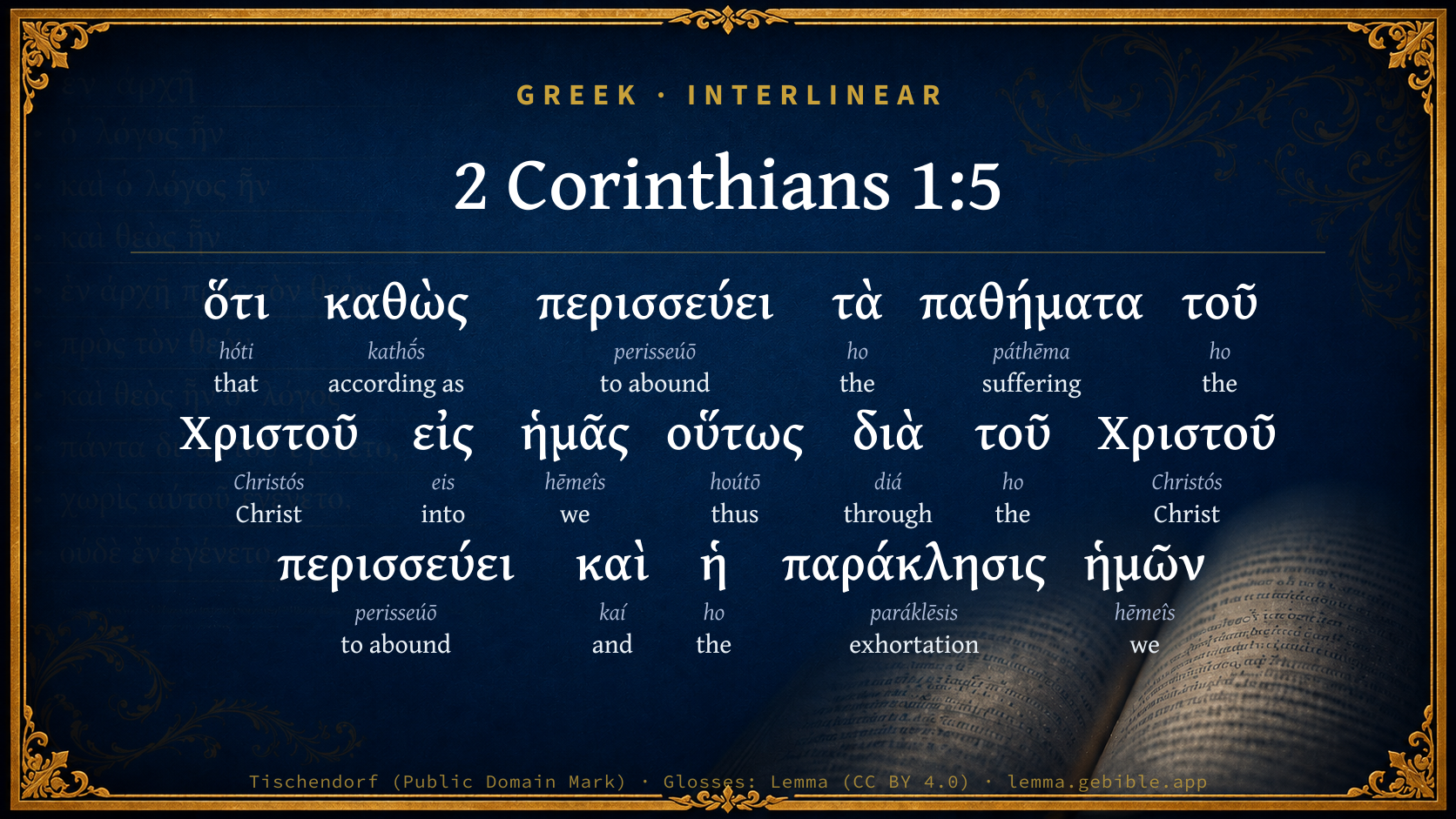
  1. ὅτι hóti G3754 “that” Conjunction
  2. καθὼς kathṓs G2531 “according as” Adverb
  3. περισσεύει perisseúō G4052 “to abound” Verb, Present, Active, Indicative, 3rd person, Singular
  4. τὰ ho G3588 “the” Article, Nominative, Plural, Neuter
  5. τοῦ ho G3588 “the” Article, Genitive, Singular, Masculine
  6. Χριστοῦ Christós G5547 “Christ” Noun, Genitive, Singular, Masculine
  7. εἰς eis G1519 “into” Preposition
  8. ἡμᾶς hēmeîs G2249 “we” Personal pronoun, 1st person, Accusative, Plural
  9. οὕτως hoútō G3779 “thus” Adverb
  10. διὰ diá G1223 “through” Preposition
  11. τοῦ ho G3588 “the” Article, Genitive, Singular, Masculine
  12. Χριστοῦ Christós G5547 “Christ” Noun, Genitive, Singular, Masculine
  13. περισσεύει perisseúō G4052 “to abound” Verb, Present, Active, Indicative, 3rd person, Singular
  14. καὶ kaí G2532 “and” Conjunction
  15. ἡ ho G3588 “the” Article, Nominative, Singular, Feminine
  16. παράκλησις paráklēsis G3874 “exhortation” Noun, Nominative, Singular, Feminine
  17. ἡμῶν hēmeîs G2249 “we” Personal pronoun, 1st person, Genitive, Plural

About this verse

These counts appear in no published source. They are computed here, from the morphology-tagged text and Lemma’s own curated glosses. What Lemma adds →

18
words
12
distinct lemmas
Pauline Epistles
section

Notable vocabulary

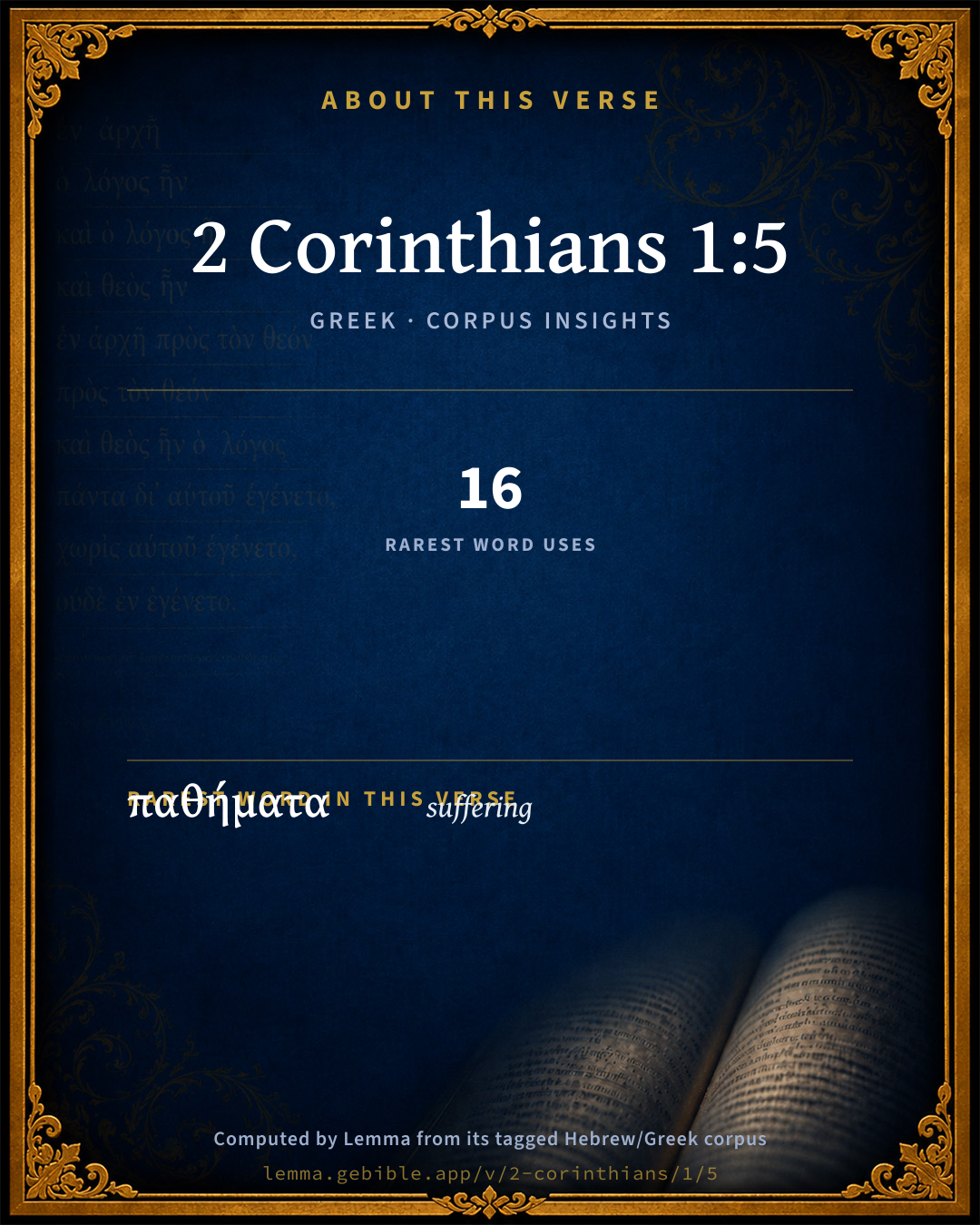
The rarest word here is παθήματα suffering G3804 — appearing just 16 times in the whole Greek New Testament.

Shared distinctive vocabulary

παθήματα suffering G3804 occurs in 16 verses of the Greek New Testament. Also found in:

Repetition

Words recur within this verse:

  • περισσεύει to abound G4052 ×2
  • Χριστοῦ Christ G5547 ×2
  • τὰ the G3588 ×4
  • ἡμᾶς we G2249 ×2

Cross-references

10

Topical passages linked to 2 Corinthians 1:5 in the Treasury of Scripture Knowledge — connected by theme and wording, ordered by reader-vote popularity; previews shown in the World English Bible.

  • Colossians 1:24 Now I rejoice in my sufferings for your sake, and fill up on my part that which is lacking of the afflictions of Christ in my flesh for his body's sake, which is the assembly;
  • Philippians 3:10 that I may know him, and the power of his resurrection, and the fellowship of his sufferings, becoming conformed to his death;
  • Philippians 1:20 according to my earnest expectation and hope, that I will in no way be disappointed, but with all boldness, as always, now also Christ will be magnified in my body, whether by life, or by death.
  • 2 Thessalonians 2:16–17 Now our Lord Jesus Christ himself, and God our Father, who loved us and gave us eternal comfort and good hope through grace,
  • 2 Corinthians 4:10–11 always carrying in the body the putting to death of the Lord Jesus, that the life of Jesus may also be revealed in our body.
  • Philippians 2:1 If there is therefore any exhortation in Christ, if any consolation of love, if any fellowship of the Spirit, if any tender mercies and compassion,
  • 1 Corinthians 4:10–13 We are fools for Christ's sake, but you are wise in Christ. We are weak, but you are strong. You have honor, but we have dishonor.
  • 2 Corinthians 11:23–30 Are they servants of Christ? (I speak as one beside himself) I am more so; in labors more abundantly, in prisons more abundantly, in stripes above measure, in deaths often.
  • Luke 2:25 Behold, there was a man in Jerusalem whose name was Simeon. This man was righteous and devout, looking for the consolation of Israel, and the Holy Spirit was on him.
  • Acts 9:4 He fell on the earth, and heard a voice saying to him, "Saul, Saul, why do you persecute me?"

Cross-references courtesy of OpenBible.info (CC BY 4.0).

Commentary

Notes on 2 Corinthians 1:5 from classic Christian and Jewish commentators (each source and its license shown beneath its notes). The classic Christian expositions comment on the surrounding passage and are grouped to its opening verse, so a note may address several verses; the Jewish commentaries on the Tanakh (Rashi and others) are per-verse, so they appear only where the commentator wrote on this verse.

Lemma curates 59 commentaries, every one of them public domain or Creative Commons licensed, each selected and text-cleaned for this edition rather than reprinted as found. About our sources →

The Biblical Illustrator

Joseph S. Exell

2Co_1:5

For as the sufferings of Christ abound in us, so our consolation aboundeth by Christ.

The sufferings and the consolation

Our cross is not the same as Christs, yet we have a cross. Our sufferings are not the same as Christs, yet we have sufferings. The cross is like Christs, and the sufferings are like His, but yet not the same in kind or object. Yea there is a wide difference; for our trials have nothing to do with expiation. The meaning and use of trims.

I. It shows god to be in earnest with us. He does not let us alone. He takes great pains with our spiritual education and training. He is no careless Father.

II. It assures us of his love. As many as I love I rebuke and chasten.

III. It draws prayer to us.

IV. it knits us in sympathy to the whole body.

V. It teaches us sympathy with brethren.

VI. It brings us into a mood more receptive of blessing. It softens our hearts.

VII. It makes us prize the word. The Bible assumes a new aspect to us. All else darkens; but it brightens.

VIII. It shuts out the world. It all at once draws a curtain round us, and the world becomes invisible.

IX. It bids us look up. Set your affection on things above.

X. It turns our hope to the lords great coming. (A. Bonar.)

Consolations of the sufferings of Christ

The quality and extent of suffering depends not so much on the exciting causes of it as upon the nature of the faculty which suffers. It is the power of suffering that is inherent in any faculty that measures suffering, and not the magnitude of the aggression which is made outwardly. For there are many who will stand up and have their name battered, as if they were but a target, almost without suffering, while there are others to whom the slightest disparagement is like a poisoned arrow, and rankles with exquisite suffering. A stroke of a pound weight upon a bell two inches in diameter will give forth a certain amount of sound. Let the bell be of one hundred pounds weight, and the same stroke of one pound will more than quadruple the amount of aerial vibration. Let the bell be increased to a thousand pounds, and the same stroke will make the reverberations vaster, and cause them to roll yet further. Let it be a five or ten thousand pound weight bell, and that same stroke that made a tinkling on the small bell makes a roar on this large one. The very same quality that being struck in a small being produces a certain amount of susceptibility, being struck in a being that is infinite, produces an infinitely greater experience, for feeling increases in the ratio of being. The same suffering in a great nature is a thousandfold greater than it is in a small nature, because there is the vibration, as it were, of a mind so much greater given to the suffering. The chord in our souls is short and stubborn. The chord in the Divine soul is infinite; and its vibrations are immeasurably beyond any experience of our own. Sorrow in us is of the same kind as sorrow in Christ, and yet, as compared with the sorrow of Christ, human sorrow is but a mere puff. (H. W. Beecher.)

Consolation proportionate to spiritual sufferings

I. The sufferings to be expected.

1. Before we buckle on the Christian armour we ought to know what that service is which is expected of us. A recruiting sergeant often slips a shilling into the hand of some ignorant youth, and tells him that Her Majestys service is a fine thing, that he has nothing to do but walk about in his flaming colours, and go straight on to glory. But the Christian sergeant never deceives like that. Christ Himself said, Count the cost. He wished to have no disciple who was not prepared to bear hardness as a good soldier.

2. But why must the Christian expect trouble?

(1) Look upward. Thinkest thou it will be an easy thing for thy heart to become as pure as God is? Ask those bright spirits clad in white whence their victory came. Some of them will tell you they swam through seas of blood.

(2) Turn thine eyes downward. Satan will always be at thee, for thine enemy, like a roaring lion, goeth about seeking whom he may devour.

(3) Look around thee. Thou art in an enemys country.

(4) Look within thee. There is a little world in here, which is quite enough to give us trouble. Sin is there and self and unbelief.

II. The distinction to be noticed. Our sufferings are said to be the sufferings of Christ. Now, suffering itself is not an evidence of Christianity. There are many people who have troubles who are not children of God. A man is dishonest, and is put in jail for it; a man is a coward, and men hiss at him for it; a man is insincere, and therefore persons avoid him. Yet he says he is persecuted. Not at all; it serves him right. Take heed that your sufferings are the sufferings of Christ. It is only then that we may take comfort. What is meant by this? As Christ, the head, had a certain amount of suffering to endure, so the body must also have a certain weight laid upon it. Ours are the sufferings of Christ if we suffer for Christs sake. If you are called to endure hardness for the sake of the truth, then those are the sufferings of Christ. And this ennobles us and makes us happy. It must have been some honour to the old soldier who stood by the Iron Duke in his battles to be able to say, We fight under the good old Duke, who has won so many battles, and when he wins, part of the honour will be ours. I remember a story of a great commander who led his troops into a defile, and when there a large body of the enemy entirely surrounded him. He knew a battle was inevitable on the morning, he therefore went round to hear in what condition his soldiers minds were. He came to one tent, and as he listened he heard a man say, Our general is very brave, but he is very unwise this time; he has led us into a place where we are sure to be beaten; there are so many of the enemy and only so many of us. Then the commander drew aside a part of the tent and said, How many do you count me for? Now, Christian, how many do you count Christ for? He is all in all.

III. A proportion to be experienced. As the sufferings of Christ abound in us so the consolations of Christ abound. God always keeps a pair of scales--in this side He puts His peoples trials, and in that He puts their consolations. When the scale of trial is nearly empty, you will always find the scale of consolation in nearly the same condition, and vice versa. Because--

1. Trials make more room for consolation. There is nothing makes a man have a big heart like a great trial.

2. Trouble exercises our graces, and the very exercise of our graces tends to make us more comfortable and happy. Where showers fall most, there the grass is greenest.

3. Then we have the closest dealings with God. When the barn is full, man can live without God. But once take your gourds away, you want your God. Some people call troubles weights. Verily they are so. A ship that has large sails and a fair wind needs ballast. A gentleman once asked a friend concerning a beautiful horse of his feeding shout in the pasture with a clog on its foot, Why do you clog such a noble animal? Sir, said he, I would a great deal sooner clog him than lose him; he is given to leap hedges. That is why God clogs His people.

IV. A person to be honoured. Christians can rejoice in deep distress, but to whom shall the glory be given? Oh, to Jesus, for the text says it is all by Him. The Christian can rejoice, since Christ will never forsake him. (C. H. Spurgeon.)

Suffering and consolation

1. It would be difficult to exaggerate how much suffering, patiently and heroically borne, contributed to the propagation of the Christian religion. All the apostles were martyrs, except St. John, and he was a martyr in will.

2. This Epistle is one which is marked by intense feeling. We see the different emotions of joy and sorrow, thankfulness and indignation, disappointment and confidence, distress and hope, breaking forth every here and there in this Second Letter to the Corinthians. The apostle is speaking in the text of troubles, afflictions, and persecutions which he himself had endured, to which he refers in verse

3. But he does not repine.

I. The sufferings of christ abound in us.

1. First, notice what a very different view of suffering we find in the New Testament from that which was taken of old. The Jewish estimate was very narrow. We see from the Gospels that the Jew regarded suffering as retributive, but not as remedial or perfective. There are many reasons for interpreting the purposes of pain and affliction in a wider way. The sufferings of Job, a perfect and an upright man, and the sufferings of the animal world, might have opened the eyes to the inadequacy of their theory.

2. The apostle says, The sufferings of Christ abound in us. Is not Christ in glory? How canst. Paul speak still of His sufferings? The words have received three interpretations. One, the sufferings of Christ means our sufferings for Him. Another, by the sufferings of Christ is meant sufferings similar to those which He bore; and so the martyrs might all claim a special likeness to Him in their violent deaths. But the third interpretation seems more to the point. The sufferings of Christ mean His sufferings in us. Christ said, when Saul was persecuting His members, Why persecutest thou Me? So close is the union between the Head and the members, that Christ, as an old commentator asserts, was in a manner stoned in Stephen, beheaded in Paul, crucified in Peter, and burnt in St. Lawrence.

II. Now, our consolation.

1. Our sufferings differ from Christs, in that we have consolation which is apportioned to our trial. Christ suffered without solace. His Passion was endured amid what spiritual writers describe as dryness of spirit. This, it need not be said, intensifies affliction (Joh_12:27; Mat_27:46).

2. But with the Christian, if the sufferings abound, the consolation abounds also. This accounts in part for the different spirit in which the martyrs faced death from that which the King of Martyrs displayed.

3. Christ purchased the consolation which is bestowed upon His members. The text runs, Our consolation aboundeth by Christ, or, Revised Version, through (διά) Christ. Through His death and passion, through His all-prevailing intercession, through the gift of the Spirit, and the grace of the sacraments--trial and persecution have been endured even with thankfulness and joy (Jam_1:2; Php_3:10).

III. lessons.

1. To take a right view of suffering.

2. To realise the consolation as the gift of Christ, and as measured out in proportion to our day of trial.

3. Especially to seek this consolation from the Comforter, God the Holy Ghost--like the Churches of old, who walked in the comfort of the Holy Ghost (Act_9:31). (Canon Hutchings, M. A.)

How Christ comforteth those who suffer for Him

I. As our sufferings are for Christ, so by the same Christ are our comforts. Consider in what respects comforts may be said to abound by Christ.

1. Efficiently. He being the same with God, is therefore a God of all consolation, and as a Mediator He is sensible of our need, and therefore the more ready to comfort. Christ that wanted comfort Himself, and therefore had an angel sent to comfort Him, is thereby the more compassionate and willing to comfort us. Thus you may read Christ and God put together in this very act (2Th_2:16-17). Christ, therefore, not only absolutely as God, but relatively as Mediator, is qualified with all fitness and fulness to communicate consolation; He is the fountain and head, as of grace, so of comfort.

2. Meritoriously. He hath merited at the hands of God our comfort. As by Christ the Spirit of God is given to the Church as a guide into all truth, and as the Sanctifier, so He is also the Comforter, who giveth every drop of consolation that any believer doth enjoy.

3. Objectively--i.e., in Him, and from Him we take our comfort. As Christ is called our righteousness, because in and through His righteousness we are accepted of in Him, so Christ is our comfort, because in Him we find matter of all joy (Php_3:3).

II. How many ways Christ makes His comforts to abound to those that suffer for Him.

1. By persuading them of the goodness of the cause, why they suffer.

2. By forewarning of their sufferings, All who will live godly must suffer tribulation. Christ hath done us no wrong, He hath told us what we must look for, it is no more than we expected. The fiery trial is not a strange thing. Surely this maketh way for much comfort, that we looked for afflictions beforehand; we prepared an ark against the deluge should come.

3. By informing us of His sovereignty and conquest over the world. If our enemies were equal or superior to Christ, then we might justly be left without comfort; but what Christ spake to His disciples belongs to all (Joh_14:18; Joh_16:33).

4. By virtue of His prayer put up in that very behalf (Joh_17:13).

5. By instructing us of the good use and heavenly advantage all these tribulations shall turn unto.

(1) Our spiritual and eternal good. This will winnow away our chaff, purge our dross, be a school wherein we shall learn more spiritual and Divine knowledge than ever before. Sufferings have taught more than vast libraries, or the best books can teach.

(2) Our eternal glory. (A. Burgess.)

The sacred joy

These words fathom a depth of human experience which can only be touched by those who seek in the life of Christ the key to the mystery of pain. There is a suffering which is common to man, and there is in respect of such suffering consolation in God. But there is a suffering which belongs to life under its highest conditions and which the mere man of the world never tastes, but for which there is a Divine joy which is equally beyond his range.

I. The nature of the suffering which is to be regarded as a sharing of the suffering of the Lord. Among the elements which enter into it are--

1. The spectacle of the misery of mankind. On earth Christ wept as He beheld it, and the Christian is also bound to feel the pressure of its burden.

2. The deadly nature of evil. We cannot cheat ourselves into the belief that it does not much matter, that God is good and will make it all right at last. Sin is to be looked at in the light of Calvary. That teaches how terrible it is to the eye of God, how deadly in the heart of man.

3. The resistance of the will of the flesh to the best efforts and influences; its determination to reject the things that heal and save. It was this that made Christ the Man of Sorrows (Luk_13:34). To see a man perish within reach of rescue is one of the most piteous of spectacles. Imagine, then, what the world must be to Christ as He says, Ye will not come unto Me that ye might have life. This burden the disciple of Christ has ever pressing upon him as he fulfils his ministry in a scornful world.

4. The future eternal destiny. The thought pressed as a constant burden on the heart of Christ. It was this that drove Paul into barbarous lands, if he might save a soul from death. The fellowship of the Redeemers tears is no unknown experience to the disciple.

II. How our consolation aboundeth in Christ. If we are called to share the suffering, we are called also to share the consolation. There was a joy set before Christ for which He endured the Cross, etc.

the joy of a sure redemption of humanity. These are some of the elements of the joy.

1. The God of all power and might has taken up the burden and wills the redemption of the world. God has come forth in Christ to undertake in person the recovery of our race. In working and suffering for man we have the assurance that God is with us. We see Mammon or Moloch on the throne, but it cannot be for ever. With all the vantage strength of His Godhead, Christ is working at the problem of mans salvation. When we feel saddened by the burden of human misery let us rest on the thought, God is in Christ reconciling the world unto Himself.

2. There is a joy in the fulfilment of a self-sacrificing ministry which is more like heavenly rapture than any other experience which is within our reach. Unselfish work, inspired by the love of Christ, is the souls gymnastic culture. To sow the seed of the kingdom is the present joy of a lifetime. No man who has known it would part with it to be a crowned king. The certainty of the issue (Isa_55:10-13). (J. Baldwin Brown, B. A.)

The Biblical Illustrator, edited by Joseph S. Exell (c. 1880s–1900s) — public domain. Text from a community e-Sword module.

Bengel's Gnomon

Johann Albrecht Bengel

2Co 1:5. Τοῦ Χριστοῦ, εἰς ἠμᾶς· διὰ Χριστοῦ, ἡμῶν, of Christ towards (in) us; ours by Christ) The words and their order are sweetly interchanged.—παθήματα· παράκλησις, adversities (sufferings); consolation) The former are numerous; the latter is but one, and yet exceeds the former.—οὕτως, so) There shines forth brightly from this very epistle, as compared with the former, a greater amount of consolation to the Corinthians, who had been deeply impressed with the first epistle, consolation being extremely well suited to their circumstances, after the distresses which had intervened; and so there shines forth brightly in it the newness of the whole inner man, increasing more and more day by day.

Bengel's Gnomon of the New Testament — English translation (T&T Clark, Edinburgh, 1860) — public domain. Text from a community e-Sword module.

Meyer's Critical & Exegetical Commentary

Heinrich August Wilhelm Meyer

2Co_1:5. Ground assigned for the ἧς παρακαλούμεθα αὐτοὶ ὑπὸ τ. Θεοῦ.

περισσεύει εἰς ἡμᾶς] is abundant in relation to us, i.e. it is imparted to us above measure, in a very high degree. Comp. Rom_5:15.

τὰ παθήματα τοῦ Χριστοῦ] are not the sufferings for Christs sake (so Pelagius and most), which cannot be expressed by the simple genitive, but the sufferings of Christ (Winer, Billroth, Olshausen, Neander, Ewald, Hofmann), in so far as every one who suffers for the gospel suffers the same in category as Christ suffered. Comp. Mat_20:22; Php_3:10; Col_1:24; Heb_13:13; 1Pe_4:13. See also on Rom_8:17. Hence Cornelius a Lapide, Leun, and Rückert render correctly in substance: quales passus est Christus. But Chrysostom, Theophylact, Oecumenius, Beza, Calovius, and others are wrong, who render: the sufferings, which Christ endures in His members; comp. de Wette and Osiander. For the conception of a Christ continuing to suffer in His members is nowhere found in the N. T., not even in Act_9:4, and is contrary to the idea of His exaltation. See on Col_1:24.

διὰ τοῦ Χ.] through His indwelling by means of the Spirit. See Rom_8:9-10; Eph_3:17; Col_1:29, al.

Meyer — Critical and Exegetical Commentary on the New Testament — English translation by Peter Christie, edited by Frederick Crombie (T&T Clark, 1880) — public domain. Text from a community e-Sword module.

Expositor's Greek Testament

ed. W. Robertson Nicoll

2Co 1:5 . ὅτι καθὼς περισσύει κ . τ . λ .: for as Christ’s sufferings flow over abundantly to us, even so our comfort also aboundeth through Christ . That the Christian is a fellow-sufferer with Christ is frequently urged by St. Paul (Rom 8:17 , Phi 3:10 , Col 1:24 ; see esp. chap. 2Co 4:10-11 below, and cf. Mat 20:22 ). Here he dwells on the thought that this fellowship in suffering implies also the consolation and strength which flow from union with Christ; cf. 1Pe 4:13 .

The Expositor's Greek Testament, edited by W. Robertson Nicoll (1897–1910) — public domain. Text from a community e-Sword module.

Geneva Bible (1599)

Geneva Bible translators

The miseries which we suffer for Christ, or which Christ suffereth in us.

Geneva Bible (1599) marginal notes — public domain. Text via Bolls.life.

Jamieson, Fausset & Brown

Robert Jamieson, A. R. Fausset & David Brown

sufferings--standing in contrast with "salvation" (Co2 1:6); as "tribulation" (distress of mind), with comfort or "consolation."

of Christ--Compare Col 1:24. The sufferings endured, whether by Himself, or by His Church, with which He considers Himself identified (Mat 25:40, Mat 25:45; Act 9:4; Jo1 4:17-21). Christ calls His people's sufferings His own suffering: (1) because of the sympathy and mystical union between Him and us (Rom 8:17; Co1 4:10); (2) They are borne for His sake; (3) They tend to His glory (Eph 4:1; Pe1 4:14, Pe1 4:16).

abound in us--Greek, "abound unto us." The order of the Greek following words is more forcible than in English Version, "Even so through Christ aboundeth also our comfort." The sufferings (plural) are many; but the consolation (though singular) swallows up them all. Comfort preponderates in this Epistle above that in the first Epistle, as now by the effect of the latter most of the Corinthians had been much impressed.

Jamieson, Fausset & Brown — Commentary Critical and Explanatory on the Whole Bible (1871) — public domain (CC PDM 1.0). Text via the HelloAO Bible API.

Adam Clarke's Commentary

Verse 5. The sufferings of Christ] Suffering endured for the cause of Christ: such as persecutions, hardships, and privations of different kinds.

Our consolation also aboundeth] We stood as well, as firmly, and as easily, in the heaviest trial, as in the lightest; because the consolation was always proportioned to the trial and difficulty. Hence we learn, that he who is upheld in a slight trial need not fear a great one; for if he be faithful, his consolation shall abound, as his sufferings abound. Is it not as easy for a man to lift one hundred pounds' weight, as it is for an infant to lift a few ounces? The proportion of strength destroys the comparative difficulty.

Adam Clarke's Commentary on the Bible (1810–1826) — public domain. Text from a community e-Sword/MySword module.

John Calvin's Commentaries

5. For as the sufferings of Christ abound — This statement may be explained in two ways — actively and passively. If you take it actively, the meaning will be this: “The more I am tried with various afflictions, so much the more resources have I for comforting others.” I am, however, more inclined to take it in a passive sense, as meaning that God multiplied his consolations according to the measure of his tribulations. David also acknowledges that it had been thus with him:

According to the multitude, says he, of my anxieties within me, thy consolations have delighted my soul. (Psalm 94:19.)

In Paul’s words, however, there is a fuller statement of doctrine; for the afflictions of the pious he calls the sufferings of Christ, as he says elsewhere,

that he fills up in his body what is wanting in the sufferings of Christ. (Colossians 1:24.)

The miseries and vexations, it is true, of the present life are common to good and bad alike, but when they befall the wicked, they are tokens of the curse of God, because they arise from sin, and nothing appears in them except the anger of God and participation with Adam, which cannot but depress the mind. But in the mean time believers are conformed to Christ, and

bear about with them in their body his dying, that the life of Christ may one day be manifested in them. (2 Corinthians 4:10.)

I speak of the afflictions which they endure for the testimony of Christ, (Revelation 1:9,) for although the Lord’s chastisements, with which he chastises their sins, are beneficial to them, they are, nevertheless, not partakers, properly speaking, of Christ’s sufferings, except in those cases in which they suffer on his account, as we find in 1 Peter 4:13. Paul’s meaning then is, that God is always present with him in his tribulations, and that his infirmity is sustained by the consolations of Christ, so as to prevent him from being overwhelmed with calamities.

John Calvin's Commentaries (1540-1563) — public domain. Text from the Calvin Translation Society English edition (1840s-50s) via the Christian Classics Ethereal Library (ccel.org). Calvin's coverage is partial (roughly two-thirds of the Bible); uncommented books and verses are honest gaps, never fabricated. The 19th-century editor's footnotes and remarks are omitted so the notes are faithfully Calvin's own voice.

Ellicott's Commentary for English Readers

(5) Abound in us.—Better, overflow to us. The sufferings of Christ, as in 1Pe_4:13; 1Pe_5:1 (the Greek in 1Pe_1:11 expresses a different thought), are those which He endured on earth; those which, in His mysterious union with His Church, are thought as passing from Him to every member of His body, that they too may drink of the cup that He drank of. For the thought that in our sufferings, of whatever nature, we share Christ’s sufferings, comp. 2Co_4:10; Php_3:10; Col_1:24; 1Pe_4:13. The use of the plural, “our tribulations,” “overflow to us,” is dependent partly on the fact that St. Paul has joined Timotheus with himself in his salutation, and partly on the fact that it is his usual way of speaking of himself unless he has distinctly to assert his own individuality.

So our consolation also aboundeth.—Better, as before, overflows. The consolation which has come to him through Christ, as the channel through whom it flows down from the Father, has, like the suffering, an expansive power, and pours itself out on others.

A Bible Commentary for English Readers, edited by Charles John Ellicott (1878–1897) — public domain. Text from a community e-Sword module.

The Cambridge Bible for Schools and Colleges

gen. ed. J. J. S. Perowne

5. For as the sufferings of Christ abound in us] Rather super-abound unto us. All the principal English versions render in us, and thus many commentators have been misled. The word translated abound means to exceed, be over and above (Mat_5:20; Mat_14:20). Thus the meaning of the passage is that the sufferings of Christ overflow to us and that thus we are made partakers of them. See Mat_20:22; Mar_10:38; Gal_2:20; Heb_13:13. For (see notes on ch. 2Co_4:11-12) our sufferings for Christ’s sake arise from the same cause as His, namely the opposition of darkness to light, of death to the life that is imparted by Him to His members. Such passages as ch. 2Co_4:10; Col_1:24, carry the idea a step further, and represent Christ as suffering in His members, by virtue of His union with them. So also Mat_25:40; Mat_25:45; Act_9:4; Gal_6:17; Php_3:10.

The Cambridge Bible for Schools and Colleges (gen. ed. J. J. S. Perowne; Cambridge University Press, 1878–1918) — public domain. Text from a community e-Sword module.

John Gill's Exposition

For as the sufferings of Christ abound in us,.... By "the sufferings of Christ" are not meant those which he suffered in his own person for the sake, and in the room and stead of his people, the fruits and effects of which abound to them, and in them; but those which he suffers in his members, or which they suffer for his sake; and which are said to "abound in" them, because of the variety and greatness of them; though not as if they were more or greater than what Christ suffered in his soul and body, when he was made sin and a curse for his people: yet notwithstanding the abundance of them, such is the goodness and grace of God, that he proportions comforts to them; as their afflictions increase, so do their comforts; as their sufferings for the sake of Christ, and his Gospel, are more and greater,

so, says he,

our consolation aboundeth by Christ: meaning, either that consolation which they felt and enjoyed in their own souls, under all their tribulations, which abundantly answered to them, and which they ascribe to Christ, from and by whom it comes to them; or else that consolation, which, by preaching Christ, abounded to the relief of others who were in distress and trouble.

John Gill's Exposition of the Whole Bible (1746–1763) — public domain (CC PDM 1.0). Text via the HelloAO Bible API.

Trapp's Complete Commentary

John Trapp

5 For as the sufferings of Christ abound in us, so our consolation also aboundeth by Christ.

Ver. 5. As the sufferings of Christ] So called, either because the saints suffer for Christ, or because they have him suffering with them, Act 9:4. God is more provoked than Nehemiah, Neh 4:3; Neh 4:5.

So our consolation] As the lower the ebb, the higher the tide, οπου πλεων κοπος, πολυ κερδος, saith Ignatius. The more pain, the more gain. It is to my loss if you bate me anything in my sufferings. As the hotter the day, the greater the dew at night; so the hotter the time of trouble, the greater the dews of refreshing from God.

John Trapp, A Commentary or Exposition upon All the Books of the Old and New Testament (1647–1656) — public domain. Text from a community e-Sword module.

Albert Barnes' Notes on the Bible

For as the sufferings of Christ abound in us - As we are called to experience the same sufferings which Christ endured; as we are called to suffer in his cause, and in the promotion of the same object. The sufferings which they endured were in the cause of Christ and his gospel; were endured in endeavoring to advance the same object which Christ sought to promote; and were substantially of the same nature. They arose from opposition, contempt, persecution, trial, and want, and were the same as the Lord Jesus was himself subjected to during the whole of his public life; compare Col 1:24. Thus, Peter says 1Pe 4:13 of Christians that they were “partakers of Christ’s sufferings.”

So our consolation also aboundeth by Christ - By means of Christ, or through Christ, consolation is abundantly imparted to us. Paul regarded the Lord Jesus as the source of consolation, and felt that the comfort which he imparted, or which was imparted through him, was more than sufficient to overbalance all the trials which he endured in this cause. The comforts which he derived from Christ were those, doubtless, which arose from his presence, his supporting grace, from his love shed abroad in the heart; from the success which he gave to his gospel, and from the hope of reward which was held out to him by the Redeemer, as the result of all his sufferings. And it may he observed as an universal truth, that if we suffer in the cause of Christ, if we are persecuted, oppressed, and calumniated on his account, he will take care that cur hearts shall be filled with consolation.

Albert Barnes' Notes on the Bible (1834–1885) — public domain. Text from a community e-Sword/MySword module.

Haydock's Catholic Bible Commentary

St. Paul here styles his own sufferings, the sufferings of Christ, to shew that Christ take part, and suffers in all his members. (St. John Chrysostom) --- Though it is generally understood to signify the sufferings undergone for Christ. (Estius) --- If we consider the very intimate union that exists between Jesus Christ, who is the head, and every one of the living members of his body, that is, the Church, that whatever any one suffers, for the cause of truth, Christ is said to suffer, as the Lord said to Saul, why persecutest thou me? and that whatever is given to any indigent brother in the name of a disciple, Christ receives as given to himself, can we want any further proof of the excellence and power of good works, which begin and terminate in charity? (Haydock)

George Leo Haydock (1774–1849), Haydock's Catholic Family Bible and Commentary, 1859 edition — public domain. Excludes Psalms (Douay-Rheims chapter numbering differs from Protestant) and Deuterocanonical books (Catholic canon only).

Matthew Poole's English Annotations

He calleth his and the other apostles’ sufferings, the sufferings of Christ, either because they were sufferings for Christ, that is, for doing the work which Christ had given them to do; or his and their personal sufferings, as members of that body of which Christ is the Head. Christ calleth Saul’s persecuting the saints, a persecuting of himself, Act 9:4. Thus we read of Paul’s filling up that which is behind of the afflictions of Christ, Col 1:24.

So our consolation also aboundeth by Christ; but, saith the apostle, blessed be God, as we have many sufferings for Christ, so also we have many consolations by Christ. Christ, as God, is the efficient cause of the saints’ consolation; as Mediator, dying for us, he is the meritorious cause; and it is by his Spirit (who is called the Comforter) that they are applied to us.

Matthew Poole's English Annotations on the Holy Bible (1683–1685) — public domain. Text from a community e-Sword/MySword module.

Whedon's Commentary on the Bible

Daniel D. Whedon

5. Sufferings of Christ—Not as some render, sufferings for Christ; but the same sufferings in kind as those of Christ; or rather, sufferings undergone by Christians in their oneness with Christ, so that they are his.

By Christ—For Christ makes consolation to abound to all who undergo his sufferings. The martyr for Christ has rejoiced and triumphed in the flame through Christ.

Daniel D. Whedon (gen. ed.), Commentary on the Old and New Testaments (1874–1909) — public domain. Text from a community e-Sword module.

The Pulpit Commentary

As the sufferings of Christ abound in us; rather, unto us. "The sufferings of Christ" are the sufferings which he endured in the days of his flesh, and they were not exhausted by him, but overflow to us who have to suffer as he suffered, bearing about with us his dying, that we may share his life. (2Co_4:10) The idea is, not that he is suffering in us and with us, (though the truth of his intense sympathy with his suffering Church may be shadowed forth in some such terms Mat_25:40-45; Act_9:4) but that we have "a fellowship in his sufferings"; Php_3:17 Gal_2:20, "I have been crucified with Christ;" Heb_13:13, "Bearing his reproach." Our sufferings are the sufferings of Christ because we suffer as he suffered (1Pe_4:13) and in the same cause. Aboundeth by Christ. If his sufferings, as it were, overflow to us, so too is he the Source of our comfort, in that he sendeth us the Comforter. (Joh_14:16-18)

HOMILIES BY D. FRASER Ver. 5.

Christian suffering.

It is correct to say that Christ suffered in order that we may not suffer, died that we may never die. "Christ suffered for us." But it is also correct to say that Christ suffered in order that we may suffer with him, and, following him in the path of self denial and patience, may be with him in his kingdom and glory. The apostles Paul and Peter regarded sufferings for Christ as continuations of the sufferings of Christ, and always looked, and taught their brethren to look, along a vista of trial and affliction toward the happy issue of being glorified together with Christ at his appearing. As members of the body of Christ we suffer. As the natural body of Christ suffered in the days of his flesh, so now the mystical body, the Church, suffers in these days of the Spirit. It must have its agony and bloody sweat before the end comes; blows of contempt, scourging, buffeting; and must have its "bones sore vexed," as were those of his body on the cross; sore vexed, but not broken: "A bone of him shall not be broken." As witnesses for the Name of Christ we suffer. While walking and witnessing in the acceptance and power of his resurrection, we must be identified with him as the despised and rejected One. We are in collision with the spirit of the world, and the more firmly we lift our testimony against it the more the sufferings of Christ abound in us. In primitive times men suffered as Christians, for no other offence than the confession of the Saviour"s Name. The council of the Jews arrested the apostles Peter and John, and put the deacon Stephen to death, on this charge. The cultivated Pliny, when Proconsul of Bithynia, about forty years after the death of St. Paul, is shown, by his correspondence with the Emperor Trajan, to have regarded the very fact of being a Christian as a crime worthy of instant punishment. Christian faith was in his eyes nothing but an absurd and excessive superstition, and the noble constancy of the Christians under threats and torture "a contumacious and inflexible obstinacy." So the witnesses for our Lord suffered in Bithynia under the illustrious Trajan, as well as in Italy under the infamous Nero, and throughout the empire under the cruel Domitian and Diocletian. But it sustained them to know that they were fulfilling the sufferings of Christ. His grace was sufficient for them. On them rested the Spirit of glory and of God. Such discipline continues, though without actual peril of life. Faithful Christians suffer many things, at many points, and from many quarters. And when they suffer for the Church it is a continuation of our Lord"s unselfish suffering. So St. Paul endured all things for the Lord"s sake and the sake of the elect. He used the expression, "I fill up that which is behind of the afflictions of Christ", (Col_1:24) in reference to his inward anxiety and "agony" for those at Colosse and Laodicea, who had not seen his face in the flesh. His anxiety for their confirmation in the mystery of God was a sort of supplement to the deep struggle of the Saviour in behalf of multitudes, Paul included, who had not seen and could not see his face in the flesh. The apostle had no thought of adding to the sufferings of Christ in respect of their expiatory virtue, but rejoiced that he was permitted to follow his Master in this same path of affliction and solicitude for the Church. All sowers of "the incorruptible seed" have to sow with tears. And hearers of the Word are most profited when they receive it "in much affliction, with joy of the Holy Ghost." Three views may be taken of those afflictions which are distinctively Christian.

1. They are for the Lord, incurred and endured for his Name. So were theafflictions of Christ for the Name and glory of the Father. The world hated both him and his Father.

2. They are for the good of the Christian sufferer tribulations that workpatience, chastisements for his profit. So were the afflictions of Christ for his own good. "Though he were a Son, he learned obedience by the things which he suffered.

3. For the sake of his brethren, or for the good of the Church, which isedified through the self-denial and godly patience of individual believers in successive generations. So were the afflictions of Christ for the Church which he redeemed, and in which he now succours them that are tempted. The present time, then, is one of communion with our Lord in suffering. Let four advices be given to those who suffer with a good conscience for well doing and not for evil doing.

I HAVE A CARE ONE FOR ANOTHER. Trouble may make men sullen and self engrossed. Correct this tendency by remembering that you are not isolated persons, but parts of the body of Christ, and so members of one another. If you suffer, bear yourselves so that others may be confirmed by your faith and patience. If they suffer, suffer with them, help to bear their burdens, condole in their sorrow, minister to their necessity. "Weep with them that weep.

II LEARN PATIENCE FROM "THE MAN OF SORROWS." It ought to cure peevishness and wilfulness to read the story of our Lord"s passion, and consider the meekness of him "who endured such contradiction of sinners against himself." See how St. Peter sets before suffering saints the example of their Master. (1Pe_2:20-23)

III LOOK FOR STRENGTH TO THE SYMPATHIZING SAVIOUR. In the present connection between Christ and Christians the Scripture marks a distinction. The saints suffer with Christ; Christ sympathizes with the saints. The word for the former is sumpascein: the word for the latter is sumpaqein. The Head is raised above suffering, but sympathizes with the distressed and bruised members, and loves to supply consolation and relief. "Our consolation also aboundeth by Christ." He makes us strong, even in the hour when our hearts are jaded and our spirits faint. The crook in the lot, the thorn in the flesh, the buffeting in the world, the disappointment in the Church, he knows it all, and he can bear us through it all.

IV REJOICE IN THE HOPE OF HIS COMING. There is a deep wisdom of God in the long drawn affliction of Christ and the Church. Glory comes out of the dark womb of trouble. How long the travail must be God only knows. Jesus Christ suffered till he was perfected, and then God exalted him. The Church must suffer and struggle till she is perfected and God exalts her too. And the glory that awaits her is that of her Beloved. As the Church enters into his sufferings, so is she to enter into his glory. This is the day for faithful service and saintly patience. The coming day is that of honour and reward, "that, when his glory shall be revealed, ye may be glad also with exceeding joy. F.

Christ"s sufferings renewed in his disciples.

as the sufferings of Christ abound in us." We have expressed here a characteristic and familiar thought of the apostle"s the one which brought to him the fullest and deepest consolations. It is true, but it is too easily apprehended to be all the truth, that St. Paul"s sufferings, borne in fulfilling his ministry, were Christ"s sufferings because a part of his service; but the apostle evidently reached the unspeakably precious and inspiring view of Christian suffering which sees it to be Christ"s, because it is essentially like his it is vicarious, it is borne for others. He says, "Whether we be afflicted, it is for your consolation and salvation or whether we be comforted, it is for your consolation and salvation." St. Paul would know "the fellowship of Christ"s sufferings, being made conformable unto his death;" even to that death in its vicariousness, as a sublime self sacrifice for the salvation of others. For the thought that in our sufferings, of whatever nature, we share Christ"s sufferings, comp. Php_3:13; Col_1:24 1Pe_4:13. All vicariously borne suffering is Christly; it is the kind of which he is the Leader and the sublime Example; it is even necessary, as attendant on all human efforts to bless others. Every one who would help another must take into account that he may have to suffer in doing it. Illustrate by the doctor, or the man who tries to save, from water, or fire, or accident, a fellow creature. He may even perish in so doing. The Christian may cherish this supreme comfort he may become to others, in measure, what Christ is to him. He may become the inspiration of vicarious service. His Christly example may act on men as Christ"s example acted on him. If it might be so, St. Paul was willing to suffer. It may be shown and illustrated that such Christ-like enduring has

I A TEACHING power on others. It brings its revelations of God and brotherhood. It opens mysteries. It impresses the evil of sin.

II AN ELEVATING power on others. It lifts men up to bear their own sufferings well, when we can show them the Christ-likeness of ours.

III A COMFORTING power, since it shows, not only how God"s grace can abound, but also how God can turn even what we think evil into gracious agency for blessing. Sufferers still can strengthen, help, and save others. R.T.

The Pulpit Commentary (1880–1919), ed. H.D.M. Spence-Jones & Joseph S. Exell — public domain. Text from a community e-Sword module.

John Wesley's Explanatory Notes

For as the sufferings of Christ abound in us - The sufferings endured on his account. So our comfort also aboundeth through Christ - The sufferings were many, the comfort one; and yet not only equal to, but overbalancing, them all.

John Wesley, Explanatory Notes Upon the Whole Bible (1754–1765) — public domain. Text via the GEBible commentary corpus.

Burkitt's Expository Notes on the New Testament

William Burkitt

Note here, 1. That the saint’s sufferings are called the sufferings of Christ. The head suffers in the members, because the members suffer for the sake of the head.

Note, 2. That the saint’s sufferings in the cause, and for the sake of Christ, are sometimes overflowing and excessive sufferings: The sufferings of Christ abound in us.

Note, 3. That as a Christian’s sufferings are for Christ, so are their comforts and consolations from him; yea, their comforts do bear some proportion to their sufferings; as our sufferings abound, so our consolation abounds by Christ.

William Burkitt's Expository Notes on the New Testament (1700–1703) — public domain. Text from a community e-Sword module.

McGarvey & Pendleton's Commentaries

J. W. McGarvey

For as the sufferings of Christ abound unto us, even so our comfort also aboundeth through Christ . [By "sufferings of Christ" Paul means the persecutions, etc., suffered for Christ's sake. As Christ himself suffered while on the earth, so the church, his mystical body, must likewise suffer while in the flesh ( Phi_3:17 ; Gal_2:20 ; Heb_3:13 ; 1Pe_4:13 ; Act_9:4 ). It does this because it lives as he did, and its work is in a sense supplemental to his ( Col_1:24 ; Joh_17:14 ; Joh_18:19-20 ). It is comforted by the Holy Spirit ( Joh_14:16-18 ), with the sense of the present love of Christ, and assured hope of reward; a sense of increased power to assist and comfort others; a trust that all things are working together for good ( 2Co_4:17 ). The measure of affliction becomes also the measure of comfort.]

J. W. McGarvey (with Philip Y. Pendleton), Commentaries on the New Testament (The Fourfold Gospel, 1914; Acts; and the epistles) — public domain. Text from a community e-Sword/MySword module.

The People's New Testament

B. W. Johnson

5. For as the sufferings of Christ abound in us. Christ suffers with his saints when they suffer for him. See Acts 9:4, 5. Hence, when Paul endured affliction for Christ, “the sufferings of Christ abounded” in him. But Christ comforts those who thus suffer (John 16:2–4). Christ suffers in the person of his servants, but forgets not his promise to be with them always.

B. W. Johnson's The People's New Testament with Notes (1889–1891) — public domain. Electronic text from the Christian Classics Ethereal Library (CCEL) ThML edition.

unfoldingWord translationNotes

Door43 World Missions Community

For just as the sufferings of Christ abound for our sake

Paul speaks of Christ's sufferings as if they were objects that could increase in number. AT: "For just as Christ suffered greatly for our sake" (See: Metaphor)

the sufferings of Christ

Possible meanings are 1) that this refers to the suffering that Paul and Timothy experience because they preach the message about Christ or 2) that this refers to the suffering that Christ experienced on their behalf.

our comfort abounds

Paul speaks of comfort as if it were an object that could increase in size. (See: Metaphor)

But if we are afflicted

Here the word "we" refers to Paul and Timothy, but not to the Corinthians. This can be stated in active form. AT: "But if people afflict us" (See: Exclusive and Inclusive "We" and Active or Passive)

if we are comforted

This can be stated in active form. AT: "if God comforts us" (See: Active or Passive)

Your comfort is working effectively

"You experience effective comfort"

translationWords

suffer

Christ

comfort

afflicted

save

patient

confidence

unfoldingWord translationNotes — © Distant Shores Media and the Door43 World Missions Community, licensed CC BY-SA 4.0. Source: git.door43.org/Door43/en_tn.

Cambridge Greek Testament for Schools and Colleges

5. ὅτι καθὼς περισσεύει τὰ παθήματα τοῦ χριστοῦ εἰς ἡμᾶς. ‘The sufferings of the Messiah abound unto us,’ which means ‘in reference to us’ or ‘in our case’; so that the ‘in us’ of the A. V. is substantially correct: comp. Rom 5:15; Rom 8:18. The comfort is given in proportion to the suffering, and this correspondence between comfort and suffering is effected in Christ. The sufferings of Christ’s ministers are identified with His sufferings in that they have the same cause and the same end,—the opposition of evil and the vanquishing of evil. Comp. 2Co 4:10; Rom 8:17; Php 3:10; Heb 13:13; 1Pe 4:13. That Christ, now in glory, still suffers in His members, is a thought which has no place here, and perhaps nowhere in Scripture. For τὰ παθήματα τ. χρ. comp. Luk 24:26, and see Hort on 1Pe 1:11.

οὕτως διὰ τοῦ χριστοῦ. Even so our comfort also aboundeth through the Christ. The correspondence is exact, καθὼς … οὔτως: ‘just as, so’ or ‘as, even so.’ ‘Through the Christ,’ who dwells in us through His Spirit; Eph 3:16-19. Comp. 2Co 13:4.

Somewhat different is Bishop Lightfoot’s interpretation: “the sufferings of Christ are said to ‘overflow’ (περισσεύειν) upon the Apostle.” See his note on ἀνταναπληρῶ τὰ ὑστερήματα τῶν θλίψεων τοῦ χριστοῦ, (Col 1:24), a passage which he regards as similar in meaning to this verse, though not identical with it. According to this view the sufferings of the Messiah (τοῦ χριστοῦ) overflow on to those who belong to the Messianic people,—the new Israel,—of which the Apostle was marked out as a representative.

Cambridge Greek Testament for Schools and Colleges (Cambridge University Press, 1896; 21 vols, various authors incl. Carr, Maclear, Plummer, Farrar, Lumby, Moule, M. R. James, Simcox) — public domain. Text from a community e-Sword module.

Alford’s Greek Testament

Henry Alford

5.] ‘As He is, so are we in this world:’ 1Jn 4:17. As the sufferings of Christ (endured by Christ, whether in his own person, or in his mystical body the Church, see Mat 25:40, Mat 25:45) abound towards us (i.e. in our case, see reff.);—even so through Christ our consolation also abounds. The form of expression is altered in the latter clause: instead of ἡ παράκλησις τοῦ χριστοῦ περις. we have ἡ παράκ. ἡμῶν περισς. διὰ τοῦ χριστοῦ. And not without reason:—we suffer, because we are His members: we are consoled because He is our Head. There is no comparison (as Chrys., p. 422, οὐ γὰρ ὅσα ἔπαθε, φησίν, ἐπάθομεν μόνον, ἀλλὰ καὶ περισσά) between the personal sufferings of Christ, and theirs.

Henry Alford, The Greek Testament (1849–1861) — public domain. Text from a community e-Sword module.

International Critical Commentary

5. ὅτι καθώς κ.τ.λ. ‘Because just as the sufferings of the Messiah abound unto us, so through the Messiah our comfort also aboundeth.’ For καθὼς … οὔτως … see 1Th 2:4. The sufferings are those quas Christus prior pertulit et nobis perferendas reliquit (Herveius). The preachers of the Kingdom have to suffer persecution as He had (1Pe 4:13); but Chrys. gives too much meaning to περισσεύει, when he interprets it as meaning that Christ’s ministers suffer more than He did. ‘The sufferings of the Messiah’ are those which He was destined to suffer, which ἔδει παθεῖν τ. Χριστόν (see on Luk 24:26 and cf. Act 17:3; 2Co 4:10; Rom 6:5; Php 3:10, with Lightfoot’s note).* ‘Sufferings endured for Christ’s sake’ is wrong as translation (cf. 4:11), and inadequate as exegesis. ‘Sufferings which the glorified Christ suffers when His members suffer’ is questionable exegesis, which is not justified by the Apostle’s use of τοῦ Χριστοῦ instead of τοῦ Ἰησοῦ as in Gal 6:17. It is the sufferings of the Messiah that he is pointing to, for his recent opponents were Jews. Moreover, τ. Χριστοῦ is necessary in the second clause, for not the historical Jesus who suffered is the Consoler, but the glorified Christ; and it would have marred the antithesis to have ‘Jesus’ in the first clause and ‘Christ’ in the second. In 4:10, he has ‘Jesus’ in both clauses. In the background is the thought of the absolute unity between Christ and His members; and although we can hardly think of Him as still liable to suffering when His members suffer, yet their sufferings are a continuation of His, and they supplement His (Col 1:24) in the work of building up the Church. One purpose of His sufferings was to make men feel more certain of the love of God (Rom 8:32). Cf. 4:10; Rom 6:5, Rom 6:8:17; Php 3:10; Mat 20:22, Mat 20:25:40, 45). It is less likely that he is hinting at opponents who had said that his sufferings were richly deserved. So far as possible, he wishes to suppress all allusion to the unhappy past, and hence the obscure wording of this paragraph. What he desires to emphasize is the comfort which he and those who had opposed him now enjoy, owing to their submission. In N.T., πάθημα is confined to the Pauline Epp., Heb. and 1 Pet. The change from plur. to sing. is effective; illa multa sunt, haec una, et tamen potior (Beng.). D E have τὸ πάθημα to match ἡ παράκλησις.

περισσεύει εἰς ἡμᾶς. Cf. 9:8; Rom 5:15; Eph 1:8.

διὰ τοῦ Χριστοῦ. ‘Through the Messiah’: it is through His instrumentality that the reconciliation between the Jew of Tarsus and his Jewish antagonists in Corinth, which has been such a comfort to both sides, has come about. This use of διά is freq. of the Son (1Co 8:6; Col 1:16; Heb 1:2), but it is also used of the Father (1Co 1:9; Rom 11:36; Heb 2:10), and therefore, as Chrys. remarks, is not derogatory to the Divinity of the Son. It is He who sends His Spirit to bring comfort. He has become πνεῦμα ζωοποιοῦν (1Co 15:45).

καὶ ἡ παράκλησις ἡμῶν. This does not mean the comfort which we give, but the comfort which we receive. After περισσεύει we may understand εἰς ὑμᾶς. St Paul and Timothy have received abundant comfort and have abundant comfort to impart.

D E F G 17, 37, Latt. Copt. ins. καί after οὕτως. Vulg. omits καί before ἡ παράκλησις.

International Critical Commentary — older volumes (1896–1929), various authors — public domain. Text from a community e-Sword module.

Vincent's Word Studies in the New Testament

Marvin R. Vincent

Sufferings of Christ. Not things suffered for Christ 's sake, but Christ 's own sufferings as they are shared by His disciples. See Mt 20:22; Phi 3:10; Col 1:24; 1Pe 4:13. Note the peculiar phrase abound [περισσευει] in us, by which Christ 's sufferings are represented as overflowing upon His followers. See on Col 1:24.

Marvin R. Vincent, Word Studies in the New Testament (1887–1900) — public domain. Text from a community e-Sword/MySword module.

Lesson kit

Teaching starters — assembled from the data on this page, not authored interpretation. Every prompt links to the verse data it draws on. Edit before teaching.

2 Corinthians, in the Pauline Epistles, opens this verse with 18 words (12 distinct Greek lemmas). Its most distinctive word is páthēma (“suffering”). A historical commentator’s framing appears above. Read the whole chapter for the surrounding context.

Discussion questions

  1. The word páthēma carries the sense “suffering.” How does it shape the verse?
  2. Romans 7:5 shares the word «suffering» with this verse. How do the two illuminate each other?
  3. “to abound” occurs 2× in this one verse. What is the effect of the repetition?
  4. These translations render this verse differently. What is at stake in choosing one wording over another?
  5. Reading how The Biblical Illustrator and Bengel's Gnomon read this verse, where do the two commentators agree and where do they part?

Things to notice

  • These translations choose different wording for 10 words in this verse.
  • “to abound” occurs 2× in this single verse.
  • 12 distinct Greek lemmas span 18 words in this verse.

Reading settings

Reading text

Shown beneath each verse's original-language words.

Old Testament
Old Testament edition

Read the OT as the Masoretic Hebrew (MT) or the Greek Septuagint (LXX).

English shown for the Greek Septuagint (in the Hebrew ↔ Greek comparison).

Comparing translations? Open the Compare panel on any verse page to stack up to four side by side.