
James 2:26

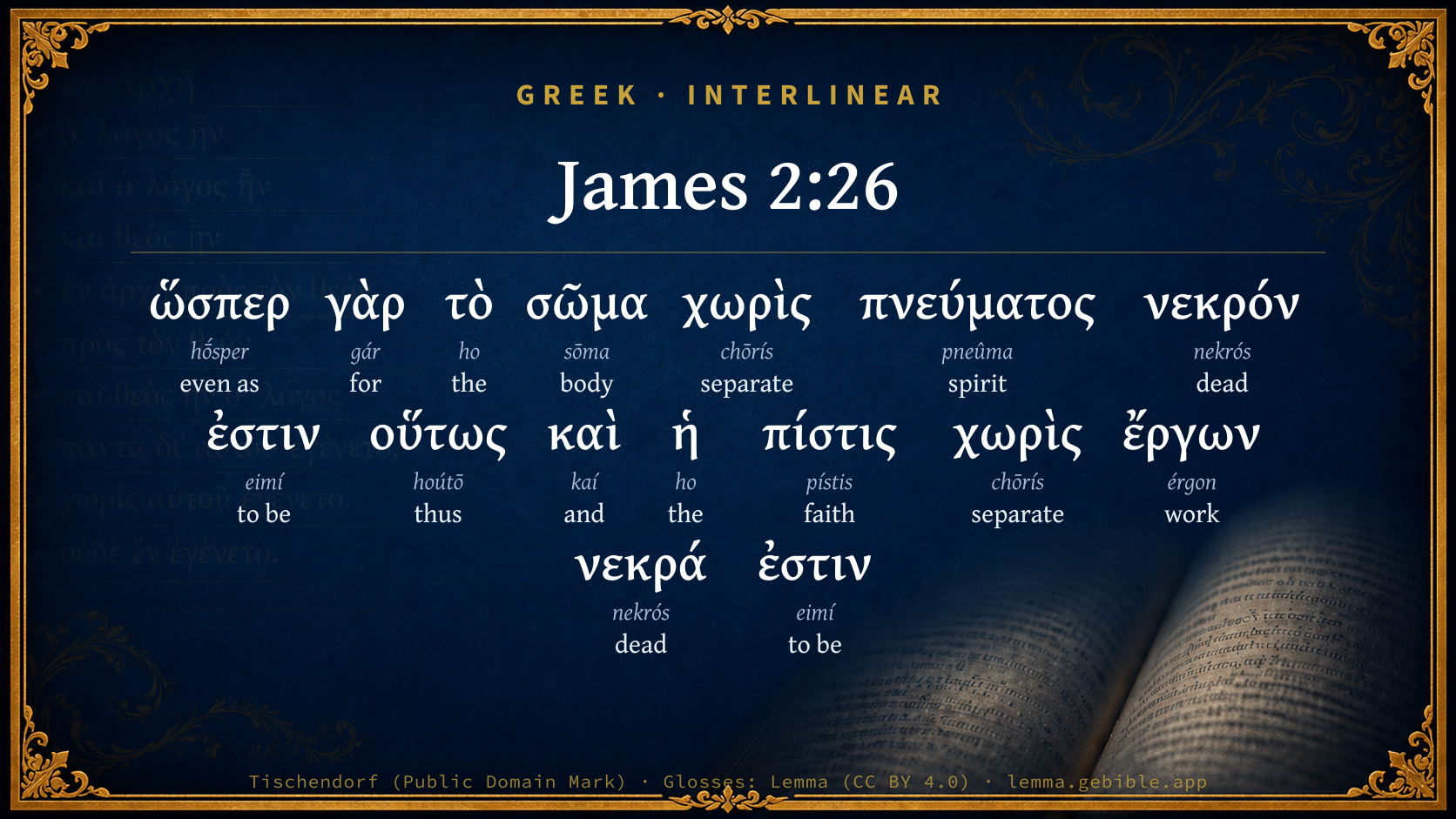
Greek (Tischendorf 8th ed.) James 2:26 appears in the Greek New Testament. The text above is from the Tischendorf 8th edition. Each word links to its Strong’s number and a concise gloss. Click any word for its full Thayer’s Greek Lexicon entry.
Download image
Cite this verse

James 2:26 (World English Bible). Public Domain. Lemma interlinear Bible study tool, https://lemma.gebible.app/v/james/2/26.

Show BibTeX & RIS
BibTeX
RIS
English Translation
For as the body apart from the spirit is dead, even so faith apart from works is dead.
World English Bible · Public Domain
Download a study sheet

One document with this verse’s original text, its word-by-word gloss line, the meaning frame, cross-references with their text, attributed commentary, and full source and license credits — printable, and it pastes into notes with its structure intact.

This verse Autodidact and up

Study sheet (.html) Plain text (.txt)

A passage Seminary Student

Up to 50 verses in one chapter. A passage sheet keeps up to 6 commentary sources and 12 cross-references per verse, in the order this page ranks them, and says so on the sheet whenever that leaves anything out. Ask for a single verse and you get the Autodidact verse sheet above.

Everything on this page stays free to read, with no account — the sheet is a download of what is already on screen, not access to it.

Want to remove ads? Support Godless Engineer
Compare translations 3

The same verse in 3 English versions, stacked beneath the original-language interlinear above. Click any original word for its lexicon entry.

Each is an independent rendering of the whole verse — the interlinear is not word-aligned to these translations.

Highlighted words mark where these versions differ — a whole-verse word diff, not a word-by-word alignment.

  • World English Bible Public Domain
    For as the body apart from the spirit is dead, even so faith apart from works is dead.
  • King James Version Public Domain
    For as the body without the spirit is dead, so faith without works is dead also.
  • unfoldingWord Literal Text CC BY-SA 4.0
    For just as the body without the spirit is dead, thus also the faith without works is dead.

unfoldingWord Literal Text — © unfoldingWord, licensed CC BY-SA 4.0. Word-aligned USFM3 via Door43 (git.door43.org/unfoldingWord/en_ult).

Versions to compare (up to 4)

3 of 4 selected

Show all 19 translations

Every available English version of this verse, each an independent rendering of the whole verse.

  • World English Bible Public Domain
    For as the body apart from the spirit is dead, even so faith apart from works is dead.
  • Berean Standard Bible Public Domain
    As the body without the spirit is dead, so faith without deeds is dead.
  • Majority Standard Bible Public Domain
    For as the body without the spirit is dead, so faith without deeds is dead.
  • King James Version Public Domain
    For as the body without the spirit is dead, so faith without works is dead also.
  • American Standard Version (1901) Public Domain
    For as the body apart from the spirit is dead, even so faith apart from works is dead.
  • Revised Version (1885) Public Domain
    For as the body apart from the spirit is dead, even so faith apart from works is dead.
  • Geneva Bible (1599) Public Domain
    For as the body without ye spirit is dead, euen so the faith without workes is dead.
  • Douay-Rheims (1899) Public Domain
    For even as the body without the spirit is dead; so also faith without works is dead.
  • Young's Literal Translation Public Domain
    for as the body apart from the spirit is dead, so also the faith apart from the works is dead.
  • Literal Standard Version CC BY-SA 4.0
    For as the body apart from [the] spirit is dead, so also the faith apart from works is dead.
  • Unlocked Literal Bible CC BY-SA 4.0
    For as the body apart from the spirit is dead, even so faith apart from works is dead.
  • unfoldingWord Literal Text CC BY-SA 4.0
    For just as the body without the spirit is dead, thus also the faith without works is dead.
  • Darby Bible Public Domain
    For as the body without a spirit is dead, so also faith without works is dead.
  • World Messianic Bible Public Domain
    For as the body apart from the spirit is dead, even so faith apart from works is dead.
  • Webster's Bible Public Domain
    For as the body without the spirit is dead, so faith without works is dead also.
  • Free Bible Version CC BY-SA 4.0
    Just as the body is dead without the spirit, trust in God is dead if you don't do what's right.
  • Bible in Basic English Public Domain
    For as the body without the spirit is dead even so faith without works is dead.
  • Text-Critical English NT CC BY 4.0
    For just as the body without the spirit is dead, so faith without works is also dead.
  • Tyndale New Testament (1534) Public Domain
    For as the body with oute the sprete is deed even so fayth with out dedes is deed.

Literal Standard Version (2020), Covenant Press — licensed CC BY-SA 4.0. Text via the HelloAO Bible API (eBible.org). Unlocked Literal Bible (unfoldingWord) — licensed CC BY-SA 4.0. Text via the HelloAO Bible API (eBible.org). unfoldingWord Literal Text — © unfoldingWord, licensed CC BY-SA 4.0. Word-aligned USFM3 via Door43 (git.door43.org/unfoldingWord/en_ult). Free Bible Version, Dr. Jonathan Gallagher — licensed CC BY-SA 4.0. Text via the HelloAO Bible API (eBible.org).

Word by word

More ways to search: Search by grammar → Find every occurrence → Compare this word →

Practice this passage: Drill this verse → Learn its vocabulary →

About this verse

These counts appear in no published source. They are computed here, from the morphology-tagged text and Lemma’s own curated glosses. What Lemma adds →

16
words
12
distinct lemmas
General Epistles
section

Shared distinctive vocabulary

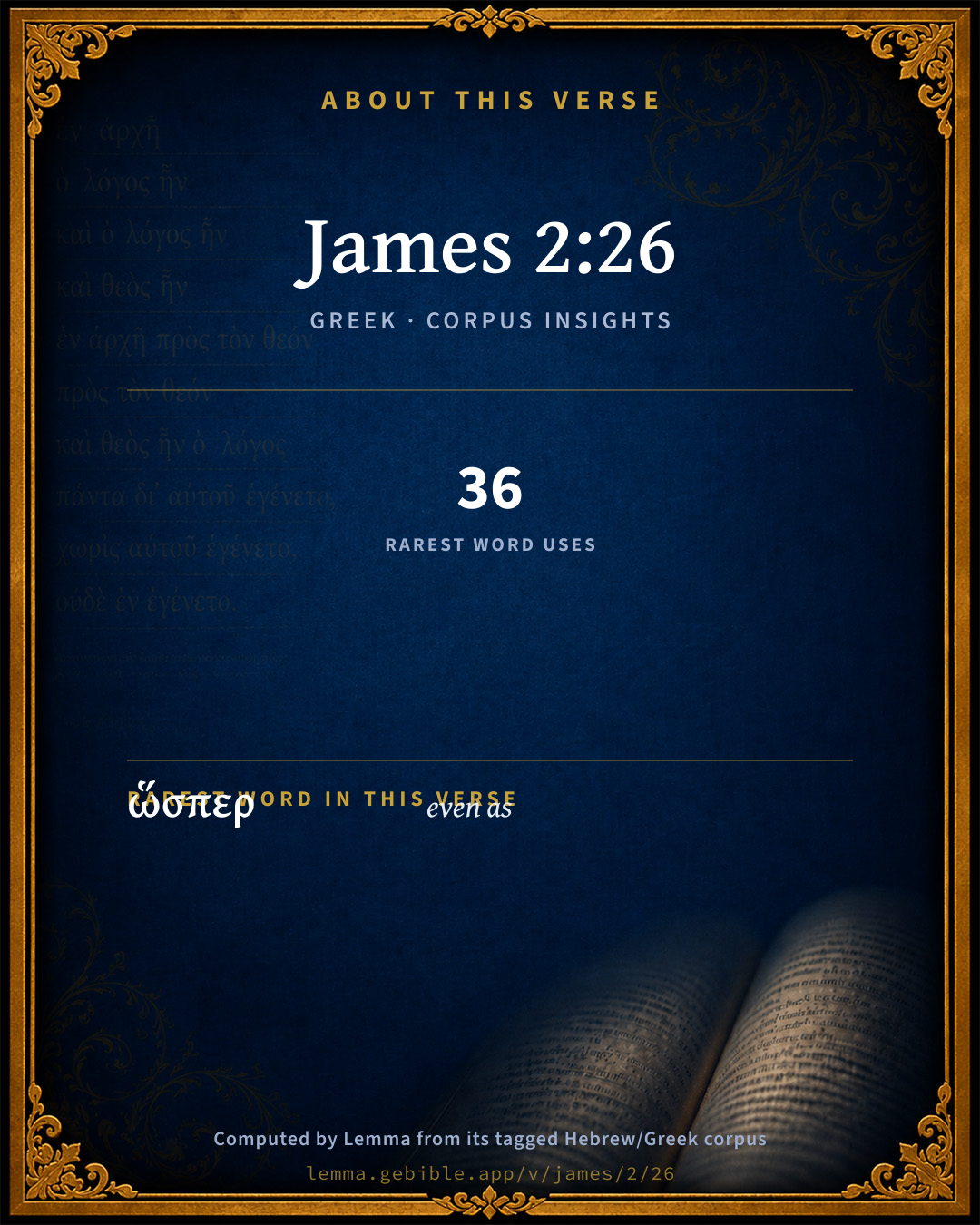
ὥσπερ even as G5618 occurs in 36 verses of the Greek New Testament. Also found in:
Repetition

Words recur within this verse:

  • χωρὶς separate G5565 ×2
  • νεκρόν dead G3498 ×2
  • ἐστιν to be G1510 ×2
  • τὸ the G3588 ×2

Cross-references

9

Topical passages linked to James 2:26 in the Treasury of Scripture Knowledge — connected by theme and wording, ordered by reader-vote popularity; previews shown in the World English Bible.

  • James 2:20 But do you want to know, vain man, that faith apart from works is dead?
  • James 2:17 Even so faith, if it has no works, is dead in itself.
  • James 2:14 What good is it, my brothers, if a man says he has faith, but has no works? Can faith save him?
  • Ecclesiastes 12:7 And the dust returns to the earth as it was, And the spirit returns to God who gave it.
  • Psalms 104:29 You hide your face: they are troubled; You take away their breath: they die, and return to the dust.
  • Job 34:14–15 If he set his heart on himself, If he gathered to himself his spirit and his breath;
  • Acts 7:59–60 They stoned Stephen as he called out, saying, "Lord Jesus, receive my Spirit!"
  • Isaiah 2:22 Stop trusting in man, whose breath is in his nostrils; For of what account is he?
  • Luke 23:46 Jesus, crying with a loud voice, said, "Father, into your hands I commit my spirit!" Having said this, he breathed his last.

Cross-references courtesy of OpenBible.info (CC BY 4.0).

Commentary

Notes on James 2:26 from classic Christian and Jewish commentators (each source and its license shown beneath its notes). The classic Christian expositions comment on the surrounding passage and are grouped to its opening verse, so a note may address several verses; the Jewish commentaries on the Tanakh (Rashi and others) are per-verse, so they appear only where the commentator wrote on this verse.

Lemma curates 59 commentaries, every one of them public domain or Creative Commons licensed, each selected and text-cleaned for this edition rather than reprinted as found. About our sources →

Tyndale Open Study Notes

Tyndale Open Resources

2:26 Good works are as necessary to faith as breath is to a physical body (Gen 2:7). We cannot have one without the other.

Tyndale Open Study Notes — © Tyndale Open Resources, licensed CC BY-SA 4.0. Text via the HelloAO Bible API.

Bengel's Gnomon

Johann Albrecht Bengel

Jas 2:26. Γὰρ, for) For is used in the place of therefore, as Rom 3:28, note.—τὸ σῶμα χωρὶς πνεύματος, the body without a spirit) πνεῦμα often denotes πνοὴν, the breath, which is the sign of life; but when it is opposed to the body, it denotes the spirit or soul: nor is that sense foreign to the meaning of this passage. Faith without works resembles a lifeless body; but it does not therefore follow that living faith derives its life from works. It has been already explained, at Jas 2:21, why James has mentioned works rather than the peculiar energy of faith. Vain pretenders have the form, but not the power of godliness. 2Ti 3:5; Tit 1:16.

Bengel's Gnomon of the New Testament — English translation (T&T Clark, Edinburgh, 1860) — public domain. Text from a community e-Sword module.

Meyer's Critical & Exegetical Commentary

Heinrich August Wilhelm Meyer

Jam_2:26 is added as a reason (γάρ), primarily indeed, to what directly goes before (ἐξ ἔργων ἐδικαιώθη), but thereby likewise to the universal sentiment contained in Jam_2:24. James here repeats the same judgment which he has already expressed (Jam_2:17) on πίστις χωρὶς τῶν ἔργων; yet heightens it by the comparison with σῶμα χωρὶς πνεύματος: for as the body without the spirit is dead, so also faith without works is dead.

τὸ σῶμα χωρὶς πνεύματος] By σῶμα is to be understood the human body, and by πνεῦμα the vital principle animating it, by which it lives; whether James has contemplated πνεῦμα definitely as the intellectual spirit of man (as the principle of the morally-determined and God-derived life peculiar to man), or generally as the breath of life proceeding from God (see Gen_6:17, LXX.: πᾶσα σὰρξ ἐν ᾖ ἐστὶ πνεῦμα ζωῆς; Rev_11:11; Rev_13:15), remains uncertain. With the body without the spirit, which is νεκρός, James compares (οὕτως is not the sign of assurance = even so certainly, Baumgarten) faith without works (the article τῶν denotes works as those which belong to πίστις, its corresponding works), which is also νεκρός. This comparison appears so far incongruous, as the relation of ἔργα to πίστις does not correspond with that of πνεῦμα to the σῶμα, since ἔργα are the fruit, and not the source of πίστις.[160] Therefore some interpreters have by ἔργα understood not works themselves, but love (Theile), or the innermost life of faith in its outwardly operative and visible manifestation (Frank); but such an exchange of ideas is not to be justified. Already some of the older expositors, as Gomar, Piscator, Laurentius, Wolf, and others, and recently Philippi (Theile is undecided), explain ΠΝΕῦΜΑ = breath. This, however, is even linguistically objectionable, as ΠΝΕῦΜΑ in the N. T. occurs in the meaning of breath proceeding out of the mouth only in 2Th_2:8, a passage in accordance with the O. T.; but also in sense this explanation is not justified, for although the breath is the proof of the existence of life in the body (Philippi), yet the ideas breath and works have too great disparity between them to be parallelized with each other. It is more natural, with de Wette, Kern, Hofmann, Wiesinger, and Weiss, to assume that James intends not to compare the single members with each other (ΣῶΜΑ with ΠΊΣΤΙς, and ΠΝΕῦΜΑ with ἜΡΓΟΙς), but to make prominent that a faith which is ΧΩΡῚς ΤῶΝ ἜΡΓΩΝ, is thereby proved to be like to the body, in which the πνεῦμα, the source of life, is wantingwhich is thus only a dead body. With this sentence, in which the idea expressed in Jam_2:17 is strongly confirmed, James closes this section, as from this it is self-evident that faith without works cannot effect justification for man, and consequently not ΣΩΤΗΡΊΑ, and therefore profits nothing (Jam_2:14).

[160] Lange denies the apparent incongruity, because the spirit also, in virtue of its actuality, effects the higher visibility of the body!

1. The doctrine of James in this section is according to expression in opposition with that of the Apostle Paul (James: ἐξ ἔργων δικαιοῦται ἄνθρωπος καὶ οὐκ ἐκ πίστεως μόνον; Paul, Gal_2:16 : οὖ δικαιοῦται ἄνθρωπος ἐξ ἔργων νόμου, ἐὰν μὴ διὰ πίστεως; James asks: Ἀβραὰμ οὐκ ἐξ ἔργων ἐδικαίωθη; Paul, in Rom_4:2, says: εἰ Ἀβραὰμ ἐξ ἔργων ἐδικαιώθη, ἐχεῖκαύχημα, ἀλλʼ οὐ πρὸς τὸν Θεόν). It is asked whether also the sentiment of the one contradicts that of the other. Until the time of Luther, the conviction prevailed that the two agreed in thought. This is maintained in recent times by Neander, Thiersch, Hofmann, Wiesinger, Lange, Hengstenberg, Philippi, and others. Luther, on the contrary, was of opinion that the doctrine of James decidedly contradicted that of Paul; and the same view has been expressed in recent times by de Wette, Kern, Baur, Schwegler, and others, also Ranch. There is a middle view, that there is indeed a diversity of doctrine between Paul and James, but that this does not exclude a higher unity; thus Schmid, Weizsäcker (Renters Repert. Oct. 1855), Lechler, and others.

Already Theophylact, Oecumenius, Bede have, for the sake of harmonizing the difference, asserted that the ἔργα of James are different from those of which Paul speaks; Paul intends opera legis (Oecumenius: τὰ κατὰ νόμον σαββατισμῶν καὶ περιτομῆς καὶ τῶν λοιπῶν ἁγνισμῶν); James, on the contrary, opera fidei (Oecumenius: ἔργα τὰ πίστιν βιβαιοῦιτα). This is indeed true. Paul has to do with Judaizing opponents who maintained the necessity of circumcision, and consequently of all legal works; but James, with such Christians who trusted to simple πίστις, and thought that this would secure their salvation, although destitute of corresponding works. Paul had thus to prove that ἔργα τοῦ νόμου were not necessary; James, that ἔργα τῆς πίστεως were necessary. Nevertheless, this recognition of the different relations does not suffice to an actual harmonizing of the difference; for it has with truth been maintained that, according to the doctrinal system of Paul, a justifying efficacy is denied not only to works of law, but also to works of faith, since these last do not precede, but follow justification.

Accordingly a different meaning of the term πίστις has been adopted, and it has been maintained that by πίστις χωρὶς ἔργων James understands only bare speculation (Oecumenius: ἡ ἀπλῆ συγκατάθεσις), the frigida et nuda notitia, or indeed even the falsa professio fidei. This is certainly not entirely suitable, though Paul does not know by name a πίστις νεκρά. But although it were correct, yet the recognition of this distinction does not suffice to reconcile the difference; for Wieseler is decidedly right when, against Schmid, Olshausen, Neander, and others, he remarks, that it is one thing to say, To be justified by faith which is proved by works, and another thing, To be justified by works in which faith is proved. Already by Calvin, Calovius, Gerhard, and others, and in recent times particularly by Hofmann, Wiesinger, Brückner, Lange, Philippi, and others, the wished-for reconciliation has been attempted to be brought about, by ascribing a different meaning to the word δικαιοῦσθαι in James from what it has in Paul; that James speaks not de actu, but de statu justificationis. But either thereby a meaning is assigned to the word which it never has, or there results from it in James an idea inappropriate to the connection; see exposition of the verses in question. Hengstenberg (Brief des Jakobus in the Evang. Kirchenz. 1866, No. 9194) correctly maintains that δικαιοῦσθαι has with Paul and James the same meaning; but when he attempts to prove the agreement of the two modes of expression by the supposition that, as there are different stages of faith, so there are different stages of justification, and that James speaks of a more perfect justification than Paul in the passages in question, this cannot be admitted, since it contradicts the nature of divine justification to conceive it as advancing from an imperfect to a more and more perfect stage. Even the justification at the last judgment is in itself not more perfect than that by which God in this life absolves the believer from his sins; the distinction consisting only in this, that by the former he obtains salvation as a present blessing, and that in all its fulness, which by the latter was conferred on him as a blessing yet future.[161]

[161] It is incorrect when Hengstenberg says: If by faith is understood genuine living faith, and by works genuine works proceeding from faith, justification by faith and justification by works can be taught without contradiction; since the justification of which Paul speaks is the reason and not the consequence of works of faith: on which account even Riggenbach (On Justification, etc., in the Stud. u. Krit. 1868, Part II.) has not been able to approve of this assertion of Hengstenberg. It is also no less incorrect when Hengstenberg, in spite of ἐξ ἔργων … οὐκ ἐκ πίστεως μόνον, ver. 24, thinks that in James also faith alone is represented as justifying, since James does not give the name of justification to Gods act of grace which is effectual in man only through faith.

The exposition given in the above pages has shown that the idea of the word δικαιοῦσθαι with James is none other than what it is with Paul, but that by it James has in view the justification that places believers at the last judgment in the full enjoyment of salvation, whereas Paul denotes by it the justification that puts believers already in this world in a gracious relation toward God. Only on this supposition does James say what he designs to say; for if δικαιοῦσθαι (so also σώζειν, Jam_2:14) refers to the judgment of God still in the future for believers, the proof that it has ἔργα for its essential condition effectually hits the opponent who thought to be able to obtain σωτηρία by an inoperative faith.

That the doctrine of James so understood is in agreement with that of Paul follows from the following remarks:(1) James here evidently says nothing against the Pauline doctrine of justification, since his ἐξ ἔργων does not refer to being placed in a new relation to God, of which there is no mention. The inquiry, by what this is conditioned, is not discussed by James in his Epistle at all; yet it is to be observed that to him the foundation of the Christian life is πίστις, and that he designates the new birth (chap. Jam_1:18) as a work of God, which only takes place through the will of God, and indeed so that God implants the word of truth in man. That James in this asserts something which is not in contradiction, but in agreement with Pauls doctrine of justification, requires no proof. (2) The doctrine of Paul concerning the future judgment of believers does not conflict with what James says of δικαιοῦσθαι, although he does not use that expression in reference to it (except in Rom_2:13). It is to be observed, that Paul very definitely distinguishes the justifying act of God, by which the forgiveness of sins is adjudged to the believer for the sake of Christ, from the judicial act of God by which σωτηρία will either be adjudged or denied to the justified. Justification (so called by Paul) is conditioned on the part of man only by πίστις; the future σωτηρία will only be adjudged to him in whom πίστις has proved itself to be a working principle. As, on the one hand, it is incorrect to affirm that, according to Paul, he only is justified by πίστις with whom it does not remain inactive; so, on the other hand, it is incorrect to think that according to him no reference is taken of ἔργα in the judgment of God.[162] Wiesinger, in proof that Paul denies the justifying (the word taken in his sense) efficacy of an inoperative faith, adduces the passages, Rom_8:4; Rom_8:13; Rom_13:8-10; 1Co_6:7-11; 1Co_6:13; Gal_5:6; Gal_5:19-21; Eph_2:8-10; Col_1:10; Tit_2:14; but it is, on the contrary, to be observed that in none of these passages (except Eph_2:8, in the words ἐστε σεσωσμένοι διὰ τῆς πίστεως) is the discourse of being justified (ΔΙΚΑΙΟῦΣΘΑΙ, in the sense of Paul). All these passages, however, prove that Paul makes the attainment of ΣΩΤΗΡΊΑ, or the future inheritance of the kingdom of God, conditioned on the ἔργοις of the justified. It is to be observed that in Gal_5:6, ΠΊΣΤΙς ΔΙʼ ἈΓΆΠΗς ἘΝΕΡΓΟΥΜΈΝΗ does not (as is almost universally assumed) refer to ΔΙΚΑΙΟῦΣΘΑΙ, but to ἈΠΕΚΔΈΧΕΣΘΑΙ ἘΛΠΊΔΑ ΔΙΚΑΙΟΣΎΝΗς, thus to the hope of those who are σεσωσμένοι διὰ τῆς πίστεως. Further, in 1Co_6:11, the Christians, to whom Paul says ἈΠΕΛΟΎΣΑΣΘΕ, ἩΓΙΆΣΘΗΤΕ, ἘΔΙΚΑΙΏΘΗΤΕ,[163] are exhorted to consider that the ἄδικοι shall not inherit the βασιλεία Θεοῦ; also, in Gal_5:25, it is indicated that the ζῆν πνεύματι, which is peculiar to believers, must also be a στοιχεῖν πνεύματι; and lastly, Paul in 2Co_5:10 says expressly that we all (that is, Christians who as such are δικαιωθέντες) must appear before the judgment-seat of Christ, ἵνα κομίσηται ἕκαστος τὰ διὰ τοῦ σώματος πρὸς ἃ ἔπραξεν, εἴτε ἀγαθόν, εἴτε κακόν. From these passages, which might be greatly multiplied, it is not to be denied that Paul, as he definitely excludes every co-operation of human works in justification,[164] so he no less definitely represents the future salvation as conditioned by the practice of ἔργα τῆς πίστεως (see Hengstenberg, Evangel. Kirchenztg. 1866, p. 1119 ff.).[165] But if this is the case, then in reference to this point there occurs a difference between Paul and James, not in thought, but only in expression; namely, Paul denotes by the word δικαιοῦν that declaration of righteousness or acquittal by God, by which the believer is placed in a new filial relation to God; whilst James means that declaration of righteousness or acquittal by God, by which he who is born again as a child of God receives the σωτηρία imparted at the judgment; but with both δικαιοῦν means to declare righteous, to acquit, but not to prove one righteous, or to convert him into a righteous man. So also, in what both say concerning Abraham, there is no difference in sentiment; the only difference is that ἐλογίσθη αὐτῷ εἰς δικαιοσύνην and ἐδικαιώθη are considered by James as two points, whilst Paul considers the second to be equivalent to the first.

[162] By this it is not intended to be denied that Paul often combines the two acts as one act of divine salvation, and also that he frequently refers the final salvation (not less than justification) purely to the grace of God. The problem is rather this, that, on the one hand, the final salvation is represented as a pure act of Gods grace, but, on the other hand, the final judgment is as definitely represented as an act carried into effect κατὰ τὰ ἔργα; as by Paul, so in the Scriptures generally. The solution of this problem, however, belongs not to our present subject.

[163] By ἡγιάσθητε and ἐδικαιώθητε a change of mans disposition is not in itself designated, but the change of his relation to God effected by God. Meyer in loco incorrectly gives to the word δικαιοῦσθαι a meaning (namely, to be made righteous) which it has elsewhere neither with Paul nor in any other passage of the N. T.

[164] Even with the recognition of this undeniable fact, Pauls doctrine of justification by faith is not always understood in strict precision. This is particularly the case when it is said, that according to Paul faith justifies, so far as it is a principle of new life, whereas it is rather the case that, according to him, faith is a principle of new life, because it justifies. Only when this is misunderstood can it be said, on the supposition that Paul and James understand by δικαιοῦν the same divine act, that between them there is no fundamental, but only an unessential contrast. See remarks of the author in the Erl. Zeitschr. April number, 1862, p. 214 f., where among other things it is said: The reason of justification is not the ethical nature of faith, but solely and entirely the merit of Christ or Christ Himself with whom faith, that is, faith in Christ, places us in connection. We are not justified for the sake of faith, but through faith (διὰ τῆς πίστεως) for the sake of Christ: thus it holds good for the justification which is by faith alone, that every reference to works is entirely excluded.

[165] The objection of Philippi, that the declaration of righteousness in the judgment takes place not ἐκ τῶν ἔργων, but only κατὰ τὰ ἔργα, is contradicted by the word of Christ, Mat_12:37.

2. If from what has been said it follows that the doctrine of James is not in contradiction with that of Paul, then every reason for the opinion that James wrote his Epistle with reference to Paul falls to the ground. The employment of the same expressions by both is indeed surprising, but it is to be observed that these expressions have their origin neither in Paul nor in James, but already occur in the O. T. Paul uses the expressions δικαιοῦσθαι, δικαιοσύνη, δικαίωσις, chiefly in a relation foreign to the O. T., to which, however, he was led by the words ἐλογίσθη εἰς δικαιοσύνην. James, on the contrary, uses them not in the application peculiar to Paul, but in the manner in which they are used in the O. T. Also the reference to Abraham by James is not to be explained on the ground that Paul confirms his doctrine of justification by what happened to Abraham; for, since James designed to appeal for his assertion to an O. T. type, it was entirely natural that his glance should first fall on Abraham; also the distinction is to be observed that James used Abraham only as an example, whereas Paul, as Schleiermacher correctly observes, referred to him his entire peculiar system of doctrine, whilst he would trace back to him the special covenant of the people with God.

From all this it follows that James neither designed an attack upon the Pauline doctrine itself, for in this case he would have been obliged to demonstrate the necessity of ἔργα νόμου, nor also an attack upon a misunderstanding of it, for then he would have been obliged to show that his readers could only regard themselves as δικαιωθέντες, when their faith was to them an impulse to the practice of good works;[166] rather the Pauline doctrine was unknown to him, since otherwise he would necessarily have conformed to Pauls mode of representation. By this likewise the opinion is confirmed, that the composition of the Epistle belongs not to the later, but to the earlier apostolic times; see on this Sec. 4 of the Introduction, and the treatise of Weiss mentioned above; also his bibl. Theol. p. 124 f.

[166] How the deductions of James are to be directed against a misunderstanding of the Pauline doctrine, if δικαιοῦσθαι has with him the meaning of to be proved, is in fact not to be understood, so much the less as the justifying power of faith assuredly does not depend on its being proved by works before men.

Meyer — Critical and Exegetical Commentary on the New Testament — English translation by Peter Christie, edited by Frederick Crombie (T&T Clark, 1880) — public domain. Text from a community e-Sword module.

Expositor's Greek Testament

ed. W. Robertson Nicoll

Jas 2:26 . πνεύματος : Spitta’s suggested reading, κινήματος , is very ingenious, but quite unnecessary; רוח is often used of “breath,” and the Greek equivalent, πνεῦμα , is also used in the same way in the Septuagint.

The Expositor's Greek Testament, edited by W. Robertson Nicoll (1897–1910) — public domain. Text from a community e-Sword module.

Geneva Bible (1599)

Geneva Bible translators

The conclusion repeated again: faith which bringeth not forth fruits and works, is not faith, but a dead carcass.

Geneva Bible (1599) marginal notes — public domain. Text via Bolls.life.

Jamieson, Fausset & Brown

Robert Jamieson, A. R. Fausset & David Brown

Faith is a spiritual thing: works are material. Hence we might expect faith to answer to the spirit, works to the body. But James reverses this. He therefore does not mean that faith in all cases answers to the body; but the FORM of faith without the working reality answers to the body without the animating spirit. It does not follow that living faith derives its life from works, as the body derives its life from the animating spirit.

Next: James Chapter 3

Jamieson, Fausset & Brown — Commentary Critical and Explanatory on the Whole Bible (1871) — public domain (CC PDM 1.0). Text via the HelloAO Bible API.

Adam Clarke's Commentary

Verse 26. For as the body without the spirit is dead] There can be no more a genuine faith without good works, than there can be a living human body without a soul.

WE shall never find a series of disinterested godly living without true faith. And we shall never find true faith without such a life. We may see works of apparent benevolence without faith; their principle is ostentation; and, as long as they can have the reward (human applause) which they seek, they may be continued. And yet the experience of all mankind shows how short-lived such works are; they want both principle and spring; they endure for a time, but soon wither away. Where true faith is, there is God; his Spirit gives life, and his love affords motives to righteous actions. The use of any Divine principle leads to its increase. The more a man exercises faith in Christ, the more he is enabled to believe; the more he believes, the more he receives; and the more he receives, the more able he is to work for God. Obedience is his delight, because love to God and man is the element in which his soul lives. Reader, thou professest to believe; show thy faith, both to God and man, by a life conformed to the royal law, which ever gives liberty and confers dignity.

"Some persons, known to St. James, must have taught that men are justified by merely believing in the one true God; or he would not have taken such pains to confute it. Crediting the unity of the Godhead, and the doctrine of a future state, was that faith through which both the Jews in St. James' time and the Mohammedans of the present day expect justification. St. James, in denying this faith to be of avail, if unaccompanied with good works, has said nothing more than what St. Paul has said, in other words, Rom. 2, where he combats the same Jewish error, and asserts that not the hearers but the doers of the law will be justified, and that a knowledge of God's will, without the performance of it, serves only to increase our condemnation."-Michaelis.

Adam Clarke's Commentary on the Bible (1810–1826) — public domain. Text from a community e-Sword/MySword module.

Ellicott's Commentary for English Readers

(26) As the body without the spirit . . .—A closing simile of much force, As the body without the spirit, so faith without works. But the term “without” is hardly strong enough to represent the Greek “apart from.” Of our own human wisdom we had been rather inclined to say that works were likest to the body, and faith to the breath or animation thereof. “The Apostle’s view,” says Alford, “seems to be this, Faith is the body, the sum and substance of the Christian life; works (= obedience) the moving and quickening of that body, just as the spirit is the moving and quickening principle of the natural body. So that ‘as the body without the spirit is dead, so faith without works is also dead.’ ”

A Bible Commentary for English Readers, edited by Charles John Ellicott (1878–1897) — public domain. Text from a community e-Sword module.

The Cambridge Bible for Schools and Colleges

gen. ed. J. J. S. Perowne

26. For as the body without the spirit is dead …] Some MSS. omit the conjunction, but the evidence for retaining it preponderates. The reasoning seems to refer Rahab’s justification by works to the wider law that faith without works is dead (as in Jas_2:17) and therefore cannot justify. Our usual mode of thought would lead us to speak of works, the outward visible acts, as the body, and of faith as the spirit or vivifying principle. From St James’s standpoint, however, faith “by itself” was simply the assent of the intellect to a dogma or series of dogmas, and this seemed to him to be “dead” until it was vitalised by love shewing itself in act. St Paul reproves the deadness of mere morality, St James that of mere orthodoxy. St James, it will be noted, adopts the simple division of man’s nature into “body and spirit,” rather than St Paul’s more philosophical trichotomy of “body, soul and spirit.” 1Th_5:23. Comp. note on ch. Jas_3:13.

faith without works] More literally, faith apart from works.

ON THE TEACHING OF ST PAUL AND ST JAMES

The view which has been given in the notes seems to the writer clear and coherent in itself, consistent with what we know as to the relations between the two Apostles, and involving less violence of interpretation than any other hypothesis. Two other views have, however, been maintained with arguments more or less plausible, and it will be well to notice them briefly.

(1) There is the position assumed by some of the bolder critics of the French and German Schools, that there was a real antagonism in the Apostolic Church, not only between the Judaizing teachers and St Paul, but between that Apostle and the three, Peter, James, and John, to whom the Church of the Circumcision looked as its natural leaders. On this assumption, the writer of the Acts of the Apostles strives to gloss over the divergence of the two parties, and to represent an unreal unity. The messages to the Seven Churches are “a cry of passionate hate against St Paul and his followers” (Renan, St Paul, p. 367). When St James says, “Wilt thou know, O vain man, that faith without works is dead,” he is probably pointing at St Paul himself. From the point of view of those who hold this theory it is, perhaps, a small thing that it is inconsistent with the belief that the teaching of St James and of St Paul had, as its source, the inspiration of the Eternal Spirit, who, though working in many different ways and with wide diversity of gifts, is yet the Spirit of the Truth which is essentially one. But on simply historical grounds the theory is, it is believed, untenable. St Paul himself acknowledges that after he had privately laid before them the sum and substance of the Gospel as he preached it, James, Cephas, and John gave to him the right hands of fellowship (Gal_2:9). James appears as giving a public sanction to that Gospel at the Council at Jerusalem (Act_15:13-21). Long after the Judaizing teachers had been doing their worst for years, the “right hand of fellowship” is still held out by the one teacher to the other (Act_21:17-25). The question whether this hypothesis is as satisfactory an explanation of the facts with which it deals, as that which I have here given, I am content to leave to the judgment of the reader.

(2) The other theory has at least the merit of accepting the teaching of each of the two writers as in itself inspired and true. It assumes that St James wrote after St Paul, and aimed at correcting inferences that had been wrongly drawn from his doctrine, that a man is justified by faith without the deeds of the law. How to reconcile their statements on this assumption is a problem which has been variously solved. (a) It has been said that St Paul speaks of man’s justification before God, St James of the proof of that justification before the eyes of men; but of this there is not a shadow of proof in the language of either writer. (b) It has been maintained that St Paul speaks of a true faith, St James of that which is false or feigned; but nothing in the language of the latter, though he stigmatizes the faith which is without works as dead, suggests the thought that it did not mean a real acceptance of the dogma which it professed to hold. (c) It has been held that the “works” of which St Paul speaks as unable to justify, are the ceremonial works of the law of Moses, those on which the Pharisees laid stress; but the width of St Paul’s teaching as to the nature and office of the law in Galatians 3, Romans 7 scatters this view to the winds at once. (d) There is a nearer approximation to the truth in the solution which finds in St James’s faith the intellectual acceptance of a dogma, in St Paul’s the trust in a living Person as willing and able to save, and therefore the confidence that salvation is attainable by him who so trusts. This is, in the main, the view that has been taken in these notes, with the exception of the point on which stress has been laid above, that the Antinomianism which St James condemned was that of ultra-Jewish teachers, who taught a justification by faith in Monotheism, and not of an ultra-Pauline party. It agrees practically with the distinction drawn by the Schoolmen that St James speaks of a fides informis, rudimentary and incomplete, St Paul of a fides formata, developed or completed by Love. Errors, however, assume subtle disguises. Those who used St James’s name in the Apostolic age dwelt so much on outward acts apart from the motive that gives them life, as sufficient for man’s acceptance with God, that it was necessary for St Paul to revive the truth which had been first distorted and then denied, that “the just by faith shall live” (Hab_2:4; Rom_1:17; Gal_3:11). His teaching again, in its turn, led men to think that they might be justified by faith, not in God who justifies, but in a dogma about justification. It was well that both aspects of the truth should have been presented then, and have been preserved for the guidance of the Church in all ages, as completing each the other. We need not fear to be as varied in our teaching as were those who were taught of God, and to tell men, according to their variations in character, as they require more deepening of the spiritual life, or more strengthening for practical activity, now that they must be justified by faith, and now that they must be justified by works.

The Cambridge Bible for Schools and Colleges (gen. ed. J. J. S. Perowne; Cambridge University Press, 1878–1918) — public domain. Text from a community e-Sword module.

John Gill's Exposition

For as the body without the spirit is dead,.... This simile is made use of to illustrate what the apostle had asserted in Jam 2:17 that as a body, when the spirit or soul is departed from it, or the breath is gone out of it, is dead, and without motion, and useless; which the Jews (d) express in like manner, , "the body without the spirit", or "breath, is a carcass".

So faith without works is dead also: a vain thing, useless and unprofitable, can neither justify, nor save, nor prove that a man is justified, or will be saved.

(d) Ohel. Moed, fol. 15. 1.

Next: James Chapter 3

John Gill's Exposition of the Whole Bible (1746–1763) — public domain (CC PDM 1.0). Text via the HelloAO Bible API.

Trapp's Complete Commentary

John Trapp

26 For as the body without the spirit is dead, so faith without works is dead also.

Ver. 26. As the body, &c.] Yet is not charity the soul of faith, but the vital spirit only.

John Trapp, A Commentary or Exposition upon All the Books of the Old and New Testament (1647–1656) — public domain. Text from a community e-Sword module.

Albert Barnes' Notes on the Bible

For as the body without the spirit is dead - Margin, “breath.” The Greek word πνεύμα pneuma is commonly used to denote spirit or soul, as referring to the intelligent nature. The meaning here is the obvious one, that the body is animated or kept alive by the presence of the soul, and that when that is withdrawn, hope departs. The body has no life independent of the presence of the soul.

So faith without works is dead also - There is as much necessity that faith and works should be united to constitute true religion, as there is that the body and soul should be united to constitute a living man. If good works do not follow, it is clear that there is no true and proper faith; none that justifies and saves. If faith produces no fruit of good living, that fact proves that it is dead, that it has no power, and that it is of no value. This shows that James was not arguing against real and genuine faith, nor against its importance in justification, but against the supposition that mere faith was all that was necessary to save a man, whether it was accompanied by good works or not. He maintains that if there is genuine faith it will always be accompanied by good works, and that it is only that faith which can justify and save. If it leads to no practical holiness of life, it is like the body without the soul, and is of no value whatever. James and Paul both agree in the necessity of true faith in order to salvation; they both agree that the tendency of true faith is to produce a holy life; they both agree that where there is not a holy life there is no true religion, and that a man cannot be saved. We may learn, then, from the whole doctrine of the New Testament on the subject, that unless we believe in the Lord Jesus we cannot be justified before God; and that unless our faith is of that kind which will produce holy living, it has no more of the characteristics of true religion than a dead body has of a living man.

Reconciliation of Paul and James.

At the close of the exposition of this chapter, it may be proper to make a few additional remarks on the question in what way the statements of James can be reconciled with those of Paul, on the subject of justification. A difficulty has always been felt to exist on the subject; and there are, perhaps, no readers of the New Testament who are not perplexed with it. Infidels, and particularly Voltaire, have seized the occasion which they supposed they found here to sneer against the Scriptures, and to pronounce them to be contradictory. Luther felt the difficulty to be so great that, in the early part of his career, he regarded it as insuperable, and denied the inspiration of James, though be afterwards changed his opinion, and believed that his Epistle was a part of the inspired canon; and one of Luther’s followers was so displeased with the statements of James, as to charge him with willful falsehood. - Dr. Dwight’s Theology, Serm. lxviii. The question is, whether their statements can be so reconciled, or can be shown to be so consistent with each other, that it is proper to regard them both as inspired men? Or, are their statements so opposite and contradictory, that it cannot be believed that both were under the influences of an infallible Spirit? In order to answer these questions, there are two points to be considered:

What the real difficulty is; and, How the statements of the two writers can be reconciled, or whether there is any way of explanation which will remove the difficulty.

I. What the difficulty is. This relates to two points - that James seems to contradict Paul in express terms, and that both writers make use of the same case to illustrate their opposite sentiments.

(1) That James seems to contradict Paul in express terms. The doctrine of Paul on the subject of justification is stated in such language as the following: “By the deeds of the law there shall no flesh be justified in his sight,” Rom 3:20. “We conclude that a man is justified by faith without the deeds of the law,” Rom 3:28. “Being justified by faith,” Rom 5:1. “Knowing that a man is not justified by the works of the law, but by the faith of Jesus Christ,” Gal 2:16. Compare Rom 3:24-26; Gal 3:11; Tit 3:5-6. On the other hand, the statement of James seems to be equally explicit that a man is not justified by faith only, but that good works come in for an important share in the matter. “Was not Abraham our father justified by works?” Jam 2:21. “Seest thou how faith wrought with his works?” Jam 2:22. “Ye see then how that by works a man is justified, and not by faith only,” Jam 2:24.

(2) Both writers refer to the same case to illustrate their views - the case of Abraham. Thus Paul Rom 4:1-3 refers to it to prove that justification is wholly by faith. “For if Abraham were justified by works, he hath whereof to glory; but not before God. For what saith the Scripture? Abraham believed God, and it was imputed unto him for righteousness.” And thus James Jam 2:21-22 refers to it to prove that justification is by works: “Was not Abraham our father justified by works when he had offered Isaac his son upon the altar?”

The difficulty of reconciling these statements would be more clearly seen if they occurred in the writings of the same author; by supposing, for example, that the statements of James were appended to the fourth chapter of the Epistle to the Romans, and were to be read in connection with that chapter. Who, the infidel would ask, would not be struck with the contradiction? Who would undertake to harmonize statements so contradictory? Yet the statements are equally contradictory, though they occur in different writers, and especially when it is claimed for both that they wrote under the influence of inspiration.

II. The inquiry then is, how these apparently contradictory statements may be reconciled, or whether there is any way of explanation that will remove the difficulty. This inquiry resolves itself into two - whether there is any theory that can be proposed that would relieve the difficulty, and whether that theory can be shown to be well founded.

(1) Is there any theory which would remove the diffficulty - any explanation which can be given on this point which, if true, would show that the two statements may be in accordance with each other and with truth?

Before suggesting such an explanation, it may be further observed, that, as all history has shown, the statements of Paul on the subject of justification are liable to great abuse. All the forms of Antinomianism have grown out of such abuse, and are only perverted statements of his doctrine. It has been said, that if Christ has freed us from the necessity of obeying the law in order to justification; if he has fulfilled it in our stead, and borne its penalty, then the law is no longer binding on those who are justified, and they are at liberty to live as they please. It has been further said, that if we are saved by faith alone, a man is safe the moment he believes, and good works are therefore not necessary. It is possible that such views as these began to prevail as early as the time of James, and, if so, it was proper that there should be an authoritative apostolic statement to correct them, and to check these growing abuses. If, therefore, James had, as it has been supposed he had, any reference to the sentiments of Paul, it was not to correct his sentiments, or to controvert them but it was to correct the abuses which began already to flow from his doctrines, and to show that the alleged inferences did not properly follow from the opinions which he held; or, in other words, to show that the Christian religion required men to lead holy lives, and that the faith by which it was acknowledged that the sinner must be justified, was a faith which was productive of good works.

Now, all that is necessary to reconcile the statements of Paul and James, is to suppose that they contemplate the subject of justification from different points of view, and with reference to different inquiries. Paul looks at it before a man is converted, with reference to the question how a sinner may be justified before God; James after a man is converted, with reference to the question how he may show that he has the genuine faith which justifies. Paul affirms that the sinner is justified before God only by faith in the Lord Jesus, and not by his own works; James affirms that it is not a mere speculative or dead faith which justifies, but only a faith that is productive of good works, and that its genuineness is seen only by good works. Paul affirms that whatever else a man has, if he have not faith in the Lord Jesus, he cannot be justified; James affirms that no matter what pretended faith a man has, if it is not a faith which is adapted to produce good works, it is of no value in the matter of justification. Supposing this to be the true explanation, and that these are the “stand-points” from which they view the subject, the reconciliation of these two writers is easy: for it was and is still true, that if the question is asked how a sinner is to be justified before God, the answer is to be that of Paul, that it is by faith alone, “without the works of the law;” if the question be asked, how it can be shown what is the kind of faith that justifies, the answer is that of James, that it is only that which is productive of holy living and practical obedience.

(2) Is this a true theory? Can it be shown to be in accordance with the statements of the two writers? Would it be a proper explanation if the same statements had been made by the same writer? That it is a correct theory, or that it is an explanation founded in truth, will be apparent if:

(a)The language used by the two writers will warrant it;

(b)If it accords with a fair interpretation of the declarations of both writers; and,

(c)If, in fact, each of the two writers held respectively the same doctrine on the subject.

(a) Will the language bear this explanation? That is, will the word justify, as used by the two writers, admit of this explanation? That it will, there need be no reasonable doubt; for both are speaking of the way in which man, who is a sinner, may be regarded and treated by God as if he were righteous - the true notion of justification. It is not of justification in the sight of men that they speak, but of justification in the sight of God. Both use the word “justify” in this sense - Paul as affirming that it is only by faith that it can be done; James as affirming, in addition not in contradiction, that it is by a faith that produces holiness, and no other.

(b) Does this view accord with the fair interpretation of the declarations of both writers?

In regard to Paul, there can be no doubt that this is the point from which he contemplates the subject, to wit, with reference to the question how a sinner may be justified. Thus, in the Epistle to the Romans, where his principal statements on the subject occur, he shows, first, that the Gentiles cannot be justified by the works of the law, Rom. 1, and then that the same thing is true in regard to the Jews, Rom. 2–3, by demonstrating that both had violated the law given them, and were transgressors, and then Rom 3:20 draws his conclusion, “Therefore by the deeds of the law there shall no flesh be justified in his sight” - the whole argument showing conclusively that he is contemplating the subject before a man is justified, and with reference to the question how he may be.

In regard to James, there can be as little doubt that the point of view from which he contemplates the subject, is after a man professes to have been justified by faith, with reference to the question what kind of faith justifies, or how it may be shown that faith is genuine. This is clear,

(aa) because the whole question is introduced by him with almost express reference to that inquiry: “What doth it profit, my brethren, though a man say he hath faith, and have not works? Can faith save him?” Jam 2:14. That is, can such faith - can this faith (ἡ πίστις hē pistis) save him? In other words, He must have a different kind of faith in order to save him. The point of James” denial is not that faith, if genuine, would save; but it is, that such a faith, or a faith without works, would save.

(bb) That this is the very point which he discusses, is further shown by his illustrations, Jam 2:15-16, Jam 2:19. He shows Jam 2:15-16 that mere faith in religion would be of no more value in regard to salvation, than if one were naked and destitute of food, it would meet his wants to say, “Depart in peace, be ye warmed and filled;” and then Jam 2:19, that even the demons had a certain kind of faith in one of the cardinal doctrines of religion, but that it was a faith which was valueless - thus showing that his mind was on the question what is true and genuine faith.

(cc) Then he shows by the case to which he refers Jam 2:21-23 - the case of Abraham - that this was the question before his mind. He refers not to the act when Abraham first believed - the act by which as a sinner he was justified before God; but to an act that occurred twenty years after - the offering up of his son Isaac. See the notes at those verses. He affirms that the faith of Abraham was of such a kind that it led him to obey the will of God; that is, to good works. Though, as is implied in the objection referred to above, he does refer to the same case to which Paul referred - the case of Abraham - yet it is not to the same act in Abraham. Paul Rom 4:1-3 refers to him when he first believed, affirming that he was then justified by faith; James refers indeed to an act of the same man, but occurring twenty years after, showing that the faith by which he had been justified was genuine. Abraham was, in fact, according to Paul, justified when he believed, and, had he died then, he would have been saved; but according to James, the faith which justified him was not a dead faith, but was living and operative, as was shown by his readiness to offer his son on the altar.

(c) Did each of these two writers in reality hold the same doctrine on the subject? This will be seen, if it can be shown that James held to the doctrine of justification by faith, as really as Paul did; and that Paul held that good works were necessary to show the genuineness of faith, as really as James did.

(1) They both agreed in holding the doctrine of justification by faith. Of Paul’s belief there can be no doubt. That James held the doctrine is apparent from the fact that he quotes the very passage in Genesis, Gen 15:6, and the one on which Paul relies, Rom 4:1-3, as expressing his own views - “Abraham believed God, and it was imputed unto him for righteousness.” The truth of this, James does not deny, but affirms that the Scripture which made this declaration was fulfilled or confirmed by the act to which he refers.

(2) They both agreed in holding that good works are necessary to show the genuineness of faith. Of James” views on that point there can be no doubt. That Paul held the same opinion is clear.

(a) from his own life, no man ever having been more solicitous to keep the whole law of God than he was.

(b) From his constant exhortations and declarations, such as these: “Created in Christ Jesus unto good works,” Eph 2:10; “Charge them that are rich, that they be rich in good works,” 1Ti 6:17-18; “In all things showing thyself a pattern of good works,” Tit 2:7; “Who gave himself for us, that he might purify unto himself a peculiar people, zealous of good works,” Tit 2:14; “These things I will that thou affirm constantly, that they which have believed in God might be careful to maintain good works,” Tit 3:8.

(c) It appears from the fact that Paul believed that the rewards of heaven are to be apportioned according to our good works, or according to our character and our attainments in the divine life. The title indeed to eternal life is, according to him, in consequence of faith; the measure of the reward is to be our holiness, or what we do. Thus he says, 2Co 5:10, “For we must all appear before the judgment-seat of Christ, that every one may receive the things done in his body.” Thus also he says, 2Co 9:6, “He which soweth sparingly. shall reap also sparingly; and he which soweth bountifully, shall reap also bountifully.” And thus also he says, Rom 2:6, that God “will render to every man according to his deeds.” See also the influence which faith had on Paul personally, as described in the third chapter of his Epistle to the Philippians. If these things are so, then these two writers have not contradicted each other, but, viewing the subject from different points, they have together stated important truths which might have been made by any one writer without contradiction; first, that it is only by faith that a sinner can be justified - and second, that the faith which justifies is that only which leads to a holy life, and that no other is of value in saving the soul. Thus, on the one hand, men would be guarded from depending on their own righteousness for eternal life; and, on the other, from all the evils of Antinomianism. The great object of religion would be secured - the sinner would be justified, and would become personally holy.

Albert Barnes' Notes on the Bible (1834–1885) — public domain. Text from a community e-Sword/MySword module.

Matthew Poole's English Annotations

The spirit: this may be understood either, according to the marginal reading, of the breath; and then the sense is, that life and breath being inseparable companions, as the the of breath argues want of life in the body, so, lively faith and works being as inseparable, want of works argues want of life in faith: or, according to the reading in the text, spirit, taking it for that substance which animates the body, and is the cause of vital functions in it, which is sometimes called spirit, Psa 31:5; Ecc 12:7; 1Co 2:11; and then the sense is, that as a body is without a soul, so faith is without works, i.e. both are dead. As a body without the soul hath the shape and lineaments of a man, but nothing that may discover life in it; so faith without works may be like true faith, have some resemblance of it, but hath nothing to discover the truth and life of it.

So faith; not true faith, for that cannot be dead, but an empty profession of faith, which is rather called faith by way of concession, or because of some likeness it hath to it, than really is so; as a dead body, though called a body, is really but a carcass.

Matthew Poole's English Annotations on the Holy Bible (1683–1685) — public domain. Text from a community e-Sword/MySword module.

Whedon's Commentary on the Bible

Daniel D. Whedon

26. As the body… so faith—Reciprocally, we may make faith the body and works the spirit necessary to its life; or works the body of which faith is the spirit. Faith is the dead body without works; for it is truly without the active will-power, without which it is the mere dead speculative belief, like that of the demons in Jas_2:19.

St. James’s paragraph here on faith and works has, from its marked antithesis to Paul’s language of the same point, furnished a fruitful topic for discussion to commentators and theologians. Huther, in a brief excursus, summarizes its history. Before the Reformation no difficulty of reconciliation was felt. Luther opened the query with a strong and repeated rejection of the epistle from the canon as contradictory to Paul, unapostolic, and unauthentic. The consistency of James with Paul has, nevertheless, been recognised by the German scholars, Neander, Wiesinger, and Hengstenberg; but denied by De Wette, Baur, and other rationalists. Huther reconciles the two (as Fletcher of Madeley, in his “Checks,” did before him) by saying that Paul speaks of present justification, which is truly by faith, and James of our justification at the day of Judgment, which is “according to” our works, as is attested by many Scripture passages. But so far as time comes into view this distinction fails; for God’s judicial estimate of us is ever now, “according to” our present moral state. The final judgment is but the closing public pronunciation of the final sum total of our character. God’s present judgment is as much “according to” our works as his final. And in this, our moral sum total under God’s adjudication, faith is properly viewed as one of the works “according to” which we are judged. And thus we are justified by works. And yet this is not precisely the view that St. James in this paragraph presents.

Huther places in contrast the words of the two apostles thus: James says, “By works a man is justified, and not by faith only.” (Jas_2:24.) Paul says, (Gal_2:16,) “A man is not justified by the works of the law, but by… faith.” Again, James, (Jas_2:21,) “Was not Abraham… justified by works?” and Paul, (Rom_4:2,) “If Abraham were justified by works, he hath whereof to glory.” In regard to which we remark: (1.) James does not here, or any where else, deny, but does assume, that we are justified by faith. (2.) Nor does he deny that it is faith which alone, and in itself, justifies; he only denies that the faith which alone justifies is ever alone and unattended by works. (3.) And even in the alone justifying faith there is a virtual inchoate work which (Jas_2:22) requires to be verified and perfected in the consequent external work. Works, therefore, though never justifying without faith, do have, as inhering in faith, an auxiliary justifying effect. And that view Paul never denies, but frequently implies. See our notes on Rom_2:6; Rom_3:27. With Paul it is working faith, faith with work present and prospective in it, that justifies. It is only merit-work that he denies. But so pointedly antithetical are James’s propositions to Paul’s, that we hold them as intended by him to be the corrective of the effect of Paul’s trenchant statements in the mind of the Church. 4. That there was a standing antithesis, without real contradiction, between Paul and James, is evinced by the “from James” of Gal_2:12, (where see note, with our note on Act_15:6;) and we believe that antithesis is here stated, and was, on James’s part, intentional and wise.

(5.) How truly James’s statements do stand as a perpetual corrective of the antinomianism often inferred from Paul’s language in successive periods of the Church, is well illustrated by Wesley’s experience with the Moravians, given in our vol. iv, p. 209. So antinomian had they become by implicitly following Luther and overstraining Paul, that he took to expounding James to bring them to the right position. Not one moment do we hesitate to place the words of this illustrious apostle, James of Jerusalem, the brother of the Lord himself, lineal son of David, and hereditary king of the twelve tribes, as coequal in authority with Paul, the apostle of the Gentiles. Both were apostles, but neither of the twelve. (6.) All this indicates that the Epistle of James is subsequent to that to the Romans; long enough subsequent for that great epistle to have powerfully influenced the mind of the Church. And this passage, like 2Pe_3:15-16, is a clear allusion to the doctrinal statements of Paul, implying their perversion by many of his readers.

Daniel D. Whedon (gen. ed.), Commentary on the Old and New Testaments (1874–1909) — public domain. Text from a community e-Sword module.

The Pulpit Commentary

Conclusion of the whole matter: "As the body apart from the spirit is dead, even so faith apart from works is dead."

The Pulpit Commentary (1880–1919), ed. H.D.M. Spence-Jones & Joseph S. Exell — public domain. Text from a community e-Sword module.

Burkitt's Expository Notes on the New Testament

William Burkitt

In this verse the apostle sums up the whole matter, by comparing a dead faith to a dead corpse; as that is imperfect, wanting its best and noblest part: so faith without works wants that which dignifies and completes it.

Faith, without holiness to enliven it, is a dead body, without the spirit to quicken it.

Again, as a dead corpse is useless as well as imperfect; though it has eyes, it sees not; feet, it walks not; mouth, but speaks not; thus it is with a dead faith, being unaccompanied with a good life; no believing, without obedience, will avail us; for though there is no merit in our obedience that we should be saved for it, yet is there such a necessity of obedience, that we shall never be saved without it.

Again, as a dead corpse is noisome to us, so is a profession of faith without obedience loathsome to God: he says to all the workers of iniquity, Depart, from me, I know you not. I approve you not.

As the body without the spirit is dead, that is, as the body is known to be dead, if we perceive no vital actions flowing from the soul, so is faith dead, if we see it not demonstrated by effectual operation: as it is necessary to the being of a living body that it be united to the soul, so it is necessary to the being of a living Christian’s faith, that it brings forth works of obedience in the Christian’s life: For as the body without the spirit is dead, so faith without works is dead also.

William Burkitt's Expository Notes on the New Testament (1700–1703) — public domain. Text from a community e-Sword module.

The People's New Testament

B. W. Johnson

26. For as the body without the spirit. The body is a lifeless, dead thing, without the spirit. So lifeless is faith it shows an energy in works.

Note. —Some have thought, among these Luther, that Paul and James were not in agreement on the subject of faith. Those who thus conclude mistake both these inspired men of God. Paul shows that works without faith will not justify, and hence lays the emphasis on faith; James shows that faith without works will not justify, and lays the emphasis on works. Neither teaches that faith alone, or works alone will justify. Paul, indeed, shows that faith alone is worthless (1 Cor. 13:2), and in Hebrews, chapter 11, he emphasizes works as the demonstration of faith. The two writers are in agreement, and all seeming disagreement is due to the fact that they are seeking to correct different errors, and hence look at the matter from different points of view.

B. W. Johnson's The People's New Testament with Notes (1889–1891) — public domain. Electronic text from the Christian Classics Ethereal Library (CCEL) ThML edition.

Cambridge Greek Testament for Schools and Colleges

26. ὥσπερ τὸ σῶμα χωρὶς πνεύματος κ.τ.λ. The illustration is important. The union of faith and works is as close as the union of body and spirit. In each case the union is that which we call life. Separation of the two elements means death. Body (σῶμα) and spirit (πνεῦμα) is an exhaustive division of the human individual. Sometimes indeed man is regarded as consisting of spirit, soul (ψυχή) and body, as 1Th 5:23. But in this passage and elsewhere as Rom 8:9 ff., where body or flesh (σάρξ) and spirit are spoken of as alone constituting the human entity, ψυχή is included in πνεῦμα, which is divinely infused life in its highest manifestation by virtue of which man became a living soul: καὶ ἐνεφύσησεν εἰς τὸ πρόσωπον αὐτοῦ πνοὴν ζωῆς· καὶ ἐγένετο ὁ ἄνθρωπος εἰς ψυχὴν ζῶσαν, Gen 2:7. Comp. πᾶσα σὰρξ ἐν ᾗ ἐστὶν πνεῦμα ζωῇς, Gen 6:17. The ψυχή though including all lower forms of life is in its perfect state one with πνεῦμα. Bodily life and spiritual life are made of one high principle of life. See Delitzsch, System of Biblical Psychology, p. 231 f. (Eng. Trans.). Life consists in movement and energy; but these under present conditions are impossible without σῶμα. So faith is inconceivable without works, and works without faith.

Cambridge Greek Testament for Schools and Colleges (Cambridge University Press, 1896; 21 vols, various authors incl. Carr, Maclear, Plummer, Farrar, Lumby, Moule, M. R. James, Simcox) — public domain. Text from a community e-Sword module.

Alford’s Greek Testament

Henry Alford

26.] General conclusion to the argument, but in the form of a comparison, as in ver. 17. For (γάρ binds the verse on to the foregoing, and makes it rather depend on this axiom, than this axiom a conclusion from it: ‘it must be so, Rahab must have been thus justified, seeing that’ &c.) just as the body without (separate from) spirit (or, the spirit) is dead, so also faith without works (or without its works, the works belonging to it: as in ver. 20) is dead. This comparison has been found matter of surprise to some Commentators, inasmuch as the things compared do not seem relatively to correspond. Faith is unquestionably a thing spiritual: works are external and material: so that it would seem as if the members of the comparison should have been inverted, and works made the body, faith the spirit. But the Apostle’s view seems rather to be this: Faith is the body, the sum and substance, of the Christian life.: works (= obedience), the moving and quickening of that body; just as the spirit is the moving and quickening principle of the natural body. So that as the body without the spirit is dead, so faith without works is also dead.

Henry Alford, The Greek Testament (1849–1861) — public domain. Text from a community e-Sword module.

Vincent's Word Studies in the New Testament

Marvin R. Vincent

Works [των εργων] . Note the article : the works belonging or corresponding to faith; its works.

Marvin R. Vincent, Word Studies in the New Testament (1887–1900) — public domain. Text from a community e-Sword/MySword module.

Lesson kit

Teaching starters — assembled from the data on this page, not authored interpretation. Every prompt links to the verse data it draws on. Edit before teaching.

James, in the General Epistles, opens this verse with 16 words (12 distinct Greek lemmas). Its most distinctive word is hṓsper (“even as”). A historical commentator’s framing appears above. Read the whole chapter for the surrounding context.

Discussion questions

  1. What does “even as” (hṓsper) contribute to the verse as a whole?
  2. Matthew 6:2 shares the word «even as» with this verse. How do the two illuminate each other?
  3. “separate” occurs 2× in this one verse. What is the effect of the repetition?
  4. These translations render this verse differently. What is at stake in choosing one wording over another?
  5. Reading how Tyndale Open Study Notes and Bengel's Gnomon read this verse, where do the two commentators agree and where do they part?

Things to notice

  • These translations choose different wording for 6 words in this verse.
  • “separate” occurs 2× in this single verse.
  • 12 distinct Greek lemmas span 16 words in this verse.

Reading settings

Reading text

Shown beneath each verse's original-language words.

Old Testament
Old Testament edition

Read the OT as the Masoretic Hebrew (MT) or the Greek Septuagint (LXX).

English shown for the Greek Septuagint (in the Hebrew ↔ Greek comparison).

Comparing translations? Open the Compare panel on any verse page to stack up to four side by side.