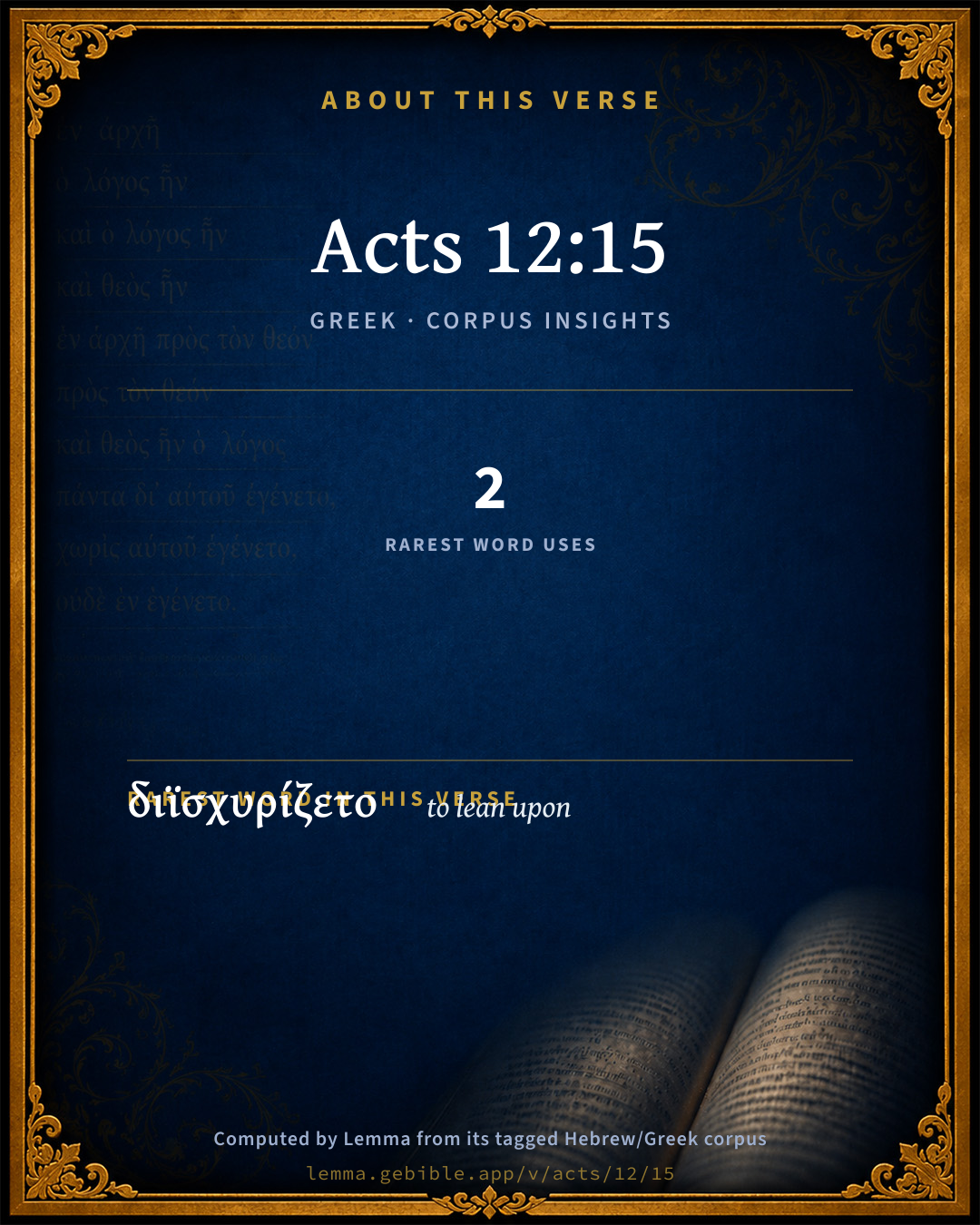
Acts 12:15

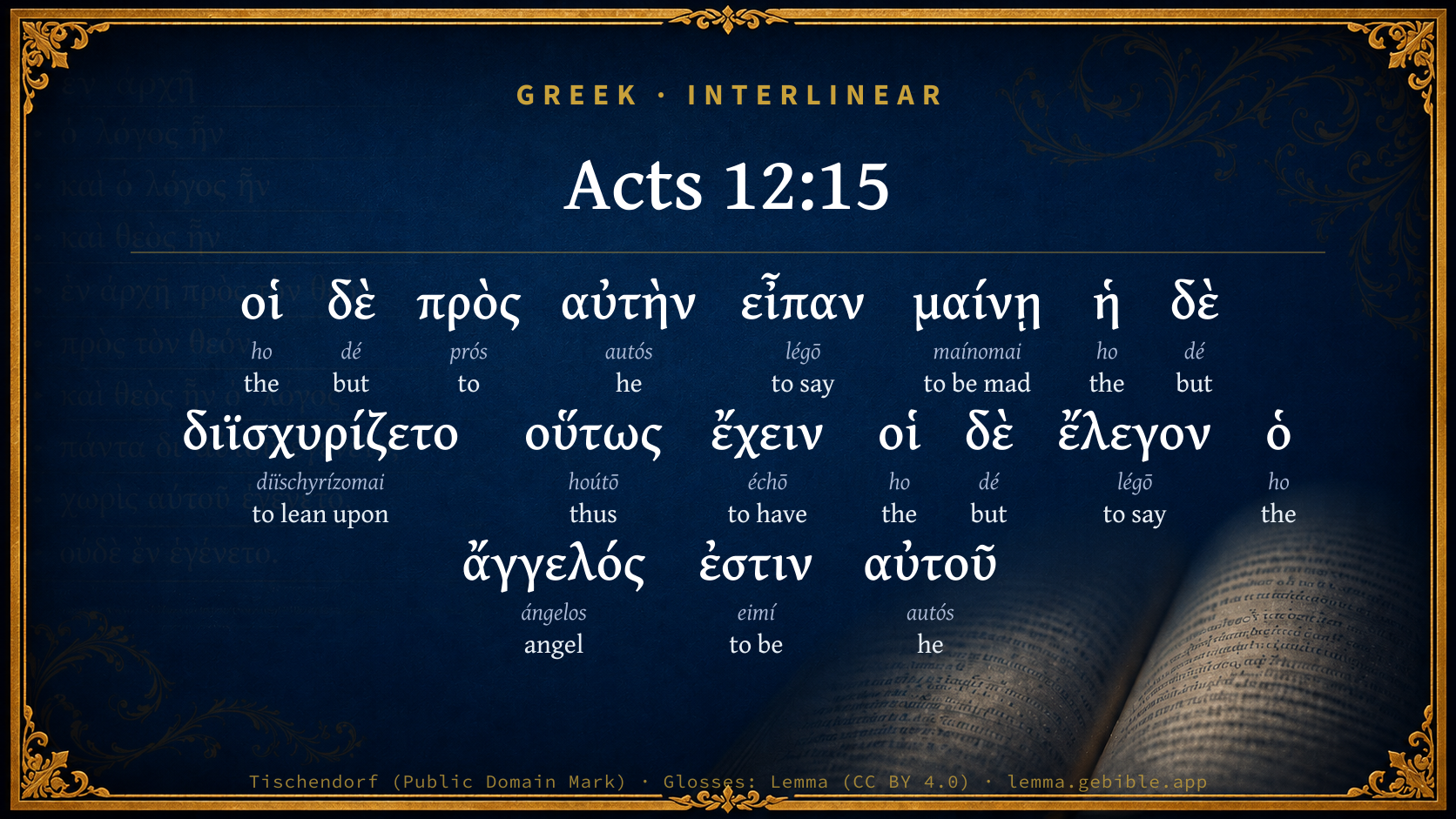
Greek (Tischendorf 8th ed.) Acts 12:15 appears in the Greek New Testament. The text above is from the Tischendorf 8th edition. Each word links to its Strong’s number and a concise gloss. Click any word for its full Thayer’s Greek Lexicon entry.
Download image
Cite this verse

Acts 12:15 (World English Bible). Public Domain. Lemma interlinear Bible study tool, https://lemma.gebible.app/v/acts/12/15.

Show BibTeX & RIS
BibTeX
RIS
English Translation
They said to her, "You are crazy!" But she insisted that it was so. They said, "It is his angel."
World English Bible · Public Domain
Download a study sheet

One document with this verse’s original text, its word-by-word gloss line, the meaning frame, cross-references with their text, attributed commentary, and full source and license credits — printable, and it pastes into notes with its structure intact.

This verse Autodidact and up

Study sheet (.html) Plain text (.txt)

A passage Seminary Student

Up to 50 verses in one chapter. A passage sheet keeps up to 6 commentary sources and 12 cross-references per verse, in the order this page ranks them, and says so on the sheet whenever that leaves anything out. Ask for a single verse and you get the Autodidact verse sheet above.

Everything on this page stays free to read, with no account — the sheet is a download of what is already on screen, not access to it.

Want to remove ads? Support Godless Engineer
Compare translations 3

The same verse in 3 English versions, stacked beneath the original-language interlinear above. Click any original word for its lexicon entry.

Each is an independent rendering of the whole verse — the interlinear is not word-aligned to these translations.

Highlighted words mark where these versions differ — a whole-verse word diff, not a word-by-word alignment.

  • World English Bible Public Domain
    They said to her, "You are crazy!" But she insisted that it was so. They said, "It is his angel."
  • King James Version Public Domain
    And they said unto her, Thou art mad. But she constantly affirmed that it was even so. Then said they, It is his angel.
  • unfoldingWord Literal Text CC BY-SA 4.0
    But they said to her, “You are insane!” But she was insisting that it was thus. So they were saying, “It is his angel.”

unfoldingWord Literal Text — © unfoldingWord, licensed CC BY-SA 4.0. Word-aligned USFM3 via Door43 (git.door43.org/unfoldingWord/en_ult).

Versions to compare (up to 4)

3 of 4 selected

Show all 19 translations

Every available English version of this verse, each an independent rendering of the whole verse.

  • World English Bible Public Domain
    They said to her, "You are crazy!" But she insisted that it was so. They said, "It is his angel."
  • Berean Standard Bible Public Domain
    “You are out of your mind,” they told her. But when she kept insisting it was so, they said, “It must be his angel.”
  • Majority Standard Bible Public Domain
    “You are out of your mind,” they told her. But when she kept insisting it was so, they said, “It must be his angel.”
  • King James Version Public Domain
    And they said unto her, Thou art mad. But she constantly affirmed that it was even so. Then said they, It is his angel.
  • American Standard Version (1901) Public Domain
    And they said unto her, Thou art mad. But she confidently affirmed that it was even so. And they said, It is his angel.
  • Revised Version (1885) Public Domain
    And they said unto her, Thou art mad. But she confidently affirmed that it was even so. And they said, It is his angel.
  • Geneva Bible (1599) Public Domain
    But they said vnto her, Thou art mad. Yet she affirmed it constantly, that it was so. Then said they, It is his Angel.
  • Douay-Rheims (1899) Public Domain
    But they said to her: Thou art mad. But she affirmed that it was so. Then said they: It is his angel.
  • Young's Literal Translation Public Domain
    and they said unto her, `Thou art mad;' and she was confidently affirming `it' to be so, and they said, `It is his messenger;'
  • Literal Standard Version CC BY-SA 4.0
    and they said to her, “You are mad”; and she was confidently affirming [it] to be so, and they said, “It is his messenger”;
  • Unlocked Literal Bible CC BY-SA 4.0
    So they said to her, “You are insane.” But she insisted that it was so. They said, “It is his angel.”
  • unfoldingWord Literal Text CC BY-SA 4.0
    But they said to her, “You are insane!” But she was insisting that it was thus. So they were saying, “It is his angel.”
  • Darby Bible Public Domain
    And they said to her, Thou art mad. But she maintained that it was so. And they said, It is his angel.
  • World Messianic Bible Public Domain
    They said to her, “You are crazy!” But she insisted that it was so. They said, “It is his angel.”
  • Webster's Bible Public Domain
    And they said to her, Thou art insane. But she constantly affirmed that it was even so. Then they said, It is his angel.
  • Free Bible Version CC BY-SA 4.0
    “You're mad!” they told her. But she kept on insisting it was true. So they said, “It must be his angel.”
  • Bible in Basic English Public Domain
    And they said to her, You are off your head. But still she said, with decision, that it was so. And they said, It is his angel.
  • Text-Critical English NT CC BY 4.0
    They said to her, “Yoʋ are out of yoʋr mind.” But when she kept insisting that it was so, they said, “It is his angel.”
  • Tyndale New Testament (1534) Public Domain
    And they sayde vnto her: thou arte mad. And she bare them doune that it was even so. Then sayde they: it is his angell.

Literal Standard Version (2020), Covenant Press — licensed CC BY-SA 4.0. Text via the HelloAO Bible API (eBible.org). Unlocked Literal Bible (unfoldingWord) — licensed CC BY-SA 4.0. Text via the HelloAO Bible API (eBible.org). unfoldingWord Literal Text — © unfoldingWord, licensed CC BY-SA 4.0. Word-aligned USFM3 via Door43 (git.door43.org/unfoldingWord/en_ult). Free Bible Version, Dr. Jonathan Gallagher — licensed CC BY-SA 4.0. Text via the HelloAO Bible API (eBible.org).

Word by word

More ways to search: Search by grammar → Find every occurrence → Compare this word →

Practice this passage: Drill this verse → Learn its vocabulary →

διϊσχυρίζετο
diïschyrízomai
G1340
“to lean upon”
Verb, Imperfect, Middle or Passive deponent, Indicative, 3rd person, Singular
Part of Speech
Verb
Tense
Imperfect
Voice
Middle or Passive deponent
Mood
Indicative
Person
3rd person
Number
Singular
Full Thayer's Definition

Origin: from G1223 and a derivative of G2478

TDNT: None

1. to lean upon 2. to affirm stoutly, assert confidently
  1. οἱ ho G3588 “the” Article, Nominative, Plural, Masculine
  2. δὲ dé G1161 “but” Conjunction
  3. πρὸς prós G4314 “to” Preposition
  4. αὐτὴν autós G846 “he” Personal pronoun, Accusative, Singular, Feminine
  5. εἶπαν légō G3004 “to say” Verb, Aorist, Active, Indicative, 3rd person, Plural
  6. μαίνῃ maínomai G3105 “to be mad” Verb, Present, Middle or Passive deponent, Indicative, 2nd person, Singular
  7. ἡ ho G3588 “the” Article, Nominative, Singular, Feminine
  8. δὲ dé G1161 “but” Conjunction
  9. οὕτως hoútō G3779 “thus” Adverb
  10. ἔχειν échō G2192 “to have” Verb, Present, Active, Infinitive
  11. οἱ ho G3588 “the” Article, Nominative, Plural, Masculine
  12. δὲ dé G1161 “but” Conjunction
  13. ἔλεγον légō G3004 “to say” Verb, Imperfect, Active, Indicative, 3rd person, Plural
  14. ὁ ho G3588 “the” Article, Nominative, Singular, Masculine
  15. ἄγγελός ángelos G32 “angel” Noun, Nominative, Singular, Masculine
  16. ἐστιν eimí G1510 “to be” Verb, Present, Active, Indicative, 3rd person, Singular
  17. αὐτοῦ autós G846 “he” Personal pronoun, Genitive, Singular, Masculine

About this verse

These counts appear in no published source. They are computed here, from the morphology-tagged text and Lemma’s own curated glosses. What Lemma adds →

18
words
11
distinct lemmas
Acts
section

Notable vocabulary

The rarest word here is διϊσχυρίζετο to lean upon G1340 — appearing just 2 times in the whole Greek New Testament.

Shared distinctive vocabulary

διϊσχυρίζετο to lean upon G1340 occurs in 2 verses of the Greek New Testament. Also found in:

Repetition

Words recur within this verse:

  • εἶπαν to say G3004 ×2
  • οἱ the G3588 ×4
  • δὲ but G1161 ×3
  • αὐτὴν he G846 ×2

Cross-references

8

Topical passages linked to Acts 12:15 in the Treasury of Scripture Knowledge — connected by theme and wording, ordered by reader-vote popularity; previews shown in the World English Bible.

  • Matthew 18:10 See that you don't despise one of these little ones, for I tell you that in heaven their angels always see the face of my Father who is in heaven.
  • Mark 16:11 When they heard that he was alive, and had been seen by her, they disbelieved.
  • Mark 16:14 Afterward he was revealed to the eleven themselves as they sat at the table, and he rebuked them for their unbelief and hardness of heart, because they didn't believe those who had seen him after he had risen.
  • Luke 24:11 These words seemed to them to be nonsense, and they didn't believe them.
  • Luke 24:37–38 But they were terrified and filled with fear, and supposed that they had seen a spirit.
  • Acts 26:24 As he thus made his defense, Festus said with a loud voice, "Paul, you are crazy! Your great learning is driving you insane!"
  • Genesis 48:16 the angel who has redeemed me from all evil, bless the lads, and let my name be named on them, and the name of my fathers Abraham and Isaac. Let them grow into a multitude in the midst of the earth."
  • Job 9:16 If I had called, and he had answered me, Yet would I not believe that he listened to my voice.

Cross-references courtesy of OpenBible.info (CC BY 4.0).

Commentary

Notes on Acts 12:15 from classic Christian and Jewish commentators (each source and its license shown beneath its notes). The classic Christian expositions comment on the surrounding passage and are grouped to its opening verse, so a note may address several verses; the Jewish commentaries on the Tanakh (Rashi and others) are per-verse, so they appear only where the commentator wrote on this verse.

Lemma curates 59 commentaries, every one of them public domain or Creative Commons licensed, each selected and text-cleaned for this edition rather than reprinted as found. About our sources →

Bengel's Gnomon

Johann Albrecht Bengel

Act 12:15. Μαίνῃ, thou art mad) [Some subjoin the mark of interrogation after this word. But the margin of both Gr. Editions leaves it undecided.—E. B.] A formula used in case of a thing which is not believed.—διϊσχυρίζετο, she perseveringly affirmed) Quite differently from what they are wont to do, who are either mad or sleeping.—ὁ ἄγγελος αὐτοῦ, his angel) So they inferred from the similarity of the voice. From the opinion of those saints as to the angel of Peter, whom they were supposing to be close to death, having been heard by the damsel, no solid conclusion can be inferred as to a single angel being the attendant on each individual among men. [Scripture assigns frequently to one holy man the guardianship rather of many angels.—V. g.] However even Peter speaks definitely with the article τὸν, Act 12:11, τὸν ἄγγελον αὐτοῦ: whereas ordinarily the article is not always added to possessive pronouns. Comp. Mat 19:28, δόξης αὐτοῦ; Act 3:2, μητρὸς αὐτοῦ.

Bengel's Gnomon of the New Testament — English translation (T&T Clark, Edinburgh, 1860) — public domain. Text from a community e-Sword module.

Meyer's Critical & Exegetical Commentary

Heinrich August Wilhelm Meyer

Act_12:15-16. Μαίνῃ] Thou art mad! An expression of extreme surprise at one who utters what is absurd or otherwise incredible. Comp. Act_26:24; Hom. Od. xviii. 406. The hearer also of something incredible himself exclaims: μαίνομαι! Jacobs, ad Anthol. IX. p. 440.

διϊσχυρίζ.] as in Luk_22:59, and often in Greek writers: she maintained firmly and strongly.

ὁ ἄγγελος αὐτοῦ ἐστιν] Even according to the Jewish conception (see Lightfoot ad loc.), the explanation suggested itself, that Peters guardian angel had taken the form and voice of his protégé and was before the door. But the idea, originating after the exile, of individual guardian angels (see on Mat_18:10), is adopted by Jesus Himself (Mat_18:10), and is essentially connected with the idea of the Messianic kingdom (Heb_1:14). Olshausen rationalizes this conception in an unbiblical manner, to this effect: that in it is meant to be expressed the thought, that there lives in the world of spirit the archetype of every individual to be realized in the course of his development, and that the higher consciousness which dwells in man here below stands in living connection with the kindred phenomena of the spirit-world. Cameron, Hammond, and others explain: a messenger sent by him from the prison. It is decisive against this interpretation, that those assembled could just as little light on the idea of the imprisoned Peters having sent a messenger, as the maid could have confounded the voice of the messenger with the well-known voice of Peter, for it must be presumed from διϊσχυρίζετο οὕτως ἔχειν that she told the more special reasons for her certainty that Peter was there.

Act_12:16. ἀνοίξαντες] consequently the persons assembled themselves, who had now come out of their room.

Meyer — Critical and Exegetical Commentary on the New Testament — English translation by Peter Christie, edited by Frederick Crombie (T&T Clark, 1880) — public domain. Text from a community e-Sword module.

Expositor's Greek Testament

ed. W. Robertson Nicoll

Act 12:15 . Μαίνῃ : used as in a colloquial expression, not meaning literal insanity, see Page’s note on Act 26:24 , so in 2Ki 9:11 , ἐπίληπτος seems to be used. διϊσχυρίζετο : only here and in Luk 22:59 ( cf. Act 15:2 [252] ). In Luke, A.V. renders “confidently affirmed” as it should be here, and as it is in R.V.; found in classical Greek, and so also in Jos., Ant. , ii., 6, 4, but not in LXX; cf. also its use in Acta Petri et Pauli Apocryph. , 34, 39 (Lumby). Both ἰσχυρίζεσθαι and its compound here are used in medical language, and both in the same way as in this passage. If we compare the parallel passages, Mat 26:73 , Mar 14:70 , Luk 22:59 , in Matthew we have εἶπον , in Mark ἔλεγον , but in Luke the strong word in the passage before us; Hobart, p. 77, and see also a similar change in parallel passages on p. 76. Ὁ ἄγγελος αὐτοῦ ἐστιν , cf. Mat 18:10 , Heb 1:14 . According to Jewish ideas they would believe that Peter’s guardian angel had assumed his form and voice, and stood before the door, see Edersheim, Jesus the Messiah , ii. 748 755, especially 752; “ Apocrypha ” (“Speaker’s Commentary”) “Angelology,” i., 171 ff.; Weber, Jüdische Theol. , pp. 170, 171 (1897); “Angels,” B.D., 1 2 , Blass, Nösgen, J. Lightfoot, in loco . We may contrast the reserve of the canonical books of the Jews with the details of their later theology, “Engel,” Hamburger, Real-Encyclopädie des Judentums , i., 2 and 3.

[252] R(omana), in Blass, a first rough copy of St. Luke.

The Expositor's Greek Testament, edited by W. Robertson Nicoll (1897–1910) — public domain. Text from a community e-Sword module.

Jamieson, Fausset & Brown

Robert Jamieson, A. R. Fausset & David Brown

Thou art mad--one of those exclamations which one can hardly resist on hearing what seems far "too good to be true."

she constantly affirmed--"kept steadfastly affirming."

that it was even so. Then said they, It is his angel--his disembodied spirit, his ghost; anything, in fact, rather than himself. Though this had been the burden of their fervent prayers during all the days of unleavened bread, they dispute themselves out of it as a thing incredible. Still, it is but the unbelief of the disciples who "believed not for joy and wondered" at the tidings of their Lord's resurrection. How often do we pray for what we can hardly credit the bestowment of, when it comes in answer to our prayers! This, however, argues not so much hard unbelief as that kind of it incident to the best in this land of shadows, which perceives not so clearly as it might how very near heaven and earth, the Lord and His praying people, are to each other.

Jamieson, Fausset & Brown — Commentary Critical and Explanatory on the Whole Bible (1871) — public domain (CC PDM 1.0). Text via the HelloAO Bible API.

Adam Clarke's Commentary

Verse 15. It is his angel.] It was a common opinion among the Jews that every man has a guardian angel, and in the popish Church it is an article of faith. The Jews also believed that angels often assumed the likeness of particular persons. They have many stories of the appearance of Elijah in the likeness of different rabbins. As αγγελος signifies in general a messenger, whether Divine or human, some have thought that the angel or messenger here means a servant or person which the disciples supposed was sent from Peter to announce something of importance to the brethren: it was also an opinion among the Jews, even in the time of the apostles, as appears from Philo, that the departed souls of good men officiated as ministering angels; and it is possible that the disciples at Mary's house might suppose that Peter had been murdered in the prison; and that his spirit was now come to announce this event, or give some particular warning to the Church.

Adam Clarke's Commentary on the Bible (1810–1826) — public domain. Text from a community e-Sword/MySword module.

John Calvin's Commentaries

15. When he did knock at the gate. Whereas they think that the maid is mad, which telleth them that Peter was come; we gather by this, that they did not hope or look for Peter’s deliverance, and yet we will not say that they prayed without faith; because they looked for some other success, to with that Peter being armed with power from heaven, should be ready, whether it were by life or death, to glorify God, that the flock being terrified with the violent invasion of wolves might not be scattered abroad, that those that were weak might not faint, that the Lord would put away that whirlwind of persecution. But in that the Lord granteth them more than they hoped for, he surpasseth their desires with his infinite goodness. And now that which was done seemeth to them incredible, that they may be the more provoked to praise his power.

It is his angel. They call him his angel, who was by God appointed to be his keeper and the minister of his safety. In which sense Christ saith that the angels of little ones do always see the face of his Father, (Matthew 18:10.) And what do they gather hence commonly? that every particular man hath a particular angel, which taketh charge of him; but it is too weak. For the Scripture doth sometimes testify (Exodus 14:10) that there is one angel given to a great people, and to one man only a great host. For Elizeus [Elisha] his servant had his eyes opened, so that he saw in the air chariots of fire, which were appointed to defend the prophet, (2 Kings 6:17.) And in Daniel there is but one angel of the Persians, and one of the Grecians named, (Daniel 10:5, 12.) Neither doth the Scripture promise to every man a certain and peculiar angel, but rather that the Lord hath charged his angels to keep all the faithful, (Psalm 91:11;) also that they pitch their tents about the godly, (Psalm 34:8.) Therefore, that vain surmise which is common touching the two angels of every man is profane. Let this be sufficient for us, that the whole host of heaven doth watch for the safety of the Church; and that as necessity of time requireth sometimes one angel, sometimes more do defend us with their aid. Assuredly, this is inestimable goodness of God, in that he saith that the angels, who are the beams of his brightness, are our ministers.

John Calvin's Commentaries (1540-1563) — public domain. Text from the Calvin Translation Society English edition (1840s-50s) via the Christian Classics Ethereal Library (ccel.org). Calvin's coverage is partial (roughly two-thirds of the Bible); uncommented books and verses are honest gaps, never fabricated. The 19th-century editor's footnotes and remarks are omitted so the notes are faithfully Calvin's own voice.

Ellicott's Commentary for English Readers

(15) It is his angel.—The language expresses the common belief of the Jews, that every true Israelite had a guardian angel specially assigned to him, who, when he appeared in human form, assumed the likeness of the man whom he protected. It is obvious that the record of the casual utterance of such a belief cannot be taken as an authoritative sanction of it.

A Bible Commentary for English Readers, edited by Charles John Ellicott (1878–1897) — public domain. Text from a community e-Sword module.

The Cambridge Bible for Schools and Colleges

gen. ed. J. J. S. Perowne

15. she constantly affirmed] i.e. confidently, with determination; which was the old meaning of the word in the A. V. Cp. Frith, Workes, Life, fol. 3, “he so constantly defended himself, that he had prevailed, if he might have been heard.”

It is his angel] The author of the Epistle to the Hebrews (Act_1:14) expresses in part the opinion of the Jews concerning angels when he asks, “Are they not all ministering spirits sent forth to minister for them who shall be heirs of salvation?” The Jewish belief was that each man had a guardian angel assigned to him. Cp. Midrash Rabbah on Ecc_4:4, where it is said that “six hundred thousand of the angels of the presence came down on Sinai at the giving of the Law, and each one bore a crown to crown Israel, one for each Israelite.” Cp. also our Lord’s language (Mat_18:10).

The Cambridge Bible for Schools and Colleges (gen. ed. J. J. S. Perowne; Cambridge University Press, 1878–1918) — public domain. Text from a community e-Sword module.

John Gill's Exposition

And they said unto her, thou art mad, &c. "Or art thou not mad?" as the Ethiopic version, and two of Beza's exemplars read, and some others: they thought the girl must be out of her senses; they looked upon the thing impossible; for though they were praying for him, and praying in faith, yet they might have no expectation of a deliverance; but were praying that they might be supported under such a trial, and that it might be sanctified to them; and for Peter, that he might be strengthened and made steadfast, and kept faithful to the last; and bear, by his sufferings and death, a glorious and honourable testimony for Christ:

but she constantly affirmed that it was even so; she asserted it over and over, and was positive in it; nothing they could say could put her off of it; she was sure of it; which when they observed, they could not tell what to say to it, but as follows: then said they,

it is his angel; not his tutelar or guardian angel, everyone having, as some think, a particular angel to attend him; whereas sometimes one angel attends many persons, and sometimes many angels encamp about, and are a guard to a single saint; nor did they think it was an angel sent to give notice of his death, as some persons, by one means or another, have had previous notices of the death of their friends; but rather, that it was an angel in Peter's shape, who had something to communicate: and this agrees with the notions of the Jews, who think that angels do assume the shapes of men on certain occasions: so they say (i), when Moses was in danger in Pharaoh's court, God sent Michael, the prince of the host of heaven, "in the shape of an executioner"; who brought him at once out of Egypt, and set him at the border of it, the distance of three days journey: Bar Kaphra says (k), an angel descended , "in the likeness of Moses", and caused him to flee, and they thought the angel had been Moses: and so it is elsewhere said (l), that an angel descended "in the likeness of Solomon", sitting upon his throne: there are some who think, that the sense of the brethren praying for Peter, was not that it was an angel, a celestial spirit, but a messenger sent by Peter from the prison on some errand: who represented him, or mentioning his name, the damsel took him for Peter himself. Beza's ancient copy reads, "then said they unto her, perhaps it is his angel", and so the Syriac version.

(i) Chronicon Mosis, fol. 6. 1. (k) Debarim Rabba, sect. 2. fol. 237. 1. (l) Midrash Kohelet, fol. 64. 4.

John Gill's Exposition of the Whole Bible (1746–1763) — public domain (CC PDM 1.0). Text via the HelloAO Bible API.

Trapp's Complete Commentary

John Trapp

15 And they said unto her, Thou art mad. But she constantly affirmed that it was even so. Then said they, It is his angel.

Ver. 15. It is his angel] Or, it is his messenger, or one come from him. See a like place, Luk 7:24. Angels use not to stand at door and knock, and wait for an opening. Fernelius (holding that each saint hath his angel-guardian) tells us out of the rabbins, that Adam’s angel was called Raziel, Abraham’s Zachiel, Isaac’s Raphael, Jacob’s Peniel, and Moses’ Metraton. But this may as well pass for a Jewish fable.

John Trapp, A Commentary or Exposition upon All the Books of the Old and New Testament (1647–1656) — public domain. Text from a community e-Sword module.

Albert Barnes' Notes on the Bible

Thou art mad - Thou art insane. They seemed to have regarded his rescue as so difficult and so hopeless, that they deemed it proof of derangement that she now affirmed it. And yet this was the very thing for which they had been so earnestly praying. When it was now announced to them that the object of their prayers was granted, they deemed the messenger that announced it insane. Christians are often surprised even when their prayers are answered. They are overwhelmed and amazed at the success of their own petitions, and are slow to believe that the very thing for which they have sought could be granted. It shows, perhaps, with how little faith, after all, they pray, and how slow they are to believe that God can hear and answer prayer. In a revival of religion in answer to prayer, Christians are often overwhelmed and astonished when even their own petitions are granted, and when God manifests his own power in his own way and time. Prayer should be persevered in, and we should place ourselves in a waiting posture to catch the first indications that God has heard us.

But she constantly affirmed - She insisted on it. How much better it would have been to have hastened at once to the gate, than thus to have engaged in a controversy on the subject. Peter was suffered to remain knocking while they debated the matter. Christians are often engaged in some unprofitable controversy when they should hasten to catch the first tokens of divine favor, and open their arms to welcome the proofs that God has heard their prayers.

Then said they - Still resolved not to be convinced.

It is his angel - Any way of accounting for it rather than to admit the simple fact, or to ascertain the simple truth. All this was caused by the little hope which they had of his release, and their earnest desire that it should be so. It was just such a state of mind as is indicated when we say, “The news is too good to e believed.” The expression “It is his angel” may mean that they supposed that the “tutelary guardian,” or angel appointed to attend Peter, had come to announce something respecting him, and that he had assumed the voice and form of Peter in order to make them certain that he came from him. This notion arose from the common belief of the Jews that each individual had assigned to him, at birth, a celestial spirit, whose office it was to guard and defend him through life. See the notes on Mat 18:10. That the Jews entertained this opinion is clear from their writings. See Kuinoel. Lightfoot thinks that they who were assembled supposed that the angel had assumed the voice and manner of Peter in order to intimate to them that he was about to die, and to excite them to earnest prayer that he might die with constancy and firmness. Whatever their opinions were, however, it proves nothing on these points. There is no evidence that they were inspired in these opinions, nor are their notions countenanced by the Scriptures. They were the mere common traditions of the Jews, and prove nothing in regard to the truth of the opinion one way or the other.

Albert Barnes' Notes on the Bible (1834–1885) — public domain. Text from a community e-Sword/MySword module.

Haydock's Catholic Bible Commentary

Thou art mad, or talkest idly. --- Then said they, it is his Angel. It seems ridiculous to translate here a messenger. Does a messenger speak with the very voice of him that sends him? St. John Chrysostom[2] and others on this place observe, that they believed that every one, at least of the faithful, hath a good Angel. (Witham) --- "If proper Angels," saith St. John Chrysostom, (T. iii. hom. 7. in laud. Paul.) "be deputed by our Lord to such as have only charge of their own existence, (as Israel said, Genesis xlviii. 16. the Angel that delivereth me from all evils, bless these boys) much more are super-human spirits at hand to help those unto whom the charge and burden of the world is committed." Such persons as can believe that God permits evil spirits to tempt us, can find no difficulty surely in believing that the same good, just, and merciful Creator will permit good spirits to guide, protect, and assist us. Repeated proofs of both are found in holy writ. The learned Protestant commentator, Polus, on this text, says: Hujusmodi visis assueverat eo tempore Ecclesia, quæ etiam novit fideles præsidio angelorum esse circumseptos. The Church at that period had been accustomed to similar apparitions, nor is she ignorant that the faithful are secured by the protection of Angels. (T. iv. p. 1494.)

===============================

[BIBLIOGRAPHY]

It is his Angel. St. John Chrysostom on these words, hom. xxvi. Ex hoc verum est quod unusquisque Angelum habet; Greek: alethes oti ekastos Aggelon echei.

George Leo Haydock (1774–1849), Haydock's Catholic Family Bible and Commentary, 1859 edition — public domain. Excludes Psalms (Douay-Rheims chapter numbering differs from Protestant) and Deuterocanonical books (Catholic canon only).

Matthew Poole's English Annotations

Thou art mad; thou speakest thou knowest not what; thinking her, out of fear, to have been discomposed in her mind.

It is his angel: some have thought, that by Peter’s angel no other was meant than some messenger from Peter, which they might expect from him in such a case as he was in; now though αγγελος (the word here) signifies a messenger or an angel, indifferently, yet how could Rhoda then know it to have been Peter’s voice? A messenger’s voice being no more like his that sent him than another man’s. They did, probably mean some angel that had assumed Peter’s shape, and imitated his voice: and the Jews having had a constant opinion, that at least every good man hath a guardian angel which God appoints to him for a means of his preservation, might be apt to imagine that this was that angel whose charge St. Peter was, Mat 18:10. Though that angel spoken of, Gen 48:16, most probably was the angel of the new covenant, and not a created angel, being Jacob blesseth in his name; yet the opinion of tutelar angels, though not certain or needful, is to this day thought probable.

Matthew Poole's English Annotations on the Holy Bible (1683–1685) — public domain. Text from a community e-Sword/MySword module.

Whedon's Commentary on the Bible

Daniel D. Whedon

15. His angel—To translate this his messenger, as some do, makes no intelligible sense. The damsel’s reason for knowing it to be Peter must have been her recognition of his voice; and how would it explain that fact to say that it was a messenger from Peter? But the Jews did popularly entertain the belief that a man had a guardian angel who sometimes assumed his form and voice. This belief, entertained by the present company, can be no valid proof of the doctrine for us. They were not inspired persons, as their mistaken talk to Rhoda shows, and they only expressed a personal belief.

Daniel D. Whedon (gen. ed.), Commentary on the Old and New Testaments (1874–1909) — public domain. Text from a community e-Sword module.

The Pulpit Commentary

Confidently for constantly, A.V.; (for the same use of diiscurizomai, see Luk_22:59) and they said for then said they, A.V. It is his angel; meaning probably his guardian angel. (Mat_18:10) But the expression is obscure, and we do not know exactly the nature of the belief on which it was grounded. They must have thought that perhaps Peter had been put to death in prison that very night, and that his angel, speaking with his voice, was sent to announce it to the Church. The narrative is a striking instance how "slow of heart to believe" are even the most devout. They were praying very earnestly for Peter"s life; their prayer was granted; and yet the announcement of it only draws out the answer, "Thou art mad!" and then, as an alternative, the explanation, "It is his angel!

Testimony versus reasoning.

The subject is suggested by the persistence of Rhoda and the incredulity of the disciples. Upon the evidence of her senses Rhoda constantly affirmed that it was St. Peter who stood at the gate. The disciples vigorously argued that it could not be he, and tried to reason away her testimony, St. Peter was in prison, and it was simply impossible that he could be knocking at the gate. So much is made in our time of the demand for facts and evidence and verification of all statements, and it is so often assumed that reasoning can destroy testimony, or that testimony, as we have it on the Christian theme, is insufficient to support our elaborate reasoning, that the trustworthiness of each, and the relations in which each stands to the other, may be profitably considered.

I THE IMPORTANCE OF TESTIMONY. Our senses are the appointed media for our communication with the outer world, and they are both the first and constant sources of our knowledge. We learn to trust them. We readily receive the testimony of others as to what they have seen and heard, and, with limitations, as to what they have felt. There is, then,

(1) knowledge received directly upon the testimony of our own senses; and

(2) knowledge received indirectly upon the testimony of others who tell us what they know through the senses. And as the sphere directly open to each one of us is very limited, we are very largely dependent for our knowledge on the testimony of others, upon such witness of personal knowledge as Rhoda gave. In the matters of the Christian religion we are wholly dependent on this indirect witness of the senses. What the apostles themselves saw, and tasted, and handled, and felt of the Word of life, that they declare unto us. The four Gospels come to us as the testimony of the senses of men who looked on Christ, lived with him, listened to him, and knew him in the intimacy of a close and dear friendship. We cannot too constantly or too earnestly urge that Christianity rests upon a basis of sensible facts, and that of them we have the testimony directly from the very persons who witnessed them. Therefore, though all the world may please to declare that we are mad, as the disciples said that Rhoda was, we too shall constantly affirm that it is even so as we have testified. No facts of human history can be received by us save on principles which compel us also to receive the facts of our Redeemer"s life and death.

II HUMAN TESTIMONY MUST ALWAYS BE UNCERTAIN. This should be fully admitted. It is uncertain, because

(1) our senses may be untrained and so unfit to receive impressions; or

(2) diseased, and so likely to receive distorted impressions; or

(3) the subjects with which they are concerned may be altogether new to us, and we may thus be unprepared duly to correct impression. Still, so far as the bare facts are concerned, the uncertainty is not such as to prove a practical disability. In the range of fact men are found generally to agree.

III HUMAN REASONING IS NECESSARILY UNCERTAIN. As in the case of the disciples who reasoned against Rhoda. The uncertainty comes out of:

1. Prejudice and bias (see the idola of Bacon).

2. Insufficient facts; some of the worst reasoning is explained by incomplete knowledge of the facts on which the reasoning is based.

3. False methods (see the fallacies explained in books on logic).

IV THE TRUTH MAY BE REACHED BY WISE REASONING UPON SUFFICIENT TESTIMONY. To receive testimony alone may be mere credulity. To receive upon argument alone may be to yield to mere human force, to the power of superior intellect. Bat with due inquiry into basis-facts, and careful reasoning upon the facts, we may arrive at satisfying apprehensions of the truth. Apply to the acceptance of Christianity, with its difficulty of the miraculous. The four Gospels are a fourfold testimony to the great Christian facts. We must build our reasoning on the facts; just as those disciples should have received Rhoda"s fact, and followed it up with their reasoning, and not made their reasoning oppose the facts. R.T.

The Pulpit Commentary (1880–1919), ed. H.D.M. Spence-Jones & Joseph S. Exell — public domain. Text from a community e-Sword module.

John Wesley's Explanatory Notes

They said, Thou art mad - As we say, Sure you are not in your senses to talk so. It is his angel - It was a common opinion among the Jews, that every man had his particular guardian angel, who frequently assumed both his shape and voice. But this is a point on which the Scriptures are silent.

John Wesley, Explanatory Notes Upon the Whole Bible (1754–1765) — public domain. Text via the GEBible commentary corpus.

McGarvey & Pendleton's Commentaries

J. W. McGarvey

See notes one verse 13

J. W. McGarvey (with Philip Y. Pendleton), Commentaries on the New Testament (The Fourfold Gospel, 1914; Acts; and the epistles) — public domain. Text from a community e-Sword/MySword module.

Cambridge Greek Testament for Schools and Colleges

15. ἡ δὲ διϊσχυρίζετο, but she confidently affirmed. In the time of the A.V. constantly had the meaning of confidently, which it has now lost. διϊσχυρίζομαι is in N.T. only here and in St Luk 22:59. It occurs in Acta Petri et Pauli Apocryph. §§ 34 and 39, οἱ δὲ τῷ Σίμωνι κολληθέντες τὸν Πέτρον διϊσχυρίζοντο μάγον. The word is often found in classical Greek.

ὁ ἄγγελός ἐστιν αὐτοῦ, it is his angel. The author of the Epistle to the Hebrews expresses (Act 1:14) in part the opinion of the Jews concerning angels when he asks, ‘Are they not all ministering spirits sent forth to do service to them who shall be heirs of salvation?’ The Jewish belief was that each man had a guardian angel assigned to him. Cf. Midrash Rabbah on Ecc 4:4, where it is said that ‘six hundred thousand of the angels of the presence came down on Sinai at the giving of the Law, and each one bore a crown to crown Israel, one for each Israelite.’ Cf. also our Lord’s language (Mat 18:10).

Cambridge Greek Testament for Schools and Colleges (Cambridge University Press, 1896; 21 vols, various authors incl. Carr, Maclear, Plummer, Farrar, Lumby, Moule, M. R. James, Simcox) — public domain. Text from a community e-Sword module.

Alford’s Greek Testament

Henry Alford

15. ἄγγελός ἐστ. αὐτοῦ] No other rendering but his angel will suit the sense: and with a few exceptions (Camero, Basnage, Hammond, and one or two more) all Commentators, ancient and modern, have recognized this meaning. Our Lord plainly asserts the doctrine of guardian angels in ref. Matt. (see note there): and from this we further learn in what sense His words were understood by the early church. From His words taken with the context (μὴ καταφρονήσητε ἑνὸς τῶν μικρῶν τούτων) we infer that each one has his guardian angel: from this passage we find not only that such was believed to be the case, but that it was supposed that such angel occasionally appeared in the semblance (seeing that he spoke with the voice) of the person himself. We do not, it is true, know who the speakers were: nor is the peculiar form in which they viewed the doctrine binding upon us: it may have been erroneous, and savouring of superstition. But of the doctrine itself this may not be said, as the Lord Himself has asserted it. See Wordsw.’s interesting note here.

For what purpose they supposed this angel to have come, does not appear in the narrative.

Henry Alford, The Greek Testament (1849–1861) — public domain. Text from a community e-Sword module.

Vincent's Word Studies in the New Testament

Marvin R. Vincent

Constantly affirmed [διισχυριζετο] . Better, confidently affirmed; constant is used in its older sense of consistent. The verb contains two ideas : strong assertion [ισχυς] , and holding to the assertion through all contradiction [δια] ; hence, she strongly and consistently asserted.

Angel. Guardian angel, according to the popular belief among the Jews that every individual has his guardian angel, who may, on occasion, assume a visible appearance resembling that of the person whose destiny is committed to him.

Marvin R. Vincent, Word Studies in the New Testament (1887–1900) — public domain. Text from a community e-Sword/MySword module.

Lesson kit

Teaching starters — assembled from the data on this page, not authored interpretation. Every prompt links to the verse data it draws on. Edit before teaching.

Acts, in the Acts, opens this verse with 18 words (11 distinct Greek lemmas). Its most distinctive word is diïschyrízomai (“to lean upon”). A historical commentator’s framing appears above. Read the whole chapter for the surrounding context.

Discussion questions

  1. How does “to lean upon” (diïschyrízomai) shape what this verse is saying?
  2. Luke 22:59 shares the word «to lean upon» with this verse. How do the two illuminate each other?
  3. “to say” occurs 2× in this one verse. What is the effect of the repetition?
  4. The translations on this page render this verse differently — a whole-verse word diff, not a word-by-word alignment. What might account for the different wordings?
  5. Reading how Bengel's Gnomon and Meyer's Critical & Exegetical Commentary read this verse, where do the two commentators agree and where do they part?

Things to notice

Reading settings

Reading text

Shown beneath each verse's original-language words.

Old Testament
Old Testament edition

Read the OT as the Masoretic Hebrew (MT) or the Greek Septuagint (LXX).

English shown for the Greek Septuagint (in the Hebrew ↔ Greek comparison).

Comparing translations? Open the Compare panel on any verse page to stack up to four side by side.