
Luke 12:54

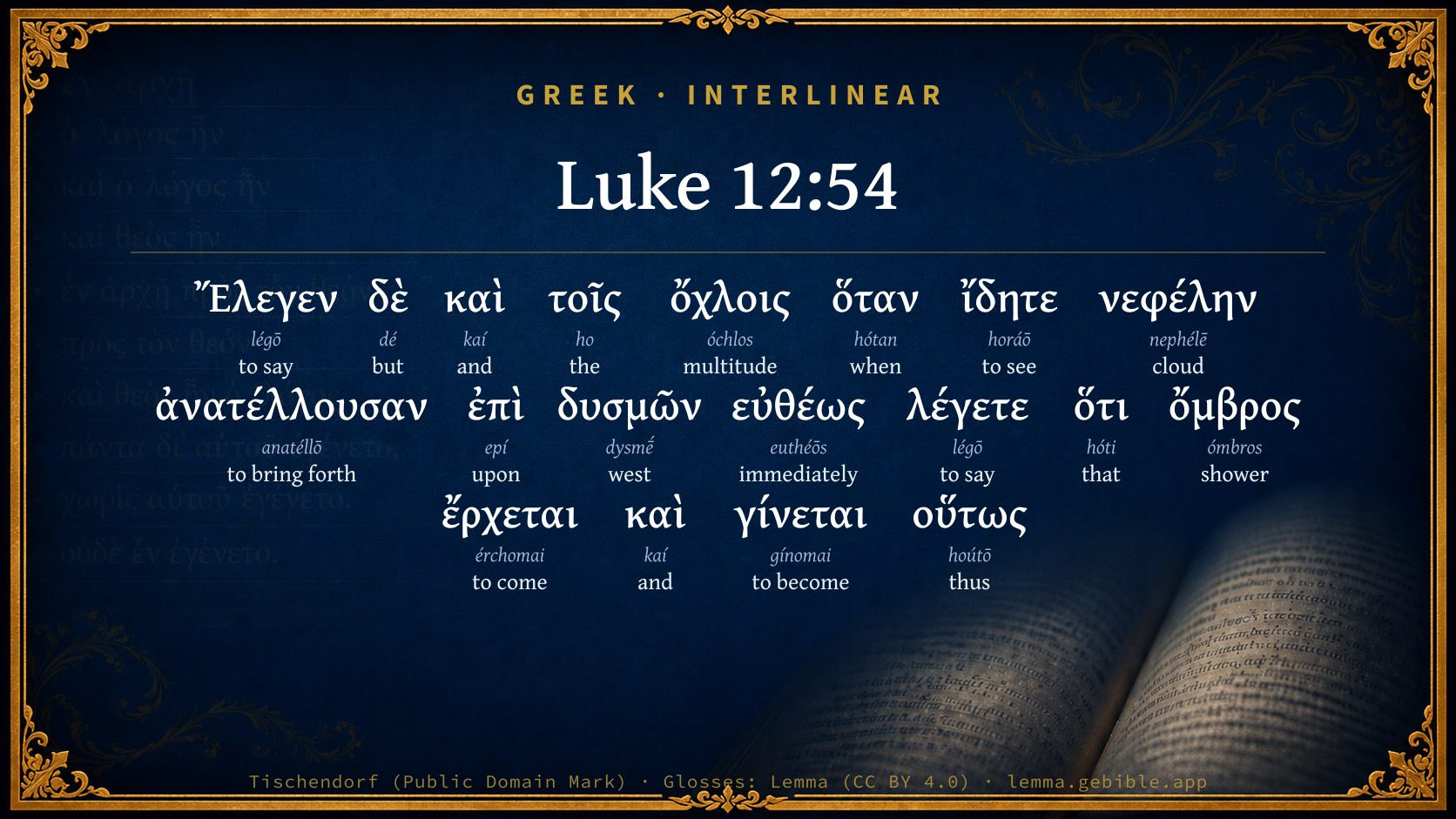
Greek (Tischendorf 8th ed.) Luke 12:54 appears in the Greek New Testament. The text above is from the Tischendorf 8th edition. Each word links to its Strong’s number and a concise gloss. Click any word for its full Thayer’s Greek Lexicon entry.
Download image
Cite this verse

Luke 12:54 (World English Bible). Public Domain. Lemma interlinear Bible study tool, https://lemma.gebible.app/v/luke/12/54.

Show BibTeX & RIS
BibTeX
RIS
English Translation
He said to the multitudes also, "When you see a cloud rising from the west, immediately you say, 'A shower is coming,' and so it happens.
World English Bible · Public Domain
Highlights
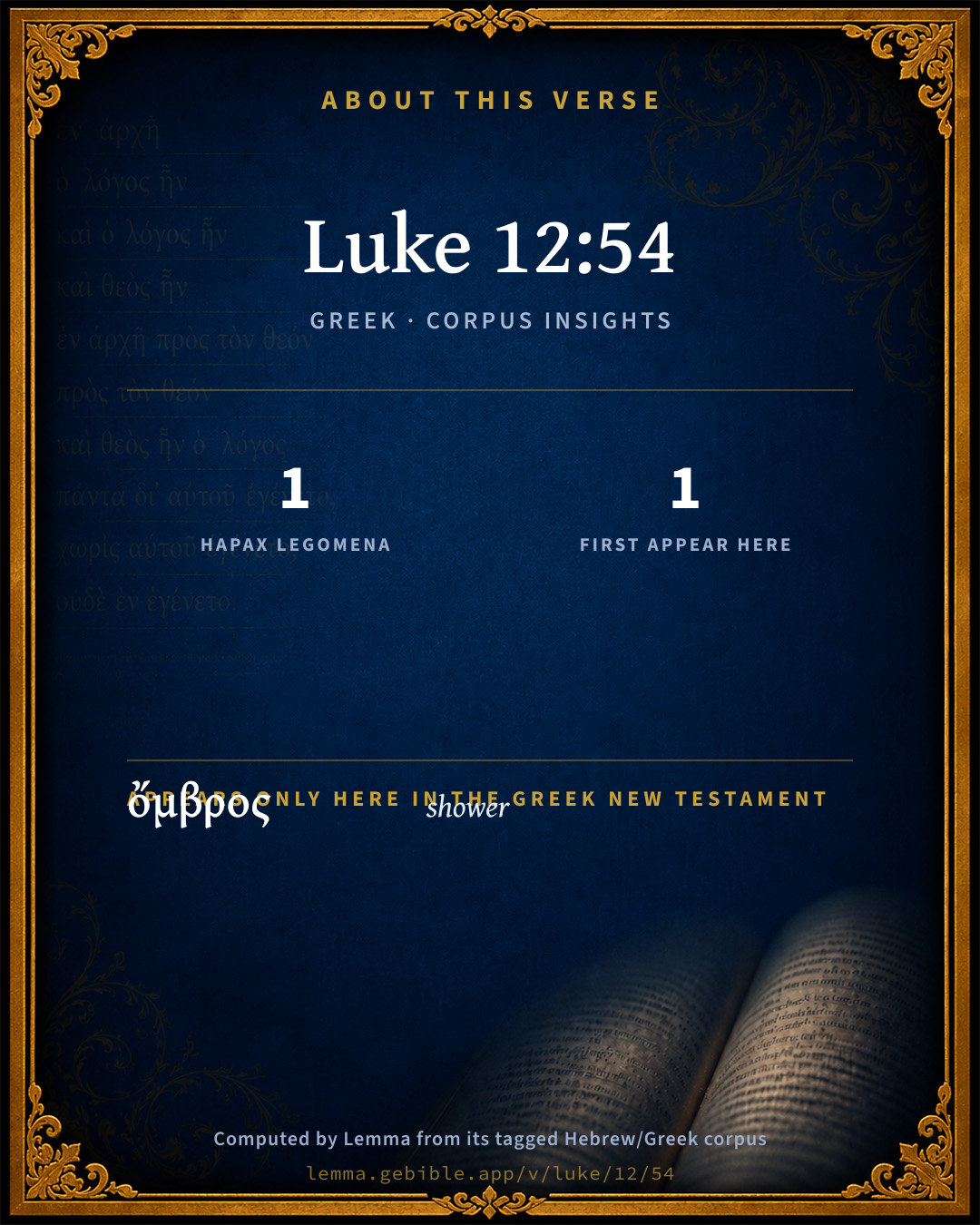
  • 1 hapax legomenon — only here in the Greek New Testament
  • 1 first appearance in the Greek New Testament
Full analysis ↓
Download a study sheet

One document with this verse’s original text, its word-by-word gloss line, the meaning frame, cross-references with their text, attributed commentary, and full source and license credits — printable, and it pastes into notes with its structure intact.

This verse Autodidact and up

Study sheet (.html) Plain text (.txt)

A passage Seminary Student

Up to 50 verses in one chapter. A passage sheet keeps up to 6 commentary sources and 12 cross-references per verse, in the order this page ranks them, and says so on the sheet whenever that leaves anything out. Ask for a single verse and you get the Autodidact verse sheet above.

Everything on this page stays free to read, with no account — the sheet is a download of what is already on screen, not access to it.

Want to remove ads? Support Godless Engineer
Compare translations 3

The same verse in 3 English versions, stacked beneath the original-language interlinear above. Click any original word for its lexicon entry.

Each is an independent rendering of the whole verse — the interlinear is not word-aligned to these translations.

Highlighted words mark where these versions differ — a whole-verse word diff, not a word-by-word alignment.

  • World English Bible Public Domain
    He said to the multitudes also, "When you see a cloud rising from the west, immediately you say, 'A shower is coming,' and so it happens.
  • King James Version Public Domain
    And he said also to the people, When ye see a cloud rise out of the west, straightway ye say, There cometh a shower; and so it is.
  • unfoldingWord Literal Text CC BY-SA 4.0
    And he was also saying to the crowds, “When you see a cloud rising in the west, immediately you say, ‘A shower is coming,’ and it happens thus.

unfoldingWord Literal Text — © unfoldingWord, licensed CC BY-SA 4.0. Word-aligned USFM3 via Door43 (git.door43.org/unfoldingWord/en_ult).

Versions to compare (up to 4)

3 of 4 selected

Show all 19 translations

Every available English version of this verse, each an independent rendering of the whole verse.

  • World English Bible Public Domain
    He said to the multitudes also, "When you see a cloud rising from the west, immediately you say, 'A shower is coming,' and so it happens.
  • Berean Standard Bible Public Domain
    Then Jesus said to the crowds, “As soon as you see a cloud rising in the west, you say, ‘A shower is coming,’ and that is what happens.
  • Majority Standard Bible Public Domain
    Then Jesus said to the crowds, “As soon as you see a cloud rising from the west, you say, ‘A shower is coming,’ and that is what happens.
  • King James Version Public Domain
    And he said also to the people, When ye see a cloud rise out of the west, straightway ye say, There cometh a shower; and so it is.
  • American Standard Version (1901) Public Domain
    And he said to the multitudes also, When ye see a cloud rising in the west, straightway ye say, There cometh a shower; and so it cometh to pass.
  • Revised Version (1885) Public Domain
    And he said to the multitudes also, When ye see a cloud rising in the west, straightway ye say, There cometh a shower; and so it cometh to pass.
  • Geneva Bible (1599) Public Domain
    Then said he to the people, When ye see a cloude rise out of the West, straightway ye say, A shower commeth: and so it is.
  • Douay-Rheims (1899) Public Domain
    And he said also to the multitudes: When you see a cloud rising from the west, presently you say: A shower is coming: and so it happeneth:
  • Young's Literal Translation Public Domain
    And he said also to the multitudes, `When ye may see the cloud rising from the west, immediately ye say, A shower doth come, and it is so;
  • Literal Standard Version CC BY-SA 4.0
    And He also said to the multitudes, “When you may see the cloud rising from the west, immediately you say, A shower comes, and it is so;
  • Unlocked Literal Bible CC BY-SA 4.0
    Jesus was saying to the crowds also, “When you see a cloud rising in the west, immediately you say, 'A shower is coming,' and so it happens.
  • unfoldingWord Literal Text CC BY-SA 4.0
    And he was also saying to the crowds, “When you see a cloud rising in the west, immediately you say, ‘A shower is coming,’ and it happens thus.
  • Darby Bible Public Domain
    And he said also to the crowds, When ye see a cloud rising out of the west, straightway ye say, A shower is coming; and so it happens.
  • World Messianic Bible Public Domain
    He said to the multitudes also, “When you see a cloud rising from the west, immediately you say, ‘A shower is coming,’ and so it happens.
  • Webster's Bible Public Domain
    And he said also to the people, When ye see a cloud rising in the west, immediately ye say, There cometh a shower; and so it is.
  • Free Bible Version CC BY-SA 4.0
    Then Jesus spoke to the crowds. “When you see a cloud rising in the west, you immediately say, ‘a rain-shower's coming,’ and it happens.
  • Bible in Basic English Public Domain
    Then he said to the people, When you see a cloud coming up in the west, straight away you say, There will be rain; and so it is.
  • Text-Critical English NT CC BY 4.0
    Jesus also said to the crowds, “When you see a cloud rising from the west, you immediately say, ‘A rainstorm is coming,’ and that is what happens.
  • Tyndale New Testament (1534) Public Domain
    Then sayde he to the people: when ye se a cloude ryse out of the west strayght waye ye saye: we shall have a shower and soo it is.

Literal Standard Version (2020), Covenant Press — licensed CC BY-SA 4.0. Text via the HelloAO Bible API (eBible.org). Unlocked Literal Bible (unfoldingWord) — licensed CC BY-SA 4.0. Text via the HelloAO Bible API (eBible.org). unfoldingWord Literal Text — © unfoldingWord, licensed CC BY-SA 4.0. Word-aligned USFM3 via Door43 (git.door43.org/unfoldingWord/en_ult). Free Bible Version, Dr. Jonathan Gallagher — licensed CC BY-SA 4.0. Text via the HelloAO Bible API (eBible.org).

Word by word

More ways to search: Search by grammar → Find every occurrence → Compare this word →

Practice this passage: Drill this verse → Learn its vocabulary →

ὄμβρος
ómbros
G3655
“shower”
Noun, Nominative, Singular, Masculine
Part of Speech
Noun
Case
Nominative
Number
Singular
Gender
Masculine
Full Thayer's Definition

Origin: of uncertain affinity

TDNT: None

1. a shower a. a violent storm, accompanied by high wind with thunder and lightning
  1. Ἔλεγεν légō G3004 “to say” Verb, Imperfect, Active, Indicative, 3rd person, Singular
  2. δὲ dé G1161 “but” Conjunction
  3. καὶ kaí G2532 “and” Conjunction
  4. τοῖς ho G3588 “the” Article, Dative, Plural, Masculine
  5. ὄχλοις óchlos G3793 “multitude” Noun, Dative, Plural, Masculine
  6. ὅταν hótan G3752 “when” Conjunction
  7. ἴδητε horáō G3708 “to see” Verb, Aorist, Active, Subjunctive, 2nd person, Plural
  8. νεφέλην nephélē G3507 “cloud” Noun, Accusative, Singular, Feminine
  9. ἀνατέλλουσαν anatéllō G393 “to bring forth” Verb, Present, Active, Participle, Accusative, Singular, Feminine
  10. ἐπὶ epí G1909 “upon” Preposition
  11. δυσμῶν dysmḗ G1424 “west” Noun, Genitive, Plural, Feminine
  12. εὐθέως euthéōs G2112 “immediately” Adverb
  13. λέγετε légō G3004 “to say” Verb, Present, Active, Indicative, 2nd person, Plural
  14. ὅτι hóti G3754 “that” Conjunction
  15. ἔρχεται érchomai G2064 “to come” Verb, Present, Middle or Passive deponent, Indicative, 3rd person, Singular
  16. καὶ kaí G2532 “and” Conjunction
  17. γίνεται gínomai G1096 “to become” Verb, Present, Middle or Passive deponent, Indicative, 3rd person, Singular
  18. οὕτως hoútō G3779 “thus” Adverb

About this verse

These counts appear in no published source. They are computed here, from the morphology-tagged text and Lemma’s own curated glosses. What Lemma adds →

19
words
17
distinct lemmas
Gospels
section

Notable vocabulary

1 hapax legomenon — a word that appears only here in the entire Greek New Testament:

  • ὄμβρος shower G3655

First appearance in Scripture

This word makes its first canonical appearance in the Greek New Testament here:

  • ὄμβρος shower G3655

Shared distinctive vocabulary

δυσμῶν west G1424 occurs in 5 verses of the Greek New Testament. Also found in:
Repetition

Words recur within this verse:

  • Ἔλεγεν to say G3004 ×2
  • καὶ and G2532 ×2

Cross-references

2

Topical passages linked to Luke 12:54 in the Treasury of Scripture Knowledge — connected by theme and wording, ordered by reader-vote popularity; previews shown in the World English Bible.

  • Matthew 16:2–4 But he answered them, "When it is evening, you say, 'It will be fair weather, for the sky is red.'
  • 1 Kings 18:44–45 It happened at the seventh time, that he said, "Behold, a small cloud, like a man's hand, is rising out of the sea." He said, Go up, tell Ahab, Make ready [your chariot], and get you down, that the rain not stop you.

Cross-references courtesy of OpenBible.info (CC BY 4.0).

Commentary

Notes on Luke 12:54 from classic Christian and Jewish commentators (each source and its license shown beneath its notes). The classic Christian expositions comment on the surrounding passage and are grouped to its opening verse, so a note may address several verses; the Jewish commentaries on the Tanakh (Rashi and others) are per-verse, so they appear only where the commentator wrote on this verse.

Lemma curates 59 commentaries, every one of them public domain or Creative Commons licensed, each selected and text-cleaned for this edition rather than reprinted as found. About our sources →

Matthew Henry's Commentary

Having given his disciples their lesson in the foregoing verses, here Christ turns to the people, and gives them theirs, Luk 12:54. He said also to the people: he preached ad populum - to the people, as well as ad clerum - to the clergy. In general, he would have them be as wise in the affairs of their souls as they are in their outward affairs. Two things he specifies: -

I. Let them learn to discern the way of God towards them, that they may prepare accordingly. They were weather-wise, and by observing the winds and clouds could foresee when there would be rain and when there would be hot weather (Luk 12:54, Luk 12:55); and, according as they foresaw the weather would be, they either housed their hay and corn, or threw it abroad, and equipped themselves for a journey? Even in regard to changes of the weather God gives warning to us what is coming, and art has improved the notices of nature in weather-glasses. The prognostications here referred to had their origin in repeated observations upon the chain of causes: from what has been we conjecture what will be. See the benefit of experience; by taking notice we may come to give notice. Whose is wise will observe and learn. See now.

1. The particulars of the presages: "When you see a cloud arising out of the west" (the Hebrew would say, out of the sea), "perhaps it is at first no bigger than a man's hand (Kg1 18:44), but you say, There is a shower in the womb of it, and it proves so. When you observe the south wind blow, you say, There will be heat" (for the hot countries of Africa lay not far south from Judea), "and it usually comes to pass;" yet nature has not ties itself to such a track but that sometimes we are mistaken in our prognostics.

2. The inferences from them (Luk 12:56): "Ye hypocrites, who pretend to be wise, but really are not so, who pretend to expect the Messiah and his kingdom" (for so the generality of the Jews did) "and yet are no way disposed to receive and entertain it, how is it that you do not discern this time, that you do not discern that now is the time, according to the indications given in the Old Testament prophecies, for the Messiah to appear, and that, according to the marks given of him, I am he? Why are you not aware that you have now an opportunity which you will not have long, and which you may never have again, of securing to yourselves an interest in the kingdom of God and the privileges of that kingdom?" Now is the accepted time, now or never. It is the folly and misery of man that he knows not his time, Ecc 9:12. This was the ruin of the men of that generation, that they knew not the day of their visitation, Luk 19:44. But a wise man's heart discerns time and judgment; such was the wisdom of the men of Issachar, who had understanding of the times, Ch1 12:32. He adds, "Yea, and why even of yourselves, though ye had not these loud alarms given you, judge ye not what is right? Luk 12:57. You are not only stupid and regardless in matters that are purely of divine revelation, and take not the hints which that gives you, but you are so even in the dictates of the very light and law of nature." Christianity has reason and natural conscience on its side; and, if men would allow themselves the liberty of judging what is right, they would soon find that all Christ's precepts concerning all things are right, and that there is nothing more equitable in itself, nor better becoming us, than to submit to them and be ruled by them.

II. Let them hasten to make their peace with God in time, before it be too late, Luk 12:58, Luk 12:59. This we had upon another occasion, Mat 5:25, Mat 5:26. 1. We reckon it our wisdom in our temporal affairs to compound with those with whom we cannot contend, to agree with our adversary upon the best terms we can, before the equity be foreclosed, and we be left to the rigour of the law: "When thou goest with thine adversary to the magistrate, to whom the appeal is made, and knowest that he has an advantage against thee, and thou art in danger of being cast, thou knowest it is the most prudent course to make the matter up between yourselves; as thou art in the way, give diligence to be delivered from him, to get a discharge, lest judgment be given, and execution awarded according to law." Wise men will not let their quarrels go to an extremity, but accommodate them in time. 2. Let us do thus in the affairs of our souls. We have by sin made God our adversary, have provoked his displeasure against us, and he has both right and might on his side; so that it is to no purpose to think of carrying on the controversy with him either at bar or in battle. Christ, to whom all judgment is committed, is the magistrate before whom we are hastening to appear: if we stand a trial before him, and insist upon our own justification, the cause will certainly go against us, the Judge will deliver us to the officer, the ministers of his justice, and we shall be cast into the prison of hell, and the debt will be exacted to the utmost; though we cannot make a full satisfaction for it, it will be continually demanded, till the last mite be paid, which will not be to all eternity. Christ's sufferings were short, yet the value of them made them fully satisfactory. In the sufferings of damned sinners what is wanting in value must be made up in an endless duration. Now, in consideration of this, let us give diligence to be delivered out of the hands of God as an adversary, into his hands as a Father, and this as we are in the way, which has the chief stress laid upon it here. While we are alive, we are in the way; and now is our time, by repentance and faith through Christ (who is the Mediator as well as the magistrate), to get the quarrel made up, while it may be done, before it be too late. Thus was God in Christ reconciling the world to himself, beseeching us to be reconciled. Let us take hold on the arm of the Lord stretched out in this gracious offer, that we may make peace, and we shall make peace (Isa 27:4, Isa 27:5), for we cannot walk together till we be agreed.

Matthew Henry's Commentary on the Whole Bible (1708–1710) — public domain (CC PDM 1.0). Text via the HelloAO Bible API.

Jamieson, Fausset & Brown

Robert Jamieson, A. R. Fausset & David Brown

NOT DISCERNING THE SIGNS OF THE TIME. (Luk 12:54-59)

to the people--"the multitude," a word of special warning to the thoughtless crowd, before dismissing them. (See on Mat 16:2-3).

Jamieson, Fausset & Brown — Commentary Critical and Explanatory on the Whole Bible (1871) — public domain (CC PDM 1.0). Text via the HelloAO Bible API.

The Biblical Illustrator

Joseph S. Exell

Luk_12:54-57

How is it that ye do not discern this time?

--

Signs of the times

I. CONSIDER THE RELIGIOUS ASPECT OF OUR OWN AGE.

1. The times are sadly darkened with superstition.

2. A parching wind of unbelief is sweeping over the Churches.

3. Religious apathy abounds. The remedies for this are--

(1) Prayer.

(2) Personal activity.

4. There is an evident withdrawal of the Holy Ghost from this land. The earth has her harvest, but where is the harvest of the Church. Where are revivals now? The Spirit is grieved, and is gone from the Church; and why is it? Have Christian men become worldly? It is true that you can scarcely tell a Christian from a worldling, nowadays? O for more holiness, then; this is the demand which the times make upon us. Ye men of God, be holy, yea, be ye perfect even as your Father which is in heaven is perfect. Has unbelief restrained the dew and rain of the Spirit? Is it true that He cannot do many mighty works among us because of our unbelief? O for more faith, then. Put up the prayer, Lord, increase our faith, and rest not day nor night till the prayer be heard.

II. Now, I have to use the text in reference to THE TIMES WITHIN US. There is a little world within our bosom, which has its winds and its clouds, and if we are wise we shall watch. First, I shall speak to believers. Believers, there are times with you when the cloud rises out of the west, and straightway ye say, There cometh a shower. Times of refreshing-you have had them; look back upon them, they are choice memories. You must have the Spirit of God, or how can you live? Much more, how can you bring forth fruit unto perfection? Watch for these showers, then, and when they come, use them. Open your heart, as the earth opens her furrows after a long drought, when there are great gaping cracks in the soil ready to drink in the shower. Let your heart be receptive of the Divine influence. Wait upon the Lord, and when the Lord comes to bless you, be like Gideons fleece, ready to imbibe and retain the dew, till you are full of it. Believers, we have to speak to you also about spiritual drought, for you have such seasons, Ye see the south wind blow, and ye say, There will be heat; and it cometh to pass. You have your droughty times--at least, I have mine. They may be sent in chastisement. We do not value the blessing of the Spirit enough, and so it is withdrawn. Sometimes they may be intended to try our faith, to see whether we can strike our roots deep down into rivers of waters which never dry, and tap the eternal springs which lie beneath, and yield not to the summers drought. Perhaps our times of drought are sent to drive us to our God, for when the means of grace fail us, and even the Word no longer comforts us, we may fly to the Lord Himself, and drink at the well-head. Perhaps, however, this drought has been occasioned by ourselves. Worldliness is a south wind, which soon brings a parching condition upon the spirits of men. My last and most solemn work is now to come. I have to speak to sinners. Ungodly men are fools before God, but they are very often the reverse of fools in common life. They know what weather there will be, they can read the signals of the skies. Now I ask them to use the wit they have, and of themselves judge that which is right. If you lived in Palestine, when you saw a cloud you would expect a shower. When you see sin, do you not expect punishment? (C. H.Spurgeon.)

Sign of a coming shower

Miss Rogers, in her Domestic Life in Palestine, says:--At Haifa, I was sitting one day in the oriel window at the British consulate, with the Rev. Dr. Bowen (the late lamented bishop of Sierra Leone); black clouds came travelling quickly from the west over the lead-coloured sea. Dr. Bowen observed, in the words of Christ, When ye see a cloud rise out of the west, straightway ye say, There cometh a shower; and so it is. He had scarcely uttered the words, when the clouds spread, and fell in a tremendous torrent; the sea swelled, and rolled heavily to the shore; the ships looked as if they would break away from their anchors, and loud peals of thunder made the casemented recess in which we sat tremble violently. Why even of yourselves Judge ye not what is right?--

Christ appealing to the man within the man

To judge what is right, in the matter here under notice, is to form a right conclusion as to the question of questions, What think ye of Christ? And, you observe, our Lord speaks of a possibility of drawing the true answer, not from evidences commonly so called, not from signs of the times, not from miracles, not from proofs of power exhibited to the senses, but from within--from something inside the man, saying to him, God is here. Adistinction is made in the text between a discernment of truth by signs, and a judgment upon it exercised from within. It is quite clear that the words of yourselves express something more intimate, more essential to the man, than that action of the mind upon external evidences for the want of which He has just reproved them. The signs are clear, He says, but you ought not to want them. There is that in you which ought to have judged what is right, as to Me and My gospel, without waiting for other evidence of wonder or sign. Brethren, there is something in us to which Jesus Christ appeals, besides the mere intellect. It is quite clear that Jesus Christ, when He was upon earth, placed not one part but the whole of the man in the judgment-seat before which He pleaded. If He had been satisfied with a formal assent to His revelation; if His object had been to reckon His followers by millions, and to cover the inhabited world with churches, without further question as to the state of hearts towards God, or as to the character of lives in the view of eternity; He might have said,

How is it that, with evidence so conclusive, ye do not discern this time? but He would never have gone on to say, Yea, and why even of yourselves judge ye not what is right? This addresses that compound thing, that complex being, of which intellect is but one element, and not the noblest. Jesus Christ stands upon earth, and, seeing us as we are, as such speaks to us. When He has gained our first attention, if so it be, by miracles, He goes on to reason with us concerning ourselves. He reminds us that there is that in us which makes us first rebels against duty, and then cowards before conscience; rovers in pursuit of satisfactions which come not, and slaves in the prospect of inevitable death. He deals with us as persons not all intellect; persons whose life is lived in many homes and many regions, of thought and feeling, of memory and hope, of companionship and affection, making it indispensable that one who comes to us with an effectual treatment of our actual condition should not only convince our understandings as to his claims and his credentials, but also (and much more) draw our hearts towards himself as the very rest and home and satisfaction of our being. And as this is His aim, so this is His method. He stands here in the midst of us, and His first words are, When ye pray, say, Our Father. Say it, whosoever you be, and whatsoever. It is a revelation, pure and simple--lie brings it to us out of the great heaven--and yet He is able to appeal to us, His audience, as to the self-evidencing character of this which He says. Even of yourselves, He says, judge what I say. Is it not good? is it not true? is it not verified within? And so of the rest. Come unto Me, all ye that labour and are heavy laden, and I will give you rest. Does not He who thus speaks bring His own witness with Him? Well must lie know us. Never man spake like this man. Try whether this word, which is so good, so pure, so lovely, has not, in the very being so, its evidence of Deity in the speaker. Is there not here the very knowledge of the Omniscient? Is there not here that very Fountain of goodness, whose thoughts are at once ours and not ours? Is not this what I mean by God? Shall I not rest and nestle at once under the shadow of this wing? (Dean Vaughan.)

The meanness and falseness of the common excuses for irreligion and immorality

These words appear, by the parallel places in the other evangelists, to have been originally designed against those amongst the Jews, who from dislike of the strictness of our blessed Lords morality, pretended ignorance of His Divine mission, after He had given abundant proofs of it; when yet, without any separate proofs of it at all, the main things which He taught carried their own evidence along with them, and every mans heart bore witness to their truth. The Pharisees came forth, with the Sadducees also, tempting Him, and sought of Him a sign from heaven (Mat_16:1; Mar_8:11). But He, with no less dignity than prudence, refused to gratify a curiosity, both ill-meaning and endless; and sighing deeply in His spirit, as St. Mark informs us, at this perverse disposition of theirs; told them, with a kind, because needful, severity of speech, where the defect lay. A wicked and adulterous generation seeketh after a sign: your sinful inclinations and lives, not the want or the desire of sufficient evidence, prompt you to this demand: and verily I say unto you, there shall be no sign given, no such visible manifestation of Divine glory as you insolently require, vouchsafed to this generation: nor is it requisite. When ye see a cloud rise out of the west, straightway ye say, there cometh a shower, and so it is. And when ye see the south wind blow, ye say there will be heat, and it cometh to pass. Ye hypocrites, ye can discern the face of the sky and of the earth: but how is it that ye do not discern this time? That is: on other occasions you appear very able to judge of things by the proper indications of them. How can you then, with any colour of sincerity, pretend, that amidst so many prophecies fulfilled, and so many miracles performed, you have not, after all, sufficient conviction, that this is the season when the Messiah should appear, and that I am He? Nay, as to the principal part of My doctrine, which is the real cause of your antipathy to the whole; as to the great precepts of pure religion and uniform virtue, and your need of repentance and faith in Gods mercy; what occasion is there for any farther demonstrations of them, than your own hearts, if honestly consulted, will not fail to afford? Yea, and why even of yourselves judge ye not what is right? Now this method of reasoning is equally applicable to unbelievers and cavillers in all ages. It is in vain for them to invent new difficulties, or magnify old ones, concerning the authority of our religion; while the reason of things, the truth of facts, and the nature of God and man continue to exhibit so full proof of those fundamental articles of it, the eternal obligation of moral duties, the sinfulness of every ones nature and life, the necessity of repentance, and humble application for pardon and grace. And, since the true quarrel of such persons is against these doctrines, and these cannot be shaken; they had much better reconcile themselves to the whole, than make fruitless attacks upon one part; in which, if they were to succeed (as they never will), they would, in point of argument, be almost as far from their favourite scheme, of liberty to do what they please, and think highly of themselves notwithstanding, as they were before. For the whole of their case is: they perplex things on purpose, in order to complain that they are not clear: walk with their eyes wilfully shut, and then insist that they cannot be blamed if they stumble, for it is quite dark, and they do not see a step of their way. For the confirmation of this, let us take a view of the fundamental parts of practical religion--those which men are most apt to fail in--and see which of them all any one can fairly say he was ignorant of, or doubtful about, and had not the means of sufficient light to direct his steps.

1. To begin with the belief and worship of Almighty God. Is not every man capable of seeing, let him be ever so little acquainted with nature, that the heavens and the earth, the order of the seasons, the returns of day and night, the whole frame of things in general, is full of use and beauty; and must be the work of amazing power, wisdom, and goodness? And what He hath made, no doubt but He governs and superintends. This is the plain obvious account of things, that one should think must almost offer itself of course to every common mind, without any learning at all; and the deepest learning gives it the strongest confirmation. And what, then, hath any one to plead for himself, if he lives regardless of Him in whom he lives, and moves, and hath his being; without gratitude to His bounty.

2. Let us now proceed to the duties which we owe to our fellow-creatures. The sense of these, because they are of more immediate importance to the good of society, God hath imprinted with greater strength on our minds than even that of our obligations to Himself. As it must be the Will of Him, who is so just and good to us all, that we should be just and good to one another, and from this principle, as the root, every branch of right behaviour springs; so He hath planted in our hearts a natural love of equity, a natural feeling of kind affection; a natural conscience, applauding us when we act according to these dispositions, condemning us when we violate them; and seldom do we deserve its reproaches, but either at the time, or soon after, we undergo them.

3. The third part of our duty is the government of ourselves, according to the rules of sobriety, temperance, and chastity. Now who doth not know, that the observance of these virtues is right and fit: that the violation of them is prejudical to the reason, the health, the reputation, the fortunes, the families of men, and introduces riot and madness, confusion and misery into the world?

4. But further yet: Doth not every man know in his conscience, that, plain as his duties to God, his fellow-creatures, and himself are, he hath more or less transgressed them all; that he hath a nature continually prone to transgression; that, therefore, he needs both pardon for what is past, and assistance for the time to come; and that he can have neither but through Gods undeserved mercy? Upon the whole, since most of the main branches of our duty are thus obvious to our understandings of themselves; and all of them are constantly taught us, by the holy scripture, by the laws of our country, by the opinion and consent of the wisest and best of mankind, by the instructions of persons appointed for that purpose; what account do we imagine we shall possibly be able to give, why religion, so easily apprehended, is so little practised by us! If any doubt of the reality of the command; the reason is, that they desire to doubt: and how can we flatter ourselves that anything is excusable, which proceeds from a disposition of mind so grossly and wilfully wrong? Suppose a servant of ours had purposely kept out of the way of receiving our orders, or invented perplexities and cavils about the meaning of them, or the certainty of our having delivered them, because he had no mind to obey them: would that justify him? Should we not immediately tell him, that what he easily might and clearly ought to have known and understood, he was inexcusable, if he would not know and understand? And what must we think of our great Master in heaven, if we try to impose on Him with devices and tricks, that will not pass amongst ourselves? But in reality men have not this excuse, if it were one. They do know how they ought to behave; they do know that they ought to live soberly, righteously, and godly in this world, looking for the recompences of another; and they well know in the main what particulars this obligation comprehends; how grievously they have fallen short of them, and what need they have to repent and humbly beg forgiveness and strength, through Him who hath procured us a title to both. We can easily deceive ourselves; we can make specious pleas one to another for our failings; which the occasion that we have for allowances in our turn incline us often to look upon very favourably in our neighbours. But, in the sight of God, supposing a thing incumbent on us, and supposing it easily known to be so; what can be said to the purpose why we did not perform it? We were poor and ignorant. But we were not, or we needed not to have been, ignorant in this particular. We were suspicious and doubtful. But our doubts were affected, not real; or partial, not honest and upright. Still there are some, especially in some circumstances, who are to a much greater degree excusable for the sins they are guilty of than others. But yet all excuse is not a justification; and will least of all prove such to those who, instead of endeavouring to act right, set themselves to contrive reasons why their acting wrong should be dispensed with. It is true, the very best have their faults, and faults not indulged shall be forgiven us; if we are truly sorry for them, and earnestly apply to Gods mercy through Christ for pardon, and carefully watch against the return of them. (T. Secker.)

The Biblical Illustrator, edited by Joseph S. Exell (c. 1880s–1900s) — public domain. Text from a community e-Sword module.

Joseph Benson's Commentary

Luk 12:54-56. And he said to the people — Namely, to the unbelieving multitude, which on this occasion was gathered together, and stood around him: When ye see a cloud, &c. — As if he had said, The perverseness which I have spoken of, as about to take place when my gospel is more fully and universally preached, already shows itself in your overlooking so many proofs of the Messiah’s appearance among you, while you discover such sagacity in your observations with respect to other things. For when you see a cloud rise out of the west — Or coming from that quarter; ye say, There cometh a shower — Ομβρος, a heavy shower, and so it is: it happens as foretold. The Mediterranean sea lying west from Judea, the clouds and showers usually came from that quarter. See 1Ki 18:44-45. And when ye see the south wind blow — From the deserts of Arabia, and other hot climates; ye say, There will be heat — Καυσων, sultry or scorching heat; and it cometh to pass — Your conjecture is verified. The wind which came from the southward of Judea, blowing over the hot sands of Arabia and Egypt, occasioned, as it still does, a great heat in the air. Those which are called the hot winds in that climate are so hot that they bring on fainting and difficulty of breathing. Ye hypocrites — Who pretend to ask for a further sign, as if you were really desirous to know whether I be or be not a divine teacher; ye can discern the face of the sky — So as to foretel the changes in the weather before they come; but how is it that ye do not discern this time — This season of the Messiah’s coming, distinguishable by so many surer signs. He meant both the time of the Messiah’s appearing on earth to accomplish the salvation of mankind, according to the ancient prophecies, and also the time of his coming to destroy the Jewish nation, which he had described under the similitude of one who comes secretly and unexpectedly to rob a house.

Joseph Benson's Commentary on the Old and New Testaments (1811–1818) — public domain. Text from a community e-Sword module.

Godbey's Commentary on the New Testament

William B. Godbey

SIGNS OF HIS COMING

Luk 12:54-59 “And He also spoke to the multitude, When you may see a cloud rising in the west, you immediately say that the rain is coming, and it is so; and when you may see the south wind blowing, you say it will be warm, and it is so. Ye hypocrites, you know how to discern the face of the earth and sky, and how do you not discern this time?” The seventy weeks of Daniel, four hundred and ninety days — i.e., prophetic years, from the return of the Jews out of Babylonian captivity till the coming of Christ — had already been fulfilled; and that notable prophecy, “The scepter shall not depart from Judah, nor a lawgiver from between his feet, till Shiloh come,” had also been fulfilled, as Herod the Great, who died while the infant Jesus was in Egypt, was their last king, Coponius, his successor, being a Roman proconsul, so the scepter had already departed from Judah. Besides, all the prophecies were being wonderfully fulfilled in Him, John the Baptist, the greatest of the prophets, having not only preached Him, but actually pointed Him out to them. Amid all of these wonderful prophetical fulfillments, corroborated by His stupendous miracles, yet they did not believe on Him. It was not the want of intelligence and learning; as we see here they very shrewdly diagnosed the signs of the material world. The trouble was spiritual. They had rejected the Holy Spirit, their only Illuminator. A similar phenomenon characterizes the present generation. While the present age is flooded with the fulfillment of the latter-day prophecies, indubitable omens of our Lord’s return manifest on all sides, yet how blind the present generation! As in that day the greatest trouble was with the leading ministers, so it is now. “And why do you not judge a righteous judgment in reference to yourselves?” Their verdict in reference to the material world was correct; while our Lord is grieved to see them so utterly ignorant with reference to themselves, thus working out their own hopeless ruin. “For as you go with your adversary to the ruler, give attention on the way to be reconciled with him, lest he may deliver thee to the judge, and the judge shall turn thee over to the officer, and the officer shall cast thee into prison. I say unto thee, Thou mayest not go out from thence until thou hast paid the uttermost farthing.” We have this same statement in the Sermon on the Mount (Mat 5:25). Our Savior is the Opposer of every soul rushing into hell. He is also the Judge of quick and dead. Here you are admonished to be reconciled with Him quickly, while in the way — i.e., when you have time and opportunity; lest your Opposer (i.e., the Mediatorial Christ), in your hellward-bound way, shall turn you over to the Judicial Christ; who, of course, can do nothing but condemn you, and deliver you to the officer — i.e., Satan — who will cast you into prison — i.e., into hell where you must stay till you “pay the uttermost farthing.” Of course, you will never get out, as you have nothing to pay with.

William B. Godbey, Commentary on the New Testament (1896–1900) — public domain. Text from a community e-Sword module.

Tyndale Open Study Notes

Tyndale Open Resources

12:54 Clouds beginning to form in the west brought rain from the Mediterranean Sea.

Tyndale Open Study Notes — © Tyndale Open Resources, licensed CC BY-SA 4.0. Text via the HelloAO Bible API.

Bengel's Gnomon

Johann Albrecht Bengel

Luk 12:54. Καὶ τοῖς ὄχλοις, also to the multitudes) For He had spoken the former words to the apostles. See Luk 12:42, note. The imitators of Christ ought to submit even to division (διαμερισμὸν, Luk 12:51) for the sake of His name: whereas the multitude, being void of the influence of that heavenly motive, ought to seek after peace as their chief aim. In the case of the people, quarrels are an impediment to the entrance of grace. See Luk 12:58.—ἀπὸ δυσμῶν, from the west [the setting of the sun]) The sea was on the west of the Jews: whence rain arose from that quarter.—εὐθέως, straightway) without hesitation or doubt.

Bengel's Gnomon of the New Testament — English translation (T&T Clark, Edinburgh, 1860) — public domain. Text from a community e-Sword module.

Meyer's Critical & Exegetical Commentary

Heinrich August Wilhelm Meyer

Luk_12:54-56. See on Mat_16:2 f. The reason of those hostile separations, spoken of in Luk_12:52 f., lay, on the part of the people in whose bosom they were sure to arise, in the mistaking of the Messianic period as such. Hence the rebuke that now follows is addressed to the people; it is otherwise in the historical connection that appears in Matthew. Still the significant saying, in different forms, may have been uttered on two different occasions.

τὴν νεφέλην] the cloud, which shows itself.

ἀπὸ δυσμ.] therefore from the region of the sea. Comp. 1Ki_8:44, and see Robinson, Pal. II. p. 305.

εὐθέως] so undoubted it is to you.

Luk_12:55. νότον πνέοντα] scil. ἴδητε, to wit, in the objects moved by it.

Luk_12:56. ὑποκριταί] see on Mat_16:3. Not unsuitable as an address to the people (de Wette), but it has in view among the people, especially through pharisaical influence (Luk_12:1), the untrue nature (the ὑπόκρισις) which, as such, made them blind to the signs of the times!

τὸν δὲ καιρὸν τοῦτον] but this season, the phenomena of which so unmistakeably present to you the nearness of the Messiahs kingdom (and Jesus Himself as the Messiah), how is it possible that ye should leave it so unexamined?

Meyer — Critical and Exegetical Commentary on the New Testament — English translation by Peter Christie, edited by Frederick Crombie (T&T Clark, 1880) — public domain. Text from a community e-Sword module.

Expositor's Greek Testament

ed. W. Robertson Nicoll

Luk 12:54-59 . A final word to the crowd ( cf. Mat 16:2 f., Luk 5:25 f.). τοῖς ὄχλοις : in Mt. Jesus speaks to the Pharisees and Sadducees, in reply to their demand for a sign, which gives a more definite occasion. But the words might quite appropriately have been addressed to the people at large. The weather-skill ascribed to the audience is such as any one might possess, and all Jews needed the warning. The precise circumstances in which this logion was spoken are uncertain. ἐπὶ δυσμῶν , in the west, the region of the setting sun, and of the Mediterranean. A cloud rising up from that quarter meant, of course, rain (1Ki 18:44-45 ).

The Expositor's Greek Testament, edited by W. Robertson Nicoll (1897–1910) — public domain. Text from a community e-Sword module.

Godet's Commentaries

Frédéric Louis Godet

5 th. To the Multitudes: Luk 12:54-59.

After having announced and described the rending, the first symptoms of which He already discerns, Jesus returns anew to the multitude whom He sees plunged in security and impenitence; He points out to those men, so thoroughly earthly and self-satisfied, the thunderbolt which is about to break over their heads, and beseeches them to anticipate the explosion of the divine wrath.

Vers. 54-56. The Signs of the Times.—“And He said also to the people, When ye see a cloud rise out of the west, straightway ye say, There cometh a shower; and so it is. 55. And when ye see the south wind blow, ye say, There will be heat; and it cometh to pass. 56. Ye hypocrites, ye can discern the face of the sky and of the earth; but how is it that ye do not discern this time?”— ῎Ελεγε δὲ καί, He said also, is, as we have already seen (i. p. 276), the formula which Luke uses when Jesus at the close of a doctrinal discourse adds a last word of more gravity, which raises the question to its full height, and is intended to leave on the mind of the hearer an impression never to be effaced: “Finally, I have a last word to address to you.” This concluding idea is that of the urgency of conversion. Country people, in the matter of weather, plume themselves on being good prophets, and in fact their prognostics do not mislead them: “Ye say, ye say..., and as ye say, it comes to pass.” The rains in Palestine come from the Mediterranean (1Ki 18:44); the south wind, on the contrary, the simoom blowing from the desert, brings drought. These people know it; so their calculation is quickly made (εὐθέως); and what is more, it is correct (καὶ γίνεται, twice repeated). So it is, because all this passes in the order of things in which they are interested: they give themselves to discover the future in the present; and as they will, they can. And this clear-sightedness with which man is endowed, they put not forth in the service of a higher interest! A John the Baptist, a Jesus appear, live and die, without their concluding that a solemn hour for them has struck!

This contradiction in their mode of acting is what Jesus designates by the word hypocrites. What they want is not the eye, it is the will to use it. The word καιρός, the propitious time, is explained by the expression, Luk 19:44, the time of thy visitation. Δοκιμάζειν, to appreciate the importance.

Mat 16:1-3 ought not to be regarded as parallel to our passage. The idea is wholly different. Only in Matthew our Luk 12:56 has been joined with a parable similar to that of Luke in point of form, and that by an association of ideas easily understood.

Vers. 57-59. The Urgency of Reconciliation to God.—“Yea, and why even of yourselves judge ye not what is right? 58. (For) While thou goest with thine adversary to the magistrate, as thou art in the way give diligence that thou mayest be delivered from him; lest he hale thee to the judge, and the judge deliver thee to the officer, and the officer cast thee into prison. 59. I tell thee, thou shalt not depart thence till thou hast paid the very last mite.”

A new example (τί δὲ καί) of what they would make haste to do, if their good-will equalled their intelligence. ᾿Αφ᾿ ἑαυτῶν, of yourselves; same meaning as the “at once ye say” (Luk 12:54). It should be so natural to perform this duty, that it ought not to be necessary to remind them of it. But alas! in the domain of which Jesus is speaking, they are not so quick to draw conclusions as in that wherein they habitually move. Their finger needs to be put on things. Τὸ δικαῖον, what is just, denotes the right step to be taken in the given situation, to wit, as the sequel shows, reconciliation to God by conversion.

The following parable (Luk 12:58) is presented in the form of an exhortation, because the application is blended with the figure. The for (Luk 12:58) has this force: “Why dost not thou act thus with God? For it is what thou wouldst not fail to do with a human adversary.” We must avoid translating the ὡς ὑπάγεις, “when thou goest” (E. V.). ῾Ως signifies “whilst thou goest;” it is explained by the in the way which follows. It is before arriving at the tribunal, while you are on the way thither, that you must get reconciled to him who accuses you. Once before the judge, justice takes its course. The important thing, therefore, is to anticipate that fatal term. ᾿Εργασίαν δοῦναι seems to be a Latinism, operam dare. In the application, God is at once adversary, judge, and officer: the first by His holiness, the second by His justice, the third by His power. Or should we understand by the creditor, God; by the judge, Jesus; by the officers, the angels (Mat 13:41)? Will it ever be possible, relatively to God, to pay the last mite? Jesus does not enter into the question, which lies beyond the horizon of the parable. Other passages seem to prove that in His view this term can never be reached (Mar 9:42-49). There is in the whole passage, and especially in the I tell thee (Luk 12:59), the expression of a personal consciousness wholly free from all need of reconciliation.

Matthew places this saying in the Sermon on the Mount (Luk 12:25-26); he applies it to the duty of reconciliation between men as the condition of man’s reconciliation to God. It cannot be doubted that this saying, placed there by Matthew in virtue of a simple association of ideas, finds its real context in Luke, in the discourse which is so perfectly linked together.

Frédéric Louis Godet — Commentaries on Luke, John, Romans, and 1 Corinthians — English translation (T&T Clark, Edinburgh, 1870s–1890s) — public domain. Text from a community e-Sword module.

Geneva Bible (1599)

Geneva Bible translators

Men which are very quick of sight in earthly things, are blind in those things which pertain to the heavenly life, and that through their own malice.

Which appeareth, and gathereth itself together in that part of the air.

Geneva Bible (1599) marginal notes — public domain. Text via Bolls.life.

Adam Clarke's Commentary

Verse 54. A cloud rise] See on Mt 16:2; Mt 16:3.

Adam Clarke's Commentary on the Bible (1810–1826) — public domain. Text from a community e-Sword/MySword module.

Ellicott's Commentary for English Readers

(54-56) When ye see a cloud rise out of the west.—See Notes on Mat_16:2. The differences in form are, however, noticeable enough to suggest the impression here also of like teaching at a different time. In St. Matthew the words come as an answer to the demand for a sign, here without any such demand; there the signs are the morning and the evening redness of the sky, here the cloud in the west and the south wind blowing. It is, however, probable enough that the like answer was called forth by a like occasion.

A Bible Commentary for English Readers, edited by Charles John Ellicott (1878–1897) — public domain. Text from a community e-Sword module.

The Cambridge Bible for Schools and Colleges

gen. ed. J. J. S. Perowne

54-59. The Signs of the Times, and resultant Duty.

54. to the people] Rather, to the multitudes, whom He now addresses, having finished the lessons which were most necessary for His timid and discouraged disciples.

a cloud] Rather, the cloud, comp. Mat_16:2-3.

rise out of the west] In Hebrew the same word is used for ‘west’ and ‘sea.’ A cloud rising from the Mediterranean indicated heavy rain, 1Ki_18:44-45.

The Cambridge Bible for Schools and Colleges (gen. ed. J. J. S. Perowne; Cambridge University Press, 1878–1918) — public domain. Text from a community e-Sword module.

John Gill's Exposition

Ye hypocrites,.... A word often used of the Scribes and Pharisees, and which suggests, that there were such in company, to whom Christ more especially directs his discourse; and this may be the rather thought, since much the like things are said by him to the Pharisees, with the Sadducees, in Mat 16:1 and the same appellation is given them there, as here:

ye can discern the face of the sky, and of the earth; from the appearance of the sky, they could tell how it would be with the earth, and the inhabitants of it, whether they should have dry or wet weather, heat or cold:

but how is it that ye do not discern this time? that this is the time of the Messiah's coming, and that it is the accepted time, and day of salvation, if ye receive him, and believe in him; and a time of vengeance, if ye reject him: this might have been discerned by the prophecies of the Old Testament, which fix the characters of the Messiah, and the time of his coming; and describe the manners of the men of that generation, in which he should come: and point out both their happiness and their ruin; as also by the doctrines they heard Christ preach, and especially by the miracles which were wrought by him, it might have been known he was come.

John Gill's Exposition of the Whole Bible (1746–1763) — public domain (CC PDM 1.0). Text via the HelloAO Bible API.

Trapp's Complete Commentary

John Trapp

54 And he said also to the people, When ye see a cloud rise out of the west, straightway ye say, There cometh a shower; and so it is.

Ver. 54. See Mat 16:2.

John Trapp, A Commentary or Exposition upon All the Books of the Old and New Testament (1647–1656) — public domain. Text from a community e-Sword module.

Albert Barnes' Notes on the Bible

See the notes at Mat 16:2-3.

South wind - To the south and southwest of Judea were situated Arabia, Egypt, and Ethiopia, all warm or hot regions, and consequently the air that came from those quarters was greatly heated.

How is it that ye do not discern this time! - You see a cloud rise, and predict a shower; a south wind, and expect heat. These are regular events. So you see my miracles; you hear my preaching; you have the predictions of me in the prophets; why do you not, in like manner, infer that “this is the time” when the Messiah should appear?

Albert Barnes' Notes on the Bible (1834–1885) — public domain. Text from a community e-Sword/MySword module.

Haydock's Catholic Bible Commentary

In these words he reproaches them, that they knew well enough how to judge of the weather by the appearance of the heavens; but were ignorant how to distinguish the times: i.e. could not discern that the time marked by the prophets, for the coming of the Messias, was accomplished. In Palestine, the Mediterranean Sea, which was to the west, was accustomed to send clouds and rain; and the south winds, which came from Arabia and Egypt, very warm countries, caused dryness and heat. (Calmet)

George Leo Haydock (1774–1849), Haydock's Catholic Family Bible and Commentary, 1859 edition — public domain. Excludes Psalms (Douay-Rheims chapter numbering differs from Protestant) and Deuterocanonical books (Catholic canon only).

Matthew Poole's English Annotations

We met with a discourse of the same nature; See Poole on "Mat 16:2-3". The sense of our Saviour is, that God by his prophets had given them more certain signs and revelations of the coming of the Messiah, and of the nature of his kingdom, and the effects and consequences of it, than were written in nature of any natural effects; and upbraids their stupid ignorance and unbelief, that they could give credit to and discern the latter and not the former, whereas the former were much more certain.

Matthew Poole's English Annotations on the Holy Bible (1683–1685) — public domain. Text from a community e-Sword/MySword module.

The Pulpit Commentary

And he said also. A note of the compilers, SS. Luke and Paul, which seems to say, "Besides all the important sayings we have just written down, which were spoken on this occasion, the Master added as a conclusion the following words." It is probable that the expressions used in the next seven verses were called out by the general apathy with which his announcement of the coming woes was received by the listening multitude. Possibly he had noticed a smile of incredulity on the faces of some of the nearer by-standers. The words had already been used on other occasions in a different connection. Here he used them as a last appeal, or rather as a remonstrance. He seems to say to the people, "O blind, blind to the awful sins of the times! You are weather-wise enough, and can tell from the appearance of the sky and the sighing of the wind whether a storm is brewing or no: why not use the same faculty of discernment in higher and more important matters? Ah! be wise; make your peace with God without delay; it will soon be too late; there is an awful judgment close at hand!

When ye see a cloud rise out of the west, straightway ye say, There cometh a shower; and so it is. To the west of Palestine lay the great Mediterranean Sea, from which, of course, came all the rains which fell on that country.

The Pulpit Commentary (1880–1919), ed. H.D.M. Spence-Jones & Joseph S. Exell — public domain. Text from a community e-Sword module.

John Wesley's Explanatory Notes

And he said to the people also - In the preceding verses he speaks only to his disciples. From the west - In Judea, the west wind, blowing from the sea, usually brought rain: the south wind, blowing from the deserts of Arabia, occasioned sultry heat. Matt. xvi, 2.

John Wesley, Explanatory Notes Upon the Whole Bible (1754–1765) — public domain. Text via the GEBible commentary corpus.

Kretzmann's Popular Commentary

Paul E. Kretzmann

A last word to the people:

v. 54. And He said also to the people, When ye see a cloud rise out of the west, straightway ye say, There cometh a shower; and so it is.

v. 55. And when ye see the south wind blow, ye say, There will be heat; and it cometh to pass.

v. 56. Ye hypocrites, ye can discern the face of the sky and of the earth; but how is it that ye do not discern this time?

v. 57. Yea, and why even of yourselves judge ye not what is right?

v. 58. When thou goest with thine adversary to the magistrate as thou art in the way, give diligence that thou mayest be delivered from him, lest he hale thee to the judge, and the judge deliver thee to the officer, and the officer cast thee into prison.

v. 59. I tell thee, thou shalt not depart thence till thou hast paid the very last mite.

See Mat 16:2-3. It was a word of impressive warning which Jesus spoke to the people, as He had spoken to the Pharisees on a former occasion. The people in general had not profited by the Lord’s ministry of preaching, although they resembled their leaders very strongly in certain external particulars. When the clouds came up from the west, from the Mediterranean Sea, it was a sure sign of rain, and the prognostication of the people was made accordingly. When, the wind blew from the south, from the desert, it brought a withering heat; this they could predict with unfailing certainty. But the time and circumstances under which they were living the people could not judge properly; there they could not draw the right conclusions. They were a shallow lot, without judgment in spiritual things. Such is also the generation of these latter days, with wisdom and good judgment in external, worldly matters, but without understanding of the spiritual needs of our day and age.

The Jews were so void of proper judgment in matters concerning morality and religion that they did not even judge rightly in matters pertaining to their own private affairs. They did not know that placableness is a virtue which must be cultivated at all times, if it can be done without denial of the truth, Rom 12:18. The Lord here uses the picture of a creditor and a debtor on their way to court. The rational, expedient thing to do under the circumstances is for the debtor to seek a settlement out of court; he should make it a matter of all diligence to get away from the creditor. Should the debtor fail in his attempt, he may find himself dragged before the judge, the judge, in turn, making short work of him by committing him to an officer whose duty it was either to collect the debt after the judge had decreed payment, or to put the debtor into jail till the debt was paid. In such a case even the very last lepton, half of a quadrans, less than half a cent, was exacted. Thus people in general should not wait and hesitate about seeking reconciliation with their adversary in time. It may become too late before they realize it. Death will overtake such persons, and they will find God an implacable Judge in such matters. To keep the example of God in Christ Jesus before his mind at all times and to pray the Fifth Petition with a full understanding of its import, will be the aim of every true Christian.

Summary.Jesus warns against hypocrisy and covetousness, teaches true trust in God and the proper preparation for His own coming to Judgment, and admonishes the people to cultivate placableness.

Paul E. Kretzmann, Popular Commentary of the Bible (1921–1924) — public domain. Text from a community e-Sword module.

Burkitt's Expository Notes on the New Testament

William Burkitt

Our Saviour in these words does at once upbraid the stupid ignorance of the Jews in general, and the obstinate infidelity of the Pharisses in particular, in that they could make a judgment of the weather by the sight of the sky, by the appearnace of the heavens, and the motion of the winds, but could not discern this time of the Messiah, though they had so many miraculous signs and evidences of it; and for this he upbraids them with hypocrisy: Ye hypocrites! Ye can discern the face of the sky, but you do not discern this time.

Learn thence, that to pretend either more ignorance, or greater uncertainty, in discerning the signs of gospel times (the time of our gracious visitation) than the signs of the weather, is great hypocrisy: Ye hypocrites! Can ye not discern this time?

Observe farther, that Christ does not here condemn the study of nature, or making observations of the state of the weather by the face of the sky; for Almighty God, by natural signs, gives us warning of a change in natural things; and in like manner, by his providential dispensations. He gives us warning of a change in civil things: He that is wise will observe both, and by their observation will come to understand the pleasure of the Lord.

William Burkitt's Expository Notes on the New Testament (1700–1703) — public domain. Text from a community e-Sword module.

The People's New Testament

B. W. Johnson

54–57. When ye see a cloud rising. See notes on Matt. 16:2, 3.

Why even of yourselves? Why not judge what is right without any external signs?

B. W. Johnson's The People's New Testament with Notes (1889–1891) — public domain. Electronic text from the Christian Classics Ethereal Library (CCEL) ThML edition.

unfoldingWord translationNotes

Door43 World Missions Community

General Information:

Jesus begins to speak to the crowd.

When you see a cloud rising ... happens

This condition normally meant rain was coming in Israel. (See: Assumed Knowledge and Implicit Information)

A shower is coming

"Rain is coming" or "It is going to rain"

When a south wind is blowing

This condition normally meant hot weather was coming in Israel. (See: Assumed Knowledge and Implicit Information)

the earth and the heavens

"the earth and the sky"

how is it that you do not know how to interpret the present time?

Jesus uses a question to rebuke the crowd. Jesus uses this question to convict them. It can be translated as a statement. AT: "you should know how to interpret the present time." (See: Rhetorical Question)

translationWords

hypocrite

interpret

heaven

unfoldingWord translationNotes — © Distant Shores Media and the Door43 World Missions Community, licensed CC BY-SA 4.0. Source: git.door43.org/Door43/en_tn.

Cambridge Greek Testament for Schools and Colleges

54–59. THE SIGNS OF THE TIMES, AND RESULTANT DUTY

54. ἐπὶ δυσμῶν. אBL Ti[258] W.H[259]

[258] Ti. Tischendorf.

[259] W.H. Westcott and Hort.

54. τοῖς ὄχλοις. ‘To the multitudes,’ whom He now addresses, having finished the lessons which were most necessary for His timid and discouraged disciples.

νεφέλην. Perhaps the reading may be τὴν ν. (comp. Mat 16:2-3), ‘the cloud’ which rises over the west. The τὴν may have been lost by homoeoteleuton.

ἀνατέλλουσαν ἐπὶ δυσμῶν. In Hebrew the same word is used for ‘west’ and ‘sea.’ A cloud rising from the Mediterranean indicated heavy rain. 1Ki 18:44-45.

Cambridge Greek Testament for Schools and Colleges (Cambridge University Press, 1896; 21 vols, various authors incl. Carr, Maclear, Plummer, Farrar, Lumby, Moule, M. R. James, Simcox) — public domain. Text from a community e-Sword module.

Alford’s Greek Testament

Henry Alford

54-59.] Reproaches for blindness to the signs of the times. The connexion of this with the foregoing is natural and close. ἀπὸ τοῦ νῦν (ver. 52), the distinction shall begin to be made;—the discord and division between those who discern τὸν καιρὸν τοῦτον (ver. 56) and those who do not. Our Lord then turns to the crowd (καί. He not only said to the disciples the foregoing, but also to the crowd the following) and reproaches them (1) for their blindness, in not being able to discern it, as they did the signs in the natural heavens; and (2) for their want of prudence (vv. 57-59), in not repenting and becoming reconciled to the law of God while yet there was time. Schleiermacher and De Wette can discover no connexion, and yet the latter thinks Luke inserted the sayings of vv. 54-56 out of Mat_16, because of vv. 49 ff.

54.] There is a somewhat similar saying of our Lord at Mat 16:2 ff., but differing both in its occasion and its substance.

τὴν νεφ., just as τὰς νεφέλας,—the cloud,—that usually rises there: see 1Ki 18:44. The west, in Judæa, would be the direction of the sea.

Henry Alford, The Greek Testament (1849–1861) — public domain. Text from a community e-Sword module.

International Critical Commentary

54-59. § Ignorance of the Signs of the Times. Christ once more addresses the multitude (ver. 15), apparently on the same occasion; but it is by no means certain that Lk. means this. If so, this is a last solemn word by way of conclusion. The parallel passage Mat 16:2, Mat 16:3 is of very doubtful authority. It can hardly be derived from Lk., from which it differs almost entirely in wording, but perhaps comes from some independent tradition.

54. Ἔλεγεν δὲ καὶ. The formula is suitable for introducing a final utterance of special point. Comp. 5:36, 9:23, 16:1, 18:1. For τοῖς ὄχλοις see on 11:29.

ἐπὶ δυσμῶν. In the West, and therefore from the Mediterranean Sea, which was a sign of rain (1Ki 18:44). Robinson, Res. in Psa_1. p. 429; D.B. art. “Rain.”

εὐθέως λέγετε ὄτι Ὄμβρος ἔρχεται. Both the εὐθέως and the pres. ἔρχεται point to the confidence with which the announcement is made: “at once ye say, Rain is coming.” Comp. ἔρχεται ὥρα. Ὄμβρος is “heavy rain, a thunder-shower”: Deu 32:2; Wisd. 16:16; Ecclus. 49:9; Jos. Ant. ii. 16, 3.

International Critical Commentary — older volumes (1896–1929), various authors — public domain. Text from a community e-Sword module.

Vincent's Word Studies in the New Testament

Marvin R. Vincent

A cloud. With the definite article, the cloud, which you so often see. There cometh a shower. Or, a shower is coming. See on Jas 5:7.

It is [γινεται] . Better, as Rev., it cometh to pass.

Marvin R. Vincent, Word Studies in the New Testament (1887–1900) — public domain. Text from a community e-Sword/MySword module.

Lesson kit

Teaching starters — assembled from the data on this page, not authored interpretation. Every prompt links to the verse data it draws on. Edit before teaching.

Luke, in the Gospels, opens this verse with 19 words (17 distinct Greek lemmas). Its most distinctive word is ómbros (“shower”). A historical commentator’s framing appears above. Read the whole chapter for the surrounding context.

Discussion questions

  1. How does “shower” (ómbros) shape what this verse is saying?
  2. 1 word here appears nowhere else in the Greek New Testament. Why might the author reach for such rare wording?
  3. This is the first place “shower” appears in Scripture (first appears here). What does its debut here establish?
  4. How does Matthew 8:11, which shares the word «west», read alongside this verse?
  5. What does the repetition of “to say” (2× in this one verse) do in this verse?
  6. These translations render this verse differently. What is at stake in choosing one wording over another?
  7. Compare how Matthew Henry's Commentary and Jamieson, Fausset & Brown read this verse. Where do they agree or differ?

Things to notice

  • 1 word in this verse appears nowhere else in the Greek New Testament.
  • 1 word makes its first canonical appearance in Scripture here.
  • These translations choose different wording for 16 words in this verse.
  • “to say” occurs 2× in this single verse.
  • 17 distinct Greek lemmas span 19 words in this verse.

Reading settings

Reading text

Shown beneath each verse's original-language words.

Old Testament
Old Testament edition

Read the OT as the Masoretic Hebrew (MT) or the Greek Septuagint (LXX).

English shown for the Greek Septuagint (in the Hebrew ↔ Greek comparison).

Comparing translations? Open the Compare panel on any verse page to stack up to four side by side.