
Revelation 18:21

Greek (Tischendorf 8th ed.) Revelation 18:21 appears in the Greek New Testament. The text above is from the Tischendorf 8th edition. Each word links to its Strong’s number and a concise gloss. Click any word for its full Thayer’s Greek Lexicon entry.
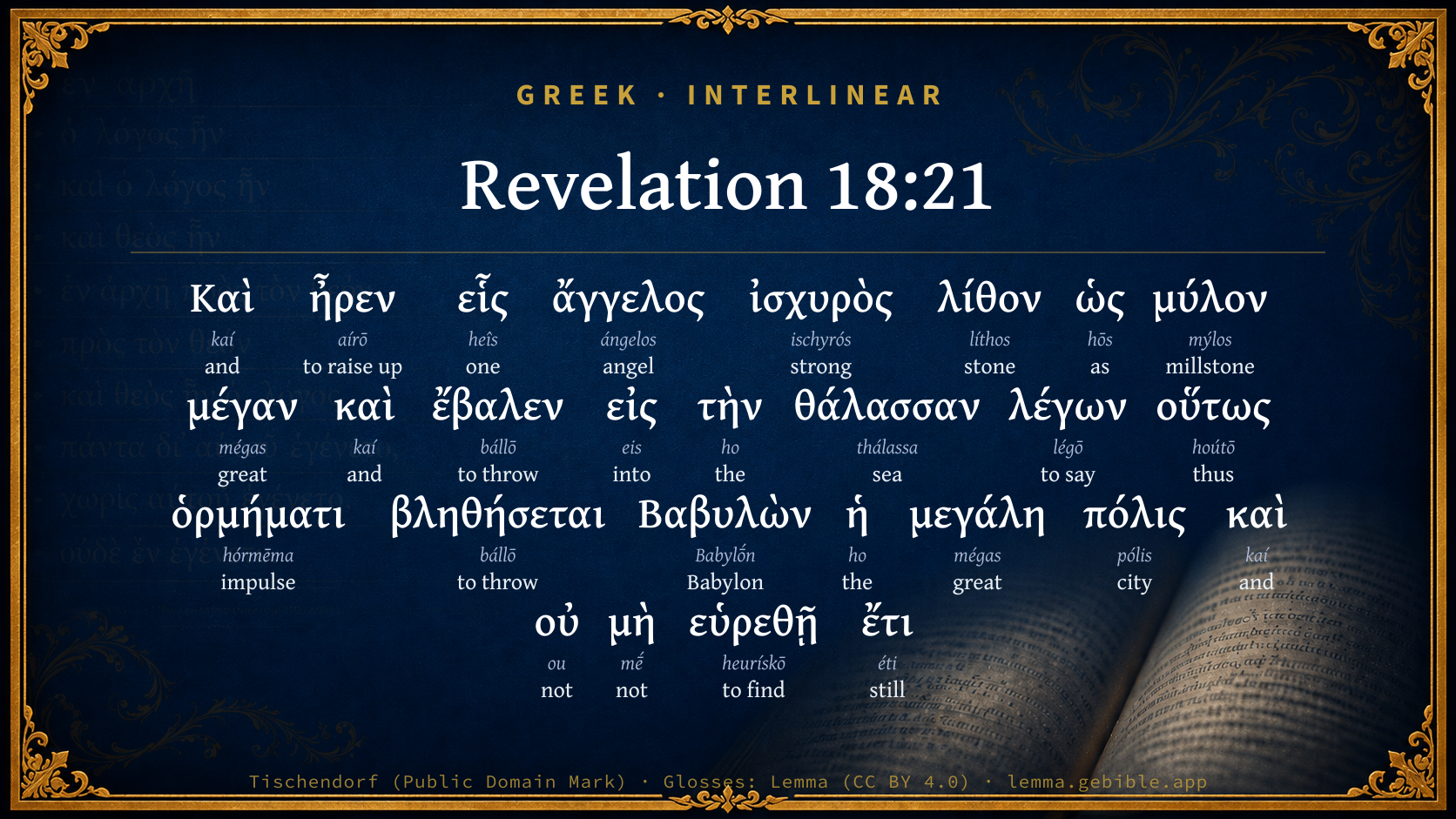
Download image
Cite this verse

Revelation 18:21 (World English Bible). Public Domain. Lemma interlinear Bible study tool, https://lemma.gebible.app/v/revelation/18/21.

Show BibTeX & RIS
BibTeX
RIS
English Translation
A mighty angel took up a stone like a great millstone and cast it into the sea, saying, "Thus with violence will Babylon, the great city, be thrown down, and will be found no more at all.
World English Bible · Public Domain
Highlights
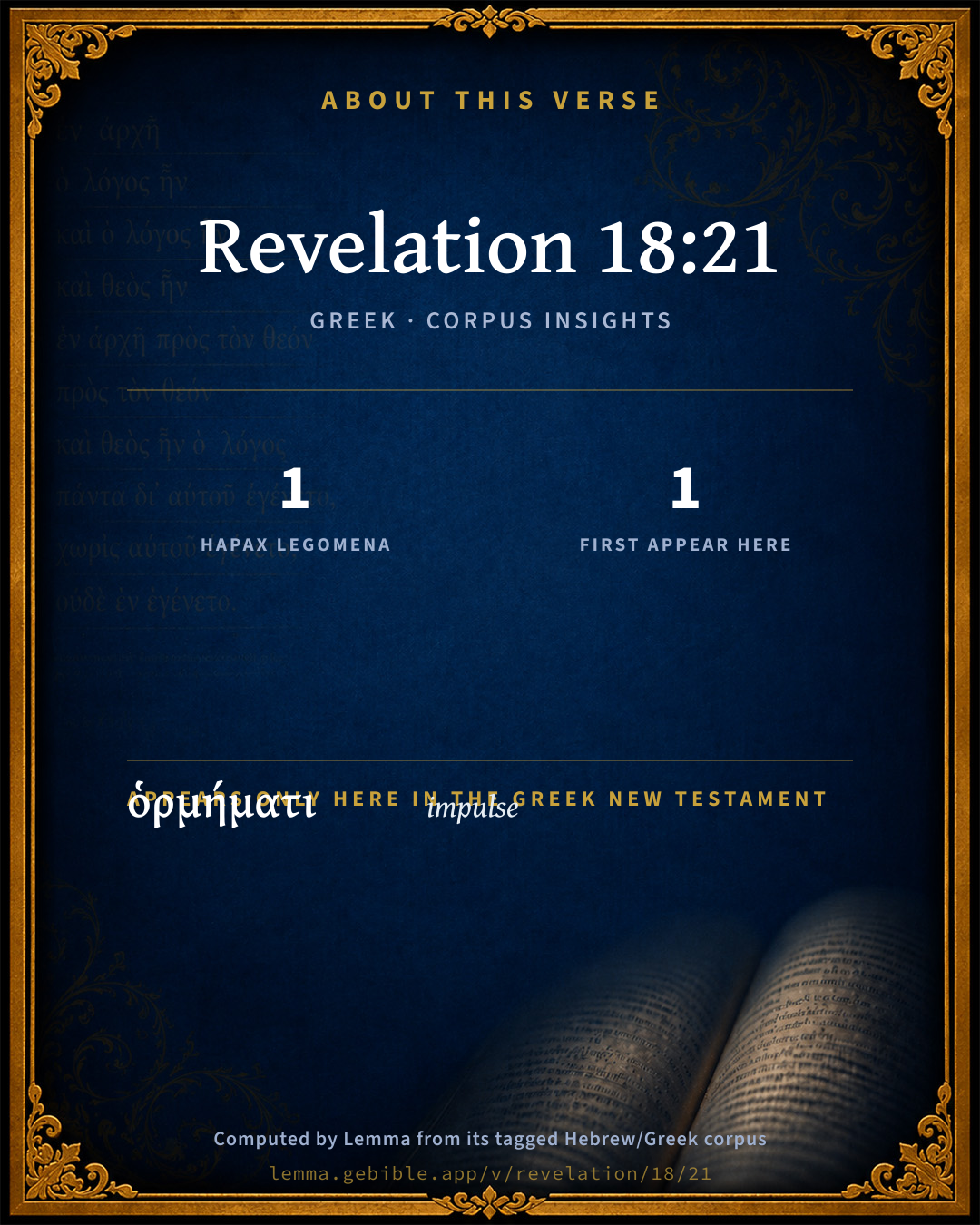
  • 1 hapax legomenon — only here in the Greek New Testament
  • 1 first appearance in the Greek New Testament
Full analysis ↓
Download a study sheet

One document with this verse’s original text, its word-by-word gloss line, the meaning frame, cross-references with their text, attributed commentary, and full source and license credits — printable, and it pastes into notes with its structure intact.

This verse Autodidact and up

Study sheet (.html) Plain text (.txt)

A passage Seminary Student

Up to 50 verses in one chapter. A passage sheet keeps up to 6 commentary sources and 12 cross-references per verse, in the order this page ranks them, and says so on the sheet whenever that leaves anything out. Ask for a single verse and you get the Autodidact verse sheet above.

Everything on this page stays free to read, with no account — the sheet is a download of what is already on screen, not access to it.

Want to remove ads? Support Godless Engineer
Compare translations 3

The same verse in 3 English versions, stacked beneath the original-language interlinear above. Click any original word for its lexicon entry.

Each is an independent rendering of the whole verse — the interlinear is not word-aligned to these translations.

Highlighted words mark where these versions differ — a whole-verse word diff, not a word-by-word alignment.

  • World English Bible Public Domain
    A mighty angel took up a stone like a great millstone and cast it into the sea, saying, "Thus with violence will Babylon, the great city, be thrown down, and will be found no more at all.
  • King James Version Public Domain
    And a mighty angel took up a stone like a great millstone, and cast it into the sea, saying, Thus with violence shall that great city Babylon be thrown down, and shall be found no more at all.
  • unfoldingWord Literal Text CC BY-SA 4.0
    And a mighty angel took up a stone like a great millstone and threw into the sea, saying, “Thus Babylon, the great city, will be thrown down with violence, and she will certainly not be seen anymore,

unfoldingWord Literal Text — © unfoldingWord, licensed CC BY-SA 4.0. Word-aligned USFM3 via Door43 (git.door43.org/unfoldingWord/en_ult).

Versions to compare (up to 4)

3 of 4 selected

Show all 19 translations

Every available English version of this verse, each an independent rendering of the whole verse.

  • World English Bible Public Domain
    A mighty angel took up a stone like a great millstone and cast it into the sea, saying, "Thus with violence will Babylon, the great city, be thrown down, and will be found no more at all.
  • Berean Standard Bible Public Domain
    Then a mighty angel picked up a stone the size of a great millstone and cast it into the sea, saying: “With such violence the great city of Babylon will be cast down, never to be seen again.
  • Majority Standard Bible Public Domain
    Then a mighty angel picked up a stone the size of a great millstone and cast it into the sea, saying: “With such violence the great city of Babylon will be cast down, never to be seen again.
  • King James Version Public Domain
    And a mighty angel took up a stone like a great millstone, and cast it into the sea, saying, Thus with violence shall that great city Babylon be thrown down, and shall be found no more at all.
  • American Standard Version (1901) Public Domain
    And a strong angel took up a stone as it were a great millstone and cast it into the sea, saying, Thus with a mighty fall shall Babylon, the great city, be cast down, and shall be found no more at all.
  • Revised Version (1885) Public Domain
    And a strong angel took up a stone as it were a great millstone, and cast it into the sea, saying, Thus with a mighty fall shall Babylon, the great city, be cast down, and shall be found no more at all.
  • Geneva Bible (1599) Public Domain
    Then a mightie Angell tooke vp a stone like a great milstone, and cast it into the sea, saying, With such violence shall that great citie Babylon be cast, and shalbe found no more.
  • Douay-Rheims (1899) Public Domain
    And a mighty angel took up a stone, as it were a great millstone, and cast it into the sea, saying: With such violence as this shall Babylon, that great city, be thrown down, and shall be found no more at all.
  • Young's Literal Translation Public Domain
    And one strong messenger did take up a stone as a great millstone, and did cast `it' to the sea, saying, `Thus with violence shall Babylon be cast, the great city, and may not be found any more at all;
  • Literal Standard Version CC BY-SA 4.0
    And one strong messenger took up a stone as a great millstone, and cast [it] into the sea, saying, “Thus with violence will Babylon be cast, the great city, and may not be found anymore at all;
  • Unlocked Literal Bible CC BY-SA 4.0
    A mighty angel took up a stone like a great millstone and threw it into the sea, saying, “In this way, Babylon, the great city, will be thrown down with violence and will not be seen anymore.
  • unfoldingWord Literal Text CC BY-SA 4.0
    And a mighty angel took up a stone like a great millstone and threw into the sea, saying, “Thus Babylon, the great city, will be thrown down with violence, and she will certainly not be seen anymore,
  • Darby Bible Public Domain
    And a strong angel took up a stone, as a great millstone, and cast [it] into the sea, saying, Thus with violence shall Babylon the great city be cast down, and shall be found no more at all;
  • World Messianic Bible Public Domain
    A mighty angel took up a stone like a great millstone and cast it into the sea, saying, “Thus with violence will Babylon, the great city, be thrown down, and will be found no more at all.
  • Webster's Bible Public Domain
    And a mighty angel took up a stone like a great millstone, and cast it into the sea, saying, Thus with violence shall that great city Babylon be thrown down, and shall be no more found.
  • Free Bible Version CC BY-SA 4.0
    A powerful angel picked up a rock the size of a large millstone and threw it into the sea, saying, “With this kind of violence the great city of Babylon will be thrown down, and will never exist again.”
  • Bible in Basic English Public Domain
    And a strong angel took up a stone like the great stone with which grain is crushed, and sent it into the sea, saying, So, with a great fall, will Babylon, the great town, come to destruction, and will not be seen any more at all.
  • Text-Critical English NT CC BY 4.0
    Then a mighty angel picked up a stone like a great millstone and threw it into the sea, and said, “With such violence Babylon the great city will be thrown down, never to be found again.
  • Tyndale New Testament (1534) Public Domain
    And a myghty angell toke vp a stone lyke a grett mylstone and cast it into the see sayinge: with suche violence shall that gret cite Babilon be cast and shallbe founde no more.

Literal Standard Version (2020), Covenant Press — licensed CC BY-SA 4.0. Text via the HelloAO Bible API (eBible.org). Unlocked Literal Bible (unfoldingWord) — licensed CC BY-SA 4.0. Text via the HelloAO Bible API (eBible.org). unfoldingWord Literal Text — © unfoldingWord, licensed CC BY-SA 4.0. Word-aligned USFM3 via Door43 (git.door43.org/unfoldingWord/en_ult). Free Bible Version, Dr. Jonathan Gallagher — licensed CC BY-SA 4.0. Text via the HelloAO Bible API (eBible.org).

Word by word

More ways to search: Search by grammar → Find every occurrence → Compare this word →

Practice this passage: Drill this verse → Learn its vocabulary →

ὁρμήματι
hórmēma
G3731
“impulse”
Noun, Dative, Singular, Neuter
Part of Speech
Noun
Case
Dative
Number
Singular
Gender
Neuter
Full Thayer's Definition

Origin: from G3730

TDNT: 12:47,7

1. a rush, impulse 2. that which is impelled or hurried away by impulse
  1. Καὶ kaí G2532 “and” Conjunction
  2. ἦρεν aírō G142 “to raise up” Verb, Aorist, Active, Indicative, 3rd person, Singular
  3. εἷς heîs G1520 “one” Adjective, Nominative, Singular, Masculine
  4. ἄγγελος ángelos G32 “angel” Noun, Nominative, Singular, Masculine
  5. ἰσχυρὸς ischyrós G2478 “strong” Adjective, Nominative, Singular, Masculine
  6. λίθον líthos G3037 “stone” Noun, Accusative, Singular, Masculine
  7. ὡς hōs G5613 “as” Adverb
  8. μύλον mýlos G3458 “millstone” Adjective, Accusative, Singular, Masculine
  9. μέγαν mégas G3173 “great” Adjective, Accusative, Singular, Masculine
  10. καὶ kaí G2532 “and” Conjunction
  11. ἔβαλεν bállō G906 “to throw” Verb, Aorist, Active, Indicative, 3rd person, Singular
  12. εἰς eis G1519 “into” Preposition
  13. τὴν ho G3588 “the” Article, Accusative, Singular, Feminine
  14. θάλασσαν thálassa G2281 “sea” Noun, Accusative, Singular, Feminine
  15. λέγων légō G3004 “to say” Verb, Present, Active, Participle, Nominative, Singular, Masculine
  16. οὕτως hoútō G3779 “thus” Adverb
  17. βληθήσεται bállō G906 “to throw” Verb, Future, Passive, Indicative, 3rd person, Singular
  18. Βαβυλὼν Babylṓn G897 “Babylon” Noun, Nominative, Singular, Feminine
  19. ἡ ho G3588 “the” Article, Nominative, Singular, Feminine
  20. μεγάλη mégas G3173 “great” Adjective, Nominative, Singular, Feminine
  21. πόλις pólis G4172 “city” Noun, Nominative, Singular, Feminine
  22. καὶ kaí G2532 “and” Conjunction
  23. οὐ ou G3756 “not” Particle, Negative
  24. μὴ mḗ G3361 “not” Particle, Negative
  25. εὑρεθῇ heurískō G2147 “to find” Verb, Aorist, Passive, Subjunctive, 3rd person, Singular
  26. ἔτι éti G2089 “still” Adverb

About this verse

These counts appear in no published source. They are computed here, from the morphology-tagged text and Lemma’s own curated glosses. What Lemma adds →

27
words
22
distinct lemmas
Revelation
section

Notable vocabulary

1 hapax legomenon — a word that appears only here in the entire Greek New Testament:

  • ὁρμήματι impulse G3731

First appearance in Scripture

This word makes its first canonical appearance in the Greek New Testament here:

  • ὁρμήματι impulse G3731

Shared distinctive vocabulary

μύλον millstone G3458 occurs in 5 verses of the Greek New Testament. Also found in:
Repetition

Words recur within this verse:

  • μέγαν great G3173 ×2
  • ἔβαλεν to throw G906 ×2
  • Καὶ and G2532 ×3
  • τὴν the G3588 ×2

Cross-references

14

Topical passages linked to Revelation 18:21 in the Treasury of Scripture Knowledge — connected by theme and wording, ordered by reader-vote popularity; previews shown in the World English Bible.

  • Jeremiah 51:63–64 It shall be, when you have made an end of reading this book, that you shall bind a stone to it, and cast it into the midst of the Euphrates:
  • Ezekiel 26:21 I will make you a terror, and you shall no more have any being; though you are sought for, yet shall you never be found again, says the Lord Yahweh.
  • Revelation 5:2 I saw a mighty angel proclaiming with a loud voice, "Who is worthy to open the book, and to break its seals?"
  • Job 20:8 He shall fly away as a dream, and shall not be found: Yes, he shall be chased away like a vision of the night.
  • Daniel 11:19 Then he shall turn his face toward the fortresses of his own land; but he shall stumble and fall, and shall not be found.
  • Revelation 12:8 They didn't prevail, neither was a place found for him any more in heaven.
  • Revelation 16:20 Every island fled away, and the mountains were not found.
  • Revelation 18:22 The voice of harpists, minstrels, flute players, and trumpeters will be heard no more at all in you. No craftsman, of whatever craft, will be found any more at all in you. The sound of a mill will be heard no more at all in you.
  • Revelation 20:11 I saw a great white throne, and him who sat on it, from whose face the earth and the heaven fled away. There was found no place for them.
  • Exodus 15:5 The deeps cover them. They went down into the depths like a stone.
  • Nehemiah 9:11 You divided the sea before them, so that they went through the midst of the sea on the dry land; and their pursuers you did cast into the depths, as a stone into the mighty waters.
  • Psalms 37:36 But he passed away, and, behold, he was not. Yes, I sought him, but he could not be found.
  • Revelation 10:1 I saw a mighty angel coming down out of the sky, clothed with a cloud. A rainbow was on his head. His face was like the sun, and his feet like pillars of fire.
  • Revelation 18:10 standing far away for the fear of her torment, saying, 'Woe, woe, the great city, Babylon, the strong city! For your judgment has come in one hour.'

Cross-references courtesy of OpenBible.info (CC BY 4.0).

Commentary

Notes on Revelation 18:21 from classic Christian and Jewish commentators (each source and its license shown beneath its notes). The classic Christian expositions comment on the surrounding passage and are grouped to its opening verse, so a note may address several verses; the Jewish commentaries on the Tanakh (Rashi and others) are per-verse, so they appear only where the commentator wrote on this verse.

Lemma curates 59 commentaries, every one of them public domain or Creative Commons licensed, each selected and text-cleaned for this edition rather than reprinted as found. About our sources →

The Biblical Illustrator

Joseph S. Exell

Rev_18:21-24

A mighty angel took up a stone.

A great millstone

Observe here--

1. Babylons utter destruction represented by the type and sign of a millstone cast into the sea: like a millstone she had ground and oppressed the Church of God; and now, like a millstone thrown into the sea, she sinks into the pit of destruction. Almighty God, by this symbol, signified to St. John that Babylons ruin should be violent, irrecoverable, and irreparable; she falls never to rise more. The casting of a stone into the sea was anciently the emblem of everlasting forgetfulness.

2. The amplification of Babylons ruin particularised in several instances.

(1) That nothing should ever more be found in her that belonged to pleasure or delight; no voice of harpers, musicians, or trumpeters.

(2) Nothing which belonged to profit or trading, no artificers and craftsmen.

(3) Nothing belonging to food, no noise of a millstone for grinding corn and making provision for bread.

(4) Nothing to relieve against the darkness and terror of the night, as the light of a candle.

(5) No means for the propagation of mankind by marriage--the voice of the bride and the bridegroom shall be heard no more. All which expressions do imply extreme destruction and utter desolation, intimating that Babylon shall be a place utterly abandoned and forsaken.

3. A threefold cause assigned for all this, to wit--

(1) Damnable covetousness: her merchants were the great ones of the earth. Her sinful way of merchandising, by dealing in spiritual commodities, seems here to be pointed at; her making merchandise of the souls of men, as we have it (verse 13).

(2) Her bewitching idolatry, called here sorceries, whereby she enticed people to join with her in her superstitious worship.

(3) Her cruelty and bloodshed; in her was found the blood of prophets, and of saints, and of all that were slain upon the earth.

But how can the blood shed by others be laid to her charge?

1. Because the doctrines which caused their blood to be shed were with her.

2. Because her jurisdiction gave commission to slay the saints which were slain in other kingdoms.

3. Because by the influence of her example at home much blood had been shed abroad. God will charge upon others, as he did upon Babylon, not only the sin which they have acted, but all the sins which they have been necessary unto. (W. Burkitt, M. A.)

Moral evil symbolised

I. A symbolisation of its nature. If you want to see sin, or moral evil, in all its hideous aspects, in all its infernal operations, in all its damning consequences, study the great city of Babylon. The great city Babylon is in every unrenewed soul.

II. A symbolisation of its overthrow. The moral evil of the world is to be destroyed; it is not to exist for ever.

1. It is to be overthrown by superhuman agency. A mighty angel; a messenger from heaven. Was not Christ a mighty Messenger sent from heaven for this purpose? Yes, He came to destroy the works of the devil. It has been said that good alone can overcome evil. True, but it must be good in a supernatural form, and in this form the gospel brings us the good.

2. It is to be overthrown in such a way as never to appear again. Babylon is thrown like a great millstone into the sea. As Pharaoh sank like lead in the mighty waters, and rose no more to life, so shall moral evil, like a mighty millstone, fall into the fathomless abysses of eternal ruin. (Homilist.)

.

The Biblical Illustrator, edited by Joseph S. Exell (c. 1880s–1900s) — public domain. Text from a community e-Sword module.

Whedon's Commentary on the Bible

Daniel D. Whedon

d. Mournful picture of the silence by day, and the darkness by night, within the city home, Rev_18:21-24.

And—In the present paragraph there is not a verb in the future tense, except one, shall be thrown down. This is future, because it is a quotation from Jer_51:63-64, where a similar throwing of a stone into the sea illustrates the downfall of ancient Babylon. All the other verbs of the passage are in the (aorist) past tense.

No more at all—This solemn expression of perpetual ruin is seven times uttered in this paragraph; the symbol number of absolute divine completeness.

Daniel D. Whedon (gen. ed.), Commentary on the Old and New Testaments (1874–1909) — public domain. Text from a community e-Sword module.

Tyndale Open Study Notes

Tyndale Open Resources

18:21-24 The songs responding to Babylon’s fall (18:1-24) conclude with a portrayal of the city’s doom.

18:21 a boulder the size of a huge millstone: Heavy millstones, shaped for grinding olives or grain, were used throughout the ancient world. Jesus also spoke of using such stones in judgment (see Matt 18:6). The dramatically thrown boulder signified that the power of Rome was forever thrown down.

Tyndale Open Study Notes — © Tyndale Open Resources, licensed CC BY-SA 4.0. Text via the HelloAO Bible API.

Meyer's Critical & Exegetical Commentary

Heinrich August Wilhelm Meyer

Rev_18:21-24. Finally, a mighty angel in representing the impending sudden destruction of the great city, by casting a great stone into the sea, not only in his speech explaining this symbolical act, describes, by individual vivid features, the transformation into desolate silence of the pleasure and magnificence that have hitherto prevailed, but also points definitely to the guilt of the city as the ground of the judgment.

εἰς ἄγγελος ἰσχυοὸς. On εἰς in the indefinite sense, cf. Rev_8:13. The might of the angel is especially emphasized, because this is demanded for his action.[4003]

ΛΊΘΟΝ Ὡς ΜΎΛΙΝΟΝ ΜΈΓΑΝ. By the comparison ῶς ΜΎΛ. ΜΈΓ., the greatness of the stone is illustrated.[4004] The meaning of the act[4005] is described well by Andr., since he holds to the literal interpretation of the angel: ΚΑΘἈΠΕΡ, ΦΗΣῚΝ, Ὁ ΜΎΛΟς ΚΑΤΑΔΎΕΙ ὉΡΜΉΜΑΤΙ ΕἸς ΤῊΝ ΘΆΛΑΣΣΑΝ, ΟὝΤΩ ΚΑῚ Ἡ Τῆς ΒΑΒΥΛῶΝΟς ΤΑΎΤΗς ἈΘΡΌΟΝ ἜΣΤΑΙ ΚΑΘΑΊΡΕΣΙς, ὬΣΤΕ ΜΉΤΕ ἼΧΝΟς ΑὐΤῆς ΦΥΛΑΧΘῆΝΑΙ ΕἸς ΤῸ ΜΕΤΈΠΕΙΤΑ.[4006] Here it is likewise remarkable that Andr. does not see that he is led to substitute for the expression Ὁ ΜΎΛΟς, which is unusual as a designation of a millstone, that which is ordinarily employed, and how he correctly paraphrases the ὈΡΜΉΜΑΤΙ[4007] by ἈΘΡΌΟΝ.

Concerning Οὐ ΜῊ with aor. subj., Rev_18:21 sqq.,[4008] see Winer, p. 471.

The description, Rev_18:22 sqq., which refers not only to objects of pleasure and luxury, but also to daily wants and natural relations of life, has the model of Eze_26:13, Jer_25:10,[4009] as its foundation; the ἘΡΉΜΩΣΙς of the city (Rev_18:16; Rev_18:19; Rev_17:16)[4010] is illustrated in a concrete way.

Πᾶς ΤΕΧΝΊΤΗς ΠΑΣ. ΤΈΧΝΗς. The exhaustive conclusion of the category, of which several individual examples are mentioned.[4011] ὍΤΙ ΟἹ ἜΜΠΟΡΟΙ ΣΟΥ, Κ.Τ.Λ. Very suitably, the discourse of the angel concludes with a definite presentation of the guilt of the city. This, however, is stated in a threefold way from Rev_18:1 on:[4012] first, the unprecedented luxury in which the city had indulged, because of its wealth;[4013] then the licentiousness into which she had led astray all nations and kings, as she brought all the world thither to her service and to acknowledge her as the divine queen;[4014] finally, her bloody hostility to the saints.[4015] All three points[4016] the angel emphasizes, sealing, as it were, his announcement of judgment with this establishment of guilt; the first, in the words ὍΤΙ ΟἹ ἜΜΠΟΡΟΊ ΣΟΥ ἮΣΑΝ ΟἹ ΜΕΓΙΣΤᾶΝΕς Τῆς Γῆς,[4017] because thy merchants were the great men of the earth, i.e., because they who brought thee the objects of thy luxurious life found in thy wealth and extravagance a source of their own wealth, which made them the great men of the earth;[4018] the second, in the words ὅτι ἐν τῇ φαρμακείᾳ σου, κ.τ.λ., which cannot be understood as a foundation of what immediately precedes,[4019] but are co-ordinate with the first expression ὅτι οἱ ἔαποροι, κ.τ.λ., since here the same object is described as in Rev_17:2; Rev_17:4, and the seductive sorcery[4020] is in fact nothing else than the intoxicating wine of the harlot. The most important third point of the guilt is finally emphasized with especial force, Rev_18:24, by the change in the form of the discourse. Not in an apostrophe to the city, but in a judgment of firm objectivity, it is here finally established that in the city the blood of prophets and of saints, and of all those slain upon earth (for Christs sake), was found. In an exquisite manner the ΕὐΡΈΘΗ indicates how the blood, which has been shed upon the earth, was reckoned to the city. The city is the capital of the entire empire, hating and murdering believers; as a matter of fact also, in the Neronian universal persecution, it took the lead of its empire.

In violation of the context, Ew. ii. understands the ΠΆΝΤ. Τ. ἙΣΦ., Κ.Τ.Λ., of those not Christians.

[4003] Cf. Rev_5:2, 18.

[4004] Cf. Rev_11:1, Rev_8:8.

[4005] Cf. Jer_51:63 sqq.

[4006] [Just as, he says, the millstone sinks by its impulse into the sea, so also the destruction of this Babylon shall be all at once, so that not a trace of it shall be preserved for posterity.]

[4007] Cf. Mat_8:32 with its parallels.

[4008] Also Rev_18:7.

[4009] Cf. Jer_7:34, Jer_14:9, Jer_33:11.

[4010] Cf. Jer_7:34.

[4011] Cf. Rev_18:14; Rev_18:17.

[4012] Cf. ch. 17.

[4013] Rev_18:3; Rev_18:7; Rev_18:11 sqq.

[4014] Cf. Rev_18:3; Rev_18:6 sq., 9, Rev_17:2.

[4015] Cf. Rev_17:6.

[4016] Cf. Ewald.

[4017] Cf. Isa_23:8.

[4018] Cf. Rev_6:15. So Ewald, De Wette, Hengstenb., etc. Eichh. improperly regards the οί ἔμπ. σου as the predicate, as he besides regards the merchandise as a figurative designation for fornication.

[4019] Against Hengstenb.

[4020] φαρμακεία refers to the love-potions of the harlot. Cf. Isa_47:9; Isa_47:11 sqq. Ewald, De Wette.

Meyer — Critical and Exegetical Commentary on the New Testament — English translation by Peter Christie, edited by Frederick Crombie (T&T Clark, 1880) — public domain. Text from a community e-Sword module.

Expositor's Greek Testament

ed. W. Robertson Nicoll

Rev 18:21-24 : a rhythmic song of doom, introduced by a symbolic action partly imitated from Jer 51:63-64 .

Rev 18:21 . Rome’s fall will be irrevocable and sudden and violent, as a powerful angel shows dramatically by seizing a huge boulder and flinging it into the sea. Cf. the analogous description of Babylon’s collapse in Sib. Or. ver. 158, 163, 174. The reiterated emphasis on Roman luxury is notable. Later literature, as Friedländer observes (Rev 3:9-17 ), tended to a conventional exaggeration of the luxurious civilisation under the Empire; judged by modern standards, at any rate, it was not particularly extravagant. This denunciation of wealth and ease, however, is apposite in a source which reflects the age of Nero, since it was under Nero, rather than under Vespasian or Domitian, that Roman luxury during the first century of our era reached its zenith. The oracle breathes the scorn felt by simple provincials for the capital’s wanton splendour, and indeed for the sins of a pleasure-loving civilisation. But it is religious poetry, not a prose transcript of the contemporary commercial situation. Cf. Dill’s Roman Society , pp. 32 f., 66 f.

The Expositor's Greek Testament, edited by W. Robertson Nicoll (1897–1910) — public domain. Text from a community e-Sword module.

Geneva Bible (1599)

Geneva Bible translators

The third prediction, as I said verse 1, standing of a sign, and the interpretation thereof: the interpretation thereof is in 2 sorts, first by a simple propounding of the thing itself, in this verse, and then by declaration of the events in the verses following.

Geneva Bible (1599) marginal notes — public domain. Text via Bolls.life.

Jamieson, Fausset & Brown

Robert Jamieson, A. R. Fausset & David Brown

a--Greek, "one."

millstone--Compare the judgment on the Egyptian hosts at the Red Sea, Exo 15:5, Exo 15:10; Neh 9:11, and the foretold doom of Babylon, the world power, Jer 51:63-64.

with violence--Greek, "with impetus." This verse shows that this prophecy is regarded as still to be fulfilled.

Jamieson, Fausset & Brown — Commentary Critical and Explanatory on the Whole Bible (1871) — public domain (CC PDM 1.0). Text via the HelloAO Bible API.

Adam Clarke's Commentary

Verse 21. Thus with violence shall that great city Babylon be thrown down] This action is finely and forcibly expressed by the original words: Οὑτως ὁρμηματι βληθησεται Βαβυλων ἡ μεγαλη πολις. The millstone will in falling have not only an accelerated force from the law of gravitation, but that force will be greatly increased by the projectile force impressed upon it by the power of the destroying angel.

Shall be found no more at all.] In her government, consequence, or influence. This is true of ancient Babylon; we are not certain even of the place where it stood. It is also true of Jerusalem; her government, consequence, and influence are gone. It is not true of Rome pagan; nor, as yet, of Rome papal: the latter still exists, and the former is most intimately blended with it; for in her religions service Rome papal has retained her language, and many of her heathen temples has she dedicated to saints real or reputed, and incorporated many of her superstitions and absurdities in a professedly Christian service. It is true also that many idols are now restored under the names of Christian saints!

Adam Clarke's Commentary on the Bible (1810–1826) — public domain. Text from a community e-Sword/MySword module.

Ellicott's Commentary for English Readers

THE IRREMEDIABLE OVERTHROW OF BABYLON SYMBOLICALLY DECLARED.

(21) And a mighty angel . . .—The taking up of the stone and casting it into the waters is a symbol drawn from Jeremiah (Jeremiah 51). Jeremiah enjoined Seraiah to bind the prophetic roll to a great stone, and cast them together into the Euphrates. The meaning of the act was explained—“Thus shall Babylon sink and shall not rise,” &c. (Jer_51:63-64). The great dead mass, sinking helplessly by the law of its own weight, signified a fall past recovery. So Pharaoh and his host sank like lead in the mighty waters. It is the doom Christ foreshadowed as awaiting those who caused His children to fall (Mat_18:6). The mighty angel, strong to lift the ponderous stone, throws it into the sea, saying, Thus with violence (or, with a bound) shall Babylon, the great city, be thrown, and shall not be found any more. At one bound, without a single resting-stage in its downward career, without chance or power of recovery, the vast world-city would fall. She who sat as a queen upon many waters, sinks as a stone in the mighty waters. She will not be found any more. The words “any more,” or “no more,” are repeated in these verses no less than six times, like a funeral knell over the departed greatness which is described.

A Bible Commentary for English Readers, edited by Charles John Ellicott (1878–1897) — public domain. Text from a community e-Sword module.

The Cambridge Bible for Schools and Colleges

gen. ed. J. J. S. Perowne

21. a mighty angel] Lit., one strong angel.

cast it into the sea &c.] Jer_51:63-64.

with violence] Lit., with a rush or dash. R. V. “with a mighty fall.”

The Cambridge Bible for Schools and Colleges (gen. ed. J. J. S. Perowne; Cambridge University Press, 1878–1918) — public domain. Text from a community e-Sword module.

John Gill's Exposition

And the voice of harpers, and musicians, and of pipers and trumpeters,.... Which were for mirth, delight, and pleasure:

shall be heard no more at all in thee: the words seem to be taken from Isa 24:8 and may not only regard the loss of every thing that was delightful and pleasant to the ear in private houses, at festivals, and nuptials, and the like, but the ceasing of church music; there will be no more bells, nor organs, or any other instruments of music; no more chanters, and sub-chanters, choristers, singing men and boys:

and no craftsman, of whatsoever craft he be shall be, found any more in thee; which are very useful and necessary in cities and societies; it is threatened to Judah, that the cunning artificer should be taken from her, Isa 3:3 and it is reckoned as a considerable part of the distress of the captivity that the carpenters and smiths were away from Jerusalem, Jer 24:1 and this judgment may fall on Rome for her worshipping idols of gold, silver, brass, stone, and wood, the works of men's hands, artificers and craftsmen, and who are employed in making other trinkets and wares for antichrist:

and the sound of a millstone shall be heard no more at all in thee; to grind corn with, see Jer 25:10 there will be a famine at the time that Rome is besieged, Rev 18:8 and after it is destroyed, there will be no corn to grind, nor inhabitants to eat it, and so no use of the millstone; this is said in opposition to her luxurious and delicious living, Rev 18:3 and this may also refer to feasts and rich entertainments, for which spices were ground and prepared by an hand mill (m) in the house; and so may signify here that there would be no more of such entertainments and rich living; with which sense agrees what follows. This clause is wanting in the Syriac and Ethiopic versions.

(m) Schindler. Lex. Pentaglott. in Voce Col. 1712.

John Gill's Exposition of the Whole Bible (1746–1763) — public domain (CC PDM 1.0). Text via the HelloAO Bible API.

Trapp's Complete Commentary

John Trapp

21 And a mighty angel took up a stone like a great millstone, and cast it into the sea, saying, Thus with violence shall that great city Babylon be thrown down, and shall be found no more at all.

Ver. 21. And a mighty angel] For further assurance a sign is added, and an allusion made to Jer 51:63. And here it is easy to observe a notable gradation, an angel, a strong angel, taketh a stone, and a great stone, even a millstone, which he letteth not barely fall, but casteth, and with impetuous force thrusteth into the bottom of the sea, whence it cannot be buoyed up. Thus is set forth to the eye also the irreparable ruin of Rome.

John Trapp, A Commentary or Exposition upon All the Books of the Old and New Testament (1647–1656) — public domain. Text from a community e-Sword module.

Albert Barnes' Notes on the Bible

And a mighty angel - See the notes on Rev 18:1. This seems, however, to have been a different angel from the one mentioned in Rev 18:1, though, like that, he is described as having great power.

Took up a stone like a great millstone - On the structure of mills among the ancients see the notes on Mat 24:41.

And cast it into the sea - As an emblem of the utter ruin of the city; an indication that the city would be as completely destroyed as that stone was covered by the waters.

Saying, Thus with violence - With force, as the stone was thrown into the sea. The idea is, that it would not be by a gentle and natural decline, but by the application of foreign power. This accords with all the representations in this book, that violence will be employed to overthrow the papal power. See Rev 17:16-17. The origin of this image is probably Jer 51:63-64; “And it shall be, when thou hast made an end of reading this book, that thou shalt bind a stone to it, and cast it into the midst of Euphrates; and thou shalt say, Thus shall Babylon sink, and shall not rise from the evil that I will bring on her.”

Albert Barnes' Notes on the Bible (1834–1885) — public domain. Text from a community e-Sword/MySword module.

Matthew Poole's English Annotations

And a mighty angel took up a stone like a great millstone, and cast it into the sea; for a sign or symbol of the irreparable ruin of Rome, signified by that great millstone which had ground to powder so many of God’s holy ones. By this sign God shows his prophet:

1. That Rome shall be ruined.

2. That it shall be done with violence.

3. That it shall be a total, utter ruin, from whence it shall never recover.

Matthew Poole's English Annotations on the Holy Bible (1683–1685) — public domain. Text from a community e-Sword/MySword module.

The Pulpit Commentary

And a mighty angel took up a stone like a groat millstone, and cast it into the sea, saying; add one strong angel. (cf. the "mighty voice" in ver. 2; also Rev_10:1, and elsewhere) The adjective, of course, refers to the mightiness of the deed wrought. (cf. Jer_51:61-64, "Thou shall bind a stone to it, and cast it into the midst of Euphrates; and thou shall say, Thus shall Babylon sink, and shall not rise," etc.) The sea may be typical of the nations of the earth. (see Rev_13:1) Thus with violence shall that groat city Babylon be thrown down, and shall be found no more at all; Thus with a mighty fall shall Babylon, the great city, be cast down, etc. (Revised Version). Alford translates "with a rush;" ormhma is peculiar to this passage. The complete nature of this extinction is indicated by the frequency of the words, "no more at all," in vers. 21-23.

"No more.

Six times over does this word recur, and always concerning the same fact. That fact, therefore, must be notable, and is intended to be noticed by us. Of what, then, is it thus repeatedly said, it is "no more"? A glance at this chapter shows that "the great city Babylon" is spoken of, and that accursed city meant heathen Rome to the mind of St. John. But full well we know that even when Rome pagan gave way to Rome papal, evil and sin, bloody persecution and cruel wrong, did not disappear. Therefore we take Babylon to mean far more than any Rome, or any city that is or has been on the face of the earth; we take it as telling of the whole kingdom of evil that mighty empire, that hoary sinner against God and man. Though St. John meant Rome, his words tell of far more than Rome. And we, coming so far further down in the world"s history, are able and glad to read in them this fuller meaning which we believe to have been in the Divine mind, though not in that of his servant. Let Babylon stand, then, for the city where Satan"s seat is the whole kingdom and dominion of the devil, and let us listen to the six times repeated stroke of the word "no more," which in our text and two following verses may be heard. The city is to be "no more," and her music "no more," and her trade "no more," and her food supplies "no more," and her lamp lit feasts "no more," and her marriage festivals "no more." Thus, by the utter desolation of a great city, such as that which came on Babylon, is set forth the fact of the final and complete overthrow of that kingdom of evil of which Babylon was the ancient type, and Rome, in St. John"s day, the embodiment. Such utter overthrow is

I SIGNIFIED BY SYMBOL. See the mighty angel lifting aloft the huge and ponderous millstone and then hurling it, with all his force, into the depths of the sea. There, buried out of sight, sunk down into the bed of ocean, it shall never more be seen. Such is the symbol. One that seemed little likely of fulfilment when it was given, and even now, oftentimes, seems as if it never would be fulfilled.

II VERIFIED BY FACT. Babylon had fallen, in spite of all its greatness, and heathen Rome was hastening to her fall. And other such Babylons have risen, and wrought their evil, and rioted in their sin, and, like her, have fallen. Therefore we may he assured that the last and greatest of them all will also one day be "no more.

III LONGED FOR BY THE OPPRESSED. "How long, O Lord, how long, dost thou not avenge? such has been the cry of the oppressed for weary ages. "Thy kingdom come," is the cry we put up day by day.

IV PROMISED IN THE GOSPEL. "The Spirit of the Lord is upon me," said Jesus, "because he hath anointed me to preach glad tidings to the poor," etc. (Luke 4). And this is the gospel, that the kingdom of evil shall be "no more." It is present with us now, we know, in all its forms. But it is not always so to be. Ere the glad tidings were proclaimed, good men, sore perplexed and troubled, pondered much and sadly over the mystery of evil. They could not understand how God could let it be. Nor do we fully understand even now. But this much we know, that it is but for a time. And faith is able to grasp the promise of the gospel, and to "rest in the Lord, and wait patiently for him.

V REJOICED IN BY SAINTS. The joy of all heaven because of this overthrow of evil is told of in the next chapter. Their Alleluias ascend unceasingly, for that God hath judged the accursed city and established his own reign.

VI CREDIBLE TO REASON. The evidence for the Divine existence and the Divine character as holy, just, wise, and good becomes more convincing the more it is considered, notwithstanding the existence of a kingdom of evil. Doubtless that kingdom is a great stumbling block to both reason and faith, but it is not an insurmountable one. But were it not for the truth we are considering now, that all this accursed rule of evil shall one day be "no more," we do not see how faith in God could live. For that faith necessitates as its corollary that evil should terminate and be "no more." Reason reiterates her conviction that if God be, evil must one day be "no more.

VII ACCOMPLISHED BY CHRIST. "For this purpose the Son of God was manifested." "I saw," he says, "Satan as lightning fall from heaven." "The prince of this world is judged." There was that, however imperfectly we may understand it, in the life, death, and resurrection of our Lord Jesus Christ, which effected the virtual overthrow of evil. Satan received his death stroke; he is no longer what he was. We know and confess that in some aspects of life it seems very hard to believe this. But when we consider what the power of our blessed Lord and Master has already done; how the might of his meekness, the love of his sacrifice, the attraction of his cross, have already subdued so many hearts and triumphed over so many foes, then faith revives, and we can believe that, as he said, "the prince of this world is judged." Lord, we believe; but help our unbelief. S.C.

Moral evil symbolized.

"And a mighty angel took up a stone like a great millstone, and cast it into the sea," etc. In these words we have a symbolization of moral evil.

I A SYMBOLIZATION OF ITS NATURE. Babylon is a symbol. Not unfrequently is moral evil in the aggregate represented by some one object. Sometimes by the "old man," that is, the unrenewed, depraved man; he is the embodiment of all the elements of sin. Sometimes by the "world," that is, the moral evil embodied in the world. "He that loveth the world," etc., that is, the moral evil embodied in the world. In Nebuchadnezzar"s dream it is represented as a colossal image, representing the wealth and power of empire, the pride of the idolatry, the wickedness of all kingdoms. Here in these words it is represented by the great city Babylon. Babylon stands here as the grand symbol of moral evil. If you want to see sin, or moral evil, in all its hideous aspects, in all its infernal operations, in all its damning consequences, study the great city of Babylon. In this city you will find not only the evils of the Roman Catholic Church, but of all Churches, of all institutions, of all countries and climes, ay, of all human hearts. The great city Babylon is in every unreserved soul. Here is

II A SYMBOLIZATION OF ITS OVERTHROW. "And a mighty angel took up a stone like a great millstone, and cast it into the sea, saying, Thus with violence shall that great city Babylon be thrown down, and shall be found no more at all." The moral evil of the world is to be destroyed; it is not to exist forever. The various figures used to symbolize it are set forth as objects for utter destruction. The world is to be "overcome, as Christ overcame it. The old man, which is corrupt, is to be "crucified with his affections and lusts." The great image is to be shivered to pieces by the "stone," the symbol of Divine truth; and here the great city Babylon is represented as being thrown like a great millstone "into the sea." Two remarks are suggested concerning its overthrow.

1. It is to be overthrown by superhuman agency. "A mighty angel," a messenger from heaven. Was not Christ a mighty Messenger sent from heaven for this purpose? Yes; he came to "destroy the works of the devil." It is said that good alone can overcome evil. True, but it must be good in a supernatural form; and in this form the gospel brings us the good.

2. It is to be overthrown in such a way as never to appear again. Babylon is thrown like a great millstone into the sea. "And shall be found no more at all." As Pharaoh sank like lead in the mighty waters, and rose no more to life, so shall moral evil like a mighty millstone fall into the fathomless abysses of eternal ruin. "Shall be found no more at all." No less than six times are these words repeated. Some one has said that they toll like a funeral knell. I would rather say that they chime like a triumphant peal. Thank God, mighty and wide as is the dominion of evil in the world, I am prone to believe that it will not endure forever. All the holy prayers in the universe cry for its ruin. All holy agencies work for it, and omnipotence is pledged to its overthrow. D.T.

The Pulpit Commentary (1880–1919), ed. H.D.M. Spence-Jones & Joseph S. Exell — public domain. Text from a community e-Sword module.

John Wesley's Explanatory Notes

And a mighty angel took up a stone, and threw it into the sea - By a like emblem Jeremiah fore-showed the fall of the Chaldean Babylon, Jer. li, 63, 64.

John Wesley, Explanatory Notes Upon the Whole Bible (1754–1765) — public domain. Text via the GEBible commentary corpus.

Kretzmann's Popular Commentary

Paul E. Kretzmann

The punishment completed:

v. 21. and a mighty angel took up a stone like a great millstone, and cast it into the sea, saying, Thus with violence shall that great city Babylon be thrown down and shall be found no more at all.

v. 22. And the voice of harpers and musicians and of pipers and trumpeters shall be heard no more at all in thee; and no craftsman, of whatsoever craft he be, shall be found any more in thee; and the sound of a millstone shall be heard no more at all in thee;

v. 23. and the light of a candle shall shine no more at all in thee; and the voice of the bridegroom and of the bride shall be heard no more at all in the e; for thy merchants were the great men of the earth; for by thy sorceries were all nations deceived.

v. 24. And in her was found the blood of prophets and of saints and of all that were slain upon the earth.

Here the seer pictures inevitable doom, total and terrible desolation: And there lifted up one mighty angel a stone like a millstone, and threw it into the sea, saying, Thus with force shall be thrown down Babylon, the great city, and shall no more be found; and the voice of harpists and minstrels and flutists and trumpeters no more shall be heard in thee, and all craftsmen of every craft shall no more be found in thee, and the sound of the millstone shall no more be heard in thee, and the light of a lamp shall no more shine in thee, and the voice of bridegroom and bride shall no more be heard in thee, because thy merchants were the magnates of the earth, because by thy incantations were deceived all nations, and in her was found the blood of prophets and saints and of all those that had been slain on the earth. That is the sentence of doom, given in the form of a rhythmic song, and introduced by a symbolic action resembling that of Jer 51:63-64. The judgment of the great city, of spiritual Babylon, the kingdom of Anti-Christ, is sealed; the blow given her by the Reformation was so strong as to lay her low forever. No matter what efforts the papacy makes to regain her former absolute reign in the world, all such attempts are bound to result in failure. The glory which she formerly held is departed from her forever. The sins of spiritual adultery, of idolatry, and of the magic spells with which Rome managed to seduce the mighty ones of the earth, the blood which she has shed during the thousand years and more which she has been in existence, call down upon her the curse of the Lord, His eternal damnation.

Summary

The fall and destruction of the kingdom of Anti-Christ is here described in full, together with the wailing complaint of rulers and merchants and shipmasters that grew rich in the traffic in her goods and luxuries, while there is rejoicing in heaven over the vindication of the martyrs and prophets and apostles.

Paul E. Kretzmann, Popular Commentary of the Bible (1921–1924) — public domain. Text from a community e-Sword module.

Burkitt's Expository Notes on the New Testament

William Burkitt

Observe here, 1. Babylon’s utter desolation represented by the type and sign of a millstone cast into the sea; like a millstone she had ground and oppressed the church of God, and now, like a millstone thrown into the sea, she sinks into the pit of destruction.

Almighty God, by this sign or symbol, signified to St. John that Babylon’s ruin should be violent, irrecoverable, and irreparable; she falls never to rise more. The casting of a stone into the sea was anciently the emblem of everlasting forgetfulness.

Observe, 2. The amplification of Babylon’s ruin particularized in several instances.

1. That nothing should evermore be found in her that belonged to pleasure or delight: no voice of harpers, musicians, or trumpeters.

2. Nothing which belonged to profit or trading, no artificers or craftsmen.

3. Nothing belonging to food, no noise of a millstone for grinding corn and making provision for bread.

4. Nothing to relieve against the darkness and terror of the night; as the light of a candle.

5. No means for the propagation of mankind by marriage; The voice of the bride and the bridegroom shall be heard no more.

All which expressions do imply extreme destruction and utter desolation: intimating, that Babylon shall be a place utterly abandoned and forsaken.

Observe, 3. A three-fold cause assigned for all this, to wit,

1. Damnable covetousness: Her merchants were the great ones of the earth. Her sinful way of merchandising, by dealing in spiritual commodities peculiar to Rome, seems to be here pointed at; her making merchandise of the souls of men, as we have it, Rev 18:13.

2. Her bewitching idolatry, called here sorceries, whereby she enticed people to join with her in her superstitious worship.

3. Her cruelty and bloodshed: In her was found the blood of prophets and of saints, and of all that were slain upon earth.

Quest. But how can the blood shed by others be laid to her charge?

Ans. 1. Because the doctrines which caused their blood to be shed were with her.

2. Because her jurisdiction gave commission to slay the saints which were slain in other kingdoms.

3. Because by the influence of her example at home, much blood had been shed abroad.

God will charge upon others, as he did upon Babylon, not only the sin which they have acted, but all the sin which they have been accessary to.

William Burkitt's Expository Notes on the New Testament (1700–1703) — public domain. Text from a community e-Sword module.

The People's New Testament

B. W. Johnson

21–24. And a strong angel took up a millstone. See Jeremiah 51:61–64. This symbolical act implies an utter destruction. In Jeremiah the stone is cast into the Euphrates. Now it is cast into the sea, because another Babylon is designed.

B. W. Johnson's The People's New Testament with Notes (1889–1891) — public domain. Electronic text from the Christian Classics Ethereal Library (CCEL) ThML edition.

unfoldingWord translationNotes

Door43 World Missions Community

Connecting Statement:

Another angel begins to speak about Babylon. This is a different angel than the ones who have spoken previously.

millstone

a large round stone used to crush grain

Babylon, the great city, will be thrown down with violence and will not be seen anymore

God will completely destroy the city. This can be stated in active form. AT: "God will violently throw down Babylon, the great city, and it will no longer exist" (See: Metaphor and Active or Passive)

will not be seen anymore

"no one will see it anymore." Not being seen here means that it will not exist. AT: "it will not exist anymore" (See: Metonymy)

The sound made by harpists, musicians, flute players, and trumpeters will not be heard anymore in you

This can be stated in active form. AT: "No one in your city will ever again hear the sound that harpists, musicians, flute players, and trumpeters make" (See: Active or Passive)

in you

The angel speaks as if Babylon were there listening to him. AT: "in Babylon" (See: Apostrophe)

will not be heard anymore in you

"no one will hear them anymore in you." Not being heard here means that they will not be there. AT: "they will not be in your city anymore" (See: Metonymy)

No craftsman ... will be found in you

Not being found there means that they will not be there. AT: "No craftsman of any kind will be in your city" (See: Metonymy)

No sound of a mill will be heard anymore in you

The sound of something not being heard means that no one will make that sound. AT: "No one will use a mill in your city" (See: Metonymy)

translationWords

angel

Babylon

harp

flute

trumpet

unfoldingWord translationNotes — © Distant Shores Media and the Door43 World Missions Community, licensed CC BY-SA 4.0. Source: git.door43.org/Door43/en_tn.

Cambridge Greek Testament for Schools and Colleges

21. ἰσχυρὸς λίθον. א* has λίθον ἰσχυρόν. A Syr[679] Tyc[680] omit ἰσχυρός.

[679] Syriac.

[680] Tyconius.

ὡς μύλον μέγαν. א has ὡς λίθον μἑγαν, AC ὡς μύλινον (C μυλικὸν) μέγαν.

21. καὶ ἔβαλεν κ.τ.λ. Jer 51:63-64.

οὕτως ὁρμήματι. Vg[692] Hoc impetu. R. V[693] “with a mighty fall.”

[692] Vulgate.

[693] Revised Version.

Cambridge Greek Testament for Schools and Colleges (Cambridge University Press, 1896; 21 vols, various authors incl. Carr, Maclear, Plummer, Farrar, Lumby, Moule, M. R. James, Simcox) — public domain. Text from a community e-Sword module.

Alford’s Greek Testament

Henry Alford

21-23.] Symbolic proclamation by an angel of Babylon’s ruin. And one (or a) strong angel took up a stone great as a millstone, and cast it into the sea, saying, Thus with a rush shall be thrown down Babylon the great city, and shall never be found any more. And the sound of harpers and musicians and flute-players and trumpeters shall never be heard in thee any more, and every artisan of every art shall never be found in thee any more, and the sound of the millstone (see Jer 25:10, Heb. and E. V., not LXX, where the denunciation regards Jerusalem, and is to be performed by the King of Babylon) shall never be heard in thee any more, and the light of a lamp shall never shine in (or upon) thee any more (still from Jer. l. c.), and the voice of the bridegroom and the bride shall never be heard in thee any more: because thy merchants were the great men of the earth, because in thy sorcery (on the form φαρμακία (= -κεία) see reff.) all the nations were deceived (see Isa 47:9-12). And in her (the angel drops the address to the fallen city, and speaks out this last great cause of her overthrow as a fact respecting her) the blood of prophets and of saints was found and of all who have been slain on the earth (i. e. naturally, of all slain for Christ’s sake and His word. Compare the declaration of our Lord respecting Jerusalem, Mat 23:35).

Henry Alford, The Greek Testament (1849–1861) — public domain. Text from a community e-Sword module.

Vincent's Word Studies in the New Testament

Marvin R. Vincent

A mighty angel [εις αγγελος ισχυρος] . Lit., "one strong angel." A great millstone. See on Mt 18:6.

With violence [ορμηματι] . Lit. with an impulse or rush. Only here in the New Testament.

Marvin R. Vincent, Word Studies in the New Testament (1887–1900) — public domain. Text from a community e-Sword/MySword module.

Lesson kit

Teaching starters — assembled from the data on this page, not authored interpretation. Every prompt links to the verse data it draws on. Edit before teaching.

Revelation, in the Revelation, opens this verse with 27 words (22 distinct Greek lemmas). Its most distinctive word is hórmēma (“impulse”). A historical commentator’s framing appears above. Read the whole chapter for the surrounding context.

Discussion questions

  1. What does “impulse” (hórmēma) contribute to the verse as a whole?
  2. 1 word here appears nowhere else in the Greek New Testament. Why might the author reach for such rare wording?
  3. This is the first place “impulse” appears in Scripture (first appears here). What does its debut here establish?
  4. How does Matthew 18:6, which shares the word «millstone», read alongside this verse?
  5. What does the repetition of “great” (2× in this one verse) do in this verse?
  6. These translations render this verse differently; the difference is in the English rendering, not the original. What questions does that raise?
  7. Compare how The Biblical Illustrator and Whedon's Commentary on the Bible read this verse. Where do they agree or differ?

Things to notice

  • 1 word in this verse appears nowhere else in the Greek New Testament.
  • 1 word makes its first canonical appearance in Scripture here.
  • These translations choose different wording for 10 words in this verse.
  • “great” occurs 2× in this single verse.
  • 22 distinct Greek lemmas span 27 words in this verse.

Reading settings

Reading text

Shown beneath each verse's original-language words.

Old Testament
Old Testament edition

Read the OT as the Masoretic Hebrew (MT) or the Greek Septuagint (LXX).

English shown for the Greek Septuagint (in the Hebrew ↔ Greek comparison).

Comparing translations? Open the Compare panel on any verse page to stack up to four side by side.