
Luke 24:46

Greek (Tischendorf 8th ed.) Luke 24:46 appears in the Greek New Testament. The text above is from the Tischendorf 8th edition. Each word links to its Strong’s number and a concise gloss. Click any word for its full Thayer’s Greek Lexicon entry.
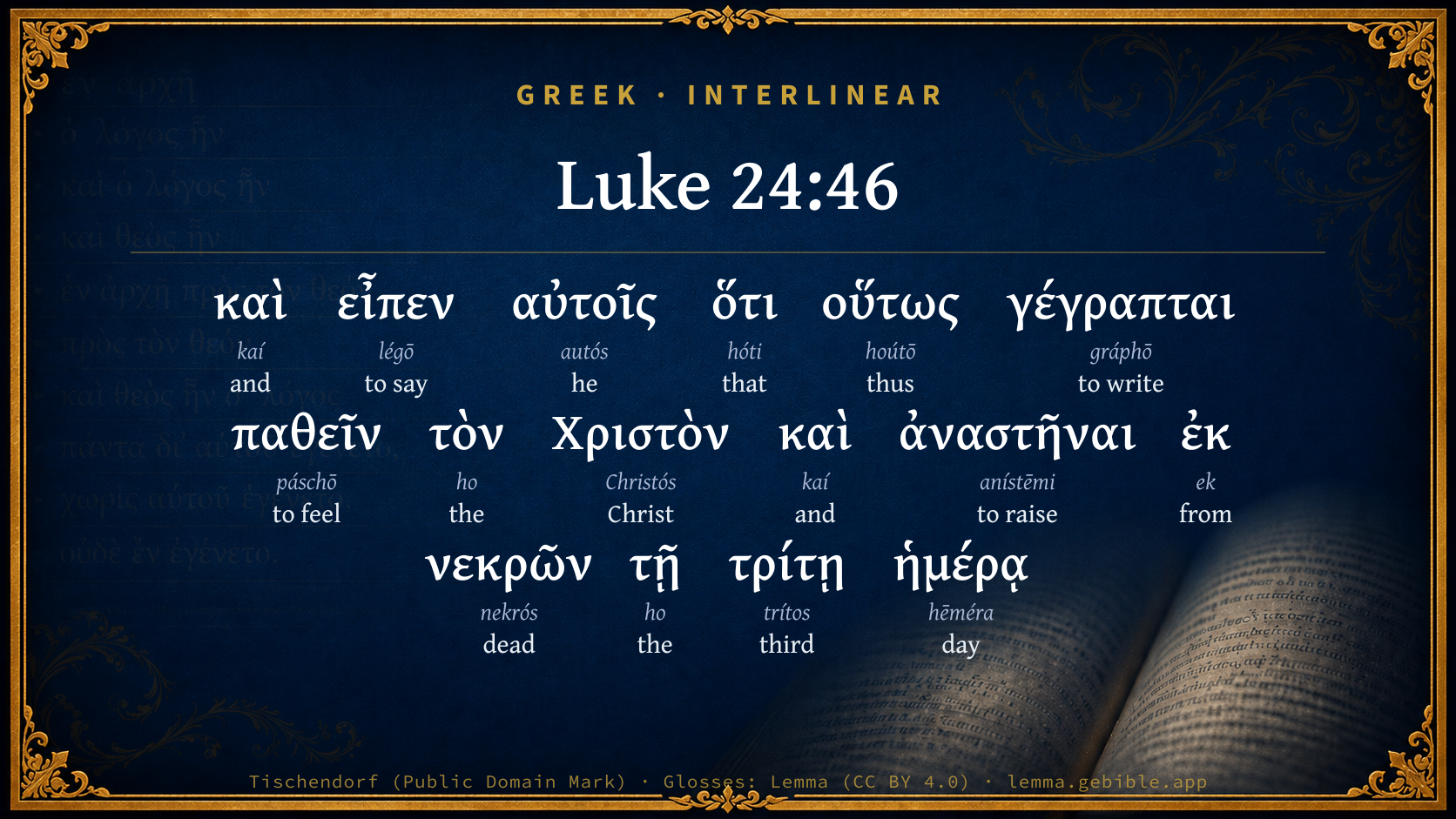
Download image
Cite this verse

Luke 24:46 (World English Bible). Public Domain. Lemma interlinear Bible study tool, https://lemma.gebible.app/v/luke/24/46.

Show BibTeX & RIS
BibTeX
RIS
English Translation
He said to them, "Thus it is written, and thus it was necessary for the Christ to suffer and to rise from the dead the third day,
World English Bible · Public Domain
Download a study sheet

One document with this verse’s original text, its word-by-word gloss line, the meaning frame, cross-references with their text, attributed commentary, and full source and license credits — printable, and it pastes into notes with its structure intact.

This verse Autodidact and up

Study sheet (.html) Plain text (.txt)

A passage Seminary Student

Up to 50 verses in one chapter. A passage sheet keeps up to 6 commentary sources and 12 cross-references per verse, in the order this page ranks them, and says so on the sheet whenever that leaves anything out. Ask for a single verse and you get the Autodidact verse sheet above.

Everything on this page stays free to read, with no account — the sheet is a download of what is already on screen, not access to it.

Want to remove ads? Support Godless Engineer
Compare translations 3

The same verse in 3 English versions, stacked beneath the original-language interlinear above. Click any original word for its lexicon entry.

Each is an independent rendering of the whole verse — the interlinear is not word-aligned to these translations.

Highlighted words mark where these versions differ — a whole-verse word diff, not a word-by-word alignment.

  • World English Bible Public Domain
    He said to them, "Thus it is written, and thus it was necessary for the Christ to suffer and to rise from the dead the third day,
  • King James Version Public Domain
    And said unto them, Thus it is written, and thus it behoved Christ to suffer, and to rise from the dead the third day:
  • unfoldingWord Literal Text CC BY-SA 4.0
    “Thus it has been written: The Christ would suffer, and rise up from the dead on the third day,

unfoldingWord Literal Text — © unfoldingWord, licensed CC BY-SA 4.0. Word-aligned USFM3 via Door43 (git.door43.org/unfoldingWord/en_ult).

Versions to compare (up to 4)

3 of 4 selected

Show all 19 translations

Every available English version of this verse, each an independent rendering of the whole verse.

  • World English Bible Public Domain
    He said to them, "Thus it is written, and thus it was necessary for the Christ to suffer and to rise from the dead the third day,
  • Berean Standard Bible Public Domain
    And He told them, “This is what is written: The Christ will suffer and rise from the dead on the third day,
  • Majority Standard Bible Public Domain
    And He told them, “This is what is written: And thus it is necessary that the Christ will suffer and rise from the dead on the third day,
  • King James Version Public Domain
    And said unto them, Thus it is written, and thus it behoved Christ to suffer, and to rise from the dead the third day:
  • American Standard Version (1901) Public Domain
    and he said unto them, Thus it is written, that the Christ should suffer, and rise again from the dead the third day;
  • Revised Version (1885) Public Domain
    and he said unto them, Thus it is written, that the Christ should suffer, and rise again from the dead the third day;
  • Geneva Bible (1599) Public Domain
    And said vnto them, Thus is it written, and thus it behoued Christ to suffer, and to rise againe from the dead the third day,
  • Douay-Rheims (1899) Public Domain
    And he said to them: Thus it is written, and thus it behoved Christ to suffer, and to rise again from the dead, the third day:
  • Young's Literal Translation Public Domain
    and he said to them -- `Thus it hath been written, and thus it was behoving the Christ to suffer, and to rise out of the dead the third day,
  • Literal Standard Version CC BY-SA 4.0
    and He said to them, “Thus it has been written, and thus it was necessary [for] the Christ to suffer, and to rise out of the dead [on] the third day,
  • Unlocked Literal Bible CC BY-SA 4.0
    He said to them, “Thus it is written, that the Christ should suffer, and rise again from the dead on the third day.
  • unfoldingWord Literal Text CC BY-SA 4.0
    “Thus it has been written: The Christ would suffer, and rise up from the dead on the third day,
  • Darby Bible Public Domain
    and said to them, Thus it is written, and thus it behoved the Christ to suffer, and to rise from among the dead the third day;
  • World Messianic Bible Public Domain
    He said to them, “Thus it is written, and thus it was necessary for the Messiah to suffer and to rise from the dead the third day,
  • Webster's Bible Public Domain
    And said to them, Thus it is written, and thus it behooved Christ to suffer, and to rise from the dead the third day:
  • Free Bible Version CC BY-SA 4.0
    He told them, “It was written like this: the Messiah would suffer and rise from the dead on the third day, and in his name
  • Bible in Basic English Public Domain
    And he said to them, So it is in the Writings that the Christ would undergo death, and come back to life again on the third day;
  • Text-Critical English NT CC BY 4.0
    and said to them, “Thus it is written, and thus it was necessary for the Christ to suffer and to rise from the dead on the third day,
  • Tyndale New Testament (1534) Public Domain
    and sayde vnto them. Thus is it written and thus it behoved Christ to suffre and to ryse agayne from deeth the thyrde daye

Literal Standard Version (2020), Covenant Press — licensed CC BY-SA 4.0. Text via the HelloAO Bible API (eBible.org). Unlocked Literal Bible (unfoldingWord) — licensed CC BY-SA 4.0. Text via the HelloAO Bible API (eBible.org). unfoldingWord Literal Text — © unfoldingWord, licensed CC BY-SA 4.0. Word-aligned USFM3 via Door43 (git.door43.org/unfoldingWord/en_ult). Free Bible Version, Dr. Jonathan Gallagher — licensed CC BY-SA 4.0. Text via the HelloAO Bible API (eBible.org).

Word by word

More ways to search: Search by grammar → Find every occurrence → Compare this word →

Practice this passage: Drill this verse → Learn its vocabulary →

παθεῖν
páschō
G3958
“to feel”
Verb, Aorist, Active, Infinitive
Part of Speech
Verb
Tense
Aorist
Voice
Active
Mood
Infinitive
Full Thayer's Definition

Origin: apparently a root word

TDNT: 20:04,8

1. to be affected or have been affected, to feel, have a sensible experience, to undergo a. in a good sense, to be well off, in good case b. in a bad sense, to suffer sadly, be in a bad plight 1. of a sick person
  1. καὶ kaí G2532 “and” Conjunction
  2. εἶπεν légō G3004 “to say” Verb, Aorist, Active, Indicative, 3rd person, Singular
  3. αὐτοῖς autós G846 “he” Personal pronoun, Dative, Plural, Masculine
  4. ὅτι hóti G3754 “that” Conjunction
  5. οὕτως hoútō G3779 “thus” Adverb
  6. γέγραπται gráphō G1125 “to write” Verb, Perfect, Passive, Indicative, 3rd person, Singular
  7. τὸν ho G3588 “the” Article, Accusative, Singular, Masculine
  8. Χριστὸν Christós G5547 “Christ” Noun, Accusative, Singular, Masculine
  9. καὶ kaí G2532 “and” Conjunction
  10. ἀναστῆναι anístēmi G450 “to raise” Verb, Aorist, Active, Infinitive
  11. ἐκ ek G1537 “from” Preposition
  12. νεκρῶν nekrós G3498 “dead” Adjective, Genitive, Plural, Masculine
  13. τῇ ho G3588 “the” Article, Dative, Singular, Feminine
  14. τρίτῃ trítos G5154 “third” Adjective, Dative, Singular, Feminine
  15. ἡμέρᾳ hēméra G2250 “day” Noun, Dative, Singular, Feminine

About this verse

These counts appear in no published source. They are computed here, from the morphology-tagged text and Lemma’s own curated glosses. What Lemma adds →

16
words
14
distinct lemmas
Gospels
section

Shared distinctive vocabulary

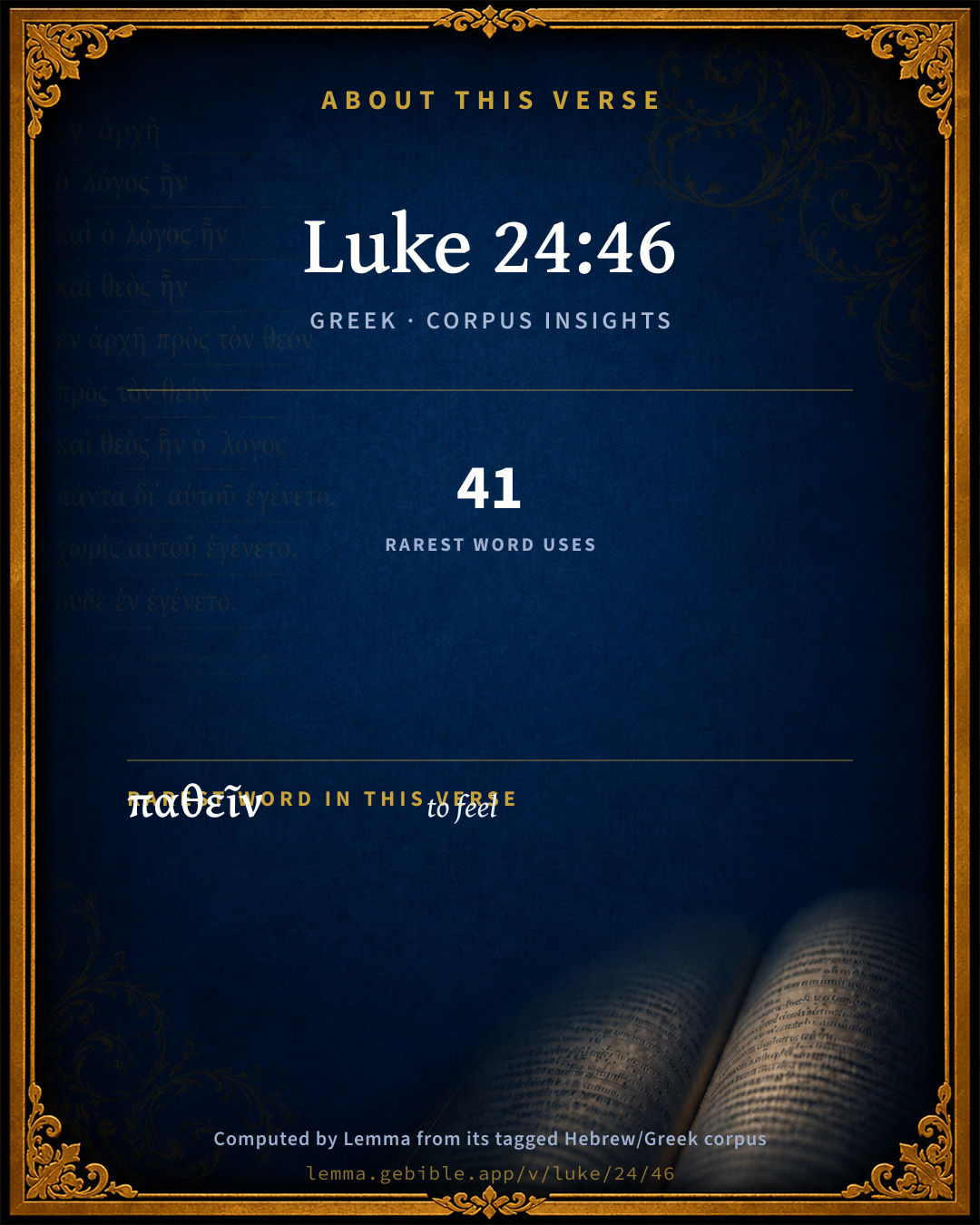
παθεῖν to feel G3958 occurs in 40 verses of the Greek New Testament. Also found in:
Repetition

Words recur within this verse:

Cross-references

9

Topical passages linked to Luke 24:46 in the Treasury of Scripture Knowledge — connected by theme and wording, ordered by reader-vote popularity; previews shown in the World English Bible.

  • Isaiah 53:2–12 For he grew up before him as a tender plant, and as a root out of a dry ground: he has no form nor comeliness; and when we see him, there is no beauty that we should desire him.
  • Isaiah 50:6 I gave my back to the strikers, and my cheeks to those who plucked off the hair; I didn't hide my face from shame and spitting.
  • Luke 24:44 He said to them, "This is what I told you, while I was still with you, that all things which are written in the law of Moses, the prophets, and the psalms, concerning me must be fulfilled."
  • Luke 24:7 saying that the Son of Man must be delivered up into the hands of sinful men, and be crucified, and the third day rise again?"
  • Luke 24:26–27 Didn't the Christ have to suffer these things and to enter into his glory?"
  • Psalms 22:1–31 My God, my God, why have you forsaken me? Why are you so far from helping me, and from the words of my groaning?
  • Acts 17:3 explaining and demonstrating that the Christ had to suffer and rise again from the dead, and saying, "This Jesus, whom I proclaim to you, is the Christ."
  • 1 Peter 1:3 Blessed be the God and Father of our Lord Jesus Christ, who according to his great mercy became our father again to a living hope through the resurrection of Jesus Christ from the dead,
  • Acts 4:12 There is salvation in none other, for neither is there any other name under heaven, that is given among men, by which we must be saved!"

Cross-references courtesy of OpenBible.info (CC BY 4.0).

Where the printed editions differ

1 variant

Places in this verse where the major printed Greek editions disagree on the wording in a way that affects the translation — a comparison of editions, not a manuscript-by-manuscript collation. The editions are the modern critical texts (Nestlé-Aland 28/27, SBL, Westcott-Hort, Tregelles, Tyndale House) and the traditional texts behind the KJV (the Textus Receptus and the Byzantine/Majority text). It is not a claim about which reading is original.

  1. Extra text
    καὶ οὕτως ἔδει

    “and thus it was necessary for”

    In TRByz Not in NA28NA27TynSBLWHTreg

    καὶ οὕτως ἔδει (kai houtōs edei) 'and thus it was necessary for' is only in traditional manuscripts (TR+Byz)

Textual data: Translators Amalgamated Greek New Testament (STEPBible TAGNT) · CC BY 4.0.

Commentary

Notes on Luke 24:46 from classic Christian and Jewish commentators (each source and its license shown beneath its notes). The classic Christian expositions comment on the surrounding passage and are grouped to its opening verse, so a note may address several verses; the Jewish commentaries on the Tanakh (Rashi and others) are per-verse, so they appear only where the commentator wrote on this verse.

Lemma curates 59 commentaries, every one of them public domain or Creative Commons licensed, each selected and text-cleaned for this edition rather than reprinted as found. About our sources →

Tyndale Open Study Notes

Tyndale Open Resources

24:46 that the Messiah would suffer and die: See study note on 24:25-26.

Tyndale Open Study Notes — © Tyndale Open Resources, licensed CC BY-SA 4.0. Text via the HelloAO Bible API.

Bengel's Gnomon

Johann Albrecht Bengel

Luk 24:46. Καὶ σὕτως) and therefore thus.

Bengel's Gnomon of the New Testament — English translation (T&T Clark, Edinburgh, 1860) — public domain. Text from a community e-Sword module.

Meyer's Critical & Exegetical Commentary

Heinrich August Wilhelm Meyer

Luk_24:46-47. Καὶ οὕτως ἔδει being deleted (see the critical remarks), the passage reads: for thus it is written that the Messiah should suffer and rise again, etc., and that there should be announced, etc. By means of ὅτι Jesus adds the circumstance in the way of motive, on account of which He opened their νοῦς, etc.; οὔτω, however, has its reference in these instructions just given: in the manner, in such a way as I have just introduced you into the understanding of the Scripture. What follows, being conceived under the form of doctrinal positions (the Messiah suffers, etc.) as far as the end of Luk_24:47, is then the Messianic summary of Old Testament prophecy.

ἐπὶ τῷ ὀνόμ. αὐτοῦ] on the foundation of His nameon the confession of this name, to wit, by which the whole evangelic agency is supporteddepends the announcement of repentance and forgiveness, as far as concerns their specific purpose and their characteristic nature. Comp. Act_3:16; Act_4:17 f., Act_5:28; Act_5:40.

ἀρξάμενον] for which Erasmus and Markland conjectured ἀρξαμένων,[279] is the impersonal accusative neuter: incipiendo (Herodotus, iii. 91, and thereon Schweighäuser), i.e. so that it (the office of the κηρυχθῆναι) begins, i.e. from Jerusalem (Ast, Lex. Plat. I. p. 288). See Winer, p. 550 [E. T. 779]; Bornemann, Schol. in loc. Comp. Buttmann, Neutest. Gr. p. 321 [E. T. 374 f.].

ἀπὸ Ἱερουσ.] as the metropolis of the whole theocracy. Comp. Isa_2:3; Isa_40:9, and elsewhere; Act_1:8; Rom_15:19.

εἰς πάντα τὰ ἔθνη] among all nations, Mat_28:19.

[279] As D actually reads. Other attempts at improvement: ἀρξαμένην, ἀρξάμενος. In respect of ἀρξάμενοι, followed by Ewald, see the critical remarks.

Meyer — Critical and Exegetical Commentary on the New Testament — English translation by Peter Christie, edited by Frederick Crombie (T&T Clark, 1880) — public domain. Text from a community e-Sword module.

Expositor's Greek Testament

ed. W. Robertson Nicoll

Luk 24:46 gives the conclusion of the expository discourse in Christ’s own words ( καὶ εἶπεν , ὅτι ) = the gist of prophecy is: the suffering and resurrection of the Christ, and the preaching in the name of the Risen One, to all nations, of repentance unto the remission of sins.

The Expositor's Greek Testament, edited by W. Robertson Nicoll (1897–1910) — public domain. Text from a community e-Sword module.

Jamieson, Fausset & Brown

Robert Jamieson, A. R. Fausset & David Brown

behoved Christ--(See on Luk 24:26).

Jamieson, Fausset & Brown — Commentary Critical and Explanatory on the Whole Bible (1871) — public domain (CC PDM 1.0). Text via the HelloAO Bible API.

Ellicott's Commentary for English Readers

(46) Thus it behoved Christ to suffer.—Better, as elsewhere, that the Christ should suffer.

A Bible Commentary for English Readers, edited by Charles John Ellicott (1878–1897) — public domain. Text from a community e-Sword module.

The Cambridge Bible for Schools and Colleges

gen. ed. J. J. S. Perowne

46. and thus it behoved Christ to suffer] Read, thus it is written that the Christ should suffer, א, B, C, D, L.

The Cambridge Bible for Schools and Colleges (gen. ed. J. J. S. Perowne; Cambridge University Press, 1878–1918) — public domain. Text from a community e-Sword module.

John Gill's Exposition

And he led them out as far as Bethany,.... Not the town of Bethany; could that be thought, it might be supposed that he led his disciples thither, to pay a visit to his dear friends there, Lazarus, Mary, and Martha, before his ascension; but the town of Bethany was fifteen furlongs, or near two miles distance from Jerusalem, Joh 11:18 whereas the place from whence Christ ascended was but a sabbath day's journey from it, which was two thousand cubits, or about a mile, Act 1:12. This Bethany, therefore, was a tract of land, so called from the town, which began at the Mount of Olives, where Bethphage ended; see Mar 11:1 and hither from Jerusalem Christ led his disciples, in order to ascend to heaven in their sight; and this was the spot of ground, where he began to ride in triumph to Jerusalem, and here he ascended in a triumphant manner to heaven; this was the place he frequently retired to for solemn, and solitary prayer, and where he had put up many a strong cry to God, and now from hence he ascended to him; this was the place whither he went after he had ate his last passover, where he was taken, and from whence he came to suffer and die for his people:

and he lift up his hands, and blessed them. The lifting up of his hands was not in order to put them upon his disciples; though the Ethiopic version adds, "and put them on"; nor was it used as a prayer gesture; nor was the blessing of them prayer wise, or by praying for a blessing on them; but as Aaron, his type, lift up his hands towards the people of Israel, and blessed them, when he had offered the offerings for them, Lev 9:22 so Christ, as the great high priest, having offered himself a sacrifice for the sins of his people, lift up his hands towards his apostles, and blessed them in an authoritative way, by bestowing blessings upon them: he blessed them with a larger measure of the Spirit; for though they were to wait some few days longer for the extraordinary effusion of the Spirit, yet, in the mean while, they received from him more of it than they had formerly had; for he breathed upon them, and said, receive the Holy Ghost, Joh 20:22. He blessed them with larger measures of grace, and with more spiritual light, and understanding into the Scriptures of truth, and with much inward peace of mind, and with the fresh discoveries of pardoning love; and which seemed necessary, since by their conduct towards him, one by denying him, and the rest by forsaking him, the peace of their minds was broken, and they needed a fresh application of forgiving grace. The form of blessing the people used by Aaron, and his sons, the priests, who were types of Christ, is recorded in Num 6:23 and though our Lord might not use the same form in blessing his disciples, yet it seems he used the same gesture, lifting up his hands, as they did. The Targumists say (d), the blessing of the priests was done by stretching, or spreading out their hands; but other Jewish writers observe, it was by lifting them up: concerning which their rule is (e);

"in the province, the priests lift up their hands, as high as their shoulders, but in the sanctuary, above their heads, except the high priest, who did not lift up his hands above the plate of gold on his forehead.''

The reason of this was, because the name Jehovah was written upon it, and it was not proper his hands should be lifted up above that. The account Maimonides (f) gives of this affair is;

"how is the lifting up of hands? in the borders, at the time the messenger of the congregation comes to service, when he has said, who ever will, &c. all the priests that stand in the synagogue, remove from their places, and go, and ascend the desk (or pulpit), and stand there with their faces to the temple, and their backs to the people, and their fingers closed within their hands, until the messenger of the congregation has finished the confession, or thanksgiving; and then they turn their faces to the people, and stretch out their fingers, and lift up their hands to their shoulders and begin to bless, and the messenger of the congregation pronounces them (the blessings) word by word, &c. How is the blessing of the priests in the sanctuary? the priests go up into the desk (or pulpit), after the priests have finished the morning daily service, and lift up their hands above, over their heads, except the high priest, who does not lift up his hands above the plate of gold, on his forehead; and one pronounces them (the blessings) word for word, as they do in the borders (in the country), &c.''

And as our Lord used this gesture in blessing, it is very likely he complied with another rule, by expressing it in the Hebrew tongue; for the Jews say (g), the blessing of the priests is not said in any place, but in the holy tongue.

(d) Targum Jon. in Num. vi. 23. & Targum in Cant. vii. 7. (e) Misn Sota, c. 7. sect. 6. Bemidbar Rabba sect. 11. fol. 203. 3. (f) Hilchot Tephilla, c. 14. sect. 3. 9. (g) Hilchot Tephilla, c. 14. sect. 11. Vid. Targum Jon. & Rabba, ut supra, & T. Bab. Sota, fol. 38. 1.

John Gill's Exposition of the Whole Bible (1746–1763) — public domain (CC PDM 1.0). Text via the HelloAO Bible API.

Trapp's Complete Commentary

John Trapp

46 And said unto them, Thus it is written, and thus it behoved Christ to suffer, and to rise from the dead the third day:

Ver. 46. Thus it is written, &c.] All things done and suffered by our Saviour were punctually and exactly foretold and foreshown by Moses and the prophets; and especially by Isaiah, who writes more like an evangelist than a prophet; and is therefore called the Evangelical Prophet. (Jerome.)

John Trapp, A Commentary or Exposition upon All the Books of the Old and New Testament (1647–1656) — public domain. Text from a community e-Sword module.

Albert Barnes' Notes on the Bible

It behoved - It became; it was proper or necessary that the Messiah should thus suffer. It was predicted of him, and all things have happened as it was foretold.

Albert Barnes' Notes on the Bible (1834–1885) — public domain. Text from a community e-Sword/MySword module.

Matthew Poole's English Annotations

All the Divine predictions are certain and infallible. The Jews did maliciously and freely prosecute our Saviour to death, and God did certainly foresee how their wills would be determined, and the event was accomplished accordingly.

Matthew Poole's English Annotations on the Holy Bible (1683–1685) — public domain. Text from a community e-Sword/MySword module.

Whedon's Commentary on the Bible

Daniel D. Whedon

46-49. The discourse 44, at the interview, concerned the application of prophecy to explain the recent events. The present passage, like the parallel in Acts, exhibits some of the main points of the forty days’ teaching.

46. Said unto them—A subsequent continuation of discourse to the same them, on the same general subject, but with less reference to time or place.

It behooved—Not only to fulfil Scripture, but to fulfil the great scheme of salvation of which Scripture itself is a part.

Daniel D. Whedon (gen. ed.), Commentary on the Old and New Testaments (1874–1909) — public domain. Text from a community e-Sword module.

The Pulpit Commentary

Thus it is written, and thus it behoved Christ to suffer, and to rise. from the dead the third day. The majority of the older authorities omit the words, "and thus it behoved." The verse should be read thus: "Thus it is written that Christ should suffer," etc. These words probably were spoken on that first Easter evening. They were apparently repeated on several occasions during the forty days. The Old Testament they would see now with the new light cast upon it showed the necessity of an atoning Redeemer, from the sin which it everywhere reveals, and of a dying Redeemer, from the death which it proclaims as the consequence. While the same Scriptures no less authoritatively proclaim that through this suffering the Redeemer-Messiah should attain to his glorification.

The Pulpit Commentary (1880–1919), ed. H.D.M. Spence-Jones & Joseph S. Exell — public domain. Text from a community e-Sword module.

McGarvey & Pendleton's Commentaries

J. W. McGarvey

J. W. McGarvey's The Fourfold Gospel [CXLII. The Great Commission Given].

CXLII. THE GREAT COMMISSION GIVEN. (Time and place same as last section.) aMATT. XXVIII. 18-20; bMARK XVI. 15-18; cLUKE XXIV. 46, 47.

a18 And Jesus came to them and spake unto them, saying, All authority hath been given unto me in heaven and on earth. b15 And he said unto them, Go ye atherefore, binto all the world, and preach the gospel to the whole creation. aand make disciples of all the nations, baptizing them into the name of the Father and of the Son and of the Holy Spirit: 20 teaching them to observe all things whatsoever I commanded you: b16 He that believeth and is baptized shall be saved; but he that disbelieveth shall be condemned. cThus it is written, that the Christ should suffer, and rise again from the dead the third day; 47 and that repentance and remission of sins should be preached in his name unto all the nations, beginning from Jerusalem. [The verses from Luke are taken from a later conversation, which will be handled in our Psa_8:6, 1Co_15:27, 1Co_15:28, magnifies instead of detracting from their wonderful import, for he deems its necessary to state that the Father himself is not subject to the Son. Surely in connection with this marvelous celestial power, his dominion over out tiny earth would not need to be mentioned if it were not that we, its inhabitants, are very limited in our conception of things, and require exceedingly plain statements. The command calls for the Christianizing of all nations. If we realized better that authority with which Christ prefaces his commission, the conquest of the nations in his name would seem to us a small matter indeed, and we should set about it expecting to witness its speedy accomplishment. The structure of the sentence in the original Greek shows that it is the disciples and not the nations who are to be baptized; according to the commission, therefore, one must be made a disciple before he can be baptized. Baptism brings us into divine relation to God. Being a part of the process of adoption, it is called a birth ( Joh_3:5). The baptized Christian bears the name into which he is baptized ( Rom_2:24, Jam_2:7). Luke sums up the whole commission by recording the words of Christ, wherein he states that he suffered that it might be preached to all nations that if men would repent, God could now forgive ( Rom_3:26). From Luke's record we also learn that the preaching of these glad tidings was to begin at Jerusalem.] b17 And these signs shall accompany them that believe: in my name shall they cast out demons; they shall speak with new tongues; 18 they shall take up serpents, and if they drink any deadly thing, it shall in no wise hurt them; they shall lay hands on the sick, and they shall recover. [The Book of Acts gives examples of each one of these except the fourth, and though we have no record of a disciple escaping the effects of drinking poison, [763] there is little doubt that in the many persecutions such cases did occur.] aand lo, I am with you always, even unto the end of the world. [This is a promise not of bare companionship, but of full sympathy and support ( Isa_43:2, Exo_33:15, Jos_1:5). The duration of this promise shows that it is intended for all disciples.]

[FFG 762-764]

J. W. McGarvey (with Philip Y. Pendleton), Commentaries on the New Testament (The Fourfold Gospel, 1914; Acts; and the epistles) — public domain. Text from a community e-Sword/MySword module.

Cambridge Greek Testament for Schools and Colleges

46. οὕτως γέγραπται κ.τ.λ. ‘Thus it is written that the Christ should suffer.’ אBCDL.

Cambridge Greek Testament for Schools and Colleges (Cambridge University Press, 1896; 21 vols, various authors incl. Carr, Maclear, Plummer, Farrar, Lumby, Moule, M. R. James, Simcox) — public domain. Text from a community e-Sword module.

International Critical Commentary

46. Godet would put a full stop at γραφάζ and make καὶ εἶπεν αὐτοῖς introduce a fresh summary of what was said, possibly on another occasion. It is very unnatural to make ὅτι mean “because” or “for,” and take it as the beginning of Christ’s words. “He opened their minds and (in explanation of this act) said to them, Because thus it is written,” etc. (Mey.). It is more doubtful whether ὅτι introduces the oratio recta (Weiss, Hahn), in which case it is left untranslated (AV. RV.), or the oratio obliqua (Rhem.).

οὕτως γέγραπται παθεῖν τὸν χριστόν. Thus א B C* L, Aeth. Syr. Harcl. So also D, a b c d e ff2 l r Boh,, but with τὸν Χριστόν before παθεῖν Syr-Sin. and Arm. substitute for γεγραπται the ἔδει of the similar ver. 26, while A C2 N X Γ D Δ Π, fq Vulg. insert καὶ οὕτως ἔδει after γέγραπται, and c e Cypr. omit οὕτως. All are attempts to get rid of abruptness, and perhaps the reading of A C2 etc. is a conflation of א B etc. with Syr-Sin. and Arm. D omits ἐκ νεκρῶν.

For the aor. infin. referring to what is future in reference to the main verb see Burton., § 114.

International Critical Commentary — older volumes (1896–1929), various authors — public domain. Text from a community e-Sword module.

Vincent's Word Studies in the New Testament

Marvin R. Vincent

Thus is behoved. The best texts omit. Render, as Rev., thus it is written that the Christ should suffer.

Christ [τον χριστον] . Note the article, the Christ, and see on Mt 1:1.

Marvin R. Vincent, Word Studies in the New Testament (1887–1900) — public domain. Text from a community e-Sword/MySword module.

Lesson kit

Teaching starters — assembled from the data on this page, not authored interpretation. Every prompt links to the verse data it draws on. Edit before teaching.

Luke, in the Gospels, opens this verse with 16 words (14 distinct Greek lemmas). Its most distinctive word is páschō (“to feel”). A historical commentator’s framing appears above. Read the whole chapter for the surrounding context.

Discussion questions

  1. What does “to feel” (páschō) contribute to the verse as a whole?
  2. How does Matthew 16:21, which shares the word «to feel», read alongside this verse?
  3. What does the repetition of “and” (2× in this one verse) do in this verse?
  4. The translations on this page render this verse differently — a whole-verse word diff, not a word-by-word alignment. What might account for the different wordings?
  5. Compare how Tyndale Open Study Notes and Bengel's Gnomon read this verse. Where do they agree or differ?

Things to notice

Reading settings

Reading text

Shown beneath each verse's original-language words.

Old Testament
Old Testament edition

Read the OT as the Masoretic Hebrew (MT) or the Greek Septuagint (LXX).

English shown for the Greek Septuagint (in the Hebrew ↔ Greek comparison).

Comparing translations? Open the Compare panel on any verse page to stack up to four side by side.