2 Thessalonians 3:17

Greek (Tischendorf 8th ed.) 2 Thessalonians 3:17 appears in the Greek New Testament. The text above is from the Tischendorf 8th edition. Each word links to its Strong’s number and a concise gloss. Click any word for its full Thayer’s Greek Lexicon entry.
Download image
Cite this verse

2 Thessalonians 3:17 (World English Bible). Public Domain. Lemma interlinear Bible study tool, https://lemma.gebible.app/v/2-thessalonians/3/17.

Show BibTeX & RIS
BibTeX
RIS
English Translation
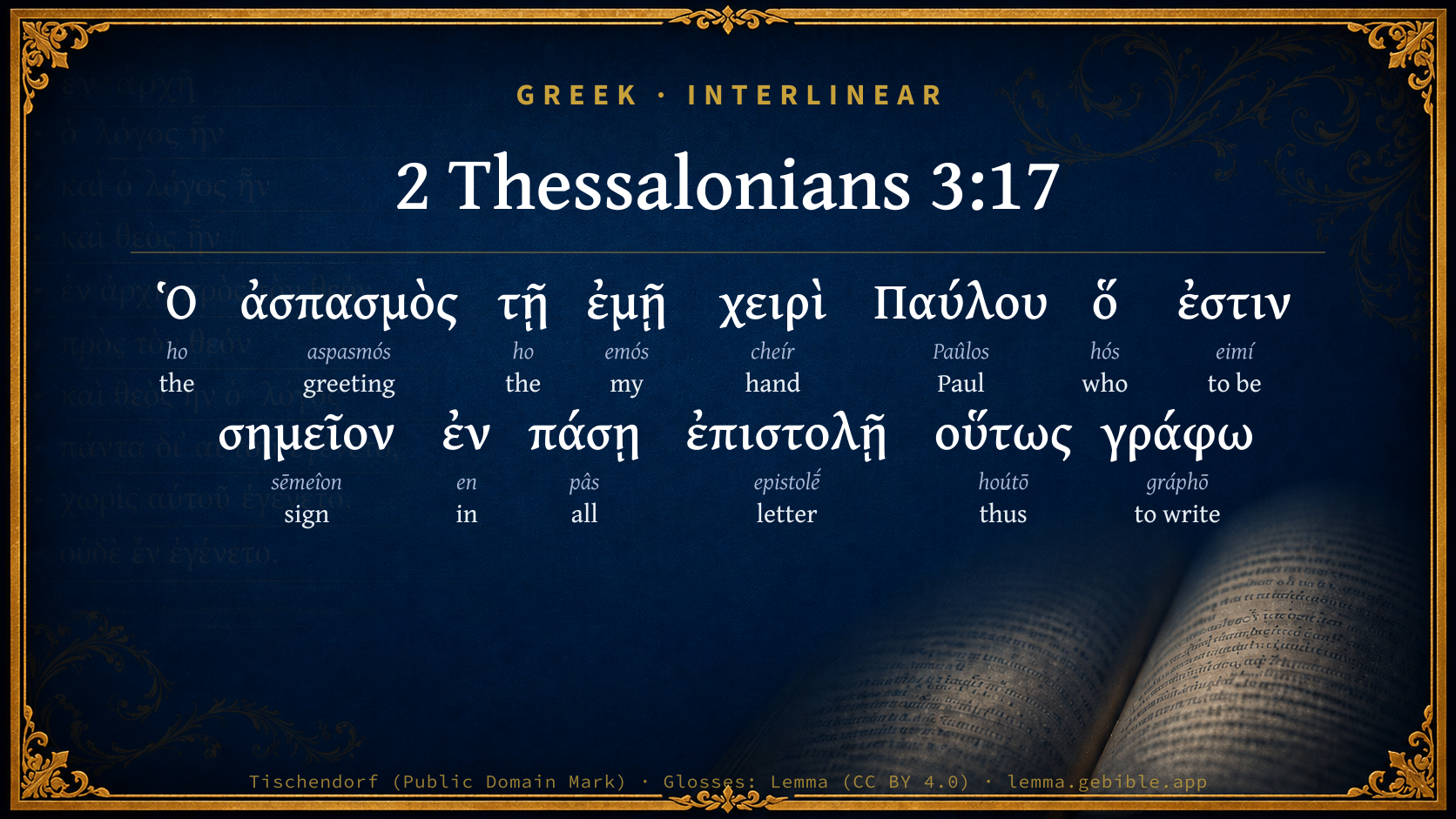
The greeting of me, Paul, with my own hand, which is the sign in every letter: this is how I write.
World English Bible · Public Domain
Download a study sheet

One document with this verse’s original text, its word-by-word gloss line, the meaning frame, cross-references with their text, attributed commentary, and full source and license credits — printable, and it pastes into notes with its structure intact.

This verse Autodidact and up

Study sheet (.html) Plain text (.txt)

A passage Seminary Student

Up to 50 verses in one chapter. A passage sheet keeps up to 6 commentary sources and 12 cross-references per verse, in the order this page ranks them, and says so on the sheet whenever that leaves anything out. Ask for a single verse and you get the Autodidact verse sheet above.

Everything on this page stays free to read, with no account — the sheet is a download of what is already on screen, not access to it.

Want to remove ads? Support Godless Engineer
Compare translations 3

The same verse in 3 English versions, stacked beneath the original-language interlinear above. Click any original word for its lexicon entry.

Each is an independent rendering of the whole verse — the interlinear is not word-aligned to these translations.

Highlighted words mark where these versions differ — a whole-verse word diff, not a word-by-word alignment.

  • World English Bible Public Domain
    The greeting of me, Paul, with my own hand, which is the sign in every letter: this is how I write.
  • King James Version Public Domain
    The salutation of Paul with mine own hand, which is the token in every epistle: so I write.
  • unfoldingWord Literal Text CC BY-SA 4.0
    This greeting in my own hand—Paul—which is a sign in every letter. In this manner I write.

unfoldingWord Literal Text — © unfoldingWord, licensed CC BY-SA 4.0. Word-aligned USFM3 via Door43 (git.door43.org/unfoldingWord/en_ult).

Versions to compare (up to 4)

3 of 4 selected

Show all 19 translations

Every available English version of this verse, each an independent rendering of the whole verse.

  • World English Bible Public Domain
    The greeting of me, Paul, with my own hand, which is the sign in every letter: this is how I write.
  • Berean Standard Bible Public Domain
    This greeting is in my own hand—Paul. This is my mark in every letter; it is the way I write.
  • Majority Standard Bible Public Domain
    This greeting is in my own hand—Paul. This is my mark in every letter; it is the way I write.
  • King James Version Public Domain
    The salutation of Paul with mine own hand, which is the token in every epistle: so I write.
  • American Standard Version (1901) Public Domain
    The salutation of me Paul with mine own hand, which is the token in every epistle: so I write.
  • Revised Version (1885) Public Domain
    The salutation of me Paul with mine own hand, which is the token in every epistle: so I write.
  • Geneva Bible (1599) Public Domain
    The salutation of me Paul, with mine owne hand, which is ye token in euery Epistle: so I write,
  • Douay-Rheims (1899) Public Domain
    The salutation of Paul with my own hand; which is the sign in every epistle. So I write.
  • Young's Literal Translation Public Domain
    The salutation by the hand of me, Paul, which is a sign in every letter; thus I write;
  • Literal Standard Version CC BY-SA 4.0
    The salutation by the hand of me, Paul, which is a sign in every letter; thus I write.
  • Unlocked Literal Bible CC BY-SA 4.0
    This is my greeting, Paul, with my own hand, which is the sign in every letter. This is how I write.
  • unfoldingWord Literal Text CC BY-SA 4.0
    This greeting in my own hand—Paul—which is a sign in every letter. In this manner I write.
  • Darby Bible Public Domain
    The salutation by the hand of me, Paul, which is [the] mark in every letter; so I write.
  • World Messianic Bible Public Domain
    I, Paul, write this greeting with my own hand, which is the sign in every letter. This is how I write.
  • Webster's Bible Public Domain
    The salutation of Paul with my own hand, which is the token in every epistle: so I write.
  • Free Bible Version CC BY-SA 4.0
    Notice the greeting to you from me, Paul, in my own handwriting. This is my signature on every letter I write.
  • Bible in Basic English Public Domain
    These words of love to you at the end are in my writing, Paul's writing, and this is the mark of every letter from me.
  • Text-Critical English NT CC BY 4.0
    I, Paul, write this greeting with my own hand. This is the distinguishing mark in all my letters; it is the way I write.
  • Tyndale New Testament (1534) Public Domain
    The salutacion of me Paul with myne awne honde. This is the token in all pistles. So I write.

Literal Standard Version (2020), Covenant Press — licensed CC BY-SA 4.0. Text via the HelloAO Bible API (eBible.org). Unlocked Literal Bible (unfoldingWord) — licensed CC BY-SA 4.0. Text via the HelloAO Bible API (eBible.org). unfoldingWord Literal Text — © unfoldingWord, licensed CC BY-SA 4.0. Word-aligned USFM3 via Door43 (git.door43.org/unfoldingWord/en_ult). Free Bible Version, Dr. Jonathan Gallagher — licensed CC BY-SA 4.0. Text via the HelloAO Bible API (eBible.org).

Word by word

More ways to search: Search by grammar → Find every occurrence → Compare this word →

Practice this passage: Drill this verse → Learn its vocabulary →

ἀσπασμὸς
aspasmós
G783
“greeting”
Noun, Nominative, Singular, Masculine
Part of Speech
Noun
Case
Nominative
Number
Singular
Gender
Masculine
Full Thayer's Definition

Origin: from G782

TDNT: 09:16,8

1. a salutation, either oral or written
  1. Ὁ ho G3588 “the” Article, Nominative, Singular, Masculine
  2. τῇ ho G3588 “the” Article, Dative, Singular, Feminine
  3. ἐμῇ emós G1699 “my” Possessive pronoun, 1st person, Dative, Singular, Feminine
  4. χειρὶ cheír G5495 “hand” Noun, Dative, Singular, Feminine
  5. Παύλου Paûlos G3972 “Paul” Noun, Genitive, Singular, Masculine
  6. ὅ hós G3739 “who” Relative pronoun, Nominative, Singular, Neuter
  7. ἐστιν eimí G1510 “to be” Verb, Present, Active, Indicative, 3rd person, Singular
  8. σημεῖον sēmeîon G4592 “sign” Noun, Nominative, Singular, Neuter
  9. ἐν en G1722 “in” Preposition
  10. πάσῃ pâs G3956 “all” Adjective, Dative, Singular, Feminine
  11. ἐπιστολῇ epistolḗ G1992 “letter” Noun, Dative, Singular, Feminine
  12. οὕτως hoútō G3779 “thus” Adverb
  13. γράφω gráphō G1125 “to write” Verb, Present, Active, Indicative, 1st person, Singular

About this verse

These counts appear in no published source. They are computed here, from the morphology-tagged text and Lemma’s own curated glosses. What Lemma adds →

14
words
13
distinct lemmas
Pauline Epistles
section

Notable vocabulary

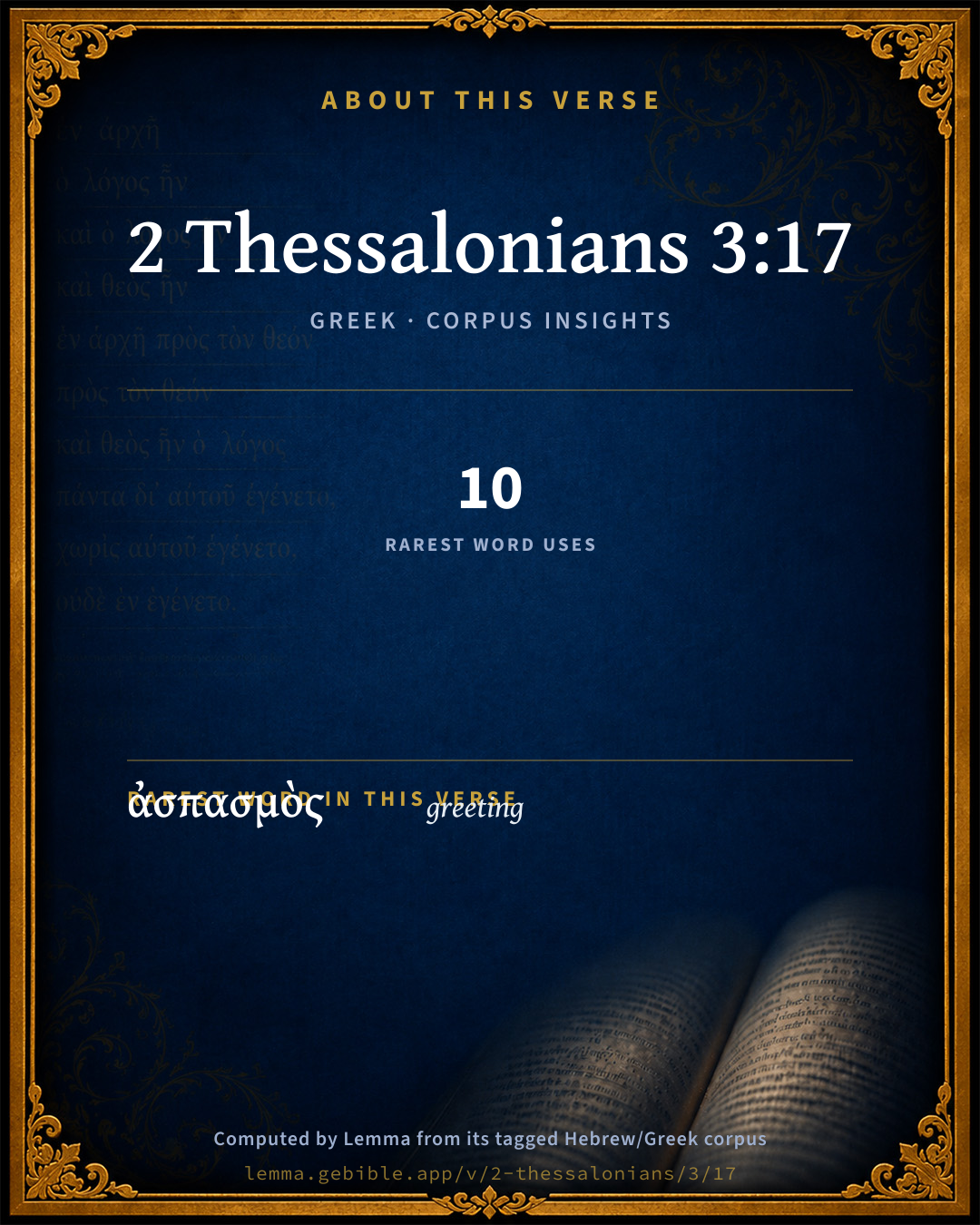
The rarest word here is ἀσπασμὸς greeting G783 — appearing just 10 times in the whole Greek New Testament.

Shared distinctive vocabulary

ἀσπασμὸς greeting G783 occurs in 10 verses of the Greek New Testament. Also found in:

Repetition

A word recurs within this verse:

Cross-references

5

Topical passages linked to 2 Thessalonians 3:17 in the Treasury of Scripture Knowledge — connected by theme and wording, ordered by reader-vote popularity; previews shown in the World English Bible.

  • 1 Corinthians 16:21 This greeting is by me, Paul, with my own hand.
  • Colossians 4:18 The salutation of me, Paul, with my own hand: remember my bonds. Grace be with you. Amen.
  • 2 Thessalonians 1:5 This is an obvious sign of the righteous judgment of God, to the end that you may be counted worthy of the Kingdom of God, for which you also suffer.
  • Joshua 2:12 Now therefore, please swear to me by Yahweh, since I have dealt kindly with you, that you also will deal kindly with my father's house, and give me a true token;
  • 1 Samuel 17:18 and bring these ten cheeses to the captain of their thousand, and look how your brothers fare, and take their pledge.

Cross-references courtesy of OpenBible.info (CC BY 4.0).

Commentary

Notes on 2 Thessalonians 3:17 from classic Christian and Jewish commentators (each source and its license shown beneath its notes). The classic Christian expositions comment on the surrounding passage and are grouped to its opening verse, so a note may address several verses; the Jewish commentaries on the Tanakh (Rashi and others) are per-verse, so they appear only where the commentator wrote on this verse.

Lemma curates 59 commentaries, every one of them public domain or Creative Commons licensed, each selected and text-cleaned for this edition rather than reprinted as found. About our sources →

The Biblical Illustrator

Joseph S. Exell

2Th_3:17

The salutation of Paul with Mine own hand, which is the token in every epistle

Pauls token

Was the mark by which to tell an authentic epistle of his from those forged letters with which false brethren had troubled the Church (2Th_2:2).

At first sight it seems to us too audacious for any one to have conceived the thought of writing a letter under the name of Paul; but, on the other hand, we must recollect several points.

1. St. Pauls genuine first epistle, in spite of its claim to inspiration (1Th_4:15), could not yet have acquired in the eyes of the Thessalonians the sanctity it wears for us. They had no notion of such a thing as Holy Scripture; and even if they had, St. Paul was a familiar figure, a mechanic, who had just left them, not yet invested with the heroic halo.

2. Such literary forgeries were not uncommon in that age, and scarcely considered reprehensible, unless they were framed to inculcate with authority some heretical teaching. Apocryphal gospels soon after abounded, under false titles, and works fathered on Clement and other great Church teachers.

3. There need not always have been a direct intention to deceive the readers as to the authorship; but the renowned name acted as a tempting advertisement for the work, and the theories thus shot forth hit their mark; whether the real authorship were discovered or not mattered little in comparison. Such points must be borne in mind before we accept as genuine any of the early Christian writings. (Canon Mason.)

There is the suggestion here that other letters may have passed between the apostle and the Thessalonian believers. If there were such a correspondence, we may regard it as having no doctrinal interest, and so was allowed to disappear. The amanuensis--probably Timothy--has now finished his work, and the apostle authenticates it. He gives his sign manual as a guarantee of the genuineness of the letter. He calls attention to it. Though his readers were doubtless acquainted with it, he asks them to mark it well--its large and, it may be, uncouth characters (Gal_6:11) were to be the token in every epistle he might in future send to them or to others, where attestation was needful. So I write. (J. Hutchison, D. D.)

The Biblical Illustrator, edited by Joseph S. Exell (c. 1880s–1900s) — public domain. Text from a community e-Sword module.

Whedon's Commentary on the Bible

Daniel D. Whedon

17. With mine own hand—So far by amanuensis; now by autograph.

Token in every epistle—His first epistle was without such authentication; but the forged or pretended epistle of 2Th_2:2, had warned him to guard against imposition.

Every epistle needing authentication, whether written to the Thessalonians or to others, was to receive its autographic token henceforth. Of those so explicitly authenticated are Colossians, (Col_4:18,) and 1 Corinthians, (1Co_16:21,) Galatians being entirely autographic. In Romans the concluding doxology may have been autographic; as Eph_6:24, and Php_4:23. Several epistles may not have needed authentication, as 2 Corinthians, which was sent by Titus; and those written to individuals, as Timothy, Titus, and Philemon, which were either autographic or known by circumstances to be genuine.

So I write—This is my penmanship. Grotius, ingeniously, but incorrectly, supposes that Paul appended a complex monogram as his mark. The apostle’s autograph probably included 2Th_3:17-18.

Daniel D. Whedon (gen. ed.), Commentary on the Old and New Testaments (1874–1909) — public domain. Text from a community e-Sword module.

Lange's Commentary on the Holy Scriptures

3. 2Th_3:17-18

He concludes with a parting Salutation and Benediction under his own hand

17The salutation of Paul with mine own hand;44 which is the [a] token45 in every epistle: so I write. 18The grace of our Lord Jesus Christ be with you all. Amen.46

EXEGETICAL AND CRITICAL

1. (2Th_3:17.) The salutation of Paul with mine own hand; Παύλου is in apposition to ἐμῇ, which indeed as to sense is the same thing μου. Hitherto, therefore, Paul had dictated; and that was his custom (Rom_16:22); though Gal_6:12 [11] purports otherwise.—Which is the [a] token; ὅ might be explained by attraction, the subject being conformed to the gender of the predicate; but it is better to understand it thus: which, to wit, the ἀσπάζεσθαι τῆ̣ ἐμῆ̣ χειρί.—In every epistle; on which Theophylact already remarks: ἐν πάσῃ τῆ̣ ἐπιστ. τῆ̣ ἵσως πεμφθησομένῃ πρὸς ὑμᾶς, ῆ καὶ ἁπλῶς ἐν πάσῃ τῆ̣ πρὸς οὕστινας. [Ellicott: “Apparently with reference to every future epistle (τῆ̣ πρὸς οὕστινας δήποτε, Theoph. 2) which the Apostle might hereafter deem it necessary so to authenticate,—not merely those he might have contemplated writing to Thessalonica (Theoph. 1, Lünem.); for consider 1Co_16:21 and Col_4:18. If it be urged that these last mentioned are the only Epistles in which the autograph attestation seems to have found a place, it may be reasonably answered that the πάσῃ must be understood relatively of every Epistle that was sent in such a way or under such circumstances as to have needed it. All the other Epistles (except 1 Cor., Col., which have the σημεῖον, and 1 Thess., which was sent before circumstances proved it to be necessary) are fairly, shown both by De Wette and by Alford in loc. to have either been delivered by emissaries (2 Corinth., Phil.), to bear marks (Gal_6:11, and perhaps the doxology in Rom., Eph.), or to be of such a general character (Rom.? Eph.? and those to individuals) as to have rendered such a formal attestation unnecessary.”—J. L.]—So I write; not, that is, these words, as if there were cause for surprise, if we meet with them again only in 1 Cor. and Col.; it is not ταῦτα, but οὕτως, and De Wette’s inquiry, why the words recur in the smallest number of the other Epistles, is quite superfluous. He says merely: This is my handwriting (see the Introduction to Thess., p. 114). Grotius, Bengel and others, thought of an intricate monogram, difficult of imitation; but that is untenable, and not consonant to antiquity. It may be further asked, whether by the autograph salutation Paul means 2Th_3:17, or 2Th_3:18, or both together. Very improbable is Diedrich’s idea: The salutation and benediction in 2Th_3:16 are written by my hand. The word is referred to 2Th_3:18 by Chrysostom (ἀσπασμὸν καλεῖ τὴν εὐχήν), Theodoret, Theophylact; by Lünemann, on the other hand, only to 2Th_3:17, ἀσπασμός, he thinks, being something different from a benediction. But probably this is to distinguish too nicely, and besides it is scarcely to be supposed, that Paul should have written 2Th_3:17 with his own hand, and then again have dictated 2Th_3:18. Nor does Lünemann assume this, but regards both verses as autographical. In that case, however, the separation between salutation and benediction also fails, as Hofmann properly remarks. The closing salutation might be compressed, or extended. The Apostle wrote it himself, but not always in the same words, nor always expressly drawing attention to it: ὁ ἀσπ., &c. In this place it is the salutation of love, and at the same time a precautionary measure for the future. After what has been said, Lünemann’s other inference is likewise untenable, that, if Paul here says for the first time: οὕτως γράφω, and thus shows that his handwriting was still unknown to the Thessalonians, then in the First Epistle he had not written the salutation. But he might there too have written the words of benediction, and merely not have found occasion to make express reference to his handwriting. So Hofmann with reason. Utterly groundless is it, when Grotius also infers from our passage that this Epistle was the first, since, had they already received one at an earlier period, this notice would have been unnecessary.—A thorough knowledge of Paul’s customary procedure could only be got from the original letters. But we know enough to say, that to regard the warding off of a pernicious forgery, as just a mark by which a forger betrays himself, is the most perverse abuse of our passage.47

2. (2Th_3:18.) The grace of our Lord Jesus Christ be with you all; as in the First Epistle, only that here all is expressed; no one, therefore, even of the delinquents is excluded.

DOCTRINAL AND ETHICAL

(2Th_3:17-18.) Paul takes great pains even for the fides humana of Scripture. The interest which faith has in scientific criticism consists in this, that it must be of importance for us to place confidence in nothing that is precarious. Now the original apostolic manuscript is not accessible to us, but we are referred to a series of intermediate processes, through which copies of the original are delivered to us, and, were we obliged to verify the trustworthiness of these mediums, we should remain in a painful uncertainty. But, on the whole, it is only through the fides divina that the fides humana first receives its full authentication. Only because this Epistle also bears the stamp of the Spirit of God, is the assertion of the writer, which we read at 2Th_3:17, worthy of credit, and it becomes a moral impossibility for us to impeach it as a falsehood. Not the Apostle’s handwriting, which we no longer have before us, but the grace of the Lord Jesus Christ, which pervades the Epistle, is for us the decisive seal of authenticity.

HOMILETICAL AND PRACTICAL

Stähelin: Truly this is also the mark of all those who are a living epistle of Christ (2Co_3:2-3), that the grace of their Lord Jesus, whom they have received in faith and love to their justification, sanctification, and salvation, is by them continually embraced and held fast as their souls’ only comfort and joy.

THE END OF THESSALONIANS.

Footnotes:

[44]2Th_3:17.—[The Greek is: Ὁ ἀσπασμὸς τῆ ἐμῆ χειρὶ Παύλου, which Riggehbach renders: Der Gruss mit meiner Paulushand. Our English Version gives it in three forms: “The salutation of me Paul with mine own hand” (1Co_16:21; and so Ellicott in our text); “The salutation by the hand of me Paul” (Col_4:18); “The salutation of Paul with mine own hand” (2Th_3:17). The second mode was adopted in my Revision of this Epistle.—J. L. ]

[45]2Th_3:17.—[σημεῖον, without the article; and so De Wette, Lünemann, Conybeare, Ellicott, and others.—J. L.]

[46]2Th_3:18.—Most authorities give ἀμήν; it is wanting in B., Sin. à prima manu, and some others. Grotius decides, that Amen was added by the church, when the Epistle was read. [It is cancelled by Tischendorf and Alford. Riggenbach likewise omits it.—J. L.]

[47][Webster and Wilkinson: “We have here a strong proof that St. Paul regarded himself and desired the churches to regard him as the sole author of his Epistles, whatever might be the association of the superscription, or the corresponding phraseology of the composition.”—J. L.]

Lange's Commentary on the Holy Scriptures (Critical, Doctrinal, and Homiletical), ed. John Peter Lange, English translation edited by Philip Schaff (1864–1880) — public domain. Text from a community e-Sword module.

Tyndale Open Study Notes

Tyndale Open Resources

3:17 A secretary had written this letter for Paul (Rom 16:22; 1 Pet 5:12). Now Paul takes the pen to add a final greeting in his own hand (cp. 1 Cor 16:21; Gal 6:11; Col 4:18; Phlm 1:19). Because he suspected that a letter he had not written was circulating under his name (2 Thes 2:2), he emphasizes this authenticating procedure to prove this letter is from him.

Tyndale Open Study Notes — © Tyndale Open Resources, licensed CC BY-SA 4.0. Text via the HelloAO Bible API.

Bengel's Gnomon

Johann Albrecht Bengel

2Th 3:17. Τῇ ἐμῇ χειρὶ, with my own hand) Therefore the greater part of the epistle had been written by another hand.—σημεῖον, token) We have reason to believe that Paul [with a view to guard against fraud of every kind, ch. 2Th 2:2.—V. g.] distinguished, by a peculiar and inimitable painting (tracing) and formation of the letters, the words of the salutation, grace, etc., 2Th 3:18.—ἐν πάσῃ ἐπ στολῇ, in every epistle) He had at that time, therefore, already written more.—οὕτω, so) not otherwise. He hereby meets any doubt.[31]

[31] Bengel, J. A. (1860). Vol. 4: Gnomon of the New Testament (M. E. Bengel & J. C. F. Steudel, Ed.) (J. Bryce, Trans.) (213–237). Edinburgh: T&T Clark.

Bengel's Gnomon of the New Testament — English translation (T&T Clark, Edinburgh, 1860) — public domain. Text from a community e-Sword module.

Meyer's Critical & Exegetical Commentary

Heinrich August Wilhelm Meyer

2Th_3:17-18. Autographic salutation, with a repeated benediction. Paul had not written the letter with his own hand, but dictated it Comp. Rom_16:22; 1Co_16:21; Col_4:18.

ὅ] does not stand by attraction for ὅς, nor also does it bring forward a simple special point from the foregoing (so Wieseler on Gal_6:11; and Laurent in the Stud. u. Krit. 1864, p. 639; Neutestam. Studien, Gotha 1866, p. 5: which, namely, the autographic writing), but it refers to the whole preceding idea: which circumstance of the salutation now written.

σημεῖον] a sign, i. e. a mark of authenticity. Comp. 2Th_2:2. Chrysostom, Theodoret, Theophylact, Bullinger, Estius, Piscator, Menochius, Cornelius a Lapide, Er. Schmid, Beza, Joachim Lange, Harduin, Benson, Bengel, Moldenhauer, Zachariae, Baur (Paulus, p. 489), Hofmann, Riggenbach, and most critics, incorrectly find this mark in the addition of the words following in 2Th_3:18; for the autographic salutation is expressly designated as this mark. But a salutation and a benediction are different from each other.

ἐν πάσῃ ἐσιστολῇ] in every Epistle, can only be referred to all the Epistles which the apostle has, perhaps, at a later period, still to write to the Thessalonians. For only for the Thessalonians, who had already been actually deceived by a false Pauline Epistle, and led into error, was such a precaution of practical importance against a new deception. Besides, if ἐν πάσῃ ἐπιστολῇ is to be understood absolutely instead of relatively, the autographic salutation would be found in all the Epistles of the apostle. But it is only found in 1Co_16:21 and Col_4:18.

οὕτως γράφω] thusthat is to say, in such characters as are given in 2Th_3:17-18

I write. The handwriting of the apostle was accordingly still unknown to the readers. From this it follows, that also the First Epistle to the Thessalonians was not written by the apostles own hand. Moreover, Zeltner (de monogrammate Pauli, Altorfii 1721), Bengel, and Moldenhauer erroneouslybecause transferring a modern custom into antiquityconsider that we are here to think on characters artificially twisted into a monogram by the apostle and rendered incapable of imitation. Against Zeltner, see Wolf, p. 402 ff.

Meyer — Critical and Exegetical Commentary on the New Testament — English translation by Peter Christie, edited by Frederick Crombie (T&T Clark, 1880) — public domain. Text from a community e-Sword module.

Expositor's Greek Testament

ed. W. Robertson Nicoll

2Th 3:17-18 . Conclusion. Paul now takes the pen from his amanuensis, to add the salutation in his own handwriting for the purpose of authenticating the epistle (otherwise in 1Co 16:21 ). This, he observes, is the sign-manual of his letters ( cf. 2Th 2:2 ), i.e. , the fact of a personal written greeting at the close, not any form of words (like 2Th 3:18 ), or the use of the word “grace,” or “certum quendam nexum literarium” (Grotius). The precaution is natural, in view of his suspicion about unauthorised communications. Compare “the σεσημείωμαι (generally contracted into σεση ) with which so many of the Egyptian papyrus-letters and ostraca close” (Milligan, p. 130), or the postscript in one’s own handwriting ( ξύμβολον ) which guaranteed an ancient letter (Deissmann: Licht vom Osten , 105). μετά ( cf. 2Th 3:16 ), the divine presence is realised through the experience of Christ’s grace.

The Expositor's Greek Testament, edited by W. Robertson Nicoll (1897–1910) — public domain. Text from a community e-Sword module.

Geneva Bible (1599)

Geneva Bible translators

The Apostle subscribeth his letters with his own hand, that false letters might not be brought and put in place of true.

Geneva Bible (1599) marginal notes — public domain. Text via Bolls.life.

Jamieson, Fausset & Brown

Robert Jamieson, A. R. Fausset & David Brown

The Epistle was written by an amanuensis (perhaps Silas or Timothy), and only the closing salutation written by Paul's "own hand" (compare Rom 16:22; Co1 16:21; Col 4:18). Wherever Paul does not subjoin this autograph salutation, we may presume he wrote the whole Epistle himself (Gal 6:11).

which--which autograph salutation.

the token--to distinguish genuine Epistles from spurious ones put forth in my name (Th2 2:2).

in every epistle--Some think he signed his name to every Epistle with his own hand; but as there is no trace of this in any manuscripts of all the Epistles, it is more likely that he alludes to his writing with his own hand in closing every Epistle, even in those Epistles (Romans, Second Corinthians, Ephesians, Philippians, First Thessalonians) wherein he does not specify his having done so.

so I write--so I sign my name: this is a specimen of my handwriting, by which to distinguish my geniune letters from forgeries.

Jamieson, Fausset & Brown — Commentary Critical and Explanatory on the Whole Bible (1871) — public domain (CC PDM 1.0). Text via the HelloAO Bible API.

Adam Clarke's Commentary

Verse 17. The salutation of Paul with mine own hand] It is very likely that Paul employed an amanuensis generally, either to write what he dictated, or to make a fair copy of what he wrote. In either case the apostle always subscribed it, and wrote the salutation and benediction with his own hand; and this was what authenticated all his epistles. A measure of this kind would be very necessary if forged epistles were carried about in those times. See note on 1Co 16:21, and see Col 4:18.

Adam Clarke's Commentary on the Bible (1810–1826) — public domain. Text from a community e-Sword/MySword module.

John Calvin's Commentaries

17 The salutation, with my own hand. Here again he provides against the danger, of which he had previously made mention — lest epistles falsely ascribed to him should find their way into the Churches. For this was an old artifice of Satan — to put forward spurious writings, that he might detract from the credit of those that are genuine; and farther, under pretended designations of the Apostles, to disseminate wicked errors with the view of corrupting sound doctrine. By a singular kindness on the part of God, it has been brought about that, his frauds being defeated, the doctrine of Christ has come down to us sound and entire through the ministry of Paul and others. The concluding prayer explains in what manner God aids his believing people — by the presence of Christ’s grace.

John Calvin's Commentaries (1540-1563) — public domain. Text from the Calvin Translation Society English edition (1840s-50s) via the Christian Classics Ethereal Library (ccel.org). Calvin's coverage is partial (roughly two-thirds of the Bible); uncommented books and verses are honest gaps, never fabricated. The 19th-century editor's footnotes and remarks are omitted so the notes are faithfully Calvin's own voice.

Ellicott's Commentary for English Readers

(17) The salutation.—At this point St. Paul takes the pen out of his secretary’s hand, and adds the closing words himself. The actual salutation does not begin until the benediction of the 18th verse, to which this 17th is intended to attract attention.

Which.—Namely, the autograph addition of a salutation, or valedictory prayer, not the special words in which it was couched.

The token.—Rather, a token—a mark, that is, by which to tell an authentic Epistle of his from those forged letters with which false brethren had troubled the Thessalonian Church (2Th_2:2). At first sight, it seems to us too audacious for any one to have conceived the thought of writing a letter under the name of St. Paul; but, on the other hand, we must recollect several points. (1) St. Paul’s genuine First Epistle, in spite of its claim to inspiration (1Th_4:15), could not yet have acquired in the eyes of the Thessalonians the sanctity it wears for us; they had no notion of such a thing as Holy Scriptures, and even if they had, St. Paul was a familiar figure, a mechanic who had just left them, not yet invested with the heroic halo. (2) Such literary forgeries were not uncommon in that age, and scarcely considered reprehensible, unless they were framed to inculcate with authority some heretical teaching. Apocryphal Gospels soon after abounded, under false titles, and works fathered upon St. Clement and other great Church teachers. (3) There need nor always have been a direct intention to deceive the readers as to the authorship, but the renowned name acted as a tempting advertisement for the work, and the theories thus shot forth hit their mark; whether the real authorship were discovered or not mattered little in comparison. Such points must be borne in mind before we accept as genuine any of the early Christian writings.

In every epistle.—That is, naturally, “in every Epistle which I write.” It cannot be narrowly restricted to mean, “in every Epistle which I shall for the future write to you Thessalonians,” though that is, of course, the practical significance. Nor does it imply a formed design of writing other Epistles to other churches. It seems necessary to suppose that St. Paul had already made a practice of concluding Letters with his autograph, though only one Letter of his is now extant of an earlier date than our present Epistle. There is no reason whatever to suppose that all the Letters ever written by St. Paul have been preserved to us (see Dr. Lightfoot’s Philippians, p. 136, et seq.), any more than all the sayings and acts of Jesus Christ (Joh_21:25); and even when he wrote his First Epistle to Thessalonica he had seen the necessity of giving careful directions about his Letters (1Th_5:27), and of rousing his correspondents to a reasonable scepticism (1Th_5:21). The same solicitude re-appears in 1Co_16:21; Gal_6:11. And the rule which St. Paul had already made he always observed, so far as we can test; for all his extant Epistles, as Bishop Wordsworth points out on 1Th_5:28, contain his “salutation” at the end.

So I write.—“Such is my handwriting.” It need not mean that the Thessalonians hitherto were unacquainted with his hand; he only calls their attention closely to it. The great bold handwriting (comp. Gal_6:11) would not easily be mistaken.

A Bible Commentary for English Readers, edited by Charles John Ellicott (1878–1897) — public domain. Text from a community e-Sword module.

The Cambridge Bible for Schools and Colleges

gen. ed. J. J. S. Perowne

17. The salutation of Paul with mine own hand] Lit., The salutation with my own hand—of PAUL. In the last word the Apostle’s formal signature is attached. Pen in hand, he adds the brief concluding sentences to the letter, lying now all but complete before him.

The Apostle commonly employed one of his helpers as amanuensis. “I Tertius, who wrote this letter,” e.g., in Rom_16:22; comp. Gal_6:11, Phm_1:19, where he notifies his writing sua manu. But it was needful that he should sign his name, with a few words of greeting written by himself, in order to authenticate the Epistle. In other Epistles we find the autograph conclusion without the final signature, which was not usual in ancient letters. There is no reference of this kind at the close of his First Epistle; but since that time his written authority had been alleged for statements he had never made (ch. 2Th_2:2). He is careful to guard against this possibility in writing to Thessalonica a second time. He calls attention, as he pens this attestation, to his handwriting, and gives notice that no document bearing his name will be genuine without this seal: which is the token in every epistle (“Paul’s mark,” as one might say)—thus I write.

There was something peculiar and noticeable in the Apostle’s penmanship, which could not he mistaken. Some infer from Gal_6:11 that St Paul’s script was distinguished by its large and bold appearance; but it may be that he used large characters in that passage for the sake of emphasis. Further allusions to the autograph conclusion are found in 1Co_16:21, and Col_4:18.

The Cambridge Bible for Schools and Colleges (gen. ed. J. J. S. Perowne; Cambridge University Press, 1878–1918) — public domain. Text from a community e-Sword module.

John Gill's Exposition

The salutation of Paul with mine own hand,.... In writing his epistles, the body and substance of them he used an amanuensis, but the salutation he wrote with his own hand:

which is the token in every epistle; by which they might be known to be true and genuine, and be distinguished from counterfeit ones: and the rather he mentions this, that they might be troubled neither by word, nor by spirit, nor by epistle, as from them, as they had been, Th2 2:2 for it seems that this wicked practice of counterfeiting the epistles of the apostles, or carrying about spurious ones, under their name, began so early; to prevent which, the apostle took this method,

so I write, as follows:

John Gill's Exposition of the Whole Bible (1746–1763) — public domain (CC PDM 1.0). Text via the HelloAO Bible API.

Trapp's Complete Commentary

John Trapp

17 The salutation of Paul with mine own hand, which is the token in every epistle: so I write.

Ver. 17. So I write, The grace, &c.] This is that St Paul would have every, of his Epistles stamped with his own hand, viz. prayer for all his people.

John Trapp, A Commentary or Exposition upon All the Books of the Old and New Testament (1647–1656) — public domain. Text from a community e-Sword module.

Albert Barnes' Notes on the Bible

The salutation of Paul with mine own hand; - See the notes, 1Co 16:21. “Which is the token in every epistle.” Greek: “sign.” That is, this signature is a sign or proof of the genuineness of the epistle; compare the notes on Gal 6:11.

So I write - Referring, probably, to some mark or method which Paul had of signing his name, which was well known, and which would easily be recognized by them.

Albert Barnes' Notes on the Bible (1834–1885) — public domain. Text from a community e-Sword/MySword module.

Haydock's Catholic Bible Commentary

The salvation of, &c. The apostle gives them his caution, for fear the faithful might be deceived by fictitious letters. For they had already received one of this kind, which had terrified them, by foretelling that the day of judgment was at hand. This deception he is here anxious to remove, signing the present communication with his own hand, and sealing it with his own seal. For although the rest of the epistle had been written by another, these words to the end were written by himself. (Estius) --- All the civilities of this great doctor of grace terminate in wishing it to his friends. This is his genuine character, because it is the love and continual effusion of his heart. (Bible de Vence) --- Amen. This the congregation added after the epistle had been read, and from this circumstance alone has it found a place here. (Polus synopsis Criticorum, p. 1003, vol. 4.)

====================

George Leo Haydock (1774–1849), Haydock's Catholic Family Bible and Commentary, 1859 edition — public domain. Excludes Psalms (Douay-Rheims chapter numbering differs from Protestant) and Deuterocanonical books (Catholic canon only).

Matthew Poole's English Annotations

This the apostle addeth after he had finished his Epistle, and taken his farewell, as a proof that the Epistle was genuine, and came from himself; because it may be there were some then who did counterfeit his Epistles, as there have been many since who have counterfeited creeds, liturgies, gospels, writings of the fathers, &c., and he knew it might be of dangerous consequence to the churches, to have his writings counterfeited. Heretics in several ages, and the Church of Rome particularly, have herein been deeply guilty. And though it is probable the body of this Epistle was written by some amanuensis, as is evident of the Epistle to the Romans, that it was written by one Tertius, Rom 16:22; and when he tells the Galatians, Gal 6:11, he wrote their Epistle with his own hand, so Phm 1:19, it implies sometimes he did not so; yet this salutation he wrote with his own hand, which he practised not only in this, but in all his other Epistles, as he here affirmed. And he wrote it in such characters whereby his own hand might be known; else it was an easy matter for any impostor to write the same words. And the words of it are here set down, but elsewhere explained, and therefore nothing is further needful here.

Matthew Poole's English Annotations on the Holy Bible (1683–1685) — public domain. Text from a community e-Sword/MySword module.

The Pulpit Commentary

The salutation of Paul with mine own hand. The apostle usually dictated his Epistles to an amanuensis, but wrote the concluding words with his own hand. Thus Tertius was his amanuensis when he wrote the Epistle to the Romans. (Rom_16:22) Probably the Epistle to the Galatians is an exception, (Gal_6:11) and also the Epistle to Philemon on. (Phm_1:19) The same authentication expressed in the same words is found in the First Epistle to the Corinthians, (1Co_16:21) and in the Epistle to the Colossians. (Col_4:18) Which; referring, not to the salutation, but to the whole clause; which circumstance. Is the token; the mark of authentication. Of every Epistle. Such authentication was especially necessary in the case of the Thessalonians, as it would seem that a forged epistle had been circulated among them. (2Th_2:2) Some restrict the words to the Epistles which the apostle would afterwards write to the Thessalonians (Lunemann); but they are rather to be understood of a caution which the apostle practised, or was to practise, in all his Epistles. Some refer the token to the words, "The salutation of Paul with mine own hand," and although these words are only found in two other Epistles, yet it is asserted that the other Epistles were otherwise sufficiently authenticated. But it appears better to understand by the salutation the benediction which follows; and a similar salutation or benediction is found at the close of all Paul"s Epistles. (see 1Th_5:28)

Vers. 17, 18.

The closing salutation with its autographic significance.

salutation of me Paul with mine own hand, which is the token in every Epistle: so I write." He takes the pen out of the hand of his amanuensis and writes the closing words himself.

I IT WAS IMPORTANT TO AUTHENTICATE THE EPISTLE. There were letters falsely attributed to him. (1Th_2:2) It is essential for Christians to know the distinction between the human and the Divine. The Thessalonians would be able to identify his large, bold handwriting. (Gal_6:11)

II THE SALUTATION WAS NOT A MERE SYMBOL OF FRIENDSHIP, BUT A PRAYER FOR HIS BELOVED CONVERTS. "The grace of our Lord Jesus Christ be with you all.

1. His Epistles began with prayer; they end with prayer round that which he said with mighty walls on either side.

2. All the good he desires for his converts is included in the grace of theGod-Man. The prayer implies the Divinity of Christ. His name alone appears in his parting supplication.

3. It is a parting request for all the brethren without exception, including even those who received his rebukes. T.C.

The Pulpit Commentary (1880–1919), ed. H.D.M. Spence-Jones & Joseph S. Exell — public domain. Text from a community e-Sword module.

Burkitt's Expository Notes on the New Testament

William Burkitt

Observe here, 1. That the salutation written with his own hand respects his own writing, which did serve as a token or certain mark whereby his own epistles were distinguished from all counterfeits. The sending of salutations, either by word or writing, that we may thereby testify our sincere affection to absent friends, is not a matter of decency only, but of duty; not of compliment barely, but of conscience. The salutation of Paul with mine own hand.

Observe, 2. His usual valediction and farewell wish, The grace of our Lord Jesus Christ, be with you all, Amen. As if he had said, "May the gracious and undeserved favour of God in Christ, with all the fruits and effects, the benefits and advantages of it, be conveyed to you all, without exception, and be the portion and privilege of every soul of you; and in testimony both of my affectionate desire and assured confidence, I say, Amen, so be it, so let it be.

Learn hence, that there is an inexhaustible fountain of rich grace in Christ, and so copious are the streams of spiritual blessings which flow from it, that wish we never so much to others, yet there still remaineth enough for ourselves. St. Paul, who wisheth all grace to the Thessalonians, knew very well there was enough both for himself and them: and that how large a measure soever was bestowed upon them, there would not be the less remaining for himself; therefore doth he thus close and conclude his epistle, saying, The grace of our Lord Jesus Christ be with you all. Amen.

William Burkitt's Expository Notes on the New Testament (1700–1703) — public domain. Text from a community e-Sword module.

McGarvey & Pendleton's Commentaries

J. W. McGarvey

The salutation of me Paul with mine own hand, which is the token in every epistle: so I write . [I. e., this is my penmanship.]

J. W. McGarvey (with Philip Y. Pendleton), Commentaries on the New Testament (The Fourfold Gospel, 1914; Acts; and the epistles) — public domain. Text from a community e-Sword/MySword module.

The People's New Testament

B. W. Johnson

17, 18. The salutation of Paul. Here he adds the salutation in his own hand-writing. The Epistle thus far had been written by one to whom he dictated, as was his custom, but he now adds his autograph. This autograph was proof of the genuineness. Their attention is perhaps called to this on account of a spurious epistle (2:2).

B. W. Johnson's The People's New Testament with Notes (1889–1891) — public domain. Electronic text from the Christian Classics Ethereal Library (CCEL) ThML edition.

Cambridge Greek Testament for Schools and Colleges

17. Ὁ ἀσπασμὸς τῇ ἐμῇ χειρί—ΠΑΥΛΟΥ. The salutation with my own hand—of PAUL. In the last word the Apostle Paul’s formal signature is attached, which endorses the Epistle as proceeding from him and expressing his mind, though another hand had held the pen (cf. Rom 16:22), and although his two companions were partners in the Letter and may, either or both of them, have personally contributed to it; see Introd., pp. xlviii–lii, liv. In Gal 6:11 and Phm 1:19 St Paul again notifies the inscribing of certain words sua manu, implying that the body of the Epistle was indited through an amanuensis. This was, presumably, the Apostle’s habit. In other Epistles we find the autograph conclusion (ὁ ἀσπασμός) serving as signature without the name, which in ancient writing was given at the head of the letter. There was no reference to this signature at the close of the former Epistle; but since its dispatch the written authority of the Apostles has been quoted for statements they repudiate (2Th 2:2; see note). St Paul is now guarding against such misrepresentation.

St Paul calls attention in penning the attestation to his handwriting, and gives notice that no document claiming his authority will be genuine without this seal: ὅ ἐστιν σημεῖον ἐν πάσῃ ἐπιστολῇ· οὕτως γράφω, which is a token (sign) in every letter—so I write. In St Paul’s extant Letters, while it is the exception for him to sign his name in the closing salutation, he appears regularly to have written out the ἀσπασμός with his own hand. There was something peculiar and noticeable in the Apostle’s script. Some infer from Gal 6:11 that he wrote an unusually large, bold hand; but the γράμματα μεγάλα of that passage may have been employed there for emphasis. His handicraft of tent-cloth stitching would inevitably make his fingers stiff and inapt for the use of the pen.

Cambridge Greek Testament for Schools and Colleges (Cambridge University Press, 1896; 21 vols, various authors incl. Carr, Maclear, Plummer, Farrar, Lumby, Moule, M. R. James, Simcox) — public domain. Text from a community e-Sword module.

Alford’s Greek Testament

Henry Alford

17.] Autographic salutation. The Epistle, as it follows from this, was not written with the Apostle’s own hand, but dictated. So with other Epistles; see Rom 16:22:1Co 16:21: Col 4:18.

ὅ] which circumstance: not attraction for ὅς. The whole of vv. 17, 18, not merely the benediction, are included. By the words οὕτως γράφω, we must not conceive that any thing was added, such as his signature,—or as Œc., οἷον τὸ ἀσπάζομαι ὑμᾶς, ἢ τὸ ἔῤῥωσθε, ἤ τι τοιοῦτον: they are said of that which he is writing at the time. His reason for this caution evidently was, the ἐπιστολὴ ὡς διʼ ἡμῶν, spoken of ch. 2:2. And the words ἐν πάσῃ ἐπιστολῇ must not, with Lün., be limited to any future Epistles which he might send to the Thessalonians, but understood of a caution which he intended to practise in future with all his Epistles: or at least with such as required, from circumstances, this identification. Thus we have (1 Thess. being manifestly an exception, as written before the rule was established) Gal. written with his own hand (see note on Gal 6:11); 1 Cor. authenticated (16:21); 2 Cor. sent by Titus and therefore perhaps not needing it (but it may have existed in 13:12, 13 without being specified); Rom. not requiring it as not insisting on his personal authority (but here again the concluding doxology may have been autographic): Col. authenticated (4:18): Eph. apparently without it (but possibly 6:24 may have been autographic): Phil. from its character and its bearer Epaphroditus not requiring it (but here again 4:23 may be autographic): and the Epistles to individuals would not require such authentication, not to mention that they are probably all autographic—that to Philemon certainly is, see ver. 19 there. (So for the most part De Wette.)

Henry Alford, The Greek Testament (1849–1861) — public domain. Text from a community e-Sword module.

International Critical Commentary

17. ὁ ὀσπασμός κτλ. It would appear that Paul, like his contemporaries, occasionally wrote (Phil. 19) but regularly dictated (Rom 16:22) his letters; and that, again like his contemporaries, he was in the habit of adding to every dictated letter a few concluding words in his own handwriting. Sometimes, and for varying reasons, he calls attention to the autographic conclusion, thus purposely authenticating his letter; so for example in 1Co 16:21, Col 4:18 where as here we have ὁ ἀσπασμὸς τῇ χειρὶ Παύλο (the genitive being in apposition with ἐμου implied in ἐμῇ); see also Gal 6:11 = Phm 1:19 ἔγραψα τῇ ἐμῇ χειρι It is not at all necessary to assume in any of these instances that a particular suspicion of forgery prompted the summons to attention, though it is not inconceivable in our passage that mention is made of the autographic conclusion in view of the fact that some of the idle brethren (I 5:27, II 3:14) may have excused their intention to disregard Paul’s epistolary injunctions on the score that the letter to be read was not genuine.

ὅ ὲστιν σημεῖον κτλ “Not ‘which salutation,’ nor ‘which hand,’ as if ο were attracted by σημεῖο; but ‘which autographic way of giving the salutation’” (Lillie). The σημεῖο = “token” refers to what Paul has written in his own hand; it is a proof of authenticity. In view of the ancient habit of writing, or at least of signing a letter, just as we sign with our pen a letter written or typewritten by the stenographer, it is quite unnecessary to limit the scope of the phrase “in every letter.” The οὕτως γράφ refers not to the fact but to the manner of the autographic conclusion; “mark the handwriting” (Rutherford). The Thessalonians had already received a letter from Paul, in which, according to epistolary custom, he had himself written a few closing words (I 5:28 or 26-28). His handwriting, which was characteristic (Gal 6:11), is assumed to be known. In case of necessity, the majority could direct the attention of the recalcitrant among the idlers to the same hand in I and II.

Deissmann (Light, 153, 158 f.) calls attention to ancient procedure in the matter of writing autographic conclusions in evidence of authenticity, and properly urges that it is a begging of the question to assume that Paul “only finished off with his own hand those letters in which he expressly says that he did.” In a very brief letter from Mystarion to a priest, dated September 13, 50 (BGU, 37), a reproduction of which is given by Deissmann (ibid, 157), the ἔρρως and the date are written in another hand, that is, “in Mystarion’s own hand,” a circumstance that “proves that somebody at that date (about the time of our letter) closed a letter in his own hand without expressly saying so.” In the Passalacqua papyrus (Deissmann, BS. 212 f., Witk., 35), a σύμβολο = σημεῖο is given, as a token of genuineness, to the messenger along with the letter: ἀπεδόθη τἀδʼ αύτῷ καὶ τὸ σύμβολον τῶν ἐ (Deissmann, έμῶ); on the other hand, there is no parallel for a σύμβολο = σημεῖο as contained in the letter itself. The extent of the autographic writing here and elsewhere is uncertain, naturally enough, for we do not possess the original. In our passage, Th. Mops., Chrys., Wohl, and others restrict it to v. 18; Ell., Lft., Mill. and others include vv. 17-18; Schmiedel, Dob. and others include vv. 16-18; and Dibelius includes both v. 18 and the date now lost.

IX. BENEDICTION (3:18)

International Critical Commentary — older volumes (1896–1929), various authors — public domain. Text from a community e-Sword module.

Vincent's Word Studies in the New Testament

Marvin R. Vincent

The salutation of Paul with mine own hand [ασπασμος τη εμη χειρι παυλου] . Rev. properly, "the salutation of me Paul." The genitive of me is contained, according to a familiar Greek idiom, in the possessive pronoun my. Paul had apparently been employing an amanuensis.

In every epistle. Comp. 1Co 16:21; Col 4:18.

Marvin R. Vincent, Word Studies in the New Testament (1887–1900) — public domain. Text from a community e-Sword/MySword module.

Lesson kit

Teaching starters — assembled from the data on this page, not authored interpretation. Every prompt links to the verse data it draws on. Edit before teaching.

2 Thessalonians, in the Pauline Epistles, opens this verse with 14 words (13 distinct Greek lemmas). Its most distinctive word is aspasmós (“greeting”). A historical commentator’s framing appears above. Read the whole chapter for the surrounding context.

Discussion questions

  1. How does “greeting” (aspasmós) shape what this verse is saying?
  2. How does Matthew 23:7, which shares the word «greeting», read alongside this verse?
  3. What does the repetition of “the” (2× in this one verse) do in this verse?
  4. The translations on this page render this verse differently — a whole-verse word diff, not a word-by-word alignment. What might account for the different wordings?
  5. Compare how The Biblical Illustrator and Whedon's Commentary on the Bible read this verse. Where do they agree or differ?

Things to notice

Reading settings

Reading text

Shown beneath each verse's original-language words.

Old Testament
Old Testament edition

Read the OT as the Masoretic Hebrew (MT) or the Greek Septuagint (LXX).

English shown for the Greek Septuagint (in the Hebrew ↔ Greek comparison).

Comparing translations? Open the Compare panel on any verse page to stack up to four side by side.