

James 3:5
Greek (Tischendorf 8th ed.) James 3:5 appears in the Greek New Testament. The text above is from the Tischendorf 8th edition. Each word links to its Strong’s number and a concise gloss. Click any word for its full Thayer’s Greek Lexicon entry.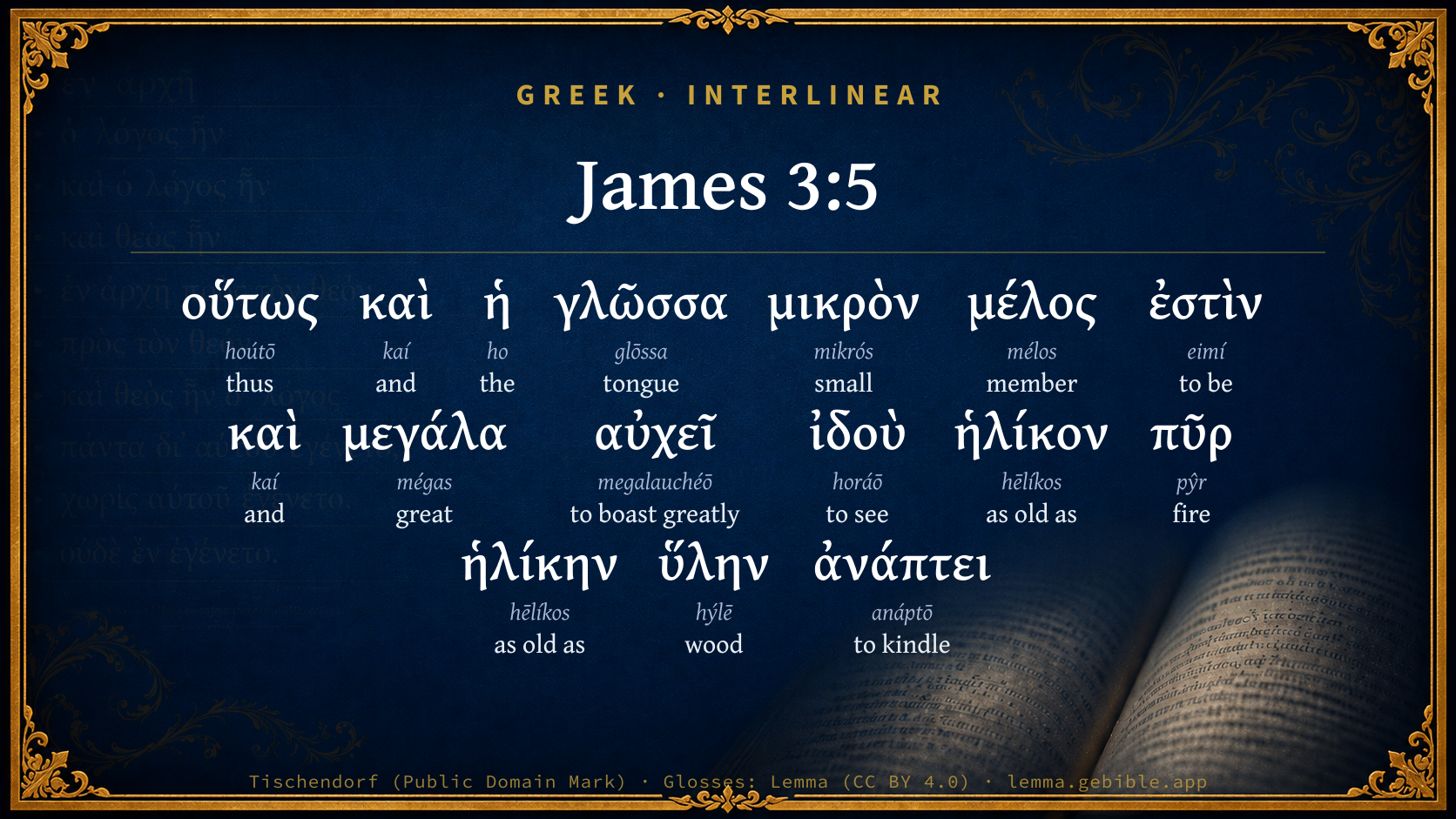
So the tongue is also a little member, and boasts great things. See how a small fire can spread to a large forest!
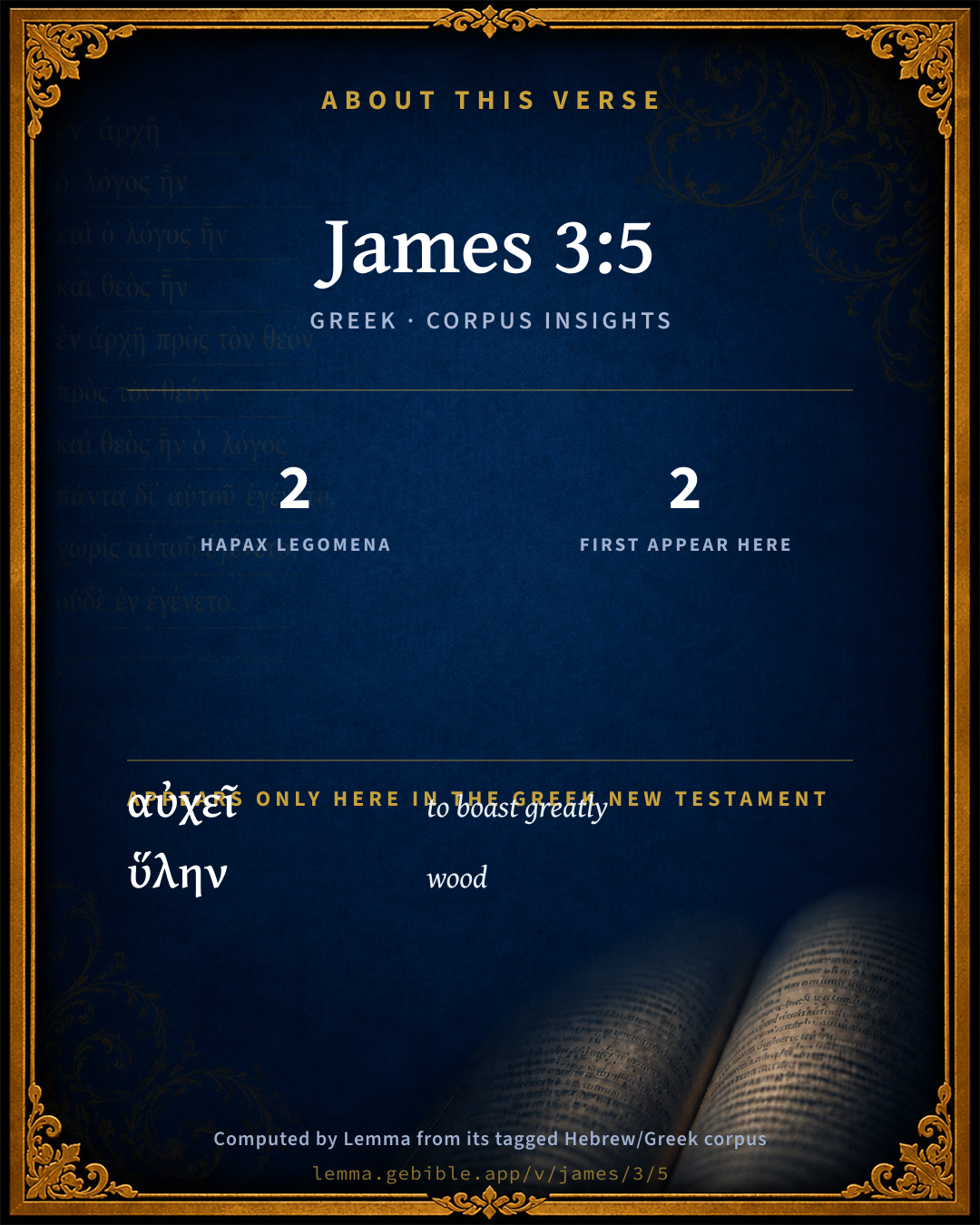
- 2 hapax legomena — only here in the Greek New Testament
- 2 first appearances in the Greek New Testament
Download a study sheet
One document with this verse’s original text, its word-by-word gloss line, the meaning frame, cross-references with their text, attributed commentary, and full source and license credits — printable, and it pastes into notes with its structure intact.
This verse Autodidact and up
A passage Seminary Student
Up to 50 verses in one chapter. A passage sheet keeps up to 6 commentary sources and 12 cross-references per verse, in the order this page ranks them, and says so on the sheet whenever that leaves anything out. Ask for a single verse and you get the Autodidact verse sheet above.
Everything on this page stays free to read, with no account — the sheet is a download of what is already on screen, not access to it.
Compare translations 3
The same verse in 3 English versions, stacked beneath the original-language interlinear above. Click any original word for its lexicon entry.
Each is an independent rendering of the whole verse — the interlinear is not word-aligned to these translations.
Highlighted words mark where these versions differ — a whole-verse word diff, not a word-by-word alignment.
-
World English Bible Public Domain
So the tongue is also a little member, and boasts great things. See how a small fire can spread to a large forest!
-
King James Version Public Domain
Even so the tongue is a little member, and boasteth great things. Behold, how great a matter a little fire kindleth!
-
unfoldingWord Literal Text CC BY-SA 4.0
Thus also the tongue is a small member, but it boasts great things. Behold how small a fire kindles so large a forest.
unfoldingWord Literal Text — © unfoldingWord, licensed CC BY-SA 4.0. Word-aligned USFM3 via Door43 (git.door43.org/unfoldingWord/en_ult).
Show all 19 translations
Every available English version of this verse, each an independent rendering of the whole verse.
-
World English Bible Public Domain
So the tongue is also a little member, and boasts great things. See how a small fire can spread to a large forest!
-
Berean Standard Bible Public Domain
In the same way, the tongue is a small part of the body, but it boasts of great things. Consider how small a spark sets a great forest ablaze.
-
Majority Standard Bible Public Domain
In the same way, the tongue is a small part of the body, but it boasts of great things. Consider how small a spark sets a great forest ablaze.
-
King James Version Public Domain
Even so the tongue is a little member, and boasteth great things. Behold, how great a matter a little fire kindleth!
-
American Standard Version (1901) Public Domain
So the tongue also is a little member, and boasteth great things. Behold, how much wood is kindled by how small a fire!
-
Revised Version (1885) Public Domain
So the tongue also is a little member, and boasteth great things. Behold, how much wood is kindled by how small a fire!
-
Geneva Bible (1599) Public Domain
Euen so the tongue is a litle member, and boasteth of great things: beholde, howe great a thing a litle fire kindleth.
-
Douay-Rheims (1899) Public Domain
Even so the tongue is indeed a little member, and boasteth great things. Behold how small a fire kindleth a great wood.
-
Young's Literal Translation Public Domain
so also the tongue is a little member, and doth boast greatly; lo, a little fire how much wood it doth kindle!
-
Literal Standard Version CC BY-SA 4.0
so also the tongue is a little member, and boasts greatly; behold, how much forest a little fire kindles!
-
Unlocked Literal Bible CC BY-SA 4.0
Likewise the tongue is a small body part, yet it boasts great things. Notice also how small a fire sets on fire a large forest.
-
unfoldingWord Literal Text CC BY-SA 4.0
Thus also the tongue is a small member, but it boasts great things. Behold how small a fire kindles so large a forest.
-
Darby Bible Public Domain
Thus also the tongue is a little member, and boasts great things. See how little a fire, how large a wood it kindles!
-
World Messianic Bible Public Domain
So the tongue is also a little member, and boasts great things. See how a small fire can spread to a large forest!
-
Webster's Bible Public Domain
Even so the tongue is a little member, and boasteth great things. Behold, how great a matter a little fire kindleth!
-
Free Bible Version CC BY-SA 4.0
In just the same way the tongue is a very small part of the body, but it makes great boasts! Think how a big forest can be set on fire by a very small flame!
-
Bible in Basic English Public Domain
Even so the tongue is a small part of the body, but it takes credit for great things. How much wood may be lighted by a very little fire!
-
Text-Critical English NT CC BY 4.0
In the same way, the tongue is a small member, yet it makes great boasts. Consider how great a forest a little fire kindles.
-
Tyndale New Testament (1534) Public Domain
Even so the tonge is a lyttell member and bosteth great thinges. Beholde how gret a thinge a lyttell fyre kyndleth
Literal Standard Version (2020), Covenant Press — licensed CC BY-SA 4.0. Text via the HelloAO Bible API (eBible.org). Unlocked Literal Bible (unfoldingWord) — licensed CC BY-SA 4.0. Text via the HelloAO Bible API (eBible.org). unfoldingWord Literal Text — © unfoldingWord, licensed CC BY-SA 4.0. Word-aligned USFM3 via Door43 (git.door43.org/unfoldingWord/en_ult). Free Bible Version, Dr. Jonathan Gallagher — licensed CC BY-SA 4.0. Text via the HelloAO Bible API (eBible.org).
Word by word
More ways to search: Search by grammar → Find every occurrence → Compare this word →
Practice this passage: Drill this verse → Learn its vocabulary →
- Appears 1× in the Greek New Testament
- First appears here
- Part of Speech
- Verb
- Tense
- Present
- Voice
- Active
- Mood
- Indicative
- Person
- 3rd person
- Number
- Singular
Full Thayer's Definition
- οὕτως hoútō G3779 “thus” Adverb
- καὶ kaí G2532 “and” Conjunction
- ἡ ho G3588 “the” Article, Nominative, Singular, Feminine
- γλῶσσα glōssa G1100 “tongue” Noun, Nominative, Singular, Feminine
- μικρὸν mikrós G3398 “small” Adjective, Nominative, Singular, Neuter
- μέλος mélos G3196 “member” Noun, Nominative, Singular, Neuter
- ἐστὶν eimí G1510 “to be” Verb, Present, Active, Indicative, 3rd person, Singular
- καὶ kaí G2532 “and” Conjunction
- μεγάλα mégas G3173 “great” Adjective, Accusative, Plural, Neuter
- αὐχεῖ megalauchéō G3166 “to boast greatly” Verb, Present, Active, Indicative, 3rd person, Singular
- ἰδοὺ horáō G3708 “to see” Verb, Aorist, Middle, Imperative, 2nd person, Singular
- ἡλίκον hēlíkos G2245 “as old as” Adjective, Nominative, Singular, Neuter
- πῦρ pŷr G4442 “fire” Noun, Nominative, Singular, Neuter
- ἡλίκην hēlíkos G2245 “as old as” Adjective, Accusative, Singular, Feminine
- ὕλην hýlē G5208 “wood” Noun, Accusative, Singular, Feminine
- ἀνάπτει anáptō G381 “to kindle” Verb, Present, Active, Indicative, 3rd person, Singular
About this verse
These counts appear in no published source. They are computed here, from the morphology-tagged text and Lemma’s own curated glosses. What Lemma adds →
- 16
- words
- 14
- distinct lemmas
- General Epistles
- section
Notable vocabulary
2 hapax legomena — words that appear only here in the entire Greek New Testament:
First appearance in Scripture
These words make their first canonical appearance in the Greek New Testament here:
Shared distinctive vocabulary
ἀνάπτει to kindle G381 occurs in 2 verses of the Greek New Testament. Also found in:
Cross-references
20Topical passages linked to James 3:5 in the Treasury of Scripture Knowledge — connected by theme and wording, ordered by reader-vote popularity; previews shown in the World English Bible.
- Proverbs 18:21 Death and life are in the power of the tongue; Those who love it will eat its fruit.
- Jeremiah 9:3–8 They bend their tongue, [as it were] their bow, for falsehood; and they are grown strong in the land, but not for truth: for they proceed from evil to evil, and they don't know me, says Yahweh.
- Proverbs 12:18 There is one who speaks rashly like the piercing of a sword, But the tongue of the wise heals.
- Proverbs 15:2 The tongue of the wise commends knowledge, But the mouth of fools gush out folly.
- Psalms 17:10 They close up their callous hearts. With their mouth they speak proudly.
- Psalms 73:8–9 They scoff and speak with malice. In arrogance, they threaten oppression.
- Psalms 12:2–4 Everyone lies to his neighbor. They speak with flattering lips, and with a double heart.
- Psalms 52:1–2 Why do you boast of mischief, mighty man? God's loving kindness endures continually.
- Jeremiah 18:18 Then said they, Come, and let us devise devices against Jeremiah; for the law shall not perish from the priest, nor counsel from the wise, nor the word from the prophet. Come, and let us strike him with the tongue, and let us not give heed to any of his words.
- Jude 1:16 These are murmurers and complainers, walking after their lusts (and their mouth speaks proud things), showing respect of persons to gain advantage.
- Psalms 10:3 For the wicked boasts of his heart's cravings, He blesses the greedy, and condemns Yahweh.
- Revelation 13:5–6 A mouth speaking great things and blasphemy was given to him. Authority to make war for forty-two months was given to him.
- Ezekiel 28:2 Son of man, tell the prince of Tyre, Thus says the Lord Yahweh: Because your heart is lifted up, and you have said, I am a god, I sit in the seat of God, in the midst of the seas; yet you are man, and not God, though you did set your heart as the heart of God;-
- 2 Kings 19:22–24 Whom have you defied and blasphemed? and against whom have you exalted your voice and lifted up your eyes on high? [even] against the Holy One of Israel.
- 2 Peter 2:18 For, uttering great swelling words of emptiness, they entice in the lusts of the flesh, by licentiousness, those who are indeed escaping from those who live in error;
- Exodus 15:9 The enemy said, 'I will pursue, I will overtake, I will divide the spoil. My desire shall be satisfied on them. I will draw my sword, my hand shall destroy them.'
- Job 21:14–15 They tell God, 'Depart from us, For we don't want to know about your ways.
- Job 22:17 Who said to God, 'Depart from us;' And, 'What can the Almighty do for us?'
- Daniel 4:30 The king spoke and said, Is not this great Babylon, which I have built for the royal dwelling-place, by the might of my power and for the glory of my majesty?
- Daniel 3:15 Now if you are ready whenever you hear the sound of the horn, flute, zither, lyre, harp, pipe, and all kinds of music to you fall down and worship the image which I have made, [well]: but if you don't worship, you shall be cast the same hour into the midst of a burning fiery furnace; and who is that god that shall deliver you out of my hands?
Cross-references courtesy of OpenBible.info (CC BY 4.0).
Lesson kit
Teaching starters — assembled from the data on this page, not authored interpretation. Every prompt links to the verse data it draws on. Edit before teaching.
James, in the General Epistles, opens this verse with 16 words (14 distinct Greek lemmas). Its most distinctive word is megalauchéō (“to boast greatly”). A historical commentator’s framing appears above. Read the whole chapter for the surrounding context.
Discussion questions
- The word megalauchéō carries the sense “to boast greatly.” How does it shape the verse?
- This verse holds 2 words here found nowhere else in the Greek New Testament. What might the rare words draw attention to?
- 2 words here appear for the first time in Scripture. What is being introduced at this debut?
- Luke 12:49 shares the word «to kindle» with this verse. How do the two illuminate each other?
- “as old as” occurs 2× in this one verse. What is the effect of the repetition?
- These translations render this verse differently; the difference is in the English rendering, not the original. What questions does that raise?
- Reading how The Biblical Illustrator and The Preacher's Complete Homiletical Commentary read this verse, where do the two commentators agree and where do they part?
Things to notice
- 2 words in this verse appear nowhere else in the Greek New Testament.
- 2 words make their first canonical appearance in Scripture here.
- These translations choose different wording for 16 words in this verse.
- “as old as” occurs 2× in this single verse.
- 14 distinct Greek lemmas span 16 words in this verse.
Commentary
Notes on James 3:5 from classic Christian and Jewish commentators (each source and its license shown beneath its notes). The classic Christian expositions comment on the surrounding passage and are grouped to its opening verse, so a note may address several verses; the Jewish commentaries on the Tanakh (Rashi and others) are per-verse, so they appear only where the commentator wrote on this verse.
Lemma curates 59 commentaries, every one of them public domain or Creative Commons licensed, each selected and text-cleaned for this edition rather than reprinted as found. About our sources →
The Biblical Illustrator
Joseph S. Exell
The Biblical Illustrator, edited by Joseph S. Exell (c. 1880s–1900s) — public domain. Text from a community e-Sword module.
The Preacher's Complete Homiletical Commentary
Joseph S. Exell (gen. ed.)
The Preacher's Complete Homiletical Commentary (gen. ed. Joseph S. Exell; Funk & Wagnalls, c. 1892) — public domain (pre-1929). A full-Bible homiletical/sermon-outline anthology covering 65 of 66 books (2 John is absent from the source module). Text from a community e-Sword module.
Bengel's Gnomon
Johann Albrecht Bengel
Bengel's Gnomon of the New Testament — English translation (T&T Clark, Edinburgh, 1860) — public domain. Text from a community e-Sword module.
Meyer's Critical & Exegetical Commentary
Heinrich August Wilhelm Meyer
Meyer — Critical and Exegetical Commentary on the New Testament — English translation by Peter Christie, edited by Frederick Crombie (T&T Clark, 1880) — public domain. Text from a community e-Sword module.
Expositor's Greek Testament
ed. W. Robertson Nicoll
The Expositor's Greek Testament, edited by W. Robertson Nicoll (1897–1910) — public domain. Text from a community e-Sword module.
Geneva Bible (1599)
Geneva Bible translators
Geneva Bible (1599) marginal notes — public domain. Text via Bolls.life.
Jamieson, Fausset & Brown
Robert Jamieson, A. R. Fausset & David Brown
Jamieson, Fausset & Brown — Commentary Critical and Explanatory on the Whole Bible (1871) — public domain (CC PDM 1.0). Text via the HelloAO Bible API.
Adam Clarke's Commentary
Adam Clarke's Commentary on the Bible (1810–1826) — public domain. Text from a community e-Sword/MySword module.
John Calvin's Commentaries
John Calvin's Commentaries (1540-1563) — public domain. Text from the Calvin Translation Society English edition (1840s-50s) via the Christian Classics Ethereal Library (ccel.org). Calvin's coverage is partial (roughly two-thirds of the Bible); uncommented books and verses are honest gaps, never fabricated. The 19th-century editor's footnotes and remarks are omitted so the notes are faithfully Calvin's own voice.
Ellicott's Commentary for English Readers
A Bible Commentary for English Readers, edited by Charles John Ellicott (1878–1897) — public domain. Text from a community e-Sword module.
The Cambridge Bible for Schools and Colleges
gen. ed. J. J. S. Perowne
The Cambridge Bible for Schools and Colleges (gen. ed. J. J. S. Perowne; Cambridge University Press, 1878–1918) — public domain. Text from a community e-Sword module.
John Gill's Exposition
John Gill's Exposition of the Whole Bible (1746–1763) — public domain (CC PDM 1.0). Text via the HelloAO Bible API.
Trapp's Complete Commentary
John Trapp
John Trapp, A Commentary or Exposition upon All the Books of the Old and New Testament (1647–1656) — public domain. Text from a community e-Sword module.
Albert Barnes' Notes on the Bible
Albert Barnes' Notes on the Bible (1834–1885) — public domain. Text from a community e-Sword/MySword module.
Haydock's Catholic Bible Commentary
George Leo Haydock (1774–1849), Haydock's Catholic Family Bible and Commentary, 1859 edition — public domain. Excludes Psalms (Douay-Rheims chapter numbering differs from Protestant) and Deuterocanonical books (Catholic canon only).
Matthew Poole's English Annotations
Matthew Poole's English Annotations on the Holy Bible (1683–1685) — public domain. Text from a community e-Sword/MySword module.
Whedon's Commentary on the Bible
Daniel D. Whedon
Daniel D. Whedon (gen. ed.), Commentary on the Old and New Testaments (1874–1909) — public domain. Text from a community e-Sword module.
The Pulpit Commentary
The Pulpit Commentary (1880–1919), ed. H.D.M. Spence-Jones & Joseph S. Exell — public domain. Text from a community e-Sword module.
John Wesley's Explanatory Notes
John Wesley, Explanatory Notes Upon the Whole Bible (1754–1765) — public domain. Text via the GEBible commentary corpus.
The People's New Testament
B. W. Johnson
B. W. Johnson's The People's New Testament with Notes (1889–1891) — public domain. Electronic text from the Christian Classics Ethereal Library (CCEL) ThML edition.
unfoldingWord translationNotes
Door43 World Missions Community
unfoldingWord translationNotes — © Distant Shores Media and the Door43 World Missions Community, licensed CC BY-SA 4.0. Source: git.door43.org/Door43/en_tn.
Cambridge Greek Testament for Schools and Colleges
Cambridge Greek Testament for Schools and Colleges (Cambridge University Press, 1896; 21 vols, various authors incl. Carr, Maclear, Plummer, Farrar, Lumby, Moule, M. R. James, Simcox) — public domain. Text from a community e-Sword module.
Alford’s Greek Testament
Henry Alford
Henry Alford, The Greek Testament (1849–1861) — public domain. Text from a community e-Sword module.
International Critical Commentary
International Critical Commentary — older volumes (1896–1929), various authors — public domain. Text from a community e-Sword module.
Vincent's Word Studies in the New Testament
Marvin R. Vincent
Marvin R. Vincent, Word Studies in the New Testament (1887–1900) — public domain. Text from a community e-Sword/MySword module.