
1 Corinthians 11:12

Greek (Tischendorf 8th ed.) 1 Corinthians 11:12 appears in the Greek New Testament. The text above is from the Tischendorf 8th edition. Each word links to its Strong’s number and a concise gloss. Click any word for its full Thayer’s Greek Lexicon entry.
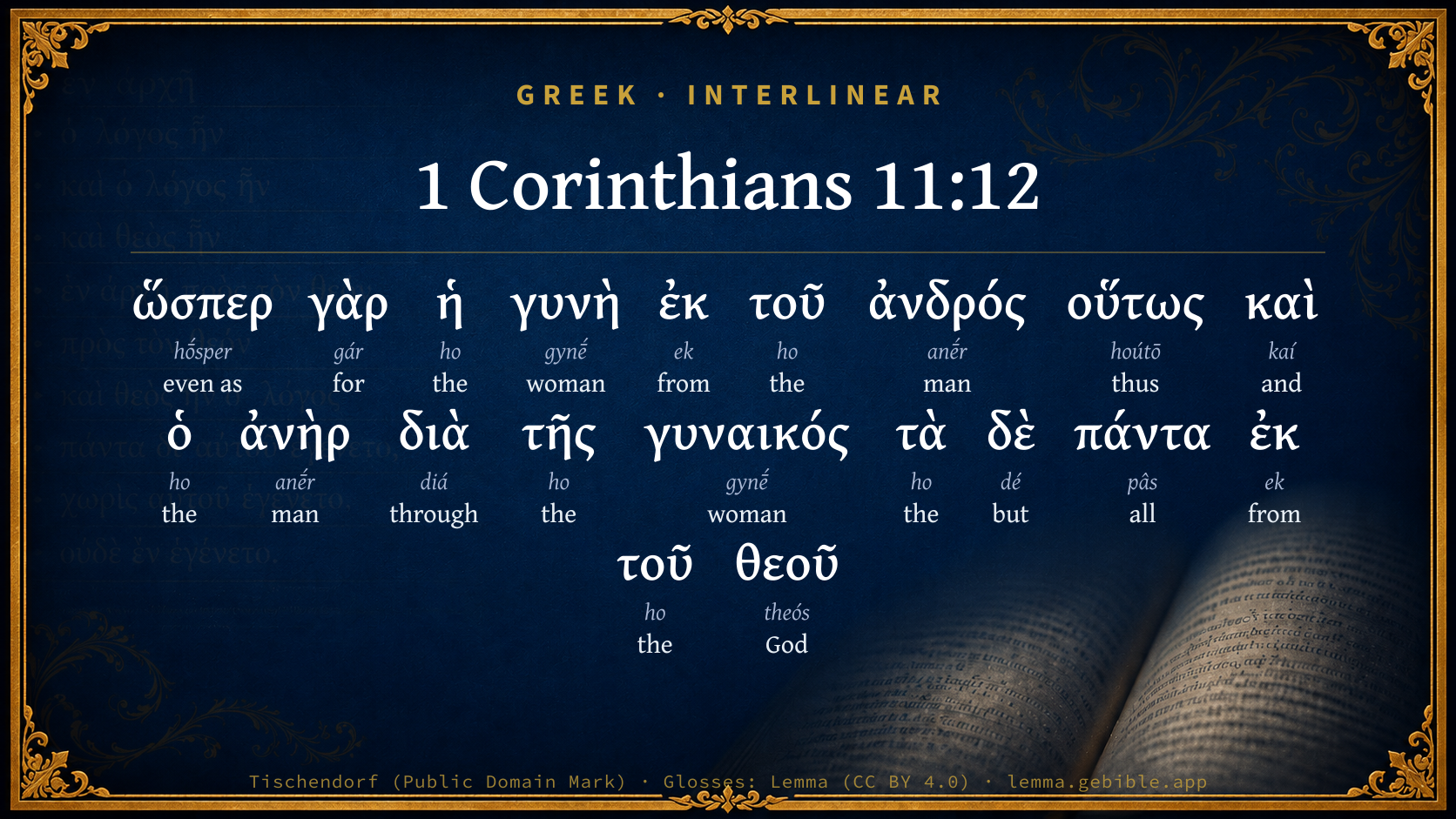
Download image
Cite this verse

1 Corinthians 11:12 (World English Bible). Public Domain. Lemma interlinear Bible study tool, https://lemma.gebible.app/v/1-corinthians/11/12.

Show BibTeX & RIS
BibTeX
RIS
English Translation
For as woman came from man, so a man also comes through a woman; but all things are from God.
World English Bible · Public Domain
Download a study sheet

One document with this verse’s original text, its word-by-word gloss line, the meaning frame, cross-references with their text, attributed commentary, and full source and license credits — printable, and it pastes into notes with its structure intact.

This verse Autodidact and up

Study sheet (.html) Plain text (.txt)

A passage Seminary Student

Up to 50 verses in one chapter. A passage sheet keeps up to 6 commentary sources and 12 cross-references per verse, in the order this page ranks them, and says so on the sheet whenever that leaves anything out. Ask for a single verse and you get the Autodidact verse sheet above.

Everything on this page stays free to read, with no account — the sheet is a download of what is already on screen, not access to it.

Want to remove ads? Support Godless Engineer
Compare translations 3

The same verse in 3 English versions, stacked beneath the original-language interlinear above. Click any original word for its lexicon entry.

Each is an independent rendering of the whole verse — the interlinear is not word-aligned to these translations.

Highlighted words mark where these versions differ — a whole-verse word diff, not a word-by-word alignment.

  • World English Bible Public Domain
    For as woman came from man, so a man also comes through a woman; but all things are from God.
  • King James Version Public Domain
    For as the woman is of the man, even so is the man also by the woman; but all things of God.
  • unfoldingWord Literal Text CC BY-SA 4.0
    For even as the woman from the man, so also the man through the woman, but all from God.

unfoldingWord Literal Text — © unfoldingWord, licensed CC BY-SA 4.0. Word-aligned USFM3 via Door43 (git.door43.org/unfoldingWord/en_ult).

Versions to compare (up to 4)

3 of 4 selected

Show all 19 translations

Every available English version of this verse, each an independent rendering of the whole verse.

  • World English Bible Public Domain
    For as woman came from man, so a man also comes through a woman; but all things are from God.
  • Berean Standard Bible Public Domain
    For just as woman came from man, so also man is born of woman. But everything comes from God.
  • Majority Standard Bible Public Domain
    For just as woman came from man, so also man is born of woman. But everything comes from God.
  • King James Version Public Domain
    For as the woman is of the man, even so is the man also by the woman; but all things of God.
  • American Standard Version (1901) Public Domain
    For as the woman is of the man, so is the man also by the woman; but all things are of God.
  • Revised Version (1885) Public Domain
    For as the woman is of the man, so is the man also by the woman; but all things are of God.
  • Geneva Bible (1599) Public Domain
    For as the woman is of the man, so is the man also by the woman: but all things are of God.
  • Douay-Rheims (1899) Public Domain
    For as the woman is of the man, so also is the man by the woman: but all things of God.
  • Young's Literal Translation Public Domain
    for as the woman `is' of the man, so also the man `is' through the woman, and the all things `are' of God.
  • Literal Standard Version CC BY-SA 4.0
    for as the woman [is] of the man, so also the man [is] through the woman, and all the things [are] of God.
  • Unlocked Literal Bible CC BY-SA 4.0
    For as the woman comes from the man, so does the man come from the woman. And all things come from God.
  • unfoldingWord Literal Text CC BY-SA 4.0
    For even as the woman from the man, so also the man through the woman, but all from God.
  • Darby Bible Public Domain
    For as the woman [is] of the man, so also [is] the man by the woman, but all things of God.
  • World Messianic Bible Public Domain
    For as woman came from man, so a man also comes through a woman; but all things are from God.
  • Webster's Bible Public Domain
    For as the woman is from the man, even so is the man also by the woman; but all things from God.
  • Free Bible Version CC BY-SA 4.0
    As the woman came from the man, so the man comes from the woman —but more importantly everything comes from God.
  • Bible in Basic English Public Domain
    For as the woman is from the man, so the man is through the woman; but all things are from God.
  • Text-Critical English NT CC BY 4.0
    For just as woman came from man, so also man is born of woman, but all things come from God.
  • Tyndale New Testament (1534) Public Domain
    For as the woman is of the man even so is the man by the woman: but all is of God.

Literal Standard Version (2020), Covenant Press — licensed CC BY-SA 4.0. Text via the HelloAO Bible API (eBible.org). Unlocked Literal Bible (unfoldingWord) — licensed CC BY-SA 4.0. Text via the HelloAO Bible API (eBible.org). unfoldingWord Literal Text — © unfoldingWord, licensed CC BY-SA 4.0. Word-aligned USFM3 via Door43 (git.door43.org/unfoldingWord/en_ult). Free Bible Version, Dr. Jonathan Gallagher — licensed CC BY-SA 4.0. Text via the HelloAO Bible API (eBible.org).

Word by word

More ways to search: Search by grammar → Find every occurrence → Compare this word →

Practice this passage: Drill this verse → Learn its vocabulary →

ὥσπερ
hṓsper
G5618
“even as”
Adverb
Part of Speech
Adverb
Full Thayer's Definition

Origin: from G5613 and G4007

TDNT: None

1. just as, even as
  1. γὰρ gár G1063 “for” Conjunction
  2. ἡ ho G3588 “the” Article, Nominative, Singular, Feminine
  3. γυνὴ gynḗ G1135 “woman” Noun, Nominative, Singular, Feminine
  4. ἐκ ek G1537 “from” Preposition
  5. τοῦ ho G3588 “the” Article, Genitive, Singular, Masculine
  6. ἀνδρός anḗr G435 “man” Noun, Genitive, Singular, Masculine
  7. οὕτως hoútō G3779 “thus” Adverb
  8. καὶ kaí G2532 “and” Conjunction
  9. ὁ ho G3588 “the” Article, Nominative, Singular, Masculine
  10. ἀνὴρ anḗr G435 “man” Noun, Nominative, Singular, Masculine
  11. διὰ diá G1223 “through” Preposition
  12. τῆς ho G3588 “the” Article, Genitive, Singular, Feminine
  13. γυναικός gynḗ G1135 “woman” Noun, Genitive, Singular, Feminine
  14. τὰ ho G3588 “the” Article, Nominative, Plural, Neuter
  15. δὲ dé G1161 “but” Conjunction
  16. πάντα pâs G3956 “all” Adjective, Nominative, Plural, Neuter
  17. ἐκ ek G1537 “from” Preposition
  18. τοῦ ho G3588 “the” Article, Genitive, Singular, Masculine
  19. θεοῦ theós G2316 “God” Noun, Genitive, Singular, Masculine

About this verse

These counts appear in no published source. They are computed here, from the morphology-tagged text and Lemma’s own curated glosses. What Lemma adds →

20
words
12
distinct lemmas
Pauline Epistles
section

Shared distinctive vocabulary

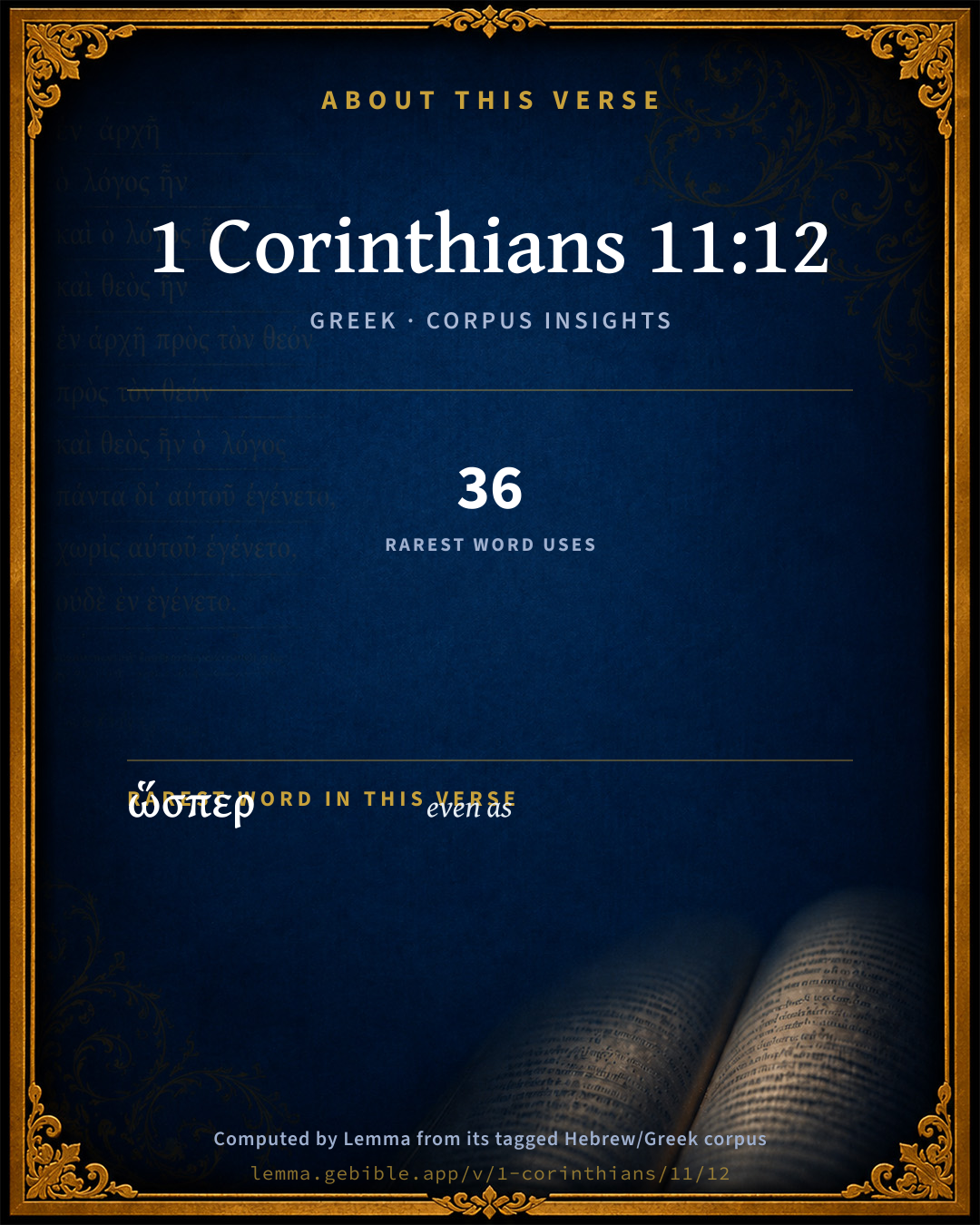
ὥσπερ even as G5618 occurs in 36 verses of the Greek New Testament. Also found in:
Repetition

Words recur within this verse:

Cross-references

4

Topical passages linked to 1 Corinthians 11:12 in the Treasury of Scripture Knowledge — connected by theme and wording, ordered by reader-vote popularity; previews shown in the World English Bible.

  • Romans 11:36 For of him, and through him, and to him, are all things. To him be the glory for ever! Amen.
  • 1 Corinthians 8:6 yet to us there is one God, the Father, of whom are all things, and we for him; and one Lord, Jesus Christ, through whom are all things, and we live through him.
  • Proverbs 16:4 Yahweh has made everything for its own end-- Yes, even the wicked for the day of evil.
  • Hebrews 1:2–3 has at the end of these days spoken to us by his Son, whom he appointed heir of all things, through whom also he made the worlds.

Cross-references courtesy of OpenBible.info (CC BY 4.0).

Commentary

Notes on 1 Corinthians 11:12 from classic Christian and Jewish commentators (each source and its license shown beneath its notes). The classic Christian expositions comment on the surrounding passage and are grouped to its opening verse, so a note may address several verses; the Jewish commentaries on the Tanakh (Rashi and others) are per-verse, so they appear only where the commentator wrote on this verse.

Lemma curates 59 commentaries, every one of them public domain or Creative Commons licensed, each selected and text-cleaned for this edition rather than reprinted as found. About our sources →

Bengel's Gnomon

Johann Albrecht Bengel

1Co 11:12. Ἡ γυνὴ ἐκ τοῦ) Only here, and at 1Co 11:10, the articles are added. In 1Co 11:10, the force of the relative is at 1Co 11:9, and in 1Co 11:12 at 1Co 11:11.—ἐκ—διὰ, from [of]—by) The particles differ; presently afterwards ἐκ is also said of God.—πάντα, all things) the man, the woman, and the mutual dependence of either upon the other.

Bengel's Gnomon of the New Testament — English translation (T&T Clark, Edinburgh, 1860) — public domain. Text from a community e-Sword module.

Meyer's Critical & Exegetical Commentary

Heinrich August Wilhelm Meyer

1Co_11:12. For, were this not the case, the Christian system would be clearly at variance with the divine arrangement in nature. This against Rückert, who accuses 1Co_11:12 of lending no probative support to 1Co_11:11.

ἡ γυνὴ ἐκ τοῦ ἀνδρ.] sc[1791] ἐστι, namely, in respect of origination at first. Comp 1Co_11:8.

Ὁ ἈΝῊΡ ΔΙᾺ Τῆς ΓΥΝ.] in respect of origination now. Ἐκ denotes the direct origination in the way known to all his readers from the history of womans creation in Gen_2:21 f.; ΔΙΆ again the mediate origin by birth, all men being ΓΕΝΝΗΤΟῚ ΓΥΝΑΙΚῶΝ, Mat_11:11; Gal_4:4. Paul might have repeated the ἘΚ in the second clause also (Mat_1:16; Gal_4:4), but he wished to mark the difference between the first and the continued creation. And in order to bring out the sacred character of the moral obligation involved in this genetic relation of mutual dependence, he adds: ΤᾺ ΔῈ ΠΆΝΤΑ ἘΚ Τ. ΘΕΟῦ: now all this, that we have been treating of (vir, mulier et alterius utrius mutua ab altero dependentia, Bengel), is from God, proceeding from and ordered by Him. As regards this ἐκ, comp 2Co_5:18; 1Co_8:6; Rom_11:36.

[1791] c. scilicet.

Meyer — Critical and Exegetical Commentary on the New Testament — English translation by Peter Christie, edited by Frederick Crombie (T&T Clark, 1880) — public domain. Text from a community e-Sword module.

Godet's Commentaries

Frédéric Louis Godet

1Co 11:12-19.

The idea of the whole passage is this: The denial of the resurrection of the dead draws with it that of Christ’s resurrection, and thereby gives the lie to the apostolic testimony and to the whole of Christianity.

Vv. 12. The for indicates that the relative equality of the two sexes in Christ was already prefigured, so to speak, by a fact belonging to the order of natural life. So it was that the for of 1Co 11:7 served to give a reason for the wife’s moral subordination by a fact drawn from the inferior domain. If, so far as creation goes, the woman is of the man,—this is the proof of her dependence (1Co 11:8),—on the other hand, as to the conservation of the race, the man is of the woman, and this decisive fact in the life of humanity, restores equality to a certain extent between the two sexes. The natural order makes woman not only man’s spouse, but also his mother; therewith all is said. We see here with what wisdom the apostle could apply to the domain of spiritual life, not only the scriptural types, but also the hieroglyphics of nature. And thus are explained to us the last words of the verse: “And all things are of God.” He is the Author of nature as well as of grace, and He has laid in the first the outlines, so to speak, of the Divine thoughts, which he realizes perfectly in the second.

Frédéric Louis Godet — Commentaries on Luke, John, Romans, and 1 Corinthians — English translation (T&T Clark, Edinburgh, 1870s–1890s) — public domain. Text from a community e-Sword module.

Hodge's Commentary on Romans, Ephesians & First Corinthians

Charles Hodge

1Co_11:12

For as the woman (is) of the man, even so (is) the man also by the woman; but all things of God.

The one is not without the other, for as the woman was originally formed out of the man, so the man is born of the woman. This is a proof, not of the admitted equality of the sexes in the kingdom of God, but of their mutual dependence in the kingdom of nature. It therefore confirms the interpretation given of the preceding verse. But all things are of God; these subordinate relations of one creature to another are merged, as it were, in the supreme causality of God. It matters little whether the man was of the woman or the woman of the man, as both alike are of God; just as he before said, it matters little whether a man were a Jew or Gentile, bond or free, since all are alike before God.

Charles Hodge — Commentary on Romans (1835), First Corinthians (1857), and Ephesians (1856) — public domain. Text from a community e-Sword module.

Jamieson, Fausset & Brown

Robert Jamieson, A. R. Fausset & David Brown

As the woman was formed out of (from) the man, even so is man born by means of woman; but all things (including both man and woman) are from God as their source (Rom 11:36; Co2 5:18). They depend mutually each on the other, and both on him.

Jamieson, Fausset & Brown — Commentary Critical and Explanatory on the Whole Bible (1871) — public domain (CC PDM 1.0). Text via the HelloAO Bible API.

Adam Clarke's Commentary

Verse 12. For as the woman is of the man] For as the woman was first formed out of the side of man, man has ever since been formed out of the womb of the woman; but they, as all other created things, are of God.

Adam Clarke's Commentary on the Bible (1810–1826) — public domain. Text from a community e-Sword/MySword module.

John Calvin's Commentaries

12. As the woman is of the man If this is one of the reasons, why the man has superiority — that the woman was taken out of him, there will be, in like manner, this motive to friendly connection — that the male sex cannot maintain and preserve itself without the aid of women. For this remains a settled point — that it is not good for man to be alone (Genesis 2:18.) This statement of Paul may, it is true, be viewed as referring to propagation, because human beings are propagated not by men alone, but by men and women; but I understand it as meaning this also — that the woman is a needful help to the man, inasmuch as a solitary life is not expedient for man. This decree of God exhorts us to cultivate mutual intercourse.

But all things of God God is the Source of both sexes, and hence both of them ought with humility to accept and maintain the condition which the Lord has assigned to them. Let the man exercise his authority with moderation, and not insult over the woman who has been given him as his partner. Let the woman be satisfied with her state of subjection, and not take it amiss that she is made inferior to the more distinguished sex. Otherwise they will both of them throw off the yoke of God, who has not without good reason appointed this distinction of ranks. Farther, when it is said that the man and the woman, when they are wanting in their duty to each other, are rebels against the authority of God, the statement is a more serious one than if Paul had said, that they do injury to one another.

Doth not even nature itself He again sets forth nature as the mistress of decorum, and what was at that time in common use by universal consent and custom — even among the Greeks — he speaks of as being natural, for it was not always reckoned a disgrace for men to have long hair. Historical records bear, that in all countries in ancient times, that is, in the first ages, men wore long hair. Hence also the poets, in speaking of the ancients, are accustomed to apply to them the common epithet of unshorn It was not until a late period that barbers began to be employed at Rome — about the time of Africanus the elder. And at the time when Paul wrote these things, the practice of having the hair shorn had not yet come into use in the provinces of Gaul or in Germany. Nay more, it would have been reckoned an unseemly thing for men, no less than for women, to be shorn or shaven; but as in Greece it was reckoned all unbecoming thing for a man to allow his hair to grow long, so that those who did so were remarked as effeminate, he reckons as nature a custom that had come to be confirmed.

John Calvin's Commentaries (1540-1563) — public domain. Text from the Calvin Translation Society English edition (1840s-50s) via the Christian Classics Ethereal Library (ccel.org). Calvin's coverage is partial (roughly two-thirds of the Bible); uncommented books and verses are honest gaps, never fabricated. The 19th-century editor's footnotes and remarks are omitted so the notes are faithfully Calvin's own voice.

Ellicott's Commentary for English Readers

(12) For as the woman is of the man.—An appeal to the original act of creation proves the truth of the previous statement of the interdependence of the sexes. If already (1Co_11:7) the fact of woman’s having been taken out of man was used as an argument to prove her subordination, there is now coupled with that fact of the origin of woman that other fact of the perpetual birth of man from woman, to show that there is a mutual relation. The first woman was made out of man; therefore woman is dependent on man. Every man has been born of a woman; therefore man is not independent of woman. In the Greek the word rendered “of” represents a finite act—the word rendered “by” a continued process.

But all things of God.—Thus, as usual, St. Paul completes the thought by tracing all up to God. The mediate processes of their origin may differ, but the source of their being is common—they, and all beings, and all things, and the sequence of all things come of God. (See 1Co_8:6; Rom_11:36; 2Co_5:18.)

A Bible Commentary for English Readers, edited by Charles John Ellicott (1878–1897) — public domain. Text from a community e-Sword module.

The Cambridge Bible for Schools and Colleges

gen. ed. J. J. S. Perowne

12. For as the woman is of the man] i.e. by creation (Gen_2:22),

even so is the man also by the woman] By birth.

but all things of God] We are not to dwell too much on the intermediate links in the chain of causation, but to remember that all human beings exist by God’s ordinance, and that therefore each has his own rights as well as duties, which cannot be neglected without injury to the Divine order of this world.

The Cambridge Bible for Schools and Colleges (gen. ed. J. J. S. Perowne; Cambridge University Press, 1878–1918) — public domain. Text from a community e-Sword module.

John Gill's Exposition

Judge in yourselves,.... The apostle having gone through a variety of reasoning and arguments, showing the superiority of the man to the woman, by which he would prove, that the one should be covered, and the other uncovered, returns to his subject again, and appeals to the common sense and understanding of the Corinthians, and makes them themselves judges of the matter; suggesting that the thing was so clear, and he so certain of what he had advanced being right, that he leaves it with them, not doubting but that they would, upon a little reflection within themselves, join with him in this point:

is it comely that a woman pray unto God uncovered? in you judgment you can never think so, however pleasing and gratifying such a sight may be, to the lust of the flesh, and to the lust of the eye; he does not mention prophesying, only instances in praying; but it is to be understood of one, as of another; and his meaning is, that it is an uncomely thing in a woman to appear in public service with her head uncovered, whether it be in joining in the public prayers, or in singing of psalms, or in hearing the word expounded; and though the apostle does not put the case of the man's praying to God, or prophesying in his name with his head covered, yet his sense is the same of that, as of the woman's.

John Gill's Exposition of the Whole Bible (1746–1763) — public domain (CC PDM 1.0). Text via the HelloAO Bible API.

Trapp's Complete Commentary

John Trapp

12 For as the woman is of the man, even so is the man also by the woman; but all things of God.

Ver. 12. But all things of God] God consulted not with man to make him happy, saith one. As he was ignorant while himself was made, so he did not know while a second self was made out of him. Both that the comfort might be greater than was expected; as also that he might not upbraid his wife with any great dependence or obligation, he neither willing the work, nor suffering any pain to have it done.

John Trapp, A Commentary or Exposition upon All the Books of the Old and New Testament (1647–1656) — public domain. Text from a community e-Sword module.

Albert Barnes' Notes on the Bible

As the woman is of the man - In the original creation, she was formed from the man.

So is the man also by the woman - Is born of the woman, or descended from her. The sexes are dependent on each other, and should therefore cultivate an indissoluble union.

But all things of God - All things were created and arranged by him. This expression seems designed to suppress any spirit of complaint or dissatisfaction with this arrangement; to make the woman contented in her subordinate station, and to make the man humble by the consideration that it is all owing to the appointment of God. The woman should therefore be contented, and the man should not assume any improper superiority, since the whole arrangement and appointment is of God.

Albert Barnes' Notes on the Bible (1834–1885) — public domain. Text from a community e-Sword/MySword module.

Matthew Poole's English Annotations

The man hath a priority to the woman, being first created, and a superiority over her upon that account, she being made for him, not he for her, this is indeed the man’s advantage; but on the other side, since the creation of the first man, all men are by the woman, who conceives them in her womb, suckles them at her breasts, is concerned in their education while children, and dandled upon her knees; the man therefore hath no reason to despise and too much to trample upon the woman: and all these things are of God, by the wise ordering and disposing of God; so as neither hath the man, by reason of his prerogative, in being first created, and the end for which the woman was created, any cause to insult and triumph over the woman; neither hath the woman any cause, by reason of her prerogative, that the man is by her, any cause to triumph over the man; but both of them ought to look upon themselves as having their prerogatives from God, and in the use of them to behave themselves according to the will of God, behaving themselves in their respective stations as it is the will of God they should behave themselves, the woman being subject to the man, and testifying such subjection by all the signs of it, and the man carrying himself towards the woman as he who is the image and glory of God.

Matthew Poole's English Annotations on the Holy Bible (1683–1685) — public domain. Text from a community e-Sword/MySword module.

Whedon's Commentary on the Bible

Daniel D. Whedon

12. Of, rather, from the man—By derivation from his side, according to Genesis.

By the woman—By natural birth.

But all things of God—By whom the sexes and their relations have been constituted.

Daniel D. Whedon (gen. ed.), Commentary on the Old and New Testaments (1874–1909) — public domain. Text from a community e-Sword module.

The Pulpit Commentary

By the woman; that is, "born of a woman". (Job_14:1) But all things of God. And all things also "through him and to him," made by him, and tending to him as their end. (Rom_11:5-6)

The Pulpit Commentary (1880–1919), ed. H.D.M. Spence-Jones & Joseph S. Exell — public domain. Text from a community e-Sword module.

John Wesley's Explanatory Notes

And as the woman was at first taken out of the man, so also the man is now, in the ordinary course of nature, by the woman; but all things are of God - The man, the woman, and their dependence on each other.

John Wesley, Explanatory Notes Upon the Whole Bible (1754–1765) — public domain. Text via the GEBible commentary corpus.

McGarvey & Pendleton's Commentaries

J. W. McGarvey

For as the woman is of the man, so is the man also by the woman; but all things are of God . [Lest any man should be inflated with pride by the statement in 1Co_11:7 ; fancying that there was some degree of proportion between the exaltation of God over man and of man over woman, Paul adds these words to show that men and women are mutually dependent, and hence nearly equals, but that God, as Creator, is exalted over all. The idea of proportion, therefore, is utterly misleading. To the two reasons already given for the covering of a woman's and the uncovering of a man's head, Paul adds two more.]

J. W. McGarvey (with Philip Y. Pendleton), Commentaries on the New Testament (The Fourfold Gospel, 1914; Acts; and the epistles) — public domain. Text from a community e-Sword/MySword module.

The People's New Testament

B. W. Johnson

12. For as the woman is of the man, etc. As she was created for man so man is born of woman. There is an equipoise. These relations are all “of God.”

B. W. Johnson's The People's New Testament with Notes (1889–1891) — public domain. Electronic text from the Christian Classics Ethereal Library (CCEL) ThML edition.

Cambridge Greek Testament for Schools and Colleges

12. ἐκ τοῦ ἀνδρός, i.e. by creation and generation (Gen 2:22).

διὰ τῆς γυναικός. By birth.

ἐκ τοῦ θεοῦ. We are not to dwell too much on the intermediate links in the chain of causation, but to remember that all human beings come from God and exist by His ordinance, and that therefore each has his own rights as well as duties, which cannot be neglected without injury to the Divine order of this world.

Cambridge Greek Testament for Schools and Colleges (Cambridge University Press, 1896; 21 vols, various authors incl. Carr, Maclear, Plummer, Farrar, Lumby, Moule, M. R. James, Simcox) — public domain. Text from a community e-Sword module.

Alford’s Greek Testament

Henry Alford

12.] And in this, the Christian life accords with the original ordinance of God. For (proof of ver. 11) as the woman is (was taken, Gen 2:21 f.) out of the man, so the man is (is born, in the propagation of the human race) by means of the woman; but all things (both man and woman and all things else: a general maxim, see 2Co 5:18) are of (as their source,—thus uniting in one great head both sexes and all creation) God. They are dependent on one another, but both on Him: the Christian life therefore, which unites them in Christ, is agreeable to God’s ordinance.

12-14.] On the abuse of Spiritual Gifts: especially prophesying, and speaking with tongues. The second particular requiring correction in their assemblies, see ch. 11:18, note. Chrys. well says: τοῦτο ἅπαν τὸ χωρίον σφόδρα ἐστὶν ἀσαφές· τὴν δὲ ἀσάφειαν ἡ τῶν πραγμάτων ἄγνοιά τε καὶ ἔλλειψις ποιεῖ τῶν τότε μὲν συμβαινόντων, νῦν δὲ οὐ γινομένων. Hom. xxix. p. 257.

Henry Alford, The Greek Testament (1849–1861) — public domain. Text from a community e-Sword module.

International Critical Commentary

12. This mutual dependence of the sexes is shown by the fact that, although originally woman sprang from man, yet ever since then it is through woman that man comes into existence: if he is her initial cause (ἐκ), she is his instrumental cause (διά c. gen). But (another reason why man must not be contemptuous) the whole universe—man and woman and their whole environment—owes its origin to God. Cf. 15:27; Eph 5:23; and see Basil, De Spiritu, v. 12, xviii. 46.

International Critical Commentary — older volumes (1896–1929), various authors — public domain. Text from a community e-Sword module.

Lesson kit

Teaching starters — assembled from the data on this page, not authored interpretation. Every prompt links to the verse data it draws on. Edit before teaching.

1 Corinthians, in the Pauline Epistles, opens this verse with 20 words (12 distinct Greek lemmas). Its most distinctive word is hṓsper (“even as”). A historical commentator’s framing appears above. Read the whole chapter for the surrounding context.

Discussion questions

  1. How does “even as” (hṓsper) shape what this verse is saying?
  2. Matthew 6:2 shares the word «even as» with this verse. How do the two illuminate each other?
  3. “woman” occurs 2× in this one verse. What is the effect of the repetition?
  4. The translations on this page render this verse differently — a whole-verse word diff, not a word-by-word alignment. What might account for the different wordings?
  5. Reading how Bengel's Gnomon and Meyer's Critical & Exegetical Commentary read this verse, where do the two commentators agree and where do they part?

Things to notice

  • These translations choose different wording for 5 words in this verse.
  • “woman” occurs 2× in this single verse.
  • 12 distinct Greek lemmas span 20 words in this verse.

Reading settings

Reading text

Shown beneath each verse's original-language words.

Old Testament
Old Testament edition

Read the OT as the Masoretic Hebrew (MT) or the Greek Septuagint (LXX).

English shown for the Greek Septuagint (in the Hebrew ↔ Greek comparison).

Comparing translations? Open the Compare panel on any verse page to stack up to four side by side.