Genesis 44:10

Hebrew (Westminster Leningrad Codex) Genesis 44:10 appears in the Hebrew Old Testament. The text above is from the Westminster Leningrad Codex. Each word links to its Strong’s number, a concise gloss, and parsing drawn from the Open Scriptures Hebrew Bible morphology. Click any word for its full Brown-Driver-Briggs (BDB) entry.
Download image
Cite this verse

Genesis 44:10 (World English Bible). Public Domain. Lemma interlinear Bible study tool, https://lemma.gebible.app/v/genesis/44/10.

Show BibTeX & RIS
BibTeX
RIS
English Translation
He said, "Now also let it be according to your words: he with whom it is found will be my bondservant; and you will be blameless."
World English Bible · Public Domain
Download a study sheet

One document with this verse’s original text, its word-by-word gloss line, the meaning frame, cross-references with their text, attributed commentary, and full source and license credits — printable, and it pastes into notes with its structure intact.

This verse Autodidact and up

Study sheet (.html) Plain text (.txt)

A passage Seminary Student

Up to 50 verses in one chapter. A passage sheet keeps up to 6 commentary sources and 12 cross-references per verse, in the order this page ranks them, and says so on the sheet whenever that leaves anything out. Ask for a single verse and you get the Autodidact verse sheet above.

Everything on this page stays free to read, with no account — the sheet is a download of what is already on screen, not access to it.

Want to remove ads? Support Godless Engineer
Compare translations 3

The same verse in 3 English versions, stacked beneath the original-language interlinear above. Click any original word for its lexicon entry.

Each is an independent rendering of the whole verse — the interlinear is not word-aligned to these translations.

Highlighted words mark where these versions differ — a whole-verse word diff, not a word-by-word alignment.

  • World English Bible Public Domain
    He said, "Now also let it be according to your words: he with whom it is found will be my bondservant; and you will be blameless."
  • King James Version Public Domain
    And he said, Now also let it be according unto your words: he with whom it is found shall be my servant; and ye shall be blameless.
  • unfoldingWord Literal Text CC BY-SA 4.0
    And he said, “Indeed now, according to your words, so it: Whoever is found with it will be a slave for me, but you will be blameless.”

unfoldingWord Literal Text — © unfoldingWord, licensed CC BY-SA 4.0. Word-aligned USFM3 via Door43 (git.door43.org/unfoldingWord/en_ult).

Versions to compare (up to 4)

3 of 4 selected

Show all 18 translations

Every available English version of this verse, each an independent rendering of the whole verse.

  • World English Bible Public Domain
    He said, "Now also let it be according to your words: he with whom it is found will be my bondservant; and you will be blameless."
  • Berean Standard Bible Public Domain
    “As you say,” replied the steward. “But only the one who is found with the cup will be my slave, and the rest of you shall be free of blame.”
  • Majority Standard Bible Public Domain
    “As you say,” replied the steward. “But only the one who is found with the cup will be my slave, and the rest of you shall be free of blame.”
  • King James Version Public Domain
    And he said, Now also let it be according unto your words: he with whom it is found shall be my servant; and ye shall be blameless.
  • American Standard Version (1901) Public Domain
    And he said, Now also let it be according unto your words: he with whom it is found shall be my bondman; and ye shall be blameless.
  • Revised Version (1885) Public Domain
    And he said, Now also let it be according unto your words: he with whom it is found shall be my bondman; and ye shall be blameless.
  • Geneva Bible (1599) Public Domain
    And he said, Now then let it be according vnto your wordes: he with whome it is found, shall be my seruant, and ye shalbe blamelesse.
  • Douay-Rheims (1899) Public Domain
    And he said to them: Let it be according to your sentence: with whomsoever it shall be found, let him be my servant, and you shall be blameless.
  • Young's Literal Translation Public Domain
    And he saith, `Now, also, according to your words, so it `is'; he with whom it is found becometh my servant, and ye are acquitted;'
  • Literal Standard Version CC BY-SA 4.0
    And he says, “Now also, according to your words, so it [is]; he with whom it is found becomes my servant, and you are acquitted”;
  • Unlocked Literal Bible CC BY-SA 4.0
    The steward said, “Now also let it be according to your words. He with whom the cup is found will be my slave, and you others will be innocent.”
  • unfoldingWord Literal Text CC BY-SA 4.0
    And he said, “Indeed now, according to your words, so it: Whoever is found with it will be a slave for me, but you will be blameless.”
  • Darby Bible Public Domain
    And he said, Now also [let] it [be] according to your words: let him with whom it is found be my bondman, but ye shall be blameless.
  • World Messianic Bible Public Domain
    He said, “Now also let it be according to your words. He with whom it is found will be my slave; and you will be blameless.”
  • Webster's Bible Public Domain
    And he said, Now also let it be according to your words: he with whom it shall be found, shall be my servant; and ye shall be blameless.
  • Free Bible Version CC BY-SA 4.0
    “Whatever you say,” the man replied, “but only the one found with it will become my slave since the rest of you will be free of any blame.”
  • Bible in Basic English Public Domain
    And he said, Let it be as you say: he in whose bag it is seen will become my servant; and you will not be responsible.
  • JPS Tanakh (1917) Public Domain
    And he said: 'Now also let it be according unto your words: he with whom it is found shall be my bondman; and ye shall be blameless.'

Literal Standard Version (2020), Covenant Press — licensed CC BY-SA 4.0. Text via the HelloAO Bible API (eBible.org). Unlocked Literal Bible (unfoldingWord) — licensed CC BY-SA 4.0. Text via the HelloAO Bible API (eBible.org). unfoldingWord Literal Text — © unfoldingWord, licensed CC BY-SA 4.0. Word-aligned USFM3 via Door43 (git.door43.org/unfoldingWord/en_ult). Free Bible Version, Dr. Jonathan Gallagher — licensed CC BY-SA 4.0. Text via the HelloAO Bible API (eBible.org).

Word by word

More ways to search: Search by grammar → Find every occurrence → Compare this word →

Practice this passage: Drill this verse → Learn its vocabulary →

נְקִיִּֽם
nâqîy
H5355
“innocent”
Adjective, Adjective, Masculine, Plural, Absolute
Part of Speech
Adjective
Type
Adjective
Gender
Masculine
Number
Plural
State
Absolute
Full BDB Definition

Origin: from H5352

TWOT: 1412a , 1412b

clean, free from, exempt, clear, innocent - free from guilt, clean, innocent - free from punishment - free or exempt from obligations - innocent
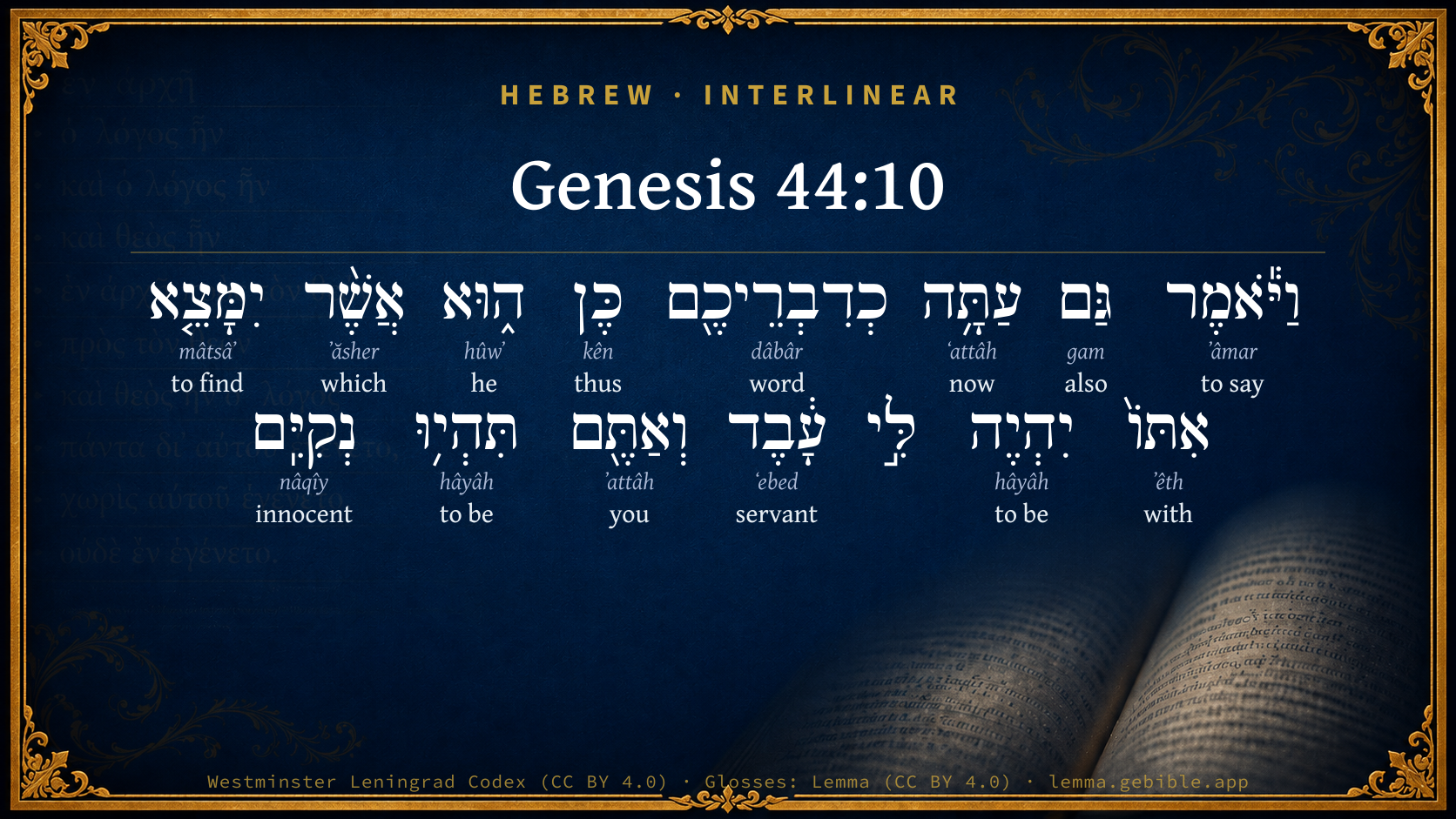
  1. וַיֹּ֕אמֶר ʼâmar H559 “and · to say” Conjunction + Verb, Qal, Sequential Imperfect, 3rd Person, Masculine, Singular
  2. גַּם gam H1571 “also” Particle, Accusative
  3. עַתָּ֥ה ʻattâh H6258 “now” Adverb
  4. כְדִבְרֵיכֶ֖ם dâbâr H1697 “like/as · words · your” Preposition + Noun, Common, Masculine, Plural, Construct + Suffix, Personal, 2nd Person, Masculine, Plural
  5. כֶּן kên H3651 “thus” Adverb
  6. ה֑וּא hûwʼ H1931 “he” Pronoun, Personal, 3rd Person, Masculine, Singular
  7. אֲשֶׁ֨ר ʼăsher H834 “which” Particle, Relative
  8. יִמָּצֵ֤א mâtsâʼ H4672 “to find” Verb, Niphal, Imperfect, 3rd Person, Masculine, Singular
  9. אִתּוֹ֙ ʼêth H854 “with · him” Preposition + Suffix, Personal, 3rd Person, Masculine, Singular
  10. יִהְיֶה hâyâh H1961 “to be” Verb, Qal, Imperfect, 3rd Person, Masculine, Singular
  11. עָ֔בֶד ʻebed H5650 “servant” Noun, Common, Masculine, Singular, Absolute
  12. וְאַתֶּ֖ם ʼattâh H859 “and · you” Conjunction + Pronoun, Personal, 2nd Person, Masculine, Plural
  13. תִּהְי֥וּ hâyâh H1961 “to be” Verb, Qal, Imperfect, 2nd Person, Masculine, Plural

About this verse

These counts appear in no published source. They are computed here, from the morphology-tagged text and Lemma’s own curated glosses. What Lemma adds →

15
words
13
distinct lemmas
Pentateuch
section

Shared distinctive vocabulary

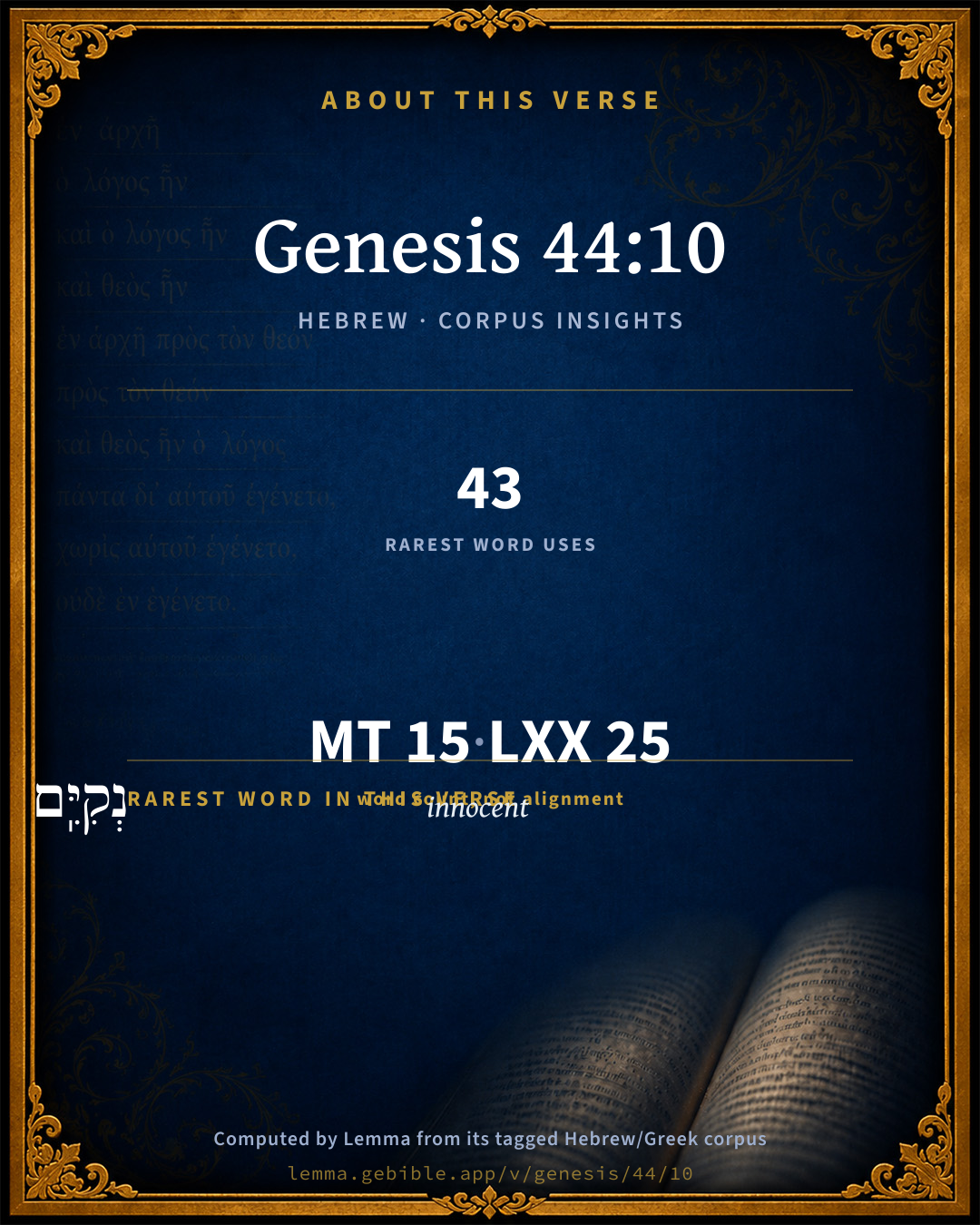
נְקִיִּֽם innocent H5355 occurs in 42 verses of the Hebrew Bible. Also found in:

Grammatical profile

  • 4 verbs
  • 2 nouns
  • 1 adjective
  • 2 pronouns
  • 2 prepositions
  • 2 adverbs
  • 2 particles

Verb forms

  • וַיֹּ֕אמֶר Qal · Sequential Imperfect
  • יִמָּצֵ֤א Niphal · Imperfect
  • יִהְיֶה Qal · Imperfect
  • תִּהְי֥וּ Qal · Imperfect

Repetition

A word recurs within this verse — often emphatic in Hebrew:

  • יִהְיֶה to be H1961 ×2

Hebrew & Septuagint length

In English translation the verse runs 26 words from the Hebrew and 28 from the Septuagint (LXX English) — closely comparable.

A rough comparison of the two English renderings, which tokenize alike — not a word-level alignment.

Word counts can differ between the Hebrew and the Greek without any difference in meaning — e.g. the Hebrew direct-object marker אֵת has no separate Greek word, and Greek often adds the article ὁ.

In the original languages it is 15 Hebrew tokens and 25 Greek tokens — but the two are counted differently (Hebrew bundles its prefixes and suffixes into one token; the Greek is in lemma form), so that isn’t a like-for-like length.

Cross-references

4

Topical passages linked to Genesis 44:10 in the Treasury of Scripture Knowledge — connected by theme and wording, ordered by reader-vote popularity; previews shown in the World English Bible.

  • Genesis 44:17 He said, "Far be it from me that I should do so. The man in whose hand the cup is found, he will be my bondservant; but as for you, go up in peace to your father."
  • Genesis 44:33 Now therefore, please let your servant stay instead of the boy, a bondservant to my lord; and let the boy go up with his brothers.
  • Exodus 22:3 If the sun has risen on him, there shall be guilt of bloodshed for him; he shall make restitution. If he has nothing, then he shall be sold for his theft.
  • Matthew 18:24–25 When he had begun to reconcile, one was brought to him who owed him ten thousand talents.

Cross-references courtesy of OpenBible.info (CC BY 4.0).

Hebrew and Greek witnesses Masoretic Hebrew ↔ Greek Septuagint

The same verse in the two great witnesses to the Old Testament, shown verse-for-verse.

These are two independent witnesses, not word-aligned to each other, and the Septuagint is shown in lemma (dictionary) form.

Hebrew Genesis 44:10 Masoretic · Westminster Leningrad Codex

וַיֹּ֕אמֶר גַּם עַתָּ֥ה כְדִבְרֵיכֶ֖ם כֶּן ה֑וּא אֲשֶׁ֨ר יִמָּצֵ֤א אִתּוֹ֙ יִהְיֶה לִּ֣י עָ֔בֶד וְאַתֶּ֖ם תִּהְי֥וּ נְקִיִּֽם

He said, "Now also let it be according to your words: he with whom it is found will be my bondservant; and you will be blameless."

World English Bible · Public Domain

Greek LXX Genesis 44:10 Septuagint · lemma form

ὁ δέ εἶπον καί νῦν ὡς λέγω οὕτως εἰμί ὁ ἄνθρωπος παρά ὅς ἄν εὑρίσκω ὁ κόνδυ αὐτός εἰμί ἐγώ παῖς σύ δέ εἰμί καθαρός

And he said, Now then it shall be as you⌃ say; with whoever the cup shall be found, he shall be my servant, and you⌃ shall be clear.

LXX2012 (modern English Septuagint) · Public Domain

Hebrew: Westminster Leningrad Codex (CC BY 4.0). Greek: Septuagint (public domain); English from LXX2012 (modern English Septuagint) (Public Domain). How the Septuagint differs from the Hebrew →

Targum (Aramaic paraphrase)

2

The Targum is the ancient Jewish Aramaic paraphrase of the Hebrew Scriptures — an interpretive translation, not the Hebrew text itself. Onkelos (literal) and Pseudo-Jonathan (expansive) render the Torah, and Jonathan the Prophets. Coverage is partial: where no permissively-licensed English translation exists for a verse, only the Aramaic is shown. This is verse-level text, not a word-by-word alignment to the Hebrew.

  1. Targum Onkelos Torah (Genesis–Deuteronomy)
    וַאֲמַר אַף כְּעַן כְּפִתְגָּמֵיכוֹן כֶּן הוּא דִּי יִשְׁתְּכַח עִמֵּהּ יְהֵי לִי עַבְדָּא וְאַתּוּן תְּהוֹן זַכָּאִין

    (no public-domain English translation for this verse)

    Targum Onkelos — Aramaic: “Onkelos Genesis” (public domain); “Onkelos Exodus” (public domain); “Onkelos Leviticus” (public domain); “Onkelos Numbers” (public domain); “Onkelos Deuteronomy” (public domain). English: “Sefaria Community Translation” (CC0 1.0 (public-domain dedication)); “J.W. Etheridge. The Targums of Onkelos and Jonathan Ben Uzziel on the Pentateuch. London: Longmans, Green, 1862” (public domain). Text via Sefaria.

  2. Targum Pseudo-Jonathan Torah (Genesis–Deuteronomy)
    וַאֲמַר אוּף כְּדֵין הֵי כְּפִתְגָמֵיכוֹן כֵּן יְהִי דְיִשְׁתַּכַּח עִמֵיהּ יְהִי לִי עַבְדָא וְאַתּוּן תְּהוֹן זַכָּאִין

    And he said, According to your words let it be. With whomsoever it is found he shall be my slave, but you shall be innocent.

    Targum Pseudo-Jonathan — Aramaic: “Targum Jonathan on Genesis” (public domain); “Targum Jonathan on Exodus” (public domain); “Targum Jonathan on Leviticus” (public domain); “Targum Jonathan on Numbers” (public domain); “Targum Jonathan on Deuteronomy” (public domain). English: “The Targum of Jonathan ben Uzziel, trans. J. W. Etheridge, London, 1862” (public domain). Text via Sefaria.

Commentary

Notes on Genesis 44:10 from classic Christian and Jewish commentators (each source and its license shown beneath its notes). The classic Christian expositions comment on the surrounding passage and are grouped to its opening verse, so a note may address several verses; the Jewish commentaries on the Tanakh (Rashi and others) are per-verse, so they appear only where the commentator wrote on this verse.

Lemma curates 59 commentaries, every one of them public domain or Creative Commons licensed, each selected and text-cleaned for this edition rather than reprinted as found. About our sources →

Trapp's Complete Commentary

John Trapp

Gen 44:10 And he said, Now also [let] it [be] according unto your words: he with whom it is found shall be my servant; and ye shall be blameless.

Ver. 10. Shall be my servant,] i.e., Mine, in my master’s name and behalf.

John Trapp, A Commentary or Exposition upon All the Books of the Old and New Testament (1647–1656) — public domain. Text from a community e-Sword module.

Geneva Bible (1599)

Geneva Bible translators

Hebrew, innocent.

Geneva Bible (1599) marginal notes — public domain. Text via Bolls.life.

The Cambridge Bible for Schools and Colleges

gen. ed. J. J. S. Perowne

10. my bondman] Joseph’s steward, while accepting the terms, mitigates their severity. He proposes that the offender, if apprehended, shall alone be punished, not with death, but with slavery. Joseph’s brethren readily accept the terms.

The Cambridge Bible for Schools and Colleges (gen. ed. J. J. S. Perowne; Cambridge University Press, 1878–1918) — public domain. Text from a community e-Sword module.

John Gill's Exposition

And he said, now also let it be according unto your words,.... Not according to the full extent of their words, but according to a part of them; that be only should be a servant that was found guilty; so moderating the punishment which they had fixed, and were willing to submit to, and therefore could not object to what he next proposes:

he with whom it is found shall be my servant; speaking in the name of Joseph, whom he represented, and who had directed him what to say:

and ye shall be blameless; acquitted of the charge, and pronounced innocent, and let go free.

John Gill's Exposition of the Whole Bible (1746–1763) — public domain (CC PDM 1.0). Text via the HelloAO Bible API.

Haydock's Catholic Bible Commentary

Sentence. It is but just; yet I shall only insist on the detention of the culprit. (Calmet) --- Joseph wished to see whether the marks of attention, which he had shewn to Benjamin, would have excited the envy of his brethren (Menochius); and whether they would be concerned for him: thus he would discover their present dispositions. He might wish also to keep his younger brother out of danger, in case they were inclined to persecute him. (Haydock)

George Leo Haydock (1774–1849), Haydock's Catholic Family Bible and Commentary, 1859 edition — public domain. Excludes Psalms (Douay-Rheims chapter numbering differs from Protestant) and Deuterocanonical books (Catholic canon only).

Matthew Poole's English Annotations

Thus he moderates the conditions which they proposed, exempting the innocent, and exchanging the deserved and offered death of the nocent into slavery.

Matthew Poole's English Annotations on the Holy Bible (1683–1685) — public domain. Text from a community e-Sword/MySword module.

Keil & Delitzsch

C. F. Keil & F. Delitzsch

The man replied, "Now let it be even (גּם placed first for the sake of emphasis) according to your words: with whom it is found, he shall be my slave, and ye (the rest) shall remain blameless." Thus he modified the sentence, to assume the appearance of justice.

Keil & Delitzsch — Biblical Commentary on the Old Testament (1861–1891) — public domain (CC PDM 1.0). Text via the HelloAO Bible API. (Old Testament only.)

Rashi

Rabbi Shlomo Yitzchaki (Rashi)

גם עתה כדבריכם IT WERE RIGHT TO BE ACCORDING TO YOUR WORDS — Indeed, this is only right: in very truth it should be according to your words since you are all guilty in this matter. Because when there are ten men and stolen property is found in possession of one of them, all of them are involved in the theft. I, however, shall deal with you within the line of strict justice (i.e. more equitably) and only אשר ימצא אתו יהיה לי עבד HE WITH WHOM IT IS FOUND SHALL BE MY BONDMAN (Genesis Rabbah 92:8).

Rashi on the Tanakh — English translations: “The Judaica Press complete Tanach with Rashi, translated by A. J. Rosenberg” (CC BY 4.0); “Pentateuch with Rashi's commentary by M. Rosenbaum and A.M. Silbermann, 1929-1934” (public domain); “The Metsudah Tanach series, Lakewood, N.J” (CC BY 4.0); and “The Book of Joshua, Metsudah Publications, 1997” (CC BY 4.0). Text via Sefaria.

Ramban (Nachmanides)

Rabbi Moshe ben Nachman (Ramban / Nachmanides)

ALSO NOW IT WERE RIGHT TO BE ACCORDING TO YOUR WORDS. “Indeed, this is only right. Verily it should be according to your words since you are all guilty in this matter. When there are ten men and a stolen thing is found in the possession of one of them, all of them are arrested. I, however, will deal with you inside the bounds [of justice, that is, I will deal with you more leniently]. He with whom it shall be found, he alone shall be my servant.” Thus the language of Rashi.But according to this interpretation, the words, gam atah (also now), do not fit in well. (a true decision), how can the words gam atah (also now) fit into the context since these words suggest that now a new law is established. (Aboab.) See also my Hebrew commentary, p. 238. Perhaps Rashi is saying: “Also now, when according to your words, it is the law [that all be held guilty in the matter], he with whom it shall be found shall be my servant.” (also now) apply since this is a principle newly set forth. But this can hardly be correct since Joseph said, Far be it from me to do so. This shows that it is not the law that they all be held responsible for the theft. It is for this reason that he said: “Far be it from me, for I am the judge of the whole land, and far be it from me to do you wrong,” for all ten men are not guilty if a stolen article is found in the possession of one of them unless they all planned the theft and were united in going to steal it. Then, if one of them took it with the knowledge of all, they are all liable.The correct interpretation would seem to be that at first he accused them all: Why have you repaid evil for good? You have done evil in so doing. And they freed themselves of the accusation by saying, “With whomsoever of thy servants it be found, let him die, since he is the thief, and we also, who are guiltless of the theft, will be my lord’s servants. Thus their opinion was that the thief, in whose possession it might be found, was the only one with knowledge of the theft, for if they were all involved in the theft, why should that one alone be put to death while the rest remain alive. In that case, all of them should be put to death or all of them should become servants, for they all bear equal legal responsibility. Rather, they pleaded that the others had no knowledge of the theft. They agreed that they should become servants as a self-punishment only. This is why Joseph said to them, “Gam atah (also now) that you are assembled and are together, it were right to be according to your words; nevertheless, he with whom it is found, he alone is the thief, and he alone is deserving of punishment, and he will be a servant to me for I desire his services more than his death. But you shall be guiltless, for perhaps you did not know about the theft, as you say.”Perhaps the meaning of the words kein hu (it were right) is that “it shall be so,” meaning, “also now that the law is not so, according to your words, and ye shall be guiltless. according to your words so shall it be.” A similar case is the verse, And she said: According to your words, ‘kein hu,’ and she sent them away, and they departed, which means, “so shall it be.” This is the correct interpretation in my opinion. This conforms to the words of our Rabbis in Bereshith Rabbah, who say, “If ten people are discovered with a stolen article, are they not all to be imprisoned? I will not do so, but he with whom it is found shall be my servant.” They thus intended to interpret the verse as I have explained it, and not in accordance with the words of Rashi. We might correct the interpretation in accordance with the opinion of the Rabbi [Rashi] by stating that Joseph said: “Far be it from me to do this and deal more harshly with you than my house-steward, who freed you at the outset by saying to you, but ye shall be guiltless, for I will confirm the words of my servant, and the counsel of my messenger will I perform.” Vayigash

Ramban (Nachmanides) on the Tanakh — English translation: “Commentary on the Torah by Ramban (Nachmanides). Translated and annotated by Charles B. Chavel. New York, Shilo Pub. House, 1971-1976” (CC BY 4.0). Text via Sefaria.

Radak

Rabbi David Kimhi (Radak)

ויאמר, גם עתה כדבריכם כן הוא, he meant that although legally speaking the law is as you say, I will be more lenient with you, etc.

אשר ימצא, the one in whose possession, etc. Other commentators interpret the words כדבריכם כן הוא to mean that your argument that you are honest as proven by your bringing back the money you found is acceptable, [but it does not apply to either Shimon or Binyamin, neither of whom have brought back any money.] but if the goblet is found in someone’s sack, that individual will have to be my master’s slave. I will however, not hold you responsible by association.

Radak on the Tanakh — English translations: “Sefaria Community Translation” (CC0 1.0 (public-domain dedication)); “Eliyahu Munk, HaChut Hameshulash” (CC BY 4.0); “Rabbi Mike Feuer, Jerusalem Anthology” (CC BY 4.0); and “R. David Kimhi on the first book of Psalms, Translated by R.G. Finch, London, 1919” (public domain). Text via Sefaria.

Lesson kit

Teaching starters — assembled from the data on this page, not authored interpretation. Every prompt links to the verse data it draws on. Edit before teaching.

Genesis, in the Pentateuch, opens this verse with 15 words (13 distinct Hebrew lemmas). Its most distinctive word is nâqîy (“innocent”). A historical commentator’s framing appears above. Read the whole chapter for the surrounding context.

Discussion questions

  1. The word nâqîy carries the sense “innocent.” How does it shape the verse?
  2. How does Genesis 24:41, which shares the word «innocent», read alongside this verse?
  3. What does the repetition of “to be” (2× in this one verse) do in this verse?
  4. These translations render this verse differently. What is at stake in choosing one wording over another?
  5. «וַיֹּ֕אמֶר» is a Qal Sequential Imperfect verb. How does that grammatical form shape the action described?
  6. Compare how Trapp's Complete Commentary and Geneva Bible (1599) read this verse. Where do they agree or differ?

Things to notice

Reading settings

Reading text

Shown beneath each verse's original-language words.

Old Testament
Old Testament edition

Read the OT as the Masoretic Hebrew (MT) or the Greek Septuagint (LXX).

English shown for the Greek Septuagint (in the Hebrew ↔ Greek comparison).

Comparing translations? Open the Compare panel on any verse page to stack up to four side by side.