
Romans 12:5

Greek (Tischendorf 8th ed.) Romans 12:5 appears in the Greek New Testament. The text above is from the Tischendorf 8th edition. Each word links to its Strong’s number and a concise gloss. Click any word for its full Thayer’s Greek Lexicon entry.
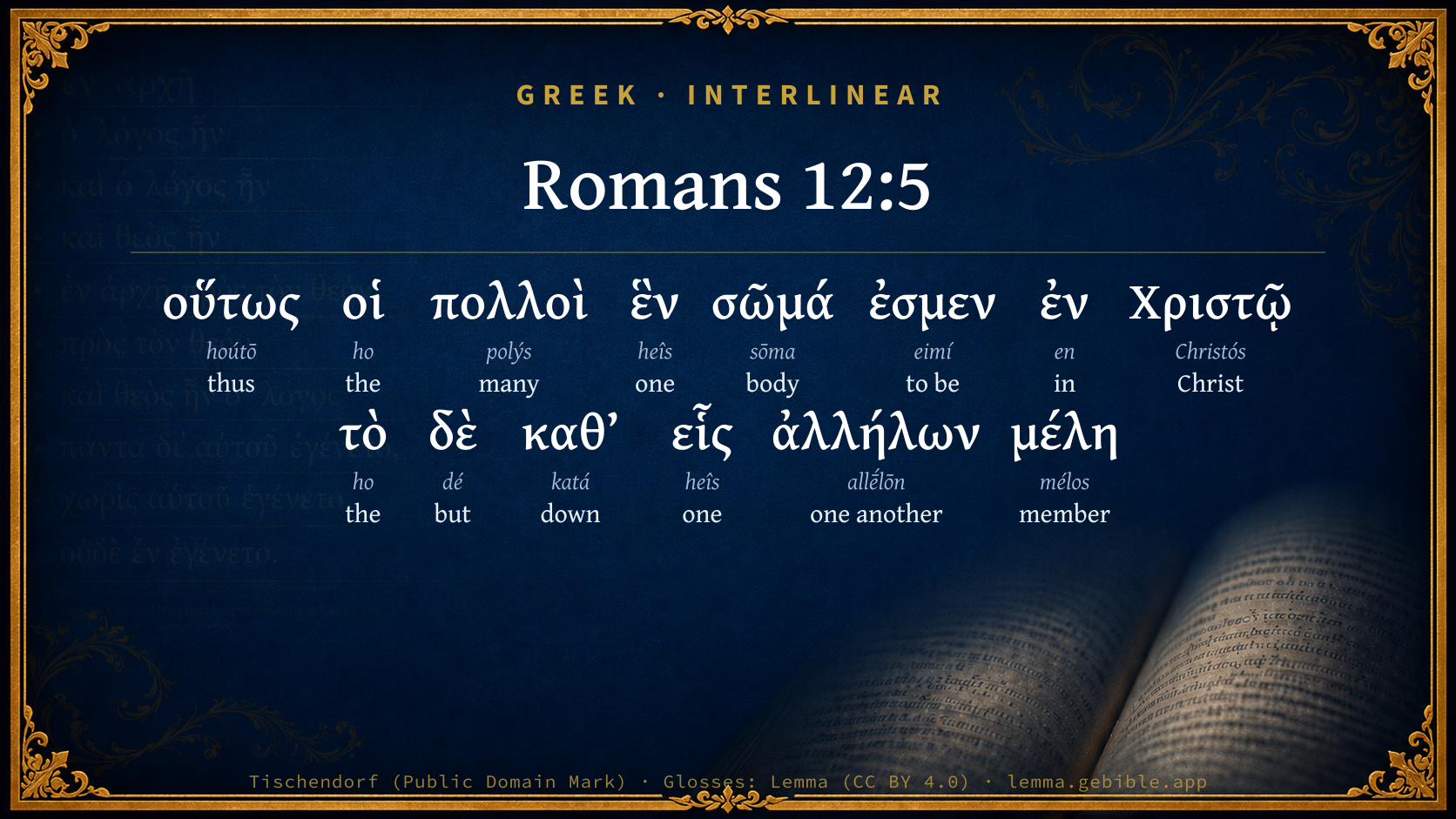
Download image
Cite this verse

Romans 12:5 (World English Bible). Public Domain. Lemma interlinear Bible study tool, https://lemma.gebible.app/v/romans/12/5.

Show BibTeX & RIS
BibTeX
RIS
English Translation
so we, who are many, are one body in Christ, and individually members one of another.
World English Bible · Public Domain
Download a study sheet

One document with this verse’s original text, its word-by-word gloss line, the meaning frame, cross-references with their text, attributed commentary, and full source and license credits — printable, and it pastes into notes with its structure intact.

This verse Autodidact and up

Study sheet (.html) Plain text (.txt)

A passage Seminary Student

Up to 50 verses in one chapter. A passage sheet keeps up to 6 commentary sources and 12 cross-references per verse, in the order this page ranks them, and says so on the sheet whenever that leaves anything out. Ask for a single verse and you get the Autodidact verse sheet above.

Everything on this page stays free to read, with no account — the sheet is a download of what is already on screen, not access to it.

Want to remove ads? Support Godless Engineer
Compare translations 3

The same verse in 3 English versions, stacked beneath the original-language interlinear above. Click any original word for its lexicon entry.

Each is an independent rendering of the whole verse — the interlinear is not word-aligned to these translations.

Highlighted words mark where these versions differ — a whole-verse word diff, not a word-by-word alignment.

  • World English Bible Public Domain
    so we, who are many, are one body in Christ, and individually members one of another.
  • King James Version Public Domain
    So we, being many, are one body in Christ, and every one members one of another.
  • unfoldingWord Literal Text CC BY-SA 4.0
    in the same way, we, the many, are one body in Christ and the individually members of one other.

unfoldingWord Literal Text — © unfoldingWord, licensed CC BY-SA 4.0. Word-aligned USFM3 via Door43 (git.door43.org/unfoldingWord/en_ult).

Versions to compare (up to 4)

3 of 4 selected

Show all 19 translations

Every available English version of this verse, each an independent rendering of the whole verse.

  • World English Bible Public Domain
    so we, who are many, are one body in Christ, and individually members one of another.
  • Berean Standard Bible Public Domain
    so in Christ we who are many are one body, and each member belongs to one another.
  • Majority Standard Bible Public Domain
    so in Christ we who are many are one body, and each member belongs to one another.
  • King James Version Public Domain
    So we, being many, are one body in Christ, and every one members one of another.
  • American Standard Version (1901) Public Domain
    so we, who are many, are one body in Christ, and severally members one of another.
  • Revised Version (1885) Public Domain
    so we, who are many, are one body in Christ, and severally members one of another.
  • Geneva Bible (1599) Public Domain
    So we being many are one body in Christ, and euery one, one anothers members.
  • Douay-Rheims (1899) Public Domain
    So we being many, are one body in Christ, and every one members one of another.
  • Young's Literal Translation Public Domain
    so we, the many, one body are in Christ, and members each one of one another.
  • Literal Standard Version CC BY-SA 4.0
    so we, the many, are one body in Christ, and members of one another—each one.
  • Unlocked Literal Bible CC BY-SA 4.0
    In the same way, we who are many are one body in Christ, and are individually members of each other.
  • unfoldingWord Literal Text CC BY-SA 4.0
    in the same way, we, the many, are one body in Christ and the individually members of one other.
  • Darby Bible Public Domain
    thus we, [being] many, are one body in Christ, and each one members one of the other.
  • World Messianic Bible Public Domain
    so we, who are many, are one body in Messiah, and individually members of one another,
  • Webster's Bible Public Domain
    So we, being many, are one body in Christ, and every one members one of another.
  • Free Bible Version CC BY-SA 4.0
    so we are one body in Christ, even though we are many—and we all belong to one another.
  • Bible in Basic English Public Domain
    So we, though we are a number of persons, are one body in Christ, and are dependent on one another;
  • Text-Critical English NT CC BY 4.0
    so we, who are many, are one body in Christ, and individually members of one another.
  • Tyndale New Testament (1534) Public Domain
    so we beynge many are one body in Christ and every man (amonge oure selves) one anothers members

Literal Standard Version (2020), Covenant Press — licensed CC BY-SA 4.0. Text via the HelloAO Bible API (eBible.org). Unlocked Literal Bible (unfoldingWord) — licensed CC BY-SA 4.0. Text via the HelloAO Bible API (eBible.org). unfoldingWord Literal Text — © unfoldingWord, licensed CC BY-SA 4.0. Word-aligned USFM3 via Door43 (git.door43.org/unfoldingWord/en_ult). Free Bible Version, Dr. Jonathan Gallagher — licensed CC BY-SA 4.0. Text via the HelloAO Bible API (eBible.org).

Word by word

More ways to search: Search by grammar → Find every occurrence → Compare this word →

Practice this passage: Drill this verse → Learn its vocabulary →

μέλη
mélos
G3196
“member”
Noun, Nominative, Plural, Neuter
Part of Speech
Noun
Case
Nominative
Number
Plural
Gender
Neuter
Full Thayer's Definition

Origin: of uncertain affinity

TDNT: 13:15,6

1. a member, limb: a member of the human body a. of bodies given up to criminal intercourse, because they are as it were members belonging to the harlot's body
  1. οὕτως hoútō G3779 “thus” Adverb
  2. οἱ ho G3588 “the” Article, Nominative, Plural, Masculine
  3. πολλοὶ polýs G4183 “many” Adjective, Nominative, Plural, Masculine
  4. ἓν heîs G1520 “one” Adjective, Nominative, Singular, Neuter
  5. σῶμά sōma G4983 “body” Noun, Nominative, Singular, Neuter
  6. ἐσμεν eimí G1510 “to be” Verb, Present, Active, Indicative, 1st person, Plural
  7. ἐν en G1722 “in” Preposition
  8. Χριστῷ Christós G5547 “Christ” Noun, Dative, Singular, Masculine
  9. τὸ ho G3588 “the” Article, Nominative, Singular, Neuter
  10. δὲ dé G1161 “but” Conjunction
  11. καθ’ katá G2596 “down” Preposition
  12. εἷς heîs G1520 “one” Adjective, Nominative, Singular, Masculine
  13. ἀλλήλων allḗlōn G240 “one another” Reciprocal pronoun, Genitive, Plural, Masculine

About this verse

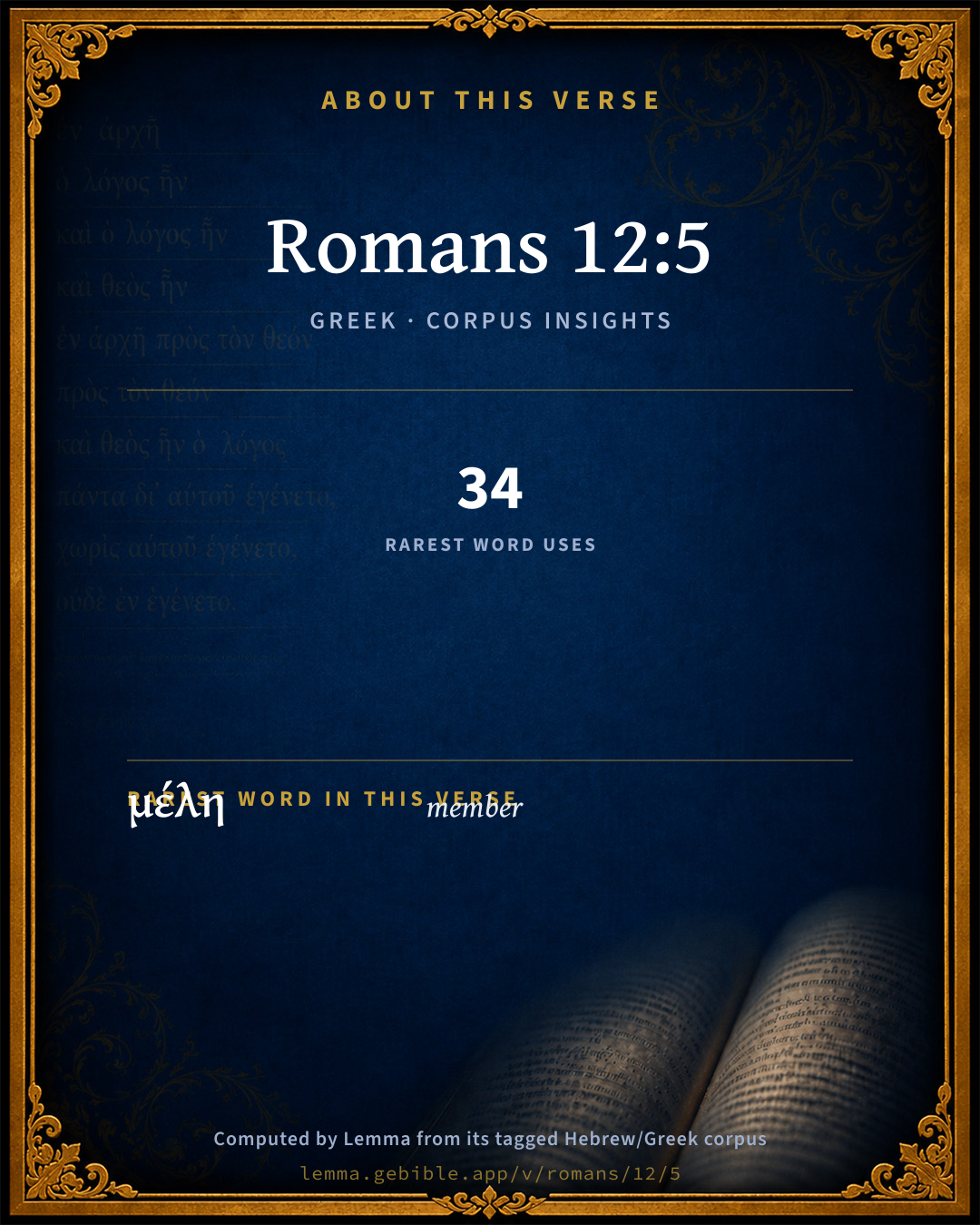
These counts appear in no published source. They are computed here, from the morphology-tagged text and Lemma’s own curated glosses. What Lemma adds →

14
words
12
distinct lemmas
Pauline Epistles
section

Shared distinctive vocabulary

μέλη member G3196 occurs in 24 verses of the Greek New Testament. Also found in:
Repetition

Words recur within this verse:

Cross-references

11

Topical passages linked to Romans 12:5 in the Treasury of Scripture Knowledge — connected by theme and wording, ordered by reader-vote popularity; previews shown in the World English Bible.

  • 1 Corinthians 12:20 But now they are many members, but one body.
  • 1 Corinthians 12:27–28 Now you are the body of Christ, and members individually.
  • 1 Corinthians 10:17 Because we, who are many, are one bread, one body; for we all partake of the one bread.
  • Ephesians 4:25 Therefore, putting away falsehood, speak truth each one with his neighbor. For we are members one of another.
  • Ephesians 5:30 because we are members of his body, of his flesh and bones.
  • Colossians 2:19 and not holding firmly to the Head, from whom all the body, being supplied and knit together through the joints and ligaments, grows with God's growth.
  • 1 Corinthians 10:33 even as I also please all men in all things, not seeking my own profit, but the profit of the many, that they may be saved.
  • 1 Corinthians 12:12–14 For as the body is one, and has many members, and all the members of the body, being many, are one body; so also is Christ.
  • Colossians 1:24 Now I rejoice in my sufferings for your sake, and fill up on my part that which is lacking of the afflictions of Christ in my flesh for his body's sake, which is the assembly;
  • Romans 12:4 For even as we have many members in one body, and all the members don't have the same function,
  • Ephesians 1:23 which is his body, the fullness of him who fills all in all.

Cross-references courtesy of OpenBible.info (CC BY 4.0).

Commentary

Notes on Romans 12:5 from classic Christian and Jewish commentators (each source and its license shown beneath its notes). The classic Christian expositions comment on the surrounding passage and are grouped to its opening verse, so a note may address several verses; the Jewish commentaries on the Tanakh (Rashi and others) are per-verse, so they appear only where the commentator wrote on this verse.

Lemma curates 59 commentaries, every one of them public domain or Creative Commons licensed, each selected and text-cleaned for this edition rather than reprinted as found. About our sources →

Bengel's Gnomon

Johann Albrecht Bengel

Rom 12:5. Ὁ δὲ καθεὶς) see Mar 14:19, note.—μέλη, members, Eph 4:25.

Bengel's Gnomon of the New Testament — English translation (T&T Clark, Edinburgh, 1860) — public domain. Text from a community e-Sword module.

International Critical Commentary

12:5. Modesty and sobriety and good judgement are necessary because of the character of the community: it is an organism or corporate body in which each person has his own duty to perform for the well-being of the whole and therefore of himself.

This comparison of a social organism to a body was very common among ancient writers, and is used again and again by St. Paul to illustrate the character of the Christian community: see 1Co 12:12; Eph 4:15; Col 1:18. The use here is based upon that in 1Co 12:12-31. In the Epistles of the Captivity it is another side of the idea that is expounded, the unity of the Church in Christ as its head.

12:5. τὸ δὲ καθʼ εἷς. An idiomatic expression found in later Greek. Cf. Mar 14:19 εἷς καθʼ εἷς: Joh 8:9: 3 Macc. 5:34 ὁ καθʼ εἷς δὲ τῶν φίλων: Lucian Soloecista 9; Eus. H. E. X. iv, &c. εἷς καθʼ εἷς was probably formed on the model of ἓν καθʼ ἕν, and then καθʼ εἷς came to be treated adverbially and written as one word: hence it could be used, as here, with a neuter article.

International Critical Commentary — older volumes (1896–1929), various authors — public domain. Text from a community e-Sword module.

Hodge's Commentary on Romans, Ephesians & First Corinthians

Charles Hodge

Rom_12:4, Rom_12:5

For as we have many members in one body, and all members have not the same office; so we, etc. In these verses we have the same comparison that occurs more at length in 1 Corinthians 12, and for the same purpose. The object of the apostle is in both cases the same. He designs to show that the diversity of offices and gifts among Christians, so far from being inconsistent with their union as one body in Christ, is necessary to the perfection and usefulness of that body. It would be as unreasonable for all Christians to have the same gifts, as for all the members of the human frame to have the same office. This comparison is peculiarly beautiful and appropriate; because it not only clearly illustrates the particular point intended, but at the same time brings into view the important truth that the real union of Christians results from the indwelling of the Holy Spirit, as the union of the several members of the body is the result of their being all animated and actuated by one soul. Nothing can present in a clearer light the duty of Christian fellowship, or the sinfulness of divisions and envying among the members of Christs body, than the apostles comparison. Believers, though many, are one body in Christ, and every one members one of another. Οἱ πολλοὶ ἓν σῶμά ἐσμεν. We, the many, are one body. In one respect we are many, in another we are one. Just as the body is many as to its members, and one in their organic connection. Believers are one body, i.e. a living organic whole, not in virtue of any external organization, but in Christ, i.e. in virtue of their common union with him. And as this union with Christ is not merely external, or by profession, or by unity of opinion and sentiment only, but vital, arising from the indwelling of the Holy Ghost, the Spirit of Christ, so, the apostle adds, the union of believers one with another, is also a vital union. They are ὁ καθ ̓ εἷς ἀλλήλων μέλη, every one members one of another. The relation of believers to each other is far more intimate than that between the members of any external organization, whether civil or ecclesiastical. It is analogous to the mutual relation of the members of the same body, animated by one soul. ὁ καθ ̓ εἷς for ὁ καθ ̓ ἕνα, in the sense of εἷς ἕκαστος, is a solecism occurring only in the later Greek.

Charles Hodge — Commentary on Romans (1835), First Corinthians (1857), and Ephesians (1856) — public domain. Text from a community e-Sword module.

Adam Clarke's Commentary

Verse 5. So we, being many] We who are members of the Church of Christ, which is considered the body of which he is the head, have various offices assigned to us, according to the measure of grace, faith and religious knowledge which we possess; and although each has a different office, and qualifications suitable to that office, yet all belong to the same body; and each has as much need of the help of another as that other has of his; therefore, let there be neither pride on the one hand, nor envy on the other. The same metaphor, in nearly the same words, is used in Synopsis Sohar, page 13. "As man is divided into various members and joints, united among themselves, and raised by gradations above each other, and collectively compose one body; so all created things are members orderly disposed, and altogether constitute one body. In like manner the law, distributed into various articulations, constitutes but one body." See Schoettgen.

Adam Clarke's Commentary on the Bible (1810–1826) — public domain. Text from a community e-Sword/MySword module.

Ellicott's Commentary for English Readers

(5) In Christ.—Christ is the unifying principle in the Church, just as the personality or will is the unifying principle in man.

Every one.—A somewhat peculiar phrase in the Greek, not found in this form in classical writers, meaning “as individuals.”

Members one of another.—Strictly speaking, the members are called members in their relation to the body, and not in their relation to each other. We should say, rather, “fellow-members with one another.”

A Bible Commentary for English Readers, edited by Charles John Ellicott (1878–1897) — public domain. Text from a community e-Sword module.

The Cambridge Bible for Schools and Colleges

gen. ed. J. J. S. Perowne

5. in Christ] i.e. by virtue of our union with Him. See on Rom_8:1. Cp. also for the profound meaning of the phrase, 2Co_5:17.

and every one] Perhaps better, in view of MSS. &c., but with respect to individuality; “as concerns our several positions.”

The Cambridge Bible for Schools and Colleges (gen. ed. J. J. S. Perowne; Cambridge University Press, 1878–1918) — public domain. Text from a community e-Sword module.

John Gill's Exposition

So we being many are one body in Christ,.... This is the application of the above simile. The chosen of God, the redeemed of Christ, and those that are justified by his righteousness, and sanctified by his Spirit; though they are but few in comparison of the men of the world, but considered in themselves are many, and yet make up but one body, the church, of which Christ is the head: and though this general assembly; or church universal, may be distinguished into several congregational churches, and distinct communities, yet each community, consisting of divers persons, is but one body "in Christ", united and knit together by joints and bands, under him their head, Lord, and King; in him, and not in Caesar, or any earthly monarch, to distinguish this body from bodies politic, or any civil community among men:

and everyone members one of another; as in union with Christ their head, so to one another in love, walking in holy fellowship together, sympathizing with, and serving each other.

John Gill's Exposition of the Whole Bible (1746–1763) — public domain (CC PDM 1.0). Text via the HelloAO Bible API.

Trapp's Complete Commentary

John Trapp

5 So we, being many, are one body in Christ, and every one members one of another.

Ver. 5. One body in Christ] {See Trapp on "1Co 12:12"} {See Trapp on "1Co 12:13"}

And every one members] Try thy membership, if, 1. Sociable with Christ and Christians. 2. Useful and serviceable to the body. 3. Compassionate, as Paul; "Who is afflicted," saith he, "and I burn not?" I feel twinges when others are hurt; and I hold myself a debtor (as a member) to Greeks and barbarians, to the wise and unwise, be they but of the body, Rom 1:14.

John Trapp, A Commentary or Exposition upon All the Books of the Old and New Testament (1647–1656) — public domain. Text from a community e-Sword module.

Albert Barnes' Notes on the Bible

So we, being many - We who are Christians, and who are numerous as individuals.

Are one body - Are united together, constituting one society, or one people, mutually dependent, and having the same great interests at heart, though to be promoted by us according to our special talents and opportunities. As the welfare of the same body is to be promoted in one manner by the feet, in another by the eye, etc.; so the welfare of the body of Christ is to be promoted by discharging our duties in our appropriate sphere, as God has appointed us.

In Christ - One body, joined to Christ, or connected with him as the head; Eph 1:22-23, “And gave him to be head over all things to the church, which is his body;” compare Joh 15:1-7. This does not mean that there is any physical or literal union, or any destruction of personal identity, or any thing particularly mysterious or unintelligible. Christians acknowledge him as their head. that is, their Lawgiver; their Counsellor, Guide, and Redeemer. They are bound to him by especially tender ties of affection, gratitude, and friendship; they are united in him, that is, in acknowledging him as their common Lord and Saviour. Any other unions than this is impossible; and the sacred writers never intended that expressions like these should be explained literally. The union of Christians to Christ is the most tender and interesting of any in this world, but no more mysterious than what binds friend to friend, children to parents, or husbands to their wives; compare Eph 5:23-33. (See the supplementary note at Rom 8:17.)

And every one members one of another - Compare 1Co 12:25-26. That is, we are so united as to be mutually dependent; each one is of service to the other; and the existence and function of the one is necessary to the usefulness of the other. Thus, the members of the body may be said to be members one of another; as the feet could not, for example, perform their functions or be of use if it were not for the eye; the ear, the hand, the teeth, etc., would be useless if it were not for the other members, which go to make up the entire person. Thus, in the church, every individual is not only necessary in his place as an individual, but is needful to the proper symmetry and action of the whole. And we may learn here:

(1) That no member of the church of Christ should esteem himself to be of no importance. In his own place he may be of as much consequence as the man of learning, wealth, and talent may be in his.

(2) God designed that there should be differences of endowments of nature and of grace in the church; just as it was needful that there should be differences in the members of the human body.

(3) No one should despise or lightly esteem another. All are necessary. We can no more spare the foot or the hand than we can the eye; though the latter may be much more curious and striking as a proof of divine skill. We do not despise the hand or the foot any more than we do the eye; and in all we should acknowledge the goodness and wisdom of God. See these thoughts carried out in 1Co 12:21-25.

Albert Barnes' Notes on the Bible (1834–1885) — public domain. Text from a community e-Sword/MySword module.

Whedon's Commentary on the Bible

Daniel D. Whedon

5. One body in the faith and atoning mercy of Christ.

One of another— Each belonged not only to the whole, but each to the other; since the good order or disorder of one limb affects every other limb. We have here a sight of the organic arrangements of the Roman Church as it existed before a later providential expediency had crystallized it into permanent form, and before the apostle had ever overseen it. The official and charismatic are so blended that while there are unity, and form, and regular cooperation, yet the polity is spontaneous and spiritual, rather than governmental.

Daniel D. Whedon (gen. ed.), Commentary on the Old and New Testaments (1874–1909) — public domain. Text from a community e-Sword module.

John Wesley's Explanatory Notes

So we - All believers. Are one body - Closely connected together in Christ, and consequently ought to be helpful to each other.

John Wesley, Explanatory Notes Upon the Whole Bible (1754–1765) — public domain. Text via the GEBible commentary corpus.

Godbey's Commentary on the New Testament

William B. Godbey

5. “So also we being many are one body in Christ and members one of another,

William B. Godbey, Commentary on the New Testament (1896–1900) — public domain. Text from a community e-Sword module.

McGarvey & Pendleton's Commentaries

J. W. McGarvey

so we, who are many, are one body in Christ, and severally members one of another . [As God gives to each member of the human body its several function for the good of the whole body, so he distributed the miraculous gifts of the Spirit to the different members of the Roman church for the good of the whole church. The gifts were intended to be held in common, so that each member should contribute to the needs of all the others, and in return receive from all the others in mutual helpfulness and interdependence. Difference in office or function, therefore, was not a matter for pride or boasting, for the gift was held in trust for service, and was a gift to the whole body, through the individual member. There is no room for comparison or pride between the related members of one living organism. This comparison of the relationship of Christians to the mutual dependence of the members of the human body is a favorite one with Paul, and he elaborates it at 1Co_12:4-31 and Eph_4:1-16 . See also Eph_4:25 ; Eph_5:30 ]

J. W. McGarvey (with Philip Y. Pendleton), Commentaries on the New Testament (The Fourfold Gospel, 1914; Acts; and the epistles) — public domain. Text from a community e-Sword/MySword module.

Cambridge Greek Testament for Schools and Colleges

5. οἱ πολλοὶ κ.τ.λ. We who are many, being in Christ, are one body; cf. Rom 8:1-10. The connexion of the individual with Christ, made in baptism, is a connexion of life, given by the presence of His life in him. But this life is one and the same for all who are baptised into Him; therefore the connexion of the individual is not only with Christ but with all who are instinct with the same life. The individuality however is not thereby submerged, but socialised, so to speak: it is developed by being brought into these new and living relations and has its part in the organic whole. The emphasis here is not on the connexion with Christ, which is assumed, but on the consequent connexion with others. So in 1Co 10:17; 1Co 12:13; Eph 2:16; Eph 4:4. In 1Co 12:27, Eph 1:23; Eph 4:12 alibi, the stress is on the relation to Christ.

τὸ δὲ καθ’ εἷς. Cf. Mar 14:19, [Joh.] Rom 8:9. “κατὰ is used as an adverb distributively. M. Gr. καθείς or καθένας = each,” Moulton, p. 105. τὸ … = as regards our several individualities; cf. Rom 9:5, Rom 12:18; Blass, p. 94. The accus. of reference has become an adverbial accus.

ἀλλήλων μέλη. Cf. Eph 4:25, where also the stress is on the mutual obligations in the society; otherwise μέλν Χριστοῦ (1Co 6:15; 1Co 12:27; Eph 5:30). Thus again the special direction of the σωφροσύνη is indicated.

Cambridge Greek Testament for Schools and Colleges (Cambridge University Press, 1896; 21 vols, various authors incl. Carr, Maclear, Plummer, Farrar, Lumby, Moule, M. R. James, Simcox) — public domain. Text from a community e-Sword module.

Alford’s Greek Testament

Henry Alford

5. τὸ δὲ καθʼ εἷς] But [severally, i.e.] as regards individuals. A solœcism for τὸ δὲ εἷς καθʼ ἕνα, as ἓν καθʼ ἕν in ref. Rev. Wetst., on ref. Mark, gives many examples of it.

Members of one another = fellow-members with one another,—members of the body of which we one with another are members.

Henry Alford, The Greek Testament (1849–1861) — public domain. Text from a community e-Sword module.

Vincent's Word Studies in the New Testament

Marvin R. Vincent

Being many [οι πολλοι] . Lit., the many. Rev., better, who are many. Every one [το δε καθ εις] . The literal phrase can only be rendered awkwardly : and as to what is true according to one; i e., individually, severally. Compare, for a similar phrase, Mr 14:19; Joh 8:9.

Marvin R. Vincent, Word Studies in the New Testament (1887–1900) — public domain. Text from a community e-Sword/MySword module.

Lesson kit

Teaching starters — assembled from the data on this page, not authored interpretation. Every prompt links to the verse data it draws on. Edit before teaching.

Romans, in the Pauline Epistles, opens this verse with 14 words (12 distinct Greek lemmas). Its most distinctive word is mélos (“member”). A historical commentator’s framing appears above. Read the whole chapter for the surrounding context.

Discussion questions

  1. The word mélos carries the sense “member.” How does it shape the verse?
  2. Matthew 5:29 shares the word «member» with this verse. How do the two illuminate each other?
  3. “one” occurs 2× in this one verse. What is the effect of the repetition?
  4. These translations render this verse differently; the difference is in the English rendering, not the original. What questions does that raise?
  5. Reading how Bengel's Gnomon and International Critical Commentary read this verse, where do the two commentators agree and where do they part?

Things to notice

Reading settings

Reading text

Shown beneath each verse's original-language words.

Old Testament
Old Testament edition

Read the OT as the Masoretic Hebrew (MT) or the Greek Septuagint (LXX).

English shown for the Greek Septuagint (in the Hebrew ↔ Greek comparison).

Comparing translations? Open the Compare panel on any verse page to stack up to four side by side.