Acts 19:20

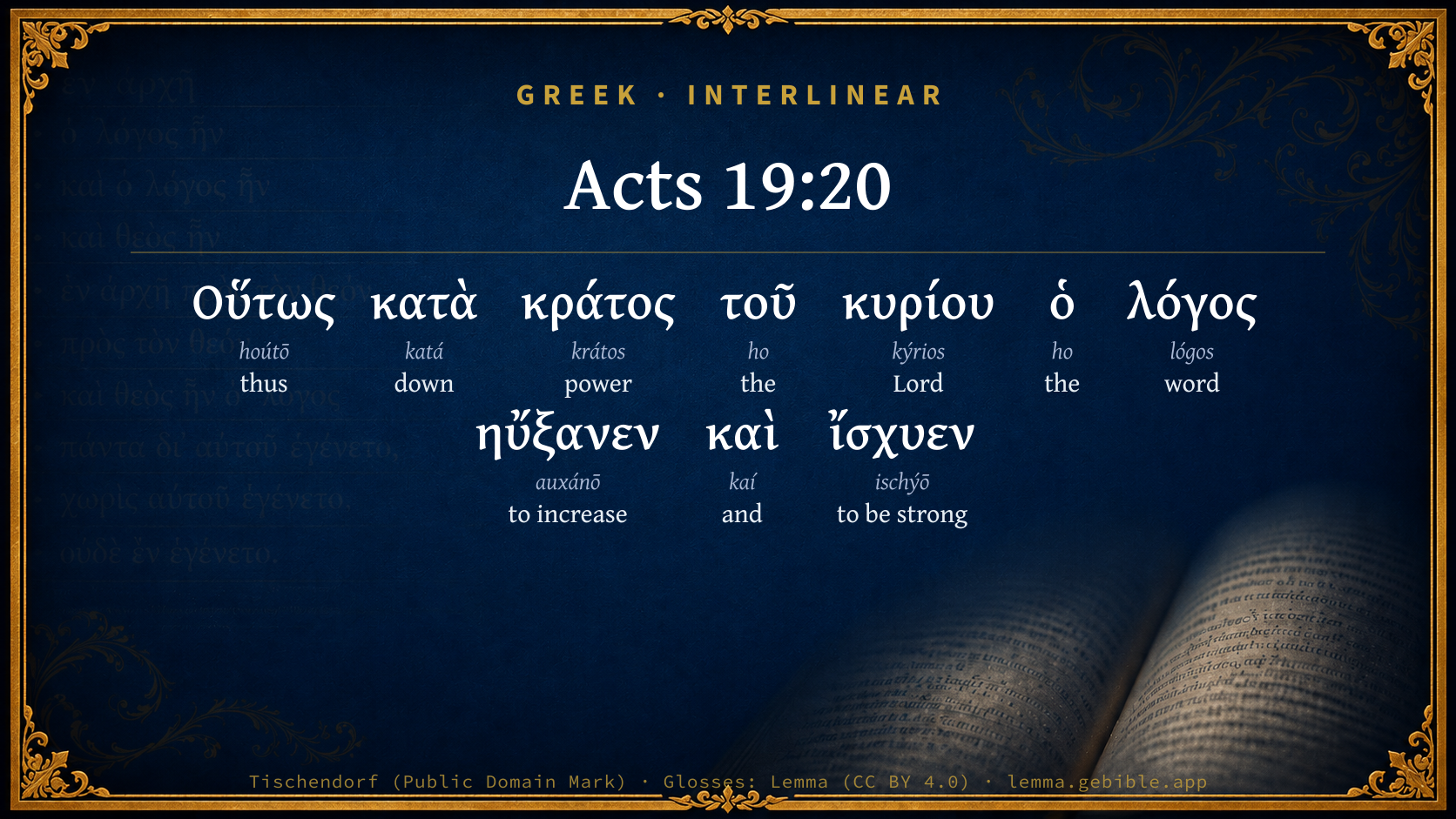
Greek (Tischendorf 8th ed.) Acts 19:20 appears in the Greek New Testament. The text above is from the Tischendorf 8th edition. Each word links to its Strong’s number and a concise gloss. Click any word for its full Thayer’s Greek Lexicon entry.
Download image
Cite this verse

Acts 19:20 (World English Bible). Public Domain. Lemma interlinear Bible study tool, https://lemma.gebible.app/v/acts/19/20.

Show BibTeX & RIS
BibTeX
RIS
English Translation
So the word of the Lord was growing and becoming mighty.
World English Bible · Public Domain
Download a study sheet

One document with this verse’s original text, its word-by-word gloss line, the meaning frame, cross-references with their text, attributed commentary, and full source and license credits — printable, and it pastes into notes with its structure intact.

This verse Autodidact and up

Study sheet (.html) Plain text (.txt)

A passage Seminary Student

Up to 50 verses in one chapter. A passage sheet keeps up to 6 commentary sources and 12 cross-references per verse, in the order this page ranks them, and says so on the sheet whenever that leaves anything out. Ask for a single verse and you get the Autodidact verse sheet above.

Everything on this page stays free to read, with no account — the sheet is a download of what is already on screen, not access to it.

Want to remove ads? Support Godless Engineer
Compare translations 3

The same verse in 3 English versions, stacked beneath the original-language interlinear above. Click any original word for its lexicon entry.

Each is an independent rendering of the whole verse — the interlinear is not word-aligned to these translations.

Highlighted words mark where these versions differ — a whole-verse word diff, not a word-by-word alignment.

  • World English Bible Public Domain
    So the word of the Lord was growing and becoming mighty.
  • King James Version Public Domain
    So mightily grew the word of God and prevailed.
  • unfoldingWord Literal Text CC BY-SA 4.0
    So with power the word of the Lord was increasing and prevailing.

unfoldingWord Literal Text — © unfoldingWord, licensed CC BY-SA 4.0. Word-aligned USFM3 via Door43 (git.door43.org/unfoldingWord/en_ult).

Versions to compare (up to 4)

3 of 4 selected

Show all 19 translations

Every available English version of this verse, each an independent rendering of the whole verse.

  • World English Bible Public Domain
    So the word of the Lord was growing and becoming mighty.
  • Berean Standard Bible Public Domain
    So the word of the Lord powerfully continued to spread and prevail.
  • Majority Standard Bible Public Domain
    So the word of the Lord powerfully continued to spread and prevail.
  • King James Version Public Domain
    So mightily grew the word of God and prevailed.
  • American Standard Version (1901) Public Domain
    So mightily grew the word of the Lord and prevailed.
  • Revised Version (1885) Public Domain
    So mightily grew the word of the Lord and prevailed.
  • Geneva Bible (1599) Public Domain
    So the worde of God grewe mightily, and preuailed.
  • Douay-Rheims (1899) Public Domain
    So mightily grew the word of God, and was confirmed.
  • Young's Literal Translation Public Domain
    so powerfully was the word of God increasing and prevailing.
  • Literal Standard Version CC BY-SA 4.0
    so powerfully was the word of God increasing and prevailing.
  • Unlocked Literal Bible CC BY-SA 4.0
    So the word of the Lord spread very widely in powerful ways.
  • unfoldingWord Literal Text CC BY-SA 4.0
    So with power the word of the Lord was increasing and prevailing.
  • Darby Bible Public Domain
    Thus with might the word of the Lord increased and prevailed.
  • World Messianic Bible Public Domain
    So the word of the Lord was growing and becoming mighty.
  • Webster's Bible Public Domain
    So mightily grew the word of God, and prevailed.
  • Free Bible Version CC BY-SA 4.0
    In this way the word of the Lord grew strong and spread widely.
  • Bible in Basic English Public Domain
    So the word of the Lord was increased very greatly and was full of power.
  • Text-Critical English NT CC BY 4.0
    In this way the word of the Lord was increasing and prevailing mightily.
  • Tyndale New Testament (1534) Public Domain
    So myghtely grewe the worde of god and prevayled.

Literal Standard Version (2020), Covenant Press — licensed CC BY-SA 4.0. Text via the HelloAO Bible API (eBible.org). Unlocked Literal Bible (unfoldingWord) — licensed CC BY-SA 4.0. Text via the HelloAO Bible API (eBible.org). unfoldingWord Literal Text — © unfoldingWord, licensed CC BY-SA 4.0. Word-aligned USFM3 via Door43 (git.door43.org/unfoldingWord/en_ult). Free Bible Version, Dr. Jonathan Gallagher — licensed CC BY-SA 4.0. Text via the HelloAO Bible API (eBible.org).

Word by word

More ways to search: Search by grammar → Find every occurrence → Compare this word →

Practice this passage: Drill this verse → Learn its vocabulary →

About this verse

These counts appear in no published source. They are computed here, from the morphology-tagged text and Lemma’s own curated glosses. What Lemma adds →

10
words
9
distinct lemmas
Acts
section

Notable vocabulary

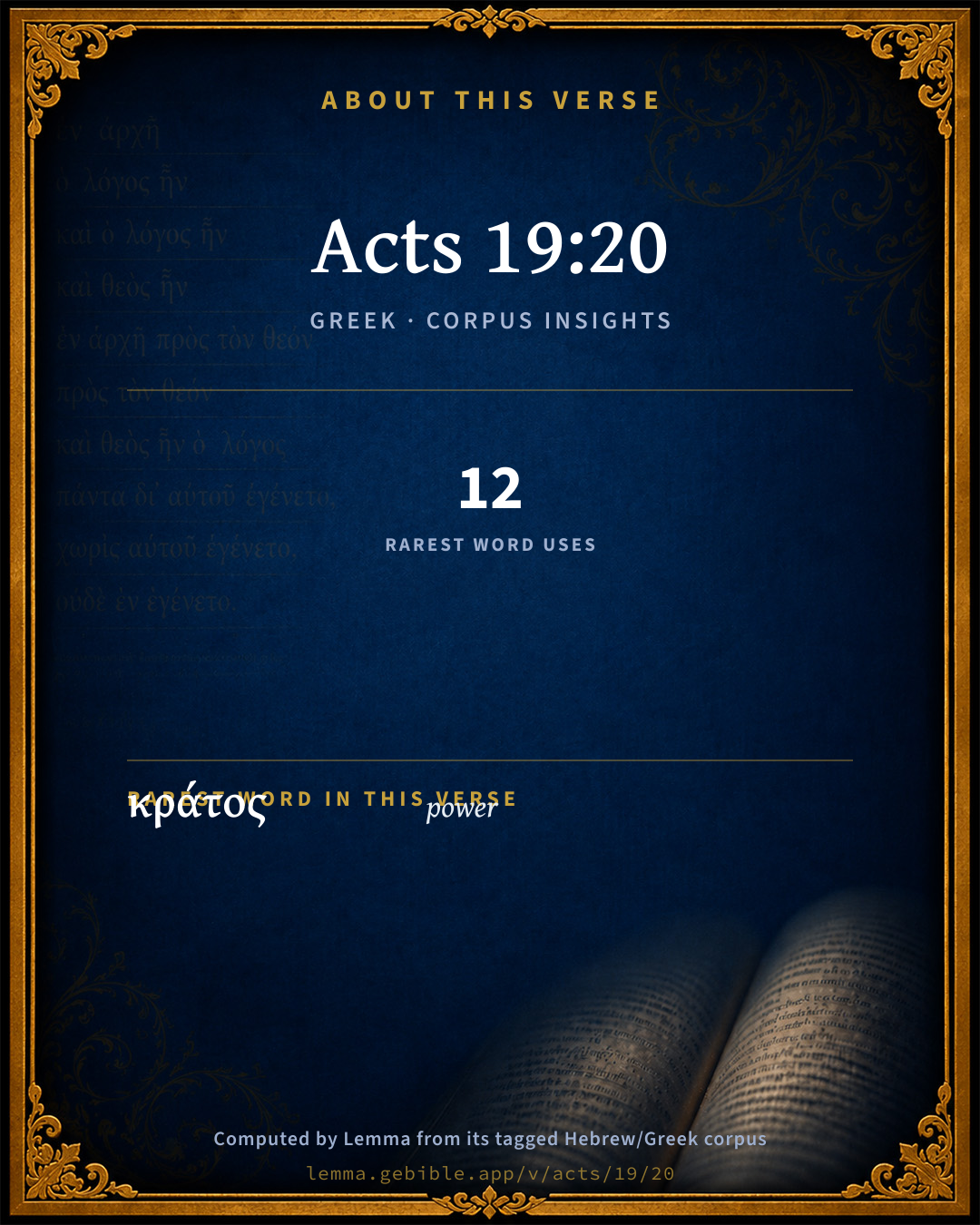
The rarest word here is κράτος power G2904 — appearing just 12 times in the whole Greek New Testament.

Shared distinctive vocabulary

κράτος power G2904 occurs in 12 verses of the Greek New Testament. Also found in:

Repetition

A word recurs within this verse:

Cross-references

4

Topical passages linked to Acts 19:20 in the Treasury of Scripture Knowledge — connected by theme and wording, ordered by reader-vote popularity; previews shown in the World English Bible.

  • Acts 6:7 The word of God increased and the number of the disciples multiplied in Jerusalem exceedingly. A great company of the priests were obedient to the faith.
  • Acts 12:24 But the word of God grew and multiplied.
  • Isaiah 55:11 so shall my word be that goes forth out of my mouth: it shall not return to me void, but it shall accomplish that which I please, and it shall prosper in the thing whereto I sent it.
  • 2 Thessalonians 3:1 Finally, brothers, pray for us, that the word of the Lord may spread rapidly and be glorified, even as also with you;

Cross-references courtesy of OpenBible.info (CC BY 4.0).

Commentary

Notes on Acts 19:20 from classic Christian and Jewish commentators (each source and its license shown beneath its notes). The classic Christian expositions comment on the surrounding passage and are grouped to its opening verse, so a note may address several verses; the Jewish commentaries on the Tanakh (Rashi and others) are per-verse, so they appear only where the commentator wrote on this verse.

Lemma curates 59 commentaries, every one of them public domain or Creative Commons licensed, each selected and text-cleaned for this edition rather than reprinted as found. About our sources →

The Biblical Illustrator

Joseph S. Exell

Act_19:20

So mightily grew the Word of God and prevailed.

The growing and prevailing gospel

1. This is a despatch from the seat of war announcing a glorious victory for the royal arms.

2. Past triumphs of the gospel may be use:! as encouragements.

3. We, too, shall see the Word of God grow and prevail, for--

(1) The gospel is the same as ever.

(2) The human race is unchanged at heart.

(3) The sins to be overcome are the same.

(4) The Holy Spirit is just as mighty to convince and renew.

4. The trophies of victory may be expected to be the same. Men, magic, books, and the love of money shall all be subdued. Let us turn aside to see--

I. The Word of God planted. Planted it was, or it could not have grown. The work proceeded in the following fashion:

1. Certain disciples were further enlightened, aroused, and led to seek a higher degree of grace. This was an admirable beginning, and revivals thus commenced are usually lasting.

2. These became obedient to an ordinance which had been overlooked (Act_19:5), and also received the Holy Ghost, of whom they had heard nothing: two great helps to revival.

3. A bold ministry proclaimed and defended the truth.

4. Opposition was aroused. This is always a needful sign. God is not at work long without the devil working also.

5. Deceitful counterfeiting commenced, and was speedily ended in the most remarkable manner.

6. Paul preached, pleaded, made the gospel to sound forth, and on departing could say, I am pure from the blood of all men. Read this and the following chapter, and see how three years were well spent in planting the Church at Ephesus.

II. The Word of God growing. The measure of it was seen--

1. In a Church formed with many suitable elders.

2. In a neighbourhood fully aware of the presence of the gospel among them, for it touched them practically; so much so, that important trades were affected.

3. In a people converted, and openly confessing their conversion.

4. In a general respect paid to the faith. Even those who did not obey it yet yielded it homage and owned its power. Here we see Pauls work and Gods work. Paul laboured diligently in planting, and God made it to grow: yet it was all of God. Is the Word of God growing among us? If not, why not? It is a living seed, and should grow. It is a living seed, and will grow unless we hinder it.

III. The Word of God prevailing. Growth arouses opposition; but where the Word grows with inward vitality it prevails over outward opposition. The particular proof of prevalence here given is the burning of magical books.

1. Paul does not appear to have dwelt continually upon the evil habit of using magical arts; but gospel light showed the guilt of witchcraft, and Providence cast contempt on it.

2. The sin being exposed, it was confessed by those who had been guilty of it, and by those who had commenced its study.

3. Being confessed, it was renounced altogether, and, though there was no command to that effect, yet in a voluntary zeal of indignation the books were burned. This was right because--

(1) If sold, they would do harm.

(2) They were so detestable that they deserved burning.

(3) Their public burning lighted up a testimony.

4. Their destruction involved expense, which was willingly incurred, and that expense gave weight to the testimony.

Conclusion:

1. No other proof of power in our ministry will equal that which is seen in its practical effect upon our hearers lives.

2. Will you who attend our preaching see to it that you purge yourselves from all filthiness of the flesh and of the spirit? (C. H. Spurgeon.)

The conditions of growth

The phrase of the text, or its equivalent, is found five times in the Acts, and in connection with circumstances which throw considerable light on the laws of Church increase.

I. The baptism of the Spirit (Act_2:47). The power of the Holy Ghost is the fundamental condition. Without this there can be no life, and therefore no growth. This is the supreme ministerial qualification, and is essential for the conviction and conversion of hearers, and for the constant quickening of the Church.

II. The purification of the Church (Act_5:14). All the gifts that were poured into the Church treasury might have been vitiated by the presence of Ananias and Sapphira. Achans presence troubled Israel, and Jonahs the mariners, so the Church sometimes suffers through its neglect of discipline. Better to brave the anger of the rich and influential than that the Word of God should be bound.

III. Full consecration to ministerial work (Act_6:7). We can well believe how the apostles were hampered by undertaking all the minute details of Church administration, and how a progressive impulse would be given when laymen were found work to do. Would that congregations would see how growth is necessarily hindered when ministers are overburdened. Whatever interferes with pulpit efficiency assuredly interferes with the progress of the work of God. A thoughtful and cooperative laity is much to be desired.

IV. Provident interpositions favourable to the Church (chap. 12:24). Peter was miraculously delivered from prison and Herod as miraculously removed. When hindrances are taken away, and gospel agencies liberated, no wonder the Word of God grows and multiplies. Providence often interposes now in the opening of hitherto closed doors, and in the liberation of men and money for the work. Yet how often are these interpositions allowed to pass by unheeded! What are our commercial supremacy and colonial extension, the progress of the cause of liberty and toleration on the Continent, the results of travel and enterprise, etc., but so many providential interferences in favour of the gospel?

V. Daring aggression. It was a bold thing to attack Ephesus at all, but encouraged by the capture of an outpost, the apostle marched on the very citadel. Here, as almost everywhere, courage was justified by success. Cautious timidity is the very worst policy with such a resolute foe as the devil, and such a scornful foe as the world. From the time of Paul downwards the Churchs victories have been won by men who did not know what impossibility meant, but who, trusting in God, feared nothing and expected everything. Conclusion: These conditions of growth were all fulfilled here.

1. The baptism of the Spirit (verse 6).

2. The purification of the Church (verse 9).

3. Full ministerial devotion (Act_20:18-20).

4. Providential interpositions--Johns disciples; the school of Tyrannus. (J. W. Burn.)

Growth of the Word of God

A most remarkable example of the value of free distribution of the Word of God has recently reached my ears. A well-known evangelical minister of Christ lately made a tour in Canada. Arriving at an out-of-the-way village, he found a lively assembly of French Christians, who were walking in the love of God and in the comfort of the Holy Ghost. They had their church and school house, and, moreover, a college for the training of the young. At their head was a venerable minister of ninety, his white hair flowing over his shoulders, quite a patriarch in appearance. Surprised to find a flourishing Church in such a place, the visitor inquired by what instrumentality such a work had been brought about. The aged pastor went to his closet and produced a small French Testament, literally worn out. This, said he, was the commencement of the work. More than half a century ago, a lady passing through this place presented me with this little Testament. I was a Roman Catholic, but the perusal of this book, so freely given to me, was the means, through the Holy Spirits enlightenment, of my regeneration. I was the first convert. I lent it to others, thence followed another conversion, and another, until our number has reached three hundred. For years the priest persecuted me, and at length offered a large sum of money if I would give up the Bible, but when he found all his efforts unavailing he desisted; and now we are a happy united community, with our church, our schools, and our college. Here, then, is an instance of the importance of giving away the Word of God and gospel tracts. Owing to the gift of a small Testament, costing a few pence, one soul was snatched as a brand from the burning, and other converts were gathered in, resulting in a precious work of grace in a remote quarter of Canada. (Cheyne Brady.)

The Biblical Illustrator, edited by Joseph S. Exell (c. 1880s–1900s) — public domain. Text from a community e-Sword module.

Tyndale Open Study Notes

Tyndale Open Resources

19:20 Luke’s summary of the success of the Good News in Ephesus is short but pungent (cp. 2:43-47; 5:14; 6:7; 9:31; 12:24; 16:5; see Rom 1:16). When the Christian faith overcame problems of internal dissension, idolatry, and pagan practices, it spread widely and grew rapidly.

Tyndale Open Study Notes — © Tyndale Open Resources, licensed CC BY-SA 4.0. Text via the HelloAO Bible API.

Bengel's Gnomon

Johann Albrecht Bengel

Act 19:20. Ηὔξανε, grew) in point of extent.—ἴσχυεν, prevailed) in regard to intensity.

Bengel's Gnomon of the New Testament — English translation (T&T Clark, Edinburgh, 1860) — public domain. Text from a community e-Sword module.

Meyer's Critical & Exegetical Commentary

Heinrich August Wilhelm Meyer

Act_19:20. So (so much) with power (par force) grew (in external diffusion, Act_6:7, Act_12:24) and displayed itself powerful (in the production of great effects) the doctrine of the Lord.

κατὰ κράτος] See Valckenaer, p. 565; Bernhardy, p. 241; Bornemann, ad Xen. Cyr. i. 4. 23. The reference of κράτος to the power of Christ (Eph_1:19) has occasioned the order τοῦ Κυρίου ὁ λόγος (Lachmann and Tischendorf, following A B א*).

Meyer — Critical and Exegetical Commentary on the New Testament — English translation by Peter Christie, edited by Frederick Crombie (T&T Clark, 1880) — public domain. Text from a community e-Sword module.

Expositor's Greek Testament

ed. W. Robertson Nicoll

Act 19:20 . κατὰ κράτος : adverbial, so only here in N.T., cf. Jdg 4:3 , and Jos., Ant. , viii., 11, 3, in classical Greek, Xen., Cyr. , i., 4, 23, etc. ηὔξ . καὶ ἴσ .: in contrast to the empty superstitions and vanities the continuous growth (imperfect) of the Church.

The Expositor's Greek Testament, edited by W. Robertson Nicoll (1897–1910) — public domain. Text from a community e-Sword module.

Alford’s Greek Testament

Henry Alford

20. κατὰ κράτος] “Eo modo dicitur urbs αἱρεῖσθαι κατὰ κράτος, quæ vi expugnatur, apud Plut. Apophth. p. 176. Hinc lucem mutuatur locus, Act 19:20, ubi dicitur verbum Domini κατὰ κράτος ἰσχύειν, per vim invalescere, quasi oppugnans et vi expugnans corda hominum.” Hermann on Viger, p. 632. So κατὰ μικρόν, κατʼ ὀλίγον, καθʼ ὑπερβολήν, κατὰ κόσμον. See Bernhardy, Syntax, p. 241, f.

Henry Alford, The Greek Testament (1849–1861) — public domain. Text from a community e-Sword module.

Adam Clarke's Commentary

Verse 20. So mightily grew the word of God, and prevailed.] The Codex Bezae reads this verse thus: "So mightily grew the word of the Lord, and prevailed; and the faith of God increased and multiplied." It is probable that it was about this time that St. Paul had that conflict which he mentions, 1Co 15:32: If I after the manner of men, have fought with wild beasts at Ephesus, &c. See the note there. It means some severe trials not here mentioned, unless we may suppose him to refer to the ferocious insurrection headed by Demetrius, mentioned at the end of this chapter. See Clarke on Ac 19:38

Adam Clarke's Commentary on the Bible (1810–1826) — public domain. Text from a community e-Sword/MySword module.

John Calvin's Commentaries

20. Grew mightily [lions.] The word κατα κρατος doth signify that the word increased not a little, (or that these proceedings were not common) as if he should say, that in those increasings appeared rare efficacy, and such as was greater than it used commonly to be. The word grew do I refer unto the number of men, as if he should have said, that the Church was increased, new disciples being gathered together dally, because doctrine is spread abroad. And I interpret that, that the word was confirmed in every one thus, to wit, that they did profit in the obedience of the gospel and in godliness more and more, and that their faith took deeper root.

John Calvin's Commentaries (1540-1563) — public domain. Text from the Calvin Translation Society English edition (1840s-50s) via the Christian Classics Ethereal Library (ccel.org). Calvin's coverage is partial (roughly two-thirds of the Bible); uncommented books and verses are honest gaps, never fabricated. The 19th-century editor's footnotes and remarks are omitted so the notes are faithfully Calvin's own voice.

Ellicott's Commentary for English Readers

(20) So mightily grew the word of God and prevailed.—The verbs imply a continuous growth. The better MSS. give, “the word of the Lord.”

A Bible Commentary for English Readers, edited by Charles John Ellicott (1878–1897) — public domain. Text from a community e-Sword module.

The Cambridge Bible for Schools and Colleges

gen. ed. J. J. S. Perowne

20. So mightily grew the word of God, &c.] The oldest Greek texts have “the word of the Lord” (adopted by R. V.), The full sense of the words rendered “mightily” is “with overpowering force and strength, which nothing could resist.”

The Cambridge Bible for Schools and Colleges (gen. ed. J. J. S. Perowne; Cambridge University Press, 1878–1918) — public domain. Text from a community e-Sword module.

John Gill's Exposition

And the same time there arose no small stir about that way. The Syriac version reads, "the way of God"; and the Vulgate Latin version, "the way of the Lord": that is, the Christian religion, and the doctrines and ordinances of the Gospel, which the saints were directed to walk in; and the Ethiopic version renders it, "about this doctrine"; which mightily grew and prevailed, and which such numbers embraced; and how great the stir was about it, and from whence it arose, who began it, and what were the consequences of it, are hereafter related.

And the same time there arose no small stir about that way. The Syriac version reads, "the way of God"; and the Vulgate Latin version, "the way of the Lord": that is, the Christian religion, and the doctrines and ordinances of the Gospel, which the saints were directed to walk in; and the Ethiopic version renders it, "about this doctrine"; which mightily grew and prevailed, and which such numbers embraced; and how great the stir was about it, and from whence it arose, who began it, and what were the consequences of it, are hereafter related.

Acts 19:24

act 19:24

act 19:24

act 19:24For a certain man, named Demetrius, a silversmith,.... Who worked in silver, not in coining silver money, but in making silver vessels, in melting silver, and casting it into moulds, and forming it into different shapes; and particularly,

which made silver shrines for Diana; who Diana was; see Gill on Act 19:27, these were not coins or medals of silver, struck by Demetrius, with the figure of the temple of Diana on them, nor images of Diana, as the Ethiopic version reads; but they were chaplets, or little temples made of silver, in imitation of the temple of Diana at Ephesus, with her image included in it; the words may be rendered, "silver temples": in some manuscripts it is added, "like little chests": which being sold to the people,

brought no small gain to the craftsmen: who were of the same trade with him; masters of the same business, who employed others under them, as appears by what follows.

John Gill's Exposition of the Whole Bible (1746–1763) — public domain (CC PDM 1.0). Text via the HelloAO Bible API.

Trapp's Complete Commentary

John Trapp

20 So mightily grew the word of God and prevailed.

Ver. 20. So mightily grew the word of God and prevailed] Happy it is for a people or person, when the word falls upon their spirits in the power of it, and subdues them; when the peace of God ruleth in their hearts, {βραβευετω, Col 3:15} and every high thought is so captivated to the obedience of Christ, that they can say, as Jdg 8:22; "Rule thou over us," &c. "For thou hast delivered us from the hand of Midian."

John Trapp, A Commentary or Exposition upon All the Books of the Old and New Testament (1647–1656) — public domain. Text from a community e-Sword module.

Albert Barnes' Notes on the Bible

So mightily grew the word of God - So powerfully. It had such efficacy and power in this wicked city. That power must have been mighty which would thus make them willing not only to cease to practice imposition, but to give up all hopes of future gains, and to destroy their property. On this instructive narrative we may remark:

(1) That religion has power to break the hold of sinners on unjust and dishonest means of living.

(2) That those who have been engaged in an unchristian and dishonorable practice will abandon it when they become Christians.

(3) That their abhorrence of their former course will be, and ought to be, expressed as publicly as was the offence.

(4) That the evil practice will be abandoned at any sacrifice, however great. The question will be, what is right; not what will it cost. Property, in the view of a converted man, is nothing when compared with a good conscience.

(5) This conduct of those who had used curious arts shows us what ought to be done by those who have been engaged in any evil course of life and who are then converted. If what they did when they were converted was right - and who can doubt it? - it settles a great principle on which young converts should act. If a man has been engaged in the slave-trade, he will abandon it, and his duty will not be to sell his ship to one who he knows will continue the traffic. His property should be withdrawn from the business publicly, either by being destroyed, or by being converted to a useful purpose. If a man has been a distiller of ardent spirits as a drink, his duty will be to forsake his evil course. Nor will it be his duty to sell his distillery to one who will continue the business, but to withdraw his property from it publicly, either by destroying it, or converting it to some useful purpose. If a man has been engaged in the traffic in ardent spirits, his duty is not to sell his stock to those who will continue the sale of the poison, but to withdraw it from public use - converting it to some useful purpose, if he can; if not, by destroying it. All that has ever been said by money-loving distillers, or venders of ardent spirits, about the loss which they would sustain by abandoning the business, might have been said by these practitioners of curious arts in Ephesus. And if the excuses of rumselling people are valid, their conduct was folly; and they should either have continued the business of practicing “curious arts” after they were converted, or should have sold their “books” to those who would have continued it. For assuredly it was not worse to practice jugglery and fortune-telling than it is to destroy the bodies and souls of people by the traffic in ardent spirits. And yet, how few people there are in Christian lands who practice on the principle of these honest, but comparatively unenlightened men at Ephesus.

Albert Barnes' Notes on the Bible (1834–1885) — public domain. Text from a community e-Sword/MySword module.

Matthew Poole's English Annotations

The increase which the seed of the word had made was very remarkable; or it is a great instance of the power of God’s word, when it makes men willing to part with their beloved and accustomed sins, and not to stand upon saving or gaining; as Isa 55:11.

Matthew Poole's English Annotations on the Holy Bible (1683–1685) — public domain. Text from a community e-Sword/MySword module.

Whedon's Commentary on the Bible

Daniel D. Whedon

20. Grew the word—As all these dark superstitions flowed from the one great Ephesian idolatry, so their exposure disgraced the system, and wrought a sense in men’s minds of the true divinity of Christianity.

Daniel D. Whedon (gen. ed.), Commentary on the Old and New Testaments (1874–1909) — public domain. Text from a community e-Sword module.

The Pulpit Commentary

The Lord for God, A.V. If the R.T. has the true order of the words, they must be construed, To such an extent, according to the might of the Lord, did the word grow and prevail, after the analogy of Eph_1:19. Katatov, however, taken by itself, is quite usual, like katan kaq uJperbolh etc. (Alford), and is rightly rendered "mightily.

The prevailing power of the Word.

mightily grew the Word of the Lord and prevailed." Compare other Scripture figures; e.g. "His Word runneth very swiftly". (Psa_147:15) "Finally, brethren, pray for us, that the Word of the Lord may have free course, and be glorified". (2Th_3:1)

I THE GROWING POWER OF GOD"S WORD. Reference is to the gospel message the tidings brought to men concerning Jesus Christ; the message brought by Jesus Christ, the message centering in, and gathering round, Jesus Christ. Put into all kinds of moulds and shapes and forms of language, the "Word of the Lord" is this: The heavenly Father has himself overcome the hindrances and separating difficulties dividing him from his children. He is become a reconciling God, and in Jesus Christ his Son he is willing to pardon; he is waiting to welcome back home every returning, repenting, believing child. The apostle thinks of this gospel message as a "living thing," and so he speaks of its growing. " Wherever there is life there is growth. If there be life in the seed, there will be growth of blade, breaking the soil, and shooting up into the light. If growth ever ceases in our bodies, death ensues. And so, if there be life in God"s gospel, it will have the power of widening, spreading, and enlarging its influence. The sign of growth noticed in connection with the text is the power which Christian truth increasingly gained over the feelings and the conduct of the Ephesian disciples, leading them to a most impressive public act of self-denial. Show that the growth takes two forms.

(1) Inward growth; the gospel as the soul"s new life, gaining an ever-increasing self-mastery.

(2) Outward growth; the gospel as a testimony, winning more and more adherents as it is proclaimed more fully and widely. And impress

(3) that these two modes of growth are mutually related and mutually helpful. Culture of inward spiritual life always should bear its fruit in enlarged Christian activity; and greater energy put into Christian work should always be felt to make greater demands on Christian life and feeling. Illustrate this twofold growth from the history of the early Church.

II THE PREVAILING POWER OF THE WORD. This sets before us two points.

1. Since there is life in the Word, and that life is seen in growth, it will be sure to meet with opposition. If the apostles would only have ceased to witness for Christ, they would have suffered no persecution. If any of us will let the life in Christ fade down and die within us, the world will cease to present any opposition. The dead in trespasses and sins have no difficulties; but "they that will live godly must suffer persecution." It is a simple condition of growth, that it involves resistance; it pushes its way against opposition. And, in the case of earnest piety, this opposition becomes more than resistance it is enmity and willful endeavor.

2. Since there is life in the Word, we may be sure that it will overcome the opposition; or, as the text says, it will prevailgain the mastery. This may be illustrated from martyr-times, when Christianity has seemed to be crushed, but the life has proved stronger than all outward resistances. See especially, in recent years, the result of persecutions in Madagascar. Illustrate also from missionary spheres, in which various kinds of hindrances are presented, yet the life in the Word gains gradual mastery. Illustrate by St. Paul"s sublime triumphs over all forms of opposition tact with in his missionary work. And show how the prevailing power of the Word is found in individual experience; in the gradual mastery of personal habits; and in our external relations and circumstances. Impress that faith in the "growth" and "prevailing power" of Christianity needs to be kept alive in the Church and in all our hearts; and that such a faith would prove an abiding inspiration to holier living and to nobler laboring. R.T.

The Pulpit Commentary (1880–1919), ed. H.D.M. Spence-Jones & Joseph S. Exell — public domain. Text from a community e-Sword module.

John Wesley's Explanatory Notes

So powerfully did the word of God grow - In extent, and prevail - In power and efficacy.

John Wesley, Explanatory Notes Upon the Whole Bible (1754–1765) — public domain. Text via the GEBible commentary corpus.

McGarvey & Pendleton's Commentaries

J. W. McGarvey

See notes on verse 18

J. W. McGarvey (with Philip Y. Pendleton), Commentaries on the New Testament (The Fourfold Gospel, 1914; Acts; and the epistles) — public domain. Text from a community e-Sword/MySword module.

Cambridge Greek Testament for Schools and Colleges

20. οὕτως κατὰ κράτος, so mightily. The phrase is common in classical Greek in the sense of ‘with all one’s power and might.’

Cambridge Greek Testament for Schools and Colleges (Cambridge University Press, 1896; 21 vols, various authors incl. Carr, Maclear, Plummer, Farrar, Lumby, Moule, M. R. James, Simcox) — public domain. Text from a community e-Sword module.

Lesson kit

Teaching starters — assembled from the data on this page, not authored interpretation. Every prompt links to the verse data it draws on. Edit before teaching.

Acts, in the Acts, opens this verse with 10 words (9 distinct Greek lemmas). Its most distinctive word is krátos (“power”). A historical commentator’s framing appears above. Read the whole chapter for the surrounding context.

Discussion questions

  1. How does “power” (krátos) shape what this verse is saying?
  2. How does Luke 1:51, which shares the word «power», read alongside this verse?
  3. What does the repetition of “the” (2× in this one verse) do in this verse?
  4. The translations on this page render this verse differently — a whole-verse word diff, not a word-by-word alignment. What might account for the different wordings?
  5. Compare how The Biblical Illustrator and Tyndale Open Study Notes read this verse. Where do they agree or differ?

Things to notice

Reading settings

Reading text

Shown beneath each verse's original-language words.

Old Testament
Old Testament edition

Read the OT as the Masoretic Hebrew (MT) or the Greek Septuagint (LXX).

English shown for the Greek Septuagint (in the Hebrew ↔ Greek comparison).

Comparing translations? Open the Compare panel on any verse page to stack up to four side by side.