Genesis 50:3

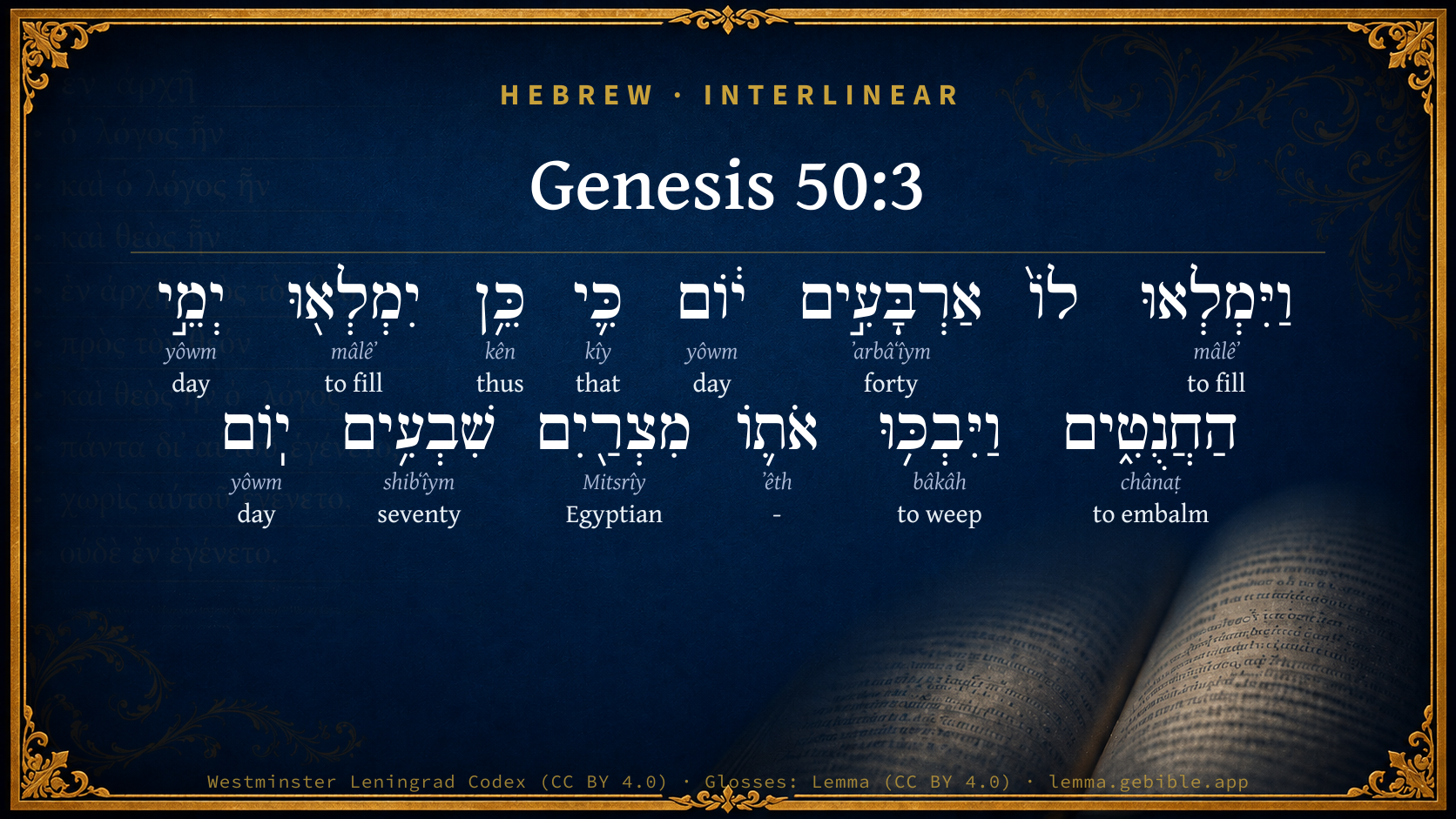
Hebrew (Westminster Leningrad Codex) Genesis 50:3 appears in the Hebrew Old Testament. The text above is from the Westminster Leningrad Codex. Each word links to its Strong’s number, a concise gloss, and parsing drawn from the Open Scriptures Hebrew Bible morphology. Click any word for its full Brown-Driver-Briggs (BDB) entry.
Download image
Cite this verse

Genesis 50:3 (World English Bible). Public Domain. Lemma interlinear Bible study tool, https://lemma.gebible.app/v/genesis/50/3.

Show BibTeX & RIS
BibTeX
RIS
English Translation
Forty days were fulfilled for him, for that is how many the days it takes to embalm. The Egyptians wept for him for seventy days.
World English Bible · Public Domain
Download a study sheet

One document with this verse’s original text, its word-by-word gloss line, the meaning frame, cross-references with their text, attributed commentary, and full source and license credits — printable, and it pastes into notes with its structure intact.

This verse Autodidact and up

Study sheet (.html) Plain text (.txt)

A passage Seminary Student

Up to 50 verses in one chapter. A passage sheet keeps up to 6 commentary sources and 12 cross-references per verse, in the order this page ranks them, and says so on the sheet whenever that leaves anything out. Ask for a single verse and you get the Autodidact verse sheet above.

Everything on this page stays free to read, with no account — the sheet is a download of what is already on screen, not access to it.

Want to remove ads? Support Godless Engineer
Compare translations 3

The same verse in 3 English versions, stacked beneath the original-language interlinear above. Click any original word for its lexicon entry.

Each is an independent rendering of the whole verse — the interlinear is not word-aligned to these translations.

Highlighted words mark where these versions differ — a whole-verse word diff, not a word-by-word alignment.

  • World English Bible Public Domain
    Forty days were fulfilled for him, for that is how many the days it takes to embalm. The Egyptians wept for him for seventy days.
  • King James Version Public Domain
    And forty days were fulfilled for him; for so are fulfilled the days of those which are embalmed: and the Egyptians mourned for him threescore and ten days.
  • unfoldingWord Literal Text CC BY-SA 4.0
    and they completed forty days for him, for so they complete the days of embalmings. And the Egyptians wept for him seventy days.

unfoldingWord Literal Text — © unfoldingWord, licensed CC BY-SA 4.0. Word-aligned USFM3 via Door43 (git.door43.org/unfoldingWord/en_ult).

Versions to compare (up to 4)

3 of 4 selected

Show all 18 translations

Every available English version of this verse, each an independent rendering of the whole verse.

  • World English Bible Public Domain
    Forty days were fulfilled for him, for that is how many the days it takes to embalm. The Egyptians wept for him for seventy days.
  • Berean Standard Bible Public Domain
    taking the forty days required to complete the embalming. And the Egyptians mourned for him seventy days.
  • Majority Standard Bible Public Domain
    taking the forty days required to complete the embalming. And the Egyptians mourned for him seventy days.
  • King James Version Public Domain
    And forty days were fulfilled for him; for so are fulfilled the days of those which are embalmed: and the Egyptians mourned for him threescore and ten days.
  • American Standard Version (1901) Public Domain
    And forty days were fulfilled for him; for so are fulfilled the days of embalming: and the Egyptians wept for him three-score and ten days.
  • Revised Version (1885) Public Domain
    And forty days were fulfilled for him; for so are fulfilled the days of embalming: and the Egyptians wept for him threescore and ten days.
  • Geneva Bible (1599) Public Domain
    So fourtie dayes were accomplished (for so long did the dayes of them that were enbaumed last) and the Egyptians bewayled him seuentie dayes.
  • Douay-Rheims (1899) Public Domain
    And while they were fulfilling his commands, there passed forty days: for this was the manner with bodies that were embalmed, and Egypt mounted for him seventy days.
  • Young's Literal Translation Public Domain
    and they fulfil for him forty days, for so they fulfil the days of the embalmed, and the Egyptians weep for him seventy days.
  • Literal Standard Version CC BY-SA 4.0
    and they fulfill for him forty days, for so they fulfill the days of the embalmed, and the Egyptians weep for him seventy days.
  • Unlocked Literal Bible CC BY-SA 4.0
    They took forty days, for that was the full time for embalming. The Egyptians wept for him seventy days.
  • unfoldingWord Literal Text CC BY-SA 4.0
    and they completed forty days for him, for so they complete the days of embalmings. And the Egyptians wept for him seventy days.
  • Darby Bible Public Domain
    And forty days were fulfilled for him; for so are fulfilled the days of those who are embalmed. And the Egyptians mourned for him seventy days.
  • World Messianic Bible Public Domain
    Forty days were used for him, for that is how many days it takes to embalm. The Egyptians wept for Israel for seventy days.
  • Webster's Bible Public Domain
    And forty days were fulfilled for him; (for so are fulfilled the days of those who are embalmed:) and the Egyptians mourned for him seventy days.
  • Free Bible Version CC BY-SA 4.0
    This took a full 40 days, the normal time for the process, and the Egyptians mourned for him for 70 days.
  • Bible in Basic English Public Domain
    And the forty days needed for making the body ready went by: and there was weeping for him among the Egyptians for seventy days.
  • JPS Tanakh (1917) Public Domain
    And forty days were fulfilled for him; for so are fulfilled the days of embalming. And the Egyptians wept for him threescore and ten days.

Literal Standard Version (2020), Covenant Press — licensed CC BY-SA 4.0. Text via the HelloAO Bible API (eBible.org). Unlocked Literal Bible (unfoldingWord) — licensed CC BY-SA 4.0. Text via the HelloAO Bible API (eBible.org). unfoldingWord Literal Text — © unfoldingWord, licensed CC BY-SA 4.0. Word-aligned USFM3 via Door43 (git.door43.org/unfoldingWord/en_ult). Free Bible Version, Dr. Jonathan Gallagher — licensed CC BY-SA 4.0. Text via the HelloAO Bible API (eBible.org).

Word by word

More ways to search: Search by grammar → Find every occurrence → Compare this word →

Practice this passage: Drill this verse → Learn its vocabulary →

הַחֲנֻטִ֑ים
chânaṭ
H2590
“the · embalming”
Particle, Definite Article + Noun, Common, Masculine, Plural, Absolute
Part of Speech
Particle + Noun
Type
Common
Gender
Masculine
Number
Plural
State
Absolute
Full BDB Definition

Origin: a primitive root

TWOT: TWOT- 691

to embalm, spice, make spicy (verb) - (Qal) - to spice, make spicy - to embalm - (CLBL) to ripen - (BDB) embalming (noun masculine plural abstract)
  1. וַיִּמְלְאוּ mâlêʼ H4390 “and · to fill” Conjunction + Verb, Qal, Sequential Imperfect, 3rd Person, Masculine, Plural
  2. אַרְבָּעִ֣ים ʼarbâʻîym H705 “forty” Adjective, Cardinal number, Both, Plural, Absolute
  3. י֔וֹם yôwm H3117 “day” Noun, Common, Masculine, Singular, Absolute
  4. כִּ֛י kîy H3588 “that” Conjunction
  5. כֵּ֥ן kên H3651 “thus” Particle, Demonstrative
  6. יִמְלְא֖וּ mâlêʼ H4390 “to fill” Verb, Qal, Jussive, 3rd Person, Masculine, Plural
  7. יְמֵ֣י yôwm H3117 “days of” Noun, Common, Masculine, Plural, Construct
  8. וַיִּבְכּ֥וּ bâkâh H1058 “and · to weep” Conjunction + Verb, Qal, Sequential Imperfect, 3rd Person, Masculine, Plural
  9. אֹת֛וֹ ʼêth H853 “- · him” Particle, Direct Object + Suffix, Personal, 3rd Person, Masculine, Singular
  10. מִצְרַ֖יִם Mitsrîy H4713 “Egyptian” Noun, Proper
  11. שִׁבְעִ֥ים shibʻîym H7657 “seventy” Adjective, Cardinal number, Both, Plural, Absolute
  12. יֽוֹם yôwm H3117 “day” Noun, Common, Masculine, Singular, Absolute

About this verse

These counts appear in no published source. They are computed here, from the morphology-tagged text and Lemma’s own curated glosses. What Lemma adds →

14
words
10
distinct lemmas
Pentateuch
section

Notable vocabulary

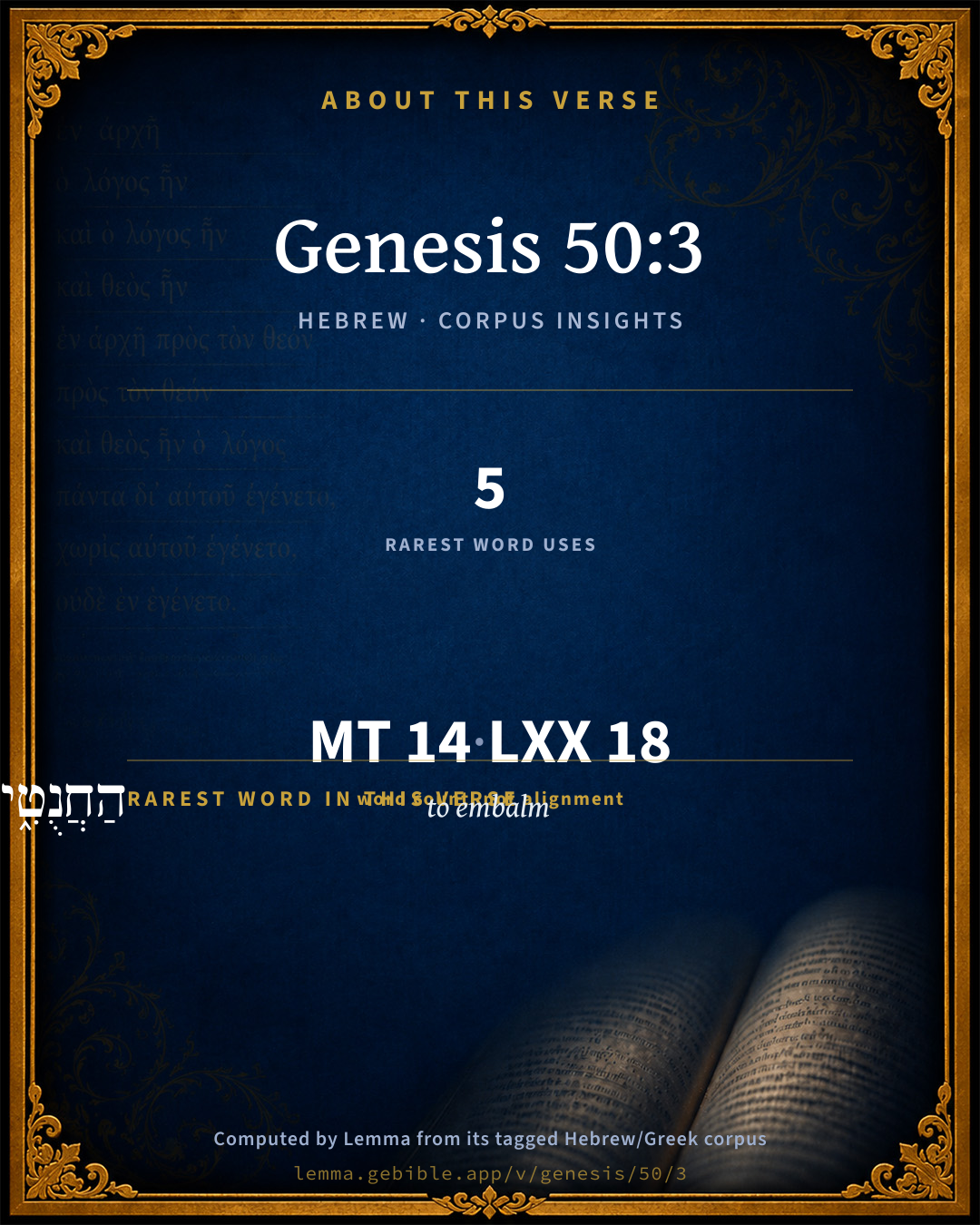
The rarest word here is הַחֲנֻטִ֑ים to embalm H2590 — appearing just 5 times in the whole Hebrew Bible.

Shared distinctive vocabulary

הַחֲנֻטִ֑ים to embalm H2590 occurs in 4 verses of the Hebrew Bible. Also found in:

Grammatical profile

  • 3 verbs
  • 5 nouns
  • 2 adjectives
  • 1 preposition
  • 1 conjunction
  • 2 particles

Verb forms

  • וַיִּמְלְאוּ Qal · Sequential Imperfect
  • יִמְלְא֖וּ Qal · Jussive
  • וַיִּבְכּ֥וּ Qal · Sequential Imperfect

Repetition

Words recur within this verse — often emphatic in Hebrew:

  • י֔וֹם day H3117 ×3
  • וַיִּמְלְאוּ to fill H4390 ×2

Hebrew & Septuagint length

In English translation the verse runs 25 words from the Hebrew and 22 from the Septuagint (LXX English) — closely comparable.

A rough comparison of the two English renderings, which tokenize alike — not a word-level alignment.

Word counts can differ between the Hebrew and the Greek without any difference in meaning — e.g. the Hebrew direct-object marker אֵת has no separate Greek word, and Greek often adds the article ὁ.

In the original languages it is 14 Hebrew tokens and 18 Greek tokens — but the two are counted differently (Hebrew bundles its prefixes and suffixes into one token; the Greek is in lemma form), so that isn’t a like-for-like length.

Cross-references

4

Topical passages linked to Genesis 50:3 in the Treasury of Scripture Knowledge — connected by theme and wording, ordered by reader-vote popularity; previews shown in the World English Bible.

  • Numbers 20:29 When all the congregation saw that Aaron was dead, they wept for Aaron thirty days, even all the house of Israel.
  • Deuteronomy 34:8 The children of Israel wept for Moses in the plains of Moab thirty days: so the days of weeping in the mourning for Moses were ended.
  • Genesis 50:10 They came to the threshing floor of Atad, which is beyond the Jordan, and there they lamented with a very great and sore lamentation. He mourned for his father seven days.
  • Deuteronomy 21:13 and she shall put the clothing of her captivity from off her, and shall remain in your house, and bewail her father and her mother a full month: and after that you shall go in to her, and be her husband, and she shall be your wife.

Cross-references courtesy of OpenBible.info (CC BY 4.0).

Hebrew and Greek witnesses Masoretic Hebrew ↔ Greek Septuagint

The same verse in the two great witnesses to the Old Testament, shown verse-for-verse.

These are two independent witnesses, not word-aligned to each other, and the Septuagint is shown in lemma (dictionary) form.

Hebrew Genesis 50:3 Masoretic · Westminster Leningrad Codex

וַיִּמְלְאוּ לוֹ֙ אַרְבָּעִ֣ים י֔וֹם כִּ֛י כֵּ֥ן יִמְלְא֖וּ יְמֵ֣י הַחֲנֻטִ֑ים וַיִּבְכּ֥וּ אֹת֛וֹ מִצְרַ֖יִם שִׁבְעִ֥ים יֽוֹם

Forty days were fulfilled for him, for that is how many the days it takes to embalm. The Egyptians wept for him for seventy days.

World English Bible · Public Domain

Greek LXX Genesis 50:3 Septuagint · lemma form

καί πληρόω αὐτός τεσσαράκοντα ἡμέρα οὕτως γάρ καταἀριθμέω ὁ ἡμέρα ὁ ταφή καί πενθέω αὐτός αἴγυπτος ἑβδομήκοντα ἡμέρα

And they fulfilled forty days for him, for so are the days of embalming numbered; and Egypt mourned for him seventy days.

LXX2012 (modern English Septuagint) · Public Domain

Hebrew: Westminster Leningrad Codex (CC BY 4.0). Greek: Septuagint (public domain); English from LXX2012 (modern English Septuagint) (Public Domain). How the Septuagint differs from the Hebrew →

Targum (Aramaic paraphrase)

2

The Targum is the ancient Jewish Aramaic paraphrase of the Hebrew Scriptures — an interpretive translation, not the Hebrew text itself. Onkelos (literal) and Pseudo-Jonathan (expansive) render the Torah, and Jonathan the Prophets. Coverage is partial: where no permissively-licensed English translation exists for a verse, only the Aramaic is shown. This is verse-level text, not a word-by-word alignment to the Hebrew.

  1. Targum Onkelos Torah (Genesis–Deuteronomy)
    וּשְׁלִימוּ לֵהּ אַרְבְּעִין יוֹמִין אֲרֵי כֵּן שְׁלִימוּ יוֹמֵי חֲנִיטַיָּא וּבְכוֹ יָתֵהּ מִצְרָאֵי שַׁבְעִין יוֹמִין

    (no public-domain English translation for this verse)

    Targum Onkelos — Aramaic: “Onkelos Genesis” (public domain); “Onkelos Exodus” (public domain); “Onkelos Leviticus” (public domain); “Onkelos Numbers” (public domain); “Onkelos Deuteronomy” (public domain). English: “Sefaria Community Translation” (CC0 1.0 (public-domain dedication)); “J.W. Etheridge. The Targums of Onkelos and Jonathan Ben Uzziel on the Pentateuch. London: Longmans, Green, 1862” (public domain). Text via Sefaria.

  2. Targum Pseudo-Jonathan Torah (Genesis–Deuteronomy)
    וּשְׁלִימוּ לֵיהּ מִן דְאִתְבְּסַם אַרְבְּעִין יוֹמִין אֲרוּם כְּדֵין שַׁלְמִין יוֹמֵי בַּסִימַיָיא וּבְכוּן יָתֵיהּ מִצְרָאֵי שׁוּבְעִין יוֹמִין אָמְרִין אִלֵין לְאִלֵין אִיתוּן נִבְכֵּי עַל יַעֲקב חֲסִידָא דְבִזְכוּתֵיהּ עֲדַת כַּפְנָא מִן אַרְעָא דְמִצְרַיִם דַהֲוָות גְזֵירְתָּא לְמֶהֱוֵי כַפְנָא אַרְבְּעִין וְתַרְתֵּין שְׁנִין וּבִזְכוּתֵיהּ דְיַעֲקב אִתְמַנְעָן אַרְבְּעִין שְׁנִין מִן מִצְרַיִם וְלָא הֲוָה כַּפְנָא אֱלָהֵן תַּרְתֵּין שְׁנִין בִּלְחוֹדֵיהוֹן

    And the forty days of embalming were completed to him; for so fulfil they the days of embalming; and the Mizraee lamented him seventy days; saying one to another, Come, let us lament over Jakob the Holy, whose righteousness turned away the famine from the land of Mizraim. For it had been decreed that there should be forty and two years of famine, but through the righteousness of Jakob forty years are withheld from Mizraim, and there came famine but for two years only.

    Targum Pseudo-Jonathan — Aramaic: “Targum Jonathan on Genesis” (public domain); “Targum Jonathan on Exodus” (public domain); “Targum Jonathan on Leviticus” (public domain); “Targum Jonathan on Numbers” (public domain); “Targum Jonathan on Deuteronomy” (public domain). English: “The Targum of Jonathan ben Uzziel, trans. J. W. Etheridge, London, 1862” (public domain). Text via Sefaria.

Commentary

Notes on Genesis 50:3 from classic Christian and Jewish commentators (each source and its license shown beneath its notes). The classic Christian expositions comment on the surrounding passage and are grouped to its opening verse, so a note may address several verses; the Jewish commentaries on the Tanakh (Rashi and others) are per-verse, so they appear only where the commentator wrote on this verse.

Lemma curates 59 commentaries, every one of them public domain or Creative Commons licensed, each selected and text-cleaned for this edition rather than reprinted as found. About our sources →

Trapp's Complete Commentary

John Trapp

Gen 50:3 And forty days were fulfilled for him; for so are fulfilled the days of those which are embalmed: and the Egyptians mourned for him threescore and ten days.

Ver. 3. And the Egyptians mourned for him seventy days.] Longer than Joseph mourned; they did it through "ignorance," and as men "without hope"; for both which, see 1Th 4:13. Joseph could look through his own loss, and see his father’s gain beyond it. Besides, he could say, as Jerome {a} in like case, Tulisti, Domine, patrem, quem ipse dederas: Non coutristor quid recepisti; ago gratias, quod dedisti. And if epicures could comfort themselves in their greatest dejections, ex praeteritarum voluptatum recordatione; { b} how much more could Joseph now; not only by calling to mind this last seventeen years’ enjoyment of his dear father, beyond all hope and expectation; but chiefly, that happy change his father had made, from darkness to light, from death to life, from sorrow to solace; from a factious world, to a heavenly habitation, where he drinks of that torrent of pleasure, without let or loathing.

{a} Jerome, ad Julian.

{b} Cic., De Finib., lib. ii.

John Trapp, A Commentary or Exposition upon All the Books of the Old and New Testament (1647–1656) — public domain. Text from a community e-Sword module.

Joseph Benson's Commentary

Gen 50:3. Forty days were fulfilled for him — That is, for embalming him, this time being, at the least, requisite to go through the process. But according to Herodotus, the body often remained at the embalmer’s seventy days. The Egyptians mourned for him threescore and ten days — Thirty days according to the custom of the Hebrews, Num 20:29,

Deu 34:8, over and above the forty employed in embalming, which also was a time of mourning. During all which time they either confined themselves, and sat solitary, or, when they went out, appeared in the habit of close mourners, according to the custom of the country.

Joseph Benson's Commentary on the Old and New Testaments (1811–1818) — public domain. Text from a community e-Sword module.

Tyndale Open Study Notes

Tyndale Open Resources

50:3 the Egyptians mourned for Jacob for seventy days, just two days short of the mourning period for a pharaoh. This showed the great respect that the Egyptians had for Joseph.

Tyndale Open Study Notes — © Tyndale Open Resources, licensed CC BY-SA 4.0. Text via the HelloAO Bible API.

Geneva Bible (1599)

Geneva Bible translators

They were more excessive in lamenting than the faithful.

Geneva Bible (1599) marginal notes — public domain. Text via Bolls.life.

Jamieson, Fausset & Brown

Robert Jamieson, A. R. Fausset & David Brown

the Egyptians mourned, &c. It was made a period of public mourning, as on the death of a royal personage.

Jamieson, Fausset & Brown — Commentary Critical and Explanatory on the Whole Bible (1871) — public domain (CC PDM 1.0). Text via the HelloAO Bible API.

Adam Clarke's Commentary

Verse 3. Forty days] The body it appears required this number of days to complete the process of embalming; afterwards it lay in natron thirty days more, making in the whole seventy days, according to the preceding accounts, during which the mourning was continued.

Adam Clarke's Commentary on the Bible (1810–1826) — public domain. Text from a community e-Sword/MySword module.

John Calvin's Commentaries

3. And forty days were fulfilled for him. We have shown already that Moses is speaking of a ceremonial mourning; and therefore he does not prescribe it as a law, or produce it as an example which it is right for us to follow. For, by the laws, certain days were appointed, in order that time might be given for the moderating of grief in some degree; yet something also was conceded to ambition. Another rule, however, for restraining grief is given to us by the Lord. And Joseph stooped, more than he ought, to the perverted manners of the Egyptians; for the world affects to believe that whatever is customary is lawful; so that what generally prevails, carries along everything it meets, like a violent inundation. The seventy days which Moses sets apart to solemn mourning, Herodotus, in his second book, assigns to the embalming. But Diodorus writes that the seasoning of the body was completed in thirty days. Both authors diligently describe the method of embalming. And though I will not deny that, in the course of time, the skill and industry in practicing this art increased, yet it appears to me probable that this method of proceeding was handed down from the fathers.

John Calvin's Commentaries (1540-1563) — public domain. Text from the Calvin Translation Society English edition (1840s-50s) via the Christian Classics Ethereal Library (ccel.org). Calvin's coverage is partial (roughly two-thirds of the Bible); uncommented books and verses are honest gaps, never fabricated. The 19th-century editor's footnotes and remarks are omitted so the notes are faithfully Calvin's own voice.

Ellicott's Commentary for English Readers

(3) Forty days.—Herodotus (ii. 86) describes the process of embalming as occupying seventy days, but he was speaking of what he saw at Thebes, whereas Memphis was the Egyptian capital in Joseph’s time; and the mummies of Thebes are, we are told, far more perfectly preserved than those of Memphis. Diodorus agrees very nearly with the periods mentioned here, saying (i. 91) that the embalming took somewhat more than thirty days, and the mourning for a king seventy-two. The usual period of mourning among the Israelites was thirty days (Num_20:29 : Deu_34:8). Probably, therefore, the forty days spent in the embalming were included in the “threescore and ten days,” during which the Egyptians mourned for Jacob.

A Bible Commentary for English Readers, edited by Charles John Ellicott (1878–1897) — public domain. Text from a community e-Sword module.

The Cambridge Bible for Schools and Colleges

gen. ed. J. J. S. Perowne

3. forty days] Herod. ii. 86 mentions 70 days, and Diodorus (i. 72) mentions 72 days as the time required for the process of embalming.

threescore and ten days] It is here specially mentioned in honour of Jacob, that the Egyptian nation mourned him for 70 days.

The period of mourning for Aaron and for Moses was 30 days (Num_20:29; Deu_34:8). In later historic times the period of mourning for the dead was seven days (cf. 1Sa_31:13; Job_2:13; Sir_22:12; Jdt_16:24).

The Cambridge Bible for Schools and Colleges (gen. ed. J. J. S. Perowne; Cambridge University Press, 1878–1918) — public domain. Text from a community e-Sword module.

John Gill's Exposition

Forty days were fulfilled for him,.... Were spent in embalming him:

for so are fulfilled the days of those that are embalmed; so long the body lay in the pickle, in ointment of cedar, myrrh and cinnamon, and other things, that it might soak and penetrate thoroughly into it: and so Diodorus Siculus (d) says, that having laid more than thirty days in such a state, it was delivered to the kindred of the deceased:

and the Egyptians mourned for him seventy days; during the time of their embalming him; for longer than seventy days the body might not lie in the pickle, as before observed, from Herodotus. According to Diodorus Siculus (e), the Egyptians used to mourn for their kings seventy two days: the account he gives is, that"upon the death of a king, all Egypt went into a common mourning, tore their garments, shut up their temples, forbid sacrifices, kept not the feasts for seventy two days, put clay upon their heads (f), girt linen clothes under their breasts; men and women, two or three hundred together, went about twice a day, singing in mournful verses the praises of the deceased; they abstained from animal food, and from wine, and all dainty things; nor did they use baths, nor ointments, nor lie in soft beds, nor dared to use venery, but, as if it was for the death of a beloved child, spent the said days in sorrow and mourning.''Now these seventy days here are either a round number for seventy two, or two are taken from them, as Quistorpius suggests, to make a difference between Jacob, and a king of theirs, who yet being the father of their viceroy, they honoured in such a manner. Jarchi accounts for the number thus, forty for embalming, and thirty for mourning; which latter was the usual time for mourning with the Jews for principal men, and which the Egyptians added to their forty of embalming; see Num 20:29.

(d) lBibliothec. l. 1. p. 82. (e) lbid. p. 65. (f) Vid. Pompon. Mela de Situ Orbis, l. 1. c. 9.

John Gill's Exposition of the Whole Bible (1746–1763) — public domain (CC PDM 1.0). Text via the HelloAO Bible API.

Matthew Poole's English Annotations

For him, i.e. for his embalming; that so the drugs or spices which were applied might more effectually reach to all the parts of the dead body, and keep it from corruption. And the effect of their diligence and so long continuance in this work was, that bodies have been preserved uncorrupt for some thousand of years.

Threescore and ten days, i.e. thirty days, (according to the custom of the Hebrews, Num 20:29; Deu 34:8, to which doubtless the Egyptians in this case did accommodate themselves,) besides the forty days spent in embalming him, which also was a time of mourning. And thus I suppose the Egyptians reckoned those seventy-two days which Diodorus Siculus saith they spent in mourning for their deceased kings.

Matthew Poole's English Annotations on the Holy Bible (1683–1685) — public domain. Text from a community e-Sword/MySword module.

Whedon's Commentary on the Bible

Daniel D. Whedon

3. Forty days… of those which are embalmed… mourned for him threescore and ten days — That is, it required forty days for the embalming, during which time the mourning for him went on, and after the embalming they continued to mourn for thirty days more. Thus the Egyptians honoured Jacob as though he were a great prince. “Diodorus says, that the process of embalming took more than thirty days, and that the Egyptians were accustomed to mourn seventy-two days for a king. Herodotus mentions that the body was never allowed to lie in the natron more than seventy days, 2:86. These periods, given by the classical writers, it will be seen remarkably correspond with the numbers of the text. The actual process occupied the first forty days, while the body lay for thirty days more in natron, completing thus the seventy days of mourning. Wilkinson, in Rawl., Her., ii, p. 122. There were, however, many grades and varieties of the process, according to the rank of the person, for rank is seen in the grave in Egypt as well as in Christendom.” — Newhall.

Daniel D. Whedon (gen. ed.), Commentary on the Old and New Testaments (1874–1909) — public domain. Text from a community e-Sword module.

The Pulpit Commentary

And forty days were fulfilled for him; for so are fulfilled the days of those who are embalmed: and the Egyptians mourned (literally, wept) for him threescore and ten days i.e. the whole period of mourning, including the forty days for embalming, extended to seventy days, a statement which strikingly coincides with the assertion of Diodorus Siculus (1:72), that the embalming process occupied about thirty days, while the mourning continued seventy-two days; the first number, seventy, being seven decades, or ten weeks of seven days, and the second 12 x 6 = 72, the duodecimal calculation being also used in Egypt (vide Wilkinson in Rawlinson"s "Herodotus," vol. 2. p. 121; and in " Manners and Customs of the Ancient Egyptians: vol. 3. p. 471, et seqq., ed. 1878). The apparent discrepancy between the accounts of Genesis and Herodotus will disappear if the seventy days of the Greek historian, during which the body lay in antrum, be viewed as the entire period of mourning (Hengstenberg"s "Egypt and the Books of Moses," p. 68; Sir G. Wilkinson in Rawlinson"s "Herodotus," vol. 2. p. 121), a sense which the words tauta desantev tariceuousi litrw krihyantev hJmerav ejbdomhkonta (Heb 2:86) will bear, though Kalisch somewhat arbitrarily, but unconvincingly, pronounces it to be "excluded both by the context and Greek syntax."

The Pulpit Commentary (1880–1919), ed. H.D.M. Spence-Jones & Joseph S. Exell — public domain. Text from a community e-Sword module.

John Wesley's Explanatory Notes

He observed the ceremony of solemn mourning for him. Forty days were taken up in embalming the body, which the Egyptians had an art of doing so curiously, as to preserve the very features of the face unchanged. All this time, and thirty days more, seventy in all, they either confined themselves and sat solitary, or when they went out, appeared in the habit of close mourners, according to the decent custom of the country. Even the Egyptians, many of them, out of the respect they had for Joseph, put themselves into mourning for his father.

John Wesley, Explanatory Notes Upon the Whole Bible (1754–1765) — public domain. Text via the GEBible commentary corpus.

Rashi

Rabbi Shlomo Yitzchaki (Rashi)

וימלאו לו [AND FORTY DAYS] WERE FULFILLED — They (the physicians) completed the days of embalming until forty days were completed for him.

ויבכו אתו מצרים שבעים יום AND THE EGYPTIANS WEPT FOR HIM THREESCORE AND TEN DAYS — viz., forty days during the period of embalming and thirty more days for mourning. They wept for him during so long a period because a blessing had come to them on his arrival in Egypt for the famine then ceased and the waters of the Nile again increased (Midrash Tanchuma, Nasso 26).

Rashi on the Tanakh — English translations: “The Judaica Press complete Tanach with Rashi, translated by A. J. Rosenberg” (CC BY 4.0); “Pentateuch with Rashi's commentary by M. Rosenbaum and A.M. Silbermann, 1929-1934” (public domain); “The Metsudah Tanach series, Lakewood, N.J” (CC BY 4.0); and “The Book of Joshua, Metsudah Publications, 1997” (CC BY 4.0). Text via Sefaria.

Radak

Rabbi David Kimhi (Radak)

שבעים יום. Forty days were spent embalming his body and thirty days of weeping for the absence of this man henceforth. We find that both Moses and Aaron were mourned for 30 days (Numbers 20,29 and Deuteronomy 34 8) The difference was that Moses and Aaron were mourned after they had been buried, whereas Yaakov was mourned prior to his interment. This was permissible as the embalming procedure was equated with a kind of burial. During all these days the Egyptians wept out of respect for the feelings of Joseph. According to a view quoted by Rashi, the Egyptians also mourned him, being aware that this man had been able to arrest the famine five years before it had run its predetermined course. This concludes the manuscripts available of the Redak’s commentary on the Torah. We are all impoverished when reflecting on much has been lost of his commentary.

Radak on the Tanakh — English translations: “Sefaria Community Translation” (CC0 1.0 (public-domain dedication)); “Eliyahu Munk, HaChut Hameshulash” (CC BY 4.0); “Rabbi Mike Feuer, Jerusalem Anthology” (CC BY 4.0); and “R. David Kimhi on the first book of Psalms, Translated by R.G. Finch, London, 1919” (public domain). Text via Sefaria.

Lesson kit

Teaching starters — assembled from the data on this page, not authored interpretation. Every prompt links to the verse data it draws on. Edit before teaching.

Genesis, in the Pentateuch, opens this verse with 14 words (10 distinct Hebrew lemmas). Its most distinctive word is chânaṭ (“to embalm”). A historical commentator’s framing appears above. Read the whole chapter for the surrounding context.

Discussion questions

  1. The word chânaṭ carries the sense “to embalm.” How does it shape the verse?
  2. Genesis 50:2 shares the word «to embalm» with this verse. How do the two illuminate each other?
  3. “day” occurs 3× in this one verse. What is the effect of the repetition?
  4. The translations on this page render this verse differently — a whole-verse word diff, not a word-by-word alignment. What might account for the different wordings?
  5. The verb «וַיִּמְלְאוּ» is Qal Sequential Imperfect. How does its form color the action?
  6. Reading how Trapp's Complete Commentary and Joseph Benson's Commentary read this verse, where do the two commentators agree and where do they part?

Things to notice

Reading settings

Reading text

Shown beneath each verse's original-language words.

Old Testament
Old Testament edition

Read the OT as the Masoretic Hebrew (MT) or the Greek Septuagint (LXX).

English shown for the Greek Septuagint (in the Hebrew ↔ Greek comparison).

Comparing translations? Open the Compare panel on any verse page to stack up to four side by side.