
Romans 6:19

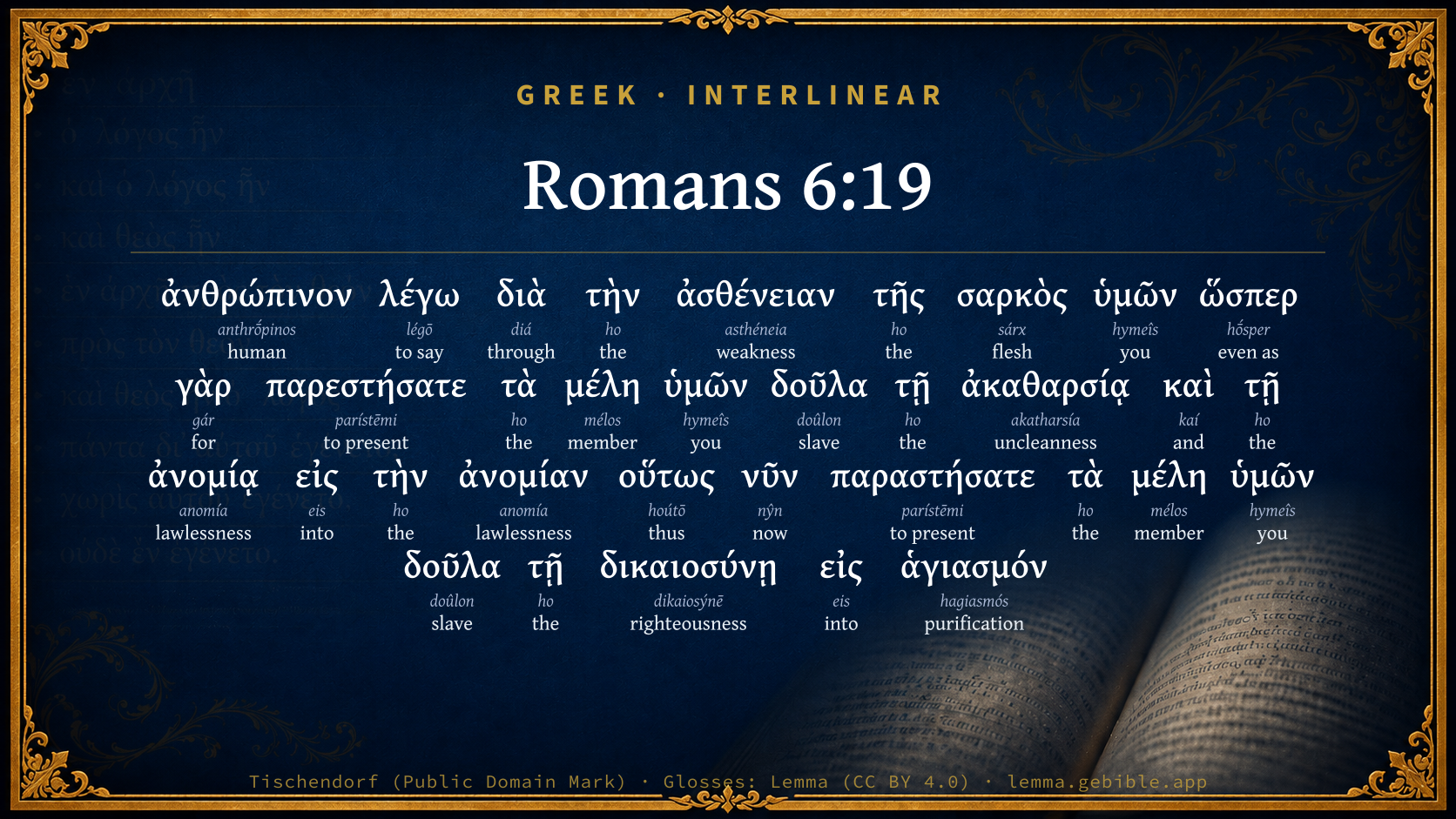
Greek (Tischendorf 8th ed.) Romans 6:19 appears in the Greek New Testament. The text above is from the Tischendorf 8th edition. Each word links to its Strong’s number and a concise gloss. Click any word for its full Thayer’s Greek Lexicon entry.
Download image
Cite this verse

Romans 6:19 (World English Bible). Public Domain. Lemma interlinear Bible study tool, https://lemma.gebible.app/v/romans/6/19.

Show BibTeX & RIS
BibTeX
RIS
English Translation
I speak in human terms because of the weakness of your flesh, for as you presented your members as servants to uncleanness and to wickedness upon wickedness, even so now present your members as servants to righteousness for sanctification.
World English Bible · Public Domain
Highlights
  • 2 first appearances in the Greek New Testament
Full analysis ↓
Download a study sheet

One document with this verse’s original text, its word-by-word gloss line, the meaning frame, cross-references with their text, attributed commentary, and full source and license credits — printable, and it pastes into notes with its structure intact.

This verse Autodidact and up

Study sheet (.html) Plain text (.txt)

A passage Seminary Student

Up to 50 verses in one chapter. A passage sheet keeps up to 6 commentary sources and 12 cross-references per verse, in the order this page ranks them, and says so on the sheet whenever that leaves anything out. Ask for a single verse and you get the Autodidact verse sheet above.

Everything on this page stays free to read, with no account — the sheet is a download of what is already on screen, not access to it.

Want to remove ads? Support Godless Engineer
Compare translations 3

The same verse in 3 English versions, stacked beneath the original-language interlinear above. Click any original word for its lexicon entry.

Each is an independent rendering of the whole verse — the interlinear is not word-aligned to these translations.

Highlighted words mark where these versions differ — a whole-verse word diff, not a word-by-word alignment.

  • World English Bible Public Domain
    I speak in human terms because of the weakness of your flesh, for as you presented your members as servants to uncleanness and to wickedness upon wickedness, even so now present your members as servants to righteousness for sanctification.
  • King James Version Public Domain
    I speak after the manner of men because of the infirmity of your flesh: for as ye have yielded your members servants to uncleanness and to iniquity unto iniquity; even so now yield your members servants to righteousness unto holiness.
  • unfoldingWord Literal Text CC BY-SA 4.0
    I speak as a man because of the weakness of your flesh. For just as you presented your members as slaves to uncleanness and to more and more lawlessness, so now present your members slaves to righteousness to sanctification.

unfoldingWord Literal Text — © unfoldingWord, licensed CC BY-SA 4.0. Word-aligned USFM3 via Door43 (git.door43.org/unfoldingWord/en_ult).

Versions to compare (up to 4)

3 of 4 selected

Show all 19 translations

Every available English version of this verse, each an independent rendering of the whole verse.

  • World English Bible Public Domain
    I speak in human terms because of the weakness of your flesh, for as you presented your members as servants to uncleanness and to wickedness upon wickedness, even so now present your members as servants to righteousness for sanctification.
  • Berean Standard Bible Public Domain
    I am speaking in human terms because of the weakness of your flesh. Just as you used to offer the parts of your body in slavery to impurity and to escalating wickedness, so now offer them in slavery to righteousness leading to holiness.
  • Majority Standard Bible Public Domain
    I am speaking in human terms because of the weakness of your flesh. Just as you used to offer the parts of your body in slavery to impurity and to escalating wickedness, so now offer them in slavery to righteousness leading to holiness.
  • King James Version Public Domain
    I speak after the manner of men because of the infirmity of your flesh: for as ye have yielded your members servants to uncleanness and to iniquity unto iniquity; even so now yield your members servants to righteousness unto holiness.
  • American Standard Version (1901) Public Domain
    I speak after the manner of men because of the infirmity of your flesh: for as ye presented your members `as' servants to uncleanness and to iniquity unto iniquity, even so now present your members `as' servants to righteousness unto sanctification.
  • Revised Version (1885) Public Domain
    I speak after the manner of men because of the infirmity of your flesh: for as ye presented your members as servants to uncleanness and to iniquity unto iniquity, even so now present your members as servants to righteousness unto sanctification.
  • Geneva Bible (1599) Public Domain
    I speake after the maner of man, because of the infirmitie of your flesh: for as yee haue giuen your members seruants to vncleannes and to iniquitie, to commit iniquitie, so now giue your mebers seruants vnto righteousnesse in holinesse.
  • Douay-Rheims (1899) Public Domain
    I speak an human thing, because of the infirmity of your flesh. For as you have yielded your members to serve uncleanness and iniquity, unto iniquity; so now yield your members to serve justice, unto sanctification.
  • Young's Literal Translation Public Domain
    In the manner of men I speak, because of the weakness of your flesh, for even as ye did present your members servants to the uncleanness and to the lawlessness -- to the lawlessness, so now present your members servants to the righteousness -- to sanctification,
  • Literal Standard Version CC BY-SA 4.0
    I speak in a human [way], because of the weakness of your flesh, for even as you presented your members servants to the uncleanness and to the lawlessness—to the lawlessness, so now present your members servants to righteousness—to sanctification,
  • Unlocked Literal Bible CC BY-SA 4.0
    I speak like a man because of the weakness of your flesh. For just as you presented the parts of your body as slaves to uncleanness and to evil, in the same way now, present the parts of your body as slaves to righteousness for sanctification.
  • unfoldingWord Literal Text CC BY-SA 4.0
    I speak as a man because of the weakness of your flesh. For just as you presented your members as slaves to uncleanness and to more and more lawlessness, so now present your members slaves to righteousness to sanctification.
  • Darby Bible Public Domain
    I speak humanly on account of the weakness of your flesh. For even as ye have yielded your members in bondage to uncleanness and to lawlessness unto lawlessness, so now yield your members in bondage to righteousness unto holiness.
  • World Messianic Bible Public Domain
    I speak in human terms because of the weakness of your flesh; for as you presented your members as servants to uncleanness and to wickedness upon wickedness, even so now present your members as servants to righteousness for sanctification.
  • Webster's Bible Public Domain
    I speak after the manner of men, because of the infirmity of your flesh: for as ye have yielded your members servants to uncleanness and to iniquity, to (work) iniquity; even so now yield your members servants to righteousness, to (work) holiness.
  • Free Bible Version CC BY-SA 4.0
    I'm using this everyday example because your human thinking is limited. Just as you once enslaved yourselves to immorality, piling up sin upon sin, now you must enslave yourselves to what is pure and right.
  • Bible in Basic English Public Domain
    I am using words in the way of men, because your flesh is feeble: as you gave your bodies as servants to what is unclean, and to evil to do evil, so now give them as servants to righteousness to do what is holy.
  • Text-Critical English NT CC BY 4.0
    (I am speaking in human terms because of the weakness of your flesh.) For just as you presented your members as slaves to impurity and to lawlessness leading to more lawlessness, so now present your members as slaves to righteousness leading to sanctification.
  • Tyndale New Testament (1534) Public Domain
    I will speake grossly because of the infirmitie of youre flesshe. As ye have geve youre membres servauntes to vnclennes and to iniquitie from iniquitie vnto iniquitie: even so nowe geve youre membres servantes vnto rightewesnes that ye maye be sanctified.

Literal Standard Version (2020), Covenant Press — licensed CC BY-SA 4.0. Text via the HelloAO Bible API (eBible.org). Unlocked Literal Bible (unfoldingWord) — licensed CC BY-SA 4.0. Text via the HelloAO Bible API (eBible.org). unfoldingWord Literal Text — © unfoldingWord, licensed CC BY-SA 4.0. Word-aligned USFM3 via Door43 (git.door43.org/unfoldingWord/en_ult). Free Bible Version, Dr. Jonathan Gallagher — licensed CC BY-SA 4.0. Text via the HelloAO Bible API (eBible.org).

Word by word

More ways to search: Search by grammar → Find every occurrence → Compare this word →

Practice this passage: Drill this verse → Learn its vocabulary →

δοῦλα
doûlon
G1400
“slave”
Adjective, Accusative, Plural, Neuter
Part of Speech
Adjective
Case
Accusative
Number
Plural
Gender
Neuter
Full Thayer's Definition

Origin: See definition G1401

TDNT: None

- Original: δοῦλον - Transliteration: Doulon - Phonetic: doo'-lon - Definition: - Origin: See definition G1401 - TDNT entry: None - Part(s) of speech: - Strong's: Neuter of G1401 ; subservient : - servant.
  1. ἀνθρώπινον anthrṓpinos G442 “human” Adjective, Accusative, Singular, Neuter
  2. λέγω légō G3004 “to say” Verb, Present, Active, Indicative, 1st person, Singular
  3. διὰ diá G1223 “through” Preposition
  4. τὴν ho G3588 “the” Article, Accusative, Singular, Feminine
  5. ἀσθένειαν asthéneia G769 “weakness” Noun, Accusative, Singular, Feminine
  6. τῆς ho G3588 “the” Article, Genitive, Singular, Feminine
  7. σαρκὸς sárx G4561 “flesh” Noun, Genitive, Singular, Feminine
  8. ὑμῶν hymeîs G5210 “you” Personal pronoun, 2nd person, Genitive, Plural
  9. ὥσπερ hṓsper G5618 “even as” Adverb
  10. γὰρ gár G1063 “for” Conjunction
  11. παρεστήσατε parístēmi G3936 “to present” Verb, Aorist, Active, Indicative, 2nd person, Plural
  12. τὰ ho G3588 “the” Article, Accusative, Plural, Neuter
  13. μέλη mélos G3196 “member” Noun, Accusative, Plural, Neuter
  14. ὑμῶν hymeîs G5210 “you” Personal pronoun, 2nd person, Genitive, Plural
  15. τῇ ho G3588 “the” Article, Dative, Singular, Feminine
  16. ἀκαθαρσίᾳ akatharsía G167 “uncleanness” Noun, Dative, Singular, Feminine
  17. καὶ kaí G2532 “and” Conjunction
  18. τῇ ho G3588 “the” Article, Dative, Singular, Feminine
  19. ἀνομίᾳ anomía G458 “lawlessness” Noun, Dative, Singular, Feminine
  20. εἰς eis G1519 “into” Preposition
  21. τὴν ho G3588 “the” Article, Accusative, Singular, Feminine
  22. ἀνομίαν anomía G458 “lawlessness” Noun, Accusative, Singular, Feminine
  23. οὕτως hoútō G3779 “thus” Adverb
  24. νῦν nŷn G3568 “now” Adverb
  25. παραστήσατε parístēmi G3936 “to present” Verb, Aorist, Active, Imperative, 2nd person, Plural
  26. τὰ ho G3588 “the” Article, Accusative, Plural, Neuter
  27. μέλη mélos G3196 “member” Noun, Accusative, Plural, Neuter
  28. ὑμῶν hymeîs G5210 “you” Personal pronoun, 2nd person, Genitive, Plural
  29. δοῦλα doûlon G1400 “slave” Adjective, Accusative, Plural, Neuter
  30. τῇ ho G3588 “the” Article, Dative, Singular, Feminine
  31. δικαιοσύνῃ dikaiosýnē G1343 “righteousness” Noun, Dative, Singular, Feminine
  32. εἰς eis G1519 “into” Preposition
  33. ἁγιασμόν hagiasmós G38 “purification” Noun, Accusative, Singular, Masculine

About this verse

These counts appear in no published source. They are computed here, from the morphology-tagged text and Lemma’s own curated glosses. What Lemma adds →

34
words
20
distinct lemmas
Pauline Epistles
section

Notable vocabulary

The rarest word here is δοῦλα slave G1400 — appearing just 2 times in the whole Greek New Testament.

First appearance in Scripture

These words make their first canonical appearance in the Greek New Testament here:
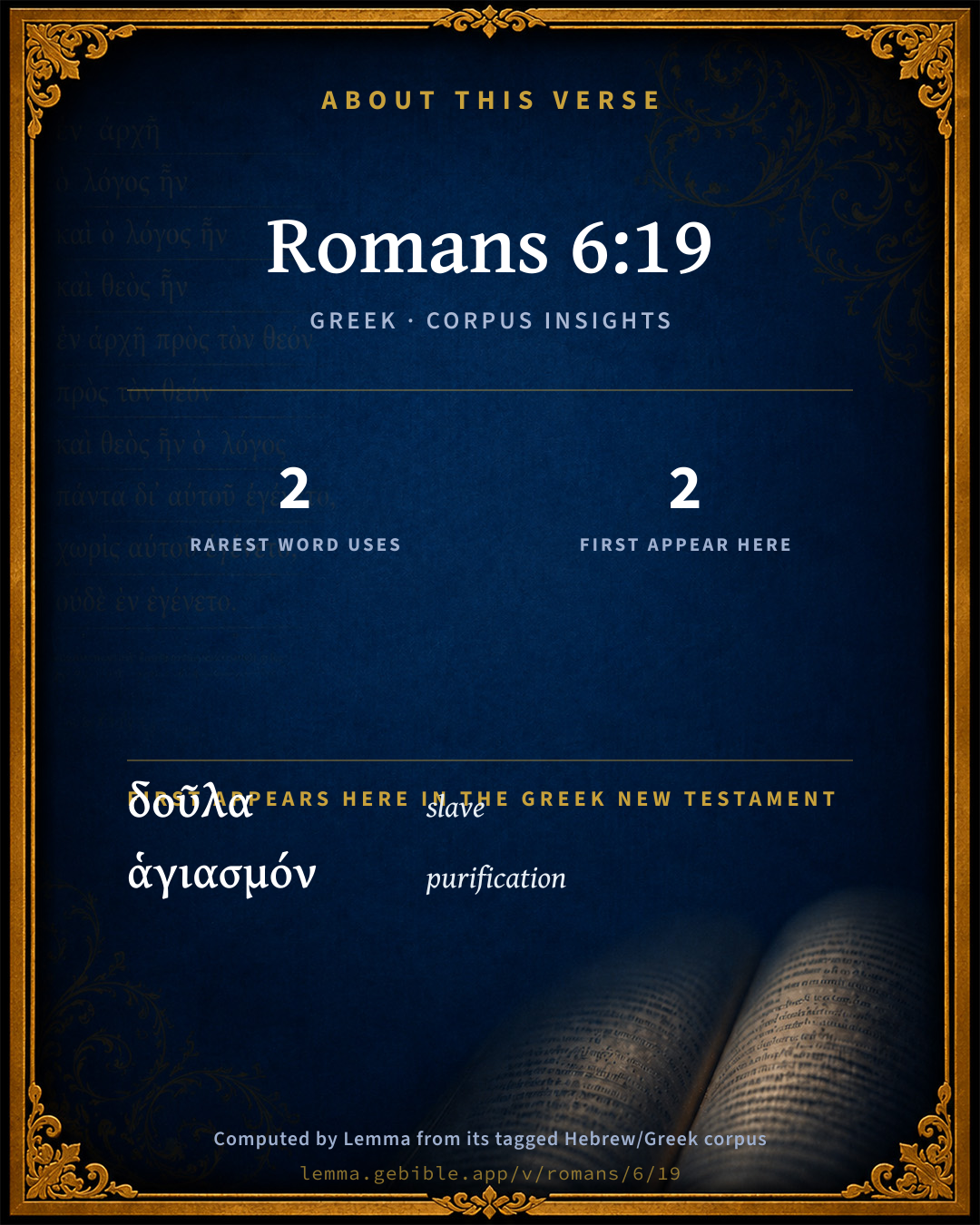
  • δοῦλα slave G1400
  • ἁγιασμόν purification G38

Repetition

Words recur within this verse:

  • παρεστήσατε to present G3936 ×2
  • μέλη member G3196 ×2
  • δοῦλα slave G1400 ×2
  • ἀνομίᾳ lawlessness G458 ×2
  • εἰς into G1519 ×2
  • τὴν the G3588 ×8
  • ὑμῶν you G5210 ×3

Cross-references

16

Topical passages linked to Romans 6:19 in the Treasury of Scripture Knowledge — connected by theme and wording, ordered by reader-vote popularity; previews shown in the World English Bible.

  • Romans 6:13 Neither present your members to sin as instruments of unrighteousness, but present yourselves to God, as alive from the dead, and your members as instruments of righteousness to God.
  • 1 Peter 4:2–4 that you no longer should live the rest of your time in the flesh for the lusts of men, but for the will of God.
  • Colossians 3:5–7 Put to death therefore your members which are on the earth: sexual immorality, uncleanness, depraved passion, evil desire, and covetousness, which is idolatry;
  • Ephesians 2:2–3 in which you once walked according to the course of this world, according to the prince of the powers of the air, the spirit who now works in the children of disobedience;
  • 1 Corinthians 6:11 Such were some of you, but you were washed. But you were sanctified. But you were justified in the name of the Lord Jesus, and in the Spirit of our God.
  • Romans 3:5 But if our unrighteousness commends the righteousness of God, what will we say? Is God unrighteous who inflicts wrath? I speak like men do.
  • Romans 6:16–17 Don't you know that to whom you present yourselves as servants to obedience, his servants you are whom you obey; whether of sin to death, or of obedience to righteousness?
  • Galatians 3:15 Brothers, I speak like men. Though it is only a man's covenant, yet when it has been confirmed, no one makes it void, or adds to it.
  • Romans 8:26 In the same way, the Spirit also helps our weaknesses, for we don't know how to pray as we ought. But the Spirit himself makes intercession for us with groanings which can't be uttered.
  • Romans 15:1 Now we who are strong ought to bear the weaknesses of the weak, and not to please ourselves.
  • 1 Corinthians 5:6 Your boasting is not good. Don't you know that a little yeast leavens the whole lump?
  • 1 Corinthians 9:8 Do I speak these things according to the ways of men? Or doesn't the law also say the same thing?
  • 2 Timothy 2:16–17 But shun empty chatter, for they will proceed further in ungodliness,
  • Hebrews 12:15 looking carefully lest there be any man who falls short of the grace of God; lest any root of bitterness springing up trouble you, and thereby the many be defiled;
  • 1 Corinthians 15:32–33 If I fought with animals at Ephesus for human purposes, what does it profit me? If the dead are not raised, then "let us eat and drink, for tomorrow we die."
  • Hebrews 4:15 For we don't have a high priest who can't be touched with the feeling of our infirmities, but one who has been in all points tempted like we are, yet without sin.

Cross-references courtesy of OpenBible.info (CC BY 4.0).

Commentary

Notes on Romans 6:19 from classic Christian and Jewish commentators (each source and its license shown beneath its notes). The classic Christian expositions comment on the surrounding passage and are grouped to its opening verse, so a note may address several verses; the Jewish commentaries on the Tanakh (Rashi and others) are per-verse, so they appear only where the commentator wrote on this verse.

Lemma curates 59 commentaries, every one of them public domain or Creative Commons licensed, each selected and text-cleaned for this edition rather than reprinted as found. About our sources →

The Biblical Illustrator

Joseph S. Exell

Rom_6:19-20

I speak after the manner of men.

Apostolic exhortation

I. Its method. After the manner of men, i.e., (Gr.) humanly--as men ordinarily speak, borrowing any illustrations from common life. Spiritual subjects are made plainer by familiar comparisons, and so preachers should use simple language and homely illustrations. This was exemplified in Christ, and inspired writers in general. The most useful preachers have ever been those who speak most humanly. The arrow too high flies over the head; too low falls short of the mark.

II. The reason for the method. The infirmity of your flesh--imperfect knowledge through the flesh--an apology for the use of the expression slaves, etc. Some believers are still babes and carnal (1Co_3:1-4; Heb_5:12-14); others are spiritual and of a full age. In Gods family are fathers, young men, little children (1Jn_2:12-14). The flesh is an impediment to the apprehension of truth. Carnal nature views holiness not as liberty but as bondage. Arguments and modes of speaking to be adapted to the hearers state. Let not the mature and enlightened, then, cavil at methods adapted to reach the immature and ignorant and vice versa.

III. Its substance.

1. A reminiscence. As ye have yielded your members servants--

(1) To uncleanness, a characteristic of heathen life in general (Rom_1:24). Uncleanness is sin against oneself: unchastity of life. All sin is uncleanness; some sins especially so (Rom_13:13). The greatest slave is he who serves sensual pleasures.

(2) To iniquity--unlawfulness--what is opposed to Gods law, and even the laws of human society (Luk_18:4). Uncleanness and iniquity include the whole circumference of sin (Mat_15:19).

(3) Unto iniquity--to the practice of iniquity as a result; to an always still greater progress and depth in iniquity. The practice is the necessary effect of the bondage. Sin allows none of its servants to remain idle.

2. An enforcement of duty. Even so now--as heartily and thoroughly, and in consideration of the past yield your members--

(1) Servants to righteousness. Still servants, but to righteousness instead of sin. Christ gives His disciples a yoke, but it is an easy one. Servitude to righteousness means truest liberty.

(2) Unto holiness--so as to practise and grow in it. Holiness is that which is in accordance with Gods will, and embraces the whole man (1Th_5:23). It is a matter of growth. The faithful performance of one duty prepares for that of another. Victory over one sin strengthens us for victory over a second. The practice of righteousness confirms the principle of holiness. Gracious acts strengthen gracious habits, as labour adds to muscle. (T. Robinson, D. D.)

Will ye be the servants of sin or the servants of God

?--To determine your choice consider--

I. The contrast.

1. Sin conducts you from iniquity to iniquity.

2. God will lead you in the path of holiness.

II. The immediate consequences.

1. The fruit of sin is shame.

2. Of faith is holiness.

III. The final result.

1. The wages of sin is death.

2. The gift of God eternal life. (J. Lyth, D. D.)

Forsake the service of sin; enter the service of righteousness

Then you escape--

1. Out of disgraceful impurity into true holiness (Rom_6:19-21).

2. Out of dishonourable servitude into true freedom (Rom_6:20-22).

3. Out of death and condemnation into eternal life (Rom_6:21-23). (W. Hauck.)

Two ways and two ends

I. The one was bitter servitude; the other sweet liberty.

II. The one has disgraceful notoriety; the other praiseworthy modesty.

III. The one has eternal death; the other eternal life. Note what Jesus says of these two ways and their ending (Mat_7:13). (W. Ziethe.)

The slavery of sin unlawful--a ground of hope to the sinner

Luthers domestic, Elizabeth, in a fit of displeasure, left his service without notice. She subsequently fell into sin and became dangerously ill. Luther visited her, and, taking his seat by her bedside, she said, I have given my soul to Satan. Why, rejoined Luther, thats of no consequence. What else? I have, continued she, done many wicked things; but this is what most oppresses me, that I have deliberately sold my poor soul to the devil, and how can such a crime ever find mercy? Elizabeth, listen to me, rejoined the man of God. Suppose, while you lived in my house, you had sold and transferred all my children to a stranger, would the sale or transfer have been lawful and binding? Oh no, said the deeply humbled girl, for I had no right to do that. Very well, you had still less right to give your soul to the arch enemy; it no more belongs to you than my children do. It is the exclusive property of the Lord Jesus Christ; He made it, and when lost also redeemed it; it is His, with all its powers and faculties, and you cant giveaway and sell what is not yours; if you have attempted it, the whole transaction was unlawful, and entirely void. Now, do you go to the Lord, confess your guilt with a broken heart and a contrite spirit, and entreat Him to pardon you, and take back again what is wholly His own. And as for the sin of attempting to alienate His rightful properly, throw that back upon the devil, for that, and that alone is his. The girl obeyed, was converted, and died full of hope.

Changed uses

Among the spoils taken when Alexander conquered and captured Darius was a richly jewelled cabinet or casket in which the Persian king kept his perfumes and sweet ointments. It was carried to Alexander, who at once turned it to another and nobler use, and added a syllable to its name. He placed in it his copy of the Iliad, saying, This shall no longer be called myrrh box, but Homer box. What the myrrh box became by passing under Alexanders hands illustrates what the soul becomes by passing under the hands of its Divine Inspirer. By unseen influences (as certainly as by the miracle touch) God adds to the graces of a chosen vessel the gift of spiritual power and expression. He makes it empty that He may fill it with greater riches.

For when ye were the servants of sin, ye were free from righteousness.

The servants of sin

1. There is no condition so sad as that of a slave; and no slavery so hard as that of sin. There was once a tyrant who ordered one of his subjects to make an iron chain of a certain length. The man brought the work, and the tyrant bade him make it longer still. And he continued to add link to link, till at length the cruel taskmaster ordered his servants to bind the worker with his own chain, and cast him into the fire. That hardest of tyrants, the devil, treats his slaves in like manner. At first the chain of sin is light, and could easily be cast off. But day by day Satan bids his victims add another link. The servant of sin grows more hardened, daring, reckless in his evil way. He adds sin to sin, and then the end comes.

2. Very often the slaves of sin do not know that they are slaves. They talk about their freedom from restraint, they tell us they are their own masters, that the godly are slaves. Once I visited a madhouse. Some had one delusion, some another. One thought he was a king, another the heir to a fortune. But one thing they all believed, that they were in their right minds.

3. The servants of sin bear about the marks of their master. I have seen gangs of convicts working on Dartmoor. You could not mistake them for anything else if they were dressed in the best of clothing. The word convict is stamped upon every grey face, as plainly as the Government mark is stamped upon their clothing. The servants of sin have their marks also. Look at the shifty eyes, and downward glance of the knave and the false man; the flushed brow and cruel eyes of the angry man; the weak lips and trembling hand of the drunkard.

4. The servants of sin have their so-called enjoyments, these are the baits with which the tyrant gets them into his power. For a time the way of transgressors is made easy and pleasant. The broad road is shaded, and edged with fair fruits and flowers. A saint of old once saw a man leading a herd of swine, which followed him willingly. When the saint marvelled, the man showed him that they followed him for the sake of the sweet food in his hand, and knew not whither they were going. So the servants of sin follow Satan for the sake of the sweet things which he offers, and know not that they are going to their death, even the living death of a lost soul. (J. H. W. Buxton, M. A.)

Freedom from righteousness

Standing altogether outside it, having no relation to it, destitute of it, entirely unaffected by it; strangers therefore to its happy and gainful service. Possessing a freedom which is a bane and a bondage. A planets freedom from the law which preserves it in its orbit; a childs freedom from the restraints of a happy home. This freedom pleases the flesh, but ruins the man; it is not mercifully given, but madly taken; it is Satans miserable choice, Better to reign in hell than serve in heaven. Note the latent irony of the text; Ye were free; but what kind of freedom? A freedom akin to that of hell. Freedom from righteousness a mans greatest misery; freedom in righteousness his greatest mercy. (T. Robinson, D. D.)

Liberty and restraint

You hear every day greater numbers of foolish people speaking about liberty, as if it were such an honourable thing; so far from being that, it is, on the whole, and in the broadest sense, dishonourable, and an attribute of the lower creatures. No human being, however great or powerful, was ever so free as a fish. There is always something that he must or must not do; while the fish may do whatever he likes. All the kingdoms of the world put together are not half so large as the sea, and all the railroads and wheels that ever were or will be invented, are not so easy as fins. You will find, on fairly thinking of it, that it is his restraint which is honourable to man, not his liberty; and, what is more, it is restraint which is honourable even in the lower animals. A butterfly is more free than a bee, but you honour the bee more just because it is subject to certain laws which fit it for orderly function in bee society. And throughout the world, of the two abstract things, liberty and restraint, restraint is always the more honourable. It is true, indeed, that in these and all other matters you never can reason finally from the abstraction, for both liberty and restraint are good when they are nobly chosen, and both are bad when they are badly chosen; but of the two, I repeat, it is restraint which characterises the higher creature, and betters the lower creature; and from the ministering of the archangel to the labour of the insect, from the poising of the planets to the gravitation of a grain of dust--the power and glory of all creatures and all matter consist in their obedience, not in their freedom. The sun has no liberty, a dead leaf has much. The dust of which you are formed has no liberty. Its liberty will come--with its corruption. (J. Ruskin.)

The Biblical Illustrator, edited by Joseph S. Exell (c. 1880s–1900s) — public domain. Text from a community e-Sword module.

Joseph Benson's Commentary

Rom 6:19-22. I speak after the manner of men — He seems to mean that his reasoning was taken from the customs of men, and was accommodated to their apprehension; and that he used metaphors and allegories which were well known; because of the infirmity of your flesh — Dulness of apprehension, and weakness of understanding, flow from the infirmity of the flesh; that is, of human nature. Or, as some understand the expression to mean, I recommend a duty to you, suited to human nature; yea, even to the infirmities thereof; that you should do as much for God as you have done for sin, and be as diligent in the service of Christ as you have been in the pursuit of your lusts. For as — In time past, while you were ignorant of the gospel, and many of you the slaves of heathen vice and idolatry; ye yielded your members servants to uncleanness — To various fleshly lusts which defiled you; and to iniquity — Or unrighteousness toward others; unto iniquity — Adding one iniquity to another; even so now — Being enlightened by the gospel to see the evil of such things, and the miserable consequences awaiting them; and being renewed by the influences of divine grace, it is but reasonable that you should be as ready to pursue a pious and virtuous line of conduct, and to do good now, as formerly you were to do evil; and become servants of righteousness unto holiness — Observe, reader, they who are true servants of righteousness, which may here mean a conformity to the divine will, go on to holiness, which implies a conformity to the divine nature. For when ye were the servants of sin — Were under its guilt and power; ye were free from righteousness — You not only had not righteousness enough, but, strictly speaking, had no true righteousness at all; never doing any single action that was truly good, and, on the whole, acceptable to God, because none was performed from such principles as could entitle it to his complete approbation. In all reason, therefore, ye ought now to be free from unrighteousness; to be as uniform and zealous in serving God as you were in serving the devil. What fruit had ye then in those things — Consider, what advantage did you derive from the practices to which you were then habituated, and whereof ye are now ashamed? — The very remembrance of which now gives you pain, and creates in you much remorse and trouble? For the end of those things is death — The word τελος, here rendered end, signifies both the end for which a thing is done, and the last issue of it. It is used in the former sense, 1Pe 1:9; receiving, το τελος, the end of your faith, the salvation of your souls; the end or purpose for which ye believed. But its meaning here is, that the punishment of death, to be inflicted on sinners, is the natural consequence, or issue, and reward of their sin.

Joseph Benson's Commentary on the Old and New Testaments (1811–1818) — public domain. Text from a community e-Sword module.

Tyndale Open Study Notes

Tyndale Open Resources

6:19 Paul uses the Greek word sarx (human nature, or flesh) to refer to the frailty and proneness to sin that characterizes humans. Paul uses the illustration of slavery to show the relationship of the human nature to sin.

Tyndale Open Study Notes — © Tyndale Open Resources, licensed CC BY-SA 4.0. Text via the HelloAO Bible API.

Bengel's Gnomon

Johann Albrecht Bengel

Rom 6:19. Ἀνθρώπινον, after the manner of men) Language after the manner of men, is frequent, and in some measure always occurring, whereby Scripture condescends to suit itself to our capacity. Too plain language is not always better [the best] adapted to the subject in hand. The accusative is used for the adverb. [According to our mode of speaking, it may be translated, Ich muss es euch mir massiv sagen, I must speak to you with great plainness and simplicity.—V. g.]—διὰ, because of) Slowness of understanding arises from weakness of the flesh, i.e., of a nature merely human, comp. 1Co 3:3. Ἀσθένειαν, weakness) Those who desire discourse to be continuously in all respects quite plain, should perceive in this a mark of their own weakness, and should not take amiss [take offence at] a more profound expression of the truth, but they should consider it with gratitude, as an ample benefit, if in one way or the other, they have had the good fortune to understand the subject: at first, the mode of expressing the truth is more sublime, then afterwards it is more plain, as in the case of Nicodemus.—Joh 3:3; Joh 3:15. That which pleases most [the greatest number] is not always the best.—V. g.—τῇ ἀνομιᾳ εἰς τὴν ἀνομίαν, to iniquity unto iniquity) A ploce[65] not observed by the Syriac version. The word [to] iniquity [ἀνομίᾳ] (before which uncleanness is put, as a part before a whole) is opposed to righteousness; the word [unto] iniquity [ἀνομίαν] is opposed to holiness [end of verse] Righteousness corresponds to the Divine will, holiness as it were, to the whole of the Divine nature. Those who are the servants of righteousness, make progress [i.e., advance from righteousness to holiness, whereby they partake of the Divine nature]; ἄνομοι, workers of iniquity are workers of iniquity, nothing more.

[65] See App., tit. Ploce. A word twice put, once in the simple sense, and once again to express some attribute of the word.

Bengel's Gnomon of the New Testament — English translation (T&T Clark, Edinburgh, 1860) — public domain. Text from a community e-Sword module.

Meyer's Critical & Exegetical Commentary

Heinrich August Wilhelm Meyer

Rom_6:19. Paul had, in Rom_6:16-18, represented the idea of the highest moral freedomin a form corresponding indeed with its nature as a moral necessity (Deo servire vera libertas est, Augustine), but still borrowed from human relationsas δουλεία. He now therefore, not to justify himself, but to induce his readers to separate the idea from the form, announces the fact that, and the reason why, he thus expresses himself regarding the loftiest moral idea in this concrete fashion, derived from an ordinary human relation. I speak (in here making mention of slavery, Rom_6:16-18) what is human (belonging to the relations of the natural human life) on account of the (intellectual) weakness of your flesh, i.e. in order thereby to come to the help of this your weakness. For the setting forth of the idea in some such sensuous form is the appropriate means of stimulating and procuring its apprehension in the case of one, whose knowledge has not yet been elevated by divine enlightenment to a higher platform of strength and clearness released from such human forms. Respecting ἀνθρώπινον see the examples in Wetstein. It is the antithesis of θεῖον, Plat. Rep. p. 497 C. The expression κατὰ ἄνθρωπον λέγω in ch. Rom_3:5 is in substance equivalent, since ἀνθρώπινον also necessarily indicates the form and dress employed for the idea, for whose representation the Apostle has uttered what is human. The σάρξ, however, i.e. the material human nature in its psychical determination, as contrasted with the divine pneumatic influence (comp on Rom_4:1), is weak for religious and moral discernment, as well as for good (Mat_26:41); hence the σοφία σαρκική (2Co_1:12) is foolishness with God (1Co_3:19). Others, taking it not of intellectual weakness, but of moral weakness, refer it to what follows (Origen, Chrysostom, Theophylact, Erasmus, Calvin, Estius, Hammond, Wetstein, and others, including Klee, Reithmayr, and Bisping), in the sense: I do not demand what is too hard (ἀνθρώπ., comp 1Co_10:13); for although I might require a far higher degree of the new obedience, yet I require only the same as ye have formerly rendered to sin.[1483] But the following ὭΣΠΕΡ.… ΟὝΤΩ introduces not the equality of the degree, but, as is plain from Rom_6:20, only the comparison in general between the former and the present state. Besides, the demand itself, which by this interpretation would only concern a lower stage of Christian life, would be inappropriate to the morally ideal character of the whole hortatory discourse, which is not injured by the concrete figurative form. This remark also applies to the dismembering explanation of Hofmann (comp Th. Schott), who makes ἈΝΘΡΏΠΙΝΟΝ ΛΈΓΩ form a parenthesis, and then connects ΔΙᾺ ΤῊΝ ἈΣΘΈΝΕΙΑΝ Τ. ΣΑΡΚῸς ὙΜῶΝ with ἘΔΟΥΛΏΘΗΤΕ Τῇ ΔΙΚΑΙΟΣΎΝῌ, so that the thought would be: the weakness of our in born nature gives occasion that our translation into the life of righteousness is dealt with as an enslavement thereto, while otherwise it would be simply restoration to the freedom of doing our own will; according to this weakness what is right is not done freely of itself, but in the shape of a service. But how could Paul have so degraded the moral loftiness of the position of the δουλωθέντες τῇ δικαιοσύνῃ! To him they were indeed the ΔΟΥΛΩΘΈΝΤΕς Τῷ ΘΕῷ (Rom_6:22), and in his estimation there was nothing morally more exalted than to be ΔΟῦΛΟς ΘΕΟῦ, as Christ Himself was. The Christian has put on Christ in this respect also (Gal_3:27), and lives in the spirit of the holiest freedom (2Co_3:17 f.); his subjection to the service of ΔΙΚΑΙΟΣΎΝΗ has not taken place on account of his inborn nature incapacitating him for moral freedom (as though it were a measure of compulsion); but on the contrary he has put off the morally weak old man, and so he lives as a new creatureby means of the newness of the spirit, and in virtue of his communion in the resurrection-life of Christin the condition of righteousness, which Paul has here under the designation of bondage, accommodating himself by the ordinary human expression to the natural weakness of the understanding, brought into contrast with the having been freed from sin.

ὥσπερ γάρ Κ.Τ.Λ[1485]] Practical assigning of a reason for the proposition just affirmed ἀνθρωπίνως in Rom_6:18, in the form of a concrete demand. In opposition to Hofmann, who (at variance with his own interpretation of Rom_13:6!) declares it impossible to clothe the assigning of a reason in the dress of an exhortation, see Baeumlein, Partik. p. 86. Heb_12:3 (see Delitzsch) is to be taken in the same way; comp Jam_1:7; and see on 1Co_1:26. Hence: for, as ye have placed your members at the disposal, etc., so now place, etc. Since the discourse proceeds indeed in the same figurative manner, but yet so that it now assumes the hortatory form, ἀνθρώπινον.… σαρκὸς ὑμῶν is not to be put in a parenthesis, but with Fritzsche, Lachmann, and Tischendorf, to be separated from ὥσπερ by a period.

τῇ ἀκαθαρσίᾳ κ. τῇ ἀνομίᾳ] The two exhaust the notion of ἁμαρτία (Rom_6:13), so that ἀκαθ. characterises sin as morally defiling the man (see on Rom_1:24), and ἀνομ. (1Jn_3:4) as a violation of the divine law (see Tittmann, Synon. p. 48).

εἰς τὴν ἀνομ.] on behalf of antagonism to law, in order that it may be established (in facto). The interpretation εἰς τὸ ἐπιπλέον ἀνομεῖν, Theophylact (so also Oecumenius, Erasmus, Luther, Grotius, Köllner, Ewald, and others), is, in its practical bearing, erroneous, since it is only the yielding of the members to the principle of ἀνομία that actually brings the latter into a concrete reality.

εἰς ἁγιασμόν] in order to attain holiness (1Co_1:30; 1Th_4:3 f. 7; 2Th_2:13), moral purity and consecration to God. To be an ἅγιος in mind and walkthat goal of Christian developmentis the aim of the man, who places his members at the disposal of δικαιοσύνη as ruler over him. The word ἁγιασμός is found only in the LXX., Apocr. and in the N. T. (in the latter it is always holiness, not sanctification,[1487] even in 1Ti_2:15; Heb_12:14; 1Pe_1:2), but not Greek writers. In Dion. Hal. i. 21, it is a false reading, as also in Diod. iv. 39. ʼΑγιασμόν stands without the article, because this highest moral goal is conceived of qualitatively.

[1483] So also probably Theodoret: τῇ φύσει μετρῶ τὴν παραίνεσιν· οἶδα γὰρ τὰ ἐν τῷ θνητῷ σώματι κινούμενα πάθη.

[1485] .τ.λ. καὶ τὰ λοιπά.

[1487] In opposition to Hofmann, on ver. 22. But to the Christian consciousness it is self-evident that holiness can only be attained under the influence of the Holy Spirit. Comp. Ritschl, altkath. K. p. 82.

Meyer — Critical and Exegetical Commentary on the New Testament — English translation by Peter Christie, edited by Frederick Crombie (T&T Clark, 1880) — public domain. Text from a community e-Sword module.

Expositor's Greek Testament

ed. W. Robertson Nicoll

Rom 6:19 . ἀνθρώπινον λέγω διὰ τὴν ἀσθένειαν τῆς σαρκὸς ὑμῶν . Cf. Rom 3:5 , Gal 3:15 . Paul apologises for using this human figure of the relation of slave to master to convey spiritual truths. But what is “the weakness of the flesh” which makes him have recourse to such figures? Weiss makes it moral. The Apostle speaks with this unmistakable plainness and emphasis because he is writing to morally weak persons whose nature and past life really made them liable to temptations to libertinism. This seems to me confirmed by the reference, which immediately follows, to the character of their pre-Christian life. Others make the weakness rather intellectual than ethical, as if Paul said: “I condescend to your want of spiritual intelligence in using such figures”. But this is not a natural meaning for “the weakness of your flesh,” and does not yield so good a connection with what follows. δοῦλα τῇ ἀκαθαρσίᾳ καὶ τῇ ἀνομίᾳ : ἀκαθαρσία defiling the sinner, ἀνομία disregarding the will of God. If εἰς τὴν ἀνομίαν should remain in the text, it may suggest that this bad life never gets beyond itself. On the other hand, to present the members as slaves to righteousness has ἁγιασμός in view, which is a higher thing. ἁγιασμὸς is sanctification, primarily as an act or process, eventually as a result. It is unreal to ask whether the process or the result is meant here: they have no meaning apart.

The Expositor's Greek Testament, edited by W. Robertson Nicoll (1897–1910) — public domain. Text from a community e-Sword module.

Cambridge Greek Testament for Schools and Colleges

19. ἀνθρώπινον λέλω. An apology for the harsh word ἐδουλώθηστε:he calls it slavery, because the weakness of the flesh needs just such a masterful control as that word implies, and as it had lent itself to under its former master. The mastery of Christ is even more exacting and exclusive than the mastery of sin: Cf. Mat 5:20. He developes this thought in Rom 6:19-21.

διὰ τὴν ἀσθ. gives the reason why he thinks the word δουλεία appropriate even to their new life.

ὥσπερ γὰρ κ.τ.λ. A summary of the state described in Rom 1:18 f. Cf. Rom 2:14 f.

εἰς ἁγιασμόν = for hallowing, to be hallowed; the translation into character of the call expressed in the name ἅγιοι: submitting their lives to the influence of the revealed δικαιοσύνη: here, as generally, marks the process; cf. 1Pe 1:2; 2Th 2:13; 1Th 4:7. The hallowing is the work of the Spirit (cf. Rom 8:2) upon their surrendered lives.

Cambridge Greek Testament for Schools and Colleges (Cambridge University Press, 1896; 21 vols, various authors incl. Carr, Maclear, Plummer, Farrar, Lumby, Moule, M. R. James, Simcox) — public domain. Text from a community e-Sword module.

Godet's Commentaries

Frédéric Louis Godet

Vv. 19. “I speak after the manner of men because of the infirmity of your flesh: for as ye have yielded your members servants to uncleanness, and to iniquity unto iniquity; even so now yield your members servants to righteousness unto holiness.”

Several critics (Beng., De Wette, Mey., Philip.) refer the fleshly infirmity of the Romans, of which the apostle here speaks, to their intellectual weakness, their inability to apprehend religious truth adequately. This is the reason which has led him to make use of a human mode of speaking, calling the fulfilment of righteousness a servitude, which, from the divine point of view, is, on the contrary, true liberty. What is well-founded in this explanation is the application of the first words of Rom 6:19 to the term servitude used in Rom 6:18. But what seems to me inexact, is to apply the expression weakness of the flesh to a defect of understanding. Does not this explanation contradict what the apostle recognizes in such forcible terms, Rom 15:14 : the high degree of Christian knowledge to which the Church of Rome has already attained? Weakness of the flesh (more literally: proceeding from the flesh) must therefore denote a general state shared by the Romans with the great majority of the members of the Christian Church, consequently a moral rather than an intellectual state; and this is really what the expression used by the apostle naturally indicates. If the obligation to practice righteousness seems to the greater number of believers to be a subjection to a strange principle, it is not in consequence of a want of understanding; the cause is deeper; it is because the flesh, the love of the ego, has not yet been completely sacrificed. From this moral fact there arises even in the Christian the painful impression that perfect righteousness is a most exacting, sometimes even a harsh master, and that the obligation to conform in all points to the will of God makes him a slave. Such is the imperfect moral condition to the impressions of which Paul accommodates his language in the expressions used in Rom 6:18. The ancient Greek interpreters thought this remark, Rom 6:19 a, should be connected with what follows, giving it the meaning: “I do not mean to ask of you what goes beyond your human weakness, caused by the flesh; yield your members only to righteousness in the same measure as you formerly yielded them to sin. I do not ask more of you.” But it is evident that the apostle, in a passage in which he is describing the standard of Christian holiness, cannot think of abating aught of the demands of the new principle. The exhortation which follows cannot be less absolute than that which preceded, Rom 6:12-13, and which was unaccompanied by any such clause. Hofmann and Schott take the two words ἀνθρώπινον λέγω, I speak as a man, as a parenthesis, and join the regimen διὰ τὴν ἀσθένειαν, on account of the weakness of the flesh, to the verb: ye became subject, Rom 6:18. According to this view Paul recognizes that the practice of goodness is really a servitude for the believer, subjection to a strange will; and that arising from the persistence of the old nature, and from the fact that the flesh requires to be constantly subdued. But it is very doubtful whether the apostle here seriously called by the name of servitude that Christian life which he represents always, like Jesus Himself, as the most glorious emancipation. Undoubtedly, in 1Co 9:27, he uses the expression δουλαγωγεῖν, to bring into subjection, but in a figure, and in relation to the body.

The imperative yield proves that the second part of the verse is an exhortation. But in this case why attach it with a for to what precedes? Can an exhortation serve to demonstrate anything? Does it not require itself to be founded on a demonstration? To understand this strange form, we must, I think, change the imperative yield into the form: “ye are held bound to yield.” We can then understand how this idea may be connected by for with Rom 6:18 : “Ye were made subject to righteousness henceforth, since, in fact (for), it remains to you only to yield your members.” It must not be forgotten, indeed, that the exhortation: yield your members, was already expressed previously in Rom 6:12-13, and that as logically based on all that preceded (therefore, Rom 6:12), and that consequently the transition from Rom 6:18 b to 19b may be thus paraphrased: “ye became the servants of righteousness, for, in fact, as I have shown you, ye have now nothing else to do than to yield your members to righteousness.” The only difference between the exhortation of Rom 6:12-13 and that of 18b is that Paul said in the former: do; while here, in keeping with the object of this second passage, he says: “And ye cannot do otherwise.” By this relation between the for of Rom 6:19 b and Rom 6:18, it may be proved that 19a is indeed, as we have seen, an interjected observation.

There is a slightly ironical touch in the meaning of the second part of Rom 6:19. It concerns the readers to be now in the service of their new master, righteousness, as active and zealous servants as they formerly were in the service of their old master. “Ye were eager to yield your members to sin to commit evil, be ye now as eager to yield them to righteousness to realize holiness. Do not inflict on this second master the shame of serving him less faithfully than the first.” The old master is denoted by the two terms ἀκαθαρσία, uncleanness, and ἀνομία, lawlessness, life going beyond all rule, licentiousness. The first of these terms characterizes sin as personal degradation, the second as contempt of the standard of right written in the law on every man’s conscience (Rom 2:14-15). This distinction seems to us more natural than that laid down by Tholuck, who takes the term uncleanness in the strictly proper sense of the word, and who takes lawlessness to be sin in general. The broad sense which we give to the word uncleanness appears clearly from 1Th 4:7. The two expressions therefore embrace each, as it seems to us, the whole sphere of sin, but from two different points of view.

From sin as a principle, the apostle passes to sin as an effect. The regimen εἰς ἀνομίαν, unto lawlessness, signifies: to do all one’s pleasure without being arrested in the least by the line of demarkation which separates good from evil. This expression ἀνομία, lawlessness, so expressly repeated, and this whole description of the previous life of the readers, is evidently more applicable to men formerly Gentiles than to believers of Jewish origin.

With sin characterized as an evil disposition, as an inward principle, in the two forms of degradation and lawlessness, there is contrasted goodness, also as a principle and as a moral disposition, by the term δικαιοσύνη, righteousness. This is the will of God, moral obligation accepted by the believer as the absolute rule of his will and life. Then with sin as an effect produced in the form of ἀνομία, the rejection of every rule in practice, there is contrasted goodness as a result obtained, by the term ἁγιασμός: this is the concrete and personal realization of goodness, the fruit of perpetual submission to the principle of righteousness, holiness, or sanctification. The word ἁγιασμός is usually translated by sanctification, and this is represented as the progressive amelioration of the individual resulting from his moral self-discipline. It is certain that Greek substantives in μος or σμος are, as Curtius says (Schulgramm. § 342), nomina actionis, denoting properly an action put forth, rather than a state of being. But we must not forget two things: 1. That, from the Scripture point of view, the author of the act denoted by the term sanctify is God, and not man; this is established, as it seems to me, by 1Pe 1:2, 2Th 2:13, and 1Co 1:30, where this act is ascribed to the Holy Spirit and to Christ. 2. That even in the Old Testament the term ἁγιασμός seems to be used in the LXX. to denote not the progressive work, but its result; thus Amo 2:11, where the LXX. use this word to translate nezirim, the consecrated ones; and Eze 45:4, where it seems to be taken in the same sense as mikdasch, sanctuary. In the New Testament, likewise, it more naturally denotes the result reached than the action put forth, in the following passages: 1Th 4:3; 1Ti 2:15; Heb 12:14. We are thus led to translate it rather by the term holiness. And this seems to be confirmed by the preposition εἰς, for, unto, which expresses the goal rather than the way. If it is asked wherein the term ἁγιασμός, taken in the sense of holiness, still differs from ἁγιότης, (Heb 12:10) and ἁγιωσύνη (Rom 1:4; 1Th 3:13; 2Co 7:1), which seem to be completely synonymous, the indication of the shade may be found in the form of the terminations: ἁγιότης denotes holiness as an abstract idea; ἁγιωσύνη, as a personal quality, an inward disposition; ἁγιασμός, as a work which has reached the state of complete realization in the person and life, the result of the divine act expressed by ἁγιάζειν.

The apostle has thus reminded the church of the two principles between which it has finally made its choice, and the necessity laid on the believer to be as thoroughgoing in his new master’s service as he had been in that of the former; he now labors to strengthen this choice and decision by presenting the consequences of the one and the other condition of dependence. On the one side, shame and death; on the other, holiness and life. Here is the second part of the passage; Rom 6:20-21 describe the consequences of the service of sin to their extreme limit; Rom 6:22 gives the consequences of dependence on God also to their final goal; Rom 6:23, in an antithesis full of solemnity, formulates this double end of human life.

Frédéric Louis Godet — Commentaries on Luke, John, Romans, and 1 Corinthians — English translation (T&T Clark, Edinburgh, 1870s–1890s) — public domain. Text from a community e-Sword module.

Hodge's Commentary on Romans, Ephesians & First Corinthians

Charles Hodge

Rom_6:19

I speak after the manner of men, ἀνθρώπινον λέγω; I say what is human, i.e. common among men. The only difference between this expression and the more common phrase, κατ ̓ ἄνθρωπον λέγω, is, that the former characterizes as human the thing said, and the other the manner of saying it. The idea in this case is the same. The apostle means to say, that he uses an illustration drawn from the common relations of men, to set forth the relation of the believer to God. The slave is bound to serve his master; the obedience of the believer to God is no less certain. The one is slavery, because the obedience is independent of the will, and coerced; the other is perfect freedom, because rendered from the heart, and with full consent of the will. Yet both are a δουλεία so far as certainty of obedience is concerned. This is the common and natural interpretation of this clause. Others, however, take ἀνθρώπινον in the sense in which it is used in 1Co_10:13. There it is opposed to what is superhuman, beyond the strength of man to bear: I demand only what is human. The obedience required is, on account of the weakness of your flesh, only such as you are able to render. For as ye served sin, so you can serve righteousness. The one is as easy as the other. The one is the measure of the other. But this does violence to the connection. The ὥσπερ οὕτω do not refer to the measure of the obedience, but to the change of masters: As ye served sin, so now serve God. Besides, the principle that the measure of obedience is determined by our ability, is utterly at variance with the word of God and the dictates of conscience. The simple design of the apostle in this passing or parenthetical remark is, to state the reason why he designated our new relation to God a slavery. He used this illustration, he says, on account of the weakness of their flesh; not intellectual weakness, but such as arose from the σάρξ, their nature as corrupt. It was their lack of spirituality which rendered such illustrations necessary. The γάρ (for) of the next clause refers to Rom_6:18 : Being freed from sin, ye became the servants of righteousness; for as ye yielded your members, etc. Your members, yourselves, your various faculties, with special reference to their bodily organs as the outward, visible instruments of evil. Ye yielded your members, δοῦλα, bound. This is the only passage in the New Testament in which δοῦλος is used as an adjective. They yielded their members to uncleanness and to iniquity, τῇ ἀκαθαρσίᾳ καὶ τῇ ἀνομίᾳ. These two words express the same thing under different aspects. Sin subjectively considered is pollution, a defilement of the soul; relatively to the law of God, it is ἀνομία, what is unlawful, what fails of conformity to the law. In the next clause, unto iniquity, the word is used in a wider sense. They gave themselves up to iniquity, that is, to do evil; εἰς τὴν ἀνομίαν being equivalent to εἰς τὸ ποιεῖν ἀνομίαν. Men give themselves up to sin as a master, to do what the law forbids. The same idea is expressed, if εἰς τὴν ἀνομίαν means, for the manifestation of iniquity. So now yield your members as servants to righteousness. Having been delivered from bondage to the tyrant sin, ye should act as becomes your new relation, and be obedient to your new master, even to him who hath bought you with his blood. To righteousness, unto holiness, εἰς ἁγιασμόν, so as to be pure in heart and life. The proximate result of obedience to God is inward conformity to the Divine image. Compare 1Th_3:13; 1Th_4:7.

Charles Hodge — Commentary on Romans (1835), First Corinthians (1857), and Ephesians (1856) — public domain. Text from a community e-Sword module.

Jamieson, Fausset & Brown

Robert Jamieson, A. R. Fausset & David Brown

I speak after the manner of men--descending, for illustration, to the level of common affairs.

because of the infirmity of your flesh--the weakness of your spiritual apprehension.

for as ye have yielded--"as ye yielded," the thing being viewed as now past.

your members servants to Uncleanness and to Iniquity unto--the practice of

iniquity; even so now yield your members servants to Righteousness unto holiness--rather, "unto (the attainment of) sanctification," as the same word is rendered in Th2 2:13; Co1 1:30; Pe1 1:2 : --that is, "Looking back upon the heartiness with which ye served Sin, and the lengths ye went to be stimulated now to like zeal and like exuberance in the service of a better Master."

Jamieson, Fausset & Brown — Commentary Critical and Explanatory on the Whole Bible (1871) — public domain (CC PDM 1.0). Text via the HelloAO Bible API.

Adam Clarke's Commentary

Verse 19. I speak after the manner of men] This phrase is often used by the Greek writers to signify what was easy to be comprehended; what was ad captum vulgi, level with common understandings, delivered in a popular style; what was different from the high flights of the poets, and the studied sublime obscurity of the philosophers.

Because of the infirmity of your flesh] As if he had said: I make use of metaphors and figures connected with well-known natural things; with your trades and situation in life; because of your inexperience in heavenly things, of which ye are only just beginning to know the nature and the names.

Servants to uncleanness, &c.] These different expressions show how deeply immersed in and enslaved by sin these Gentiles were before their conversion to Christianity. Several of the particulars are given in the first chapter of this epistle.

Adam Clarke's Commentary on the Bible (1810–1826) — public domain. Text from a community e-Sword/MySword module.

John Calvin's Commentaries

19. I speak what is human, etc. He says that he speaks after the manner of men, not as to the substance but as to the manner. So Christ says, in John 3:12, that he announced earthly things, while yet he spoke of heavenly mysteries, though not so magnificently as the dignity of the things required, because he accommodated himself to the capacities of a people ignorant and simple. And thus the Apostle says, by way of preface, that he might more fully show how gross and wicked is the calumny, when it is imagined, that the freedom obtained by Christ gives liberty to sin. He reminds the faithful at the same time, that nothing is more unreasonable, nay, base and disgraceful, than that the spiritual grace of Christ should have less influence over them than earthly freedom; as though he had said, “I might, by comparing sin and righteousness, show how much more ardently ye ought to be led to render obedience to the latter, than to serve the former; but from regard to your infirmity I omit this comparison: nevertheless, though I treat you with great indulgence, I may yet surely make this just demand — that you should not at least obey righteousness more coldly or negligently than you served sin.” It is a sort of reticence or silence, a withholding of something when we wish more to be understood than what we express. He does yet exhort them to render obedience to righteousness with so much more diligence, as that which they served is more worthy than sin, though he seems not to require this in so many words.

As ye have presented, etc.; that is, “As ye were formerly ready with all your faculties to serve sin, it is hence sufficiently evident how wretchedly enslaved and bound did your depravity hold you to itself: now then ye ought to be equally prompt and ready to execute the commands of God; let not your activity in doing good be now less than it was formerly in doing evil.” He does not indeed observe the same order in the antithesis, by adapting different parts to each other, as he does in 1 Thessalonians 4:7, where he sets uncleanness in opposition to holiness; but the meaning is still evident.

He mentions first two kinds — uncleanness and iniquity; the former of which is opposed to chastity and holiness, the other refers to injuries hurtful to our neighbour. But he repeats iniquity twice, and in a different sense: by the first he means plunders, frauds, perjuries, and every kind of wrong; by the second, the universal corruption of life, as though he had said, “Ye have prostituted your members so as to perpetrate all wicked works, and thus the kingdom of iniquity became strong in you” By righteousness I understand the law or the rule of a holy life, the design of which is sanctification, as the case is when the faithful devote themselves to serve God in purity.

John Calvin's Commentaries (1540-1563) — public domain. Text from the Calvin Translation Society English edition (1840s-50s) via the Christian Classics Ethereal Library (ccel.org). Calvin's coverage is partial (roughly two-thirds of the Bible); uncommented books and verses are honest gaps, never fabricated. The 19th-century editor's footnotes and remarks are omitted so the notes are faithfully Calvin's own voice.

Ellicott's Commentary for English Readers

(19) I speak after the manner of men.—I am using a merely human figure of speech, a figure taken from common human relations, and not a high mystical phrase such as I used just now, because of the dulness of your understanding: that form of expression you might not be able to comprehend; this present figure is clear even to a mind that is busy with earthly and carnal things, and has not much faculty for taking in anything beyond.

Your flesh.—This corresponds nearly to what is elsewhere called “the carnal mind,” a mind alive only to material and sensible things.

To iniquity unto iniquity.—Ye yielded up your members to iniquity for the practice of iniquity.

Unto holiness.—Rather, for sanctification; to be made holy.

A Bible Commentary for English Readers, edited by Charles John Ellicott (1878–1897) — public domain. Text from a community e-Sword module.

The Cambridge Bible for Schools and Colleges

gen. ed. J. J. S. Perowne

19. after the manner of men] More lit., humanly. He apologizes, so to speak, for using the peculiarly earthly image of the slave-market to enforce a truth of the most exalted spiritual dignity; namely, the necessary conformity of the wills of the justified to the will of God.

because of the infirmity of your flesh] i.e., because you are “weak” to apprehend spiritual truth, as being still “in the flesh;” affected by that element of your nature which (besides being the stronghold of sin) is always the antithesis of “the spirit.” This is his reason for going so low for his metaphor; for boldly depicting their state of justification as one also of slavery. No illustration less harsh would convey the full reality of obligation to their minds.

to uncleanness and to iniquity] Two main aspects of sin. “Iniquity “is lit., and better, lawlessness. The first of the two words means, the craving for evil as such; the second, the hatred of holy restraint as such.

unto iniquity] Lit., again, unto lawlessness; i.e. “with the result of lawless acts on the lawless principle.” See 1Jn_3:4, where the Gr. precisely means, “sin and lawlessness are convertible terms.”

servants] The word is, of course, emphatic in both parts of the verse.

righteousness] See notes above on Rom_6:16-18, in favour of still referring this word to justification, the “gift of righteousness” (see on ch. Rom_5:17) regarded as the new motive in the life of the justified; the new power which was to use their “members” as its “weapons” against sin. (See on Rom_6:13.)

unto holiness] Lit., and better, unto sanctification. The Gr. noun indicates rather a process than a principle or a condition. (So too Heb_12:14.) The result of the new “bondage” was to be a steady course of purification; a process of self-denial, watchfulness, and diligent observance of the holy will of the God of Peace.

The Cambridge Bible for Schools and Colleges (gen. ed. J. J. S. Perowne; Cambridge University Press, 1878–1918) — public domain. Text from a community e-Sword module.

John Gill's Exposition

I speak after the manner of men,.... This refers either to what the apostle had said already concerning service and liberty, things which were known among men, and easy to be understood; or to the following exhortation: what he was about to say, he delivered in a manner suited to their understandings, and was "that which was human"; not angelic, or what required the power, purity, and perfection of angels; or what was unreasonable or impossible, but what was their reasonable service, as men; and might be done through the grace of God, in the strength of Christ, and by the assistance of the Spirit: and though he might have insisted upon it with good reason, that they ought to be more diligent and industrious in the service of God than they had been in the service of sin; yet

because of the infirmity of their flesh, considering that they had flesh, or corrupt nature, and were attended with weakness in knowledge, faith, and obedience; he only pressed this upon them, that in like manner as they had been servants to sin, they would be servants to righteousness:

for as ye have yielded your members servants to uncleanness, and to iniquity unto iniquity; what they yielded to the service of sin were their "members"; by which, as before, may be meant, either the powers and faculties of their souls, or the parts and members of their bodies, or both; and particularly the latter, as the eyes and ears, the tongue, the mouth, the hands, and feet, which are all employed by a natural man in the drudgery of sin: these are yielded to sin under the form and character of "servants"; and as such are governed, directed, and ordered to fulfil this and the other lust, which is done willingly and readily: these members are "yielded", presented, and given up cheerfully to this slavery; which is both scandalous and unrighteous: it is "to uncleanness"; which designs all sorts of pollution and filthiness, both of flesh and spirit: "and to iniquity"; everything that is contrary to the law, all unrighteousness and ungodliness; and it is added, "unto iniquity"; which may design all sorts of sin, a progress in it, adding continually to it; which shows them to have been thorough hearty servants of sin. Now what the apostle exhorts to, and requires of them, is, that

even so now they would yield their members servants to righteousness unto holiness; that is, let the same members that have been employed in the service of sin, be made use of in the service of righteousness: let your eyes be employed in looking and diligently searching into the Scriptures of truth; your ears in hearing the Gospel preached; your lips, mouth, and tongue, in expressing the praises of God, for what he has done for you; your hands in distributing to the interest of religion, and the necessities of the saints; and your feet in hastening to attend on public worship, and observe the testimonies of the Lord: let them be employed under the same form and character as servants, waiting upon the Lord, ready to fulfil his will; and in the same manner, freely, willingly, and cheerfully, and that constantly and universally, in all acts of righteousness and holiness.

John Gill's Exposition of the Whole Bible (1746–1763) — public domain (CC PDM 1.0). Text via the HelloAO Bible API.

Trapp's Complete Commentary

John Trapp

19 I speak after the manner of men because of the infirmity of your flesh: for as ye have yielded your members servants to uncleanness and to iniquity unto iniquity; even so now yield your members servants to righteousness unto holiness.

Ver. 19. After the manner of men] That is commonly, Crassius et rudius loquor, by a similitude drawn from human affairs of easy and ordinary observation.

To uncleanness, and to iniquity] Mark the opposition, there are three tos in the expression of the service to sin; but in the service of God only two. Wicked men take great pains for hell; would they but take the same for heaven, they could not likely miss it.

John Trapp, A Commentary or Exposition upon All the Books of the Old and New Testament (1647–1656) — public domain. Text from a community e-Sword module.

Albert Barnes' Notes on the Bible

I speak after the manner of men - I speak as people usually speak; or I draw an illustration from common life, in order to make myself better understood.

Because of the infirmity of your flesh - The word “infirmity” means weakness, feebleness; and is opposed to vigor and strength. The word “flesh” is used often to denote the corrupt passions of people; but it may refer here to their intellect, or understanding; “Because of your imperfection of spiritual knowledge; or incapacity to discern arguments and illustrations that would be more strictly spiritual in their character.” This dimness or feebleness had been caused by long indulgence in sinful passions, and by the blinding influence which such passions have on the mind. The sense here is, “I use an illustration drawn from common affairs, from the well-known relations of master and slave, because you will better see the force of such an illustration with which you have been familiar, than you would one that would be more abstract, and more strictly spiritual.” It is a kind of apology for drawing an illustration from the relation of master and slave.

For as ye have yielded - Note, Rom 6:13. Servants to uncleanness. Have been in bondage to impurity. The word “uncleanness” here refers to impurity of life in any form; to the degraded passions that were common among the heathen; see Rom. 1.

And to iniquity - Transgression of law.

Unto iniquity - For the purpose of committing iniquity. It implies that they had done it in an excessive degree. It is well for Christians to be reminded of their former lives, to awaken repentance, to excite gratitude, to produce humility and a firmer purpose to live to the honor of God. This is the use which the apostle here makes of it.

Unto holiness - In order to practice holiness. Let the surrender of your members to holiness be as sincere and as unqualified as the surrender was to sin. This is all that is required of Christians. Before conversion they were wholly given to sin; after conversion they should be wholly given to God. If all Christians would employ the same energies in advancing the kingdom of God that they have in promoting the kingdom, of Satan, the church would rise with dignity and grandeur, and every continent and island would soon feel the movement. No requirement is more reasonable than this; and it should be a source of lamentation and mourning with Christians that it is not so; that they have employed so mighty energies in the cause of Satan, and do so little in the service of God. This argument for energy in the divine life, the apostle proceeds further to illustrate by comparing the rewards obtained in the two kinds of servitude, that of the world, and of God.

Albert Barnes' Notes on the Bible (1834–1885) — public domain. Text from a community e-Sword/MySword module.

Haydock's Catholic Bible Commentary

I speak a human thing,[2] or I am proposing to you what is according to human strength and ability assisted by the grace of God, with a due regard to the weakness and infirmity of your flesh. The sense, according to St. John Chrysostom is this, that the apostle having told them they must be dead to sin, lead a new life, &c. he now encourages them to it, by telling them, that what is required of them is not above their human strength, as it is assisted by those graces which God offers them, and which they have received. Where we may observe that these words, I speak of a human thing, are not the same, nor to be taken in the same sense, as chap. iii. 6. when he said, I speak after a human way, or I speak like men. (Witham) --- What I ask of you Christian Romans, is, that you so earnestly labour for your sanctification as to improve daily in virtue, as formerly you plunged every day deeper and deeper into vice. (Menochius)

===============================

[BIBLIOGRAPHY]

Humanum dico, Greek: anthropinon lego; chap. iii. 6. Secundum hominem, Greek: kat anthropon. See St. John Chrysostom, hom. xii.

George Leo Haydock (1774–1849), Haydock's Catholic Family Bible and Commentary, 1859 edition — public domain. Excludes Psalms (Douay-Rheims chapter numbering differs from Protestant) and Deuterocanonical books (Catholic canon only).

Matthew Poole's English Annotations

I speak after the manner of men because of the infirmity of your flesh: q.d. I accommodate myself to your capacity, because of the weakness of your understanding in spiritual things; therefore I use this familiar similitude of service and freedom, that by these secular and civil things you might the better understand such as are spiritual: see Joh 3:12.

For as ye have yielded, &c.: q.d. The great thing that I desire of you (and it is most reasonable) is this, that you would be as sedulous and careful now to obey God, as you have formerly been to obey and serve sin; to do good, as you have been to do evil.

To uncleaness; to fleshly lusts, which defile you.

To iniquity unto iniquity; i.e. adding one sin to another; or else by the former you may understand original, by the latter actual sin. He useth three words about the service of sin, and but two about the service of God; wicked men take great pains for hell; oh that we would take the same for heaven.

Matthew Poole's English Annotations on the Holy Bible (1683–1685) — public domain. Text from a community e-Sword/MySword module.

Whedon's Commentary on the Bible

Daniel D. Whedon

19. After the manner of men—I illustrate deep spiritual truth by ordinary images drawn from secular life.

Infirmity… flesh—Which needs spiritual truth in material shapes. The Roman Christians knew the significance of slavery as a source of illustration, being not only familiar with it, but even being, perhaps, some of themselves slaves. He momentarily apologizes for this sort of illustration, and then pushes it to its final and awful result.

Daniel D. Whedon (gen. ed.), Commentary on the Old and New Testaments (1874–1909) — public domain. Text from a community e-Sword module.

The Pulpit Commentary

I speak after the manner of men because of the infirmity of your flesh. Here anyrwpinon legw ("I speak humanly") may be taken as referring to the expression immediately preceding, viz. edoulwyhte th dikaiosunh . St. Paul may mean, "In saying you were made slaves to righteousness, I am using human language not properly applicable to your spiritual relations. For you are not really in bondage now; you have been emancipated from your former bondage to sin, and are now called upon to render a free willing allowance to righteousness; being, in fact, sons, not slaves." This view of the true position of the Christian being one of freedom recurs so often and so forcibly with St. Paul that it is peculiarly likely to be the thought before him here; the very word edoulwyhte would be likely to suggest it. (cf. Rom_8:15, seq.; 2Co_3:17 Gal_4:4-7 Gal_5:1, Gal_5:13) If (he would say) you fully realized your position as sons of God, you would feel it impossible even to think of sinning willingly; but, in accommodation to your human weakness, I put the case as if you had only been transferred from one bondage to another, so as to show that, even so, you are under an obligation not to sin. According to this view of the meaning of the passage, "the infirmity of your flesh" has reference to dulness of spiritual perception, sarx being opposed in a general sense to pneuma . Had they been pneumatikoi , they would have discerned ta tou pneumatov tou Yeou without need of any such human view of the matter being put before them. (cf. 1Co_2:14) Some, however, taking asyeneian thv sarko to denote moral weakness, which renders the attainment of holiness difficult for man, (cf. Mar_14:38) understand anyrwpinon legw as meaning, "I require of you no more than is possible for your frail humanity; for I call on you only to render to righteousness the same allegiance you once rendered to sin." This interpretation gives a totally different meaning to the clause. It has the support of Origen, Chrysostom, Theodoret, Calvin, Estius, Wetstein, and others; but it does not appear so natural or probable as the other, which is accepted by most modern commentators. For as ye yielded your members servants to uncleanness and to iniquity unto iniquity; even so now yield your members servants to righteousness unto sanctification (rather than holiness, as in the Authorized Version; the word is agiasmov , always so translated elsewhere). This is a setting forth of what must follow in practice from the view that has been taken of the change in the Christian"s position resembling the transference of bondservants from one master to another. They must devote their members (see above on ver. 13) to the service of the new master in the same way as they had done to that of the old one; the aims or results of the two services being also intimated. The old service was in giving themselves up to uncleanness (with reference to sins of sensuality), and generally to anomia , i.e. lawlessness, or disregard of duty; and its result is expressed by a repetition of the latter word. For sin leads to nothing positive; lawless conduct only results in a habit or state of lawlessness; whereas the service of righteousness in itself leads to sanctification to the abiding result of participation in the holiness of God. "Qui justitiae serviunt, proficiunt; anomoi , iniqui, sunt iniqui, nil amplius" (Bengel).

The Pulpit Commentary (1880–1919), ed. H.D.M. Spence-Jones & Joseph S. Exell — public domain. Text from a community e-Sword module.

John Wesley's Explanatory Notes

I speak after the manner of men - Thus it is necessary that the scripture should let itself down to the language of men. Because of the weakness of your flesh - Slowness of understanding flows from the weakness of the flesh, that is, of human nature. As ye have presented your members servants to uncleanness and iniquity unto iniquity, so now present your members servants of righteousness unto holiness - Iniquity (whereof uncleanness is an eminent part) is here opposed to righteousness; and unto iniquity is the opposite of unto holiness. Righteousness here is a conformity to the divine will; holiness, to the whole divine nature. Observe, they who are servants of righteousness go on to holiness; but they who are servants to iniquity get no farther. Righteousness is service, because we live according to the will of another; but liberty, because of our inclination to it, and delight in it.

John Wesley, Explanatory Notes Upon the Whole Bible (1754–1765) — public domain. Text via the GEBible commentary corpus.

Scofield Reference Notes

C. I. Scofield

holiness

sanctification. (See Scofield "Rev 22:11")

The Scofield Reference Bible (1917 edition), notes by C. I. Scofield — public domain. Text from a community e-Sword module.

Kretzmann's Popular Commentary

Paul E. Kretzmann

Servants of righteousness unto everlasting life:

v. 19. I speak after the manner of men because of the infirmity of your flesh; for as ye have yielded your members servants to uncleanness and to iniquity unto iniquity, even so now yield your members servants to righteousness unto holiness.

v. 20. For when ye were the servants of sin, ye were free from righteousness.

v. 21. What fruit had ye then in those things whereof ye are now ashamed? For the end of those things is death.

v. 22. But now being made free from sin, and become servants to God, ye have your fruit unto holiness, and the end everlasting life.

v. 23. For the wages of sin is death; but the gift of God is eternal life through Jesus Christ, our Lord.

Paul had used a very strong expression: "slavery of righteousness," to illustrate his meaning, a comparison taken from the common relations of men, to set forth the relation of the believers to God. And so he here apologizes: in a way, for using this human figure of the relation of slave to master to convey the great spiritual truth which he intends to impress upon his readers. It was necessary to speak thus plainly, in such homely phrases and figures, on account of the weakness of their flesh, not so much on account of their intellectual as on account of their moral weakness, the heathen Christians still tending somewhat toward laxity in morals, toward abuse of Christian liberty. And therefore Paul continues the application of his strong figure of speech: As they had yielded, offered, set forth, the members and organs of their bodies, bound in slavery to uncleanness, pollution of their own body, soul, and mind, and to iniquity, lawlessness, transgression of the divine Law in general. Such are the fruits of the natural state of man: evil in its various forms, a progression in lawless behavior, one sin being the cause and instigation of another. But their changed status now demands, and the apostle adds the urgency of his admonition: So now offer, set forth, your members as bound under righteousness unto holiness. The believers are not merely obligated to a life of righteousness, but they are in its bonded service. And the result is purity in heart and life, an inward conformity to the divine image, 1Th 4:7.

The apostle now gives further confirmation to his admonition: When you were slaves of sin, you were free from righteousness. So far as righteousness was concerned, they were free; they were not concerned with righteousness, they were serving another master; they had nothing in common with righteousness, were absolutely unable and unfit to perform anything that would have been acceptable in the sight of God. And what was the result? What fruits were matured under those conditions? What was the product of the slavery of sin? The answer can be only one: Such things as now cause you to be ashamed as you remember your former conversation, for they were horrible vices, shameful delights, which will invariably plunge into death and destruction for both soul and body. Now, however, the situation is reversed: Having been emancipated, set free, from sin, and bound to the Lord, you have in your possession your fruit to sanctification, but the end eternal life. The entire situation presents the contrast to carnal-mindedness. In the case of the believers the evil master, sin, has been deposed; instead, there is the controlling influence of the Spirit’s power. And the product of the service of God thus entered into is holiness, all desires, thoughts, and actions being devoted to the performing of God’s will. And the end, the result of this service of righteousness, is eternal life, the fullness of life in the presence of God forever and ever. The apostle, therefore, concludes with an axiomatic statement: For the wages of sin is death; what sin, as the tyrannical ruler, pays its subjects, is their due and well-deserved reward. Sin cannot be allowed to go unrewarded, that is, unpunished. For a confirmed sinner to hope for pardon without atonement is to hope for the impossible, namely, that God will, in the end, prove unjust. But, by a contrast as great as that between heaven and hell: The free gift of God is eternal life in Christ Jesus, our Lord. There is not a word, not a hint of reward here: everlasting life is a free, an unmerited gift of grace and mercy. The punishment of hell is always merited, the bliss of heaven never. In Jesus Christ the possession of eternal life is assured, for He has made its attainment possible, and in and through Him we are placed in possession of this glorious gift. With this blessed goal before their eyes, the believers will also walk circumspectly on the paths of righteousness and withstand every effort of sin to regain the ascendancy, lest they lose the gift which has become theirs by faith and the hope which the heavenly calling holds before them in Christ Jesus.

Summary.The apostle admonishes the Christians no longer to serve sin, but to walk in righteousness, by reminding them of the fact that in Christ Jesus they have died unto sin and have become partakers of the new spiritual life, by which they have become servants unto righteousness and have before them the goal of everlasting life.

Paul E. Kretzmann, Popular Commentary of the Bible (1921–1924) — public domain. Text from a community e-Sword module.

Godbey's Commentary on the New Testament

William B. Godbey

DEPRAVITY SUPERSEDED BY SANCTIFICATION

19. “For I speak after the manner of a man on account of the weakness of your flesh.” While in these bodies, as Wesley well says, “we can only think, speak and act through organs of clay.” Sense and phraseology must be simplified and adapted to the people. For this reason, the Old Testament abounds in symbolism, and the New in parabolic and materialistic imagery and illustration. In heaven Paul hears language incomprehensible on earth, doubtless because of its pure spirituality (2 Corinthians 12).

“For as ye presented your members slaves unto uncleanness and iniquity pursuant to iniquity.”

This is a vivid description of the wicked living animal lives, afflictive and even suicidal to themselves. God’s order reversed — the angel down in the mud and the hog on top! The brutal “uncleanness” peculiar to the wicked gives them a hell on earth — ten thousand aches, pains and sorrows known only to themselves. Thousands of people annually die in the hospitals of this city (New York) and are buried alone in the Potter’s Field, with no friend on earth to speak a word in the dying ear. Millions of people shorten their lives by brutality and sink into paupers’ graves. The wicked not only sin against themselves and humanity, but sin against God. Hence this double epithet: “uncleanness,” which is sin against themselves; and “iniquity” (Greek, lawlessness, i. e., transgression of God’s laws), sin against God. Here the Holy Ghost specifies the source of all this, i. e., eis anomian, “pursuant to iniquity” or “lawlessness.” This word means depravity. In, prefixed to a word, means not. Hence iniquity means the want of equity, i. e., justice. De, used as a word, has a negative meaning, i. e., deprivation. Hence you see iniquity and depravity are synonymous. In this verse we have the affirmation that both uncleanness and iniquity proceed from the common source of human depravity. This is the negative side of the argument. Now, in the prosecution of the affirmative, we find a radical tergiversation take place, eliminating depravity and superseding it by holiness to the Lord. “Thus now ye have presented your members slaves unto righteousness pursuant to sanctification.” This part of the verse describes the experience following the wonderful transformation of grace. I find here the very pure Greek construction appertaining to sanctification after the wonderful transition as to depravity in the former state when you were “slaves to uncleanness and iniquity.” Hence it follows as a logical sequence that the deep interior of the heart, where Satan has his throne and the rattlesnakes of inbred sin coil and rattle on all sides, is gloriously expurgated of all evil, Satan ousted, the snakes, reptiles and doleful creatures slain, their blood and bones enriching the soil, now turned over to King Immanuel, who transforms the entire situation into the blooming gardens and beautiful fields of Eden, through which the angels walk, and the songs of the seraphim are wafted on heavenly breezes, and there the Holy Ghost has enthroned Jesus to reign without a rival. The antithesis is profoundly significant, eis anomian and eis hagiasmon: “pursuant to iniquity” in case of the sinner, and “pursuant to sanctification” in case of the righteous. Here is the significant fact: the deep, subterranean region of the fallen spirit, occupied by inbred sin and impregnably fortified by the devil, is radically expurgated of all carnal debris, washed in the blood of the Lamb, and filled with the perfect love of God. Consequently the very temptations which formerly stirred the malevolent affections, i. e., anger, wrath, malice, envy, jealousy, prejudice, bigotry, egotism, pride, vanity and all of the selfish predilections, now arouse the very opposite, i. e., love, kindness, pity, sympathy, philanthropy, charity, forgiveness, and an earnest desire to do good for evil. All this follows as a logical sequence from the fact that the old malevolent affections are eradicated and gone, and the benevolent emotions have taken their place. Hence so long as you are truly sanctified, the very incentives which formerly to your sorrow, defeat and disgrace aroused evil, will now only awaken the corresponding good. This is truly a miracle of grace, paradoxical to aliens, but blessedly real to the truly sanctified.

William B. Godbey, Commentary on the New Testament (1896–1900) — public domain. Text from a community e-Sword module.

McGarvey & Pendleton's Commentaries

J. W. McGarvey

I speak after the manner of men because of the infirmity of your flesh: for as ye presented your members as servants to uncleanness and to iniquity unto iniquity, even so now present your members as servants to righteousness unto sanctification . [But thanks be to God that these principles are not mere matters of speculation with you, but have been tested and applied by you in your actual experience, for whereas ye were once the slaves of sin, ye, of your own free will and heart's choice, changed your masters, and became, by your obedience to it, the servants or slaves of the principles set down in the Christian or gospel form of teaching whereunto (as is the custom when slaves are sold) ye were delivered for service. Now, I use this illustration of the transfer of slaves, which is taken from daily, secular affairs, not because it is a perfect and adequate representation of your change of relationship in passing from the world unto Christ, but because your fleshly nature clouds your understanding of spiritual ideas, and you therefore comprehend them better if clothed in an earthly or parabolic dress, even if the figure or illustration is defective. Christ is far from being a tyrannical master, and certainly cherishes no such feelings towards you as those which a slave-owner holds towards his slaves; yet the figure nevertheless aids you to comprehend the point which I am now discussing, for you can readily see that, as under the old slavery, you presented your members as servants to impurity and to lawlessness for the purpose of being lawless, so, under the new service, it behooves you to now present your members as servants to righteousness for the purpose of becoming sanctified, or holy.]

J. W. McGarvey (with Philip Y. Pendleton), Commentaries on the New Testament (The Fourfold Gospel, 1914; Acts; and the epistles) — public domain. Text from a community e-Sword/MySword module.

The People's New Testament

B. W. Johnson

19. I speak after the manner of men. Use figures taken from human relations, those of master and slave. At that time slavery existed everywhere. Because of the infirmity of your flesh. Because of infirmity of understanding due to the flesh. For as. As they had been servants of sin in its various forms, uncleanness, and iniquity unto iniquity (working out iniquity), so now being freed from that service, let them serve righteousness unto holiness, with the result of showing forth holy lives.

B. W. Johnson's The People's New Testament with Notes (1889–1891) — public domain. Electronic text from the Christian Classics Ethereal Library (CCEL) ThML edition.

unfoldingWord translationNotes

Door43 World Missions Community

I speak like a man

Paul may have expected his readers to wonder why he was speaking of slavery and freedom. Here he is saying that he is using these ideas from their everyday experience to help them understand that people are controlled either by sin or by righteousness. AT: "I am speaking about this in human terms" or "I am using examples from everyday life"

because of the weakness of your flesh

Often Paul uses the word "flesh" as the opposite of "spirit." AT: "because you do not fully understand spiritual things" (See: Metonymy)

presented the parts of your body as slaves to uncleanness and to evil

Here, "body parts" refers to the whole person. AT: "offered yourselves as slaves to everything that is evil and not pleasing to God" (See: Synecdoche)

present the parts of your body as slaves to righteousness for sanctification

Here "body parts" refers to the whole person. AT: "offer yourselves as slaves to what is right before God so that he might set you apart and give you the power to serve him" (See: Synecdoche)

you were free from righteousness

Here "free from righteousness" is a metaphor for not having to do what is righteous. The people were living as though they thought that they did not have to do what was right. AT: "it was as though you were free from righteousness" or "you behaved as though you did not have to do what was right" or (See: Metaphor and Irony)

At that time, what fruit then did you have of the things of which you are now ashamed?

"Fruit" here is a metaphor for "result" or "outcome." Paul is using a question to emphasize that sinning results in nothing good. AT: "Nothing good came from those things that now cause you shame" or "You gained nothing by doing those things that now cause you shame" (See: Rhetorical Question)

translationWords

flesh

servant

clean

evil

righteous

sanctify

shame

die

unfoldingWord translationNotes — © Distant Shores Media and the Door43 World Missions Community, licensed CC BY-SA 4.0. Source: git.door43.org/Door43/en_tn.

Alford’s Greek Testament

Henry Alford

19.] For the expression ἐδουλώθητε the Apostle apologizes: ‘it is not literally so; the servant of righteousness is no slave, under no yoke of bondage; but in order to set the contrast between the former and the new state better before you, I have used this word:’ I speak as a man (according to the requirements of rhetorical antithesis) on account of the (intellectual, as De W. and Thol.: not moral, as Meyer and Olsh.) weakness of your flesh (i.e. ‘because you are σαρκικοί and not πνευματικοί, and want such figures to set the truth before you.’

Orig., Chrys., Theodoret, Calv., Estius, Wetst., al., take these words in a totally different sense: ‘I require of you nothing which your fleshly weakness will not bear’): for (explanatory of ἐδουλώθ.) like as ye (once) rendered up your members (as) servants to impurity and to lawlessness (two divisions of ἁμαρτία—impurity, against a man’s self,—lawlessness against God), unto lawlessness (both which, ἀκαθ. and ἀνομ., lead to ἀνομία, result in it: ‘qui justitiæ serviunt, proficiunt: ἄνομοι, iniqui, sunt iniqui, nihil amplius.’ Bengel: not ‘from one ἀνομία to another,’ as Œcum., Theophyl., Luth., Grot., Erasm., al.: because (De W.) ἀνομία is not an act, but a principle), so now render up your members (as) servants to righteousness (see ver. 16) unto (leading to, having as its result, perfect) sanctification (contrast to ἀνομία, and both embracing their respective consequences).

Henry Alford, The Greek Testament (1849–1861) — public domain. Text from a community e-Sword module.

International Critical Commentary

19. ἀνθρώπινον λέγω. St. Paul uses this form of phrase (cf. Gal 3:15 κατὰ ἄνθρωπον λέγω) where he wishes to apologize for having recourse to some common (or as he would have called it ‘carnal’) illustration to express spiritual truths. So Chrys. (first explanation) ὡσανεὶ ἔλεγεν, ἀπὸ ἀνθρωπίνων λογισμῶν, ἀπὸ τῶν ἐν συνηθείᾳ γινομένων.

διὰ τὴν ἀσθένειαν τῆς σαρκός. Two explanations are possible: (1) ‘because of the moral hindrances which prevent the practice of Christianity’ (Chrys. Theodrt. Weiss and others); (2) ‘because of the difficulties of apprehension, from defective spiritual experience, which prevent the understanding of its deeper truths’ (most moderns). Clearly this is more in keeping with the context. In any case the clause refers to what has gone before, not (as Orig. Chrys., &c.) to what follows.

σάρξ = human nature in its weakness, primarily physical and moral, but secondarily intellectual. It is intellectual weakness in so far as this is determined by moral, by the limitations of character: cf. φρονεῖν τὰ τῆς σαρκός, φρόνημα τῆς σαρκός Rom 8:5 f.; σοφοὶ κατὰ σάρκα 1Co 1:26. The idea of this passage is similar to that of 1Co 3:2 γάλα ὑμᾶς ἐπότισα, οὐ βρῶμα· οὔπω γὰρ ἠδύνασθε.

τῇ ἀκαθαρασίᾳ. ἀκαθαρσία and ἀνομία fitly describe the characteristic features of Pagan life (cf. 1:24 ff.). As throughout the context these forms of sin are personified; they obtain a mastery over the man; and εἰς τὴν ἀνομίαν describes the effect of that mastery—‘to the practice of iniquity.’ With these verses (19-21) compare especially 1Pe 4:1-5.

εἰς ἁγιασμόν. Mey. (but not Weiss) Lips. Oltr. Go. would make ἁγιασμός here practically = ἁγιωσύνη, i. e. not so much the process of consecration as the result of the process. There is certainly this tendency in language; and in some of the places in which the word is used it seems to have the sense of the resulting state (e. g. 1Th 4:4, where it is joined with τιμή; 1Ti 2:15, where it is joined with πίστις and ἀγάπη). But in the present passage the word may well retain its proper meaning: the members are to be handed over to Righteousness to be (gradually) made fit for God’s service, not to become fit all at once. So Weiss Gif. Va. Mou. (‘course of purification’). For the radical meaning see the note on ἄγιος ch. 1:7, and Dr. A. B. Davidson, Hebrews, p. 206: ἁγιασμός = ‘the process of fitting for acceptable worship,’ a sense which comes out clearly in Heb 12:14 διώκετε … τὸν ἁγιασμὸν οὗ χωρὶς οὐδεὶς ὄψεται τὸν Κύριον. The word occurs some ten times (two vv. ll.) in LXX and in Ps. Sol. 17:33, but is not classical.

International Critical Commentary — older volumes (1896–1929), various authors — public domain. Text from a community e-Sword module.

Vincent's Word Studies in the New Testament

Marvin R. Vincent

After the manner of men [ανθρωπινον] . Lit., what is human, popularly. He seems to have felt that the figures of service, bondage, etc., were unworthy of the subject, and apologizes for his use of the image of the slave mart to enforce such a high spiritual truth, on the ground of their imperfect spiritual comprehension. Compare 2Co 2:6; 1Co 3:1, 2.

To iniquity unto iniquity [τη ανομια εις την ανομιαν] . Iniquity issuing in an abiding iniquitous state. Lit., lawlessness. It is used by John as the definition of sin, 1Jo 3:4.

Holiness [αγιασμον] . Rev., sanctification. For the kindred adjective agiov holy, see on saints, Act 26:10. Agiasmov is used in the New Testament both of a process - the inauguration and maintenance of the life of fellowship with God, and of the resultant state of sanctification. See 1Th 4:3, 7; 2Th 2:13; 1Ti 2:15; 1Pe 1:2; Heb 12:14. It is difficult to determine which is meant here. The passages in Thessalonians, Timothy, and Hebrews, are cited by interpreters on both sides. As in ver. 22 it appears that sanctification contemplates a further result (everlasting life), it is perhaps better to understand it as the process. Yield your members to righteousness in order to carry on the progressive work of sanctification, perfecting holiness (1Co 7:1).

Marvin R. Vincent, Word Studies in the New Testament (1887–1900) — public domain. Text from a community e-Sword/MySword module.

Lesson kit

Teaching starters — assembled from the data on this page, not authored interpretation. Every prompt links to the verse data it draws on. Edit before teaching.

Romans, in the Pauline Epistles, opens this verse with 34 words (20 distinct Greek lemmas). Its most distinctive word is doûlon (“slave”). A historical commentator’s framing appears above. Read the whole chapter for the surrounding context.

Discussion questions

  1. How does “slave” (doûlon) shape what this verse is saying?
  2. 2 words here appear for the first time in Scripture. What is being introduced at this debut?
  3. Romans 6:13 shares this passage’s theme. How do the two illuminate each other?
  4. “to present” occurs 2× in this one verse. What is the effect of the repetition?
  5. These translations render this verse differently; the difference is in the English rendering, not the original. What questions does that raise?
  6. Reading how The Biblical Illustrator and Joseph Benson's Commentary read this verse, where do the two commentators agree and where do they part?

Things to notice

  • 2 words make their first canonical appearance in Scripture here.
  • These translations choose different wording for 25 words in this verse.
  • “to present” occurs 2× in this single verse.
  • 20 distinct Greek lemmas span 34 words in this verse.

Reading settings

Reading text

Shown beneath each verse's original-language words.

Old Testament
Old Testament edition

Read the OT as the Masoretic Hebrew (MT) or the Greek Septuagint (LXX).

English shown for the Greek Septuagint (in the Hebrew ↔ Greek comparison).

Comparing translations? Open the Compare panel on any verse page to stack up to four side by side.