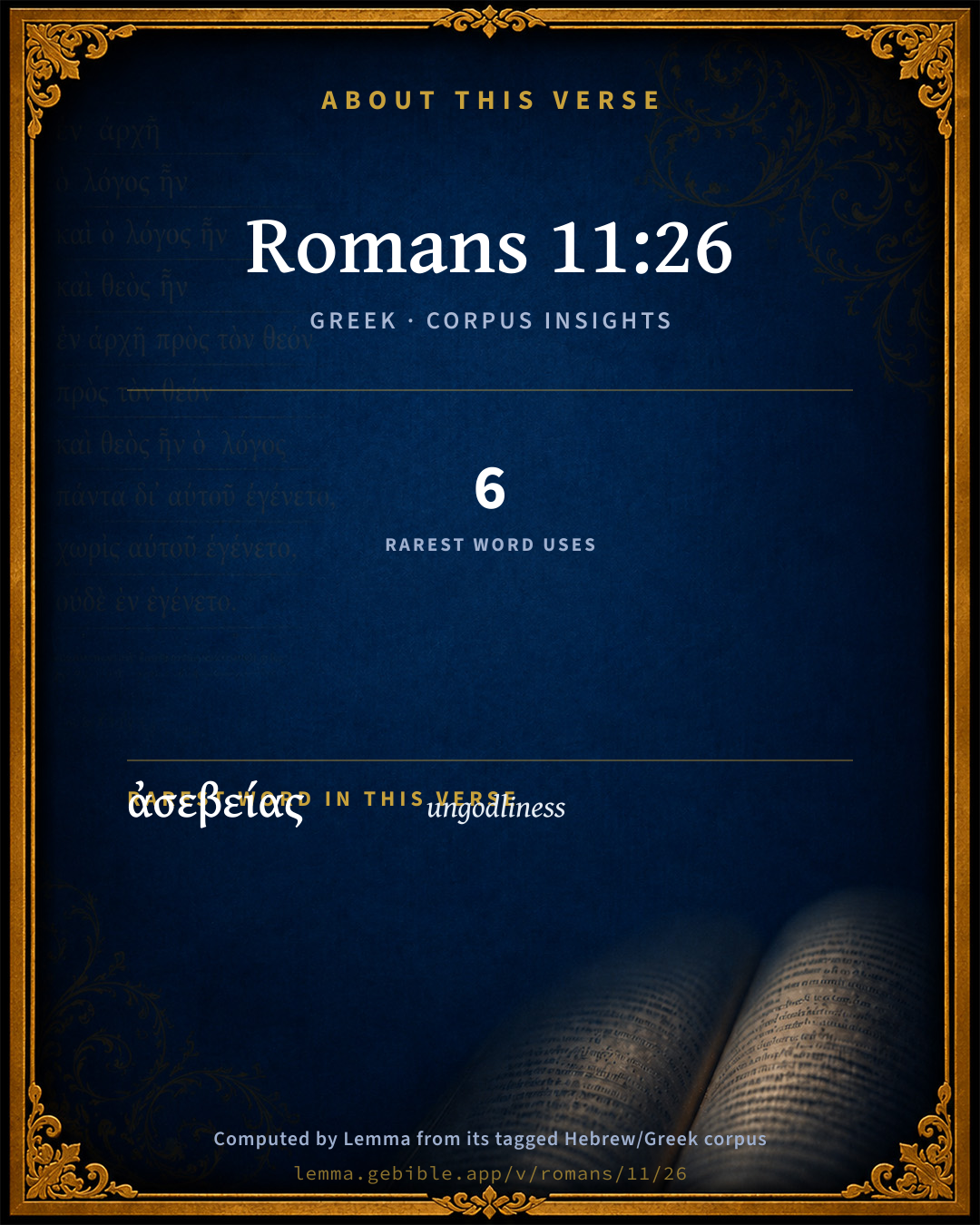
Romans 11:26

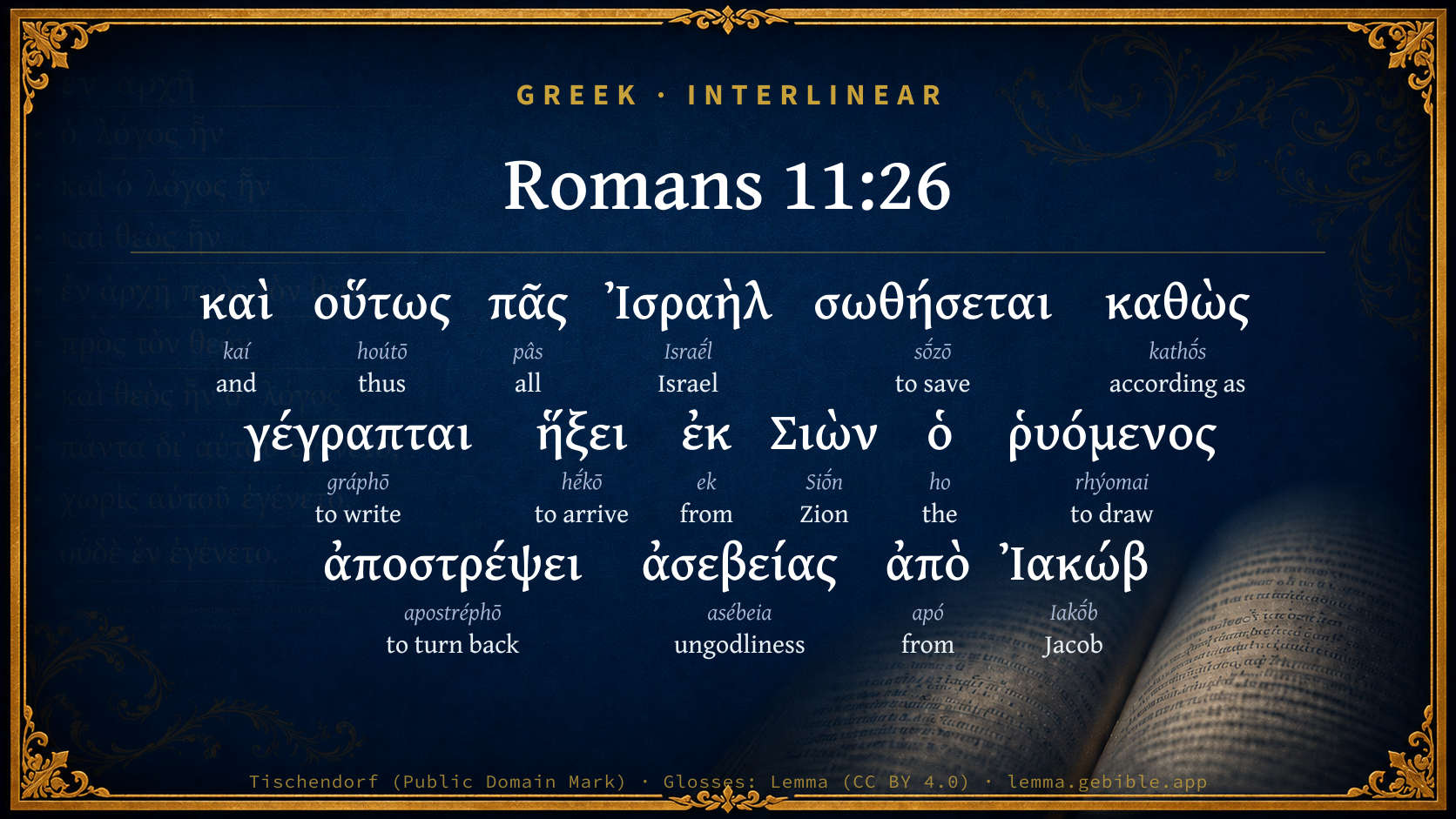
Greek (Tischendorf 8th ed.) Romans 11:26 appears in the Greek New Testament. The text above is from the Tischendorf 8th edition. Each word links to its Strong’s number and a concise gloss. Click any word for its full Thayer’s Greek Lexicon entry.
Download image
Cite this verse

Romans 11:26 (World English Bible). Public Domain. Lemma interlinear Bible study tool, https://lemma.gebible.app/v/romans/11/26.

Show BibTeX & RIS
BibTeX
RIS
English Translation
and so all Israel will be saved. Even as it is written, "There will come out of Zion the Deliverer, And he will turn away ungodliness from Jacob.
World English Bible · Public Domain
Download a study sheet

One document with this verse’s original text, its word-by-word gloss line, the meaning frame, cross-references with their text, attributed commentary, and full source and license credits — printable, and it pastes into notes with its structure intact.

This verse Autodidact and up

Study sheet (.html) Plain text (.txt)

A passage Seminary Student

Up to 50 verses in one chapter. A passage sheet keeps up to 6 commentary sources and 12 cross-references per verse, in the order this page ranks them, and says so on the sheet whenever that leaves anything out. Ask for a single verse and you get the Autodidact verse sheet above.

Everything on this page stays free to read, with no account — the sheet is a download of what is already on screen, not access to it.

Want to remove ads? Support Godless Engineer
Compare translations 3

The same verse in 3 English versions, stacked beneath the original-language interlinear above. Click any original word for its lexicon entry.

Each is an independent rendering of the whole verse — the interlinear is not word-aligned to these translations.

Highlighted words mark where these versions differ — a whole-verse word diff, not a word-by-word alignment.

  • World English Bible Public Domain
    and so all Israel will be saved. Even as it is written, "There will come out of Zion the Deliverer, And he will turn away ungodliness from Jacob.
  • King James Version Public Domain
    And so all Israel shall be saved: as it is written, There shall come out of Sion the Deliverer, and shall turn away ungodliness from Jacob:
  • unfoldingWord Literal Text CC BY-SA 4.0
    and thus all Israel will be saved, just as it is written: “From Zion will come the Deliverer. He will turn away ungodly things from Jacob.

unfoldingWord Literal Text — © unfoldingWord, licensed CC BY-SA 4.0. Word-aligned USFM3 via Door43 (git.door43.org/unfoldingWord/en_ult).

Versions to compare (up to 4)

3 of 4 selected

Show all 19 translations

Every available English version of this verse, each an independent rendering of the whole verse.

  • World English Bible Public Domain
    and so all Israel will be saved. Even as it is written, "There will come out of Zion the Deliverer, And he will turn away ungodliness from Jacob.
  • Berean Standard Bible Public Domain
    And so all Israel will be saved, as it is written: “The Deliverer will come from Zion; He will remove godlessness from Jacob.
  • Majority Standard Bible Public Domain
    And so all Israel will be saved, as it is written: “The Deliverer will come from Zion; He will remove godlessness from Jacob.
  • King James Version Public Domain
    And so all Israel shall be saved: as it is written, There shall come out of Sion the Deliverer, and shall turn away ungodliness from Jacob:
  • American Standard Version (1901) Public Domain
    and so all Israel shall be saved: even as it is written, There shall come out of Zion the Deliverer; He shall turn away ungodliness from Jacob:
  • Revised Version (1885) Public Domain
    and so all Israel shall be saved: even as it is written, There shall come out of Zion the Deliverer; He shall turn away ungodliness from Jacob:
  • Geneva Bible (1599) Public Domain
    And so all Israel shalbe saued, as it is written, The deliuerer shall come out of Sion, and shall turne away the vngodlinesse from Iacob.
  • Douay-Rheims (1899) Public Domain
    And so all Israel should be saved, as it is written: There shall come out of Sion, he that shall deliver, and shall turn away ungodliness from Jacob.
  • Young's Literal Translation Public Domain
    and so all Israel shall be saved, according as it hath been written, `There shall come forth out of Sion he who is delivering, and he shall turn away impiety from Jacob,
  • Literal Standard Version CC BY-SA 4.0
    and so all Israel will be saved, according as it has been written: “There will come forth out of Zion He who is delivering, and He will turn away impiety from Jacob,
  • Unlocked Literal Bible CC BY-SA 4.0
    Thus all Israel will be saved, just as it is written: “Out of Zion will come the Deliverer. He will remove ungodliness from Jacob,
  • unfoldingWord Literal Text CC BY-SA 4.0
    and thus all Israel will be saved, just as it is written: “From Zion will come the Deliverer. He will turn away ungodly things from Jacob.
  • Darby Bible Public Domain
    and so all Israel shall be saved. According as it is written, The deliverer shall come out of Zion; he shall turn away ungodliness from Jacob.
  • World Messianic Bible Public Domain
    and so all Israel will be saved. Even as it is written, “There will come out of Zion the Deliverer, and he will turn away ungodliness from Jacob.
  • Webster's Bible Public Domain
    And so all Israel shall be saved: as it is written, There shall come out of Sion the Deliverer, and shall turn away ungodliness from Jacob:
  • Free Bible Version CC BY-SA 4.0
    This is how all Israel will be saved. As Scripture says, “The Savior will come from Zion, and he will turn Jacob away from his opposition to God.
  • Bible in Basic English Public Domain
    And so all Israel will get salvation: as it is said in the holy Writings, There will come out of Zion the One who makes free; by him wrongdoing will be taken away from Jacob:
  • Text-Critical English NT CC BY 4.0
    and in this way all Israel will be saved, as it is written, “The Deliverer will come from Zion and will remove ungodliness from Jacob.”
  • Tyndale New Testament (1534) Public Domain
    and so all Israel shalbe saved. As it is writte: There shall come oute of Sion he that doth delyver and shall turne awaye the vngodlynes of Iacob.

Literal Standard Version (2020), Covenant Press — licensed CC BY-SA 4.0. Text via the HelloAO Bible API (eBible.org). Unlocked Literal Bible (unfoldingWord) — licensed CC BY-SA 4.0. Text via the HelloAO Bible API (eBible.org). unfoldingWord Literal Text — © unfoldingWord, licensed CC BY-SA 4.0. Word-aligned USFM3 via Door43 (git.door43.org/unfoldingWord/en_ult). Free Bible Version, Dr. Jonathan Gallagher — licensed CC BY-SA 4.0. Text via the HelloAO Bible API (eBible.org).

Word by word

More ways to search: Search by grammar → Find every occurrence → Compare this word →

Practice this passage: Drill this verse → Learn its vocabulary →

ἀσεβείας
asébeia
G763
“ungodliness”
Noun, Accusative, Plural, Feminine
Part of Speech
Noun
Case
Accusative
Number
Plural
Gender
Feminine
Full Thayer's Definition

Origin: from G765

TDNT: 10:05,1

1. want of reverence towards God, impiety, ungodliness
  1. καὶ kaí G2532 “and” Conjunction
  2. οὕτως hoútō G3779 “thus” Adverb
  3. πᾶς pâs G3956 “all” Adjective, Nominative, Singular, Masculine
  4. Ἰσραὴλ Israḗl G2474 “Israel” Noun, Proper, indeclinable
  5. σωθήσεται sṓzō G4982 “to save” Verb, Future, Passive, Indicative, 3rd person, Singular
  6. καθὼς kathṓs G2531 “according as” Adverb
  7. γέγραπται gráphō G1125 “to write” Verb, Perfect, Passive, Indicative, 3rd person, Singular
  8. ἥξει hḗkō G2240 “to arrive” Verb, Future, Active, Indicative, 3rd person, Singular
  9. ἐκ ek G1537 “from” Preposition
  10. Σιὼν Siṓn G4622 “Zion” Noun, Proper, indeclinable
  11. ὁ ho G3588 “the” Article, Nominative, Singular, Masculine
  12. ῥυόμενος rhýomai G4506 “to draw” Verb, Present, Middle or Passive deponent, Participle, Nominative, Singular, Masculine
  13. ἀποστρέψει apostréphō G654 “to turn back” Verb, Future, Active, Indicative, 3rd person, Singular
  14. ἀπὸ apó G575 “from” Preposition
  15. Ἰακώβ Iakṓb G2384 “Jacob” Noun, Proper, indeclinable

About this verse

These counts appear in no published source. They are computed here, from the morphology-tagged text and Lemma’s own curated glosses. What Lemma adds →

16
words
16
distinct lemmas
Pauline Epistles
section

Notable vocabulary

The rarest word here is ἀσεβείας ungodliness G763 — appearing just 6 times in the whole Greek New Testament.

Shared distinctive vocabulary

ἀσεβείας ungodliness G763 occurs in 6 verses of the Greek New Testament. Also found in:

Cross-references

23

Topical passages linked to Romans 11:26 in the Treasury of Scripture Knowledge — connected by theme and wording, ordered by reader-vote popularity; previews shown in the World English Bible.

  • Isaiah 59:20 A Redeemer will come to Zion, and to those who turn from disobedience in Jacob, says Yahweh.
  • Jeremiah 31:31–37 Behold, the days come, says Yahweh, that I will make a new covenant with the house of Israel, and with the house of Judah:
  • Psalms 14:7 Oh that the salvation of Israel would come out of Zion! When Yahweh restores the fortunes of his people, Then Jacob shall rejoice, and Israel shall be glad.
  • Hosea 3:5 Afterward the children of Israel shall return, and seek Yahweh their God, and David their king, and shall come with trembling to Yahweh and to his blessings in the last days.
  • Zechariah 10:6–12 "I will strengthen the house of Judah, And I will save the house of Joseph, And I will bring them back; For I have mercy on them; And they will be as though I had not cast them off: For I am Yahweh their God, and I will hear them.
  • Amos 9:14–15 I will bring back the captivity of my people Israel, And they will rebuild the ruined cities, and inhabit them; and they will plant vineyards, and drink wine from them. They shall also make gardens, And eat the fruit of them.
  • Joel 3:16–21 Yahweh will roar from Zion, And thunder from Jerusalem; And the heavens and the earth will shake; But Yahweh will be a refuge to his people, And a stronghold to the children of Israel.
  • Isaiah 45:17 [But] Israel shall be saved by Yahweh with an everlasting salvation: you shall not be disappointed nor confounded world without end.
  • Ezekiel 37:21–28 Say to them, Thus says the Lord Yahweh: Behold, I will take the children of Israel from among the nations, where they are gone, and will gather them on every side, and bring them into their own land:
  • Acts 3:26 God, having raised up his servant, Jesus, sent him to you first, to bless you, in turning away everyone of you from your wickedness."
  • Isaiah 11:11–16 It shall happen in that day, that the Lord will set his hand again the second time to recover the remnant of his people, who shall remain, from Assyria, and from Egypt, and from Pathros, and from Cush, and from Elam, and from Shinar, and from Hamath, and from the islands of the sea.
  • Isaiah 54:6–10 For Yahweh has called you as a wife forsaken and grieved in spirit, even a wife of youth, when she is cast off, says your God.
  • Zephaniah 3:12–20 But I will leave in the midst of you an afflicted and poor people, and they will take refuge in the name of Yahweh.
  • Titus 2:14 who gave himself for us, that he might redeem us from all iniquity, and purify for himself a people for his own possession, zealous for good works.
  • Ezekiel 34:22–31 therefore will I save my flock, and they shall no more be a prey; and I will judge between sheep and sheep.
  • Matthew 1:21 She shall bring forth a son. You shall call his name Jesus, for it is he who shall save his people from their sins."
  • Jeremiah 3:17–23 At that time they shall call Jerusalem the throne of Yahweh; and all the nations shall be gathered to it, to the name of Yahweh, to Jerusalem: neither shall they walk any more after the stubbornness of their evil heart.
  • Jeremiah 32:37–41 Behold, I will gather them out of all the countries, where I have driven them in my anger, and in my wrath, and in great indignation; and I will bring them again to this place, and I will cause them to dwell safely:
  • Jeremiah 33:24–26 Don't you consider what this people has spoken, saying, The two families which Yahweh did choose, he has cast them off? thus do they despise my people, that they should be no more a nation before them.
  • Ezekiel 39:25–40:48 Therefore thus says the Lord Yahweh: Now will I bring back the captivity of Jacob, and have mercy on the whole house of Israel; and I will be jealous for my holy name.
  • Micah 7:15–20 "As in the days of your coming forth out of the land of Egypt, I will show them marvelous things."
  • Psalms 106:47 Save us, Yahweh, our God, Gather us from among the nations, To give thanks to your holy name, To triumph in your praise!
  • Jeremiah 30:17–22 For I will restore health to you, and I will heal you of your wounds, says Yahweh; because they have called you an outcast, [saying], It is Zion, whom no man seeks after.

Cross-references courtesy of OpenBible.info (CC BY 4.0).

Commentary

Notes on Romans 11:26 from classic Christian and Jewish commentators (each source and its license shown beneath its notes). The classic Christian expositions comment on the surrounding passage and are grouped to its opening verse, so a note may address several verses; the Jewish commentaries on the Tanakh (Rashi and others) are per-verse, so they appear only where the commentator wrote on this verse.

Lemma curates 59 commentaries, every one of them public domain or Creative Commons licensed, each selected and text-cleaned for this edition rather than reprinted as found. About our sources →

The Cambridge Bible for Schools and Colleges

gen. ed. J. J. S. Perowne

26. And so all Israel shall be saved] Several interpretations of these words are in themselves legitimate. They may refer (A) to the natural Israel, the Jews; or (B) to the “Israel of God,” the true Church of Christ. Again, if the reference (A) is adopted, the prophecy may mean (a) that then all the elect of Israel shall at length be gathered in—the long process shall at length be complete; or (b) that every individual of the then generation of Jews shall be brought to Messiah’s grace; or (c) that “all” bears a less exact reference here, as so often in Scripture, and means “in general;”—“Israel in general, the Jews of that day as a great aggregate, on a scale unknown before, shall be saved.”

Of these various possibilities we prefer on the whole (A. c,) as the most in accord with the context, and with the analogy of Scripture. The explanation (B) is in itself entirely true: the final glory and triumph of the Gospel will surely be, not specially the salvation of the Jews, but that of the Universal Church—the immortal Bride of the King Eternal. And it is extremely important to remember the full recognition in Scripture of all its true members as the “seed of Abraham” (Gal_3:29). But this is not the truth exactly in point here, where St Paul is dealing with the special prospect of a time when “blindness in part” will no longer characterize Jews as Jews. And the “Israel” of Rom_11:25 is probably the Israel of Rom_11:26, as no distinction is suggested in the interval.—Again, the reference marked (A. a), though perfectly true in itself, is less likely here because in Rom_11:15; Rom_11:25, we have had already a prediction of a restoration of Jews, en masse, to grace; whereas the process of gathering in the elect of all ages is continuous, and thus, on the whole, gradual.—Again, the reference marked (A. b), though the Divine Plan may, of course, intend no less, is far from analogous to the main teaching of Scripture as to the developements (even the largest) of grace in this world.—On the whole, then, we adopt the interpretation which explains the sentence as predicting the conversion of some generation or generations of Jews, a conversion so real and so vastly extensive that unbelief shall be the small exception at the most, and that Jews as such shall everywhere be recognized as true Christians, lights in the world, and salt on the earth.

There shall come out of Sion, &c.] In the following quotation St Paul more or less combines, as often, (see e.g. Rom_3:10-18,) several O. T. prophecies; with this for the main purport, that one ultimate result of the coming of Messiah should be the gift of grace to the Jews. In Isa_59:20-21, we have in the Heb., “And there shall come a Redeemer for Zion, and for them that turn from transgression in Jacob, saith the Lord: As for me, this is my covenant with them.” In Isa_27:9; “This is all the fruit [of God’s dealings, namely] to take away his [Jacob’s] sin.” In Psa_14:7 (LXX. Rom_13:7); “Oh that the salvation of Israel were come out of Zion!” In Isa_59:20 the LXX. has, “There shall come for Sion’s sake the deliverer, and shall turn away ungodliness from Jacob.” In Isa_27:9 it has, “This is his blessing, when I shall take away his sin.”

St Paul seems to have woven into one Isa_59:20 and Psa_14:7, and to have completed the sentence from Isa_27:9. In the last clause of Rom_11:26 here he adopts the LXX., because, though it represents the Heb. inexactly, the substantial meaning is untouched:—the Redeemer’s coming shall be “for,” “for the benefit of,” those who turn from sin, by being the cause of their so doing; He shall thus turn sin from them, in the sense of removing its guilt and breaking its power.

shall come out of Sion] Here probably the reference is to the First Advent. Q. d., “It stands foretold that the Appearance of Messiah, of the seed of David, shall result in the subdual of the unbelief and rebellion of Jacob, and the bringing in of a covenant for him of final pardon and peace. Now Messiah has appeared; therefore, how slow soever the fulfilment be as yet, the remainder of this great promise must be drawing on: Israel shall yet be saved.” The words have been often explained to foretel a future Coming of the Redeemer, whether literal or figurative, to work the conversion of Israel on a great scale. But the explanation above is fully sufficient for the argument, and (to say the least) more in accord with St Paul’s general teaching as to the future Coming of the Lord.

the Deliverer] the Rescuer; same word as 1Th_1:10, “who rescueth us from the wrath to come.” Heb. “Goel;” the Avenger of a Kinsman; hence generally the strong friend who rescues the weak.

ungodliness] Lit. impieties.—Perhaps omit the “and” before “shall turn away.”

The Cambridge Bible for Schools and Colleges (gen. ed. J. J. S. Perowne; Cambridge University Press, 1878–1918) — public domain. Text from a community e-Sword module.

Tyndale Open Study Notes

Tyndale Open Resources

11:26-27 The phrase all Israel could refer to the total of all believers, both Jewish and Gentile; with this meaning, and so would describe the way that God works to bring salvation to all his people. Alternatively, all Israel could refer to the total of all Jews destined to believe throughout the Christian era, or to a significant number of Jews who turn to Christ in the last days. With the last meaning, and so would have a sequential meaning—after the full number of Gentiles comes to Christ, then the full number of Jews will be saved. It does not mean all Jewish people (see 2:17-29) • In the Old Testament, The one who rescues is the Lord. Paul almost surely is referring to Jesus Christ (see 1 Thes 1:10). • from Jerusalem: The Hebrew text of Isa 59:20 says that the redeemer will come to Jerusalem. Paul might have changed the wording to represent Jesus’ first coming from among the people of Israel or to speak of the second coming when Jesus will return from the heavenly Jerusalem (see Heb 12:22).

Tyndale Open Study Notes — © Tyndale Open Resources, licensed CC BY-SA 4.0. Text via the HelloAO Bible API.

Bengel's Gnomon

Johann Albrecht Bengel

Rom 11:26. καὶ οὓτω, and so) he does not say and then, but with greater force, and so, in which very expression the then is included; to wit, the blindness of Israel will be terminated by the very coming in of the Gentiles.—πᾶς Ἰσραὴλ, all Israel) Israel contradistinguished from the Gentiles, of which Rom 11:25 treats. The words, שארית, a remnant, and פליטה, deliverance, are used in respect of those that perished; but the Remnant itself, numerous in itself, will be wholly converted, Mic 2:12.—σωθήσεται) shall be saved: The Latin Vulgate has expressed this by, salvus fieret; and not inappropriately.[124] It contains this sentiment, the fulness of the Gentiles shall be brought in and so all Israel shall be made safe; but ἄχρις οὗ, until, has changed the former verb εἰσελεύσεται [Indic.] into ΕἸΣΈΛΘῌ [Subj.], the second verb, ΣΩΘΉΣΕΤΑΙ, remaining [Indicative].—See similar instances noticed at Mar 3:27. The Latin Vulg. has expressed the meaning.—ἭΞΕΙ ἘΚ ΣΙῺΝ—ΔΙΑΘΉΚΗ, ὋΤΑΝ ἈΦΈΛΩΜΑΙ ΤᾺς ἉΜΑΡΤΊΑς ΑὐΤῶς) shall come out of Zion—the covenant, when I shall take away their sins. Isa 59:20-21, LXX., καὶ ἥξει ἓνεκα Σιὼν—ΔΙΑΘΉΚΗ, ΕἾΠΕ ΚΎΡΙΟς, Κ.Τ.Λ., and shall come for the sake of Zion—the covenant, saith the Lord, etc. Isa 27:9, LXX., καὶ τοῦτο ἐστιν ἡ εὐλογία αὐτοῦ, ὍΤΑΝ ἈΦΈΛΩΜΑΙ ΤῊΝ ἈΜΑΡΤΊΑΝ ΑὐΤΟῦ, Κ.Τ.Λ., and this is His blessing, when I shall take away his sin. Heb. גואל לציון, and there shall come to Zion (and for its benefit) the Redeemer, and to those turning from transgression in Jacob. Paul, ch. 3, in describing sin had quoted Psalms 14, and chiefly ch. 59 of Isaiah: now in describing salvation, he joins together the same texts. He says, ἐκ Σιὼν, out of Sion, as the LXX., Psa 14:7. The Deliverer or Redeemer comes (ἘΚ) out of Sion and (ì, ἛΝΕΚΑ) for good to Sion. His coming has been already accomplished, and the fruit will arrive at perfection at the proper time. Sion is a whole, in a good sense, Jacob here is a whole, in a less favourable sense; those returning are a part.

[124] Thus the Vulg. makes σωθήσεται depend on ἂχρις οὖ, donec, “until the fulness of the Gentiles shall come in, and until all Israel shall thus be saved.”—ED.

Bengel's Gnomon of the New Testament — English translation (T&T Clark, Edinburgh, 1860) — public domain. Text from a community e-Sword module.

Meyer's Critical & Exegetical Commentary

Heinrich August Wilhelm Meyer

Rom_11:26 f. Καὶ οὕτω] And so, namely, after the πλήρωμα τῶν ἐθνῶν shall have come in. The modal character of the οὕτω therefore lies in the succession of time conditioning the emergence of the fact (comp. 1Co_11:28), as it also in the classics, in the sense of so then, embraces what has been previously said. See Schweighäuser, Lex. Herod. II. p. 167; Thucyd. iii. 96. 2; Xen. Anab. iii. 5. 6; Dem. 644. 18, 802. 20. Theodoret rightly says: τῶν γὰρ ἐθνῶν δεξαμένων τὸ κήρυγμα πιστεύσουσι κἀκεῖνοι, and that, according to Rom_11:11, under the impulse of powerful emulation. We may add that this great final result is brought into more important prominence, if we take ΚΑῚ ΟὝΤΩ Κ.Τ.Λ. independently, than if we make it form part of the statement dependent on ὍΤΙ (Lachmann, Tischendorf, Fritzsche, Ewald, Hofmann, and others).

Πᾶς ἸΣΡΑΉΛ] This notion, so definitely expressed, of the totality of the people is in no way to be limited; the whole of those are intended, who, at the time that the fulness of the Gentiles shall have come in, will compose Israel. All Israelites who up to that time shall be still unconverted, will then be converted to salvation, so that at that term entire Israel will obtain the saving deliverance; but comp., as to the quite unlimited expression, the remark on Rom_11:25. Limitations from other interests than that of exegesis have been suggested: such as that the spiritual Israel, Gal_6:6, is meant (Augustine, Theodoret, Luther, Calvin, Grotius, and others, including Krummacher); or only the select portion of the Jews (Calovius, Bengel, and several others, including Olshausen: all those members of the Israelitish people who from the beginning belonged to the true λεῖμμα); or that πᾶς is to be taken comparatively only of the greater number, of the bulk (Oecumenius, Wetstein, Rückert, Fritzsche, Tholuck). To this comes in substance also Hofmanns explanation: that the people, as a people, will be converted; but πᾶς Ἰσραήλ is, in fact, not Israel as a whole, but rather the entire Israel, as is also meant in 2Ch_12:1 and in all O. T. passages, in contrast to ἀπὸ μέρους, Rom_11:25. Comp. πᾶς οἶκος Ἰσρ., Act_2:36, πᾶς ὁ λαὸς Ἰσρ., and the like. This also against Weiss, bibl. Theol. p. 404.

σωθήσεται] will be saved, unto Messianic salvation, by their conversion to Christ.

καθὼς γέγρ.] For πᾶς Ἰσρ. σωθής. Paul finds a Scripture warrant, not merely a substratum for his own ideas (Tholuck), in Isa_59:20-21 (not quite closely after the LXX., and, from ὅταν onwards, with a bringing in of Isa_27:9; see Surenhus. καταλλ. p. 503 f.); to the prophetic sense of this passage the future salvation of all Israel corresponds as result.

ἐκ Σιών] for from God will the deliverer come; the theocratic central-point and dwelling-place of the divine kingdom is the holy mount of Zion. Comp. Psa_14:7; Psa_53:6, et al. See also Rom_9:33. The LXX. have, following the original, ἕνεκεν Σιών (לְצִיּוֹן, i.e. for Zion). Our ἘΚ ΣΙΏΝ is a variation of memory, occasioned by the reminiscence of other passages (comp. Psa_14:7; Psa_53:6; Psa_110:2); for ἕνεκεν Σ. would have been quite as suitable to the apostles purpose (in opposition to Reiche, Fritzsche, van Hengel); hence to discover intentional reasons for this deviation (Philippi: in order to bring into stronger relief the claim of the people as contrasted with the Gentiles) is groundless. Nor was this deviation more convenient (Hofmann) for the apostle, namely, in order to designate Christs place of manifestation; but it involuntarily on his part found its way into the citation freely handled.

ὁ ῥυόμενος] i.e. not God (Grotius, van Hengel), who first emerges in Rom_11:27, but the Messiah. In the Heb. we find גּוֹאֵל, a deliverer, without the article, by which, however, no other is intended. The future coming of the deliverer which is here predicted is, in the sense of the fulfilment of this prophecy, necessarily that whereby the Πᾶς ἸΣΡΑῊΛ ΣΩΘΉΣΕΤΑΙ will be effected; consequently not the Parousia, because the conversion of all Israel must be antecedent to this, but rather that specially efficacious self-revelation of Christ in the preaching of His gospel (comp. Eph_2:17), to be expected by the future, whereby He will bring about that final sacred-historical epoch of the people, the conversion of its totality. Erroneously, however, Augustine, Chrysostom, Theodoret, and Beda have supposed it predicted that Elijah or Enoch would appear before the end of the world as converter of the Jews.

ἈΠΟΣΤΡ. ἈΣΕΒ. ἈΠῸ ἸΑΚ.] He will turn away, i.e. (comp. Bar_3:7; 1Ma_4:58) remove, do away with impieties from Jacob. By this, in the sense of the apostle, is meant the atoning, reconciling work of the Messiah (comp. Joh_1:29 : αἴρων τ. ἁμαρτ.), which He will accomplish in Israel by its conversion. Hence there follows, as the correlative to this in Rom_11:27, the forgiveness of sins on the part of God, procured through Him, and that as the actually saving essence of the covenant, which the people possesses from God. Compare the original text, which, however, instead of Κ. ἈΠΟΣΤΡ. ἈΣΕΒ. ἈΠῸ ἸΑΚΏΒ has וּלְשָׁבֵי פֶשַׁע בְּיַעֲקֹב, and for those turning from apostasy in Jacob. Paul, however, because following generally in this quotation the LXX., retains also its deviation from the original text, but not as if this could have been more welcome to him for his object, for in that respect he might have just as well made use of the words of the original.

αὕτη] points to the following (comp. 1Jn_5:2), so that the sense of Rom_11:27 is: And when I shall have forgiven their sins, this, this remission of sins conferred by me, will be my covenant to them, i.e. they will therein have from me the execution of my covenant. Both in the original and in the LXX. ΑὝΤΗ points to the following, in which the words of the covenant (ΤῸ ΠΝΕῦΜΑ ΤῸ ἘΜῸΝ … Οὐ ΜῊ ἘΚΛΊΠῌ ἘΚ ΤΟῦ ΣΤΌΜ. Κ.Τ.Λ.) are adduced; but instead of them, Paul, for the object which he has in view, puts ὍΤΑΝ ἈΦΈΛΩΜΑΙ Κ.Τ.Λ. from Isa_27:9, where likewise a preceding demonstrative (ΤΟῦΤΌ ἘΣΤΙΝ Ἡ ΕὐΛΟΓΊΑ ΑὐΤΟῦ) points forward to ὍΤΑΝ. Hence we may not, with others (including Köllner and Hofmann), refer ΑὝΤΗ to the preceding, in which case ἀποστρ. ἀσεβείας ἀπὸ Ἰακ. is supposed to point to the moral conversion, and ἈΦΕΛ. Τ. ἉΜΑΡΤ. ΑὐΤ. to the forgiveness, on the ground of which that conversion takes place (see Hofmann). According to this view, the essence of the covenant would lie in sanctification, not in reconciliation, which would be conceived rather as antecedent to the covenant,a view which runs counter to the N. T. doctrine (Mat_26:26; Heb_9:15 ff; Heb_10:29; Heb_12:24; Heb_13:20).

Ἡ ΠΑΡʼ ἘΜΟῦ ΔΙΑΘΉΚΗ] The covenant which proceeded from me, which was made on my part. See Bernhardy, p. 255 f.; Fritzsche, ad Marc. p. 182 f.; van Hengel, in loc.

REMARK.

The conversion of entire Israel promised by Paul as a μυστήριον revealed to him, has not yet taken place; for the opinion, that the promise had been fulfilled already in the apostolic age through the conversion of a great part of the people (comp. Euseb. H. E. iii. 35; Judaizantes in Jerome; Grotius, Limborch, Wetstein), is set aside, notwithstanding Act_21:20, by the literal meaning of πᾶς Ἰσραήλ and of πλήρωμα τῶν ἐθνῶν. The fulfilment is to be regarded as still future, as the last step in the universal extension of Christianity upon earth. In respect of time no more special definition can be given, than that the conversion of the totality of the Gentiles must precede it; whence only this is certain, that it is still a time very distant. Paul has certainly viewed the matter as near, seeing that he conceived the Parousia itself to be near (not merely, perhaps, its possible, but its actual emergencein opposition to Philippi),a conception which was shared by him with the whole apostolical church, although it remained without the verification of the event, as this was conceived of. But the promise of the conversion of the people of Israel is not on that account itself to be regarded as one, the fulfilment of which is no longer to be hoped for,as though, with the non-verified conception of the time of the event, the event itself should fall to the ground (Ammon, Reiche, Köllner, Fritzsche); for it is the fact in itself, and not the epoch of it, which is disclosed by the apostle as part of the μυστήριον which was revealed to him; and therefore this disclosure rested on the ἀποκάλυψις received, not on individual opinion and expectation. The duration of time until the Parousia was not subject-matter of revelation, Act_1:7, and the conception of it belongs, therefore, not to that in the apostolic teaching which has the guarantee of divine certainty, but to the domain of subjective hope and expectation, which associated themselves with what was revealed,a distinction which even Philippi does not reject. The latter, however, endeavours to remove from the category of error the apostolic expectation of the nearness of the Parousia, because it was not cherished with that divine certainty; but cannot thereby prevent it, where it is presupposed so definitely, as e.g. Rom_13:11, or is expressed so unconditionally, as e.g. 1Co_15:51-52, from being characterized by an unprejudiced mind as a human error, which did not, however, exclude occasionally other moods, as in 2Co_5:8, Php_1:23. Of such human mistakes and vacillations, which lie outside the range of revealed truth, that truth is independent (against Hoelemann, neue Bibelstud. p. 232 ff., and others).

We may further notice that our passage directly controverts the Ebionitish view, now renewed in various quarters (Chr. A. Crusius, Delitzsch, Baumgarten, Ebrard, Auberlen, and others; expositors of the Apocalypse), of an actual restoration of Israel to the theocratic kingdom in Canaan, as to be expected on the ground of prophetic predictions (Hos_2:2; Hos_2:16 ff., Hos_3:4-5; Isa_11:11; Isa_24:16, chap. 60; Jer_34:3, et al.). Israel does not take in the church, but the church takes in Israel; and whenever this occurs, Israel has in the true sense again its kingdom and its Canaan. Comp. Tholuck on Rom_11:25; Kahnis, Dogm. I. p. 576 f.; Hengstenberg, Christol. I. p. 256; and see especially Bertheau, in the Jahrb. f. Deutsche Theol. 1859, p. 353 ff.

Meyer — Critical and Exegetical Commentary on the New Testament — English translation by Peter Christie, edited by Frederick Crombie (T&T Clark, 1880) — public domain. Text from a community e-Sword module.

Expositor's Greek Testament

ed. W. Robertson Nicoll

Rom 11:26 . καὶ οὕτως = and thus; not merely temporal, but = under the influence of the jealousy so excited under the impression produced on the Jews by the sight of the Gentiles in their fulness peopling the kingdom all Israel shall be saved. This is an independent sentence. For πᾶς Ἰσραὴλ see 1Ki 12:1 , 2Ch 12:1 . It means Israel as a whole. Paul is thinking of the historical people, as the contrast with Gentiles shows, but he is not thinking of them one by one. Israel a Christian nation, Israel as a nation a part of the Messianic kingdom, is the content of his thought. To make πᾶς Ἰσραὴλ refer to a “spiritual” Israel, or to the elect, is to miss the mark: it foretells a “conversion of the Jews so universal that the separation into an ‘ elect remnant ’ and ‘ the rest who were hardened ’ shall disappear” (Gifford). καθὼς γέγραπται Isa 59:20 f., but the last words ὅταν ἀφέλωμαι κ . τ . λ . from Isa 27:9 . The prophet says ἕνεκεν Σίων Paul’s ἐκ Σιὼν is probably a lapse of memory, due to the impression of passages like Psa 14:7 , 53:7, Isa 2:3 , though Philippi thinks it intentional the object being to emphasise the title of the Jews, as against the Gentiles, to a share in the kingdom. It is then as if he said: Salvation is of the Jews, and surely therefore for them. It is impossible to say that ἥξει refers to the first or to the second advent: the distinction is not present to Paul’s mind as he writes; all he is concerned with is the fact that in prophetic scripture language is used which implies that Israel as a people is to inherit the Messianic salvation. ὁ ῥυόμενος , Hebrew גֹּאֵל is the Messiah. ἀποστρέψει ἀσεβείας . Cf. Bar 3:7 , 1Ma 4:58 .

The Expositor's Greek Testament, edited by W. Robertson Nicoll (1897–1910) — public domain. Text from a community e-Sword module.

Hodge's Commentary on Romans, Ephesians & First Corinthians

Charles Hodge

Rom_11:26

And so all Israel shall be saved, as it is written. Israel, here, from the context, must mean the Jewish people, and all Israel, the whole nation. The Jews, as a people, are now rejected; as a people, they are to be restored. As their rejection, although national, did not include the rejection of every individual; so their restoration, although in like manner national, need not be assumed to include the salvation of every individual Jew. Πᾶς Ἰσραὴλ is not therefore to be here understood to mean, all the true people of God, as Augustine, Calvin, and many others explain it; nor all the elect Jews, i.e. all that part of the nation which constitute the remnant according to the election of grace; but the whole nation, as a nation.

In support of what he had said, the apostle appeals to the Old Testament prophecies. It is probable that here, as elsewhere, he does not intend to refer exclusively to any one prediction, but to give the general sense of many specific declarations of the ancient prophets. Isa_59:20, Isa_59:21; Isa_27:9; Jer_31:31-34; Psa_14:7, are the passages which seem to have been immediately before the apostles mind, and to have given color to his language. In Isa_49:20, it is said, The Redeemer shall come to Zion, and unto them that turn from transgression in Jacob. Instead of ἐκ Σιών, out of Zion. the lxx has ἕνεκεν Σιών, for the sake of Zion, the English version, to Zion. In Psa_14:7, it is out of Zion. The latter part of the verse, as given by Paul, does not agree with the Hebrew, which is correctly rendered in our version, To such as turn from transgression (literally, to the converts of transgression) in Jacob. Paul follows the lxx, καὶ ἀποστρέψει ἀσεβείας ἀπὸ Ἰακώβ, and shall turn iniquity from Jacob. In Isa_27:9, the phrase is, the iniquity of Jacob shall be purged. The general idea expressed in these passages is, The God, the deliverer, shall come for the salvation of Jacob, i.e. of the Jews. And this is all that Paul desired to establish by these ancient prophecies. The apostle teaches, that the deliverance promised of old, and to which the prophet Isaiah referred in the passage above cited, included much more than the conversion of the comparatively few Jews who believed in Christ at the advent. The full accomplishment of the promise, that he should turn away ungodliness from Jacob, contemplated the conversion of the whole nation, as such, to the Lord. We are, of course, bound to receive the apostles interpretation as correct; and there is the less difficulty in this, as there is nothing in the original passage at all incompatible with it, and as it accords with the nature of Gods covenant with his ancient people.

Charles Hodge — Commentary on Romans (1835), First Corinthians (1857), and Ephesians (1856) — public domain. Text from a community e-Sword module.

Jamieson, Fausset & Brown

Robert Jamieson, A. R. Fausset & David Brown

And so all Israel shall be saved--To understand this great statement, as some still do, merely of such a gradual inbringing of individual Jews, that there shall at length remain none in unbelief, is to do manifest violence both to it and to the whole context. It can only mean the ultimate ingathering of Israel as a nation, in contrast with the present "remnant." (So THOLUCK, MEYER, DE WETTE, PHILIPPI, ALFORD, HODGE). Three confirmations of this now follow: two from the prophets, and a third from the Abrahamic covenant itself. First, as it is written, There shall come out of Sion the Deliverer, and

shall--or, according to what seems the true reading, without the "and"--"He shall"

turn away ungodliness from Jacob--The apostle, having drawn his illustrations of man's sinfulness chiefly from Psa 14:1-7 and Isa. 59:1-21, now seems to combine the language of the same two places regarding Israel's salvation from it [BENGEL]. In the one place the Psalmist longs to see the "salvation of Israel coming out of Zion" (Psa 14:7); in the other, the prophet announces that "the Redeemer (or, 'Deliverer') shall come to (or 'for') Zion" (Isa 59:20). But as all the glorious manifestations of Israel's God were regarded as issuing out of Zion, as the seat of His manifested glory (Psa 20:2; Psa 110:2; Isa 31:9), the turn which the apostle gives to the words merely adds to them that familiar idea. And whereas the prophet announces that He "shall come to (or, 'for') them that turn from transgression in Jacob," while the apostle makes Him say that He shall come "to turn away ungodliness from Jacob," this is taken from the Septuagint version, and seems to indicate a different reading of the original text. The sense, however, is substantially the same in both. Second,

Jamieson, Fausset & Brown — Commentary Critical and Explanatory on the Whole Bible (1871) — public domain (CC PDM 1.0). Text via the HelloAO Bible API.

Adam Clarke's Commentary

Verse 26. And so all Israel shall be saved] Shall be brought into the way of salvation, by acknowledging the Messiah; for the word certainly does not mean eternal glory; for no man can conceive that a time will ever come in which every Jew then living, shall be taken to the kingdom of glory. The term saved, as applied to the Israelites in different parts of the Scripture, signifies no more than their being gathered out of the nations of the world, separated to God, and possessed of the high privilege of being his peculiar people. And we know that this is the meaning of the term, by finding it applied to the body of the Israelites when this alone was the sum of their state. See the Preface, page viii, c.

As it is written] The apostle supports what he advances on this head by a quotation from Scripture, which, in the main, is taken from Isa 59:20: The Deliverer shall come out of Zion, and turn away ungodliness from Jacob. Now this cannot be understood of the manifestation of Christ among the Jews or of the multitudes which were converted before, at, and for some time after, the day of pentecost; for these times were all past when the apostle wrote this epistle, which was probably about the 57th or 58th year of our Lord; and, as no remarkable conversion of that people has since taken place, therefore the fulfilment of this prophecy is yet to take place. In what manner Christ is to come out of Zion, and in what way or by what means he is to turn away transgression from Jacob, we cannot tell; and to attempt to conjecture, when the time, occasion, means, &c., are all in mystery, would be more than reprehensible.

Adam Clarke's Commentary on the Bible (1810–1826) — public domain. Text from a community e-Sword/MySword module.

John Calvin's Commentaries

26. And so all Israel, etc. Many understand this of the Jewish people, as though Paul had said, that religion would again be restored among them as before: but I extend the word Israel to all the people of God, according to this meaning, — “When the Gentiles shall come in, the Jews also shall return from their defection to the obedience of faith; and thus shall be completed the salvation of the whole Israel of God, which must be gathered from both; and yet in such a way that the Jews shall obtain the first place, being as it were the first-born in God’s family.” This interpretation seems to me the most suitable, because Paul intended here to set forth the completion of the kingdom of Christ, which is by no means to be confined to the Jews, but is to include the whole world. The same manner of speaking we find in Galatians 6:16. The Israel of God is what he calls the Church, gathered alike from Jews and Gentiles; and he sets the people, thus collected from their dispersion, in opposition to the carnal children of Abraham, who had departed from his faith.

As it is written, etc. He does not confirm the whole passage by this testimony of Isaiah, (Isaiah 59:20,) but only one clause, — that the children of Abraham shall be partakers of redemption. But if one takes this view, — that Christ had been promised and offered to them, but that as they rejected him, they were deprived of his grace; yet the Prophet’s words express more, even this, — that there will be some remnant, who, having repented, shall enjoy the favor of deliverance.

Paul, however, does not quote what we read in Isaiah, word for word;

“come,” he says, “shall a Redeemer to Sion, and to those who shall repent of iniquity in Jacob, saith the Lord.” (Isaiah 59:20.)

But on this point we need not be very curious; only this is to be regarded, that the Apostles suitably apply to their purpose whatever proofs they adduce from the Old Testament; for their object was to point but passages, as it were by the finger, that readers might be directed to the fountain itself.

But though in this prophecy deliverance to the spiritual people of God is promised, among whom even Gentiles are included; yet as the Jews are the first-born, what the Prophet declares must be fulfilled, especially in them: for that Scripture calls all the people of God Israelites, is to be ascribed to the pre-eminence of that nation, whom God had preferred to all other nations. And then, from a regard to the ancient covenant, he says expressly, that a Redeemer shall come to Sion; and he adds, that he will redeem those in Jacob who shall return from their transgression. By these words God distinctly claims for himself a certain seed, so that his redemption may be effectual in his elect and peculiar nation. And though fitter for his purpose would have been the expression used by the Prophet, “shall come to Sion;” yet Paul made no scruple to follow the commonly received translation, which reads, “The Redeemer shall come forth from Mount Sion.” And similar is the case as to the second part, “He shall turn away iniquities from Jacob:” for Paul thought it enough to regard this point only, — that as it is Christ’s peculiar office to reconcile to God an apostate and faithless people, some change was surely to be looked for, lest they should all perish together.

John Calvin's Commentaries (1540-1563) — public domain. Text from the Calvin Translation Society English edition (1840s-50s) via the Christian Classics Ethereal Library (ccel.org). Calvin's coverage is partial (roughly two-thirds of the Bible); uncommented books and verses are honest gaps, never fabricated. The 19th-century editor's footnotes and remarks are omitted so the notes are faithfully Calvin's own voice.

Ellicott's Commentary for English Readers

(26) When this ingathering of the Gentiles is complete, then the turn of Israel will come round again, and the prophecies of their conversion will be fulfilled.

There shall come . . .—This prophecy is peculiarly appropriate, as it refers to the exiles who had apostatised in Babylon. Then, as now, a part of the nation had remained true, and those who had not would come back to their obedience.

Out of Sion.—There is a curious variation here from the original, which is rather, to Sion. The LXX. has “for Sion”—i.e., in the cause of Sion. The Apostle appears to be quoting from memory, and is influenced by a reminiscence of other passages. Zion is the centre and capital of the theocracy, but the Messiah must first take up His abode there before He can issue from it.

A Bible Commentary for English Readers, edited by Charles John Ellicott (1878–1897) — public domain. Text from a community e-Sword module.

John Gill's Exposition

And so all Israel shall be saved,.... Meaning not the mystical spiritual Israel of God, consisting both of Jews and Gentiles, who shall appear to be saved in the Lord with an everlasting salvation, when all God's elect among the latter are gathered in, which is the sense many give into; but the people of the Jews, the generality of them, the body of that nation, called "the fulness" of them, Rom 11:12, and relates to the latter day, when a nation of them shall be born again at once; when, their number being as the sand of the sea, they shall come up out of the lands where they are dispersed, and appoint them one head, Christ, and great shall be the day of Jezreel; when they as a body, even the far greater part of them that shall be in being, shall return and seek the Lord their God, and David their King; shall acknowledge Jesus to be the true Messiah, and shall look to him, believe on him, and be saved by him from wrath to come. There is a common saying among them (c), , "all Israel shall have a part", or "portion in the world to come"; and in support of this they usually produce the passage in Isa 60:21, "thy people also shall be all righteous": yea, they even go so far as to say (d),

"that hell fire will have no power over the transgressors of Israel;''

fancying, that every individual person of their nation will be saved; though they sometimes except such who deny the resurrection of the dead, and that the law is from heaven, or is an epicure, and he that reads foreign books, or is an enchanter, or pronounces the ineffable name: but the apostle is not to be understood with such a latitude; he refers to the last times, and to a very general conversion of them to the Messiah:

as it is written, Isa 59:20,

there shall come out of Zion the Deliverer: the words of the prophet are, "and the Redeemer shall come to Zion": by the Redeemer, or Deliverer, words of the same signification, is meant the Messiah, as the Jews (e) themselves own, and apply this passage to him; who is the "Goel", or near kinsman of his people, to whom the right of their redemption belongs as man; and who as God was able to effect it, and, as God-man and Mediator, was every way qualified for it, and has obtained it for them: and whereas, in the prophet Isaiah, he is said to "come to", and by the apostle, "out of Zion", this may be reconciled by observing, that the servile letter sometimes signifies "from", as well as to, when it is put in the room of of which instances may be given, as Exo 16:1 compared with Ch2 11:4. Besides, the Messiah was to come out of Zion, as well as to come to it, according to Psa 14:7; so that the apostle fitly expresses the faith and expectation of the old Jewish church in this citation:

and shall turn away ungodliness from Jacob; in the prophet it is, "and unto them that turn from transgression in Jacob", Isa 59:20. The apostle follows the translation of the Septuagint, and which is favoured by the Chaldee paraphrase, which runs thus; "the Redeemer shall come to Zion, and to turn the rebellious ones of the house of Jacob to the law"; so that the Jew (f) has no reason to charge the apostle with a perversion of the prophet's words, when they are cited so agreeably to their own Targumist: and the sense of them relates not to what Christ did on the cross, when the iniquities of his people were laid on him, and he bore them, and removed them all in one day from them; but to what he will do to the Jews in the latter day, in consequence thereof; he will convince them of their ungodliness, give them repentance for it and remission of it.

(c) Misn. Sanhedrin c. 11. sect. 1. (d) T. Bab. Erubin, fol. 19. 1. & Chagiga, fol. 27. 1. (e) Aben Ezra in loc. T. Bab. Sanhedrin, fol. 98. 1. (f) R. Isaac, Chizzuk Emuna, par. 2. c. 81.

John Gill's Exposition of the Whole Bible (1746–1763) — public domain (CC PDM 1.0). Text via the HelloAO Bible API.

Trapp's Complete Commentary

John Trapp

26 And so all Israel shall be saved: as it is written, There shall come out of Sion the Deliverer, and shall turn away ungodliness from Jacob:

Ver. 26. Shall turn away ungodliness] That is, He shall pardon their sin. The prophet Isaiah hath it, Unto them that turn from transgression in Jacob, &c. They whose persons are justified, have their lusts mortified.

John Trapp, A Commentary or Exposition upon All the Books of the Old and New Testament (1647–1656) — public domain. Text from a community e-Sword module.

Albert Barnes' Notes on the Bible

And so - That is, in this manner; or when the great abundance of the Gentiles shall be converted, then all Israel shall be saved.

All Israel - All the Jews. It was a maxim among the Jews that “every Israelite should have part in the future age.” (Grotius.) The apostle applies that maxim to his own purpose; and declares the sense in which it would be true. He does not mean to say that every Jew of every age would be saved; for he had proved that a large portion of them would be, in his time, rejected and lost. But the time would come when, as a people, they would be recovered; when the nation would turn to God; and when it could be said of them that, as a nation, they were restored to the divine favor. It is not clear that he means that even then every individual of them would be saved, but the body of them; the great mass of the nation would be. Nor is it said when this would be. This is one of the things which “the Father hath put in his own power;” Act 1:7. He has given us the assurance that it shall be done to encourage us in our efforts to save them; and he has concealed the time when it shall be, lest we should relax our efforts, or feel that no exertions were needed to accomplish what must take place at a fixed time.

Shall be saved - Shall be recovered from their rejection; be restored to the divine favor; become followers of the Messiah, and thus be saved as all other Christians are.

As it is written - Isa 59:20. The quotation is not literally made, but the sense of the passage is preserved. The Hebrew is, “There shall come to Zion a Redeemer, and for those who turn from ungodliness in Jacob.” There can be no doubt that Isaiah refers here to the times of the gospel.

Out of Zion - Zion was one of the bills of Jerusalem. On this was built the city of David. It came thus to denote, in general, the church, or people of God. And when it is said that the Redeemer should come out of Zion, it means that he should arise among that people, be descended from themselves, or should not be a foreigner. The Septuagint, however render it, “the Redeemer shall come on account of Zion.” So the Chaldee paraphrase, and the Latin Vulgate.

And shall turn away ... - The Hebrew is, “to those forsaking un godliness in Jacob.” The Septuagint has rendered it in the same manner as the apostle.

Albert Barnes' Notes on the Bible (1834–1885) — public domain. Text from a community e-Sword/MySword module.

Matthew Poole's English Annotations

Here is a third and chief part of the aforementioned mystery, that in the end,

all Israel shall be saved. By Israel is not meant the whole church of God, consisting of Jews and Gentiles; so that word is used, Gal 6:16, and elsewhere; for then, what he spake would have been no mystery at all: but by Israel here (as in the precedent verse) you must understand, the nation and people of the Jews. And by

all Israel is not meant every individual Israelite, but many, or (it may be) the greatest part of them. So all is to be taken in Scripture: see Joh 6:45; 1Ti 2:6, and elsewhere. Look, as when he speaks of the conversion of the Gentiles, and the coming in of their fulness, there are many (too many of them) still unconverted; so, notwithstanding the general calling of the Jews, a great many of them may remain uncalled.

As it is written; the apostle had this by revelation, but he proves it also by Scripture. All are not agreed from whence these testimonies are taken; the former is found (with some little variation) in Isa 59:20; as for the latter, some think it is taken from Jer 31:33. Others think, that he joineth two places in Isaiah together, (as he did before, Rom 11:8), and the last words are taken out of Isa 27:9. The Seventy have the very words used by the apostle. These prophecies and promises, though they were in part fulfilled when Christ came in the flesh, {see Act 3:26} yet there will be a more full and complete accomplishment thereof upon the Jewish nation and people towards the end of the world.

Matthew Poole's English Annotations on the Holy Bible (1683–1685) — public domain. Text from a community e-Sword/MySword module.

Whedon's Commentary on the Bible

Daniel D. Whedon

26. All Israel—The apostle is speaking of the Israel existing at the time of the blessed plenitude of the Gentiles.

Saved—With a present and prospective salvation.

Written—Paul evidently begins in his quotation with Isa_59:20, but the rest of his quotation is a blending of different passages as from a mingled memory. From Zion is to Zion in the Hebrew. But the various clauses all taken together suit and authorize his purpose. A deliverer both to Zion and from Zion is to be the Saviour of Jacob.

Daniel D. Whedon (gen. ed.), Commentary on the Old and New Testaments (1874–1909) — public domain. Text from a community e-Sword module.

John Wesley's Explanatory Notes

And so all Israel shall be saved - Being convinced by the coming of the gentiles. But there will be a still larger harvest among the gentiles, when all Israel is come in. The deliverer shall come - Yea, the deliverer is come; but not the full fruit of his coming. Isaiah lix, 20

John Wesley, Explanatory Notes Upon the Whole Bible (1754–1765) — public domain. Text via the GEBible commentary corpus.

Scofield Reference Notes

C. I. Scofield

Jacob

Summary: Israel, so named from the grandson of Abraham, was chosen for a fourfold mission:

(1) To witness to the unity of God in the midst of universal idolatry Deu 6:4; Isa 43:10; Isa 43:12

(2) to illustrate to the nations the blessedness of serving the true God Deu 33:26-29; 1Ch 17:20; 1Ch 17:21; Psa 144:15.

(3) to receive, preserve, and transmit the Scripture Deu 4:5-8; Rom 3:1; Rom 3:2.

(4) to produce, as to His humanity, the Messiah Gen 3:15; Gen 12:3; Gen 22:18; Gen 28:10-14; Gen 49:10; 2Sa 7:12-16; Isa 7:14; Isa 9:6; Mat 1:1; Rom 1:3. According to the prophets, Israel, regathered from all nations, restored to her own land and converted, is yet to have her greatest earthly exaltation and glory. See "Kingdom (O.T.)"; Gen 1:26; Zec 12:8.

(See Scofield "Zec 12:8") N.T. Luk 1:31-33; 1Co 15:24.

"Davidic Covenant" (See Scofield "2Sa 7:16").

For Another Point of View: See Topic 301242

The Scofield Reference Bible (1917 edition), notes by C. I. Scofield — public domain. Text from a community e-Sword module.

Godbey's Commentary on the New Testament

William B. Godbey

26. “So all Israel shall be saved.” The fulfillment of this mournful prophecy is to be with the faithful remnant. The remnant will be gathered back mainly unconverted (Ezekiel 57). Zachariah tells us two parts shall be cut off, i. e., two-thirds slain in the Tribulation. Finally the surviving third, passing through the fires of a terrible persecution, shall come out triumphant, hailing their glorious descending King with shouts of welcome: “Blessed is he who cometh in the name of the Lord.” “Thus all Israel shall be saved” and come to the front of the world, where they stood before Nebuchadnezzar conquered the world and brought the Gentiles to the front. Thus the remnant of grace, all saved, shall come to the front of the world to lead all nations during the glorious oncoming Millennial Theocracy. Jerusalem, built out over all the interior highlands of Palestine, located at the juncture of Asia, Africa and Europe, and through the Mediterranean accessible to America, will become the capital of all nations and the joy of the whole earth. In a wonderful and mysterious way the Jews in all lands are now providentially being prepared for the metropolitanship of the world, when the nations shall beat their swords into plough-shares and their spears into pruning-hooks and learn war no more. If the difficulties of the late Spanish war had been submitted to a committee of sanctified men, both Spanish and American, thoroughly cultured in the laws, institutions and finances of both nations, in a short time they would have settled all the differences, raised a shout and sent terms of peaceful reconciliation to brother nations. The Jews now stand at the head of the finances, learning and jurisprudence in all nations, really by their money power today ruling the kings of the earth, thus getting ready to come to the front of the world. “A Leader shall come out of Zion, and shall turn ungodliness from Jacob.” When Christ ascended into heaven He was crowned King in Zion. David, His brightest type, was first crowned King of Judah at Hebron; seven and a half years subsequently he was crowned king of all the tribes of Israel at Jerusalem. So, when Christ ascended from His first advent, He was crowned King of saints at God’s right hand, and when He comes the second time He will be crowned King of kings in all the earth. Doubtless about the time He shall appear to take up His Bride He will in some way reveal Himself to His people, the Jews, giving an impetus to their speedy conversion.

William B. Godbey, Commentary on the New Testament (1896–1900) — public domain. Text from a community e-Sword module.

McGarvey & Pendleton's Commentaries

J. W. McGarvey

and so [that is, in this way; namely, by abiding till this determinate time] all Israel [the national totality, the portion hardened; a round-number expression, allowing liberty to any small remnant which may possibly still persist in unbelief] shall be saved [Shall be Christianized by overcoming their unbelief. And this revelation, fully detailed by Paul, had already been adumbrated or partially published in the prophets, as follows]: even as it is written, There shall come out of Zion the Deliverer; He shall turn away ungodliness from Jacob [ Isa_59:20 ]:

J. W. McGarvey (with Philip Y. Pendleton), Commentaries on the New Testament (The Fourfold Gospel, 1914; Acts; and the epistles) — public domain. Text from a community e-Sword/MySword module.

The People's New Testament

B. W. Johnson

26. So all Israel shall be saved. After the fulness of the Gentiles has come in, the Jews, as a people, shall be saved. That is, of the Jews then living, the great part shall be converted. The nation shall turn to the Lord. Even as it is written. Paul does not quote literally in what follows, but cites the sense of Isa. 59:20, 21, and Isa. 27:9. There shall come a Deliverer out of Zion. Christ. He shall turn ungodliness from Jacob. Convert to righteousness the descendants of Jacob, the Jews.

B. W. Johnson's The People's New Testament with Notes (1889–1891) — public domain. Electronic text from the Christian Classics Ethereal Library (CCEL) ThML edition.

unfoldingWord translationNotes

Door43 World Missions Community

Connecting Statement:

Paul says that a deliverer will come out of Israel to the glory of God.

Thus all Israel will be saved

This can be stated in active form. AT: "Thus God will save all Israel" (See: Active or Passive)

just as it is written

You can translate this in an active form. AT: "just as the scriptures record" (See: Active or Passive)

Out of Zion

Here "Zion" is used as a metonym for the place where God dwells. AT: "From where God is among the Jews" (See: Metonymy)

the Deliverer

"the one who brings his people to safety"

He will remove ungodliness

Paul speaks of ungodliness as if it were an object that someone could remove, perhaps like someone removes a garment. (See: Metaphor)

from Jacob

Here "Jacob" is used as a metonym for Israel. AT: "from the Israelite people" (See: Metonymy)

I will take away their sins

Here Paul speaks of sins as if they were objects that someone could take away. AT: "I will remove the burden of their sins" (See: Metaphor)

translationWords

Israel

save

written

Zion

deliver

godly

Jacob

covenant

sin

unfoldingWord translationNotes — © Distant Shores Media and the Door43 World Missions Community, licensed CC BY-SA 4.0. Source: git.door43.org/Door43/en_tn.

Cambridge Greek Testament for Schools and Colleges

26. καὶ οὕτως, so and only so: πᾶς Ἰ = τὸ πλήρωμα αὐτῶν Rom 11:12. The idea is that Israel as a nation will have its part fully in the consummated kingdom of Christ (cf. 1 Corinthians 15) and in this final reconciliation S. Paul sees the fulfilment of the promises. What fate awaits those Israelites who fell away, he does not consider. Jewish eschatology seems to have provided for the inclusion of all Israel in the Messianic kingdom by means of a general resurrection. But this question of the ultimate salvation of individuals is as completely ignored at this point, as it has been throughout these chapters.

καθὼς γέγραπται κ.τ.λ., Isa 59:20. ἐκ Σιὼν is substituted for ἕνεκεν Σ. LXX[220] and ‘to S.’ Hebr.; the last clause is from Isa 28:9. The context in Isa. concerns the sins of Israel, and the verses quoted give the promise of redemption. This hope, which contemporary Judaism applied to a restoration of Israel by the establishment of the Messianic kingdom in Jerusalem, S. Paul sees fulfilled in the final return of the Christ and the establishment of His spiritual kingdom. For Sion thus spiritualised cf. Gal 4:26; for the new covenant, 2Co 3:6 f. For the Jewish interpretation of these passages, cf. S. H. The context is quoted in c. 3.

[220] LXX. the Septuagint Version of the Old Testament

Cambridge Greek Testament for Schools and Colleges (Cambridge University Press, 1896; 21 vols, various authors incl. Carr, Maclear, Plummer, Farrar, Lumby, Moule, M. R. James, Simcox) — public domain. Text from a community e-Sword module.

Alford’s Greek Testament

Henry Alford

26.] And thus (when this condition shall have been fulfilled) all Israel shall be saved (Israel as a nation, see above: not individuals,—nor is there the slightest ground for the notion of the ἀποκατάστασις).

This prophecy has been very variously regarded. Origen, understanding by the ‘omnis Israel qui salvus fiet,’ the ‘reliquiæ quæ electæ sunt,’ yet afterwards appears to find in the passage his notion of the final purification of all men,—of the believing, by the word and doctrine: of the unbelieving, by purgatorial fire. Chrysostom gives no explanation: but on our Lord’s words in Mat 17:11, he says, ὅταν εἴπῃ ὅτι Ἠλίας μὲν ἔρχεται κ. ἀποκαταστήσει πάντα, αὐτὸν Ἠλίαν φησί, κ. τὴν τότε ἐσομένην τῶν Ἰουδαίων ἐπιστροφήν,—and shortly after calls him τῆς δευτέρας παρουσίας πρόδρομος. Similarly Theodoret and Gregory of Nyssa (in Thol.); so also Augustine, de Civ. Dei xx. 29, vol. vii. p. 704,—‘ultimo tempore ante judicium (per Eliam, exposita sibi lege) Judæos in Christum verum esse credituros, celeberrimum est in sermonibus cordibusve fidelium.’ Similarly most of the fathers (Estius), and schoolmen (Thol.);—Jerome, however, on Isa 11:11, vol. iv. p. 162, says, ‘Nequaquam juxta nostros Judaizantes, in fine mundi quum intraverit plenitudo gentium, tunc omnis Israel salvus fiet: sed hæc omnia de primo intelligamus adventu.’ Grotius and Wetst. believe it to have been fulfilled after the destruction of Jerusalem, when μυρίοι ἐκ περιτομῆς became believers in Christ ( H. E. iii. 35). But Thol. has shewn that neither could the number of Gentiles received into the Church before that time have answered to the πλήρωμα τ. ἐθνῶν, nor those Jews to πᾶς Ἰσραήλ, which expression accordingly Grotius endeavours to explain by a Rabbinical formula, that “all Israel have a part in the Messiah;” which saying he supposes the Apostle to have used in a spiritual sense, meaning the Israel of God, as Gal 6:16. The Reformers for the most part, in their zeal to impugn the millenarian superstitions then current, denied the future general conversion of the Jews, and would not recognize it even in this passage:—Luther did so [recognize it], at one time, but towards the end of his life spoke most characteristically and strongly of what he conceived to be the impossibility of such national conversion (see extract in Tholuck’s note, p. 616):—Calvin says: ‘Multi accipiunt de populo Judaico, ac si Paulus diceret instaurandum adhuc in religionem ut prius: sed ego Israelis nomen ad totum Dei populum extendo, hoc sensu, Quum Gentes ingressæ fuerint, simul et Judæi ex defectione se ad fidei obedientiam recipient. Atque ita complebitur salus totius Israelis Dei, quem ex utrisque colligi oportet: sic tamen ut priorem locum Judæi obtineant, ceu in familia Dei primogeniti.’ Calovius, Bengel, and Olshausen, interpret πᾶς Ἰσρ. of the elect believers of Israel:—Beza, Estius, Koppe, Reiche, Köllner, Meyer, Tholuck, De Wette, al., hold that the words refer, as I have explained them above, to a national restoration of Israel to God’s favour.

I have not mixed with the consideration of this prophecy the question of the restoration of the Jews to Palestine, as being clearly irrelevant to it: the matter here treated being, their reception into the Church of God.

καθὼς γέγρ.] This quotation appears to have for its object to shew that the Redeemer was to come for the behoof of God’s own chosen people.

For ἐκ Σιών, the LXX have ἕνεκεν Σιών (לְצִיּוֹן), the E. V. ‘to Zion.’ The Apostle frequently varies from the LXX, and a sufficient reason can generally be assigned for the variation: here, though this reason is not apparent, we cannot doubt that such existed, for the LXX would surely have suited his purpose even better than ἐκ, had there been no objection to it. It may be that the whole citation is intended to express the sense of prophecy rather than the wording of any particular passage, and that the Apostle has, in ἐκ Σιών, summed up the prophecies which declare that the Redeemer should spring out of Israel.

ὁ ῥυόμ. is in the Heb. ‘a deliverer’—the Apostle adopts the LXX, probably as appropriating the expression to Christ.

ἀποστρ. κ.τ.λ.] Heb. and E. V. ‘and unto them that turn from transgression in Jacob.’

ὅταν ἀφέλ. from another place in Isa.(ref.),—hardly from Jer_31 (LXX, 38.) 34, as Stuart;—and also containing a general reference to the character of God’s new covenant with them, rather than a strict reproduction of the original meaning of any particular words of the prophet. “How came the Apostle, if he wished only to express the general thought, that the Messiah was come for Israel, to choose just this citation, consisting of two combined passages, when the same is expressed more directly in other passages of the Old Testament? I believe that the ἥξει gave occasion for the quotation: if he did not refer this directly to the second coming of the Messiah, yet it allowed of being indirectly applied to it.” Tholuck.

Henry Alford, The Greek Testament (1849–1861) — public domain. Text from a community e-Sword module.

International Critical Commentary

26. καὶ οὕτω: ‘and so,’ i.e. by the whole Gentile world coming into the kingdom and thus rousing the Jews to jealousy, cf. ver. 11f. These words ought to form a new sentence and not be joined with the preceding, for the following reasons: (1) the reference of οὕτω is to the sentence ἄχρις οὗ κ.τ.λ. We must not therefore make οὕτω … σωθήσεται coordinate with πώρωσις … γέγονεν and subordinate to ὅτι, for if we did so οὕτω would be explained by the sentence with which it is coordinated, and this is clearly not St. Paul’s meaning. He does not mean that Israel will be saved because it is hardened. (2) The sentence, by being made independent, acquires much greater emphasis and force.

πᾶς Ἰσραήλ. In what sense are these words used? (1) The whole context shows clearly that it is the actual Israel of history that is referred to. This is quite clear from the contrast with τὸ πλήρωμα τῶν ἐθνῶν in ver. 25, the use of the term Israel in the same verse, and the drift of the argument in vv. 17-24. It cannot be interpreted either of the spiritual Israel, as by Calvin, or the remnant according to the election of grace, or such Jews as believe, or all who to the end of the world shall turn unto the Lord.

(2) πᾶς must be taken in the proper meaning of the word: ‘Israel as a whole, Israel as a nation,’ and not as necessarily including every individual Israelite. Cf. 1Ki 12:1 καὶ εἶπε Σαμουὴλ πρὸς πάντα Ἰσραήλ: 2Ch 12:1 ἐγκατελιπε τὰς ἐντολὰς Κυρίου καὶ πᾶς Ἰσραὴλ μετʼ αὐτοῦ: Dan 9:11 καὶ πᾶς Ἰσραὴλ παρέβησαν τόν νουον σου καὶ ἐξέκλιναν τοῦ μὴ ἀκοῦσαι τῆς φωνῆς σου.

σωθήσεται: ‘shall attain the σωτηρία of the Messianic age by being received into the Christian Church’: the Jewish conception of the Messianic σωτηρία being fulfilled by the spiritual σωτηρία of Christianity. Cf. 10:13.

So the words of St. Paul mean simply this. The people of Israel as a nation, and no longer ἀπὸ μέρους, shall be united with the Christian Church. They do not mean that every Israelite shall finally be saved. Of final salvation St. Paul is not now thinking, nor of God’s dealings with individuals, nor does he ask about those who are already dead, or who will die before this salvation of Israel is attained. He is simply considering God’s dealings with the nation as a whole. As elsewhere throughout these chapters, St. Paul is dealing with peoples and classes of men. He looks forward in prophetic vision to a time when the whole earth, including the kingdoms of the Gentiles (τὸ πλήρωμα τῶν ἐθνῶν) and the people of Israel (πᾶς Ἰσραήλ), shall be united in the Church of God.

26, 27. καθὼς γέγραπται. The quotation is taken from the LXX of Isa 59:20, the concluding words being added from Isa 27:9. The quotation is free: the only important change, however, is the substitution of ἐκ Σιών for the ἕνεκεν Σιών of the LXX. The Hebrew reads ‘and a Redeemer shall come to Zion, and unto them that turn from transgression in Jacob.’ The variation apparently comes from Ps. 13:7, Psa 52:7 (LXX) τίς δώσει ἐκ Σιὼν τὸ σωτήριον τοῦ Ἰσραήλ;

The passage occurs in the later portion of Isaiah, just where the Prophet dwells most fully on the high spiritual destinies of Israel; and its application to the Messianic kingdom is in accordance with the spirit of the original and with Rabbinic interpretation. St. Paul uses the words to imply that the Redeemer, who is represented by the Prophets as coming from Zion, and is therefore conceived by him as realized in Christ, will in the end redeem the whole of Israel. The passage, as quoted, implies the complete purification of Israel from their iniquity by the Redeemer and the forgiveness of their sins by God.

In these speculations St. Paul was probably strongly influenced, at any rate as to their form, by Jewish thought. The Rabbis connected these passages with the Messiah: cf. Tract. Sanhedrin, f. 98. 1 ‘R. Jochanan said: When thou shalt see the time in which many troubles shall come like a river upon Israel, then expect the Messiah himself as says Isa 59:19.’ Moreover a universal restoration of Israel was part of the current Jewish expectation. All Israel should be collected together. There was to be a kingdom in Palestine, and in order that Israel as a whole might share in this there was to be a general resurrection. Nor was the belief in the coming in of the fulness of the Gentiles without parallel. Although later Judaism entirely denied all hope to the Gentiles, much of the Judaism of St. Paul’s day still maintained the O. T. belief (Isa 14:2; Isa 66:12, Isa 66:19-21; Dan 2:44; Dan 7:14, Dan 7:27). So Enoch xc. 33 ‘And all that had been destroyed and dispersed and all the beasts of the field and all the birds of the heaven assembled in that house, and the Lord of the sheep rejoiced with great joy because they were all good and had returned to his house.’ Orac. Sibyll. iii. 710 f. καὶ τότε δὴ νῆσοι πᾶσαι πόλιες τʼ ἐρέουσιν … δεῦτε, πεσόντες ἅπαντες ἐπὶ χθονὶ λισσώμεσθα ἀθάνατον βασιλῆα, θεὸν μέγαν ἀέναόν τε. Ps. Sol. xvii. 33-35 ‘And he shall purge Jerusalem and make it holy, even as it was in the days of old, so that the nations may come from the ends of the earth to see his glory, bringing as gifts her sons that had fainted, and may see the glory of the Lord, wherewith God hath glorified her.’ The centre of this kingdom will be Jerusalem (compare the extract given above), and it is perhaps influenced by these conceptions that St. Paul in ix. 26 inserts the word ‘there’ and here reads ἐκ Σιών. If this be so, it shows how, although using so much of the forms and language of current conceptions, he has spiritualized just as he has broadened them. Gal 4:26 shows that he is thinking of a Jerusalem which is above, very different from the purified earthly Jerusalem of the Rabbis; and this enables us to see how here also a spiritual conception underlies much of his language.

ὁ ῥυόμενος: Jesus as the Messiah. Cf. 1Th 1:10.

International Critical Commentary — older volumes (1896–1929), various authors — public domain. Text from a community e-Sword module.

Vincent's Word Studies in the New Testament

Marvin R. Vincent

The deliverer [ο ρυομενος] . The Hebrew is goel redeemer, avenger. The nearest relative of a murdered person, on whom devolved the duty of avenger, was called goel haddam avenger of blood. So the goel was the nearest kinsman of a childless widow, and was required to marry her (Deu 25:5 - 10). It is the word used by Job in the celebrated passage Job 19:25. See, also, Rut 3:12, 13; Rut 4:1 - 10. 5 9

Marvin R. Vincent, Word Studies in the New Testament (1887–1900) — public domain. Text from a community e-Sword/MySword module.

Lesson kit

Teaching starters — assembled from the data on this page, not authored interpretation. Every prompt links to the verse data it draws on. Edit before teaching.

Romans, in the Pauline Epistles, opens this verse with 16 words (16 distinct Greek lemmas). Its most distinctive word is asébeia (“ungodliness”). A historical commentator’s framing appears above. Read the whole chapter for the surrounding context.

Discussion questions

  1. The word asébeia carries the sense “ungodliness.” How does it shape the verse?
  2. Romans 1:18 shares the word «ungodliness» with this verse. How do the two illuminate each other?
  3. These translations render this verse differently; the difference is in the English rendering, not the original. What questions does that raise?
  4. Reading how The Cambridge Bible for Schools and Colleges and Tyndale Open Study Notes read this verse, where do the two commentators agree and where do they part?

Things to notice

Reading settings

Reading text

Shown beneath each verse's original-language words.

Old Testament
Old Testament edition

Read the OT as the Masoretic Hebrew (MT) or the Greek Septuagint (LXX).

English shown for the Greek Septuagint (in the Hebrew ↔ Greek comparison).

Comparing translations? Open the Compare panel on any verse page to stack up to four side by side.