Luke 17:26

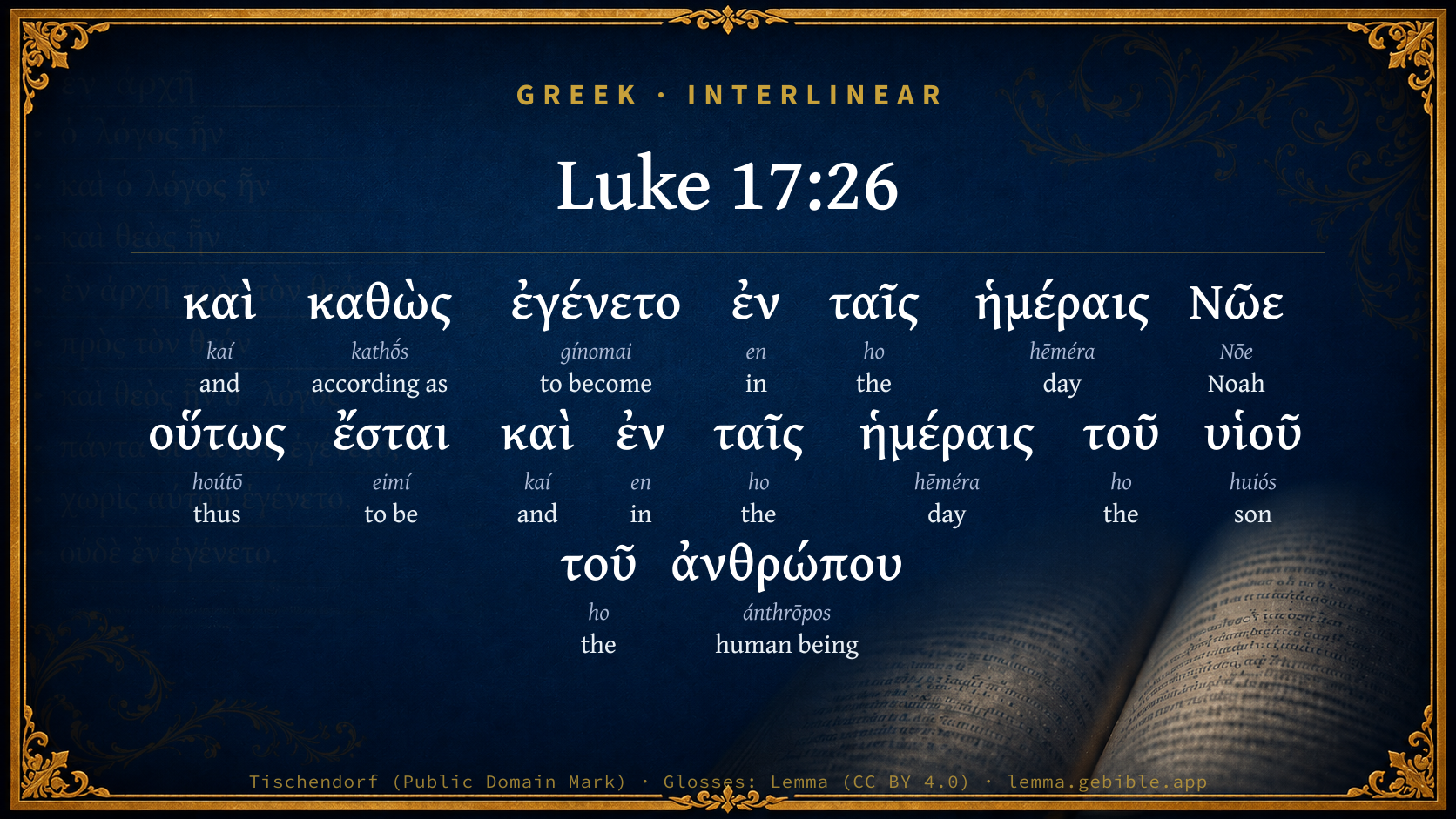
Greek (Tischendorf 8th ed.) Luke 17:26 appears in the Greek New Testament. The text above is from the Tischendorf 8th edition. Each word links to its Strong’s number and a concise gloss. Click any word for its full Thayer’s Greek Lexicon entry.
Download image
Cite this verse

Luke 17:26 (World English Bible). Public Domain. Lemma interlinear Bible study tool, https://lemma.gebible.app/v/luke/17/26.

Show BibTeX & RIS
BibTeX
RIS
English Translation
As it happened in the days of Noah, even so will it be also in the days of the Son of Man.
World English Bible · Public Domain
Download a study sheet

One document with this verse’s original text, its word-by-word gloss line, the meaning frame, cross-references with their text, attributed commentary, and full source and license credits — printable, and it pastes into notes with its structure intact.

This verse Autodidact and up

Study sheet (.html) Plain text (.txt)

A passage Seminary Student

Up to 50 verses in one chapter. A passage sheet keeps up to 6 commentary sources and 12 cross-references per verse, in the order this page ranks them, and says so on the sheet whenever that leaves anything out. Ask for a single verse and you get the Autodidact verse sheet above.

Everything on this page stays free to read, with no account — the sheet is a download of what is already on screen, not access to it.

Want to remove ads? Support Godless Engineer
Compare translations 3

The same verse in 3 English versions, stacked beneath the original-language interlinear above. Click any original word for its lexicon entry.

Each is an independent rendering of the whole verse — the interlinear is not word-aligned to these translations.

Highlighted words mark where these versions differ — a whole-verse word diff, not a word-by-word alignment.

  • World English Bible Public Domain
    As it happened in the days of Noah, even so will it be also in the days of the Son of Man.
  • King James Version Public Domain
    And as it was in the days of Noe, so shall it be also in the days of the Son of man.
  • unfoldingWord Literal Text CC BY-SA 4.0
    And just as it happened in the days of Noah, thus it will be also in the days of the Son of Man.

unfoldingWord Literal Text — © unfoldingWord, licensed CC BY-SA 4.0. Word-aligned USFM3 via Door43 (git.door43.org/unfoldingWord/en_ult).

Versions to compare (up to 4)

3 of 4 selected

Show all 19 translations

Every available English version of this verse, each an independent rendering of the whole verse.

  • World English Bible Public Domain
    As it happened in the days of Noah, even so will it be also in the days of the Son of Man.
  • Berean Standard Bible Public Domain
    Just as it was in the days of Noah, so also will it be in the days of the Son of Man:
  • Majority Standard Bible Public Domain
    Just as it was in the days of Noah, so also will it be in the days of the Son of Man:
  • King James Version Public Domain
    And as it was in the days of Noe, so shall it be also in the days of the Son of man.
  • American Standard Version (1901) Public Domain
    And as it came to pass in the days of Noah, even so shall it be also in the days of the Son of man.
  • Revised Version (1885) Public Domain
    And as it came to pass in the days of Noah, even so shall it be also in the days of the Son of man.
  • Geneva Bible (1599) Public Domain
    And as it was in the dayes of Noe, so shall it be in the dayes of the Sonne of man.
  • Douay-Rheims (1899) Public Domain
    And as it came to pass in the days of Noe, so shall it be also in the days of the Son of man.
  • Young's Literal Translation Public Domain
    `And, as it came to pass in the days of Noah, so shall it be also in the days of the Son of Man;
  • Literal Standard Version CC BY-SA 4.0
    And as it came to pass in the days of Noah, so will it also be in the days of the Son of Man;
  • Unlocked Literal Bible CC BY-SA 4.0
    As it happened in the days of Noah, even so will it also happen in the days of the Son of Man.
  • unfoldingWord Literal Text CC BY-SA 4.0
    And just as it happened in the days of Noah, thus it will be also in the days of the Son of Man.
  • Darby Bible Public Domain
    And as it took place in the days of Noe, thus also shall it be in the days of the Son of man:
  • World Messianic Bible Public Domain
    As it was in the days of Noah, even so it will also be in the days of the Son of Man.
  • Webster's Bible Public Domain
    And as it was in the days of Noah, so shall it be also in the days of the Son of man.
  • Free Bible Version CC BY-SA 4.0
    The time when the Son of man comes will be like it was in Noah's day.
  • Bible in Basic English Public Domain
    And as it was in the days of Noah, so will it be in the day of the Son of man.
  • Text-Critical English NT CC BY 4.0
    Just as it was in the days of Noah, so will it be in the days of the Son of Man.
  • Tyndale New Testament (1534) Public Domain
    As it happened in the tyme of Noe: So shall it be in the tyme of the sonne of man.

Literal Standard Version (2020), Covenant Press — licensed CC BY-SA 4.0. Text via the HelloAO Bible API (eBible.org). Unlocked Literal Bible (unfoldingWord) — licensed CC BY-SA 4.0. Text via the HelloAO Bible API (eBible.org). unfoldingWord Literal Text — © unfoldingWord, licensed CC BY-SA 4.0. Word-aligned USFM3 via Door43 (git.door43.org/unfoldingWord/en_ult). Free Bible Version, Dr. Jonathan Gallagher — licensed CC BY-SA 4.0. Text via the HelloAO Bible API (eBible.org).

Word by word

More ways to search: Search by grammar → Find every occurrence → Compare this word →

Practice this passage: Drill this verse → Learn its vocabulary →

Νῶε
Nōe
G3575
“Noah”
Noun, Proper, indeclinable
Part of Speech
Noun · Proper, indeclinable
Full Thayer's Definition

Origin: of hebrew origin H5146

TDNT: None

Noah = "rest" 1. the tenth in descent from Adam, second father of the human family
  1. καὶ kaí G2532 “and” Conjunction
  2. καθὼς kathṓs G2531 “according as” Adverb
  3. ἐγένετο gínomai G1096 “to become” Verb, Aorist, Middle deponent, Indicative, 3rd person, Singular
  4. ἐν en G1722 “in” Preposition
  5. ταῖς ho G3588 “the” Article, Dative, Plural, Feminine
  6. ἡμέραις hēméra G2250 “day” Noun, Dative, Plural, Feminine
  7. οὕτως hoútō G3779 “thus” Adverb
  8. ἔσται eimí G1510 “to be” Verb, Future, Middle deponent, Indicative, 3rd person, Singular
  9. καὶ kaí G2532 “and” Conjunction
  10. ἐν en G1722 “in” Preposition
  11. ταῖς ho G3588 “the” Article, Dative, Plural, Feminine
  12. ἡμέραις hēméra G2250 “day” Noun, Dative, Plural, Feminine
  13. τοῦ ho G3588 “the” Article, Genitive, Singular, Masculine
  14. υἱοῦ huiós G5207 “son” Noun, Genitive, Singular, Masculine
  15. τοῦ ho G3588 “the” Article, Genitive, Singular, Masculine
  16. ἀνθρώπου ánthrōpos G444 “human being” Noun, Genitive, Singular, Masculine

About this verse

These counts appear in no published source. They are computed here, from the morphology-tagged text and Lemma’s own curated glosses. What Lemma adds →

17
words
11
distinct lemmas
Gospels
section

Notable vocabulary

The rarest word here is Νῶε Noah G3575 — appearing just 8 times in the whole Greek New Testament.

Shared distinctive vocabulary

Νῶε Noah G3575 occurs in 8 verses of the Greek New Testament. Also found in:

Repetition

Words recur within this verse:

Cross-references

12

Topical passages linked to Luke 17:26 in the Treasury of Scripture Knowledge — connected by theme and wording, ordered by reader-vote popularity; previews shown in the World English Bible.

  • Matthew 24:37–39 "As the days of Noah were, so will be the coming of the Son of Man.
  • Genesis 7:7–23 Noah went into the ark with his sons, his wife, and his sons' wives, because of the waters of the flood.
  • Luke 17:24 for as the lightning, when it flashes out of the one part under the sky, shines to the other part under the sky; so will the Son of Man be in his day.
  • Luke 17:22 He said to the disciples, "The days will come, when you will desire to see one of the days of the Son of Man, and you will not see it.
  • Hebrews 11:7 By faith, Noah, being warned about things not yet seen, moved with godly fear, prepared an ark for the saving of his house, through which he condemned the world, and became heir of the righteousness which is according to faith.
  • 1 Peter 3:19–20 in which he also went and preached to the spirits in prison,
  • 2 Peter 2:5 and didn't spare the ancient world, but preserved Noah with seven others, a preacher of righteousness, when he brought a flood on the world of the ungodly;
  • Genesis 6:5 Yahweh saw that the wickedness of man was great in the earth, and that every imagination of the thoughts of his heart was only evil continually.
  • Job 22:15–18 Will you keep the old way Which wicked men have trodden,
  • 2 Peter 3:6 by which means the world that then was, being overflowed with water, perished.
  • Genesis 6:7 Yahweh said, "I will destroy man whom I have created from the surface of the ground; man, along with animals, creeping things, and birds of the sky; for I am sorry that I have made them."
  • Luke 18:8 I tell you that he will avenge them quickly. Nevertheless, when the Son of Man comes, will he find faith on the earth?"

Cross-references courtesy of OpenBible.info (CC BY 4.0).

Commentary

Notes on Luke 17:26 from classic Christian and Jewish commentators (each source and its license shown beneath its notes). The classic Christian expositions comment on the surrounding passage and are grouped to its opening verse, so a note may address several verses; the Jewish commentaries on the Tanakh (Rashi and others) are per-verse, so they appear only where the commentator wrote on this verse.

Lemma curates 59 commentaries, every one of them public domain or Creative Commons licensed, each selected and text-cleaned for this edition rather than reprinted as found. About our sources →

The Biblical Illustrator

Joseph S. Exell

Luk_17:26-27

As it was in the days of Noe

Wherein are we endangered by things lawful?

I. WHEN DO LAWFUL THINGS BECOME SIN TO US?

1. When they become hindrances in our way to heaven, instead of helps as they were intended to be.

2. When our hearts are wrapped up in them.

II. HOW WE MAY JUDGE OF OUR HEARTS, AND KNOW WHEN THEY MISCARRY AND OFFEND IN THE PURSUIT, USE, AND ENJOYMENT OF LAWFUL THINGS.

1. When our desire of, and endeavours after, worldly things grow strong and vehement and very eager and impatient.

2. When you have raised expectations and hopes of great contentment and satisfaction from your comforts.

3. When the obedience and willing submission of the soul is brought off to any worldly comfort, and the soul stoops to its sceptre, and the faculties, like the centurions servants, do as they are bid. Such comforts which are slavishly obeyed are sinfully enjoyed.

4. When the soul groweth very tender and compassionate towards such a comfort, and begins to spare that above other things; then that becomes a lust, and lust is very tender and delicate, and must be tenderly used.

5. When the care, anxiety, and solicitude of the soul runs out after the comforts of this life, saying, What shall I eat? what shall I drink? How shall I live and maintain my wife and children? what shall I do to get, to keep such or such a thing?

6. That comfort which thou art not dead unto, neither is that dead to thee, thou wilt hardly enjoy with safety to thyself, or thou wilt part withal but upon severe terms.

7. If, after God hath been weaning us in a more special manner by His word and rod, and taking off our hearts from our worldly comforts, yet the strong bent of the soul is towards them, it argues much carnal love to them that we are not crucified to those comforts.

III. WHAT ARE THE SINS THAT ATTEND THE IMMODERATE SINFUL USE OR ABUSE OF LAWFUL COMFORTS? I will confine myself to the sins in the text.

1. The first sin in their eating and drinking, etc., was sensuality.

2. Pride, ease, and idleness generally go together.

3. Security follows. (H. Wilkinson, D. D.)

The revelation of the Son of Man

The revelation of the Son of Man is an event which takes more shapes than one in this passage.

1. First our Lord indicates that it implies a period of danger in one place and of the possibility of escape in another place--of safety in the field and not in the house, of safety without, but not within. The revelation of the Son of Man thus takes the shape of a critical period, such as might happen during a siege, or the destruction of a dwelling or of a whole city--where life would be in peril within the walls, but might be saved beyond the walls, and where safety lay only in immediate flight: lingering would be ruin, a quick departure from the doomed city the only way of escape. That is one aspect of the revelation of the Son of Man. And Christ exhorts His disciples, and all who hear Him, to escape with their lives--to escape with the higher life, the better life. Let not the love of property interfere with the love of life; lose all rather than lose life; and let not the love of the lower life interfere with the preservation of the higher life--the life of the spirit, the true life of man. Lose life itself rather than lose that; for in preserving that, all is preserved.

2. Then our Lord speaks of ,the day of the Son of Man--or, altering the phraseology, of the night of the Son of Man--when He is revealed. In that night there shall be two in one bed--the one taken and the other left; two women grinding at the mill--the one taken and the other left; two men in the field--the one taken and the other left. It is a time of separation which is indicated; the figure of the siege disappears, and new figures take its place. It is a time, though not of apparent outward danger, yet of judgment; but on what principle the judgment takes place, these words do not of themselves determine. For aught that appears, it may be a separation of accident or of caprice; it is a separation, and that is all we know. But when the disciples say further, Where, Lord? He utters a proverb which casts light on the judgment and also on the siege and separation: Wheresoever the body is, thither will the eagles be gathered together, a parable that may have been old or new, it matters not; the meaning is plain, and it is twofold.

(1) It evidently means that the judgment is one which is true to nature. Our Lord gives the principles on which the judgment or separation proceeds. It is the dead carcass on which the eagles prey. It is the corrupt city, the corrupt State, the corrupt heart, on which judgment is pronounced: the judgment is not one of accident or caprice, but of truth, of righteousness. That is the principle of separation and judgment. And

(2) in answer to the question Where, Lord? Jesus gives, I think, another lesson on this matter,--viz., that this revelation of the Son of Man is not a single and solitary act of judgment at some future and far-distant day, but that it is a revelation often made--made, now on a country, now on a people, now on a Church, now on a system. The revelation of the Son of Man is not a thing of time and place, it is an eternal law in the dispensation of God. The judgment of God is proceeding every day; it is proceeding quietly and unseen. It is only now and then that mens eyes are open to behold it, and then the judgment is revealed. But it is not the less true that Gods judgment proceeds day by day, whether it is seen and revealed or not. Corruption shall bring about its own recompense--not at a particular time or place; not in some one notable instance years or centuries hence, but wheresoever the carcass is, there will the eagles be gathered together. (A. Watson, D. D.)

The Biblical Illustrator, edited by Joseph S. Exell (c. 1880s–1900s) — public domain. Text from a community e-Sword module.

Joseph Benson's Commentary

Luk 17:26-30. As it was in the days of Noe, &c. — In the next place, he foretold the stupidity of the generation he should come to destroy, comparing it to that of the old world, about the time of the flood; who, being wholly unaffected with the admonitions which Noah gave them, while building the ark, and with the threatenings which he then denounced, went on as usual, following their ordinary occupations, and pursuing their pleasures, both lawful and unlawful, in great security. The consequence of which was, that, ere they were aware, the flood came and destroyed them all. See on Mat 24:37; Mat 24:39. Likewise, as it was in the days of Lot — The Jewish people shall be sunk in carnal security at the coming of the Son of man to execute judgment upon them, as the Sodomites were, when they were unexpectedly destroyed by fire and brimstone from heaven.

Joseph Benson's Commentary on the Old and New Testaments (1811–1818) — public domain. Text from a community e-Sword module.

Godbey's Commentary on the New Testament

William B. Godbey

THE DAYS OF NOAH

Luk 17:26-27. “And as it was in the days of Noah, so it will be in the days of the Son of man. They were eating, drinking, marrying, getting married, until the day on which Noah entered into the ark, and the flood came and destroyed them all.” Abel was a holy man, and God’s first martyr, succeeded by his brother Seth in the leadership of the antediluvian Holiness Church; while Cain was the patriarchal founder of the Anti- holiness Church, being very religious, as we see from his offering to the Lord; but no blood — i. e., no sanctification. After many centuries of separation, unfortunately the holiness people intermarried with the Cainites, the latter predominating and leading the former into worldliness, till the lights of truth and holiness had yielded to an almost total eclipse amid the fogs of worldly wickedness and dead Churchism, till God in mercy found it necessary to interpose, and miraculously give victory and a new start to His truth and righteousness on the earth, lest the last hope of humanity should go down in the gloom of rayless night, thus bringing the flood on an ungodly world, which He saw, if let alone, would do nothing but populate hen. Therefore, in mercy interposing to arrest the otherwise hopeless, hellward-bound trend, He rescued the only surviving righteous family to populate the newborn world, Noah’s ark, in which the faithful few mounted the raging floods and rode above a perishing world, emblematizing the cloud in which the faithful few will be caught up when the Lord comes. Here you see our Lord’s description of the business rush among the antediluvians, going fight on till the flood came. So the legitimate conclusion follows that this wicked world will be, like the people before the flood, engrossed and bewildered with transitory things, heeding not the solemn warnings we have in this precious Book, amply sufficient to fortify us against all delusion and surprise. So it was in the days of Noah, who knew well that the flood was coming, and preached it to the people; yet they believed him not, but rushed right on in their worldly impetuosity till the flood came and took them all away. Our Infallible Savior assures us that a repetition of these events is impending at the time of His coming. God help us to be true, and, like Noah, warn the people, and thus clear our skirts of their blood! If they believe us, it will be well for them; if not, we have delivered our souls.

William B. Godbey, Commentary on the New Testament (1896–1900) — public domain. Text from a community e-Sword module.

Tyndale Open Study Notes

Tyndale Open Resources

17:26-29 in Noah’s day . . . in the days of Lot: See Gen 6–9 for Noah and Gen 18:16–19:29 for Lot; both are stories of God’s cataclysmic judgment against human wickedness.

Tyndale Open Study Notes — © Tyndale Open Resources, licensed CC BY-SA 4.0. Text via the HelloAO Bible API.

Bengel's Gnomon

Johann Albrecht Bengel

Luk 17:26. Καθὼς, even as) The last times of all correspond with the deluge, in respect to the universality of the catastrophe; and with the destruction of Sodom, in respect to the fact of fire being the agency employed.—καὶ ἐν ταῖς ἡμέραις, also in the days) In the first instance, the actual day of the revelation of the Son of man in Luk 17:30 is called “the Day of the Son of man;” then afterwards also those days, which precede it, receive that appellation: the last days of [His] expectation: Heb 10:13 [From henceforth expecting till His enemies be made His footstool]. Comp. the phrase, Psalms 119(118):84, πόσαι εἰσὶν αἱ ἡμέραι τοῦ δούλου σου, “How many are the days of thy servant?” So also, before His coronation or nuptials, some time is assigned to the King or Bridegroom. A similar plural occurs, ch. Luk 9:51 [ἐν τῷ συμπληροῦσθαι τὰς ἡμέρας τῆς ἀναλήψεως αὐτοῦ], where see the note. [Though the day of His assumption or ascension was one day, yet the forty days before it and after His resurrection were equivalent to a παρασκευή, or Preparation for it.]

Bengel's Gnomon of the New Testament — English translation (T&T Clark, Edinburgh, 1860) — public domain. Text from a community e-Sword module.

Meyer's Critical & Exegetical Commentary

Heinrich August Wilhelm Meyer

Luk_17:26-27. Comp. Mat_24:37 f.

καθὼς ἐγένετο κ.τ.λ.] to wit, that men carelessly and securely pursued their accustomed striving till they were overtaken by the flood.

ἐν ταῖς ἡμέραις τ. υἱοῦ τ. ἀνθρώπου] in the days in which the appearance of the Messiah will come.

Luk_17:27. ἤσθιον, ἔπινον κ.τ.λ.] a vividly graphic asyndeton.

καὶ ἦλθεν] not to be connected with ἄχρι ἧς ἡμέρας (Bleek). See Gen_7:4; Gen_7:10.

Meyer — Critical and Exegetical Commentary on the New Testament — English translation by Peter Christie, edited by Frederick Crombie (T&T Clark, 1880) — public domain. Text from a community e-Sword module.

Expositor's Greek Testament

ed. W. Robertson Nicoll

Luk 17:26-30 . The advent will be a surprise (Mat 24:37-41 ).

The Expositor's Greek Testament, edited by W. Robertson Nicoll (1897–1910) — public domain. Text from a community e-Sword module.

Godet's Commentaries

Frédéric Louis Godet

Vers. 26-30. “And as it was in the days of Noe, so shall it be also in the days of the Son of man. 27. They did eat, they drank, they married, and were given in marriage, until the day that Noe entered into the ark; and the flood came, and destroyed them all. 28. Likewise also, as it was in the days of Lot; they did eat, they drank, they bought, they sold, they planted, they builded; 29. But the same day that Lot went out of Sodom it rained fire and brimstone from heaven, and destroyed them all. 30. Even thus shall it be in the day when the Son of man is revealed.”

While believers sigh with growing ardour for the return of their Lord, carnal security more or less complete takes possession of the race. It is an epoch like those which have preceded all the great catastrophes of history. The business of earthly life is carried through with regularity; but religious feeling gradually disappears from the heart of men who have become secularized. The days of Noe denote the 120 years during which the ark was a-building. ᾿Εξεγαμίζοντο strictly means, were given in marriage, that is to say, young daughters by their parents. The finite verbs ἤσθιον, ἔπινον (Luk 17:28), ἔβρεξε (Luk 17:29), are in apposition to ἐγένετο, and, as such, are still dependent on ὡς. The apodosis does not occur till Luk 17:30. This form is analogous to the Hebrew construction which we have so often observed in Luke (ἐγένετο, with a finite verb for its subject). ῎Εβρεξε is generally regarded as active: God caused it to rain. Comp. Gen 19:24, καὶ κύριος ἔβρεξεν (Mat 5:45). But as in this case the ἀπ᾿ οὐρανοῦ would be pleonastic, and as βρέχω is found in Polybius and the later Greek authors in a neuter sense, it is more natural to adopt this sense here, by which we at the same time preserve the parallelism between ἀπώλεσεν (subject, πῦρ καὶ θεῖον) and the ἀπώλεσεν, Luk 17:27 (subject, κατακλυσμός).

The word ἀποκαλύπτεται supposes that Jesus is present, but that a veil conceals His person from the view of the world. All at once the veil is lifted, and the glorified Lord is visible to all. This term occurs again in the same sense, 1Co 1:7; 2Th 1:7; 1Pe 1:7; and perhaps 1Co 3:13. The point of comparison between this event and the examples quoted is the surprise caused in the bosom of security.

Mat 24:37-39 contains a passage parallel to Luk 17:26-27 (the example of Noe). The idea is the same; but the terms are so different, that they forbid us to assume that the two editions proceed from the same text.

Frédéric Louis Godet — Commentaries on Luke, John, Romans, and 1 Corinthians — English translation (T&T Clark, Edinburgh, 1870s–1890s) — public domain. Text from a community e-Sword module.

Geneva Bible (1599)

Geneva Bible translators

The world shall be taken unawares with the sudden judgment of God: and therefore the faithful ought to watch continually.

Geneva Bible (1599) marginal notes — public domain. Text via Bolls.life.

Jamieson, Fausset & Brown

Robert Jamieson, A. R. Fausset & David Brown

eat . . . married . . . planted--all the ordinary occupations and enjoyments of life. Though the antediluvian world and the cities of the plain were awfully wicked, it is not their wickedness, but their worldliness, their unbelief and indifference to the future, their unpreparedness, that is here held up as a warning. Note.--These recorded events of Old Testament history--denied or explained away nowadays by not a few--are referred to here as facts.

Jamieson, Fausset & Brown — Commentary Critical and Explanatory on the Whole Bible (1871) — public domain (CC PDM 1.0). Text via the HelloAO Bible API.

Adam Clarke's Commentary

Verse 26. As it was in the days of Noe] See Clarke on Mt 24:38.

Adam Clarke's Commentary on the Bible (1810–1826) — public domain. Text from a community e-Sword/MySword module.

Ellicott's Commentary for English Readers

(26) As it was in the days of Noe.—See Notes on Mat_24:26-27. Here, also, the “days” of the Son of Man take the place of the parousia.

A Bible Commentary for English Readers, edited by Charles John Ellicott (1878–1897) — public domain. Text from a community e-Sword module.

The Cambridge Bible for Schools and Colleges

gen. ed. J. J. S. Perowne

26. as it was in the days of Noe] as described in Gen_7:11-23. The Second Advent should flame upon a sensual and unexpectant world.

The Cambridge Bible for Schools and Colleges (gen. ed. J. J. S. Perowne; Cambridge University Press, 1878–1918) — public domain. Text from a community e-Sword module.

John Gill's Exposition

They did eat, they drank,.... That is, the inhabitants of the old world ate and drank, not merely in a common way, with moderation, and for the support and comfort of life, which is not blameworthy, nor inconsistent with religious exercises; but they lived in an extravagant and luxurious manner; they indulged their sensual appetites, and put away the evil day far from them, that Noah told them of:

they married wives, they were given in marriage; not as should have been done by professors of religion among themselves; but the sons of God, or professors of the true religion, the posterity of Seth took them wives of the daughters of men, of the wicked, of the seed of Cain; and very likely gave their daughters in marriage to the sons of men; see Gen 6:2 and so they went on in a secure manner, notwithstanding all the remonstrances, warnings, and threatenings of God, by his servant:

until the day that Noe entered into the ark; which he had built by divine direction, for the saving of himself and family, and the creatures that were with him, from the waters of the flood; and this was in the six hundredth year of his life, in the second month, the month of October, and in the seventeenth day of that month; Gen 7:11

and the flood came and destroyed them all; all the inhabitants of the earth, every living substance, men, cattle, creeping things, and fowls of the heaven; all but Noah, and his wife, and his three sons, and their wives, and the creatures that were with him in the ark: the flood came not of itself, or by chance, or through the influence, or by the concurrence of second causes merely; though these were used, ordered, and directed by the first cause of all things; but it came by the power of God, according to his will; he brought it on the world of the ungodly; see Pe2 2:5 The mode of expression is Jewish; it is said of Cain, who is supposed by the Jews to have lived till the flood, , "the flood came", and washed him away (g).

(g) Bereshit Rabba, sect. 32. fol. 27. 2. & Shemot Rabba, sect. 31. fol. 134. 4.

John Gill's Exposition of the Whole Bible (1746–1763) — public domain (CC PDM 1.0). Text via the HelloAO Bible API.

Trapp's Complete Commentary

John Trapp

26 And as it was in the days of Noe, so shall it be also in the days of the Son of man.

Ver. 26. {See Trapp on "Mat 24:27"} {See Trapp on "1Pe 3:20"}

John Trapp, A Commentary or Exposition upon All the Books of the Old and New Testament (1647–1656) — public domain. Text from a community e-Sword module.

Albert Barnes' Notes on the Bible

See the notes at Mat 24:37-39.

Albert Barnes' Notes on the Bible (1834–1885) — public domain. Text from a community e-Sword/MySword module.

Matthew Poole's English Annotations

See Poole on "Mat 24:37", and following verse to Mat 24:39. Our blessed Lord in these verses doth both declare the surprisal of the Jews with that judgment which was coming upon them, and of the world with his coming in the day of judgment, (of which the destruction of Jerusalem was a type), and also forewarns them to take heed that they might not be surprised; he tells them, that

in the days of the Son of man, ( so that he speaketh of more than one day), the day of his power in the destruction of the Jews, and in the day of judgment, the antitype to the former, it shall be as in the days of Noah and of Lot. In the days of those men, neither the men of the old world, nor the men of Sodom, would hearken either to Noah or Lot, who were preachers of righteousness to them, and gave them examples of sober and holy lives; but gave up themselves to luxury, and lived in a careless regard of any thing God was doing, until the very day that Noah went into the ark, with his family, and the flood destroyed all the rest; and till the day that Lot went out of Sodom, and fire and brimstone came down and destroyed all those who were left in Sodom. So it would be before the final ruin of the world. Till the very days came, and men felt it, the generality of men would not believe it, nor make any preparation for it. But in our Lord’s propounding these two great examples to them, he also lets them know their duty and wisdom, viz. to watch, and be upon their guard, with Lot to get ready to go out of Sodom, with Noah to prepare an ark upon this admonition which he gave them. There are no such signs of approaching ruin to persons or nations, as security, and the abounding of sin and wickedness, notwithstanding the warnings which God giveth them by his messengers.

Matthew Poole's English Annotations on the Holy Bible (1683–1685) — public domain. Text from a community e-Sword/MySword module.

Whedon's Commentary on the Bible

Daniel D. Whedon

26. The days of the Son of man—The days preceding his second advent, just as the days of Noah were the days preceding the flood.

Daniel D. Whedon (gen. ed.), Commentary on the Old and New Testaments (1874–1909) — public domain. Text from a community e-Sword module.

The Pulpit Commentary

Vers. 26-28. As it was in the days of Nee (Noah)... as it was in the days of Lot. The prominent sin of the antediluvian, he reminds them, was sensuality in its varied forms. The torch of religious feeling will have waned in that unknown and possibly distant future when Messiah shall reappear, and will be burning with a pale, faint light. The bulk of mankind will be given up to a sensuality which the higher culture then generally reached will have been utterly powerless to check or even to modify. Men, just as in the days when the ark was building and Noah was preaching, as in the days when the dark cloud was gathering over the doomed cities of the plain and Abraham was praying, will be entirely given up to their pursuits, their pleasures, and their sins. They will argue that the sun rose yesterday and on many yesterdays; of course it will rise to-morrow. Perfect security will have taken possession of the whole race, just as, on a smaller scale, was the case in the days of Noah and of Lot, when the floods came and the fire, and did their stern, pitiless work; so will that day of the second coming of Messiah, with its" bloody and fiery dawn, assuredly come on man when he is utterly unprepared.

Vers. 26-30. The unlearnt lesson.

Man differs from the brute creation in that he learns and profits by experience he advances. He passes through stage after stage toward the perfection of his life upon the earth. He is the hunter at one period, then the shepherd, then the agriculturist. From the lowest barbarism he reaches, in time, the most refined civilization. But he is very slow indeed to learn, if he does learn at all, moral and spiritual truths. The excellency of thrift, of temperance, of purity, of patience, how long a time it is taking man to acquire these virtues! Our text opens to us the truth of the danger of spiritual trifling, and indicates that what men were long ages ago, that they still are in this respect.

I SPIRITUAL TRIFLING. The men of the time of Noah were living in a state of utter worldliness and impiety. They were not without remonstrance and rebuke; Noah was himself "a preacher of righteousness" unto them. But they hearkened not, nor heeded; they made light of his admonitions and his warnings. They found some pretext under which they could easily hide the truth he reminded them of, and they went on their way of materialism and enjoyment. The same with the people of Sodom, and the character and instruction of Lot. And so with us.

1. Men are living in sinful selfishness and worldliness many in crime, many more in vice; but a very large multitude in practical godlessness. God is not in all, he is not in many if in any of their thoughts. His will is not the object of their inquiry, is not the rule of their life.

2. The religious teacher comes and admonishes; he says, "Man cannot live by bread alone;" the claims of the Divine Father, of the holy Saviour, are the supreme claims, etc.

3. But still the same course is pursued; the better thoughts that are momentarily stirred in the heart are silenced; sacred truths are extinguished; the truth of God is treated lightly; the world and the things that are in the world are uppermost and are victorious.

II THE PALPABLE FOLLY OF SUCH TRIFLING AS THIS.

1. It is attended with immediate and certain injury. For it is impossible for a human soul to reject the truth or to quench the Spirit of God, and not be seriously the worse for such an act.

2. There is the grave peril of a great disaster. The generation is eating and drinking and marrying, and behold! the Flood sweeps them away. The cities are trading and feasting, and lo! the fires of heaven come down and consume them. They who trifle with the most sacred things are sure to find that, suddenly, in such an hour as they think not, the end arrives. The business plans are all broken off; the brilliant career is concluded; the flow of pleasures is arrested. Death suddenly appears, and deals his fatal blow. These sacred opportunities which have been so little prized, so much disparaged, recede with terrible rapidity and disappear. Opportunity that waited by the side, and waited all in vain, melts and vanishes in a moment. The soul awakes from its long lethargy to see that its powers have been wasted and that its chance is gone!

III THE ELUSIVENESS OH THIS SOLEMN LESSON. Men have always known this, and they have always acted as if they were ignorant of it. "As it was... so shall it be." So is it to-day. By spiritual trifling men fritter away the golden chance that Divine love puts into their hands. Be wise in time. Realize what you are doing, what injury you are working, what risk you are running. C.

The Pulpit Commentary (1880–1919), ed. H.D.M. Spence-Jones & Joseph S. Exell — public domain. Text from a community e-Sword module.

John Wesley's Explanatory Notes

The days of the Son of man - Those which immediately follow that which is eminently styled his day. Matt. xxiv, 37.

John Wesley, Explanatory Notes Upon the Whole Bible (1754–1765) — public domain. Text via the GEBible commentary corpus.

Scofield Reference Notes

C. I. Scofield

Son of man

(See Scofield "Mat 8:20").

The Scofield Reference Bible (1917 edition), notes by C. I. Scofield — public domain. Text from a community e-Sword module.

Kretzmann's Popular Commentary

Paul E. Kretzmann

The suddenness of Christ’s advent:

v. 26. And as it was in the days of Noe, so shall it be also in the days of the Son of Man.

v. 27. They did eat, they drank, they married wives, they were given in marriage, until the day that Noe entered into the ark, and the Flood came, and destroyed them all.

v. 28. Likewise also as it was in the days of Lot; they did eat, they drank, they bought, they sold, they planted, they built;

v. 29. but the same day that Lot went out of Sodom it rained fire and brimstone from heaven, and destroyed them all.

v. 30. Even thus shall, it be in the day when the Son of Man is revealed.

The distinguishing characteristic of the time just preceding the final advent of Christ, the Son of Man, will be an indifferent carelessness. The days of Noah are an example. The warning had gone out through the mouth of this preacher of righteousness that the people should repent of their foolish ways. But they gave so little heed to the warning that they continued in all the manner of complete abandon in the desires of the flesh up to the very hour of the cataclysm: they ate, they drank, they married, they were married; men and women, the entire generation, past all hope of redemption. And then, with the sudden frightfulness that has characterized the judgments of God in similar situations, came the day on which Noah entered into the ark; then came the Flood and destroyed them all. And the days of Lot are another example of the utter, blind heedlessness of the people. In Sodom and Gomorrah the inhabitants continued in the delights of the flesh as well as in all their lines of business, work, and endeavor: they ate, they drank, they bought, they sold, they planted, they built, up to the very hour of the catastrophe that overwhelmed the cities, when it rained fire and sulphur from heaven and destroyed them all. The people of the last times will not have learned their lesson from the previous calamities; when the Son of Man will be revealed before their astonished, horrified eyes on the last day, He will find them as unprepared for His coming, as deeply steeped in the foolishness of the Noachites and of the Sodomites as any generation ever was.

Paul E. Kretzmann, Popular Commentary of the Bible (1921–1924) — public domain. Text from a community e-Sword module.

Burkitt's Expository Notes on the New Testament

William Burkitt

In these verses our Saviour declares, that Jerusalem’s destruction, and the world’s final desolation at the great day, would be like the destruction of the old world in the days of Noah, and like the destruction of Sodom in the days of Lot, and that both in regard of unexpectedness, and in regard of sensuality and security, as they before the flood were eating and drinking, marrying and giving in marriage; that is, wholly given up to sensuality and debauchery; and did not know, that is, did not consider, the floods coming, until it swept them away; thus was it before the destruction of Jerusalem, and will be before the end of the world.

Hence we learn, that as the old world perished by infidelity, security, and sensuality, so will the same sins be prevailing before the destruction of this present world. As it was in the days of Noah, so shall it be in the days of the Son of man.

William Burkitt's Expository Notes on the New Testament (1700–1703) — public domain. Text from a community e-Sword module.

Cambridge Greek Testament for Schools and Colleges

26. καθώς. Once in Herodotus, but never in Attic for καθάπερ.

ἐν ταῖς ἡμέραις Νῶε. As described in Gen 7:11-23. The Second Advent should flame upon a sensual and unexpectant world.

Cambridge Greek Testament for Schools and Colleges (Cambridge University Press, 1896; 21 vols, various authors incl. Carr, Maclear, Plummer, Farrar, Lumby, Moule, M. R. James, Simcox) — public domain. Text from a community e-Sword module.

International Critical Commentary

26. Having told the disciples that the Son of Man will not come as soon as they wish (22), in what way He will not come (23), in what way He will come (24), and what will happen first (25), Christ now states in what condition the human race will be when He comes.

καὶ καθὼς ἐγέετο . Not ὥσπερ, as in ver. 24. There something analogous was introduced; here something exactly similar is cited. “Just as, even as.” Comp. 11:30; Joh 3:14; 2Co 1:5, 2Co 10:7, etc. In Attic Greek we should rather have καθό (Rom 8:26), καθά (Mat 27:10), or καθάπερ (Rom 12:4).

International Critical Commentary — older volumes (1896–1929), various authors — public domain. Text from a community e-Sword module.

Lesson kit

Teaching starters — assembled from the data on this page, not authored interpretation. Every prompt links to the verse data it draws on. Edit before teaching.

Luke, in the Gospels, opens this verse with 17 words (11 distinct Greek lemmas). Its most distinctive word is Nōe (“Noah”). A historical commentator’s framing appears above. Read the whole chapter for the surrounding context.

Discussion questions

  1. How does “Noah” (Nōe) shape what this verse is saying?
  2. How does Matthew 24:37, which shares the word «Noah», read alongside this verse?
  3. What does the repetition of “day” (2× in this one verse) do in this verse?
  4. These translations render this verse differently. What is at stake in choosing one wording over another?
  5. Compare how The Biblical Illustrator and Joseph Benson's Commentary read this verse. Where do they agree or differ?

Things to notice

Reading settings

Reading text

Shown beneath each verse's original-language words.

Old Testament
Old Testament edition

Read the OT as the Masoretic Hebrew (MT) or the Greek Septuagint (LXX).

English shown for the Greek Septuagint (in the Hebrew ↔ Greek comparison).

Comparing translations? Open the Compare panel on any verse page to stack up to four side by side.