1 Corinthians 15:45

Greek (Tischendorf 8th ed.) 1 Corinthians 15:45 appears in the Greek New Testament. The text above is from the Tischendorf 8th edition. Each word links to its Strong’s number and a concise gloss. Click any word for its full Thayer’s Greek Lexicon entry.
Download image
Cite this verse

1 Corinthians 15:45 (World English Bible). Public Domain. Lemma interlinear Bible study tool, https://lemma.gebible.app/v/1-corinthians/15/45.

Show BibTeX & RIS
BibTeX
RIS
English Translation
So also it is written, "The first man, Adam, became a living soul." The last Adam became a life-giving spirit.
World English Bible · Public Domain
Download a study sheet

One document with this verse’s original text, its word-by-word gloss line, the meaning frame, cross-references with their text, attributed commentary, and full source and license credits — printable, and it pastes into notes with its structure intact.

This verse Autodidact and up

Study sheet (.html) Plain text (.txt)

A passage Seminary Student

Up to 50 verses in one chapter. A passage sheet keeps up to 6 commentary sources and 12 cross-references per verse, in the order this page ranks them, and says so on the sheet whenever that leaves anything out. Ask for a single verse and you get the Autodidact verse sheet above.

Everything on this page stays free to read, with no account — the sheet is a download of what is already on screen, not access to it.

Want to remove ads? Support Godless Engineer
Compare translations 3

The same verse in 3 English versions, stacked beneath the original-language interlinear above. Click any original word for its lexicon entry.

Each is an independent rendering of the whole verse — the interlinear is not word-aligned to these translations.

Highlighted words mark where these versions differ — a whole-verse word diff, not a word-by-word alignment.

  • World English Bible Public Domain
    So also it is written, "The first man, Adam, became a living soul." The last Adam became a life-giving spirit.
  • King James Version Public Domain
    And so it is written, The first man Adam was made a living soul; the last Adam was made a quickening spirit.
  • unfoldingWord Literal Text CC BY-SA 4.0
    So also it is written, “The first man Adam became a living soul.” The last Adam a life-giving spirit.

unfoldingWord Literal Text — © unfoldingWord, licensed CC BY-SA 4.0. Word-aligned USFM3 via Door43 (git.door43.org/unfoldingWord/en_ult).

Versions to compare (up to 4)

3 of 4 selected

Show all 19 translations

Every available English version of this verse, each an independent rendering of the whole verse.

  • World English Bible Public Domain
    So also it is written, "The first man, Adam, became a living soul." The last Adam became a life-giving spirit.
  • Berean Standard Bible Public Domain
    So it is written: “The first man Adam became a living being;” the last Adam a life-giving spirit.
  • Majority Standard Bible Public Domain
    So it is written: “The first man Adam became a living being;” the last Adam a life-giving spirit.
  • King James Version Public Domain
    And so it is written, The first man Adam was made a living soul; the last Adam was made a quickening spirit.
  • American Standard Version (1901) Public Domain
    So also it is written, The first man Adam became a living soul. The last Adam `became' a life-giving spirit.
  • Revised Version (1885) Public Domain
    So also it is written, The first man Adam became a living soul. The last Adam became a life-giving spirit.
  • Geneva Bible (1599) Public Domain
    As it is also written, The first man Adam was made a liuing soule: and the last Adam was made a quickening Spirit.
  • Douay-Rheims (1899) Public Domain
    The first man Adam was made into a living soul; the last Adam into a quickening spirit.
  • Young's Literal Translation Public Domain
    so also it hath been written, `The first man Adam became a living creature,' the last Adam `is' for a life-giving spirit,
  • Literal Standard Version CC BY-SA 4.0
    so also it has been written: “The first man Adam became a living creature,” the last Adam [is] for a life-giving spirit,
  • Unlocked Literal Bible CC BY-SA 4.0
    So also it is written, “The first man Adam became a living soul.” The last Adam became a life-giving spirit.
  • unfoldingWord Literal Text CC BY-SA 4.0
    So also it is written, “The first man Adam became a living soul.” The last Adam a life-giving spirit.
  • Darby Bible Public Domain
    Thus also it is written, The first man Adam became a living soul; the last Adam a quickening spirit.
  • World Messianic Bible Public Domain
    So also it is written, “The first man Adam became a living soul.” The last Adam became a life-giving spirit.
  • Webster's Bible Public Domain
    And so it is written, The first man Adam was made a living soul, the last Adam was made a vivifying spirit.
  • Free Bible Version CC BY-SA 4.0
    As Scripture says, “The first man, Adam, became a living being”; but the last Adam a life-giving spirit.
  • Bible in Basic English Public Domain
    And so it is said, The first man Adam was a living soul. The last Adam is a life-giving spirit.
  • Text-Critical English NT CC BY 4.0
    And so it is written, “The first man Adam became a living being.” The last Adam became a life-giving spirit.
  • Tyndale New Testament (1534) Public Domain
    as it is written: the fyrste man Adam was made a livinge soule: and the last Adam was made a quickeninge sprete.

Literal Standard Version (2020), Covenant Press — licensed CC BY-SA 4.0. Text via the HelloAO Bible API (eBible.org). Unlocked Literal Bible (unfoldingWord) — licensed CC BY-SA 4.0. Text via the HelloAO Bible API (eBible.org). unfoldingWord Literal Text — © unfoldingWord, licensed CC BY-SA 4.0. Word-aligned USFM3 via Door43 (git.door43.org/unfoldingWord/en_ult). Free Bible Version, Dr. Jonathan Gallagher — licensed CC BY-SA 4.0. Text via the HelloAO Bible API (eBible.org).

Word by word

More ways to search: Search by grammar → Find every occurrence → Compare this word →

Practice this passage: Drill this verse → Learn its vocabulary →

Ἀδὰμ
Adám
G76
“Adam”
Noun, Proper, indeclinable
Part of Speech
Noun · Proper, indeclinable
Full Thayer's Definition

Origin: of hebrew origin H121

TDNT: 03:21,2

Adam = "the red earth" 1. Adam, the first man, the parent of the whole human family
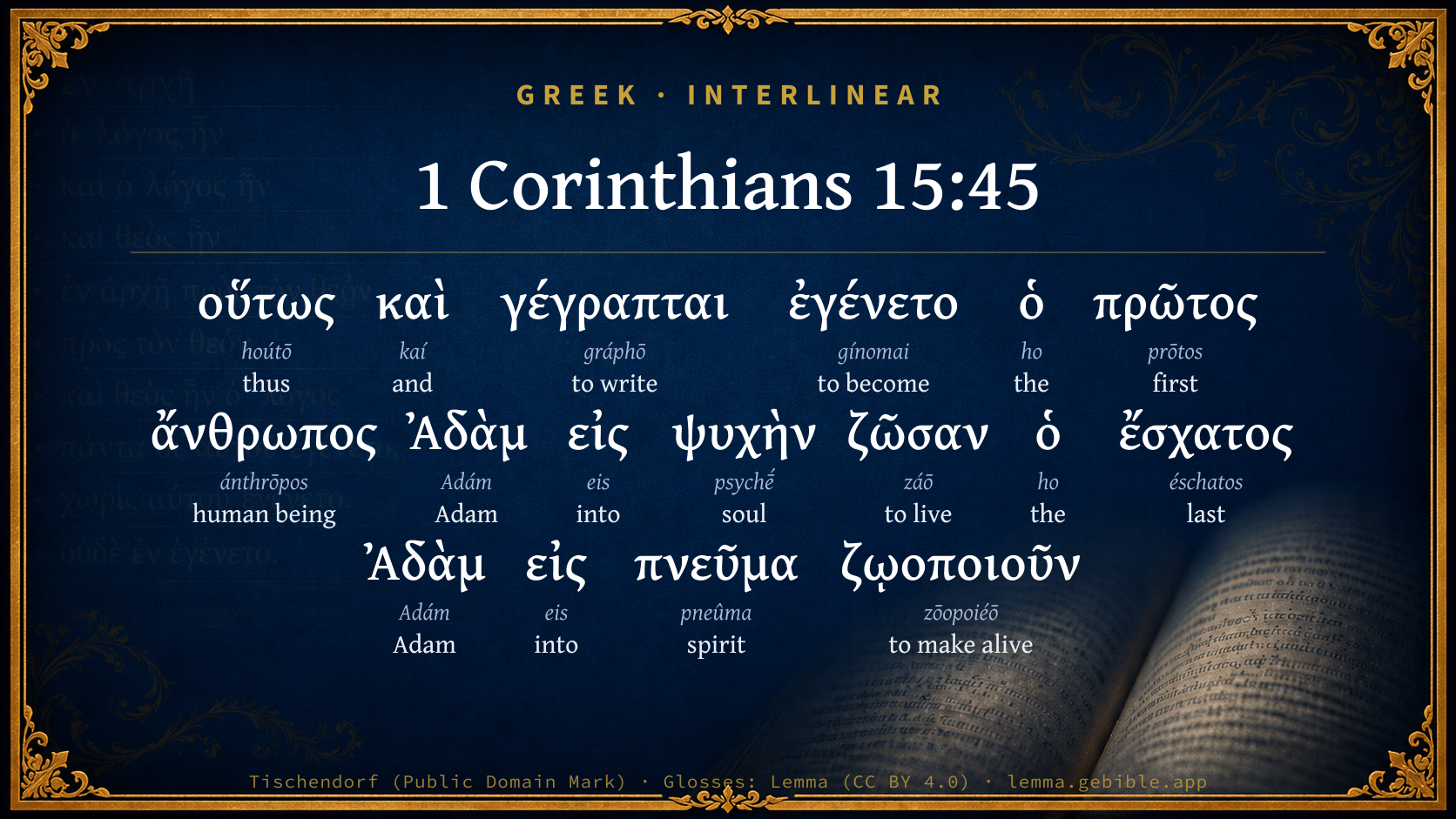
  1. οὕτως hoútō G3779 “thus” Adverb
  2. καὶ kaí G2532 “and” Conjunction
  3. γέγραπται gráphō G1125 “to write” Verb, Perfect, Passive, Indicative, 3rd person, Singular
  4. ἐγένετο gínomai G1096 “to become” Verb, Aorist, Middle deponent, Indicative, 3rd person, Singular
  5. ὁ ho G3588 “the” Article, Nominative, Singular, Masculine
  6. πρῶτος prōtos G4413 “first” Adjective, Nominative, Singular, Masculine, Superlative
  7. ἄνθρωπος ánthrōpos G444 “human being” Noun, Nominative, Singular, Masculine
  8. εἰς eis G1519 “into” Preposition
  9. ψυχὴν psychḗ G5590 “soul” Noun, Accusative, Singular, Feminine
  10. ζῶσαν záō G2198 “to live” Verb, Present, Active, Participle, Accusative, Singular, Feminine
  11. ὁ ho G3588 “the” Article, Nominative, Singular, Masculine
  12. ἔσχατος éschatos G2078 “last” Adjective, Nominative, Singular, Masculine, Superlative
  13. Ἀδὰμ Adám G76 “Adam” Noun, Proper, indeclinable
  14. εἰς eis G1519 “into” Preposition
  15. πνεῦμα pneûma G4151 “spirit” Noun, Accusative, Singular, Neuter
  16. ζῳοποιοῦν zōopoiéō G2227 “to make alive” Verb, Present, Active, Participle, Accusative, Singular, Neuter

About this verse

These counts appear in no published source. They are computed here, from the morphology-tagged text and Lemma’s own curated glosses. What Lemma adds →

17
words
14
distinct lemmas
Pauline Epistles
section

Notable vocabulary

The rarest word here is Ἀδὰμ Adam G76 — appearing just 9 times in the whole Greek New Testament.

Shared distinctive vocabulary

Ἀδὰμ Adam G76 occurs in 7 verses of the Greek New Testament. Also found in:

Repetition

Words recur within this verse:

  • Ἀδὰμ Adam G76 ×2
  • εἰς into G1519 ×2
  • ὁ the G3588 ×2

Cross-references

33

Topical passages linked to 1 Corinthians 15:45 in the Treasury of Scripture Knowledge — connected by theme and wording, ordered by reader-vote popularity; previews shown in the World English Bible.

  • John 5:21 For as the Father raises the dead and gives them life, even so the Son also gives life to whom he desires.
  • Genesis 2:7 Yahweh God formed man from the dust of the ground, and breathed into his nostrils the breath of life; and man became a living soul.
  • Romans 8:2 For the law of the Spirit of life in Christ Jesus made me free from the law of sin and of death.
  • Romans 8:10–11 If Christ is in you, the body is dead because of sin, but the spirit is alive because of righteousness.
  • Romans 5:12–14 Therefore, as sin entered into the world through one man, and death through sin; and so death passed to all men, because all sinned.
  • John 6:63 It is the spirit who gives life. The flesh profits nothing. The words that I speak to you are spirit, and are life.
  • John 14:6 Jesus said to him, "I am the way, the truth, and the life. No one comes to the Father, except through me.
  • John 6:33 For the bread of God is that which comes down out of heaven, and gives life to the world."
  • John 6:39–40 This is the will of my Father who sent me, that of all he has given to me I should lose nothing, but should raise him up at the last day.
  • John 6:57 As the living Father sent me, and I live because of the Father; so he who feeds on me, he will also live because of me.
  • 1 Corinthians 15:47–49 The first man is of the earth, made of dust. The second man is the Lord from heaven.
  • John 6:54 He who eats my flesh and drinks my blood has eternal life, and I will raise him up at the last day.
  • 1 John 1:1–3 That which was from the beginning, that which we have heard, that which we have seen with our eyes, that which we saw, and our hands touched, concerning the Word of life
  • Romans 5:17 For if by the trespass of the one, death reigned through the one; so much more will those who receive the abundance of grace and of the gift of righteousness reign in life through the one, Jesus Christ.
  • John 14:19 Yet a little while, and the world will see me no more; but you will see me. Because I live, you will live also.
  • Romans 5:21 that as sin reigned in death, even so might grace reign through righteousness to eternal life through Jesus Christ our Lord.
  • Revelation 22:1 He showed me a river of water of life, clear as crystal, proceeding out of the throne of God and of the Lamb,
  • Revelation 22:17 The Spirit and the bride say, "Come!" He who hears, let him say, "Come!" He who is thirsty, let him come. He who desires, let him take the water of life freely.
  • John 1:4 In him was life, and the life was the light of men.
  • John 4:10 Jesus answered her, "If you knew the gift of God, and who it is who says to you, 'Give me a drink,' you would have asked him, and he would have given you living water."
  • John 4:14 but whoever drinks of the water that I will give him will never thirst again; but the water that I will give him will become in him a well of water springing up to eternal life."
  • John 6:68 Simon Peter answered him, "Lord, to whom would we go? You have the words of eternal life.
  • John 10:10 The thief only comes to steal, kill, and destroy. I came that they may have life, and may have it abundantly.
  • John 10:28 I give eternal life to them. They will never perish, and no one will snatch them out of my hand.
  • John 11:25–26 Jesus said to her, "I am the resurrection and the life. He who believes in me, though he die, yet will he live.
  • John 17:2–3 even as you gave him authority over all flesh, he will give eternal life to all whom you have given him.
  • Acts 3:15 and killed the Prince of life, whom God raised from the dead, to which we are witnesses.
  • Philippians 3:21 who will change the body of our humiliation to be conformed to the body of his glory, according to the working by which he is able even to subject all things to himself.
  • Colossians 3:4 When Christ, our life, is revealed, then you will also be revealed with him in glory.
  • 1 John 5:11–12 The testimony is this, that God gave to us eternal life, and this life is in his Son.
  • Revelation 21:6 He said to me, "It is done! I am the Alpha and the Omega, the Beginning and the End. I will give freely to him who is thirsty from the spring of the water of life.
  • John 5:25–29 Most assuredly, I tell you, the hour comes, and now is, when the dead will hear the Son of God's voice; and those who hear will live.
  • Revelation 16:3 The second angel poured out his bowl into the sea, and it became blood as of a dead man. Every living thing in the sea died.

Cross-references courtesy of OpenBible.info (CC BY 4.0).

Commentary

Notes on 1 Corinthians 15:45 from classic Christian and Jewish commentators (each source and its license shown beneath its notes). The classic Christian expositions comment on the surrounding passage and are grouped to its opening verse, so a note may address several verses; the Jewish commentaries on the Tanakh (Rashi and others) are per-verse, so they appear only where the commentator wrote on this verse.

Lemma curates 59 commentaries, every one of them public domain or Creative Commons licensed, each selected and text-cleaned for this edition rather than reprinted as found. About our sources →

The Biblical Illustrator

Joseph S. Exell

1Co_15:45-50

The first man Adam was made a living soul

Adam and Christ

Or the mystery of life contemplated:--

I.

In its sources.

1. Adam was endued with natural life, Christ with a life-giving Spirit.

2. The natural preceded the spiritual.

3. The natural is of the earth, the spiritual is the Lord from heaven.

II. In its communication.

1. From Adam we derive the earthy or natural life, from Christ the heavenly.

2. The image of the earthy precedes the heavenly.

3. As the earthy body (flesh and blood) cannot inherit heaven, it must be exchanged for an incorruptible body. (J. Lyth, D.D.)

The two Adams

I. The resemblance.

1. The existence of each rose not in the ordinary course of nature. Neither came by the ordinary laws of human generation.

(1) The first was formed out of the dust of the earth, and derived his spirit from the breath of God.

(2) the second was conceived of the Holy Ghost. The pedigree of each is unparalleled in the history of the race.

2. Each commenced free from sin.

(1) The first was created in the image of God; all his faculties were well balanced and free from all bias to wrong.

(2) The latter was harmless, undefiled, separate from sinners.

3. Each had a nature capable of temptation. Temptability is an attribute of all created intelligences. Where there is no power to go wrong, there is no virtue in keeping right.

(1) The first Adam was tempted, and was conquered.

(2) The second was tempted, and triumphed.

4. The character of each exerts a momentous influence upon the whole race.

(1) The character of the first generated a moral atmosphere of sensuality, ambition, selfishness, unbelief.

(2) The character of the second generated an atmosphere that is morally salubrious, sunny, and invigorating. He who lives in the first atmosphere is still in Adam, and is earthy. He who lives in the second is Christly and spiritual.

II. The dissimilarity.

1. The one had a sublimer connection with God than the other. Adam was the offspring, representative, and steward of God. Christ was God-man. God was in Him in a special sense, unfolding truths, working miracles, and reconciling the world unto Himself. Be was God manifested in the flesh. The one yielded to the devil, the other conquered him.

2. the One possessed a higher type of moral excellence than the other. The character of the first was innocence, not holiness. Holiness implies intelligence, convictions, efforts, habits. This had not Adam. Hence he gave way to the first and simplest temptation. This holiness Christ had in the sublimest degree; and He triumphed over principalities and powers of evil, and made a show of them openly.

3. The influence of the one upon the race has been infinitely pernicious, that of the other infinitely beneficent. The first planted that upas whose pestiferous branches have spread over all men, and whose poisonous food all have tasted and been injured. The other planted the tree of life, bearing fruit for the healing of the nations.

4. The moral influence of the one is destined to decrease, the other to increase. Where sin abounded, grace will much more abound. The kingdoms of our God shall become the kingdoms of His Christ, and He shall reign for ever. (D. Thomas, D.D.)

The first and the last Adam

1. St. Paul bases his assertion that if there is a psychical body, there is also a spiritual, first, on the analogies of Nature; second, on the nature of Man as revealed in Holy Writ (see 1Co_15:44); third, on the historical facts that Adam had the one and Christ the other.

2. Note, however, some interesting preliminaries. The opening clause of the text is almost an exact quotation from Gen_2:7; that the second refers to Christ is proved by these two facts: that with the rabbis, at whose feet Paul sat, the last Adam was a common name for the Messiah; and that St. Paul never uses the designations the second Man, or the last Adam, of any one but Christ. Again the rabbis bid us note that Moses says, not man was made, but became a living soul. They hold that when God breathed the breath of life into Adam, He conferred on him the higher spiritual nature of man; but that, when Adam sinned, he fell, and became a man in whom the soul ruled rather than the spirit. And the rabbis have the Scriptures on their side. What was the fall but a fall from the higher life of the spirit into the lower life of the soul, into a life of mere intelligence and passion as distinguished from a life of righteousness, faith, love, joy, peace? Why was he debarred from the tree of life but because that it was no longer meet that his body should put on incorruption and immortality?

I. The first man Adam became a living soul.

1. The psychical or soulish man is a man in whom the soul is supreme. Conscience, righteousness, faith, God, etc., do not stand first with him; but man, time, earth, the gratifications of sense and intellect. Was not Adam a man of this type? When the spiritual crisis came his faith failed him. God was not first with him, nor Gods will.

2. A soulish man he came to have a soulish body. Indications of this are seen in--

(1) Adams newborn shame of his nakedness.

(2) The passion which made Cain a murderer.

(3) The infirmities, the special forms of death and corruption, to which Adam and his children became liable.

Nevertheless, as our own experience proves, the body, even when thus changed and depraved, was nevertheless perfect in its adaptation to the faculties, functions, cravings, needs of the soul.

II. Christ, the last Adam, was a life-giving spirit.

1. He was the true spiritual Man; for in Him all faculties and passions of the soul were in subjection to the spirit. To Him, living and walking in the spirit, all that is of earth and time and soul was as nothing when compared with the eternal realities. And therefore He could refuse all the kingdoms of this world, and could hasten to help any man, however lowly, however earthly, and seek to quicken in him, by help to the body, the life of the spirit. Of a charity so intense that He loved every man, of a faith so clear and strong that He looked through all the shows of time to the eternal substance, of a hope so lively that He despaired of no man, of a righteousness so pure that even the practised eyes of incarnate evil could find nothing in Him, of a peace so perfect that even His unparalleled labour and conflict could not impair it; in heaven even while He was on earth; making His Fathers will His daily food, He stands before us the one true spiritual Man.

2. So also the last Adam teaches us what the spiritual body is.

(1) He had a body like to ours, yet not altogether the same as ours. Conceived of a Virgin by the Holy Ghost, Christ took our flesh as Adam took it, from the hands of God, immaculate; receiving a physical body which might change and rise into a spiritual body without passing, as our bodies must, through the purifications of corruption. We die perforce. But He laid down His life. He saw no corruption. It was not possible that He should be holden of death.

(a) And therefore we see signs of the spiritual body even in the body of His humiliation. Virtue went out of Him. He lived not by bread alone. He walked on the storm-tossed waves. On Mount Tabor He stood before the eyes of His amazed and dazzled disciples a spiritual man in a spiritual body.

(b) But all these signs of the spiritual m the physical region of His life were prompted by that which is of the spirit, not by that which is of the soul. It was at the touch of faith, of spiritual need and desire and trust, that virtue went out of Him. It was that He might feed the hungry, succour the distressed, or deliver the imperilled, that He exerted a supernatural control over natural laws: and He fed, succoured, delivered men that they might come to know Him, and God in Him, and thus possess themselves of eternal life. When the weak physical frame was transfigured with an immortal strength and splendour, it was because His spirit was rapt in the ecstasies of redeeming love as He talked with Moses and Elias, because He saw that the work of His redemption would be triumphantly accomplished.

(2) After His death and resurrection, the signs that He inhabits a spiritual body grow more apparent. Though He can still eat and drink, etc., He glides through closed doors, passes as in an instant from place to place, vanishes from their sight as the disciples recognise Him. At His will, He is visible or invisible: He is here. He is there; the spiritual body being now as perfect a servant of the spirit in Him as the psychical body of the soul. He can eat, but He does not need to eat. His body is raised into higher conditions, endowed with loftier powers. It is heavenly, not earthly; it is spiritual rather than physical or psychical. Conclusion: Do any ask: But what is all this to us? Adam and Christ were both exceptional men. If the first Adam was a psychical man and the last Adam a spiritual man, how does that bear on St. Pauls argument? It is much--nay, it is everything--to us; and that precisely because both Adam and Christ were exceptional men, who stand in an exceptional relation to the human race. For (verse 22) both the Adam and the Christ are in us, and in all men; that they contend together in us for the mastery; that it is at our own option to side either with the one or with the other; and that, according as we espouse the first Adam or the last, we become earthly or heavenly, psychical or spiritual men. If we permit the Christ to reign in us, in our mortal members, our mortality will put on immortality--as His did, and be swallowed up of life--as His was. Like His, our spiritual manhood will demand and receive a spiritual body. And therefore St. Paul may fairly exhort us that, as we bear the image of the earthly (man), so also we should bear the image of the heavenly. ( S. Cox, D.D.)

The second Adam a quickening Spirit

Human relationships correspond with those which subsist between Jesus Christ and His people, and doubtless were constituted to shadow it forth. In procuring the redemption of His people, Christ assumes the standing of a husband, who, by uniting Himself to us, made Himself capable of standing in our place, and answering for our acts. In advocating our cause, that He may do this effectually, and with an experimental feeling of our wants, He assumes the place of a brother unto us. By His resurrection He assumes the relationship of a father, the giver of life and of being to His people. As the natural life, or life of the soul, is to be traced to the first man Adam, so the spiritual life in the believer is to be traced to Christ, the last Adam. But here, however, the resemblance ends. Adam was but a living soul, capable of continuing the same life in others who should succeed him; but Christ, by His resurrection from the dead, has become a quickening spirit, capable of giving life unto the dead. Note the bearing of the text--

I. On the foundation of the Christians salvation.

1. The apostle here enumerates only two men of all that have ever lived: because all men stand in such a relationship to the first Adam, and all believers stand in such a relationship to the second, as they can stand in to no other man. We do not see, in the ordinary course of human generation, that all children are born with what is peculiar in the sinful propensities of their immediate progenitors. By dint of care you may guard against the outbreaking of those sins which have been peculiar to the immediate progenitor; but you will not be able by your utmost care to root out the evil which is in the heart of man. And the inference from this is that there is a connection between us and the first man Adam which does not subsist between us and our immediate parents, or any intermediate link of the chain by which we are connected with our first progenitor. And so it is written of Adam, that he begot a son in his own image, after his own likeness; who thus deriving from him his life of nature, shared with Adam in all the miserable circumstances of his fallen condition. When God created Adam, He created all men; all therefore stood, and all fell in Adam: all in him became not only exposed to the consequences, but also infected with the very nature of his sin.

2. Now there is no greater difficulty in the idea that having union with the last Adam as a quickening Spirit, we are endowed with His life and His likeness, than in the former idea. This is the only foundation of our salvation. Salvation is not to be found in the reformation of conduct, in a difference of feeling, in an act of the mind, but in a vital union with Christ.

II. On the trials of the Christians present condition. The great peculiarity in the Christians condition is that while he is a quickened spirit in union with Christ the quickening Spirit, he yet has a body proper only to a soul, by still having, in his own nature, union with the first Adam. This throws a striking light on many passages in Scripture which are descriptive of the Christian experience (2Co_5:1-4; Rom_8:22-23; Rom_7:24). What do these (and a variety of similar passages) express but the desires of the quickened spirit to be released from this prison-house in which it is pent up? And does not this also point out the Christians resource under such trials? What is it but to walk by faith and not by sight? (Rom_8:10-13; Col_3:1-5).

III. On the Christians future prospects. We are as yet, indeed, in the natural body--the body proper to a soul; but there is a spiritual body; and as we are now by faith quickened in spirit, so there is a renewal unto holiness to this body also, which shall be revived, and glorified, and changed into the likeness of Christs glorious body. For as the resurrection of Christ shows us the perfection and sufficiency of Christs work, so ours will bring to perfection in us the fruit of His work. As it was His resurrection that showed Him to have come out from under the effects of imputed sin, into the possession of the glory which He had with the Father before the world was; so ours will show us to have come out of the course of sin and of the flesh into the enjoyment of that glory. As it was His resurrection that showed Him to be the Conqueror of Satan; so ours will show us to be conquerors over all evil through Him. As it was by His resurrection that He was declared to be the Son of God with power; so it is ours by which we shall be manifested to be sons of God. (W. Dodsworth, M.A.)

The last Adam

Note--

I. The relation between Christ and Adam which is implied in the name. A name used to designate a party whoso proper name it is not, expresses a symbolical or typical relation between the two (Rom_5:14). Adam prefigured Christ--

1. In the holiness of his nature. There have been only two men who were free from every taint of sin when they came into the world; and there never will be more.

2. In his dominion (Psa_8:1-9; cf. Heb_2:1-18.). Adam as the lord of this world, and the creatures contained in it, symbolised that King who has on His head many crowns.

3. In his marriage (Eph_5:25-33).

4. In his trial.

(1) By God. A course of obedience was prescribed to him, and a reward was promised if he followed it. Do this and thou shalt live, was the substance of what God said to Adam. To the Son of God also a course of obedience was prescribed: and on this account He took the form of a servant. To Him, too, it was said, Do this and live.

(2) His trial by Satan.

5. In his covenant headship. The covenant with Adam was expressed in the form of a threatening (Gen_2:16-17), while the covenant with Christ was expressed in the form of a promise (Gal_3:16); but the fact is unaltered that there was a covenant with each. Now Adam, in his headship, typified Christ in--

(1) The representative character which he bore. The first progenitor represented his posterity. Such representation is not unusual. Parents represent their children, and princes their subjects. But the only case which for magnitude and grandeur can be likened to that of Adam, is the case of Christ.

(2) The vicarious action of Adam under the covenant, which furnishes a typical illustration of that which was vicarious in the Saviours career.

(3) The imputation and legal reckoning of Adams vicarious procedure to his posterity. Analogous, in some measure, to this, is the legal reckoning which we see applied to great trading companies for the doings of their managers. So vicarious action was binding on Christ (Rom_5:12-19; Gal_3:13).

(4) The transmission of moral qualities and tendencies from Adam to all his posterity. The first man, by his fall, not only contracted guilt, but brought upon his nature the taint of corruption; and that taint is communicated through him to all mankind. In Christ, the Son of God, there is a holy human nature. And by the power of His Holy Spirit, effecting a real and vital union between Him and His people, they become holy as He is holy.

II. The relation which is implied by prefixing to the name adam the term last. Christ is called David and Solomon. But He is not called the last David, or the last Solomon. John the Baptist is called Elias, but not the last Elias. These were types and only types. But Adam was not a mere type. There was, beyond this, a public and official relation between him and Christ; so that if Adam had not gone before, or if he had been other than he was, or had actual otherwise than he did, there would have been no need of Christ. The common name is suggestive of the unity of obligation being derived from the first member of the series. The special term last is suggestive of the obligation being at last fulfilled.

1. Let the two Adams be contrasted.

(1) In respect of what they were (verses 45, 47).

(2) In respect of what they accomplished.

(a) The first Adam entailed only sin upon his posterity; the last Adam has for His people righteousness: He is their righteousness (Rom_5:19).

(b) The first Adam condemns all; the last Adam justifies all (Rom_5:18).

(c) In the first Adam, all die, all are dead (Rom_5:15-17); in the last Adam, Christ, all are made alive (1Co_15:22; 1Co_15:18-19).

2. Let our Lords success, as the last Adam, be considered in opposition to the failure of the first Adam. Christ, as the last Adam, succeeded by fulfilling the obedience to the law in which the first Adam failed, and by overcoming the obstacle which the first Adams failure created. The last Adam is perfect, as a competitor for the prize--eternal life to man--which the first Adam lost; as a worker at the task in which the first Adam broke down.

(1) In respect of his vicarious action. In that respect he is emphatically the last Adam. His vicarious action was perfect. There was no flaw in it (Heb_5:8-9; Rom_5:19).

(2) In respect of the imputation and legal reckoning of his vicarious action (Rom_5:18).

(3) In respect of the actual transmission and communication of all the life and holiness which His vicarious action involves. As the last Adam, He has the Holy Spirit to give. And by the gift of the Holy Spirit He effectually secures the salvation of all who are His. (A. Gray.)

Christ the archetype of Adam

Sometimes, after an engraven steel-plate has given forth some pictures it is destroyed, in order to enhance the value of the copies thrown off. If the copies were all destroyed, then the ideal would be lost. But when one type was thrown off and planted in paradise, the original remained when the copy was spoiled. Man still remained--the Eternal Son remained. (W. Anot, D.D.)

The wonderful contrast

I. Adam was a living soul, which includes--

1. Reason; thus above the brute, and able actively to glorify God. They passively praise Him.

2. Spirituality, or knowledge, righteousness, and true holiness in mind and soul. Nothing can comprehend holiness but the image of that holiness.

3. Happiness. Holiness is happiness; God infinitely happy, because infinitely holy. He must delight in His own image, and for us to wear that image is a greater honour than, if it were possible to be invested with creative power.

4. Immortality. We are immortal, but not independently so; God alone is (1Ti_6:16).

II. The last adam a quickening spirit. He quickens--

1. From spiritual death (Eph_2:5).

2. The afflicted (Psa_119:50).

3. The backslider (Hos_14:4).

4. From the grave (Php_3:20-21).

We manifest our oneness with Adam by our disobedience, and our oneness with Christ by our obedience. The most glorious work of God is the renewal of a human soul, and its transition from grace to glory. How grateful we should be that God has promised that His work within us shall be as perfect as His work for us (Eph_5:14). (Homiletic Monthly.)

Natural and spiritual life

I. Adam was made a living soul.

1. Endued with natural life.

2. His body possessed no inherent immortality.

3. Its perpetuated life depended upon obedience and his access to the tree of life.

4. Consequently he could not in any case confer immortality upon his descendants.

II. Christ was made a quickening spirit.

1. Possessed life in Himself, hence His resurrection.

2. Communicates it to all who believe in Him.

3. Hence also He will raise them up in the last day. (J. Lyth, D.D.)

The Biblical Illustrator, edited by Joseph S. Exell (c. 1880s–1900s) — public domain. Text from a community e-Sword module.

Joseph Benson's Commentary

1Co 15:45-46. And so it is written — With respect to the animal body, Gen 2:7. The first Adam was made a living soul — God gave him animal life, in many respects resembling that of other animals; the last Adam was made — Rather was, or is, for there is nothing in the original for made; a quickening Spirit — Having life in himself, and quickening whom he will: imparting even a more refined life to men’s bodies at the resurrection, than that which they formerly possessed. Christ is called Adam, because believers receive their sanctified, spiritual nature, and their immortal bodies, from him, (see Eph 5:32,) just as mankind have derived their corrupted nature and mortal bodies from the first Adam. He is also called the last Adam, because he is posterior in time to the first Adam, or because there shall be no restorer and head of the human race after him. Howbeit that was not first which is spiritual, &c. — That is, as the first Adam existed before Christ was sent to assume our nature, and become our Saviour, so must we first wear that animal body, which we derive from the one, before we put on that spiritual body which we receive from the other. Here we are taught that the plan of the divine government is to lead his creatures from a lower to a higher state of perfection. They, therefore, who contend that things should be as perfect at the beginning as at the conclusion of his administration, are wiser than God.

Joseph Benson's Commentary on the Old and New Testaments (1811–1818) — public domain. Text from a community e-Sword module.

Tyndale Open Study Notes

Tyndale Open Resources

15:45-49 Adam and Christ founded two distinct humanities: One is natural and earthly, enslaved to sin and death; the other is spiritual and heavenly, purified and destined for life. Adam represents the natural (physical) body and Christ the spiritual (resurrection) body. See also 15:21-22; Rom 5:12-21.

15:45-46 Just as Christ’s life-giving Spirit supersedes the natural life, the spiritual body will supersede the physical body.

Tyndale Open Study Notes — © Tyndale Open Resources, licensed CC BY-SA 4.0. Text via the HelloAO Bible API.

Bengel's Gnomon

Johann Albrecht Bengel

1Co 15:45. Γέγραπται, it is written) Gen 2:7, LXX., ἐγένετο ὁ ἄνθρωπος εἰς ψυχὴν ζῶσαν, man became a living soul. Paul adds other things in accordance with the nature of the contraries [the things antithetical to the former.]—πρῶτος) that is, the FIRST; for the last is in antithesis to it; but in 1Co 15:47, πρῶτος means the former of the two; for it is in antithesis to δεύτερος, the second: and each is there considered, as a model of the rest. ὁ ἔσχατος, the last, in like manner as ὁ δεύτερος, the second, points to Christ, not to the whole human race in its perfect consummation.—Ἀδὰμ) A proper name here; but it is presently after repeated by antonomasia.[143]—ψυχὴν, life—soul) Hence ψυχικὸν living, animal, [natural] 1Co 15:44.—ὁ ἔσχατος, the last) Job 19:25. אחרון, the same as he who is called נאל, as is evident there from the parallelism of the double predicate. Christ is last; the day of Christ is the last day, Joh 6:39. [Christ is a Spirit, 2Co 3:17.—V. g.]—ζωοποιοῦν, quickening) He not only lives, but also makes alive.

[143] Append. The substitution of a proper name for a common name, or vice versa.

Bengel's Gnomon of the New Testament — English translation (T&T Clark, Edinburgh, 1860) — public domain. Text from a community e-Sword module.

Meyer's Critical & Exegetical Commentary

Heinrich August Wilhelm Meyer

1Co_15:45. Scriptural confirmation for the εἰ ἔστι σῶμα ψ. κ.τ.λ.

οὕτω] so, i.e. in this sense, corresponding to what has been said above, it stands written also, etc. The passage is from Gen_2:7 according to the LXX. (κ. ἐγένετο ὁ ἄνθρ. εἰς ψ. ζ.), but with the addition of the more precisely explanatory words πρῶτος and Ἀδάμ. The citation extends only to ζῶσαν; the ὁ ἔσχατος κ.τ.λ. that follow are words of the apostle, in which he gives an explanation of his οὕτω by calling attention, namely, to the opposite nature of the last Adam, as that to which the Scripture likewise pointed by its description of the first Adam, in virtue of the typical relation of Adam to Christ. He joins on these words of his own, however, immediately to the passage of Scripture, in order to indicate that the ὁ ἔσχατος … ζωοποιοῦν follows as necessarily from it according to its typical reference, as if the words had been expressed along with it.[80] He thus gives expression to the inference which is tacitly contained in the statement, by adding forthwith this self-evident conclusion as if belonging also to the passage of Scripture, because posited for it by the inner necessity of the antithesis. When others, such as Billroth and Rückert, assume that ὁ ἔσχατος κ.τ.λ. is meant really to be a part of the Scripture-quotation, they in that case charge the apostle with having made the half of the citation himself and given it out as being Bible words; but assuredly no instance is to be found of such an arbitrary procedure, however freely he handles passages from the Old Testament elsewhere. And would the readers, seeing that ἐγένετο … ζῶσαν is such a universally known statement, have been able to recognise in ὁ ἔσχατος κ.τ.λ. Bible words? According to Hofmann, οὕτω καὶ γέγρ. is a completed sentence, which only states that the distinction between two kinds of human body is scriptural. In order to demonstrate this scripturalness the apostle then applies the passage Gen_2:7. But against this it may be urged, first, that Paul is wont in general to use the γέγραπται for citing passages of Scripture; secondly, that the reader could all the less think here of another use of the word, since in reality at the moment a passage of Scripture, and that a universally familiar one, is joined on directly and without a particle (such as γάρ) to lead the thoughts aright in another directio.

ἐγένετο] by his creation, by means of the animation through Gods breat.

εἰς ψυχὴν ζῶσαν] לְנֶפֶשׁ חַיָה comp. Gen_1:30, unto a living soul-nature, so that thus the body of Adam must be formed as the receptacle and organ of the ψυχή, must be a σῶμα ψυχικόν.[81] Therewith sin itself is not assumed as yet, nor even the necessity of its future entrance (comp. Ernesti, Urspr. d. Sünde, I. p. 133), but the susceptibility for it, which, however, did not fall within the scope of the apostle her.

ὁ ἔσχατος Ἀδάμ is Christ. Comp. 1Co_15:22; Rom_5:14; Neve Schalom, 1Co_9:9 : Adamus postremus (האחרון) est Messias. He is called, however, and is the last Adam in reference to the first Adam, whose antitype He is as the head and the beginner of the new humanity justified and redeemed through Him; but at the same time in reference also to the fact, that after Him no other is to follow with an Adamite vocation. Apart from this latter reference, He may be called also the second Adam. Comp. 1Co_15:47.

ΕἸς ΠΝΕῦΜΑ ΖΩΟΠΟΙ.] unto a life-giving spirit-being, sc. ἐγένετο. It is thereby expressed that the body of Christ became a σῶμα πνευματικόν. But what is the point of time, at which Christ ΕἸς ΠΝΕῦΜΑ ΖΩΟΠ. ἘΓΈΝΕΤΟ? Not as a created being, as one of the heavenly forms in the divine retinue before His mission (Holsten), nor yet in His incarnation,[82] whether we may supply mentally a Deitate (Beza, comp. too Räbiger, Christol. Paul. p. 35; Baur, Delitzsch, al.), or take refuge in the communicatio hypostatica (Calovius and others); for during his earthly life Christ had a ψυχικὸν σῶμα (only without sin, Rom_8:3), which ate, drank, slept, consisted of flesh and blood, suffered, died, etc. The one correct answer in accordance with the context, since the point in hand has regard to the resurrection (and see especially 1Co_15:44), can only be: after His death (comp. Hellwag in the Tübing. theol. Jahrb. 1848, 2, p. 240; Ernesti, Urspr. d. Sünde, II. p. 122 ff.; Weiss, bibl. Theol. p. 314), and indeed through His resurrection, Christ became εἰς πνεῦμα ζωοπ. The body, doubtless, of the Risen One before His ascension (hence the Socinians think here of the latter event; so, too, J. Müller and Maier) consisted still of flesh and blood, still ate, drank, etc.; but it was immortal, and so changed (see Remark appended to Luk_24:51) that it already appears as ΠΝΕΥΜΑΤΙΚΌΝ, although it was only at the ascension that it entered upon its completion in that respect, and consequently into its ΔΌΞΑ as the ΣῶΜΑ Τῆς ΔΌΞΗς (Php_3:21). The event producing the change, therefore, is the resurrection; in virtue of this, the last Adam, who shall appear only at the Parousia in the whole efficiency of His life-power (1Co_15:47), became (ἐγένετο) ΕἸς ΠΝΕῦΜΑ ΖΩΟΠΟΙΟῦΝ,[83] and that through God, who raised Him u.

ζωοποιοῦν] οὐκ εἶπεν· εἰς πνεῦμα ζῶν, ἀλλὰ ζωοποιοῦν τὸ μεῖζον εἰπών, Theophylact. The connection shows what ζωή is meant in ΖΩΟΠΟΙΟῦΝ, namely, the resurrection-life, which Christ, who has become πνεῦμα ζωοπ., works at His Parousia. Comp. 1Co_15:22; Php_3:21; Col_3:4; 1Th_4:16; Joh_5:21 ff. This limitation of the reference of ΖΩΟΠΟΙΟῦΝ, made in accordance with the context, shows that we have not here an argument proving too much (in opposition to Baur, neut. Theol. p. 197).

[80] To make the relation of the two halves discernible in reading, let ἑγένετο … ζῶσαν be read slowly and loud, pause markedly at ζῶσαν, and let then ὁ ἕσχατος κ.τ.λ. follow a little less slowly and loudly.

[81] Not as if he had lacked the higher life-principle (the πνεῦμα); but the ψυχή was that which determined the nature of the body.

[82] So, too, Sellin in the Luther. Zeitschr. 1867, p. 231.

[83] There exists no ground for assuming a different conception of the corporeity of the risen Christ before His resurrection on the part of Paul than on the part of the evangelists. It is true that Paul mentions the appearances of the Risen One, ver. 5 ff., in such a way that he speaks of the appearance after the ascension, ver. 8, no otherwise than of those which preceded it. But he had there no ground for drawing any such distinction, since it only concerned him generally to enumerate the appearances of the Risen One, while for his purpose it was all the same which of them had taken place before and which after the ascension.

Meyer — Critical and Exegetical Commentary on the New Testament — English translation by Peter Christie, edited by Frederick Crombie (T&T Clark, 1880) — public domain. Text from a community e-Sword module.

Expositor's Greek Testament

ed. W. Robertson Nicoll

1Co 15:45 puts into words of Scripture the law of development affirmed, thereby showing its agreement with the plan of creation and its realisation in the two successive heads of the race. Into his citation of Gen 2:7 (LXX) P. introduces πρῶτος and duplicates ἄνθρωπος by Ἀδάμ ( ha’adâm ), to prepare for his antithetical addition ὁ ἔσχατος Ἀδὰμ εἰς πνεῦμα ζωοποιοῦν . On the principle of 1Co 15:44 b , the Adam created as ψυχὴ was the crude beginning of humanity (the pred. ψυχὴ ζῶσα is shared by A. with the animals , Gen 1:20 ; Gen 1:24 ) a “first” requiring a “last” as his complement and explanation. The two types differ here not as the sin-committing and sin-abolishing (Rom 5:12 ff.), but as the rudimentary and finished man respectively, with their physique to match. Αδὰμ is repeated in the second clause by way of maintaining the humanity of Christ and His genetic relation to the protoplast ( cf. Luk 1:23-38 ), essential as the ground of our bodily relationship to Him (1Co 15:48 f.; cf. Heb 2:14 ff.). The time of Christ’s γενέσθαι εἰς πν . ζωοπ ., in view of the context and esp. of 1Co 15:42 ff., can only be His resurrection from the grave (Est., Gr [2544] , Mr [2545] , Hn [2546] , Hf [2547] , El [2548] ), which supplies the hinge of Paul’s whole argument ( cf. Rom 1:4 ; Rom 6:4 ff; Rom 10:9 , etc.); not the incarnation (Thp [2549] , Bz [2550] , Baur, Ed [2551] ), for His pre-resurrection body was a σῶμα ψυχικόν (Rom 8:3 , etc.; 2Co 13:4 , Phi 2:7 , etc.). By rising from the dead, Christ ἐγενήθη εἰς πνεῦμα He entered on the spiritual and ultimate form of human existence; and at the same time, ἐγενήθη εἰς πν . ζωοποιοῦν He entered this state so as to communicate it to His fellows: cf. 1Co 15:20-23 , Col 1:18 , Rev 1:5 ; also Rom 8:10 f., 2Co 4:14 ; Joh 6:33 ; Joh 11:25 ; Joh 14:19 , etc. The action of Jesus in “breathing” upon His disciples while He said, “Receive the Holy Spirit” (Joh 20:22 f.), symbolised the vitalising relationship which at this epoch He assumed towards mankind; this act raised to a higher potency the original “breathing” of God by which man “became a living soul”. “Spirit is life-power, having the ground of its vitality in itself, while the soul has only a subject and conditioned life; spirit vitalises that which is outside of itself, soul leads its individual life within the sphere marked out by its environment” (Hf [2552] ); cf. Joh 3:34 ; Joh 4:14 ; Joh 5:25 f.; Heb 7:25 . ὁ ἔσχατος ἄνθρωπος recalls the Rabbinical title, ha’adâm ha’acharôn , given to the Messiah ( Neve Shalom , ix. 9): Christ is not, however, the later or second, but the last , the final Adam. The two Adams of Philo, based on the duplicate narrative of Gen 1:2 the ideal “man after the image of God” and the actual “man of the dust of the earth” with which Pfleiderer and others identify Paul’s πρῶτος and ἔσχατος , χοϊκὸς and ἐπουράνιος Ἀδάμ , are not to be found here. For ( a ) Philo’s first is Paul’s last ; ( b ) both Paul’s Adams are equally concrete; ( c ) the resurrection of Christ distinguishes their respective periods, a crisis the conception of which is foreign to Philo’s theology; ( d ) moreover, Gen 1:26 is referred in 1Co 11:7 above to the historical , not the ideal, First Man.

[2544] Greek, or Grotius’ Annotationes in N.T.

[2545] Meyer’s Critical and Exegetical Commentary (Eng. Trans.).

[2546] C. F. G. Heinrici’s Erklärung der Korintherbriefe (1880), or 1 Korinther in Meyer’s krit.-exegetisches Kommentar (1896).

[2547] J. C. K. von Hofmann’s Die heilige Schrift N.T. untersucht , ii. 2 (2te Auflage, 1874).

[2548] C. J. Ellicott’s St. Paul’s First Epistle to the Corinthians .

[2549] Theophylact, Greek Commentator.

[2550] Beza’s Nov. Testamentum: Interpretatio et Annotationes (Cantab., 1642).

[2551] T. C. Edwards’ Commentary on the First Ep. to the Corinthians . 2

[2552] J. C. K. von Hofmann’s Die heilige Schrift N.T. untersucht , ii. 2 (2te Auflage, 1874).

The Expositor's Greek Testament, edited by W. Robertson Nicoll (1897–1910) — public domain. Text from a community e-Sword module.

Godet's Commentaries

Frédéric Louis Godet

Vv. 45. “And so it is written: the first man, Adam, was made a living soul; the last Adam, a quickening spirit.”

The apostle does not say, as usually in his Scripture proofs: καθὼς γέγραπται, as it is written. The form οὕτω καί, and so, indicates, not a proof strictly so called, but simple agreement of thought. Hofmann even thinks that he may detach this short proposition altogether from what follows, and connect it with what precedes. But this is only a poor expedient intended to set aside the difficulty which attaches to the following quotation. The difficulty is this: If the proposition relative to the first man is a quotation from Gen 2:7, it seems as if the same should be the case with the following proposition, relative to the last Adam. But in the Old Testament text there is nothing corresponding to this second idea. How then are we to explain the course taken by the apostle, if the two propositions depend on the: so it is written? The apostle evidently had no intention of deceiving his readers by leading them to believe that the second proposition was taken from the Old Testament as well as the first. Most commentators think that he found in the well-known parallelism between the two heads of humanity the right to introduce the second member into his quotation, though it was not expressly found in the narrative of Genesis. But would not this be to carry freedom of quotation to an unwarrantable degree? I do not think it necessary to apply the: it is written, to the verse as a whole. The first proposition is taken from a universally known Scripture text. The second is borrowed from the fact of the equally well-known appearance of the historic Christ, and Paul expresses it, according to the law of contrast, on the model of the former. As Bengel says: “Caetera addit ex naturâ oppositorum;” so that the first proposition alone depends, in his view, on the: so it is written. The sequel will still better explain this procedure.

The form γίνεσθαι εἰς, to be made into..., denotes not only the first moment of man’s creation, but also the whole development of this Divine act even to its goal. It is wholly false to make this term ψυχή ζῶσα, living soul, the equivalent of psychical man (1Co 2:14), and to conclude from this comparison that the was made implies the fall. The one point in question here is the fact of creation. The was made refers to the progress indicated in the account of Genesis itself, according to which man, created at first of the dust, afterwards received the communication of the Divine breath, thereby attaining the form of existence which was provisionally destined for him.

The Hebrew text says: “And Adam was made a living soul;” the LXX. likewise, translating Adam by ὁ ἄνθρωπος, man. Paul preserves the two terms: man and Adam, because the latter contains the idea of the head of a species. Besides, he adds the epithet πρῶτος, first, with a view to the coming antithesis. His object is precisely to trace the line which this man, who is yet only the first, and not the final man, shall not be able to pass. This psychical state will only be a point of departure; a new creative act will be needed to produce the final man.

This limit of the natural man, this provisional maximum, is denoted by the term ψυχὴ ζῶσα, living soul. In the passages Gen 1:20; Gen 1:24, this same expression is applied to all the animals, to distinguish them from plants. We thus see that the term signifies: a life-breath individualized and animating a physical organism; an animated being, endowed with a body. But these life-breaths which are the principle of animal existence, may be very variously endowed; and consequently the parity of man with the animal world, so strongly emphasized by this term, does not contradict the superiority and sovereignty ascribed to the human species in this same account of Genesis. The meaning of the word ψυχή, soul, must not be restricted to the purely sensitive and inferior powers of the human soul. There is nothing requiring or even authorizing such limitation. As the life-breath belonging to each animal is distinguished by special powers, more or less elevated, that of man differs from that of other animated beings in certain faculties which constitute his superiority over them all and make him their sovereign: the νοῦς, mind, whereby he distinguishes truth from falsehood, good from evil; will, its own mistress and capable of choosing between opposite motives; the καρδία, heart, that deep and rich soil of feeling into which will and mind strike their roots; finally, the higher organ with which the human soul is endowed for the perception of the Divine, the πνεῦμα, spirit, the religious sense which distinguishes man absolutely from all that is animal and which forms the starting-point of the higher existence in which the natural life is to issue. If Genesis does not mention this special element of human nature, and speaks only of the soul, it is because it embraces it also in this term. It is not till a subsequent period that spirit will become the dominant principle of human life. In the sphere of natural life, it is the living soul which is the characteristic feature. The soul is for the time the seat of the personality which, by the body, communicates with the lower world and, by the spirit, with God in whose image it is created. From the standpoint of Genesis, the expression living soul therefore denotes a terminal point, the goal of the first creation; whereas from Paul’s point of view this goal was a first stage, simply a state of expectation. And this is what gives occasion to the second proposition added by the apostle. The first asserted a fulness, but also a void; and this void the second serves to fill.

Christ is called Adam, to characterize Him as head of a race, no less than the first. At the same time He is called the last. Why not the second, as in 1Co 15:47? Because in consequence of the subject treated throughout this chapter, Paul is concerned, not about Christ’s relation to the other Adam, but about the part He fills in relation to humanity, the mission which He has received to bring it to its final state.

There is found in the treatise Nevé Schalom an analogous expression: “Adamus postremus est Messias.” This agreement of Paul with the Rabbinical writing is easily explained; for it is known that the Nevé Schalom is the work of Rabbi Abraham, of Catalonia, who died in 1492.

The last Adam begins by realizing in Himself the perfect state. He is πνεῦμα ζωοποιοῦν, a quickening [life-giving] spirit. There is no article, as if this were His exclusive privilege. It is a human state, which Paul contrasts with a living soul. The construction εἰς πνεῦμα..., necessarily leads us to supply the verb ἐγένετο, was made, according to the first proposition. Contrasted as it is with soul, spirit denotes, not only a being that lives, but a principle capable of giving life; which, while continually renewing itself, communicates life to that which it penetrates: “a fountain springing up into eternal life” (Joh 4:14). As Edwards says, “the soul is the object [the seat] of life; the spirit is the source of life.” The epithet ζωοποιοῦν, quickening, is also applied to the πνεῦμα, Joh 6:63, and there as characterizing its essence: τὸ πνεῦμά ἐστι τὸ ζωοποιοῦν. In our context, it seems to me that the term should not be applied to the communication of spiritual life, but rather to the spirit’s action on the body, which serves as its organ. The soul animates the body; it guides and moves it. The spirit does more: it quickens it by communicating to it ever new force and youth. To what point in the life of the Saviour should we apply this γίνεσθαι, becoming, which made Him a quickening spirit? When He was created as the heavenly man, answers Holsten. We delay the examination of this idea of the heavenly man, ascribed to Paul, till 1Co 15:45. At the time of the incarnation, thinks Edwards: “Then it was that Christ introduced a Divine force into humanity.” This meaning would not, according to this commentator, prevent us from holding that the body of Christ was psychical, like ours, during His earthly life, and that He did not receive His spiritual body till the time of His resurrection, by the quickening spirit whom He possessed from the beginning. Ambrosiaster, Grotius, Meyer, Heinrici, etc., think of the time of the resurrection. Does not the form γίνεσθαι εἰς, to be made, become, relieve us from the necessity of choosing between these different suppositions? From the time of the incarnation there began in Jesus the growing and quickening action of the spirit on the body. This action, suspended by His voluntary submission to the power of death, broke forth gloriously in His resurrection, but in a certain measure only, for the facts prove that in His appearances the risen One still had His psychical body, though already transformed to some extent. Finally, it was at the Ascension that the transformation was completed, and that He put on the spiritual body in which He appeared to Paul at the time of his conversion. Compare on the relation between the spirit of holiness, under the power of which the Lord lived on the earth, and His bodily glorification, Rom 1:4; Rom 8:11.

It may be asked whether the epithet ζωοποιοῦν, quickening, already points to the influence which Christ will exercise over the body of His own at the Advent to glorify it like His own; comp. Php 3:21. It is evident that Paul is tending to this idea, which he will express positively in 1Co 15:48-49; but for the present it is undoubtedly wisest to answer, with R. Schmidt: “Here there is but one thing in question: whether there will be another body completely different from the earthly body. The question how Jesus succeeds in procuring a spiritual body for other men, is a remoter one” (p. 114). We have already seen that the absence of the article before πνεῦμα ζωοποιοῦν speaks in favour of this answer.

But a question very naturally presented itself: How does it happen, that the spiritual state being superior to the psychical state, God was pleased to begin with the latter, and then delayed so long to grant the former? Does not God in all things will what is perfect? There is a law which has determined the course taken by God, and which the apostle confines himself to stating here without explaining it.

Frédéric Louis Godet — Commentaries on Luke, John, Romans, and 1 Corinthians — English translation (T&T Clark, Edinburgh, 1870s–1890s) — public domain. Text from a community e-Sword module.

Geneva Bible (1599)

Geneva Bible translators

That is called a natural body, which is quickened and maintained by a living soul only, such as Adam was, of whom all we are born naturally: and that is said to be a spiritual, which together with the soul is quickened with a far more excellent virtue: to wit, with the Spirit of God, which descendeth from Christ the second Adam unto us.

Adam is called the first man, because he is the root as it were from which we spring: and Christ is the latter man: because he is the beginning of all them that are spiritual, and in him we are all comprehended.

Christ is called a Spirit, by reason of that most excellent nature, that is to say, God who dwelleth in him bodily, as Adam is called a living soul, by reason of the soul which is the best part in him.

Geneva Bible (1599) marginal notes — public domain. Text via Bolls.life.

Jamieson, Fausset & Brown

Robert Jamieson, A. R. Fausset & David Brown

so--in accordance with the distinction just mentioned between the natural or animal-souled body and the spiritual body.

it is written-- (Gen 2:7); "Man became (was made to become) a living soul," that is, endowed with an animal soul, the living principle of his body.

the last Adam--the LAST Head of humanity, who is to be fully manifested in the last day, which is His day (Joh 6:39). He is so called in Job 19:25; see on Job 19:25 (compare Rom 5:14). In contrast to "the last," Paul calls "man" (Gen 2:7) "the FIRST Adam."

quickening--not only living, but making alive (Joh 5:21; Joh 6:33, Joh 6:39-40, Joh 6:54, Joh 6:57, Joh 6:62-63; Rom 8:11). As the natural or animal-souled body (Co1 15:44) is the fruit of our union with the first Adam, an animal-souled man, so the spiritual body is the fruit of our union with the second Adam, who is the quickening Spirit (Co2 3:17). As He became representative of the whole of humanity in His union of the two natures, He exhausted in His own person the sentence of death passed on all men, and giveth spiritual and everlasting life to whom He will.

Jamieson, Fausset & Brown — Commentary Critical and Explanatory on the Whole Bible (1871) — public domain (CC PDM 1.0). Text via the HelloAO Bible API.

Adam Clarke's Commentary

Verse 45. The first man Adam was made a living soul] These forms of expression are also common among the Jews: hence we find אדם הראשון Adam harishon, "Adam the first;" and אדם קדמאי Adam kadmai, " Adam the last." They assert that there are two Adams: 1. The mystical heavenly Adam; and 2. The mystical earthly Adam. See Sohar Exod., fol. 29; and the several examples in Schoettgen. The apostle says this is written: The first man Adam was made a living soul: this is found Ge 2:7, in the words נשמת חיים nishmath chaiyim, the breath of lives; which the apostle translates ψυχην ζωσαν, a living soul.

The last Adam - a quickening spirit.] This is also said to be written; but where, says Dr. Lightfoot, is this written in the whole sacred book? Schoettgen replies, In the very same verse, and in these words: ויהי האדם לנפש חיה vayehi ha-Adam le-nephesh chaiyah, and Adam became a living soul; which the apostle translates πνευμα ζωοποιουν, a quickening, or life-giving spirit. Among the cabalistic Jews נפש nephesh is considered as implying greater dignity than נשמה nishma. The former may be considered as pointing out the rational, the latter the sensitive soul. All these references to Jewish opinions and forms of speech the apostle uses to convince them that the thing was possible; and that the resurrection of the body was generally credited by all their wise and learned men. The Jews, as Dr. Lightfoot observes, speak frequently of the Spirit of the Messiah; and they allow that it was this Spirit that moved on the face of the waters, Ge 1:2. And they assert that the Messiah shall quicken those who dwell in the dust.

"It ought not to be passed by," says the same author, "that Adam, receiving from God the promise of Christ-The seed of the woman shall bruise the head of the serpent, and believing it, named his wife Chauvah, that is, life; so the Septuagint, και εκαλεσεν Αδαμ το ονονα της γυναικος αυτου Ζωη· And Adam called the name of his wife, Life. What! Is she called Life that brought death into the world? But Adam perceived τον εσχατον Αδαμ, the last Adam exhibited to him in the promise, to be πνευμα ζωο, ποιουν, a quickening or life-giving spirit; and had brought in a better life of the soul; and should at last bring in a better life of the body. Hence is that saying, Joh 1:4: Εν αυτῳ ζωη ην, In HIM was LIFE."

Some contend that the first Adam and the last Adam mean the same person in two different states: the first man with the body of his creation; the same person with the body of his resurrection. 1Co 15:49.

Adam Clarke's Commentary on the Bible (1810–1826) — public domain. Text from a community e-Sword/MySword module.

Ellicott's Commentary for English Readers

(45) And so it is written.—Better, And so it is written, The first man Adam became a living soul: the last Adam became a quickening spirit. The quotation which follows here is from Gen_2:7, and it is the latter part of that verse which is quoted. The Rabbinical explanation of that passage was—that God breathed into man the breath of life originally, but that man became (not “was made”) only a living soul, i.e., one in whom the mere human faculties held sway, and not the spirit. He became this lower thing by his own act of disobedience. Here, then, St. Paul, contrasts the two Adams—the first man and Christ—from whom we derive our natural and our spiritual natures, and our natural and spiritual bodies. The first Adam became, by his disobedience, a mere living soul, and from him we inherit that nature; the second Adam, by his obedience, became a life-giving spirit, and from Him we inherit the spiritual nature in us. The same verb which is expressed in the first clause must be understood in the second clause. The same thought is expressed in Rom_5:19.

A Bible Commentary for English Readers, edited by Charles John Ellicott (1878–1897) — public domain. Text from a community e-Sword module.

The Cambridge Bible for Schools and Colleges

gen. ed. J. J. S. Perowne

45. And so it is written] In Gen_2:7. This applies only to the first part of the verse. But did not St Paul know that the words had been uttered, and would one day be recorded, which make it true also of the second part? See St Joh_5:21; Joh_6:33; Joh_6:39-40; Joh_6:54; Joh_6:57; Joh_11:25.

The first man Adam was made a living soul] Rather, became a living soul. The word here translated soul, the adjective formed from which is rendered by the word natural in the last and in the next verse, is translated indifferently by life and soul in the N. T. As instances of the former see St Mat_10:39; Mat_16:25; of the latter, St Mat_10:28; Mat_16:26. We must not press this so far as to say that before Christ came man had no πνεῦμα or spiritual nature (though the Hebrew word corresponding to πνεῦμα is noticeably absent in Gen_2:7), but we are justified in saying that until Christ recreated and redeemed humanity the higher nature existed only in a rudimentary state, in the form of an aspiration after higher things, and that it was overborne and subjected by the lower, or animal nature. “Adam was therefore a ‘living soul,’ that is, a natural man—a man with intelligence, perception and a moral sense, with power to form a society and to subdue nature to himself.” Robertson.

the last Adam] So called because Christ was a new starting-point of humanity. Thus to be in Christ is called a ‘new creation,’ 2Co_5:17 (cf. Gal_6:15). He is called the ‘new man,’ created after God in righteousness and holiness,’ Eph_4:24; Col_3:10, Whom we are to ‘put on,’ Rom_13:14; Gal_3:27. “For being from above and from heaven, and God by nature and Emmanuel, and having received our likeness, and become a second Adam, how shall He not richly make them partakers of His Own Life, who desire to partake of the intimate union effected with Him by faith? For by the mystic blessing we have become embodied into Him, for we have been made partakers of Him by the Spirit.” Cyril of Alexandria.

a quickening spirit] See texts quoted under ‘it is written,’ and last note; also Rom_6:11 (Greek); 2Co_3:6; 2Co_3:17; Eph_2:5; Col_2:13; Col_3:4. “He does not call the second Adam a ‘living spirit,’ but a life-giving one; for He ministers the eternal life to all.” Theodoret. The word ‘quickening’ means that which gives life, as we speak of the “quick and the dead” in the Creed. The idea of activity to which the word quick and its derivatives is now confined, comes from its original idea of life. We use the word lively in a similar manner. The word is really kindred to the Latin vivus and the French vie.

The Cambridge Bible for Schools and Colleges (gen. ed. J. J. S. Perowne; Cambridge University Press, 1878–1918) — public domain. Text from a community e-Sword module.

John Gill's Exposition

As is the earthy, such are they also that are earthy,.... As was Adam's body, so are the bodies of those that descend from him; they are houses of clay, earthly houses of this tabernacle, which rise out of the earth, are maintained by the things of it, and return to it again:

and as is the heavenly, such are, or will be

they also that are heavenly; as is the glorious and spiritual body of Christ, the Lord from heaven, as that now is in heaven, and will be when he descends from thence; so will be the bodies of them that are heavenly, that are heaven born souls now, are partakers of the heavenly calling, and whose conversation is in heaven; and who, in the resurrection morn, will have heavenly, spiritual, and glorious bodies, like unto Christ's: so Philo (h) the Jew on those words, "and man became a living soul", has this note;

"there are two kinds of men, for the one is "the heavenly man", and the other is "earthy"; the heavenly man is he, who is made after the image of God, incorruptible, and wholly devoid of earthy substance; the earthy is made of seminal matter, which is called the ground.''

(h) Leg. Allegor. l. 1. p. 46.

John Gill's Exposition of the Whole Bible (1746–1763) — public domain (CC PDM 1.0). Text via the HelloAO Bible API.

Trapp's Complete Commentary

John Trapp

45 And so it is written, The first man Adam was made a living soul; the last Adam was made a quickening spirit.

Ver. 45. A quickening spirit] Christ is called a spirit from his Deity, as Heb 9:14, and a quickening spirit, because he is the principle of life to all believers.

John Trapp, A Commentary or Exposition upon All the Books of the Old and New Testament (1647–1656) — public domain. Text from a community e-Sword module.

Albert Barnes' Notes on the Bible

And so it is written, - Gen 2:7. It is only the first part of the verse which is quoted.

The first man Adam was made a living soul - This is quoted exactly from the translation by the Septuagint, except that the apostle has added the words “first” and “Adam.” This is done to designate whom he meant. The meaning of the phrase “was made a living soul” (ἐγένετο εις ψυκὴν ζωσαν egeneto eis psuchēn zōsan - in Hebrew, נפשׁ חיה nephesh chayaah is, became a living, animated being; a being endowed with life. The use of the word “soul” in our translation, for ψυχὴ psuchē, and נפשׁ nephesh, does not quite convey the idea. We apply the word “soul,” usually, to the intelligent and the immortal part of man; that which reasons, thinks, remembers, is conscious, is responsible, etc. The Greek and Hebrew words, however, more properly denote that which is alive, which is animated, which breathes, which has an animal nature, see the note on 1Co 15:44. And this is precisely the idea which Paul uses here, that the first man was made an animated being by having breathed into him the breath of life Gen 2:7, and that it is the image of this animated or vital being which we bear, 1Co 15:48. Neither Moses nor Paul deny that in addition to this, man was endowed with a rational soul, an immortal nature; but that is not the idea which they present in the passage in Genesis which Paul quotes.

The last Adam - The second Adam, or the “second man,” 1Co 15:47. That Christ is here intended is apparent, and has been usually admitted by commentators. Christ here seems to be called Adam because he stands in contradistinction from the first Adam; or because, as we derive our animal and dying nature from the one, so we derive our immortal and undying bodies from the other. From the one we derive an animal or vital existence; from the other we derive our immortal existence, and resurrection from the grave. The one stands at the head of all those who have an existence represented by the words, “a living soul;” the other of all those who shall have a spiritual body in heaven. He is called “the last Adam;” meaning that there shall be no other after him who shall affect the destiny of man in the same way, or who shall stand at the head of the race in a manner similar to what had been done by him and the first father of the human family. They sustain special relations to the race; and in this respect they were “the first” and “the last” in the special economy. The name “Adam” is not elsewhere given to the Messiah, though a comparison is several times instituted between him and Adam. (See the Supplementary Note on 1Co 15:22; also Rom 5:12, note.)

A quickening spirit - (εἰς πνεῦμα ζωοποιοῦν eis pneuma zōopoioun. A vivifying spirit; a spirit giving or imparting life. Not a being having mere vital functions, or an animated nature, but a being who has the power of imparting life. This is not a quotation from any part of the Scriptures, but seems to be used by Paul either as affirming what was true on his own apostolic authority, or as conveying the substance of what was revealed respecting the Messiah in the Old Testament. There may be also reference to what the Saviour himself taught, that he was the source of life; that he had the power of imparting life, and that he gave life to all whom he pleased: see the note at Joh 1:4; note at Joh 5:26, “For as the Father hath life in himself, so hath he given to the Son to have life in himself.” 1Co 15:21, “for as the Father raiseth up the dead, and quickeneth them, even so the Son quickeneth whom he will.”

The word “spirit,” here applied to Christ, is in contradistinction from “a living being,” as applied to Adam, and seems to be used in the sense of spirit of life, as raising the bodies of his people from the dead, and imparting life to them. He was constituted not as having life merely, but as endowed with the power of imparting life; as endowed with that spiritual or vital energy which was needful to impart life. All life is the creation or production of “spirit” (Πνεῦμα Pneuma); as applied to God the Father, or the Son, or the Holy Spirit. Spirit is the source of all vitality. God is a spirit, and God is the source of all life. And the idea here is, that Christ had such a spiritual existence such power as a spirit; that he was the source of all life to his people. The word “spirit” is applied to his exalted spiritual nature, in distinction from his human nature, in Rom 1:4; 1Ti 3:16; 1Pe 3:18. The apostle does not here affirm that he had not a human nature, or a vital existence as a man; but that his main characteristic in contradistinction from Adam was, that he was endowed with an elevated spiritual nature, which was capable of imparting vital existence to the dead.

Albert Barnes' Notes on the Bible (1834–1885) — public domain. Text from a community e-Sword/MySword module.

Matthew Poole's English Annotations

The first part is written in Gen 2:7, God breathed into man’s nostrils the breath of life, and so he became a living soul; that is, a living substance, living an animal, natural life, by virtue of that breath of life which God breathed into him.

The last Adam, by which he meaneth Christ, who in time was after the first Adam, and was born in the last days, and was the last common Head; as Adam was the first, with respect of natural and carnal propagation, so Christ was the last Head, in respect of grace and spiritual regeneration, he

was made a quickening spirit: He was made so, not when he was conceived and born, for he had a body subject to the same natural infirmities that ours are; but upon his resurrection from the dead, when, though he had the same body, in respect of the substance of it, yet it differed in qualities, and was much more spiritual; with which body he ascended up into heaven, clothed with a power, as to quicken souls with a spiritual life, so also to quicken our mortal bodies at his second coming, when he shall raise the dead out of their graves.

Matthew Poole's English Annotations on the Holy Bible (1683–1685) — public domain. Text from a community e-Sword/MySword module.

Whedon's Commentary on the Bible

Daniel D. Whedon

45. So—In accordance with this distinction between the soulical and the spiritual, it is written in Gen_2:7.

Was made a living soul—Paul quotes the words of the Septuagint, which, like those of the Hebrew, are literally rendered became unto, or into, a living soul. From these words, as Dr. Poor truly says, no argument for immortality could be drawn, for our English translation wrongly conceals that in Gen_1:20-21; Gen_1:24, the words severally rendered creature that hath life, living creature, living creature, are in the Hebrew precisely the same as here for living soul, which last is the true translation in every case. Yet a most remarkable difference between the case of the animals who, in the above three verses, become a living soul, and man, who becomes a living soul, is this: that whereas the animals become such in accordance with God’s fiat to nature to bring them forth, man becomes so by the direct breath of the Almighty.

Of the antitheses of this verse the clause, the first… soul is Moses’ scripture; the last clause, the last… quickening spirit, is Paul’s; and, as equally inspired, is equally good. Yet it may be Paul’s equivalent for Gen_2:7, “breathed into his nostrils the breath of life,” expressed in form to balance the antithesis. Christ is a quickening, that is, an alive-making, spirit, by the resurrection of men wrought by him.

Daniel D. Whedon (gen. ed.), Commentary on the Old and New Testaments (1874–1909) — public domain. Text from a community e-Sword module.

The Pulpit Commentary

The first man Adam was made a living soul. (Gen_2:7) The last Adam. A rabbinic expression also for the Messiah. A quickening Spirit. "The Son quickeneth whom he will" (Joh_5:21; comp. 6:23). The best comment on the expression will be found in Rom_8:2, Rom_8:11. Christ is "a quickening," i.e. a life giving, "Spirit," here mainly in the sense that we shall only be raised by "the power of his resurrection", (Joh_5:24, Joh_5:25) but also in the sense that his Spirit dwelleth in us, and is our true Life.

The two Adams.

first man," etc. A specification of some of the points between the two Adams of resemblances and of dissimilarity will suggest a line of spiritual thought at once interesting, instructive, and practical.

I THE RESEMBLANCE.

1. The existence of each rose not in the ordinary course of nature. Neither came by the ordinary laws of human generation. The first was formed out of the dust of the earth, and derived his spirit from the breath of God. The second was conceived of the Holy Ghost. The pedigree of each is unparalleled in the history of the race.

2. The existence of each commenced free from the slightest taint of sin. The first was created in the image of God; all his faculties were well balanced and free from all bias to wrong. The latter was "harmless, undefiled, separate from sinners.

3. The existence of each had a nature capable of temptation. Temptability is an attribute of all created intelligences. Where there is no power to go wrong there is no virtue in keeping right. The first Adam was tempted, and he was conquered; the second was tempted, and he triumphed.

4. The character of each exerts a momentous influence upon the whole race. The character of the first generated a moral atmosphere in which myriads of his posterity were born and brought up an atmosphere of sensuality, ambition, selfishness, unbelief, etc. The character of the second generated a moral atmosphere into which his true disciples enter by faith in him an atmosphere that is morally salubrious, sunny, and invigorating.

He who lives in the first atmosphere is stilt in Adam and is earthly. He who lives in the second atmosphere is Christly and is spiritual.

II THE DISSIMILARITY.

1. The one had a sublimer connection with God than the other. Adam at first was a Divine man, the offspring, representative, and steward of God. The second was God Man. God was in him in a special sense, unfolding truths, working miracles, and reconciling the world unto himself. He was God "manifested in the flesh." The one yielded to the devil; the other conquered him. The first gave way to the tempter; the second stood against him, resisted him, and bruised his head.

2. The one possessed a higher type of moral excellence than the other. The character of the first was innocence, not holiness. Holiness implies intelligence, convictions, efforts, habits, etc. This had not Adam; hence he gave way to the first and simplest temptation. This holiness Christ had in the sublimest degree; and he triumphed over principalities and powers of evil, and made a "show of them openly.

3. The influence of the one upon the race has been infinitely pernicious, that of the other infinitely beneficent. The first planted that upas, whose pestiferous branches have spread over all the men that have been and that are, and whose poisonous fruit all have tasted and been injured. The other planted that tree of life, which is growing day by day, and is destined to grow until its branches, bearing fruit for the healing of the nations, shall spread over the world and give life to all.

4. The moral influence of the one is destined to decrease, of the other to increase. Though the moral influence of the first Adam has been universal and imperial for ages, and is so still, it is destined to contract in its dimensions and to weaken in its power. The influence of the second, on the contrary, is to widen its sphere and increase its power, until it shall encompass the wide world, and strike the highest moral inspirations into all souls. "Where sin abounded, grace will much more abound." The kingdoms of our God shall become the kingdoms of his Christ, and he shall reign forever.

The last Adam.

The apostle has supported the Christian belief in the resurrection by adducing natural analogies, and these will always possess a certain measure of force for intelligent and reflective minds. But it is observable that he returns to what is the strongest ground of belief in the future life and all which it involves, viz. the personal relation of the Christian to his Divine and mighty Lord. The foundation of our hope is in the assurance of our Saviour, "Because I live, ye shall live also.

I THE DESIGNATION OF CHRIST: THE LAST ADAM. This, though a rabbinical expression applied to the Messiah, has a truly Christian signification.

1. It implies our Lord"s true humanity; he was a descendant of our first parents, and he was the Son of man.

2. It implies his federal headship, his representative character, and his peculiar authority. There is a new humanity created afresh for the glory of God; and of this the Lord Christ is the one rightful Ruler and Head.

II THE DESCRIPTION OF CHRIST: A LIFE-GIVING SPIRIT.

1. This is in contrast with the description of the first Adam, "a living soul," so called in the book of Genesis. From our progenitor we have inherited the body and the animal and rational nature for which that body is a suitable vehicle.

2. This is indicative of the perogative of Christ to impart a new and higher spiritual life to humanity. We receive from him by the bestowal of his Spirit a nobler being, a being which allies us to God, and which fits us for the occupations and the joys of heaven. "In him was life." He did not however possess life only to retain it as his own, but in order to share it with his people. "I," said he, "am come that they might have life, and that they might have it more abundantly.

3. This is explanatory of the revelation of resurrection and immortality. The nature we inherit from Adam fits us for earth; the nature which we receive from Christ fits us for heaven. Adam is "the earthy," and they who dwell on earth share his earthy being and life; Christ is "the heavenly" and they who are made in his likeness and who share his character and spirit are qualified for celestial and eternal joys. T.

The Pulpit Commentary (1880–1919), ed. H.D.M. Spence-Jones & Joseph S. Exell — public domain. Text from a community e-Sword module.

John Wesley's Explanatory Notes

The first Adam was made a living soul - God gave him such life as other animals enjoy: but the last Adam, Christ, is a quickening spirit - As he hath life in himself, so he quickeneth whom he will; giving a more refined life to their very bodies at the resurrection. Gen. ii, 7

John Wesley, Explanatory Notes Upon the Whole Bible (1754–1765) — public domain. Text via the GEBible commentary corpus.

Scofield Reference Notes

C. I. Scofield

was made

Omit italicized words "was made."

The Scofield Reference Bible (1917 edition), notes by C. I. Scofield — public domain. Text from a community e-Sword module.

Godbey's Commentary on the New Testament

William B. Godbey

45. “And as has been written, The first Adam became a living soul, the last Adam a life-creating spirit.” We read that when God created man, He breathed into his nostrils the breath of life, and he became a living soul as a result of that inbreathing. The Hebrew word ruach, translated “spirit” throughout the whole Bible, i. e., applied both to the Holy Spirit and the human spirit, also means the breath, which is but the atmosphere and one of the prominent symbols of the Holy Spirit. Hence, when it is said God breathed into his nostrils the breath of life, using the verb form of the same word, the revelation is that God in so doing imparted to Adam his spirit.

The effect of the human spirit thus imparted was to confer immortality on the human soul already existing as a result of creation; because God never created anything dead. Hence we must conclude that when He created Adam he was alive, i. e., had animal life like the entire animal creation. Whereas it is said that God breathed into Adam the breath of life, and he became a living soul, He did nothing of this kind to any of the other animals. Hence the mistake of John Wesley and others in their conclusion that the animals are immortal and will be raised from the dead. While the body of man is a mere animal, he has the additional element of the human spirit, which inherits immortality from God who gave it, and confers the same on the human soul resident in the body. Whereas Adam the first became a living soul, this being the ultimatum of his existence, the last Adam, who has a human soul and body like the first Adam, is different from and superior to His predecessor in the fact that He is a life-creating spirit, i. e., none other than the very and eternal God who created the universe, and this same Second Adam became the Omnipotent Executive of the new creation, in which He creates life in the dead human spirit, the Greek word for “quickening” (E. V.) being zoopoioun, from zooee, “life,” and poieoo, “create.” Hence it means life-creating, constantly and pertinently applied to the Second Person of the Trinity, who (Colossians 1) is certified to have created all things in Heavens and in earth, visible and invisible, involving the conclusion that Omnipotence becomes creative in the Second Person of the Trinity.

MAN CREATED

William B. Godbey, Commentary on the New Testament (1896–1900) — public domain. Text from a community e-Sword module.

McGarvey & Pendleton's Commentaries

J. W. McGarvey

So also it is written [ Gen_2:7 ], The first man Adam became a living soul. The last Adam became a life-giving spirit .

J. W. McGarvey (with Philip Y. Pendleton), Commentaries on the New Testament (The Fourfold Gospel, 1914; Acts; and the epistles) — public domain. Text from a community e-Sword/MySword module.

The People's New Testament

B. W. Johnson

45. The first man, Adam, was made a living soul. Gen. 2:7. From him came our natural life. The last Adam, Christ, of whom Adam was a type. A quickening spirit. By giving life to the dead, and imparting spiritual existence.

B. W. Johnson's The People's New Testament with Notes (1889–1891) — public domain. Electronic text from the Christian Classics Ethereal Library (CCEL) ThML edition.

unfoldingWord translationNotes

Door43 World Missions Community

But the spiritual did not come first but the natural, and then the spiritual

"The natural being came first. The spiritual being is from God and came later."

natural

created by earthly processes, not yet connected to God

translationWords

written

Adam

life

soul

spirit

unfoldingWord translationNotes — © Distant Shores Media and the Door43 World Missions Community, licensed CC BY-SA 4.0. Source: git.door43.org/Door43/en_tn.

Cambridge Greek Testament for Schools and Colleges

45. γέγραπται. In Gen 2:7. This applies only to the first part of the verse. But did not St Paul know that the words had been uttered, and would one day be recorded, which make it true also of the second part? See Joh 5:21; Joh 6:33; Joh 6:39-40; Joh 6:54; Joh 6:57; Joh 11:25. The citation is from the Hebrew.

ἐγένετο. Became a living soul, ψυχή is translated indifferently by life and soul in the A.V. As instances of the former see Mat 10:39; Mat 16:25; of the latter, Mat 10:28; Mat 16:26. We must not press this so far as to say that before Christ came man had no πνεῦμα or spiritual nature (though the Hebrew word corresponding to πνεῦμα is noticeably absent in Gen 2:7), but we are justified in saying that until Christ recreated and redeemed humanity the higher nature existed only in a rudimentary state, in the form of an aspiration after higher things, and that it was overborne and subjected by the lower, or animal nature. ‘Adam was therefore “a living soul,” that is, a natural man—a man with intelligence, perception and a moral sense, with power to form a society and to subdue nature to himself.’ Robertson.

ὁ ἔσχατος Ἀδάμ. So called because Christ was a new starting point of humanity. Thus to be in Christ is called a ‘new creation,’ 2Co 5:17 (cf. Gal 6:15). He is called the ‘new man,’ ‘created after God in righteousness and holiness,’ Eph 4:24; Col 3:10, Whom we are to ‘put on,’ Rom 13:14; Gal 3:27. ‘For being from above and from heaven, and God by nature and Emmanuel, and having received our likeness, and become a second Adam, how shall He not richly make them partakers of His Own Life, who desire to partake of the intimate union effected with Him by faith? For by the mystic blessing we have become embodied into Him, for we have been made partakers of Him by the Spirit.’ Cyril of Alexandria. See Tertullian De Res. Carnis c. 49 ‘Nam et supra novissimus Adam dictus, de consortio substantiae commercium nominis traxit, quia nec Adam ex semine caro quod et Christus.’

πνεῦμα ζωοποιοῦν. See texts quoted under γέγραπται, and last note; also Rom 6:11; 2Co 3:6; 2Co 3:17; Eph 2:5; Col 2:13; Col 3:4. ‘He does not call the second Adam a “living spirit,” but a life-giving one; for He ministers the eternal life to all.’ Theodoret. The word ‘quickening’ means that which gives life, as we speak of the ‘quick and the dead’ in the Creed. The idea of activity to which the word quick and its derivatives is now confined, comes from its original ideal of life. We use the word lively in a similar manner. The word is really kindred to the Latin vivus and the French vie.

Cambridge Greek Testament for Schools and Colleges (Cambridge University Press, 1896; 21 vols, various authors incl. Carr, Maclear, Plummer, Farrar, Lumby, Moule, M. R. James, Simcox) — public domain. Text from a community e-Sword module.

Alford’s Greek Testament

Henry Alford

45.] Confirmation of this from Scripture.

οὕτως, thus, viz. in accordance with what has been just said. The citation extends only to the words ἐλένετο ὁ ἄνθρ. εἰς ψυχ. ζῶσαν: πρῶτος and Ἀδάμ are supplied, as are also the concluding words, in which lies the real confirmation. The words quoted serve therefore rather for the illustration of man being a ψυχή, than for a proof of the existence of the spiritual body.

ἐγένετο] by his creation,—by means of God breathing into him the breath of life.

εἰς ψ. ζῶσ.] becoming thereby a σῶμα ψυχικόν.

ὁ ἔσχ. Ἀδάμ] This expression was well known among the Jews as indicating the Messiah. The Rabbinical work Neve Shalom ix. 9 (Schöttgen), says: “Adamus postremus est Messias:” see other instances in Schöttg. ad loc.

ἔσχατος, as being the last head of humanity,—to be manifested in the last times: or merely in contrast to the first.

εἰς πν. ζωοπ.] scil. ἐγένετο—became a quickening (life—bestowing) spirit. When? This has been variously answered: see De Wette and Meyer. The principal periods selected are his Incarnation, his Resurrection, and his Ascension. But it seems to me that the question is not one to be pressed: in the union of the two natures, the second Adam was constituted a life-bestowing Spirit, and is such now in heaven, yet having the resurrection-body. The whole complex of his suffering and triumphant state seems to be embraced in these words. That His resurrection-state alone is not intended, is evident from ἐξ οὐρανοῦ, ver. 47. He was a πνεῦμα ζωοποιοῦν, even while in the σῶμα ψυχικόν; and is still such in the σῶμα πνευματικόν. The life implied in ζωοποιοῦν, is the resurrection-life: see Joh 5:21, Joh 5:28; Rom 8:11.

Henry Alford, The Greek Testament (1849–1861) — public domain. Text from a community e-Sword module.

International Critical Commentary

45. ‘Thus also it stands written; The first man Adam became a life-having soul; the last Adam a life-giving spirit.’ The second clause is not in Gen 2:7, but is St Paul’s comment on it (Thackeray, St Paul and Contemporary Jewish Thought, p. 201). Comp. Joh 3:31, Joh 5:21, where the Evangelist may be combining his own reflexions with quotation. The ψυχή results from the union of the breath of life with a lifeless body. God’s breathing the vital principle into a lifeless human body shows that He gave man a soul-governed body, a body that was to be the organ of the ψυχή. Must not the last Adam be something much higher than that? St Paul says ‘the last Adam’ (Rom 5:12-19) rather than ‘the second Adam,’ because here the point is that He is the supreme result in the ascending development. There will be no other Head of the human race. Our first parent was in one sense. Head of the race; its ideal representative was head in a different sense; and there can be no third Head. † To those who believed that the world would soon come to an end it was specially obvious that Christ was the last Adam. Even in Jesus Himself there was development until He became ζωοποιοῦν, ‘able to communicate a higher form of life’ to the race of which He was Head: comp. Joh 20:22. He became such at the Resurrection, and perhaps still more so at the Ascension. Before His death, His σῶμα, like ours, was ψυχικόν. See Thackeray, pp. 40-49; Dalman, Words of Jesus, p. 247; Abbott, The Son of Man, p. 79; Evans ad loc.

International Critical Commentary — older volumes (1896–1929), various authors — public domain. Text from a community e-Sword module.

Vincent's Word Studies in the New Testament

Marvin R. Vincent

A living soul [ψυχην ζωσαν] . See Gen 2:7. Here yuch passes into its personal sense - an individual personality (see Rom 11:4), yet retaining the emphatic reference to the yuch as the distinctive principle of that individuality in contrast with the pneuma spirit following. Hence this fact illustrates the general statement there is a natural body : such was Adam 's, the receptacle and organ of the yuch soul.

Last Adam. Christ. Put over against Adam because of the peculiar relation in which both stand to the race : Adam as the physical, Christ as the spiritual head. Adam the head of the race in its sin, Christ in its redemption. Compare Rom 5:14.

Quickening spirit [πνευμα ζωοποιουν] . Rev., life - giving. Not merely living, but imparting life. Compare Joh 1:4; Joh 3:36; Joh 5:26, 40; Joh 6:33 35; Joh 10:10; Joh 11:25; Joh 14:6. The period at which Christ became a quickening Spirit is the resurrection, after which His body began to take on the characteristics of a spiritual body. 133 See Rom 6:4; 1Pe 1:21.

Marvin R. Vincent, Word Studies in the New Testament (1887–1900) — public domain. Text from a community e-Sword/MySword module.

Lesson kit

Teaching starters — assembled from the data on this page, not authored interpretation. Every prompt links to the verse data it draws on. Edit before teaching.

1 Corinthians, in the Pauline Epistles, opens this verse with 17 words (14 distinct Greek lemmas). Its most distinctive word is Adám (“Adam”). A historical commentator’s framing appears above. Read the whole chapter for the surrounding context.

Discussion questions

  1. How does “Adam” (Adám) shape what this verse is saying?
  2. Luke 3:38 shares the word «Adam» with this verse. How do the two illuminate each other?
  3. “Adam” occurs 2× in this one verse. What is the effect of the repetition?
  4. These translations render this verse differently; the difference is in the English rendering, not the original. What questions does that raise?
  5. Reading how The Biblical Illustrator and Joseph Benson's Commentary read this verse, where do the two commentators agree and where do they part?

Things to notice

  • These translations choose different wording for 5 words in this verse.
  • “Adam” occurs 2× in this single verse.
  • 14 distinct Greek lemmas span 17 words in this verse.

Reading settings

Reading text

Shown beneath each verse's original-language words.

Old Testament
Old Testament edition

Read the OT as the Masoretic Hebrew (MT) or the Greek Septuagint (LXX).

English shown for the Greek Septuagint (in the Hebrew ↔ Greek comparison).

Comparing translations? Open the Compare panel on any verse page to stack up to four side by side.