1 Corinthians 9:14

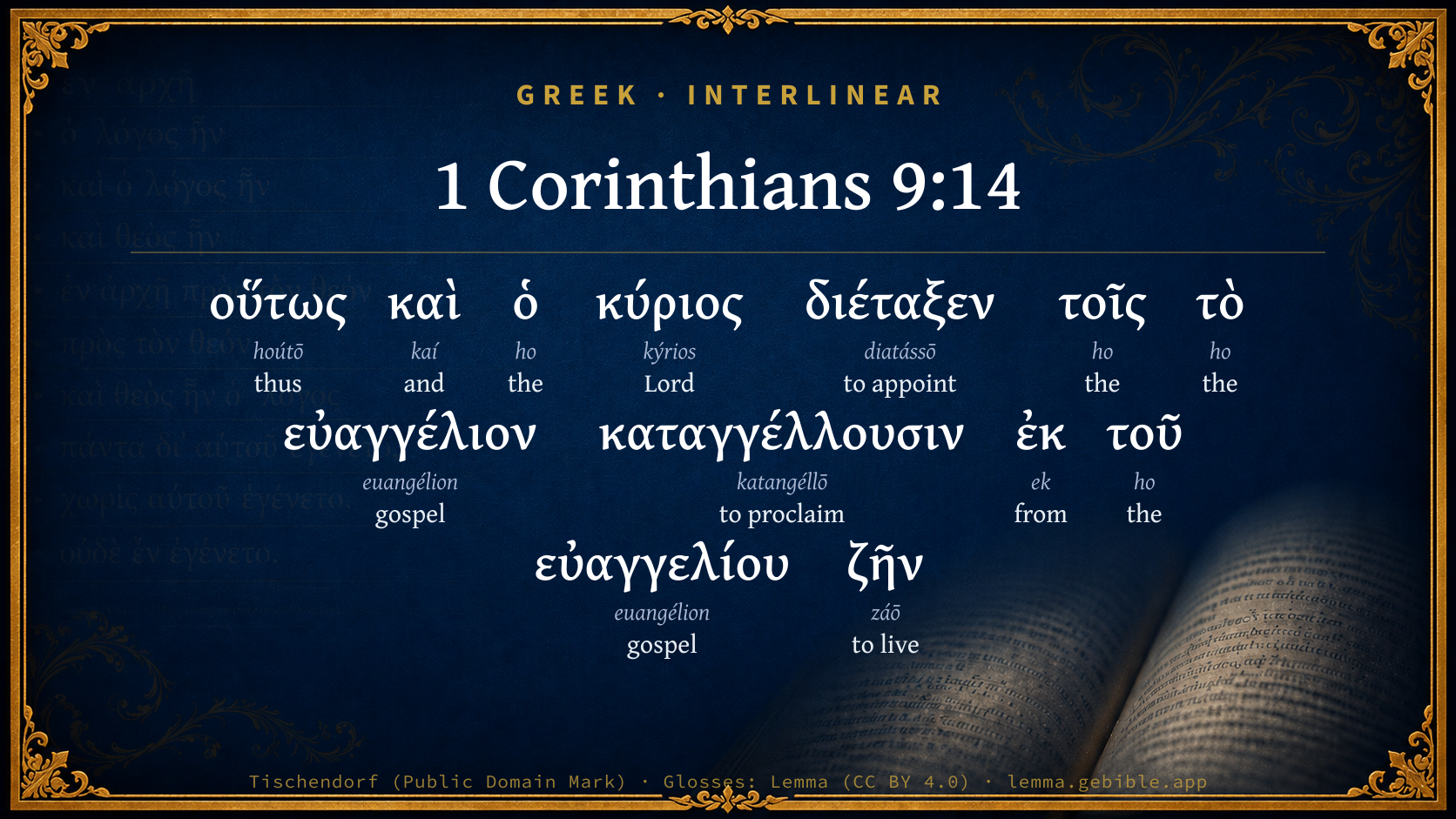
Greek (Tischendorf 8th ed.) 1 Corinthians 9:14 appears in the Greek New Testament. The text above is from the Tischendorf 8th edition. Each word links to its Strong’s number and a concise gloss. Click any word for its full Thayer’s Greek Lexicon entry.
Download image
Cite this verse

1 Corinthians 9:14 (World English Bible). Public Domain. Lemma interlinear Bible study tool, https://lemma.gebible.app/v/1-corinthians/9/14.

Show BibTeX & RIS
BibTeX
RIS
English Translation
Even so the Lord ordained that those who proclaim the Gospel should live from the Gospel.
World English Bible · Public Domain
Download a study sheet

One document with this verse’s original text, its word-by-word gloss line, the meaning frame, cross-references with their text, attributed commentary, and full source and license credits — printable, and it pastes into notes with its structure intact.

This verse Autodidact and up

Study sheet (.html) Plain text (.txt)

A passage Seminary Student

Up to 50 verses in one chapter. A passage sheet keeps up to 6 commentary sources and 12 cross-references per verse, in the order this page ranks them, and says so on the sheet whenever that leaves anything out. Ask for a single verse and you get the Autodidact verse sheet above.

Everything on this page stays free to read, with no account — the sheet is a download of what is already on screen, not access to it.

Want to remove ads? Support Godless Engineer
Compare translations 3

The same verse in 3 English versions, stacked beneath the original-language interlinear above. Click any original word for its lexicon entry.

Each is an independent rendering of the whole verse — the interlinear is not word-aligned to these translations.

Highlighted words mark where these versions differ — a whole-verse word diff, not a word-by-word alignment.

  • World English Bible Public Domain
    Even so the Lord ordained that those who proclaim the Gospel should live from the Gospel.
  • King James Version Public Domain
    Even so hath the Lord ordained that they which preach the gospel should live of the gospel.
  • unfoldingWord Literal Text CC BY-SA 4.0
    In the same way also, the Lord commanded the ones proclaiming the gospel to live from the gospel.

unfoldingWord Literal Text — © unfoldingWord, licensed CC BY-SA 4.0. Word-aligned USFM3 via Door43 (git.door43.org/unfoldingWord/en_ult).

Versions to compare (up to 4)

3 of 4 selected

Show all 19 translations

Every available English version of this verse, each an independent rendering of the whole verse.

  • World English Bible Public Domain
    Even so the Lord ordained that those who proclaim the Gospel should live from the Gospel.
  • Berean Standard Bible Public Domain
    In the same way, the Lord has prescribed that those who preach the gospel should receive their living from the gospel.
  • Majority Standard Bible Public Domain
    In the same way, the Lord has prescribed that those who preach the gospel should receive their living from the gospel.
  • King James Version Public Domain
    Even so hath the Lord ordained that they which preach the gospel should live of the gospel.
  • American Standard Version (1901) Public Domain
    Even so did the Lord ordain that they that proclaim the gospel should live of the gospel.
  • Revised Version (1885) Public Domain
    Even so did the Lord ordain that they which proclaim the gospel should live of the gospel.
  • Geneva Bible (1599) Public Domain
    So also hath the Lord ordeined, that they which preach ye Gospel, should liue of the Gospel.
  • Douay-Rheims (1899) Public Domain
    So also the Lord ordained that they who preach the gospel, should live by the gospel.
  • Young's Literal Translation Public Domain
    so also did the Lord direct to those proclaiming the good news: of the good news to live.
  • Literal Standard Version CC BY-SA 4.0
    So also the LORD directed to those proclaiming the good news to live of the good news.
  • Unlocked Literal Bible CC BY-SA 4.0
    In the same way, the Lord commanded that those who proclaim the gospel should get their living from the gospel.
  • unfoldingWord Literal Text CC BY-SA 4.0
    In the same way also, the Lord commanded the ones proclaiming the gospel to live from the gospel.
  • Darby Bible Public Domain
    So also the Lord has ordained to those that announce the glad tidings to live of the glad tidings.
  • World Messianic Bible Public Domain
    Even so the Lord ordained that those who proclaim the Good News should live from the Good News.
  • Webster's Bible Public Domain
    Even so hath the Lord ordained that they who preach the gospel should live by the gospel.
  • Free Bible Version CC BY-SA 4.0
    In just the same way the Lord ordered that those who announce the good news should live from supporters of the good news.
  • Bible in Basic English Public Domain
    Even so did the Lord give orders that the preachers of the good news might get their living from the good news.
  • Text-Critical English NT CC BY 4.0
    In the same way, the Lord has commanded that those who proclaim the gospel should earn their living by the gospel.
  • Tyndale New Testament (1534) Public Domain
    Even so also dyd the lorde ordayne that they which preache the gospell shuld live of the gospell.

Literal Standard Version (2020), Covenant Press — licensed CC BY-SA 4.0. Text via the HelloAO Bible API (eBible.org). Unlocked Literal Bible (unfoldingWord) — licensed CC BY-SA 4.0. Text via the HelloAO Bible API (eBible.org). unfoldingWord Literal Text — © unfoldingWord, licensed CC BY-SA 4.0. Word-aligned USFM3 via Door43 (git.door43.org/unfoldingWord/en_ult). Free Bible Version, Dr. Jonathan Gallagher — licensed CC BY-SA 4.0. Text via the HelloAO Bible API (eBible.org).

Word by word

More ways to search: Search by grammar → Find every occurrence → Compare this word →

Practice this passage: Drill this verse → Learn its vocabulary →

About this verse

These counts appear in no published source. They are computed here, from the morphology-tagged text and Lemma’s own curated glosses. What Lemma adds →

13
words
9
distinct lemmas
Pauline Epistles
section

Notable vocabulary

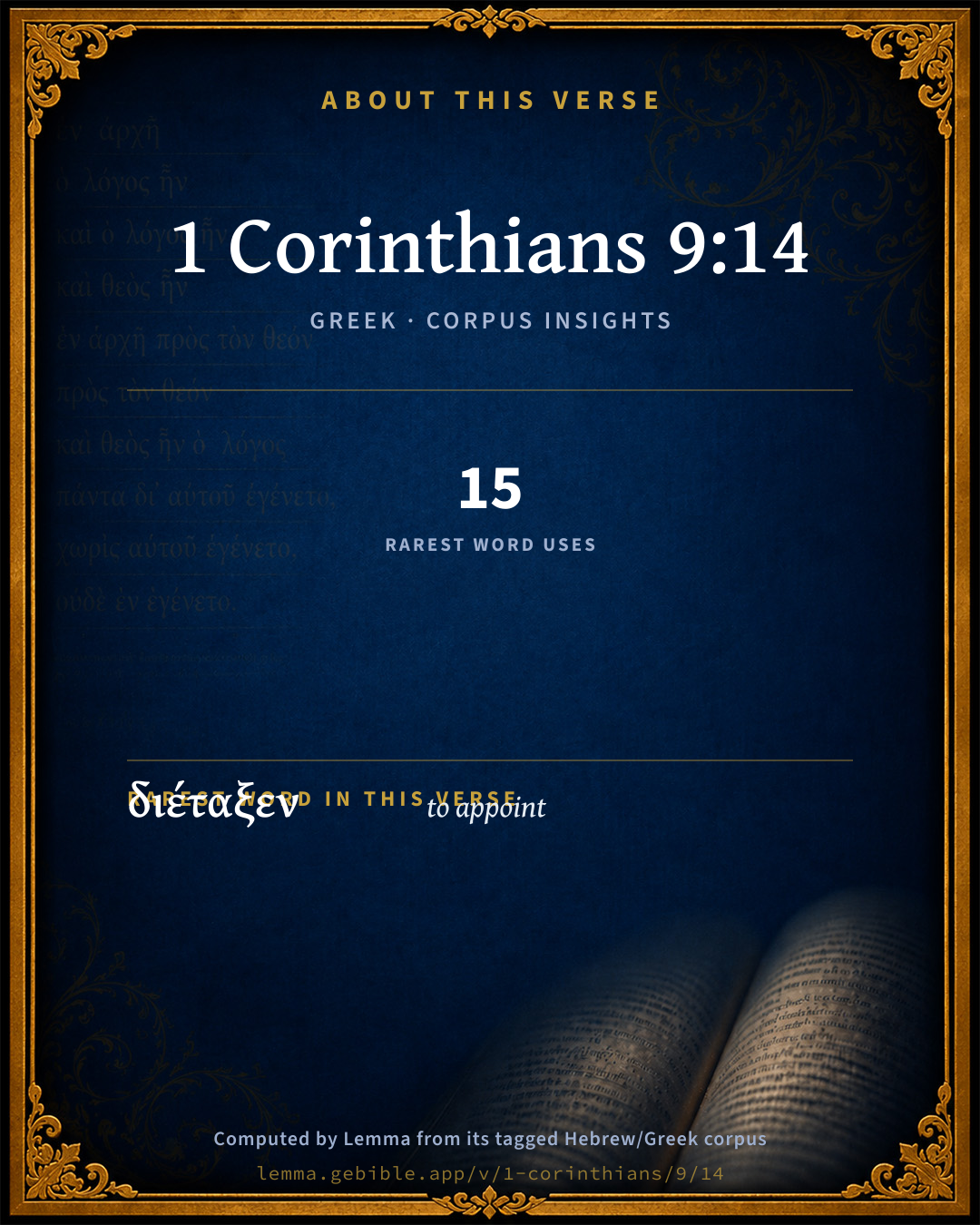
The rarest word here is διέταξεν to appoint G1299 — appearing just 15 times in the whole Greek New Testament.

Shared distinctive vocabulary

διέταξεν to appoint G1299 occurs in 15 verses of the Greek New Testament. Also found in:

Repetition

Words recur within this verse:

  • εὐαγγέλιον gospel G2098 ×2
  • ὁ the G3588 ×4

Cross-references

5

Topical passages linked to 1 Corinthians 9:14 in the Treasury of Scripture Knowledge — connected by theme and wording, ordered by reader-vote popularity; previews shown in the World English Bible.

  • Matthew 10:10 Take no bag for your journey, neither two coats, nor shoes, nor staff: for the laborer is worthy of his food.
  • 1 Timothy 5:17–18 Let the elders who rule well be counted worthy of double honor, especially those who labor in the word and in teaching.
  • 1 Corinthians 9:4 Have we no right to eat and to drink?
  • Galatians 6:6 But let him who is taught in the word share all good things with him who teaches.
  • Luke 10:7 Remain in that same house, eating and drinking the things they give, for the laborer is worthy of his wages. Don't go from house to house.

Cross-references courtesy of OpenBible.info (CC BY 4.0).

Commentary

Notes on 1 Corinthians 9:14 from classic Christian and Jewish commentators (each source and its license shown beneath its notes). The classic Christian expositions comment on the surrounding passage and are grouped to its opening verse, so a note may address several verses; the Jewish commentaries on the Tanakh (Rashi and others) are per-verse, so they appear only where the commentator wrote on this verse.

Lemma curates 59 commentaries, every one of them public domain or Creative Commons licensed, each selected and text-cleaned for this edition rather than reprinted as found. About our sources →

Tyndale Open Study Notes

Tyndale Open Resources

9:14 the Lord ordered: See Matt 10:10; Luke 10:7; see also Gal 6:6; 1 Tim 5:17-18.

Tyndale Open Study Notes — © Tyndale Open Resources, licensed CC BY-SA 4.0. Text via the HelloAO Bible API.

Bengel's Gnomon

Johann Albrecht Bengel

1Co 9:14. Ὁ Κύριος, the Lord) Christ Mat 10:10.

Bengel's Gnomon of the New Testament — English translation (T&T Clark, Edinburgh, 1860) — public domain. Text from a community e-Sword module.

Hodge's Commentary on Romans, Ephesians & First Corinthians

Charles Hodge

1Co_9:14

Even so hath the Lord ordained that they which preach the gospel should live of the gospel.

Even so (οὕτω καί), so also, i.e. as God had ordained under the Old Testament, so also the Lord (i.e. Christ) had ordained under the New. Christ has made the same ordinance respecting the ministers of the gospel, that God made respecting the priests of the law. The Lord hath ordained that, etc., (διέταξεν τοῖς), he commanded those who preach, etc. It was a command to ministers themselves not to seek their support from secular occupations; but to live of the gospel, as the priests lived of the temple. Mat_10:10. Luk_10:8. This is the law of Christ, obligatory on ministers and people; on the latter to give, and on the former to seek a support from the church and not from worldly avocations. There are circumstances under which, as the case of Paul shows, this command ceases to be binding on preachers. These are exceptions, to be justified, each on its own merits; the rule, as a rule, remains in force. If this subject were viewed in this light, both by preachers and people, there would be little difficulty in sustaining the gospel, and few ministers would be distracted by worldly pursuits.

Charles Hodge — Commentary on Romans (1835), First Corinthians (1857), and Ephesians (1856) — public domain. Text from a community e-Sword module.

Geneva Bible (1599)

Geneva Bible translators

Because they preach the Gospel. It followed by this place, that Paul gat no living, neither would have any other man get, by any commodity of masses, or any other such superstitious trumperies.

Geneva Bible (1599) marginal notes — public domain. Text via Bolls.life.

Jamieson, Fausset & Brown

Robert Jamieson, A. R. Fausset & David Brown

Even so--The only inference to be drawn from this passage is, not that the Christian ministry is of a sacrificial character as the Jewish priesthood, but simply, that as the latter was supported by the contributions of the people, so should the former. The stipends of the clergy were at first from voluntary offerings at the Lord's Supper. At the love-feast preceding it every believer, according to his ability, offered a gift; and when the expense of the table had been defrayed, the bishop laid aside a portion for himself, the presbyters, and deacons; and with the rest relieved widows, orphans, confessors, and the poor generally [TERTULLIAN, Apology, 39]. The stipend was in proportion to the dignity and merits of the several bishops, presbyters, and deacons [CYPRIAN, c. 4, ep. 6].

preach . . . gospel--plainly marked as the duty of the Christian minister, in contrast to the ministering about sacrifices (Greek) and waiting at the altar of the Jewish priesthood and Levites (Co1 9:13). If the Lord's Supper were a sacrifice (as the Mass is supposed to be), this fourteenth verse would certainly have been worded so, to answer to Co1 9:13. Note the same Lord Christ "ordains" the ordinances in the Old and in the New Testaments (Mat 10:10; Luk 10:7).

Jamieson, Fausset & Brown — Commentary Critical and Explanatory on the Whole Bible (1871) — public domain (CC PDM 1.0). Text via the HelloAO Bible API.

Adam Clarke's Commentary

Verse 14. Even so hath the Lord ordained] This is evidently a reference to our Lord's ordination, Mt 10:10: The workman is worthy of his meat. And Lu 10:7: For the labourer is worthy of his hire. And in both places it is the preacher of the Gospel of whom he is speaking. It was a maxim among the Jews, "that the inhabitants of a town where a wise man had made his abode should support him, because he had forsaken the world and its pleasures to study those things by which he might please God and be useful to men." See an ordinance to this effect in the tract Shabbath, fol. 114.

Adam Clarke's Commentary on the Bible (1810–1826) — public domain. Text from a community e-Sword/MySword module.

Ellicott's Commentary for English Readers

(14) Even so.—These words explain why the Apostle again referred to Jewish law, after having in 1Co_9:9 already made use of an appeal to the Law as an argument. It is now again referred to only to introduce the crowning argument that Christ Himself perpetuated this law in its application to the Christian ministry. (See Mat_10:10; Luk_10:7.)

They which preach the gospel.—The preaching of the gospel is in the Christian ministry the function which corresponds to the offering of sacrifice in the Jewish priesthood. Bengel well remarks, “If the Mass were a sacrifice, Paul would undoubtedly have accommodated to it the apodosis here.”

A Bible Commentary for English Readers, edited by Charles John Ellicott (1878–1897) — public domain. Text from a community e-Sword module.

The Cambridge Bible for Schools and Colleges

gen. ed. J. J. S. Perowne

14. Even so hath the Lord ordained] In St Mat_10:10, and St Luk_10:7.

The Cambridge Bible for Schools and Colleges (gen. ed. J. J. S. Perowne; Cambridge University Press, 1878–1918) — public domain. Text from a community e-Sword module.

John Gill's Exposition

But I have used none of these things,.... Either none of these arguments or reasons, for a minister's maintenance, taken from the reason of things, the law of Moses, the examples of the priests and Levites, and the order and appointment of Christ, in favour of himself, and that he might be provided for by them accordingly; or none of the things he had a right to do as other apostles, as to eat and drink at the public expense, to lead about with him a sister, a wife, had he any, and to forbear working with his own hands:

neither have I written these things, that it should be so done unto me; it was not on his own account that he gave these strong reasons, urged these instances, and so undeniably proved this point, that ministers should be maintained by the people; and this he says to prevent what some might be ready enough to suggest, that though the apostle had as yet took nothing of the church at Corinth, it was plain, that for the time to come, he meant to do it; and therefore had written these things with such a view, to make way for his after supply from them. This he denies, and gives his reason for it,

for it were better for me to die; through want, with famine, could he be supplied no other way, than to take the least farthing of them:

or than that any man should make my glorying void; meaning not so much his inward pleasure, joy, and satisfaction in preaching the Gospel freely, it being more blessed to give than to receive; but his boasting or glorying, not before God, but against the false apostles; that he had never taken anything of the church at Corinth for preaching, nor never would, when they had insinuated he preached for gain, and by artful methods had got their money, and drained their purses.

John Gill's Exposition of the Whole Bible (1746–1763) — public domain (CC PDM 1.0). Text via the HelloAO Bible API.

Trapp's Complete Commentary

John Trapp

14 Even so hath the Lord ordained that they which preach the gospel should live of the gospel.

Ver. 14. Even so hath the Lord] Note that "so," saith one; "that is, as they of old lived at the altar by tithes, so ministers now. How else will men satisfy their consciences in the particular quantity they must bestow upon the ministers? The Scripture speaks only of the tenth part."

John Trapp, A Commentary or Exposition upon All the Books of the Old and New Testament (1647–1656) — public domain. Text from a community e-Sword module.

Albert Barnes' Notes on the Bible

Even so - In the same manner, and for the same reasons.

Hath the Lord ordained - Hath the Lord appointed, commanded, “arranged” that it should be so (διέταξε dietaxe). The word here means that he has made this a law, or has required it. The word “Lord” here doubtless refers to the Lord Jesus, who has sent forth his ministers to labor in the great harvest of the world.

That they which preach the gospel - They who are sent forth by him; who devote their lives to this work; who are called and employed by him in this service. This refers, therefore, not only to the apostles, but to all who are duly called to this work, and who are his ambassadors.

Should live of the gospel - Should be supported and maintained in this work. Paul here probably refers to the appointment of the Lord Jesus, when he sent forth his disciples to preach, Mat 10:10; Luk 10:8; compare Gal 6:6. The man may be said to “live in the gospel” who is supported while he preaches it, or wire derives his maintenance in that work. Here we may observe:

(1) That the command is that they shall “live” (ζῇν zēn) of the gospel. It is not that they should grow rich, or lay up treasures, or speculate in it, or become merchants, farmers, teachers, or bookmakers for a living; but it is that they should have such a maintenance as to constitute a livelihood. They should be made comfortable; not rich. They should receive so much as to keep their minds from being harassed with cares, and their families from want not so much as to lead them to forget their dependence on God, or on the people. Probably the true rule is, that they should be able to live as the mass of the people among whom they labor live; that they should be able to receive and entertain the poor, and be willing to do it; and so that the rich also may not despise them, or turn away from their dwelling.

(2) This is a command of the Lord Jesus; and if it is a command, it should be obeyed as much as any other law of the Redeemer. And if this is a command, then the minister is entitled to a support; and then also a people are not at liberty to withhold it. Further, there are as strong reasons why they should support him, as there are why they should pay a schoolmaster, a lawyer, a physician, or a day-laborer. The minister usually toils as hard as others; expends as much in preparing for his work; and does as much good. And there is even a higher claim in this case. God has given an express command in this case; he has not in the others.

(3) The salary of a minister should not be regarded as a “gift” merely, any more than the pay of a congressman, a physician, or a lawyer. He has a claim to it; and God has commanded that it should be paid. It is, moreover, a matter of stipulation and of compact, by which a people agree to compensate him for his services. And yet, is there anything in the shape of “debt” where there is so much looseness as in regard to this subject? Are people usually as conscientious in this as they are in paying a physician or a merchant? Are not ministers often in distress for that which has been promised them, and which they have a right to expect? And is not their usefulness, and the happiness of the people, and the honor of religion intimately connected with obeying the rule of the Lord Jesus in this respect?

Albert Barnes' Notes on the Bible (1834–1885) — public domain. Text from a community e-Sword/MySword module.

Matthew Poole's English Annotations

God’s will is the same under the New Testament that it was under the Old; it is not as to the people a matter of liberty, so as men may choose whether they will maintain their ministers or not, there is an ordinance of God in the case: it is the will of God, that those who are taken off from worldly employments, and spend their time in the study and preaching of the gospel, should have a livelihood from their labour.

Matthew Poole's English Annotations on the Holy Bible (1683–1685) — public domain. Text from a community e-Sword/MySword module.

Whedon's Commentary on the Bible

Daniel D. Whedon

14. Even so—The third and conclusive argument—the command of Christ. Mat_10:10; Luk_10:7. Another instance indicating, probably, Paul’s acquaintance with the gospels of Matthew and Luke.

Daniel D. Whedon (gen. ed.), Commentary on the Old and New Testaments (1874–1909) — public domain. Text from a community e-Sword module.

The Pulpit Commentary

Hath the Lord ordained. (Mat_10:10; Luk_10:7) The reference has special interest, because it shows that St. Paul was at least orally familiar with the discourses of Christ. Indeed, there is nothing impossible or improbable in the supposition that some of these were already being circulated in manuscript. Should live of the gospel. If, that is, they desired and had need to do so. He does not say, "to live of the altar," because Christians have no "altar" except in the metaphorical sense in which the cross is called an altar in Heb_13:10.

The Pulpit Commentary (1880–1919), ed. H.D.M. Spence-Jones & Joseph S. Exell — public domain. Text from a community e-Sword module.

John Wesley's Explanatory Notes

Matt. x, 10

John Wesley, Explanatory Notes Upon the Whole Bible (1754–1765) — public domain. Text via the GEBible commentary corpus.

Godbey's Commentary on the New Testament

William B. Godbey

14. “Thus truly the Lord has commanded that those preaching the gospel shall live from the gospel.” While these Scriptures are so clear and unmistakable in favor of the temporal support of the gospel ministry, we must remember that our Savior scathingly condemns “the hireling shepherd,” certifying that he can not be relied on, but will play the coward in time of danger. Great mistakes are made by little financial institutions in the churches, bringing the people into bondage, abstracting their faith from God and centralizing it upon their own efforts. We would do well to commit the temporal support to God, as we do the spiritual interest, feeling assured that He will verify His promise and see that those who preach the gospel “do live on the gospel.” God feeds his preachers like He feeds the birds, in a mysterious way to them and to others. This great salvation breaks every yoke from the neck of God’s people, and gives perfect spiritual liberty on all lines, emancipating us not only from burdens, but even from solicitude, commanding us to “be careful for nothing. “

William B. Godbey, Commentary on the New Testament (1896–1900) — public domain. Text from a community e-Sword module.

McGarvey & Pendleton's Commentaries

J. W. McGarvey

Even so did the Lord ordain that they that proclaim the gospel should live of the gospel . [ Mat_10:10 ; Luk_10:7 . This precept was all which Paul needed to urge. He no doubt elaborated this argument that the Corinthians might be fully convinced that he was perfectly aware of his rights at the time when he waived them. The apostle next sets forth more fully why he preferred to support himself rather than receive compensation from the churches.]

J. W. McGarvey (with Philip Y. Pendleton), Commentaries on the New Testament (The Fourfold Gospel, 1914; Acts; and the epistles) — public domain. Text from a community e-Sword/MySword module.

The People's New Testament

B. W. Johnson

14. Even so hath the Lord ordained, etc. It was the Lord's ordinance, even if Paul did not exercise the power, that those who preach the gospel should be sustained by the church. See Matt. 10:9, 10.

B. W. Johnson's The People's New Testament with Notes (1889–1891) — public domain. Electronic text from the Christian Classics Ethereal Library (CCEL) ThML edition.

Cambridge Greek Testament for Schools and Colleges

14. ὁ κύριος διέταξεν. In Mat 10:10, and Luk 10:7. Cf. ch. 1Co 7:10; 1Co 7:12; 1Co 7:25. The R.V. ‘ordained’, with the more definite meaning attached to the aorist, gives the best sense here.

Cambridge Greek Testament for Schools and Colleges (Cambridge University Press, 1896; 21 vols, various authors incl. Carr, Maclear, Plummer, Farrar, Lumby, Moule, M. R. James, Simcox) — public domain. Text from a community e-Sword module.

Alford’s Greek Testament

Henry Alford

14.] Analogy of the maintenance of the Jewish priesthood from the sacred offerings, with this right of the Christian teacher, as ordained by Christ.

Meyer rightly remarks, that οἱ τὰ ἱερὰ ἐργαζόμενοι can only mean the priests, not including the Levites: and therefore that both clauses apply to the same persons.

ἐργάζεσθαι, ἔρδειν, ῥέζειν, are technical words for the offering of sacrifice. See reff. to LXX.

ἱεροῦ here, as θυσιαστηρίου is parallel with it below, is probably not ‘the sacrifice,’ ‘the holy thing,’ but the temple—‘the holy building.’ Similarly Jos. B. J. v. 13. 6, makes the Zealots say, δεῖ … τοὺς τῷ ναῷ στρατευομένους ἐκ τοῦ ναοῦ τρέφεσθαι.

παρεδρ.] So Jos. contra Apion. 1:7, speaks of the priests as τῇ θεραπείᾳ τοῦ θεοῦ προσεδρεύοντας.

On the practice referred to, see Num 18:8 ff.; Deu 18:1 ff.

No other priesthood but the Jewish can have been in the mind of the Apostle. The Jew knew of no θυσιαστήριον but one: and he certainly would not have proposed heathen sacrificial customs, even in connexion with those appointed by God, as a precedent for Christian usage: besides that the idea is inconsistent with οὕτως καί: see below.

14.] So also (i.e. in analogy with that His other command) did the Lord (Christ; the Author by His Spirit of the O. T. as well as the New) command (viz. Mat 10:10; Luk 10:7, Luk 10:8) to those who are preaching the gospel, to live of (be maintained by. Themistius (Kypke) has ζῇν ἐξ ἐργασίας) the gospel. Observe, that here the Apostle is establishing an analogy between the rights of the sacrificing priests of the law, and of the preachers of the gospel. Had those preachers been likewise sacrificing priests, is it possible that all allusion to them in such a character should have been here omitted? But as all such allusion is omitted, we may fairly infer that no such character of the Christian minister was then known. As Bengel remarks on ver. 13: ‘Si missa esset sacrificium, plane Paulus versu sequente apodosin huc accommodasset.’

Henry Alford, The Greek Testament (1849–1861) — public domain. Text from a community e-Sword module.

International Critical Commentary

14. Just as God appointed that the priests and Levites should be supported out of what the people offered to Him, so did Christ also appoint that missionaries should be supported out of the proceeds of missions. For the parallel between Christian preachers and Jewish priests see Rom 15:16. It is clear that ὁ Κύριος. means Christ; ‘the Lord also, ’ just as Jehovah had done. St Paul was familiar with what is recorded Mat 10:10; Luk 10:7, Luk 10:8. See on 7:10 and 11:23.

International Critical Commentary — older volumes (1896–1929), various authors — public domain. Text from a community e-Sword module.

Godet's Commentaries

Frédéric Louis Godet

Vv. 14. “Even so hath the Lord ordained that they which preach the gospel should live of the gospel.”

Rückert does not think that we have here a new argument; he regards it as only the application to the Christian Church of what was common among Jews and Gentiles (1Co 9:13). But the apostle could not possibly have presented the consequence of a Jewish or Gentile usage as a positive command of the Lord. We must therefore understand the οὕτω καί in the sense of: And so also. This is the last fact which completes the proof of the apostles’ right. When Paul says: hath ordained, he is thinking of a saying of Jesus; it is that of Mat 10:10 and Luk 10:7. He knew it from apostolic tradition, as he did that which he has already quoted 1Co 7:10. It is somewhat remarkable that in 1Ti 5:18 this command of Jesus is connected, as in our passage, with that of Deuteronomy cited in 1Co 9:10.

By the dative τοῖς καταγγέλλουσιν, to them who preach, Paul does not mean that it is to the preachers the command is given; it is the dative of favour: for them. The expression: live of the gospel, may apply, according to time or place, to free gifts or to a regular salary. It is only the principle which is of importance.

According to St. Paul, the Lord has established in His Church a class of members occupying a particular position. While other believers realize the new life in the exercise of a secular profession which affords them a livelihood, they renounce every secular occupation to consecrate all their time and powers to the development of the spiritual life in others; and consequently the Church to which they thus consecrate their life is bound to provide for their material support, as Jesus provided for the maintenance of His disciples from the day when He commanded them to leave their nets, and said to them: “I will make you fishers of men.” Such is the foundation of the institution of the Christian ministry. The object of Jesus in establishing it was not to institute a new priesthood, a human mediatorship between God and the Church; but neither did He wish to abandon the development of His work to the spontaneous zeal of the faithful. He has avoided these two opposite rocks, and confined Himself to instituting a ministry to preach and have the cure of souls, the members of which live for the gospel, and consequently ought also to live of the gospel. But woe to the man who claims to live of the gospel without living at the same time for the gospel!

Paul has reminded his readers that he was really an apostle (1Co 9:1-3), and then demonstrated by five arguments of increasing force the right which therefore belongs to him and his fellow - labourers (1Co 9:4-14). He now reaches the idea which he had in view from the beginning: that of the voluntary sacrifice which he has made of this right (1Co 9:15-17). In 1Co 9:15 he expresses the fact of the sacrifice itself; in 1Co 9:16-18, the reason which impels him to act thus.

Frédéric Louis Godet — Commentaries on Luke, John, Romans, and 1 Corinthians — English translation (T&T Clark, Edinburgh, 1870s–1890s) — public domain. Text from a community e-Sword module.

Lesson kit

Teaching starters — assembled from the data on this page, not authored interpretation. Every prompt links to the verse data it draws on. Edit before teaching.

1 Corinthians, in the Pauline Epistles, opens this verse with 13 words (9 distinct Greek lemmas). Its most distinctive word is diatássō (“to appoint”). A historical commentator’s framing appears above. Read the whole chapter for the surrounding context.

Discussion questions

  1. What does “to appoint” (diatássō) contribute to the verse as a whole?
  2. How does Matthew 11:1, which shares the word «to appoint», read alongside this verse?
  3. What does the repetition of “gospel” (2× in this one verse) do in this verse?
  4. The translations on this page render this verse differently — a whole-verse word diff, not a word-by-word alignment. What might account for the different wordings?
  5. Compare how Tyndale Open Study Notes and Bengel's Gnomon read this verse. Where do they agree or differ?

Things to notice

  • These translations choose different wording for 13 words in this verse.
  • “gospel” occurs 2× in this single verse.
  • 9 distinct Greek lemmas span 13 words in this verse.

Reading settings

Reading text

Shown beneath each verse's original-language words.

Old Testament
Old Testament edition

Read the OT as the Masoretic Hebrew (MT) or the Greek Septuagint (LXX).

English shown for the Greek Septuagint (in the Hebrew ↔ Greek comparison).

Comparing translations? Open the Compare panel on any verse page to stack up to four side by side.