John 14:31

Greek (Tischendorf 8th ed.) John 14:31 appears in the Greek New Testament. The text above is from the Tischendorf 8th edition. Each word links to its Strong’s number and a concise gloss. Click any word for its full Thayer’s Greek Lexicon entry.
Download image
Cite this verse

John 14:31 (World English Bible). Public Domain. Lemma interlinear Bible study tool, https://lemma.gebible.app/v/john/14/31.

Show BibTeX & RIS
BibTeX
RIS
English Translation
But that the world may know that I love the Father, and as the Father commanded me, even so I do. Arise, let us go from here.
World English Bible · Public Domain
Download a study sheet

One document with this verse’s original text, its word-by-word gloss line, the meaning frame, cross-references with their text, attributed commentary, and full source and license credits — printable, and it pastes into notes with its structure intact.

This verse Autodidact and up

Study sheet (.html) Plain text (.txt)

A passage Seminary Student

Up to 50 verses in one chapter. A passage sheet keeps up to 6 commentary sources and 12 cross-references per verse, in the order this page ranks them, and says so on the sheet whenever that leaves anything out. Ask for a single verse and you get the Autodidact verse sheet above.

Everything on this page stays free to read, with no account — the sheet is a download of what is already on screen, not access to it.

Want to remove ads? Support Godless Engineer
Compare translations 3

The same verse in 3 English versions, stacked beneath the original-language interlinear above. Click any original word for its lexicon entry.

Each is an independent rendering of the whole verse — the interlinear is not word-aligned to these translations.

Highlighted words mark where these versions differ — a whole-verse word diff, not a word-by-word alignment.

  • World English Bible Public Domain
    But that the world may know that I love the Father, and as the Father commanded me, even so I do. Arise, let us go from here.
  • King James Version Public Domain
    But that the world may know that I love the Father; and as the Father gave me commandment, even so I do. Arise, let us go hence.
  • unfoldingWord Literal Text CC BY-SA 4.0
    but so that the world might know that I love the Father, and just as the Father commanded me, thus I do. Get up. Let us go from here.”

unfoldingWord Literal Text — © unfoldingWord, licensed CC BY-SA 4.0. Word-aligned USFM3 via Door43 (git.door43.org/unfoldingWord/en_ult).

Versions to compare (up to 4)

3 of 4 selected

Show all 19 translations

Every available English version of this verse, each an independent rendering of the whole verse.

  • World English Bible Public Domain
    But that the world may know that I love the Father, and as the Father commanded me, even so I do. Arise, let us go from here.
  • Berean Standard Bible Public Domain
    But I do exactly what the Father has commanded Me, so that the world may know that I love the Father. Get up! Let us go on from here.
  • Majority Standard Bible Public Domain
    But I do exactly what the Father has commanded Me, so that the world may know that I love the Father. Get up! Let us go on from here.
  • King James Version Public Domain
    But that the world may know that I love the Father; and as the Father gave me commandment, even so I do. Arise, let us go hence.
  • American Standard Version (1901) Public Domain
    but that the world may know that I love the Father, and as the Father gave me commandment, even so I do. Arise, let us go hence.
  • Revised Version (1885) Public Domain
    but that the world may know that I love the Father, and as the Father gave me commandment, even so I do. Arise, let us go hence.
  • Geneva Bible (1599) Public Domain
    But it is that the world may knowe that I loue my Father: and as the Father hath commanded me, so I doe. Arise, let vs goe hence.
  • Douay-Rheims (1899) Public Domain
    But that the world may know, that I love the Father: and as the Father hath given me commandment, so do I: Arise, let us go hence.
  • Young's Literal Translation Public Domain
    but that the world may know that I love the Father, and according as the Father gave me command so I do; arise, we may go hence.
  • Literal Standard Version CC BY-SA 4.0
    but that the world may know that I love the Father, and according as the Father gave Me command, so I do; arise, we may go from here.”
  • Unlocked Literal Bible CC BY-SA 4.0
    but in order that the world will know that I love the Father, I do just as the Father commanded me. Let us get up and go from here.”
  • unfoldingWord Literal Text CC BY-SA 4.0
    but so that the world might know that I love the Father, and just as the Father commanded me, thus I do. Get up. Let us go from here.”
  • Darby Bible Public Domain
    but that the world may know that I love the Father, and as the Father has commanded me, thus I do. Rise up, let us go hence.
  • World Messianic Bible Public Domain
    But that the world may know that I love the Father, and as the Father commanded me, even so I do. Arise, let’s go from here.
  • Webster's Bible Public Domain
    But that the world may know that I love the Father; and as the Father gave me commandment, even so I do. Arise, let us go hence.
  • Free Bible Version CC BY-SA 4.0
    but I'm doing what my Father told me to do so that the world will know that I love the Father. Now get up. Let's go.”
  • Bible in Basic English Public Domain
    But he comes so that the world may see that I have love for the Father, and that I am doing as I am ordered by the Father. Get up, and let us go.
  • Text-Critical English NT CC BY 4.0
    Rather, I do just as the Father has commanded me, so that the world may know that I love the Father. Rise, let us go from here.
  • Tyndale New Testament (1534) Public Domain
    But that the worlde maye knowe that I love the father: therfore as the father gave me commaundment even so do I. Ryse let vs go hence.

Literal Standard Version (2020), Covenant Press — licensed CC BY-SA 4.0. Text via the HelloAO Bible API (eBible.org). Unlocked Literal Bible (unfoldingWord) — licensed CC BY-SA 4.0. Text via the HelloAO Bible API (eBible.org). unfoldingWord Literal Text — © unfoldingWord, licensed CC BY-SA 4.0. Word-aligned USFM3 via Door43 (git.door43.org/unfoldingWord/en_ult). Free Bible Version, Dr. Jonathan Gallagher — licensed CC BY-SA 4.0. Text via the HelloAO Bible API (eBible.org).

Word by word

More ways to search: Search by grammar → Find every occurrence → Compare this word →

Practice this passage: Drill this verse → Learn its vocabulary →

ἐντεῦθεν
enteûthen
G1782
“hence”
Adverb
Part of Speech
Adverb
Full Thayer's Definition

Origin: from the same as G1759

TDNT: None

1. from this place, hence 2. on the one side and on the other, on each side
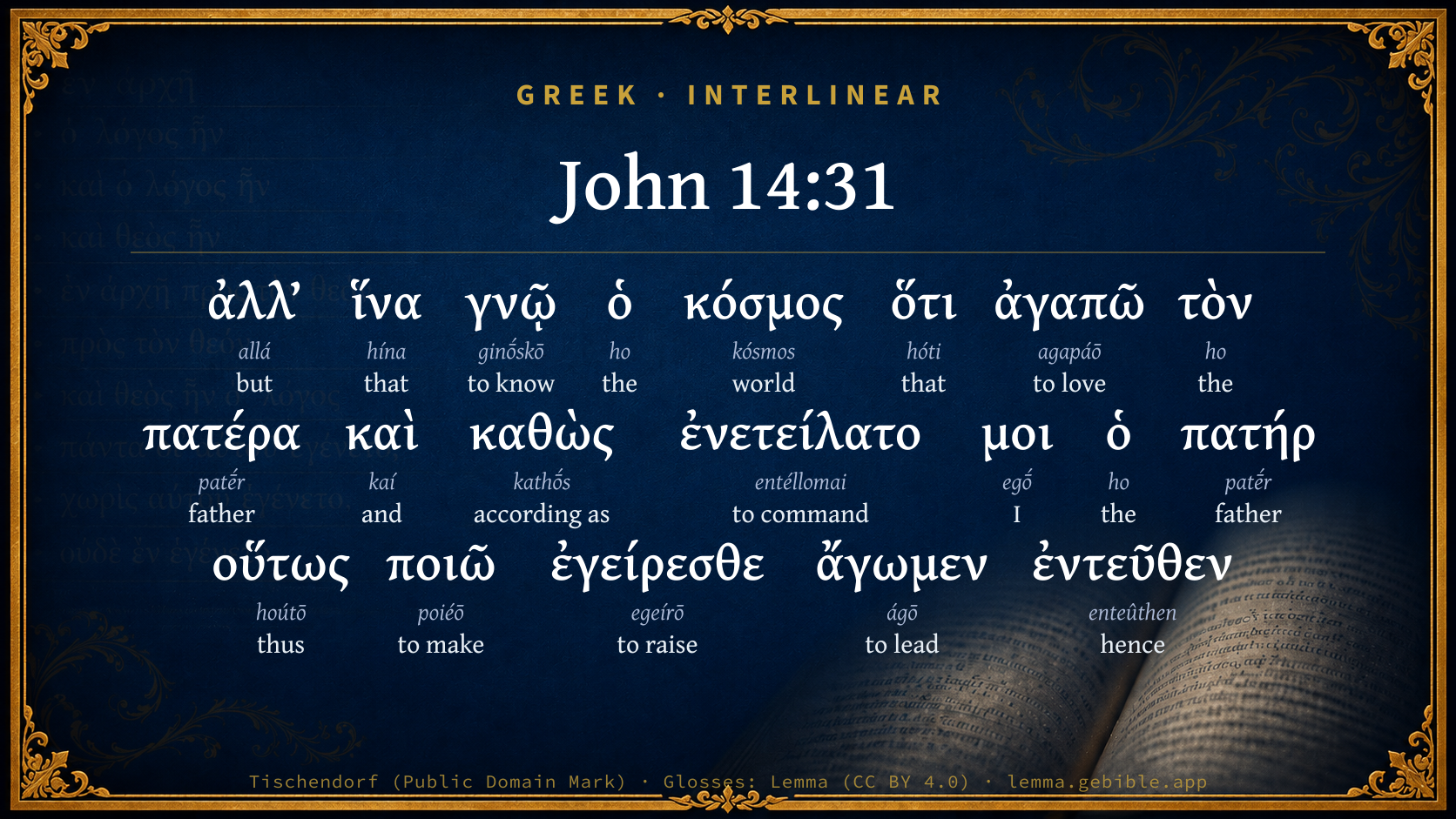
  1. ἀλλ’ allá G235 “but” Conjunction
  2. ἵνα hína G2443 “that” Conjunction
  3. γνῷ ginṓskō G1097 “to know” Verb, Aorist, Active, Subjunctive, 3rd person, Singular
  4. ὁ ho G3588 “the” Article, Nominative, Singular, Masculine
  5. κόσμος kósmos G2889 “world” Noun, Nominative, Singular, Masculine
  6. ὅτι hóti G3754 “that” Conjunction
  7. ἀγαπῶ agapáō G25 “to love” Verb, Present, Active, Indicative, 1st person, Singular
  8. τὸν ho G3588 “the” Article, Accusative, Singular, Masculine
  9. πατέρα patḗr G3962 “father” Noun, Accusative, Singular, Masculine
  10. καὶ kaí G2532 “and” Conjunction
  11. καθὼς kathṓs G2531 “according as” Adverb
  12. ἐνετείλατο entéllomai G1781 “to command” Verb, Aorist, Middle deponent, Indicative, 3rd person, Singular
  13. μοι egṓ G1473 “I” Personal pronoun, 1st person, Dative, Singular
  14. ὁ ho G3588 “the” Article, Nominative, Singular, Masculine
  15. πατήρ patḗr G3962 “father” Noun, Nominative, Singular, Masculine
  16. οὕτως hoútō G3779 “thus” Adverb
  17. ποιῶ poiéō G4160 “to make” Verb, Present, Active, Indicative, 1st person, Singular
  18. ἐγείρεσθε egeírō G1453 “to raise” Verb, Present, Middle or Passive, Imperative, 2nd person, Plural
  19. ἄγωμεν ágō G71 “to lead” Verb, Present, Active, Subjunctive, 1st person, Plural

About this verse

These counts appear in no published source. They are computed here, from the morphology-tagged text and Lemma’s own curated glosses. What Lemma adds →

20
words
17
distinct lemmas
Gospels
section

Notable vocabulary

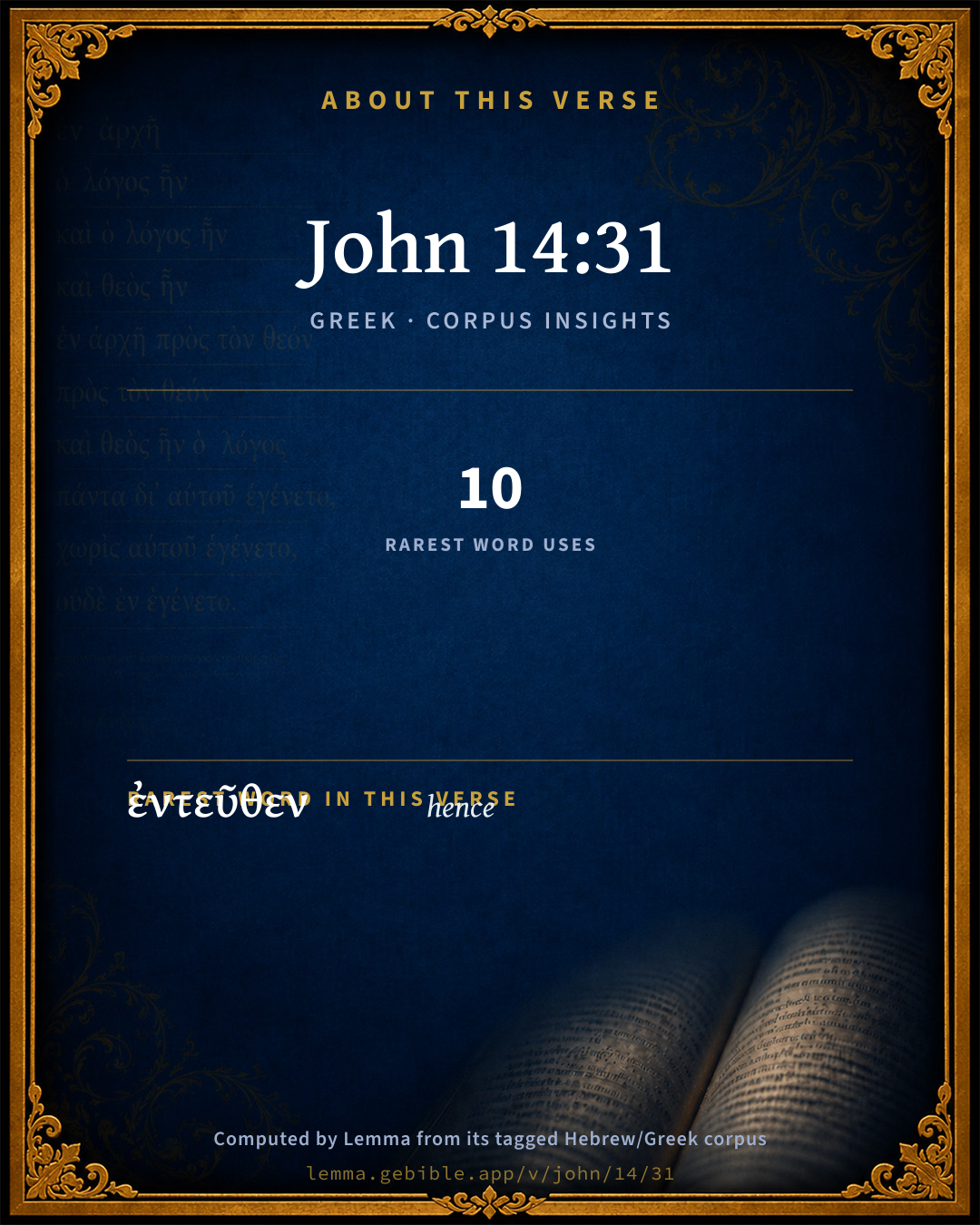
The rarest word here is ἐντεῦθεν hence G1782 — appearing just 10 times in the whole Greek New Testament.

Shared distinctive vocabulary

ἐντεῦθεν hence G1782 occurs in 9 verses of the Greek New Testament. Also found in:

Repetition

Words recur within this verse:

Cross-references

14

Topical passages linked to John 14:31 in the Treasury of Scripture Knowledge — connected by theme and wording, ordered by reader-vote popularity; previews shown in the World English Bible.

  • John 10:18 No one takes it away from me, but I lay it down by myself. I have power to lay it down, and I have power to take it again. I received this commandment from my Father."
  • Philippians 2:8 And being found in human form, he humbled himself, becoming obedient to death, yes, the death of the cross.
  • Luke 12:50 But I have a baptism to be baptized with, and how distressed I am until it is accomplished!
  • John 4:34 Jesus said to them, "My food is to do the will of him who sent me, and to accomplish his work.
  • John 12:49 For I spoke not from myself, but the Father who sent me, he gave me a commandment, what I should say, and what I should speak.
  • Hebrews 5:7–8 He, in the days of his flesh, having offered up prayers and petitions with strong crying and tears to him who was able to save him from death, and having been heard for his godly fear,
  • Psalms 40:8 I delight to do your will, my God. Yes, your law is within my heart."
  • John 15:9 Even as the Father has loved me, I also have loved you. Remain in my love.
  • Matthew 26:39 He went forward a little, fell on his face, and prayed, saying, "My Father, if it is possible, let this cup pass away from me; nevertheless, not what I desire, but what you desire."
  • John 12:27 "Now my soul is troubled. What shall I say? 'Father, save me from this time?' But for this cause I came to this time.
  • John 18:11 Jesus therefore said to Peter, "Put the sword into its sheath. The cup which the Father has given me, shall I not surely drink it?"
  • Hebrews 12:2–3 looking to Jesus, the author and perfecter of faith, who for the joy that was set before him endured the cross, despising shame, and has sat down at the right hand of the throne of God.
  • Matthew 26:46 Arise, let's be going. Behold, he who betrays me is at hand."
  • Hebrews 10:5–9 Therefore when he comes into the world, he says, "Sacrifice and offering you didn't desire, But a body did you prepare for me;

Cross-references courtesy of OpenBible.info (CC BY 4.0).

Commentary

Notes on John 14:31 from classic Christian and Jewish commentators (each source and its license shown beneath its notes). The classic Christian expositions comment on the surrounding passage and are grouped to its opening verse, so a note may address several verses; the Jewish commentaries on the Tanakh (Rashi and others) are per-verse, so they appear only where the commentator wrote on this verse.

Lemma curates 59 commentaries, every one of them public domain or Creative Commons licensed, each selected and text-cleaned for this edition rather than reprinted as found. About our sources →

The Biblical Illustrator

Joseph S. Exell

Joh_14:31

But that the world may know that I love the Father

Christs departure

1.

It is well that we do not know when the last time is the last: unconsciously and without premonition we leave our door, we retire to bed, we grasp the hand of our friend for the last time: and by and by it is said, He is not, for God hath taken him. How much of mercy there is in this veiling of the future, this sparing of farewells, we may understand from the flutter and pain with which foreseen and calculated things are done for the last time. We leave home, friends, church, and, even though it be for improved conditions, there is a laceration in the parting proportioned to the length of association.

2. We are differently constituted. Some can change their homes with as little thought or feeling as they can change their clothes. They have lived in half a dozen houses, worshipped in half a dozen churches. They strike no deep roots, and feel no parting sorrow deeper than good natural regret. Hardly is this the finest type of human feeling. To merely be put down on a surface and strike no roots difficult or painful to pull up, is a grave implication of either the plant or the soil. In this departure

I. CHRIST WAS IMPELLED BY HIS SUPREME SENSE OF DUTY. As the Father gave Me commandment. No self-interest, no sentiment, was ever permitted to interfere with this sense of duty. While yet a youth it was the supreme law of life--Wist ye not, etc. As a man it dominated all impulses of filial affection. Woman, what have I to do with thee?

1. In all great lives the sense of duty is dominant. Sometimes God gives reasons for what He requires of us; but if the only reason is that God has demanded it we may not hesitate. As with an army or a child, the commander and father may not be able to give reasons, nevertheless duty is imperative. God has many purposes we cannot understand.

2. In many of us the sense of duty is weak. We consult our convenience, advantage, likings. How rarely we choose unpleasant work because of its importance!

3. No strong or noble character can come out of this. A man who will not for the sake of duty do an arduous thing will never build up his moral strength or glorify God.

II. ANOTHER IMPULSE WAS TO PRODUCE THE IMPRESSION OF HIS FILIAL AFFECTION. That the world may know.

1. Love is the inspiration of all high duty. Duty is not mere measured service. A son who weighed the literal word of command could hardly be called dutiful.

2. Our Lord attached great importance to the impression which His loving duty made upon men. He would have the world see it so that it might inspire love. What shall I do to show my love to God? Let selfishness or sentiment come in, and how narrowed becomes the sphere of duty, and how poor its motive I There can be no blessing upon it.

III. TO MAINTAIN DUTY AND LOVE THE MASTER TOOK NO COUNT OF EASE OR SAFETY. Arise, etc. He went forth to His foreseen passion and death. We often hesitate to run a risk for Him. He laid down His life for the sheep. To maintain duty He broke up the tenderest fellowship with His own. (H. Allon, D. D.)

Reflections on departure

(on removing to another place of worship):--Let us apply these words.

I. TO THE SON OF GOD IN THE SOLEMN MOMENT WHEN THEY WERE UTTERED. He was going to the garden, to that great and awful conflict in which the prophecy was to be fulfilled, that He should present His soul an offering for sin, and bear the burden of the worlds atonement. This was the last night of the Redeemers life. He had been eating the passover with His disciples. He could use these words with ideas and anticipations, of which they knew nothing. The traitor had gone, and made his arrangements; and our Lord saw this: yet there was nothing, either like fainting under the prospect, or rashness, or precipitancy, or passion: but all was calm and tranquil.

II. TO SEVERAL CIRCUMSTANCES OF PROVIDENCE AS THEY OCCUR TO OURSELVES.

1. To local removals of place and of habitation, when the voice of Providence and of God calls us from scenes and situations where we have been surrounded by kindred and congenial society; from our fathers house, from a particular habitation which we may have long occupied, where we may have felt and experienced much of the blessing of God; where we may have passed through many afflictions; and we feel we must say to ourselves, Let us go hence, there are many emotions which come upon the heart; and I should never envy that man his feelings, who had never experienced such emotions.

2. To moral circumstances, when we may be called to depart from circumstances of enjoyment, comfort, and tranquillity, and to enter upon scenes of adversity and misfortune, when we are called to experience what is painful and distressing to our mind and heart.

3. To what is spiritual. I cannot help thinking of the resolutions which have often been made, when these words have been carried home to the heart of a man by the Spirit of God; when he has determined to arise and go to his Father.

4. To the matter of death. That word departure conveys a grand truth: it is not extinction, but the going, the passing from one place to another; the continuance of consciousness, of every capacity, faculty, and feeling; and the passing of the intelligent spirit into another place, and another state.

III. TO OUR OWN PERSONAL CIRCUMSTANCES. If we are permitted to see another Sabbath, we hope to be worshipping in another sanctuary, rendered necessary by the Providence of God. We are going from a place interesting to our minds, hallowed to our remembrances

1. By the purposes to which it has been devoted.

2. By events which have transpired within it. Here souls have been born to God. Over this scene angels have rejoiced over sinners that have repented.

3. By relative recollections of interest and importance. Here many of you have the recollection of a pious ancestry; here you have been led by them; here perhaps you were dedicated in baptism; and here your parents have borne you upon their hearts.

4. By personal recollection. You rejoice, and give God thanks, that you were led here to hearken to the voice of the man of God, in exhibiting that truth by which you trust you were saved and sanctified. And many of you have peculiar recollections of seasons, in which the truth hath been peculiarly appropriate to your personal circumstances.

5. Painful recollections. You have to look back upon services neglected, and Sabbaths misimproved; when you have heard with indolence, or a critical and improper feeling; when you have conversed on what you have heard with flippancy, instead of retiring with it to pray. (T. Binney.)

The calmness of Christ

Christs calmness here in prospect of Gethsemane and the cross is in keeping with the whole tenor of His life, and suggests

I. HIS CONSCIOUSNESS OF THE RECTITUDE OF HIS CHARACTER AND PROCEDURE. Had He been conscious of any wrong against God or man, His conscience would have disturbed Him. Or had He had any misgiving as to the rectitude of His procedure He might have been disturbed. His calmness was not stoicism or indifference--for Christ was exquisitely sensitive and emotional.

II. A SETTLED SENSE OF HIS SUBLIME SUPERIORITY. Well He knew the ignorance and depravity of those who opposed Him, and He rose above it all. Their stormy insults awoke no ripple upon the deep translucent lake of His great nature.

III. AN INWARD ASSURANCE OF HIS ULTIMATE SUCCESS. He had an end to accomplish, and had laid His plans. He had calculated on all the opposition He had to encounter, and knew that He would see of the travail of His soul, etc.

IV. THE HARMONY OF ALL HIS IMPULSES AND POWERS. Because in us there are two elements warring--flesh and spirit--we are constantly being disturbed. Right wars against policy, conscience against impulse, and we get like the troubled sea. Not so with Christ, all the elements of His soul moved as harmoniously as do the planets. He was at one with Himself, as well as with God and the universe.

V. HIS COMMANDING CLAIM TO OUR IMITATION in the crisis of life and in death. (D. Thomas, D. D.)

A watchword

We cannot be long in one stay. A voice ever sounds in our ear, Arise, let us go hence. Even when we have conversed on the sweetest themes, or have enjoyed the holiest ordinances, we have not yet crone to our eternal abode; still are we on the march, and the trumpet soundeth, Arise, let us go hence. Our Lord was under marching orders, and He knew it: for Him there was no stay upon this earth. Hear how He calls Himself, and all His own, to move on, though bloody sweat and bloody death be in the way.

I. OUR MASTERS WATCHWORD. Arise, let us go hence. By this stirring word

1. He expressed His desire to obey the Father. As the Father gave Me commandment, even so I do. Arise, let us go hence.

(1) He was not hindered by expected suffering.

(2) He did not start back, though in that suffering there would be the special element of His Fathers forsaking Him.

(3) He did not hesitate though death was in near prospect.

(4) He was eager to do the will of the Father, and make all heaven and earth know how entirely He yielded Himself to the Father.

2. He indicated His readiness to meet the arch-enemy. The prince of this word cometh. Arise, let us go hence.

(1) He was prepared for the test. He hath nothing in Me.

(2) He was eager to overthrow His dominion.

3. He revealed His practical activity. All through the chapter observe our Lords energy. He is ever on the move. I go. I will come again. I will do it. I will pray. Arise, let us go hence.

(1) He prefers action to the most sacred rites, and so leaves the supper table with this word on His lips.

(2) He prefers action to the sweetest converse. I will not talk much with you. Arise, let us go hence.

4. He manifested His all-consuming love to us.

(1) He was straitened till He had accomplished our redemption.

(2) He could not rest in the company of His best-beloved till their ransom was paid.

(3) He would not sit at Gods right hand till He had felt the shame of the Cross, and the bitterness of death (Heb_12:2).

II. OUR OWN MOTTO. Arise, let us go hence. Ever onward, ever forward, we must go (Exo_14:15).

1. Out of the world when first called by grace (2Co_6:17). How clear the call! How prompt should be our obedience! Jesus is without the camp, we go forth unto Him (Heb_13:13), We must arouse ourselves to make the separation. Arise, let us go hence,

2. Out of forbidden associations, if, as believers, we find ourselves like Lot in Sodom. Escape for thy life (Gen_19:17).

3. Out of present attainments when growing in grace (Php_3:13-14).

4. Out of all rejoicing in self. There we must never stop for a single instant. Self-satisfaction should startle us.

5. To work, anywhere for Jesus. We should go away from Christian company and home comforts to win souls (Mar_16:15).

6. To defend the faith where it is most assailed. We should be prepared to quit our quiet to contend with the foe (Jud_1:3).

7. To suffer when the Lord lays affliction upon us (2Co_12:9).

8. To die when the voice from above calls us home (2Ti_4:6).

Conclusion:

1. Oh sinner, where would you go if suddenly summoned?

2. Oh saint, what better could happen to you than to rise and go hence? (C. H. Spurgeon.)

.

The Biblical Illustrator, edited by Joseph S. Exell (c. 1880s–1900s) — public domain. Text from a community e-Sword module.

Bengel's Gnomon

Johann Albrecht Bengel

Joh 14:31. Ἀλλʼ ἵνα, but that) This indicates that in the preceding verse καὶ signifies and indeed [to which ἀλλʼ ἵνα here answers],—γνῷ ὁ κόσμος, that the world may know) The world, which is held fast by its prince; by divesting itself of its character, however, that the world may cease to be the world, and may recognise to its salvation that the good pleasure of the Father is in Me.—οὕτως ποιῶ, that so I do) from love; ch. Joh 15:10, “Even as I have kept My Father’s commandments, and abide in His love.” The full stop is rightly fixed here: nor is the ἀλλʼ ἵνα which precedes an objection to this (Let the ἀλλʼ ἵνα be well considered in ch. Joh 1:8, “He was not that light, but that he should bear witness of that light;” Joh 9:3, Joh 13:18, Joh 15:25; 1Jn 2:19; Mar 14:49, “I was daily with you—and ye took Me not; but that the Scriptures might be fulfilled” [ἀλλʼ ἵνα πληρωθῶσιν αἱ γραφαί]): in this sense, but, viz. I await the onset of the prince of the world, [that the world may know, etc.] The stopping by a colon is not ancient. See Luther’s Kirchenpostill for the feast of Pentecost. If ἐγείρεσθε, arise, were the Apodosis, such a connection would be a remote one, involving many enunciations or sentiments.[356] Between this going and the world’s coming to know Jesus, how many things intervened!—ἐγείρεσθε, arise) A word expressing alacrity. He Himself strenuously proceeds to the business in hand, rising now already before His disciples.—ἄγωμεν ἐντεῦθεν, let us go hence) into the city, to the Passover. Comp. ch. Joh 13:1, “Before the feast of the Passover;” Joh 18:1. The things which heretofore elapsed from ch. Joh 13:31 [The departure of Judas after receiving the sop], were done and spoken on Thursday outside the city. But the things which follow in chapters 15. and 16. and 17., were spoken in the city on the very evening of the Passover, accompanied with the wonted hymn; namely, immediately before His going forth beyond the brook Cedron (ch. Joh 18:1). There are then two discourses, which are divided by this abrupt breaking off here (Joh 14:31). [To the common scope of which, however, as well as to the sense and argument, the intervening Passover-supper most sweetly corresponds.—Harm., p. 507.]

[356] ‘Noemata.’ Beng. seems to mean, ἐγείρεσθε is too far removed from ἀλλὰ, and there are too many intervening enunciations which would be made to be involved in and depend on it, for it to be the Apodosis to ἀλλά.—E. and. T.

Bengel's Gnomon of the New Testament — English translation (T&T Clark, Edinburgh, 1860) — public domain. Text from a community e-Sword module.

Meyer's Critical & Exegetical Commentary

Heinrich August Wilhelm Meyer

Joh_14:31. That the world may know, etc. (as far as οὕτω ποιῶ), rise (from table), let us go hence! In order to bring the world to the knowledge of my love and my obedience to the Father (ut mundus desinat mundus esse et patris in me beneplacitum agnoscat salutariter, Bengel), let us away from here, and go to meet the diabolical power, before which I must now fall according to Gods counsel! The apodosis does not begin so early as καὶ καθώς (Grotius, Kuinoel, Paulus), in which case καί would mean also, and a reflection less appropriate to the mood of deep emotion would result. If a full point be placed after ποιῶ (Bengel, Lachmann, Tischendorf, Ewald), which, however, renders the sentence heavy, and makes what follows to stand too abruptly, then after ἀλλʼ a simple ἔρχεται would have to be supplied. Comp. Joh_15:25.

After the summons ἐγείρεσθε, κ.τ.λ., we are to think of the company at table as having risen. But Jesus, so full of that which, in view of the separation ever drawing nearer, He desired to impress on the heart of the disciples, and enchained by His love for them, takes up the word anew, and standing, continues to address chap. 15 and 16 to the risen disciples, and then follows the prayer of chap, 17, after which the actual departure, Joh_18:1, ensues. This view (Knapp, Lücke, Tholuck, Olshausen, Klee, Winer, Lnthardt, Ewald, Brückner, Bleek, following the older expositors, also Gerhard, Calovius, and Maldonatus) appears to be correct from this, that John, without any indication of a change of place, connects Joh_15:1 immediately with Joh_14:31; while, that the following discourses, and especially the prayer, were uttered on the way (Ammonius, Hilarius, Beda, Luther, Aretius, Grotius, Wetstein, Lampe, Rosenmüller, Lange, Ebrard), is neither in any way indicated, nor reconcilable with Joh_18:1, nor psychologically probable. A pure importation, further, is the opinion of Chrysostom, Theophylact, Euth. Zigabenus, Erasmus, and several others, that Christ, Joh_14:31, went with the disciples to a more secluded and safer place, where He (sur la pente couverte de vignes, qui descend dans la vallée du Cédron, Godet) delivered chap. 15, 16, 17; so also is Bengels harmonistic device, which Wichelhaus has adopted, that the locality of the discourse from Joh_13:31[158] to Joh_14:31 had been outside the city, but that now He set forth to go to Jerusalem for the passover.[159] Others, while De Wette abides by the hypothesis of an hiatus between chap. 14 and 15, the reason of which remains unknown, have sought to make use of the ἐγείρεσθε, ἄγωμεν, Mat_26:46, Mar_14:42, in spite of the quite different historical connection in Matthew and Mark, in order to charge the author with a clumsy attempt to interweave that reminiscence in his narrative (Strauss, Scholten); in opposition to which Weisse, with equal arbitrariness and injustice, accuses the supposed editor of the Gospel with having placed in juxtaposition, without any link of connection, two Johannean compositions, of which the one closed with Joh_14:31, and the other began with Joh_15:1. Baur and Hilgenfeld, indeed, make the synoptic words, divested of their more definite historical justification, stand here only as a sign of pause. The Johannean words, and those in the Synoptics uttered in Gethsemane, have nothing to do with one another; but the apparent incongruity with the present passage speaks, in fact, in favour of the personal testimony of the reporter, before whose eyes the whole scene vividly presented itself. Comp. Bleeks Beitr. p. 239.

[158] Bengel on Joh_13:31 : λέγει: dicit postridie, nempe mane, feria V.

[159] So also again Röpe, d. Mahl des Fusswasch., Hamb. 1856, p. 25 f., who, following Bynaeus, assumes that in ἐγείρεσθε, κ. τ. λ. is contained the setting forth from Bethany for Jerusalem, and that chap. 1517 were then spoken at the paschal meal on the 14th Nisan, in reference to the institution of the Supper.

Meyer — Critical and Exegetical Commentary on the New Testament — English translation by Peter Christie, edited by Frederick Crombie (T&T Clark, 1880) — public domain. Text from a community e-Sword module.

Expositor's Greek Testament

ed. W. Robertson Nicoll

Joh 14:31 . Jesus goes to death not crushed by the machinations of Satan, “but that the world may know that I love the Father and as the Father has commanded me,” οὕτω ποιῶ , “thus I do,” applies to His whole life, which was throughout ruled by regard to the Father’s commandment, but in the foreground of His thought at present is His departure from the disciples, His death. ἐγείρεσθε , ἄγωμεν ἐντεῦθεν , “arise, let us go hence,” similar to the summons in Mat 26:46 , but the idea of referring so common an expression to a reminiscence of the Synoptic passage is absurd. On the movement made in consequence of the summons, see on Joh 15:1 .

In chapters 15 and 16 Jesus (1) explains the relation He holds to those who continue His work, Joh 15:1-17 ; (2) the attitude the world will assume to His followers, Joh 15:18-25 ; (3) the conquest of the world by the Spirit, 26 16:11; and (4) adds some last words, encouragements and warnings, Joh 16:12-33 . In this last conversation, which extends from chap. 13 to chap. 16 inclusive, the closing words of chap. 14, ἐγείρεσθε ἄγωμεν ἐντεῦθεν , form the best marked division. At this point Jesus and His disciples rose from table. Whether the conversation was continued in the house or after they left it may be doubtful; but probabilities are certainly much in favour of the former alternative. A party of twelve could not conveniently talk together on the street. In Joh 18:1 we read that when Jesus had uttered the prayer recorded in 17 ἐξῆλθε σὺν τοῖς μαθηταῖς αὐτοῦ πέραν τοῦ χειμάρρου τῶν Κέδρων . This, however, may refer to their leaving the city, not the house. Bengel thinks they may have paused in the courtyard of the house.

The Expositor's Greek Testament, edited by W. Robertson Nicoll (1897–1910) — public domain. Text from a community e-Sword module.

Jamieson, Fausset & Brown

Robert Jamieson, A. R. Fausset & David Brown

But that the world may know that I love the Father, &c.--The sense must be completed thus: "But to the Prince of the world, though he has nothing in Me, I shall yield Myself up even unto death, that the world may know that I love and obey the Father, whose commandment it is that I give My life a ransom for many."

Arise, let us go hence--Did they then, at this stage of the discourse, leave the supper room, as some able interpreters conclude? If so, we think our Evangelist would have mentioned it: see Joh 18:1, which seems clearly to intimate that they then only left the upper room. But what do the words mean if not this? We think it was the dictate of that saying of earlier date, "I have a baptism to be baptized with, and how am I straitened till it be accomplished!"--a spontaneous and irrepressible expression of the deep eagerness of His spirit to get into the conflict, and that if, as is likely, it was responded to somewhat too literally by the guests who hung on His lips, in the way of a movement to depart, a wave of His hand, would be enough to show that He had yet more to say ere they broke up; and that disciple, whose pen was dipped in a love to his Master which made their movements of small consequence save when essential to the illustration of His words, would record this little outburst of the Lamb hastening to the slaughter, in the very midst of His lofty discourse; while the effect of it, if any, upon His hearers, as of no consequence, would naturally enough be passed over.

Next: John Chapter 15

Jamieson, Fausset & Brown — Commentary Critical and Explanatory on the Whole Bible (1871) — public domain (CC PDM 1.0). Text via the HelloAO Bible API.

Adam Clarke's Commentary

Verse 31. Arise, let us go hence.] Calmet supposes that Christ, having rendered thanks to God, and sung the usual hymn, Mt 26:30; Mr 14:26; rose from the table, left the city, and went towards the garden of Olives, or garden of Gethsemane, on the road to which, a part of the following discourse was delivered. It was now about midnight, and the moon was almost full, it being the 14th day of her age, about the time in which the Jewish passover was to be slain.

THE reader should carefully note the conduct of our Lord. He goes to die as a SACRIFICE, out of love to mankind, in obedience to the Divine will, and with unshaken courage. All our actions should be formed on this plan. They should have the love of God and man for their principle and motive; his glory for their end; and his will for their rule. He who lives and acts thus shall live for ever. Amen.

Adam Clarke's Commentary on the Bible (1810–1826) — public domain. Text from a community e-Sword/MySword module.

John Calvin's Commentaries

31. But that the world may know. Some think that these words should be read as closely connected with the words, Arise, let us go hence, so as to make the sense complete. Others read the former part of the verse separately, and suppose that it breaks off abruptly. As it makes no great difference in regard to the meaning, I leave it to the reader to give a preference to either of these views. What chiefly deserves our attention is, that the decree of God is here placed in the highest rank; that we may not suppose that Christ was dragged to death by the violence of Satan, in such a manner that anything happened contrary to the purpose of God. It was God who appointed his Son to be the Propitiation, and who determined that the sins of the world should be expiated by his death. In order to accomplish this, he permitted Satan, for a short time, to treat him with scorn; as if he had gained a victory over him. Christ, therefore, does not resist Satan, in order that he may obey the decree of his Father, and may thus offer his obedience as the ransom of our righteousness.

Arise, let us go hence. Some think that Christ, after he said these things, changed his place, and that what follows was spoken by him on the road; but as John afterwards adds, that Christ went away with his disciples beyond the brook Kedron, it appears more probable that Christ intended to exhort the disciples to render the same obedience to God, of which they beheld in him so illustrious an example, and not that he led them away at that moment.

John Calvin's Commentaries (1540-1563) — public domain. Text from the Calvin Translation Society English edition (1840s-50s) via the Christian Classics Ethereal Library (ccel.org). Calvin's coverage is partial (roughly two-thirds of the Bible); uncommented books and verses are honest gaps, never fabricated. The 19th-century editor's footnotes and remarks are omitted so the notes are faithfully Calvin's own voice.

Ellicott's Commentary for English Readers

(31) The most probable arrangement of this verse is to omit the period after “so I do,” and to consider all down to this point as governed by “that.” We shall read then, “But, that the world may know that I love the Father, and that as the Father gave Me commandment, so I do, arise, let us go hence.” He has asserted, in the previous verse, the sinlessness which makes His act wholly self-determined. He now expresses the subordination of His own to the Father’s will, and summons the Apostles to rise up with Him from the table, and go forth from the room.

But that the world . . .—The words seem to point back to “the prince of this world” who has just been mentioned. The prince cometh, but it is to a defeat; and the very world over which he has ruled will see in the self-sacrifice of Jesus the love of the Father. That love will reclaim them from the bondage of the oppressor and restore them to the freedom of children.

It is an interesting question which we cannot hope with certainty to solve, whether or not in obedience to the command they went from the room at once. In other words, were the discourse of John 15, 16 and the prayer of John 17, uttered in the room after the summons to depart, or on the way to the garden of Gethsemane? The immediate connection of the opening words of the next chapter with the present verse naturally leads to the opinion that they were spoken in the same place, and, in the absence of any hint of a change, it is safe not to assume any. The words of Joh_18:1 are probably those which express the act to which the words our Lord has just spoken summon them. But comp. Chronological Harmony of the Gospels, p. xxxv.

A Bible Commentary for English Readers, edited by Charles John Ellicott (1878–1897) — public domain. Text from a community e-Sword module.

The Cambridge Bible for Schools and Colleges

gen. ed. J. J. S. Perowne

31. But that] Once more we have an instance of S. John’s elliptical use of these words (see on Joh_13:18), ‘But (this is done, i.e. Satan cometh) in order that, &c.’ Some, however, would omit the full stop at ‘I do’ and make ‘that’ depend upon ‘Arise:’ ‘But that the world may know that I love the Father, and that as the Father commanded Me so I do, arise, let us go hence.’ There is a want of solemnity, if not a savour of ‘theatrical effect,’ in this arrangement. Moreover it is less in harmony with S. John’s style, especially in these discourses. The more simple construction is the more probable.

let us get hence] ‘Let us go and meet the power before which I am willing in accordance with God’s will to fall.’

We are probably to understand that they rise from table and prepare to depart, but that the contents of the next three chapters are spoken before they leave the room (comp. Joh_18:1). Others suppose that the room is left now and that the next two chapters are discourses on the way towards Gethsemane, chap. 17 being spoken at some halting place, possibly the Temple. See introductory note to chap. 17.

The Cambridge Bible for Schools and Colleges (gen. ed. J. J. S. Perowne; Cambridge University Press, 1878–1918) — public domain. Text from a community e-Sword module.

John Gill's Exposition

But that the world may know,.... Not the wicked and unbelieving world, but the world of God's elect, such as are brought to believe in Christ:

that I love the Father; Christ must needs love the Father, as being of the same nature and essence with him, and as standing in the relation of a son to him; he loved all that the Father loves, and approved of all his purposes, counsels, and determinations, concerning himself and the salvation of his people; and therefore he voluntarily laid down his life for them:

and as the Father gave me commandment, so I do: as a son is obedient to a father, so was Christ in all things obedient to the commands of his heavenly Father, in preaching the Gospel, obeying the law, and suffering death; all which he did and suffered, as the Father gave commandment to him, as man and Mediator: and that it might fully appear how much he loved his Father, and agreed with him in all his designs of grace; how much his will was resigned to his, and what respect he paid to whatever he said or ordered; he said to his disciples,

arise, let us go hence: not from the passover, or the supper, for the passover was not as yet, and the Lord's supper was not instituted; nor in order to go to Mount Olivet, or to the garden, where Judas and his armed men would be to meet him, and lay hold on him, as is generally thought; but from Bethany, where he and his disciples now were, in order to go to Jerusalem and keep the passover, institute the supper, and then surrender himself into the hands of his enemies, and die for the sins of his people; for between this and the sermon in the following chapters, was the Lord's supper celebrated; when Christ having mentioned the fruit of the vine, he should drink new with his disciples in his Father's kingdom, he very pertinently enters upon the discourse concerning the vine and branches, with which the next chapter begins: the phrase is Jewish; so R. Jose and R. Chiyah say to one another as they sat, , "arise, and let us go hence" (f).

(f) Zohar in Exod. fol. 74. 1.

Next: John Chapter 15

John Gill's Exposition of the Whole Bible (1746–1763) — public domain (CC PDM 1.0). Text via the HelloAO Bible API.

Trapp's Complete Commentary

John Trapp

31 But that the world may know that I love the Father; and as the Father gave me commandment, even so I do. Arise, let us go hence.

Ver. 31. But that the world may know] Not you only, but all must take notice of my ready obedience to the will of my heavenly Father, even to the suffering of death. Christ’s passion must shine as a perpetual picture in our hearts; therefore it is so accurately described by all the four evangelists, whereas his birth is recorded but by two of them only.

John Trapp, A Commentary or Exposition upon All the Books of the Old and New Testament (1647–1656) — public domain. Text from a community e-Sword module.

Albert Barnes' Notes on the Bible

That the world may know that I love the Father - That it might not be alleged that his virtue had not been subjected to trial. It was subjected. He was tempted in all points like as we are, yet without sin, Heb 4:15. He passed through the severest forms of temptation, that it might be seen and known that his holiness was proof to all trial, and that human nature might be so pure as to resist all forms of temptation. This will be the case with all the saints in heaven, and it was the case with Jesus on earth.

Even so I do - In all things he obeyed; and he showed that, in the face of calamities, persecutions, and temptations, he was still disposed to obey his Father. This he did that the world might know that he loved the Father. So should we bear trials and resist temptation; and so, through. persecution and calamity, should we show that we are actuated by the love of God. “Arise, let us go hence.” It has been commonly supposed that Jesus and the apostles now rose from the paschal supper and went to the Mount of Olives, and that the remainder of the discourse in John 15; 16, together with the prayer in John 17, was delivered while on the way to the garden of Gethsemane; but some have supposed that they merely rose from the table, and that the discourse was finished before they left the room. The former is the more correct opinion. It was now probably toward midnight, and the moon was at the full, and the scene was one, therefore, of great interest and tenderness. Jesus, with a little band, was himself about to die, and he went forth in the stillness of the night, counselling his little company in regard to their duties and dangers, and invoking the protection and blessing of God his Father to attend, to sanctify, and guide them in the arduous labors, the toils, and the persecutions they were yet to endure, John 17.

Albert Barnes' Notes on the Bible (1834–1885) — public domain. Text from a community e-Sword/MySword module.

Haydock's Catholic Bible Commentary

As the Father hath given me commandment, so I do. --- He again speaks of himself, as man. Arise, let us go hence. Yet by chap. xviii. ver. 1. Christ still continued the like instructions, either in the same place, or in the way to Gethsemani. (Witham)

George Leo Haydock (1774–1849), Haydock's Catholic Family Bible and Commentary, 1859 edition — public domain. Excludes Psalms (Douay-Rheims chapter numbering differs from Protestant) and Deuterocanonical books (Catholic canon only).

Matthew Poole's English Annotations

I die not for my own sin; but being found in fashion as a man, I humbled myself, and became obedient unto death, even the death of the cross, ,{as Phi 2:8} to let the world know, that I love the Father, and am obedient to him, doing even so as he hath commanded me.

Arise, let us go hence; arise from supper, (after which they were wont sometimes to lengthen out discourse), the supper in Bethany, as some think; but to me it seems more probable (as I said before) to be the passover supper, and the Lord’s supper which immediately followed that; and let us go hence, out of the guest chamber, where the passover was to be administered. So as it is most probable, that the discourses in the two next chapters were as they went along in the way to Mount Olivet. In this discourse our Saviour hath most applied himself to relieve his disciples upon their disturbance for their want of our Saviour’s bodily presence.

Matthew Poole's English Annotations on the Holy Bible (1683–1685) — public domain. Text from a community e-Sword/MySword module.

Whedon's Commentary on the Bible

Daniel D. Whedon

31. So I do—Namely, undergo the sufferings of the cross. Why? Not because the prince of this world has a right to inflict it; but, first, that the world may know my love for the Father; and, second, because it is the Father’s command.

Arise, let us go hence—The discourse and converse at the table now having been finished, Jesus rises from the table and bids his apostles rise, that they may listen to his solemn valedictory, closed with his high-priestly prayer, preparatory to their going forth in separation and his going forth to his Passion. We suppose that, first, each makes his personal preparation. And then, as the Israelites first partook of the Passover standing, as if preparatory to a going forth, so these apostles reverently stood around the central figure of their Lord to listen to the last converse before the cross. When they next assemble round him it shall be to hear words spoken from his lips clothed with immortality. As they surround his central person at the close of the wine-communion, very suitable is the apologue, with which he opens, of the Vine and its surrounding branches.

Daniel D. Whedon (gen. ed.), Commentary on the Old and New Testaments (1874–1909) — public domain. Text from a community e-Sword module.

The Pulpit Commentary

But that all ina is elliptical (Westcott translates, "But I surrender myself, that," etc.; and Meyer, "But he cometh, that," etc.), not dependent on egeiresyethe world may know that very world over which this alien spirit has so long tyrannized may know, if not now, yet ultimatelythat I love the Father. Then it is the world which is to be nevertheless drawn to him by his being "lifted up (Joh 12) the world which the Father loves so much as to save and redeem from the power of the enemy. And even as the Father commanded me which is undoubtedly in harmony with the entire representation of the meizonothv of the Father so I do. My love is strong as death. Though the prince of the world has no right over me, I go at the Father"s bidding to do his will, to suffer, but to win, and through death to destroy him that has the power of death. Arise, let us go hence words which are also found Mat_26:46, and are a touch of the eyewitness that nothing will obliterate. A second-century theologian would not have introduced such a feature.

They leave the guest-chamber, and so the remainder of the discourse was delivered in the brightness of the Paschal moon, under shadow of the walls of Jerusalem, or in some corner of the temple area, or some convenient place on the way to Gethsemane. He said these words, however, before he crossed the Kedron. (Joh_18:1) Apparently on the way thither he once more took up his parable.

The Pulpit Commentary (1880–1919), ed. H.D.M. Spence-Jones & Joseph S. Exell — public domain. Text from a community e-Sword module.

John Wesley's Explanatory Notes

But I suffer him thus to assault me,

1. Because it is the Father's commission to me, Chap. x, 18.

2. To convince the world of my love to the Father, in being obedient unto death, Phil. ii, 8. Arise, let us go hence - Into the city, to the passover. All that has been related from Chap. xii, 31, was done and said on Thursday, without the city. But what follows in the fifteenth, sixteenth, and seventeenth chapters, was said in the city, on the very evening of the passover just before he went over the brook Kedron.

John Wesley, Explanatory Notes Upon the Whole Bible (1754–1765) — public domain. Text via the GEBible commentary corpus.

Scofield Reference Notes

C. I. Scofield

world

kosmos = mankind. (See Scofield "Mat 4:8").

The Scofield Reference Bible (1917 edition), notes by C. I. Scofield — public domain. Text from a community e-Sword module.

The People's New Testament

B. W. Johnson

31. That the world may know that I love the Father. His obedience in the hour of trial demonstrated that he so loved the Father that he sought not his own, but the Father's will.

B. W. Johnson's The People's New Testament with Notes (1889–1891) — public domain. Electronic text from the Christian Classics Ethereal Library (CCEL) ThML edition.

Cambridge Greek Testament for Schools and Colleges

31. ἐντολὴν ἔδωκεν (BLX) for ἐνετείλατο (אAD).

In this last great discourse (14:14–17) we find a return of the spiral movement noticed in the Prologue (see on Joh 1:18). The various subjects are repeatedly presented and withdrawn in turn. Thus the Paraclete is spoken of in five different sections (Joh 14:16-17; Joh 14:25-26; Joh 15:26; Joh 16:8-15; Joh 16:23-25); the relation between the Church and the world in three (Joh 14:22-24; Joh 15:18-25; Joh 16:1-3). So also with Christ’s departure and return.

31. ἀλλ’ ἵνα. see on Joh 1:8. But (Satan cometh) in order that. Some would omit the full stop at ποιῶ and make ἵνα depend on ἐγείρεσθε: ‘But that the world may know that I love the Father, and that as the Father commanded Me so I do, arise, let us go hence.’ There is a want of solemnity, if not a savour of ‘theatrical effect,’ in this arrangement. Moreover it is less in harmony with S. John’s style, especially in these discourses. The more simple construction is the more probable. But comp. Mat 9:6.

ἄγωμεν. ‘Let us go and meet the power before which I am willing in accordance with God’s will to fall.’

We are probably to understand that they rise from table and prepare to depart, but that the contents of the next three chapters are spoken before they leave the room (comp. Joh 18:1). Others suppose that the room is left now and that the next two chapters are discourses on the way towards Gethsemane, chap. 17 being spoken at some halting-place, possibly the Temple. See introductory note to chap. 17.

Cambridge Greek Testament for Schools and Colleges (Cambridge University Press, 1896; 21 vols, various authors incl. Carr, Maclear, Plummer, Farrar, Lumby, Moule, M. R. James, Simcox) — public domain. Text from a community e-Sword module.

Alford’s Greek Testament

Henry Alford

31.] ‘But my Death is an act of voluntary obedience, that it may be known that I love and obey the Father—that the glory of the Father in and by Me may be manifested.’

The construction is elliptic: supply, ‘But (his power over Me for death will be permitted by Me) that,’ &c. And set a period at ποιῶ, as usually done.

Meyer, al., and Luthardt, would carry on the sense from ποιῶ, “But that the world may know that I love the Father, and as the Father commanded me, thus I do, arise, let us go hence.” I need only put it to the inner feeling of any who have learned to appreciate the majesty and calmness of our Lord’s discourses, whether a sentence so savouring of theatrical effect is likely to have been spoken by Him. We may notwithstanding safely believe that the ἐγ. ἄγ. ἐντ., without this connexion, does undoubtedly express the holy boldness of the Lord in going to meet that which was to come upon Him, and is for that reason inserted by St. John.

ἐγείρ., ἄγ. ἐντ.] These words imply a movement from the table to depart. Probably the rest of the discourse, and the prayer, ch. 17, were delivered when now all were standing ready to depart. There would be some little pause, in which the preparations for departure would be made. But the place is clearly the same, see ch. 18:1, ταῦτα εἰπὼν ὁ Ἰησοῦς ἐξῆλθεν:—besides which, we can hardly suppose (Grot., &c.) discourses of a character like those in ch. 15, 16 to have been delivered to as many as eleven persons, while walking by the way, and in a time of such publicity as that of the Paschal Feast. Still less is the supposition of Bengel and Beausobre probable,—that ch. 13, 14 happened outside the city, and that between ch. 14 and 15 the paschal meal takes place. Compare also ch. 13:30, which is decisive against this idea.

Henry Alford, The Greek Testament (1849–1861) — public domain. Text from a community e-Sword module.

International Critical Commentary

31. ἀλλʼ ἵνα γνῷ ὁ κόσμος κτλ. We must supply something before ἵνα, “but I do these things that the world may recognise” my love for, and obedience to, the Father. For similar elliptical constructions with ἵνα, see 9:3, 13:18, 15:25, 1Jn 2:19. Otherwise we are obliged to take the whole clause as subordinate to “Arise, let us go hence,” which is very harsh. Whichever constr. is adopted, the meaning is the same. Jesus assures His apostles once more that what He does at this critical hour is done voluntarily and in obedience to the Divine purpose. Having made this declaration, He offers His Prayer (c. 17) before He leaves the house to face arrest and death.

ἵνα γνῷ ὁ κόσμος … cf. 17:23 for this ideal of the future; and cf. 1Co 1:21 for the reality of the present.

ὅτι ἀγαπῶ τὸν πατέρα. This is the only place in the N.T. where the “love” of the Son for the Father is mentioned explicitly. The love of the Father for the Son is mentioned often in Jn. (see on 3:35, where ἀγαπᾶν is the verb employed, and 5:20, where we find φιλεῖν); but it is remarkable that Jn. never again speaks of Jesus as “loving” God. See on 3:16 for ἀγαπᾶν in Jn.

ἐνετείλατο. So אADΓΔΘ; but BL have ἐντολὴν δέδωκεν, from the parallel saying at 12:49, where see the exegetical note. For the obedience of Christ to the commandment of the Father, see 4:34, 8:55, and cf. Php 2:8, Heb 5:8. This obedience was perfect throughout His life on earth, but here the allusion is rather to the last act of self-surrender in going to meet the Passion. Here is the last word of Jesus to the Eleven: “As the Father commanded me, so I do.”

ἐγείρεσθε, ἄγωμεν. According to Mar 14:42, Mat 26:46, these were the words with which Jesus summoned the sleeping disciples at Gethsemane, just before His arrest. Jn. adds ἐντεῦθεν, and puts the words in a slightly different context; i.e. they mark the conclusion of the Discourse in the Upper Room, which was followed by a short pause for prayer, the solemn prayer of c. 17 being said standing, before Jesus and His disciples left the house for Gethsemane and the arrest (18:1).

For those who accept the traditional order of chapters, the sharp finality of ἐγείρεσθε, ἄγωμεν ἐντεῦθεν is not easy of explanation. The allegory of the Vine (c. 15) comes in strangely after such words,1 which must mark a break in, or the termination of, the Last Discourse of Jesus. Several exegetes suppose that, after He had said “Arise, let us go hence,” Jesus and His eleven disciples left the house, the rest of the discourse being spoken as they were walking to Gethsemane. It is difficult to suppose that teaching so profound and so novel was given under such conditions, or that Jn. intends thus to represent the course of events. Westcott suggested that before the little party crossed the Kidron they halted for a time in the Temple precincts, where quiet opportunity could be found for the delivery of cc. 15, 16 and for the great prayer of c. 17. But there is no evidence for such an hypothesis. The simplicity of the exegesis which emerges from placing the text in the order that is here adopted is a strong argument in its favour.

ἄγωμεν, it may be noted, is used thrice in c. 11 of a going forth to meet death (see on 11:7).

D Bezæ (δ 5). Cambridge. v-vi. Græco-Latin. Cc. 18:14-20:13 are missing in the Greek text, and the gap has been filled by a ninth-century scribe (Dsupp).

1 Cf. Lightfoot, Supernatural Religion, p. 194, and Biblical Essays, p. 68.

Diat. E. A. Abbott’s Diatessarica, including his Johannine Vocabulary and Johannine Grammar, Parts I.-X. (1900-1915).

C Ephræmi (δ 3). Paris. v. Palimpsest. Contains considerable fragments of Jn.

N Purpureus Petropolitanus (ε 19). Dispersed through the libraries of Leningrad, Patmos, Rome, Vienna, and British Museum. vi. Some pages are missing. Edited by H. S. Cronin in Cambridge Texts and Studies (1899).

Γ̠(ε 70) Oxford and Leningrad. ix-x. Contains Son 1:1-13 8:3-15:24 19:6 to end.

Δ̠Sangallensis (ε 76). St. Gall. ix-x. Græco-Latin.

Θ̠Koridethi (ε 050). Tiflis. vii-ix. Discovered at Koridethi, in Russian territory, and edited by Beermann & Gregory (Leipzig, 1913). The text is akin to that of fam. 13, fam. 1, and the cursives 28, 565, 700 See Lake and Blake in Harvard Theol. Review (July 1923) and Streeter, The Four Gospels. Cf. also J.T.S. Oct. 1915, April and July 1925.

אԠSinaiticus (δ 2). Leningrad. iv.

A Alexandrinus (δ 4). British Museum. v. Cc. 6:50-8:52 are missing.

B Vaticanus (δ 1). Rome. Cent. iv.

L Regius (ε 56). Paris. viii. Cc. 15:2-20 21:15-25 are missing.

W Freer (ε 014). Washington. iv-vi. Discovered in Egypt in 1906. The Gospels are in the order Mt., Jn., Lk., Mk. Collation in The Washington MS. of the Four Gospels, by H. A. Sanders (1912).

1 Cf. Origen`s Comm. in Joh. (ed. Brooke, ii. 308).

2 Cf. also Lowther Clarke, Theology, July 1924, p. 41; and Abbott, Diat. 2186.

1 See Introd., p. clviii f.

Moulton-Milligan Vocabulary of the Greek Testament, illustrated from the papyri, by J. H. Moulton and G.Milligan (1914-). This is being completed by Dr. Milligan; it is indispensable.

1 See on 3:16.

2 Blass omits με.

1 Gore, Bampton Lectures, p. 132.

1 For the patristic comments on this text, see Westcott in loc.; and cf. Gore, Dissertations, p. 164 f.

1 Cf. Introd., p. xxi.

Bernard, J. H. (1929). A critical and exegetical commentary on the Gospel according to St. John. Paged continuously. (A. H. McNeile, Ed.) (2:530-557). New York: C. Scribner’ Sons.

14:1 ff. The opening verses of c. 14 are among the most familiar and the most precious in our Authorised Version of the Bible. It is an ungrateful task to disturb their beautiful cadences, charged with many memories, by offering a different rendering of the Greek text. But it must be attempted here, as at other points in the Fourth Gospel, if we are to express as nearly as we can the meaning of the evangelist’s words. In v. 1, as will be seen, Tyndale’s translation of 1534 has been preferred to the A.V. of 1611.

The Promise of a Future Life, Where the Disciples Would Be with Jesus (14:1-4)

31. ἀλλʼ ἵνα γνῷ ὁ κόσμος κτλ. We must supply something before ἵνα, “but I do these things that the world may recognise” my love for, and obedience to, the Father. For similar elliptical constructions with ἵνα, see 9:3, 13:18, 15:25, 1Jn 2:19. Otherwise we are obliged to take the whole clause as subordinate to “Arise, let us go hence,” which is very harsh. Whichever constr. is adopted, the meaning is the same. Jesus assures His apostles once more that what He does at this critical hour is done voluntarily and in obedience to the Divine purpose. Having made this declaration, He offers His Prayer (c. 17) before He leaves the house to face arrest and death.

ἵνα γνῷ ὁ κόσμος … cf. 17:23 for this ideal of the future; and cf. 1Co 1:21 for the reality of the present.

ὅτι ἀγαπῶ τὸν πατέρα. This is the only place in the N.T. where the “love” of the Son for the Father is mentioned explicitly. The love of the Father for the Son is mentioned often in Jn. (see on 3:35, where ἀγαπᾶν is the verb employed, and 5:20, where we find φιλεῖν); but it is remarkable that Jn. never again speaks of Jesus as “loving” God. See on 3:16 for ἀγαπᾶν in Jn.

ἐνετείλατο. So אADΓΔΘ; but BL have ἐντολὴν δέδωκεν, from the parallel saying at 12:49, where see the exegetical note. For the obedience of Christ to the commandment of the Father, see 4:34, 8:55, and cf. Php 2:8, Heb 5:8. This obedience was perfect throughout His life on earth, but here the allusion is rather to the last act of self-surrender in going to meet the Passion. Here is the last word of Jesus to the Eleven: “As the Father commanded me, so I do.”

ἐγείρεσθε, ἄγωμεν. According to Mar 14:42, Mat 26:46, these were the words with which Jesus summoned the sleeping disciples at Gethsemane, just before His arrest. Jn. adds ἐντεῦθεν, and puts the words in a slightly different context; i.e. they mark the conclusion of the Discourse in the Upper Room, which was followed by a short pause for prayer, the solemn prayer of c. 17 being said standing, before Jesus and His disciples left the house for Gethsemane and the arrest (18:1).

For those who accept the traditional order of chapters, the sharp finality of ἐγείρεσθε, ἄγωμεν ἐντεῦθεν is not easy of explanation. The allegory of the Vine (c. 15) comes in strangely after such words,1 which must mark a break in, or the termination of, the Last Discourse of Jesus. Several exegetes suppose that, after He had said “Arise, let us go hence,” Jesus and His eleven disciples left the house, the rest of the discourse being spoken as they were walking to Gethsemane. It is difficult to suppose that teaching so profound and so novel was given under such conditions, or that Jn. intends thus to represent the course of events. Westcott suggested that before the little party crossed the Kidron they halted for a time in the Temple precincts, where quiet opportunity could be found for the delivery of cc. 15, 16 and for the great prayer of c. 17. But there is no evidence for such an hypothesis. The simplicity of the exegesis which emerges from placing the text in the order that is here adopted is a strong argument in its favour.

ἄγωμεν, it may be noted, is used thrice in c. 11 of a going forth to meet death (see on 11:7).

D Bezæ (δ 5). Cambridge. v-vi. Græco-Latin. Cc. 18:14-20:13 are missing in the Greek text, and the gap has been filled by a ninth-century scribe (Dsupp).

1 Cf. Lightfoot, Supernatural Religion, p. 194, and Biblical Essays, p. 68.

Diat. E. A. Abbott’s Diatessarica, including his Johannine Vocabulary and Johannine Grammar, Parts I.-X. (1900-1915).

C Ephræmi (δ 3). Paris. v. Palimpsest. Contains considerable fragments of Jn.

N Purpureus Petropolitanus (ε 19). Dispersed through the libraries of Leningrad, Patmos, Rome, Vienna, and British Museum. vi. Some pages are missing. Edited by H. S. Cronin in Cambridge Texts and Studies (1899).

Γ̠(ε 70) Oxford and Leningrad. ix-x. Contains Son 1:1-13 8:3-15:24 19:6 to end.

Δ̠Sangallensis (ε 76). St. Gall. ix-x. Græco-Latin.

Θ̠Koridethi (ε 050). Tiflis. vii-ix. Discovered at Koridethi, in Russian territory, and edited by Beermann & Gregory (Leipzig, 1913). The text is akin to that of fam. 13, fam. 1, and the cursives 28, 565, 700 See Lake and Blake in Harvard Theol. Review (July 1923) and Streeter, The Four Gospels. Cf. also J.T.S. Oct. 1915, April and July 1925.

אԠSinaiticus (δ 2). Leningrad. iv.

A Alexandrinus (δ 4). British Museum. v. Cc. 6:50-8:52 are missing.

B Vaticanus (δ 1). Rome. Cent. iv.

L Regius (ε 56). Paris. viii. Cc. 15:2-20 21:15-25 are missing.

W Freer (ε 014). Washington. iv-vi. Discovered in Egypt in 1906. The Gospels are in the order Mt., Jn., Lk., Mk. Collation in The Washington MS. of the Four Gospels, by H. A. Sanders (1912).

1 Cf. Origen`s Comm. in Joh. (ed. Brooke, ii. 308).

2 Cf. also Lowther Clarke, Theology, July 1924, p. 41; and Abbott, Diat. 2186.

1 See Introd., p. clviii f.

Moulton-Milligan Vocabulary of the Greek Testament, illustrated from the papyri, by J. H. Moulton and G.Milligan (1914-). This is being completed by Dr. Milligan; it is indispensable.

1 See on 3:16.

2 Blass omits με.

1 Gore, Bampton Lectures, p. 132.

1 For the patristic comments on this text, see Westcott in loc.; and cf. Gore, Dissertations, p. 164 f.

1 Cf. Introd., p. xxi.

International Critical Commentary — older volumes (1896–1929), various authors — public domain. Text from a community e-Sword module.

Vincent's Word Studies in the New Testament

Marvin R. Vincent

But that the world may know, etc. The connection in this verse is much disputed. Some explain, Arise, let us go hence, that the world may know that I love the Father, and that even as the Father commanded me so I do. Others, So I do, that the world may know - and even as the Father, etc. Others, again, take the opening phrase as elliptical, supplying either, he cometh, i e., Satan, in order that the world may know - and that as the Father, etc.; or, I surrender myself to suffering and death that the world may know, etc. In this case, Arise, etc., will form, as in A. V. and Rev., an independent sentence. I incline to adopt this. The phrase ajll' ina, but in order that, with an ellipsis, is common in John. See Joh 1:8, 31; Joh 9:3; Joh 13:18; Joh 14:25; 1Jo 2:19. ===Joh15

CHAPTER XV

Where the following discourses were uttered is a matter of uncertainty. Some suppose that after the words, Arise, let us go hence, the disciples still lingered at the table. Others, that the discourses were spoken on the way to the Mount of Olives; and others, again, in the court of the temple. Assuming that the figure of the vine was suggested by some external object, that object is explained according to the different views of the scene of the discourses. Those who think that it was the chamber which the company had not yet left, suggest the cup of wine of which they had recently partaken (Meyer); or a vine whose tendrils had crept into the room (Tholuck); or the view of vineyards outside in the light of the moon [στορρ] . Those who assign the discourses to the walk to the Mount of Olives, down to Kedron through the vineyards, draw the figure from the vineyards, and the fires burning along the sides of the Kedron valley in order to consume the vine - cuttings (Lange, Godet). Those who place the discourses in the court of the temple, find the suggestion in the great golden vine over the temple - gate (Westcott, Lampe). Others, again, think that the similitude was not drawn from any external object, but was suggested by the familiar Old Testament symbolism of the vineyard and the vine, as in Psa 80:8 - 19; Isa 5:1 sqq.; Jer 2:21; Eze 19:10 sqq. (So Lucke, Alford, Milligan and Moulton, and Trench).

Marvin R. Vincent, Word Studies in the New Testament (1887–1900) — public domain. Text from a community e-Sword/MySword module.

Lesson kit

Teaching starters — assembled from the data on this page, not authored interpretation. Every prompt links to the verse data it draws on. Edit before teaching.

John, in the Gospels, opens this verse with 20 words (17 distinct Greek lemmas). Its most distinctive word is enteûthen (“hence”). A historical commentator’s framing appears above. Read the whole chapter for the surrounding context.

Discussion questions

  1. The word enteûthen carries the sense “hence.” How does it shape the verse?
  2. Luke 4:9 shares the word «hence» with this verse. How do the two illuminate each other?
  3. “father” occurs 2× in this one verse. What is the effect of the repetition?
  4. These translations render this verse differently. What is at stake in choosing one wording over another?
  5. Reading how The Biblical Illustrator and Bengel's Gnomon read this verse, where do the two commentators agree and where do they part?

Things to notice

Reading settings

Reading text

Shown beneath each verse's original-language words.

Old Testament
Old Testament edition

Read the OT as the Masoretic Hebrew (MT) or the Greek Septuagint (LXX).

English shown for the Greek Septuagint (in the Hebrew ↔ Greek comparison).

Comparing translations? Open the Compare panel on any verse page to stack up to four side by side.