Romans 5:18

Greek (Tischendorf 8th ed.) Romans 5:18 appears in the Greek New Testament. The text above is from the Tischendorf 8th edition. Each word links to its Strong’s number and a concise gloss. Click any word for its full Thayer’s Greek Lexicon entry.
Download image
Cite this verse

Romans 5:18 (World English Bible). Public Domain. Lemma interlinear Bible study tool, https://lemma.gebible.app/v/romans/5/18.

Show BibTeX & RIS
BibTeX
RIS
English Translation
So then as through one trespass, all men were condemned; even so through one act of righteousness, all men were justified to life.
World English Bible · Public Domain
Download a study sheet

One document with this verse’s original text, its word-by-word gloss line, the meaning frame, cross-references with their text, attributed commentary, and full source and license credits — printable, and it pastes into notes with its structure intact.

This verse Autodidact and up

Study sheet (.html) Plain text (.txt)

A passage Seminary Student

Up to 50 verses in one chapter. A passage sheet keeps up to 6 commentary sources and 12 cross-references per verse, in the order this page ranks them, and says so on the sheet whenever that leaves anything out. Ask for a single verse and you get the Autodidact verse sheet above.

Everything on this page stays free to read, with no account — the sheet is a download of what is already on screen, not access to it.

Want to remove ads? Support Godless Engineer
Compare translations 3

The same verse in 3 English versions, stacked beneath the original-language interlinear above. Click any original word for its lexicon entry.

Each is an independent rendering of the whole verse — the interlinear is not word-aligned to these translations.

Highlighted words mark where these versions differ — a whole-verse word diff, not a word-by-word alignment.

  • World English Bible Public Domain
    So then as through one trespass, all men were condemned; even so through one act of righteousness, all men were justified to life.
  • King James Version Public Domain
    Therefore as by the offence of one judgment came upon all men to condemnation; even so by the righteousness of one the free gift came upon all men unto justification of life.
  • unfoldingWord Literal Text CC BY-SA 4.0
    So then, as through one trespass to all men to condemnation, so also through one righteous act to all men to justification of life.

unfoldingWord Literal Text — © unfoldingWord, licensed CC BY-SA 4.0. Word-aligned USFM3 via Door43 (git.door43.org/unfoldingWord/en_ult).

Versions to compare (up to 4)

3 of 4 selected

Show all 19 translations

Every available English version of this verse, each an independent rendering of the whole verse.

  • World English Bible Public Domain
    So then as through one trespass, all men were condemned; even so through one act of righteousness, all men were justified to life.
  • Berean Standard Bible Public Domain
    So then, just as one trespass brought condemnation for all men, so also one act of righteousness brought justification and life for all men.
  • Majority Standard Bible Public Domain
    So then, just as one trespass brought condemnation for all men, so also one act of righteousness brought justification and life for all men.
  • King James Version Public Domain
    Therefore as by the offence of one judgment came upon all men to condemnation; even so by the righteousness of one the free gift came upon all men unto justification of life.
  • American Standard Version (1901) Public Domain
    So then as through one trespass `the judgment came' unto all men to condemnation; even so through one act of righteousness `the free gift came' unto all men to justification of life.
  • Revised Version (1885) Public Domain
    So then as through one trespass the judgment came unto all men to condemnation; even so through one act of righteousness the free gift came unto all men to justification of life.
  • Geneva Bible (1599) Public Domain
    Likewise then as by the offence of one, the fault came on all men to condemnation, so by the iustifying of one, the benefite abounded toward all men to the iustification of life.
  • Douay-Rheims (1899) Public Domain
    Therefore, as by the offence of one, unto all men to condemnation; so also by the justice of one, unto all men to justification of life.
  • Young's Literal Translation Public Domain
    So, then, as through one offence to all men `it is' to condemnation, so also through one declaration of `Righteous' `it is' to all men to justification of life;
  • Literal Standard Version CC BY-SA 4.0
    So, then, as through one offense to all men [it is] to condemnation, so also through one declaration of “Righteous” [it is] to all men to justification of life;
  • Unlocked Literal Bible CC BY-SA 4.0
    So then, by one trespass condemnation came to all people, so also one act of righteousness leads to justification and life for all people.
  • unfoldingWord Literal Text CC BY-SA 4.0
    So then, as through one trespass to all men to condemnation, so also through one righteous act to all men to justification of life.
  • Darby Bible Public Domain
    so then as [it was] by one offence towards all men to condemnation, so by one righteousness towards all men for justification of life.
  • World Messianic Bible Public Domain
    So then as through one trespass, all men were condemned; even so through one act of righteousness, all men were justified to life.
  • Webster's Bible Public Domain
    Therefore, as by the offense of one, judgment came upon all men to condemnation, even so by the righteousness of one the free gift came upon all men to justification of life.
  • Free Bible Version CC BY-SA 4.0
    Just as one sin brought condemnation on everyone, in the same way one right act gave everyone the opportunity to live right.
  • Bible in Basic English Public Domain
    So then, as the effect of one act of wrongdoing was that punishment came on all men, even so the effect of one act of righteousness was righteousness of life for all men.
  • Text-Critical English NT CC BY 4.0
    So then, just as one trespass led to condemnation for all men, so one act of righteousness leads to justification and life for all men.
  • Tyndale New Testament (1534) Public Domain
    Lykewyse then as by the synne of one condemnacion cam on all men: even so by the iustifyinge of one cometh the rightewesnes that bringeth lyfe vpo all men.

Literal Standard Version (2020), Covenant Press — licensed CC BY-SA 4.0. Text via the HelloAO Bible API (eBible.org). Unlocked Literal Bible (unfoldingWord) — licensed CC BY-SA 4.0. Text via the HelloAO Bible API (eBible.org). unfoldingWord Literal Text — © unfoldingWord, licensed CC BY-SA 4.0. Word-aligned USFM3 via Door43 (git.door43.org/unfoldingWord/en_ult). Free Bible Version, Dr. Jonathan Gallagher — licensed CC BY-SA 4.0. Text via the HelloAO Bible API (eBible.org).

Word by word

More ways to search: Search by grammar → Find every occurrence → Compare this word →

Practice this passage: Drill this verse → Learn its vocabulary →

δικαίωσιν
dikaíōsis
G1347
“justification”
Noun, Accusative, Singular, Feminine
Part of Speech
Noun
Case
Accusative
Number
Singular
Gender
Feminine
Full Thayer's Definition

Origin: from G1344

TDNT: 05:43,2

1. the act of God declaring men free from guilt and acceptable to him 2. abjuring to be righteous, justification
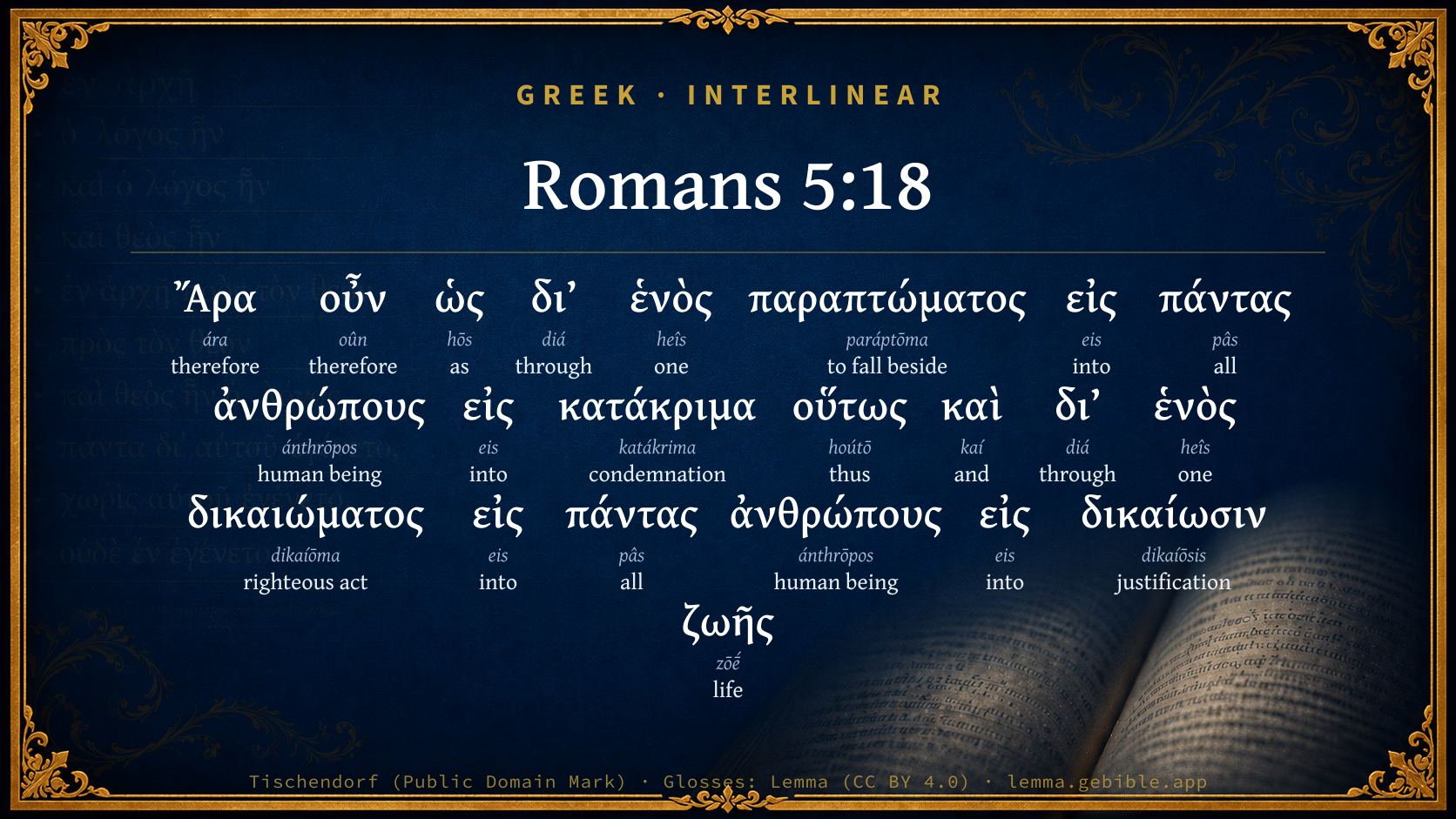
  1. Ἄρα ára G686 “therefore” Particle
  2. οὖν oûn G3767 “therefore” Conjunction
  3. ὡς hōs G5613 “as” Adverb
  4. δι’ diá G1223 “through” Preposition
  5. ἑνὸς heîs G1520 “one” Adjective, Genitive, Singular, Neuter
  6. παραπτώματος paráptōma G3900 “to fall beside” Noun, Genitive, Singular, Neuter
  7. εἰς eis G1519 “into” Preposition
  8. πάντας pâs G3956 “all” Adjective, Accusative, Plural, Masculine
  9. ἀνθρώπους ánthrōpos G444 “human being” Noun, Accusative, Plural, Masculine
  10. εἰς eis G1519 “into” Preposition
  11. κατάκριμα katákrima G2631 “condemnation” Noun, Accusative, Singular, Neuter
  12. οὕτως hoútō G3779 “thus” Adverb
  13. καὶ kaí G2532 “and” Conjunction
  14. δι’ diá G1223 “through” Preposition
  15. ἑνὸς heîs G1520 “one” Adjective, Genitive, Singular, Neuter
  16. δικαιώματος dikaíōma G1345 “righteous act” Noun, Genitive, Singular, Neuter
  17. εἰς eis G1519 “into” Preposition
  18. πάντας pâs G3956 “all” Adjective, Accusative, Plural, Masculine
  19. ἀνθρώπους ánthrōpos G444 “human being” Noun, Accusative, Plural, Masculine
  20. εἰς eis G1519 “into” Preposition
  21. ζωῆς zōḗ G2222 “life” Noun, Genitive, Singular, Feminine

About this verse

These counts appear in no published source. They are computed here, from the morphology-tagged text and Lemma’s own curated glosses. What Lemma adds →

22
words
15
distinct lemmas
Pauline Epistles
section

Notable vocabulary

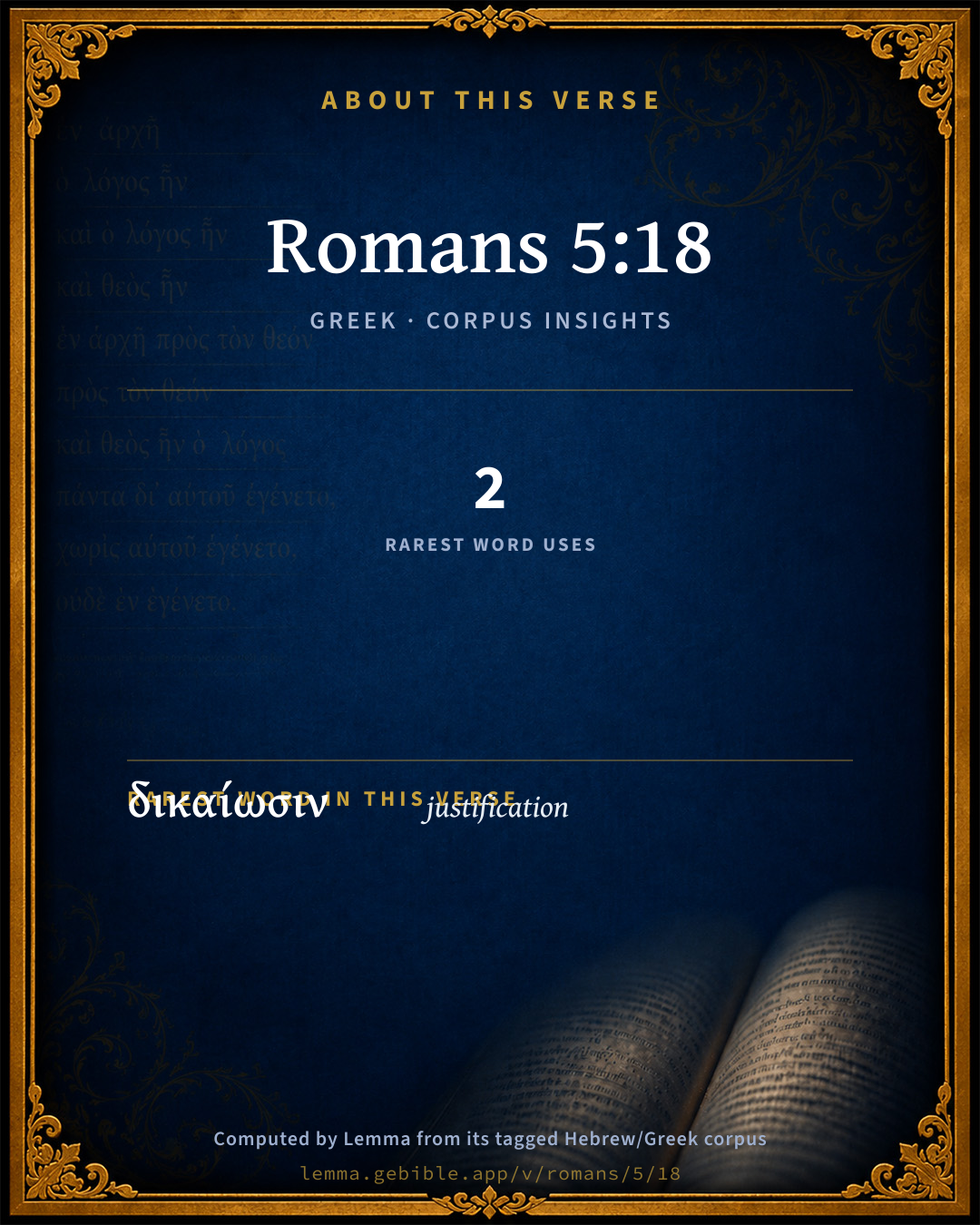
The rarest word here is δικαίωσιν justification G1347 — appearing just 2 times in the whole Greek New Testament.

Shared distinctive vocabulary

δικαίωσιν justification G1347 occurs in 2 verses of the Greek New Testament. Also found in:

Repetition

Words recur within this verse:

  • εἰς into G1519 ×4
  • δι’ through G1223 ×2
  • ἑνὸς one G1520 ×2
  • πάντας all G3956 ×2
  • ἀνθρώπους human being G444 ×2

Cross-references

14

Topical passages linked to Romans 5:18 in the Treasury of Scripture Knowledge — connected by theme and wording, ordered by reader-vote popularity; previews shown in the World English Bible.

  • Romans 5:12 Therefore, as sin entered into the world through one man, and death through sin; and so death passed to all men, because all sinned.
  • 1 Corinthians 15:22 For as in Adam all die, so also in Christ all will be made alive.
  • Romans 5:15 But the free gift isn't like the trespass. For if by the trespass of the one the many died, much more did the grace of God, and the gift by the grace of the one man, Jesus Christ, abound to the many.
  • Romans 5:19 For as through the one man's disobedience many were made sinners, even so through the obedience of the one will many be made righteous.
  • Acts 13:39 and by him everyone who believes is justified from all things, from which you could not be justified by the law of Moses.
  • Romans 4:25 who was delivered up for our trespasses, and was raised for our justification.
  • 1 Timothy 2:4–6 who desires all people to be saved and come to full knowledge of the truth.
  • Hebrews 2:9 But we see him who has been made a little lower than the angels, Jesus, because of the suffering of death crowned with glory and honor, that by the grace of God he should taste of death for everyone.
  • John 1:7 The same came as a witness, that he might testify about the light, that all might believe through him.
  • Romans 3:19–22 Now we know that whatever things the law says, it speaks to those who are under the law, that every mouth may be closed, and all the world may be brought under the judgment of God.
  • John 12:32 And I, if I am lifted up from the earth, will draw all people to myself."
  • John 3:26 They came to John, and said to him, "Rabbi, he who was with you beyond the Jordan, to whom you have testified, behold, the same baptizes, and everyone is coming to him."
  • 2 Peter 1:1 Simon Peter, a servant and apostle of Jesus Christ, to those who have obtained a like precious faith with us in the righteousness of our God and Savior, Jesus Christ:
  • 1 John 2:20 You have an anointing from the Holy One, and you know the truth.

Cross-references courtesy of OpenBible.info (CC BY 4.0).

Commentary

Notes on Romans 5:18 from classic Christian and Jewish commentators (each source and its license shown beneath its notes). The classic Christian expositions comment on the surrounding passage and are grouped to its opening verse, so a note may address several verses; the Jewish commentaries on the Tanakh (Rashi and others) are per-verse, so they appear only where the commentator wrote on this verse.

Lemma curates 59 commentaries, every one of them public domain or Creative Commons licensed, each selected and text-cleaned for this edition rather than reprinted as found. About our sources →

Adam Clarke's Commentary

Verse 18. Therefore, as by the offence of one, c.] The Greek text of this verse is as follows:- Αρα ουν, ὡς δι' ἑνος παραπτωματος, εις παντας ανθρωπους εις κατακριμα· αυτω και ἑνος δικαιωματος, εις παντας ανθρωπους, εις δικαιωσιν ζωης; which literally rendered stands thus:-Therefore, as by one offence unto all men, unto condemnation; so likewise, by one righteousness unto all men, to justification of life. This is evidently an elliptical sentence, and its full meaning can be gathered only from the context. He who had no particular purpose to serve would, most probably, understand it, from the context, thus:- Therefore, as by one sin all men came into condemnation; so also by one righteous act all men came unto justification of life: which is more fully expressed in the following verse. Now, leaving all particular creeds out of the question, and taking in the scope of the apostle's reasoning in this and the preceding chapter, is not the sense evidently this? - Through the disobedience of Adam, a sentence of condemnation to death, without any promise or hope of a resurrection, passed upon all men; so, by the obedience of Christ unto death, this one grand righteous act, the sentence was so far reversed, that death shall not finally triumph, for all shall again be restored to life. Justice must have its due; and therefore all must die. The mercy of God, in Christ Jesus, shall have its due also; and therefore all shall be put into a salvable state here, and the whole human race shall be raised to life at the great day. Thus both justice and mercy are magnified; and neither is exalted at the expense of the other.

The apostle uses three remarkable words in these three verses:-

1. δικαιωμα, justification, Ro 5:16.

2. δικαιοσυνη, which we render righteousness, Ro 5:17; but is best rendered justification, as expressing that pardon and salvation offered to us in the Gospel: See Clarke on Ro 1:16.

3. δικαιωσις, which is also rendered justification, Ro 5:18.

The first word, δικαιωμα, is found in the following places: Lu 1:6; Ro 1:32; Ro 2:26; Ro 5:16, Ro 5:18; Ro 8:4; He 9:1, He 9:10; Re 15:4; Re 19:8; to which the reader may refer. δικαιωμα signifies, among the Greek writers, the sentence of a judge, acquitting the innocent, condemning and punishing the guilty; but in the New Testament it signifies whatever God has appointed or sanctioned as a law; and appears to answer to the Hebrew משפט יהוה mishpat Yehovah, the statute or judgment, of the Lord; It has evidently this sense in Lu 1:6: Walking in all the commandments and ORDINANCES, δικαιωμασι, of the Lord blameless; and it has the like meaning in the principal places referred to above; but in the verse in question it most evidently means absolution, or liberation, from punishment, as it is opposed to κατακριμα, condemnation, Ro 5:18. See Clarke on Ro 1:16; and see Schleusner in voce.

The second word, δικαιοσυνη, I have explained at large in Ro 1:16, already referred to.

The third word δικαιωσις, is used by the Greek writers, almost universally, to denote the punishment inflicted on a criminal, or the condemnatory sentence itself; but in the New Testament where it occurs only twice, (Ro 4:25, he was raised for our justification, δικαιωσιν; and Ro 5:18, unto justification of life, δικαιωσιν ζωης,) it evidently signifies the pardon and remission of sins; and seems to be nearly synonymous with δικαιωμα. Dr. Taylor thinks that "δικαιοσυνη is Gospel pardon and salvation, and has reference to God's mercy. δικαιωμα is our being set quite clear and right; or our being restored to sanctity, delivered from eternal death, and being brought to eternal life; and has reference to the power and guilt of sin. And δικαιωσις he thinks may mean no more than our being restored to life at the resurrection." Taking these in their order, there is:

First, pardon of sin.

Secondly, purification of heart, and preparation for glory.

Thirdly, the resurrection of the body, and its being made like to his glorious body, so as to become a fit tabernacle for the soul in a glorified state for ever and ever.

The same writer observes that, when the apostle speaks of forgiveness of sins simply, he insists on faith as the condition; but here, where he speaks of justification of life, he mentions no condition; and therefore he supposes justification of life, the phrase being understood in a forensic sense, to mean no more than the decree or judgment that determines the resurrection from the dead. This is a favourite point with the doctor, and he argues largely for it: see his notes.

Adam Clarke's Commentary on the Bible (1810–1826) — public domain. Text from a community e-Sword/MySword module.

The Cambridge Bible for Schools and Colleges

gen. ed. J. J. S. Perowne

18. Therefore] In Rom_5:18-19 the argument, from Rom_5:12, is summed up as to its main substance; namely, the parallel of Adam and Christ; the illustration of the work of Christ by Adam’s position in respect of his descendants and the effect on them of his sin.

as by the offence of one] Better, as by one offence, as in marg. E. V.—The Gr. is elliptical here. We may supply “the result was,” in each part of the verse; as through one offence the result was, unto all men, to condemnation; so through one righteous act the result was, unto all men, to justification of life.—The word rendered here righteous act is the same as that rendered “acquittal” in the note on Rom_5:16, q.v. Its strict original meaning is a thing righteously done. Its usual actual meaning is an ordinance of justice. But in one N. T. passage at least it appears to mean a righteous act or course of acts. (Rev_19:8, “the righteousnesses of the saints.”) It thus is possible to interpret it in one place here as an ordinance of acquittal, in the other as the great act of righteousness (which becomes also, as it were, a statute of righteousness,) done by the Redeemer for His brethren. Such a change of reference is not alien to St Paul’s style.—If, however, the interpretation righteous ordinance should seem more necessary than it seems to us, it would fairly suit the context. Christ’s obedience is (as suggested just above) viewed thus as the embodied ordinance, or institute, of Justification. This last, on the whole, is Meyer’s explanation.

all men … all men] What is the reference of these words in the two cases respectively? In the first, certainly, all mankind is meant. Every man, not in theory only but fact, incurred sentence of death in Adam. In the second case also, many commentators, (e.g. Meyer,) hold that all mankind is intended: not that all actually receive justification, but that all are within the scope of Christ’s work. Without entering on the profound question of the Divine Intentions, and merely seeking for St Paul’s special thought here, we prefer to take the second “all men” with a limit, as meaning “all who are connected with the Second Adam;” all “His brethren.” For through this whole context St Paul is dealing with results and facts, not with abstract theory. From the dreadful fact of the result of death from the Fall he reasons to the results of Christ’s work; and the parallel would be most imperfect (and such as precisely to contradict the “much more” of Rom_5:15; Rom_5:17,) if while in the one case condemnation was a fact and act, Justification should be only a possibility in the other. If Adam brings death in fact on all concerned, Christ must bring life in fact on all concerned also. Again, a limitation is suggested by the whole reasoning of the Epistle, and specially by Rom_8:30, where the justified are identical with the “foreknown” and “glorified,” in the plain sense of the passage.—The use of “all men” with this change of reference is fairly illustrated by 1Co_15:22-23. For through that whole ch. the Resurrection of the Church is the sole subject; and 1Co_15:23 explicitly refers to “them that are Christ’s:” and yet, when the parallel of Adam and Christ is in view, the word “all” is equally used there in both cases.—See for other illustrations, though less exact, Joh_12:32; Tit_2:11.

The view of Christ as the Head of all Mankind is, to say the least, far less distinct in Scripture than that of Christ as the Head of justified Mankind, the true Church. Bearing this in mind, a difference of reference here will surely seem more natural than a sameness which can only be explained by admitting profound differences along with it.

justification of life] i.e. which confers, and results in, life; both by reversal of the sentence of death, and (as in Rom_5:17) by the gift of the life of glory in consequence.

The Cambridge Bible for Schools and Colleges (gen. ed. J. J. S. Perowne; Cambridge University Press, 1878–1918) — public domain. Text from a community e-Sword module.

Albert Barnes' Notes on the Bible

Therefore - Wherefore (Ἄρα οὖν ara oun). This is properly a summing up, a recapitulation of what had been stated in the previous verses. The apostle resumes the statement or proposition made in Rom 5:12, and after the intermediate explanation in the parenthesis Rom 5:13-17, in this verse and the following, sums up the whole subject. The explanation, therefore, of the previous verses is designed to convey the real meaning of Rom 5:18-19.

As by the offence of one - Admitting this as an undisputed and everywhere apparent fact, a fact which no one can call in question.

Judgment came - This is not in the Greek, but it is evidently implied, and is stated in Rom 5:16. The meaning is, that all have been brought under the reign of death by one man.

Upon all men - The whole race. This explains what is meant by “the many” in Rom 5:15.

To condemnation - Rom 5:16.

Even so - In the manner explained in the previous verses. With the same certainty, and to the same extent. The apostle does not explain the mode in which it was done, but simply scares the fact.

By the righteousness of one - This stands opposed to the one offence of Adam, and must mean, therefore, the holiness, obedience, purity of the Redeemer. The sin of one man involved people in ruin; the obedience unto death of the other Phi 2:8 restored them to the favor of God.

Came upon all men - (εἰς παντας ἀνθρώπους eis pantas anthrōpous. Was with reference to all people; had a bearing upon all people; was originally adapted to the race. As the sin of Adam was of such a nature in the relation in which he stood as to affect all the race, so the work of Christ in the relation in which he stood was adapted also to all the race. As the tendency of the one was to involve the race in condemnation, so the tendency of the other was to restore them to acceptance with God. There was an original applicability in the work of Christ to all people - a richness, a fulness of the atonement suited to meet the sins of the entire world, and restore the race to favor.

Unto justification of life - With reference to that justification which is connected with eternal life. That is, his work is adapted to produce acceptance with God, to the same extent as the crime of Adam has affected the race by involving them in sin and misery The apostle does not affirm that in fact as many will be affected by the one as by the other; but that it is suited to meet all the consequences of the fall; to be as wide-spread in its effects; and go be as salutary as that had been ruinous. This is all that the argument requires. Perhaps there could not be found a more striking declaration any where, that the work of Christ had an original applicability to all people; or that it is in its own nature suited to save all. The course of argument here leads inevitably to this; nor is it possible to avoid it without doing violence to the obvious and fair course of the discussion.

It does not prove that all will in fact be saved, but that the plan is suited to meet all the evils of the fall. A certain kind of medicine may have an original applicability to heal all persons under the same disease; and may be abundant and certain, and yet in fact be applied to few. The sun is suited to give light to all, yet many may be blind, or may voluntarily close their eyes. Water is adapted to the needs of all people, and the supply may be ample for the human family, yet in fact, from various causes, many may be deprived of it. So of the provisions of the plan of redemption. They are adapted to all; they are ample, and yet in fact, from causes which this is not the place to explain, the benefits, like those of medicine, water, science, etc. may never be enjoyed by all the race. Calvin concurs in this interpretation, and thus shows, that it is one which commends itself even to the most strenuous advocates of the system which is called by his name. He says, “He (the apostle) makes the grace common to all, because it is offered to all, not because it is in fact applied to all. For although Christ suffered for the sins or the whole world (nam etsi passus est Christus pro peccatis totius mundi), and it is offered to all without distinction (indifferenter), yet all do not embrace it.” See Cal. Commentary on this place.

Albert Barnes' Notes on the Bible (1834–1885) — public domain. Text from a community e-Sword/MySword module.

The Biblical Illustrator

Joseph S. Exell

Rom_5:18

Therefore as by the offence of one Judgment came upon all men to condemnation.

Condemnation

I. Its cause. Sin.

II. Its miseries.

1. Physical.

2. Spiritual.

3. Eternal.

III. Its cure.

1. Justification.

2. Freely offered.

3. Through the righteousness of Christ. (J. Lyth, D. D.)

The contrast between a state of condemnation and grace

I. In their origin.

1. The one originates in sin.

2. The other in the righteousness of Christ.

II. In their evidences.

1. The one is distinguished by disobedience.

2. The other by the obedience of faith.

III. In their relation to the law.

1. The law exposes sin, and increases condemnation.

2. Grace removes both yet magnifies the law.

IV. In their results.

1. Condemnation brings death temporal, eternal.

2. Grace confers a new life on earth and a glorious and blissful life in the world to come. (J. Lyth, D. D.)

The mediatorial system

1. One of the chief glories of Christianity is this--it is the religion of facts. These facts are few, extraordinary, and eternal and universal in their aspects.

2. In the context we have two classes of facts.

(1) Dark melancholy facts.

(a) Sin is in the world; it has quenched its lights, destroyed its liberties, embittered its enjoyments. History, observation and our own consciousness convince us of this.

(b) Death is in the world. It has reigned from Adam to this day. Individuals, families, nations, the world are dying. Every sepulchre, funeral, illness, pulse, reminds us that the dust is to be our home.

(c) Both sin and death have entered the world by the same man, Adam. The origin of evil is a deep mystery, but its introduction to our world is a historical fact clearly stated in the Bible. God made Adam the father, the priest of the world, but Adam ruined it and himself. Adam was the original sinner, and we his children sin and die.

(2) Bright and animating facts.

(a) Grace is in the world. Grace hath abounded. God was under no obligation to show or continue grace to this world. He might withdraw it; that would leave man a demon in character, who would soon kindle around himself the fires of an universal hell. Grace alone keeps the world from becoming the victim of its own transgression.

(b) There is a higher, nobler life than this. Grace reigns through righteousness unto eternal life. Eternal life means freedom from sin, which is the destroyer of the innocence, happiness and utility of man; freedom from the penalties of violated law; and freedom from annihilation, It means an existence without sin, misery, or end.

(c) This grace and eternal life flow to man through the same channel, Christ Jesus the Lord.

3. The apostle states these great truths--

(1) To convince Jews and Gentiles that both were equally indebted to Christ for salvation. The Gentile had the law written on his conscience, and the Jew had the law outwardly written, and both transgressed, so that both needed a Saviour.

(2) To set forth the nature and number of benefits derived through the mediation of Christ.

I. The existence of the human race rests on the mediation of Jesus.

1. The Lord commanded the man, saying,…of the tree of knowledge of good and evil, thou shalt not eat of it; for in the day thou eatest thereof, thou shalt surely die. A phrase which must have meant either absolute annihilation or the dissolution of soul and body, and the consequent punishment of both in hell. But Adam did sin. Was his existence quenched? Was he driven to hell? No. Was he spared on the ground of rectitude? No; for if justice could have spared him for one hour, it could have spared him forever. But he was spared; and as he could not have been spared on the ground of justice, he must have been spared on the ground of grace, and if on the ground of grace, then it was through the mediation of Christ, for grace reigns only through Him.

2. A new system was introduced, and Adams forfeited being was spared, and his species was to be multiplied because the Second Adam had been appointed to be the Great Head and Saviour of the human kind. But if our very existence is an effect of the great mediatorial scheme, all the means, comforts, and hopes of our existence are also effects of the same scheme. In Him all things consist.

3. Under the government of the Son of Man the human race has already grown into extraordinary numerical greatness, and is to continue to augment in strength, moral and physical excellence, grandeur and happiness, for perhaps millions of years to come. It is natural to think so, if we consider the honour which God has already bestowed on our nature, by raising it to union with Himself; that four thousand years were occupied in preparations for the advent; the extensive provisions that have been made for the future accommodation of our race in another world; that the agency of the Church is in its infancy; that the sciences and arts, matter and mind, have hardly yet presented their first oblations to Christianity.

4. Christ is to be honoured here more than He has yet been. It was on earth He was born, died, first published His salvation, qualified Himself for His mediatorial crown. Here, also, He is to be acknowledged as the Lord of all. The mediation of Christ is the basis of human existence, and the means of restoration to light, purity and glory.

II. The mediatory agency of Jesus Christ procures immortality for man.

1. Mans existence is not limited to this narrow, dark sphere. Our immortality and the knowledge of it are the gifts of Christ. His existence in the invisible world is the greatest proof we have of its reality. His resurrection and ascension are the most convincing arguments for a future world. He lives. We shall live.

2. It is true that an endless existence will be a curse to the wicked; but let not the author of immortality be blamed for that. Remember--

(1) Existence is a blessing; history and consciousness prove that.

(2) Nothing can render existence a curse but sin. It is not in the power of any creature. The Creator Himself will not render a perfectly holy being unhappy.

(3) Christ is now able and willing to take away sin from us. Yes, He is willing, and if you are so too, your existence is safe forever.

III. The mediation of Christ has furnished us with a system of means to prepare us for a happy immortality. Grace reigns through righteousness unto eternal life by Jesus Christ our Lord. Here is the essence of the gospel. This is--

1. A system of grace. The doctrine of human merit is at once unphilosophical and unscriptural. Mans salvation is all of grace. Its origination, discovery, application, and perfection in heaven is grace. Let us trust and triumph in gospel grace.

2. A system of righteousness also. It justifies man before God, and justifies God in doing so before His own intelligent universe. Here, then, is a scheme that is just to all. It injures none; it benefits the universe.

Conclusion: From the whole we may infer--

1. That Christianity is infinitely superior to natural religion. It reveals more, and its revelations are warm, loving, transforming.

2. Christ is the most extraordinary and interesting Being in the universe. How vast His sphere! How benevolent His agency! How Divine His character! In all things He has the preeminence.

3. Let us rejoice in Christianity while parting with friends in death. Christ lives, they live. We shall also live. (Caleb Morris.)

The two representatives of the race

The words judgment came and the free gift came, are not part of the original, but are introduced to complete the sense. In the margin you read, by one offence, instead of, by one mans offence, and also by one righteousness (righteous act) instead of by the righteousness of one. Dean Alford translates the verse--As through one trespass the issue was unto all men to condemnation; even so through one righteous act, the issue was unto all men to justification of life. Note, then--

I. The loss to all men through Adam.

1. There is no principle more widely conceded than that of representation. Our national, municipal, and social arrangements, are all more or less representative. We honour the son of a good man, not merely for his own excellence, but also for the sake of his father. We suspect the son of a bad man, even although we know no evil of him personally. No one imagines that there is any injustice in this. Those who suffer by it are pitied, but their misfortune is recognised to be the natural consequence of their connection with those whom they represent. On the other hand we never grudge to others any advantage which they may gain by it.

2. Now this principle is everywhere recognised in the Bible. We read that the Lord our God is a jealous God, visiting the iniquity of the fathers upon the children, etc. We see the descendants of Canaan punished for their progenitors offence; the Edomites excluded from their birthright because their father Esau had despised it; how the wives and children of Achan and those of Dathan and Abiram were destroyed because of the sin of their relatives. We find Jesus Himself declaring that vengeance was about to descend upon the children of those who slew the prophets. And when we read the story of the siege of Jerusalem, that awful record seems to demand no less an explanation than that all the righteous blood shed upon the earth was exacted at the hands of that generation. His blood be upon us and upon our children; and in the story of the Jews through eighteen centuries, who can fail to perceive the cleaving of the curse?

3. The loss which has come to all men through the trespass of Adam is an instance of this great law of representation. Adam was the head of our race. He could neither stand nor fall alone. That which we see upon a small scale when the fortunes of a family depend upon the conduct of some member, or when the history of a nation is determined by some one statesmans decision--that took place upon the vastest scale when Adam was placed upon his probation in Eden. What was the tragic issue we all know. The head of the family gambled away his fair inheritance, bequeathing only to us the bitter entail of his corruption and death. The forbidden fruit turned out to be a deadly poison, and the pale infection has spread through all the race. Adam had been created in the likeness of God. But when Adam begat a child (Gen_5:3), it was in the image of a depraved and fallen man. The perversity which appears in early childhood, the proneness to error even of the wisest and most virtuous, the callous indifference to the will of Heaven which characterises the majority, the common selfishness and the black list of daily crimes are witnesses of the curse that broods over the nations. Moreover, there is in the conscience of every one of us the knowledge that we have our own sad share in the inheritance of the fall.

4. There is something painful in this view of life. To be born under the condemnation of God, who can bear to think of it? As Paul points out in this very chapter, death, the wages of sin, comes even upon those who have not sinned after the similitude of Adams transgression; i.e., the sentence comes upon those who have not personally incurred it. Torturing pains and untimely death are allotted to our little babes, and to those who, by reason of disease or imperfection of brain, are at no period of their lives responsible. God forbid that because of this we should challenge the Divine justice. If I suffer wrong today because of the crime or folly of some ancestor, the wrong be upon the head of the offender, not upon the law! Yet if this were the whole truth we might, indeed, be perplexed and broken-hearted. But, thank God, there is a counterbalancing fact, viz.

II. The gain to all men through Jesus Christ. By His righteous act there is an issue unto all men towards acquittal resulting in life. We have in this new fact a new operation of the representative principle. It pleased God to make His Divine Son a Second Great Head of the human race, that as in Adam all die, even so in Christ shall all be made alive (1Co_11:3). As our Representative He paid the penalty of our sins. He bare our sins in His own body on the tree. As our Representative He fulfilled all righteousness, that we might be made the righteousness of God in Him. From the first Adam a poison passed into the lives of all men. From the Second an antidote passed into the lives of all men. The statements have respect not to a portion of the race, not to an elect few, but to all men.

1. We owe to Christ the very fact of our existence. The warning to Adam respecting the forbidden fruit was, In the day thou cutest thereof thou shalt surely die. Had the sentence been speedily executed, then, in the deepest of all senses, we should all have died in Adam, for we should never have been born. What was it that arrested the course of the law? Not justice, surely; but grace (Joh_1:17). It was because of the obedience of Christ, foreseen and mercifully taken into account, that Adam was spared, and that our birth into this world became possible.

2. All men owe much more than this. When we come to inspect human nature, we find there that which cannot be accounted for by our descent from the fallen Adam. Those who have had to deal with abandoned women declare that beneath all their degradation they have discovered something left of womanhood and modesty. Those who have moved freely among the vilest men of the land, have found in the deepest heart of the blackest reprobates something of good. In every man, side by side with a corruption whose issue is unto condemnation, there exists, also, a pure influence, whose issue, could it but prevail, is unto justification of life. Whence comes this influence? Is it a part of our heritage from the first Adam? We cannot believe it. Can a clean thing come out of an unclean? Do men gather grapes on thorns, or figs on thistles? Whatever of generosity, of purity, is found in any human heart; whatever gracious disposition, or kindly motive, or noble inspiration; whatever is sweet and child-like in the young; whatever is modest, and gentle, and winsome in woman; whatever is brave, and loyal, and faithful in man is some portion of that heritage of good which has come to us from Christ, the federal Head and redeeming Representative of our race. Conclusion: We are here today, losers and gainers by this principle of representation. The first Adam and the second are in every one of us. We have inherited from both. We have inherited a sinful and corrupt nature. We have inherited also a better nature. We stand now upon our own personal probation. We are summoned now to make our choice between the natural man that is in us, and the Spiritual Man that is in us. The issue is for eternity, and why will ye die? Choose not that forbidden fruit, whose bitter end is death, or at the last the just God must needs ratify your choice, and you will perish in the second death. Choose rather to live. Let that life which was bestowed for Christs sake be used in Christs service. (W. J. Woods, B. A.)

Our loss through Adam and our gain through Christ

1. Some points of importance are lost in the authorised rendering. The offence of one is, in the original, one offence, or one trespass, as in Mat_6:14. The word properly expresses a fall by the side of the path of duty. The righteousness of one is, in the same way, in the original, one act of righteousness. The whole redeeming work of Christ is here, then, summed up into a single act of righteousness. The next verse explains the expression by introducing the equivalent word obedience, and if further explanation were needed, St. Paul himself gives it in Php_2:8. Obedient even unto death, yea, the death of the Cross; not a death by itself as a single isolated deed, but as a crown of life--the self-sacrifice begun in incarnation, continued through the earthly life, and consummated on Calvary. Through this one act of righteousness the free gift through the grace of Jesus (verse 15), bringeth all men unto the justification of life, i.e., bringing with it the absolution which has life in it, the free forgiveness which gives that unity with God which is the eternal life of the soul. This is the first change of rendering.

2. The next is perhaps yet more important. The fourfold omission in verse 19 (A.V) of the definite article is a very serious loss. St. Paul did not write Greek at random. In verse 16 he omits the article, for there his purpose was to contrast the singleness of the sin which brought condemnation to the multitudes with the sins which elicited and evoked compassion; but in verses 15, 17 and 19 the particular one man who brought sin and death is designedly set in contrast with the particular one man who brought in grace and life. The other pair of omissions in this verse is equally serious. Many were made sinners, many were made righteous, is a culpable gloss upon St. Pauls language. St. Paul was not afraid to say judgment came upon all men; the free gift came upon all to justification of life; nor that the many were made sinners and the many were made righteous; the all in the one verse and the many in the other are equivalent terms. St. Pauls object was to show the universality of redemption. Christ, by His one sacrifice made a full, perfect, and sufficient sacrifice for the sins of the whole world. Although they will not come, He yet speaks in that universal whosoever will. The gracious work of Christ in redeeming is co-extensive with the disastrous work of Adam in ruining--As in Adam all die, even so in Christ shall all be made alive. As through the disobedience of one man, the many--the universe of humanity--were made or placed on the footing of sinners, even so through the obedience of the One shall the many be constituted as righteous. (Dean Vaughan.)

The Biblical Illustrator, edited by Joseph S. Exell (c. 1880s–1900s) — public domain. Text from a community e-Sword module.

Joseph Benson's Commentary

Rom 5:18-19. Therefore, &c. — Here the apostle compares Christ and Adam together again, as he began to do Rom 5:12, with which this verse seems to be connected, (all the intermediate verses coming in as a parenthesis,) and he makes the comparison full in both members; which there, by reason of intervening matter, was left off imperfect. As if he had said, On the whole you see, as I began to observe to you before, that as by the offence of one, judgment came upon all men to condemnation — Or, the condemnatory sentence was passed upon all men; even so, by the righteousness of one — The obedience of Christ, the free gift — Or gift of grace; came upon all men — Is provided for, and offered to, the whole human race, and is actually conferred on all the spiritual seed of the second Adam, on all true believers; unto justification of life — Unto that justification by grace through faith, whereby we have a right and title to eternal life. Or, leaving out the words in Italics, which are not in the original, the verse may be paraphrased thus: “As the consequence of one offence on the one hand extended to all men, to bring condemnation upon them; so also, on the other side, the consequence of one grand act of righteousness extended to all men, who receive and embrace it; securing to them that justification which will be crowned with the enjoyment of eternal life.” For, as by one man’s disobedience many — That is, all men; were made, or constituted sinners — Being then in the loins of their first parent, the common head and representative of them all, and became obnoxious to death; so by the obedience of one — By his obedience unto death, by his dying for us; many — Namely, all that believe with a faith working by love; shall be, or are, constituted righteous — That is, pardoned, justified, and sanctified, and shall be treated as such in the day of God’s final account; though they have no perfect righteousness of their own to plead, in consequence of which they should stand before God and claim the reward. With respect to Dr. Taylor’s scheme of interpretation, it is justly observed here by Dr. Doddridge, that although “to become liable to death for the offence of another is indeed being thereby constituted, or rather treated, as a sinner, since death is in its primary view to be considered as the wages of sin, or the animadversion of a righteous God upon it;” yet, “simply to be raised from the dead is not being made righteous, or treated as a righteous person; since it is a very supposable case, and will in fact be the case of millions, that a sinner may be raised in order to more condign and dreadful punishment. The whole interpretation, therefore, which Dr. Taylor has given of this text, in this view, appears to me destitute of a sufficient foundation.”

Rom 5:20-21, Moreover the law entered — Made a little entrance, as Dr. Doddridge translates παρε ισηλθεν; the sense also given it by the Vulgate, sub intravit. Thus the partial and limited entrance of the law is distinguished from that universal entrance of sin which passed on all. Others, however, as L’Enfant and Wesley, render it, The law intervened, or came between Adam and Christ, the offence and the free gift; that the offence might abound — That is, the consequence (not the design) of the law’s coming in, was not the taking away of sin, but the increase of it; yet where sin abounded, grace did much more abound — Not only in the remission of that sin which Adam brought on us, but of all our own sins; not only in remission of sins, but infusion of holiness; not only in deliverance from death, but admission to everlasting life; a far more noble and excellent life than that which we lost by Adam’s fall. That as sin hath reigned unto death — In the wide and universal destruction made of those whom it had brought under that fatal sentence; so grace might reign — Which could not reign before the fall, before man had sinned; through righteousness — Imputed, implanted, and practised; through the justification of men’s persons, the renovation of their nature, and their practical obedience to God’s holy law; unto eternal life by Jesus Christ our Lord — Here is pointed out, 1st, The source of all our blessings, the rich and free grace of God. 2d, The meritorious cause; not any works or righteousness of man, but the alone merits of our Lord Jesus Christ. 3d, The effect or end of all; not only pardon, but life, divine life, leading to glory.

Joseph Benson's Commentary on the Old and New Testaments (1811–1818) — public domain. Text from a community e-Sword module.

Tyndale Open Study Notes

Tyndale Open Resources

5:18 Christ’s one act of righteousness refers to his death on the cross, a righteous act because Christ chose to die in obedience to the Father’s will (see John 10:18). • new life for everyone: Paul is not teaching that all people will experience the new life that Christ won through his death on the cross. New life is available to everyone through Christ, but not everyone receives it.

Tyndale Open Study Notes — © Tyndale Open Resources, licensed CC BY-SA 4.0. Text via the HelloAO Bible API.

Bengel's Gnomon

Johann Albrecht Bengel

Rom 5:18. Ἄρα οὖν) ἄρα draws the inference, syllogistically: οὖν concludes, almost rhetorically: for this subject is not farther discussed than in this and the following verse.—ἑνὸς—ἑνὸς, of one—of one) In the masculine; as is manifest from the antithesis, all. The word one, generally put without the addition, man, designates with the greatest force, one, either of the two.—δικαιώματος—δικαίωσιν) Δικαίωμα is, so to speak, the material substratum, the foundation for δικαιώσει, justification; obedience, righteousness fulfilled. It may be called justificament (justificamentum) The ground and material of justification, as ἐδραίωμα denotes a firmament [or means of making firm]; ἔνδυμα, vestment; ἐπίβλημα, additament [or the thing wherewith addition is made]; μίασμα, defilement; ὀχύρωμα, muniment; περικάθαρμα, the means of purgation; περίψημα, the thing scraped of; σκέπασμα, a tegument or the thing wherewith a covering is made; στερέωμα, firmament; ὑπόδημα, a thing wherewith the foot is covered, a shoe; φρόνημα, sentiment [the material of φρόνησις] French sentiment. Aristot. Eth. Book v. c. 10, has put ἀδίκημα and δικαίωμα in opposition to each other, and defines the latter to be the correction of injustice [τὸ ἐπανόρθωμα τοῦ ἀδικήματος] the putting right what is wrong; which is tantamount to satisfaction [or atonement], a term undeservedly hateful to the Socinians.

The following scheme exhibits the exquisite propriety of the terms:—

A.

B.

C.

D.

Rom 5:16.

κρίμα,

κατάκριμα·,

χάρισμα,

δικαίωμα,

judgment.

condemnation.

free gift.

righteousness.

Rom 5:18.

παράπτωμα,

κατάκριμα·,

δικαίωμα,

δικαίωσις ζωῆς,

Offence.

condemnation.

righteousness.

justification of life.

In both verses A and B are of the same class, συστοιχεῖ, [are co-ordinate] and likewise C and D; but A and C correspond in the opposite classes, ἀντιστοιχεῖ; so also B and D. In Rom 5:16 the transaction on the part of God is described; in Rom 5:18 on the part of Adam and of Christ; and that, with less variety of words in the case of the economy of sin, than in the case of the economy of grace. Διχάιωσις ζωῆς, justification of life, is that Divine declaration, by which the sinner, subject to death, has life awarded to him, and that too, with justice on his side.

Bengel's Gnomon of the New Testament — English translation (T&T Clark, Edinburgh, 1860) — public domain. Text from a community e-Sword module.

Meyer's Critical & Exegetical Commentary

Heinrich August Wilhelm Meyer

Rom_5:18 f. Summary recapitulation of the whole parallel treated of from Rom_5:12 onwards, so that the elements of likeness and unlikeness contained in it are now comprehended in one utterance. Συλλογίζεται ἐνταῦθα τὸ πᾶν, Theodore of Mopsuestia. The emergence of the ἄρα οὖν now ushering in the conclusion, as well as the corresponding relation of the contents of Rom_5:18 f. to the indication given by ὁς ἐστι τύπος τοῦ μέλλοντος in Rom_5:14, carries us back to Rom_5:12; not merely to Rom_5:16 f. (de Wette, Fritzsche); or merely to Rom_5:15-17 (Hofmann, Dietzsch). The right view is taken by Philippi, Ewald, Holsten.

ἄρα οὖν] conclusive: accordingly then,[1335] in very frequent use by the Apostle (Rom_7:3; Rom_7:25, Rom_8:12, Rom_9:16; Rom_9:18, Rom_14:12; Rom_14:19; Gal_6:10; Eph_2:19 et al[1336]), and that, contrary to the classical usage (Herm. a[1337] Antig. 628, a[1338] Viger. p. 823), at the beginning of the sentence. For the necessary (contrary to Mehrings view) completion of the two sentences, which are in the sharpest and briefest manner compressed as it were into a mere exclamation (Ewald), it is sufficient simply to supply: res cessit, it has come, ἀπεβή (Winer, p. 546 [E. T. 734]), or ἐγένετο (Grotius). See Buttmanns neut. Gr. p. 338. As it therefore has come to a sentence of condemnation for all men through One trespass, so also it has come to justification of life (which has for its consequence the possession of the future Messianic life, comp Rom_5:21; Joh_5:28-29) for all men through One justifying judgment. The supplying of τὸ κρῖμα ἐγένετο to the first, and τὸ χάρισμα ἐγένετο to the second half (so Fritzsche and Rückert), considering the opposite sense of the two subjects, renders the very compressed discourse somewhat singular.

διʼ ἑνὸς δικ.] through one judicial verdict (see on Rom_5:16; Rom_5:19), namely, that which was pronounced by God on account of the obedience of Christ rendered through His death. In strict logic indeed the δικαίωμα, which is properly the antithesis of κατάκριμα (as in Rom_5:16), should not be opposed to παράπτωμα; but this incongruity of a lively interchange of conceptions is not un-Pauline (comp Rom_5:15). And it is thoroughly unwarranted to assign to δικαίωμα here also, as in Rom_5:16, significations which it has not; such as actual status of being righteous (Hofmann, Stölting), fulfilment of right (Philippi, Mangold), making amends (Rothe), righteous deed (Holsten), righteous life-condition of Christ (Dietzsch), with which a new humanity begins, act of justification (Tholuck), virtuousness (Baumgarten-Crusius), obedience (de Wette), and the likedefinitions, in which for the most part regard is had to the act of the death of Jesus partly with and partly without the addition of the obedientia activa (comp also Klöpper), while Fritzsche explains it of the incarnation and humiliation of Christ (Php_2:5; Php_2:8) as His recte factum. Ewald interprets rightly: through One righteous sentence; so also van Hengel and Umbreit. This alone is permitted by Rom_5:16. It is the One declaration of what is now of right, that is, the judicial verdict of the being reconciled, which took place on the part of God on the ground of Christs sacrificial deaththe consequence therefore, of His ὑπακοή rendered in deathand which so far may appear as the antithesis to the fall of Adam with the same right as in Rom_5:15 the grace and gift were adduced as the contrast to that fall. To take the ἑνός as masculine (Vulgate, Theodoret, Theophylact, Erasmus, Luther, Calvin, and many others, including Tholuck, Fritzsche, Nielsen, Picard, Klöpper, Philippi, and Hofmann), is, seeing that no article is annexed, unwarranted according to the analogy of the immediate context, vv 17, 19; or Paul would have only expressed himself in a way liable to be misunderstood (how differently in ver 16!). Equally unwarranted is it to conceive the verb to be supplied in the apodosis as in the future (Philippi, Dietzsch). The judicial verdict is given and has redounded once and for ever to justification of eternal life for all; that is the great historical fact of salvation, which Paul has in view and sets forth as a concrete event (not under the point of view of a timeless abstraction, as Rothe thought) without considering how far it is now or in the future appropriated through faith by the subjects.

In both halves of the verse πάντες ἄνθρωποι is simply all men, as in Rom_5:12. At the same time it must be noted that in the second half the relation is conceived in its objectivity. On the part of God it has come to justification for all; thus the case stands objectively; the subjective attainment of this universal justification, the realisation of it for the individuals, depends upon whether the latter believingly apprehend the δικαίωμα for their own subjective δικαίωσις, or unbelievingly reject it. This dependence on a subjective condition, however, did not belong to the scope of our passage, in which the only object was to set forth the all-embracing blessed objective consequence of the ἓ δικαίωμα, in contrast to the all-destructive objective consequence of the ἕν παράπτωμα. Hence just as little can anything be deduced from our passage as from Rom_11:32 in favour of a final ἀποκατάστασις. The distinction imported by Hofmann and Lechler: that πάντες ἄνθρωποι means all without distinction, and πάντες οἱ ἄνθρωποι, on the other hand, all without exception, the sum total of mankind, is purely fanciful; πάντες means omnes, nemine excepto, alike whether the substantive belonging to it, in accordance with the connection, has or has not the article (articulus, cum sensus fert additus vel omissus, discrimen sententiae non facit, Ellendt, Lex. Soph. II. p. 519). Only when the article stands before πάντες (consequently οἱ πάντες ἄνθ.) does the distinction emerge, that we have to think of cunctos sive universos, i. e. singulos in unum corpus colligatos (Ellendt, p. 521); comp Krüger, § 50, 11, 12; Kühner, II. 1, p. 545.

[1335] Ἄρα, ad internam potius causam spectat, οὖν, magis ad externam, Klotz, ad Devar. p. 717. Comp. p. 173. The ἄρα serves specifically for dialectic accuracy; Baeumlein, p. 35; comp. Kühner, II. p. 857.

[1336] t al. and others; and other passages; and other editions.

[1337] d refers to the note of the commentator or editor named on the particular passage.

[1338] d refers to the note of the commentator or editor named on the particular passage.

Meyer — Critical and Exegetical Commentary on the New Testament — English translation by Peter Christie, edited by Frederick Crombie (T&T Clark, 1880) — public domain. Text from a community e-Sword module.

Expositor's Greek Testament

ed. W. Robertson Nicoll

Rom 5:18 . With ἄρα οὖν ( cf. Rom 7:3 ; Rom 7:25 , and often in Paul) the conclusion of the argument is introduced. It is simplest to take ἑνὸς in both clauses as neuter. “As through one offence the result for all men was condemnation, so also through one righteous act the result for all men is justification of life.” The result in both cases is mediated; in the former, by men’s actual sin; in the latter, by their faith in Christ. It has been questioned whether δικαίωμα can mean a “righteous act,” that which Christ achieved in His death, conceived as one thing commanding the approval of God. This sense seems to be required by the contrast with παράπτωμα , but Meyer and others argue that, as in Rom 5:16 , the meaning must be “a sentence of justification”. “Through one justifying sentence (pronounced over the world because of Christ’s death) the result for all men is justification of life.” But this justifying sentence in vacuo is alien to the realism of Paul’s thinking, and no strain is put upon δικαίωμα (especially when we observe its correspondence with παράπτωμα ) in making it signify Christ’s work as a thing in which righteousness is, so to speak, embodied. Lightfoot ( Notes on Epistles of St. Paul , p. 292) adopts this meaning, “a righteous deed,” and quotes Arist., Rhet. , i., 13, τὰ ἀδικήματα πάντα καὶ τὰ δικαιώματα , and Etk. Nic. , v., 7 (10): καλεῖται δὲ μᾶλλον δικαιοπράγημα τὸ κοινόν : δικαίωμα δὲ τὸ ἐπανόρθωμα τοῦ ἀδικήματος . This sense of an act by which an injustice is rectified is exactly suitable here. Through this the result for all men is δικαίωσις ζωῆς : for the genitive, see Winer, p. 235. Simcox, Language of the N.T. , 85. When God justifies the sinner, he enters into and inherits life. But Lightfoot makes it gen appos.

The Expositor's Greek Testament, edited by W. Robertson Nicoll (1897–1910) — public domain. Text from a community e-Sword module.

Hodge's Commentary on Romans, Ephesians & First Corinthians

Charles Hodge

Rom_5:18

Therefore, as by the offense of one, judgment came on all men to condemnation; even so, etc. The words ἄρα οὖν (therefore) are the inferential particles so often used in Pauls epistles, at the beginning of a sentence, contrary to the ordinary classical usage Rom_7:3, Rom_7:25; Rom_8:12; Rom_9:16, etc. They frequently serve to introduce a summation of what had previously been said. The inference from the whole discussion, from the beginning of the epistle to Rom_5:12 of this chapter, is introduced in that verse by διὰ τοῦτο, wherefore. It followed, from all the apostle had said of the method of justification through Jesus Christ, that there is a striking analogy between our fall in Adam and our restoration in Christ. The carrying out of this comparison was interrupted, in the first place, to prove, in Rom_5:13, Rom_5:14, the position assumed in Rom_5:12, that all men are subject to death on account of the sin of Adam; and, in the second place, to limit and explain the analogy asserted to exist between Christ and Adam, at the close of Rom_5:14. This is done in Rom_5:15-17. Having thus fortified and explained his meaning, the apostle now states the case in full. The word therefore, at the beginning of Rom_5:12, marks an inference from the whole doctrine of the epistle; the corresponding words here are also strictly inferential. It had been proved that we are justified by the righteousness of one man, and it had also been proved that we are under condemnation for the offense of one. Therefore, as we are condemned, even so are we justified.

It will be remarked, from the manner in which they are printed, that the words judgment came, in the first clause of this verse, and the free gift came, in the second, have nothing to answer to them in the original. That they are correctly and necessarily supplied, is obvious from a reference to Rom_5:16, where these elliptical phrases occur in full. The construction in the clauses (κρίμα) εἰς κατάκριμα and (χάρισμα) εἰς δικαίωσιν ζωῆς, is the same as in Rom_5:16. Judgment unto condemnation is a sentence of condemnation, and the free gift unto justification is gratuitous justification. The sentence is said to be δι ̓ ἑνὸς παραπτώματος, through the offense of one, and the justification is δι ̓ ἑνὸς δικαιὼματος, through the righteousness of one. In Rom_5:16, this word δικαίωμα is rendered justification, because it is there in antithesis to κατάκριμα, condemnation; it is here properly rendered righteousness, because it is in antithesis to παράπτωμα, offense, and because what is here expressed by δικαίωμα is in Rom_5:19 expressed by ὑπακοή, obedience. This explanation is consistent with the signification of the word which means a righteous thing, whether it be an act, a judgment, or an ordinance. In Rev_19:8, τὰ δικαιώματα τῶν ἁγίων is correctly rendered the righteousness of the saints. Luther translates the word in the passage before us, gerechtigkeit, agreeing with our translators. Calvin renders it justificatio, by the justification of one. In this interpretation many of the modern commentators concur. The principal argument for this explanation of the word is, that it is used in that sense in Rom_5:16; but there, as just remarked, it is opposed to kata&krima, condemnation, while here it is opposed to para&ptwma, offense. As the word may mean either justification or righteousness, that sense should be adopted which suits the immediate context. Many of the older theologians render it satisfaction; according to the Aristotelian definition, δικαίωμα τὸ ἐπανόρθωμα τοῦ ἀδικήματος. This gives a good sense: By the satisfaction of one, the free gift has come on all men unto justification of life. But this, although in accordance with the strict classical use of the word, is not the sense in which it is used in the Bible, and it is not so suitable to the context.

Instead of rendering δι ̓ ἑνὸς παραπτώματος, by the offense of one, and δι ̓ ἑνὸς δικαιώματος, by the righteousness of one, a large class of commentators render them, by one offense, and by one righteousness. This does not materially alter the sense, and it is favored by the absence of the article, before ἑνός. In Rom_5:17, Rom_5:19, it is τοῦ ἑνός, the one. In favor of the version in our English translation, however, it may be urged:

1. That ἑνός, throughout the whole context in Rom_5:12, Rom_5:15, Rom_5:17, Rom_5:19, is masculine, except in Rom_5:16, where it is opposed to the neuter pollw~n. The omission of the article is sufficiently accounted for from the fact that the one intended, viz. Adam, had been before distinctly designated.

2. The comparison is between Adam and Christ, rather than between the sin of the one and the righteousness of the other.

3. The expression, one righteousness, is awkward and unusual; and if e(no_j δικαιώματος be rendered one righteousness act, then it is inappropriate, inasmuch as we are not justified by one act of Christ, but by his whole life of obedience and suffering.

4. The natural opposition between one and all, requires e(no&j to be masculine: It was by the offense, of one man that all men were condemned.

That the apostle here again teaches that there is a causal relation between the sin of Adam and the condemnation of his race, cannot be denied. The only possible question is, What is the nature of that relation, as expressed by διά? It was δι ̓ ἑνὸς παραπτώματος, by the offense of one that judgment came upon all men. Does this mean that the offense of one was simply the occasion of all being condemned, or that it was the ground or reason of their condemnation? It is of course admitted that the proper force of διά with the genitive is, by means of, and with the accusative, on account of. As the genitive and not the accusative is here used, it might seem that the apostle designedly avoided saying that all were condemned (διὰ τὸ παράπτωμα τοῦ e(no&j,) on account of the offense of one. But there is no necessity for departing from the ordinary force of the preposition with the genitive, in order to justify the interpretation given above. The relation of a means to an end, depends on the nature of that means. To say that condemnation is through, or by means of an offense, is to say that the offense is the rational or judicial means, i.e. the ground of the condemnation. No man doubts that when, in Rom_5:12, the apostle says, that death was (διὰ τῆς ἁμαρτίας) by means of sin, he means that it was on account of sin. This is not a solitary case. In Rom_3:24, we are said to be justified (διὰ τῆς ἀπολυτρώσεως) through the redemption of Christ, i.e. by means of the redemption; but the ransom paid by Christ, in being the means was the ground of our redemption. So in the familiar phrases, through his blood, Eph_1:7; Col_1:20; through his death, Rom_5:10; Col_1:22; by his cross, Eph_2:16; by the sacrifice of himself, Heb_9:26; through the offering of the body of Jesus, and in many similar expressions the preposition retains its proper force with the genitive, as, indicating the means, and yet the means, from the nature of the case, is, the ground or reason. Thus also, in this immediate connection, we have, the expressions, by the righteousness of one all are justified, and by the obedience of one shall many be made righteous. We have, therefore, in this single passage, no less than three cases, Rom_5:12, Rom_5:18, Rom_5:19, in which this preposition with the genitive indicates such a means to an end, as the ground or reason on account of which something is given or performed. All this is surely sufficient to prove that it may, in the case before us, express the ground why the sentence of condemnation has passed on all men. That such, in this connection, must be its meaning, appears,

1. From the nature of the subject spoken of. To say that one man has been corrupted by another, may indeed express very generally, that one was the cause of the corruption of the other, without giving any information as to the mode in which the result was secured. But to say that a man was justified by means of a good action, or that he was condemned by means of a bad one; or plainer still, in Pauls own language, that a condemnatory sentence came upon him by means of that action; according to all common rules of interpretation, naturally means that such action was the reason of the sentence.

2. From the antithesis. If the phrase, by the righteousness of one all are justified, means as is admitted, that this righteousness is the ground of our justification, the opposite clause, by the offense of one all are condemned, must have a similar meaning.

3. The point of the comparison, as frequently remarked before, lies in this very idea. The fact that Adams sin was the occasion of our sinning, and thus incurring the Divine displeasure, is no illustration of the fact that Christs righteousness, and not our own merit, is the ground of our acceptance. There would be some plausibility in this interpretation, if it were the doctrine of the gospel that Christs righteousness is the occasion of our becoming holy, and that on the ground of this personal holiness we are justified. But this lot being the case, the interpretation in question cannot be adopted in consistency with the design of the apostle, or the common rules of exposition.

4. This clause is nearly identical with the corresponding one of Rom_5:16, the judgment was by one (offense) to condemnation. But that clause, as shown above, is made, almost by common consent, to mean that the offense was the ground of the condemnatory sentence. Such, therefore, must be the meaning of the apostle in this verse; compare also Rom_5:15, Rom_5:17, Rom_5:19.

The second question of importance respecting this verse is, whether the all men of the second clause is coextensive with the all men of the first. Are the all who are justified for the righteousness of Christ, the all who are condemned for the sin of Adam? In regard to this point, it may be remarked,

1. That no inference can be fairly drawn in favor of an affirmative answer to this question, from the mere universality of the expression. Nothing is more familiar to the readers of the Scriptures than that such universal terms are to be limited by the nature of the subject or the context. Thus Joh_3:26, it is said of Christ, all men come to him; Joh_12:32, Christ says, I, if I be lifted up, will draw all men unto me. Thus the expressions, all the world should be taxed, all Judea, all Jerusalem, must, from the nature of the case, be limited. In a multitude of cases, the words all, all things, mean the all spoken of in the context, and not all, without exception; see Eph_1:10; Col_1:20; 1Co_15:22, 1Co_15:51; 2Co_5:14, etc.

2. This limitation is always implied when the Scriptures elsewhere speak of a necessary condition connected with the blessing to which all are said to attain. It is everywhere taught that faith is necessary to justification; and, therefore, when it is said all are justified, it must mean all believes. By him, says the apostle, all that believe are justified from all things, etc. Act_13:39.

3. As if to prevent the possibility of mistake, Paul, in Rom_5:17, says it is those who receive the gift of righteousness that reign in life.

4. Even the all men, in the first clause, must be limited to those descended from Adam by ordinary generation. It is not absolutely all. The man Christ Jesus must be excepted. The plain meaning is, all connected with Adam, and all connected with Christ.

5. A reference to the similar passage in 1Co_15:22, confirms this interpretation, As in Adam all die, so in Christ shall all be made alive; that is, shall be made partakers of glorious resurrection and of eternal life. Thus the original word (ζωοποιηθήσονται,) and the context require the latter clause of that verse to be understood. The all there intended are immediately called they that are Christs, v. 23, i.e. all connected with him, and not numerically the all that die in Adam.

6. This interpretation is necessary, because it is impossible, with any regard to scriptural usage or truth, to carry the opposite interpretation through. In this whole passage there are two classes of persons spoken of those connected with Adam, and those connected with Christ. Of the former it is said they die, Rom_5:15; they are condemned, Rom_5:16, Rom_5:18; they are made sinners, Rom_5:19, by the offense of one man

Of the latter it is said, that to them the grace of God and the gift by grace hath abounded, Rom_5:15; that they are freely justified from many offenses, Rom_5:16, Rom_5:18; that they shall reign in life through Christ Jesus, Rom_5:17; that they are regarded and treated as righteous, Rom_5:19. If these things can be said of all men, of impenitent sinners and hardened reprobates, what remains to be said of the people of God? It is not possible so to eviscerate these declarations as to make them contain nothing more than that the chance of salvation is offered to all men. To say that a man is justified, is not to say that he has the opportunity of justifying himself; and to say that a man shall reign in life, is not to say he may possibly be saved. Whoever announces to a congregation of sinners, that they are all justified, they are all constituted righteous, they all have the justification of life? The interpretation which requires all these strong and plain declarations to be explained in a sense which they confessedly have nowhere else in the Bible, and which makes them mean hardly anything at all, is at variance with every sound principle of construction. If the all in the latter part of the verse is co-extensive with the all in the former, the passage of necessity teaches universal salvation; for it is impossible that to be justified, constituted righteous, can mean simply that justification is offered to all men. The all who are justified are saved. If therefore the all means, all men, the apostle teaches that all men are saved. And this is the use to which many Universalists have put the passage. As, however, not only the Scriptures generally, but Paul himself, distinctly teach that all men are not to be saved, as in 2Th_1:9, this interpretation cannot be admitted by any who acknowledge the inspiration of the Bible. It is moreover, an unnatural interpretation, even if the attention be limited to this one passage; because, as death on account of Adam supposes union with Adam, so life on account of Christ supposes union with Christ. It is all who are in Adam who are condemned for his offense, and the all who are in Christ who are justified by his righteousness. The modern German commentators, even those who do not hesitate to differ from the apostle, admit this to be the meaning of the passage. Thus Meyer says, Die τάντες ἄνθρωποι in the first clause, are die Gesammtheit der Adams-generation, and in the second clause, die Gesammtheit der Christus-generation. Philippi says, The limitation of the πάντες ἄνθρωποι is of necessity to be assumed. It can only mean all who believe …. The apostle views, on the one hand, the generation of those lost in Adam, and on the other, the generation of those saved in Christ.

Charles Hodge — Commentary on Romans (1835), First Corinthians (1857), and Ephesians (1856) — public domain. Text from a community e-Sword module.

Geneva Bible (1599)

Geneva Bible translators

Therefore to be short, as by one man’s offense, the guiltiness came on all men, to make them subject to death: so on the contrary side, the righteousness of Christ, which by God’s mercy is imputed to all believers, justifieth them, that they may become partakers of everlasting life.

Not only because our sins are forgiven us, but also because the righteousness of Christ is imputed unto us.

Geneva Bible (1599) marginal notes — public domain. Text via Bolls.life.

Jamieson, Fausset & Brown

Robert Jamieson, A. R. Fausset & David Brown

Therefore--now at length resuming the unfinished comparison of Rom 5:12, in order to give formally the concluding member of it, which had been done once and again substantially, in the intermediate verses.

as by the offence of one judgment came--or, more simply, "it came."

upon all men to condenmation; even so by the righteousness of one the free gift came--rather, "it came."

upon all men to justification of life--(So CALVIN, BENGEL, OLSHAUSEN, THOLUCK, HODGE, PHILIPPI). But better, as we judge: "As through one offense it [came] upon all men to condemnation; even so through one righteousness [it came] upon all men to justification of life"--(So BEZA, GROTIUS, FERME, MEYER, DE WETTE, ALFORD, Revised Version). In this case, the apostle, resuming the statement of Rom 5:12, expresses it in a more concentrated and vivid form--suggested no doubt by the expression in Rom 5:16, "through one offense," representing Christ's whole work, considered as the ground of our justification, as "ONE RIGHTEOUSNESS." (Some would render the peculiar word here employed, "one righteous act" [ALFORD, &c.]; understanding by it Christ's death as the one redeeming act which reversed the one undoing act of Adam. But this is to limit the apostle's idea too much; for as the same word is properly rendered "righteousness" in Rom 8:4, where it means "the righteousness of the law as fulfilled by us who walk not after the flesh, but after the Spirit," so here it denotes Christ's whole "obedience unto death," considered as the one meritorious ground of the reversal of the condemnation which came by Adam. But on this, and on the expression, "all men," see on Rom 5:19. The expression "justification of life," is a vivid combination of two ideas already expatiated upon, meaning "justification entitling to and issuing in the rightful possession and enjoyment of life").

Jamieson, Fausset & Brown — Commentary Critical and Explanatory on the Whole Bible (1871) — public domain (CC PDM 1.0). Text via the HelloAO Bible API.

John Calvin's Commentaries

18. Therefore, etc. This is a defective sentence; it will be complete if the words condemnation and justification be read in the nominative case; as doubtless you must do in order to complete the sense. We have here the general conclusion from the preceding comparison; for, omitting the mention of the intervening explanation, he now completes the comparison, “As by the offense of one we were made (constitute) sinners; so the righteousness of Christ is efficacious to justify us. He does not say the righteousness — δικαιοσύνην, but the justification — δικαίωμα, of Christ, in order to remind us that he was not as an individual just for himself, but that the righteousness with which he was endued reached farther, in order that, by conferring this gift, he might enrich the faithful. He makes this favor common to all, because it is propounded to all, and not because it is in reality extended to all; for though Christ suffered for the sins of the whole world, and is offered through God’s benignity indiscriminately to all, yet all do not receive him.

These two words, which he had before used, judgment and grace, may be also introduced here in this form, “As it was through God’s judgment that the sin of one issued in the condemnation of many, so grace will be efficacious to the justification of many.” Justification of life is to be taken, in my judgment, for remission, which restores life to us, as though he called it life-giving. For whence comes the hope of salvation, except that God is propitious to us; and we must be just, in order to be accepted. Then life proceeds from justification.

John Calvin's Commentaries (1540-1563) — public domain. Text from the Calvin Translation Society English edition (1840s-50s) via the Christian Classics Ethereal Library (ccel.org). Calvin's coverage is partial (roughly two-thirds of the Bible); uncommented books and verses are honest gaps, never fabricated. The 19th-century editor's footnotes and remarks are omitted so the notes are faithfully Calvin's own voice.

Ellicott's Commentary for English Readers

(18) Therefore.—Recapitulating what has just been said.

The offence of one.—Rather, One trespass.

Judgment came.—These words are supplied in the English version, but they are somewhat too much of a paraphrase. It is better to render simply, the issue was, which words may also be substituted for the “free gift came,” below.

A Bible Commentary for English Readers, edited by Charles John Ellicott (1878–1897) — public domain. Text from a community e-Sword module.

John Gill's Exposition

Therefore as by the offence of one,.... Or by one offence, as before, the guilt of which is imputed to, and

judgment came upon all men to condemnation; which word is used in a legal sense, and intends condemnation to eternal death, as appears from the antithesis in the text; for if "justification of life", means an adjudging to eternal life, as it certainly does, the judgment or guilt, which is unto condemnation, must design a condemnation to eternal death, the just wages of sin: and this sentence of condemnation comes upon all men, all the sons of Adam without exception, even upon the elect of God themselves; though it is not executed upon them, but on their surety, whereby they are delivered from it:

even so by the righteousness of one, the free gift came upon all men to justification of life; the righteousness of Christ being freely imputed without works, as it is to all the men that belong to the second Adam, to all his seed and offspring, is their justification of life, or what adjudges and entitles them to eternal life. The sentence of justification was conceived in the mind of God from eternity, when his elect were ordained unto eternal life, on the foot of his Son's righteousness; this passed on Christ at his resurrection from the dead, and on all his people as considered in him, when they, in consequence of it, were quickened together with him; and this passes upon the conscience of a sinner at believing, when he may, as he should, reckon himself alive unto God, and is what gives him a right and title to everlasting life and glory.

John Gill's Exposition of the Whole Bible (1746–1763) — public domain (CC PDM 1.0). Text via the HelloAO Bible API.

Trapp's Complete Commentary

John Trapp

18 Therefore as by the offence of one judgment came upon all men to condemnation; even so by the righteousness of one the free gift came upon all men unto justification of life.

Ver. 18. By the offence of one] We were all in Adam, as the whole country in a parliamentman. And although we chose not, God chose for us.

John Trapp, A Commentary or Exposition upon All the Books of the Old and New Testament (1647–1656) — public domain. Text from a community e-Sword module.

Matthew Poole's English Annotations

Here, after a long parenthesis, the apostle returns to what he had begun to say in Rom 5:12; and now he makes the comparison full in both members, which there, by reason of intervening matter, was left imperfect, as I before hinted.

Judgment; guilt, which exposeth to judgment.

Came upon all men; all the posterity, or natural seed, of the first Adam.

The free gift; that which all along he calls the free gift, seems to be the benefit believers have by Christ’s obedience.

Came upon all men; not all universally, but all sorts of men indifferently, Gentiles as well as Jews; or all that are his spiritual seed. Or all men here is put for many men; see elsewhere, Luk 6:26; Act 22:15.

Many is sometimes put for all, as Dan 12:2, and again all for many; and indeed these two words, all and many, seem to be used reciprocally by this context in particular, Rom 5:15,19.

Matthew Poole's English Annotations on the Holy Bible (1683–1685) — public domain. Text from a community e-Sword/MySword module.

Whedon's Commentary on the Bible

Daniel D. Whedon

18. Condemnation… justification—From Adam’s offence resulted condemnation upon all men; from Christ’s righteousness, justification upon all men. The condemnation would have produced the exclusion of the race from existence by the infliction of immediate death upon Adam. (Note on Rom_11:32.) But the justification of all in view of the atonement secured the continuity of the race, by which every person comes into the world in a justified state. That justification is unto life—that is, results in salvation—unless forfeited by sin.

Says Dr. Wilbur Fisk on this verse: “Guilt is not imputed until, by a voluntary rejection of the Gospel, man makes the depravity of his nature the object of his own choice. Hence, although, abstractly considered, this depravity is destructive to the possessors, yet through the grace of the Gospel all are born free from condemnation.”

Daniel D. Whedon (gen. ed.), Commentary on the Old and New Testaments (1874–1909) — public domain. Text from a community e-Sword module.

The Pulpit Commentary

So then, as through one trespass (rather so than "by the offence of one," as in the Authorized Version) the judgment came upon all men unto condemnation, so also through one act of righteousness (so Revised Version. The expression is di enomatov , contrasted with the preceding di eno) the free gift came upon all men unto justification of life, i.e. conferring life. "Declaratio Divina ilia, qua peccator, mortis reus, vitae adjudicatur, idque jure" (Bengel). Here, as was observed under ver. 15, the phrase used is eiv pantav anyrwpouv , not eiv touv , thus indisputably denoting universality of effect, as of the paraptwma , so also of dikaiwma . But there is no verb to make clear the force of the preposition eiv . It may denote the result to which a cause tends, without implying its inevitable accomplishment. Thus, (Rom_7:10) Eureyh moi h entolh h eiv zwhn, auth eiv yanaton , where the same preposition expresses both the intended result of life and the actual result of death.

Vers. 18, 19. The two antitheses.

The equal solidarity with Christ as with Adam reaffirmed, from the implication of vers. 12-14, in the strength of the arguments of vers. 15-17. Affirmed in two antitheses, the one pointing in either case more to historical events, the other to moral causes.

I THE HISTORICAL ANTITHESIS.

1. One trespass unto condemnation the condemnation that is marked by death.

2. One act of righteousness (i.e. one decree of righteousness) unto justification the justification that brings life.

II THE MORAL ANTITHESIS.

1. One man"s disobedience making the many sinners: it being imputed to them for sin. The sinfulness of perverted will also bound up in the same sad heritage.

2. One Man"s obedience obedience "unto death" (Php_2:8) making the many righteous: it being imputed to them for righteousness. The power of a holy will also involved in the restored heritage.

We see here the immense importance of moral acts; the immense influence also of moral factors. Never to be repeated on such a scale: but not on a lesser scale? "If one member suffer, all the members suffer with it; if one member is honoured, all the members rejoice with it T.F.L.

The Pulpit Commentary (1880–1919), ed. H.D.M. Spence-Jones & Joseph S. Exell — public domain. Text from a community e-Sword module.

John Wesley's Explanatory Notes

Justification of life - Is that sentence of God, by which a sinner under sentence of death is adjudged to life.

John Wesley, Explanatory Notes Upon the Whole Bible (1754–1765) — public domain. Text via the GEBible commentary corpus.

Scofield Reference Notes

C. I. Scofield

offence

Sin. (See Scofield "Rom 3:23").

The Scofield Reference Bible (1917 edition), notes by C. I. Scofield — public domain. Text from a community e-Sword module.

Kretzmann's Popular Commentary

Paul E. Kretzmann

A summary of the argument:

v. 18. Therefore, as by the offense of one, judgment came upon all men to condemnation, even so by the righteousness of one the free gift came upon all men unto justification of life.

v. 19. For as by one man’s disobedience many were made sinners, so by the obedience of One shall many be made righteous.

v. 20. Moreover, the Law entered that the offense might abound. But where sin abounded, grace did much more abound,

v. 21. that as sin hath reigned unto death, even so might grace reign through righteousness unto eternal life by Jesus Christ, our Lord.

Paul now takes up the thread of the argument which he introduced in v. 12. He introduces the inference from the whole discussion with "wherefore. " As by the trespass of one the result for all men was condemnation, so through the righteousness of One the result for all men is justification of life. When Adam ate of the forbidden fruit, it was a single act of disobedience; but as the consequence of that one trespass the sentence of condemnation has been passed upon all men. On the other hand, the righteousness of Christ, His fulfilling all the demands of the righteousness of the Law, has resulted in the fact that all men are declared to be righteous, the judgment of life being pronounced upon them. And in close connection herewith are two other facts: For just as through the disobedience of the one man many, all men, were presented before God as sinners, so also through the obedience of One all men are presented as just and righteous. First the disobedience of Adam was imputed to all men: God looked upon them as disobedient on account of the sin of Adam; but then came Christ with His perfect obedience for all men, with His complete fulfillment of the Law, and through this vicarious obedience the many, all men, are placed in the rank, in the category of just and righteous people. In this way Christ earned righteousness for all men; the objective justification concerns the whole world: every person without exception belongs to the number of those for whom the benefit of Christ’s work has been obtained. Of the fact that this objective justification actually becomes the property of the individual person by faith, Paul speaks elsewhere: but here we have the full comfort of the assurance that the righteousness of Christ was sufficient to place all men in the class of those for whom the obstacles of their salvation have been removed and full righteousness obtained. Thus the comparison between Adam and Christ is closed. But the apostle had above, v. 13, referred to the Law and to Moses. The question might therefore arise what connection these have with the present discussion, since they stand midway between Adam and Christ in history St. Paul states: The Law entered in addition, as an accessory or subordinate thing; it did not have the decisive significance and influence which sin had in its coming. It came only for the purpose that the trespass of Adam might be increased or augmented by actual transgressions of a fixed, written Law. For now that there was a definite norm of the will of God, the number of sins which could be shown as existing was increased enormously. But by that very fact the gracious intention of God toward men received an opportunity to reveal itself. Where, however, sin abounded, grace superabounded; it was dispensed in richest measure and in the very same sphere. And thus the Law did not frustrate, but furthered the gracious end contemplated in the work of Christ. For the dominion of sin, which was emphasized by the Law, had to yield to the dominion of grace: in order that, just as sin reigned in death, so also grace might reign through righteousness unto eternal life through Jesus Christ, our Lord. Death, spiritual as well as temporal, was the sphere or province in which the power or triumph of sin was exercised and manifested. But the goal, the end, of grace is eternal life. The unmerited love of God in Christ Jesus is abundantly and effectively shown in securing eternal life. This glorious effect is secured by means of righteousness, the full and complete righteousness which is through Jesus Christ, our Lord. And so the blessed results of the redemption of Jesus Christ, which are imparted to men by faith, find their glorious realization in that life of everlasting bliss which is the end of justification.

Summary

The apostle describes the blessed consequences of justification as they are guaranteed to us by the love of God and the death of Christ; he shows that, as the sin of Adam has resulted in the condemnation of all men, so the righteousness of Christ resulted in the justification of all men, whose end, for the believers, is eternal life.

Paul E. Kretzmann, Popular Commentary of the Bible (1921–1924) — public domain. Text from a community e-Sword module.

Burkitt's Expository Notes on the New Testament

William Burkitt

Observe, here, How the apostle informs us of a truth, which all the writing of philosophers never acquainted us with; namely, the meritorious imputation of Adam’s sin to all his posterity; that all mankind sinned in Adam, and became obnoxious to death, and all other calamities and miseries, as a punishment for their sin.

Yea, the writings of Moses himself, though they declare to us the sin of Adam, and that his sin was punished with death; yet that, by his disobedience, all his race and posterity were involved, and became miserable, is a truth which we are peculiarly beholden to the gospel, and particularly to this text and context, for the more full discover of.

And the account of that matter seems to stand thus: The rebellion of the first man against the great Creator, was a sin of universal efficacy, that derives a guilt and stain to mankind in all ages of the world.

And the account which the scripture gives of it is grounded on the relation which we have to Adam, as the whole race of mankind was virtually in Adam’s loins, so it was presumed to give virtual consent to what he did: When he broke, all his posterity became bankrupts; there being a conspiracy of all the sons of Adam in that rebellion, and not one subject left in his obedience: Add to this, that principal of mankind.

In the first covenant made betwixt God and him, Adam was considered, not as a single person but as a caput gentis; and contracted not for himself only, but for all his descendants, by ordinary generation: His person was the root and fountain of theirs, and his will the representative of theirs: From hence his numerous issue became a party in the covenant, and had a title to the benefits contained in it upon his obedience, and was liable to the curse upon the violation of it: Upon this ground it is, that the apostle here in this text and context, institutes a parallel betwixt Adam and Christ: That as by the disobedience of the former, many were made sinners: so by the obedience of the latter many were made righteous.

As Christ in his death did not suffer as a private person, but as a surety and sponsor representing the whole church: in like manner, Adam in his disobedience was esteemed a public person, representing the whole race of mankind: And by a just law it was not restrained to himself, but is the sin of the common nature.

But adored, forever adored, be the wisdom and goodness of Almighty God, in providing a remedy which bears proportion to the cause of our ruin, but as we fell in Adam our representative, so we are raised by Christ the head of our recovery, which two person are considered as causes of contrary effects!

The effects are sin and righteousness, condemnation, and justification. For as the disobedience of the first Adam is meritoriously imputed to all his natural posterity, and brings death upon all; so the righteousness of the second Adam is meritoriously imputed to all his spiritual progency, to obtain life for them. As the carnal Adam, having lost original righteousness, derives a corrupt nature to all that descend from him: so the spiritual Adam, having, by his obedience, purchased grace for us, conveys a vital efficacy unto us.

The same Spirit of holiness which annointed our Redeemer, doth quicken all his race, that as they have borne the image of the earthly, they may bear the image of the heavenly Adam.

William Burkitt's Expository Notes on the New Testament (1700–1703) — public domain. Text from a community e-Sword module.

Godbey's Commentary on the New Testament

William B. Godbey

18. “Then as by the offense of one it was unto all men to condemnation, so indeed by the righteousness of one it was unto all men unto the justification of life.” This is perfectly clear on the universal ruin through Adam in the Fall, and the universal redemption through Christ in the Mediatorial Kingdom, the only trouble arising from the fact that we are all free and liable to sin and fall under condemnation at any time till our probation ends. The Adamic ruin is seminal; the redemption of Christ, personal.

William B. Godbey, Commentary on the New Testament (1896–1900) — public domain. Text from a community e-Sword module.

McGarvey & Pendleton's Commentaries

J. W. McGarvey

So then as through one trespass the judgment came unto all men to condemnation; even so through one act of righteousness the free gift came unto all men to justification of life . [So then, says the apostle, in conclusion, if one act of sin brought sentence of condemnation unto death upon all, because all were in sinful Adam as their forefather, thus sharing his act; so also one act of righteousness (the sacrifice of the cross) brought unto all justification (or release from Adam's sentence of condemnation) unto life. Adam's sin brought natural death upon the whole human family, but nothing more. The punishment which we incur through Adam terminates at death. If men are punished after death, it is not because of Adam's, but because of their own individual sins.]

J. W. McGarvey (with Philip Y. Pendleton), Commentaries on the New Testament (The Fourfold Gospel, 1914; Acts; and the epistles) — public domain. Text from a community e-Sword/MySword module.

The People's New Testament

B. W. Johnson

18. Therefore as by the offence of one. By Adam's offence, which brought the sentence of death on all our race. Even so by the righteousness of one. Jesus Christ. The free gift came upon all to justification of life. This passage shows that Christ's death brought for all men all that had been lost by Adam's sin. Adam's sin brought (1) Natural death. (2) Spiritual death to all who continued in sin. Christ's death brings (1) Life for all. All shall be resurrected from the dead. (2) Therefore it brings the full pardon of the sin of our race in Adam. (3) Therefore all infants and irresponsible persons are now sinless. (4) It brings eternal life to all who are freed from Adam's sin, and have no personal sins of their own; and (5) It brings the opportunity of forgiveness of personal sins through the gospel, and hence, of securing eternal life.

B. W. Johnson's The People's New Testament with Notes (1889–1891) — public domain. Electronic text from the Christian Classics Ethereal Library (CCEL) ThML edition.

unfoldingWord translationNotes

Door43 World Missions Community

by one trespass

"through the one sin committed by Adam" or "because of Adam's sin"

condemnation came to all people

Here "condemnation" refers to God's punishment. AT: "all people deserve God's punishment for sin" (See: Assumed Knowledge and Implicit Information)

one act

the sacrifice of Jesus Christ

justification and life for all people

Here "justification" refers to God's ability to make people right with him. AT: "God's offer to make all people right with him" (See: Assumed Knowledge and Implicit Information)

one man's disobedience

the disobedience of Adam

the many were made sinners

You can translate this in an active form. AT: "many people sinned" (See: Active or Passive)

the obedience of the one

the obedience of Jesus

will the many be made righteous

You can translate this in an active form. AT: "God will make many people right with him" (See: Active or Passive)

translationWords

trespass

condemn

righteous

just

disobey

sin

obey

righteous

unfoldingWord translationNotes — © Distant Shores Media and the Door43 World Missions Community, licensed CC BY-SA 4.0. Source: git.door43.org/Door43/en_tn.

Cambridge Greek Testament for Schools and Colleges

18. ἄρα οὖν. The parallel is now summed up without the qualifications, in the simplest form.

ὡς δι’ ἑνὸς κ.τ.λ. The best way of translating seems to be to turn εἰς πάντας ἀνθρ. into a statement—all men were affected. The prepositional form seems almost to be chosen in order to avoid a definite statement as to the nature of the nexus between the one man and all men.

εἰς κατάκριμα, sc. θανάτου’ |[138] εἰς δικ. ζωῆς.

[138] | parallel to

δι’ ἑνὸς δικαιώματος. Possibly as above, ‘through one man’s acquittal,’ as an accomplished fact; but the antithesis to παράπτωμα, and the parallel with τῆς ὑπακοῆς (Rom 5:19), suggest the rendering ‘righteous act’ or ‘enacted righteousness.’ We have to choose between an inexact antithesis here, or a difference in the meaning of δικαίωμα here and in Rom 5:16.

εἰς δικαίωσιν ζωῆς, for an acquittal, carrying with it not the mere negative Setting aside of sin, but the positive gift of life.

ζωῆς. The gen. of definition—an acquittal involving life.

Cambridge Greek Testament for Schools and Colleges (Cambridge University Press, 1896; 21 vols, various authors incl. Carr, Maclear, Plummer, Farrar, Lumby, Moule, M. R. James, Simcox) — public domain. Text from a community e-Sword module.

Alford’s Greek Testament

Henry Alford

18.] Recapitulation and co-statement of the parallel and distinctions. Therefore (ἄρα οὖν, see reff., is placed by Paul at the beginning of a sentence, contrary to classical usage) as by means of one trespass (not, ‘the transgression of one,’ as Erasm., Luth., Calv., Koppe, Fritz., Thol. [similarly E. V.], which is contrary to usage, and to ver. 17, where that meaning is expressed by τῷ τοῦ ἑνὸς παραπτώματι. In this summing up, the Apostle puts the antithetical elements as strongly and nakedly as possible in contrast; and therefore abridges the ‘trespass of one’ and ‘the righteous act of one’ into ‘one trespass’ and ‘one righteous act’) it came upon (ἐγένετο, indefinite, being supplied) all men unto condemnation,—so also by means of one righteous act (the Death of Christ viewed as the acme of His Obedience, see Php 2:8 = ἡ ὑπακοὴ τοῦ ἑνός below; not as in ver. 16,—nor Righteousness, as Thol., which would not contrast with παραπτ., a single act) it came upon all men (in extent of grace,—in posse, not in esse as the other) unto justification of (conferring, leading to) life.

Henry Alford, The Greek Testament (1849–1861) — public domain. Text from a community e-Sword module.

International Critical Commentary

18. This and the three following verses, introduced by the strongly illative particles ἄρα οὖν, sum up the results of the whole comparison between Adam and Christ: the resemblance is set forth in vv. 18, 19; the difference and vast preponderance of the scale of blessing in vv. 20, 21.

Again we have a condensed antithesis—the great salient strokes confronting each other without formal construction: origin, extent, issue, alike parallel and alike opposed. ‘As then, through one lapse, to all men, unto condemnation—so also, through one justifying act, to all men, unto justification of life.’ There are two difficulties, the interpretation of διʼ ἑνὸς δικαιώματος and of δικαίωσιν ζωῆς.

διʼ ἑνὸς δικαιώματος. Does δικαίωμα here mean the same thing as in ver. 16? If so, it is the sentence by which God declares men righteous on account of Christ’s Death. Or is it the merit of that Death itself, the ‘righteous act,’ or ὑπακοή, of Christ? A number of scholars (Holsten, Va. Lips. Lid.) argue that it must be the latter in order to correspond with διʼ ἑνὸς παραπτώματος. So too Euthym.-Zig. διʼ ἑνὸς δικαιώματος τοῦ Χ. τὴν ἄκραν δικαιοσύνην πεπληρωκότος. But it seems better, with Mey. Gif. and others, to give the same sense to δικαίωμα as in ver. 16. We saw that there the sense was fixed by κατάκριμα, which is repeated in the present verse. On the other hand it is doubtful whether δικαίωμα can quite = ‘a righteous act.’ God’s sentence and the act of Christ are so inseparable that the one may be used in the antithesis as naturally as the other.

It is best also to follow the natural construction of the Greek and make ἑνός neut. in agreement with δικαιώμ. (Mey.-W. Va. Gif.) rather than masc. (Lips.).

δικαίωσιν ζωῆς. ‘Life’ is both the immediate and ultimate result of that state of things into which the Christian enters when he is declared ‘righteous’ or receives his sentence of absolution.

International Critical Commentary — older volumes (1896–1929), various authors — public domain. Text from a community e-Sword module.

Vincent's Word Studies in the New Testament

Marvin R. Vincent

The offense of one [ενος παραπτωματος] . Rev., corrects, one trespass.

The righteousness of one [ενος δικαιωματος] . See on ver 16. Rev., correctly, one act of righteousness.

Marvin R. Vincent, Word Studies in the New Testament (1887–1900) — public domain. Text from a community e-Sword/MySword module.

Godet's Commentaries

Frédéric Louis Godet

Vv. 18, 19. “So then as by one offence there was condemnation for all men; so also by one act of justification there was for all men justification of life. For as by one man’s disobedience the many were constituted sinners; so by the obedience of one shall the many be constituted righteous.”

The result on the side of righteousness is at least equal to that which history attests on the side of condemnation: the apostle could make this affirmation after the previous demonstration, and at length close the parallel opened at Rom 5:12.

The ἄρα, in consequence, introduces this declaration as a conclusion from the argument which precedes, and the οὐν, therefore, takes up the thread of the sentence broken since Rom 5:12. These two particles combined thus exhaust the logical connection of this verse with all that prepared for it.

The first proposition is the summary reproduction of Rom 5:12. The understood verb is ἀπέβη, issued, here taken in an impersonal sense (there came about, res cessit, Mey.). Philippi takes ἕνος as a masculine pronoun: “by one’s offence.” But in that case we must take the ἕνος of the second proposition in the same sense, which, as we shall see, is impossible.

The κατάκριμα, sentence of condemnation, denotes the condemnation to death which has overtaken mankind, the: “Thou art dust, and to dust shalt thou return.” There is no reference here to eternal condemnation (the ἀπώλεια).

The particles οὕτω and καί, so and also, refer, the one to the moral analogy of the two facts, the other, simply to the repetition of the two similar facts. Many commentators apply the expression: by one act of righteousness, δἰ ἕνος δικαιώματος, to the holy life of Jesus, which was throughout, as it were, one great act of righteousness, or to His expiatory death, as the culminating point of that perfect life. The meaning of the Greek term, which Aristotle (Nicom. Rom 5:10) defines: ἐπανόρθωμα τοῦ ἀδικήματος, a reparation of injury, might suit either the one or the other of these senses. They are, however, both inadmissible for the following reasons: 1. It is not natural to depart from the meaning the word has in Rom 5:16; now there it forms (in a rigorously symmetrical proposition) the antithesis of κατάκριμα, sentence of condemnation; this positively determines its meaning: sentence of justification. 2. If this term be applied to the holy life or expiatory death of Jesus Christ, there arises a complete tautology with the second proposition of Rom 5:19, where ὑπακοή, obedience, has the very meaning which is here given to δικαίωμα. And yet the for, which connects the two verses, implies a logical gradation from the one to the other. 3. In Paul’s terminology it is God and not Jesus Christ who is the justifier, Rom 8:33 (Θεὸς ὁ δικαιῶν). By ἓν δικαίωμα we must therefore understand a divine act. It is therefore the one collective sentence of justification, which in consequence of the death of Christ has been pronounced in favor of all sinners, of which, as we have seen, Rom 4:25, the resurrection of Jesus was at once the effect and proof. It is ever this same divine declaration which takes effect in the case of every sinner as he believes. If such is the meaning of the word δικαίωμα, the ἕνος is obviously an adjective and not a pronoun: “by one act of justification.”

The verb to be understood is neither in the present nor the future: there is, or there will be. For the matter in question is an accomplished fact. It is therefore the past: there was, as in the first member.

The sentence already passed is destined for all men with a view to their personal justification. It is this destination which is expressed by the εἰς δικαίωσιν ζωῆς, to justification of life, exactly like the εἰς πίστιν, Rom 1:17, and the εἰς πάντας (for all), Rom 3:22. The apostle does not say that all shall be individually justified; but he declares that, in virtue of the one grand sentence which has been passed, all may be so, on condition of faith. The strongly active sense of the word δικαίωσις (the act of justifying) fits it peculiarly to denote the individual sentence by which the collective justification is applied to each believer.

The genitive ζωῆς is the genitive of effect: “the justification which produces life.” By this word life Paul here denotes above all spiritual life (Rom 6:4; Rom 6:11; Rom 6:23), the re-establishing of holiness; then, in the end, the restoration and glorification of the body itself (Rom 8:11). The word thus hints beforehand the entire contents of the following part (chap. 6-8).

Frédéric Louis Godet — Commentaries on Luke, John, Romans, and 1 Corinthians — English translation (T&T Clark, Edinburgh, 1870s–1890s) — public domain. Text from a community e-Sword module.

Lesson kit

Teaching starters — assembled from the data on this page, not authored interpretation. Every prompt links to the verse data it draws on. Edit before teaching.

Romans, in the Pauline Epistles, opens this verse with 22 words (15 distinct Greek lemmas). Its most distinctive word is dikaíōsis (“justification”). A historical commentator’s framing appears above. Read the whole chapter for the surrounding context.

Discussion questions

  1. The word dikaíōsis carries the sense “justification.” How does it shape the verse?
  2. Romans 4:25 shares the word «justification» with this verse. How do the two illuminate each other?
  3. “into” occurs 4× in this one verse. What is the effect of the repetition?
  4. These translations render this verse differently; the difference is in the English rendering, not the original. What questions does that raise?
  5. Reading how Adam Clarke's Commentary and The Cambridge Bible for Schools and Colleges read this verse, where do the two commentators agree and where do they part?

Things to notice

Reading settings

Reading text

Shown beneath each verse's original-language words.

Old Testament
Old Testament edition

Read the OT as the Masoretic Hebrew (MT) or the Greek Septuagint (LXX).

English shown for the Greek Septuagint (in the Hebrew ↔ Greek comparison).

Comparing translations? Open the Compare panel on any verse page to stack up to four side by side.