
2 Timothy 3:8

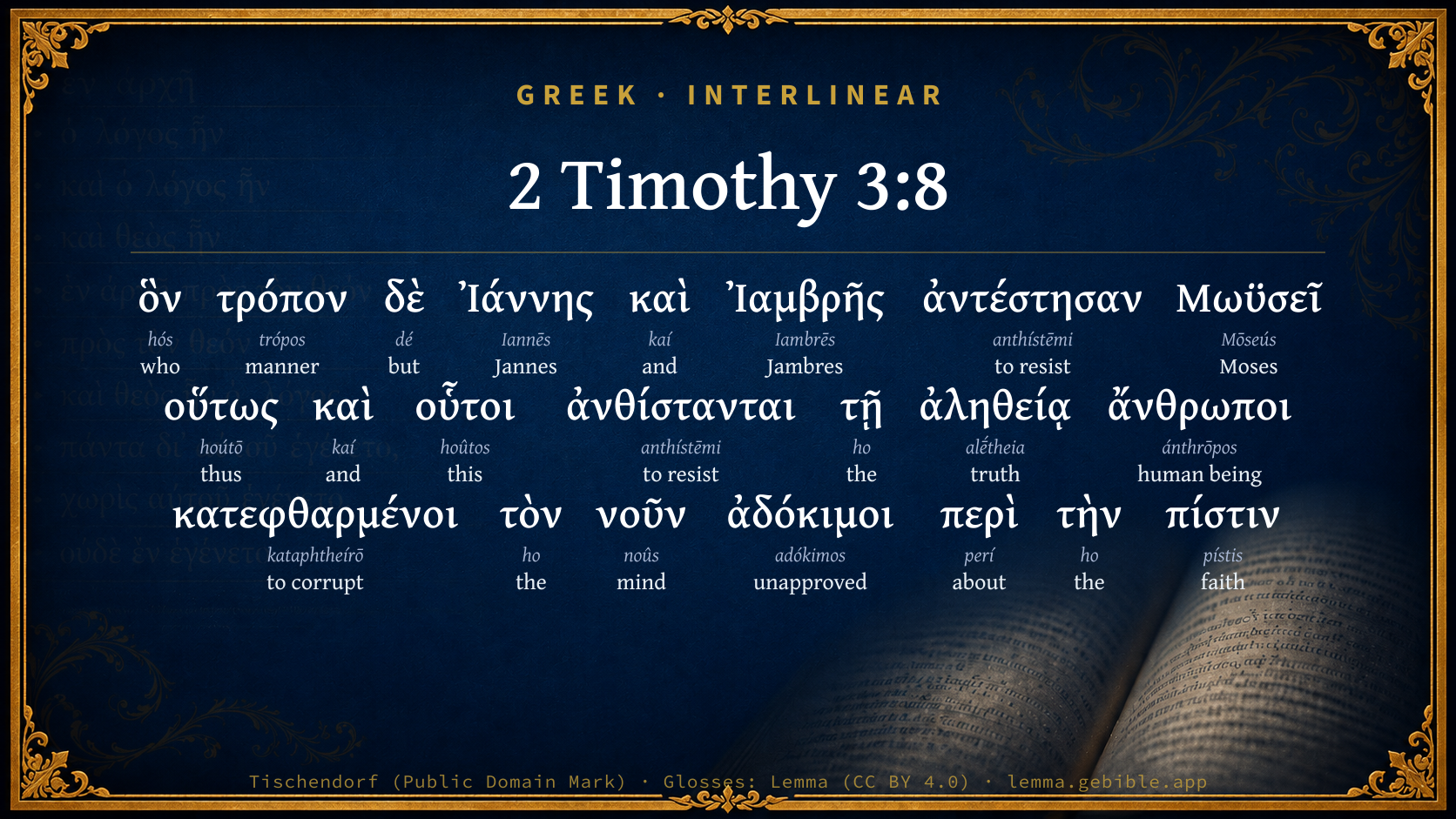
Greek (Tischendorf 8th ed.) 2 Timothy 3:8 appears in the Greek New Testament. The text above is from the Tischendorf 8th edition. Each word links to its Strong’s number and a concise gloss. Click any word for its full Thayer’s Greek Lexicon entry.
Download image
Cite this verse

2 Timothy 3:8 (World English Bible). Public Domain. Lemma interlinear Bible study tool, https://lemma.gebible.app/v/2-timothy/3/8.

Show BibTeX & RIS
BibTeX
RIS
English Translation
Even as Jannes and Jambres opposed Moses, so do these also oppose the truth; men corrupted in mind, reprobate concerning the faith.
World English Bible · Public Domain
Highlights
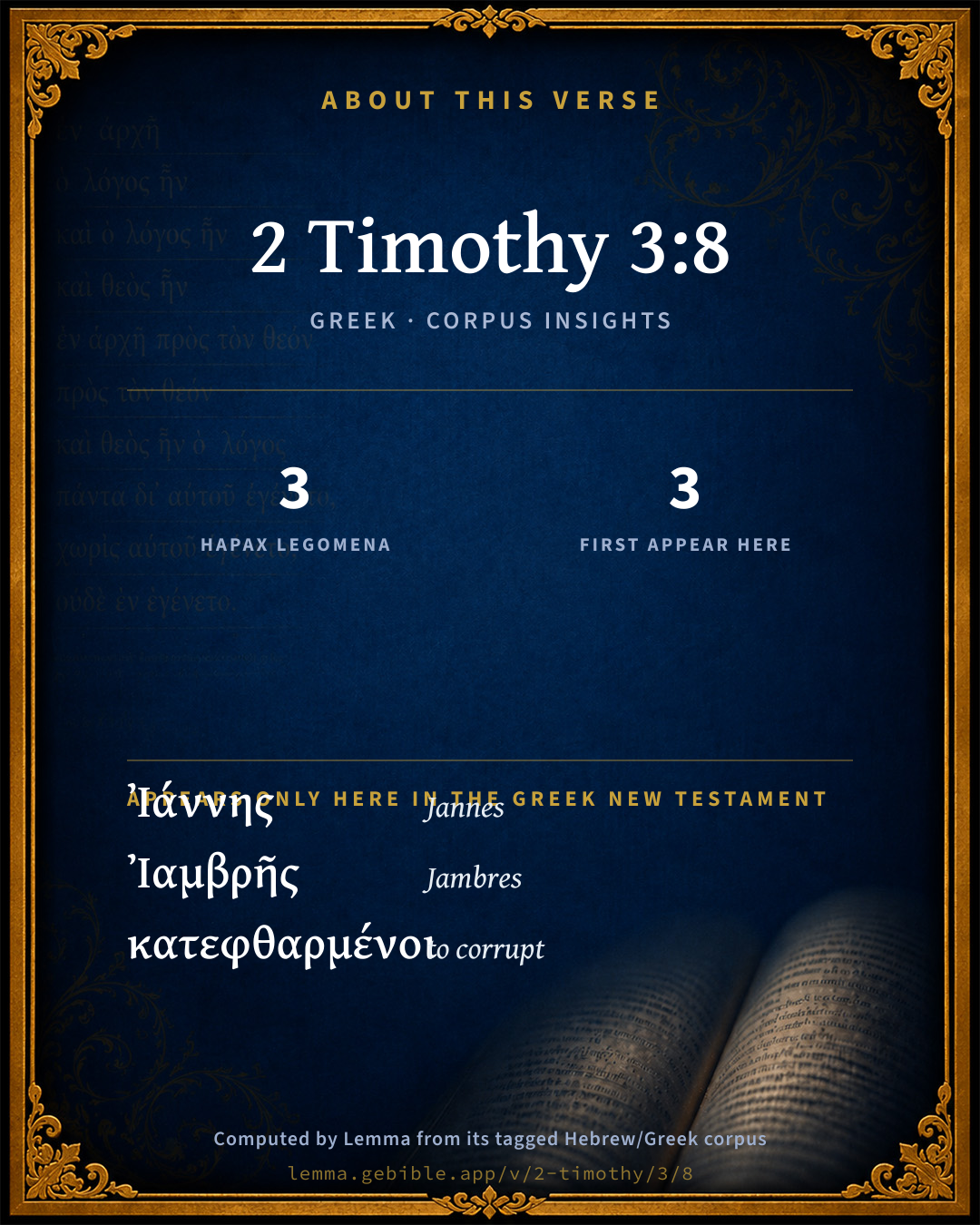
  • 3 hapax legomena — only here in the Greek New Testament
  • 3 first appearances in the Greek New Testament
Full analysis ↓
Download a study sheet

One document with this verse’s original text, its word-by-word gloss line, the meaning frame, cross-references with their text, attributed commentary, and full source and license credits — printable, and it pastes into notes with its structure intact.

This verse Autodidact and up

Study sheet (.html) Plain text (.txt)

A passage Seminary Student

Up to 50 verses in one chapter. A passage sheet keeps up to 6 commentary sources and 12 cross-references per verse, in the order this page ranks them, and says so on the sheet whenever that leaves anything out. Ask for a single verse and you get the Autodidact verse sheet above.

Everything on this page stays free to read, with no account — the sheet is a download of what is already on screen, not access to it.

Want to remove ads? Support Godless Engineer
Compare translations 3

The same verse in 3 English versions, stacked beneath the original-language interlinear above. Click any original word for its lexicon entry.

Each is an independent rendering of the whole verse — the interlinear is not word-aligned to these translations.

Highlighted words mark where these versions differ — a whole-verse word diff, not a word-by-word alignment.

  • World English Bible Public Domain
    Even as Jannes and Jambres opposed Moses, so do these also oppose the truth; men corrupted in mind, reprobate concerning the faith.
  • King James Version Public Domain
    Now as Jannes and Jambres withstood Moses, so do these also resist the truth: men of corrupt minds, reprobate concerning the faith.
  • unfoldingWord Literal Text CC BY-SA 4.0
    And the way Jannes and Jambres opposed Moses, so also these oppose the truth, men having been corrupted the mind, unapproved concerning the faith.

unfoldingWord Literal Text — © unfoldingWord, licensed CC BY-SA 4.0. Word-aligned USFM3 via Door43 (git.door43.org/unfoldingWord/en_ult).

Versions to compare (up to 4)

3 of 4 selected

Show all 19 translations

Every available English version of this verse, each an independent rendering of the whole verse.

  • World English Bible Public Domain
    Even as Jannes and Jambres opposed Moses, so do these also oppose the truth; men corrupted in mind, reprobate concerning the faith.
  • Berean Standard Bible Public Domain
    Just as Jannes and Jambres opposed Moses, so also these men oppose the truth. They are depraved in mind and disqualified from the faith.
  • Majority Standard Bible Public Domain
    Just as Jannes and Jambres opposed Moses, so also these men oppose the truth. They are depraved in mind and disqualified from the faith.
  • King James Version Public Domain
    Now as Jannes and Jambres withstood Moses, so do these also resist the truth: men of corrupt minds, reprobate concerning the faith.
  • American Standard Version (1901) Public Domain
    And even as Jannes and Jambres withstood Moses, so do these also withstand the truth. Men corrupted in mind, reprobate concerning the faith.
  • Revised Version (1885) Public Domain
    And like as Jannes and Jambres withstood Moses, so do these also withstand the truth; men corrupted in mind, reprobate concerning the faith.
  • Geneva Bible (1599) Public Domain
    And as Iannes and Iambres withstoode Moses, so doe these also resist the trueth, men of corrupt mindes, reprobate concerning the faith.
  • Douay-Rheims (1899) Public Domain
    Now as Jannes and Mambres resisted Moses, so these also resist the truth, men corrupted in mind, reprobate concerning the faith.
  • Young's Literal Translation Public Domain
    and, even as Jannes and Jambres stood against Moses, so also these do stand against the truth, men corrupted in mind, disapproved concerning the faith;
  • Literal Standard Version CC BY-SA 4.0
    and even as Jannes and Jambres stood against Moses, so these also stand against the truth, men corrupted in mind, disapproved concerning the faith;
  • Unlocked Literal Bible CC BY-SA 4.0
    In the same way that Jannes and Jambres stood against Moses, these false teachers also stand against the truth. They are men corrupt in mind, and with regard to the faith they are proven to be false.
  • unfoldingWord Literal Text CC BY-SA 4.0
    And the way Jannes and Jambres opposed Moses, so also these oppose the truth, men having been corrupted the mind, unapproved concerning the faith.
  • Darby Bible Public Domain
    Now in the same manner in which Jannes and Jambres withstood Moses, thus these also withstand the truth; men corrupted in mind, found worthless as regards the faith.
  • World Messianic Bible Public Domain
    Even as Jannes and Jambres opposed Moses, so these also oppose the truth, men corrupted in mind, who concerning the faith are rejected.
  • Webster's Bible Public Domain
    Now as Jannes and Jambres withstood Moses, so do these also resist the truth: men of corrupt minds, reprobate concerning the faith.
  • Free Bible Version CC BY-SA 4.0
    Just like Jannes and Jambres opposed Moses, these teachers also oppose the truth. They are people with corrupted minds whose supposed trust in God is a lie.
  • Bible in Basic English Public Domain
    And as James and Jambres went against Moses, so do these go against what is true: men of evil minds, who, tested by faith, are seen to be false.
  • Text-Critical English NT CC BY 4.0
    Just as Jannes and Jambres opposed Moses, so these false teachers also oppose the truth. They are corrupted in mind and have proven themselves to be unqualified with respect to the faith.
  • Tyndale New Testament (1534) Public Domain
    As Iannes and Iambres withstode Moses even so do these resist the trueth men they are of corrupt myndes and leawde as concernynge the fayth:

Literal Standard Version (2020), Covenant Press — licensed CC BY-SA 4.0. Text via the HelloAO Bible API (eBible.org). Unlocked Literal Bible (unfoldingWord) — licensed CC BY-SA 4.0. Text via the HelloAO Bible API (eBible.org). unfoldingWord Literal Text — © unfoldingWord, licensed CC BY-SA 4.0. Word-aligned USFM3 via Door43 (git.door43.org/unfoldingWord/en_ult). Free Bible Version, Dr. Jonathan Gallagher — licensed CC BY-SA 4.0. Text via the HelloAO Bible API (eBible.org).

Word by word

More ways to search: Search by grammar → Find every occurrence → Compare this word →

Practice this passage: Drill this verse → Learn its vocabulary →

Ἰάννης
Iannēs
G2389
“Jannes”
Noun, Nominative, Singular, Masculine
Part of Speech
Noun
Case
Nominative
Number
Singular
Gender
Masculine
Full Thayer's Definition

Origin: of Egyptian origin

TDNT: 06:12,3

Janna = "he vexed" 1. he and Jambres, were two Egyptian magicians who in the presence of Pharaoh imitated the miracles of Aaron in order to destroy his influence with the king. The author of the epistle derived their names from the tradition of the Talmudists and the Rabbins
  1. ὃν hós G3739 “who” Relative pronoun, Accusative, Singular, Masculine
  2. τρόπον trópos G5158 “manner” Noun, Accusative, Singular, Masculine
  3. δὲ dé G1161 “but” Conjunction
  4. καὶ kaí G2532 “and” Conjunction
  5. Ἰαμβρῆς Iambrēs G2387 “Jambres” Noun, Nominative, Singular, Masculine
  6. ἀντέστησαν anthístēmi G436 “to resist” Verb, Aorist, Active, Indicative, 3rd person, Plural
  7. Μωϋσεῖ Mōseús G3475 “Moses” Noun, Dative, Singular, Masculine
  8. οὕτως hoútō G3779 “thus” Adverb
  9. καὶ kaí G2532 “and” Conjunction
  10. οὗτοι hoûtos G3778 “this” Demonstrative pronoun, Nominative, Plural, Masculine
  11. ἀνθίστανται anthístēmi G436 “to resist” Verb, Present, Middle, Indicative, 3rd person, Plural
  12. τῇ ho G3588 “the” Article, Dative, Singular, Feminine
  13. ἀληθείᾳ alḗtheia G225 “truth” Noun, Dative, Singular, Feminine
  14. ἄνθρωποι ánthrōpos G444 “human being” Noun, Nominative, Plural, Masculine
  15. κατεφθαρμένοι kataphtheírō G2704 “to corrupt” Verb, Perfect, Passive, Participle, Nominative, Plural, Masculine
  16. τὸν ho G3588 “the” Article, Accusative, Singular, Masculine
  17. νοῦν noûs G3563 “mind” Noun, Accusative, Singular, Masculine
  18. ἀδόκιμοι adókimos G96 “unapproved” Adjective, Nominative, Plural, Masculine
  19. περὶ perí G4012 “about” Preposition
  20. τὴν ho G3588 “the” Article, Accusative, Singular, Feminine
  21. πίστιν pístis G4102 “faith” Noun, Accusative, Singular, Feminine

About this verse

These counts appear in no published source. They are computed here, from the morphology-tagged text and Lemma’s own curated glosses. What Lemma adds →

22
words
18
distinct lemmas
Pauline Epistles
section

Notable vocabulary

3 hapax legomena — words that appear only here in the entire Greek New Testament:

  • Ἰάννης Jannes G2389
  • Ἰαμβρῆς Jambres G2387
  • κατεφθαρμένοι to corrupt G2704

First appearance in Scripture

These words make their first canonical appearance in the Greek New Testament here:

  • Ἰάννης Jannes G2389
  • Ἰαμβρῆς Jambres G2387
  • κατεφθαρμένοι to corrupt G2704

Shared distinctive vocabulary

ἀδόκιμοι unapproved G96 occurs in 8 verses of the Greek New Testament. Also found in:
Repetition

Words recur within this verse:

  • ἀντέστησαν to resist G436 ×2
  • τῇ the G3588 ×3
  • καὶ and G2532 ×2

Cross-references

31

Topical passages linked to 2 Timothy 3:8 in the Treasury of Scripture Knowledge — connected by theme and wording, ordered by reader-vote popularity; previews shown in the World English Bible.

  • Exodus 7:11 Then Pharaoh also called for the wise men and the sorcerers. They also, the magicians of Egypt, did in like manner with their enchantments.
  • Acts 13:8–11 But Elymas the sorcerer (for so is his name by interpretation) withstood them, seeking to turn aside the proconsul from the faith.
  • Revelation 2:20 But I have this against you, that you tolerate your woman, Jezebel, who calls herself a prophetess. She teaches and seduces my servants to commit sexual immorality, and to eat things sacrificed to idols.
  • 1 Timothy 6:5 constant friction of people of corrupt minds and destitute of the truth, who suppose that godliness is a means of gain. Withdraw yourself from such.
  • Ephesians 4:14 that we may no longer be children, tossed back and forth and carried about with every wind of doctrine, by the trickery of men, in craftiness, after the wiles of error;
  • 2 Timothy 4:15 of whom you also must beware; for he greatly opposed our words.
  • Titus 1:16 They profess that they know God, but by their works they deny him, being abominable, disobedient, and unfit for any good work.
  • 2 Peter 2:14 having eyes full of adultery, and who can't cease from sin; enticing unsettled souls; having a heart trained in greed; children of cursing;
  • 1 John 4:1 Beloved, don't believe every spirit, but test the spirits, whether they are of God, because many false prophets have gone out into the world.
  • Revelation 2:14–15 But I have a few things against you, because you have there some who hold the teaching of Balaam, who taught Balak to throw a stumbling block before the children of Israel, to eat things sacrificed to idols, and to commit sexual immorality.
  • Exodus 7:22 The magicians of Egypt did in like manner with their enchantments; and Pharaoh's heart was hardened, and he didn't listen to them; as Yahweh had spoken.
  • Exodus 8:18 The magicians tried with their enchantments to bring forth lice, but they couldn't. There were lice on man, and on animal.
  • Romans 16:18 For those who are such don't serve our Lord, Jesus Christ, but their own belly; and by their smooth and flattering speech, they deceive the hearts of the innocent.
  • 2 Corinthians 11:13–15 For such men are false apostles, deceitful workers, masquerading as Christ's apostles.
  • Galatians 2:4–5 This was because of the false brothers secretly brought in, who stole in to spy out our liberty which we have in Christ Jesus, that they might bring us into bondage;
  • 2 Thessalonians 2:9–11 even he whose coming is according to the working of Satan with all power and signs and lying wonders,
  • 1 Timothy 1:19 holding faith and a good conscience; which some having thrust away made a shipwreck concerning the faith;
  • 1 Timothy 4:2 through the hypocrisy of men who speak lies, branded in their own conscience as with a hot iron;
  • 2 Peter 2:1–3 But there also arose false prophets among the people, as among you also there will be false teachers, who will secretly bring in destructive heresies, denying even the Master who bought them, bringing on themselves swift destruction.
  • 1 Kings 22:22–24 Yahweh said to him, 'How?' He said, 'I will go forth, and will be a lying spirit in the mouth of all his prophets.' He said, 'You shall entice him, and shall prevail also: go forth, and do so.'
  • Titus 1:10 For there are also many unruly men, vain talkers and deceivers, especially those of the circumcision,
  • 1 John 2:18 Little children, these are the end times, and as you heard that the Antichrist is coming, even now many antichrists have arisen. By this we know that it is the end times.
  • Revelation 2:6 But this you have, that you hate the works of the Nicolaitans, which I also hate.
  • Exodus 8:7 The magicians did in like manner with their enchantments, and brought up frogs on the land of Egypt.
  • Jeremiah 28:1–17 It happened the same year, in the beginning of the reign of Zedekiah king of Judah, in the fourth year, in the fifth month, that Hananiah the son of Azzur, the prophet, who was of Gibeon, spoke to me in the house of Yahweh, in the presence of the priests and of all the people, saying,
  • Acts 8:21–22 You have neither part nor lot in this matter, for your heart isn't right before God.
  • Acts 15:24 Because we have heard that some who went out from us have troubled you with words, unsettling your souls, saying, 'You must be circumcised and keep the law,' to whom we gave no commandment;
  • Romans 1:28 Even as they refused to have God in their knowledge, God gave them up to a reprobate mind, to do those things which are not fitting;
  • 2 Corinthians 13:5–6 Test your own selves, whether you are in the faith. Test your own selves. Or don't you know as to your own selves, that Jesus Christ is in you?--unless indeed you are disqualified.
  • Galatians 1:7–9 and there isn't another gospel. Only there are some who trouble you, and want to pervert the Gospel of Christ.
  • Jude 1:18–19 They said to you that "In the last time there will be mockers, walking after their own ungodly lusts."

Cross-references courtesy of OpenBible.info (CC BY 4.0).

Commentary

Notes on 2 Timothy 3:8 from classic Christian and Jewish commentators (each source and its license shown beneath its notes). The classic Christian expositions comment on the surrounding passage and are grouped to its opening verse, so a note may address several verses; the Jewish commentaries on the Tanakh (Rashi and others) are per-verse, so they appear only where the commentator wrote on this verse.

Lemma curates 59 commentaries, every one of them public domain or Creative Commons licensed, each selected and text-cleaned for this edition rather than reprinted as found. About our sources →

The Biblical Illustrator

Joseph S. Exell

2Ti_3:8-9

As Jannes and Jambres withstood Moses.

Jannes and Jambres

I. The nature of the opposition offered by these men to Moses. You do not find that they tried to make light of the miracles of Moses, or call in question their genuineness, or anything of the sort. No, they simply tried by imitations to depreciate the value of the real. They so surrounded the true diamond with cut glass copies that in the eye of an undiscerning public it was difficult to tell the difference. This is the kind of resistance the Church has to struggle against in the present day. The old, rough, brutal, physical opposition has passed away. It would be folly on the part of Satan to try and use such weapons now. Like a skilful angler he suits the fly on his hook to the season of the year. Variety, if not pleasing, is profitable to him in this respect. Having failed to do away with Christians, he now seeks to make the whole world Christian after his sort. Stamping out the genuine having proved an utter failure, he now seeks to swamp them with imitations of his own manufacture.

II. The influence of jannes and jambres. Jannes and Jambres wield an immense power in the present day, and it is no use shutting our eyes to the fact. Jannes is not to be got rid of with a laugh, nor Jambres with a smile of indifference. Their existence is a source of constant danger, and their presence in the professing Church does more to paralyze its testimony than all the outward opposition and persecution it has ever met. This form of Satanic resistance is an awful proof of the deep-sightedness of the great adversary. He knows that nothing can possibly deaden the power of the Churchs testimony more than flooding it with a number of cold formalists, who in the eyes of the world can do as much as the genuine Christian. And then when the world detects they are but shams and finds that it has been deceived, so much the better for him, for he knows that the whole Church will be judged by the impostors, and all put down as belonging to the same family. Counterfeits destroy confidence. This is true in everything. It is unprincipled rogues that make it so hard for honest men to get their bread. It is quackery that keeps the true medicine out of the field. It is bubble joint-stock companies that eat out all commercial trust, and make the very name to many a synonym for fraud. Everywhere the true and real are suffering through the influence of the false and base imitations. I have heard an anecdote somewhere that so exactly sets forth the idea I have in my mind I cannot but tell it. One gentleman made a wager with another that if he stood on London Bridge with a tray full of sovereigns and offered them to the public for sixpence each, he would not sell half a dozen of them in the day. All day long the man cried out, Real sovereigns for sixpence, and declared with all earnestness that he could guarantee their genuineness. Of course no one believed him and he sold none. Why? Because the public had so often seen sham sovereigns for sale that it never doubted they were the same. The gilt having come first had destroyed all faith in the gold. Just so in the spiritual world. The existence of Jannes and Jambres eats out all faith in the reality of any Christian life.

III. The end of their resistance. They were put to shame (see Exo_8:18). Ah Jannes, it must have been a bitter moment when you stood convicted before all of being an impostor! How complete the collapse of their pretensions. So shall it he with their followers of to-day. This Paul most distinctly states in the verse following our text, But they shall proceed no further: for their folly shall be manifest unto all men as theirs also was. Folly? No other word could better describe their resistance. The hypocrite is of all fools the greatest. He is almost certain to be unmasked in time, and even should he carry on the horrible deception unto the last, what shall it profit him when God calleth for his soul? Now just as Jannes and Jambres failed to do all that Moses did, so there are some things that the mere formalist can never accomplish. I will but mention two.

1. He has no power to bear trouble with joyfulness. His whole life being one of externals, when he is driven by force of circumstances to seek his joy in the life within, he fails, and fails utterly, for there is no life there. A sham Christianity withers up in days of trouble. It has no arms to put beneath a man when the dark waters of sorrow roll and surge around him. No, it can do none of these. It fails like the magicians when needed the most. The form may do for bright and sunny days when sorrow and sickness are unknown, but it requires the power to triumph in the winter night, and to take joyfully the spoiling of the goods. Put a Jannes or Jambres amidst a number of anxious souls, and tell him to speak to them and point them the way of peace. See how he fails.

2. If not, I pray you to remember that Jannes and Jambres were included in the doom of the Egyptians. When the angel of death walked through the streets of Egypt, there was no exception made. The form of religion does not save--the appearance of piety is of no avail. (A. G. Brown.)

Men must guard against error

This must teach us to keep our judgments pure, and our understandings clear, for it is our guide, and if that mislead us, we must needs fall into the ditch. Corruption in judgment (in some respects) is worse than corruption in manners, especially when the mind hath been enlightened with the knowledge of the truth; for this is the root of those corrupt manners that are amongst us. In the time of the Law, the leprosy in the head was of all other leprosies the most dangerous and destructive; the man that had it in his hand or feet was unclean, but if it were in his head then he was to be pronounced utterly unclean (Lev_13:44). Hence the Scripture gives so many caveats against errors and erroneous ones (Deu_13:3; Php_3:2; Col_2:8; 2Pe_3:17; Mat_7:13). Beware of false prophets; the word implies a diligent study and singular care, lest we be caught by such subtle adversaries. Keep your judgments pure.

1. There have been false teachers in all ages to oppose the truth and the professors of it. As Jannes and Jambres here oppose Moses, a meek, a learned, a faithful servant in all Gods house.

2. That as the devil hath his Jannes and Jambres to oppose the truth, so God hath His Moses and Aaron to uphold it. As the devil hath his domestic chaplains, so God hath His armed champions; and as the devil raiseth up oppressors, so God sends saviours.

3. A corrupt head and a corrupt heart usually go together; no sooner are mens minds corrupted, but presently it follows they are reprobate concerning the faith; and if once men make shipwreck of faith, they will soon part with a good conscience too. Corrupt principles breed corrupt practices; and corrupt practices teach men to invent corrupt principles. Be sure, then, to keep your heads free from error, if ever you would have your hearts and hands pure from sin.

4. That false teachers are very dangerous persons--they are not such meek, innocent, harmless persons as some imagine. The apostle here tells us that they are impudent, fraudulent, resisters of the truth, men of corrupt heads, hearts, and hands; and what could he say more unless he should call them devils? and so he doth (2Ti_3:3), in the last days, men, especially seducing men (for all these nineteen sins are applicable also to the false teachers of the last times, as appears by the context (2Ti_3:5-6). These study to please men, and therefore they are no servants of Christ (Gal_1:10), all their fine speeches are but like poison given in honey, which destroys more swiftly. They set a gloss upon their false tenets as tradesmen do upon their bad stuffs to make them sell the better. They can cite Scripture to draw you from Scripture, and tempt you to be irreligious by religious arguments misapplied. This is the devils great masterpiece which he hath now upon the wheel, he carries his deadliest poison in a golden cup (Rev_17:4).

5. They wrest and abuse the Scriptures for their own ends. They do violence to the Law (Zep_3:4), they wrest and wring it, they add, they detract, they change the sense, they set it on the tenters to fit it to their fancies, they turn it this way and that way as may best serve their purposes; they set it on the rack, and so make it speak what it never thought. They compel the Scriptures to go two miles, which of themselves would go but one. They deal with them as chemists do with natural bodies, which they torture to get that out of them which God and nature never put into them (2Pe_3:16).

6. They seek their own glory, not Gods. They cry up nature, and decry grace, they cry up a light within them (which is no better than darkness), and cry down Gods word without them. Simon Magus sets up himself instead of God (Act_8:9-10), they drive at self in all their actings (Rom_16:18; 2Pe_2:3; 2Pe_2:14). Impostors are always great self-seekers. These are contrary to Gods faithful ministers. (T. Hall, B. D.)

Resistance of the truth

1. Its weapons.

2. Its sworn comrades.

3. Its stubbornness.

4. Its final fate. (Van Oosterzee.)

Bounds set to spread of error

As God set bounds to the sea, saying, Hitherto shall ye come but no further, and here shall thy proud waves be stayed (Job_38:11), so He limits the malice and madness of men how far they shall prevail; He only can stop these seas of error, and bound these floods of false doctrine which are ready to overflow the face of the world. (T. Hall, B. D.)

Deceivers subject to providence of God

Our comfort is that both the deceivers and the deceived are ordered by the providence of God (Job_12:16); He sets down the time when they shall begin, and limits them how long they shall continue, He orders how far men shall deceive, and to what height they shall come and prevail, and when to stop them, that they may proceed no further: for as the maliciousness, so the deceivableness of men would know no bounds if God did not bound it; but because He doth, therefore though they would, yet they shall proceed no further. No man can do good till God assist him, and no man shall do hurt when God will stop him (Rev_20:3). (T. Hall, B. D.)

Heresies short-lived

Heresies are seldom long-lived--such meteors last not long, such mushrooms soon vanish; witness Becold, Knipperdolling, Phifer, etc. Though for a time they may deceive many, yet in a short time God discovers their hypocrisy to their reproach. (T. Hall, B. D.)

Error vanisheth, truth increaseth

Heresy is like a cloud which for a little time darkens the Church, and then vanisheth. But truth, though it meet with opposition at first and hath few followers, yet increaseth and prevails against all opposition. It hath its plus ultra, it is perpetual and endures for ever. (T. Hall, B. D.)

Impudent error near its end

Pride and impudence, they do not only preach but print their blasphemy: a sign their end is near. Smoke, the higher it riseth the sooner it is scattered (Psa_68:1-2). (T. Hall, B. D.)

The fall of error

They shall fall--

1. Irrecoverably.

2. Easily.

3. Suddenly.

4. Surely. (T. Hall, B. D.)

False teachers exposed

Observe, that God will overthrow false teachers, by discovering their coverings and making known their delusions to the world. As a disease discovered is half cured, so an error discovered is half conquered. Usually before God overthrows wicked men He discovers their vileness first, that the glory of His justice may be the more apparent, and His people may come out from amongst them. (T. Hall, B. D.)

A faithful ministry the best safeguard against error

When the sun ariseth the clouds scatter, and where the Son of Righteousness is powerfully preached and published, heretics hide themselves, and dare not make that open sale of their wares as they do in dark corners. Let us therefore pull off their masks of liberty, their sleeves of sanctity, and their trappings of hypocrisy: let us expose their error, stripped and naked in their own natural deformity, and they will soon be exploded by all, so that they shall proceed no further. (T. Hall, B. D.)

Error utilised and subjugated at last

He is infinitely just, though His ways be secret and full of darkness to us, yet they are always just. When clouds and darkness are round about Him, then righteousness and judgment are the habitation of His throne (Psa_97:7). He can make a medicine of the poisonous oppositions of wicked men, their malice shall be as horse-leeches to suck out the bad blood, as a file to take off the rust, as rubbish to cleanse the vessel and wash away the filth, and as a touchstone to try the graces of His children. And though His providences seem to cross His promises, yet wait the conclusion, and you shall see and say He hath done all things well. We see in a clock though the wheels run cross and contrary one to another, yet they all conduce to the going of the clock. Josephs imprisonment is the way to his preferment, and Jonahs drowning was the means to save him from drowning. We must not judge of Gods actions before they be formed and finished. (T. Hall, B. D.)

Their folly shall be manifest unto all--

The efficiency of the Divine government seen in the limitations of wickedness

1. This is seen in the manifest folly of sin. Sin is always folly, but this is not always made manifest in the course of human affairs. But Gods government is such that, though the folly of sin be not in every case made manifest, it is always made clear that God thwarts the designs of wicked men, no matter how ingenious they may be. Men play the knave, only to show themselves fools. Their deeds ever pass in review before the never-closing eye of Him who holds every destiny in His hand. Under every wise system of government sin is demonstrated to be folly, though it may not always be exposed.

2. One of the declared principles of this effective government is, that crime shall be its own warning. There are earnests of penalties and promises of penalties, no less pronounced, in every-day life, than in the written moral code, the latter to follow us hereafter. The trial and punishment of law-breakers remain unfinished here, though there are generally enough admonitions to associate sin with approach ing danger. Owing to the cross-workings of law upon law, here the danger is not so apparent; but the Divine economy marks its criminals before they are arraigned.

3. Sin is often limited by exposure, pain, and special judgments, so that God Him self becomes the greatest restraint. Destruction of Sennacheribs army.

4. Divine grace often limits sin in action. Conversion of Paul.

Lessons:--

1. If there is a limit to wickedness, and to wicked men, in their course, there must be a limit to individual sins. The believer has to struggle more or less with sin while in this world, but there will be an end of all that conflict.

2. Living under such a government, how unwise to lead wicked lives l

3. The Christian can be faithful and energetic in his work. Sin is sure to fail, and righteousness to succeed. (W. M. Barbour, D. D.)

The true nature of scepticism

Some time ago I was a little alarmed at the stealthy progress which that accursed system--secularism--was making in Lancashire. But God settled it. God sent us the cotton famine; that settled it: and secularism has never rallied since. When the secularists used to come out to meet us, they said to the people, Dont listen to these men; all they want is your money. All their talk is about the next world. They do not care about this. They do not care about your having food, clothes, and healthy homes. And thus we were taunted everywhere. Then occurred the outbreak of that terrible cotton famine. Where were the secularists then? Like the Arabs of the desert, they folded up their tents and silently stole away. And they who had said it was their special mission to deal with temporalities, forgot all temporalities but their own, and came up to London to lecture upon anything--admission threepence. (C. Garrett.)

Manifest folly

Dr. John Hall, in one of his sermons, compared the attacks of infidelity upon Christianity to a serpent gnawing at a file. As he kept on gnawing, he was greatly encouraged by the sight of the growing pile of chips, till, feeling pain and seeing blood, he found that he had been wearing his own teeth away against the file, but the file was unharmed.

The folly of opposition to Christ

You have heard of the swordfish. It is a very curious creature, with a long and bony beak or sword projecting in front of its head. It is also very fierce, attacking other fishes that come in its way, and trying to pierce them with its sword. The fish has sometimes been known to dart at a ship in full sail with such violence as to pierce the solid timbers. But what has happened? The silly fish has been killed outright by the force of its own blow. The ship sails on just as before, and the angry swordfish falls a victim to its own rage. But how shall we describe the folly of those who oppose the cause of Christ? They cannot succeed; like the swordfish, they only work their own destruction. (G. S. Bowes.)

Error cannot stand

Error is a palace of ice, which at last must melt and tumble down necessarily, when but one ray of the sunlight of truth penetrates it. (Van Oosterzee.)

The gospel and its enemies

Luther hoard one day a nightingale singing very sweetly near a pond full of frogs, who, by their croaking, seemed as though they wanted to silence the melodious bird. The Doctor said, Thus tis in the world; Jesus Christ is the nightingale, making the gospel to be heard; the heretics and false prophets are the frogs, trying to prevent his being heard. (Table Talk.)

The Biblical Illustrator, edited by Joseph S. Exell (c. 1880s–1900s) — public domain. Text from a community e-Sword module.

Joseph Benson's Commentary

2Ti 3:8-9. Now as Jannes and Jambres — Some ancient writers speak of these persons as the chief of Pharaoh’s magicians, whose names, though not recorded by Moses, yet being handed down by tradition, are preserved in Jonathan’s Chaldee Paraphrase on Exo 7:11; withstood Moses — We learn from Exo 7:11; Exo 7:22, that Pharaoh’s magicians imitated three of Moses’s miracles by their enchantments; that is, by repeating a form of words known only to themselves, in which they invoked certain demons, and, as they fancied, constrained them to do the things desired. By thus pretending to work miracles equal to those of Moses, they resisted him in his attempts to persuade Pharaoh to let the Israelites go. So these also resist the truth — That is, the true and genuine gospel; namely, as he seems to mean, by false miracles. In the early ages of Christianity the heretical teachers are said to have been much addicted to the study of magic, and that some of the Gnostics pretended to have the secret books of Zoroaster. Clemens. Alexand. Strom., lib. 5. p. 104. And we know that in later times the monks and friars have been great pretenders to miracles. Hence (2Ti 3:13) they are called γοητες, magicians. Men of corrupt minds — Impure notions and wicked inclinations; reprobate, αδοκιμοι, disapproved, with respect to the faith — And worthy of being rejected as enemies to it. Or, as some render the clause void of judgment as to the faith; quite ignorant, as well as careless, of true spiritual religion. But they shall proceed no further — Or, as Doddridge renders the clause, they shall not proceed much further, in these artifices, and in gaining proselytes; for their folly shall be made manifest unto all — Ανοια, their want of understanding. The apostle might justly call the errors of the authors of the apostacy, and the base arts by which they established their authority, foolishness, because, though they thought themselves superlatively wise in the methods which they devised for obtaining power and wealth, their doctrines and practices were as void of reason as are the imaginations and actions of fools. As theirs also was — To the Israelites, and even to the Egyptians themselves. That is, “the vile arts by which the corrupters of Christianity established their errors being discovered, their folly and wickedness shall be very plain to the people, even as the folly and wickedness of Pharaoh’s magicians were made plain to the Israelites, by the stop which God put to their enchantments. And thus, the truth being set in a more clear light, the wisdom and righteousness of God, in permitting these corruptions to take place for a while, will be demonstrated.” They who are acquainted with the history of the ancient heretics, and of the Romish Church, and of the Reformation, need not be informed how exactly this whole prophecy hath been fulfilled.

Joseph Benson's Commentary on the Old and New Testaments (1811–1818) — public domain. Text from a community e-Sword module.

Tyndale Open Study Notes

Tyndale Open Resources

3:8 Jannes and Jambres are, according to tradition, the names of the Egyptian sorcerers who opposed Moses (see Exod 7:8-13; 8:18; 9:11).

Tyndale Open Study Notes — © Tyndale Open Resources, licensed CC BY-SA 4.0. Text via the HelloAO Bible API.

Bengel's Gnomon

Johann Albrecht Bengel

2Ti 3:8. Ἰαννῆς καὶ Ἰαμβρῆς, Jannes and Jambres) Euseb., 2Ti 1:9, Præp. Evang., quotes the following passage from Numemius: “Jannes and Jambres, understood to be Egyptian sacred scribes (ἱερογραμματεῖς, a lower order of priests in Egypt), men of no small skill in magical operations, at the time when the Jews were driven out of the land of Egypt,” etc. Jannes and Jambres were names very well known in Paul’s time; for they were very often mentioned in the ancient books of the Hebrews, as two of the principal magicians among the Egyptians. The very acute Hillerus, according to the Abyssinian language, interprets Jannes, a jester or trickster, and Jambres, a juggler; for he is of opinion, that the appellatives were changed into proper names in the lapse of time.—Onom. S., p. 671, 843. Certainly, if they were entirely proper names, we may believe that they were formerly μέσα (terms intermediate between appellatives and proper names), which indicated the profession of the art itself (as well as the person); comp. Act 13:8.—ἀντέστησαν Μωσῇ, withstood Moses) by rivalling to some extent his wonders.—ἀνθίστανται, resist) The opposite is, shall suffer persecution, 2Ti 3:12.—ἁδοκίμοι) reprobate, having no power to approve: comp. Rom 1:28.

Bengel's Gnomon of the New Testament — English translation (T&T Clark, Edinburgh, 1860) — public domain. Text from a community e-Sword module.

Meyer's Critical & Exegetical Commentary

Heinrich August Wilhelm Meyer

2Ti_3:8. Further description of the heretics: ὃν τρόπον δὲ Ἰαννῆς καὶ Ἰαμβρῆς ἀντέστησαν Μωϋσεῖ] Paul here compares the heretics to the Egyptian Magi who are mentioned in Exodus 7. but not named. Origen (Tract. 35 in Matt.) thinks that the apostle extracted them from a liber secretus which bore the title Jamnes et Mambres. That is, however, doubtful; Theodorets supposition is more probable: τὰ μέντοι τούτων ὀνόματα οὐκ ἐκ τῆς θείας γραφῆς μεμάθηκεν ὁ θεῖος ἀπόστολος, ἀλλʼ ἐκ τῆς ἀγράφου τῶν Ἰουδαίων διδασκαλίας. The names were a part of Jewish tradition from which they passed into the Talmudic and other Jewish writings; see Targum Jonathan, Exo_7:11; Exo_22:22. Even the Pythagorean Numenius in the second century mentioned them, as Origen (Contra Celsum, iv.) and Eusebius (Praep. Evangel. ix. chap. 8) inform us. According to Jewish tradition, they are said to have been the sons of Balaam, and at first the teachers of Moses, but afterwards his chief opponents, and to have perished at last with the Egyptian army in the Red Sea; see Heydenreich and Wetstein on this passage.

The correlation of ὃν τρόπον … οὕτω does not necessarily place emphasis on the similarity of the manner of the act, but often only on the similarity of the act itself (comp. Mat_23:37; Act_7:28). Possibly, therefore, the heretics are compared with these sorcerers only because they both withstood the truth (so Plitt).

Possibly, also, it is because the resemblance lay in the heretics preaching the same thing as Timothy, just as the sorcerers did the same thing as Moses, the heretics and the sorcerers having the same purpose of striving against the truth (so Hofmann). Still the mention of the sorcerers at all is strange; hence we may suppose that the heretics by some more characteristic trait suggested the resemblance to the apostles mind, and that this trait was their use of magic arts, to which there is allusion made also in γόητες, 2Ti_3:13 (de Wette, Wiesinger, van Oosterzee[49]). The δέ not only marks the transition to a new thought, but also introduces something in contrast to what preceded: what they did they did with an appearance of piety, but in truth they were opposing the truth.

κατεφθαρμένοι τὸν νοῦν] The verb καταφθείρω (ἅπ. λεγ.; in 2Pe_2:12 it is the reading of the Rec., but there is more testimony for the simple verb) is synonymous with διαφθείρω, 1Ti_6:5.

ἀδόκιμοι περὶ τὴν πίστιν] Luthers translation: incapable of believing, is inaccurate; nor is Bezas explanation suitable: rejectanei, i.e. falsae et adulterinae doctrinae doctores, quos oporteat ab omnibus rejici. Ἀδόκιμος is one who does not stand proof, and in connection with περὶ τὴν πίστιν one who does not stand proof in regard to faith: not standing proof in respect of faith (Matthies, de Wette); comp. 1Ti_1:19. The description here given of the heretics is the same as in 1Ti_6:5 : διεφθαρμένοι τὸν νοῦν καὶ ἀπεστερημένοι τῆς ἀληθείας.

[49] Van Oosterzee here makes an apposite allusion to Simon Magus, to Elymas, to the itinerating devil-exorcisers among the Jews, and to the magic arts practised from time immemorial at Ephesus, comp. Act_19:19.

Meyer — Critical and Exegetical Commentary on the New Testament — English translation by Peter Christie, edited by Frederick Crombie (T&T Clark, 1880) — public domain. Text from a community e-Sword module.

Expositor's Greek Testament

ed. W. Robertson Nicoll

2Ti 3:8 . The apostle now returns from the γυναικάρια to their seducers, whom he compares to the magicians who withstood Moses and Aaron, both in their hostility to the truth and in their subsequent fate. St. Paul is the earliest extant authority for the names; but of course he derived them from some source, written (Origen), or unwritten (Theodoret), it is immaterial which. But the former theory is the more probable. The book is called by Origen ( in Matt . p. 916, on Mat 27:8 ), Jannes et Mambres liber , and is perhaps identical with Pœnitentia Jamnis et Mambrae condemned in the Decretum Gelasii . Pliny, whose Natural History appeared in A.D. 77, mentions Jannes along with Moses and Lotapis (or Jotapis) as Jewish Magi posterior to Zoroastes ( Hist. Nat . xxx. 1). He is followed by Apuleius, Apol . c. 90. Numenius (quoted by Eusebius ( Prep. Ev . ix. 8) mentions Jannes and Jambres as magicians who resisted Moses. In the Targ. of Jonathan on Ex. vii. 11, the names are given as ינים וימברים , Janis and Jamberes; but in the Talmud as יחנא וממרא , Jochana and Mamre. It is generally agreed that Jannes is a form of Jochanan (Johannes), and that Jambres is from the Hiphil of מרה to rebel. For the legends associated with these names, see art. in Hastings’ D. B .

ἀντέστησαν : The same word is used of Elymas the Sorcerer, Act 13:8 . The οὕτως refers rather to the degree of their hostility than to the manner in which it was expressed, i.e. , by magical arts. At the same time, it is possible that magic was practised by the false teachers; they are styled impostors, γόητες , in 2Ti 3:13 ; and Ephesus was a home of magic. See Act 19:19 .

κατεφθαρμένοι τὸν νοῦν : cf. 1Ti 6:5 , διεφθαρμ . τὸν νοῦν . This is the Pauline equivalent for the Platonic “lie in the soul”. κατεφθ . is not coordinate with ἀδόκ .; the latter is the exemplification of the former.

ἀδόκιμοι : reprobate . The A.V.m. gives the word here, and in Tit 1:16 , an active force, of no judgment, void of judgment . For περί with the acc. See on 1Ti 1:19 .

The Expositor's Greek Testament, edited by W. Robertson Nicoll (1897–1910) — public domain. Text from a community e-Sword module.

Jamieson, Fausset & Brown

Robert Jamieson, A. R. Fausset & David Brown

Now--Greek, "But"; it is no wonder there should be now such opponents to the truth, for their prototypes existed in ancient times [ALFORD].

Jannes . . . Jambres--traditional names of the Egyptian magicians who resisted Moses (Exo 7:11, Exo 7:22), derived from "the unwritten teaching of the Jews" [THEODORET]. In a point so immaterial as the names, where Scripture had not recorded them, Paul takes the names which general opinion had assigned the magicians. EUSEBIUS [Preparation of the Gospel], quotes from NUMENIUS, "Jannes and Jambres were sacred scribes (a lower order of priests in Egypt) skilled in magic." HILLER interprets "Jannes" from the Abyssinian language a trickster, and "Jambres" a juggler" (Act 13:8).

resist--"withstand," as before. They did so by trying to rival Moses' miracles. So the false teachers shall exhibit lying wonders in the last days (Mat 24:24; Th2 2:9; Rev 13:14-15).

reprobate--incapable of testing the truth (Rom 1:28) [BENGEL]. ALFORD takes passively, "not abiding the test"; rejected on being tested (Jer 6:30).

Jamieson, Fausset & Brown — Commentary Critical and Explanatory on the Whole Bible (1871) — public domain (CC PDM 1.0). Text via the HelloAO Bible API.

Adam Clarke's Commentary

Verse 8. Now as Jannes and Jambres withstood Moses] This refers to the history of the Egyptian magicians, given in Exodus 7, where see the notes (Ex 7:11, Ex 7:12), and particularly the concluding observations at the end of that chapter, Ex 7:25 where several things are said concerning these two men.

Men of corrupt minds] It appears as if the apostle were referring still to some Judaizing teachers who were perverting the Church with their doctrines, and loudly calling in question the authority and doctrine of the apostle.

Reprobate concerning the faith.] αδοκιμοι. Undiscerning or untried; they are base metal, unstamped; and should not pass current, because not standard. This metaphor is frequent in the sacred writings.

Adam Clarke's Commentary on the Bible (1810–1826) — public domain. Text from a community e-Sword/MySword module.

John Calvin's Commentaries

8 And as Jannes and Jambres resisted Moses This comparison confirms what I have already said about the “last times”, for he means that the same thing happens to us under the gospel, which the Church experienced almost from her very commencement, or at least since the law was published. In like manner the Psalmist also speaks largely about the unceasing battles of the Church.

“Often did they fight against me from my youth, now let Israel say. The wicked ploughed upon my back, they made long their furrows.” (Psalm 129:1,3)

Paul reminds us, that we need not wonder if adversaries rise up against Christ to oppose his gospel, since Moses likewise had those who contended with him; for these examples drawn from a remote antiquity yield us strong consolation.

It is generally believed; that the two who are mentioned, “Jannes and Jambres,” were magicians put forward by Pharaoh. But from what source Paul learned their names is doubtful, except that it is probable, that many things relating to those histories were handed down, the memory of which God never permitted to perish. It is also possible that in Paul’s time there were commentaries on the prophets that gave more fully those narratives which Moses touches very briefly. However that may be, it is not at random that he calls them by their names. The reason why there were two of them may be conjectured to have been this, that, because the Lord had raised up for his people two leaders, Moses and Aaron, Pharaoh determined to place against them the like number of magicians.

John Calvin's Commentaries (1540-1563) — public domain. Text from the Calvin Translation Society English edition (1840s-50s) via the Christian Classics Ethereal Library (ccel.org). Calvin's coverage is partial (roughly two-thirds of the Bible); uncommented books and verses are honest gaps, never fabricated. The 19th-century editor's footnotes and remarks are omitted so the notes are faithfully Calvin's own voice.

Ellicott's Commentary for English Readers

(8) Now as Jannes and Jambres withstood Moses.—To one brought up, like Timothy, by a pious Jewish mother, and who from a child knew the Holy Scriptures and all the history and ancient traditions connected with the early history of the people, such a comparison would be very striking. No child of Israel could hear the name of Moses, the loved hero of the chosen people, unmoved; and to be told that these false teachers of Ephesus stood in the same relation to him and the Church of Christ as, in old days—in the never-to-be-forgotten Egyptian episode—those famous magicians Jannes and Jambres stood to Moses, would throw for Timothy a new light on all the words and works of these wicked and ambitious men. We can well imagine the comparison being repeated in many an assembly of the faithful, long after the great Apostle’s death: how St. Paul had likened these early Heresiarchs to those evil men who before Pharaoh had dared to resist God and His servant Moses. These magicians, also termed wise men and sorcerers (Exo_7:11-22) at the court of Pharaoh, appear as the enemies of Moses. The names “Jannes” and “Jambres,” though not given in the sacred text, are preserved in the oral tradition of Israel. The names are found in the Targum of Jonathan on Exo_7:11; Exo_22:22. These traditions relate how these men were sons of Balaam, and in the first instance were the instructors of Moses, though subsequently his enemies and opponents. One legend mentions them as perishing in the catastrophe when the waves of the Red Sea overwhelmed the armies of Egypt; another tradition speaks of their having met their death in the slaughter after the worship of the golden calf, the making of which they advised. It was their prophetic words, so say these legendary histories, which, foretelling the birth of Moses, induced Pharaoh to give this order for the destruction of the Jewish children. The later Jews distorted the names into John and Ambrose.

So do these also resist the truth.—The point of comparison between the depraved teachers of Ephesus and these Egyptian sorcerers consisted in a persistent and deadly enmity to the truth, which existed in both cases. The life of the prophet Balaam, the traditionary father of this Jannes and Jambres, supplies a vivid illustration of this malignant and persistent hatred of what is known and felt to be true. That these Ephesian heretics in like manner availed themselves, or pretended to avail themselves of occult power is just probable, though in the comparison this point is of but little moment. We know, however, that the claim at least to possess mysterious and unearthly powers was often made by covetous and worldly men in these times: as, for instance, by Simon Magus (Act_8:9-24), by Elymas the sorcerer, the false prophet and Jew in Cyprus (Act_13:6-12). See also the episode of Act_19:18-20, when “many which used curious arts came to Paul and his companions, and confessed and shewed their deeds.”

Men of corrupt minds.—Literally, corrupted in their minds. Timothy might possibly have been induced to regard these evil men, though erring in some particulars, as still of the flock of Christ, to which they belonged nominally; but he was now instructed that they were simply enemies to the truth: that it was vain to hope that they would ever come to a knowledge of the truth, for their “mind,” the human spirit, the medium of communication with the Holy Spirit of God, was corrupted. There was no common ground of faith, save in the bare name of Christian, between Timothy and these men, for they, in the matter of faith, had been tried and found wanting.

A Bible Commentary for English Readers, edited by Charles John Ellicott (1878–1897) — public domain. Text from a community e-Sword module.

The Cambridge Bible for Schools and Colleges

gen. ed. J. J. S. Perowne

8. Now as Jannes and Jambres] And like as; the conjunction should be translated ‘now’ only when there is more of a fresh departure; the present is only a small additional paragraph. Jannes and Jambres are nowhere else mentioned in Scripture. The Targum of Jonathan inserts their names in Exo_7:11, Mambres which the Vulgate reads here being sometimes a later form for Jambres in the Jewish Commentaries. They were held to be the magicians who first imitated the wonders wrought by Moses and Aaron (see 2Ti_3:13 ‘impostors’ or ‘magicians’) but afterwards failing confessed that the power of God was with those whom they had withstood. Pliny, Hist. Nat. xxx. i. 2, mentions their story ‘est et alia magices factio a Mose et Jamne et Jotape Judæis pendens.’ He could not have derived his information from St Paul. There must have been an oral tradition or a lost book of Israelitish early history. Mr Poole (Art. Dict. Bib. from which this account is mainly taken) inclines to the latter supposition as more likely to preserve the exact names. That they are exact he thinks probable; since (1) the termination in Jambres or Mambres is like that of many Egyptian compounds ending with ra “the Sun,” as Men-kau-ra, (2) Jannes appears to be a transcription of the Egyptian name Aan, that of a king of the 15th dynasty who was probably the second predecessor of Joseph’s Pharaoh, and the most prevalent names among the Egyptians were those of kings then reigning or not long dead. The Rabbins state that Jannes and Jambres were sons of Balaam, and prophesied to Pharaoh the birth of Moses, and were authors of much mischief, subsequently perishing either in the Red Sea or in the tumult over the golden calf.

resist the truth] Rather, withstand, keeping the word.

of corrupt minds] Implies too much a natural viciousness; the perfect passive participle implies ‘having come to a corrupt state and remaining in it’ as above. In itself the word ‘corrupt’ from the Latin participle (cf. the Vulg. ‘corrupti mente)’ should have just this force, but in usage it is a mere adjective; render corrupted in mind.

reprobate] Just as in Tit_1:16, where see note.

The Cambridge Bible for Schools and Colleges (gen. ed. J. J. S. Perowne; Cambridge University Press, 1878–1918) — public domain. Text from a community e-Sword module.

John Gill's Exposition

But they shall proceed no further,.... They may proceed to more ungodliness, and wax worse and worse in error; but they shall proceed no further than the magicians of Egypt, who did lying wonders, hardened Pharaoh's heart, and deceived him and the Egyptians; but could not destroy the Israelites, nor hinder their departure out of Egypt, when their time was come: so these wicked men do false miracles, harden the popes of Rome, and deceive the nations subject to them; but they cannot deceive the elect of God, nor destroy the church of God, against which the gates of hell cannot prevail; nor could they hinder the reformation, or the departure of the Lord's people out of Babylon.

For their folly should be manifest unto all men, as theirs also was; as the folly of Jannes and Jambres was, when Aaron's rod devoured theirs; and when they could not produce lice, but was obliged to own to Pharaoh, that that plague was the finger of God; and when they could not stand before Moses, because of the boils that were upon them, Exo 7:12. And so the Arabic version renders it, "as is manifest the folly, or madness of these two"; and it is notorious in how many instances the frauds, impostures, tricks, and villanies of the church of Rome, and its votaries, have been detected and exposed; which have been the means of hindering them from proceeding any further than they have. The Alexandrian copy reads, "their understanding"; that which they pretended to have of divine things.

John Gill's Exposition of the Whole Bible (1746–1763) — public domain (CC PDM 1.0). Text via the HelloAO Bible API.

Trapp's Complete Commentary

John Trapp

8 Now as Jannes and Jambres withstood Moses, so do these also resist the truth: men of corrupt minds, reprobate concerning the faith.

Ver. 8. Now as Jannes and Jambres] Numenius the Pythagorean calleth him Mambres. These were those Egyptian sorcerers: their names St Paul had either by tradition, or out of some Jewish records. Apuleius in his second apology mentioneth one Joannes among the chief magicians. The Babylonian Talmud also maketh mention of these two by name, as chief of the sorcerers of Egypt. (Tract. Menachoth, cap. ix.)

Resist the truth] Not so much us as the truth. So Alexander the coppersmith did greatly withstand Paul’s preachings, 2Ti 4:15; this was far worse than to withstand his person.

John Trapp, A Commentary or Exposition upon All the Books of the Old and New Testament (1647–1656) — public domain. Text from a community e-Sword module.

Albert Barnes' Notes on the Bible

Now as Jannes and Jambres withstood Moses - The names of these two men are not elsewhere mentioned in the Bible. They are supposed to have been two of the magicians who resisted Moses (Exo 7:11, et al.), and who opposed their miracles to those of Moses and Aaron. It is not certain where the apostle obtained their names; but they are frequently mentioned by the Hebrew writers, and also by other writers; so that there can be no reasonable doubt that their names were correctly handed down by tradition. Nothing is more probable than that the names of the more distinguished magicians who attempted to imitate the miracles of Moses, would be preserved by tradition; and though they are not mentioned by Moses himself, and the Jews have told many ridiculous stories respecting them, yet this should not lead us to doubt the truth of the tradition respecting their names. A full collection of the Jewish statements in regard to them may be found in Wetstein, in loc.

They are also mentioned by Pliny, Nat. Hist. 30:7; and by Numenius, the philosopher, as quoted by Eusebius, 9:8, and Origen, against Celsus, p. 199. See Wetstein. By the rabbinical writers, they are sometimes mentioned as Egyptian magicians who opposed Moses in Egypt, and sometimes as the sons of Balaam. The more common account is, that they were the princes of the Egyptian magicians. One of the Jewish rabbins represents them as having been convinced by the miracles of Moses, and as having become converts to the Hebrew religion. There is no reason to doubt that these were in fact the leading men who opposed Moses in Egypt, by attempting to work counter-miracles. The point of the remark of the apostle here, is, that they resisted Moses by attempting to imitate his miracles, thus neutralizing the evidence that he was sent from God. In like manner, the persons here referred to, opposed the progress of the gospel by setting up a similar claim to that of the apostles; by pretending to have as much authority as they had; and by thus neutralizing the claims of the true religion, and leading off weak-minded persons from the truth. This is often the most dangerous kind of opposition that is made to religion.

Men of corrupt minds; - compare the notes at 1Ti 6:5.

Reprobate concerning the faith - So far as the Christian faith is concerned. On the word rendered “reprobate,” see the Rom 1:28 note; 1Co 9:27 note, rendered “cast-away;” 2Co 13:5 note. The margin here is, “of no judgment.” The meaning is, that in respect to the Christian faith, or the doctrines of religion, their views could not be approved, and they were not to be regarded as true teachers of religion.

Albert Barnes' Notes on the Bible (1834–1885) — public domain. Text from a community e-Sword/MySword module.

Haydock's Catholic Bible Commentary

Jannes and Mambres. The names of the magicians, who in Egypt, resisted Moses, says St. John Chrysostom, and though not mentioned in the Scriptures, their names might be known by tradition. (Witham) --- Since the Old Testament does not mention these magicians of Pharao, who opposed Moses, it seems probable that St. Paul either learnt their names by a particular revelation, as St. John Chrysostom, Theophylactus, and Tirinus think, or by some tradition of the Jews, agreeably to the opinions of Theodoret, Grotius, Estius, &c. Others think he might have found their names in some ancient histories, which have not reached our time; or perhaps from the apocryaphal book of Jannes and Mambres, mentioned by Origen and Ambrosiaster. Certain it is, that in St. Paul’s time the name of these two famous magicians were very well known; this it is by no means necessary in this instance to have recourse to a particular inspiration. The Orientals say that were many magicians who opposed Moses. Among others, they mention Sabous and Gadous, who came from Thebias; Graath and Mospha, from some other country. They wished, as they inform us, to imitate the miracle by which Moses turned his rod into a serpent, by throwing their canes on the ground, and ropes filled with quicksilver. These ropes began to move a little, one twisting with another, on account of the heat of the earth warmed by the sun. But the rod of Moses in a moment broke them to pieces. (Calmet) --- These magicians are called by different names. The Greek has Jannes and Jambres. Some ancient writers, Jannes and Mambres; as St. Cyprian, Optatus, (chap. 7.) Born. &c. The Jews call that Joanne, or Johanna, whom the Greeks name Jannes; and that called by the Jews Jambres, the Greeks name Mambres. The Hebrews would have them to be the sons of Balaam, the soothsayer, and the masters of Moses in the sciences of the Egyptians. (Calmet)

George Leo Haydock (1774–1849), Haydock's Catholic Family Bible and Commentary, 1859 edition — public domain. Excludes Psalms (Douay-Rheims chapter numbering differs from Protestant) and Deuterocanonical books (Catholic canon only).

Matthew Poole's English Annotations

Concerning this resistance of Moses by Jannes and Jambres, the Holy Scripture saith nothing but in this text. It is said by interpreters, that they were two brethren, the chief of Pharaoh’s magicians, who opposed Moses in the miracles he wrought, Exo 7:11, whose names might be known in Paul’s time by tradition, or the public writings of the Jews.

So do these also resist the truth; so will corrupt teachers under the gospel resist the truth of the gospel published by Christ’s ministers.

Men of corrupt minds; men whose hearts are corrupted with sordid lusts.

Reprobate concerning the faith; adokimoi of no sound judgment as to the doctrine of faith, or not approved of God, or good men, as to their sentiments about our faith.

Matthew Poole's English Annotations on the Holy Bible (1683–1685) — public domain. Text from a community e-Sword/MySword module.

Whedon's Commentary on the Bible

Daniel D. Whedon

8, 9. St. Paul here seems to describe a future, the type of which occurs at this same Ephesus in Act_19:13-20, where see notes, including the notes on the remainder of that chapter.

8. Jannes and Jambres—The traditional names of the magicians who at Memphis withstood Moses with their false miracles opposed to the true.

Exo_7:11; Exo_7:22. Origen says, that the account was preserved in a secret, or apocryphal, Jewish volume entitled “Jannes and Jambres.” The names are found, variously spelled, in the Targum of Jonathan on Exo_7:11, and Num_21:22. Says Alford:— “They were the sons of Balaam—prophesied to Pharaoh the birth of Moses, in consequence of which he gave the order for the destruction of the Jewish children—and thenceforward appear as the counsellors of much of the evil—in Egypt, and in the desert after the Exodus—which happened to Israel. They were variously reported to have perished in the Red Sea, or to have been killed in the tumult consequent on the making the golden calf, which they had advised. Origen (‘Contra Cels., 4:51, vol. i, p. 543’) mentions the Pythagorean Noumenius as relating the history of Jannes and Jambres; so also Euseb., (Praep. Evang., 9:8, vol. iii, [Migne,] p. 412.)” Pliny (“H. Nat., 30:1”) says: “There is another performance of magic, namely, by Moses, and Jannez and Jotapez, among the Jews, but many thousands of years after Zoroaster.”

Reprobate—Rejected, not able to stand the test when tried by the true doctrine of Christ as summarized in 2Ti_2:8-13.

Daniel D. Whedon (gen. ed.), Commentary on the Old and New Testaments (1874–1909) — public domain. Text from a community e-Sword module.

The Pulpit Commentary

And like for now, A.V; withstand for resist, A.V; corrupted in mind for of corrupt minds, A.V And; but would be better. Jannes and Jambres; the traditional names of the magicians who opposed Moses; and, if Origen can be trusted, there was an apocryphal book called by their names. But Theodoret ascribes their names to an unwritten Jewish tradition. Their names are found in the Targum of Jonathan on Exo_7:11 Exo_22:22; and are also mentioned, in conjunction with Moses, with some variation in the name of Jambres, by Pliny ("Hist. Nat.," 31:2), who probably got his information from a work of Sergius Paulus off magic, of which the materials were furnished by Elymas the sorcerer. (Act_13:6-8) Withstood (ajntesthsan); the same word as is used of Elymas in Act_13:8 (so ch. 4:15 and elsewhere). Corrupted in mind (katefqarmena ton noun); elsewhere only inromai 2Pe_2:12, in the sense of "perishing," being "utterly destroyed," which is the proper meaning of katafqei Here in a moral sense katefqarmenoi ton noun means men whose understanding is gone, and perished, as diefqarmenov thn means one whose hearing has perished who is deaf. Innwn. 1Ti_6:5 St. Paul uses the more common diefqarme Reprobate (ajdokima); askimov Tit_1:16, and elsewhere frequently in St. Paul"s Epistles. It is just the contrary to do. (2Ti_2:15, note)

Vers. 8, 9.

The character and aims of the fake teachers.

The apostle vividly depicts their attitude toward the truth.

I THEY HAVE THEIR HISTORICAL PROTOTYPES. "As Jannes and Jambres withstood Moses, so do these also withstand the truth.

1. These were two Egyptian magicians, called wise men and sorcerers", (Exo_7:11-22) who appeared at the court of Pharaoh to resist the wonder working power of Moses. Their names do not occur in the Old Testament, but they are found in the Targum of Jonathan, and are also quoted by heathen writers. What was more natural than that the apostle should quote to Timothy one of the two traditions of his country?

2. These magicians, reported to have been sons of Balaam, were thwarted in their arts by the superior power that worked through Moses. The parallel was therefore in a double sense apt.

II THE FALSE TEACHERS DIRECTLY WITHSTOOD THE TRUTH OF THE GOSPEL.

1. They may have used occult arts like their Egyptian prototypes to attract disciples; for the word "seducers," applied to them in the context (ver. 13), has this signification. The claim to possess such powers was not unusual in that day. (Act_8:9-24 Act_13:6-12 Act_19:18-20)

2. But, like Elymas, they withstood the truth of the gospel, by representing themselves as possessing as much authority as the apostle himself, and thus neutralizing its exclusive claims. They subverted the hopes of the gospel.

III THE EXPLANATION OF THEIR ANTI-CHRISTIAN ATTITUDE. "Men of corrupt minds, reprobate concerning the faith.

1. Corrupt affections depraved their mental judgments. Even that, mind, which is the medium through which the Holy Spirit makes his communications to man, had become darkened. "A corrupt head, a corrupt heart, and a vicious life, usually accompany each other.

2. The doctrines of these teachers had been tested and discovered to be worthless, like silver which was to be rejected by man. They had nothing but the name in common with the Christian faith.

IV THE CHECK THAT WOULD BE GIVEN TO THEIR PROGRESS. "But they shall proceed no further; for their folly shall be evident to all men, as theirs also came to be." This passage seems opposed to ch. 2:16, where it is said that "they shall advance to more ungodliness;" but in that place

(1) the apostle is speaking of an immediate diffusion of error, in this of its ultimate extinction;

(2) in that place the advance toward ungodliness is asserted, here there is a denial of its successful advance without exposure. The evil would advance, but only to a certain point, and the true character of its promoters folly would be made as manifest as was that of the Egyptian magicians. T.C.

Corruption within.

of corrupt minds." It is here that evil begins, though it does not end here. "As a man thinketh in his heart, so is he." but he does not show in himself the development of evil at once. The hour of revelation, however, will surely come; for "they that be otherwise than good cannot be hid.

I THEY RESIST THE TRUTH. For this reason the truth will not let them alone. It is an active searching power. It is "a discerner of the thoughts and intents of the heart," and men resent the intrusion of this all-discovering, all-judging power. Impurity hates purity. Falsehood hates truth. Worldly minds resist the claim of God"s Word to supremacy over their hearts and lives. They resist its right to reign, and its claim to dominate thought and action too.

II THEY BECOME REPRORATE. Reprobation is no hard decree of God"s; it is man"s own act and deed, and it is the result of the "corrupt mind." This breeding corruption spreads. The seeds of evil are scattered here and there till the soul is like a wilderness, and the mind which was made to be a garden of holiness becomes a graveyard of sin. Moral death ensues, and with death always comes corruption.

III THEY BECOME REVEALED. "Their folly shall be made manifest" (ver. 9). The secret sin becomes a public shame. The thought incarnates itself in deed, and retribution takes the form of disgrace. W.M.S.

The Pulpit Commentary (1880–1919), ed. H.D.M. Spence-Jones & Joseph S. Exell — public domain. Text from a community e-Sword module.

John Wesley's Explanatory Notes

Several ancient writers speak of Jannes and Jambres, as the chief of the Egyptian magicians. Men of corrupt minds - Impure notions and wicked inclinations. Void of judgment - Quite ignorant, as well as careless, of true, spiritual religion.

John Wesley, Explanatory Notes Upon the Whole Bible (1754–1765) — public domain. Text via the GEBible commentary corpus.

Fairbairn on Ezekiel, Jonah & the Pastoral Epistles

Patrick Fairbairn

Ver. 8. Now in the same manner (ὃν τρόπον δὲ) that Jannes and Jambres withstood Moses, so do these also withstand the truth. The reference to these ancient magicians shows, as already stated, the class of corrupt opponents more immediately in the eye of the apostle. It appears that a very old tradition among the Jews had handed down the two names here mentioned as those of the leading magicians who endeavoured to rival the miracles of Moses, and foil him in his mission. The names appear in the Chaldee paraphrast, at Exo 1:15, very nearly the same as here—Janis and Jimbres; and again as Janis and Jambres at Exo 7:11. Other modes of spelling the names in the Rabbinical writings (such as Jonos and Jombros, Janos and Jambrinos), with various, evidently fabulous, accounts respecting them, are given by Schöttgen on this passage; also by Wetstein. It is needless to go into these tales, which apparently belong to different periods, and are not always consistent with each other. But there is no reason to doubt the correctness of the tradition as to the names and the persons they represented, there being no conceivable temptation in such a case to depart from the truth, and a very great probability that the truth so far should have found some place in Jewish memorials of the past. As regards the substance of the historical allusion, nothing depends on the specific names; for the action ascribed here to Jannes and Jambres is the same that in the narrative of Exodus is associated with the magicians generally; nor can it be doubted that a body so peculiar in the powers they professed to exercise, and so influential in their position, would have their recognised heads and leaders, by whatever names they might be called. In proud reliance on their thaumaturgical skill, and doubtless supposing that Moses and Aaron were only members of a similar craft with their own, they withstood the claim to a divine commission and a strictly supernatural power which was put forth by those men of God, entered with them into a competitive trial, and so completely failed in the attempt that they were obliged to own themselves vanquished. Such, too, the apostle affirms, would be the issue of the trial which was then proceeding between the ministers of the gospel and the adversaries—not false teachers, properly so called, but deceitful workers, the professors of secret lore and magical art. The conflict now, as of old, was essentially one between God’s truth on the one side, and the devil’s lie on the other; between the one grand remedy of Heaven for the ills of humanity, and the wretched devices of self-seeking, fraudulent men,—men, it is added by the apostle, corrupted in their mind, reprobate (or worthless) concerning the faith. Such was generally the condition of the class of persons who assumed the delusive pretensions referred to, and plied the infamous traffic connected with them. From the very nature of things, their consciences must have been entirely sophisticated, and a moral state induced strongly repellent to the faith of the gospel.

Patrick Fairbairn — An Exposition of Ezekiel (1851), Jonah (1849), and The Pastoral Epistles (1874) — public domain. Text from a community e-Sword module.

Kretzmann's Popular Commentary

Paul E. Kretzmann

The certainty of the ultimate exposure of the errorists:

v. 8. Now, as Jannes and Jambres withstood Moses, so do these also resist the truth; men of corrupt minds, reprobate concerning the faith.

v. 9. But they shall proceed no further; for their folly shall be manifest unto all men, as theirs also was.

According to Jewish tradition the men here mentioned, Jannes and Jambres, were sons of Balaam and belonged to the Egyptian magicians that were such strong opponents of Moses. By inspiration of the Spirit, St. Paul here changed tradition into history, thus supplementing the Old Testament account. These magicians had heard the Word of God from the mouth of Moses and Aaron, but they had deliberately and maliciously hardened their hearts against the truth, they had persisted in offering the most stubborn resistance to all the evidence of God’s power. In the very same manner the errorists of Ephesus were resisting the truth as taught by Paul and Timothy, at the same time hindering the labor of the apostles by their secret opposition. The reason for their actions is found in the condition of their hearts: Men corrupt in their mind, not approved with respect to their faith. Men of that stamp have not only spoiled their minds for the acknowledgment of the truth, but they have also hardened their consciences. Any attempt to change this corruption seems doomed to failure from the outset. They may have a head-knowledge of the Christian doctrine, but they are void of all sound judgment in affairs of true Christian religion; if they are put to a test, they fail most lamentably. Since the knowledge of the Christian truth includes repentance and faith, self-denial and love, they are not at all pleased with the outlook. But their chief danger lies in this, that men of this kind are usually very clever in hiding their real sentiments.

The apostle, however, gives the comforting assurance that they will eventually be exposed: But they will not continue very much longer; for their lack of sense will become manifest to all, just as was that of those men. This statement is not at variance with chap. 2:16; for in that passage the apostle speaks of the increasing influence of the false teachers, while he here refers to the revelation of a hypocritical Christianity, such as may be hidden from the eyes of men for a long time. It is a matter of comfort that there will be a limit to the measure of hypocrisy which people may reach without being detected. The eyes of men will finally be opened to the real status of affairs; the lack of sense and wisdom in the hypocritical Christians will finally become manifest and an end thus put to their machinations. Note: This is a source of great consolation also in our days, since it happens time and again that certain sordid spirits will manage to gain adherents for themselves. Eventually all the opposition of error is bound to break down before the power of the truth. God does not permit the rule to be torn from His hand.

Paul E. Kretzmann, Popular Commentary of the Bible (1921–1924) — public domain. Text from a community e-Sword module.

Burkitt's Expository Notes on the New Testament

William Burkitt

Jannes and Jambres were two famous magicians in Egypt, who withstood Moses when he was working miracles before Pharaoh to hinder him from believing; their names are not mentioned in scripture, but taken by St. Paul, either from public tradition, or from some ancient Jewish records. Now, says the apostle, as the magicians resisted Moses, so these heretical seducers resist the truth, making a violent and rancorous opposition against it.

Thence learn, That there have been false teachers in all ages, who have with vehemency opposed the truth, and the professors of it. Neither the members nor the ministers of Christ shall ever want enemies to war with, whilst the seed of the serpent remains in the world.

Observe, 2. The character of these men who resist the truth, they are men of corrupt minds, and reprobate concerning the faith; they have lost all sound judgment, and made shipwreck of faith and a good conscience.

A corrupt head, a corrupt heart, and a vicious life, usually attend and accompany one another; loose principles dispose men to loose and licentious practices; such as are latitudinarians in opinion, and oftentimes so in practice too.

An heretical head and an upright heart are incompatible; a good conscience and a true faith, like Hippocrate’s twins, live and die together.

William Burkitt's Expository Notes on the New Testament (1700–1703) — public domain. Text from a community e-Sword module.

The People's New Testament

B. W. Johnson

8, 9. As Jannes and Jambres. These were the traditional names of the Egyptian magicians who opposed Moses. See Exod. 7:11. Paul adopts these names in referring to them. As these opposed Moses, so do the false teachers just described oppose the truth. These names are found in a Jewish Targum on Exod. 7:11, and 22:11. Reprobate. Have abandoned the faith.

B. W. Johnson's The People's New Testament with Notes (1889–1891) — public domain. Electronic text from the Christian Classics Ethereal Library (CCEL) ThML edition.

unfoldingWord translationNotes

Door43 World Missions Community

Connecting Statement:

Paul gives an example of two false teachers from the time of Moses and applies it to the way people will be. Paul encourages Timothy to follow his own example and stay in God's word.

Jannes and Jambres

These are names of men. (See: How to Translate Names)

stood against

Paul speaks of those who argue against someone as if they were standing against them. AT: "opposed" (See: Metaphor)

stand against the truth

"oppose the gospel of Jesus"

They are men corrupt in mind

"Their minds are corrupt" or "They cannot think rightly"

and with regard to the faith they are proven to be false

They have been tested in how well they trust in Christ and obey him, and they have failed the test. AT: "and without sincere faith" or "and they have shown that their faith is not genuine"

they will not advance very far

Paul uses an expression about physical movement to mean that the false teachers will not have much success among the believers. AT: "they will not have much success" (See: Metaphor)

obvious

something people can easily see

of those men

"of Jannes and Jambres"

translationWords

Moses

teacher

true

mind

faith

fool

unfoldingWord translationNotes — © Distant Shores Media and the Door43 World Missions Community, licensed CC BY-SA 4.0. Source: git.door43.org/Door43/en_tn.

Cambridge Greek Testament for Schools and Colleges

8. Ἰαμβρῆς. This is the best supported orthography; but there is a Western reading Μαμβρῆς (Gc d m); Origen refers to a book entitled Iamnes et Mambres liber; see exegetical note.

8. ὂν τρόπον δὲ Ἰαννῆς καὶ Ἰαμβρῆς ἀντέστησαν Μωϋσεῖ. For like as Jannes and Jambres with stood Moses. Whether St Paul derived these names which he gives to the Egyptian magicians who ‘withstood Moses’ (Exo 7:11; Exo 7:22) from unwritten tradition or from some book now lost to us, it is impossible to say. Origen held (in Matt. § 117) that he was quoting from an apocryphal work entitled Iamnes et Mambres liber (see crit. note), which is probably the same as a book no longer extant, condemned in the Gelasian decree of 494 under the title Poenitentia Iamnae et Mambrae. The names are found in the Targum of Jonathan on Exo 7:11. Jewish Haggadoth also described them as sons of Balaam, who either perished in the Red Sea or were killed in the tumult after the episode of the golden calf. The name Jannes meets us several times. E.g. Pliny (Hist. Nat. XXX. 1) has “Est et alia factio a Mose et Ianne et Iotape ac Iudaeis pendens, sed multis millibus annorum post Zoroastrem.” In the second century Apuleius (Apol. p. 544) in like manner mentions Moses and Jannes as Magi who lived after Zoroaster.

οὕτως καὶ οὗτοι ἀνθίστανται τῇ ἀληθείᾳ. So do these also withstand the truth. We can hardly lay stress on οὕτως as ascribing to the false teachers pretension to magical arts such as the Egyptian magi practised, although γόητες of 2Ti 3:13 might support this view. ἀνθιστάναι is used of Elymas the sorcerer in a similar context in Act 13:8.

ἄνθρωποι κατεφθαρμένοι τὸν νοῦν, men corrupted in their mind. See on 1Ti 6:5. καταφθείρειν is not found elsewhere in N.T., but is a LXX. word.

ἀδόκιμοι περὶ τὴν πίστιν, reprobate concerning the faith. For the phrase περὶ τὴν πίστιν see note on 1Ti 1:19. ἀδόκιμος we have again in Tit 1:16; cp. Rom 1:28; 1Co 9:27; 2Co 13:5; it is a favourite word with St Paul. see on 1Ti 1:5.

Cambridge Greek Testament for Schools and Colleges (Cambridge University Press, 1896; 21 vols, various authors incl. Carr, Maclear, Plummer, Farrar, Lumby, Moule, M. R. James, Simcox) — public domain. Text from a community e-Sword module.

Alford’s Greek Testament

Henry Alford

8.] But (q. d. it is no wonder that there should be now such opponents to the truth, for their prototypes existed also in ancient times) as Jannes and Jambres withstood Moses (these are believed to be traditional names of the Egyptian magicians mentioned in Exo 7:11, Exo 7:22. Origen says (in Matt. comment. 117, vol. iii. p. 916), “quod ait, ‘sicut Jannes et Mambres (see var. readd.) restiterunt Mosi,’ non invenitur in publicis scripturis, sed in libro secreto, qui suprascribitur Jannes et Mambres liber.” But Thdrt.’s account is more probable (τὰ μέντοι τούτων ὀνόματα οὐκ ἐκ τῆς θείας γραφῆς μεμάθηκεν ὁ θεῖος ἀπόστολος, ἀλλʼ ἐκ τῆς ἀγράφου τῶν Ἰουδαίων διδασκαλίας), especially as the names are found in the Targum of Jonathan on Exo 7:11; Num 22:22. Schöttgen has (in loc.) a long account of their traditional history: and Wetst, quotes the passages at length. They were the sons of Balaam—prophesied to Pharaoh the birth of Moses, in consequence of which he gave the order for the destruction of the Jewish children,—and thenceforward appear as the counsellors of much of the evil,—in Egypt, and in the desert, after the Exodus,—which happened to Israel. They were variously reported to have perished in the Red Sea, or to have been killed in the tumult consequent on the making the golden calf, which they had advised. Origen, contra Cels. iv. 51, vol. i. p. 543, mentions the Pythagorean Noumenius as relating the history of Jannes and Jambres: so also Euseb. præp. evang. ix. 8, vol. iii. (Migne), p. 412. Pliny, H. Nat. xxx. 1, says, “Est et alia Magices factio, a Mose et Jamne et Jotape Judæis pendens, sed multis millibus annorum post Zoroastrem.” The later Jews, with some ingenuity, distorted the names into Joannes and Ambrosius), thus these also withstand the truth, being men corrupted (reff.: the Lexx. quote καταφθαρεὶς τὸν βίον from a fragment of Menander) in mind, worthless (not abiding the test, ‘rejectanei’) concerning the faith (in respect of the faith: περὶ τὴν πίστιν is not, as Huther, equivalent to περὶ τῆς πίστεως, but expresses more the local meaning of περί: ‘circa,’ as the Vulg. here has it. In 1Ti 1:19, περὶ τήν πίστιν ἐναυάγησαν, we have the local reference brought out more strongly, the faith being, as it were, a rock, on, round which they had been shipwrecked).

Henry Alford, The Greek Testament (1849–1861) — public domain. Text from a community e-Sword module.

International Critical Commentary

8. Ἰαννῆς καὶ Ἰαμβρῆς] (or possibly Μαμβρῆς, which is found in the Western texts and in the Talmud). An ad hominem illustration. They are fond of their Jewish myths and genealogies: well, the nearest analogy to themselves to be found there is that of magicians whose folly was exposed. ὃν πρόπον may perhaps imply similarity of method, that these teachers used magic arts like the Egyptian magicians; cf. γόητες 13 and Act 19:19. The reference is to Exo 7:11, Exo 9:11. The names are not found in O.T., Philo, or Josephus, but in slightly different forms in late Jewish Targums, one perhaps as early as the first Christian century (Schechter, Documents of Jewish Sectaries, i. p. 5); in heathen writers (Pliny, Hist. Nat. xxx. 1. 11; Apuleius, Apol. c. xc.), and in several Christian Apocryphal writings, e.g. Evang. Nicodemi, c. 5). Origen twice (ad Mat 27:9Mat 27:9 Mat 27:23:37) refers to an Apocryphal book with the title “Jannes et Mambres.” The names are apparently Semitic, perhaps meaning “the rebel” and “the opponent” (so Thackeray, The Relation of St. Paul to Contemporary Jewish Thought, pp. 216-21). For fuller details, cf. Schürer, H.J.P. (Eng. tr.) ii. 3. 149, Wetstein, Holtzmann, Dibelius, and W.-H. Notes on Select Readings, ad loc.

ἀδόκιμοι] contrast 2:15 and cf. Tit 1:16. τὴν πίστιν, probably subjective, as parallel to τὸν νοῦν; cf. Add. Note, p. 20.

International Critical Commentary — older volumes (1896–1929), various authors — public domain. Text from a community e-Sword module.

Vincent's Word Studies in the New Testament

Marvin R. Vincent

As [ον τροπον] . The formula occurs in the Synoptic Gospels (see Mt 23:37; Luk 13:34), and in Acts (i. 11; Act 7:28), but not in Paul. Jannes and Jambres. According to tradition, the names of the chiefs of the magicians who opposed Moses. Exo 7:11, 22.

Of corrupt minds [κατεφθαρμενοι τον νουν] . Better, corrupted in mind. The verb, N. T. o. Comp. diefqarmenwn ton noun corrupted in mind, 1Ti 6:5.

Reprobate [αδοκιμοι] . In Pastorals only here and Tit 1:16. A Pauline word. See on Rom 1:28, and castaway, 1Co 9:27.

Marvin R. Vincent, Word Studies in the New Testament (1887–1900) — public domain. Text from a community e-Sword/MySword module.

Lesson kit

Teaching starters — assembled from the data on this page, not authored interpretation. Every prompt links to the verse data it draws on. Edit before teaching.

2 Timothy, in the Pauline Epistles, opens this verse with 22 words (18 distinct Greek lemmas). Its most distinctive word is Iannēs (“Jannes”). A historical commentator’s framing appears above. Read the whole chapter for the surrounding context.

Discussion questions

  1. What does “Jannes” (Iannēs) contribute to the verse as a whole?
  2. 3 words here appear nowhere else in the Greek New Testament. Why might the author reach for such rare wording?
  3. 3 words make their first appearance in Scripture here. What does this debut establish?
  4. How does Romans 1:28, which shares the word «unapproved», read alongside this verse?
  5. What does the repetition of “to resist” (2× in this one verse) do in this verse?
  6. These translations render this verse differently; the difference is in the English rendering, not the original. What questions does that raise?
  7. Compare how The Biblical Illustrator and Joseph Benson's Commentary read this verse. Where do they agree or differ?

Things to notice

  • 3 words in this verse appear nowhere else in the Greek New Testament.
  • 3 words make their first canonical appearance in Scripture here.
  • These translations choose different wording for 16 words in this verse.
  • “to resist” occurs 2× in this single verse.
  • 18 distinct Greek lemmas span 22 words in this verse.

Reading settings

Reading text

Shown beneath each verse's original-language words.

Old Testament
Old Testament edition

Read the OT as the Masoretic Hebrew (MT) or the Greek Septuagint (LXX).

English shown for the Greek Septuagint (in the Hebrew ↔ Greek comparison).

Comparing translations? Open the Compare panel on any verse page to stack up to four side by side.