Romans 5:21

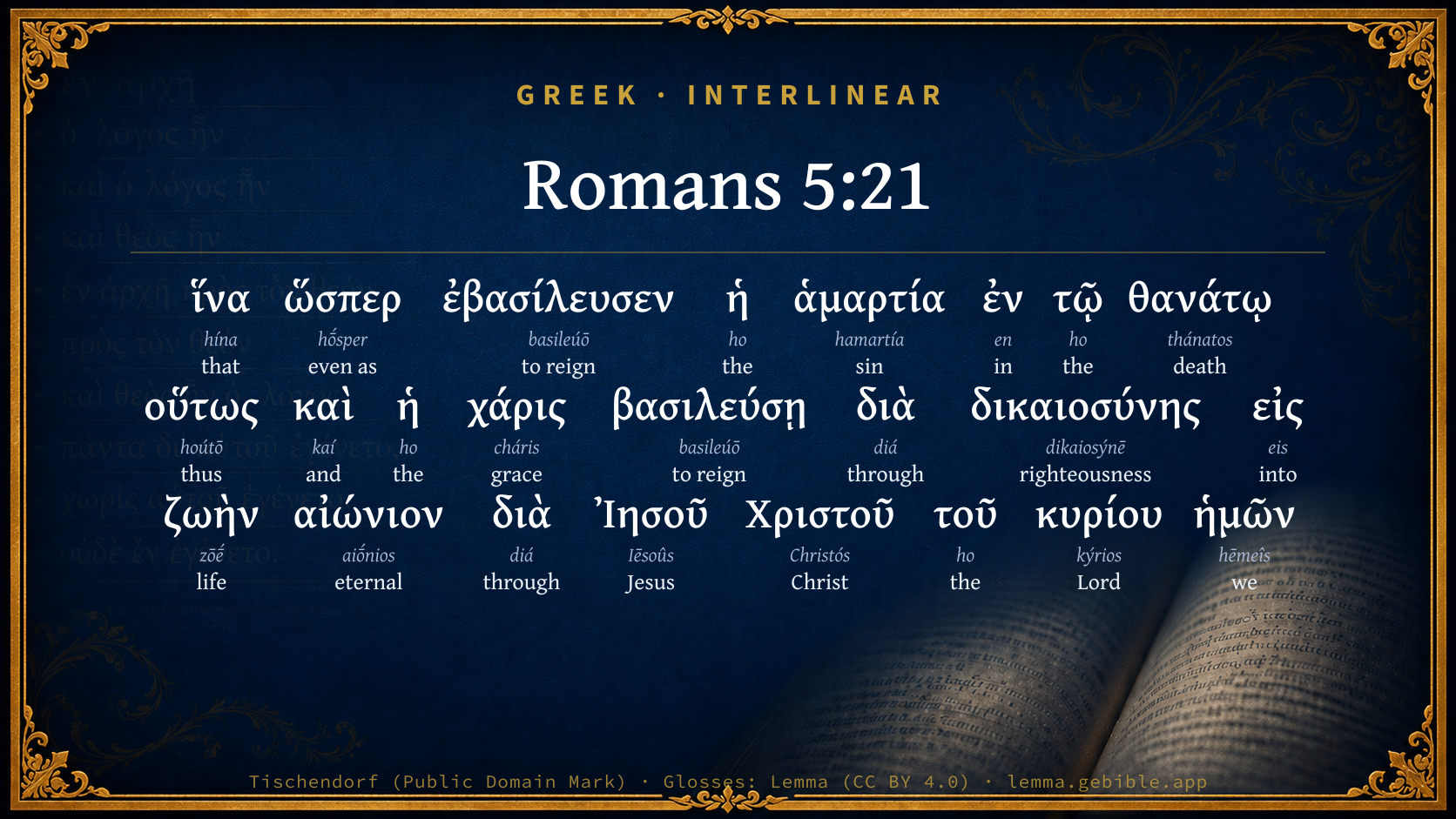
Greek (Tischendorf 8th ed.) Romans 5:21 appears in the Greek New Testament. The text above is from the Tischendorf 8th edition. Each word links to its Strong’s number and a concise gloss. Click any word for its full Thayer’s Greek Lexicon entry.
Download image
Cite this verse

Romans 5:21 (World English Bible). Public Domain. Lemma interlinear Bible study tool, https://lemma.gebible.app/v/romans/5/21.

Show BibTeX & RIS
BibTeX
RIS
English Translation
that as sin reigned in death, even so might grace reign through righteousness to eternal life through Jesus Christ our Lord.
World English Bible · Public Domain
Download a study sheet

One document with this verse’s original text, its word-by-word gloss line, the meaning frame, cross-references with their text, attributed commentary, and full source and license credits — printable, and it pastes into notes with its structure intact.

This verse Autodidact and up

Study sheet (.html) Plain text (.txt)

A passage Seminary Student

Up to 50 verses in one chapter. A passage sheet keeps up to 6 commentary sources and 12 cross-references per verse, in the order this page ranks them, and says so on the sheet whenever that leaves anything out. Ask for a single verse and you get the Autodidact verse sheet above.

Everything on this page stays free to read, with no account — the sheet is a download of what is already on screen, not access to it.

Want to remove ads? Support Godless Engineer
Compare translations 3

The same verse in 3 English versions, stacked beneath the original-language interlinear above. Click any original word for its lexicon entry.

Each is an independent rendering of the whole verse — the interlinear is not word-aligned to these translations.

Highlighted words mark where these versions differ — a whole-verse word diff, not a word-by-word alignment.

  • World English Bible Public Domain
    that as sin reigned in death, even so might grace reign through righteousness to eternal life through Jesus Christ our Lord.
  • King James Version Public Domain
    That as sin hath reigned unto death, even so might grace reign through righteousness unto eternal life by Jesus Christ our Lord.
  • unfoldingWord Literal Text CC BY-SA 4.0
    so that just as sin ruled in death, so also grace might rule through righteousness to everlasting life through Jesus Christ our Lord.

unfoldingWord Literal Text — © unfoldingWord, licensed CC BY-SA 4.0. Word-aligned USFM3 via Door43 (git.door43.org/unfoldingWord/en_ult).

Versions to compare (up to 4)

3 of 4 selected

Show all 19 translations

Every available English version of this verse, each an independent rendering of the whole verse.

  • World English Bible Public Domain
    that as sin reigned in death, even so might grace reign through righteousness to eternal life through Jesus Christ our Lord.
  • Berean Standard Bible Public Domain
    so that, just as sin reigned in death, so also grace might reign through righteousness to bring eternal life through Jesus Christ our Lord.
  • Majority Standard Bible Public Domain
    so that, just as sin reigned in death, so also grace might reign through righteousness to bring eternal life through Jesus Christ our Lord.
  • King James Version Public Domain
    That as sin hath reigned unto death, even so might grace reign through righteousness unto eternal life by Jesus Christ our Lord.
  • American Standard Version (1901) Public Domain
    that, as sin reigned in death, even so might grace reign through righteousness unto eternal life through Jesus Christ our Lord.
  • Revised Version (1885) Public Domain
    that, as sin reigned in death, even so might grace reign through righteousness unto eternal life through Jesus Christ our Lord.
  • Geneva Bible (1599) Public Domain
    That as sinne had reigned vnto death, so might grace also reigne by righteousnesse vnto eternall life, through Iesus Christ our Lord.
  • Douay-Rheims (1899) Public Domain
    That as sin hath reigned to death; so also grace might reign by justice unto life everlasting, through Jesus Christ our Lord.
  • Young's Literal Translation Public Domain
    that even as the sin did reign in the death, so also the grace may reign, through righteousness, to life age-during, through Jesus Christ our Lord.
  • Literal Standard Version CC BY-SA 4.0
    that even as sin reigned in death, so also grace may reign, through righteousness, to continuous life, through Jesus Christ our Lord.
  • Unlocked Literal Bible CC BY-SA 4.0
    This happened so that, as sin ruled in death, even so grace might rule through righteousness for everlasting life through Jesus Christ our Lord.
  • unfoldingWord Literal Text CC BY-SA 4.0
    so that just as sin ruled in death, so also grace might rule through righteousness to everlasting life through Jesus Christ our Lord.
  • Darby Bible Public Domain
    in order that, even as sin has reigned in [the power of] death, so also grace might reign through righteousness to eternal life through Jesus Christ our Lord.
  • World Messianic Bible Public Domain
    that as sin reigned in death, even so grace might reign through righteousness to eternal life through Yeshua the Messiah our Lord.
  • Webster's Bible Public Domain
    That as sin hath reigned to death, even so might grace reign through righteousness to eternal life, by Jesus Christ our Lord.
  • Free Bible Version CC BY-SA 4.0
    Just as sin ruled us and brought us death, now grace rules by making us right with God, bringing us eternal life through Jesus Christ our Lord.
  • Bible in Basic English Public Domain
    That, as sin had power in death, so grace might have power through righteousness to eternal life through Jesus Christ our Lord.
  • Text-Critical English NT CC BY 4.0
    so that just as sin reigned in death, so also grace might reign through righteousness leading to eternal life through Jesus Christ our Lord.
  • Tyndale New Testament (1534) Public Domain
    That as synne had raigned vnto deeth even so might grace raygne thorow rightewesnes vnto eternall lyfe by the helpe of Iesu Christ.

Literal Standard Version (2020), Covenant Press — licensed CC BY-SA 4.0. Text via the HelloAO Bible API (eBible.org). Unlocked Literal Bible (unfoldingWord) — licensed CC BY-SA 4.0. Text via the HelloAO Bible API (eBible.org). unfoldingWord Literal Text — © unfoldingWord, licensed CC BY-SA 4.0. Word-aligned USFM3 via Door43 (git.door43.org/unfoldingWord/en_ult). Free Bible Version, Dr. Jonathan Gallagher — licensed CC BY-SA 4.0. Text via the HelloAO Bible API (eBible.org).

Word by word

More ways to search: Search by grammar → Find every occurrence → Compare this word →

Practice this passage: Drill this verse → Learn its vocabulary →

ἐβασίλευσεν
basileúō
G936
“to reign”
Verb, Aorist, Active, Indicative, 3rd person, Singular
Part of Speech
Verb
Tense
Aorist
Voice
Active
Mood
Indicative
Person
3rd person
Number
Singular
Full Thayer's Definition

Origin: from G935

TDNT: 10:51,0

1. to be king, to exercise kingly power, to reign a. of the governor of a province b. of the rule of the Messiah c. of the reign of Christians in the millennium 2. metaph. to exercise the highest influence, to control
  1. ἵνα hína G2443 “that” Conjunction
  2. ὥσπερ hṓsper G5618 “even as” Adverb
  3. ἡ ho G3588 “the” Article, Nominative, Singular, Feminine
  4. ἁμαρτία hamartía G266 “sin” Noun, Nominative, Singular, Feminine
  5. ἐν en G1722 “in” Preposition
  6. τῷ ho G3588 “the” Article, Dative, Singular, Masculine
  7. θανάτῳ thánatos G2288 “death” Noun, Dative, Singular, Masculine
  8. οὕτως hoútō G3779 “thus” Adverb
  9. καὶ kaí G2532 “and” Conjunction
  10. ἡ ho G3588 “the” Article, Nominative, Singular, Feminine
  11. χάρις cháris G5485 “grace” Noun, Nominative, Singular, Feminine
  12. βασιλεύσῃ basileúō G936 “to reign” Verb, Aorist, Active, Subjunctive, 3rd person, Singular
  13. διὰ diá G1223 “through” Preposition
  14. δικαιοσύνης dikaiosýnē G1343 “righteousness” Noun, Genitive, Singular, Feminine
  15. εἰς eis G1519 “into” Preposition
  16. ζωὴν zōḗ G2222 “life” Noun, Accusative, Singular, Feminine
  17. αἰώνιον aiṓnios G166 “eternal” Adjective, Accusative, Singular, Feminine
  18. διὰ diá G1223 “through” Preposition
  19. Ἰησοῦ Iēsoûs G2424 “Jesus” Noun, Genitive, Singular, Masculine
  20. Χριστοῦ Christós G5547 “Christ” Noun, Genitive, Singular, Masculine
  21. τοῦ ho G3588 “the” Article, Genitive, Singular, Masculine
  22. κυρίου kýrios G2962 “Lord” Noun, Genitive, Singular, Masculine
  23. ἡμῶν hēmeîs G2249 “we” Personal pronoun, 1st person, Genitive, Plural

About this verse

These counts appear in no published source. They are computed here, from the morphology-tagged text and Lemma’s own curated glosses. What Lemma adds →

24
words
19
distinct lemmas
Pauline Epistles
section

Notable vocabulary

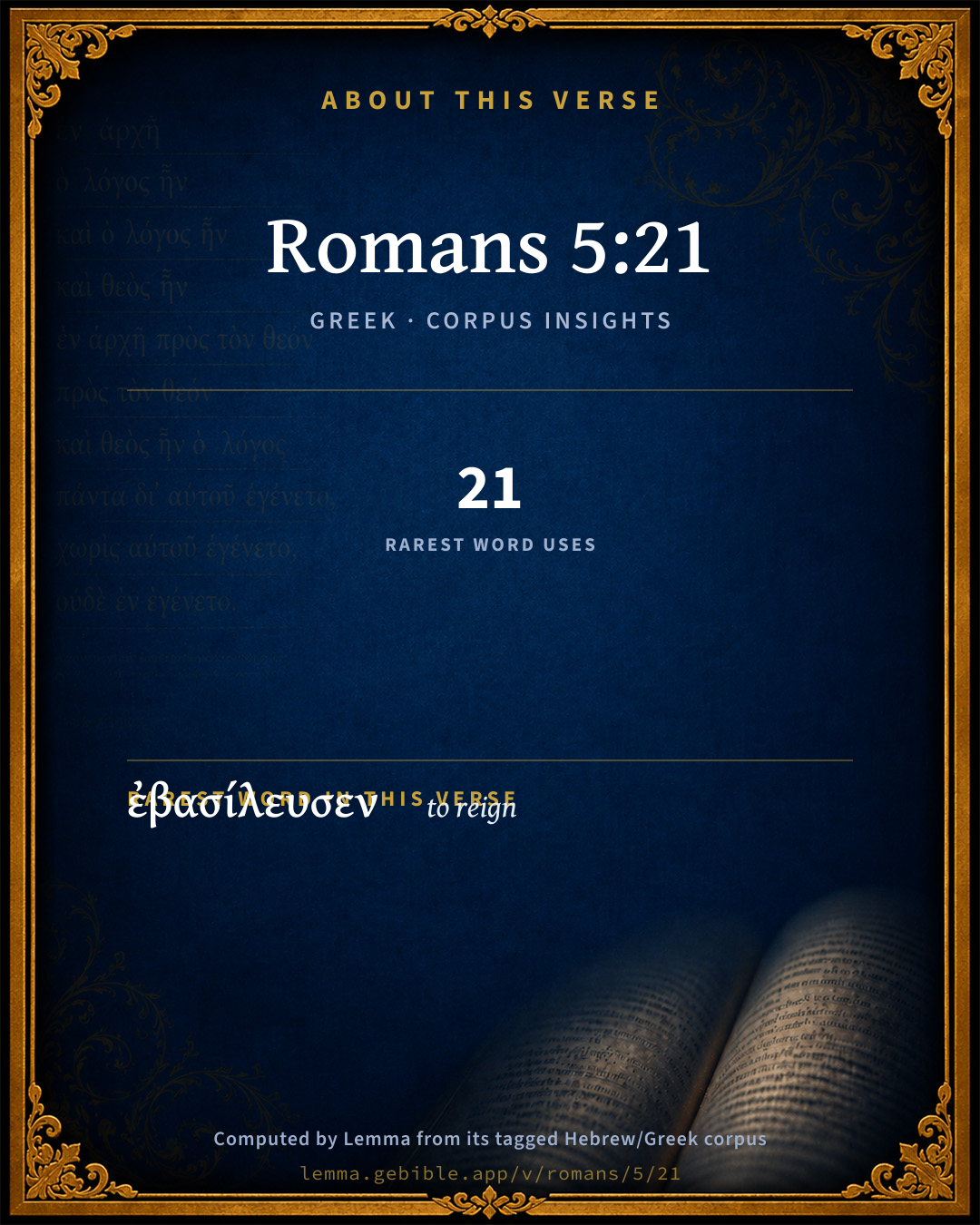
The rarest word here is ἐβασίλευσεν to reign G936 — appearing just 21 times in the whole Greek New Testament.

Shared distinctive vocabulary

ἐβασίλευσεν to reign G936 occurs in 18 verses of the Greek New Testament. Also found in:

Repetition

Words recur within this verse:

  • ἐβασίλευσεν to reign G936 ×2
  • διὰ through G1223 ×2
  • ἡ the G3588 ×4

Cross-references

17

Topical passages linked to Romans 5:21 in the Treasury of Scripture Knowledge — connected by theme and wording, ordered by reader-vote popularity; previews shown in the World English Bible.

  • Titus 2:11 For the grace of God has appeared, bringing salvation to all men,
  • Romans 5:14 Nevertheless death reigned from Adam until Moses, even over those whose sins weren't like Adam's disobedience, who is a foreshadowing of him who was to come.
  • Romans 8:10 If Christ is in you, the body is dead because of sin, but the spirit is alive because of righteousness.
  • John 1:16–17 From his fullness we all received grace upon grace.
  • Romans 6:14 For sin will not have dominion over you. For you are not under law, but under grace.
  • Romans 6:23 For the wages of sin is death, but the free gift of God is eternal life in Christ Jesus our Lord.
  • Romans 5:12 Therefore, as sin entered into the world through one man, and death through sin; and so death passed to all men, because all sinned.
  • Romans 5:17 For if by the trespass of the one, death reigned through the one; so much more will those who receive the abundance of grace and of the gift of righteousness reign in life through the one, Jesus Christ.
  • Romans 6:12 Therefore don't let sin reign in your mortal body, that you should obey it in its lusts.
  • Romans 6:16 Don't you know that to whom you present yourselves as servants to obedience, his servants you are whom you obey; whether of sin to death, or of obedience to righteousness?
  • 1 Peter 5:10 But may the God of all grace, who called you to his eternal glory by Christ Jesus, after you have suffered a little while, perfect, establish, strengthen, and settle you.
  • 1 John 2:25 This is the promise which he promised us, the eternal life.
  • John 10:28 I give eternal life to them. They will never perish, and no one will snatch them out of my hand.
  • Romans 4:13 For the promise to Abraham and to his seed that he should be heir of the world wasn't through the law, but through the righteousness of faith.
  • Hebrews 4:16 Let us therefore draw near with boldness to the throne of grace, that we may receive mercy, and may find grace for help in time of need.
  • 2 Peter 1:1 Simon Peter, a servant and apostle of Jesus Christ, to those who have obtained a like precious faith with us in the righteousness of our God and Savior, Jesus Christ:
  • 1 John 5:11–13 The testimony is this, that God gave to us eternal life, and this life is in his Son.

Cross-references courtesy of OpenBible.info (CC BY 4.0).

Commentary

Notes on Romans 5:21 from classic Christian and Jewish commentators (each source and its license shown beneath its notes). The classic Christian expositions comment on the surrounding passage and are grouped to its opening verse, so a note may address several verses; the Jewish commentaries on the Tanakh (Rashi and others) are per-verse, so they appear only where the commentator wrote on this verse.

Lemma curates 59 commentaries, every one of them public domain or Creative Commons licensed, each selected and text-cleaned for this edition rather than reprinted as found. About our sources →

MacLaren's Expositions of Holy Scripture

Alexander MacLaren

Romans

THE WARRING QUEENS

Rom 5:21.

I am afraid this text will sound to some of you rather unpromising. It is full of well-worn terms, ‘sin,’ ‘death,’ ‘grace,’ ‘righteousness,’ ‘eternal life,’ which suggest dry theology, if they suggest anything. When they welled up from the Apostle’s glowing heart they were like a fiery lava-stream. But the stream has cooled, and, to a good many of us, they seem as barren and sterile as the long ago cast out coils of lava on the sides of a quiescent volcano. They are so well-worn and familiar to our ears that they create but vague conceptions in our minds, and they seem to many of us to be far away from a bearing upon our daily lives. But you much mistake Paul if you take him to be a mere theological writer. He is an earnest evangelist, trying to draw men to love and trust in Jesus Christ. And his writings, however old-fashioned and doctrinally hard they may seem to you, are all throbbing with life-instinct with truths that belong to all ages and places, and which fit close to every one of us.

I do not know if I can give any kind of freshness to these words, but I wish to try. To begin with, I notice the highly-imaginative and picturesque form into which the Apostle casts his thoughts here. He, as it were, draws back a curtain, and lets us see two royal figures, which are eternally opposed and dividing the dominion between them. Then he shows us the issues to which these two rulers respectively conduct their subjects; and the question that is trembling on his lips is ‘Under which of them do you stand?’ Surely that is not fossil theology, but truths that are of the highest importance, and ought to be of the deepest interest, to every one of us. They are to you the former, whether they are the latter or not.

I. So, first, look at the two Queens who rule over human life.

Sin and Grace are both personified; and they are both conceived of as female figures, and both as exercising dominion. They stand face to face, and each recognises as her enemy the other. The one has established her dominion: ‘Sin hath reigned.’ The other is fighting to establish hers: ‘That Grace might reign.’ And the struggle is going on between them, not only on the wide field of the world; but in the narrow lists of the heart of each of us.

Sin reigns. The truths that underlie that solemn picture are plain enough, however unwelcome they may be to some of us, and however remote from the construction of the universe which many of us are disposed to take.

Now, let us understand our terms. Suppose a man commits a theft. You may describe it from three different points of view. He has thereby broken the law of the land; and when we are thinking about that we call it crime. He has also broken the law of ‘morality,’ as we call it; and when we are looking at his deed from that point of view, we call it vice. Is that all? He has broken something else. He has broken the law of God; and when we look at it from that point of view we call it sin. Now, there are a great many things which are sins that are not crimes; and, with due limitations, I might venture to say that there are some things which are sins that are not to be qualified as vices. Sin implies God. The Psalmist was quite right when he said; ‘Against Thee, Thee only have I sinned’; although he was confessing a foul injury he had done to Bathsheba, and a glaring crime that he had committed against Uriah. It was as to God, and in reference to Him only, that his crime and his vice darkened and solidified into sin.

And what is it, in our actions or in ourselves considered in reference to God, that makes our actions sins and ourselves sinners? Remember the prodigal son. ‘Father! Give me the portion of goods that falleth to me.’ There you have it all. He went away, and ‘wasted his substance in riotous living.’ To claim myself for my own; to act independently of, or contrary to, the will of God; to try to shake myself clear of Him; to have nothing to do with Him, even though it be by mere forgetfulness and negligence, and, in all my ways to comport myself as if I had no relations of dependence on and submission to him-that is sin. And there may be that oblivion or rebellion, not only in the gross vulgar acts which the law calls crimes, or in those which conscience declares to be vices, but also in many things which, looked at from a lower point of view, may be fair and pure and noble. If there is this assertion of self in them, or oblivion of God and His will in them, I know not how we are to escape the conclusion that even these fall under the class of sins. For there can be no act or thought, truly worthy of a man, situated and circumstanced as we are, which has not, for the very core and animating motive of it, a reference to God.

Now, when I come and say, as my Bible teaches me to say, that this is the deepest view of the state of humanity that sin reigns, I do not wish to fall into the exaggerations by which sometimes that statement has been darkened and discredited; but I do want to press upon you, dear brethren, this, as a matter of personal experience, that wherever there is a heart that loves, and leaves God out, and wherever there is a will that resolves, determines, impels to action, and does not bow itself before Him, and wherever there are hands that labour, or feet that run, at tasks and in paths self-chosen and unconsecrated by reference to our Father in heaven, no matter how great and beautiful subsidiary lustres may light up their deeds, the very heart of them all is transgression of the law of God. For this, and nothing else or less, is His law: ‘Thou shalt love the Lord thy God with all thy heart, and with all thy soul, and with all thy strength, and with all thy mind.’ I do not charge you with crimes. You know how far it would be right to charge you with vices. I do not charge you with anything; but I pray you to come with me and confess: ‘We all have sinned, and come short of the glory of God.’

I suppose I need not dwell upon the difficulty of getting a lodgment for this conviction in men’s hearts. There is no sadder, and no more conclusive proof, of the tremendous power of sin over us, than that it has lulled us into unconsciousness, hard to be broken, of its own presence and existence. You remember the old stories-I suppose there is no truth in them, but they will do for an illustration-about some kind of a blood-sucking animal that perched upon a sleeping man, and with its leathern wings fanned him into deeper drowsiness whilst it drew from him his life-blood. That is what this hideous Queen does for men. She robes herself in a dark cloud, and sends out her behests from obscurity. And men fancy that they are free whilst all the while they are her servants. Oh, dear brethren! you may call this theology, but it is a simple statement of the facts of our condition. ‘Sin hath reigned.’

And now turn to the other picture, ‘Grace might reign.’ Then there is an antagonistic power that rises up to confront the widespread dominion of this anarch of old. And this Queen comes with twenty thousand to war against her that has but ten thousand on her side.

Again I say, let us understand our terms. I suppose, there are few of the keywords of the New Testament which have lost more of their radiance, like quicksilver, by exposure in the air during the centuries than that great word Grace, which is always on the lips of this Apostle, and to him had music in its sound, and which to us is a piece of dead doctrine, associated with certain high Calvinistic theories which we enlightened people have long ago grown beyond, and got rid of. Perhaps Paul was more right than we when his heart leaped up within him at the very thought of all which he saw to lie palpitating and throbbing with eager desire to bless men, in that great word. What does he mean by it? Let me put it into the shortest possible terms. This antagonist Queen is nothing but the love of God raying out for ever to us inferior creatures, who, by reason of our sinfulness, have deserved something widely different. Sin stands there, a hideous hag, though a queen; Grace stands here, ‘in all her gestures dignity and love,’ fair and self-communicative, though a sovereign. The love of God in exercise to sinful men: that is what the New Testament means by grace. And is it not a great thought?

Notice, for further elucidation of the Apostle’s conception, how he sacrifices the verbal correctness of his antithesis in order to get to the real opposition. What is the opposite of Sin? Righteousness. Why does he not say, then, that ‘as Sin hath reigned unto death, even so might Righteousness reign unto life’ ? Why? Because it is not man, or anything in man, that can be the true antagonist of, and victor over, the regnant Sin of humanity; but God Himself comes into the field, and only He is the foe that Sin dreads. That is to say, the only hope for a sin-tyrannised world is in the out-throb of the love of the great heart of God. For, notice the weapon with which He fights man’s transgression, if I may vary the figure for a moment. It is only subordinately punishment, or law, or threatening, or the revelation of the wickedness of the transgression. All these have their places, but they are secondary places. The thing that will conquer a world’s wickedness is nothing else but the manifested love of God. Only the patient shining down of the sun will ever melt the icebergs that float in all our hearts. And wonderful and blessed it is to think that, in whatsoever aspects man’s sin may have been an interruption and a contradiction of the divine purpose, out of the evil has come a good; that the more obdurate and universal the rebellion, the more has it evoked a deeper and more wondrous tenderness. The blacker the thundercloud, the brighter glows the rainbow that is flung across it. So these two front each other, the one settled in her established throne-

‘Fierce as ten furies, terrible as hell-’

the other coming on her adventurous errand to conquer the world to herself, and to banish the foul tyranny under which men groan. ‘Sin hath reigned.’ Grace is on her way to her dominion.

II. Notice the gifts of these two Queens to their subjects.

‘Sin hath reigned in death’ {as the accurate translation has it}; ‘Grace reigns unto eternal life.’ The one has established her dominion, and its results are wrought out, her reign is, as it were, a reign in a cemetery; and her subjects are dead. If you want a modern instance to illustrate an ancient saw, think of Armenia. There is a reign whose gifts to its subjects are death. Sin reigns, says Paul, and for proof points to the fact that men die.

Now, I am not going to enter into the question here, and now, whether physical death passes over mankind because of the fact of transgression. I do not suppose that this is so. But I ask you to remember that when the Bible says that ‘Death passed upon all men, for all have sinned,’ it does not merely mean the physical fact of dissolution, but it means that fact along with the accompaniments of it, and the forerunners of it, in men’s consciences. ‘The sting of death is sin,’ says Paul, in another place. By which he implies, I presume, that, if it were not for the fact of alienation from God and opposition to His holy will, men might lie down and die as placidly as an animal does, and might strip themselves for it ‘as for a bed, that longing they’d been sick for.’ No doubt, there was death in the world long before there were men in it. No doubt, also, the complex whole phenomenon gets its terror from the fact of men’s sin.

But it is not so much that physical fact with its accompaniments which Paul is thinking about when he says that ‘sin reigns in death,’ as it is that solemn truth which he is always reiterating, and which I pray you, dear friends, to lay to heart, that, whatever activity there may be in the life of a man who has rent himself away from dependence upon God-however vigorous his brain, however active his hand, however full charged with other interests his life, in the very depth of it is a living death, and the right name for it is death. So this is Sin’s gift-that over our whole nature there come mortality and decay, and that they who live as her subjects are dead whilst they live. Dear brethren, that may be figurative, but it seems to me that it is absurd for you to turn away from such thoughts, shrug your shoulders, and say, ‘Old-fashioned Calvinistic theology!’ It is simply putting into a vivid form the facts of your life and of your condition in relation to God, if you are subjects of Sin.

Then, on the other hand, the other queenly figure has her hands filled with one great gift which, like the fatal bestowment which Sin gives to her subjects, has two aspects, a present and a future one. Life, which is given in our redemption from Death and Sin, and in union with God; that is the present gift that the love of God holds out to every one of us. That life, in its very incompleteness here, carries in itself the prophecy of its own completion hereafter, in a higher form and world, just as truly as the bud is the prophet of the flower and of the fruit; just as truly as a half-reared building is the prophecy of its own completion when the roof tree is put upon it. The men that here have, as we all may have if we choose, the gift of life eternal in the knowledge of God through Jesus Christ His Son, must necessarily tend onwards and upwards to a region where Death is beneath the horizon, and Life flows and flushes the whole heaven. Brother! do you put out your whole hand to take the poisoned gift from the claw-like hand of that hideous Queen; or do you turn and take the gift of life eternal from the hands of the queenly Grace?

III. How this queenly Grace gives her gifts.

You observe that the Apostle, as is his wont-I was going to say-gets himself entangled in a couple of almost parenthetical or, at all events, subsidiary sentences. I suppose when he began to write he meant to say, simply, ‘as Sin hath reigned unto death, so Grace might reign unto life.’ But notice that he inserts two qualifications: ‘through righteousness,’ ‘through Jesus Christ our Lord.’ What does he mean by these?

He means this, first, that even that great love of God, coming throbbing straight from His heart, cannot give eternal life as a mere matter of arbitrary will. God can make His sun to shine and His rain to fall, ‘on the unthankful and on the evil,’ and if God could, God would give eternal life to everybody, bad and good; but He cannot. There must be righteousness if there is to be life. Just as sin’s fruit is death, the fruit of righteousness is life.

He means, in the next place, that whilst there is no life without righteousness, there is no righteousness without God’s gift. You cannot break away from the dominion of Sin, and, as it were, establish yourselves in a little fortress of your own, repelling her assaults by any power of yours. Dear brethren, we cannot undo the past; we cannot strip off the poisoned garment that clings to our limbs; we can mend ourselves in many respects, but we cannot of our own volition and motion clothe ourselves with that righteousness of which the wearers shall be worthy to ‘pass through the gate into the city.’ There is no righteousness without God’s gift.

And the other subsidiary clause completes the thought: ‘through Christ.’ In Him is all the grace, the manifest love, of God gathered together. It is not diffused as the nebulous light in some chaotic incipient system, but it is gathered into a sun that is set in the centre, in order that it may pour down warmth and life upon its circling planets. The grace of God is in Christ Jesus our Lord. In Him is life eternal; therefore, if we desire to possess it we must possess Him. In Him is righteousness; therefore, if we desire our own foulness to be changed into the holiness which shall see God, we must go to Jesus Christ. Grace reigns in life, but it is life through righteousness, which is through Jesus Christ our Lord.

So, then, brother, my message and my petition to each of you are-knit yourself to Him by faith in Him. Then He who is ‘full of grace and truth’ will come to you; and, coming, will bring in His hands righteousness and life eternal. If only we rest ourselves on Him, and keep ourselves close in touch with Him; then we shall be delivered from the tyranny of the darkness, and translated into the Kingdom of the Son of His love.

Alexander MacLaren, Expositions of Holy Scripture (1904–1910) — public domain. Text from a community e-Sword module.

Bengel's Gnomon

Johann Albrecht Bengel

Rom 5:21. Ἐν τῷ θανατῳ—ἐις ζωὴν, in death—unto life) The difference is here exemplified between the particles ἐν and ἐις. Death has its limits and boundary, whereas life is everlasting, and [by divine power] divinely extended. Death is not said to be eternal; whereas life is said to be eternal, ch. Rom 6:21, etc.—ἡ χάρις βασιλεύσῃ, that grace might reign) Grace therefore has had, as it were, no reign, that is, it has had a most brief reign before the fall. We may believe, that Adam sinned not long after that he was created.—Ἰησο͂υ, Jesus) Now no longer is Adam even mentioned: the mention of Christ alone prevails.

Bengel's Gnomon of the New Testament — English translation (T&T Clark, Edinburgh, 1860) — public domain. Text from a community e-Sword module.

Hodge's Commentary on Romans, Ephesians & First Corinthians

Charles Hodge

Rom_5:21

That as sin hath reigned unto death, etc. That, ἵνα, in order that, as expressing the divine purpose. The design of God in permitting sin, and in allowing it to abound, was to bring good out of evil; to make it the occasion of the most wonderful display of his glory and grace, so that the benefits of redemption should infinitely transcend the evils of the apostasy. Sin reigned, ἐν τῷ θανάτῳ, not unto, but in death, or through death. Death spiritual as well as temporal evil in its widest sense, as the judicial consequence of sin, was the sphere in which the power or triumph of sin was manifested. Even so might grace reign, (ὥσπερ οὕτω και&), as the one has happened, so also the other. The one is in order to the other. Grace is the unmerited love of God and its consequences. It reigns, i.e., it is abundantly and effectively displayed, unto eternal life, (εἰς ζωὴν αἰώνιον,) in securing as the result of its exercise, eternal life. This is done (διὰ δικαιοσύνης) by means of righteousness, and that righteousness is through Jesus Christ our Lord. As the triumph of sin over our race was through the offense of Adam, so the triumph of grace is through the righteousness of Christ. The construction of this passage, assumed in the above interpretation, is to be preferred to that which connects δικαιοσύνης εἰς ζωὴν αἰώνιον, righteousness which is unto eternal life, because the antithesis is not between death and righteousness, but between death and life: Sin reigns in death, grace reigns unto life. That the benefits of redemption shall far outweigh the evils of the fall, is here clearly asserted. This we can in a measure comprehend, because,

1. The number of the saved shall doubtless greatly exceed the number of the lost. Since the half of mankind die in infancy, and, according to the Protestant doctrine, are heirs of salvation; and since in the future state of the Church the knowledge of the Lord is to cover the earth, we have reason to believe that the lost shall bear to the saved no greater proportion than the inmates of a prison do to the mass of the community.

2. Because the eternal Son of God, by his incarnation and mediation, exalts his people to a far higher state of being than our race, if unfallen, could ever have attained.

3. Because the benefits of redemption are not to be confined to the human race. Christ is to be admired in his saints. It is through the Church that the manifold wisdom of God is to be revealed, throughout all ages, to principalities and powers. The redemption of man is to be the great source of knowledge and blessedness to the intelligent universe.

Doctrine

I. The doctrine of imputation is clearly taught in this passage. This doctrine does not include the idea of a mysterious identity of Adam and his race; nor that of a transfer of the moral turpitude of his sin to his descendants. It does not teach that his offense was personally or properly the sin of all men, or that his act was, in any mysterious sense, the act of his posterity. Neither does it imply, in reference to the righteousness of Christ, that his righteousness becomes personally and inherently ours, or that his moral excellence is in any way transferred from him to believes. The sin of Adam, therefore, is no ground to us of remorse; and the righteousness of Christ is no ground of self-complacency in those to whom it is imputed. This doctrine merely teaches, that in virtue of the union, representative and natural, between Adam and his posterity, his sin is the ground of their condemnation, that is, of their subjection to penal evils; and that in virtue of the union between Christ and his people, his righteousness is the ground of their justification. This doctrine is taught almost in so many words in Rom_5:12, Rom_5:15-19. It is so clearly stated, so often repeated or assumed, and so formally proved, that very few commentators of any class fail to acknowledge, in one form or another, that it is the doctrine of the apostle.

It would be easy to prove that the statement of the doctrine just given is a correct exhibition of the form in which it was held by the great body of the Reformed Churches and divines. A few quotations from men of universally recognized authority, as competent witnesses on this subject, must suffice. Turrettin (Theol. ElenRomans Quaest. IX., p. 678) says, Imputation is either of something foreign to us, or of something properly our own. Sometimes that is imputed to us which is personally ours; in which sense God imputes to sinners their transgressions. Sometimes that is imputed which is without us, and not performed by ourselves; thus the righteousness of Christ is said to be imputed to us, and our sins are imputed to him, although he has neither sin in himself, nor we righteousness. Here we speak of the latter kind of imputation, not of the former, because we are treating of a sin committed by Adam, not by us. The ground of this imputation is the union between Adam and his posterity. This union is not a mysterious identity of person, but,

1. Natural, as he is the father, and we are the children.

2. Political and forensic, as he was the representative head and chief of the whole human race.

The foundation, therefore, of imputation is not only the natural connection which exists between us and Adam, since in that case all his sins might be imputed to us, but mainly the moral and federal, in virtue of which God entered into covenant with him as our head. Again, We are constituted sinners in Adam in the same way in which we are constituted righteous in Christ. Again (Vol. 2., p. 707), to impute, he says, is a forensic term, which is not to be understood physically of the infusion of righteousness, but judicially and relatively. Imputation does not alter the moral character; hence the same individual may, in different respects, be called both just and unjust: For when reference is had to the inherent quality, he is called a sinner and ungodly; but when the external and forensic relation to Christ is regarded, he is pronounced just in Christ. When God justifies us on account of the righteousness of Christ, his judgment is still according to truth; because he does not pronounce us just in ourselves subjectively, which would be false, but in another putatively and relatively. Tuckney, (Proelectiones, p. 234), We are counted righteous through Christ in the same manner that we are counted guilty through Adam. The latter is by imputation, therefore also the former. We are not so foolish or blasphemous as to say, or even to think, that the imputed righteousness of Christ makes us formally and subjectively righteous; see further quotations from this writer on Rom_4:5. Owen (in his work on Justification, p. 236) says, Things which are not our own originally, inherently, may yet be imputed to us, ex justitia, by the rule of righteousness. And this may be done upon a double relation unto those whose they are,

1. Federal.

2. Natural.

Things done by one may be imputed unto others, propter relationem foederalem, because of a covenant relation between them. So the sin of Adam was imputed unto all his posterity. And the ground hereof is, that we stood in the same covenant with him who was our head and representative. On page 242, he says, This imputation (of Christs righteousness) is not the transmission or transfusion of the righteousness of another into them which are to be justified, that they should become perfectly and inherently righteous thereby. For it is impossible that the righteousness of one should be transfused into another to become his subjectively and inherently. Again, page 307, As we are made guilty by Adams actual sin, which is not inherent in us, but only imputed to us; so are we made righteous by the righteousness of Christ, which is not inherent in us, but only imputed to us. On page 468, he says, Nothing is intended by the imputation of sin unto any, but the rendering them justly obnoxious unto the punishment due unto that sin. As the not imputing of sin is the freeing of men from being subject or liable to punishment. It is one of his standing declarations, To be alienae culpae reus, makes no man a sinner. Knapp (in his Lectures on Theology, sect. 76) says, in stating what the doctrine of imputation is, Gods imputing the sin of our first parents to their descendants, amounts to this: God punishes the descendants on account of the sin of their first parents. This he gives as a mere historical statement of the nature of the doctrine, and the form in which its advocates maintained it. Zachariae (Bib. Theologie, Vol. 2., p. 394) says, If God allows the punishment which Adam incurred, to come on all his descendants, he imputes his sin to them all. And, in this sense, Paul maintains that the sin of Adam is imputed to all, because the punishment of the one offense of Adam has come upon all. And Bretschneider, as quoted above, on Rom_4:3, when stating the doctrine of the Reformers, as presented in the various creeds published under their authority, says, that they regarded justification, which includes the idea of imputation, as a forensic or judicial act of God, by which the relation of man to God, and not the man himself, was changed. And imputation of righteousness they described as that judgment of God, according to which he treats us as though we had not sinned, but had fulfilled the law, or as though the righteousness of Christ was ours. This view of justification they constantly maintained in opposition to the Papists, who regarded it as a moral change, consisting in what they called the infusion of righteousness.

Though this view of the nature of imputation, both of sin and righteousness, is so familiar, yet as almost all the objections to the doctrine are founded on the assumption that it proceeds on the ground of a mysterious identity between Adam and his race on the one hand, and Christ and his people on the other; and that it implies the transfer of the moral character of the acts imputed, it seemed necessary to present some small portion of the evidence which might be adduced, to show that the view of the subject presented above is that which has always been held by the great body of the Reformed Churches. The objections urged against this doctrine at the present day, are precisely the same which were urged by the Roman Catholics against the Reformers; and the answers which we are obliged to repeat, are the same which the Reformers and their successors gave to those with whom they had to contend.

It will be seen how large a portion of the objections are answered by the mere statement of the doctrine.

1. It is objected that this doctrine contradicts the essential principles of moral consciousness. We never did, and never can feel guilty of anothers act, which was done without any knowledge or concurrence of our own. We may just as well say we can appropriate to ourselves, and make our own, the righteousness of another, as his unrighteousness. But we can never, in either case, even force ourselves into a consciousness that any act is really our own, except one in which we have had a personal and voluntary concern. A transfer of moral turpitude is just as impossible as a transfer of souls; nor does it lie within the boundary of human effort, that we should repent of Adams sin. Prof. Stuart, p. 239. This idea is repeated very frequently in his commentary on this passage, and the Excursus, 4, 5. To say Adams disobedience was the occasion, or ground, or instrumental cause of all men becoming sinners, and was thus an evil to them all, and to say that his disobedience was personally theirs, is saying two very different things. I see no way in which this last assertion can ever be made out by philology. Compare Mr. Barnes, p. 119. Professor Stuart further says, page 212, that if Rom_5:12 speaks of the imputation of Adams sin, it could not be said men had not sinned after the likeness of Adams transgression. So far from this must it be, that Adams sin is their very sin, and the ground why death reigns over them. Mr. Barnes says, page 119, If the doctrine of imputation be true, they not only had sinned after the similitude of Adams transgression, but had sinned the very identical sin. It was precisely like him. It was the very thing itself. In like manner, on page 96, he says, But if the doctrine of the Scriptures was, that the entire righteousness of Christ was set over to them, was really and truly theirs, and was transferred to them in any sense with what propriety could the apostle say that God justified the ungodly? etc. They are eminently pure, and have a claim not of grace, but of debt to the very highest rewards of heaven. It will be at once perceived that these and similar objections are all founded on a misapprehension of the doctrine in question. They are all directed against the ideas of identity of person, and transfer of moral character, neither of which is, as we have seen, included in it; they are, moreover, not only inconsistent with the true nature of the doctrine, but with the statements and arguments of these writers themselves. Thus Professor Stuart, page 239, says, That the son shall not die for the iniquity of the father, is as true as that the father shall not die for the iniquity of the son; as God has most fully declared in Ezekiel 18. According to this view of the subject, for the son to die for the iniquity of the father, is to have the sin of the father imputed to him, or laid to his charge. The ideas of personal identity and transfer of moral character are necessarily excluded from it, by its opponents themselves, who thus virtually admit the irrelevancy of their previous objections. The fact is, that imputation is never represented as affecting the moral character, but merely the relation of men to God and his law. To impute sin is to regard and treat as a sinner; and to impute righteousness is to regard and treat as righteous.

2. It is said that this doctrine is nothing but a theory, an attempt to explain what the apostle does not explain, a philosophical speculation, etc. This again is a mistake. It is neither a theory nor a philosophical speculation, but the statement of a scriptural fact in scriptural language. Paul says, For the offense of one man all men are condemned; and for the righteousness of one all are regarded and treated as righteous. This is the whole doctrine.

3. It is asserted that the word impute is never used in the Bible, in reference to reckoning or charging upon a man any thing which is not strictly and properly his own. But this has been shown to be incorrect; see Rom_4:3. It is used twice in Romans 4, of imputing righteousness to those without works, to the ungodly, etc. But if the objection were well founded, it would be destitute of any force; for if the word means so to ascribe an action to a man as to treat him as the author of it, it would be correct and scriptural to say that the sin or righteousness of one man is imputed to another, when that sin or righteousness is made the ground of the condemnation or justification of any other than its personal authors.

4. It is denied that Adam was the representative of his posterity, because he is not so called in Scripture, and because a representative supposes the consent of those for whom he acts. But this a mistake. It is rare that a representative is appointed by the choice of all on whom his acts are binding. This is the case in no country in the world; and nothing is more common than for a parent or court to appoint a guardian to act as the representative of a minor. If it is competent for a parent to make such an appointment, it is surely proper in God. It is a mere question of fact. If the Scriptures teach that Adam was on trial not for himself only, but also for his posterity; if the race fell when he fell; then do they teach that he was in fact and form their representative. That they do teach the fact supposed, can scarcely be denied; it is asserted as often as it is stated that the sin of Adam was the ground of the condemnation of men.

5. It is said that the doctrine of imputation is inconsistent with the first principles of justice. This objection is only of force against the mistaken view given above. It has no weight against the true doctrine. It is on all hands admitted that the sin of Adam involved the race in ruin. This is the whole difficulty. How is it to be reconciled with the divine character, that the fate of unborn millions should depend on an act over which they had not the slightest control, and in which they had no agency? This difficulty presses the opponents of the doctrine more heavily than its advocates. The former have no advantage over the latter; not in the amount of evil inflicted, because they make the evil directly indicted on account of Adams sin much greater than the others do; not in the provision made for the redemption of the race from this evil, because both maintain that the work of Christ brings the offer of life to the whole race while it infallibly secures the salvation of a multitude which no man can number. The opinion of those writers not only has no advantage over the common doctrine, but it is encumbered with difficulties peculiar to itself. It represents the race as being involved in ruin and condemnation, without having the slightest probation. According to one view, they are born with a corrupt disposition, and with the loss of righteousness, and subjection to pain and woe, by a mere arbitrary appointment of God, and without a trial, either personally, or by a representative. According to another view, men are born without any such corrupt disposition, but in a state of indifference, and are placed on their probation at the very first moment of moral agency, and under a constitution which infallibly secures their becoming sinners. According to the realistic doctrine, revived by the modern speculative theologians of the school of Schleiermacher, humanity existed as a generic life in Adam. The acts of that life were therefore the acts of all the individuals to whom, in the development of the race, the life itself was communicated. All men consequently sinned in Adam, by an act of self-determination. They are punished, therefore, not for Adams act, but for their own; not simply for their innate depravity, nor for their personal acts only, but for the act which they committed thousands of years ago, when their nature, i.e. their intelligence and will, were determined to evil in the person of Adam. This is avowedly a philosophical doctrine. This doctrine assumes the objective reality of human nature as a generic life. It takes for granted that persons can act before they exist, or that actual sin can be committed by an impersonal nature, which is a contradiction in terms, inasmuch as an intelligent, voluntary act is an act of a person. If we actually sinned in Adam, than we (as persons) were then in conscious being. This doctrine is directly opposed to Scripture, which expressly teaches that the sin of Adam, and not our personal sin, was the original ground of condemnation; as the righteousness of Christ, and not our personal righteousness, is the ground of our justification. No less clearly does the Bible condemn the other doctrines just mentioned. Paul represents the evils which came on men on account of the offense of Adam, as a condemnation; not as an arbitrary infliction, nor as a merely natural consequence. We are bound to acquiesce in the truth as taught in the Scriptures, and not to introduce explanations and theories of our own. The denial of this doctrine involves also the denial of the scriptural view of atonement and justification. It is essential to the scriptural form of these doctrines, that the idea of legal substitution should be retained. Christ bore our sins; our iniquities were laid upon him, which, according to the true meaning of scriptural language, can only signify that he bore the punishment of those sins; not the same evils, indeed either in kind or degree; but still penal, because judicially inflicted for the support of law. It matters little whether a debt be paid in gold or copper, provided it is canceled. And as a comparatively small quantity of the former is of equal value with a great deal of the latter, so the temporary sufferings of Christ are of more value for all the purposes of punishment, than the eternal sufferings of all mankind. It is then no objection to the scriptural doctrine of sacrifice and atonement, that Christ did not suffer the same kind or degree of evil, which those for whom he died must have endured in their own persons. This idea of legal substitution enters also into the scriptural view of justification. In justification, according to Pauls language, God imputes righteousness to the ungodly. This righteousness is not their own; but they are regarded and treated as righteous on account of the obedience of Christ. That is, his righteousness is so laid to their account, or imputed to them, that they are regarded and treated as if it were their own; or as if they had kept the law. This is the great doctrine of the Reformation, Luthers articulus stantis vel cadentis ecclesiae. The great question between the Papists and Protestants was, whether men are justified on account of inherent or imputed righteousness. For the latter, the Protestants contended as for their lives, and for the life of the Church. See the passages quoted above on Rom_4:3, and the Confessions of that period‹24›.

6. As the term death is used for any and every evil judicially inflicted as the punishment of sin, the amount and nature of the evil not being expressed by the word, it is no part of the apostles doctrine, that eternal misery is inflicted on any man for the sin of Adam, irrespective of inherent depravity or actual transgression. It is enough for all the purposes of his argument, that this sin was the ground of the loss of the divine favor, the withholding of divine influence, and the consequent corruption of our nature. Turrettin, Theologia Elenct., vol. 1, page 680: Poena quam peccatum Adami in nos accersit, vel est privativa, vel positiva. Quoad primam dicimus Adami peccatum nobis imputari immediate ad poenam privatiam, quia est causa privationis justitiae originalis, et sic corruptionem antecedere debet saltem ordine naturae: Sed quoad posteriorem potest dici imputari mediate quoad poenam positivam, quia isti poenae obnoxii non sumus, nisi postquam nati et corrupti sumus.

7. It is said that it is inconsistent with the omniscience and veracity of God, and consequently with his nature as God, that he should regard and treat as sinners those who are not sinners, or those as righteous who are in fact unrighteous. Gods judgments are according to truth, and therefore must be determined by the real, subjective character of those whom they concern. This difficulty arises simply from the ambiguity of language. The words sinner, just, unjust, righteous, and unrighteous, in English, and the corresponding words in other languages, are familiarly and properly used in two distinct senses. They sometimes express moral character, and sometimes legal relations. A man may therefore be just and unjust, righteous and unrighteous at the same time. A criminal who has satisfied the demands of justice, is just in the eye of the law; he cannot be again or further punished for his offense, and is entitled to all his rights as a citizen, although morally unrighteous. The sinner, and every sinner whom God accepts or pronounces righteous for the righteousness of Christ, feels himself to be in his own person most unrighteous. Gods judgment, in pronouncing him righteous, is none the less according to truth. He does not pronounce the sinner subjectively righteous, which he is not, but forensically righteous, which he is, because Christ has satisfied the demands of justice on his behalf. In like manner, when our blessed Lord, although he knew no sin, is said to have been made sin, it only means that he assumed the responsibility of meeting the requirements of the law in our place; so that his sufferings were not chastisements or calamities, but of the nature of punishment. He was condemned for our sakes, as we are justified for his. It is no impeachment, therefore, of the omniscience or veracity of God, when he holds us as guilty on account of Adams sin, as he does not pronounce us morally criminal for his offense, but simply declares that for the ends of justice we are involved in his condemnation.

8. Perhaps the most operative of all objections against the doctrine of imputation is founded on the assumption that moral character must be self-originated. It is assumed that inherent, hereditary depravity in man cannot have the nature of sin and involve guilt, unless it is due to his own act. This principle, however, is not only erroneous, but contrary to the plainest and most universally received doctrines of the Bible. It is the intuitive judgment of men that moral qualities owe their character to their nature, and not to their origin. A holy being is recognized as holy, whether his holiness be concreated, infused, or self-originated. All churches believe that Adam was created holy; all Churches believe that holiness is the product of divine power in regeneration; and all Churches, that is, the Latin, Lutheran, and Reformed, acknowledge that innate depravity is truly sin, although anterior to any act of self-determination on our part to evil. It is not necessary, therefore, to assume that if men are born in sin, their sinfulness is to be referred to their personal act. It may, consistently with the common judgment of men, and with the faith of the Church universal, be a penal consequence of the sin of Adam.

II. Whatever evil the Scriptures represent as coming upon us on account of Adam, they regard as penal; they call it death, which is the general term by which any penal evil is expressed. It is not however the doctrine of the Scriptures, nor of the Reformed Churches, nor of our standards, that the corruption of nature of which they speak, is any depravation of the soul or an essential attribute, or the infusion of any positive evil. Original sin, as the Confessions of the Reformers maintain, is not the substance of man, neither his soul nor body; nor is it anything infused into his nature by Satan, as poison is mixed with wine; it is not an essential attribute, but an accident,‹25› i.e. something which does not exist of itself, an incidental quality, etc. Bretschneider, vol. 2, p. 30. These Confessions teach that original righteousness was lost, as a punishment of Adams sin, and by that defect, the tendency to sin, or corrupt disposition, or corruption of nature is occasioned.‹26› Though they speak of original sin as being, first, negative, i.e. the loss of righteousness; and secondly, positive, or corruption of nature; yet by the latter, they state, is to be understood, not the infusion of anything in itself sinful, but an actual tendency or disposition to evil, resulting from the loss of righteousness. This is clearly expressed in the quotation just made. It is therefore in perfect consistency with his own views, and with those of the Protestant creeds, that President Edwards teaches, in his book on Original sin, It is agreeable to the sentiments of the best divines, that all sin comes from a defective or privative cause, (p. 28;) and that he argues against the idea of any evil quality being infused, implanted, or wrought into our nature by any positive cause or influence whatever, either of God or the creature, etc. With equal consistency and propriety, he goes on to state that the absence of positive good principles, and the withholding of special divine influence, and the leaving of the common principles of self-love, natural appetite, which were in man in innocence, are sufficient to account for all the corruption which appears among men. Goodwin, one of the strictest Puritanical divines, (vol. 3, p. 323,) has a distinct chapter to prove, that there is no necessity of asserting original sin to be a positive quality in our souls, since the privation of righteousness is enough to infect the soul with all that is evil. Yet he, in common with the Reformers, represents original sin as having a positive as well as a negative side. This, however, results from the active nature of the soul. If there is no tendency to the love and service of God, there is, from this very defect, a tendency to self and sin. How large a portion of the objections to the doctrine of original sin is founded on the idea of its being an evil positively infused into our nature, as poison is mixed with wine, may be inferred from the exclamation of Professor Stuart, in reference to the passage just quoted from President Edwards. He says it is a signal instance, indeed, of the triumph of the spontaneous feelings of our nature over the power of system! It would seem from this, that he has no objection to the doctrine as thus stated. And yet this is the form in which, as we have just seen, it is presented in the creeds of the Reformers, and the works of the best divines.

It will be at once perceived that all such questions as the following, proceed on an incorrect apprehension of the point at issue. It is often asked, if Adams first sin is propagated to us, why not all his other sins, and the sins of all our ancestors? No one properly maintains that Adams first sin, his act of eating the forbidden fruit, is propagated to any one. This is a sheer impossibility. We derive from Adam a nature destitute of any native tendency to the love and service of God; and since the soul, from its nature, is filled as it were with susceptibilities, dispositions, or tendencies to certain modes of acting, or to objects out of itself, if destitute of the governing tendency or disposition to holiness and God, it has, of course, a tendency to self-gratification and sin. There is surely nothing incredible or inconceivable in the existence of a native tendency to delight in God, any more than in the existence of a tendency or disposition to delight in beauty, or social intercourse, or in our own offspring. Men have still an innate sense of right and wrong, a natural sense of justice, etc. Why then may not Adam have been created with an analogous tendency to delight in God? And if this disposition presupposes a state of friendship with his Maker, or if it is the result of special Divine influence, why may not that influence be withheld as the expression of Gods displeasure for the apostasy and rebellion of man? This is perfectly analogous to the dealings of God in his providence, and agreeable to the declarations of his word. He abandons sinners to themselves as a punishment of their transgressions; he withholds or withdraws blessings from children, in punishment, or as an expression of his displeasure, for the sins of their parents. There is, therefore, nothing in this doctrine at variance with the Divine character or conduct. On the contrary, it has in its support the whole tenor of his dealings with our race, from the beginning of the world. The objections, therefore, founded on the supposed absurdity of the propagation of sin, and especially of Adams first sin, all rest on misapprehension of the doctrine in dispute.

Nor is the objection any better supported, that the doctrine of corruption of nature makes God, from whom that nature proceeds, the author of sin. Our nature is not corrupted by any positive act of God, or by the infusion, implanting, or inworking of any habit or principle of sin; God merely withholds judicially those influences which produced in Adam a tendency or disposition to holiness; precisely as a monarch often, from the purest and wisest motives, withholds favors from the children of traitors or rebels, or bestows them upon the children of patriots and public benefactors. There is in every human being a tendency to act upon the same principle. We are all disposed to regard with less favor the children of the wicked than the children of the good. If this principle is recognized even in the ordinary dealings of Divine Providence, we need not wonder at its being acted upon in that great transaction which decided the fate of the world, as Adam was not on trial for himself alone, but also for his posterity.

As little weight is due to the objection, that the law of propagation does not secure the transmission of bodily defects, or mental and moral peculiarities of parents to their children. This objection supposes that the derivation of a corrupt nature from Adam is resolved into this general law; whereas it is uniformly represented as a peculiar case, founded on the representative character of Adam, and not to be accounted for by this general law exclusively. It is constantly represented as resulting from the judicial withholding of the influences of the Holy Spirit from an apostate race. See the Confessions of the Reformers quoted above: Defectus et concupiscentia sunt poenoe, Apologia 1, p. 58. That the peculiarities, and especially that the piety of parents, are not transmitted by the law of propagation, from parents to children, does not therefore present a shadow of an objection to the common doctrine on this subject. The notorious fact, however, that the mental and moral peculiarities of parents are transmitted to their children, frequently and manifestly, though not with the uniformity of an established law, answers two important purposes. It shows that there is nothing absurd, or out of analogy with Gods dealing with men, in the doctrine of hereditary depravity; and also, that the doctrine is consistent with Gods goodness and justice. For if, under the administration of the divine Being, analogous facts are daily occurring, it must be right and consistent with the perfections of God.

The most common and plausible objection to this doctrine is, that it is inconsistent with the nature of sin and holiness to suppose that either one or the other can be innate, or that a disposition or principle, which is not the result of choice, can possess a moral character. To this objection, President Edwards answers, In the first place, I think it a contradiction to the nature of things, as judged of by the common-sense of mankind. It is agreeable to the sense of the minds of men in all ages, not only that the fruit or effect of a good choice is virtuous, but the good choice itself, from which that effect proceeds; yea, and not only so, but the antecedent good disposition, temper, or affection of mind, from whence proceeds that good choice, is virtuous. This is the general notion, not that principles derive their goodness from actions, but that actions derive their goodness from the principles whence they proceed; and so that the act of choosing that which is good is no farther virtuous than it proceeds from a good principle or virtuous disposition of mind, which supposes that a virtuous disposition of mind may be before a virtuous act of choice; and that, therefore, it is not necessary that there should first be thought, reflection, and choice, before there can be any virtuous disposition. If the choice be first, before the existence of a good disposition of heart, what signifies that choice? There can, according to our natural notions, be no virtue in a choice which proceeds from no virtuous principle, but from mere self-love, ambition, or some animal appetite. Original Sin, p. 140. It is certainly according to the intuitive judgment of men, that innate dispositions are amiable or unamiable, moral or immoral, according to their nature; and that their character does not depend on the mode of their production. The parental instinct, pity, sympathy with the happiness and sorrows of others, though founded in innate principles of our nature, are universally regarded as amiable attributes of the soul; and the opposite dispositions as the reverse. In like manner, the sense of justice, hatred of cruelty and oppression, though natural, are moral from their very nature. And the universal disposition to prefer ourselves to others, though the strongest of all the native tendencies of the mind, is no less universally recognized as evil.

The opposite opinion, which denies the possibility of moral dispositions prior to acts of choice, is irreconcilable with the nature of virtue, and insolves us in all the difficulties of the doctrine, that indifference is necessary to the freedom of the will and the morality of actions. If Adam was created neither holy nor unholy, if it is not true that God made man upright, but that he formed his own moral character, how is his choice of God as the portion of his soul to be accounted for? Or what moral character could it have? To say that the choice was made from the desire of happiness, or the impulse of self-love, affords no solution of the case; because it does not account for the nature of the choice. It assigns no reason why God, in preference to any other object, was chosen. This desire could only prompt to a choice, but could not determine the object. If it be said that the choice was determined by the superior excellence of God as a source of happiness, this supposes that this excellence was, in the view of the mind, an object supremely desirable; but the desire of moral excellence is, from the nature of the case, a moral or virtuous desire; and if this determined the choice, moral character existed prior to this determination of the will, and neither consisted in it, nor resulted from it. On the other hand, if the choice was determined by no desire of the object as a moral good, it could have no moral character. How is it possible that the choice of an object which is made from no regard for its excellence, should have any moral character? The choice, considered as an act of the mind, derives its character entirely from the motive by which it is determined. If the motive be desire for it as morally excellent, the choice is morally good, and is the evidence of an antecedent virtuous disposition of mind; but if the motive be mere self-love, the choice is neither good nor bad. There is no way, on the theory in question, of accounting for this preference for God, but by assuming the self-determining power of the will and supposing that the selection of one object, rather than another, is made prior to the rise of the desire for it as excellent, and consequently in a state of indifference.

This reasoning, though it applies to the origin of holiness, is not applicable to the origin of sin; and, therefore, the objection that it supposes a sinful disposition to exist in Adam, prior to his first transgression, is not valid. Because an act of disobedience performed under the impulse of self-love, or of some animal appetite, is sinful, it does not follow that an act of obedience, performed under a similar impulse, and without any regard for God or moral excellence, is virtuous.

Of all the facts ascertained by the history of the world, it would seem to be among the plainest, that men are born destitute of a disposition to seek their chief good in God, and with a disposition to make self-gratification the great end of their being. Even reason, conscience, and natural affection, are less universal characteristics of our fallen race. For there are idiots and moral monsters often to be met with; but for a child of Adam, uninfluenced by the special grace of God, to delight in his Maker, as the portion of his soul, from the first dawn of his moral being, is absolutely without example among all the thousands of millions of men who have inhabited our world. If experience can establish anything, it establishes the truth of the scriptural declaration, that which is born of the flesh is flesh. It would seem no less plain, that this cannot be the original and normal state of man; that human nature is not now what it was when it proceeded from the hand of God. Every thing else which God has made, answers the end of its being; but human nature, since the fall, has uniformly worked badly: in no one instance has it spontaneously turned to God as its chief good. It cannot be believed that God thus made man; that there has been no perversion of his faculties; no loss of some original and guiding disposition or tendency of his mind. It cannot be credited that men are now what Adam was, when he first opened his eyes on the wonders of creation and the glories of God. Reason, Scripture, and experience, therefore, all concur in support of the common doctrine of the Christian world, that the race fell in Adam, lost their original rectitude, and became prone to evil as the sparks fly upward.

This doctrine has so strong a witness in the religious experience of Christians, that it is not wonderful that it has been almost universally received. Individual opponents and objectors have indeed appeared, from time to time; but it is believed that no organized sect, bearing the Christian name, the Socinians excepted, have ever discarded it from the articles of their faith. It is so intimately connected with the doctrines of divine influence and redemption, that they have almost uniformly been held or rejected together. It has indeed often been said, because the term original sin was first used by Augustine, that the doctrine itself took its origin with him; although perfectly synonymous expressions occur so constantly in the writings of the earlier Fathers. Equally destitute of foundation is the assertion, so often made, that Augustine was driven to his views on this subject by his controversy with Pelagius. He had arrived at all the conclusions on which he ultimately rested, at least ten years before any controversy on the subject.‹27› He was led to these results by the study of the scriptures, and by his own personal experience. His earlier views on the intimately related doctrines of depravity, ability, dependence, and grace, were all modified as he became more thoroughly acquainted with the word of God, and with his own heart. When he passed what Neander calls the crisis of his religious history, he saw clearly the depth of the evil which existed within him, and had corresponding views of the necessity and efficacy of the grace of God, by which alone this evil could be removed.

With regard to Pelagius, the case was just the reverse. His views of depravity being superficial, he had very high ideas of the ability of man, and very low conceptions of the operations of the Spirit of God. The latter, as the author just referred to strikingly remarks, was the representative and champion of the general, moral, and religious consciousness of men; the other, of the peculiar nature of Christian consciousness. A doctrine which enters so much into the experience of all Christians, and which has maintained its ground in all ages and sections of the Church, must have its deep foundations in the testimony of God, and the consciousness of men.

III. It is included in the doctrines already stated, that mankind have had a fair probation in Adam, their head and representative; and that we are not to consider God as placing them on their probation, in the very first dawn of their intellectual and moral existence, and under circumstances (or a divine constitution) which secure the certainty of their sinning. Such a probation could hardly deserve the name.

IV. It is also included in the doctrine of this portion of Scripture, that mankind is an unit, in the sense in which an army, in distinction from a mob, is one; or as a nation, a community, or a family, is one, in opposition to a mere fortuitous collection of individuals. Hence the frequent and extensive transfer of the responsibility and consequences of the acts of the heads of these communities to their several members, and from one member to others. This is a law which pervades the whole moral government and providential dispensations of God. We are not like the separate grains of wheat in a measure, but links in a complicated chain. All influence the destiny of each, and each influences the destiny of all.

V. The design of the apostle being to illustrate the nature and to confirm the certainty of our justification, it is the leading doctrine of this passage, that our acceptance with God is founded neither on our faith nor our good works, but on the obedience or righteousness of Christ, which to us is a free gift. This is the fundamental doctrine of the gospel, Rom_5:18, Rom_5:19.

VI. The dreadful evil of sin is best seen in the fall of Adam, and in the cross of Christ. By the one offense of one man, what a waste of ruin has been spread over the whole world! How far beyond conception the misery that one act occasioned! There was no adequate remedy for this evil but the death of the Son of God, Rom_5:12, Rom_5:15, Rom_5:16, etc.

VII. It is the prerogative of God to bring good out of evil, and to make the good triumph over the evil. From the fall has sprung redemption, and from redemption results which eternity alone can disclose, Rom_5:20, Rom_5:21.

Remarks

1. Every man should bow down before God, under the humiliating consciousness that he is a member of an apostate race; the son of a rebellious parent; born estranged from God, and exposed to his displeasure, Rom_5:12, Rom_5:15, Rom_5:16, etc.

2. Every man should thankfully embrace the means provided for his restoration to the Divine favor, viz., the abundance of grace and gift of righteousness, Rom_5:17.

3. Those that perish, perish not because the sin of Adam has brought them under condemnation; nor because no adequate provision has been made for their recovery; but because they will not receive the offered mercy, Rom_5:17.

4. For those who refuse the proffered righteousness of Christ, and insist on trusting to their own righteousness, the evil of sin and Gods determination to punish it, show there can be no reasonable hope; while, for those who humbly receive this gift, there can be no rational ground of fear, Rom_5:15.

5. If, without personal participation in the sin of Adam, all men are subject to death, may we not hope that, without personal acceptance of the righteousness of Christ, all who die in infancy are saved?

6. We should never yield to temptation on the ground that the sin to which we are solicited appears to be a trifle (merely eating a forbidden fruit); or that it is but for once. Remember that one offense of one man. How often has a man, or a family, been ruined forever by one sin! Rom_5:12.

7. Our dependence on Jesus Christ is entire, and our obligations to him are infinite. It is through his righteousness, without the shadow of merit on our own part, that we are justified. He alone was adequate to restore the ruins of the fall. From those ruins he has built up a living temple, a habitation of God through the Spirit.

8. We must experience the operation of the law, in producing the knowledge and conviction of sin, in order to be prepared for the appreciation and reception of the work of Christ. The Church and the world were prepared, by the legal dispensation of the Old Testament, for the gracious dispensation of the New, Rom_5:20.

9. We should open our hearts to the large prospects of purity and blessedness presented in the gospel; the victory of grace over sin and death, which is to be consummated in the triumph of true religion, and in the eternal salvation of those multitudes out of every tribe and kindred, which no man can number, Rom_5:21.

Charles Hodge — Commentary on Romans (1835), First Corinthians (1857), and Ephesians (1856) — public domain. Text from a community e-Sword module.

Jamieson, Fausset & Brown

Robert Jamieson, A. R. Fausset & David Brown

That as sin--Observe, the word "offense" is no more used, as that had been sufficiently illustrated; but--what better befitted this comprehensive summation of the whole matter--the great general term sin.

hath reigned unto death--rather, "in death," triumphing and (as it were) revelling in that complete destruction of its victims.

even so might grace reign--In Rom 5:14, Rom 5:17 we had the reign of death over the guilty and condemned in Adam; here it is the reign of the mighty causes of these--of SIN which clothes Death a Sovereign with venomous power (Co1 15:56) and with awful authority (Rom 6:23), and of GRACE, the grace which originated the scheme of salvation, the grace which "sent the Son to be the Saviour of the world," the grace which "made Him to be sin for us who knew no sin," the grace which "makes us to be the righteousness of God in Him," so that "we who receive the abundance of grace and of the gift of righteousness do reign in life by One, Jesus Christ!"

through righteousness--not ours certainly ("the obedience of Christians," to use the wretched language of GROTIUS) nor yet exactly "justification" [STUART, HODGE]; but rather, "the (justifying) righteousness of Christ" [BEZA, ALFORD, and in substance, OLSHAUSEN, MEYER]; the same which in Rom 5:19 is called His "obedience," meaning His whole mediatorial work in the flesh. This is here represented as the righteous medium through which grace reaches its objects and attains all its ends, the stable throne from which Grace as a Sovereign dispenses its saving benefits to as many as are brought under its benign sway.

unto eternal life--which is salvation in its highest form and fullest development for ever.

by Jesus Christ our Lord--Thus, on that "Name which is above every name," the echoes of this hymn to the glory of "Grace" die away, and "Jesus is left alone."

On reviewing this golden section of our Epistle, the following additional remarks occur: (1) If this section does not teach that the whole race of Adam, standing in him as their federal head, "sinned in him and fell with him in his first transgression," we may despair of any intelligible exposition of it. The apostle, after saying that Adam's sin introduced death into the world, does not say "and so death passed upon all men for that Adam "sinned," but "for that all sinned." Thus, according to the teaching of the apostle, "the death of all is for the sin of all"; and as this cannot mean the personal sins of each individual, but some sin of which unconscious infants are guilty equally with adults, it can mean nothing but the one "first transgression" of their common head, regarded as the sin of each of his race, and punished, as such, with death. It is vain to start back from this imputation to all of the guilt of Adam's first sin, as wearing the appearance of injustice. For not only are all other theories liable to the same objection, in some other form--besides being inconsistent with the text--but the actual facts of human nature, which none dispute, and which cannot be explained away, involve essentially the same difficulties as the great principle on which the apostle here explains them. If we admit this principle, on the authority of our apostle, a flood of light is at once thrown upon certain features of the divine procedure, and certain portions of the divine oracles, which otherwise are involved in much darkness; and if the principle itself seem hard to digest, it is not harder than the existence of evil, which, as a fact, admits of no dispute, but, as a feature in the divine administration, admits of no explanation in the present state. (2) What is called original sin--or that depraved tendency to evil with which every child of Adam comes into the world--is not formally treated of in this section (and even in the seventh chapter, it is rather its nature and operation than its connection with the first sin which is handled). But indirectly, this section bears testimony to it; representing the one original offense, unlike every other, as having an enduring vitality in the bosom of every child of Adam, as a principle of disobedience, whose virulence has gotten it the familiar name of "original sin." (3) In what sense is the word "death" used throughout this section? Not certainly as mere temporal death, as Arminian commentators affirm. For as Christ came to undo what Adam did, which is all comprehended in the word "death," it would hence follow that Christ has merely dissolved the sentence by which soul and body are parted in death; in other words, merely procured the resurrection of the body. But the New Testament throughout teaches that the salvation of Christ is from a vastly more comprehensive "death" than that. But neither is death here used merely in the sense of penal evil, that is, "any evil inflicted in punishment of sin and for the support of law" [HODGE]. This is too indefinite, making death a mere figure of speech to denote "penal evil" in general--an idea foreign to the simplicity of Scripture--or at least making death, strictly so called, only one part of the thing meant by it, which ought not to be resorted to if a more simple and natural explanation can be found. By "death" then, in this section, we understand the sinner's destruction, in the only sense in which he is capable of it. Even temporal death is called "destruction" (Deu 7:23; Sa1 5:11, &c.), as extinguishing all that men regard as life. But a destruction extending to the soul as well as the body, and into the future world, is clearly expressed in Mat 7:13; Th2 1:9; Pe2 3:16, &c. This is the penal "death" of our section, and in this view of it we retain its proper sense. Life--as a state of enjoyment of the favor of God, of pure fellowship with Him, and voluntary subjection to Him--is a blighted thing from the moment that sin is found in the creature's skirts; in that sense, the threatening, "In the day that thou eatest thereof thou shalt surely die," was carried into immediate effect in the case of Adam when he fell; who was thenceforward "dead while he lived." Such are all his posterity from their birth. The separation of soul and body in temporal death carries the sinner's destruction" a stage farther; dissolving his connection with that world out of which he extracted a pleasurable, though unblest, existence, and ushering him into the presence of his Judge--first as a disembodied spirit, but ultimately in the body too, in an enduring condition--"to be punished (and this is the final state) with everlasting destruction from the presence of the Lord, and from the glory of His power." This final extinction in soul and body of all that constitutes life, but yet eternal consciousness of a blighted existence--this, in its amplest and most awful sense, is "DEATH"! Not that Adam understood all that. It is enough that he understood "the day" of his disobedience to be the terminating period of his blissful "life." In that simple idea was wrapt up all the rest. But that he should comprehend its details was not necessary. Nor is it necessary to suppose all that to be intended in every passage of Scripture where the word occurs. Enough that all we have described is in the bosom of the thing, and will be realized in as many as are not the happy subjects of the Reign of Grace. Beyond doubt, the whole of this is intended in such sublime and comprehensive passages as this: "God . . . gave His . . . Son that whosoever believeth in Him might not PERISH, but have everlasting LIFE" (Joh 3:16). And should not the untold horrors of that "DEATH"--already "reigning over" all that are not in Christ, and hastening to its consummation--quicken our flight into "the second Adam," that having "received the abundance of grace and of the gift of righteousness, we may reign in LIFE by the One, Jesus Christ?"

Next: Romans Chapter 6

Jamieson, Fausset & Brown — Commentary Critical and Explanatory on the Whole Bible (1871) — public domain (CC PDM 1.0). Text via the HelloAO Bible API.

Adam Clarke's Commentary

Verse 21. That as sin hath reigned unto death] As extensively, as deeply, as universally, as sin, whether implying the act of transgression or the impure principle from which the act proceeds, or both. Hath reigned, subjected the whole earth and all its inhabitants; the whole soul, and all its powers and faculties, unto death, temporal of the body, spiritual of the soul, and eternal of both; even so, as extensively, deeply, and universally might grace reign-filling the whole earth, and pervading, purifying, and refining the whole soul: through righteousness-through this doctrine of free salvation by the blood of the Lamb, and by the principle of holiness transfused through the soul by the Holy Ghost: unto eternal life-the proper object of an immortal spirit's hope, the only sphere where the human intellect can rest, and be happy in the place and state where God is; where he is seen AS HE IS; and where he can be enjoyed with out interruption in an eternal progression of knowledge and beatitude: by Jesus Christ our Lord-as the cause of our salvation, the means by which it is communicated, and the source whence it springs. Thus we find, that the salvation from sin here is as extensive and complete as the guilt and contamination of sin; death is conquered, hell disappointed, the devil confounded, and sin totally destroyed. Here is glorying: To him that loved us, and washed us from our sins in his own blood, and has made us kings and priests to God and his Father, be glory and dominion, for ever and ever. Amen. Hallelujah! The Lord God Omnipotent reigneth! Amen and Amen.

WHAT highly interesting and momentous truths does the preceding chapter bring to our view! No less than the doctrine of the fall of man from original righteousness; and the redemption of the world by the incarnation and death of Christ. On the subject of the FALL, though I have spoken much in the notes on Genesis, chap. 3, yet it may be necessary to make a few farther observations:-

1. That all mankind have fallen under the empire of death, through this original transgression, the apostle most positively asserts; and few men who profess to believe the Bible, pretend to dispute. This point is indeed ably stated, argued, and proved by Dr. Taylor, from whose observations the preceding notes are considerably enriched. But there is one point which I think not less evident, which he has not only not included in his argument, but, as far as it came in his way, has argued against it, viz. the degeneracy and moral corruption of the human soul. As no man can account for the death brought into the world but on the ground of this primitive transgression, so none can account for the moral evil that is in the world on any other ground. It is a fact, that every human being brings into the world with him the seeds of dissolution and mortality. Into this state we are fallen, according to Divine revelation, through the one offence of Adam. This fact is proved by the mortality of all men. It is not less a fact, that every man that is born into the world brings with him the seeds of moral evil; these he could not have derived from his Maker; for the most pure and holy God can make nothing impure, imperfect, or unholy. Into this state we are reduced, according to the Scripture, by the transgression of Adam; for by this one man sin entered into the world, as well as death.

2. The fact that all come into the world with sinful propensities is proved by another fact, that every man sins; that sin is his first work, and that no exception to this has ever been noticed, except in the human nature of Jesus Christ; and that exempt case is sufficiently accounted for from this circumstance, that it did not come in the common way of natural generation.

3. As like produces its like, if Adam became mortal and sinful, he could not communicate properties which he did not possess; and he must transmit those which constituted his natural and moral likeness: therefore all his posterity must resemble himself. Nothing less than a constant miraculous energy, presiding over the formation and development of every human body and soul, could prevent the seeds of natural and moral evil from being propagated. That these seeds are not produced in men by their own personal transgressions, is most positively asserted by the apostle in the preceding chapter; and that they exist before the human being is capable of actual transgression, or of the exercise of will and judgment, so as to prefer and determine, is evident to the most superficial observer:

1st, from the most marked evil propensities of children, long before reason can have any influence or control over passion; and,

2ndly, it is demonstrated by the death of millions in a state of infancy. It could not, therefore, be personal transgression that produced the evil propensities in the one case, nor death in the other.

4. While misery, death, and sin are in the world, we shall have incontrovertible proofs of the fall of man. Men may dispute against the doctrine of original sin; but such facts as the above will be a standing irrefragable argument against every thing that can be advanced against the doctrine itself.

5. The justice of permitting this general infection to become diffused has been strongly oppugned. "Why should the innocent suffer for the guilty?" As God made man to propagate his like on the earth, his transmitting the same kind of nature with which he was formed must be a necessary consequence of that propagation. He might, it is true, have cut off for ever the offending pair; but this, most evidently, did not comport with his creative designs. "But he might have rendered Adam incapable of sin." This does not appear. If he had been incapable of sinning, he would have been incapable of holiness; that is, he could not have been a free agent; or in other words he could not have been an intelligent or intellectual being; he must have been a mass of inert and unconscious matter. "But God might have cut them off and created a new race." He certainly might; and what would have been gained by this? Why, just nothing. The second creation, if of intelligent beings at all, must have been precisely similar to the first; and the circumstances in which these last were to be placed, must be exactly such as infinite wisdom saw to be the most proper for their predecessors, and consequently, the most proper for them. They also must have been in a state of probation; they also must have been placed under a law; this law must be guarded by penal sanctions; the possibility of transgression must be the same in the second case as in the first; and the lapse as probable, because as possible to this second race of human beings as it was to their predecessors. It was better, therefore, to let the same pair continue to fulfil the great end of their creation, by propagating their like upon the earth; and to introduce an antidote to the poison, and by a dispensation as strongly expressive of wisdom as of goodness, to make the ills of life, which were the consequences of their transgression, the means of correcting the evil, and through the wondrous economy of grace, sanctifying even these to the eternal good of the soul.

6. Had not God provided a Redeemer, he, no doubt, would have terminated the whole mortal story, by cutting off the original transgressors; for it would have been unjust to permit them to propagate their like in such circumstances, that their offspring must be unavoidably and eternally wretched.

God has therefore provided such a Saviour, the merit of whose passion and death should apply to every human being, and should infinitely transcend the demerit of the original transgression, and put every soul that received that grace (and ALL may) into a state of greater excellence and glory than that was, or could have been, from which Adam, by transgressing, fell.

7. The state of infants dying before they are capable of hearing the Gospel, and the state of heathens who have no opportunity of knowing how to escape from their corruption and misery, have been urged as cases of peculiar hardship. But, first, there is no evidence in the whole book of God that any child dies eternally for Adam's sin. Nothing of this kind is intimated in the Bible; and, as Jesus took upon him human nature, and condescended to be born of a woman in a state of perfect helpless infancy, he has, consequently, sanctified this state, and has said, without limitation or exception, Suffer little children to come unto me, and forbid them not, for of such is the kingdom of God. We may justly infer, and all the justice as well as the mercy of the Godhead supports the inference, that all human beings, dying in an infant state, are regenerated by that grace of God which bringeth salvation to all men, Tit 2:11, and go infallibly to the kingdom of heaven. As to the Gentiles, their case is exceedingly clear. The apostle has determined this; see Ro 2:14; Ro 2:15, and the notes there. He who, in the course of his providence, has withheld from them the letter of his word, has not denied them the light and influence of his SPIRIT; and will judge them in the great day only according to the grace and means of moral improvement with which they have been favoured. No man will be finally damned because he was a Gentile, but because he has not made a proper use of the grace and advantages which God had given him. Thus we see that the Judge of all the earth has done right; and we may rest assured that he will eternally act in the same way.

8. The term FALL we use metaphorically, to signify degradation: literally, it signifies stumbling, so as to lose the centre of gravity, or the proper poise of our bodies, in consequence of which we are precipitated on the ground. The term seems to have been borrowed from the παραπτωμα of the apostle, Ro 5:15-18, which we translate offence, and which is more literally FALL, from παρα, intensive, and πιπτω, I fall; a grievous, dangerous, and ruinous fall, and is property applied to transgression and sin in general; as every act is a degradation of the soul, accompanied with hurt, and tending to destruction. The term, in this sense, is still in common use; the degradation of a man in power we term his fall; the impoverishment of a rich man ve express in the same way; and when a man of piety and probity is overcome by any act of sin, we say he is fallen; he has descended from his spiritual eminence, is degraded from his spiritual excellence, is impure in his soul, and becomes again exposed to the displeasure of his God.

Adam Clarke's Commentary on the Bible (1810–1826) — public domain. Text from a community e-Sword/MySword module.

John Calvin's Commentaries

21. That as sin has reigned, etc. As sin is said to be the sting of death, and as death has no power over men, except on account of sin; so sin executes its power by death: it is hence said to exercise thereby its dominion. In the last clause the order of the words is deranged, but yet not without reason. The simple contrast might have been thus formed, — “That righteousness may reign through Christ.” But Paul was not content to oppose what is contrary to what is contrary, but adds the word grace, that he might more deeply print this truth on the memory — that the whole is to be ascribed, not to our merit, but to the kindness of God. He had previously said, that death reigned; he now ascribes reigning to sin; but its end or, effect is death. And he says, that it has reigned, in the past tense; not that it has ceased to reign in those who are born only of flesh, and he thus distinguishes between Adam and Christ, and assigns to each his own time. Hence as soon as the grace of Christ begins to prevail in any one, the reign of sin and death ceases.

John Calvin's Commentaries (1540-1563) — public domain. Text from the Calvin Translation Society English edition (1840s-50s) via the Christian Classics Ethereal Library (ccel.org). Calvin's coverage is partial (roughly two-thirds of the Bible); uncommented books and verses are honest gaps, never fabricated. The 19th-century editor's footnotes and remarks are omitted so the notes are faithfully Calvin's own voice.

Ellicott's Commentary for English Readers

(21) Unto death.—Rather, in death; death being, as it were, the domain in which its sovereignty was exercised.

In this last section we seem still to trace the influence of the school of Gamaliel. It appears that the Jewish doctors also attributed universal mortality to the fall of Adam, and regarded his sin as including that of the rest of mankind. (On the whole section, see Excursus F: On St. Paul’s View of the Religious History of Mankind.)

A Bible Commentary for English Readers, edited by Charles John Ellicott (1878–1897) — public domain. Text from a community e-Sword module.

The Cambridge Bible for Schools and Colleges

gen. ed. J. J. S. Perowne

21. that as sin, &c.] More lit. that as the sin reigned in death, so also may the grace reign through righteousness, &c.—“The sin reigned in death:”—i.e., death was the expression of its power. Cp. Rom_5:12-14 and notes.—“May grace reign:”—such is the exact rendering, which should be kept, though Gr. idiom makes E. V. (“might”) grammatically possible. St Paul is still thinking of the succession of future believers.

through righteousness] i.e. “through the gift of righteousness,” (Rom_5:17,) Justification. Grace provides the Method of the justification of the ungodly; it gives them a position of acceptance in the eye of the sacred Law; constitutes them, for the purposes of that Law, righteous persons.—We do not for a moment here forget that a moral change is intended, and effected, in the subjects of grace; but the argument, up to this point, has in view not this yet, but the judicial acceptance which is the prior condition of it;—Justification, not yet Sanctification.

unto eternal life] The final issue of the “reign of grace.” See Rom_6:22, Rom_8:32, and note on Rom_2:7.

by Jesus Christ our Lord] Well do these holy words close that great section of the argument which specially explains the Way of Pardon. Jesus Christ is the one Cause and Means of Pardon, and therefore indeed also the “Lord” of those who through Him are accepted and glorified.

The Cambridge Bible for Schools and Colleges (gen. ed. J. J. S. Perowne; Cambridge University Press, 1878–1918) — public domain. Text from a community e-Sword module.

John Gill's Exposition

That as sin hath reigned unto death,.... This is another end of the law's entrance, or rather an illustration of the grace of God, by comparing the reigns of sin and grace together: sin has such a power over man in a state of nature, as amounts to a dominion; it has not only an enticing, ensnaring power, to draw into a compliance with it, and an obstructive power to hinder that which is good, and an operative one of that which is evil, and a captivating, enslaving one to the same; but it has a kingly, governing, and commanding power: its dominion is universal as to men, and with respect both to the members of the body, and faculties of the soul; it is supported by laws, which are its lusts; and has its voluntary subjects, to whom it gives wages; its reign is very cruel and tyrannical; it is "unto death" corporeal, moral, or spiritual, and eternal. The ancient Jews often represent sin in the same light; they frequently speak (h) of , "the corruption of nature reigning" over men; and say (i): that he is "a king" over the several members of the body, which answer to him at the word of command. "The old and foolish king" in Ecc 4:13, is commonly interpreted by them of sin; which they say (k) is called "a king", because he rules in the world, over the children of men, and because all hearken to him: it is a petition much used by them (l),

"let not the evil imagination or corruption of nature "rule" over me:''

and on the other hand, they represent grace, or a principle of goodness, as a king, reigning over the corruption of nature; thus interpreting these words, "my son, fear thou the Lord and the king", they ask (m),

"who is the king? the king (say they) , is "the good imagination", or principle of goodness, who reigns over the evil imagination, which is called a king.''

And in another place (n) they say of a good man, that he , "caused the good imagination to reign" over the evil one; with which in some measure agrees what follows:

even so might grace reign through righteousness unto eternal life, by Jesus Christ our Lord; by grace is meant, either grace as it is in the heart of God; which reigns or bears sway in man's salvation in all the parts of it, "through righteousness"; consistent with the justice of God, in a way in which that is glorified, through the redemption of Christ: it reigns "unto eternal life"; grace has promised, prepared it, and makes meet for it, and will introduce into it, and freely give it: it reigns "by Jesus Christ"; grace reigns by him, righteousness, or justice, is glorified by him, and eternal life is in him, through him, and by him: or grace as it is in the hearts of converted persons, is meant where it reigns, has the dominion, is the governing principle, and that in a way of righteousness and true holiness; and will reign until it is perfected in glory, or is crowned with eternal life; all which are by Jesus Christ, namely, grace, righteousness, and life.

(h) T. Bab. Succa, fol. 52. 1. & Sanhedrin, fol. 91. 2. (i) Abot. R. Nathan, c. 16. fol. 5. 2. Targum in Eccl. ix. 14. Midrash Koheleth, fol. 80. 1. (k) Zohar in Gen. fol. 102. 1. Midrash Koheleth, fol. 70. 2. Caphtor, fol. 20. 1. Tzeror Hammor, fol. 14. 4. Jarchi in Eccl. iv. 13. (l) T. Bab. Beracot, fol. 60. 1. Shaare Zion, fol. 73. 1. Seder Tephiltot, fol. 3. 1. Ed. Basil. (m) Bemidbar Rabba, fol. 218. 1. (n) Midrash Koheleth, fol. 78. 3.

Next: Romans Chapter 6

John Gill's Exposition of the Whole Bible (1746–1763) — public domain (CC PDM 1.0). Text via the HelloAO Bible API.

Trapp's Complete Commentary

John Trapp

21 That as sin hath reigned unto death, even so might grace reign through righteousness unto eternal life by Jesus Christ our Lord.

Ver. 21. That as sin hath reigned] That is, the wrath of God by sin.

Through righteousness] Imputed and imparted.

By Jesus Christ] See how sweetly the end answers the beginning of the chapter, and how Christ is both author and finisher, &c.

John Trapp, A Commentary or Exposition upon All the Books of the Old and New Testament (1647–1656) — public domain. Text from a community e-Sword module.

Albert Barnes' Notes on the Bible

That as sin hath reigned - Note, Rom 5:14.

Unto death - Producing or causing death.

Even so - In like manner, also. The provisions of redemption are in themselves ample to meet all the ruins of the fall.

Might grace reign - Might mercy be triumphant; see Joh 1:17, “Grace and truth came by Jesus Christ.”

Through righteousness - Through, or by means of, God’s plan of justification; Note, Rom 1:17.

Unto eternal life - This stands opposed to “death” in the former part of the verse, and shows that there the apostle had reference to eternal death. The result of God’s plan of justification shall be to produce eternal life. The triumphs of the gospel here celebrated cannot refer to the number of the subjects, for it has not actually freed all people from the dominion of sin. But the apostle refers to the fact that the gospel is able to overcome sin of the most malignant form, of the most aggravated character, of the longest duration. Sin in all dispensations and states of things can be thus overcome; and the gospel is more than sufficient to meet all the evils of the apostasy, and to raise up the race to heaven.

This chapter is a most precious portion of divine revelation. It brings into view the amazing evils which have resulted from the apostasy. The apostle does not attempt to deny or palliate those evils; he admits them fully; admits them in their deepest, widest, most melancholy extent; just as the physician admits the extent and ravages of the disease which he hopes to cure. At the same time, Christianity is not responsible for those evils. It did not introduce them. It finds them in existence, as a matter of sober and melancholy fact, pertaining to all the race. Christianity is no more answerable for the introduction and extent of sin, than the science of medicine is responsible for the introduction and extent of disease. Like that science, it finds a state of wide-spread evils in existence; and like that science, it is strictly a remedial system. And whether true or false, still the evils of sin exist, just as the evils of disease exist, whether the science of medicine be wellfounded or not.

Nor does it make any difference in the existence of these evils, whether Christianity be true or false. If the Bible could be proved to be an imposition, it would not prove that people are not sinners. If the whole work of Christ could be shown to be imposture, still it would annihilate no sin, nor would it prove that man has not fallen. The fact would still remain - a fact certainly quite as universal, and quite as melancholy, as it is under the admitted truth of the Christian revelation - and a fact which the infidel is just as much concerned to account for as is the Christian. Christianity proposes a remedy; and it is permitted to the Christian to rejoice that that remedy is ample to meet all the evils; that it is just suited to recover our alienated world; and that it is destined yet to raise the race up to life, and peace, and heaven. In the provisions of that scheme we may and should triumph; and on the same principle as we may rejoice in the triumph of medicine over disease, so may we triumph in the ascendancy of the Christian plan over all the evils of the fall And while Christians thus rejoice, the infidel, the deist, the pagan, and the scoffer shall contend with these evils which their systems cannot alleviate or remove, and sink under the chilly reign of sin and death; just as people pant, and struggle, and expire under the visitations of disease, because they will not apply the proper remedies of medicine, but choose rather to leave themselves to its unchecked ravages, or to use all the nostrums of quackery in a vain attempt to arrest evils which are coming upon them.

Albert Barnes' Notes on the Bible (1834–1885) — public domain. Text from a community e-Sword/MySword module.

Matthew Poole's English Annotations

Before he ascribed dominion and reign to death, now to sin; the reason is evident, because death indeed reigneth by sin. Before also he had made the comparison between Adam and Christ, here it is between sin and grace, the power of one and of the other. The sum is, that as sin hath prevailed over all mankind to bring death upon man, not only a temporal but eternal death, so the grace of Christ prevails, and becomes effectual, to confer upon us eternal life.

Righteousness; i.e. imputed or imparted.

By Jesus Christ our Lord: see how sweetly the end answers the beginning of this chapter, and how Jesus Christ is both the Author and Finisher of all.

Matthew Poole's English Annotations on the Holy Bible (1683–1685) — public domain. Text from a community e-Sword/MySword module.

Whedon's Commentary on the Bible

Daniel D. Whedon

21. By Jesus Christ our Lord—And so the apostle closes his contrast in rounded triumph with the glorious name and title of the divine hero, “the Captain of our salvation.” He has now depicted the elements of the remedy; he is henceforth ready to trace the process of the renovation produced by the remedy.

Daniel D. Whedon (gen. ed.), Commentary on the Old and New Testaments (1874–1909) — public domain. Text from a community e-Sword module.

John Wesley's Explanatory Notes

That as sin had reigned - so grace also might reign - Which could not reign before the fall; before man had sinned. Through righteousness to eternal life by Jesus Christ our Lord - Here is pointed out the source of all our blessings, the rich and free grace of God. The meritorious cause; not any works of righteousness of man, but the alone merits of our Lord Jesus Christ. The effect or end of all; not only pardon, but life; divine life, leading to glory.

John Wesley, Explanatory Notes Upon the Whole Bible (1754–1765) — public domain. Text via the GEBible commentary corpus.

Scofield Reference Notes

C. I. Scofield

sin

"Sin" in Romans 6, 7 is the nature in distinction from "sins," which are manifestations of that nature.

Compare (1Jn 1:8) with (1Jn 1:10), where this distinction also appears.

grace

Grace (in salvation). (Rom 5:2); (Rom 5:15-21); (Rom 11:5-6); (Rom 3:24).

(See Scofield Joh 1:17).

The Scofield Reference Bible (1917 edition), notes by C. I. Scofield — public domain. Text from a community e-Sword module.

Godbey's Commentary on the New Testament

William B. Godbey

21. “And as sin reigned unto death, so may grace also reign through righteousness unto eternal life through Jesus Christ our Lord.” In these Scriptures the doctrine of total depravity is established beyond the possibility of cavil. “Total” means entire. Depravity means a state in which we are deprived of something, i. e., life. Hence total depravity means deprivation of spiritual life. How we have it repeated here that all are dead in Adam, our federal head. When God calls a thing dead, there is no life in it. Hence the whole human race lost spiritual life in the Fall, and are all in Adam totally depraved. It is equally true that we all receive spiritual life in Christ, in both cases normally and independent of our will. As the Pall is universal, the redemption is equally so. Hence the gracious possibility for every soul to be saved in heaven. By the grace of Christ we are born in His kingdom, and only get out by sinning out, as in case of the prodigal son, who might, like his older brother, have stayed in the father’s house. Doubtless the bitterest anguish of the damned in hell will be the awful reminiscence, “The Son of God redeemed me, and purchased heaven for me. I went to hell like a fool, having no plausible excuse for my damnation!” Meanwhile devils will berate you and say, “If we had been redeemed like you, we would not be here, but shouting with the angels.” This horrific reminiscence of heaven and eternal glory purchased for them freely by the Son of God and available at their option, but foolishly and brutally rejected and depreciated, will hunt the damned with the black ghosts of inextinguishable memory through the flight of eternal ages. The Pauline climax of this “much-more” argument is simply transcendent. Here we have the two Adams representing the whole human race — the one in sin and death, the Other in life and holiness. Well does he give the infinite pre-eminence to the Latter. Why? The first Adam who brought sin into the world was only a man like myself; the second Adam, who proposes to take it out, is not only a man, but the Omnipotent God. Hence, well does he say, “Where sin did abound, there did grace much more abound.” While sin is great, grace is infinitely greater. What a grand inspiration to every sinner to escape from Adam, who has nothing but sin and ruin, to Christ, who has a superabundance of grace, glory and heaven forever.

William B. Godbey, Commentary on the New Testament (1896–1900) — public domain. Text from a community e-Sword module.

McGarvey & Pendleton's Commentaries

J. W. McGarvey

that, as sin reigned in death, even so might grace reign through righteousness unto eternal life through Jesus Christ our Lord . [All this reasoning almost wholly ignores the Mosaic law: where then did it come in? and how did it affect the situation? Thus: the law came in, in addition to sin and death, for the purpose of increasing sin, and also that sense of guilt which could not be very poignantly felt while men were dying on account of a prenatal sin committed by Adam. But when the law had thus made men conscious of the abundant and universal prevalence of sin, then the grace of God made itself even more abundant in longsuffering, in patience, in forbearance, etc., and especially in preparing the gospel; that as sin had reigned, and produced death, even so grace might reign through righteousness unto eternal life, through the ministry and sacrifice of our Lord Jesus Christ.]

J. W. McGarvey (with Philip Y. Pendleton), Commentaries on the New Testament (The Fourfold Gospel, 1914; Acts; and the epistles) — public domain. Text from a community e-Sword/MySword module.

The People's New Testament

B. W. Johnson

21. That as sin hath reigned. Hence, with this gracious gospel of mercy for every penitent believer, even as sin once reigned and caused universal death, so might grace reign. All might accept the gospel, and enjoy the divine favor, and thus secure eternal life through Jesus Christ. The scope of God's plan of salvation is wide enough for all. If there are those who are unsaved, it is because they will not come to Christ that they might have life.

B. W. Johnson's The People's New Testament with Notes (1889–1891) — public domain. Electronic text from the Christian Classics Ethereal Library (CCEL) ThML edition.

Cambridge Greek Testament for Schools and Colleges

21. ἵνα ὥσπερ κ.τ.λ. Here the reign of death is shown to be as a matter of fact the reign of sin in the atmosphere of death; a summary again of Rom 1:18 f.

ἐν τῷ θανάτῳ. The |[139] εἰς ζωὴν shows that ἐν here is not instrumental, but describes the sphere or atmosphere in which sin reigned.

[139] | parallel to

ἡ χάρις κ.τ.λ., the grace or favour of GOD might gain its sovereignty under the condition of righteousness leading to eternal life by the action and agency of the Ascended Man Jesus Christ, now our Lord. χάρις, as throughout, describes not the state of man but the attitude of GOD towards man.

διὰ δικαιοσύνης = in or under a condition or state of righteousness: cf. 17 b and for διὰ Rom 2:27 n. The elaborate phrasing is due to the difficulty of getting an exact antithesis. The exact verbal antithesis would be ἡ δικαιοσύνη ( )[140] ἡ ἁμαρτία) β. ἐν ζωῇ ()[141] ἐν τῷ θαν.); but the true power of sovereignty is not man’s righteousness but GOD’s grace; so ἡ χάρις is put as the subject; then δικαιοσύνη expresses the state of man under the sovereignty of χάρις, and is therefore introduced by διὰ; and for ἐν ζωῇ (cf. 17 b) the description of the new atmosphere in which man is or the new power by which man lives (already implied in ἡ χάρις) is substituted εἰς ζ. αἰ. as the end to which all tends; and the whole argument is summed up in the phrase διὰ Ἰ. Χρ. τ. Κ. ἡ., which comes almost as a refrain (cf. Rom 7:17, Rom 8:23).

[140] )( opposed to

[141] )( opposed to

It is essential throughout the passage to bear in mind the argument of Rom 1:18 to Rom 3:31, and in particular the position there made plain that the sinful state is made actual in each man by his own act, just as the state of righteousness to be made actual in each man requires the personal act of faith.

Then in ch. 7. S. Paul passes from this description of GOD’s favour or grace in its range, effectiveness and purpose to consider man’s duty as the object of this grace.

Cambridge Greek Testament for Schools and Colleges (Cambridge University Press, 1896; 21 vols, various authors incl. Carr, Maclear, Plummer, Farrar, Lumby, Moule, M. R. James, Simcox) — public domain. Text from a community e-Sword module.

Alford’s Greek Testament

Henry Alford

21.] The purpose of this abounding of grace:—its ultimate prevalence and reign, by means of righteousness, unto life eternal. That, as sin reigned (the historic indefinite past, because the standing-point of the sentence is, the restitution of all things hereafter) in death (ἐν, of that in and by which the reign was exercised and shewn: death was the central act of sin’s reign. He does not here say, ‘death reigned by sin,’ as in vv. 12-14, because sin and grace are the two points of comparison, and require to be the subjects), so also grace may reign by means of (not ἐν here, though it might be so, if δικαιος. applied to our being made righteous: but as it applies to the Righteousness of Christ making us righteous, it is διὰ) righteousness, unto (leading to) life eternal through (by means of) Jesus Christ our Lord (‘Jam ne memoratur quidem Adamus, solius Christi mentio viget.’ Bengel).

Henry Alford, The Greek Testament (1849–1861) — public domain. Text from a community e-Sword module.

International Critical Commentary

21. ἐν τῷ θανάτῳ. Sin reigns, as it were, over a charnel-house; the subjects of its empire are men as good as dead, dead in every sense of the word, dead morally and spiritually, and therefore doomed to die physically (see on 6:8 below).

διὰ δικαιοσύνης. The reign of grace or Divine favour is made possible by the gift of righteousness which the Christian owes to the mediation of Christ, and which opens up for him the prospect of eternal life.

St. Paul’s Conception of Sin and of the Fall

St. Paul uses Greek words, and some of those which he uses cannot be said to have essentially a different meaning from that which attached to them on their native soil; and yet the different relations in which they are placed and the different associations which gather round them, convey what is substantially a different idea to the mind.

The word ἁμαρτία with its cognates is a case in point. The corresponding term in Hebrew has much the same original sense of ‘missing a mark.’ Both words are used with a higher and a lower meaning; and in both the higher meaning belongs to the sphere of religion. So that the difference between them is not in the words themselves but in the spirit of the religions with which they are connected.

This appears upon the face of it from the mere bulk of literary usage. In classical Greek ἁμαρτία, ἁμαρτάνειν are common enough in the lighter senses of ‘missing an aim,’ of ‘error in judgement or opinion’; in the graver sense of serious wrong-doing they are rare. When we turn to the Bible, the LXX and the N.T. alike, this proportion is utterly reversed. The words denote nearly always religious wrong-doing, and from being in the background they come strongly to the front; so much so that in the Concordance to the LXX this group of words fills some thirteen columns, averaging not much less than eighty instances to the column.

This fact alone tells its own story. And along with it we must take the deepening of meaning which the words have undergone through the theological context in which they are placed. ‘How can I do this great wickedness, and sin against God?’ (Gen 39:9). ‘Against Thee, Thee only, have I sinned, and done that which is evil in Thy sight’ (Psa 51:4). ‘Behold, all souls are Mine; as the soul of the father, so also the soul of the son is Mine: the soul that sinneth, it shall die’ (Eze 18:4). We have travelled a long way from Hellenic religion in such utterances as these.

It is impossible to have an adequate conception of sin without an adequate conception of God. The Hebrew in general, and St. Paul in particular, had this; and that is why Sin is such an intense reality to them. It is not a mere defect, the coming short of an ideal, the mark of an imperfect development. It is something more than a negation; it is a positive quality, calling forth a positive reaction. It is a personal offence against a personal God. It is an injury or wound—if the reaction which it involves may be described in such human terms as ‘injury’ or ‘wound’—directed against the Holy One whose love is incessantly going forth towards man. It causes an estrangement, a deep gulf of separation, between God and man.

The guilt of sin is proportioned to the extent to which it is conscious and deliberate. Wrong actions done without the knowledge that they are wrong are not imputed to the doer (ἁμαρτία δὲ οὐκ ἐλλογεῖται μὴ ὄντος νόμου Rom. 5:13: cf. 4:15). But as a matter of fact few or none can take advantage of this because everywhere—even among the heathen—there is some knowledge of God and of right and wrong (Rom 1:19 f.; Rom 2:12, Rom 2:14 f.), and the extent of that knowledge determines the degree of guilt. Where there is a written law like that of the Jews stamped with Divine authority, the guilt is at its height. But this is but the climax of an ascending scale in which the heinousness of the offence is proportioned to advantages and opportunities.

Why did men break the Law? In other words, Why did they sin? When the act of sin came to be analyzed it was found to contain three elements. Proximately it was due to the wicked impulses of human nature. The Law condemned illicit desires, but men had such desires and they succumbed to them (Rom 7:7 ff.). The reason of this was partly a certain corruption of human nature inherited from Adam. The corruption alone would not have been enough apart from the consentient will; neither would the will have been so acted upon if it had not been for the inherited corruption (Rom 5:12-14). But there was yet a third element, independent of both these. They operated through the man himself; but there was another influence which operated without him. It is remarkable how St. Paul throughout these chapters, Rom 5:6, Rom 5:7, constantly personifies Sin as a pernicious and deadly force at work in the world, not dissimilar in kind to the other great counteracting forces, the Incarnation of Christ and the Gospel. Now personifications are not like dogmatic definitions, and the personification in this instance does not always bear exactly the same meaning. In ch. 5, when it is said that ‘Sin entered into the world,’ the general term ‘Sin’ includes, and is made up of, the sins of individuals. But in chaps. 6 and 7 the personified Sin is set over against the individual, and expressly distinguished from him. Sin is not to be permitted to reign within the body (6:12); the members are not to be placed at the disposal of Sin (6:13); to Sin the man is enslaved (6:6, 17, 20; 7:14), and from Sin he is emancipated (6:18, 22), or in other words, it is to Sin that he dies (6:9, 11); Sin takes up its abode within his heart (7:17, 20): it works upon him, using the commandment as its instrument, and so is fatal to him (7:8, 11).

In all this the usage is consistent: a clear distinction is drawn at once between the will and the bodily impulses which act upon the will and a sort of external Power which makes both the will and the impulses subservient to it. What is the nature of this Power? Is it personal or impersonal? We could not tell from this particular context. No doubt personal attributes and functions are assigned to it, but perhaps only figuratively as part of the personification. To answer our questions we shall have to consider the teaching of the Apostle elsewhere. It is clear enough that, like the rest of his countrymen (see Charles, Book of Enoch, p. 52 f.), St. Paul did believe in a personal agency of Evil. He repeatedly uses the personal name Satan; he ascribes to him not only mischief-making in the Church (1Th 2:18; 2Co 2:11), but the direct temptation of individual Christians (1Co 7:5); he has his followers on whom he is sometimes invited to wreak his will (1Co 5:5; 1Ti 1:20); supernatural powers of deceiving or perverting men are attributed to him (2Th 2:9 κατʼ ἐνέργειαν τοῦ Σατανᾶ ἐν πάσῃ δυνάμει καὶ σημείοις καὶ τέρασι ψεύδους: cf. 2Co 11:14). The Power of Evil does not stand alone but has at its disposal a whole army of subordinate agents (ἀρχαί, ἐξουσίαι, κοσμοκράτορες τοῦ σκότους τούτου Eph 6:12; cf. Col 2:15). There is indeed a whole hierarchy of evil spirits as there is a hierarchy of good (Eph 1:21), and Satan has a court and a kingdom just as God has. He is ‘the god of the existing age’ (ὁ θεὸς τοῦ αἰῶνος τούτου 2Co 4:4), and exercises his rule till the final triumph of the Messiah (2Th 2:8 f.; 1Co 15:24 f.).

We see therefore that just as in the other books of the N.T. the Gospels, the Apocalypse, and the other Apostolic Epistles, evil is referred to a personal cause. And although it is doubtless true that in chaps. 6, 7, where St. Paul speaks most directly of the baleful activity of Sin, he does not intend to lay special stress on this; his language is of the nature of personification and does not necessarily imply a person; yet, when we take it in connexion with other language elsewhere, we see that in the last resort he would have said that there was a personal agency at work. It is at least clear that he is speaking of an influence external to man, and acting upon him in the way in which spiritual forces act.

St. Paul regards the beginnings of sin as traceable to the Fall of Adam. In this he is simply following the account in Gen_3; and the question naturally arises, What becomes of that account and of the inferences which St. Paul draws from it, if we accept the view which is pressed upon us by the comparative study of religions and largely adopted by modern criticism, that it is not to be taken as a literal record of historical fact, but as the Hebrew form of a story common to a number of Oriental peoples and going back to a common root? When we speak of a ‘Hebrew form’ of this story we mean a form shaped and moulded by those principles of revelation of which the Hebrew race was chosen to be the special recipient. From this point of view it becomes the typical and summary representation of a series of facts which no discovery of flint implements and half-calcined bones can ever reproduce for us. In some way or other as far back as history goes, and we may believe much further, there has been implanted in the human race this mysterious seed of sin, which like other characteristics of the race is capable of transmission. The tendency to sin is present in every man who is born into the world. But the tendency does not become actual sin until it takes effect in defiance of an express command, in deliberate disregard of a known distinction between right and wrong. How men came to be possessed of such a command, by what process they arrived at the conscious distinction of right and wrong, we can but vaguely speculate. Whatever it was we may be sure that it could not have been presented to the imagination of primitive peoples otherwise than in such simple forms as the narrative assumes in the Book of Genesis. The really essential truths all come out in that narrative—the recognition of the Divine Will, the act of disobedience to the Will so recognized, the perpetuation of the tendency to such disobedience; and we may add perhaps, though here we get into a region of surmises, the connexion between moral evil and physical decay, for the surest pledge of immortality is the relation of the highest part of us, the soul, through righteousness to God. These salient principles, which may have been due in fact to a process of gradual accretion through long periods, are naturally and inevitably summed up as a group of single incidents. Their essential character is not altered, and in the interpretation of primitive beliefs we may safely remember that ‘a thousand years in the sight of God are but as one day.’ We who believe in Providence and who believe in the active influence of the Spirit of God upon man, may well also believe that the tentative gropings of the primaeval savage were assisted and guided and so led up to definite issues, to which he himself perhaps at the time could hardly give a name but which he learnt to call ‘sin’ and ‘disobedience,’ and the tendency to which later ages also saw to have been handed on from generation to generation in a way which we now describe as ‘heredity.’ It would be absurd to expect the language of modern science in the prophet who first incorporated the traditions of his race in the Sacred Books of the Hebrews. He uses the only kind of language available to his own intelligence and that of his contemporaries. But if the language which he does use is from that point of view abundantly justified, then the application which St. Paul makes of it is equally justified. He too expresses truth through symbols, and in the days when men can dispense with symbols his teaching may be obsolete, but not before.

The need for an Incarnation and the need for an Atonement are not dependent upon any particular presentation, which may be liable to correction with increasing knowledge, of the origin of sin. They rest, not on theory or on anything which can be clothed in the forms of theory, but on the great outstanding facts of the actual sin of mankind and its ravages. We take these facts as we see them, and to us they furnish an abundant explanation of all that God has done to counteract them. How they are in their turn to be explained may well form a legitimate subject for curiosity, but the historical side of it at least has but a very slight bearing on the interpretation of the N. T.

History of the Interpretation of the Pauline doctrine of δικαίωσις

In order to complete our commentary on the earlier portion of the Epistle, it will be convenient to sum up, as shortly as is possible, the history of the doctrine of Justification, so far as it is definitely connected with exegesis. To pursue the subject further than that would be beside our purpose; but so much is necessary since the exposition of the preceding chapters has been almost entirely from one point of view. We shall of course be obliged to confine ourselves to certain typical names.

Clemens Romanus.

Just at the close of the Apostolic period the earliest speculation on the subject of Justification meets us. Clement of Rome, in his Epistle to the Corinthians, writes clearly guarding against any practical abuses which may arise from St. Paul’s teaching. He has before him the three writers of the N. T. who deal most definitely with ‘faith’ and ‘righteousness,’ and from them constructs a system of life and action. He takes the typical example, that of Abraham, and asks, ‘Wherefore was our father Abraham blessed!’ The answer combines that of St. Paul and St. James. ‘Was it not because he wrought righteousness and truth through faith?’ (§ 31 οὐχὶ δικαιοσύνην καὶ ἀλήθειαν διὰ πίστεως ποιήσας;). And throughout there is the same co-ordination of different types of doctrine. ‘We are justified by works and not by words’ (§ 30 ἔργοις δικαιούμενοι καὶ μὴ λόγοις). But again (§ 32): ‘And so we, having been called through His will in Christ Jesus, are not justified through ourselves or through our own wisdom or understanding or piety or works which we wrought in holiness of heart, but through faith whereby the Almighty God justified all men that have been from the beginning.’ But dangerous theories as to conduct, which arise from holding such beliefs in too crude a manner, are at once guarded against (§ 33): ‘What then must we do, brethren? Must we idly abstain from doing good, and forsake love? May the Master never allow this to befall us at least … We have seen that all the righteous were adorned in good works … Seeing then that we have this pattern, let us conform ourselves with all diligence to His will; let us with all our strength work the work of righteousness.’ Clement writes as a Christian of the second generation who inherits the teaching and phraseology of the Apostolic period. ‘Faith,’ ‘Works,’ ‘Righteousness,’ are ideas which have become part of the Christian life; the need of definition has not arisen. The system of conduct which should be exhibited as the result of the different elements of this life is clearly realized. What St. Paul and St. James each in his different way arrived at is accomplished. For the exact meaning of St. Paul, however, and the understanding of his teaching, we get no aid. Bishop Lightfoot, while showing how Clement ‘has caught the spirit of the Pauline teaching,’ yet dwells, and dwells rightly, on ‘the defect in the dogmatic statement.’ (See Lightfoot, Clement, i. 96,397.)

The question of Justification never became a subject of controversy in the early church, and consequently the Fathers contented themselves as Clement had done with a clear practical solution. We cannot find in them either an answer to the more subtle questions which later theologians have asked or much assistance as to the exact exegesis of St. Paul’s language.

Origen.

How little Origen had grasped some points in St. Paul’s thought may be seen by his comment on Rom 3:20 Ex operibus igitur legis quod non iustificabitur omnis caro in conspectu eius, hoc modo intelligendum puto: quia omnis qui caro est et secundum carnem vivit, non potest iustificari ex lege Dei, sicut et alibi dicit idem Apostolus, quia qui in carne sunt Deo placere non possunt (in Rom 3:6; Opp. tom. vi. 194, ed. Lommatzsch). But in many points his teaching is clear and strong. All Justification is by faith alone (3:9, p. 217 et dicit sufficere solius fidei iustificationem, ita ut credens quis tantummodo iustificetur, etiamsi nihil ab eo operis fuerit expletum). It is the beginning of the Christian life, and is represented as the bringing to an end of a state of enmity. We who were followers of the devil, our tyrant and enemy, can if we will by laying down his arms and taking up the banner of Christ have peace with God, a peace which has been purchased for us by the blood of Christ (4:8, p. 285, on Rom 5:1). The process of justification is clearly one of ‘imputation’ (fides ad iustitiam reputetur iv. I, p. 240, on Rom 4:1-8), and is identified with the Gospel teaching of the forgiveness of sins; the two instances of it which are quoted being the penitent thief and the woman with the alabaster box of ointment (Luk 7:37-42). But the need for good works is not excluded: sed fortassis haec aliquis audiens resolvatur et bene agendi negligentiam capiat, si quidem ad iustificandum fides sola sufficiat. ad quem dicemus, quia post iustificationem si iniuste quis agat, sine dubio iustificationis gratiam sprevit … indulgentia namque non futurorum sed praeteritorum criminum datur (3:9, p. 219, on Rom 3:27, Rom 3:28). Faith without works is impossible (4:1, p. 234): rather faith is the root from which they spring: non ergo ex operibus radix iustitiae, sed ex radice iustitiae fructus operum crescit, illa scilicet radice iustitiae, qua Deus accepto fert iustitiam sine operibus (4:1, p. 241; see also the comment on Rom 2:5, Rom 2:6 in 2:4, p. 81). We may further note that in the comment on Rom 1:17 and 3:24 the iustitia Dei is clearly interpreted as the Divine attribute.

Chrysostom.

The same criticism which was passed on Origen applies in an equal or even greater degree to Chrysostom. Theologically and practically the teaching is vigorous and well balanced, but so far as exegesis is concerned St. Paul’s conception and point of view are not understood. The circumstances which had created these conceptions no longer existed. For example, commenting on Rom 2:10 he writes: ‘it is upon works that punishment and reward depend, not upon circumcision or uncircumcision’; making a distinction which the Apostle does not between the moral and ceremonial law. The historical situation is clearly grasped and is brought out very well at the beginning of Hom. vii: ‘He has accused the Gentiles, he has accused the Jews; what follows to mention next is the righteousness which is by faith. For if the law of nature availed not, and the written Law was of no advantage, but both weighed down those that used them not aright, and made it plain that they were worthy of greater punishment, then the salvation which is by grace was henceforth necessary.’ The meaning of δικαιοσύνη Θεοῦ is well brought out. ‘The declaring of His righteousness is not only that He is Himself righteous, but that He doth also make them that are filled with the putrefying scars of sin suddenly righteous’ (Hom. vii. on iii. 24, 25). It may be interesting to quote the exposition of the passage which follows. He explains διὰ τὴν πάρεσιν τῶν προγεγονότων ἁμαρτημάτων thus: διὰ τὴν πάρεσιν, τουτέστι τὴν νέκρωσιν. οὐκέτι γὰρ ὑγείας ἐλπὶς ἦν, ἀλλʼ ὥσπερ σῶμα παραλυθὲν τῆς ἄνωθεν ἐδειτο χειρός, οὕτω καὶ ἡ ψυχὴ νεκρωθεῖσα, giving πάρεσις the meaning of ‘paralysis,’ the paralysis of spiritual life which has resulted from sin. Generally δικαιόω seems clearly to be taken as ‘make righteous,’ even in passages where it will least bear such an interpretation; for instance on 4:5 (Hom. viii.) δύναται ὁ θεὸς τὸν ἐν ἀσεβείᾳ βεβιωκότα τοῦτον ἐξαίφνης οὐχὶ κολάσεως ἐλευθερῶσαι μόνον, ἀλλὰ καὶ δίκαιον ποιῆσαι, … εἰ γὰρ μακάριος οὕτως ὁ λαβὼν ἄφεσιν ἀπὸ χάριτος πολλῷ μᾶλλον ὁ δικαιωθείς, and on 4:25 (Hom. ix) ἐπὶ τούτῳ γὰρ καὶ ἀπέθανε καὶ ἀνέστη ἵνα δικαίους ἐργάσηται. Yet his usage is not consistent, for on Rom 8:33 he writes: ‘He does not say, it is God that forgave our sins, but what is much greater:—“It is God that justifieth.” For when the Judge’s sentence declares us just (δικαίους ἀποφαίνει), and such a judge too, what signifieth the accuser?’

Theodoret.

No purpose would be served by entering further into the views of the Greek commentators; but one passage of Theodoret may be quoted as an instance of the way in which all the fathers connect Justification and Baptism. On Rom 5:1, Rom 5:2 (vid. p. 53) he writes: ἡ πίστις μὲν ὑμῖν ἐδωρήσατο τῶν ἁμαρτημάτων τὴν ἄφεσιν καὶ ἀμώμους καὶ δικαίους διὰ τῆς τοῦ λουτροῦ παλλιγγενεσίας ἀπέφηνε· προσήκει δὲ ὑμᾶς τὴν πρὸς τὸν θεὸν γεγενημένην φυλάττειν εἰρήνην.

To sum up the teaching of the Greek Fathers. They put in the very front of everything, the Atonement through the death of Christ, without as a rule elaborating any theory concerning it: this characteristic we find from the very beginning: it is as strong in Ignatius as in any later Father: they all think that it is by faith we are justified, and at the same time lay immense stress on the value, but not the merits, of good works: they seem all very definitely to connect Justification with Baptism and the beginning of the Christian life, so much so indeed that as is well known even the possibility of pardon for post-baptismal sin was doubted by some: but they have no theory of Justification as later times demand it; they are never close and exact in the exegesis of St. Paul; and they are without the historical conditions which would enable them to understand his great antithesis of ‘Law’ and ‘Gospel,’ ‘Faith’ and ‘Works,’ ‘Merit’ and ‘Grace.’

St. Augustine.

The opinions of St. Augustine are of much greater importance. Although he does not approach the question from the same point of view as the Reformation theologians, he represents the source from which came the mediaeval tendency which created that theology. His most important expositions are those contained in De Spiritu et Litera and In Psalmum XXXI Enarratio II: this Psalm he describes as Psalmus gratiae Dei et iustificationis nostrae nullis praecedentibus meritis nostris, sed praeveniente nos misericordia Domini Dei nostri … His purpose is to prove as against any form of Pelagianism that our salvation comes from no merits of our own but only from the Divine grace which is given us. This leads to three main characteristics in his exposition of the Romans. (1) For, first, good works done by those who are not in a state of grace are valueless: nemo computet bona opera sua ante fidem: ubi fides non erat bonum opus non erat (Enarratio § 4). Hence he explains Rom 2:5, Rom 2:13 ff. of works done not in a state of nature but of grace. In 2:13 the Apostle is referring to the Gentiles who have accepted the Gospel; and the ‘Law written in their hearts’ is the law not of the O.T. but of the N.T.: he naturally compares 2Co 3:3 and Rom 2:26 (De Sp. et Lit. §§ 44-49). (2) Then, secondly, St. Augustine’s exposition goes on somewhat different lines from those of the Apostle’s argument. He makes the whole aim of the early portion of the Romans to be the proof of the necessity of grace. Men have failed without grace, and it is only by means of it that they can do any works which are acceptable to God. This from one point of view really represents St. Paul’s argument, from another it is very much removed from it. It had the tendency indeed to transfer the central point in connexion with human salvation from the atoning death of Christ accepted by Faith to the gift of the Divine Grace received from God. Although in this relation, as often, St. Augustine’s exposition is deeper than that of the Greek fathers, it leads to a much less correct interpretation. (3) For, thirdly, there can be no doubt that it leads directly to the doctrine of ‘infused’ grace. It is quite true that Chrysostom has perhaps even more definitely interpreted δικαιοῦσθαι of ‘making just,’ and that Augustine in one place admits the possibility of interpreting it either as ‘making just’ or ‘reckoning just’ (De Sp. et Lit. § 45). But although he admits the two interpretations so far as concerns the words, practically his whole theory is that of an infusion of the grace of faith by which men are made just. So in his comment on 1:17 he writes: haec est iustitia Dei, quae in Testamento Veteri velata, in Novo revelatur: quae ideo iustitia Dei dicitur, quod impertiendo eam iustos facit (De Sp. et Lit. § 18): and again: credenti inquit in eum qui iustificat impium deputatur fides eius ad iustitiam. si iustificatur impius ex impio fit iustus (Enarratio § 6): so non tibi Deus reddit debitam poenam, sed donat indebitam gratiam: so De Sp. et Lit. § 56: haec est iustitia Dei, quam non solum docet per legis praeceptum, verum etiam dat per Spiritus donum.

St. Augustine’s theory is in fact this; faith is a gift of grace which infused into men, enables them to produce works good and acceptable to God. The point of view is clearly not that of St. Paul, and it is the source of the mediaeval theory of grace with all its developments.

Aquinas.

This theory as we find it elaborated in the Summa Theologiae, has so far as it concerns us three main characteristics. (1) In the first place it elaborates the Augustinian theory of Grace instead of the Pauline theory of Justification. It is quite clear that in St. Paul χάρις is the favour of God to man, and not a gift given by God to man; but gratia in St. Thomas has evidently this latter signification: cum gratia omnem naturae creatae facultatem excedat, es quod nihil aliud sit quam participatio quaedam divinae naturae quae omnem aliam naturam excedit (Summa Theologiae, Prima Secundae Qu. cxii. i). So also: donum gratiae … gratiae infusio … infundit donum gratiae iustificantis (cxiii. 3). (2) Secondly, it interprets iustificare to ‘make just,’ and in consequence looks upon justification as not only remissio peccatorum, but also an infusion of grace. This question is discussed fully in Qu. cxiii. Art. 2. The conclusion arrived at is: quum iustitiae Dei repugnet poenam dimittere vigente culpa, nullius autem hominis qualis modo nascitur, reatus poenae absque gratia tolli queat; ad culpae quoque hominis qualis modo nascitur, remissionem, gratiae infusionem requiri manifestum est. The primary text on which this conclusion is based is Rom 3:24 iustificati gratis per gratiam ipsius, which is therefore clearly interpreted to mean ‘made just by an infusion of grace’; and it is argued that the effect of the Divine love on us is grace by which a man is made worthy of eternal life, and that therefore remission of guilt cannot be understood unless it be accompanied by the infusion of grace. (3) The words quoted above, ‘by which a man is made worthy of eternal life’ (dignus vita aeterna) introduce us to a third point in the mediaeval theory of justification: indirectly by its theory of merit de congruo and de condigno it introduced just that doctrine of merit against which St. Paul had directed his whole system. This subject is worked out in Qu. cxiv, where it is argued (Art. 1) that in a sense we can deserve something from God. Although (Art. 2) a man cannot deserve life eternal in a state of nature, yet (Art. 3) after justification he can: Homo meretur uitam aeternam ex condigno. This is supported by Rom 8:17 si filii et haeredes, it being argued that we are sons to whom is owed the inheritance ex ipso iure adoptionis.

However defensible as a complete whole the system of the Summa may be, there is no doubt that nothing so complicated can be grasped by the popular mind, and that the teaching it represents led to a wide system of religious corruption which presented a very definite analogy with the errors which St. Paul combated; it is equally clear that it is not the system of Justification put forward by St. Paul. It will be convenient to pass on directly to the teaching of Luther, and to put it in direct contrast with the teaching of Aquinas. Although it arose primarily against the teaching of the later Schoolmen, whose teaching, especially on the subject of merit de congruo and de condigno, was very much developed, substantially it represents a revolt against the whole mediaeval theory.

Luther

Luther’s main doctrines were the following. Through the law man learns his sinfulness: he learns to say with the prophet, ‘there is none that doeth good, no not one.’ He learns his own weakness. And then arises the cry. ‘Who can give me any help?’ Then in its due season comes the saving word of the Gospel, ‘Be of good cheer, my son, thy sins are forgiven. Believe in Jesus Christ who was crucified for thy sins.’ This is the beginning of salvation; in this way we are freed from sin, we are justified and there is given unto us life eternal, not on account of our own merits and works, but on account of faith by which we approached Christ. (Luther on Gal 2:16; Opp. ed. 1554, p. 308.)

As against the mediaeval teaching the following points are noticeable, (1) In the first place Justification is quite clearly a doctrine of ‘iustitia imputata’: Deus acceptat seu reputat nos iustos solum propter fidem in Christum. It is especially stated that we are not free from sin. As long as we live we are subject to the stain of sin: only our sins are not imputed to us. (2) Secondly, Luther inherits from the Schoolmen the distinction of fides informis and fides formata cum charitate; but whereas they had considered that it was fides formata which justifies, with him it is fides informis. He argued that if it were necessary that faith should be united with charity to enable it to justify, then it is no longer faith alone that justifies, but charity: faith becomes useless and good works are brought in. (3) Thirdly, it is needless to point out that he attacks, and that with great vigour, all theories of merit de congruo and de condigno. He describes them thus: talie monstra pertenta et horribiles blasphemiae debebant proponi Turcis et Iudaeis, non ecclesiae Christi.

Calvin

The teaching of the Reformation worked a complete change in the exegesis of St. Paul. A condition of practical error had arisen, clearly in many ways resembling that which St. Paul combated, and hence St. Paul’s conceptions are understood better. The ablest of the Reformation commentaries is certainly that of Calvin; and the change produced may be seen most clearly in one point. The attempt that had been made to evade the meaning of St. Paul’s words as to Law, by applying them only to the ceremonial Law, he entirely brushes away (on 3:20); again, he interprets iustificare as ‘to reckon just,’ in accordance with the meaning of the Greek word and the context of 4:5 The scheme of Justification as laid down by Luther is applied to the interpretation of the Epistle, but his extravagant language is avoided. The distinction of fides informis and formata is condemned as unreal; and it is seen that what St. Paul means by works being unable to justify is not that they cannot do so in themselves, but that no one can fulfil them so completely as to be ‘just.’ We may notice that on 2:6 he points out that the words can be taken in quite a natural sense, for reward does not imply merit, and on 2:13 that he applies the passage to Gentiles not in a state of grace, but says that the words mean that although Gentiles had knowledge and opportunity they had sinned, and therefore would be necessarily condemned.

The Reformation theology made St. Paul’s point of view comprehensible, but introduced errors of exegesis of its own. It added to St. Paul’s teaching of ‘imputation’ a theory of the imputation of Christ’s merits, which became the basis of much unreal systematization, and was an incorrect interpretation of St. Paul’s meaning. The unreal distinction of fides informis and formata, added to Luther’s own extravagant language, produced a strong antinomian tendency. ‘Faith’ almost comes to be looked upon as a meritorious cause of justification; an unreal faith is substituted for dead works; and faith becomes identified with ‘personal assurance’ or ‘self-assurance.’ Moreover, for the ordinary expression of St. Paul, ‘we are justified by faith,’ was substituted ‘we are saved by faith,’ a phrase which, although once used by St. Paul, was only so used in the somewhat vague sense of σώζειν, that at one time applies to our final salvation, at another to our present life within the fold of the Church; and the whole Christian scheme of sanctification, rightly separated in idea from justification, became divorced in fact from the Christian life.

The Reformation teaching created definitely the distinction between iustitia imputata and iustitia infusa, and the Council of Trent defined Justification thus: iustificatio non est sola peccatorum remissio, sed etiam sanctificatio et renovatio interioris hominis per voluntariam susceptionem gratiae et donorum (Sess. VI. cap. vii).

Cornelius a Lapide.

A typical commentary on the Romans from this point of view is that of Cornelius a Lapide. On 1:17 he makes a very just distinction between our justification which comes by faith and our salvation which comes through the Gospel, namely, all that is preached in the Gospel, the death and merits of Christ, the sacraments, the precepts, the promises. He argues from 2:13 that works have a place in justification; and that our justification consists in the gift to us of the Divine justice, that is, of grace and charity and other virtues.

This summary has been made sufficiently comprehensive to bring out the main points on which interpretation has varied. It is clear from St. Paul’s language that he makes a definite distinction in thought between three several stages which may be named Justification, Sanctification, Salvation. Our Christian life begins with the act of faith by which we turn to Christ; that is sealed in baptism through which we receive remission of sins and are incorporated into the Christian community, being made partakers of all the spiritual blessings which that implies: then if our life is consistent with these conditions we may hope for life eternal not for our own merits but for Christ’s sake. The first step, that of Remission of sins, is Justification: the life that follows in the Christian community is the life of Sanctification. These two ideas are connected in time in so far as the moment in which our sins are forgiven begins the new life; but they are separated in thought, and it is necessary for us that this should be so, in order that we may realize that unless we come to Christ in the self-surrender of faith nothing can profit us. There is a close connexion again between Justification and Salvation; the one represents the beginning of the process of which the other is the conclusion, and in so far as the first step is the essential one the life of the justified on earth can be and is spoken of as the life of the saved; but the two are separated both in thought and in time, and this is so that we may realize that our life, as we are accepted by faith, endowed with the gift of God’s Holy Spirit, and incorporated into the Christian community, must be holy. By our life we shall be judged (see the notes on 2:6, 13): we must strive to make our character such as befits us for the life in which we hope to share: but we are saved by Christ’s death; and the initial act of faith has been the hand which we stretched out to receive the divine mercy.

Our historical review has largely been a history of the confusion of these three separate aspects of the Gospel scheme.

אԠCod. Sinaiticus

A Cod. Alexandrinus

B Cod. Vaticanus

C Cod. Ephraemi Rescriptus

D Cod. Claromontanus

E Cod. Sangermanensis

K Cod. Mosquensis

L Cod. Angelicus

Vulg. Vulgate.

Syrr. Syriac.

Boh. Bohairic.

Arm. Armenian.

Aeth. Ethiopic.

Orig.-lat. Latin Version of Origen

Chrys. Chrysostom.

Ambrstr. Ambrosiaster.

F Cod. Augiensis

G Cod. Boernerianus

P Cod. Porphyrianus

Epiph. Epiphanius.

Cyr.-Alex. Cyril of Alexandria.

Va. Vaughan.

Exp. Expositor.

Lat. Vet. Vetus Latina.

Treg. Tregelles.

WH. Westcott and Hort.

RV. Revised Version.

Mey. Meyer.

&c. always qualify the word which precedes, not that which follows:

Grm.-Thay. Grimm-Thayer’s Lexicon.

Tert. Tertullian.

Orig. Origen.

Theodrt. Theodoret.

Aug. Augustine.

al. alii, alibi.

fuld Cod. Fuldensis (Vulgate)

Pesh. Peshitto.

Lips. Lipsius.

Gif. Gifford.

Tisch. Tischendorf.

Eus. Eusebius.

ԠאCod. Sinaiticus

Orig. Origen.

Mey.-W. Meyer-Weisa.

&c. always qualify the word which precedes, not that which follows:

Gif. Gifford.

Lips. Lipsius.

Mey. Meyer.

Va. Vaughan.

Lid. Liddon.

A Cod. Alexandrinus

C Cod. Ephraemi Rescriptus

K Cod. Mosquensis

P Cod. Porphyrianus

D Cod. Claromontanus

E Cod. Sangermanensis

F Cod. Augiensis

G Cod. Boernerianus

L Cod. Angelicus

om. omittit, omittunt, &c.

B Cod. Vaticanus

Fri. Fritzsche (C. F. A.).

Oltr. Oltramare.

Aug. Augustine.

Euthym.-Zig. Euthymius Zigabenus.

AV. Authorized Version.

RV. Revised Version.

Phot. Photius.

אԠCod. Sinaiticus, corrector c

Vulg. Vulgate.

codd. codices.

Ambrstr. Ambrosiaster.

al. alii, alibi.

Orig.-lat. Latin Version of Origen

Beng. Bengel.

* ‘The designation “The Coming One” (Habba), though a most truthful expression of Jewish expectancy, was not one ordinarily used of the Messiah ’. Edersheim, L. & T.i. p. 668.

De W. De Wette.

Trench, Trench on Synonyms.

Lft. Lightfoot.

Chrys. Chrysostom.

International Critical Commentary — older volumes (1896–1929), various authors — public domain. Text from a community e-Sword module.

Vincent's Word Studies in the New Testament

Marvin R. Vincent

Unto death [εν τω θανατω] . Wrong. In death, as Rev. As the sphere or dominion of death 's tyranny. Compare ver. 14, "death reigned." Some, however, explain the preposition as instrumental, by death. How much is lost by the inaccurate rendering of the prepositions. Ellicott remarks that there are few points more characteristic of the apostle 's style than his varied but accurate use of prepositions, especially of two or more in the same or in immediately contiguous clauses. See Rom 3:22; Eph 4:6; Col 1:16.

Through Jesus Christ our Lord. "And now - so this last word seems to say - Adam has passed away; Christ alone remains" (Godet).

Marvin R. Vincent, Word Studies in the New Testament (1887–1900) — public domain. Text from a community e-Sword/MySword module.

Godet's Commentaries

Frédéric Louis Godet

Vv. 21. This verse declares the universal end of this divine dispensation which seemed at first to concern only Israel. Paul thus returns to the general idea of the entire passage. The that, as well as perhaps the ὑπέρ in the verb of the preceding sentence, implies that what was passing in Israel contemplated the establishment of a reign of grace capable of equalling and surpassing in mankind generally the reign of sin founded in Adam. This is what the legal dispensation could never effect. Far from bringing into the world the grace of justification, the law taken in itself made the offence and condemnation abound. The passage, Gal 3:13-14, is also intended to point out the relation between the curse of the Jewish law, borne by the Messiah, and the gift of grace made to the Gentiles. This superabounding of pardon brought to bear on this superabounding of sin in the midst of the Jewish people, had therefore for its end (ἵνα, that) to display grace in such a way as to assure its triumph over the reign of sin throughout the whole earth, and to replace one economy by another.— ῞Ωσπερ, absolutely as. The work of grace must not remain, either in extent or efficacy, behind that of sin.

The words ἐν τῷ θανάτῳ, in death, remind us that the reign of sin is present; it manifests itself, wraps, as it were, and embodies itself in the palpable fact of death. The meaning: by death, would not give any clear idea. Far from sin reigning by death, it is death, on the contrary, which reigns by sin.

The antithesis to the words in death is distributed between the two terms: through righteousness, and to life. The first has no reference whatever, as one whole class of exegetes would have it, to moral righteousness; for in this case its meaning would trench upon that of the following term. The word denotes, as in this whole part, of which it contains the summary, the righteousness freely granted by God to faith. Hence the apostle says: “that grace may reign through righteousness.” It is in fact by free justification that grace establishes its reign.

The end of justification is life; εἰς, unto, is opposed to “in death,” as the future is to the present. But this word eternal life does not refer merely to future glory. It comprehends the holiness which from this time forward should flow from the state of justification (comp. Rom 6:4; Rom 6:11; Rom 6:23). If the word through righteousness sums up the whole part of the Epistle now finished, the words: unto eternal life, are the theme of the whole part which is now to begin (vi-viii).

The last words: by Jesus Christ our Lord, are the final echo of the comparison which formed the subject of this passage. We understand the object of this piece: By the collective and individual fact of death in one, Paul meant to demonstrate the reality of universal and individual justification in one—universal as to destination, individual through its application to each believer. And now—so this last word seems to say

Adam has passed away; Christ alone remains.

Adam and Christ.

It is to be borne in mind, if we are not to ascribe to the apostle ideas which nothing in the doctrine of this passage justifies, that the consequences which he deduces from our solidarity with Adam belong to a wholly different sphere from those which flow, according to him, from our solidarity with Christ. We are bound to Adam by the fact of birth. Every man appears here below in some sort as a fraction of that first man in whom the entire species was personified. Adam, to use the expression of the jurist Stahl, is “the substance of natural humanity;” and as the birth by which we emanate from him is a fact outside of consciousness, and independent of our personal will, all that passes in the domain of this natural existence can have no other than an educational, provisional, and temporary character. So, too, the death of which St. Paul speaks in this whole passage is, as we have seen, not eternal damnation, but death in the ordinary sense of the word. Sin itself, and the proclivity to evil which attached to us as children of Adam, as well as the individual faults which we may commit in this state, place us no doubt in a critical position, but are not yet the cause of final perdition. These facts only constitute that imperative need of salvation which is inherent in every human soul, and to anticipate which divine grace advances with love. But on reaching the threshold of this superior domain, we find ourselves face to face with a new and wholly different solidarity, which is offered to us in Christ. It is not contracted by a natural and unconscious bond, but by the free and deliberate act of faith. And it is here only, on the threshold of the domain of this new life, that the questions relative to the eternal lot of the individual are raised and decided. To use again the words of the writer whom we just quoted: “Christ is the divine idea of humanity;” He is this idea perfectly realized. The first humanity created in Adam, with the characteristic of freedom of choice, was only the outline of humanity as finally purposed by God, the characteristic of which, as of God Himself, is holiness. The man who by faith draws his righteousness and life from the new Head of humanity is gradually raised to His level, or, as St. Paul says, to His perfect stature; this is life eternal. But the man who refuses to contract this bond of solidarity with the second Adam, remains for that very reason in his corrupt nature: he becomes answerable for it because he has refused to exchange it for the new one which was offered him, while he is at the same time responsible for the voluntary transgressions added by him to that of his first father; and, corrupting himself more and more by his lusts, he moves onward through his own fault to eternal perdition, to the second death.

We have reached the close of the fundamental part of the treatise which forms the body of the Epistle. In the first section Paul had demonstrated universal condemnation. In the second, he had expounded universal justification obtained by Christ and offered to faith. The third section has furnished the demonstration of the fact of the condemnation of all in one, rendered indubitable by the reign of death, and proceeding, in the way of an a fortiori argument, to establish the fact of the justification of all in one. The question now arises, whether the mode of justification thus expounded and demonstrated can secure the moral renewal of mankind, and explain the theocratic history of which it is the consummation. Such is the subject of the two following parts.

Frédéric Louis Godet — Commentaries on Luke, John, Romans, and 1 Corinthians — English translation (T&T Clark, Edinburgh, 1870s–1890s) — public domain. Text from a community e-Sword module.

Lesson kit

Teaching starters — assembled from the data on this page, not authored interpretation. Every prompt links to the verse data it draws on. Edit before teaching.

Romans, in the Pauline Epistles, opens this verse with 24 words (19 distinct Greek lemmas). Its most distinctive word is basileúō (“to reign”). A historical commentator’s framing appears above. Read the whole chapter for the surrounding context.

Discussion questions

  1. How does “to reign” (basileúō) shape what this verse is saying?
  2. Matthew 2:22 shares the word «to reign» with this verse. How do the two illuminate each other?
  3. “to reign” occurs 2× in this one verse. What is the effect of the repetition?
  4. These translations render this verse differently. What is at stake in choosing one wording over another?
  5. Reading how MacLaren's Expositions of Holy Scripture and Bengel's Gnomon read this verse, where do the two commentators agree and where do they part?

Things to notice

  • These translations choose different wording for 9 words in this verse.
  • “to reign” occurs 2× in this single verse.
  • 19 distinct Greek lemmas span 24 words in this verse.

Reading settings

Reading text

Shown beneath each verse's original-language words.

Old Testament
Old Testament edition

Read the OT as the Masoretic Hebrew (MT) or the Greek Septuagint (LXX).

English shown for the Greek Septuagint (in the Hebrew ↔ Greek comparison).

Comparing translations? Open the Compare panel on any verse page to stack up to four side by side.