1 Corinthians 7:40

Greek (Tischendorf 8th ed.) 1 Corinthians 7:40 appears in the Greek New Testament. The text above is from the Tischendorf 8th edition. Each word links to its Strong’s number and a concise gloss. Click any word for its full Thayer’s Greek Lexicon entry.
Download image
Cite this verse

1 Corinthians 7:40 (World English Bible). Public Domain. Lemma interlinear Bible study tool, https://lemma.gebible.app/v/1-corinthians/7/40.

Show BibTeX & RIS
BibTeX
RIS
English Translation
But she is happier if she stays as she is, in my judgment, and I think that I also have God's Spirit.
World English Bible · Public Domain
Download a study sheet

One document with this verse’s original text, its word-by-word gloss line, the meaning frame, cross-references with their text, attributed commentary, and full source and license credits — printable, and it pastes into notes with its structure intact.

This verse Autodidact and up

Study sheet (.html) Plain text (.txt)

A passage Seminary Student

Up to 50 verses in one chapter. A passage sheet keeps up to 6 commentary sources and 12 cross-references per verse, in the order this page ranks them, and says so on the sheet whenever that leaves anything out. Ask for a single verse and you get the Autodidact verse sheet above.

Everything on this page stays free to read, with no account — the sheet is a download of what is already on screen, not access to it.

Want to remove ads? Support Godless Engineer
Compare translations 3

The same verse in 3 English versions, stacked beneath the original-language interlinear above. Click any original word for its lexicon entry.

Each is an independent rendering of the whole verse — the interlinear is not word-aligned to these translations.

Highlighted words mark where these versions differ — a whole-verse word diff, not a word-by-word alignment.

  • World English Bible Public Domain
    But she is happier if she stays as she is, in my judgment, and I think that I also have God's Spirit.
  • King James Version Public Domain
    But she is happier if she so abide, after my judgment: and I think also that I have the Spirit of God.
  • unfoldingWord Literal Text CC BY-SA 4.0
    Yet according to my judgment she would be happier if she would remain as she is. And I think that I also have the Spirit of God.

unfoldingWord Literal Text — © unfoldingWord, licensed CC BY-SA 4.0. Word-aligned USFM3 via Door43 (git.door43.org/unfoldingWord/en_ult).

Versions to compare (up to 4)

3 of 4 selected

Show all 19 translations

Every available English version of this verse, each an independent rendering of the whole verse.

  • World English Bible Public Domain
    But she is happier if she stays as she is, in my judgment, and I think that I also have God's Spirit.
  • Berean Standard Bible Public Domain
    In my judgment, however, she is happier if she remains as she is. And I think that I too have the Spirit of God.
  • Majority Standard Bible Public Domain
    In my judgment, however, she is happier if she remains as she is. And I think that I too have the Spirit of God.
  • King James Version Public Domain
    But she is happier if she so abide, after my judgment: and I think also that I have the Spirit of God.
  • American Standard Version (1901) Public Domain
    But she is happier if she abide as she is, after my judgment: and I think that I also have the Spirit of God.
  • Revised Version (1885) Public Domain
    But she is happier if she abide as she is, after my judgment: and I think that I also have the Spirit of God.
  • Geneva Bible (1599) Public Domain
    But shee is more blessed, if she so abide, in my iudgement: and I thinke that I haue also the Spirite of God.
  • Douay-Rheims (1899) Public Domain
    But more blessed shall she be, if she so remain, according to my counsel; and I think that I also have the spirit of God.
  • Young's Literal Translation Public Domain
    and she is happier if she may so remain -- according to my judgment; and I think I also have the Spirit of God.
  • Literal Standard Version CC BY-SA 4.0
    and she is happier if she may so remain—according to my judgment; and I think I also have the Spirit of God.
  • Unlocked Literal Bible CC BY-SA 4.0
    Yet in my judgment she would be happier if she lives as she is. And I think that I also have the Spirit of God.
  • unfoldingWord Literal Text CC BY-SA 4.0
    Yet according to my judgment she would be happier if she would remain as she is. And I think that I also have the Spirit of God.
  • Darby Bible Public Domain
    But she is happier if she so remain, according to my judgment; but I think that *I* also have God's Spirit.
  • World Messianic Bible Public Domain
    But she is happier if she stays as she is, in my judgment, and I think that I also have God’s Spirit.
  • Webster's Bible Public Domain
    But she is happier if she so remain, after my judgment; and I think also that I have the Spirit of God.
  • Free Bible Version CC BY-SA 4.0
    But in my opinion she would be happier if she didn't remarry—and I think I too have the Spirit of God when I say this.
  • Bible in Basic English Public Domain
    But it will be better for her to keep as she is, in my opinion: and it seems to me that I have the Spirit of God.
  • Text-Critical English NT CC BY 4.0
    Yet in my judgment she is happier if she remains as she is. And I think that I too have the Spirit of God.
  • Tyndale New Testament (1534) Public Domain
    But she is happiar yf she so abyde in my iudgmet And I thinke verely that I have the sprete of God.

Literal Standard Version (2020), Covenant Press — licensed CC BY-SA 4.0. Text via the HelloAO Bible API (eBible.org). Unlocked Literal Bible (unfoldingWord) — licensed CC BY-SA 4.0. Text via the HelloAO Bible API (eBible.org). unfoldingWord Literal Text — © unfoldingWord, licensed CC BY-SA 4.0. Word-aligned USFM3 via Door43 (git.door43.org/unfoldingWord/en_ult). Free Bible Version, Dr. Jonathan Gallagher — licensed CC BY-SA 4.0. Text via the HelloAO Bible API (eBible.org).

Word by word

More ways to search: Search by grammar → Find every occurrence → Compare this word →

Practice this passage: Drill this verse → Learn its vocabulary →

γνώμην
gnṓmē
G1106
“mind”
Noun, Accusative, Singular, Feminine
Part of Speech
Noun
Case
Accusative
Number
Singular
Gender
Feminine
Full Thayer's Definition

Origin: from G1097

TDNT: 12:57,1

1. the faculty of knowledge, mind, reason 2. that which is thought or known, one's mind a. view, judgment, opinion b. mind concerning what ought to be done 1. by one's self: resolve purpose, intention 2. by others: judgment, advice 3. decree
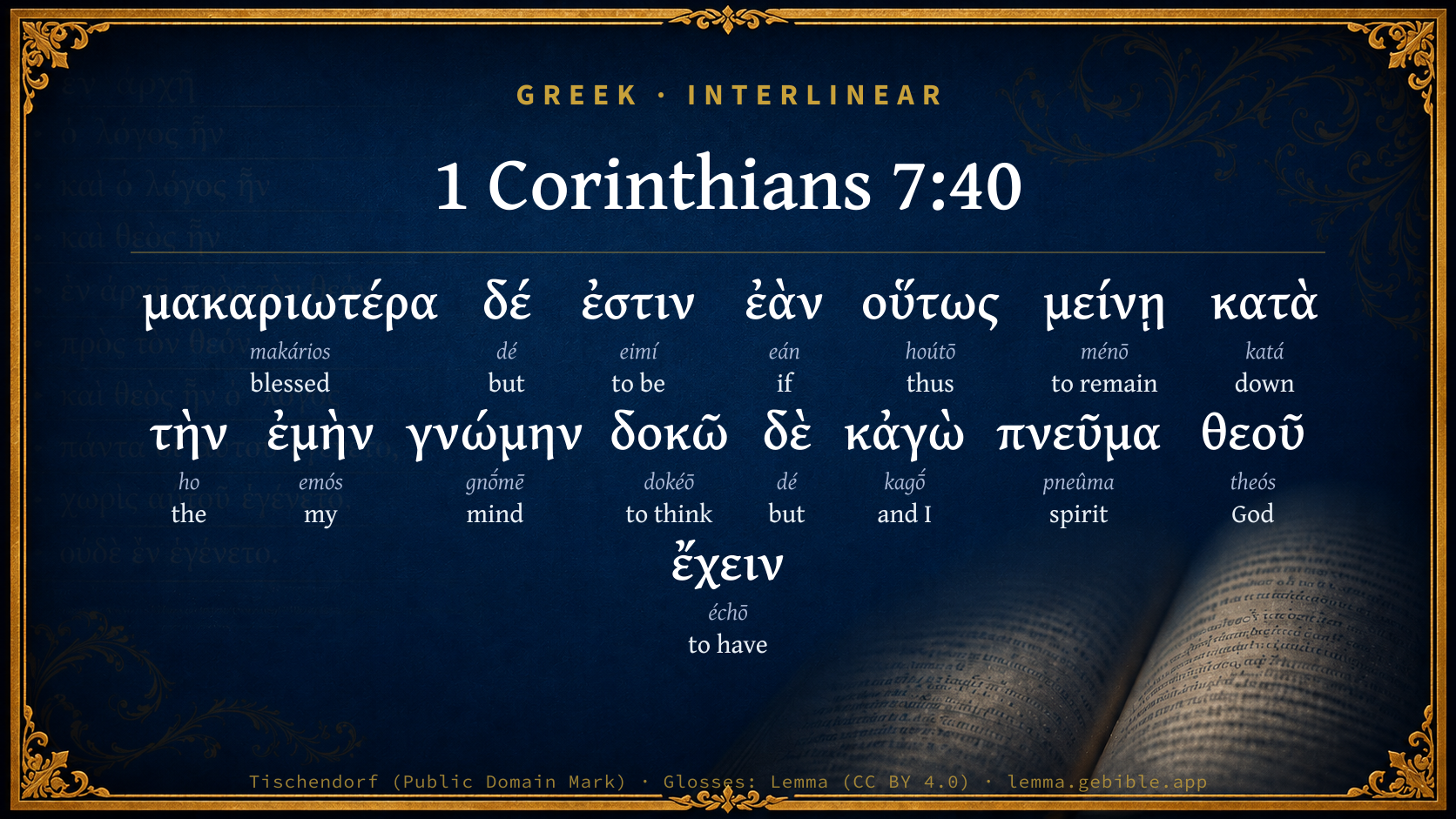
  1. μακαριωτέρα makários G3107 “blessed” Adjective, Nominative, Singular, Feminine, Comparative
  2. δέ dé G1161 “but” Conjunction
  3. ἐστιν eimí G1510 “to be” Verb, Present, Active, Indicative, 3rd person, Singular
  4. ἐὰν eán G1437 “if” Conditional
  5. οὕτως hoútō G3779 “thus” Adverb
  6. μείνῃ ménō G3306 “to remain” Verb, Aorist, Active, Subjunctive, 3rd person, Singular
  7. κατὰ katá G2596 “down” Preposition
  8. τὴν ho G3588 “the” Article, Accusative, Singular, Feminine
  9. ἐμὴν emós G1699 “my” Possessive pronoun, 1st person, Accusative, Singular, Feminine
  10. δοκῶ dokéō G1380 “to think” Verb, Present, Active, Indicative, 1st person, Singular
  11. δὲ dé G1161 “but” Conjunction
  12. κἀγὼ kagṓ G2504 “and I” Personal pronoun, 1st person, Nominative, Singular, Aramaic form
  13. πνεῦμα pneûma G4151 “spirit” Noun, Accusative, Singular, Neuter
  14. θεοῦ theós G2316 “God” Noun, Genitive, Singular, Masculine
  15. ἔχειν échō G2192 “to have” Verb, Present, Active, Infinitive

About this verse

These counts appear in no published source. They are computed here, from the morphology-tagged text and Lemma’s own curated glosses. What Lemma adds →

16
words
15
distinct lemmas
Pauline Epistles
section

Notable vocabulary

The rarest word here is γνώμην mind G1106 — appearing just 9 times in the whole Greek New Testament.

Shared distinctive vocabulary

γνώμην mind G1106 occurs in 8 verses of the Greek New Testament. Also found in:

Repetition

A word recurs within this verse:

Cross-references

11

Topical passages linked to 1 Corinthians 7:40 in the Treasury of Scripture Knowledge — connected by theme and wording, ordered by reader-vote popularity; previews shown in the World English Bible.

  • 1 Corinthians 7:1 Now concerning the things about which you wrote to me: it is good for a man not to touch a woman.
  • 1 Corinthians 7:8 But I say to the unmarried and to widows, it is good for them if they remain even as I am.
  • 1 Corinthians 7:25–26 Now concerning virgins, I have no commandment from the Lord, but I give my judgment as one who has obtained mercy from the Lord to be trustworthy.
  • 1 Corinthians 7:6 But this I say by way of concession, not of commandment.
  • 1 Corinthians 7:35 This I say for your own profit; not that I may ensnare you, but for that which is appropriate, and that you may attend to the Lord without distraction.
  • 1 Corinthians 9:1–3 Am I not free? Am I not an apostle? Haven't I seen Jesus Christ, our Lord? Aren't you my work in the Lord?
  • 1 Corinthians 14:36–37 What? Was it from you that the word of God went out? Or did it come to you alone?
  • 2 Corinthians 10:8–10 For though I should boast somewhat abundantly concerning our authority, (which the Lord gave for building you up, and not for casting you down) I will not be disappointed,
  • 2 Corinthians 12:11 I have become foolish in boasting. You compelled me, for I ought to have been commended by you, for in nothing was I inferior to the very best apostles, though I am nothing.
  • 1 Thessalonians 4:8 Therefore he who rejects doesn't reject man, but God, who has also given his Holy Spirit to you.
  • 2 Peter 3:15–16 Regard the patience of our Lord as salvation; even as our beloved brother Paul also, according to the wisdom given to him, wrote to you;

Cross-references courtesy of OpenBible.info (CC BY 4.0).

Commentary

Notes on 1 Corinthians 7:40 from classic Christian and Jewish commentators (each source and its license shown beneath its notes). The classic Christian expositions comment on the surrounding passage and are grouped to its opening verse, so a note may address several verses; the Jewish commentaries on the Tanakh (Rashi and others) are per-verse, so they appear only where the commentator wrote on this verse.

Lemma curates 59 commentaries, every one of them public domain or Creative Commons licensed, each selected and text-cleaned for this edition rather than reprinted as found. About our sources →

Bengel's Gnomon

Johann Albrecht Bengel

1Co 7:40. Μακαριωτέρα, happier) 1Co 7:1; 1Co 7:28; 1Co 7:34-35; Luk 23:29.—δοκῶ, I think) The Corinthians thought more of themselves than was right, and less of Paul. Paul with delicate pleasantry, ἀστέιως, gives them back their own expression.—κᾀγὼ) I also, no less certainly, than any of you [who may think he has the Spirit].—Πνεῦμα Θεοῦ, the Spirit of GOD) whose counsels are spiritual, divine.

Bengel's Gnomon of the New Testament — English translation (T&T Clark, Edinburgh, 1860) — public domain. Text from a community e-Sword module.

Hodge's Commentary on Romans, Ephesians & First Corinthians

Charles Hodge

1Co_7:40

But she is happier if she so abide, after my judgment: and I think also that I have the Spirit of God.

Happier, freer from exposure to suffering, 1Co_7:28; and freer from worldly care, 1Co_7:32. After my judgment; it was an opinion founded, as he says, on the peculiar circumstances of the time, and not intended to bind the conscience or to interfere with the liberty of others, 1Co_7:35. Nevertheless, it was the opinion of a holy and inspired man, and therefore entitled to the greatest deference. To have the Spirit, means to be under the influence of the Spirit; whether as a Christian or as an apostle, depends on the context. The meaning here clearly is, that the apostle was led by the Spirit to give the advice in question, so that his advice is, so to speak, the advice of the Spirit. But is not the advice of the Spirit obligatory? Certainly, if he meant it to be so; but if he meant simply to lay down a general rule of expediency, and to leave every one to judge of its application to his or her peculiar case, then it leaves all concerned free. It would cease to be advice if men could not act contrary to it, without irreverence or disobedience. I think, (δοκῶ) I have, is only, agreeably to Greek usage, an urbane way of saying I have, comp. Gal_2:6; 1Co_12:22. Paul was in no doubt of his being an organ of the Holy Ghost. I also, i.e. I as well as others. This is generally considered as referring (somewhat ironically) to the false pretenders in Corinth. I think I have the Spirit of God as well as those among you who make such high pretensions.

Charles Hodge — Commentary on Romans (1835), First Corinthians (1857), and Ephesians (1856) — public domain. Text from a community e-Sword module.

Jamieson, Fausset & Brown

Robert Jamieson, A. R. Fausset & David Brown

happier-- (Co1 7:1, Co1 7:28, Co1 7:34-35).

I think also--"I also think"; just as you Corinthians and your teachers think much of your opinions, so I also give my opinion by inspiration; so in Co1 7:25, "my judgment" or opinion. Think does not imply doubt, but often a matter of well-grounded assurance (Joh 5:39).

Next: 1 Corinthians Chapter 8

Jamieson, Fausset & Brown — Commentary Critical and Explanatory on the Whole Bible (1871) — public domain (CC PDM 1.0). Text via the HelloAO Bible API.

Adam Clarke's Commentary

Verse 40. But she is happier if she so abide] If she continue in her widowhood because of the present distress; for this must always be taken in, that consistency in the apostle's reasoning may be preserved. If this were not understood, how could St. Paul tell the widow that it would be more happy for her to continue in her widowhood than to remarry? She who had tried both the state of celibacy and the state of marriage could certainly best tell which was most for her comfort; and he could not tell any thing but by an express revelation from heaven, relative to the future state of any widow: it is certain that he can never be understood as speaking in general, as there are multitudes of persons abundantly more happy in their married than in their single state; and there are many widows also much more happy in their second marriage than they have been in their first.

After my judgment] According to the view I have of the subject, which view I take by the light of the Divine Spirit, who shows me the tribulations which are coming on the Church. But, says he, 1Co 7:28: I spare you - I will not be more explicit concerning coming evils, as I wish to save you from all forebodings which bring torment.

I think - I have the Spirit of God.] Δοκω δε κᾳγω Πνευμα Θεου εχειν might be translated, I am CERTAIN that I have the Spirit of God. This sense of δοκειν (which we translate to seem, to think, to appear, c.) I have noticed in another part of this work. Ulpian, on Demosthen. Olynth. 1, says, Το δοκειν ου παντως επι αμφιβολου ταττουσιν οἱ παλαιοι αλλα πολλακις και επι του αληθευειν· The word δοκειν is used by the ancients, not always to express what is DOUBTFUL, but often to express what is TRUE and CERTAIN. - See Bp. Pearce. The apostle cannot be understood as expressing any doubt of his being under the inspiration of the Divine Spirit, as this would have defeated his object in giving the above advices for - if they were not dictated by the Spirit of God, can it be supposed that, in the face of apparent self-interest, and the prevalence of strong passions, they could have been expected to have become rules of conduct to this people? They must have understood him as asserting that he had the direction of the Spirit of God in giving those opinions, else they could not be expected to obey.

1. IN the preceding chapter we have met with subjects both of difficulty and importance. As to the difficulties, it is hoped that they have been so generally considered in the notes that few or none of them remain; and on the subjects of peculiar importance much time has been spent, in order to impress them on the mind of the reader. The delicacy of some of them would not admit of greater plainness; and in a few instances I have been obliged to wrap the meaning in a foreign language.

2. On the important subject of marriage I have said what I believe to be true, and scruple not to say that it is the most useful state in which - the human being can be placed; and consequently that in which most honour may be brought to God. I have listened with much attention for the better part of half a century to the arguments against marriage and in favour of celibacy; and I have had the opportunity of being acquainted with many who endeavoured to exemplify their own doctrine. But I have seen an end of all their perfection: neither the world nor the Church are under any obligations to them: they either married when they could do it to their mind and convenience; or, continuing in their celibacy, they lived a comparatively useless life; and died as they should, unregretted. The doctrine is not only dangerous but anti-scriptural: and I hope I have sufficiently vindicated Paul from being its patron or supporter.

3. While I contend for the superior excellence of the marriage state, I hope I shall not be understood to be the apologist of indiscriminate marriages - no, many of them are blamable in a very high degree. Instead of consulting common sense and propriety, childish affections, brutish passions, or the love of money are the motives on which many of them have been contracted. Such marriages are miserable; must be so, and should not be otherwise; and superficial people looking at these form an estimate of the state itself, and then indulge themselves in exclaiming against an ordinance of God, either perverted by themselves or the equally foolish persons who are the subjects of their animadversion. That genuine Christians can never be so useful in any state as that of marriage I am fully convinced; but to be happy, the marriage must be in the Lord. When believers match with unbelievers, generally pars sincera trahitur; the good becomes perverted; and Satan has his triumph when he has got an immortal soul out of the Church of Christ into his own synagogue. But who among young people will lay this to heart? And how few among young men and young women will not sell their Saviour and his people for a husband or a wife!

4. The doctrine of second marriages has been long a subject of controversy in the Church. The Scriptures, properly understood, have not only nothing against them, but much for them. And in this chapter St. Paul, in the most pointed manner, admits of them. A widow may marry again, only let it be in the Lord; and a widower has certainly the same privilege.

5. The conversion which the Scripture requires, though it makes a most essential change in our souls in reference to God, and in our works in reference both to God and man, makes none in our civil state: even if a man is called, i.e. converted in a state of slavery, he does not gain his manumission in consequence of his conversion; he stands in the same relation both to the state and to his fellows that he stood in before; and is not to assume any civil rights or privileges in consequence of the conversion of his soul to God. The apostle decides the matter in this chapter, and orders that every man should abide in the calling wherein he is called.

6. From the 20th to the 23d verse the apostle refers to the state of slavery among the Greeks; and from what he says we find that even among the slaves there were Christian converts, to whom, though he recommends submission and contentment, yet he intimates that if they could get their freedom they should prefer it; and he strongly charges those that were free not to become again the slaves of men, 1Co 7:23; from which we learn that a man might dispose of his own liberty, which, in a Christian, would be a disgrace to his redemption by Christ. The word ελευθερος, which we translate freeman, means properly freed-man, one who had been a slave but had regained his liberty. It is the same as libertus among the Romans, one who was manumitted. The manumission was performed three several ways:

(1) The consent of the master that the slave should have his name entered in the census; or public register of the citizens.

(2) The slave was led before the praetor, and the magistrate laid his wand, called vindicta, on his head, and declared him free.

(3) By testament or will, the master bequeathing to the slave his freedom.

The manner in which the second mode of manumission was performed is curious. The praetor having laid the rod vindicta upon the slave's head, pronounced these words, Dico eum liberum esse more Quiritum, "I pronounce him free according to the custom of the Romans." This done he gave the rod to the lictor, or serjeant, who struck the slave with it upon the head, and afterwards with the hand upon the face and back. The head also of the slave was shaven, and a cup given him by his master as a token of freedom, and the notary entered the name of the new freed-man in the public register, with the reasons of his manumission: it was customary also to give him another surname.

7. Among our Saxon ancestors, and also after the conquest, there was a species of slavery: all the villani were slaves to their respective lords, and each was bound to serve him in a great variety of ways. There is a profusion of curious examples of this in the ancient record preserved in the bishop's auditor's office in the cathedral of Durham, commonly known by the name of the Bolden Book. This record has been lately printed under the direction of his majesty's commissioners on the public records of the kingdom, in the supplement to Domesday Book.

8. Among our Saxon ancestors manumissions were granted on various accounts:

(1) A person might, if able, purchase his own freedom.

(2) One man might purchase the freedom of another.

(3) Manumissions were granted to procure by their merit the salvation of departed souls.

(4) Persons were manumitted also in order to be consecrated to the service of God. These manumissions were usually recorded in some holybook, especially in copies of the four Evangelists, which, being preserved in the libraries of abbeys, c., were a continual record, and might at all convenient times be consulted. Several entries of these manumissions exist in a MS. of the four Evangelists, s. 4, 14, in the library of Corpus Christi or Bennet college, Cambridge.

I shall produce a specimen of one of the several kinds mentioned above, giving the original only of the first and of the others, verbal translations.

(1) The certificate of a man's having purchased his own freedom.

[Anglo-Saxon]

[Anglo-Saxon]

[Anglo-Saxon]

[Anglo-Saxon]

"Here is witnessed, in this book of Christ, that AElfwig the Red hath redeemed himself from Abbot AElfsig, and the whole convent, with one pound. And this is witnessed by the whole convent at Bath.

May Christ strike him blind

Who this writing perverts."

This is a usual execration at the end of these forms, and is in rhyme in the original.

(2) Certificate of one having purchased the liberty of another.

"Here is witnessed, in this book of Christ, that AEdric Atford has redeemed Saegyfa, his daughter, from the Abbot AElfsig, and from the convent of Bath, to be for ever free, and all her posterity."

(3) Certificate of redemption in behalf of one departed.

"Here is witnessed, in this book of Christ, that AElfric Scot and AEgelric Scot are manumitted for the soul of Abbot AElfsig, to perpetual liberty. This was done with the testimony of the whole convent."

(4) Certificate of persons manumitted to be devoted to the service of God.

"Here is witnessed, in this book of Christ, that John bought Gunnilda the daughter of Thurkill, from Goda, widow of Leafenath, with half a pound. With the testimony of the whole convent.

May Christ strike him blind

Who this writing perverts.

And he has dedicated her to Christ and St. Peter, in behalf of his mother's soul."

9. When a man was made free, it was either in the church or at some public meeting: the sheriff of the county took him by the right hand and proclaimed him a freeman, and showed him the open door and the public highway, intimating that he was free to go whithersoever he pleased, and then gave him the arms of a freeman, viz. a spear and a sword. In some cases the man was to pay thirty pence to his master of hide money, intimating that he was no longer under restraint, chastisement, or correction. From which it appears that our ancestors were in the habit of flogging their slaves. See the laws of Ina, c. 24, 39; of Wm. the Conqueror, c. 65; and of Hen. I. c. 78.

10. Among the Gentoos the manumission of a slave was as follows: The slave took a pitcher, filled it with water, and put therein berenge-arook (rice that had been cleansed without boiling) and flowers of doob, (a kind of small salad,) and taking the pitcher on his shoulder he stands near his master; the master then puts the pitcher on the slave's head, breaks it so that the water, rice, flowers, and doob that were in the pitcher may fall on the slave's body: when this is done the master thrice pronounces, I have made thee free; then the slave steps forward a few paces towards the east, and then the manumission is complete. See Code of Gentoo laws, chap. 8: sec. 2, page 160. It is evident that the whole of this ceremony is emblematical:

(1) The pitcher represents the confined, servile state of the slave.

(2) The articles contained in it, his exclusion while in a state of slavery from the grand benefits and comforts of life.

(3) The water contained in the pitcher, his exclusion from the refreshing influences of heaven; for slaves were not permitted to take part in the ordinances of religion.

(4) The clean, unboiled rice, his incapacity to have secular possessions; for slaves were not permitted to possess lands either by inheritance or purchase: a slave could sow no seed for himself, and consequently have no legal claim on support from this staff of life.

(5) The doob or salad shut up, his being without relish for that state of being which was rendered insupportable to him by his thraldom.

(6) The breaking of the pitcher, his manumission and enjoyment of liberty: being as free to go whithersoever he would as the water was to run, being now disengaged from the pitcher.

(7) The shedding of the water, rice, flower, c., over his body, his privilege of enjoying and possessing every heavenly and earthly good.

(8) His stepping towards the east, his acknowledgment to the supreme Being, the fountain of light and life, (of whom the sun was the emblem,) for his enlargement and his eagerness to possess the light and comfort of that new state of happiness into which he was now brought in consequence of his manumission.

11. The description that Dr. John Taylor gives, ln his Elements of Civil Law, of the state of slaves among the ancients, will nearly suit with their state among our ancestors, though scarcely as bad as their state in the West Indies. "They were held among the Romans, pro nullis; pro mortuis; pro quadrupedibus:- -for no men; for dead men; for beasts: nay, were in a much worse state than any cattle whatever. They had no head in the state, no name, no tribe or register. They were not capable of being injured, nor could they take by purchase or descent, had no heirs, and could make no will. Exclusive of what was called their peculium, whatever they acquired was their master's; they could neither plead nor be impleaded; but were entirely excluded from all civil concerns; were not entitled to the rights of matrimony, and therefore had no relief in case of adultery; nor were they proper objects of cognation or affinity. They might be sold, transferred, or pawned, like other goods or personal estate; for goods they were, and such were they esteemed. They might be tortured for evidence, punished at the discretion of their lord, and even put to death, by his authority. They were laid under several other civil incapacities, too tedious to mention."

When all this is considered, we may at once see the horrible evil of slavery, and wonder at the grace which could render them happy and contented in this situation see the preceding chapter, 1Co 7:20-22. And yet we need not be surprised that the apostle should say to those who were free or freed, Ye are bought with a price; do not become slaves of men.

12. I have entered the more particularly into this subject, because it, or allusions to it, are frequently occurring in the New Testament, and I speak of it here once for all. And, to conclude, I here register my testimony against the unprincipled, inhuman, anti-Christian, and diabolical slave-trade, with all its authors, promoters, abettors, and sacrilegious gains; as well as against the great devil, the father of it and them.

Adam Clarke's Commentary on the Bible (1810–1826) — public domain. Text from a community e-Sword/MySword module.

John Calvin's Commentaries

40. But she is happier if she so abide Why? Is it because widowhood is of itself a virtue? No; but because it will have less to distract, and is more exempt from earthly cares. As to what he adds — according to my judgment, he does not mean by this expression that his opinion was doubtful; but it is as if he had said that such was his decision as to this question; for he immediately adds that he has the Spirit of God, which is sufficient to give full and perfect authority. There appears, at the same time, to be somewhat of irony when he says I think For as the false apostles were ever and anon boasting in high-sounding terms of their having the Spirit of God, for the purpose of arrogating to themselves authority, and in the meantime endeavored to derogate from that of Paul, he says that he thinks that he is not less a partaker of the Spirit than they

John Calvin's Commentaries (1540-1563) — public domain. Text from the Calvin Translation Society English edition (1840s-50s) via the Christian Classics Ethereal Library (ccel.org). Calvin's coverage is partial (roughly two-thirds of the Bible); uncommented books and verses are honest gaps, never fabricated. The 19th-century editor's footnotes and remarks are omitted so the notes are faithfully Calvin's own voice.

The Cambridge Bible for Schools and Colleges

gen. ed. J. J. S. Perowne

40. and I think also that I have the Spirit of God] Not that there was any doubt in the Apostle’s mind on this point. The word used implies full persuasion that in the advice he had given he was speaking under the direction of the Holy Spirit.

The Cambridge Bible for Schools and Colleges (gen. ed. J. J. S. Perowne; Cambridge University Press, 1878–1918) — public domain. Text from a community e-Sword module.

John Gill's Exposition

But she is happier if she so abide,.... That is, a widow, in an unmarried state; which is to be understood not of the happiness of another world, but of this: the apostle's meaning is, that she would be more free from cares, and less liable to trouble, would live with more peace and quietness, and be more at leisure to serve the Lord, second marriages oftentimes proving more disagreeable than the first; but in this the apostle only gives his opinion, enjoins nothing by way of command, or in an authoritative manner: and therefore adds,

after my judgment: according to his sense of things, and agreeably to the advice he had before given to unmarried persons, whether virgins or widows, such a person was likely to have most peace, and least trouble, remaining a widow, than if married, and so consequently more happy: and in order to engage such to regard his counsel, he further says,

and I think also that I have the Spirit of God; that though he had no express command, nor did he pretend to any, nor did he lay any injunction on any, but left them to their liberty; yet he could not but think, nay, he was assured, though he thus modestly expresses himself, that he was directed to give this advice by the Spirit of God.

Next: 1 Corinthians Chapter 8

John Gill's Exposition of the Whole Bible (1746–1763) — public domain (CC PDM 1.0). Text via the HelloAO Bible API.

Trapp's Complete Commentary

John Trapp

40 But she is happier if she so abide, after my judgment: and I think also that I have the Spirit of God.

Ver. 40. But she is happier] i.e. She shall live more at ease, and have less to care for. And we should contract our cares into as narrow a compass as we can, in hard times especially.

John Trapp, A Commentary or Exposition upon All the Books of the Old and New Testament (1647–1656) — public domain. Text from a community e-Sword module.

Albert Barnes' Notes on the Bible

If she so abide - If she remain a widow even if she could be married to a Christian.

After my judgment - In my opinion; 1Co 7:25.

And I think also that I have the Spirit of God - Macknight and others suppose that this phrase implies entire certainty; and that Paul means to affirm that in this he was clear that he was under the influence of inspiration. He appeals for the use of the term (δωκῶ dōkō) to Mar 10:32; Luk 8:18; 1Co 4:9; 1Co 8:2; 1Co 11:16; Heb 4:1, etc. But the word does not usually express absolute certainty. It implies a doubt; though there may be a strong persuasion or conviction; or the best judgment which the mind can form in the case; see Mat 6:7; Mat 26:53; Mar 6:49; Luk 8:18; Luk 10:36; Luk 12:51; Luk 13:24; Luk 22:24; Act 17:18; Act 25:27; 1Co 16:12, 1Co 16:22, etc. It implies here a belief that Paul was under the influence of the infallible Spirit, and that his advice was such as accorded with the will of God. Perhaps he alludes to the fact that the teachers at Corinth deemed themselves to be under the influence of inspiration, and Paul said that he judged also of himself that he was divinely guided and directed in what he said - “Calvin.” And as Paul in this could not be mistaken; as his impression that he was under the influence of that Spirit was, in fact, a claim to divine inspiration, so this advice should be regarded as of divine authority, and as binding on all. This interpretation is further demanded by the circumstances of the case. It was necessary that he should assert divine authority to counteract the teaching of the false instructors in Corinth; and that he should interpose that authority in prescribing rules for the government of the church there in view of the special temptations to which they were exposed.

Remarks On 1 Corinthians 7

We learn from this chapter:

1. The sacredness of the marriage union; and the nature of the feelings with which it should be entered; 1Co 7:1-13. On a most delicate subject Paul has shown a seriousness and delicacy of expression which can be found in no other writings, and which demonstrate how pure his own mind was, and how much it was filled with the fear of God. In all things his aim is to promote purity, and to keep from the Christian church the innumerable evils which everywhere abounded in the pagan world. The marriage connection should be formed in the fear of God. In all that union, the parties should seek the salvation of the soul; and so live as not to dishonor the religion which they profess.

2. The duty of laboring earnestly for the conversion of the party in the marriage connection that may be a stranger to piety; 1Co 7:16. This object should lie very near the heart; and it should be sought by all the means possible. By a pure and holy life; by exemplifying the nature of the gospel; by tenderness of conversation and of entreaty; and by fidelity in all the duties of life, we should seek the conversion and salvation of our partners in the marriage connection. Even if both are Christians, this great object should be one of constant solicitude - to advance the piety and promote the usefulness of the partner in life.

3. The duty of contentment in the sphere of life in which we are placed; 1Co 7:18 ff. It is no disgrace to be poor, for Jesus chose to be poor. It is no disgrace, though it is a calamity, to be a slave. It is no disgrace to be in an humble rank of life. It is disgraceful only to be a sinner, and to complain and repine at our allotment. God orders the circumstances of our life; and they are well ordered when under the direction of his hand. The great object should be to do right in the relation which we sustain in life. If poor, to be industrious, submissive, resigned, virtuous; if rich, to be grateful, benevolent, kind. If a slave or a servant, to be faithful, kind, and obedient; using liberty, if it can be lawfully obtained; resigned, and calm, and gentle, if by the providence of God such must continue to be the lot in life.

4. The duty of preserving the order and regularity of society; 1Co 7:20-23. The design of the gospel is not to produce insubordination or irregularity, it would not break up society; does not dissolve the bonds of social life; but it cements and sanctifies the ties which connect us with those around us. It is designed to promote human happiness; and that is promoted, not by resolving society into its original elements; not by severing the marriage tie, as atheists would do; not by teaching children to disregard and despise their parents, or the common courtesies of life, but by teaching them to maintain inviolate all these relations. Religion promotes the interests of society; it does not, like infidelity, dissolve them. It advances the cause of social virtue; it does not, like atheism, retard and annihilate it. Every Christian becomes a better parent, a more affectionate child, a kinder friend, a more tender husband or wife, a more kind neighbor, a better member of the community.

5. Change in a man’s calling should not be made from a slight cause. A Christian should not make it unless his former calling were wrong, or unless he can by it extend his own usefulness. But when that can be done, he should do it, and do it without delay. If the course is wrong, it should be immediately abandoned. No consideration can make it right to continue it for a day or an hour, no matter what may be the sacrifice of property, it should be done. If a man is engaged in the slave-trade, or in smuggling goods, or in piracy, or highway robbery, or in the manufacture and sale of poison, it should be at once and forever abandoned. And in like manner, if a young man who is converted can increase his usefulness by changing his plan of life, it should be done as soon as practicable. If by becoming a minister of the gospel he can be a more useful man, every consideration demands that he should leave any other profession, however lucrative or pleasant, and submit to the self-denials, the cares, the trials, and the toils which attend a life devoted to Christ in the ministry in Christian or pagan lands. Though it should be attended with poverty, want, tears, toil, or shame, yet the single question is, “Can I be more useful to my Master there than in my present vocation?” If he can be, that is an indication of the will of God which he cannot disregard with impunity.

6. We should live above this world; 1Co 7:29-30. We should partake of all our pleasures, and endure all our sufferings, with the deep feeling that we have here no continuing city and no abiding place. Soon all our earthly pleasures will fade away; soon all our earthly sorrows will be ended. A conviction of the shortness of life will tend much to regulate our desires for earthly comforts, and will keep us from being improperly attached to them; and it will diminish our sorrows by the prospect that they will soon end.

7. We should not be immoderately affected with grief; 1Co 7:30. It will all soon end, in regard to Christians. Whether our tears arise from the consciousness of our sins or the sins of others; whether from persecution or contempt of the world; or whether from the loss of health, property, or friends, we should bear it all patiently, for it will soon end; a few days, and all will be over; and the last tear shall fall on our cheeks, and the last sigh be heaved from our bosom.

8. We should not be immoderate in our joy, 1Co 7:30. Our highest earthly joys will soon cease. Mirth, and the sound of the harp and the viol, the loud laugh and the song will soon close. What a change should this thought make in a world of gaiety, and mirth, and song! It should not make people gloomy and morose; but it should make them serious, calm, thoughtful. O, did all feel that death was near, that the solemn realities of eternity were approaching, what a change would it make in a frivilous and thoughtless world! How would it close the theater and the ball-room; how would it silence the jest, the jeer, and the loud laugh; and how would it diffuse seriousness and calmness over a now frivilous and thoughtless world! “Laughter is mad,” says Solomon; and in a world of sin, and sorrow, and death, assuredly seriousness and calm contemplation are demanded by every consideration.

9. What an effect would the thought that “time is short,” and that “the fashion of this world passeth away,” have on the lovers of wealth! It would:

(1) Teach them that property is of little value.

(2) That the possession of it can constitute no distinction beyond the grave: the rich man is just as soon reduced to dust, and is just as offensive in his splendid mausoleum, as the poor beggar.

(3) A man feeling this, would be led (or should be) to make a good use of his property on earth. See the note at Luk 16:1-9.

(4) He would be led to seek a better inheritance, an interest in the treasures that no moth corrupts, and that never fade away. See the note at Mat 6:20. This single thought. that the fashion of this world is soon to pass away - an idea which no man can doubt or deny - if allowed to take firm hold of the mind, would change the entire aspect of the world.

10. We should endeavor so to live in all things as that our minds should not be oppressed with undue anxiety and care, 1Co 7:32. In all our arrangements and plans, and in all the relations of life, our grand object should be to have the mind free for the duties and privileges of religion. We should seek not to be encumbered with care; not to be borne down with anxiety; not to be unduly attached to the things of this life.

11. We should enter into the relations of life so as not to interfere with our personal piety or usefulness, but so as to promote both, 1Co 7:32-35. All our arrangements should be so formed as that we may discharge our religious duties, and promote our usefulness to our fellow men. But, alas, how many enter into the marriage relation with unChristian companions, whose active zeal is forever quenched by such a connection! How many form commercial connections or partnerships in business with those who are not Christians, where the result is to diminish their zeal for God, and to render their whole lives useless to the church! And how much do the cares of life, in all its relations, interfere with simple-hearted piety, and with the faithful discharge of the duties which we owe to God and to a dying world! May God of his mercy enable us so to live in all the relations of life as that our usefulness shall not be retarded but augmented; and so to live that we can see without one sigh of regret the “fashion of this world pass away;” our property or our friends removed; or even the magnificence of the entire world, with all its palaces, and temples, and “cloudcapped towers,” passing away amidst the fires that shall attend the consummation of all things!

Albert Barnes' Notes on the Bible (1834–1885) — public domain. Text from a community e-Sword/MySword module.

Matthew Poole's English Annotations

But if other circumstances concur, that a widow can abide without marriage without waxing wanton, and running into temptation, and so as to manage her outward concerns without the help of a husband, my opinion is, that she is more happy if she keeps herself a widow, and doth not marry again; not more happy because more holy, or in a fairer road to the kingdom of heaven, but upon the two accounts before mentioned; more happy because free from troubles and distractions, and because she will be more free and at liberty to mind heavenly things.

And I think also that I have the Spirit of God; and, saith he, I think I know as much of the mind of the Holy Spirit of God, as either those who teach you otherwise, or who may have opinions contrary to mine in this case.

Matthew Poole's English Annotations on the Holy Bible (1683–1685) — public domain. Text from a community e-Sword/MySword module.

Whedon's Commentary on the Bible

Daniel D. Whedon

40. Happier—More safe and blessed.

So abide—As a widow. St. Paul assumes her power of continence in the case.

I think—A modest reserve of language, with, perhaps, delicate reference to the Corinthian party who denied his authority. Yet we receive the inspired validity of the apostolic writings not on the authority of the writers themselves solely, but on the concurrent authority of the apostolic Church which accepted them. A charismatic Church sympathized with the inspired apostles, and from the concurrent witness of the two, under the authority of Christ, did the New Testament Canon grow into existence and authority. See notes at the close of chap. 4.

Have… God—A single man has often falsely supposed himself inspired; but the miraculous Church, founded by the Son of God, guided by apostles whom he selected, could not be mistaken in accepting the inspiration of St. Paul.

I have the Spirit of God—An expression of amazing energy. The divine Spirit is within the human spirit, so that the outward utterance is the expression of both the divine and the human spirit.

Daniel D. Whedon (gen. ed.), Commentary on the Old and New Testaments (1874–1909) — public domain. Text from a community e-Sword module.

The Pulpit Commentary

Happier. Freer from cares, distractions, and entanglements. If she so abide. If she remain a widow. I think also that I have the Spirit of God; rather, I think that I also, as well as the other teachers who have claimed spiritual authority for the rules they have given you about these subjects. The claim to authoritative decision is obviously less emphatic than it is in 1Co_14:37; still, it is an expression of personal conviction that he has the Spirit, not an implied doubt of the fact.

The Pulpit Commentary (1880–1919), ed. H.D.M. Spence-Jones & Joseph S. Exell — public domain. Text from a community e-Sword module.

John Wesley's Explanatory Notes

I also - As well as any of you. Have the Spirit of God - Teaching me all things This does not imply any doubt; but the strongest certainty of it, together with a reproof of them for calling it in question. Whoever, therefore, would conclude from hence, that St. Paul was not certain he had the Spirit of Christ, neither understands the true import of the words, nor considers how expressly he lays claim to the Spirit, both in this epistle, chap. ii, 16, xiv, 37, and the other. 2 Cor. xiii, 3. Indeed, it may be doubted whether the word here and elsewhere translated think, does not always imply the fullest and strongest assurance. See chap. x, 12.

John Wesley, Explanatory Notes Upon the Whole Bible (1754–1765) — public domain. Text via the GEBible commentary corpus.

Godbey's Commentary on the New Testament

William B. Godbey

40. “But she is the happier if she may so remain, according to my opinion: and I realize truly that I have the Spirit of God.” After Paul has cleared up all the fogs gathering about the matrimonial problem, and turning everybody loose to walk in the clear light of God’s Word, Spirit and Providence, marrying as often as they wish, but only in the Lord, we see here that he winds up the subject with a decided leaning toward celibacy; doubtless deflecting in the line of his own personal preference, certainly with the glorious apology of better conserving the cause of God. “Think” in E.V., occurring in this verse, is too weak, as it implies doubt, which is not in the original. Hence Paul here simply testifies that he has the Spirit of God.

William B. Godbey, Commentary on the New Testament (1896–1900) — public domain. Text from a community e-Sword module.

McGarvey & Pendleton's Commentaries

J. W. McGarvey

But she is happier if she abide as she is, after my judgment: and I think that I also have the spirit of God .

J. W. McGarvey (with Philip Y. Pendleton), Commentaries on the New Testament (The Fourfold Gospel, 1914; Acts; and the epistles) — public domain. Text from a community e-Sword/MySword module.

The People's New Testament

B. W. Johnson

40. But she is happier. In his judgment, and in the conditions then prevailing, she will consult her happiness by remaining a widow. It is not only his judgment, but the Spirit seems to point the same lesson. 1 Tim. 5:14, might be supposed to conflict with this, but it does not, when we remember that Paul's advice here is due to prevailing circumstances. The question of marriage or remarriage is one of prudential considerations.

B. W. Johnson's The People's New Testament with Notes (1889–1891) — public domain. Electronic text from the Christian Classics Ethereal Library (CCEL) ThML edition.

Cambridge Greek Testament for Schools and Colleges

40. δοκῶ δέ. Not that there was any doubt in the Apostle’s mind on this point. The word used implies full persuasion that in the advice he had given he was speaking under the direction of the Holy Spirit.

κἀγώ. Not, as A.V. ‘I think also,’ but ‘I think that I, too,’ as well as others.

Cambridge Greek Testament for Schools and Colleges (Cambridge University Press, 1896; 21 vols, various authors incl. Carr, Maclear, Plummer, Farrar, Lumby, Moule, M. R. James, Simcox) — public domain. Text from a community e-Sword module.

Alford’s Greek Testament

Henry Alford

40.] Concerning second marriages of women.

40. μακαριωτέρα] [not merely happier, in our merely social secular sense, but including this] happier, partly by freedom from the attendant trials of the ἐνεστῶσα ἀνάγκη,—but principally for the reason mentioned verse 34. “To higher blessedness in heaven, which became attached to celibacy afterwards in the views of its defenders (Ambrose, Corn.-a-Lap., al.), there is no allusion here.” Meyer.

δοκῶ δὲ κἀγώ] This is modestly said, implying more than is expressed by it,—not as if there were any uncertainty in his mind. It gives us the true meaning of the saying that he is giving his opinion, as ver. 25: viz. not that he is speaking without inspiration, but that in the consciousness of inspiration he is giving that counsel which should determine the question. The rationalizing Grotius explains πνεῦμα θεοῦ, ‘non revelationem, sed sincerum affectum Deo et piis serviendi,’ referring to ch. 4:21, where (1) the meaning is not this (see note); and (2) the expression is not πνεῦμα θεοῦ.

κἀγώ] ‘as well as other teachers.’ Whether said with a general or particular reference, we cannot tell, from not being sufficiently acquainted with the circumstances.

Henry Alford, The Greek Testament (1849–1861) — public domain. Text from a community e-Sword module.

International Critical Commentary

40. μακαριωτέρα. In the same sense as μακάριον μᾶλλον, Act 20:35. She will have more real happiness if she does not marry again. There is no inconsistency between this and 1Ti 5:14. The ‘younger widows’ come under the rule given in v. 9.

οὓτως. In siatu quo, as in 2Pe 3:4, πάντα οὕτως διαμένει. Here the word refers to the condition which she entered when her husband died. This confirms the interpretation of οὕτως in v. 26. In both cases the person had better make no change.

κατὰ τὴν ἐμὴν γνώμην. The ἐμήν is emphatic, and implies that there are other opinions.

δοκῶ δὲ κἀγώ. Non dubietatem significat (Primasius) any more than νομίζω (v. 26). ‘And I also think,’ not ‘I think that I also’ (RV.). Other people may believe that their views are inspired, but the Apostle ventures also to believe that he is guided in his judgment by God’s Spirit. It seems to be clear from this that some of those who differed from him appealed to their spiritual illumination. See Goudge, p. 68; Stanley, pp. 117 f.; Dobschätz, p. 64.

On the authority of B 17, Aeth. and some other witnesses, WH. read γάρ in preference to δέ (א A D E F G K L P, Latt. Copt.), placing δέ in the margin. A few texts have no conjunction.

F G and some Latin texts (habeo or habeam) have ἒχω for ἒχειν.

Alford remarks on ch. 7, “In hardly any portion of the Epistles has the hand of correctors and interpolators of the text been busier than here. The absence of all ascetic tendency from the Apostle’s advice, on the point where asceticism was busiest and most mischievous, was too strong a testimony against it to be left in its original clearness.”

Saepe apostoli in epistolis de conjugio agunt: unus Paulus, semel, nec sua sponte, sed interrogatus, coelibatum suadet, idque lenissime (Beng.). These words are an excellent summary of the teaching in this chapter as to the comparative value of marriage and celibacy: the preference given to celibacy is tentative and exceptional, to meet exceptional conditions. “No condemnation of marriage, no exclusion of the married from the highest blessings of the Christian life, finds a place in the N.T.” (Swete on Rev 14:4, which he says “must be taken metaphorically, as the symbolical character of the Book suggests.”) See also Goudge, pp. 63-65.

* On Nietzsche’s attack on St Paul, as a man of vicious life, see Weinel, St Paul. pp. 85-93.

אԠא (Fourth century.) The Sinaitic MS., now at St Petersburg, the only MS. containing the whole N.T.

B B (Fourth century.) The Vatican MS.

C C (Fifth century). The Codex Ephraem, a Palimpsest; now at Paris. Lacks 7:18 ἐν ἀκροβυστίᾳ-9:6 τοῦ μὴ ἐργάζεσθαι: 13:8 παύσονται-14:40 ἀλλὰ ἕτερα.

17 17. (Ev. 33, Act_13. Ninth century.) At Paris (Nat. Gr. 14). See Westcott and Hort., Introd. §§ 211, 212.

* Orthodox Jews were opposed to celibacy, regarding marriage as a duty; but there were some who agreed with St Paul. “Why should I marry?” asked Rabbi ben Asaï: “I am in love with the law. Let others see to the prolongation of the race” (Renan, p. 397). The second half of Psa 120:7 gives the common view.

A A (Fifth century.) The Codex Alexandrinus; now at the British Museum.

D D (Sixth century.) Codex Clarmontanus; now at Paris. A Graeco-Latin MS. 14:13 διο͂ ὁ λαλῶν-22 σημεῖον ἐστίν is supplied by a later but ancient hand. Many subsequent hands (sixth to ninth centuries) have corrected the MS. (See Gregory, Prolegomena , pp. 418-422).

E E (Ninth century). At Petrograd. A copy of D, and unimportant

F F (Late ninth century). Codex Augiensis (from Reichenau); now at Trin. Coll. Cambr. Probably a copy of G in any case, secondary to G, from which it very rarely varies (see Gregory, p. 429).

G G (Late ninth century). Codex Boernerianus; at Dresden. Interlined with the Latin (in minluscules). Lacks 1Co 3:8-16, 1Co 6:7-14 (F).

P P (Ninth century). Porfirianus Chiovensis. A palimpsest acquired in the East by Porphyrius Bishop of Kiew. Lacks 7:15 ὑμᾶς ὁ θεός-17 περιπάτει: 12:23 τοῦ σώματος-13:5 οὐ λογί-: 14:23 τὸ λαλεῖν μή. A good type of text in St Paul’s Epistles.

K K (Ninth century). Codex S. Synod. xcviii. Lacks 1:1-6:13 ταύτην καί: 8:7 τινὲς δὲ—8:11 ἀπέθανεν.

L L (Ninth century). Codex Angelicus; At Rome.

* σχολάζειν is very rare in LXX (Psa 65:10), and is nowhere used in this sense; but in class. Grk. it is frequent in the sense of being ‘disengaged for,’ or ‘devoted to,’ a pursuit or a person. We find a similar idea Exo 19:15; 1Sa 21:5; 2Sa 11:4 Cf. Tibullus 1:3:25. See also 1Pe 3:7, 1Pe 4:7. Σύμφωνος occurs nowhere else in N.T.

* ‘By permission’ (AV.) is ambiguous; it might mean, ‘I am permitted by God to say as much as this.’ It was translated venia in some Old Latin texts, and this rendering, understood (by Augustine) as meaning ‘pardon,’ led to far-reaching error. It means ‘By way of concession’: he is telling people that they may marry, not that they must do so: ex concessione non ex imperio (Beza). There is similer uncertainty as to the scope of the τοῦτο in 11:17, and the αὔτη in 9:3. In 1Ti 1:1, κατʼ ἐπιταγήν is used in a different sense: ‘in obedience to the command.’

* See Max Krenkel, Beitraäge zur Aufhellung der Geschichte und der Briefe des Apostels Paulus, pp. 26-46, a careful examination of the question, War Paulus jemals verheiratet? Baring Gould thinks that St Paul may have married Lydia (Act 16:14, Act 16:40), and that it was she who supplied him with money (Act 24:26, Act 28:30). This is not probable.

† Eph 6:16, it is used of the flaming darts of the evil one; Rev 1:15, Rev 3:18, of what has been refined by fire. It is frequent in the latter sense in LXX, and in 2 Macc., with τοῖς θυμοῖς added, of anger. Some understand it here as meaning ‘unsatisfied affection’ rather than ἀκρασία. In 9:25 we have ἐγκρατεύσθαι again, but nowhere else in N.T. See Hos 7:4 and Cheyne’s note.

* The change from χωρισθῆναι of the wife to ἀφιέναι of the husband is intelligible. The home is his: she can leave it, but he sends her away from it. In LXX, χωρισθῆναι is frequent of separation in place. In papyri it is used of divorce; ἐὰν δὲ χωρίζωνται ἀπʼ ἀλλήλων: so also χωρισμός. Polybius (32:12:6) has κεχωρισμένη ἀπὸ τοῦν ἀδρός. See Deissmann, Bible Studies, p. 247. In v. 13, ἀφιέναι is used of the wife, perhaps in order to make an exact parallel with v. 12.

* As Evans says, “He stands upon the sacred threshold of the Church: his surroundings are hallowed. United to a saintly consort, he is in daily contact with saintly conduct: holy association may become holy assimilation, and the sanctity which ever environs may at last penetrate. But the man’s conversion is not a condition necessary to the sanctity of the subsisting conjugal union.” Origen compares such a union to a mixture of wine and water.

* There is no good reason for suspecting with Baljon that vv. 17-22 are an interpolation, or with Clemen that they come from some other Pauline Epistle. Beza proposed to place them after v. 40. Equally needlessly, Holsten suspects that v. 14 is an interpolation.

* St Paul’s prohibition must be understood in a wider sense. A Jew, when he becomes a Christian, is not ostentatiously to drop all Jewish customs and modes of life. The verb occurs nowhere else in N.T.

* Stanley has an interesting, but rather fanciful note, connecting this passage with the Father, Gal 5:6 with the Son, and Gal 6:15 with the Holy Spirit.

† Manufacturers of idols who became Christians claimed this principle as justifying their continuing to earn a living in this way. “Can’t you starve?” says Tertullian; fides famen non timet (De Idol. 5.12).

* Bachmann admits that the Apostle’s recommending people to disregard an opportunity of being freed from slavery zweifellos etwas uberraschendas hat.

† In ordinary language, ἀπελεύθερος Κυρίου would mean that he had been the Lord’s slave and that the Lord had manumitted him. He had been in slavery and the Lord had freed him from it, and this justifies the expression. The Lord was his προστάτης.

* “In the time of St Paul, ‘Lord’ was throughout the whole Eastern world a universally understood religious conception. The Apostle’s confession of his Master as ‘our Lord Jesus Christ,’ with the complementary idea that Christians were dearly bought ‘slaves,’ was at once intelligible in all the fulness of its meaning to every one in the Greek Orient” (Deissmann, New Light on the N. T., p. 79). See Lietzmann, Greek Papyri. p. 4.

* The Vulgate has tanquam non utantur, which seems to imply different Greek: Beza, ut non abutentes, which is right, for abuti often means ‘to use up.’ ‘Misusing’ would be παραχρώμενοι. In Philo (De Josepho 24.) we have χρῶ μὴ παραχρώμενος.

† Excepting Php 2:8, σχῆμα occurs nowhere else in N. T., and, excepting Isa 3:17, nowhere in LXX. The destruction of the material universe is not a Pauline idea.

* See the remarkable parallel in Epictetus (Dis. iii. 22; Long’s translation, Bell, 1903, 2. p. 87): “But in the present state of things, which is like that of an army placed in battle order, is it not fit that the philosopher should without any distraction (ἀπερίσπαστον) be employed only on the ministration (διακονίᾳ) of God, not tied down to the common duties of mankind, nor entangled in the ordinary relations of life?”

* Hermas seems to have vv. 39, 40, and 28 in his mind in Mand. IV. iv. 1.

† Harnack disputes this (Mission and Expansion, 1. p. 81). Tertullian (Ad Uxorem, ii. 1, 2) implies tht marriages between Christians and heathen did take place. See Cyprian (Test. iii. 62); matrimonium cum gentilibus non jungendum.

International Critical Commentary — older volumes (1896–1929), various authors — public domain. Text from a community e-Sword module.

Vincent's Word Studies in the New Testament

Marvin R. Vincent

Happier [μακαριωτερα] . More blessed is preferable. The word has a higher meaning than happy. See on Mt 5:3. 9 9 "Such, if on high their thoughts are set, Nor in the stream the source forget, If prompt to quit the bliss they know, Following the Lamb where'er He go, By purest pleasure unbeguiled To idolize or wife or child : Such wedded souls our God shall own For faultless virgins round His throne." KEBLE, "Christian Year," Wednesday before Easter.

Marvin R. Vincent, Word Studies in the New Testament (1887–1900) — public domain. Text from a community e-Sword/MySword module.

Lesson kit

Teaching starters — assembled from the data on this page, not authored interpretation. Every prompt links to the verse data it draws on. Edit before teaching.

1 Corinthians, in the Pauline Epistles, opens this verse with 16 words (15 distinct Greek lemmas). Its most distinctive word is gnṓmē (“mind”). A historical commentator’s framing appears above. Read the whole chapter for the surrounding context.

Discussion questions

  1. How does “mind” (gnṓmē) shape what this verse is saying?
  2. Acts 20:3 shares the word «mind» with this verse. How do the two illuminate each other?
  3. “but” occurs 2× in this one verse. What is the effect of the repetition?
  4. These translations render this verse differently; the difference is in the English rendering, not the original. What questions does that raise?
  5. Reading how Bengel's Gnomon and Hodge's Commentary on Romans, Ephesians & First Corinthians read this verse, where do the two commentators agree and where do they part?

Things to notice

Reading settings

Reading text

Shown beneath each verse's original-language words.

Old Testament
Old Testament edition

Read the OT as the Masoretic Hebrew (MT) or the Greek Septuagint (LXX).

English shown for the Greek Septuagint (in the Hebrew ↔ Greek comparison).

Comparing translations? Open the Compare panel on any verse page to stack up to four side by side.