
Romans 9:20

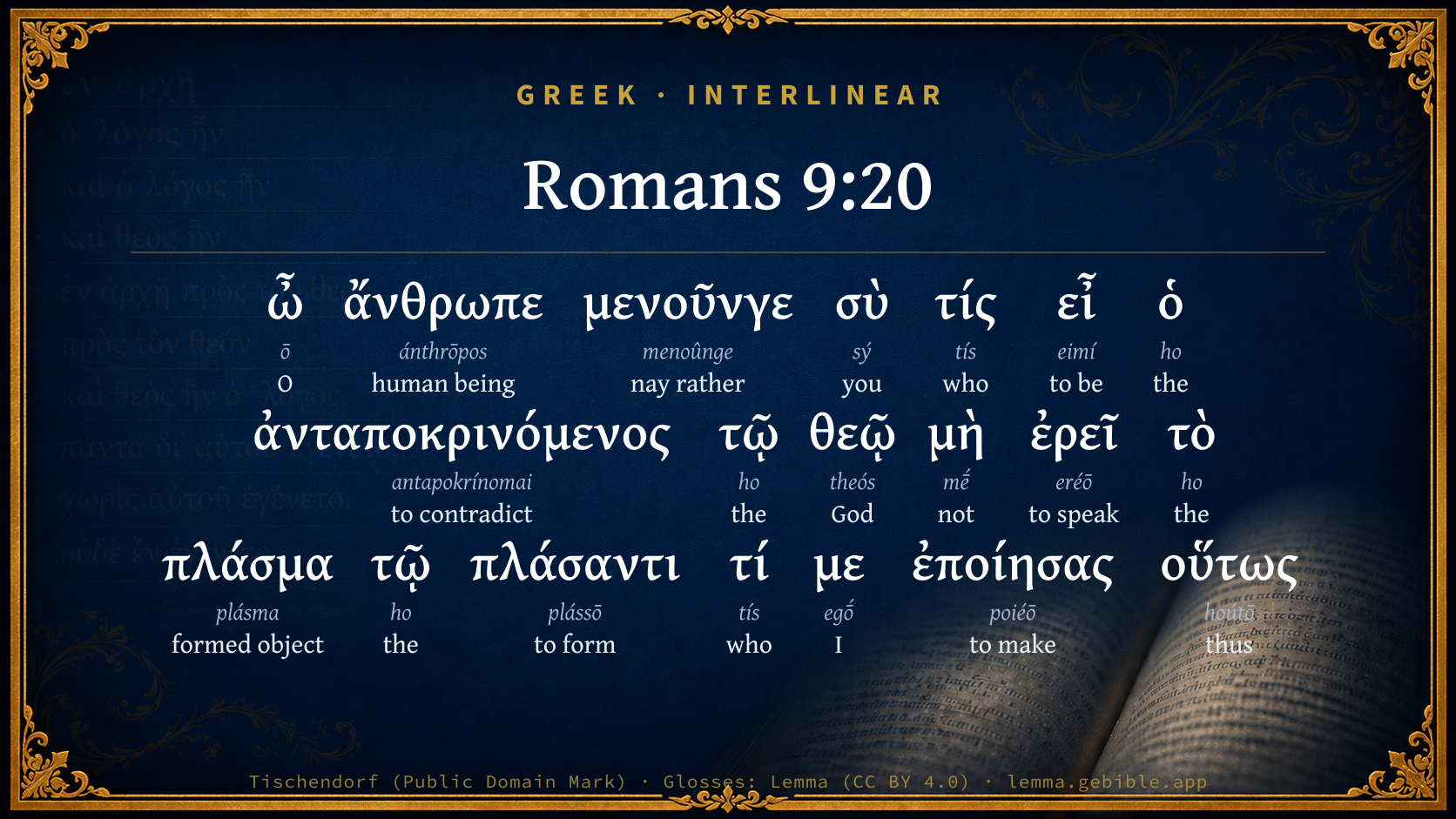
Greek (Tischendorf 8th ed.) Romans 9:20 appears in the Greek New Testament. The text above is from the Tischendorf 8th edition. Each word links to its Strong’s number and a concise gloss. Click any word for its full Thayer’s Greek Lexicon entry.
Download image
Cite this verse

Romans 9:20 (World English Bible). Public Domain. Lemma interlinear Bible study tool, https://lemma.gebible.app/v/romans/9/20.

Show BibTeX & RIS
BibTeX
RIS
English Translation
But indeed, O man, who are you to reply against God? Will the thing formed ask him who formed it, "Why did you make me like this?"
World English Bible · Public Domain
Highlights
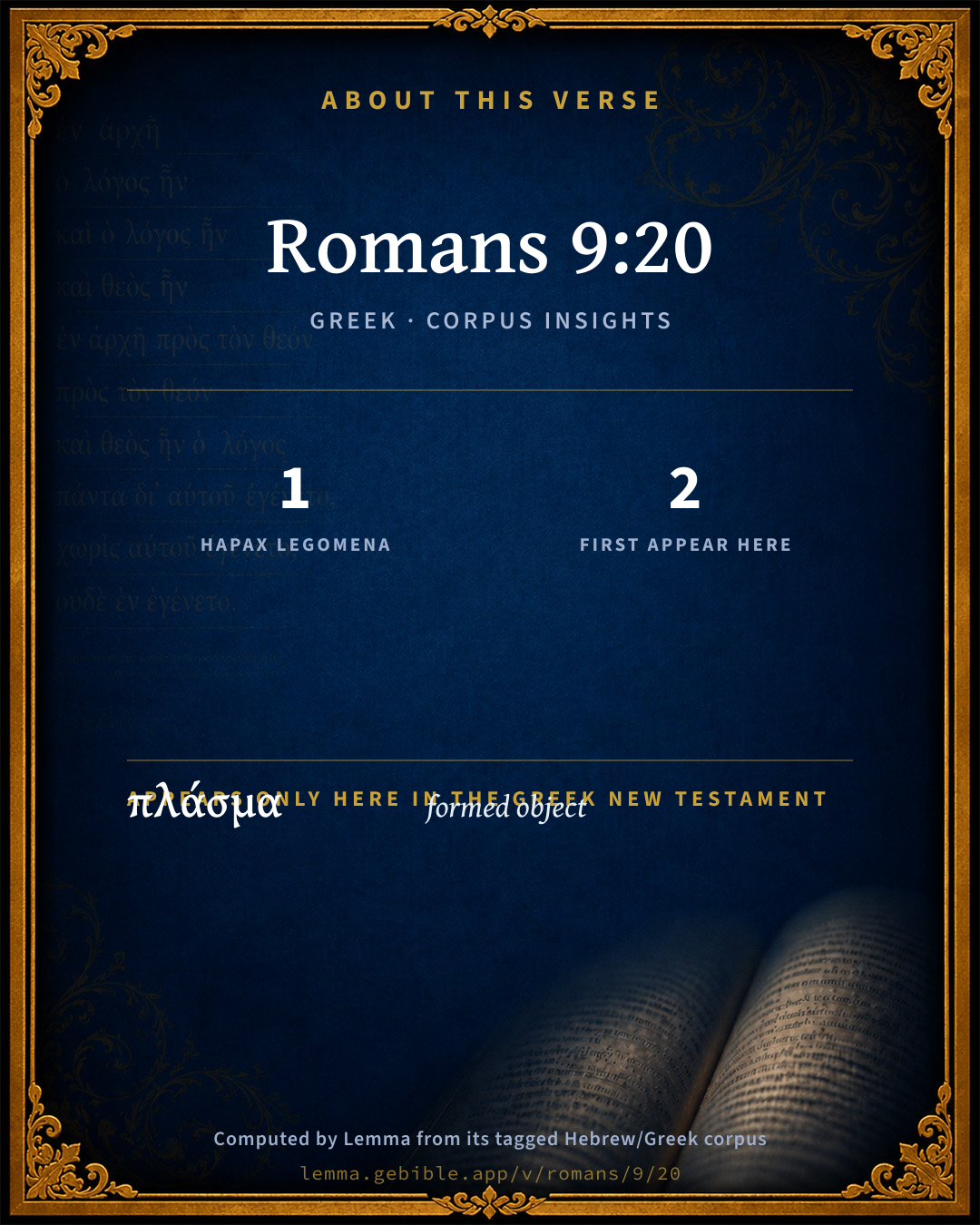
  • 1 hapax legomenon — only here in the Greek New Testament
  • 2 first appearances in the Greek New Testament
Full analysis ↓
Download a study sheet

One document with this verse’s original text, its word-by-word gloss line, the meaning frame, cross-references with their text, attributed commentary, and full source and license credits — printable, and it pastes into notes with its structure intact.

This verse Autodidact and up

Study sheet (.html) Plain text (.txt)

A passage Seminary Student

Up to 50 verses in one chapter. A passage sheet keeps up to 6 commentary sources and 12 cross-references per verse, in the order this page ranks them, and says so on the sheet whenever that leaves anything out. Ask for a single verse and you get the Autodidact verse sheet above.

Everything on this page stays free to read, with no account — the sheet is a download of what is already on screen, not access to it.

Want to remove ads? Support Godless Engineer
Compare translations 3

The same verse in 3 English versions, stacked beneath the original-language interlinear above. Click any original word for its lexicon entry.

Each is an independent rendering of the whole verse — the interlinear is not word-aligned to these translations.

Highlighted words mark where these versions differ — a whole-verse word diff, not a word-by-word alignment.

  • World English Bible Public Domain
    But indeed, O man, who are you to reply against God? Will the thing formed ask him who formed it, "Why did you make me like this?"
  • King James Version Public Domain
    Nay but, O man, who art thou that repliest against God? Shall the thing formed say to him that formed it, Why hast thou made me thus?
  • unfoldingWord Literal Text CC BY-SA 4.0
    O man, who indeed are you, the one answering against God? The one molded will not say to the one having molded, “Why did you make me this way?” will it?

unfoldingWord Literal Text — © unfoldingWord, licensed CC BY-SA 4.0. Word-aligned USFM3 via Door43 (git.door43.org/unfoldingWord/en_ult).

Versions to compare (up to 4)

3 of 4 selected

Show all 19 translations

Every available English version of this verse, each an independent rendering of the whole verse.

  • World English Bible Public Domain
    But indeed, O man, who are you to reply against God? Will the thing formed ask him who formed it, "Why did you make me like this?"
  • Berean Standard Bible Public Domain
    But who are you, O man, to talk back to God? Shall what is formed say to Him who formed it, “Why did You make me like this?”
  • Majority Standard Bible Public Domain
    But who are you, O man, to talk back to God? Shall what is formed say to Him who formed it, “Why did You make me like this?”
  • King James Version Public Domain
    Nay but, O man, who art thou that repliest against God? Shall the thing formed say to him that formed it, Why hast thou made me thus?
  • American Standard Version (1901) Public Domain
    Nay but, O man, who art thou that repliest against God? Shall the thing formed say to him that formed it, Why didst thou make me thus?
  • Revised Version (1885) Public Domain
    Nay but, O man, who art thou that repliest against God? Shall the thing formed say to him that formed it, Why didst thou make me thus?
  • Geneva Bible (1599) Public Domain
    But, O man, who art thou which pleadest against God? shall the thing formed say to him that formed it, Why hast thou made me thus?
  • Douay-Rheims (1899) Public Domain
    O man, who art thou that repliest against God? Shall the thing formed say to him that formed it: Why hast thou made me thus?
  • Young's Literal Translation Public Domain
    nay, but, O man, who art thou that art answering again to God? shall the thing formed say to Him who did form `it', Why me didst thou make thus?
  • Literal Standard Version CC BY-SA 4.0
    No, but, O man, who are you that are answering again to God? Will the thing formed say to Him who formed [it], Why did you make me thus?
  • Unlocked Literal Bible CC BY-SA 4.0
    On the contrary, man, who are you who answers against God? Will what has been molded say to the one who molds it, “Why did you make me this way?”
  • unfoldingWord Literal Text CC BY-SA 4.0
    O man, who indeed are you, the one answering against God? The one molded will not say to the one having molded, “Why did you make me this way?” will it?
  • Darby Bible Public Domain
    Aye, but thou, O man, who art *thou* that answerest again to God? Shall the thing formed say to him that has formed it, Why hast thou made me thus?
  • World Messianic Bible Public Domain
    But indeed, O man, who are you to reply against God? Will the thing formed ask him who formed it, “Why did you make me like this?”
  • Webster's Bible Public Domain
    No, but, O man, who art thou that repliest against God? shall the thing formed say to him that formed it, Why hast thou made me thus?
  • Free Bible Version CC BY-SA 4.0
    That's no way to speak, for who are you—a mere mortal—to contradict God? Can something that is created say to its creator, “Why did you make me like this?”
  • Bible in Basic English Public Domain
    But, O man, who are you, to make answer against God? May the thing which is made say to him who made it, Why did you make me so?
  • Text-Critical English NT CC BY 4.0
    On the contrary, O man, who are yoʋ to answer back to God? Shall the thing formed say to him who formed it, “Why did yoʋ make me like this?”
  • Tyndale New Testament (1534) Public Domain
    But o man what arte thou which disputest with God? Shall the worke saye to the workeman: why hast thou made me on this fassion?

Literal Standard Version (2020), Covenant Press — licensed CC BY-SA 4.0. Text via the HelloAO Bible API (eBible.org). Unlocked Literal Bible (unfoldingWord) — licensed CC BY-SA 4.0. Text via the HelloAO Bible API (eBible.org). unfoldingWord Literal Text — © unfoldingWord, licensed CC BY-SA 4.0. Word-aligned USFM3 via Door43 (git.door43.org/unfoldingWord/en_ult). Free Bible Version, Dr. Jonathan Gallagher — licensed CC BY-SA 4.0. Text via the HelloAO Bible API (eBible.org).

Word by word

More ways to search: Search by grammar → Find every occurrence → Compare this word →

Practice this passage: Drill this verse → Learn its vocabulary →

πλάσμα
plásma
G4110
“formed object”
Noun, Nominative, Singular, Neuter
Part of Speech
Noun
Case
Nominative
Number
Singular
Gender
Neuter
Full Thayer's Definition

Origin: from G4111

TDNT: 10:14,9

1. what has been moulded or formed, as from wax 2. the thing formed by a potter, earthen vessel
  1. ὦ ō G5599 “O” Interjection
  2. ἄνθρωπε ánthrōpos G444 “human being” Noun, Vocative, Singular, Masculine
  3. μενοῦνγε menoûnge G3304 “nay rather” Particle
  4. σὺ sý G4771 “you” Personal pronoun, 2nd person, Nominative, Singular
  5. τίς tís G5101 “who” Interrogative pronoun, Nominative, Singular, Masculine
  6. εἶ eimí G1510 “to be” Verb, Present, Active, Indicative, 2nd person, Singular
  7. ὁ ho G3588 “the” Article, Nominative, Singular, Masculine
  8. ἀνταποκρινόμενος antapokrínomai G470 “to contradict” Verb, Present, Middle or Passive deponent, Participle, Nominative, Singular, Masculine
  9. τῷ ho G3588 “the” Article, Dative, Singular, Masculine
  10. θεῷ theós G2316 “God” Noun, Dative, Singular, Masculine
  11. μὴ mḗ G3361 “not” Particle, Negative
  12. ἐρεῖ eréō G2046 “to speak” Verb, Future, Active, Indicative, 3rd person, Singular
  13. τὸ ho G3588 “the” Article, Nominative, Singular, Neuter
  14. τῷ ho G3588 “the” Article, Dative, Singular, Masculine
  15. πλάσαντι plássō G4111 “to form” Verb, Aorist, Active, Participle, Dative, Singular, Masculine
  16. τί tís G5101 “who” Interrogative pronoun, Accusative, Singular, Neuter
  17. με egṓ G1473 “I” Personal pronoun, 1st person, Accusative, Singular
  18. ἐποίησας poiéō G4160 “to make” Verb, Aorist, Active, Indicative, 2nd person, Singular
  19. οὕτως hoútō G3779 “thus” Adverb

About this verse

These counts appear in no published source. They are computed here, from the morphology-tagged text and Lemma’s own curated glosses. What Lemma adds →

20
words
16
distinct lemmas
Pauline Epistles
section

Notable vocabulary

1 hapax legomenon — a word that appears only here in the entire Greek New Testament:

  • πλάσμα formed object G4110

First appearance in Scripture

These words make their first canonical appearance in the Greek New Testament here:

  • πλάσμα formed object G4110
  • πλάσαντι to form G4111

Shared distinctive vocabulary

ἀνταποκρινόμενος to contradict G470 occurs in 2 verses of the Greek New Testament. Also found in:
Repetition

Words recur within this verse:

Cross-references

18

Topical passages linked to Romans 9:20 in the Treasury of Scripture Knowledge — connected by theme and wording, ordered by reader-vote popularity; previews shown in the World English Bible.

  • Isaiah 29:16 You turn things upside down! Shall the potter be esteemed as clay; that the thing made should say of him who made it, He didn't make me; or the thing formed say of him who formed it, He has no understanding?
  • Isaiah 45:9–11 Woe to him who strives with his Maker--a potsherd among the potsherds of the earth! Shall the clay ask him who fashions it, "What are you making?" or your work, "He has no hands?"
  • Isaiah 64:8 But now, Yahweh, you are our Father; we are the clay, and you our potter; and we all are the work of your hand.
  • Job 33:13 Why do you strive against him, Because he doesn't give account of any of his matters?
  • Job 36:23 Who has prescribed his way for him? Or who can say, 'You have committed unrighteousness?'
  • Job 40:2 "Shall he who argues contend with the Almighty? He who argues with God, let him answer it."
  • Matthew 20:15 Isn't it lawful for me to do what I want to with what I own? Or is your eye evil, because I am good?'
  • Job 16:3 Shall vain words have an end? Or what provokes you that you answer?
  • 1 Timothy 6:5 constant friction of people of corrupt minds and destitute of the truth, who suppose that godliness is a means of gain. Withdraw yourself from such.
  • Job 38:2–3 "Who is this who darkens counsel By words without knowledge?
  • Job 40:8 Will you even annul my judgment? Will you condemn me, that you may be justified?
  • Job 42:2–6 "I know that you can do all things, And that no purpose of yours can be restrained.
  • 1 Corinthians 1:20 Where is the wise? Where is the scribe? Where is the lawyer of this world? Hasn't God made foolish the wisdom of this world?
  • Job 40:5 I have spoken once, and I will not answer; Yes, twice, but I will proceed no further."
  • Micah 6:8 He has shown you, O man, what is good. What does Yahweh require of you, but to act justly, To love mercy, and to walk humbly with your God?
  • Romans 2:1 Therefore you are without excuse, O man, whoever you are who judge. For in that which you judge another, you condemn yourself. For you who judge practice the same things.
  • Titus 2:9 Exhort servants to be in subjection to their own masters, and to be well-pleasing in all things; not contradicting;
  • James 2:20 But do you want to know, vain man, that faith apart from works is dead?

Cross-references courtesy of OpenBible.info (CC BY 4.0).

Commentary

Notes on Romans 9:20 from classic Christian and Jewish commentators (each source and its license shown beneath its notes). The classic Christian expositions comment on the surrounding passage and are grouped to its opening verse, so a note may address several verses; the Jewish commentaries on the Tanakh (Rashi and others) are per-verse, so they appear only where the commentator wrote on this verse.

Lemma curates 59 commentaries, every one of them public domain or Creative Commons licensed, each selected and text-cleaned for this edition rather than reprinted as found. About our sources →

Albert Barnes' Notes on the Bible

Nay but, O man ... - To this objection the apostle replies in two ways; first, by asserting the sovereignty of God, and affirming that he had a right to do it Rom 9:20-21; and secondly, by showing that he did it according to the principles of justice and mercy, or that it was involved of necessity in his dispensing justice and mercy to mankind; Rom 9:22-24.

Who art thou ... - Paul here strongly reproves the impiety and wickedness of arraigning God. This impiety appears,

(1) Because man is a creature of arraigning God. This impiety appears, Because man is a creature of God, and it is improper that he should arraign his Maker.

(2) He is unqualified to understand the subject. “Who art thou?” What qualifications has a creature of a day, a being just in the infancy of his existence; of so limited faculties; so perverse, blinded, and interested as man, to sit in judgment on the doings of the Infinite Mind? Who gave him the authority, or invested him with the prerogatives of a judge over his Maker’s doings?

(3) Even if man were qualified to investigate those subjects, what right has he to reply against God, to arraign him, or to follow out a train of argument tending to involve his Creator in shame and disgrace? No where is there to be found a more cutting or humbling reply to the pride of man than this. And on no subject was it more needed. The experience of every age has shown that this has been a prominent topic of objection against the government of God; and that there has been no point in the Christian theology to which the human heart has been so ready to make objections as to the doctrine of the sovereignty of God.

Repliest against God - Margin, “Answerest again; or, disputest with God.” The passage conveys the idea of answering again; or of arguing to the dishonor of God. It implies that when God declares his will, man should be still. God has his own plans of infinite wisdom, and it is not ours to reply against him, or to arraign him of injustice, when we cannot see the reason of his doings.

Shall the thing formed ... - This sentiment is found in Isa 29:16; see also Isa 45:9. It was especially proper to adduce this to a Jew. The objection is one which is supposed to be made by a Jew, and it was proper to reply to him by a quotation from his own Scriptures. Any being has a right to fashion his work according to his own views of what is best; and as this right is not denied to people, we ought not to blame the infinitely wise God for acting in a similar way. They who have received every blessing they enjoy from him, ought not to blame him for not making them different.

Albert Barnes' Notes on the Bible (1834–1885) — public domain. Text from a community e-Sword/MySword module.

Joseph Benson's Commentary

Rom 9:20-21. Nay but, O man — Little, impotent, ignorant man; Who art thou — In all thy boasted wisdom and penetration; that repliest against God? — That accusest God of injustice, for himself fixing the terms on which he will show mercy? or for leaving those to the hardness of their hearts who obstinately and perseveringly refuse or neglect to comply with those terms? Or, (which may be rather intended,) who impiously formest arguments against God, on account of his distributing to some nations, or some individuals, favours which he denies to others; not considering that privileges which God is obliged to give to none, he may, without injustice, withhold from whom he will? Shall the thing formed say to him that formed it, Why hast thou made me thus? — Why hast thou made me capable of honour and immortality, only on the terms of repentance and faith? Or, Why was I not entitled by birth, to advantages which others were born to? The apostle alludes here to Isa 45:9, where, in answer to the objections and cavils of the unbelieving Jews, disposed to murmur against God, and arraign the wisdom and justice of his dispensations, in regard to them, the prophet asks similar questions; implying that “nations, who derive their existence and continuance merely from the power and goodness of God, have no right to find fault with him, because he hath denied them this or that advantage, or because he bears with the wickedness of some nations for a long time, while he instantly punishes others.” Hath not the potter power over the clay — And, much more, hath not God power over his creatures; to appoint one vessel — Namely, the believer; to honour, and another — Namely, the unbeliever; to dishonour? — The power of the potter over the clay is the similitude which God himself used by Jeremiah for illustrating that power and sovereignty whereby he is entitled to make some nations great and happy, and to punish and destroy others. See Jer 18:6-7; where “every reader must be sensible that nothing is said concerning individuals, some to be saved, and some to be damned, by an exercise of absolute sovereignty. It is his power and sovereignty in the disposal of nations only, that is described by the figure of the potter.” To make of the same lump one vessel to honour, and another to dishonour — “The same lump signifies the mass of mankind, out of which particular nations are formed; consequently the one vessel means, not any particular person, but a nation or community. And a vessel to honour, or an honourable use, means a nation made great and happy by the favour and protection of God, and by the advantages which he confers on them. On the other hand, a vessel to dishonour, signifies a nation which God depresses, by denying it the advantages bestowed on others, or by depriving it of the advantages which it formerly enjoyed, Act 13:17. The meaning of this question is, May not God, without injustice, exalt one nation, by bestowing privileges upon it, and depress another, by taking away the privileges which it has long enjoyed.” — Macknight. If we survey, says an eminent writer, the right which God has over us in a more general way, with regard to his intelligent creatures, God may be considered in two different views; as Creator, Proprietor, and Lord of all, or as their moral Governor and Judge. God, as sovereign Lord and Proprietor of all, dispenses his gifts or favours to his creatures with perfect wisdom, but by no rules or methods of proceeding that we are acquainted with. The time when we shall exist, the country where we shall live, our parents, our constitution of body and turn of mind: these, and numberless other circumstances, are, doubtless, ordered with perfect wisdom, but by rules that lie quite out of our sight. But God’s methods of dealing with us, as our Governor and Judge, are clearly revealed, and perfectly known; namely, that he will finally reward every man according to his works; he that believeth shall be saved, and he that believeth not shall be damned. Therefore, though he hath mercy on whom he will, and whom he will he hardeneth, (that is, suffers to be hardened, in consequence of their obstinate wickedness,) yet his is not the will of an arbitrary, capricious, or tyrannical being. He wills nothing but what is infinitely wise and good; and therefore his will is a most proper rule of judgment. He will show mercy, as he hath assured us, to none but true believers, nor harden any but such as obstinately refuse his mercy.

Joseph Benson's Commentary on the Old and New Testaments (1811–1818) — public domain. Text from a community e-Sword module.

Tyndale Open Study Notes

Tyndale Open Resources

9:20-21 See Isa 29:16; 45:9-10.

Tyndale Open Study Notes — © Tyndale Open Resources, licensed CC BY-SA 4.0. Text via the HelloAO Bible API.

Bengel's Gnomon

Johann Albrecht Bengel

Rom 9:20.[113] Ἀνθρωπε, O man) weak, ignorant of righteousness [i.e. the true way of justification].—μὴ ἐρεῖ, κ.τ.λ.) Isa 29:16. Οὐχʼ ὠς πηλὸς τοῦ κεραμέως λογισθήσεσθε; μὴ ἐρεῖ τὸ πλάσμα τῳ πλάσαντι αὐτὸ, οὐ σὺ με ἔπλασας. The same prophet, Isa 45:9, μὴ ἐρεῖ ὁ πηλὸς τῷ κεράμει: τί ποιεῖς, ὅτι οὐκ ἐργάζη, οὐδε ἔχεις χείρας. μὴ ἀποκριθήσεται τὸ πλάσμα πρὸς τὸν πλάσαντα αὐτὸ; Shall ye not be reckoned as the potter’s clay? Shall the thing formed say to Him that formed it, Thou hast not formed me? Isa 45:9, Shall the clay say to the potter, what art thou doing, that thou dost not work, thou hast no hands? Shall the thing formed answer Him that formed it?—(Vers. LXX.)

[113] Μενοῦνγε, but truly) This answer savours of a severe and somewhat vehement nature. Men of fierce dispositions must certainly be restrained; but the sweetest foundation of the whole argument is subsequently disclosed to them that are called, ver. 24. In this discussion, he who merely cuts off a portion of it from the rest, must be perplexed and stick at trifles; but he proceeds easily, who thoroughly weighs the whole connection of chapters 9, 10, 11—V. g.

Bengel's Gnomon of the New Testament — English translation (T&T Clark, Edinburgh, 1860) — public domain. Text from a community e-Sword module.

Meyer's Critical & Exegetical Commentary

Heinrich August Wilhelm Meyer

Rom_9:20. Μενοῦνγε] Imo vero, here not without irony: Yea verily, O man (Rom_2:1), who art thou (quantulus es) who repliest against God? See on Luk_11:28; also Ast, Lex. Plat. II. p. 303. On σὺ τίς εἶ, comp. Rom_14:4; Plato, Gorg. p. 452 B: σὺ δὲ … τίς εἶ, ὦ ἄνθρωπε; Paul does not give a refutation of the τί ἔτι μέμφ., but he repudiates the question as unwarranted; abrumpit quaestionem (Melancthon), and that wholly from the standpoint of the entirely unlimited divine omnipotence, on which he has placed himself in the whole of the present connection, and consistently with that standpoint.

ὁ ἀνταποκριν.] For in τί ἔτι … ἀνθέστ. there is contained an oppositional reply, namely, to Gods finding fault, not to the saying of Scripture, Rom_9:17 (Hofmann), which the apostles present train of thought has already left behind. On the expression, comp. Luk_14:6; Jdg_5:29; Job_16:8; Job_32:12. The word is not found in the Greek writers. But ἀνταποκρίνεσθαι, says Paul, as little belongs to man against God, as to the thing formed belongs the question addressed to its former: Why hast thou made me thus (as I am)? This comparison is logically correct (in opposition to Usteri, Lehrbegr. p. 269), since the tertium comparationis generally is the constituting of the quality. As the moulder produces the quality of the vessel formed by him according to his own free will, so God constitutes the moral quality (fitted for blessedness or not so) of men as He will. Only when it is maintained that the comparison with the thing formed must properly refer only to the first formation of men, and not to the subsequent ethical moulding of those created (as in Pharaohs case, whom God hardened), can its logical correctness be denied. But Paul wrote in a popular form, and it is to do him injustice to press his simile more than he himself, judging by the tenor of the entire connection, would have it pressed. Glöckler (following Pareus) finds in μὴ ἐρεῖ κ.τ.λ. and Rom_9:21 an argumentatio a minore ad majus: If not even in the case of an effigy can such a question be addressed to its former, how much less can man, etc. But this also is to be quite laid aside, and we must simply abide by the conception of a simile, since that question on the part of the thing formed cannot certainly be conceived as really taking place, and since the simile itself is of so frequent occurrence in the O. T., that Paul has doubtless employed it by way of reminiscence from that source. See Isa_29:16; Isa_45:9; Jer_18:6; Wis_15:7; Sir_36:13. Rom_9:21-23 also show that Paul sets forth God Himself under the image of the potter. According to Hofmann, the sense of the question resolves itself into a complaint over the destiny, for which the creature is created by God. But the contextual notion of ποιεῖν is not that of creation, but that of preparation, adjustment (Rom_9:21-22), correlative to the making of the potter, who does not create his vessels, but forms and fashions (πλάσαντι) them thus or thus; and οὕτως simply specifies the mode of the making: in such shape, in such a kind of way, that I have not issued from thy hands as one of another mould. Comp. Winer, p. 434 [E. T. 584]. It is the τρόπος of the ποιεῖν, which presents itself in the result.

Meyer — Critical and Exegetical Commentary on the New Testament — English translation by Peter Christie, edited by Frederick Crombie (T&T Clark, 1880) — public domain. Text from a community e-Sword module.

Expositor's Greek Testament

ed. W. Robertson Nicoll

Rom 9:20 . ὦ ἄνθρωπε is not used contemptuously, but it is set intentionally over against τῷ θεῷ : the objector is reminded emphatically of what he is, and of the person to whom he is speaking. It is not for a man to adopt this tone toward God . For μενοῦνγε cf. Rom 10:18 , Phi 3:8 : the idea is, So far from your having the right to raise such objections, it is rather for me to ask, Who art thou? etc. Paul, as has been observed above, does not refute, but repels the objection. It is inconsistent, he urges, with the relation of the creature to the Creator. μὴ ἐρεῖ κ . τ . λ . Surely the thing formed shall not say, etc. The first words of the quotation are from Isa 29:16 : μὴ ἐρεῖ τὸ πλάσμα τῷ πλάσαντι αὐτό Οὐ σύ με ἔπλασας ; ἢ τὸ ποίημα τῷ ποιήσαντι Οὐ συνετῶς με ἐποίησας ; The fact that the words originally refer to Israel as a nation, and to God’s shaping of its destiny, does not prove in the least that Paul is dealing with nations, and not with individuals, here. He never pays any attention to the original application of the O.T. words he uses; and neither Moses nor Pharaoh nor the person addressed as ὦ ἄνθρωπε is a nation. The person addressed is one who feels that the principle enunciated in Rom 9:18 must be qualified somehow, and so he makes the protest against it which Paul attempts in this summary fashion to repress. A man is not a thing, and if the whole explanation of his destiny is to be sought in the bare will of God, he will say, Why didst Thou make me thus? and not even the authority of Paul will silence him.

The Expositor's Greek Testament, edited by W. Robertson Nicoll (1897–1910) — public domain. Text from a community e-Sword module.

Hodge's Commentary on Romans, Ephesians & First Corinthians

Charles Hodge

Rom_9:20

Nay, but, O man, who art thou that repliest against God? Shall the thing formed, etc. In these words we have both a reproof and an answer. The reproof is directed against the irreverent spirit, whence such cavils always arise. After the clear proof given in the preceding verses, that God claims this sovereignty in his word, and exercises it in his providence, it argues great want of reverence for God, to assert that this claim involves the grossest injustice. It is very common with the sacred writers, and with Christ himself, when questions or cavils are presented, to direct their answers more to the feeling which the question indicated, than to the question itself. Tholuck refers, in illustration of this remark, to Joh_3:3; Mat_8:19, Mat_8:20, Mat_8:22; Mat_19:16; Mat_22:29. But in this case, besides this reproof of presumption in attempting to call our Maker to account, instead of considering that the mere fact that God claims any thing as his right, is evidence enough that it is just, there is a direct answer to the difficulty. The objection is founded on ignorance or misapprehension of the true relation between God and his sinful creatures. It supposes that he is under obligation to extend his grace to all. Whereas he is under obligation to none. All are sinners, and have forfeited every claim to his mercy; it is, therefore, the prerogative of God to spare one and not another; to make one vessel to honor, and another to dishonor. He, as their sovereign Creator, has the same right over them that a potter has over the clay. It is to be born in mind, that Paul does not here speak of the right of God over his creatures as creatures but as sinful creatures, as he himself clearly intimates in the next verses. It is the cavil of a sinful creature against his Creator, that he is answering; and he does it by showing that God is under no obligation to give his grace to any, but is as sovereign as the potter in fashioning the clay. Nay, but, O man, μενοῦνγε. This particle is often used in replies, and is partly concessive and partly corrective, as in Luk_11:28, where it is rendered, yea, rather, in Rom_10:18, yes, verily. It may here, as elsewhere, have an ironical force. Sometimes it is strongly affirmative, as in Phi_3:8, and at others, introduces, as here, a strong negation or repudiation of what had been said.

Shall the thing formed say to him that formed it, Why hast thou made me thus? See Isa_45:9. In this clause Paul presents mainly the idea of Gods right, and in the subsequent verses he shows that nothing unjust is included in the right here claimed. We are at his mercy; and it is the height of irreverence and folly for us to call him to account for the manner in which he may see fit to dispose of us.

Charles Hodge — Commentary on Romans (1835), First Corinthians (1857), and Ephesians (1856) — public domain. Text from a community e-Sword module.

Geneva Bible (1599)

Geneva Bible translators

This similitude agreeth very fitly in the first creation of mankind.

The Apostle doth not answer that it is not God’s will, or that God doth not either reject or elect according to his pleasure, which thing the wicked call blasphemy, but he rather granteth, his adversary both the antecedents, to wit, that it is God’s will, and that it must of necessity so fall out, yet he denieth that God is therefore to be thought an unjust revenger of the wicked: for seeing it appeareth by manifest proof that this is the will of God and his doing, what impudency is it for man, which is but dust and ashes to dispute with God, and as it were to call him into judgment? Now if any man say that the doubt is not so dissolved and answered, I answer, that there is no surer demonstration in any matter, because it is grounded upon this principle, That the will of God is the rule of righteousness.

An amplification of the former answer, taken from a comparison, whereby also it appeareth that God’s determined counsel is set of Paul the highest of all causes, so that it dependeth not upon any respect of second causes, but doth rather frame and direct them.

Geneva Bible (1599) marginal notes — public domain. Text via Bolls.life.

Jamieson, Fausset & Brown

Robert Jamieson, A. R. Fausset & David Brown

Nay but, O man, who art thou that repliest against God? Shall the thing formed say to him that formed it, Why hast thou made--"didst thou make"

me thus?-- (Isa 45:9).

Jamieson, Fausset & Brown — Commentary Critical and Explanatory on the Whole Bible (1871) — public domain (CC PDM 1.0). Text via the HelloAO Bible API.

Adam Clarke's Commentary

Verse 20. Nay but, O man, who art thou] As if he had said: Weak, ignorant man, darest thou retort on the infinitely good and righteous GOD? Reflect on thyself; and tell me, after thou hast abused the grace of God, and transgressed his laws, wilt thou cavil at his dispensations? God hath made, created, formed the Jewish nation; and shall the thing formed, when it hath corrupted itself, pretend to correct the wise and gracious Author of its being, and say, Why hast thou made me thus? Why hast thou constituted me in this manner? Thou hast done me wrong in giving me my being under such and such conditions.

Old John Goodwin's note on this passage is at least curious: "I scarce (says he) know any passage of the Scripture more frequently abused than this. When men, in the great questions of predestination and reprobation, bring forth any text of Scripture which they conceive makes for their notion, though the sense which they put upon it be ever so uncouth and dissonant from the true meaning of the Holy Ghost, yet, if any man contradict, they frequently fall upon him with-Nay but, O man; who art thou? As if St. Paul had left them his heirs and successors in the infallibility of his spirit! But when men shall call a solid answer to their groundless conceits about the meaning of the Scriptures, a replying against God, it savours more of the spirit who was seen falling like lightning from heaven, than of His, who saw him in this his fall."

Adam Clarke's Commentary on the Bible (1810–1826) — public domain. Text from a community e-Sword/MySword module.

John Calvin's Commentaries

20. But, O man! who art thou? etc. As it is a participle in Greek, we may read what follows in the present tense, who disputest, or contendest, or strivest in opposition to God; for it is expressed in Greek according to this meaning, — “Who art thou who enterest into a dispute with God?” But there is not much difference in the sense. In this first answer, he does nothing else but beat down impious blasphemy by an argument taken from the condition of man: he will presently subjoin another, by which he will clear the righteousness of God from all blame.

It is indeed evident that no cause is adduced higher than the will of God. Since there was a ready answer, that the difference depends on just reasons, why did not Paul adopt such a brief reply? But he placed the will of God in the highest rank for this reason, — that it alone may suffice us for all other causes. No doubt, if the objection had been false, that God according to his own will rejects those whom he honors not with his favor, and chooses those whom he gratuitously loves, a refutation would not have been neglected by Paul. The ungodly object and say, that men are exempted from blame, if the will of God holds the first place in their salvation, or in their perdition. Does Paul deny this? Nay, by his answer he confirms it, that is, that God determines concerning men, as it seems good to him, and that, men in vain and madly rise up to contend with God; for he assigns, by his own right, whatever lot he pleases to what he forms.

But they who say that Paul, wanting reason, had recourse to reproof, cast a grievous calumny on the Holy Spirit: for the things calculated to vindicate God’s justice, and ready at hand, he was at first unwilling to adduce, for they could not have been comprehended; yea, he so modifies his second reason, that he does not undertake a full defence, but in such a manner as to give a sufficient demonstration of God’s justice, if it be considered by us with devout humility and reverence.

He reminds man of what is especially meet for him to remember, that is, of his own condition; as though he had said, — “Since thou art man, thou ownest thyself to be dust and ashes; why then doest thou contend with the Lord about that which thou art not able to understand?” In a word, the Apostle did not bring forward what might have been said, but what is suitable to our ignorance. Proud men clamour, because Paul, admitting that men are rejected or chosen by the secret counsel of God, alleges no cause; as though the Spirit of God were silent for want of reason, and not rather, that by his silence he reminds us, that a mystery which our minds cannot comprehend ought to be reverently adored, and that he thus checks the wantonness of human curiosity. Let us then know, that God does for no other reason refrain from speaking, but that he sees that we cannot contain his immense wisdom in our small measure; and thus regarding our weakness, he leads us to moderation and sobriety.

Does what is formed? etc. We see that Paul dwells continually on this, — that the will of God, though its reason is hid from us, is to be counted just; for he shows that he is deprived of his right, if he is not at liberty to determine what he sees meet concerning his creatures. This seems unpleasant to the ears of many. There are also those who pretend that God is exposed to great reproach were such a power ascribed to him, as though they in their fastidiousness were better divines than Paul, who has laid down this as the rule of humility to the faithful, that they are to admire the sovereignty of God, and not to estimate it by their own judgment.

But he represses this arrogance of contending with God by a most apt similitude, in which he seems to have alluded to Isaiah 45:9, rather than to Jeremiah 18:6; for nothing else is taught us by Jeremiah, than that Israel was in the hand of the Lord, so that he could for his sins wholly break him in pieces, as a potter the earthen vessel. But Isaiah ascends higher, “Woe to him,” he says, “who speaks against his maker;” that is, the pot that contends with the former of the clay; “shall the clay say to its former, what doest thou?” etc. And surely there is no reason for a mortal man to think himself better than earthen vessel, when he compares himself with God. We are not however to be over-particular in applying this testimony to our present subject, since Paul only meant to allude to the words of the Prophet, in order that the similitude might have more weight.

John Calvin's Commentaries (1540-1563) — public domain. Text from the Calvin Translation Society English edition (1840s-50s) via the Christian Classics Ethereal Library (ccel.org). Calvin's coverage is partial (roughly two-thirds of the Bible); uncommented books and verses are honest gaps, never fabricated. The 19th-century editor's footnotes and remarks are omitted so the notes are faithfully Calvin's own voice.

Ellicott's Commentary for English Readers

(20) Nay but, O man.—The answer is not so much a solution of the intellectual difficulty, as an appeal to the religious sense to prevent it from being raised. That His dealings should be questioned at all is a breach of the reverence due to God.

A Bible Commentary for English Readers, edited by Charles John Ellicott (1878–1897) — public domain. Text from a community e-Sword module.

The Cambridge Bible for Schools and Colleges

gen. ed. J. J. S. Perowne

(C) The Reply: Creative Sovereignty

20. Nay but] Same word as Rom_10:18, and Luk_11:28; (E. V., “Yea, rather.”) Q. d., “Rather than the position of a questioner, take that of a creature.”

man] The word is, of course, emphatic.

the thing formed] Lit. the thing moulded; the Potter and the Clay being in the writer’s thought.—Here lies the force of the “who art thou?” The case is not that of yielding to vastly greater power or subtler intellect, but of yielding to the Origin of your existence; to the Uncaused Cause of your conscience, will, affections, and all. The Sovereign is the Creator; are you, the Creature, really in a position to judge Him?—This clause is nearly verbatim from Isa_29:16; Isa_45:9 (LXX.)—“Why hast thou made me thus?” is not a quotation.—In Isa_45:9, the words occur in a context of mercy. The mercy of God, as well as His severity, is sovereign and mysterious.

The Cambridge Bible for Schools and Colleges (gen. ed. J. J. S. Perowne; Cambridge University Press, 1878–1918) — public domain. Text from a community e-Sword module.

John Gill's Exposition

Hath not the potter power over the clay,.... By the power the potter has over the clay, to shape it in what form he pleases, and out of it to make what vessels he pleases, and for what purposes he thinks fit, which will be most to his own advantage, the apostle expresses the sovereign and unlimited powder which God has over his creatures; the passages referred to, are Isa 64:8, in which God is represented as the potter, and men as clay in his hands; now if the potter has such power over the clay which he did not make, only has made a purchase of, or has it in his possession, much more has God a power, who has created the clay, to appoint out of it persons to different uses and purposes, for his own glory, as he sees fit; even

of the same lump, to make one vessel to honour, and another to dishonour. The apostle seems to design hereby, to point out to us the object of predestination to be man, as yet not made, but as lying in the mere mass of creatureship, signified by the unformed clay, before put into any shape; and is an allusion to the first creation of man, out of the clay, or dust of the earth, Gen 2:7; for such a consideration of man best agrees with the clay, lump, or mass, not yet formed, than as already made, and much less as fallen and corrupted: for if men, in predestination, were considered in the corrupt mass, or as fallen creatures, they could not be so well said to be made out of it, both to honour and dishonour; but rather since they were all dishonourable, that some were left in that dishonour, and others removed from it unto honour: besides, if this is not the case, God must create man without an end, which is contrary to the principle of reason and wisdom; the end is the cause, for which a thing is what it is; and it is a known rule, that what is first in intention, is last in execution, and "vice versa": the end is first fixed, and then the means; for God to create man, and then to fix the end of his creation, is to do what no wise potter would do, first make his pots, and then think of the end of making them, and the use they are to be put unto. To make one vessel to honour, and another to dishonour, is for God to appoint creatures, which are to be made out of the same mass and lump, for his own glory; which end, his own glory, he determines to bring about by different means, as these following: with respect to the vessels of honour, whom he appoints for his glory, he determines to create them; to suffer them to fall into sin, whereby they become polluted and guilty; to raise and recover them, by the obedience, sufferings, and death of his Son; to regenerate, renew, and sanctify them, by his Spirit and grace, and to bring them to eternal happiness; and hereby compass the aforesaid end, his own glory, the glorifying of his grace and mercy, in a way consistent with justice and holiness: with respect to the vessels of dishonour, whom he also appoints for the glorifying of himself, he determines to create them out of the same lump; to suffer them to fall into sin; to leave them in their sins, in the pollution and guilt of them, and to condemn them for them; and hereby gain his ultimate end, his own glory, glorifying the perfections of his power, justice, and holiness, without the least blemish to his goodness and mercy: now if a potter has power, for his own advantage and secular interest, to make out of the same clay what vessels he pleases; much more has God a power, out of the same mass and lump of creatureship, to appoint creatures he determines to make to his own glory; which he brings about by different methods, consistent with the perfections of his nature.

John Gill's Exposition of the Whole Bible (1746–1763) — public domain (CC PDM 1.0). Text via the HelloAO Bible API.

Trapp's Complete Commentary

John Trapp

20 Nay but, O man, who art thou that repliest against God? Shall the thing formed say to him that formed it, Why hast thou made me thus?

Ver. 20. That repliest against God] Gr. Ανταποκρινομενος, chattest and wordest it with him?

John Trapp, A Commentary or Exposition upon All the Books of the Old and New Testament (1647–1656) — public domain. Text from a community e-Sword module.

Haydock's Catholic Bible Commentary

===============================

[BIBLIOGRAPHY]

O homo, tu quis es? &c. The apostle, says St. John Chrysostom, (p. 141.) does not say, that this cannot be answered, but that such questions are impertinent, because we cannot understand what God does, &c. Greek: ou legei oti adunaton toiauta luein, &c.

George Leo Haydock (1774–1849), Haydock's Catholic Family Bible and Commentary, 1859 edition — public domain. Excludes Psalms (Douay-Rheims chapter numbering differs from Protestant) and Deuterocanonical books (Catholic canon only).

Matthew Poole's English Annotations

Here follows the answer to this cavil; which is either personal to the caviller, in this and the next verse, or real to the cavil, in the two following verses.

Nay but, O man, who art thou that repliest against God? The apostle seems to speak these words with some warmth, as if his spirit and zeal was stirred at the sauciness of the caviller: q.d. Dost thou consider what thou art? Thou art but a man, a piece of living clay, a little breathing dust, a contemptible worm in comparison; and darest thou to word it with God, to dispute with thy Maker, to question or call him to an account? You may argue matters with your fellow creatures, but not with your Creator: see Isa 45:9,10, from whence this seems to be borrowed, and Job 40:2.

Shall the thing formed say to him that formed it, Why hast thou made me thus? q.d. Shall the wood quarrel with the carpenter, the iron with the smith; or, as it is in the next verse, the clay with the potter?

Matthew Poole's English Annotations on the Holy Bible (1683–1685) — public domain. Text from a community e-Sword/MySword module.

Whedon's Commentary on the Bible

Daniel D. Whedon

20. Nay—Stemming the tide of Jewish cavil, the apostle first, in this verse, rebukes his spirit, and in the verses following refutes his assumptions.

Repliest against God—We are guided at this point by the parallel passage Rom_3:4-5 where see notes. We there learn that the man does not reply against God, who (as the Arminian) maintains that “God is surely true, holy, and just, and therefore a course of injustice cannot be truly affirmed of him; and, when affirmed, is false.” Such is the apostle’s own course. To reply against God is to assume a false course as pursued by him, and to reproach him for it. This is the course of the predestinarian and the Jew.

The thing formed—Extreme cases may be conceived in which the thing formed might complain of its maker. A child has fair claims upon the parent that beget him. There are many conceivable cases of treatment toward a creature which would be intensely unjust in a creator. (See note on Rom_3:4-5.) But the apostle, reasoning with a believer in the Jehovah of the Bible, has a right to exclude such extreme cases from the argument. The thing formed by such a Creator may be promptly arraigned for a query audaciously imputing unconditional predestination to God.

Daniel D. Whedon (gen. ed.), Commentary on the Old and New Testaments (1874–1909) — public domain. Text from a community e-Sword module.

The Pulpit Commentary

Vers. 20, 21. Nay but, O man, who art thou that repliest against God? Shall the thing formed say to him that formed it, Why hast thou made me thus?. (Isa_29:16 Isa_45:9) Hath not the potter power (rather, authority) over the clay, of the same lump to make one vessel unto honour, and another unto dishonour?. (Jer_18:1-10) The figure of the clay, first introduced from Isaiah, is carried out at length in the passage from Jeremiah which is referred to. It is important, for understanding St. Paul"s drift, to examine this passage. The prophet, in order that he might understand God"s way of dealing with nations, is directed to go down to the potter"s house, and watch the potter at his work. The potter is at work with a lump of clay, with the view of making a vessel of it; but it is "marred in the hand of the potter;" it does not come out into the form intended; so he rejects it, and makes anew another vessel after his mind, "as seemed good to the potter to make it." The prophet"s application of the illustration is that, "as the clay is in the potter"s hands, so are ye in mine hand, O house of Israel, saith the LORD;" meaning that if the house of Israel failed to answer to the LORD"S purpose, he could reject it at his pleasure, as the potter did the marred vessel; and in vers. 7-10 the view is extended to God"s power over, and way of dealing with, all nations of mankind; and then, in ver. 11, the men of Judah are warned to return from their evil ways, lest the LORD should so do unto them. Thus it is by no means implied by the illustration that Israel, or any other nation, has been formed with the primary and irresistible purpose of rejecting it as a "vessel unto dishonour," or that, when rejected, it has not had opportunity of being otherwise; but only that God has absolute power and right over it, to reject it if proved unworthy. It cannot then resist his will (boulhma , i.e. determination or resolve; not here yelhma . The primary Divine yelhma is "that all men should be saved, and come to a knowledge of the truth"; (1Ti_2:4) and this men do resist. For distinction between yelein and Boulesyai ; (cf. Mat_1:19) but yet he may "find fault" with justice. It is here again evident that it is not individuals, but nations, that are in view all along. The apostle goes on next to consider whether, in God"s actual dealings with the "vessels unto dishonour," there may not be, not only great forbearance, but also a merciful purpose.

The sovereign right of God.

Some aspects of the Deity may be less pleasing to contemplate than others. The pride of man rejoices not at first in the thought of the majesty which overawes his littleness and compels him to submission. Yet as a hard flint forcibly struck emits a bright spark, and as a rough husk often covers a sweet kernel, so these stern views of the Almighty may, if reverently faced and meditated upon, yield salutary, ennobling, and even comforting reflections.

I THE POTTER CLAIMS ABSOLUTE RIGHT TO DEAL WITH THE CLAY AS HE THINKS FIT. His arbitrary power does not signify the absence of proper reasons for his selection. As in the calling of Israel to peculiar service and responsibility and honour, so everywhere can an election be discerned. We do not start in the race of life with exactly similar equipment, though we live in tabernacles of clay. If the physical and spiritual powers are the same in essence, like the particles of "the same lump," yet the faculties of some have been well trained from the beginning, and their natures have developed under favourable conditions. Here is a lesson of resignation. He is happiest who accepts the will of God as revealed in his lot, assured that God"s decision has ample justification. Even the Stoic philosophy could declare that if man knew the plans of the Superintendent of the universe, and saw them in their completeness, he would at once acquiesce in the determinations of the Arbiter of his destiny. This is the truth which mingles with the error of Mohammedan fatalism. We have to do all that lies within our power, and leave the result with him who is wise and merciful. For the Potter is our Father in heaven. How much of the vexation and worry of life is due to a conceit of our capacity, and perhaps to a jealousy of the position and attainments of our neighbours! Be content to fill a lowly place. And the time is at hand when "the pots in the Lord"s house shall be like the bowls before the altar.

II THE POTTER HAS NO DESIRE FOR THE DESTRUCTION OF HIS WORKMANSHIP. He cares not to waste his clay, nor to employ it in a manner to secure its speedy extinction. It is a pain to God to see his gifts abused, his image degraded, his work marred. He is said in ver. 22 to "endure with much long-suffering the vessels of wrath." A lesson of hopefulness is here. The Most High will not break his vessels in pieces as long as they are fit for any use, for any post, though humble and insignificant. "Potter and clay endure," however the wheel of life may turn and fashion the material into altered shapes. If the light of God shines in a vacuum, no brightness is observable. An empty heaven were a dreary home for a God of love, a silent temple for him who glories in the praises of his people and his works.

III THE POTTER PREFERS TO CONSTRUCT THE CHOICEST VESSELS. The noblest ware pays him best, and he lovingly exerts his skill on specimens of highest art. Deny not to God the delight which every artist feels in the finest productions of his genius! The most polished mirrors best reflect his glory. A lesson of aspiration therefore. "Covet earnestly the best gifts." God has made his clay instinct with will and energy; he takes pleasure in the improvement of the vessels, that they may be brought into his sanctuary. It will mightily assist our struggles to be sure that the Captain longs "to bring many sons unto glory. S.R.A.

The Pulpit Commentary (1880–1919), ed. H.D.M. Spence-Jones & Joseph S. Exell — public domain. Text from a community e-Sword module.

John Wesley's Explanatory Notes

Nay, but who art thou, O man - Little, impotent, ignorant man. That repliest against God - That accusest God of injustice, for himself fixing the terms on which he will show mercy? Shall the thing formed say to him that formed it, Why hast thou made me thus - Why hast thou made me capable of honour and immortality, only by believing?

John Wesley, Explanatory Notes Upon the Whole Bible (1754–1765) — public domain. Text via the GEBible commentary corpus.

Godbey's Commentary on the New Testament

William B. Godbey

20. “O vain man, who art thou that repliest against God? Whether shall the thing formed say to him that formed it, Why didst thou make me thus?

William B. Godbey, Commentary on the New Testament (1896–1900) — public domain. Text from a community e-Sword module.

McGarvey & Pendleton's Commentaries

J. W. McGarvey

Nay but [One word in Greek,: viz., the particle menounge. "This particle is," says Hodge, "often used in replies, and is partly concessive and partly corrective, as in Luk_11:28 ; where it is rendered, yea, rather; in Rom_10:18 ; yes, verily. It may here, as elsewhere, have an ironical force. Sometimes it is strongly affirmative, as in Phi_3:8 , and at others introduces, as here, a strong negation or repudiation of what has been said." "I do not examine the intrinsic verity of what you allege, but, be that as it may, this much is certain, that you are not in a position to dispute with God"--Godet], O man ["Man" stands at the beginner and "God" at the end of the clause to emphasize the contrast. Man, thou feeble morsel of sinful dust, wilt thou wrangle with God!], who art thou that repliest against God? ["That chattest and wordest it with him" (Trapp). "Repliest" signifies an answer to an answer. It suggests, to those familiar with legal parlance, the declaration and answer, the replication and rejoinder, the rebutter and surrebutter to the limits both of human impudence and divine patience. Before answering the objection, Paul, therefore, felt it necessary to rebuke the impious presumption of the objector. It is permissible to fathom and understand what God reveals about himself, but it is not allowable for us, out of our own sense of justice, arrogantly and confidently to fix and formulate what principles must guide God in his judging. To do this is to incur the censure meted out to Job ( Job_38:41 ). "No man," says Haldane, "has a right to bring God to trial." Man's understanding is not adequate to such a task.] Shall the thing formed say to him that formed it, Why didst thou make me thus? [In the Greek the form of the question indicates that a negative answer is expected. The question is not a quotation, but rather "an echo" of Isa_29:16 and Isa_45:9 . "Formed" implies, not creation, but subsequent ethical moulding. God does not create us evil, but we are born into a world which, if not resisted, will form us thus. This is the actual work of God in the case. If we find ourselves formed after the pattern of evil, can we, in the light of all that he has done in the gospel, censure God for our life-result? Being insensate, the wood can not quarrel with the carpenter, nor the iron with the smith. Being sensate, and knowing the grace of God, and his own free will, man also is silent, and can render no complaint. The free will of man is an offset to the insensibility of the wood and iron, and makes their cases equal, or, legally speaking, "on all fours." Inanimate material can not complain of malformation, for it lacks understanding of the facts; but man, having understanding, likewise can not complain, for the malformation was his own free choice. Speaking mathematically, the "free will" cancels the "lack of understanding," and leaves the animate and the inanimate equal, and therefore alike silent as to the results of the processes of moulding.]

J. W. McGarvey (with Philip Y. Pendleton), Commentaries on the New Testament (The Fourfold Gospel, 1914; Acts; and the epistles) — public domain. Text from a community e-Sword/MySword module.

The People's New Testament

B. W. Johnson

20. Who art thou that repliest against God? Shall men charge God with injustice? We have no right to strive with our Maker. He has the right to declare his own conditions upon which he will have mercy.

B. W. Johnson's The People's New Testament with Notes (1889–1891) — public domain. Electronic text from the Christian Classics Ethereal Library (CCEL) ThML edition.

Cambridge Greek Testament for Schools and Colleges

20. ὦ ἄνθρωπε. Cf. Rom 2:1; Rom 2:3; cf. Jas 2:20 only (Romans 9 :1Ti 6:11), thou that art mere man. For the idea cf. Wis 12:12.

μενοῦνγε. Cf. Rom 10:18; Php 3:8 only; μενοῦν, Luk 11:28. Corrective, ‘rather than put such a question consider …,’ Blass, p. 270.

ἀνταποκρινόμενος. Luk 14:6 only.

μὴ ἐρεῖ τὸ πλάσμα κ.τ.λ. Isa 29:16; Isa 45:9; cf. Isa 64:8; Jer 18:1-6; Sir 33:13; 2Ti 2:20-21. The metaphor emphasises the absurdity of the creature who quarrels with the conditions of his creation: and it brings out also again the point that man and, in particular here, nations are made for use and must subserve that use. It must not be pressed to the denial of spontaneity in man, which would be contrary to all S. Paul’s ethical teaching. Men are living or personal instruments.

Cambridge Greek Testament for Schools and Colleges (Cambridge University Press, 1896; 21 vols, various authors incl. Carr, Maclear, Plummer, Farrar, Lumby, Moule, M. R. James, Simcox) — public domain. Text from a community e-Sword module.

International Critical Commentary

20. ὦ ἄνθρωπε. The form in which St. Paul answers this question is rhetorical, but it is incorrect to say that he refuses to argue. The answer he gives, while administering a severe rebuke to his opponent, contains also a logical refutation. He reminds him that the real relation of every man to God (hence ὦ ἄνθρωπε) is that of created to Creator, and hence not only has he no right to complain, but also God has the Creator’s right to do what He will with those whom He has Himself moulded and fashioned.

μενοῦνγε: ‘nay rather,’ a strong correction. The word seems to belong almost exclusively to N. T. Greek, and would be impossible at the beginning of a sentence in classical Greek. Cf. Rom 10:18; Php 3:8; but probably not Luk 11:28.

ὦ ἄνθρωπε μενοῦνγε is read by א A B (but B om. γε as in Php 3:8), Orig. 1/4 Jo.-Damasc.; μενοῦνγε is omitted by D F G d e f g Vulg. Orig.-lat. and inserted before ὦ ἄνθρωπε by אc Dc K L P and later MSS., Orig. 3/4, Chrys. Theod.-Mops. Thdrt. &c. The same MSS. (F G d f g) and Orig.-lat. omit the word again in 10:18, and in Php 3:8 B D E F G K L and other authorities read μὲν οὖν alone. The expression was omitted as unusual by many copyists, and when restored in the margin crept into a different position in the verse.

μὴ ἐρεῖ τὸ πλάσμα, κ.τ.λ. The conception of the absolute power of the Creator over His creatures as represented by the power of the potter over his clay was a well-known O. T. idea which St. Paul shared with his opponent and to which therefore he could appeal with confidence. Both the idea and the language are borrowed from Isa 45:8-10 ἐγώ εἰμι Κύριος ὁ κτίσας σε· ποῖον βέλτιον κατεσκεύασα ὡς πηλὸν κεραμέως … μὴ ἐρεῖ ὁ πηλὸς τῷ κεραμεῖ Τί ποιεῖς, ὅτι οὐκ ἐργάζῃ οὐδὲ ἔχεις χεῖρασ; μὴ ἀποκριθήσεται τὸ πλάσμα πρὸς τὸν πλάσαντα αὐτό· and Isa 29:16 οὐχ ὡς ὁ πηλὸς τοῦ κεραμέως λογισθήσεσθὲ μὴ ἐρεῖ τὸ πλάσμα τῷ πλάσαντι αὐτὸ Οὐ σύ με ἔπλασασ; ἢ τὸ ποίημα τῷ ποιήσαντι Οὐ συνετῶς με ἐποίησας; Cf. also Isa 64:8; Jer 18:6; Eccles. 36 [33], 13.

International Critical Commentary — older volumes (1896–1929), various authors — public domain. Text from a community e-Sword module.

Vincent's Word Studies in the New Testament

Marvin R. Vincent

O man. Man as man, not Jew.

That repliest [ο ανταποκρινομενος] . Only here and Luk 14:6. Lit., to contradict in reply : to answer by contradicting. Thus, in the case of the dropsical man (Luke 14.), Jesus answered [αποκριθεις] the thought in the minds of the lawyers and Pharisees by asking, "Is it lawful to heal on the Sabbath ?" Then He asked, "Who of you would refuse on the Sabbath to extricate his beast from the pit into which it has fallen?" And they were unable to answer Him in reply : to answer by contradicting Him. So here, the word signifies to reply to an answer which God had already given, and implies, as Godet observes, the spirit of contention.

Marvin R. Vincent, Word Studies in the New Testament (1887–1900) — public domain. Text from a community e-Sword/MySword module.

Godet's Commentaries

Frédéric Louis Godet

Vv. 20. Most commentators do not hold that in the following answer Paul comes seriously to discuss the objection. Abrumpit quaestionem, says Melanchthon. Holsten observes that Paul raises the question, not to resolve it, which would be impossible, but to crush it. We acknowledge that in Rom 9:19-20 Paul pleads solely man’s incompetency to discuss the dealings of God. But we shall see that he does not stop there, and that he enters more profoundly into the marrow of the question than is generally thought. It would be surprising, indeed, if a conclusion not-to-be received should be found to be the last word of Paul’s logic. It would have been better for him in that case not to have made his interlocutor bring him to such a strait.

The particle μενοῦνγε, translated by much rather, is omitted by the Greco-Latins; wrongly, without doubt. It falls into three words: μέν, certainly; οὖν, therefore, and γέ, at least; that is to say, what follows remains in any case true, though all the rest should be false. Hence: much more certainly still; comp. Php 3:8 (much more). It therefore signifies here: “I do not examine the intrinsic truth of what thou allegest; but, however that may be, what is more certain is, that thou art not in a position to dispute with God.” The address: O man! reminds the adversary of the reason of his incompetency; it is his absolute inferiority in relation to the Creator. The exclamation ὦ ἄνθρωπε, O man, is placed by the Byzs. at the beginning of the sentence, but by the Alexs. after μενοῦνγε; the former is undoubtedly preferable. For the address: O man! justifies the use of this particle; and the two terms man and God placed, the one at the beginning of the sentence, the other at the end, form a better antithesis. The term ἀνταποκρίνεσθαι does not mean simply: to reply; but, as is proved by the only parallel in the N. T. (Luk 14:6): to reply to a reply, to make rejoinder, as it were. God, indeed, had already answered once in the previous sayings. This word implies the spirit of the contest.

The comparison of the relation between God and man to that between the vessel and the potter seems logically defective. Man free and responsible cannot be a mere instrument in the hands of God. Moreover, endowed as he is with sensibility to pleasure and pain, he cannot be manipulated like worthless matter. And certainly, if the question addressed by the vessel to the potter: “Why hast thou made me thus?” signified: “Why hast thou created me good clay or bad clay?” and in the application to man’s relation to God: “Why hast thou created me with the disposition to good or to evil?” the comparison would have no meaning. For the potter does not commit the absurdity of holding the clay responsible for its superior or inferior quality. But the question is not in the least about the production of the clay, and consequently about its qualities, but solely about the use which is made of it by the potter. He does not create the clay; he takes it as he finds it, and adapts it as best he can to the different uses he proposes to himself. And besides, it is not the yet shapeless clay which asks: “Why hast thou made me thus (with or without such or such qualities)?” it is the fully manufactured vessel (τὸ πλάσμα) which thus interrogates him who has given it its present form (τῷ πλάσαντι). Consequently, in the application made of this to the relation between man and God, this same question does not signify: “Why hast Thou created me good or evil?”—in that case the question could not be summarily set aside by Paul—but: “Why, in the development of Thy work here below, hast Thou assigned me an honorable use (by favoring me with Thy grace, like Moses) or a vile use (by hardening me like Pharaoh)? Why does such a man serve the end of Thy glory by his salvation; such another the end of Thy glory by his dishonor?” This is the question in regard to which Paul reminds his Israelitish disputant of man’s incompetency as before God. As it belongs only to the potter, in virtue of the knowledge he has of his art, to determine the use which he shall make of the different parts of the mass in his hands to extract from each the best result possible, so it belongs to God alone to assign to the different portions of humanity, to the Jews no less than to the rest of men, the use which suits Him best, with a view to His final aim. The question whether, in determining the use of one and another, He will act without rhyme or reason, or whether, on the contrary, He will adapt the use made of each to His moral predispositions, finds no place in the mind of any one who understands that God’s perfections always act in harmony, and that consequently His power is ever the servant of His goodness, justice, and wisdom. As that which justifies the power of the potter over the lump of clay is not only the superiority of his strength, but that of his understanding; so, with stronger reason, what explains the sovereignty of God and His right over mankind is not only His almightiness, but His supreme understanding, and His infinite moral perfection. And what follows, Rom 9:22-24, proves that such is the view of the apostle. For to what purpose are the expressions θέλων, willing (Rom 9:22), and ἵνα, that (Rom 9:23), if not to bring out, as we shall see, God’s perfect wisdom in the choice of His ends and the employment of His means? It is obvious, therefore, that the use God makes of man at a given moment (a Pharaoh, for example, as a vessel of dishonor), far from excluding his moral liberty, supposes and involves it. For the honor or dishonor to which God turns him in the execution of His work is not independent, as appears from this example, of the attitude taken by man in relation to God. The work of the skilful potter is not the emblem of an arbitrary use of strength; but, on the contrary, of a deliberate and intelligent employment of the matter at his disposal. Such is the apostle’s complete view. But it is quite true, as Lange says: “When man goes the length of making to himself a god whom he affects to bind by his own rights, God then puts on His majesty, and appears in all His reality as a free God, before whom man is a mere nothing, like the clay in the hand of the potter. Such was Paul’s attitude when acting as God’s advocate, in his suit with Jewish Pharisaism. This is the reason why he expresses only one side of the truth. The following passage, ver. Rom 9:30 to Rom 10:21, will show that he is very far from mistaking or forgetting the other.

The ἤ, or, of Rom 9:21, means: “Or, if it were otherwise, it must be admitted the potter has not?”...Comp. Mat 20:15. The genitive τοῦ πηλοῦ, of the lump of clay, is dependent not on ὁ κεραμεύς, the potter, but on ἐξουσίαν, power: the power which he has to use the clay. The subject, the potter, is placed between the two words, the better, as it were, to command them.

What does the lump represent? Some think that it is the people of Israel, and that God is described as having the right to make them either His elect people, or a rejected nation. This meaning breaks down on Rom 9:23-24, where we see that the vessels unto honor are elected from among the Gentiles as well as from among the Jews. The lump therefore represents the whole of humanity, not humanity as God creates it, but in the state in which He finds it every moment when He puts it to the service of His kingdom. This state includes for each individual the whole series of free determinations which have gone to make him what he is. Let not Israel therefore say to God: Thou hast no right to make of me anything else than a vessel of honor; and Thou hast no right to make of that other body, the Gentiles, anything else than a base vessel. It belongs to God Himself to decide, according to His wisdom, the part which He will assign to every human being. Comp. 2Ti 2:20-21, where the words: “If a man therefore purge himself from these, he shall be a vessel unto honor,” show clearly the truth of the standpoint which we have just expounded.

The forms ὃ μέν, ὃ δέ, might be explained as a remnant of the most ancient form of the Greek article; but it is perhaps more correct to admit an ellipsis: ὃ μὲν ποιεῖ εἰς τιμὴν, εἰς τιμὴν ποιῆσαι, etc.

Let us add, that the figure here developed by Paul is familiar to the writers of the O. T. (Isa 29:16; Isa 45:9-10; Jer 18:6, etc.), and thus had the force of a quotation. Application of the figure, Rom 9:22-24.

Frédéric Louis Godet — Commentaries on Luke, John, Romans, and 1 Corinthians — English translation (T&T Clark, Edinburgh, 1870s–1890s) — public domain. Text from a community e-Sword module.

Lesson kit

Teaching starters — assembled from the data on this page, not authored interpretation. Every prompt links to the verse data it draws on. Edit before teaching.

Romans, in the Pauline Epistles, opens this verse with 20 words (16 distinct Greek lemmas). Its most distinctive word is plásma (“formed object”). A historical commentator’s framing appears above. Read the whole chapter for the surrounding context.

Discussion questions

  1. What does “formed object” (plásma) contribute to the verse as a whole?
  2. 1 word here appears nowhere else in the Greek New Testament. Why might the author reach for such rare wording?
  3. 2 words make their first appearance in Scripture here. What does this debut establish?
  4. How does Luke 14:6, which shares the word «to contradict», read alongside this verse?
  5. What does the repetition of “the” (4× in this one verse) do in this verse?
  6. These translations render this verse differently. What is at stake in choosing one wording over another?
  7. Compare how Albert Barnes' Notes on the Bible and Joseph Benson's Commentary read this verse. Where do they agree or differ?

Things to notice

  • 1 word in this verse appears nowhere else in the Greek New Testament.
  • 2 words make their first canonical appearance in Scripture here.
  • These translations choose different wording for 22 words in this verse.
  • “the” occurs 4× in this single verse.
  • 16 distinct Greek lemmas span 20 words in this verse.

Reading settings

Reading text

Shown beneath each verse's original-language words.

Old Testament
Old Testament edition

Read the OT as the Masoretic Hebrew (MT) or the Greek Septuagint (LXX).

English shown for the Greek Septuagint (in the Hebrew ↔ Greek comparison).

Comparing translations? Open the Compare panel on any verse page to stack up to four side by side.