Acts 20:11

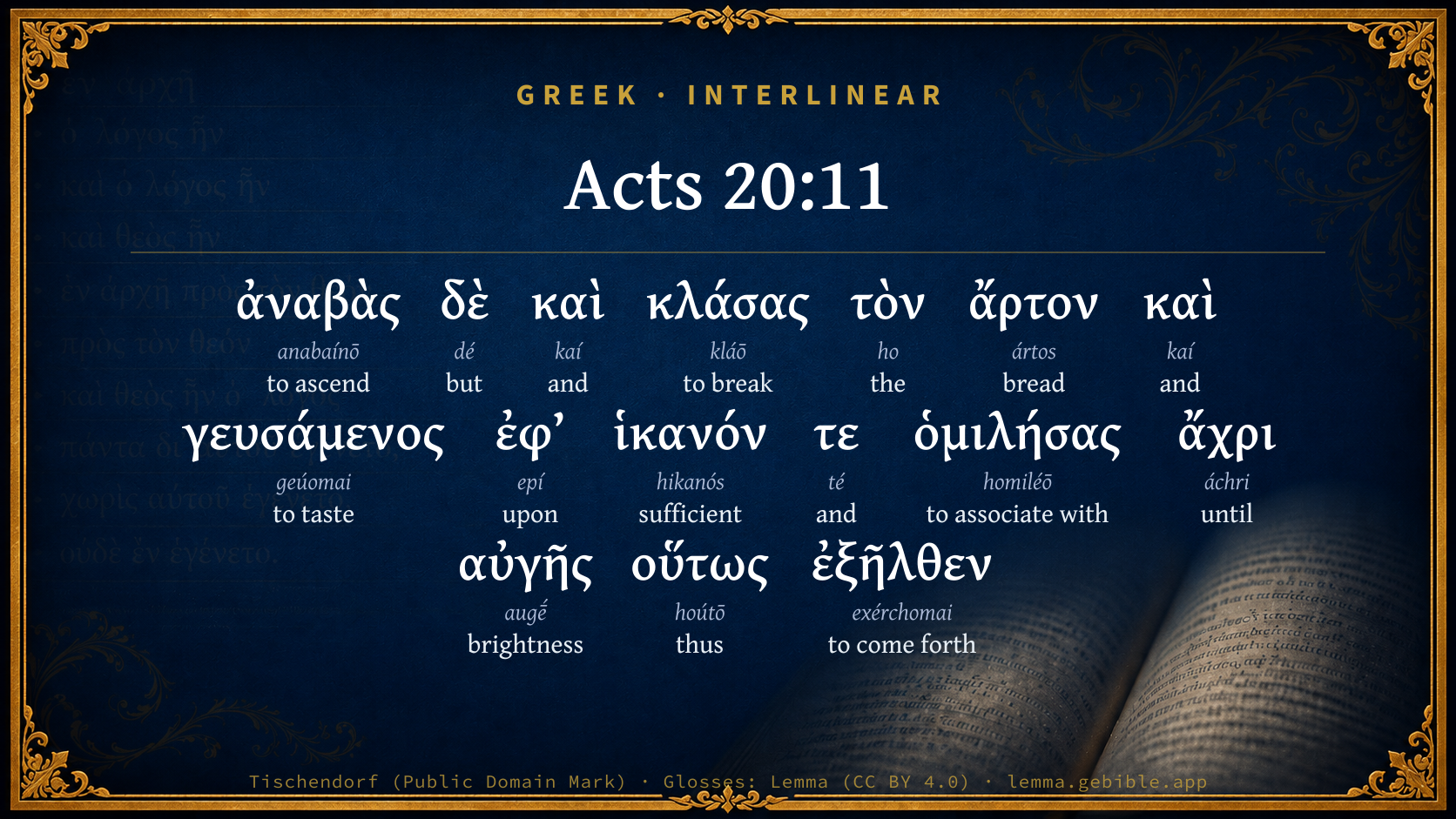
Greek (Tischendorf 8th ed.) Acts 20:11 appears in the Greek New Testament. The text above is from the Tischendorf 8th edition. Each word links to its Strong’s number and a concise gloss. Click any word for its full Thayer’s Greek Lexicon entry.
Download image
Cite this verse

Acts 20:11 (World English Bible). Public Domain. Lemma interlinear Bible study tool, https://lemma.gebible.app/v/acts/20/11.

Show BibTeX & RIS
BibTeX
RIS
English Translation
When he had gone up, and had broken bread, and eaten, and had talked with them a long while, even until break of day, he departed.
World English Bible · Public Domain
Highlights
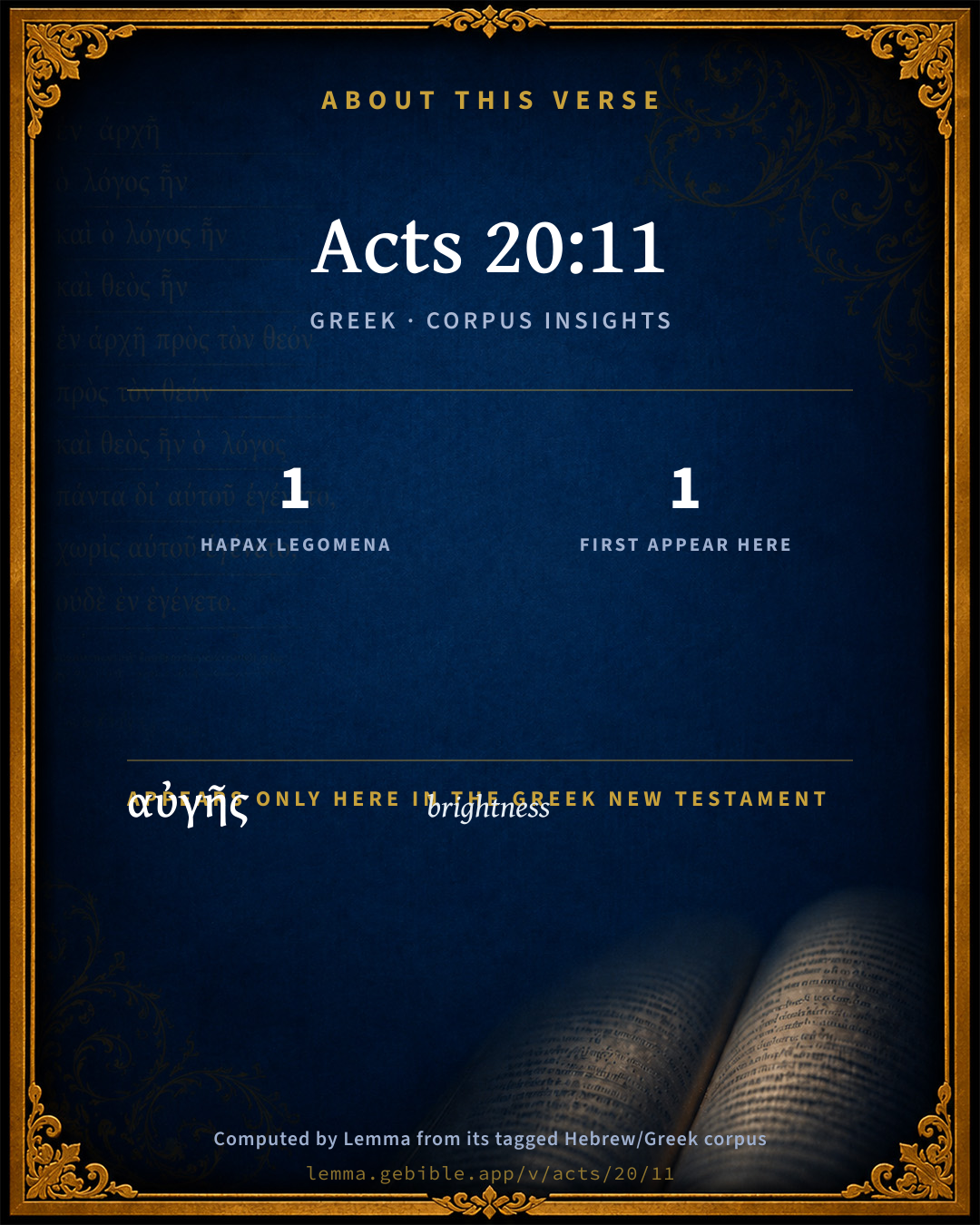
  • 1 hapax legomenon — only here in the Greek New Testament
  • 1 first appearance in the Greek New Testament
Full analysis ↓
Download a study sheet

One document with this verse’s original text, its word-by-word gloss line, the meaning frame, cross-references with their text, attributed commentary, and full source and license credits — printable, and it pastes into notes with its structure intact.

This verse Autodidact and up

Study sheet (.html) Plain text (.txt)

A passage Seminary Student

Up to 50 verses in one chapter. A passage sheet keeps up to 6 commentary sources and 12 cross-references per verse, in the order this page ranks them, and says so on the sheet whenever that leaves anything out. Ask for a single verse and you get the Autodidact verse sheet above.

Everything on this page stays free to read, with no account — the sheet is a download of what is already on screen, not access to it.

Want to remove ads? Support Godless Engineer
Compare translations 3

The same verse in 3 English versions, stacked beneath the original-language interlinear above. Click any original word for its lexicon entry.

Each is an independent rendering of the whole verse — the interlinear is not word-aligned to these translations.

Highlighted words mark where these versions differ — a whole-verse word diff, not a word-by-word alignment.

  • World English Bible Public Domain
    When he had gone up, and had broken bread, and eaten, and had talked with them a long while, even until break of day, he departed.
  • King James Version Public Domain
    When he therefore was come up again, and had broken bread, and eaten, and talked a long while, even till break of day, so he departed.
  • unfoldingWord Literal Text CC BY-SA 4.0
    And having gone up and having broken bread and having tasted, and having conversed for much until dawn, thus he left.

unfoldingWord Literal Text — © unfoldingWord, licensed CC BY-SA 4.0. Word-aligned USFM3 via Door43 (git.door43.org/unfoldingWord/en_ult).

Versions to compare (up to 4)

3 of 4 selected

Show all 19 translations

Every available English version of this verse, each an independent rendering of the whole verse.

  • World English Bible Public Domain
    When he had gone up, and had broken bread, and eaten, and had talked with them a long while, even until break of day, he departed.
  • Berean Standard Bible Public Domain
    Then Paul went back upstairs, broke bread, and ate. And after speaking until daybreak, he departed.
  • Majority Standard Bible Public Domain
    Then Paul went back upstairs, broke bread, and ate. And after speaking until daybreak, he departed.
  • King James Version Public Domain
    When he therefore was come up again, and had broken bread, and eaten, and talked a long while, even till break of day, so he departed.
  • American Standard Version (1901) Public Domain
    And when he was gone up, and had broken the bread, and eaten, and had talked with them a long while, even till break of day, so he departed.
  • Revised Version (1885) Public Domain
    And when he was gone up, and had broken the bread, and eaten, and had talked with them a long while, even till break of day, so he departed.
  • Geneva Bible (1599) Public Domain
    Then when Paul was come vp againe, and had broken bread, and eaten, hauing spoken a long while till the dawning of the day, hee so departed.
  • Douay-Rheims (1899) Public Domain
    Then going up, and breaking bread and tasting, and having talked a long time to them, until daylight, so he departed.
  • Young's Literal Translation Public Domain
    and having come up, and having broken bread, and having tasted, for a long time also having talked -- till daylight, so he went forth,
  • Literal Standard Version CC BY-SA 4.0
    and having come up, and having broken bread, and having tasted, for a long time also having talked—until daylight, so he went forth,
  • Unlocked Literal Bible CC BY-SA 4.0
    Then he went upstairs again and broke bread and ate. After talking with them much longer until dawn, he left.
  • unfoldingWord Literal Text CC BY-SA 4.0
    And having gone up and having broken bread and having tasted, and having conversed for much until dawn, thus he left.
  • Darby Bible Public Domain
    And having gone up, and having broken the bread, and eaten, and having long spoken until daybreak, so he went away.
  • World Messianic Bible Public Domain
    When he had gone up, had broken bread and eaten, and had talked with them a long while, even until break of day, he departed.
  • Webster's Bible Public Domain
    When he had come up again, and had broken bread, and eaten, and discoursed a long while, even till break of day, so he departed.
  • Free Bible Version CC BY-SA 4.0
    Paul went back upstairs, broke bread, and ate together with them. He went on talking with them until dawn came, and then he left.
  • Bible in Basic English Public Domain
    And when he had gone up, and had taken the broken bread, he went on talking to them for a long time, even till dawn, and then he went away.
  • Text-Critical English NT CC BY 4.0
    Then Paul went back upstairs, and after he had broken bread and eaten, he conversed with the disciples for a long time, until dawn; that was how he departed.
  • Tyndale New Testament (1534) Public Domain
    When he was come vp agayne he brake breed and tasted and comened a longe whyle even tyll the mornynge and so departed.

Literal Standard Version (2020), Covenant Press — licensed CC BY-SA 4.0. Text via the HelloAO Bible API (eBible.org). Unlocked Literal Bible (unfoldingWord) — licensed CC BY-SA 4.0. Text via the HelloAO Bible API (eBible.org). unfoldingWord Literal Text — © unfoldingWord, licensed CC BY-SA 4.0. Word-aligned USFM3 via Door43 (git.door43.org/unfoldingWord/en_ult). Free Bible Version, Dr. Jonathan Gallagher — licensed CC BY-SA 4.0. Text via the HelloAO Bible API (eBible.org).

Word by word

More ways to search: Search by grammar → Find every occurrence → Compare this word →

Practice this passage: Drill this verse → Learn its vocabulary →

αὐγῆς
augḗ
G827
“brightness”
Noun, Genitive, Singular, Feminine
Part of Speech
Noun
Case
Genitive
Number
Singular
Gender
Feminine
Full Thayer's Definition

Origin: of uncertain derivation

TDNT: None

1. brightness, radiance, daylight
  1. ἀναβὰς anabaínō G305 “to ascend” Verb, Aorist, Active, Participle, Nominative, Singular, Masculine
  2. δὲ dé G1161 “but” Conjunction
  3. καὶ kaí G2532 “and” Conjunction
  4. κλάσας kláō G2806 “to break” Verb, Aorist, Active, Participle, Nominative, Singular, Masculine
  5. τὸν ho G3588 “the” Article, Accusative, Singular, Masculine
  6. ἄρτον ártos G740 “bread” Noun, Accusative, Singular, Masculine
  7. καὶ kaí G2532 “and” Conjunction
  8. γευσάμενος geúomai G1089 “to taste” Verb, Aorist, Middle deponent, Participle, Nominative, Singular, Masculine
  9. ἐφ’ epí G1909 “upon” Preposition
  10. ἱκανόν hikanós G2425 “sufficient” Adjective, Accusative, Singular, Neuter
  11. τε té G5037 “and” Particle
  12. ὁμιλήσας homiléō G3656 “to associate with” Verb, Aorist, Active, Participle, Nominative, Singular, Masculine
  13. ἄχρι áchri G891 “until” Adverb
  14. οὕτως hoútō G3779 “thus” Adverb
  15. ἐξῆλθεν exérchomai G1831 “to come forth” Verb, Aorist, Active, Indicative, 3rd person, Singular

About this verse

These counts appear in no published source. They are computed here, from the morphology-tagged text and Lemma’s own curated glosses. What Lemma adds →

16
words
15
distinct lemmas
Acts
section

Notable vocabulary

1 hapax legomenon — a word that appears only here in the entire Greek New Testament:

  • αὐγῆς brightness G827

First appearance in Scripture

This word makes its first canonical appearance in the Greek New Testament here:

  • αὐγῆς brightness G827

Shared distinctive vocabulary

ὁμιλήσας to associate with G3656 occurs in 4 verses of the Greek New Testament. Also found in:

Repetition

A word recurs within this verse:

Cross-references

2

Topical passages linked to Acts 20:11 in the Treasury of Scripture Knowledge — connected by theme and wording, ordered by reader-vote popularity; previews shown in the World English Bible.

  • Acts 20:7 On the first day of the week, when the disciples were gathered together to break bread, Paul talked with them, intending to depart on the next day, and continued his speech until midnight.
  • Acts 20:9 A certain young man named Eutychus sat in the window, weighed down with deep sleep. As Paul spoke still longer, being weighed down by his sleep, he fell down from the third story, and was taken up dead.

Cross-references courtesy of OpenBible.info (CC BY 4.0).

Commentary

Notes on Acts 20:11 from classic Christian and Jewish commentators (each source and its license shown beneath its notes). The classic Christian expositions comment on the surrounding passage and are grouped to its opening verse, so a note may address several verses; the Jewish commentaries on the Tanakh (Rashi and others) are per-verse, so they appear only where the commentator wrote on this verse.

Lemma curates 59 commentaries, every one of them public domain or Creative Commons licensed, each selected and text-cleaned for this edition rather than reprinted as found. About our sources →

Bengel's Gnomon

Johann Albrecht Bengel

Act 20:11. Κλάσας ἄρτον, having broken bread) This breaking of bread was the particular act of Paul, when about to set out on his journey, and was distinct from that which had occurred the day before, Act 20:7.—ὁμιλήσας, having spoken with them) in more familiar discourse, after the more solemn address, of which Act 20:9 treats.—οὕτως, so) No taking of rest intervening.

Bengel's Gnomon of the New Testament — English translation (T&T Clark, Edinburgh, 1860) — public domain. Text from a community e-Sword module.

Meyer's Critical & Exegetical Commentary

Heinrich August Wilhelm Meyer

Act_20:11-12. On account of the discoursings the intended partaking of the Agapae (Act_20:7) had not yet taken place. But by the fall of the young man these discoursings were broken off; and now, after Paul had returned to the room, he commences, as the father of a family among those assembled, the so long deferred mealhe breaks the bread, and eats, and discourses at table (comp. Chrysostom) until break of day, whereupon he thus (οὕτως, after all that is mentioned in ἀναβὰς … αὐγῆς; see Buttmann, neut. Gr. p. 262 [E. T. 306]) leaves the place of meeting. After his departure, they (qui remanserant apud adolescentem, Erasmus) brought the lad alive (into the room), and they (those assembled) were by this greatly (οὐ μετρίως, often so with Plutarch, also in Isocrates and others) comforted over their separation from the apostle, who had left behind such a σημεῖον of his miraculous power.

κλάσας τὸν (see the critical remarks) ἄρτον stands in definite reference to κλάσαι ἄρτ., Act_20:7, and therefore the article is put. Piscator, Grotius, Kuinoel, and others erroneously hold that a breakfast is meant, which Paul partook of to strengthen him for his journey, and that therefore γευσάμ. is subjoined. But the Agape was, in fact, a real meal, and therefore γευσάμ. denotes nothing else than that Paul had begun to partake of it. It is only added to bring more prominently forward this partaking as having at length taken place.

ὁμιλήσας, as in Luk_24:14; more familiar than διαλεγ., Act_20:9. Comp. Act_10:24.

ἤγαγον] they brought him, so that he came into the midst of them; but only now, so that thus subsequently to his revival, Act_20:10, he must have gradually recovered, in order to be able to return into the room.

τὸν παῖδα] he must consequently have been still very young.

ζῶντα] Opposed to νεκρός, Act_20:9, and for the joyful confirmation of the words of the apostle, Act_20:10.

Meyer — Critical and Exegetical Commentary on the New Testament — English translation by Peter Christie, edited by Frederick Crombie (T&T Clark, 1880) — public domain. Text from a community e-Sword module.

Expositor's Greek Testament

ed. W. Robertson Nicoll

Act 20:11 . κλάσας ἄρτον : if we read τὸν ἄρ ., see critical note, “the bread,” so R.V., i.e. , of the Eucharist; so Syriac. The words evidently refer back to Act 20:7 , see Blass, Gram. , p. 148. γευσ .: often taken to refer not to the Eucharist, but to the partaking of the Agape or common meal which followed. If so, it certainly appears as if St. Paul had soon taken steps to prevent the scandals which occurred in Corinth from the Holy Communion being celebrated during or after a common meal, 1Co 9:23 , since here the Eucharist precedes, Luckock, Footprints of the Apostles as traced by St. Luke , ii., 199. Wendt, who still identifies the breaking of the bread with the Agape (so Holtzmann, Weiss), protests against the view of Kuinoel and others that reference is here made to a breakfast which St. Paul took for his coming journey. Dean Plumptre refers to the use of γεύομαι in Heb 6:4 as suggesting that here too reference is made to the participation of the Eucharist; but, on the other hand, in Act 10:10 (see Blass, in loco ) the word is used of eating an ordinary meal, and Wendt refers it to the enjoyment of the Agape ( cf. also Knabenbauer, in loco ). Weiss urges that the meaning of simply “tasting” is to be adopted here, and that τε shows that Paul only “tasted” the meal, i.e. , the Agape , and hurried on with his interrupted discourse, whilst Lewin would take γευσ . absolutely here, and refer it to a separate ordinary meal; although he maintains that the previous formula κλάσ . τὸν ἄρτον must refer to the Eucharist. In LXX the verb is frequent, but there is no case in which it means definitely more than to taste, although in some cases it might imply eating a meal, e.g. , Gen 25:30 ; for its former sense see, e.g. , Jon 3:7 . In modern Greek γευματίζω = to dine, so γεῦμα = dinner. ἐφʼ ἱκανόν τε ὁμιλ .: on St. Luke’s use of ἱκανός with temporal significance see above on p. 215, cf. with this expression 2Ma 8:25 . ὁμιλ .: only in Luke in N.T., cf. Luk 24:14-15 , Act 24:26 ; here, “talked with them,” R.V., as of a familiar meeting, elsewhere “communed,” R.V.; so in classical Greek, and in Josephus, and also in modern Greek (Kennedy); in LXX, Dan 1:19 : ὡμίλησεν αὐτοῖς ὁ β ., “the king communed with them”. In the passage before us the alternative rendering “when he had stayed in their company” is given by Grimm-Thayer, sub v. ἄχρις αὐγῆς , cf. Polyaen., iv., 18, κατὰ τὴν πρώτην αὐγὴν τῆς ἡμέρας (Wetstein); only here in N.T., found in Isa 59:9 , 2Ma 12:9 , but not in same sense as here. οὕτως , cf. Act 20:7 , after a participle, as often in classical Greek, Simcox, Language of the N. T. , p. 175, see also Act 27:17 , and Viteau, Le Grec du N. T. , p. 190 (1893).

The Expositor's Greek Testament, edited by W. Robertson Nicoll (1897–1910) — public domain. Text from a community e-Sword module.

Jamieson, Fausset & Brown

Robert Jamieson, A. R. Fausset & David Brown

broken bread and eaten--with what a mixture of awe and joy after such an occurrence! "And eaten"--denoting a common repast, as distinguished from the breaking of the eucharistic bread.

and talked a long while, even till break of day--How lifelike this record of dear Christian fellowship, as free and gladsome as it was solemn! (See Ecc 9:7).

Jamieson, Fausset & Brown — Commentary Critical and Explanatory on the Whole Bible (1871) — public domain (CC PDM 1.0). Text via the HelloAO Bible API.

Adam Clarke's Commentary

Verse 11. Had broken bread] Had taken some refreshment, in order to their journey.

And talked a long while] ομιλησας, Having familiarly conversed, for this is the import of the word, which is very different from the διελεγετο, of the seventh verse, and the διαλεγομενου, of the ninth; which imply solemn, grave discourse.

Adam Clarke's Commentary on the Bible (1810–1826) — public domain. Text from a community e-Sword/MySword module.

Ellicott's Commentary for English Readers

(11) And had broken bread, and eaten.—Better, broken the bread and tasted. In the early usage of the Lord’s Supper the bread was not made, as in the Latin Church, in the form of circular wafers, nor cut up into small cubes, as in most Reformed Churches. The loaf, probably a long roll, was placed before the celebrant, and each piece was broken off as it was given to the communicant. Stress is laid on this practice in 1Co_10:16, and indeed in the very term of “breaking of bread” as a synonym for the Lord’s Supper. (See Note on Act_2:46.) Whether the next act of “eating” refers to the actual communion (we are obliged to use technical terms for the sake of definiteness), or to a repast, or Agapè, we have no adequate data for deciding. The use of the same verb, however, in “tasting of the heavenly gift,” in Heb_6:4, suggests the former, and it is probable that the portion of bread and wine thus taken, in the primitive celebration, would be enough to constitute a real refreshment, and to enable the Apostle to continue his discourse.

Even till break of day.—The whole service must have lasted some seven or eight hours, sunrise at this time of the year, shortly after the Passover, being between 5 and 6 A.M. The inconvenience of such a protracted service led, as has been stated (see Note on Act_20:7), to the transfer of the Lord’s Supper from the evening of Saturday to the early morning of Sunday, a position which, with some moderate variations, it has retained ever since, till the introduction in recent times of the yet more primitive practice of an evening celebration.

A Bible Commentary for English Readers, edited by Charles John Ellicott (1878–1897) — public domain. Text from a community e-Sword module.

The Cambridge Bible for Schools and Colleges

gen. ed. J. J. S. Perowne

11. When he therefore was come up again] Better (with Rev. Ver.), “And when he was gone up.” The Apostle’s calmness, as well as his words, was not without effect on the congregation. He returns to the upper room, and the unfinished act of worship is completed.

and had broken bread] The best texts give “the bread,” i.e. the bread of the Eucharistic service.

and eaten] i.e. partaken of the more substantial meal of the “Agapæ,” which in the early church followed after the Communion.

and talked a long while] The verb implies the talking of persons one with another, the talk of friendly intercourse, as distinguished from the previous discourse on more solemn subjects of the spread of Christ’s kingdom and the part each of them might take in helping it on. So the Rev. Ver. well, “and had talked with them a long while.”

The Cambridge Bible for Schools and Colleges (gen. ed. J. J. S. Perowne; Cambridge University Press, 1878–1918) — public domain. Text from a community e-Sword module.

John Gill's Exposition

And they brought the young man alive,.... Up into the upper room, and presented him alive to the disciples:

and were not a little comforted; that is, the disciples, at the sight of the young man, who was taken up dead, not only for his sake, but chiefly because by this miracle the Gospel, which the apostle preached, and who was about to depart from them, was greatly confirmed to them.

John Gill's Exposition of the Whole Bible (1746–1763) — public domain (CC PDM 1.0). Text via the HelloAO Bible API.

Trapp's Complete Commentary

John Trapp

11 When he therefore was come up again, and had broken bread, and eaten, and talked a long while, even till break of day, so he departed.

Ver. 11. And eaten] After the celebration of the Lord’s supper, followed the use of daily food. Animantis cuiusque vita est in fuga, saith the philosopher; so that were it not for the repair of nutrition, natural life would be soon extinguished. So would spiritual life also.

John Trapp, A Commentary or Exposition upon All the Books of the Old and New Testament (1647–1656) — public domain. Text from a community e-Sword module.

Albert Barnes' Notes on the Bible

Come up again - To the upper room, Act 20:8.

And had broken bread, and eaten - Had taken refreshment. As this is spoken of Paul only, it is evidently distinguished from the celebration of the Lord’s Supper.

Albert Barnes' Notes on the Bible (1834–1885) — public domain. Text from a community e-Sword/MySword module.

Matthew Poole's English Annotations

Had broken bread; either in the eucharist, as in Act 20:7, or in taking his ordinary refection and breakfast.

Talked a long while, even till break of day; this was of long continuance, and speaks the patience and zeal of Christians in those times, and will rise up in judgment against a careless and negligent generation.

He departed; going that part of his journey on foot, as the rest of his company did go by sea, as Act 20:13.

Matthew Poole's English Annotations on the Holy Bible (1683–1685) — public domain. Text from a community e-Sword/MySword module.

Whedon's Commentary on the Bible

Daniel D. Whedon

11. Come up again—From the ground to the third loft.

Departed—Went out, that is, from the upper room of the assemblage.

Daniel D. Whedon (gen. ed.), Commentary on the Old and New Testaments (1874–1909) — public domain. Text from a community e-Sword module.

The Pulpit Commentary

And when he was gone up for when he therefore was come up again, A.V.; the bread for bread, A.V. and T.R.; had talked with them for talked, A.V. Had broken the bread; i.e. the bread already prepared, and spoken of in ver. 7 (where see note), but which had not yet been broken in consequence of Paul"s long discourse. And eaten. Gensamenov does not seem to mean "having eaten of the bread broken," for the word is never used of the sacramental eating of bread. That word is always fagein 1Co_11:20, 24 or ejsqiein. (1Co_11:26, 1Co_11:27, 1Co_11:28, 1Co_11:29) But geusamenov seems rather to be taken absolutely, as in Act_10:10, "having eaten," meant "having partaken" of the meal, the agape, which followed the Eucharist. Talked with them (oJmilh) Of familiar converse (Luk_24:14, Luk_24:15; Act_24:26) Compare the use of oJmilia in 1Co_15:33; from whence, of course, comes the word" homily."

The Pulpit Commentary (1880–1919), ed. H.D.M. Spence-Jones & Joseph S. Exell — public domain. Text from a community e-Sword module.

John Wesley's Explanatory Notes

So departed - Without taking any rest at all.

John Wesley, Explanatory Notes Upon the Whole Bible (1754–1765) — public domain. Text via the GEBible commentary corpus.

McGarvey & Pendleton's Commentaries

J. W. McGarvey

11. The alarm produced by the death of Eutychus, the astonishing display of divine power in his restoration to life, and the stillness of the midnight hour in which it all transpired, could but add greatly to the solemnity which already pervaded the audience. Their feelings were too deeply wrought upon to think of sleep, and the meeting was still protracted. They returned to the upper chamber, where the lights were still burning, and the elements of the Lord's supper remained as yet undistributed. Paul, notwithstanding the length and earnestness of his discourse, was still unexhausted. (11) " And having gone up, and broken the loaf, and eaten it, he conversed yet a long time, even till daybreak, and so he departed. " Thus the whole night was spent in religious discourse and conversation, interrupted, at midnight, by a death and a resurrection, and this followed by the celebration of the Lord's death, which brings the hope of a better resurrection. The whole scene concluded at daybreak, in one of those touching farewells, in which the pain of parting and the hope of meeting to part no more, struggle so tearfully for the mastery of the soul. It was a night long to be remembered by those who were there, and will yet be a theme of much conversation in eternity.

It is a question of some curiosity whether it was at daybreak on Sunday morning or Monday morning, that this assembly was dismissed. They were assembled in the early part of the night, yet the time of their assembling was included in the "first day of the week." If the brethren in Troas were accustomed to begin and close the day at midnight, according to the Greek custom, it must have been Sunday night when they met. But if they reckoned according to the Jewish method, which began and closed the day with sunset, then they must have met on what we call Saturday night; for in this case the whole of that night would belong to the first day of the week, and Sunday night to the second day. It is supposed, by many commentators, that the Greek method prevailed, and that they met Sunday night; but, with Mr. Howson, I am constrained to the other opinion; a conclusive proof of which I find in the fact, that if the meeting was on Sunday night, then the loaf was broken on Monday morning; for it was broken after midnight. There can be no doubt of this fact, unless we understand the breaking of the loaf, mentioned in the eleventh verse, as referring to a common meal. But this is inadmissible; for, having stated, ( verse 7 ,) that they came together to break the loaf and now stating, for the first time, that Paul did break the loaf, we must conclude that by the same expression, Luke means the same thing. To this objection that Paul alone is said to have broken and eaten the bread, I answer, that this would be a very natural expression to indicate that Paul officiated at the table; but, on the other hand, if it is a common meal, it would be strange that he alone should eat, especially to the exclusion of his traveling companions, who were going to start as early in the morning as he did. I conclude, therefore, that the brethren met on the night after the Jewish Sabbath, which was still observed as a day of rest by all of them who were Jews or Jewish proselytes, and considering this the beginning of the first day of the week, spent it in the manner above described. On Sunday morning Paul and his companions resumed their journey, being constrained, no doubt, by the movements of the ship, which had already been in the harbor of Troas seven days. His example does not justify traveling on the Lord's day, except under similar constraint, and upon a mission as purely religious as that which was taking him to Jerusalem.

J. W. McGarvey (with Philip Y. Pendleton), Commentaries on the New Testament (The Fourfold Gospel, 1914; Acts; and the epistles) — public domain. Text from a community e-Sword/MySword module.

unfoldingWord translationNotes

Door43 World Missions Community

Connecting Statement:

This is the end of the part of the story about Paul's preaching at Troas and about Eutychus.

General Information:

Here the word "he" refers to Paul.

broke bread

Bread was a common food during meals. Here "break bread" probably means they shared a meal with more kinds of food than just bread. (See: Synecdoche)

he left

"he went away"

the boy

This refers to Eutychus (Acts 20:09). Possible meanings are 1) he was a young man over 14 years old or 2) he was a boy between 9 and 14 years old or 3) the word "boy" implies that he was a servant or a slave.

translationWords

comfort

unfoldingWord translationNotes — © Distant Shores Media and the Door43 World Missions Community, licensed CC BY-SA 4.0. Source: git.door43.org/Door43/en_tn.

Cambridge Greek Testament for Schools and Colleges

11. ἀναβὰς δέ, and when he was gone up. The Apostle’s calmness, as well as his words, was not without effect on the congregation. He returns to the upper room, and the unfinished act of worship is completed.

καὶ κλάσας τὸν ἄρτον, and had broken the bread, i.e. the bread of the Eucharistic service. The sermón came first (Act 20:9) and then the Lord’s Supper.

καὶ γευσάμενος, and eaten, i.e. partaken of the more substantial meal of the ‘Agapè.’ This, in the early Church followed after the Communion.

ἐφ’ ἱκανόν τε ὁμιλήσας, and had talked with them a long while. ὁμιλέω means the talking of friendly intercourse. The previous discourse had been on more solemn subjects; the spread of Christ’s kingdom and the part which each of them might take in helping it forward.

For ἐφ’ ἱκανόν cf. 2Ma 8:25 συνδιώξαντες δὲ αὐτοὺς ἐφ’ ἱκανὸν ἀνέλυσαν.

Cambridge Greek Testament for Schools and Colleges (Cambridge University Press, 1896; 21 vols, various authors incl. Carr, Maclear, Plummer, Farrar, Lumby, Moule, M. R. James, Simcox) — public domain. Text from a community e-Sword module.

Alford’s Greek Testament

Henry Alford

11.] The intended breaking of bread had been put off by the accident.

τὸν ἄρτ., as ch. 2:42. Were it not for that usage, the article here might import, ‘the bread which it was intended to break,’ alluding to ἄρτ. above.

γευσάμενος] having made a meal, see reff. The agape was a veritable meal. Not ‘having tasted it,’ viz. the bread which he had broken;—though that is implied, usage decides for the other meaning.

οὕτως] ‘After so doing:’see reff.

Henry Alford, The Greek Testament (1849–1861) — public domain. Text from a community e-Sword module.

Vincent's Word Studies in the New Testament

Marvin R. Vincent

Having gone up. From the court to the chamber above.

Talked [ομιλησας] . Rather, communed. It denotes a more familiar and confidential intercourse than discoursed, in verse 7.

Marvin R. Vincent, Word Studies in the New Testament (1887–1900) — public domain. Text from a community e-Sword/MySword module.

Lesson kit

Teaching starters — assembled from the data on this page, not authored interpretation. Every prompt links to the verse data it draws on. Edit before teaching.

Acts, in the Acts, opens this verse with 16 words (15 distinct Greek lemmas). Its most distinctive word is augḗ (“brightness”). A historical commentator’s framing appears above. Read the whole chapter for the surrounding context.

Discussion questions

  1. How does “brightness” (augḗ) shape what this verse is saying?
  2. 1 word here appears nowhere else in the Greek New Testament. Why might the author reach for such rare wording?
  3. This is the first place “brightness” appears in Scripture (first appears here). What does its debut here establish?
  4. How does Luke 24:14, which shares the word «to associate with», read alongside this verse?
  5. What does the repetition of “and” (2× in this one verse) do in this verse?
  6. These translations render this verse differently; the difference is in the English rendering, not the original. What questions does that raise?
  7. Compare how Bengel's Gnomon and Meyer's Critical & Exegetical Commentary read this verse. Where do they agree or differ?

Things to notice

  • 1 word in this verse appears nowhere else in the Greek New Testament.
  • 1 word makes its first canonical appearance in Scripture here.
  • These translations choose different wording for 23 words in this verse.
  • “and” occurs 2× in this single verse.
  • 15 distinct Greek lemmas span 16 words in this verse.

Reading settings

Reading text

Shown beneath each verse's original-language words.

Old Testament
Old Testament edition

Read the OT as the Masoretic Hebrew (MT) or the Greek Septuagint (LXX).

English shown for the Greek Septuagint (in the Hebrew ↔ Greek comparison).

Comparing translations? Open the Compare panel on any verse page to stack up to four side by side.